
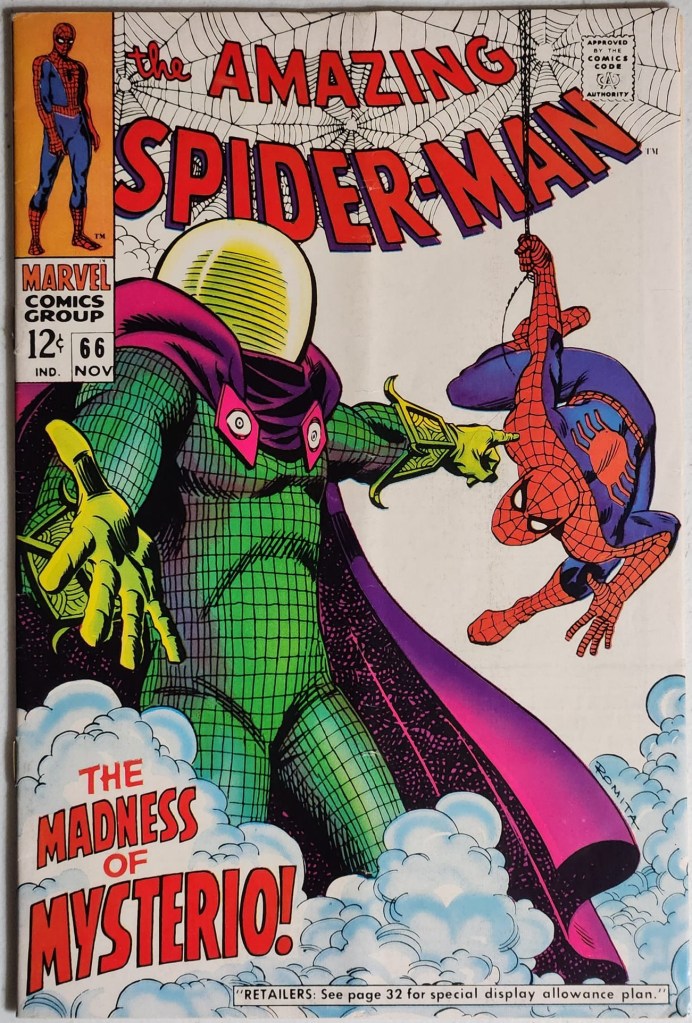
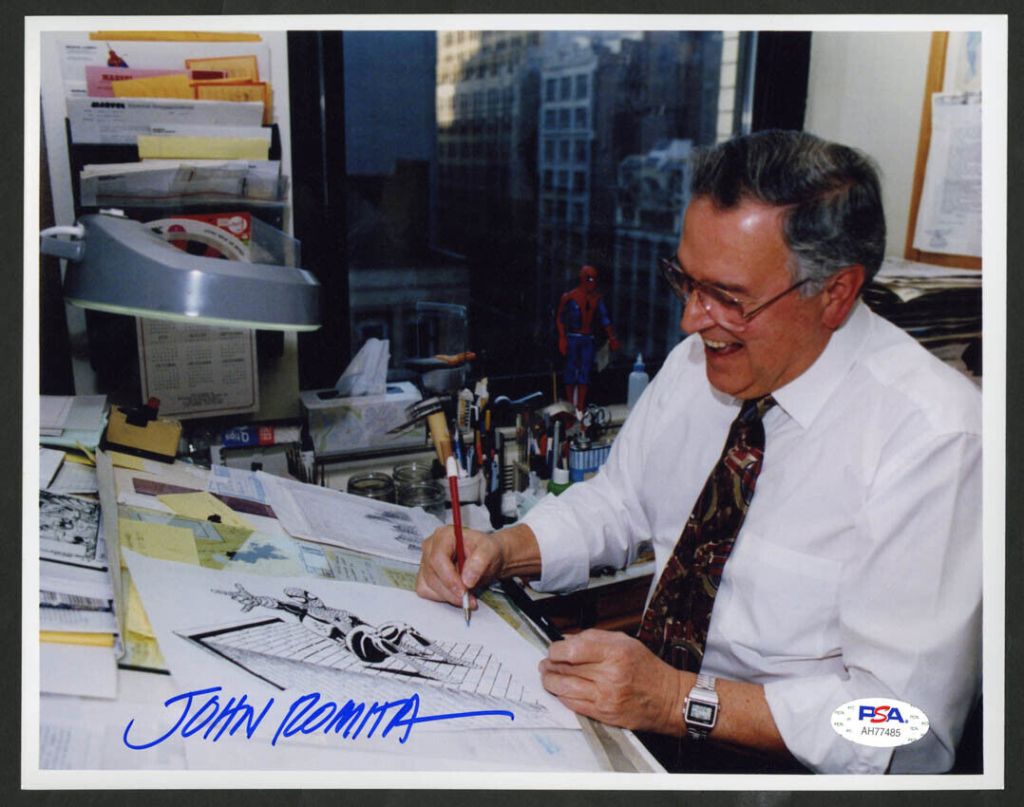
Above from left: Today’s home of the Alma News Stand (also to some as Superior News) on Superior Street; My copy of Amazing Spider-Man #66 originally purchased in the Rexall Drug Store in downtown St. Louis; John Romita, Sr., famed artist on the Amazing Spider-Man comic from the 1960s and 1970s.
Several weeks ago, an artist who affected my life growing up in Gratiot County died at 93.
John Romita, Sr., was most likely unknown to many Gratiot County residents except for some of us who were kids in the 1960s and 1970s. Romita, Sr. was a Marvel Comics artist who was the second to draw the Amazing Spider-Man starting in 1966 and running until the mid-1970s.
How could he be described? Romita drew the character as the young adult Peter Parker, who became a superhero a few years earlier due to a scientific spider’s bite. I was a comic book reader who followed Romita’s run on The Amazing Spider-Man beginning in 1968 when I first purchased an issue from inside the old Rexall Drug Store in downtown St. Louis. To this day, I can still see ASM #66 sitting on the metal rack and picking it up for a mere twelve cents. This issue had an iconic Mysterio cover and began a love affair with Spider-man and Marvel Comics that lasted about five years (on my first go-round). The comic rack at Rexall Drug was a favorite stopping place on a Friday night or Saturday morning when my father made his weekly trip to the old Commercial National Bank in St. Louis to cash his paycheck from Alma Products.
Somehow during this trip, I could squeeze a quarter out of my father, and I made regular trips into Rexall until it burned down. A fire took out the store on the northeast corner of Franklin and Mill Streets around 1970, which changed how I found my comic books. A St. Louis kid still had several choices at the intersection of those streets: Goods Package Shop, St. Louis Five & Dime, and Knapps Bakery. They were all exciting places for a baby boomer to visit with change in his hand. But, with the demise of Rexall Drug Store, I had to go elsewhere to find Spider-man. I do recall visiting Hanners Magazine Store in Ithaca (now the location of the Gratiot County Historical Museum) and seeing comics as they lined the shelves on one wall. Still, we didn’t stop in Ithaca as much as in Alma.
Fortunately for me, my father was an avid sports reader, and getting a copy of The Sporting News was something that he regularly did. To get his weekly paper, we traveled to Alma’s Superior Newsstand (or some of us called it “The News Stand”). While my father picked up his sports paper, I soon discovered that a large comic rack that spun to display comics on four or five levels was located around the corner from the entrance. It also faced Superior Street.
The stand made it easy for a kid to look in the window when a car went by or if he was walking by on the sidewalk. If the comic rack was full, you knew a new shipment of comics had just arrived. A bare or sparsely populated set of racks meant the comics had been picked over or the latest shipment had yet to make it to Superior News Stand (some called it the Alma News Stand). When I paid for my comics, I always gave Grandpa Naessens (we called him that, but I don’t believe that was his last name) my quarter, and he fished change out of a clean ashtray that he kept on the corner of the desk. Grandpa Naessens was also a memorable whistler, which he frequently did as he sat and looked out the window toward Superior Street.
And pick the comics I did. In the late 1960s, a Marvel comic (I was almost exclusively Marvel, although I respected and occasionally picked up a DC Superman or Batman) was only twelve cents. The price was neat as I could pick up two comics and pay the one-cent tax – all for a quarter. But quarters seemed hard to come by. I also remember that the time when turning in glass pop bottles only brought two cents each. It took some work to pick up a quarter, but something called “a weekly allowance” helped me with my comic book collecting.
A complication came in the summer of 1969 when Marvel and DC jumped the price of comics to fifteen cents. Within two years, books went to twenty cents each – which soon forced me to consider giving up comics and going to baseball cards.
But back to John Romita, Sr. He was considered the face and most important artist to draw Spider-Man, next to whom he succeeded an artist known as Steve Ditko. How do I describe the artwork? As a kid, the characters appeared lifelike, human, and easier to relate to. After all, Peter Parker had been a teenager. Sometimes during the “Romita Sr. run” from issues #66-102, readers also met other Marvel artists. Jim Mooney and Gil Kane shared duties with Romita during the time. Still, the best books to me were drawn by JR Sr. The books also became highly collectible in time, and based on their condition, some reached the hundreds – and even thousands of dollars depending on what issue a kid picked up. Still, by 1972, the price of comics and my interest in the Detroit Tigers meant that I had largely moved on to collecting baseball cards.
I picked up one of the last John Romita, Sr. issues I purchased at the St. Louis IGA in the fall of 1972. After that, I had outgrown the books. But I kept my copies, which were stored -and read through the years. There was a certain smell that printed books of the 1960s, and 1970s had that you couldn’t imagine today. No, it was not the smell of mildew – it was good old-fashioned paper comics. Today’s versions are slick, magazine-style, but not so in the 1960s and 1970s in Gratiot County.
In the early 1980s, I returned to Marvel Comics and quickly found The Amazing Spider-man a favorite. This time, Spider-man was being drawn by a new Romita – John Romita, Jr. This Romita would, over time, also leave a similar iconic imprint on the character -much like his father did a generation earlier.
Today in Gratiot County, one would need help finding a weekly place that sells comic books. Why is this so? By the end of the 1990s, stores no longer carried comics, forcing readers and collectors to deal almost exclusively with “the comic book store” in their locality. One or two stores tried to do this in the county, but none exist today. One’s best bet is to get a subscription service or visit the closest stores in Mt. Pleasant, Saginaw, or Lansing – all of which can be a distance to get a “comic fix.”
But, for a baby boomer growing up in the 1960s -1970s in Gratiot County, comic books were a form of popular entertainment for kids who had a quarter to spend. And now, time to return to reading the most recent issue of The Amazing Spider-Man.
Copyright 2023 James M Goodspeed
 Goodspeed's Gratiot County Historical Blog