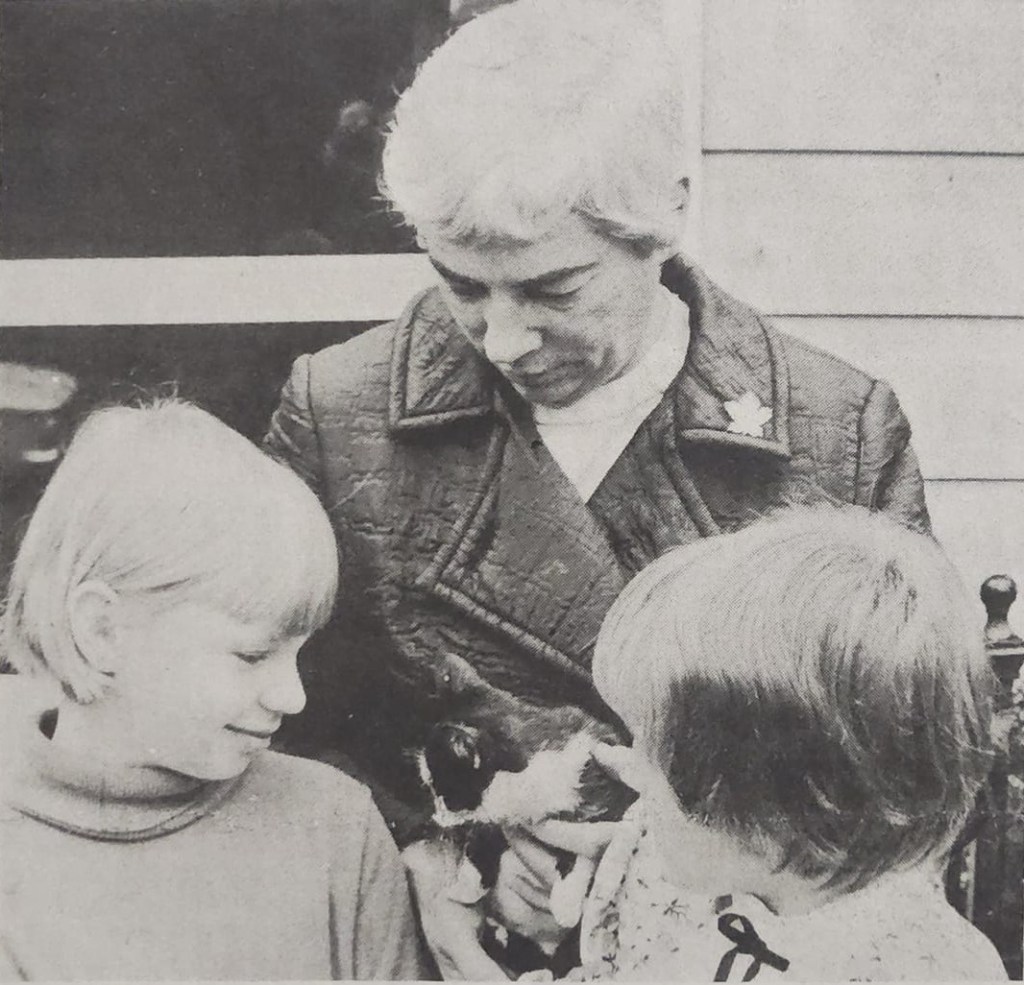
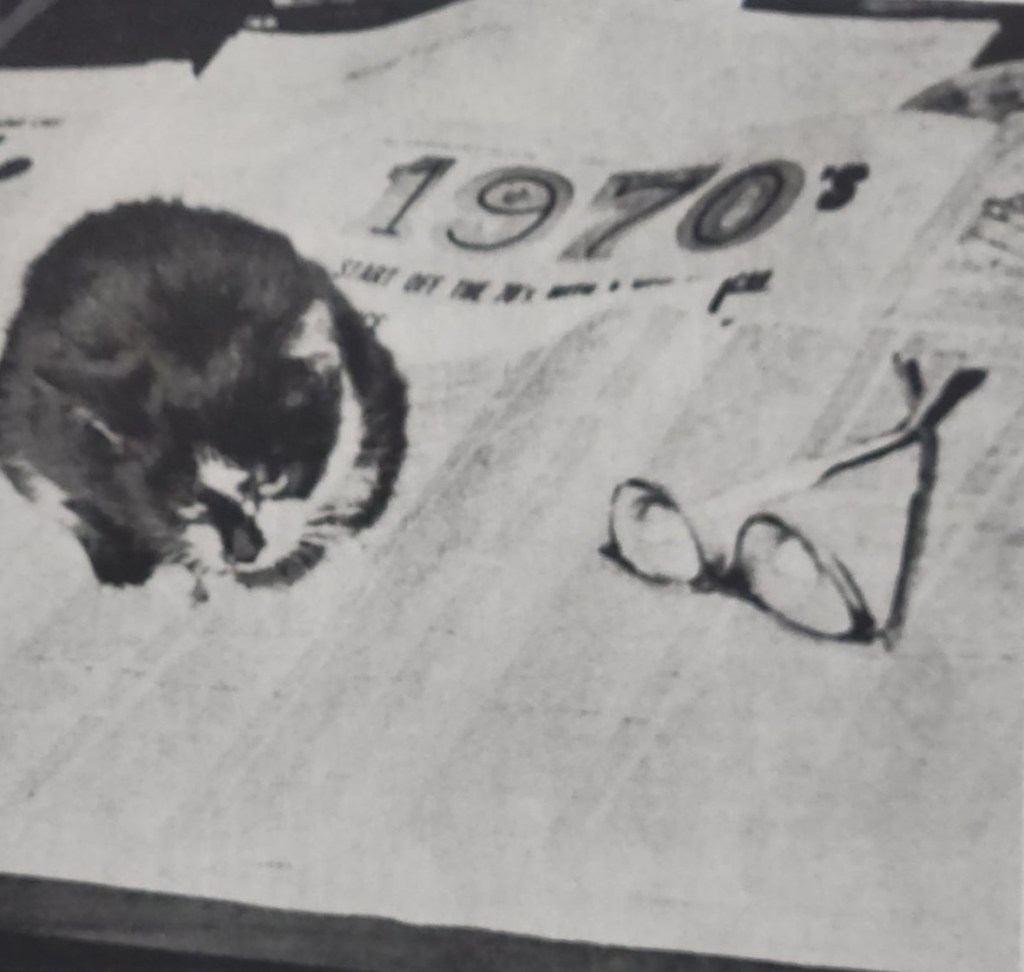
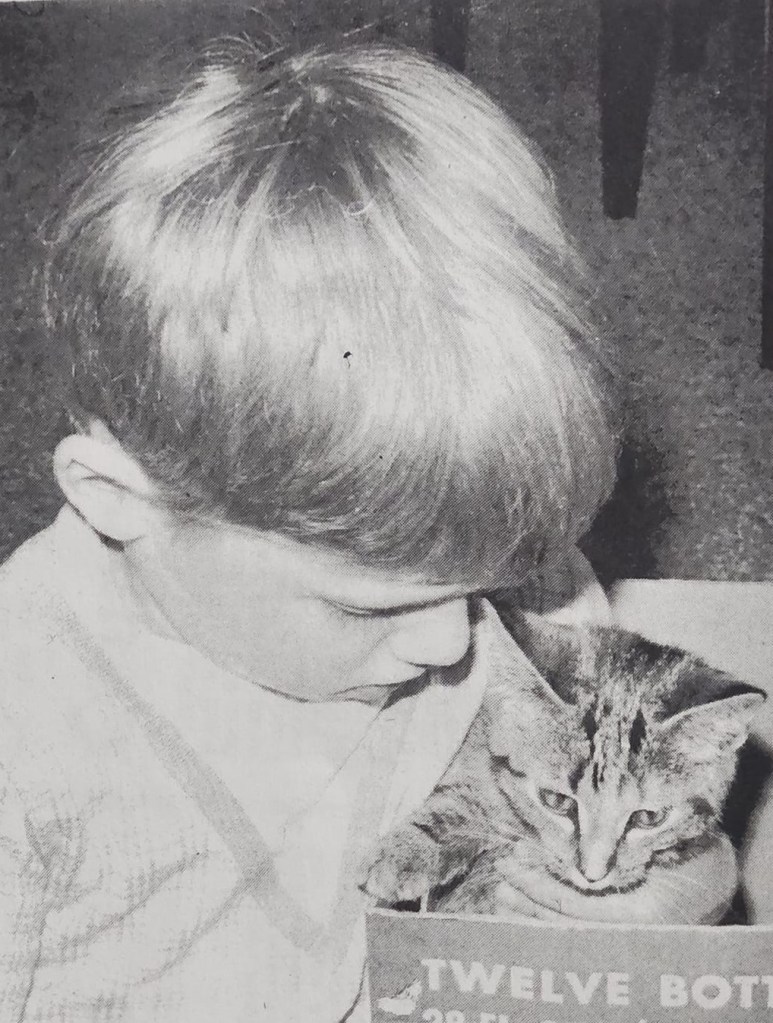
Above from top: “The Alma Cat Lady,” Margaret Russell and two Alma citizens reunite with Patches, an Alma Post Office visitor; Patches waits for someone to claim him as he rests on a telephone book at the Northwood Research Center; Christopher Griffiths looks at the unexpected visitor to the Griffiths house in the fall of 1969.
It all started when a lost kitten found the “Alma Cat Lady.” In late September 1969, a young kitten (soon named Patches) wandered across Alma and ended up in the Alma Post Office. Although the kitten quickly became a favorite of the Alma postal staff, a call went out to Margaret Russell, who was unofficially known to many in the city as “Alma’s cat lady.” When a stray and needy cat or kitten in town turned up, people knew they should call Margaret Russell, who cared deeply about Alma’s homeless animals.
In the 1960s, animals, like puppies and young dogs in Gratiot County, had nowhere to go. Max Harrell, then the Gratiot County Dog Warden, kept the animals at his residence in Riverdale. If someone wanted to adopt an unwanted puppy, the cost in 1967 was $3.50. However, cats and kittens were another county problem.
By the late 1960s in Alma, Margaret Russell quietly became the defender and hero of lost and unwanted cats in town. Russell, a Canadian who came to Alma with her husband, an Alma College professor, worked as Executive Secretary for Northwood Institute and later at the McClure Oil Company. Russell once told the Alma Record that her house soon seemed to have an invisible mark over the door, indicating that any unwanted or lost animal would find a home there. People in the city called Russell frequently to help rescue and find a home for Alma’s unwanted cats and kittens. Many times, Russell privately paid for treatment, medicine, spaying, or neutering and then tried to find a home for the pet.
How did the kitten Patches find his way into the Alma Post Office that day in the fall of 1969? This stray was a bit of a mystery; some thought the kitten gained entry through the mail drop box. Upon discovery, the Post Office named the kitten and quickly called Margaret Russell for help. Soon, a picture of Patches on top of a phone book at the Northwood Research Center appeared in the Alma Daily Record Leader newspaper dated September 24, 1969. The picture and story helped Patches find his way back to the Gibbs family, who lived eight blocks north of the Post Office and promptly reclaimed him. The story about Patches also allowed Russell to voice her concern publicly that the unwanted animals of Gratiot County needed help, and they needed it now. Shortly after the Patches incident, Mike Cameron found a declawed Siamese cat wandering around his Alma home. After the story appeared in the newspaper, he adopted it after the cat went unclaimed. Two weeks later, the Griffiths family at 717 Gratiot Avenue discovered a kitten placed in a box and left it on the doorstep. While one child in the family wanted the kitten, there was a newborn at home, which meant the kitten could not stay. Who could help find a place for another unwanted pet in Alma? Again, the Griffiths family turned to Margaret Russell for help.
Through these three incidents in late 1969, Margaret Russell spoke about the need and vision for a Humane Society in Gratiot County. Others in Gratiot County quickly joined Russell at an exploratory meeting, which took place at 5801 Golfside Drive. On December 4, another meeting occurred at the Alma Arts and Crafts Center to formally announce the plans for a Humane Society in Gratiot County. Sixty people turned out to hear Douglas Culmer from the Michigan Federation of Humane Societies, who told the group that they would soon be involved in much-needed work in Gratiot County. Culmer also informed the group that having a humane society meant considering the needs of more than just small animals.
Officers who were elected that evening at the first meeting of the Gratiot County Humane Society included Margaret Russell (who served as president), William Budge, Dr. Wilmer Smith, Mike Cameron, and Sheryl Mastej – who were all Alma residents. Still, board members comprised people from across the county to demonstrate that the new society reflected the needs beyond just Alma. St. Louis members included Dr. Frank Hedges, Lucille Peckinpaugh, Bea Smith, Ed Jacomo, and Janet Clark. Ginny Wilson represented Ithaca; Jessie Mesik served from Breckenridge. Other board members included Doris Strong, Reverend M. Florean Stark, and Leo Washburn. Mary Brewer of St. Louis served as an alternate.
The group moved quickly to apply for a tax identification number. Dr. Wilmer Smith offered to serve as a liaison between the society and other veterinarians in Gratiot County. Becoming a member cost only $1-$25 annually, but anyone who gave more than $25 became a society patron. The group also moved to establish temporary shelters, and volunteers from St. Louis and Alma came forward to offer warm, heated places to house the animals who needed immediate help. The Gratiot County Humane Society also established its meeting date on the first Thursday of the month.
By the end of December 1969, this group of concerned citizens first established the Gratiot County Humane Society. The vision of a place for homeless and unwanted animals in Gratiot County started to take shape.
Copyright 2023 James M Goodspeed
 Goodspeed's Gratiot County Historical Blog
Wonderful and inspiring story. Thank you.
LikeLike