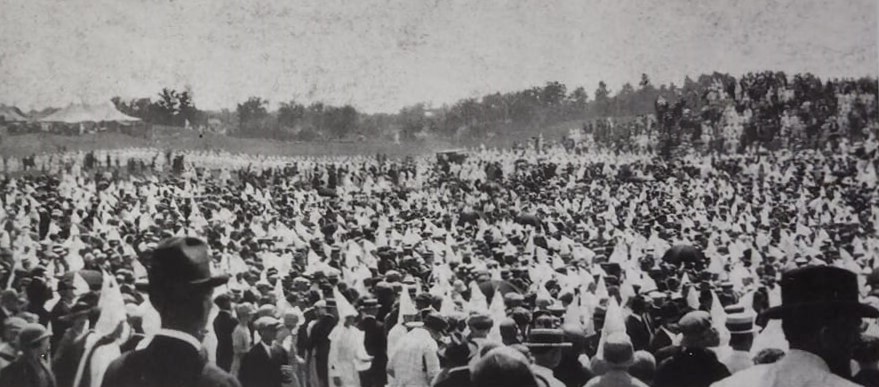
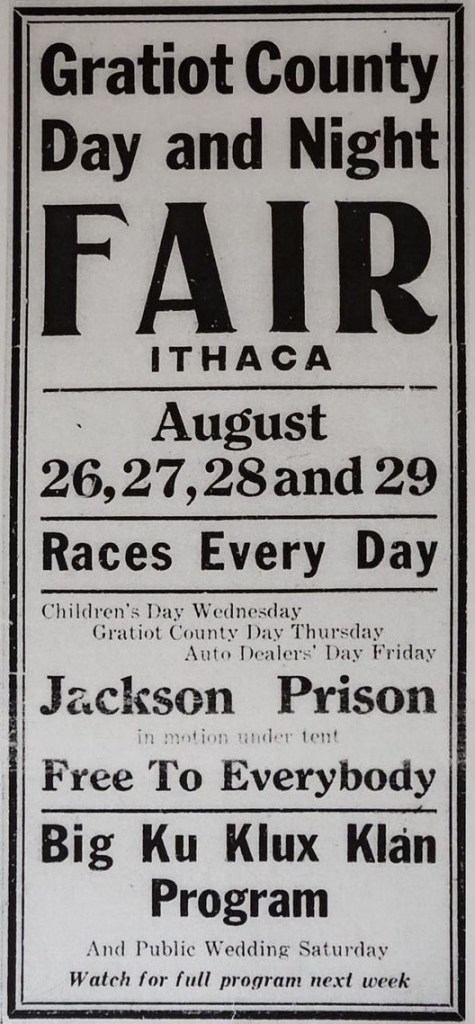

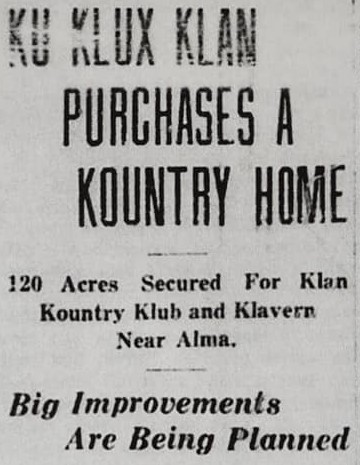
From the top, the Ku Klux Klan in Gratiot County: A Ku Klux Klan meeting takes place somewhere in the mid-Michigan area in the mid-1920s; The Gratiot County Fair held “Klan Day” and an official KKK wedding; Lewis J. King was one of a trio of so-called evangelists who came to Gratiot County under the auspices of the Klan. The three men would cause an uproar in the county before they left; A notice about the new Klan Kampground in Arcada Township.
The following is part two of a four part story concerning the Ku Klux Klan in Gratiot County during the 1920s – and a forgotten part of this county’s history which appeared one hundred years ago.
They called themselves the Invisible Empire of the Ku Klux Klan, Realm Number 24. If there was anything that many Gratiot County residents found out in the 1920s about the Ku Klux Klan, it was not invisible, and many people in the county were curious about it. This public interest was the case from 1924 to 1925 when the Klan peaked in popularity and attention within Gratiot County.
Starting in 1924, the KKK went on the offensive in southeast Gratiot by holding meetings at the packed Ashley Christian Church and a hall in Bannister, where hundreds also came. In this area of the county, the Klan attempted to intimidate and harass Catholics who were of Slovak, Czech, and Polish descent. The Klan then went and burned crosses on the property of both Father Nimrichter and the Slovacek family. The Slovaceks faced Klan members who came onto their property and threatened them to leave the community. In response, some Slovacek men used pitchforks to drive off these masked intruders.
The late summer and fall of 1924 witnessed more efforts by the Klan to try and convince people that it was growing in membership and as a movement. In August, “Klan Day” took place at the Ithaca Fair; anyone attending events at the fairgrounds could have their cars parked by Klan members. The Gratiot County Herald reported that earlier that day, over 12,000 people came into Ithaca to observe 200 Klansmen, many of whom were on horseback, lead a float with an Ithaca High School student on it dressed as Cupid. It was the largest number of people to assemble for a gathering in Ithaca until that time in history.
The parade encouraged people to come to the grandstand that night to witness mid-Michigan’s first official “Klan wedding.” At the beginning of the week, an article in the Gratiot County Herald informed anyone who wanted to buy the bride a gift about how they could do so. Reverend Leon May of the Forest Hill Church of Christ, a Klan member and Grand Kludd (state chaplain) of the Michigan KKK, performed the wedding. And yes, the couple purchased a valid marriage license.
The KKK soon received state and local attention when it announced the purchase of a 120-acre farm in Arcada Township to make it the first Ku Klux Klan Kountry Klub Klavern in Michigan. The klavern operated at that location for at least two years. One meeting in October 1925 attracted over 300 Klansmen, Klanswomen, Juniors, Tri-K girls, and American Krusaders. This entourage participated in picnics, golf, tennis, and baseball games between Klan teams as far away as Lansing and Saginaw.
In July 1925, the ugliest incident in Gratiot County’s chapter of the KKK took place in Alma’s Wright Park. Three self-professed evangelists came to Alma from Indiana to conduct so-called religious revival meetings. Afterward, Lewis J. King, George Garner, and R.C. Garner eventually left Alma in such turmoil that the after-effects of these “meetings” dragged on in Gratiot County for another sixteen months.
Most did not know that King and the Garners had been invited here by some county residents and that the trio had a long list of arrests across the Midwest for disorderly conduct, disturbing the peace, and being general nuisances. All happened wherever they went for what they advertised in the name of “White, Anglo-Saxon, Protestant Christianity and One Hundred Percent Americanism.” The Gratiot County Ku Klux Klan showed its support for the three men by regularly attending their meetings in Alma in large numbers while in complete Klan dress. However, in Alma, it seemed that issues with the Klan were like a powder keg that was about to explode.
Copyright 2023 James M Goodspeed
 Goodspeed's Gratiot County Historical Blog