Gratiot Goes to the Movies in Alma, Part II: “The Alma Vaudette and the Great Genesta, 1911-1915”

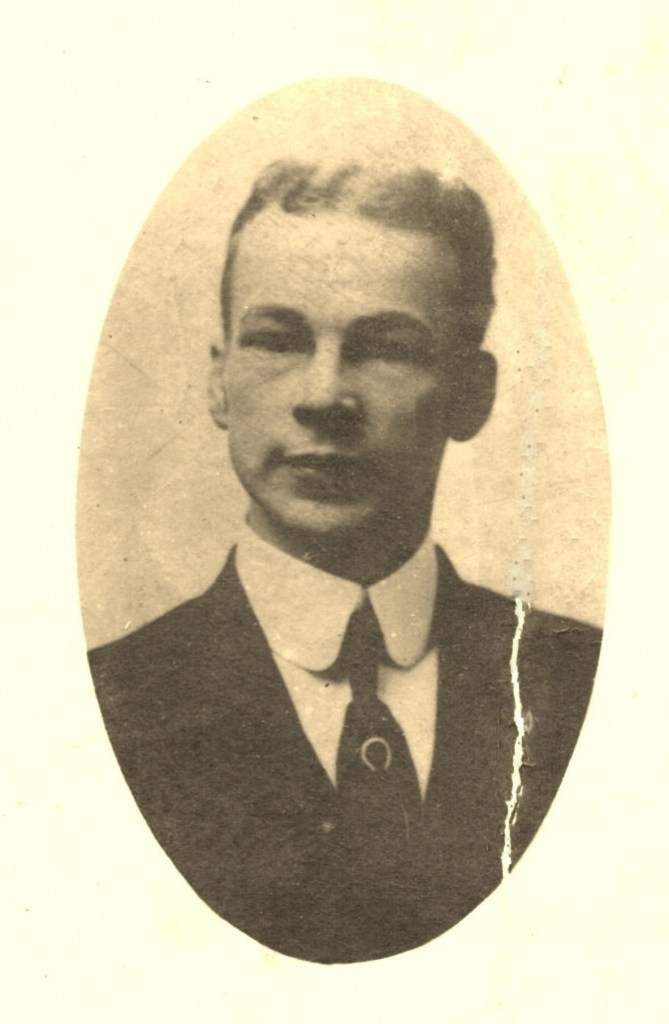
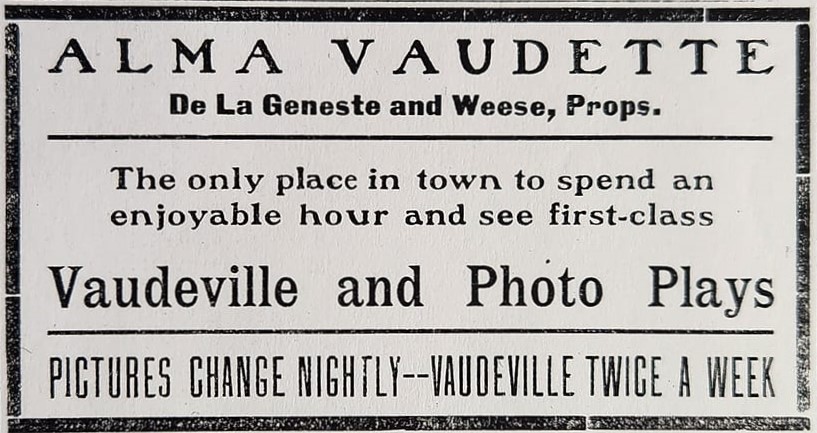
Photographs from the top: a portrait of a young Gilbert Genesta, artist and entrepreneur in Alma and in Gratiot County during the 1910s; Weese and Genesta operated the Vaudette, June 20, 1912 advertisement from the Alma Record. Business was good and sellouts were common; Genesta’s stage as it appeared for his performance at the Strand Theatre late in the 1920s.

On a warm summer’s night in August 1911, everyone in Alma seemed to be talking about someone named Royden Joseph Gilbert Raison de la Genesta.

It all started when, as the result of a bet, a group of Alma men escorted Genesta to the city jail, handcuffing and searching him to ensure that “Professor Genesta” could not escape. Genesta then ordered the group to lock the jail doors and to leave him alone inside the jail. Before the men left the jail, he said he would be on stage to perform on that Saturday night’s show at the Vaudette Theatre, which started in thirty minutes. If Genesta did not appear on time for the seven o’clock show, the Vaudette Theatre said that everyone in the audience would have their ticket refunded.

Amazingly, after less than three minutes in the jail, “The Great Genesta” appeared on Superior Street and quickly went to the Vaudette. When the curtain went up, the Great Genesta triumphantly stood on the stage, bowing to the audience’s applause and amazement at how anyone could have gotten free in a few minutes from the city jail.

            On that night in Alma, Gratiot County met one of the most interesting characters who would influence and promote movie houses in the county during the World War I era. Gilbert Genesta, as many would call him, was born in 1878 in Ashland, Kentucky, and he was married to Vaudette owner E.W. Weese’s daughter. Over time, Genesta earned a nationwide reputation as a hypnotist, escape artist, vaudeville entertainer, and entrepreneur who possessed boundless energy and ideas that shaped movie-going in Alma.

            Shortly after debuting in Alma, Genesta worked with his father-in-law to improve the Vaudette. In 1912, Weese installed more giant air ventilators, redecorated the theatre’s front, installed a new stage curtain, and hired a new operator to run the new movie machine to draw more people. Later that summer, the Great Genesta amazed the Alma community when he pulled off what became one of his trademark stunts. Genesta accepted a bet concerning another public feat, in which he proposed escaping from a sixty-gallon milk can filled with milk and secured with four padlocks. A week later, the performer did so in less than three minutes on stage in front of a packed audience. Genesta’s acts brought many to the Vaudette, and people flocked to see the latest attraction.

           In the next few years, the Vaudette continued to draw crowds by changing movie pictures nightly and bringing in new Vaudeville routines. In one case in early 1913, Weese raffled off a new ladies’ diamond ring, which he kept in a window display before giving the ring away. A year later, Weese bought a Simplex Motion Picture Machine and added 100 new seats in the theatre. Upstairs, he opened the Weese Hall, an area he redecorated to hold dances and parties. Weese also started an Alma tradition of free December matinees for children on a Saturday when their parents came into town to Christmas shop. He also occasionally offered free shows to Alma College students in an attempt to draw the college crowd. By the summer of 1915, movies with stars like Charlie Chaplin and Mary Pickford first appeared in Alma. Other attention-getting movies debuted with titles like “White Slavery,” “The Opium Smoker,” and coverage of the European war. A year later, Gilbert Genesta went a step further, had new ideas for more business in Alma, and announced that he had purchased the Vaudette.

            However, there would soon be more movie theatres and business competition in Alma because of the growing fascination with movies. By November 1915, Weese and Genesta’s monopoly on movies in Alma had ended. Another businessman, Harry Rockwell, ordered the building of a new 26×88-foot brick building on Superior Street. It featured a new appearance, hot and cold running water throughout the building, complete upstairs offices, and a sizeable sixty-foot hall at the back. This new Alma movie theatre would offer movies in Alma at this location for the next forty years, called “The Idlehour.”

Copyright 2024 James M. Goodspeed

Gratiot County Goes to the Movies in Alma: “The Early Years, 1903-1911”

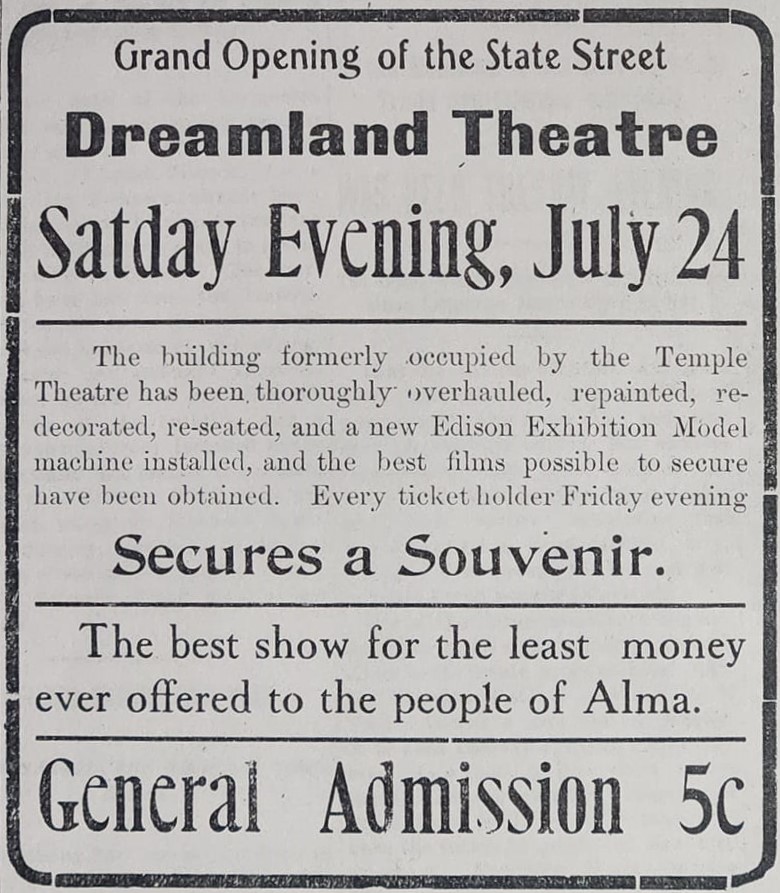
From the top: November 1903 headline for one of the first movies shown in the Alma Opera House. The results were almost disastrous; Alma Fire Chief Charles Fishbeck was one of the first successful theatre owners in Alma; Dreamland Theatre opened July 22, 1909; the Vaudette soon followed and opened on August 16, 1909.

This is the first in a series about the story of movie theatres in Alma, Michigan from 1903-1992.

The first movie theatres in Gratiot County debuted shortly after the turn of the century, with Alma leading the way. In November of 1903, the Colonial Moving Picture Company, sponsored by the Alma Fire Department, showed the first moving pictures in Alma.

It was an exciting event in more ways than one inside the Alma Opera House for that show. Just as a featured scene showing a fire department giving an alarm in a scene of the “American Fireman,” a spark from an arc light set the film and machine on fire. The crowd inside quickly panicked and then stampeded over chairs, hats, cloaks, and coats to get to safety from down the stairs and outside. In the chaos, a few people were injured when their arms got caught inside the seats. Fortunately, no one was seriously hurt. Afterward, the machine’s owner, J.G. Stewart of Boston, estimated losing $1,500 worth of film and machinery in the fire (today valued at over $28,000).

A few years later, the Opera House again experimented with moving pictures in 1908. However, Alma’s first real moving picture house became known as “The State Street Five Cent Show” or “Temple Theatre” and was owned by John Drew. It was only in business briefly until Drew sold it to L. J. Rainsberger of Dundee, who then renamed it “The Dreamland Theatre.” When the theatre debuted on July 24, 1909, it used a new Edison Exhibition Model machine to show films. Rainsberger offered a souvenir to moviegoers for only a nickel on opening night. However, “The Dreamland”  only had showings two or three nights a week. Unfortunately, not much information remains about the Temple or the Dreamland theatres.

After the Dreamland’s opening, Alma Fire Chief Charles F. Fishbeck soon provided competition. In August of 1909, he opened “The Alma Vaudette,” which provided vaudeville (acts featuring singing, dancing, and comedy) as well as moving pictures. It was located in the Vermuelen Block and featured a 12×14 foot stage, drop curtains, stage settings, paneled walls, and opera chair seating. The cost was ten cents per ticket, and children under twelve got in for only a nickel. On opening night, a crowd of 700 people blocked the sidewalk on Superior Street, waiting to buy a ticket. Once the show started, Fishbeck’s bust (profile) appeared on the screen. Next, a slide of jumbled letters chased one another over the curtain until they formed the message, “Ladies Will Please Remove.” As the crowd applauded the images, all the ladies in the audience removed their hats and placed them at the back of the theatre. On most nights, the Vaudette played to standing room only.

By the summer of 1910, Fishbeck’s theatre enjoyed continued success. It alternated vaudeville acts with movies, acrobats, magicians, music, and an occasional stock company (a traveling group of performers). “The Vaudette” boasted that as many as 3,000 people crammed into thirteen showings and installed a large ventilating fan, leading to the first use of air conditioning in a Gratiot movie theatre. The idea of providing cool air to draw in customers during Gratiot County’s hot summer weather continued in Alma theatres for decades. In 1910, the combination of air conditioning and interesting movies meant that the Vaudette kept up its brisk ticket sales.

With its growth and success, “The Vaudette” soon put “The Dreamland Theatre” out of business. Fishbeck now had the monopoly of motion pictures for Alma, but he soon decided it was the right time to sell the theatre, which he did in 1911. Erastus H. Weese, the new owner, had different ideas about improvements to Alma’s movie business. Soon, he met and hired someone who profoundly influenced movies in Gratiot County for the next decade. This man would be known as “The Great Genesta.”

Copyright 2023 James M. Goodspeed

We Remember “There’s a Seat for You” – Alma’s Great Revival of 1915

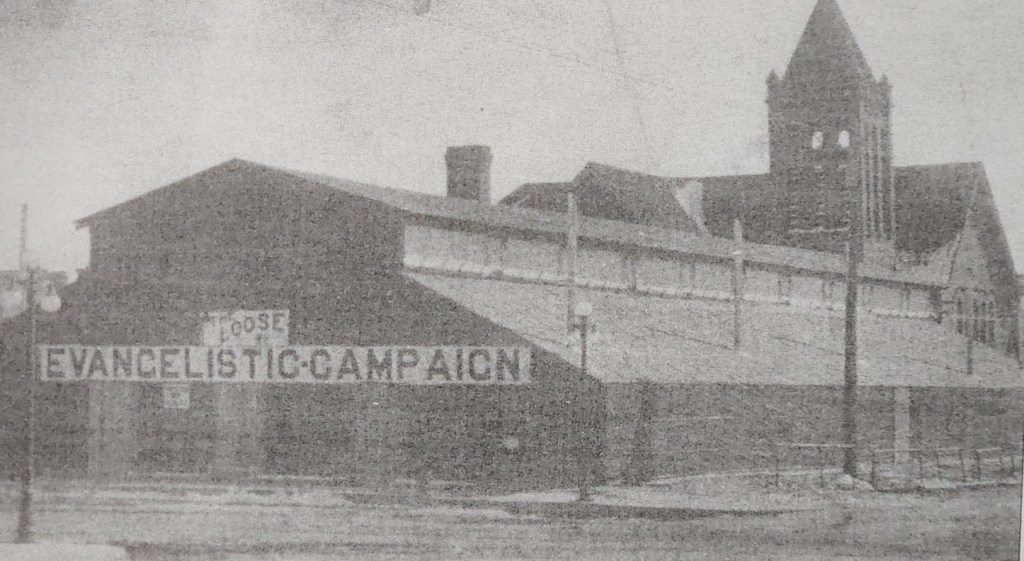
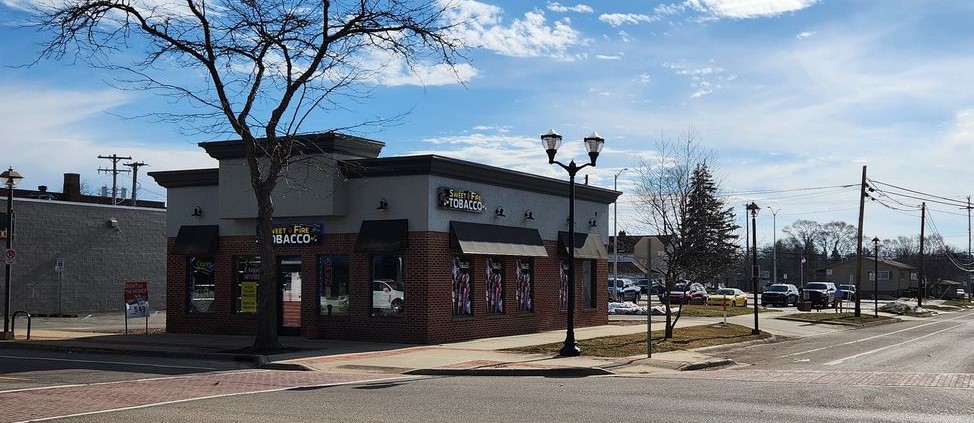
Above from the top: Inside the Tabernacle where as many as 1,500 people sat or stood for revival services during March 1915 in Alma; the Tabernacle as constructed in early March; how the location of the former Tabernacle looks today in February 2024.

    Shortly before America entered World War I,  thousands of people in Gratiot County responded to its most significant religious revival up to its time. Known as the Alma Union Evangelistic Meetings, these meetings were termed “the greatest evangelistic services ever in this part of Michigan.” These extended revival services were held in a Tabernacle on Prospect and Superior Streets on Alma’s west side in March 1915.

              The building of the Tabernacle was a feat in itself. Frank Pollasky allowed construction on his property rent-free;  Presbyterian, Baptist, and Methodist churches sponsored the services, as did the Church of Christ. To create a building that seated 1500 people, volunteer workers started construction on the morning of Monday, February 28, under the direction of Henry Soule. Amazingly, by Wednesday evening, the Tabernacle was finished and dedicated.

              The Gratiot County Gas Company provided the lights inside, and six stoves heated the large building. Decorated banners hung overhead, and football blankets, donated by the Alma College Athletic Association, kept people warm as they sat on the wooden benches.

              Evangelist Elmer P. Loose and song leader Haldor Lilleanas led the services. Both men were well-known to Midwest churches before World War I. Loose finished a similar revival meeting in Iowa before coming to Alma. Lillenanas wrote over 700 songs, and many churches nationwide used his music.

              The first ten days of meetings were the talk of the county as an estimated  9,600 people flocked to Alma. Thirty minutes before the services began, it was standing room only, and anyone who got up even for a moment lost their seat. The choir loft was overcrowded, and people used any available place to stand during each two-hour service.

              Although Evangelist Loose did not give his first formal altar call until the first Saturday evening, many walked the aisles to the front to take Loose’s hand “to get in the game for Jesus Christ.” The number of services varied, with sometimes two or three taking place daily.  

              The number of conversions during the meetings astounded the community. By March 20, over 400 were saved, and the Alma Record commented that the “community was stirred as never before.” On one Monday evening, 44 people went down the aisles; on another Sunday, 80 went forward. By March 25, over 700 people had been converted, and by the close of the meetings, the numbers rose to 900.

              As March came to a close, so did the meetings. Evangelist Loose had not stipulated a fee for his services, only relying on the generosity of the people after paying for all expenses. Starting the last Sunday, those in attendance responded and gave offerings toward the costs of the meetings, the Tabernacle, and the evangelists. In the end, the subsequent offerings paid for them all.

              The results of the Alma Union Evangelistic Meetings were substantial. At least 500 people attended each service with most averaging 1,100 to 1,200. The week following the closing of the revival, the Alma churches that sponsored the meetings opened their doors to welcome new converts on four different nights. After the revival services ended on Prospect and Superior Streets, organizers ordered the Tabernacle auctioned off to the highest bidder, with orders to remove it within ten days. Henry Soule was the high bidder at $600 and soon took down the large building.

     Today, this location, on the southeast corner of East Superior and Prospect Streets, sits diagonally from the Alma Church of God. Reflecting on the times in 1915,  some described these religious meetings as the “greatest religious expression that the people of Alma have ever known.”

Copyright 2024 James M Goodspeed