

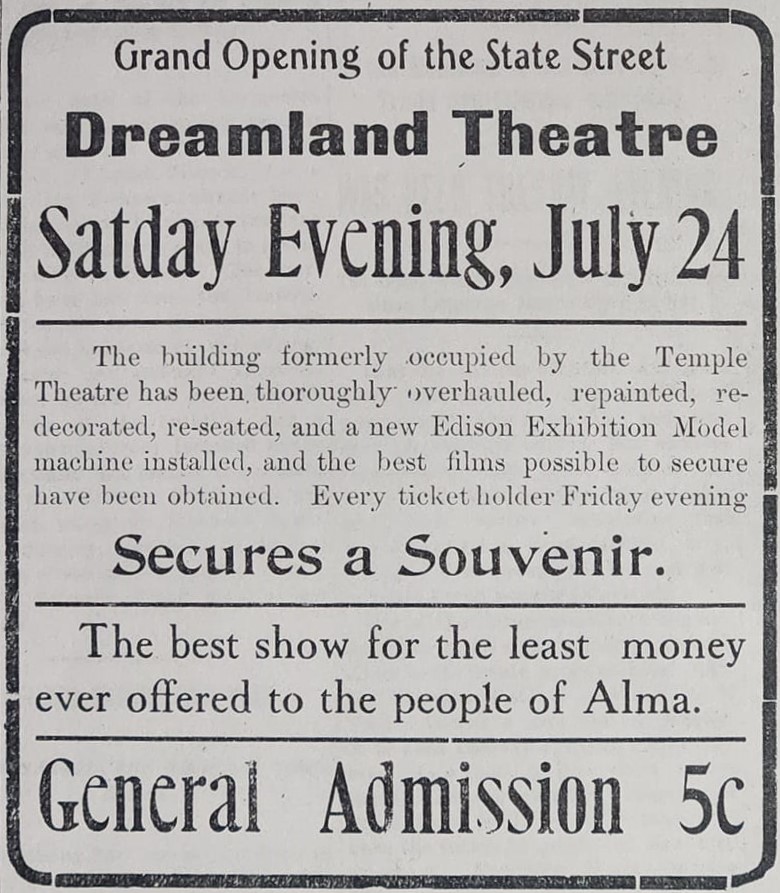

From the top: November 1903 headline for one of the first movies shown in the Alma Opera House. The results were almost disastrous; Alma Fire Chief Charles Fishbeck was one of the first successful theatre owners in Alma; Dreamland Theatre opened July 22, 1909; the Vaudette soon followed and opened on August 16, 1909.
This is the first in a series about the story of movie theatres in Alma, Michigan from 1903-1992.
The first movie theatres in Gratiot County debuted shortly after the turn of the century, with Alma leading the way. In November of 1903, the Colonial Moving Picture Company, sponsored by the Alma Fire Department, showed the first moving pictures in Alma.
It was an exciting event in more ways than one inside the Alma Opera House for that show. Just as a featured scene showing a fire department giving an alarm in a scene of the “American Fireman,” a spark from an arc light set the film and machine on fire. The crowd inside quickly panicked and then stampeded over chairs, hats, cloaks, and coats to get to safety from down the stairs and outside. In the chaos, a few people were injured when their arms got caught inside the seats. Fortunately, no one was seriously hurt. Afterward, the machine’s owner, J.G. Stewart of Boston, estimated losing $1,500 worth of film and machinery in the fire (today valued at over $28,000).
A few years later, the Opera House again experimented with moving pictures in 1908. However, Alma’s first real moving picture house became known as “The State Street Five Cent Show” or “Temple Theatre” and was owned by John Drew. It was only in business briefly until Drew sold it to L. J. Rainsberger of Dundee, who then renamed it “The Dreamland Theatre.” When the theatre debuted on July 24, 1909, it used a new Edison Exhibition Model machine to show films. Rainsberger offered a souvenir to moviegoers for only a nickel on opening night. However, “The Dreamland” only had showings two or three nights a week. Unfortunately, not much information remains about the Temple or the Dreamland theatres.
After the Dreamland’s opening, Alma Fire Chief Charles F. Fishbeck soon provided competition. In August of 1909, he opened “The Alma Vaudette,” which provided vaudeville (acts featuring singing, dancing, and comedy) as well as moving pictures. It was located in the Vermuelen Block and featured a 12×14 foot stage, drop curtains, stage settings, paneled walls, and opera chair seating. The cost was ten cents per ticket, and children under twelve got in for only a nickel. On opening night, a crowd of 700 people blocked the sidewalk on Superior Street, waiting to buy a ticket. Once the show started, Fishbeck’s bust (profile) appeared on the screen. Next, a slide of jumbled letters chased one another over the curtain until they formed the message, “Ladies Will Please Remove.” As the crowd applauded the images, all the ladies in the audience removed their hats and placed them at the back of the theatre. On most nights, the Vaudette played to standing room only.
By the summer of 1910, Fishbeck’s theatre enjoyed continued success. It alternated vaudeville acts with movies, acrobats, magicians, music, and an occasional stock company (a traveling group of performers). “The Vaudette” boasted that as many as 3,000 people crammed into thirteen showings and installed a large ventilating fan, leading to the first use of air conditioning in a Gratiot movie theatre. The idea of providing cool air to draw in customers during Gratiot County’s hot summer weather continued in Alma theatres for decades. In 1910, the combination of air conditioning and interesting movies meant that the Vaudette kept up its brisk ticket sales.
With its growth and success, “The Vaudette” soon put “The Dreamland Theatre” out of business. Fishbeck now had the monopoly of motion pictures for Alma, but he soon decided it was the right time to sell the theatre, which he did in 1911. Erastus H. Weese, the new owner, had different ideas about improvements to Alma’s movie business. Soon, he met and hired someone who profoundly influenced movies in Gratiot County for the next decade. This man would be known as “The Great Genesta.”
Copyright 2023 James M. Goodspeed
 Goodspeed's Gratiot County Historical Blog