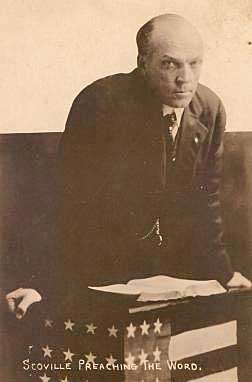
From the top, Scoville Meetings: headlines from the Alma Record announce the coming of Charles Reign Scoville’s revival meetings; a Scoville meeting for “men only,” held in Akron, Ohio probably ten years before the Tri-County Meetings which centered around Alma; undated Scoville publicity photograph taken prior to arrival in Gratiot County.
In June of 1926, a hurricane rolled into Gratiot County. However, this time, it was not a storm but the coming of Evangelist Charles Reign Scoville and the Tri-County Crusade. These religious meetings took place primarily in Gratiot County, featuring one of the leading American evangelists of the early twentieth century.
Scoville had been an evangelist for eighteen years, having conducted many successful meetings in major cities in the United States and Australia. A well-educated man who had also served briefly as a Chicago pastor before coming to Alma, Scoville reportedly once spoke to more people in a single religious campaign in the United States at that time than any other living evangelist. In one meeting in Oklahoma, he saw over 1500 people converted. Another campaign in Anderson, Indiana, made national headlines because it was the most extensive campaign held in a church building by one congregation, gaining over 1200 converts. Even Billy Sunday, a leading evangelist in America in the 1920s, believed Scoville then to be the most outstanding evangelistic speaker in America.
The Christian Church and its congregations in three mid-Michigan counties hosted many Scoville Meetings. While other congregations participated, the Alma East Superior Christian Church became the central location. Initially, Scoville’s coming to Alma led to announcements that the church probably could not contain everyone and that a large tent would be needed outside to seat everyone. Because of Scoville’s notoriety, area churches began to reserve seats well in advance to attend one of the East Superior Christian Church services.
A frontman, Samuel Bishop Pack, arrived in Alma days ahead of the rest of the Scoville team to guide the churches and to tell them what to expect. Fresh off of meetings in Winston Salem, North Carolina, the five-person Scoville team started the Alma meetings on May 30, 1926. Arlene Dux Scoville, the evangelist’s wife, came as part of the team and was one of the most accomplished soloists of 1920s gospel music.
However, Charles Reign Scoville’s preaching drew people into the churches like a magnet – and the people came. Speaking often twice a day, and frequently three times on a Sunday, “with impassioned gesticulation, his voice trembling with emotion, his eyes flashing fire, his forehead furrowed with frowns of contempt,” Scoville was like a machine gun, easily uttering 250 words per minute. As audiences sat listening intently to this evangelist, it was clearly evident that Scoville knew how to preach. Every ear of the listeners remained alert, and every eye was on him during services. Observers noted that those who usually slept in church stayed awake and remained engaged during Scoville’s topics. On one evening, his famous sermon, “Traps and Tricks of the White Slavers,” warned Gratiot County about the dangers and evil of white slavery. In this message, Scoville detailed how girls as young as twelve were stolen every year in American cities, never to be heard from again.
Other messages dealt with the evils of bootlegging and how America could never repeal Prohibition. In addition, Scoville proclaimed that bootleggers also needed to be thrown in jail until they died and all of their property confiscated. During a patriotic rally on a Tuesday, Scoville and his wife donned their army uniforms from World War I, describing how they had served during the war. When he was not preaching, Scoville went out and visited many places in Gratiot County, such as schools, businesses, factories, and community organizations. Through all of this, his charisma and personal approach appealed to many.
At the end of each meeting, people came forward, shook Scoville’s hand, and then headed to “the inquiry room,” signifying their answer to Scoville’s message and acceptance of Christ. In many churches, the Scoville services became the greatest ever held in that church or town. By the time the meetings concluded on June 27, 1926, almost 400 people had been converted, and the Scoville meetings shook Gratiot County.
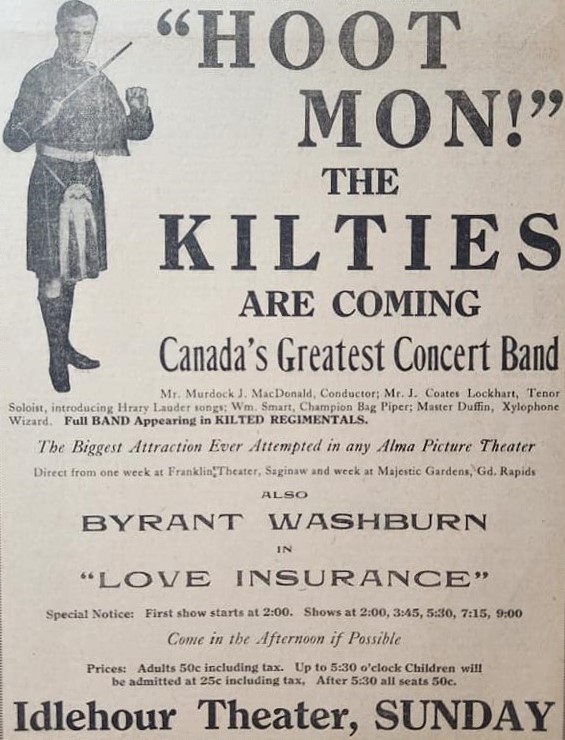
Movies in Alma in 1919 from the top: Houdini at the Idlehour Theater in May 1919; the Kilties come to Alma at the Idlehour, October 1919; “washed air” arrives at the Idlehour prior to the onset of summer, June 1919.
In mid-January 1919, after closing due to the Influenza Epidemic, theatres such as “The Liberty” and “The Idlehour” attempted to reconnect with Alma moviegoers. During the first week of reopening, something new happened in Alma, as both theatres showed different movies each night to attract business.
Although proprietor Gilbert Genesta announced the previous fall that he sold his interests in the Liberty, he soon opened another movie theatre in Alma. This time, in April 1919, Genesta planned to lease part of the Studebaker garage in the Spinney block and offered what the Alma Record deemed a “cheap grade of pictures” that would show for only ten cents. By August, Genesta had acquired a new lease, and he planned to make massive improvements inside, hoping to seat between 800 and 1,000 people. “Genesta’s Ten Cent Theatre” planned to make money by showing movies that did not appear elsewhere in town featuring Mary Pickford, Charlie Chaplin, and D.W. Griffith.
However, Genesta sold this theatre again to R.J. McLaughlin of St. Johns, who renamed it “The Regent.” The Regent ran for a while but eventually closed. Was this deal Genesta’s plan all along, or was he just a restless owner and entertainer who needed to be on the move? Although he claimed he was moving to California, Genesta would revisit and perform in Alma throughout the 1920s. In 1930, Genesta’s death in Frankfort, Kentucky, shocked Gratiot County. While performing his trademark water barrel escape, Genesta could not escape and died as a result of being trapped. Newspapers reported that his death was due to an equipment malfunction. Geneseta did not know it that night, but his barrel was damaged when it was unloaded at the theatre earlier in the day, resulting in his inability to open the escape lid properly.
Another reason Genesta left the county’s theatre business when he did was possibly due to the big news that came to Alma in May 1919. Two Detroit engineers, L. Francis Murphy and Horace H. Esselstyn, announced they had secured lots just west of city hall to build Alma’s first modern movie theatre. It would be 52 feet wide and 132 feet long, with a brick front and seats for at least 800 people. This theatre had a fully equipped stage to offer big attractions and a new heating and ventilation system for seasonal use. The basement contained the heating plant, coal, and dressing rooms. With all this room, Strand ownership hoped that major Vaudeville programs would perform there. Although the new owners modeled the theatre after “The Majestic Theatre” in Detroit, they settled on a new name for their theatre in Alma. It would be called “The Strand Theatre.”
While it planned to open in 1919, it would be late May 1920 before the Strand offered its first show. Constructed by Broughton and Son, the total investment in the building exceeded $125,000, and many in Alma wondered if the new theatre would survive. However, on the opening Saturday night, 950 people jammed inside to watch the Strand’s first show. Victor Gipe from Detroit was hired to play the new $10,000 orchestral pipe organ. People arrived early to listen to Gipe’s music due to his reputation as one of the best “picture players” in Michigan.
As the first show closed, Manager C.A. Miller stepped onto the stage to tell the audience that the more money they spent on the Strand, the better the pictures would be. A photographer then came on the stage, snapped a flashlight picture of the audience, and the Strand was off and running – a run that would last for over 70 years in Alma.
The opening of the Strand Theatre coincided with the period many called the Roaring Twenties – a decade of new motion pictures, vaudeville, and the coming of “Talkies.”
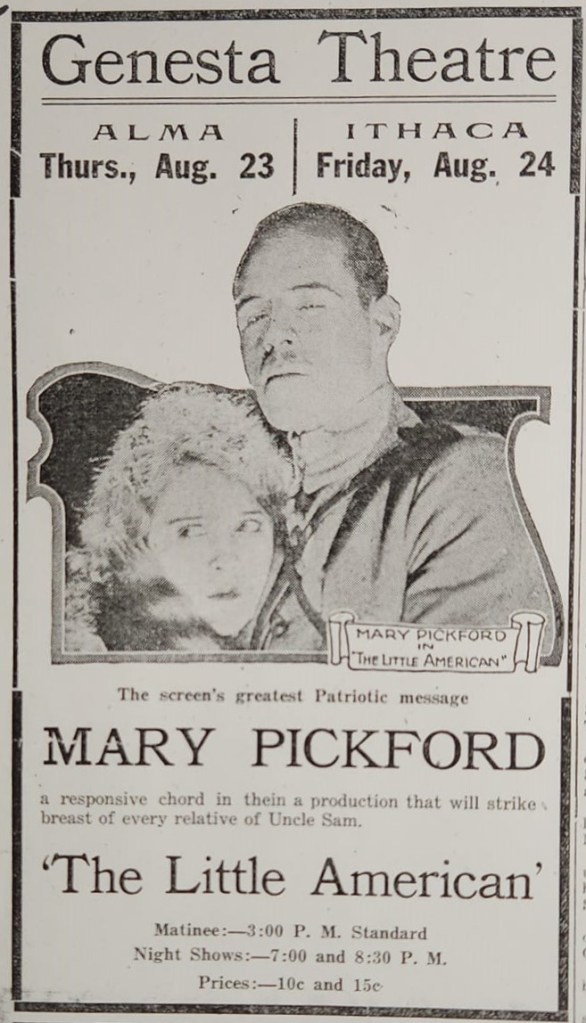
Above, participants in the first “Movie Wars” in Alma: Gilbert Genesta’s Genesta Theatre sought to keep bringing in viewers with stars like Mary Pickford in August 1917; after buying out Genesta, A.H. Ashley sought to show many World War I themed movies in May 1919; Douglas Fairbanks was a draw at the new Idlehour in June 1919.
In the summer of 1916, America slowly drifted toward involvement in what was then called the Great War. Another type of war was soon to take place in Alma. This war would take place over the attention and business that movie viewing created in Gratiot County.
By this time, Alma also had a new theater, “The Idlehour,” which opened for business in July 1916.
To draw people in, Clarence A. Miller, the Idlehour’s proprietor, promoted his new theatre as “The House of Good Shows.” Miller announced that he would show Paramount five reel features two days a week for viewers. Anyone dissatisfied with watching one of his Paramount pictures only had to say so, and the cost of their ticket would be refunded, which would be fifteen cents. Also, Pathe Pictures, a newsreel shown before the main movie, was shown three nights during the week, and bargain days occurred on Thursdays when anyone could watch a Metro Feature photoplay for ten cents. Pathe Pictures also became the first to show colored pictures in Alma when this took place on the second night the theatre opened. The Idlehour also used a continuous picture system, ending the delays in changing films. Another new addition, the Wagner white light converter, took the “flicker” out of pictures so everyone in the theater enjoyed sharp and clear images, no matter where one sat. Best of all, the theatre had a new and improved ventilation system which kept the air cool and clean. Inside, patrons also saw the newly cleaned and painted theatre walls.
Six months later, Miller installed new electric signs gracing the front and hanging out over the sidewalk. These white lights projected against a large green glass shade and spelled “Idlehour.” Anyone walking downtown Alma at night could see the marquee from a distance.
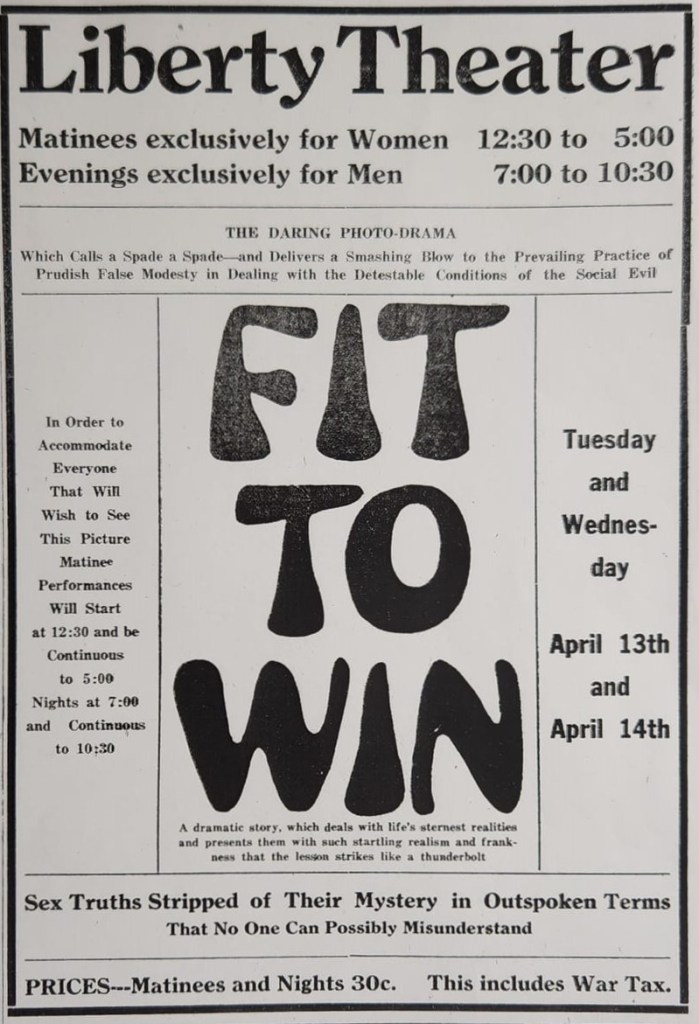
When the Idlehour opened, Gilbert Genesta had his challenges and renamed his theatre across the street the Genesta Theatre. It started when a group of concerned citizens approached the city council over the types of “social problem” movies showing at the Genesta on Monday nights. Gilbert Genesta developed a policy prohibiting children from being admitted on Monday nights because of what he called “the maturity of the movie plots.” Genesta also tried reassuring the public that he only showed movies the motion picture industry approved.
Later, in the summer of 1918, the theatres faced their first health threat when an infantile paralysis epidemic hit Michigan, forcing movie theatres to close. Although health officials in Alma monitored the situation, they did not close the theatres in the city. Unfortunately for the Alma theatres, another health crisis, the Influenza Epidemic in October 1918, would close them all for some time.
The Genesta Theatre attempted to further combat competition by installing a new Emerald Glo screen that eliminated distortion. Genesta also featured movies with war themes like “War Brides,” “Civilization,” and “Mothers of France.” Sometimes, he tried to sell more tickets by putting on some of his magic and illusion acts, such as “The Great Genesta.” Once the United States officially entered the war in April 1917, Genesta opened his theatre for high school students and gave Red Cross benefit shows. Genesta did this while maintaining this theatre and another one he bought in Ithaca. Sadly, shortly after the government forced the closing of movie theatres on Sundays to conserve fuel for the war effort, Genesta surprised many by selling his Alma theatre and appearing for a moment to move on from the movie business.
A.H. Ashley became the new owner of the Genesta and quickly changed the name to the “Liberty Theatre” to coincide with the patriotism shown at that time with America’s involvement in the war. He updated and rewired the Liberty, put in a fireproof picture booth for the film machines, and placed a new electrical sign out front. The Michigan Light & Power Company helped Ashley with putting up the lights.
However, the Idlehour was increasingly popular with moviegoers during much of the war, drawing business away from the Liberty. The largest crowd to ever see a movie until that time in Alma occurred in May 1918 when the war drama “The Unbeliever” was shown at the Idelhour. Still, the Idlehour also went up for sale a month later when the backers of Liberty bought it and then owned both Alma theatres. A.H. Ashley managed both locations, and his backers briefly had another monopoly in Alma. However, there would soon be a new competition on Superior Street. The influence of this theatre would go on in Alma for over seventy years. This new movie house would be called the Strand Theatre.
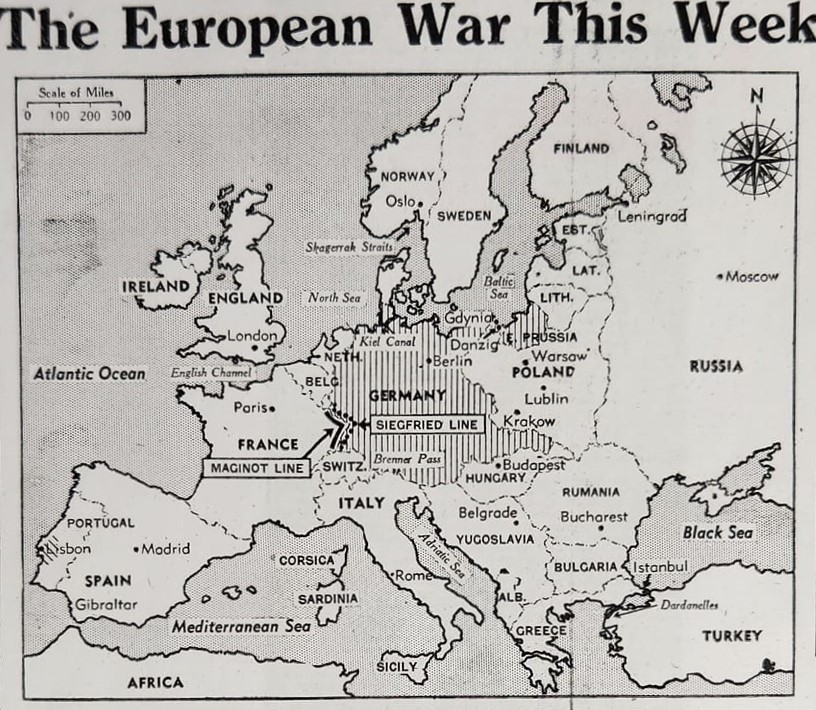
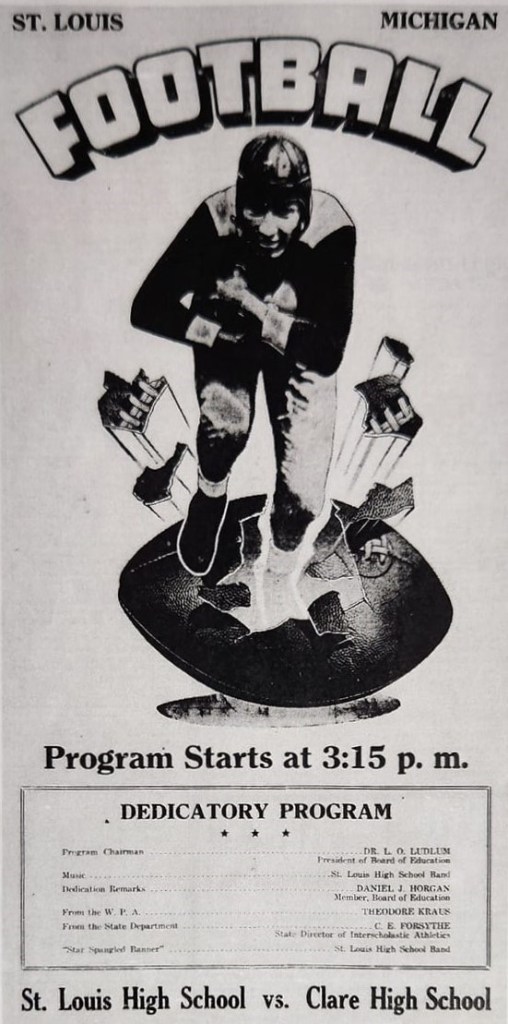
From the top: End of summer celebrations took place in Gratiot County during the Depression. St. Louis had one of them in September 1939; The start of the Second World War meant weekly war news – and maps – for readers. The Alma Record started this feature which ran throughout the war; A girls softball game in Ithaca was just one of a couple of events held during an ox roast in the village to mark the end of summer, 1939; The dedication of Wheeler Field in St. Louis was a major event which came about as the result of one of the New Deal programs during the Great Depression.
Our County in Depression and War, September 1939: “The World Goes to War, Again”
For Gratiot County, it seemed that history would repeat itself. Over twenty years after the fighting stopped in Europe in what many called “The Great World War,” Europe erupted again. Nazi Germany invaded Poland, and the world headed into a war that would last six years.
A slow, transformative journey began as the county, just like the nation, continued through the Great Depression and on into World War II.
It was September 1939 in Gratiot County.
Life in Gratiot County During the Depression
For many in Gratiot County, New Deal programs that most affected everyday life could be identified by their acronyms: NYA, WPA, and CCC.
One of the most active groups, the National Youth Administration, acquired a new leader in Alma with the arrival of Dean Carter. Carter’s task involved getting youths assigned to NYA into part-time jobs that dealt with library work, classroom assistance, ground and building improvement, and outside construction work. The focus of NYA involved helping students adjust to work and life after high school, especially if they did not attend college. Students who qualified for NYA received between $3-$6 a month (and at most $6) for participating in the program. During that fall, Gratiot County received $2,214 for 41 students in 8 high schools in the county in September to become involved in an NYA-directed work. As a result, a new NYA office opened in Alma, behind the back of City Hall for director Dean Carter. In another instance in September, NYA announced plans to train 600 aviation mechanics in Michigan at ten training centers in the state. However, Gratiot County was not one of the sites.
In another New Deal program, Works Progress Administration (WPA) workers proved very active in Alma during the summer as they continued pouring concrete on North Elwell Street, then moving to pave East End and West End Streets. The city hoped that WPA work would be done on Walnut Street if time and weather permitted. During the late summer and fall, an estimated 100-105 men worked on the streets as WPA workers. Some crew members were also assigned to build an ice rink south of the new bridge on Ely Street near the river. The site offered a good location for a winter ice skating area for youth in the city.
For young men ages 17-24 who wished to apply to work for the Civilian Conservation Corps (CCC), an application period opened from October 1-14. CCC members worked on projects such as conservation and building projects. Anyone who wanted to enter the CCC applied at the Gratiot County Welfare Relief Commission offices at 614 East Superior Street in Alma.
Some of the biggest news in September dealt with the growing popularity of Townsend Meetings in Gratiot County. The Townsend movement, led by Dr. Frances Townsend, believed that the government should give a pension of $200 to every American over 60. In return, each recipient had to spend their entire retirement by the end of the month, thus stimulating the economy and helping end the Depression. However, Townsend and his followers should have realized that the program could only work if additional money on top of this amount was spent or pumped into the economy by all people beyond the allotted $200. Since most Americans either did not have the extra money or refused to spend it, the Townsend program would fail. Still, the Townsend Meetings became very popular in Gratiot County. On one Sunday in September, an estimated 500 people (called “Townsend forces”) attended a program at the American Legion Hall where W.H. Morrison of Middleton chaired the service. When the hall could not hold everyone who wanted to go inside, an afternoon meeting occurred at Tourist Park. That crowd was also estimated to be another 500 people. By the late 1930s, smaller Townsend Clubs formed in different locations in the county. Over at Ithaca, the Ithaca Townsend Club No. 1 met at the IOOF Hall and also invited other Townsend Clubs in their district to attend programs.
A World at War – Again
As the Second World War began in Europe, news coverage about the war and the success of the Nazi invasion of Poland appeared in Gratiot County newspapers. Unsettling images of the war also appeared for the first time, stimulating the American desire to stay out of European affairs.
A regular piece in the Alma Record began its run under “The European War This Week,” which gave readers a synopsis of the current situation of the war. Responding to events in Europe, Dr. B.N. Robinson of Alma published his memories of Poland just before and after World War I. Robinson recalled the Warsaw he knew from his time there and hoped it would survive the war. He had no idea that it would be six years before the conflict known as World War II would end, leaving Poland in ruins.
Photographs of the first Nazi concentration camp in Poland showed captured Polish prisoners of war. In another picture, Polish children tried to help resist the Nazi invasion by building air raid protection trenches. These photos were only the beginning of showing Gratiot County some of the effects of the war.
The first notice of Gratiot County’s young men in the military listed three Alma boys in the Navy and one in the Aviation Corp. All enlisted in the previous year. Three of them, Raymond Alspaugh (on the USS Cincinnati), Bernard Smith (on the USS Babbitt), and John Pechacek (on the Panama Canal), were all in the Navy. Andrew Gordon Hughes, who lived on Olive Road, headed for Hawaii to serve as an aviation mechanic. It turned out that Raymond Alspaugh sent the first letter to be published in Gratiot County during World War II. Alspaugh’s letter home described being at Key West, Florida, and patrolling for foreign submarines up to 250 miles offshore.
Still, America’s tone appeared neutral as it aimed to stay out of another world war. Colonel Charles Lindberg openly urged America to stay out of a war that America could not win against the Nazis. President Franklin D. Roosevelt called for American neutrality – eventually urging neutrality in thought and deed. On the other side of the news, the war was expected to help assist the unemployed in America. At least one million jobs would be needed to fill foreign orders coming to the United States.
Gratiot Farming – Harvest Soon Here
As summer ended and fall approached, Michigan State College showed off an early type of irrigation to mid-Michigan farmers. Called the “water gun,” crowds at St. Johns, East Lansing, Hartford, and Lake City witnessed how this new overhead rotary irrigator pumped water from existing water supplies onto fields. While the device helped farmers use irrigation to improve their crops, unfortunately, at different places when MSC set up and used the gun, that location in Michigan was deluged by September rains only a few hours later. Photographs promoting the new “water gun” appeared in Gratiot County newspapers.
Gratiot County agricultural agent C.P. Milham told the public that the 1939 growing season would succeed. The most significant crop in Gratiot County was corn, which appeared to be more abundant in the northern part of the county. Even though the corn borer threatened Gratiot corn, a new hybrid-resistant corn that farmers used in the county did well during the year. As soon as the war began in Europe on September 1, stocks of flour and sugar began to be depleted in stores across the nation as homemakers stocked up on these items. Memories of rationing twenty years earlier in another world war meant that many did not want to be caught without plenty of flour and sugar. Meat and coal also became items that people started to buy and keep in larger quantities. Farm grain prices immediately jumped at area elevators. The cost of beans doubled in one week (from $1.95 to $4.00). Other grain prices did, too, such as wheat (64 cents to 8 cents) and corn (59 cents compared to 45 cents).
With fall approaching, pheasant season would soon be here in Gratiot County. Fifty people met at the Bethany Community Farm Bureau at the Bethany Community Center on September 17 for their regular meeting. At the end of their business, the group decided to have a pheasant supper on October 17. Those responsible for organizing the supper included Mr. and Mrs. Albert Bailey, Mr. and Mrs. William Schultheiss, and Mr. and Mrs. Arbogast.
Good Old School Days
With the arrival of September, school news now appeared in county newspapers. One of the most significant announcements reported that Perrinton, Middleton, and two rural schools (Fulton Center and Reynolds Schools) all consolidated to form the recently named Fulton Township Schools. Nearly 500 junior and senior high school students, with grades K-7, attended schools in Middleton and Perrinton. Grades 8-9 held classes in Middleton, and grades 10-12 met in Perrinton. Those students taking vocational courses rode the bus to Middleton for their classes. Superintendent and mathematics teacher Lloyd Eberly headed a group of fifteen staff members K-12. Because he was responsible for two buildings, Eberly kept an office in Perrinton (afternoons) and Middleton (mornings). Eberly also announced that 75 boys were trying out for the Fulton football team.
Other news in the county that dealt with the start of school included a notice in St. Louis that Superintendent T.S. Nurnberger and his wife planned to host an afternoon tea on Sunday, September 24, for staff and their husbands and school board members and their wives. Nurnberger stated that this allowed the seven new teachers in the district to meet the existing staff and school board. St. Louis Schools also announced that 22 former students enrolled for studies in the fall semester at Central State Teacher’s College in Mt. Pleasant. In this group, Warren Packer and Elizabeth Schaede went to Mt. Pleasant on a two-year rural scholarship. Some of the group’s other former St. Louis students included Marion Tangalakis, Dorothy Sigourney, Charles Hayward, and Frances Goodyear.
County School Commissioner Donald L. Baker stated that the smallest enrollment at any school in the county took place at the one-room school at Davidson, No. 1 Fractional, in Bethany Township. J. Earl Moore, the teacher, reported having seven pupils enrolled. Close behind the Davidson School, North Star No. 4 and Seville No.7 each had eight students. The largest school enrollment occurred at Bethany No. 6, where Mrs. Stella Johnson taught 45 students. Newark No. 4 followed behind with 41 students; Wheeler No. 1 had 38.
Sad news came out of Breckenridge when a popular high school student, Gerald Allen, died in Alma Hospital after an appendectomy. Allen practiced with the football team on a Friday, felt nauseous the next day, and saw a doctor. Upon being sent to the hospital, surgeons found he had a badly ruptured appendix, and he died four days later. Allen’s funeral at the Breckenridge Congregational Church was filled by fellow students, family, and community members. A member of the St. Louis Nazarene Church, Allen was laid to rest in Ridgelawn Cemetery. Gerald Allen was only seventeen years old when he died.
Sports in Gratiot County During the Depression
Two main sports occupied the attention of the county during September.
First, fast-pitch softball in St. Louis, a sport born in the county during the 1930s, wound up the second half of the season, where the Lake Shore Sugar Company won the league title with a perfect 8-0 record. No playoff game took place, as Lake Shore also won the first half of the season. Although they finished at 4-4, the talk of St. Louis was Hall’s Lumber Company, which had several young, promising players right out of high school. Many believed that these young players would challenge for the 1940 season.
Over at Alma, teams geared up for state tournaments as regular seasons concluded. Alma’s George Minnis, the star pitcher for Mid-West Refineries, headed an all-star squad of other locals like Paul Wood, George House, and Earl Hatinger. The team made their way through the tournament by defeating Grand Rapids, Saginaw, and Bay City teams. Along the way, Minnis pitched four games in three days as the Mid-West team won the Class B Championship for Alma. Shortly after the state tournament ended, C.S. Vliet of Alma organized a meeting for the 1940 season. The Alma Record and Alma Journal commented that fast-pitch softball became an entire evening of entertainment in the Gratiot community in just one season because places like Alma and St. Louis have the best-lit fields in Michigan.
Professional baseball ended in September, but a local player made the news. Vincent Battles from Riverdale came home from playing for a club in Opelousas, Louisiana, a Cleveland Indians farm team. Battles played third base and was rated the best rookie third baseman in the Evangeline League. After his return, Battles resumed playing with the Roosevelt Oilers in Mt. Pleasant, for which he had played for two years before entering minor league ball.
High school football became the second seasonal sport that Gratiot County residents eagerly watched. Most of the attention focused on St. Louis, where Coach Oldt prepared for the season’s opening game on September 22 against Ithaca. A total of 45 boys, one of the largest groups in recent memory, tried out for the varsity.
However, the biggest news and attention in St. Louis centered around the dedication of Wheeler Field, where the State Department and the Works Progress Administration created a new football facility. A unique dedication program occurred on Friday afternoon, September 29, before the first home game against Clare High School.
Wheeler Field, a large part of the ten acres of land formerly known as a boggy river flat, came under construction by the Works Progress Administration as a two-year project that cost $50,000. The field was named after Dr. Aaron R. Wheeler, who lived in St. Louis from 1883 to 1926 and was a well-known doctor, citizen, community leader, president of the Board of Education, and mayor of St. Louis. The construction of Wheeler Field also included bleachers that hosted 1500 people, six gate openings, a seven-foot metal fence, and a footbridge. A gravel parking lot held 200 cars. People could also use new tennis courts and shuffleboards, with baseball and softball fields to the west of the field. A cinder track went around the football field.
A full-page advertisement urged people to attend the Wheeler Field ceremonies and the game. St. Louis students hoped the football team would defeat Clare and gain the right to host the mascot, Caspar the Goat, after the game. The goat and the students planned to meet after the game at the Dedication Dance for students in grades 8-12. The Rhythm Makers from Saginaw provided the music.
The Long Arm of the Law in Gratiot County – in September 1939
A new Gratiot County jail opened to the public. For $40,000 ($22,000 paid by the county, $18,000 contributed through Federal funds), it measured 56 x 48 feet and looked more like a dormitory than a jail. Although no bars could be seen outside, the sheriff proclaimed the jail escape-proof. No prisoner could see the outside world due to the prism glass that let light in but did not let prisoners see through it. Three cell blocks held up to 8 men each on the main floor. The second-floor rooms looked more dormitory-like, with two separate rooms holding eight people. In a lighter moment, four well-known Ithaca men from the Ithaca Rotary Club also stepped inside one of the cells during a personal tour. Someone locked the door behind the men to give them the feel of a real jail experience.
For the second summer, Sheriff William Nestle and Alma officer Mike Slowinski found and destroyed large “marihuana” plants near Half Moon Lake in Seville Township. The plants were worth $1000 and grew over six feet tall (one measured eight and a half feet tall). This particular occurrence was the exact location where officials found “marihuana” in 1938, and the sheriff believed that these plants were self-seeded. The farmer who owned the property claimed that the plants had grown there for several years and did not know what type or their use. In a side story, the farmer claimed that women from that area came to harvest the seeds to use as a song restorer for their canaries. This event was the second drug bust in Gratiot that summer, as before this, four Mexicans in the Ashley/Bannister area were arrested and prosecuted for growing the weed.
On a more dangerous note, the Bannister Bandit appeared again in Gratiot County. Clad in a red handkerchief, this infamous masked Bandit entered John Pierce’s beer garden in Bannister through the back door at closing time, just as the Pierces counted their cash from the day. The Bandit had a nickel-plated revolver and demanded an amount of $30.00. However, he failed to take the remaining money in the cash register. Before this, the Bandit held up places in Elsie and Oakley. The Ithaca Dairy was also robbed by thieves who entered one night and made off with as much as $40.00. Those thieves cut a screen and unhooked a lock to enter the dairy.
In other legal events, the Gratiot County Herald asked the Department of Conservation in Lansing about closing counties to Sunday hunting while keeping other counties open. Many in Gratiot County lamented the number of Sunday hunters who suddenly swarmed their areas from counties that did not allow Sunday hunting. Couldn’t more counties close so that other counties would not have so many excessive hunters on Sundays? The Department replied to the Herald’s letter (in typical bureaucratic language) that if a county wanted to close on Sunday to hunting, then that county needed to petition the legislature for an enabling act, followed by a county referendum on the issue. In other words, Sunday hunting would continue in Gratiot County, and Sunday hunters from other counties would keep coming onto county farmlands without permission.
There was news of a gentler nature regarding those who wanted American citizenship. Six people showed up and got their naturalization papers in Ithaca from Judge Kelly S. Searl. Countries of birth represented at this ceremony included Yugoslavia, Poland, England, Switzerland, and England. Two others needed help to complete the process for their papers due to the absence of witnesses or the need to give proof of residence before 1906. One man born in England, Maurice Eastment of Alma, and one in Canada, Edwin Redman of Ithaca, always believed they were American citizens until Uncle Sam contacted them and told them otherwise. All new citizens in the group received a new citizens manual.
End of Summer Celebrations in the County
As the summer of 1939 ended, several ceremonies and celebrations occurred in Gratiot County. The ninth annual military horse show happened on the softball field at Alma’s Conservation Park. On that Tuesday night, the lights went on, and Troop B of the 106th Cavalry of the Michigan National Guard displayed their horses. Captain Howard L. Freeman served as the show’s general manager.
Another special meeting in Alma occurred on Saturday, September 2, when officials dedicated the Frances E. Burns Memorial Hospital at the Masonic Home. A group of approximately 300 people came to Alma for the hospital’s dedication in memory of Frances Burns, who had been active in the Maccabees during her lifetime. Burns was also influential two decades earlier in Gratiot County in leading women’s right to vote. After touring the facilities, a luncheon occurred on the lawn southwest of the Masonic Home.
A one-day city barbecue and celebration occurred in Ithaca on Wednesday, July 30. The Ithaca Chamber of Commerce offered a free ox roast, attracting many people, and in just over two hours, the crowds ate 4,000 barbecue sandwiches. Several people participated in girls’ softball games, boys’ baseball, and a running race. A trained dog show, a four-piece professional band, and a clown entertained the crowds.
St. Louis also had a four-day Farm and Industrial Jubilee from September 13-16, bringing approximately 10,000 to the city. Most store windows in town displayed farm produce, while industries and businesses in the city displayed their booths to viewers. The O’Melia Horgan Company showed its line of flour; Lake Shore Sugar Company offered sugar products; the St. Louis Creamery displayed its types of butter and buttermilk. The Natural Ray Mineral Water Company also had bottled water and blocks of salt. The St. Louis Hatchery drew much attention for its display of baby ducks. Others, like the Community Hardware, had types of radios, and the Hall Lumber and Coal Company had a contest for anyone who guessed the closest weight on three large chunks of coal. Ernest Curtis won at 302 pounds (only off by two ounces). Some other entertainment during the Jubilee consisted of the “Natural Ray Lumberjack Band,” tug-of-war contests between neighboring townships, a balloon ascension, band concerts, an escape artist, and other amateur acts.
And So We Do Not Forget
The village of Ithaca installed new parallel parking that went into effect at the end of September…Gratiot County Chapter No. 32, Disabled American Veterans of the World War, held an open meeting for new members at the Alma American Legion Hall…David C. Gardner’s two beautiful oil paintings of the State Street dam and bridge were displayed at an Alma City Commission meeting. Both paintings measured 9×13 inches. Gardner lived at 117 South State Street…Rotary Clubs from Alma, St. Louis, Breckenridge, and Ithaca planned to present five outstanding programs for the Town Hall Series. Each month, the program appears in a different community. Boake Carter, writer and radio commentator, was to appear at the first meeting in St. Louis on October 17. Season tickets cost only $2.00, and only 750 were available to the public…Oil drillers near the Hardy Dam northeast of Newaygo, Michigan, claimed to have discovered a prehistoric forest beneath 175 feet of clay…Gratiot County Conservation League announced that the dedication of Conservation League Park in Alma would be delayed until spring. Officials had hoped to have an ox roast as part of the ceremonies. However, fall weather in Gratiot County decided otherwise…the New Wright Restaurant at the Wright Hotel in Alma opened. Hours of operation ran from 6:00 a.m. to 2:00 a.m. daily. Remodeling included new fixtures, a new marquee, and a place for private parties (up to 125 people) were all new features. Earle Parchman, a radio entertainer from Lansing, headed the opening night program.
George W. Stewart of Alma lost his aged maple tree at the State and Elwell Streets corner. The tree, which measured more than two feet across at the base, had been there longer than anyone in Alma could remember. The tree had to go to give room for the extension of the new curve on the corner and to allow paving between the two streets…Mr. and Mrs. J. Henry Fockler of the little hamlet of Brice (located in North Shade Township) celebrated their Golden Wedding Anniversary. Over 150 people visited them at their home…Alma City Commissioner A.D. Smedberg urged the commission to consider the creation of a large skating pond in Alma that could be used as a municipal ice rink during the winter…Governor Luren D. Dickinson urged police to end all bingo games operated by churches, fraternal lodges, and other organizations. Although hard to police and enforce, Dickinson urged communities to crack down on this form of “gambling”…a new bowling alley went into the remodeled Garberson and Findsen Building at 215 West Superior Street in Alma. Two signs appeared before the building: “Bowling” and “Alma Recreation”…Mr. John S. Beery of St. Louis sponsored a meeting for all seniors aged 80 or over at Union Mission Hall, two doors south of the Park Hotel. A song service with special music took place, and Rev. L. George Beacock planned an address for the group. Beery hoped that those who attended would share some exciting event from their lives…Elmer and his Down on the Farm Jamboree appeared for a thirty-minute broadcast at WKAR in East Lansing. George “Elmer” Schleder, Parks Allen, and Eugene Smaltz made up a part of the crew.
The Washington Township Board voted to sign a fire protection contract with the Ithaca village. Nine townships now signed up for help from the local rural fire truck…Lake Shore Sugar Company in St. Louis announced that the hot weather Gratiot County had experienced meant that pulling sugar beets needed to be delayed for at least one week…Cleon Downing of Alma drove his creamery truck into a concrete abutment on the bridge halfway between Alma and St. Louis. Thirty cans of cream, worth an estimated $500, soon flowed down the Pine River. Downing claimed something went wrong with the vehicle, and he injured his left hip in the accident…Alma J.C. Penney manager George W. Stewart opened his cottage at Crystal Lake to Penney employees and their families. The Stewarts prepared chop suey for the meal…Mrs. Abbie Cole became the ladies’ golf champion in Ithaca. Mrs. Vera Patterson was runner-up…Alma Recreation Bowling opened opposite Tomlin and Riggle’s Service Station in Alma. Owner V.G. Case said that 60 teams bowled there each week. A total of 36 seats existed for spectators, and the alley was open from 10:00 a.m. to midnight, except on Sundays. Several youths worked as pin boys set up the pins and had a particular room to use for their spare time.
And that was Depression and War in Gratiot County in September 1939.







 Goodspeed's Gratiot County Historical Blog