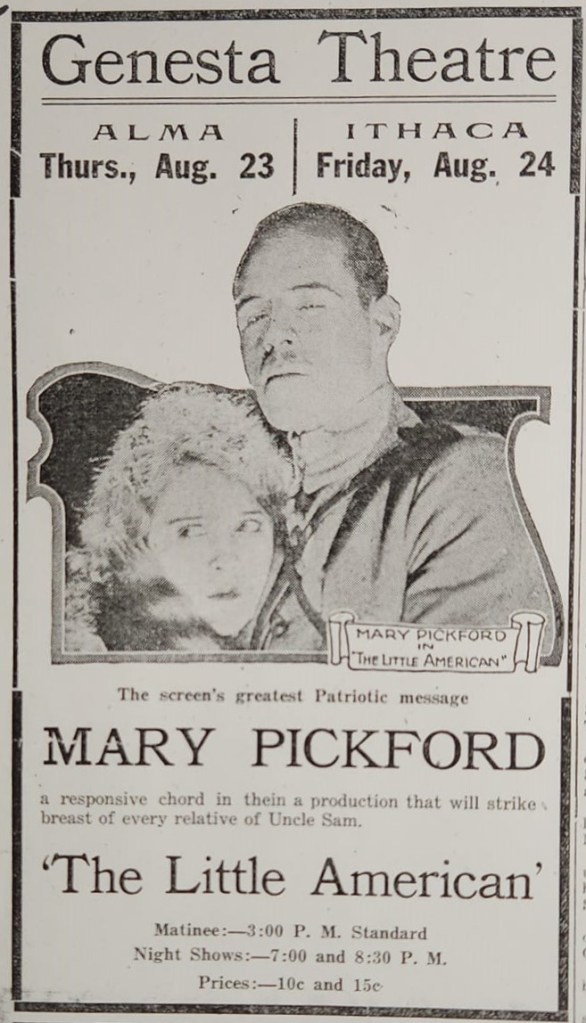
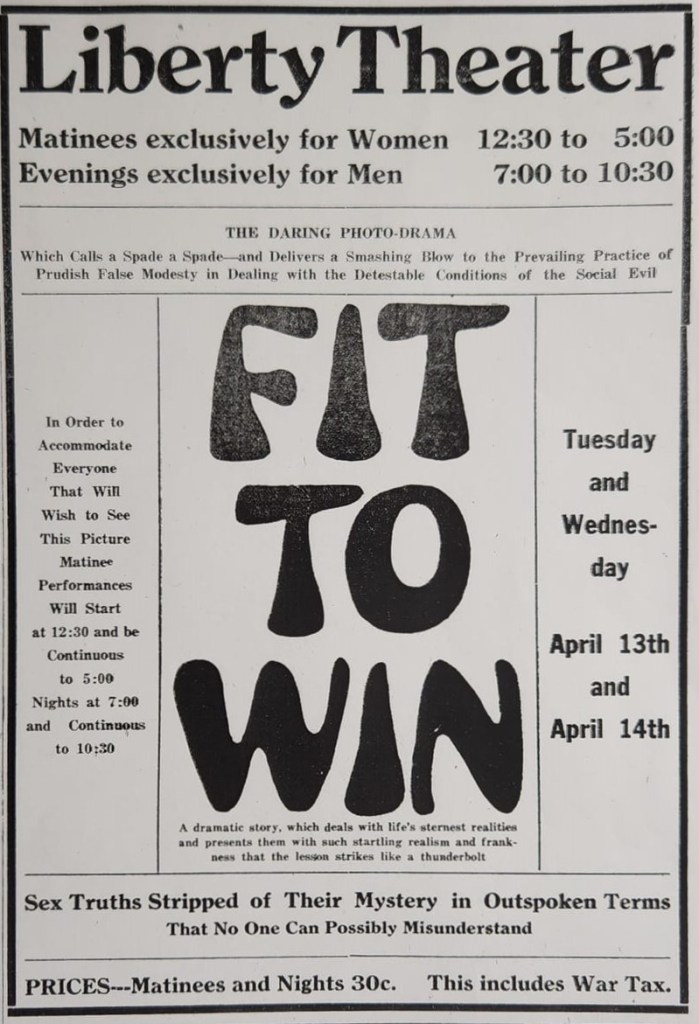

Above, participants in the first “Movie Wars” in Alma: Gilbert Genesta’s Genesta Theatre sought to keep bringing in viewers with stars like Mary Pickford in August 1917; after buying out Genesta, A.H. Ashley sought to show many World War I themed movies in May 1919; Douglas Fairbanks was a draw at the new Idlehour in June 1919.
In the summer of 1916, America slowly drifted toward involvement in what was then called the Great War. Another type of war was soon to take place in Alma. This war would take place over the attention and business that movie viewing created in Gratiot County.
By this time, Alma also had a new theater, “The Idlehour,” which opened for business in July 1916.
To draw people in, Clarence A. Miller, the Idlehour’s proprietor, promoted his new theatre as “The House of Good Shows.” Miller announced that he would show Paramount five reel features two days a week for viewers. Anyone dissatisfied with watching one of his Paramount pictures only had to say so, and the cost of their ticket would be refunded, which would be fifteen cents. Also, Pathe Pictures, a newsreel shown before the main movie, was shown three nights during the week, and bargain days occurred on Thursdays when anyone could watch a Metro Feature photoplay for ten cents. Pathe Pictures also became the first to show colored pictures in Alma when this took place on the second night the theatre opened. The Idlehour also used a continuous picture system, ending the delays in changing films. Another new addition, the Wagner white light converter, took the “flicker” out of pictures so everyone in the theater enjoyed sharp and clear images, no matter where one sat. Best of all, the theatre had a new and improved ventilation system which kept the air cool and clean. Inside, patrons also saw the newly cleaned and painted theatre walls.
Six months later, Miller installed new electric signs gracing the front and hanging out over the sidewalk. These white lights projected against a large green glass shade and spelled “Idlehour.” Anyone walking downtown Alma at night could see the marquee from a distance.
When the Idlehour opened, Gilbert Genesta had his challenges and renamed his theatre across the street the Genesta Theatre. It started when a group of concerned citizens approached the city council over the types of “social problem” movies showing at the Genesta on Monday nights. Gilbert Genesta developed a policy prohibiting children from being admitted on Monday nights because of what he called “the maturity of the movie plots.” Genesta also tried reassuring the public that he only showed movies the motion picture industry approved.
Later, in the summer of 1918, the theatres faced their first health threat when an infantile paralysis epidemic hit Michigan, forcing movie theatres to close. Although health officials in Alma monitored the situation, they did not close the theatres in the city. Unfortunately for the Alma theatres, another health crisis, the Influenza Epidemic in October 1918, would close them all for some time.
The Genesta Theatre attempted to further combat competition by installing a new Emerald Glo screen that eliminated distortion. Genesta also featured movies with war themes like “War Brides,” “Civilization,” and “Mothers of France.” Sometimes, he tried to sell more tickets by putting on some of his magic and illusion acts, such as “The Great Genesta.” Once the United States officially entered the war in April 1917, Genesta opened his theatre for high school students and gave Red Cross benefit shows. Genesta did this while maintaining this theatre and another one he bought in Ithaca. Sadly, shortly after the government forced the closing of movie theatres on Sundays to conserve fuel for the war effort, Genesta surprised many by selling his Alma theatre and appearing for a moment to move on from the movie business.
A.H. Ashley became the new owner of the Genesta and quickly changed the name to the “Liberty Theatre” to coincide with the patriotism shown at that time with America’s involvement in the war. He updated and rewired the Liberty, put in a fireproof picture booth for the film machines, and placed a new electrical sign out front. The Michigan Light & Power Company helped Ashley with putting up the lights.
However, the Idlehour was increasingly popular with moviegoers during much of the war, drawing business away from the Liberty. The largest crowd to ever see a movie until that time in Alma occurred in May 1918 when the war drama “The Unbeliever” was shown at the Idelhour. Still, the Idlehour also went up for sale a month later when the backers of Liberty bought it and then owned both Alma theatres. A.H. Ashley managed both locations, and his backers briefly had another monopoly in Alma. However, there would soon be a new competition on Superior Street. The influence of this theatre would go on in Alma for over seventy years. This new movie house would be called the Strand Theatre.
Copyright 2024 James M Goodspeed
 Goodspeed's Gratiot County Historical Blog