

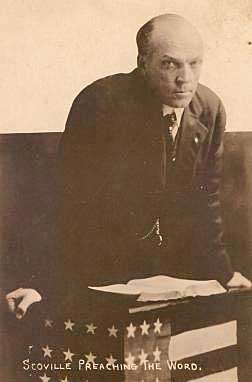
From the top, Scoville Meetings: headlines from the Alma Record announce the coming of Charles Reign Scoville’s revival meetings; a Scoville meeting for “men only,” held in Akron, Ohio probably ten years before the Tri-County Meetings which centered around Alma; undated Scoville publicity photograph taken prior to arrival in Gratiot County.
In June of 1926, a hurricane rolled into Gratiot County. However, this time, it was not a storm but the coming of Evangelist Charles Reign Scoville and the Tri-County Crusade. These religious meetings took place primarily in Gratiot County, featuring one of the leading American evangelists of the early twentieth century.
Scoville had been an evangelist for eighteen years, having conducted many successful meetings in major cities in the United States and Australia. A well-educated man who had also served briefly as a Chicago pastor before coming to Alma, Scoville reportedly once spoke to more people in a single religious campaign in the United States at that time than any other living evangelist. In one meeting in Oklahoma, he saw over 1500 people converted. Another campaign in Anderson, Indiana, made national headlines because it was the most extensive campaign held in a church building by one congregation, gaining over 1200 converts. Even Billy Sunday, a leading evangelist in America in the 1920s, believed Scoville then to be the most outstanding evangelistic speaker in America.
The Christian Church and its congregations in three mid-Michigan counties hosted many Scoville Meetings. While other congregations participated, the Alma East Superior Christian Church became the central location. Initially, Scoville’s coming to Alma led to announcements that the church probably could not contain everyone and that a large tent would be needed outside to seat everyone. Because of Scoville’s notoriety, area churches began to reserve seats well in advance to attend one of the East Superior Christian Church services.
A frontman, Samuel Bishop Pack, arrived in Alma days ahead of the rest of the Scoville team to guide the churches and to tell them what to expect. Fresh off of meetings in Winston Salem, North Carolina, the five-person Scoville team started the Alma meetings on May 30, 1926. Arlene Dux Scoville, the evangelist’s wife, came as part of the team and was one of the most accomplished soloists of 1920s gospel music.
However, Charles Reign Scoville’s preaching drew people into the churches like a magnet – and the people came. Speaking often twice a day, and frequently three times on a Sunday, “with impassioned gesticulation, his voice trembling with emotion, his eyes flashing fire, his forehead furrowed with frowns of contempt,” Scoville was like a machine gun, easily uttering 250 words per minute. As audiences sat listening intently to this evangelist, it was clearly evident that Scoville knew how to preach. Every ear of the listeners remained alert, and every eye was on him during services. Observers noted that those who usually slept in church stayed awake and remained engaged during Scoville’s topics. On one evening, his famous sermon, “Traps and Tricks of the White Slavers,” warned Gratiot County about the dangers and evil of white slavery. In this message, Scoville detailed how girls as young as twelve were stolen every year in American cities, never to be heard from again.
Other messages dealt with the evils of bootlegging and how America could never repeal Prohibition. In addition, Scoville proclaimed that bootleggers also needed to be thrown in jail until they died and all of their property confiscated. During a patriotic rally on a Tuesday, Scoville and his wife donned their army uniforms from World War I, describing how they had served during the war. When he was not preaching, Scoville went out and visited many places in Gratiot County, such as schools, businesses, factories, and community organizations. Through all of this, his charisma and personal approach appealed to many.
At the end of each meeting, people came forward, shook Scoville’s hand, and then headed to “the inquiry room,” signifying their answer to Scoville’s message and acceptance of Christ. In many churches, the Scoville services became the greatest ever held in that church or town. By the time the meetings concluded on June 27, 1926, almost 400 people had been converted, and the Scoville meetings shook Gratiot County.
Copyright 2024 James M. Goodspeed
 Goodspeed's Gratiot County Historical Blog