
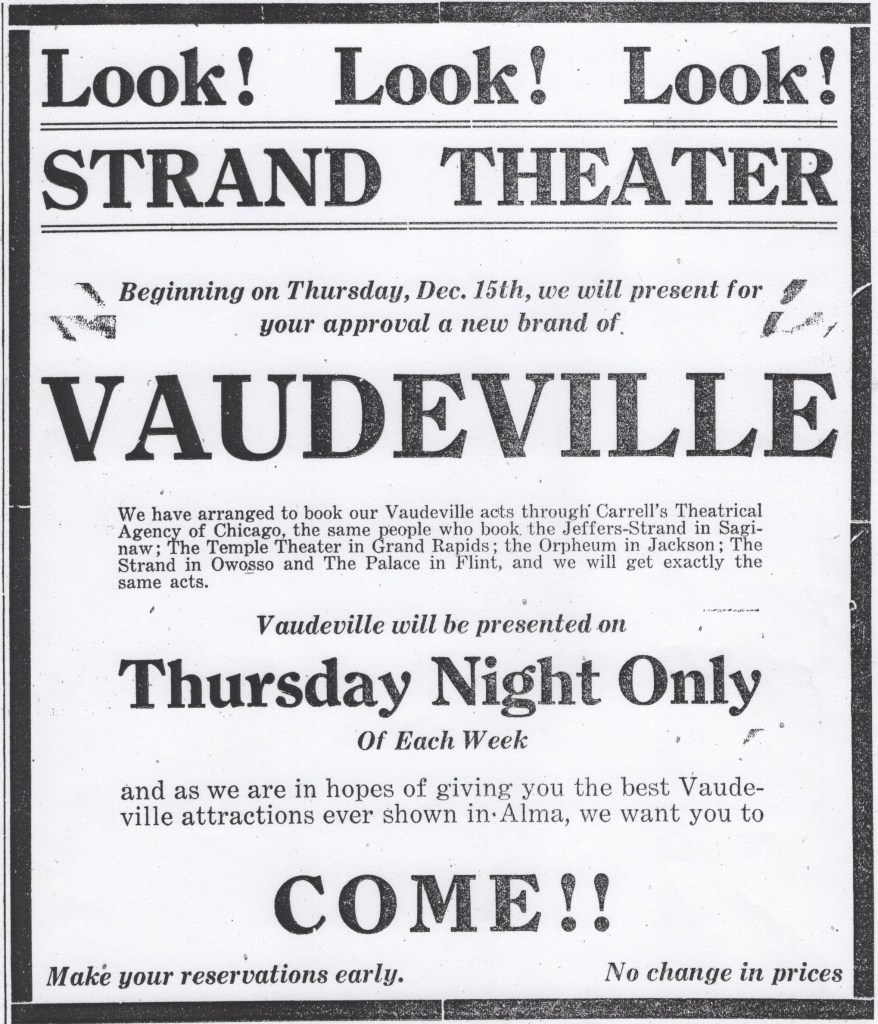
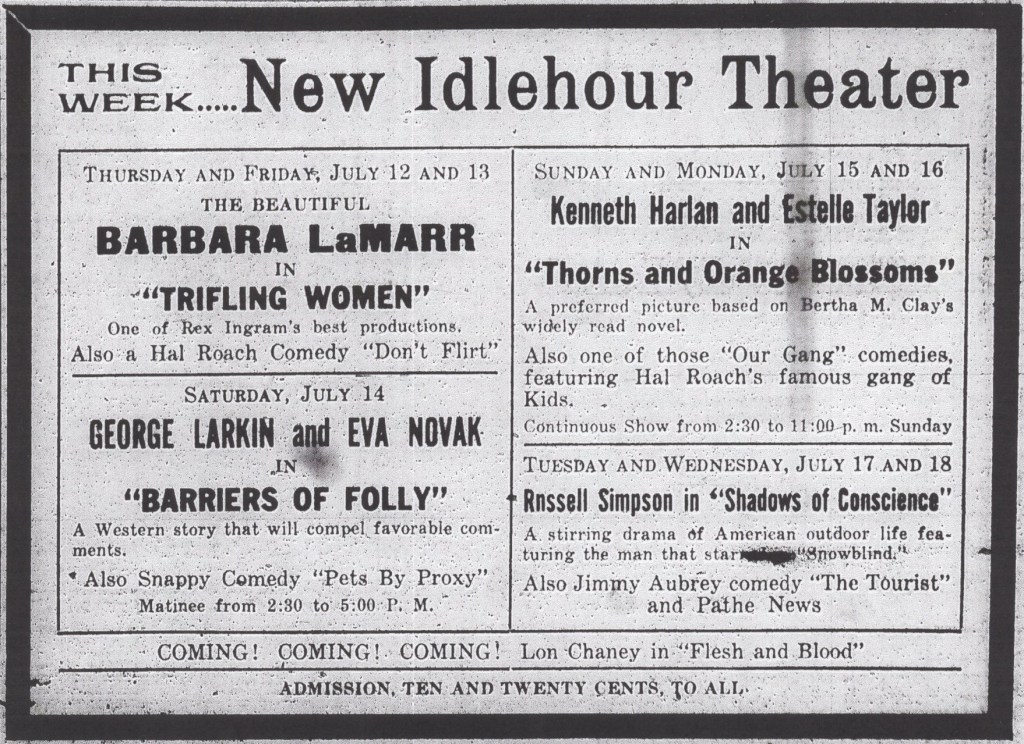
Above: Cecil B. DeMille’s epic arrives at the Strand in July 1925; vaudeville was also a part of going to movie theatres in the 1920s. At the Strand, acts took place once a week in December 1921; the Idlehour Theater was the other competition in Alma. It sought to compete with the new Strand Theatre up the street. Advertisement from July 12, 1923.
As America entered peacetime and started its journey into the 1920s, big movies, and new entertainment came to Gratiot County. World War I, the most significant and deadly conflict in human history to that date, remained a prominent theme. Mack Sennett’s “Yankee Doodle in Berlin” was one of the first major movies to come to the Strand Theatre just after it opened in early 1920. Other big draws included: “Tarzan,” “The Sheik,” and “The Ten Commandments.” One of the most popular movies, “The Phantom of the Opera,” came to the Idlehour Theatre in November 1925 and immediately sold out. By that time, matinees in 1920 only cost a viewer 11 cents. By 1925, tickets rose to a quarter.
The popularity of movies after World War I brought with them public concerns. Content in some films, as well as news coverage of the personal lives of movie stars, led to calls for censorship. Fatty Arbuckle, a well-known Hollywood actor, was reportedly involved in a booze party and the murder of a young Hollywood actress. As his story unfolded in the press, “Hollywood morals” became a topic of concern nationwide. Clergy and national and state politicians argued for censorship out of fear of how movies affected young people and children. In Gratiot County, some citizens urged the Alma City Commission to become involved by ordering local censorship. However, there is no evidence that the commission ever intervened.
In addition to movies, local theatres in the 1920s frequently showed musicals and vaudeville acts. A nationally known musical, “Robin Hood,” featuring fifty players, brought many to the Strand in 1920. Still, a special stage had to be built due to the size of the play. The mysterious Nalla Axmi informed people in Alma that he could read their minds. In an Alma Record advertisement, people were told to write down any question before coming to the Strand Theatre, and the mystic could answer it. Advertisements read, “ASK HIM – HE KNOWS.” “The Cat and the Canary,” a famous murder mystery play, entertained viewers in late 1925. Other performers like the Blackaller Players, the Sunshine Revue, and Bell’s Famous Hawaiians came to Alma, usually on weekends. Theatres frequently turned to agencies to book a traveling vaudeville act. Baby Dodo Reid, a well-known six-year-old entertainer, came to Alma in 1922 with great acclaim to draw people. During the summer, local merchants offered free vaudeville performances to drum up business.
Movie owners used other ideas to attract people to the movies in Alma. The Strand Theatre announced its first arrangement with a lyceum course, bringing dramas, professional artists, and lecturers. After the war, money made from some ticket sales went to organizations that helped starving children in Europe. In the fall, the Strand offered free movies for area farmers. In another promotion, some moviegoers were once surprised when, after a vaudeville performance, a well-known young couple got married on a Friday night. The newlyweds, never publicly named, received fifty dollars from the theatre and gifts from area merchants.
The Strand put in a new pipe organ solo a year after it opened, enabling moviegoers to sing along as songs appeared on the curtain. By late 1921, the Strand installed a new heating system during the winter to improve circulation. A new screen called a Gardiner Velvet Gold Fibcare Screen and new satin curtains also debuted. Supposedly, viewers could now pick out differences in tone in a black-and-white picture, and the curtain gave sharper, more detailed images without hurting one’s eyesight. Yes, the movie business in Alma was taking off and improving in the first half of the 1920s.
Copyright 2024 James M. Goodspeed
 Goodspeed's Gratiot County Historical Blog