


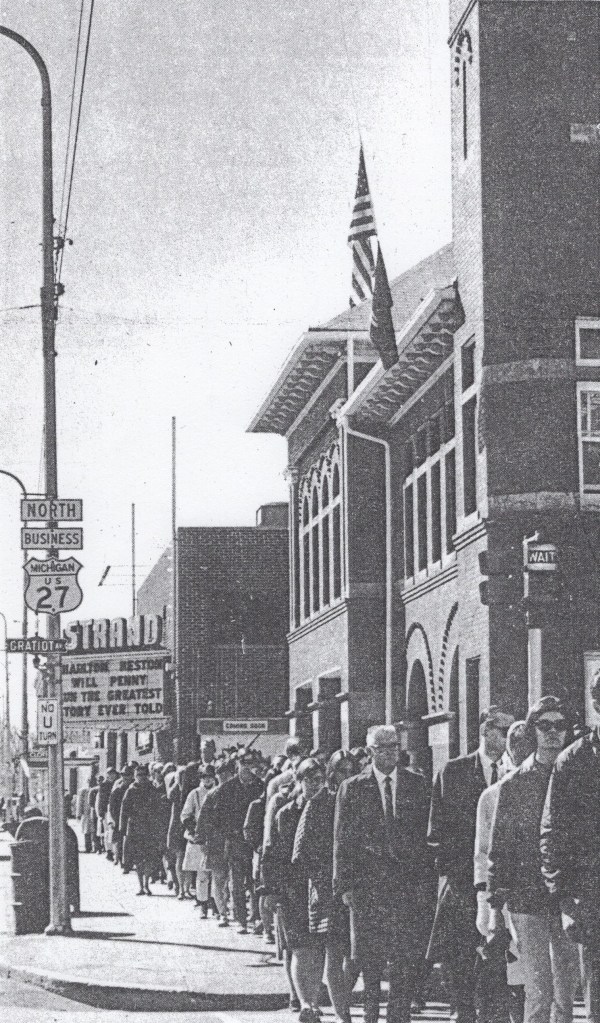
The Strand Theatre in the 1960s from the top: Keith Musser became the owner of the new Strand Theatre in 1962. One of the improvements in the new Strand was his installation of two 800,000-candle power projectors; Musser’s gift at movie promotions worked in Alma. Here, a group engages in a “Twist contest” in front of the Strand in late April 1962; “HELP!” was the call that drew many teens to see the Beatles’ first movie in late October 1965; the changing times and conflicts of the 1960s can be seen in this memorial service walk conducted by over 200 Alma College students and faculty members in front of the Strand and City Hall. All silently recognized the tragic assassination of Reverend Dr. Martin Luther King, Jr. in early April 1968. The walk stopped the traffic in downtown Alma for a few minutes without incident.
After opening in the late winter of 1962, owner Keith Musser sought ways to draw people to Alma’s new Strand Theatre. Musser’s efforts as a promoter and showing of memorable movies continued throughout the changing times of the 1960s.
In many ways, the Strand Theatre during this decade could be called “The Era of Keith Musser.” In one of his first promotions after purchasing the Strand, Musser started a “Twist Contest” in May 1962, where female contestants stepped onto a large platform in front of city hall. The first round of the “Twist-off Contest” coincided with the debut of the movie “Twist All Night.” WFYC radio broadcasted the contest finals, and winners received $25 in cash prizes. The next night, Greening’s Chevrolet Buick gave away a “beautiful jalopy” for anyone who could guess the nearest mileage on the old car. A year later, Musser hired magician Dennis Loomis to escape from a straitjacket while hanging upside down in front of the Strand.
In April 1965, Musser hyped the debut of a new James Bond movie by having a yellow convertible on loan from Mike Pung with the movie title “GOLDFINGER” hanging on the sides. The car also had four lovely girls inside, and the vehicle paraded around Alma. For Christmas 1965, Musser again displayed the Ruskovic Mastodon bones, found in Emerson Township in the 1950s, to the public. Two years later, Musser held a contest where only “red-blooded” teenage boys could win a date with “a real live girl bomb.” He then added that the Strand was “not responsible for explosions.” There were also children’s draws on Saturdays, like when Channel 6 sent His Honor the Mayor and Al E. Khatt to perform live on stage. All of these promotions appeared in local newspapers and sought to draw people to the Strand.
During this decade, the Strand made many improvements inside, such as investing in an 800,000-candle power projector to show Cinemascope and widescreen movies. Musser also installed new drapes in the theatre and purchased a new popcorn popper. He then gave away free popcorn to those passing by the theatre. Free movie passes appeared for contests and giveaways through local newspapers. Twice, on opening night, the Strand invited the public to meet actors who starred in films that were showing, like “Hawaii” and “The Green Berets.”
To those who saw them, movies at the Strand during the 1960s regularly depicted America’s ongoing social changes. In late October 1965, the Beatles starred in “Help!” Musser wanted adults to attend and sarcastically guaranteed that teenagers would not scream during the movie. “My Fair Lady” (1966) was a successful musical comedy movie with solid appeal. So was “The Sound of Music,” which ran for three weeks straight in 1967 and was one of the longest runs at the Strand during the decade. A year later, a movie addressed America’s racial issues in “Guess Who’s Coming to Dinner?” It played one month before the assassination of the Rev. Dr. Martin Luther King, Jr.
Sometimes, trying to show different kinds of movies brought about conflicts in Alma. In October 1968, the Strand started showing adult movies, and when “Ulysses” appeared, the movie was met with public opposition. That night, many Alma College students got up and walked out due to the movie’s excessive use of profanity. In response to the walkouts, Musser immediately canceled the show and replaced it with a rerelease of “The Sound of Music.” A year later, the Strand showed its first “X” rated movie, “Midnight Cowboy.” Letters supporting and demanding the use of the nation’s first movie rating system soon poured into the newspapers. All of these letters opposed the showing of adult movies in Alma. While some writers strongly urged parents to screen films before allowing their children and young people to see them, many Gratiot County residents wanted the X-rated movies banned entirely.
Yet, as the decade of the 1960s closed, the Strand Theatre had seen its best days regarding movie attendance. As the 1970s approached, a slow decline began, from which the Strand, like other movie theatres in America, ultimately would not recover.
Copyright 2024 James M. Goodspeed
 Goodspeed's Gratiot County Historical Blog