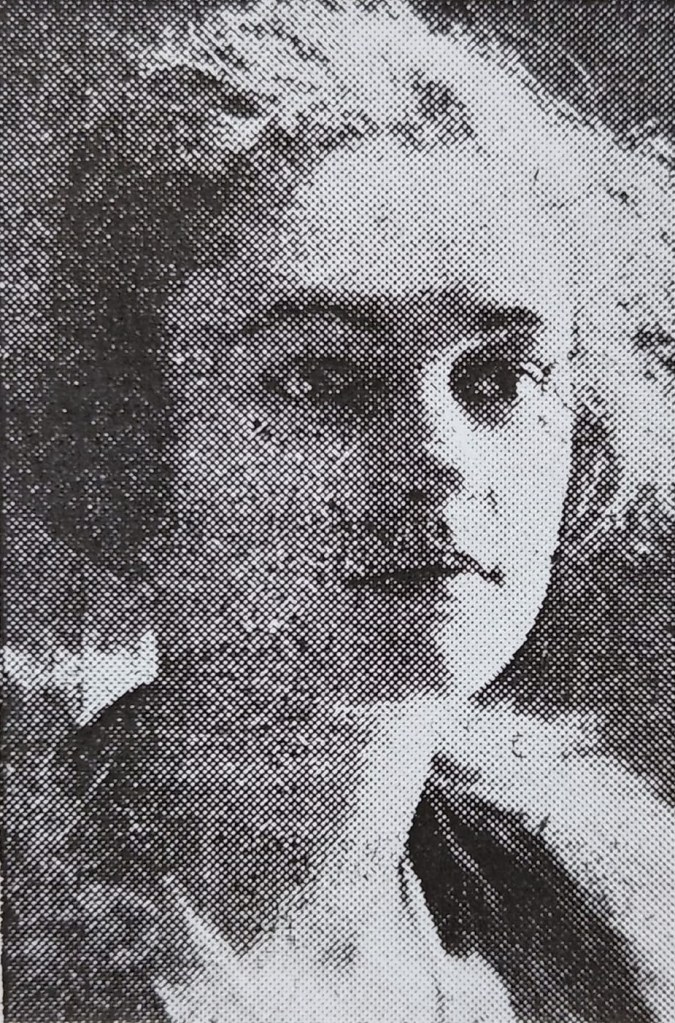
Above: An actual photo of the S.S. City of Alma taken in the 1920s; this postcard, supposedly of the ship, was issued with the ship’s name painted on the hull; Esther Rhodes, the daughter of a prominent Alma businessman, christened the ship at a ceremony in 1920.
Sixteen-year-old Esther Rhodes of Alma stepped up on the platform adjoining the ship’s top. Freshly painted battleship grey, the vessel was draped in many flags and streamers. Miss Rhodes then broke a bottle on the ship’s hull and pronounced, “I christen thee City of Alma.” Amid the cheering of the small crowd, the boat slowly slid into the water. With the christening, the group celebrated the culmination of a successful post-World War I war bond drive in Alma.
During the Fourth Liberty Loan Drive in late 1918, Alma earned recognition as one of Michigan’s largest purchasers of Liberty Bonds. Over eighty percent of the people in Alma bought a bond – a record for cities buying $10,000 or less in bonds. By raising over $403,000, Alma led Gratiot County in its effort to raise over $1,000,000 for the war effort that fall. Most of the time, Michigan towns and cities with successful bond drives had tanks named in their honor. After the war ended, the government turned to naming ships in honor of places for their work with bond sales.
On January 20, 1920, at 9:15 AM, nine people went down to the Bristol, Pennsylvania pier. Charles G. Rhodes, his wife, and daughter accompanied Alma’s Mayor Murphy and his wife. Rhodes was a prominent Alma businessman and was vice president and spokesman for the Republic Truck Factory. Two men who helped lead Alma’s successful Liberty Loan Drive, Lieutenant T.A. Robinson and Lieutenant D. Sullivan, also attended. Three people from United States Emergency Fleet Corporation offices also went along.
The ceremony to launch a ship took place at the Merchant Shipbuilding Corporation. Ten boats, in different stages of construction, could all be seen—one of them, the S.S. City of Alma was 417 feet long and 54 feet wide and belonged in the 9000-tonnage class. Onboard, it had “palatial quarters” for its ship’s crew and officers. A fabricated type of ship, it had rolled plates in the hull. These plates had holes punched into them at steel mills hundreds of miles away, a result of a type of production that sped up the building of ships during the war. This ship also had 3000 horsepower and burned oil on three boilers, but it could be converted to coal if necessary.
Still, during the Alma visit, the new vessel was unfinished and would not be ready for several weeks. Despite the delay, the Alma group received a tour aboard a similar ship in the naval yard, and a set of the S.S City of Alma’s blueprints and official ceremony photos went to Alma City Hall for display. When it became seaworthy, the new ship was assigned to the United States Shipping Board and then to the American Steamship Line. The vessel eventually belonged to the Waterman Steamship Company in Mobile, Alabama, during World War II, even though the United States Maritime Commission controlled the boat through a charter.
However, the story of the ship had a tragic ending. On June 3, 1942, while carrying 7400 tons of manganese ore and 400 miles northeast of Puerto Rico, a German submarine, U-172, sank it with one torpedo. The ship sank within three minutes, and 29 out of 39 men aboard died. The ten remaining crew members floated in a lifeboat for four days before being rescued.
Sadly, after 22 years of service, the S.S. City of Alma went to the bottom of the Caribbean.
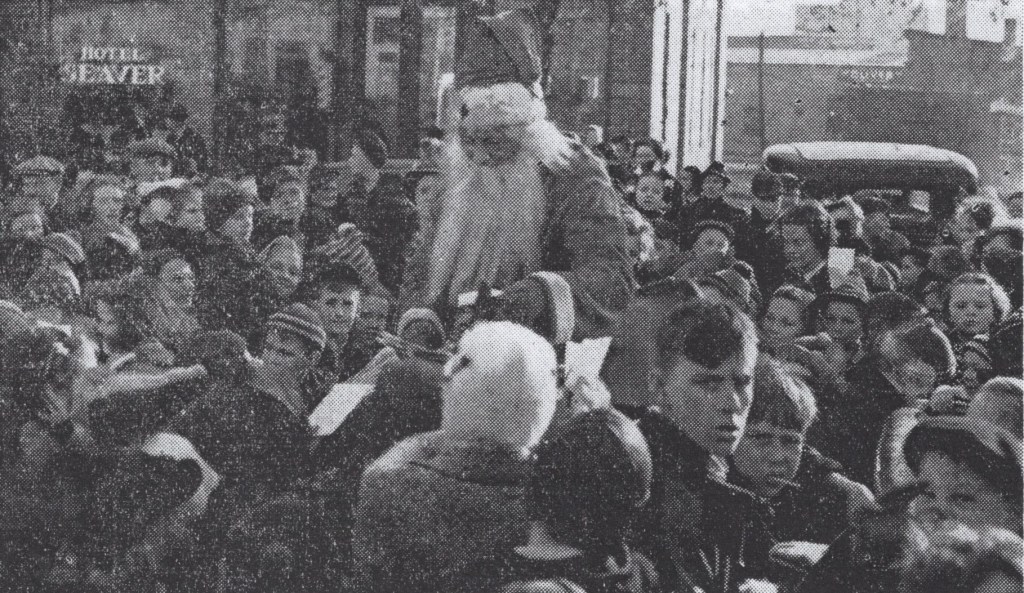
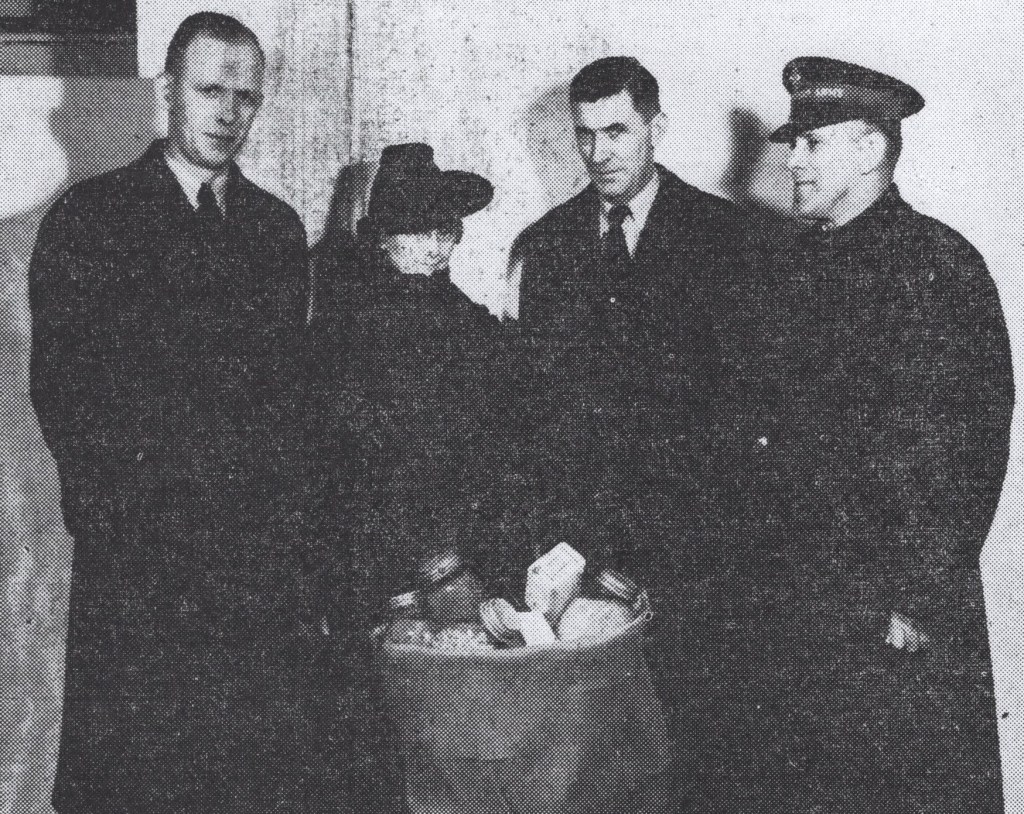
Gratiot County prepared for Christmas in December 1939: Santa arrives in Ithaca, this time in an automobile. He made more than one trip to the village before Christmas; the Alma Community Christmas League distributed Christmas baskets to 130 families in the area. Pictured from left are Clare Fillmore, Effie Ullman, Fred Towersey, and Captain W.C. Davis of the Salvation Army; the start of the Second World War dominated the year in a review regarding the news.
As winter approached, the beginnings of the Second World War seemed distant and unrelated to Gratiot County. Places with battles and conflicts like Finland and Uruguay made Gratiot residents pull out their world atlas to see where things happened.
The Depression meant again that the holiday season for many in the county would again be a hard one. Santa was here, and trees, houses, and buildings were lit to start the holiday season.
It was December 1939 in Gratiot County.
News during the Depression
The Alma Community Christmas League needed help for the upcoming Christmas season. To prepare toys as gifts for Alma youngsters, NYA (National Youth Association) workers moved from working on the Conservation League improvement project to working in shifts in the Salvation Army’s basement. WPA (Works Progress Administration) crew members resumed projects due to the mild winter weather. Work on Elwell Street resumed after a six-week layoff, and then the crew moved to East End Street. About forty men worked on this WPA project.
Gratiot County supervisors continued to prepare for the new county social welfare commission. The commission needed to appoint a collector who sought reimbursement from adults who had been hospitalized and received treatment at county expense. The county also sought to get reimbursement from parents of disabled and afflicted children who initially pledged to reimburse the state for their child’s treatment. An estimated $25,000 to $30,000 remained outstanding in Gratiot County and the county welfare relief fund had a balance of $1,938.85.
The State of Michigan’s general fund deficit grew, even though many said business conditions were improving. As of June 30, 1939, the state was $30,651,842 in the red, up over $2.2 million in the last few months.
Charles H. Reed became the president of Club No.1 of the Townsend Recovery Plan in Alma. Reed believed that the Townsend Plan, which attacked the financial needs of the elderly, would remedy the problems created by the Great Depression, including unemployment for young workers. Club No. 1 had 310 active members in Alma.
The World at War
Red Army troops broke the primary defenses at Finland’s line of defense north of Leningrad. The Soviet Union continued to invade Finland. News from Uruguay reported that the German battleship Admiral Graf Spee sank in an estuary. The commander tried to avoid turning his ship over to the British before scuttling the damaged vessel. Two other German sister ships that preyed on Allied shipping remained at sea. Holland tried to protect its waters through an intricate system of underwater mines, and the country continued to move munitions to its forts in anticipation of invasion by the Nazis.
Major George Fielding Eliot was a lecturer at the Gratiot County Town Hall Series in Breckenridge. Eliot spoke to 750 people about world war conditions and what to expect if the United States got involved. Fortunately, according to Eliot, the United States was geographically blessed and was outside of possible airplane attacks. Major Eliot had a vast audience of readers and listeners through Life Magazine, CBS Radio, the New York Herald, and Look Magazine.
American farmers received news that France ordered over 6,000 horses from the United States. France needed horses for its farm and army work to conserve gasoline, and its demands improved the horse market.
Christmas 1939 Comes to Gratiot County
The Santa Claus Club, an organization of fifteen clubs in Ithaca, met to create a united Christmas program for the village. Santa arrived in Ithaca to greet children on Saturday, December 9, following the Ithaca High School band. This time, Santa arrived in an open automobile, and the American Legion Post helped distribute over 1500 candy bags to those in attendance. Ithaca also had its annual Window Night, where the village celebrated the start of the Christmas season. Village officials gave out over 1000 tickets for the fifty prizes awarded to those who attended the Friday night lighting of downtown businesses. Although it rained that night, Santa promised to return to Ithaca the following weekend.
St. Louis also had a Window Night opening ceremony on the same night as Ithaca. Monroe Drug Store won first prize for depicting a mountain village and painted background. Those who passed Doctor Waggoner’s home on East Saginaw Street saw large red candles at the doorway’s entrance and red flood lights on the lawn. The Percy Wheeler home at 215 S. Delaware won first prize for having lighted wreaths in the front windows and a lighted tree in the corner of the house. The Wheelers were awarded ten dollars. The Arthur Stinsons and Carl Johnsons finished second and third. In downtown St. Louis, the community hall had a large star, and the Meteor Café had a giant Christmas tree on its roof.
Alma also had activities during the Christmas season. The Alma Community Christmas League provided food baskets for 130 families in the area, and they went out on Christmas Eve. The League got help from children who attended a free two-hour movie at the Strand Theatre. The cost of admittance was either to donate food or a toy. Before the Christmas Eve basket deliveries, the League also had an extensive Christmas program for the town’s youth at the high school. A group of 650 children showed up and received clothing, toys, dolls, and sweets. The gym also displayed an 18-foot-high Christmas tree, and George Urtel, city treasurer, appeared as Santa Claus. A committee made up of Chester Robinson, Mrs. L.R. Kamperman, and J. David Sullivan judged Alma homes engaged in the town’s Yule Decorations Contest. Two contests were offered, one for institutions and the other for homes. As one walked around Alma, businesses like Van’s Wallpaper and Paint, the Strand Theatre, Holland Furnace Company, and Rademacher Motor Sales all had eye-catching Christmas displays for the public. Just before Christmas, city hall lit its large, illuminated white cross with a red frame. As people walked downtown, music played from the second floor of city hall, courtesy of Chamber of Commerce officials and City Manager Reynolds. Fourteen records of Christmas music played one after the other once the record machine started.
One of the big things people saw in Gratiot County that Christmas was a mammoth billboard located on the curve 2 1/2 miles northwest of Alma on the US-27 trunkline. Both cars and passengers on the Ann Arbor railroad could see the rectangular billboard that measured 120 feet long, 20 feet high, and 10 feet wide. The billboard featured a likeness of the Holy Bible, lit up by 24 electric lamps, and displayed a Biblical quote. The sign was sponsored by an Alma and St. Louis resident who had support from Casey Vander Jagt of Grand Rapids, known as Michigan’s sign evangelist. Vander Jagt had other signs constructed along many Michigan highways in 1939.
Farm Life in December 1940
As the decade of the 1930s ended, Gratiot took stock of its schools and students. County school commissioner Donald L. Baker told an audience at the Ithaca Rotary Club that in 75 percent of the school districts, the only people attending each annual meeting were school officials. In 1939, 122 one-room rural schools operated in Gratiot County. Four schools had two rooms, and two had three rooms. In only two instances did the schools have four or five rooms. Three hundred school teachers worked in the county and were employed in 131 school districts. 9,829 students were enrolled, including 5,097 boys and 4,731 girls. In this group, elementary schools had 4,778 students and 2,452 in high schools. It cost nearly one-half million dollars to run the schools, with $393,000 coming from state aid and $107,000 from local taxes.
The Ithaca Board of Education offered a part-time evening school to an estimated 150 boys in the area regardless of whether they finished high school, had never attended, or dropped out. The Agricultural Department conducted the program, which offered training for those who wanted to learn how to rent their farms, buy livestock, buy a farm, or feed farm animals. All boys between sixteen and middle age were invited to participate.
Life on the farm could be dangerous, as Ed Altenberg of Ithaca discovered. Altenberg, who worked at Balmoral Farms west of Ithaca, broke two ribs and was knocked unconscious by a bull. The bull quietly entered a pen from the yard and threw Altenberg six feet in the air before Arch McCall could pull Altenberg to safety. The bull was considered one of Balmoral’s best show animals and had not caused problems until the last year. In better news at Balmoral Farms, ten more purebred Ayrshire cattle arrived from Quebec, Canada. The farm initially started with 75 head of Ayrshires and was a new breed in Gratiot County. Only two cows remained from the original herd that James E. Davidson began in 1925 – Springburn Lucky Girl 6th and Springburn Lucky Girl 9th.
The Ithaca Elevator Company offered a free color movie entitled “Vitamins on Parade” at the Ithaca High School gymnasium. A professor from Cornell University also planned to talk about “Solving Our Poultry Problems.” At the south end of Gratiot County, the Middleton Farmers’ Elevator Company opened a feed department in a new building that measured 20×40 feet. This new building also had seven overhead bins that held 4,000 to 5,000 bushels of grain. The elevator also had a new corn sheller, giant grain cracker and grader. As a result, Middleton now hosted one of the nicest feed elevators in central Michigan.
4-H county club enrollments reached a new high for the winter when Riverdale Hot Lunch Club entered 23 members, and North Star Clothing Club enrolled 12 members. The new county total reached 1,020 members, up from 986 the previous year. During the first year of 4-H in Gratiot County, 40 club members enrolled, and 14 completed the program. In 1935, the numbers included 393 county members with 360 finishing.
The St. Louis Lake Shore Sugar Company announced that beet slicing for the 1939 harvest season would end around December 18-19. Lake Shore processed 81,672 tons of sugar beets. However, the company experienced a fire that started in the bottom of a flue in the pulp dryer and destroyed the building’s cupola. Damage, estimated at less than $1,000, was covered by insurance.
The Long Arm of the Gratiot Law in December 1939
Several arrests and searches took place in December. The Gratiot County Prosecuting Attorney, Robert H. Baker, announced that 75 convictions had been made in November. Traffic law violations made up a total of 46. Fines totaled $539.
Four Gratiot County criminals were all arrested after being on the run for nearly one month. The group confessed that they committed safe robberies in Gratiot, Midland, Saginaw, Bay, and Huron counties and were captured in Columbus, Ohio. All were in their twenties. A trio of young Ithaca men were arrested for the robbery of the Ithaca Dairy when they made off with just over $60. Byron Campbell, Clarence Hyde, and J.C. Wheeler were initially under suspicion, but police could not tie them to the crime. After their arrest, Campbell and Hyde both were placed in solitary confinement for up to 20 days. Wheeler, who concealed some of the stolen money from the car, said that police must have taken it but later pled guilty to a fine of $27 and costs.
Issues with minorities and the law appeared in the news. The Floyd Goins case continued. Goins, a man of color, was charged with stealing 65 bushels of apples and 271 empty crates from Frank Beck’s orchard. Goins’ sons and wife were also arrested but later released. Goins testified that he purchased the apples from a dealer near Greenville. However, Goins had no proof of the sale. The trial lasted two days, and the defense ultimately produced proof of purchase of the fruit and argued that the crates were already at the Goins home in Washington Township when they moved there. Ultimately, Goins was found not guilty and discharged from jail.
Another newsworthy case appeared in Judge Kelly Searl’s courtroom when Jesse Perez, a Mexican beet worker found guilty of murder in 1936, requested a writ of habeas corpus. Perez killed another older beet worker on July 7, 1936, after a confrontation on a beet field near Elwell. Perez shot and killed Gonzolo Silba over where they worked on the field. Perez later claimed he was “railroaded” by the court and that the shooting was in self-defense. The court was confused about why Perez believed he did not get a fair trial.
In another case, the court dealt with a former WPA worker, Don Whitford of Ashley, who had been arrested three times within a few weeks for conduct while intoxicated. First, Whitford was found guilty of assault against a nine-year-old boy, and then again only a few days later in an assault against his son. In each case, public drunkenness was the issue. Over in Alma, police tracked down a pair of men after receiving 15 complaints against brothers Lane and David Lavoy, formerly of Elm Hall. The brothers siphoned gas from the cars and stole extra wheels and accessories. After their capture, the brothers were bound over for trial.
In December, the most significant crime news in Gratiot County dealt with Dewey Glinkie. Glinkie, a World War veteran with a troubled marriage and a drinking problem, was hired by Gratiot County Treasurer William G. Federspiel. Federspiel tried to help Glinkie by giving him a job, but over time became suspicious of Glinkie’s work. Then Glinke disappeared. As of mid-December, Dewey Glinkie embezzled up to nearly $2000. It would turn out that the Glinkie case would go on for years to come as Gratiot County law enforcement searched for the fugitive.
If there was any good news regarding crime in the county, it was that at Christmas, only six people resided in the county jail. People did not want to be in prison for the holidays – save one Don Whitford, who again returned to the friendly confines for violating the game law by having a pheasant out of season.
And So We Do Not Forget
Ross Clagg, an employee at Ithaca Roller Mills, narrowly escaped death when his clothing caught in the line shaft. While working alone in the basement, Clagg’s overalls became entangled while oiling machinery. During this dangerous ordeal, Clagg managed to brace himself long enough to avoid the machinery as it tore off the clothing from his body. The incident resulted in no broken bones, but Clagg was severely bruised around his shoulders, neck, and arms… A dozen Gratiot residents hurried to be among the first to purchase Christmas Seals for the 1939 Christmas season. Joe Battles and Dr. Robert Erwin were those from Alma who bought seals…The Alma Post Office was designated a first-class office by exceeding $44,450 in business for 1939. In 1934, the Alma Post Office managed $34,000 a year in business…The new Hamilton Church of God, located one-half mile south of Edgewood, opened its doors for services. Considered one of the finest rural churches in rural Michigan, it measured 36 x 70 feet with two wings, massive stone steps, and a 10×12 foot vestibule. J.C. Thompson had just arrived as the church’s new minister.
G.A. Giles returned to work at Giles Super Service Station after being confined to home for nine days with the flu…December 22 marked winter solstice, the shortest day of the year. Solstice was to arrive at 1:06 p.m. Eastern Standard Time…All teachers had to have their state teachers’ oath submitted by December 27. An estimated 70,000 oaths had been filed, and Michigan had 35,000 teaching positions…Recent cold, freezing weather meant three new inches of ice above the Alma dam. With its new construction and deeper water near the dam, the ice had a more uniform thickness. A new hockey rink was planned south of the dam on State Street, along with a smaller one at the Republic School and another at Wright Park. Tourist Park was also considered for a smaller rink for children.
Mrs. Leon Dawson announced that the Rainbow Inn in Elwell had re-opened for business. The new inn catered to those who wanted to dance and ate sandwiches and soft drinks. Gone were the elaborate chicken dinners…Reed’s Swing Band planned a “Midnight Frolic” for New Year’s Eve from midnight until 3:00 a.m…A new drug for treating syphilis became available in capsule form, according to Stanford University…The Marx Brothers appeared in “The Marx Brothers at the Circus” at the Strand Theatre…William Bourikas obtained a permit to enlarge the size of the Main Café Building at 117 East Superior Street. Bourikas planned to add a 20×24 foot addition to the back. Bourikas came to Alma during World War I and entered the business with Nick Bardeville…Hot December weather resulted in several people picking dandelion blossoms at Riverside Cemetery.
Vitamin consciousness emerged in Gratiot County as people purchased books on the use of vitamins. Stanley Vliet of the Alma Varsity Shop sold several copies of books on the subject… Approximately fifty people from twenty-four organizations met at the Rotary Room in the Wright Hotel to discuss a project for a city community center…C.P. Milhams hosted a venison dinner for fourteen guests at his home in Alma…The second annual St. Louis football banquet took place at the Park Hotel. The St. Louis Service Club sponsored the banquet for the 1939 squad. Black and red decorations, along with large cutouts of football figures, appeared at the dinner.
And that was Gratiot County During Depression and War, December 1939.
Above: Advertising on the Strand’s marquee told the story—decades of movie-going at the Strand Theatre ended in 1992; familiar Strand advertising from the 1980s until its closing.
It had been a long run, but in the early 1990s, over 75 years of movie-going ended in downtown Alma. At the start of the 1980s, the Strand Theatre faced severe challenges. First-run movies came late – if they played in Alma at all. In August 1981, Harrison Ford’s “Raiders of the Lost Ark” finally appeared nine weeks after being released in Mt. Pleasant. During Christmas 1981, the Strand closed for an entire month, although adults paid $3 and kids paid $1.25 to watch a movie. A year later, in 1982, the Strand started its policy of “All Seats All Shows for Only $1.50.” Even though these were generous ticket reductions, the VHS rental craze started, and soon, in the 1980s, one debated renting and watching a movie at home.
Determining who owned and managed the Strand during its last twenty years is a mystery, especially after owner Keith Musser died in the 1970s. Linda Apple became the Strand’s manager from 1981 to 1986; the theater had nine employees. By then, Apple reported that she only had five days’ notice to get a movie and could only plan showings two weeks in advance. Second runs were a norm then, except for an occasional big release like “Star Trek IV: The Voyage Home,” which debuted in December 1986 and had a large turnout. People knew that although ticket prices were low, prices remained high as concessionaires controlled the cost of candy, pop, and popcorn.
The end of the Strand appeared on the horizon by late March 1989. Steve A. Smith from S&R Investments announced that Alma would have a new $750,000 cinema complex in the Pine River Plaza, next to 300 Bowl. The idea of a new cinema corresponded to changes on Wright Avenue as it grew in the 1990s. A new Fisher Big Wheel store, restaurants like Taco Bell, and a new Wal-Mart came along. The new Alma Cinemas featured four screens, had a sign visible from US-27, and opened on September 15, 1989. The first movie shown at the Cinemas was “The Adventures of Milo and Otis.”
On February 16, 1992, a Sunday, the Strand closed its doors for good. For some time after this, a passerby wondered what would become of the old movie theatre with the marquee displaying a message that read “Closed.” However, another group had a dream for the Strand, and that came through the vision of the Gratiot County Players. They wanted the Strand but needed $80,000 from the owners, Craig and Kristin Naffziger. The Players pulled the deal together and showed old movies on weekends to help raise money to pay off their purchase. They eventually succeeded and held performances at the Strand several times each year.
A final goodbye to the movie days at the Strand took place on August 13, 2004. On that day, “Grand Slam at the Strand” was held as former workers and those associated with the Strand from the Depression through the 1950s showed up for a red carpet reunion. Interviews recalled the old days; visitors could leave handprints on the sidewalks. The grand old movie place, a fixture since its start in 1920, had this one last hurrah in Alma and Gratiot County. Looking back, it all began with the first movie at the Opera House. Alma’s movie history then played out with the Liberty, Idlehour, and Alma Theaters, in addition to two different Strand Theaters.
Copyright 2024 James M. Goodspeed
Did you know the Strand’s owners or managers from the 1970s to 1992? If so, please send me a note.





 Goodspeed's Gratiot County Historical Blog