
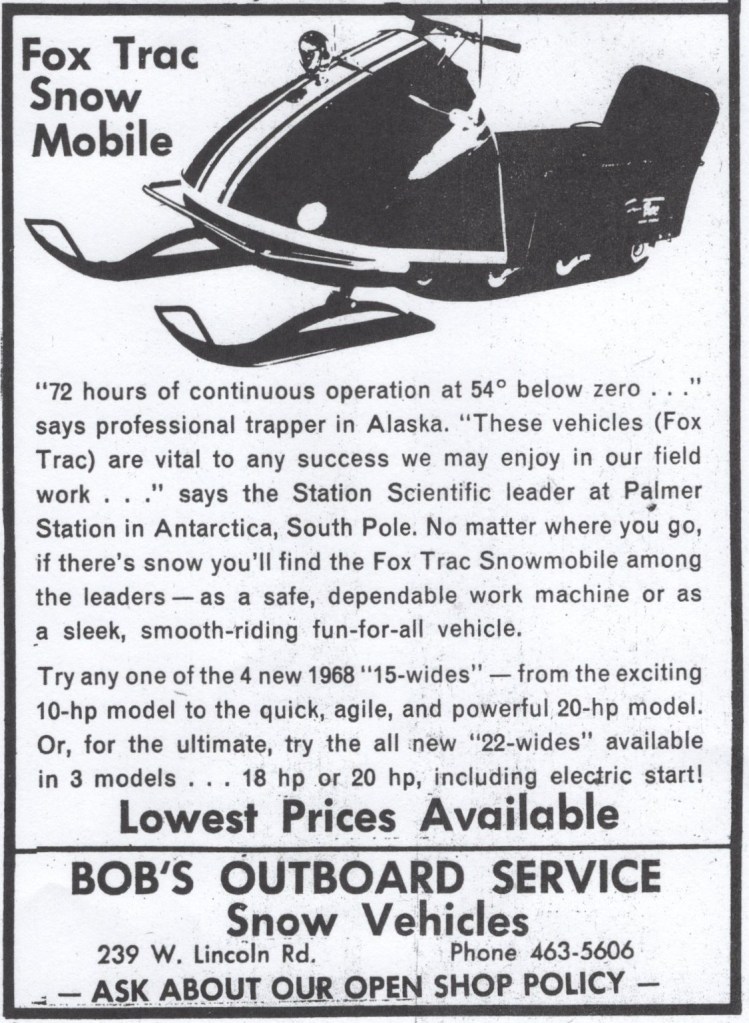


From the top, Early Snowmobiles in Gratiot County: Den Cooper of Ithaca advertised one of the first snowmobiles for sale in Gratiot County at Cooper Chevrolet’s New Showroom in December 1966; one of the first advertisements for snowmobiles for sale in Gratiot at Bob’s Outboard Service near Alma dated October 1967; one of the first county snowmobile rallies took place in early February 1968 at the Gratiot Center Historical Village. N.E. Trexler (left) and Arthur E. Williams showed two trophies to be given away; four determined Breckenridge men rode the 285-mile route of the Old Saginaw- Sault mail trail in less than 36 hours. That was after they drove from home to the Mackinaw Bridge; from left: Dick Alward, Dean Giles, Loren Humm, and Ted Humm.
They zoomed down roads across farmlands, bucking drifts, leaving gusts of snow and tracks on roads and trails. The sound of snowmobile engines used to be associated with long, even brutal Michigan winters. How and when did snow machines first arrive in Gratiot County?
Den Cooper of Ithaca displayed one of the county’s first snowmobiles at Cooper’s New Showroom in Ithaca in early December 1966, costing $699. In late October 1967, Bob’s Outboard Service at 239 West Lincoln Road in Alma sold a Fox Trac snowmobile three years after Fox Body Corporation in Wisconsin introduced the model. The company tested the Fox Trac to run for 72 hours in 54 degrees below zero weather in Alaska and even colder weather in Antarctica. The model came in “15 wides” with 10- and 20-horsepower engines. A year later, W.R. Miller Harley Davidson Sales west of St. Louis advertised the Ski-Doo, a faster, sleeker-looking machine. There must have been other early owners of snow machines and different models for sale in the mid-1960s, but the Fox Trac and Ski-doo appeared first in county newspapers.
By February 1968, an exploding snowmobile industry in Michigan boasted over 70,000 snowmobile owners. It provided a new facet of Michigan’s economy, “winter vacation.” As more people traveled north, there sometimes were more snowmobiles on lakes than those who owned boats. Snowmobiles in the late 1960s averaged between $650 to $1,300, depending on the model. In just a short time, snowmobiles’ popularity boomed. Gratiot County residents learned the names they saw and heard in the 1960s and 1970s, such as Evinrude, Arctic Cat, Suzuki, Polaris, and Rupp, to name only a few.
Invention and technology bring challenges, and it was not long before people in Gratiot County started to read about the tragedies and problems that came with snowmobiling. The first person killed in a snowmobile accident was Roger Alan Miller of Alma, who was only ten years old when his machine went through thin ice on Houghton Lake in late December 1967. Miller’s father also went through the ice but survived the ordeal. About one month later, a young Ithaca woman, Carolyn Shaull, lost her life due to a spinal injury she suffered in an accident. Other problems soon arose as farmers complained of broken fences, landowners complained of machines damaging seedling pines, and drivers called the police about those who drove machines on public highways. These problems emerged as snowmobilers sought places to run their machines in new areas to create or follow trails.
Gratiot County created opportunities in response to the many new snowmobiles in the area. One of these was the first annual snowmobile rally at the Gratiot Center Historical Village outside of Ithaca on February 4, 1968. The event offered 105 acres and an oval track for those who participated. N.A. Trexler and Arthur Williams co-chaired the rally, which consisted of seven events with four categories for contestants. All participants had to wear helmets. Two weeks later, the West Gratiot Jaycee’s Snowmobile Race occurred on Lumberjack Road north of Riverdale. Jaycee members Rex Sadler, Tom Dittenber, and Doug Bostrom presented trophies for those who competed in events. Although minimal snowmobile area existed near Alma, the Alma Outdoor Center opened southwest of the city, but only on weekends.
Snowmobile clubs also soon appeared in Gratiot County. Valdo Shankel organized the Central Michigan Snowmobile Club in Breckenridge, which boasted 25 members who went out on three-hour “safaris,” which included stopping for a wiener roast. The club met on Thursday nights at Anschutz’s Café. It taught new snowmobile owners and drivers how to operate their machines safely. A quartet of Breckenridge men made the news when they traveled from Breckenridge to the Soo in 36 hours in early February 1970. Four farmers, Dean Giles, Richard Alward, Ted Humm, and Loren Humm, left Breckenridge on a Wednesday morning, driving close to I-75 or M-27 to Gaylord, tried to follow a pipeline for a while, then returned to driving near the highway. The four men averaged 60 miles for every 4 1/2 gallons of gas in their tanks. Despite fighting rain and heavy snow in some areas, they eventually reached the Mackinac Bridge. After some local Mackinac snowmobile riders helped haul the Breckenridge men’s machines over the Bridge, they continued from St. Ignace using Old US-2, following an old mail route used a century earlier. One year later, Giles, Alward, Loren Humm, and Rodney Marr drove their Arctic Cats on a 1,200-mile trip to Thief River, Minnesota, via Sault St. Marie. Upon reaching Marquette, they had to buck seven and eight-foot drifts.
Breckenridge also appeared in the news in the late summer of 1970 when R&R Sales of Breckenridge sponsored the first Summer Drag Races for snowmobiles. The races took place on Mason Road and south of M-46, and a large turnout appeared to watch people run snowmobiles during a Gratiot summertime. Getting a snowmobile in Gratiot County in the 1970s was quite the thing. In July 1971, the St. Louis Summer Festival gave away a new Sno-Jet as the highlight of its festival activities. As the 1970s continued, Gratiot County increasingly became a “snowmobile county.”
 Goodspeed's Gratiot County Historical Blog