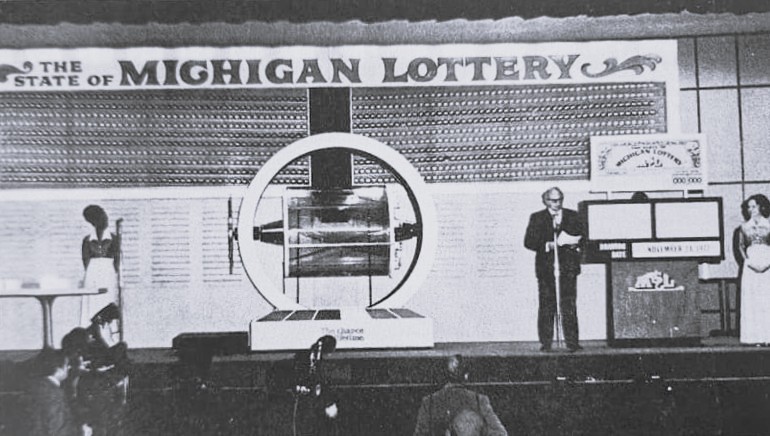


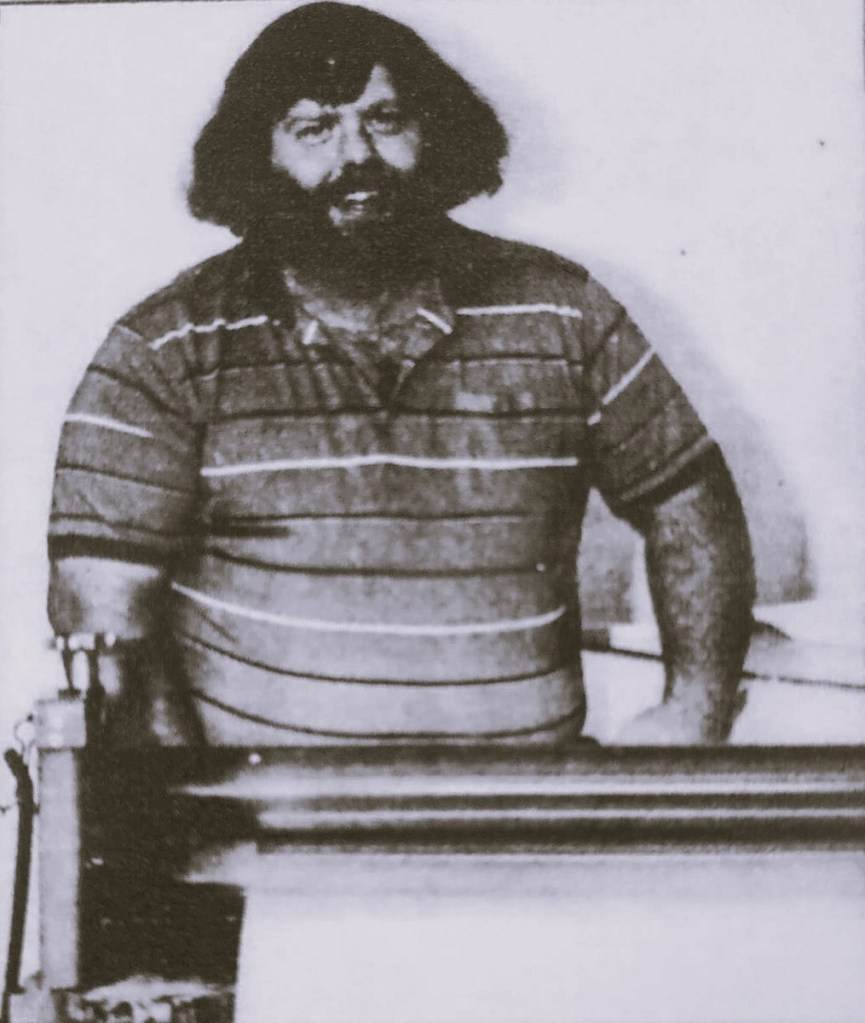
The Lottery comes to Gratiot County. From the top: the Michigan Super Lottery Show comes to the Alma National Guard Armory for the first time in 1973. It took some work to set it up; the “Lotto line” snakes through Wilhelm’s Grocery Store on Michigan Avenue in January 1985. Many in the area believed this was the place to purchase a “lucky ticket”; George W. Killinger, Jr. figured out he was guaranteed at least a second-place win in the Lotto Super Drawing in February 1974. He ended up winning $50,000. It was also held at the Alma National Guard Armory; Max Berry of Elm Hall showed off the first Super Drawing winner in early January 1973. Berry was the first to win $10,000 in Gratiot County.
“Get your lottery ticket! Buy your way to instant wealth! Support the state’s new ticket!”
With eager interest, many Gratiot County residents stampeded to buy the new lottery ticket. Michigan’s first legal lottery was introduced in November 1972, making Michigan one of seven states that instituted a lottery. People quickly took the chance to obtain instant wealth by purchasing a fifty-cent ticket. Lottery fever was on, and it hit Gratiot County hard.
At least 34 places in Gratiot County were initially authorized to sell tickets. Ithaca led the way with 11 locations. Places in Ithaca, like Mack’s Pharmacy, Dionise Market, Clagg’s Super Service Station, and the A&P Store, sold tickets. When measuring buyers’ zeal, one small store in St. Louis sold 372 tickets during that first day. At least one St. Louis store sold out its tickets and turned away potential buyers. An Ithaca gas station owner thought lottery ticket sales were great because almost every gas customer that day took their small change and bought a ticket. In another case, one Ithaca business saw a man walk in and buy fifty dollars worth of lottery tickets. Licensed sellers of lottery tickets in the county also liked it because they earned 2 ½ cents for every ticket sold.
While it would be ten days before lottery ticket buyers knew if they won the big prize of $200,000, many purchasers who matched three of the six numbers published in the newspapers won $25. They had to claim their money by visiting a claim center like Larry’s Hardware in Ithaca, which averaged about 30 claims a week. The State then mailed winnings to the claimants. Those who matched weekly numbers were eligible for the Super Drawing. Yes, Lottery fever was on, and it hit Gratiot County hard.
It was not long before Gratiot County had its first lottery winners. Max Merry, an equipment operator from Elm Hall, won the first $10,000 prize. He was then entered into the Super Drawing at Flint’s Genesee Mall for the $200,000 grand prize. Although he did not win, Merry returned to Elm Hall very happy with his initial winning. Looking back then, a $10,000 winner was the equivalent of over $70,000 today, a big win for a fifty-cent lottery ticket. Other winners appeared in the news, such as Alverta Haag, a teacher from Breckenridge, and Clifton McAllister and Max Haase of Alma became $10,000 winners. After McAllister won with his ticket, word soon spread about the place to buy a winner – Wilhelm’s Grocery Store in Alma. As the 1970s went on, long lines of ticket buyers stretched from the counter to the door.
The State Lottery became connected to Gratiot County when the State announced that the Lottery Roadshow was coming to Alma. Aligned with Michigan Week and the upcoming Highland Festival, Alma was a desirable place to hold the Roadshow, which presented a big prize to those who qualified. Lottery officials held the Super Drawing at the Alma National Guard Armory next to the fairgrounds to hold the anticipated crowd. To promote Michigan Week, the Lottery Bureau, this time, gave away four automobiles (worth $5000) from each of the State’s big automakers. The Bureau also planned to give away special $500 consolation prizes. The big winner wanted the $200,000 ultimate prize.
Setting up the big “Money Machine,” which distributed 1,000 magic balls that gave the winning numbers, was a bit of a challenge. It measured 32 feet long and 10 feet wide and took six men to set up. Two young ladies, lottery secretaries, wore bright green outfits and helped John Quinn announce the winners once the program started. In the end, the appearance of the Road Show at Alma proved to be a flop. While it hoped to draw early attendees to the Highland Festival, locals just did not come. Why? None of the possible winners for the entire drawing were from Gratiot County. Della Fogarsi of Unionville won the $200,000 check.
However, Gratiot County eventually had connections to sizeable winners of the lottery. James Fisher, who grew up near Ithaca and lived in St. Johns, won a million from a ticket he purchased at Beck’s Farm Market. Fisher received $50,000 a year for 19 years—but quickly commented that it would cost him $19,000 a year in taxes. Fisher, approaching retirement, and his family were happy to win the lottery. The first colossal lottery winner was George W. Killinger, Jr., of Alma, a custodian at Pine Avenue School. Killiinger won his large prize when the Lottery Roadshow again returned to the Alma Armory on February 7, 1974. Killinger won the runner-up prize of $50,000, which left him speechless as Killinger was the first current Gratiot County resident to bring home such a large prize. It took a while for St. Louis to get a big winner, but Herb Nelson, a Michigan Chemical Corporation truck driver, purchased his $25 winning ticket at Ken’s Party Store. While he was not a lottery finalist, he still pocketed $1,000.
As time went on, others won sizeable Lottery winnings, such as William R. Hollabaugh of Sumner, the Instant Paupers Lottery Club of Lobdell-Emery, Fred Hunter, Jim Shimunek, and the Eager Bevers Lottery Club of Alma, and Walt Nichols of St. Louis. But who was a huge Gratiot Lottery winner? The biggest winner in the 1980s to hit it big took place when the Detroit Tigers won the 1984 World Series. Steve Glesner, a Midland resident who worked as a cameraman at Central Michigan Newspapers in Alma, was shocked when he won over $5 million from a lottery ticket he bought in Midland. Glesner also won more because he had a subscription ticket. The two tickets brought him over $5.1 million, which was $208,000 a year after taxes for the next 19 years.
Glesner confessed that he was the big winner just as he watched the Tigers become World Champs on television. Glesner’s total winnings from those tickets may have matched the total salary Tigers’ highest-paid star, Darrell Evans, earned during his entire playing career. During an initial interview, Glesner said he planned to buy Tigers season tickets with some of his money.
Copyright 2025 James M. Goodspeed
 Goodspeed's Gratiot County Historical Blog