
Gratiot County in Depression and War: “The Good Old Summer Time in July 1940″

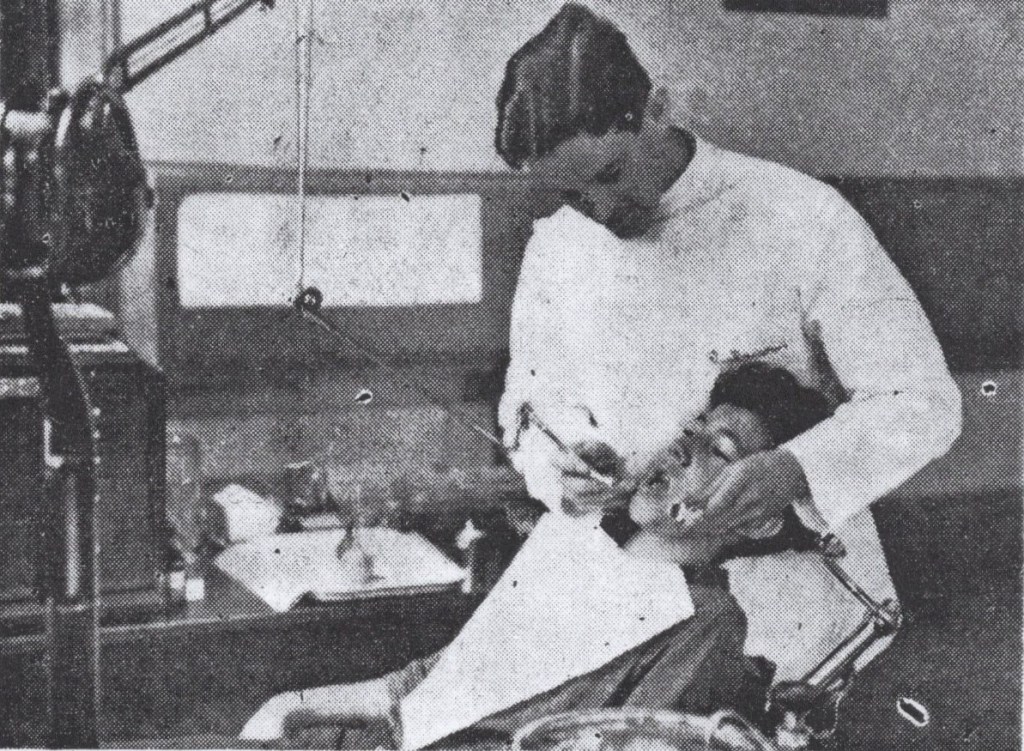
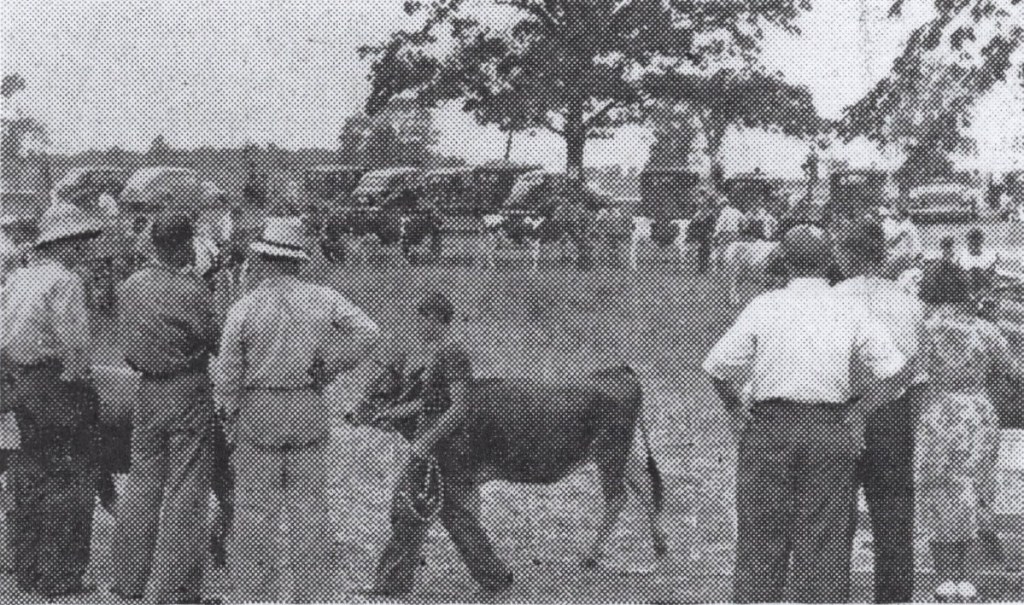
From top to bottom: Doctor G.V. Barrow of Ann Arbor works on one of his patients during the Gratiot County free dental clinic in Ithaca. Barrow treated eighteen cases each day for several weeks. The clinic then moved to Alma and concluded in St. Louis; this FFA showmanship event at the Gratiot County Fair featured stock raised by young future farmers from Gratiot; meanwhile, the Battle of Britain was in full swing in Europe. Could England survive Hitler’s bombings?; would President Franklin D. Roosevelt be nominated for a third term as President? The Democratic Convention in Chicago soon revealed that the President would indeed accept a run again for a third term.

The late spring and summer of 1940 proved to be cooler and wetter than many residents in Gratiot County wished. Newspapers warned readers that the war in Europe could soon escalate into a global conflict. Across Gratiot County, Depression-era programs continued to operate, providing respite, entertainment, and activities for both children and adults.

People could enjoy the isolation of quiet country towns, villages, and hamlets.

It was July 1940 in Gratiot County.

The World at War

Gratiot residents began reading about a potentially growing global conflict. A group of 30,000 United States troops was now placed on high alert in the Panama Canal Zone. Bombing raids by Hitler’s Luftwaffe upon Britain became known as “The Blitz.” Maps illustrated the time and distance it took to fly German bombers from their bases to targets in England. Then, there were maps illustrating how Americans, Soviets, and the Japanese all had potential areas of conflict in the Pacific. Would there soon be a “Pacific War” involving the United States? In all of this, most Americans seemed to forget that the Japanese Empire had been at war in places like China since 1937.

Here in Gratiot County, the Red Cross said that it needed only $400 to reach its goal for the War Relief Fund. They hoped to raise the balance to $1,920 by July 10. Twenty-two Michigan communities in southern Michigan agreed that military education for high and junior high school students was beneficial and necessary. The government hoped that between 10,000 and 15,000 defense workers would receive training in this way. The only question was what kind of training to provide and how far it should extend. Some, like Professor Howard McLusky from Michigan, argued that a long ideological fight involving dictatorships and democracies would soon start, and courses in high schools should prepare students for it. State Superintendent Dr. Eugene B. Elliott argued that Michigan schools had to prepare students with both strong minds and strong bodies; however, he failed to mention that he believed the United States would be directly involved in a war.

The issue of a third term in the White House arose in newspapers regarding President Franklin D. Roosevelt’s status at the Democratic Convention in Chicago. Keynote speaker Senator Alben Barkley spoke on behalf of Roosevelt and stated that the President had declared all delegates free to vote for the Democratic candidate of their choice. Still, the President did not say he would refuse a renomination. As a result, newspapers ran the headline “Way to Third Term Cleared by Roosevelt.” Within a week, FDR accepted the renomination and left the issue of a third term up to the voters.

Over at Ithaca, a hefty call for copies of birth certificates nearly swamped the county clerk’s office. Why? Numerous Gratiot residents needed them to demonstrate their citizenship status to work in plants supplying materials to Britain, as well as for anticipated home defense needs. Requests for birth certificates were received in Ithaca by phone, in person, registered mail, and air mail. Birth certificates were also necessary for those traveling to Canada for vacation or fishing. These certificates cost fifty cents each.

Depression Life, July 1940

The Gratiot County supervisors okayed the move of the county welfare office from Alma to the basement of the courthouse in Ithaca. Part of the reason for the move was a cost-saving measure that eliminated the need to rent space. The final move was contingent upon state approval.

The terms “recreation” and “recreation programs” gained a lot of attention in Alma for Turck’s Beach, and places across town where miniature golf, tennis, playgrounds, wading pools, as well as boys’ and girls’ softball and baseball all took place. There were also activities such as handicrafts, dancing, and an interest in archery. These activities took place across Alma in various locations, including Wright Park, Alma High School, some elementary schools, and the basement of the Salvation Army. The month of July, usually hot and steamy in Gratiot County, soon turned unseasonably cold and wet, thus dampening some of the swimming at Turck’s Beach. Despite the cooler weather, a large crowd gathered at the beach to enjoy a swimming show and water carnival, as well as demonstrations on how to operate a canoe and perform a rescue from drowning. Bill Moody, the head lifeguard, conducted some of the performances. At the same time, Dr. W.E. MacInnes gave a brief talk about Red Cross safety. A second water carnival was planned for early August at Turck’s Beach. Many of those who worked at these places that offered recreation had NYA workers or were tied to NYA projects.

Are you older and concerned about your finances in old age? Attend a Townsend Club meeting in the county. Townsend Club Number 2 held meetings every Monday at the Ithaca village hall. Doctor Townsend himself appeared on the front pages of local newspapers under “Doctor Townsend Says…”. Townsend billed his old age pension plan as “a movement to unite the peoples of the earth in one great brotherhood” – and ensure that every older American received an old age pension.

WPA work continued on the 1939 paving project, even though it was the summer of 1940. A crew of 65 men built new curves and gutters on streets where they paved last year. The project poured a slab on three blocks of River Avenue, then planned to move on to shorter works on Walnut, Euclid, Allen, and Orchard streets. Work was progressing more slowly in July, according to City Manager W.E. Reynolds, because in 1939, he had between 90 and 130 men working on projects. Now, regulations lowered the number to only 50 workers. Alma petitioned for an additional fifteen blocks for paving. Still, the city had not yet received approval from the federal government.

Migrant Workers, Weather, Fair in July

A reasonably large turnout was observed at Alma’s Washington School for the county’s migrant school open house held at the end of June. Almost one hundred visitors came to the open house on a Thursday night. Following this program, another 126 Mexican workers and their children attended the program’s first Family Night. Migrant center workers from Mt. Pleasant and Kenton, Ohio, joined with the Alma staff to discuss work in their respective centers. The Alma school officially enrolled up to 100 children in woodcraft, English, citizenship, table manners, and singing. This group also included sixteen toddlers and babies. By the end of July, the numbers dropped to 55 children as migrant families moved on to other work in the state. Gertrud Herman,  Merle Farnie, and Grace Rowell lead the programs at the center. Rowell, accompanied by Reverends Drake and Moreno, took a group of the older migrant children to the Gratiot County Fair to see the rodeo. A field day was also held for the older children from Alma and the Mt. Pleasant centers before the centers’ closing. The center held its final Family Night on July 25, marking the end of the program. By the time the Alma Center closed, over 400 visitors from across the state of Michigan came to Alma to see how the Washington School’s migrant center worked with children, and many migrant mothers hoped that Alma would open another program like this in 1941. This migrant center was the first such project supported by the Gratiot County Council of Churches and the Council of Women for Home Missions.

Gratiot County’s weather continued to challenge area farmers that summer. A cold and wet late spring had crops lagging during planting season, while hay, oats, wheat, and barley were unusually heavy due to the rains. A warmer July was allowing crops to start catching up, but many appeared to be below average and needed a warm late summer and an extended growing season. More Gratiot farmers planted soybeans, but the increase was not as significant as in other parts of the state. And then came a classic Gratiot cloudburst on July 8, which flooded a large section of Emerson Township. The storm affected an area in Emerson Township that measured 2 ½ miles north and south and 5 miles east and west, and it was hit with heavy winds. The Riley Aldrich farm was completely submerged in water, as were the farms of other farmers in the area. Aldrich’s grandson appeared in a Gratiot County Herald photograph with water standing halfway up his boots.

Many farm families not affected by the storm later requested help from the Gratiot Road Commission to spread spot oil in front of their homes and down their roads to deal with the dust. Farmers paid one cent per square yard, and the final cost depended upon how many times the road was oiled.

Visiting the 75th annual Graiot County Fair in Ithaca was a highlight of summer and took place from July 23 to 27. Before opening the fair, officials installed a new automatic starting system for horse racing, which would take place over four days of the fair. The fair featured the most extensive 4-H exhibits, the C.R. Ranch rodeo, Roman chariot races, horse pulling, and a large midway. Children’s Day on July 23 offered free admission to children under the age of twelve, and rides cost only a nickel.

In other news, the Farm Security Administration announced the expansion of the Farm Tenant program in Gratiot County. This program allowed former farm tenants to buy their farms under government long-term contracts. Tenant farmers were encouraged to apply to the program. Need to dip sheep? A sheep dipping demonstration took place on the Paul Burnham farm in Bethany Township and Max Church’s farm in Arcada. County Agent C.P. Milham asked Gratiot farmers to declare war on sow thistles, urging them to seek out and destroy the plants. Sow thistles grew to three feet in height, and had yellow blossoms like dandelions, which could smother a crop due to their dense mat of leaves.

The Long Arm of the Law in July 1940

The Fourth of July weekend in the county was rough on several drivers. Overall, a total of six traffic accidents injured seven people and claimed one life. Franklin Kunkel, age 22, of Riverdale, was killed in an accident when his Ford roadster crashed into another car near the Honeyoye Bridge, miles west of Alma. Kunkel tried to pass another vehicle before entering the bridge, then went off the road after striking another car. Instances of drunkenness made their way to court as a group of people from Owosso were arrested east of Alma for drunk driving. A familiar sight in Alma, Frank (Frenchy) LaBart returned to Alma after eight years. LaBart managed to bang up several cars in front of the Kroger Store while trying to park his vehicle. He was charged with drunk driving and served 45 days in jail rather than pay $56 in fines. Lillian Berted, age 29 of Alma, was arrested in Breckenridge for public drunkenness. Although initially pleading not guilty, she later changed her plea and paid a fine of $13. R.L. Lalonde of Ithaca received a fine and costs of $28.85 for driving wildly past a WPA flagman and road workers south of Alma. Lalonde was cited for reckless driving.

 Leo Gusman, a Mexican from Eaton Rapids, was arrested for driving without a license. Gusman’s penalty was paying $12.30, and he still had to spend five days in jail. Howard Sparks from Clinton County was arrested for illegally selling fireworks. He paid $16.45 rather than go to jail. Jenasio Mejia, “an Alma Mexican,” was arrested near the Michigan Sugar Company factory for carrying a concealed weapon. He was held in the county jail for having a loaded revolver and six extra shells. Someone, an itinerant peddler in Alma, was passing forged checks in Alma on behalf of Parke, Davis, and Company of Detroit. The forger had already passed one in Clare for $15.00. Be on the lookout for the crook. Two beet workers, Steve Grusky and Stanley Druska, got into a heated battle just south of Bannister. Both were arrested and hauled off to jail. In late July, Otto Morro, St. Louis street commissioner, announced that the first crop of wild marihuana in town had been located in an alley between North and Center streets. A citizen identified the plants and reported them to the authorities.

In some other instances that involved calling for the police, an 18-year-old girl in Alma jumped off the Superior Street Bridge just after midnight on July 17. Thankfully, the water was only four feet deep, but the fifteen-foot drop did more damage. She later admitted that she wanted to take her own life after parting with her male escort. Still, a sister arrived at the police station and escorted the jumper home the next day. In another tragedy, the first drowning of the summer took place at the Washington Township gravel pit, just east of the B-Z-B gas station. Herman Wallen of Perrinton, age 22, was probably killed after diving into the bottom, as a cut on the head suggested he had hit bottom; possibly he also suffered an epileptic seizure. Wallen was considered an excellent swimmer.

Another story in the Dewey Glinkie case appeared in local newspapers. Ginkie, who had stolen over $3,000 in county funds several months earlier, was in the news as Sheriff William Nestle traced a lead to Canandaigua, New York, where someone found Ginkie’s Social Security card and notebook in a mailbox. The card had been issued in Ohio, and the notebook contained Glinkie’s handwriting. Yet, the collection of notes failed to specifically tell who was helping Glinkie or who knew of his whereabouts. Before this, Glinkie had connections to Port Huron and Detroit. So, the hunt for Dewey Glinkie continued.

The county got excited when former county prosecutor Ora L. Smith announced that he was running for the Michigan Republican gubernatorial nomination for the 1940 election. Smith formally announced his candidacy on the radio station WJR in Ithaca. Several parades took place in the county to honor and support Smith. In other court news, Kelly S. Searl, a circuit court judge, began his 26th year as a judge in Ithaca. The Alma City Commission denied the use of its tourist park for house trailers. The city only charged $1.50 per week for short stays or 25 cents per day. The commission was concerned that long-term occupancy by house trailers would run up the cost of electricity and turn the area into a “trailer park.” Currently, there are 75 to 100 families or groups in Alma living in trailers.

Gratiot County Health Matters

A pair of Gratiot County residents, Vere Allen (Arcada Township) and Ruth Johnson (St. Louis), each suffered bites from their dogs. Both animals were euthanized, and their heads were sent to Lansing for rabies testing. Thirteen-year-old Anna Macey of Alma was also bitten on her thigh while riding her bike near the Wright Hotel. Police impounded the dog for observation for ten days due to concerns of rabies. The county sheriff was increasingly concerned that residents were becoming more careless about letting their animals roam rather than being quarantined. In St. Louis, many residents complained about the number of running dogs in town. Doctor D.K. Barstow warned residents that the only way to be safe from rabies was to get their dog(s) vaccinated. For those who resorted to only leashing or penning their dogs, Barstow reminded them that a leash could not keep another rabid animal from biting the family pet. Rabies vaccinations were good for a year. A statewide quarantine had been in place for 47 counties since April. During the first three months of the quarantine, County Dog Warden Howard Evitts of Pompeii announced that 160 dogs had been euthanized in Gratiot County so far.

Better health news came from the news of lower TB death rates in Gratiot County. A report showed that eight people died of TB in 1938 and seven in 1939. Vera Karajoff of Alma had to be admitted to Smith Memorial Hospital for a serious injury to her ankle. Initially, a fracture was a concern; however, Karajoff only had a severe sprain. How she did it was not reported. Charles Federspiel was released from Smith after an X-ray check-up on his fractured left arm. Federspiel broke his arm in a jumping incident. In sad news, in Ashley, grocery store owner Clarence Duprey, age 46, took his own life. He left a wife and three daughters. Newspapers listed no cause for the death.

The Gratiot County free dental clinic entered its third week in July. Dr. G. V. Barrow of Ann Arbor saw an average of eighteen cases each day in Ithaca. The clinic soon planned to move on to Alma and then to St. Louis. Approximately 400 young people received dental care in Ithaca alone from the clinic.

And So We Do Not Forget

The new C.S.A. Hall in St. Louis planned a two-day celebration for its dedication with a grand opening. A Grand March from the Park Hotel to the hall on Michigan Avenue kicked off the activities on Saturday, July 6…Notices for the upcoming performances on the Chesaning Showboat appeared in local newspapers. A cast of 125 performers, along with Jimmy Raschel’s Band, planned two-hour shows from July 11 to July 14 in Chesaning…Jean Arthur and Fred Mac Murray appeared in “Too Many Husbands” at the Ideal Theatre in Ithaca on July 4 for a one-night show. Roy Rogers appeared July 5-6 in “The Days of Jesse James.” Tickets were ten cents for matinees…The Saginaw Black Socks edged the Ithaca Independents by the score of 2-0 in a special Sunday game in Ithaca. North Star defeated the Balmoral Indians by a 7-0 score…Cupid’s victims included Marvin Neal, age 22, of Alma, and Narlene Tracy, age 19, also of Alma. Good luck to the newlywed.

Mrs. Clifford Brewer of St. Louis became the new Central Michigan women’s golf champion at Clare. Brewer defeated two previous champions on her way to the title…Vera Patterson of Ithaca set a new ladies’ golf record at the Gratiot Country Club by turning in a 37 on nine holes. Muriel Pettit held the previous record with a 39…A Reverend F.R. Davidson petitioned the Alma City Commission to set up a portable tabernacle of Masonite pressed wood for religious services in Alma. Davidson represented the General Council of the Assembly of God…The Gratiot County Board of Supervisors adopted a resolution allowing the closing of county offices and the driver’s license examination bureau in the courthouse on Saturdays. While some offices in the courthouse had previously been closed during a slow summer season, the supervisors stated that some offices could remain open on Saturdays as needed in the future…George Stewart, J.C. Penney’s manager, took a two-week vacation to spend time with family on Crystal Lake…More new paint jobs in Alma included work on Wilkins’ Economy Market, Reed’s Popular Priced store, and Gay’s 5 & 10c store.

Sidney Toler and Marjorie Weaver starred in “Charlie Chan’s Murder Cruise” on July 7-8 at the Alma Theatre. Tickets were ten and fifteen cents…The Alma Chamber of Commerce announced an outline for the program and activities for the 1940 Harvest Jubilee in late August…Former employees of the Alma Republic Truck Company planned to hold a reunion on July 27-28 in Conservation Park in Alma. A total of 1,313 letters were sent to former employees in 23 different states, inviting them to the reunion. This reunion would be the third such one held in Alma…Buy a new single-wall washing machine at Walker’s Electric Shop for only $39.50. A double-wall machine only costs ten dollars more.

Finally, over at St. Louis, a balloon ascension and jumper captivated the city on a Saturday night. The St. Louis Trade Association sponsored the event on July 6. Large crowds turned out to watch the balloon, put together by the Winkler Brothers of Lansing, fill with hot air next to the newly erected bandstand. After it filled with enough air to allow it to tower above all the buildings in St. Louis, it began to rise skyward and headed northeast. Many feared the jumper would end up in the Pine River. However, after reaching its maximum height, the jumper bailed out. It deployed two parachutes, the second of which was decorated in red and blue. How did it end? The jumper found himself in a cornfield just north of the city. The balloon ascension was just one of a series of regular Saturday night programs created by the St. Louis Trade Association that summer.

And that was Depression and War in Gratiot County in July 1940.

Copyright 2025 James M Goodspeed

Gratiot County in Depression and War, June 1940: “Summer is Coming, and so is War”

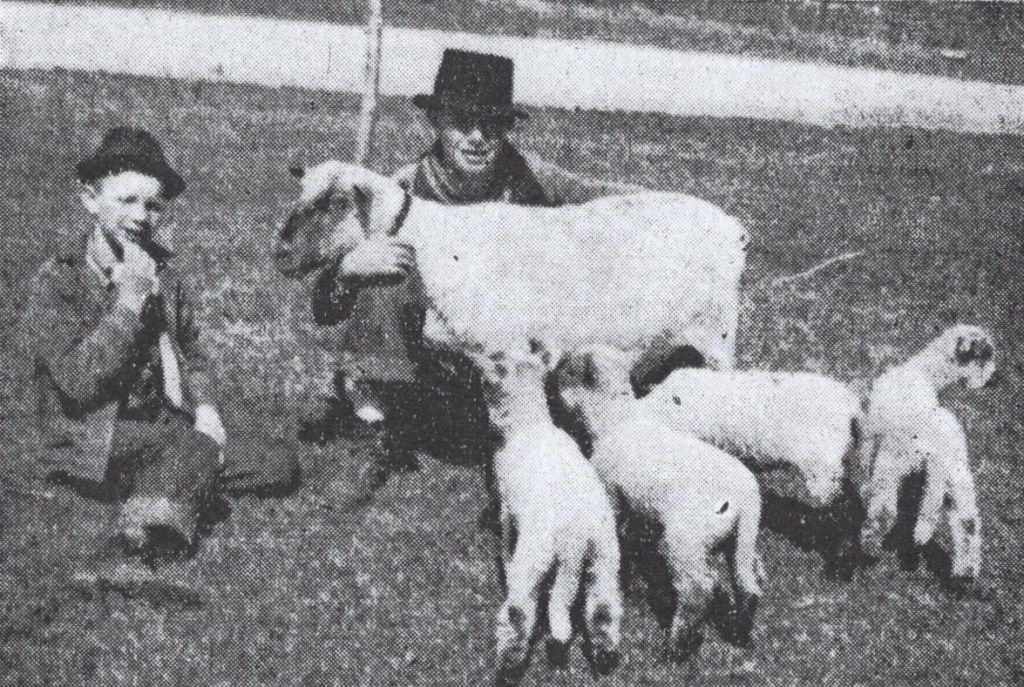
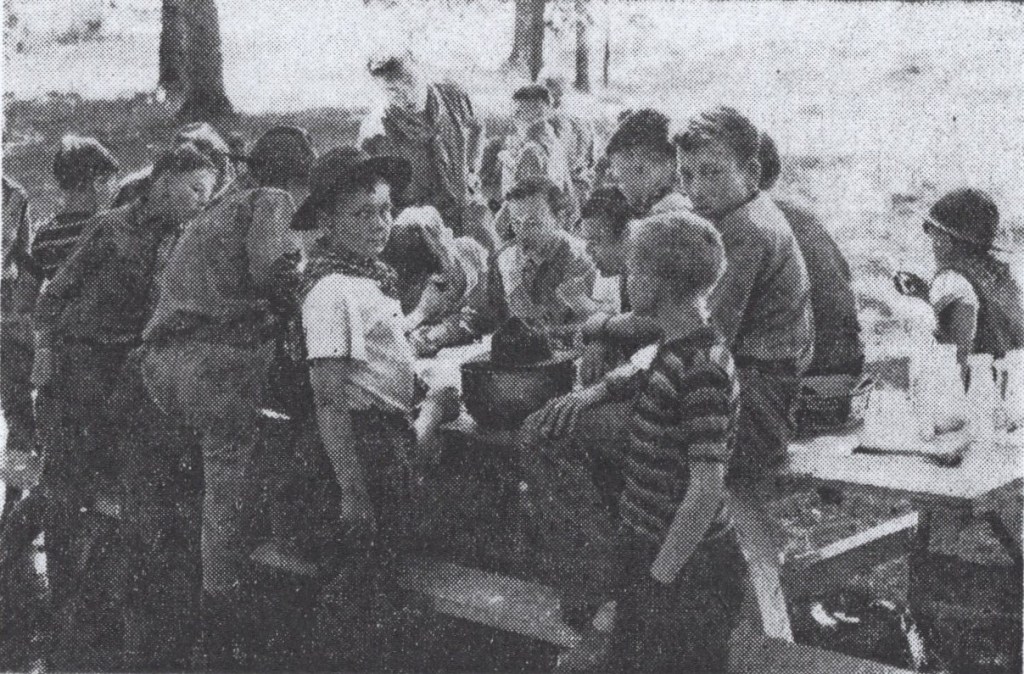
News and life in Gratiot County during June 1940 (from the top): The cartoon “Smoke” implies what many in Gratiot County began to realize – war was coming and the nation needed to prepare; James and Billie Vanderbeek of Pine River Township show off their proud “mama” and her quadruplets; unidentified Boy Scouts take in a “Camporee” at Ithaca’s Woodland Park; there was nothing like a Sunday county league baseball game in St. Louis – which one could see for only a quarter.

As Gratiot County slowly warmed up to another summer, events in Europe exploded as Nazi Germany invaded and conquered much of Western Europe.

Life in the United States began to slowly drift toward war as President Roosevelt developed plans that included large munitions plants as well as training young people for a potential national emergency.

Still, one could appreciate small-town life. How many believed that a world war in Europe could affect places like Ithaca, Alma, St. Louis, or Breckenridge?

It was June 1940 in Gratiot County.

The War in Europe in June 1940

Troubling news about the Nazi conquest of Western Europe appeared on the front pages of county newspapers. German troops crossed the Marne in France, and the nation’s collapse and surrender seemed imminent, with the outcome seemingly only a matter of days. In addition, Italy joined the war on the side of Nazi Germany and Mussolini announced Italy’s rights to Corsica, Malta, Tunisia and the Suez Canal.

In response to the events in Europe, President Roosevelt announced a draft plan to mobilize an estimated 7.5 million young men and women for noncombatant training. The President emphasized the need to train young people in “general disciplinary courses” in anticipation of a national emergency. Unlimited quotas for Army recruits were being accepted at Camp Ord, California, and Fort Lewis, Washington. Recruiters in Lansing were now available for any in Gratiot County who desired to volunteer. President Roosevelt also recommended a chain of government munitions plants across the country. The nation took another step toward preparing for war by examining thirty sites, which cost $376,000,000.

Locally, the war began to have a gradual impact on local people. Captain C.H. Reed, who operated a local fuel business in Alma, was called to active duty with the Army at Fort Brady, Sault Ste. Marie. Reed had previously supervised several CCC camps in the state. Approximately sixty members of the Troop B, 106th Cavalry of Alma, prepared to go to Wisconsin in August for 21 days of training. Before this date, the group had never trained for more than 15 days in the summer. Second Lieutenant Frank W. Iseman, an Ithaca High School graduate and a graduate of West Point, continued his training in the Air Corps Flying School. Iseman would ultimately serve as the director of operations of the 502nd Bombardment Group in the Pacific. A former Gratiot County youth, John C. Seipp of Fulton Township, passed the entrance exam to the United States Naval Academy at Annapolis, Maryland. After his family moved to Lansing, he attended Lansing Eastern High School. The Gratiot County Red Cross announced that the county reached the unit’s goal of raising $1,920 to help refugees during the war.

The Gratiot County Herald ran a very long editorial entitled “What Hitlerism Means.” The editor attempted to educate Gratiot County residents about how this war would be different from previous wars in history. It warned that Hitler would not settle for a few territories but was bent on European and, ultimately, world domination by Nazi Germany. What happened with the collapse and fall of France stood as a warning to the world that this would not be a short European war unless more countries capitulated to Adolf Hitler.

Many Social Program Activities in June 1940

June brought opportunities for New Deal programs that affected many in Gratiot County. At least three New Deal social programs collaborated to provide opportunities for children, young people, and adults to stay engaged and occupied during the late stages of the Great Depression.

Several WPA workers volunteered to help pour a concrete floor in the shelter house at Conservation League Park. After completing the 30×50-foot floor, all of these workers received a free yearly membership in the Conservation League. The shelter house encouraged more people from Gratiot to use the park for walking, picnicking, and other recreational activities.

With the warm summer weather, many young people traveled to Turck’s Beach in Alma to go swimming. The number of swimmers necessitated a program and its oversight. Both the NRA and WPA provided a total of 35 workers to watch swimmers and oversee the beach house. Over 200 swimmers turned out for the first swimming lessons at the beach. Thirty youngsters also expressed interest in participating in the new canoeing program. The main reason for the need for so many workers centered around the fact that the program, like others in the New Deal, only paid them for part-time work. Bill Moody was in charge of supervising the beach area, assisted by Bud Stearns, Don Martin, Jim Sebring, and Robert Parks. Two large towers went up on the beach so that lifeguards could watch all of the swimmers. Three wading pools were also constructed for young children on Michigan Avenue, in Wright Park, and near Hillcrest School. This type of pool also allowed families with young children to find a spot to cool off without having to go to the beach.

 In addition to Turck’s Beach, in Alma, 50 boys and 80 girls wanted to participate in a softball league. Another 40 boys, aged 15 to 17, wished to participate in a baseball league. That organization came under the direction of the NYA.

 More boys and girls in St. Louis also wanted their own recreation programs. Elliot Oldt started a program at Wheeler Field where boys and girls played a variety of sports on the field, including horseshoe pitching, badminton, softball, boxing, and croquet, among others. Ruth Walker supervised the activities for those under the age of eleven. One of the nicest draws in St. Louis now centered around new tennis courts. Tennis courts became so popular that Alma had six new courts constructed through the Wright Park improvement plan, which the WPA funded. The plan also called for new shuffleboard courts.

For young women not interested in athletics, the NYA planned a homemakers’ training school, which would accommodate up to twenty girls. They would be hired to learn food preparation, home management, laundry work, budgeting, and sewing. The NYA would pay the wages for these women. At least four other programs like this existed in the state of Michigan. Due to the numerous programs in the Alma area, the WPA recreation director, Darrell Milstead, was granted his own office in Alma City Hall.

Out on the streets of Alma, the WPA continued work on the 1939 paving project. The city believed it would soon be completed, as 20 new WPA workers would be coming to Alma, which meant potentially having as many as 70 WPA men working on Alma’s streets.

In other Depression-related news, Ithaca Townsend Club Number 1 met at the Masonic Hall and planned to show a movie in Woodland Park. Progressive Townsend Club Number 2 held its monthly meeting at the village hall. Because the Texaco gas station and Hanssen Grocery on East Center both had Townsend trade cards, members were encouraged to visit those businesses. The Townsend program was an alternate pension plan for the elderly, which commanded a very popular message to many in Gratiot County. Two Alma men, David Gerhard, Consumers Power Company manager, and H. S. Babcock, Alma Record publisher, went to the dedication of the new seven-million-dollar plant on Saginaw Bay. The featured speaker for the program was Wendell Willkie, who would soon be the Republican nominee for President in 1940. Boys between the ages of 17 and 24 could apply for enrollment in the Civilian Conservation Corps. Visit the Gratiot County Department of Social Welfare office located at 614 East Superior Street in Alma.

The Long Arm of the Law in Gratiot County

Some law officers thought Gratiot experienced fewer court appearances during June, and the jail count supported this notion. At one point, only three people were in the county jail, which had a capacity of up to twenty-two. Still, traffic violations generated the most revenue in terms of fines, totaling $466.84.

 James Vlasich was bound over to appear in the circuit court for intent to commit significant bodily harm to his mother. John Hagen of St. Louis was in trouble for driving his car on the sidewalk in St. Louis. Most of the others making appearances did so for drunk driving, like Stanley Furly, an oil pumper in the Porter oil field. He received sixty days of jail time and a $59.35 fine. And then there was the familiar face of Cornelius W. Eichorn of Emerson Township. Eichorn was picked up for reckless driving east of St. Louis this time and had no driver’s license. Eichorn was developing a habit of not driving safely. He was released on a $100 bond. In another strange case, Marvin Cooper of Arcada Township confessed to driving his tractor over three blocks of newly surfaced blacktop in Ithaca. The tractor’s lugs did much damage to the surface.

Claud Offill, formerly of Elm Hall, lost his appeal from a 1929 sentencing for assaulting Deputy Sheriff Ray Helman. Offill shot Helman twice and was on the run for twelve hours before being caught. He received a ten- to twenty-year sentence at Jackson State Prison and was now in the eleventh year of his sentence. Offill claimed his confession of assault and battery of his wife was coerced, but the high court rejected Offill’s argument. He stayed in prison.

In other news, Alma, James Campbell, Chief of Police, warned residents to stop disregarding parking tickets, which would now result in formal complaints in court. Those citizens who paid their dog taxes before the June 1 deadline brought in $2,045 in May. Howard Evitts of Pompeii, the county dog warden, would be out collecting delinquent dog taxes for those who had not paid. The Alma police department announced they were reducing their force to four officers upon the retirement of Patrolman Gus Herron. Herron, 72, served Alma for 21 years. Mildred Taft announced that she was running for probate judge. This position oversaw a team of 21 individuals who process naturalization applications in Gratiot County.

And among the last of the news was the name of a new drug that appeared in Gratiot County – “marihuana weed.” The Michigan State Police issued warnings about this new drug in mid-Michigan, and it was now a federal offense for growing, possessing, selling, purchasing, or transporting Marihuana. Police also said continuous smoking of it would lead to insanity. In the wild, the drug grew to a maximum height of 3 to 6 feet. The police also warned Sunday drivers, Boy Scouts and Girl Scouts, hikers, and farmers to be on the lookout for the illegal weed.

Health Issues and Events

To start a new dental parlor in Alma, R.B. Davies planned to open his office in his mother’s home on 226 North State Street. Davies, an Alma High School, Alma College, and the University of Michigan Department of Dentistry, returned home with good references and an eagerness to serve his patients. A twelve-week free dental clinic came to Gratiot County, sponsored by the James Couzin’s Fund of Michigan (also called The Children’s Fund of Michigan). Parents of children under sixteen who are in need received letters inviting them to receive free treatment. The clinic would be in Ithaca for five weeks, then move to Alma for four weeks, and end in St. Louis after a three-week stay. The first free dental clinic in the county was established in 1937.

William Kinney, age 57, of Arcada Township, took his own life with a shotgun. He had faced poor health and despondency due to his inability to work in his trade as a paper hanger and painter. Before he passed, he claimed to be shooting a crow, but coroner G.V. Wright disagreed. Kinney left behind his widow and two children.

Chase Farrar of Route 3, Alma, went to Smith Memorial Hospital for treatment of a gunshot wound in his left forearm. Farrar was wounded while driving a tractor and had been hit from a long distance. Robert Hinderline of Alma reported that his son had been admitted to Smith for treatment for severe burns. The young Hinderline was thought to have played with firecrackers, but the culprit was a dynamite cap from a friend’s car. The boy received heavy burns around his lips and left hand when the cap exploded. Karl Wigglesworth of Breckenridge survived electrocution from a 4800-volt line on a telephone pole near Sickles. He and another Consumers Power Employee, Leland Helfer of Ithaca, were working on the line when Wigglesworth accidentally touched a hot stick and took the jolt with his left hand and right hip, which rested on a service wire. Thankfully, the cool work of fellow worker Helfer helped free him. Wigglesworth was in Smith Memorial Hospital with a burned left hand and right hip, but survived the ordeal.

St. Louis city residents received another notice, reminding them that they had until July 1 to have their noxious weeds cut. Those who failed to cut their weeds would have the city highway crew do it, and the cost would be charged to their city taxes. Heavy June rains left many properties and vacant lots full of weeds.

Dr. Georgia V. Mills delivered a health lecture at St. Louis High School titled “Preventing Communicable Diseases.” Topics included the spread of contagious diseases, quarantines, vaccination, and the danger of tuberculosis. The St. Louis Child Study Club and the Michigan Department of Health sponsored Mills.

Farming & Outdoors in June 1940

Weeds, bugs, and fungi all grew well during June as the onslaught of cool, wet weather brought an abundance of all three to Gratiot County. Gratiot County agricultural agent C.P. Milham noted that some of the growth in the fields resulted from some farmers who used nitrogen fertilizer. Heavier soils in the county needed straight phosphate, while those planting grains needed a potash combination fertilizer.

Sheep dipping continued across parts of Gratiot County. A new portable dipping rig allowed participating farmers to treat 7,000 sheep and lambs thus far. One of the sites to be included in the upcoming weeks is Milton Snyder’s farm in Pompeii and C.K. Tuttle’s farm in Fulton Township. More farmers offered to host a sheep dipping session. Garl Vanderbeek of Pine River Township still had his quadruplet lambs, which were now almost two months old. While deliveries of quadruplet lambs were not extremely rare, having all four survive this far was. E.E. Stahl’s farm, six miles north of St. Louis, continued to welcome a strange visitor among his herd of cows. A small fawn regularly appeared among the cows, following the herd to pasture. The Stahl family could usually reach within a few feet of the small animal.

Bill Harper’s Hardware in Houserville had John Deere hay loaders for sale. The McCormick-Deering Store in Ithaca offered a smoker (demonstration) for its new harvester-thresher on June 18.

The Bailey family west of Pleasant Valley experienced a tragedy when young Dale Edward Bailey, age 15, died as a result of being pinned under a tractor. Young Bailey was plowing a field and did not return home for dinner that evening. His young sister went out to find Bailey and came upon the accident, which had the boy pinned face down between the fender and wheel of the overturned tractor. Death probably came from suffocation.

Four new 4-H clubs were organized in late June, bringing the county’s total to 20 and enrolling 212 members. The new clubs included the Good Luck Canners (in Ithaca), Pompeii Willing Workers, Happy Farmers Livestock and Crops Club (Ephert School), and Our Gang (Bannister).

In June, stricter enforcement of quarantine for dogs across the state led to a decrease in rabies cases. It also led to a reduction in dog attacks on livestock. In 1939, the state reported farmers suffered a loss of $125,000 in livestock. Most of the dogs in both questions were believed to be strays from towns and villages rather than those from farms.

Gratiot County prepared to open its first school for children of Mexican beet workers. Reverend Floyd Drake of Breckenridge, president of the Gratiot County Council of Churches and Schools, devised the idea and organized support for the school. The school planned to open in the abandoned Washington School in Alma. It would be under the direction of Gertrude Herman of Grand Rapids. She had three staff members who planned to host children aged four to fourteen, and a host of NYA (National Youth Administration) workers cleaned and prepared the building. The school planned to host up to one hundred students, and forty showed up on the first day. At the end of June, visitors from different out-of-state churches visited Alma to see the school; at least two were from New York. An open house invited Gratiot residents to view the program and facilities. 

Finally, in an attempt to get outdoors and enjoy a day fishing for trout on the Pine River, Don Lemon of Alma had a startling experience. While casting for fish, Lemon stepped on a large rattlesnake while walking on the bank. Lemon claimed the rattlesnake was as large around as his wrist, and he quickly changed locations to continue fishing.

And So We Do Not Forget

In Michigan Mid-State League Baseball, St. Louis Pure Oil played Alma Merchants on Sunday, June 9, at the St. Louis softball field. The admission cost was twenty-five cents…The St. Louis Trade Association sponsored its first Saturday night entertainment event, featuring a band concert by the St. Louis High School band. Herbert Saylor conducted the concert on a vacant lot on Mill Street…The Ithaca High School class of 1915 reunited on the school grounds in Ithaca on Saturday, June 22. Silas Partee invited all past members to attend along with their families, as this was the twenty-fifth anniversary of the reunion…The Ola Camp Meeting opened with Dr. Nathan Cohen Beskin, an evangelist and a Jewish convert to Christianity. Beskin was known nationally as an outstanding evangelist…Miss Mae Nelson offered piano and clarinet lessons in Ithaca for 75 cents a lesson. Contact Mrs. Mike Haley for more information…The Bannister area was shocked and saddened by the sudden death of young Esther Lillian Thomas. Thomas was only 14 years old and died just before her eighth-grade graduation. Esther had strong ties to her community, school, and church.

According to the recent census results, Gratiot County gained 2,429 people since 1930. A total of 35,938 people were recorded in the census, with Alma and St. Louis accounting for the majority of the increase. Elba Township lost fifty-five people, but Emerson Township only three…The Ithaca Masonic Lode prepared for the arrival of Dick Lewis, a 1913 Ithaca High School graduate who experienced success in the manufacturing field. Lewis planned to bring thirty-five entertainers for an evening program in Ithaca…Michigan Chemical Corporation planned to build a new brine well in the northwest corner of the Jake Wolford Farm just north of Oak Grove Cemetery…Spencer Tracy and Hedy Lamarr starred in “I Take This Woman” at the Ideal Theatre in Ithaca. All seats were only ten cents…The village of Ashley has lost a beloved citizen, Mrs. Emma Jane Duncan, who passed away at the age of 81. Her husband, a Civil War veteran, moved to Ashley in 1900. Many knew her for her willingness to help those who were sick and in distress. She also worked at the Ashley post office for six years…Alfred J. Fortino received his LLD degree from the University of Michigan. A 1933 Alma High School graduate, he attended and graduated from Alma College before pursuing his law degree…The Alma Chamber of Commerce has announced the committees for the upcoming Alma Harvest Jubilee, scheduled for August 22-23. Finance, entertainment, parade, and publicity committees all planned to go to work after the Fourth of July…A group of 150 Boy Scouts attended the annual Boy Scout Camporee at Ithaca’s Woodland Park. The camp operated for two days, and every four or more Scout patrols were required to provide their unit’s camping equipment. Some events included signaling, water boiling, and a flapjack contest.

Four St. Louis men purchased the Gratiot County bank building from owner H.J. Stroupe. St. Louis voters earlier turned down the idea of turning the building into the city hall. The new owners included W.V. Hess, Vere Nunn, Fred Tryon, and Ralph Goggin…Van’s Wallpaper, the Byerly store, and Almy’s Food Market in Alma all had new signs on their stores…Prepare for the opening of bass season by purchasing Shakespeare Famous Tackle at C.G. Larry Hardware in Ithaca – the Fisherman’s Headquarters…Tom Brown and Constance Moore starred in “Ma! He’s Making Eyes at Me” at the Alma Theatre. News, oddity, and comedy for only ten or fifteen cents on July 2-3…The Saginaw Black Socks came to Ithaca to play the Ithaca Independents at the Ithaca fairground on June 30 at 2:30 p.m…Skippy LaMore’s Comedians would be St. Louis for one week beginning July 1. The group planned to present seven plays in a beautiful tent theater for only ten cents…The Czechoslovak Society of America opened a new two-story building with a two-day dedication ceremony. Construction of the new hall began two years ago and measured sixty feet wide by eighty feet long…F.M. Vandercook celebrated his 90th birthday in St. Louis. Vandercook was a pioneer newspaperman who owned and operated different papers in St. Louis and Ithaca. He published the first daily paper in St. Louis in 1893…A Fourth of July celebration was scheduled for Lumberjack Park. This “old time celebration” featured patriotic addresses, the Breckenridge Community Band, hog calling, husband calling, and a free movie. One could even buy a chicken dinner from the camp cook, Mrs. C.A. Field.

Several Alma people traveled to Detroit to watch the Tigers defeat the Yankees. A group of eight led by James Kline, a meat cutter at Bert Hicks and Sons store, watched the close game. Others from Alma, like G.A. Giles, saw the Tigers take a doubleheader from the Athletics…Alma High School graduate Carl Shultz was assigned to play for the Union City, Tennessee, team in the Kitty League. The St. Louis Cardinals system signed Schultz…Earl Willert’s barbershop at 212 East Superior got an entirely new fluorescent lighting system courtesy of Everett Giles, electrician and Strand Theatre operator…Persistent rain forced the postponement of the Alma City Band’s opening concert. The group had twenty-five members…Miss Lois  Brainard, age 15 and a student at Alma High School, was selected in  “Alma’s Glamour Girl Contest.” Brainard reigned as queen over festivities for the Alma Lions Club production of the local movie, “We’re in the Movies Now.”  Margaret Atkinson finished second…Thompson’s in St. Louis advised customers to join their Blanket Club. Plan for winter – lay away a 72 by 90-inch virgin wool, moth-proofed blanket. A deposit of fifty cents and payments of only twenty-five cents a week got you the extra-large winter blanket…Gratiot’s leading naturalist, Parks Allen, wrote an article that described the different types of water birds he saw during a trip to East Tawas. Allen remarked that only three types of gulls could be found: the herring, long-billed, and Bonaparte’s gull… The Balmoral Indians defeated Shell Oil by a score of 7-4 in the season’s opening game in Ithaca.

Turck Beach in Alma is prepared to open to the public. Dressing rooms had been refurbished, repainted, and cleaned up. William Moody, Jr., will act as supervisor…Reverend R.J. Tuttle accepted the call to become the new pastor of the Alma Church of God. Tuttle completed a two-week church revival, and the congregation invited him to remain as pastor…Ten-year-old Charles Federspiel, son of Gratiot County Treasurer William G. Federspiel, was taken to Smith Memorial Hospital after suffering a double fracture of his left arm below the elbow. Young Charles obtained the injury by trying to jump off a brush pile. Unfortunately, he caught his foot on one of the branches…Recreation bowling alleys at 215 West Superior in Alma closed for the summer. Manager V.G.Case believed they would reopen after August 30…Joseph L. Winslow’s name went to the Senate for confirmation for his second term as Alma Postmaster. Winslow recently completed his civil service exam in Saginaw. H.R. Leuth of Medler Electric Company received the electrical work contract for the new St. Louis Co-Operative Creamery, which was under construction. The contract was worth more than $3,000…The Gratiot County Conservation League hosted a successful pancake supper, attracting 250 people and raising nearly $100 to enhance the park. Some prizes awarded to attendees included over forty pints of maple syrup… Gittleman’s Style Shop installed a new air conditioning system on West Superior Street in Alma. Weighing ten tons, the new system would constantly maintain a temperature of fifty percent relative humidity.

And that was the Depression and War in Gratiot County in June 1940.

Copyright 2025 by James M. Goodspeed