
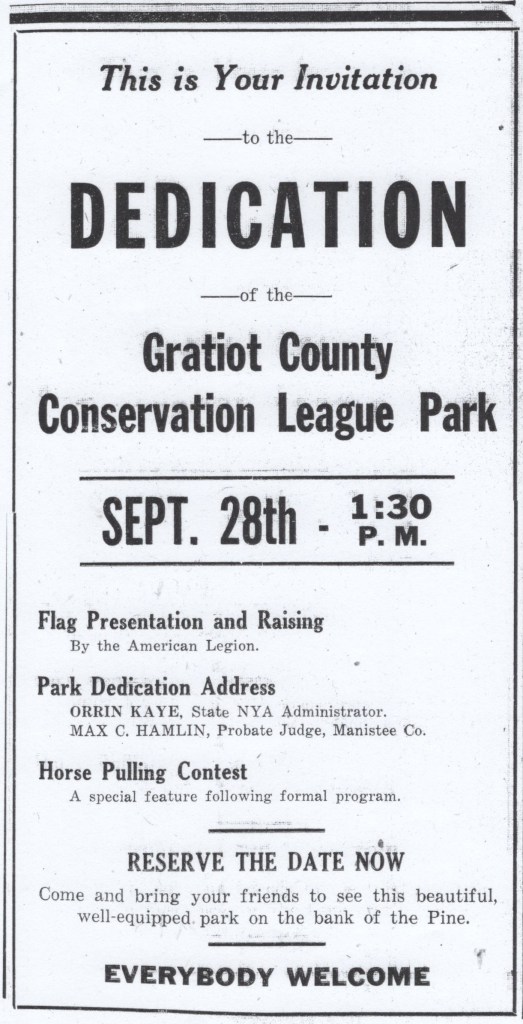
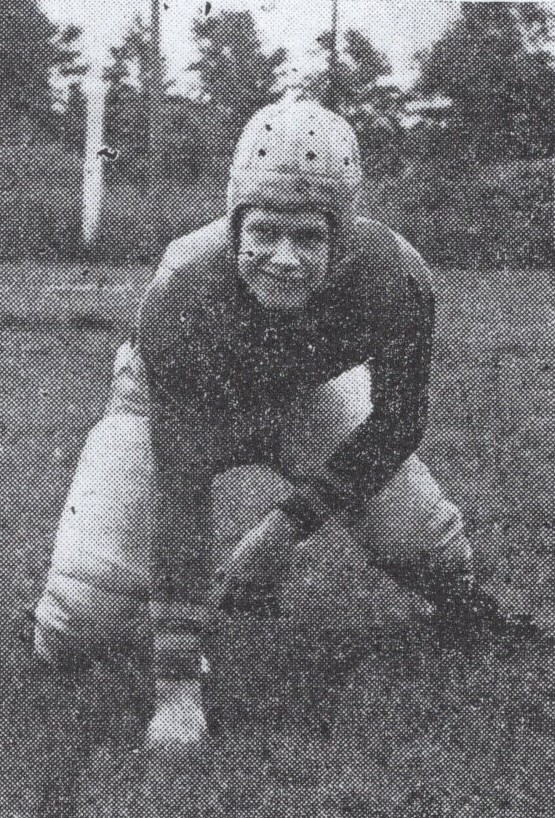
Gratiot in September 1940, from the top: Going back to school again and learning about impending warfare, September 12, 1940, cartoon from the Gratiot County Herald; Gratiot County Conservation League Park is dedicated. A combination of members, volunteers, along with NYA and WPA workers, made the use of the park possible in late September 1940; Elwood Mellinger, captain of the Ithaca football team, as it prepared to face St. Louis on September 20, 1940.
Another cold, wet fall meant it would be a challenge to bring in another Gratiot harvest.
It was a time when America prepared for a peacetime draft – its first draft since 1917.
What, Roosevelt runs for a third term as President? No President had done so in the nation’s history.
Residents also learned that the WPA programs would soon come to an end after five years of operation.
What was going on?
It was September 1940 in Gratiot County.
Europe at War, Preparation at Home
As Hitler continued to attempt a conquest of Great Britain, the only remaining obstacle to his domination of Western Europe, Gratiot County prepared for war. Although the Führer boasted to England that “I am coming,” England countered by conducting another of its early air raids upon the city of Berlin.
Even before entering the fall elections, President Franklin D. Roosevelt spoke freely and openly about the need to prepare the nation for war, and instituting a peacetime draft now became a reality. All American young men between the ages of 21 and 35 had to register for possible conscription by October 16. Roosevelt’s initial goal was to mobilize 400,000 men by early 1941 and 900,000 by the spring of that year. All registrants would carry a registration card, and those who failed to register would be considered evaders.
As a result, Gratiot County received approval from President Roosevelt to form its first draft board in twenty years. Four men, Dr. C.F. Dubois (medical examiner), Charles R. Murphy, A.D. Smedberg, and Robert Reed, headed the Alma board. All served without pay. Ahead of the draft, six local men signed up at the Alma post office on one weekend to join the United States Marine Corps. Robert Hennigar, Burson Youry, Paul Dintaman, and Lyle Goward of Alma, along with Donald Zinn and Richard Horton of Vestaburg, expected to go to Saginaw for their formal physicals. If they passed the examination, the group of men would be sent for Marine training at Parris Island, South Carolina.
Men involved in Troop B, National Guard, of Alma, returned from drills in Wisconsin. However, Captain Howard L. Freeman believed that the unit would soon be called into service as part of the 210th Coast Artillery, an anti-aircraft unit. Two weeks later, that assignment changed again, and the group would be known as Battery B of the 177th Field Artillery. The Alma battery needed to increase its strength from the current roster of 60 men to a total of 122 men between the ages of 21 and 35. At this time, one Michigan newspaper reported that many National Guardsmen would be sent south in October to Camp Beauregard, Louisiana, for a year of training. President Roosevelt soon signed an order calling up over 60,000 men in the National Guard for a one-year period of service. Sadly, a result of this order meant that the horse cavalry unit, long a part of Alma and Gratiot County’s history, would soon depart for Illinois.
Photographs in county newspapers, such as the Alma Record and Gratiot County Herald, demonstrated the hardships of war as well as this nation’s preparation to be drawn into the conflict. In an attempt to feed its population during war, England used all of its land to raise food, including growing wheat in London parks. Londoners also paid an admission fee to see a recently shot down German Messerschmitt fighter for the “Buy a Spitfire” fund. In Santa Monica, California, one plant worked to produce the world’s largest bomber, a four-motored aircraft with a 210-foot wingspan. It held a crew of ten men and could fly 6000 miles on a bombing mission. In Springfield, Massachusetts, a plant there produced 1000 Garand semi-automatic rifles daily. The plant commander urged the War Department to expand production. Two inventors of the concrete pillbox, a concrete dome-shaped shelter that builders could set in five hours, demonstrated it in front of the Army and congressional leaders. These small fortresses could be used in America to guard its borders.
Depression Life Continues
The New Youth Administration (NYA) continued work in the county as 80 young men and women received permission from the program to work more hours, and therefore, more pay. Thirty-five young women worked on various projects, including recreational activities at Conservation League Park and maintenance tasks at Alma City Hall. All project workers were required to take and complete their initial air courses. A few NYA members worked with WPA supervisors at places holding girls’ activities at Wright Park for handicrafts or at wood games activities for young people at Republic School. James Carter oversaw the woodcraft project at the Salvation Army Center. As Halloween approached, the NYA staff led interested children in creating paper masks using clay, which would be displayed at the indoor recreation centers. Two Gratiot County students, Elroy Prince of Ithaca and Darwin Snyder of Breckenridge, attended a short NYA agricultural course at Michigan State College. A total of thirty students made up the group, attended class, lived in a barracks, and worked part-time. At different Gratiot County high schools, student aid workers on the NYA payroll earned $6 each month once they received NYA certification.
The Works Progress Administration (WPA) offered further training to members from Gratiot County who traveled to Hoyt Park Field House in Saginaw. Director Darrell Milstead, recreation director, led the group as it learned about fall sports activities, arts, crafts, administration, and first aid. Among those who attended were Hazel Markham (from Ithaca), Henry Sholtz and Lester Fillhard (St. Louis), James Carter, Jack Acker, Lowell Williams, and Eldon Lott (Alma). The WPA program, which had operated nationally for several years, received news in late September that all WPA work would end by June 1941. The program director urged WPA leaders across the nation to complete their existing projects within the allotted time and avoid initiating new ones. An increase in funds for defense appropriations and an overall atmosphere of the need to train for national defense meant an end to WPA programs.
People who had past accounts with the Elwell Bank received good news from Charles H. Goggin, President of Alma First Bank of Alma. He announced a possible agreement to disperse the liquidated assets of the former Elwell Bank. Litigation continued in court in Ithaca, but an announcement was expected soon. A hundred former bank depositors had filed suit to get money from the Alma Bank, which they claimed was also tied to the Elwell bank’s collapse. The judge granted ten days for any other former depositors to file their claims for money.
Over at the Ithaca courthouse, work began on the new social welfare offices and Gratiot Bureau of Social Aid, which planned to relocate from Alma. The two new offices, expected to open in the courthouse basement, and the remodeling meant that a new entrance would be created on the south side of the building. The new rooms would now occupy what was formerly known as the youth detention area and janitor’s living quarters.
Health and Gratiot County
The Children’s Free Dental Clinic continued its work in the county after completing its time in St. Louis. A dentist worked on a total of 222 St. Louis children with 335 cavities filled and 185 teeth extracted. Another 29 children had their teeth cleaned. The Child Study Club sponsored the clinic, which provided free healthcare to underprivileged children. Doctor G.V. Barrows did the dental work and was assisted by Beth Hicks. Several children from Wheeler and Breckenridge attended the clinic as well.
The public received warnings about outbreaks of infantile paralysis in sixteen different Michigan counties. Believed to be a seasonal disease that peaked in late August and early September, a total of 272 cases were discovered in the state during September. In related news, Leonard Hubbard, 29, a popular Vestaburg musician, died of the disease only one week after contracting it. He left behind a wife and three children. In other health news, a Bannister man took his own life after years of battling illness. Frank Goldman, age 67, hung himself in his barn early one morning. Goldman suffered from being unable to eat and sleep due to health problems. In another twist, he was scheduled for the next step of becoming a naturalized citizen the day after his death. Goldman farmed in the community for 28 years.
The Long Arm of the Law in Gratiot County
August 1940 proved to be a busy month for the courts as a variety of offenses resulted in 47 convictions. Only 18 in the group were found to have committed serious crimes, and most of the others were due to traffic offenses. Fines totaled $258.30, with an additional $162.80 for costs. Some of the serious crimes involved one man being sent to Jackson Prison and four others to the county jail. Otis Andrews was sent to Jackson for violating probation for a third offense of drunk driving and got six months to two years. Andrews was warned that if he ever showed up in court again, he would be immediately sent back to Jackson.
Lawrence Lutz, 18, of St. Louis, was found guilty of carrying an unloaded concealed weapon without a license. He only got a year’s probation and was ordered to attend church with his parents every Sunday. Four men were convicted of fishing law violations for setting an illegal set line on the Maple River. They each paid $10 for a fine and $6.85 for costs. Another person unlawfully used an automobile and got three years’ probation and $200 for damages to the car.
The Alma City Commission had its first reading of a proposed ordinance regarding trailers in the city. If accepted, the new ordinance would regulate trailer families and individuals from taking up residence on vacant lots or yards. Those wishing to reside in trailers had to do so at a licensed trailer camp and pay $15 for a yearly license. The trailer camp owner was also required to provide a service building, showers, toilets, laundry facilities, drinking water, and a list of other amenities. Anyone parking a trailer next to a homeowner in Alma could only do so for two weeks at a time.
Regarding elections and politics, Gratiot County gave favorite son O.L. Smith a nearly 2-1 advantage over incumbent Luren Dickinson for the Michigan Governor’s race in the state primary election. Unfortunately, Dickinson trounced his opponents across the state to gain the nomination. He would face off against Democrat Murray D. Wagoner in November. One of the most interesting and spirited contests involved three candidates for Probate Judge. Mildred Taft, daughter of the late Probate Judge James G. Kress, won the primary election after being appointed by the Governor to fill out her deceased father’s remaining term. Taft would serve as Probate Judge until 1963.
Naturalization hearings continued at a good pace in the county as ten residents from six different countries applied to become American citizens. For this ceremony on September 19, something new happened. This time, DAR chapters from Alma and Ithaca organized a short march to the court. At the same time, bugles played and Boy Scouts accompanied the group. Alma DAR chairman, Miss Lou Nickerson, gave a brief talk on the Constitution, then Mrs. Floyd Barnes explained the meaning of the American flag. Each new citizen received a citizen’s manual with a copy of the Constitution, which included the Pledge of Allegiance. Each citizen also received a small 4×6-inch flag. Although fifteen candidates faced examination for citizenship, these ten were accepted, while the other five continued further study. Members in the group originally came from places like Croatia, England, Russia, Germany, Poland, and Slovakia.
Alien registrations also continued at post offices across the county. In Alma on one Wednesday afternoon, a total of 18 aliens registered. The Alma postmaster, J.L. Winslow, commented that several persons believed they were American citizens, but upon investigation learned they were not.
Farming
Farmers were urged not to cut their alfalfa but to wait at least until the end of September, unless used for silage or molasses. It was essential to let alfalfa store up root reserve for 1941. Sugar beets appeared to have a later-than-usual harvest due to low sugar content. The heavy rains in late August and early September meant a delay in harvesting. The Michigan Sugar Company announced it had 9,000 acres set aside for raw material for the Alma plant. A new beet dump and piler took care of a load of beets in one minute. Over at St. Louis, the Lake Shore Sugar Company had 10,000 measured acres of beets to harvest. Still, a late white frost hit Gratiot County at the very end of September. County Agent C.P. Milham announced that the enemy of all farmers, the corn borer, caused over $200,000 in damage to county farms. For many in the county, the amount could have meant profit or loss for the season. To combat the corn borer, shredding dry stalks and plowing under others by June 1 had to be a goal for all farmers, according to Milham.
In other farm news, a group of nine Junior Farm Bureau members attended Waldenwood Leadership Training Camp at Hartland, Michigan. A total of seventy-eight young people from thirteen countries attended. From Gratiot County, John Kelly, Gerald Lake, George Cox, Marion Wang, Eugene Oberst, Margaret Douglas, Edward Hooper, Lowell Quidort, and Dorothy Gibson all went. Another 24 schools proposed forming 4-H clubs in the county, bringing the total number of 4-H clubs to 42. The Beebe 4-H Club had 11 members and was led by Mrs. Helen Muscott.
Mexican night entertainment took place in Alma on September 28, coinciding with the dedication of Conservation Park. Mexican talent, recruited by Pastor Albert Mareno of Shepherd, performed a program at the Alma Tourist Park, located west of the Christian Church. Finally, pheasants surprised Dick Brown and his daughter in Alma as a rooster and three hens were flushed from behind the Brown home inside the city. Young daughter Brown is very excited to see the pheasants.
And So We Do Not Forget
Thirty boys showed up for the first St. Louis football practice of the year. The Labor Day practice marked the beginning of preparations for the season’s first game against Ithaca, just three weeks away. Coach Elliot Oldt was seeking guards and tackles to fill the ranks vacated by last year’s graduating seniors…Fulton School in Middleton and Perrinton started school on September 3, and Superintendent Eberly announced the school had four new teachers. Fulton had a total enrollment of 434 students. Grades seven through nine met in Middleton, while grades ten through twelve had classes in Perrinton. The district had five school buses…” When the Daltons Rode,” starring Randolph Scott and Kay Francis, appeared at the Strand Theatre in Alma. Tickets were ten and twenty cents…Ithaca Public Schools opened with an enrollment of 597 students. Kindergarten had forty-eight students; the senior class was made up of sixty students…The Perrinton softball team finished first and was the winner of the 1940 fastpitch softball season in St. Louis. Rowley and Church finished as runners-up.
The public was invited to observe the dedication of the Gratiot County Conservation League Park in Alma on September 28 at 1:30 p.m. Activities included a flag presentation and raising, public address, and horse pulling contest…The Pentecostal Faith Riverside Tabernacle church dedicated its new building at 523 Michigan Avenue in St. Louis. The new building seated 100 people…Students, buy your new fountain pens at Green’s Jewelry in Alma. The fountain pens only cost 29 cents each…Work on the new Gratiot County highway garage continued. The $65,000 structure is planned to open on November 1. Situated in East Ithaca on the south side of US-27…The Lincoln School in Alma received a trophy from the Automobile Club of Michigan for the number of safety contacts it had during the previous school year. One of the achievements of the Lincoln School was its use of school safety patrols by children. Lincoln placed first among forty other Michigan schools for the award…Harold Woodley of Alma saw the excavation for his new house begin in late September, marking the start of construction on his $6,300 residence on West Superior Street. The new home would be just east of the Lester Purdy Riverside Dairy farm.
Alma Schols began the new school year with approximately 1,750 students. This included 225 non-resident students who paid tuition to attend school in Alma…A “Pageant of America” was planned to be performed on the Alma College athletic field on October 4. An estimated 500 people from Alma organizations and leading citizens were involved in presenting this program. The Jean Bessac DAR Chapter led the organization of the pageant…Radio station WJR, the state’s most powerful radio station, planned to have two announcers in Alma for its “Michigan Speaks” series. Jack Garrison and Duncan Moore planned to broadcast from the streets of the city to gauge county voting preferences for the upcoming 1940 Presidential Election between President Roosevelt and challenger Wendell Wilkie…Otis Brantley, chef at the Main Café in Alma, and Claude LaVoy of Riverdale hit it big while fishing on the Maple River near Matherton. They caught two of the largest catfish seen in Alma in a long time. One was over 4 ½ feet long and weighed 45 pounds…The Michigan Masonic Home has a new V-shaped electronic sign in front of the home. It turns on automatically at 7:30 p.m. so that anyone passing by on US-27 can see it.
An open house was scheduled at George W. Stewart’s new home on 612 Liberty Street in Alma. James Medcoff, a contractor and builder, designed and built the new house using materials from the Little Rock Lumber and Coal Company in Alma. The new home cost $3,500 to construct…Senior Elwood Mellinger, left tackle, served as Ithaca football captain for the team…A tragedy occurred in Elm Hall when an explosion and fire took out the Hoxie General Store on a Friday morning. A combination of a kerosene heater and cook stove malfunction caused the fire, which resulted in $4000 in damages. George Mack and his wife had insurance on the building and contents, but it would only cover part of the loss… Roy Rogers and Gabby Hayes starred in “Saga of Death Valley” at the Ideal Theatre in Ithaca. Catch a Saturday matinee for only a dime…James Redman, 20, Alma, married Opal Jean Hahn, age 18, of Alma, and became the latest of Cupid’s victims…Miss Virginia Hetzman of Alma was runner-up at the State Fair for the dress she made and wore for the style revue. Hetzman had been involved in Martha Jean Conklin’s 4-H club for the past seven years…A representative from the Saginaw field office of the Social Security Bureau, Alma, will be Available on September 18 for two hours to answer questions and provide assistance to those applying for Social Security. Meet the rep at the office of the Michigan State Employment Service in Alma’s city hall…Finally, someone (or something) shut down ten telephone lines and twenty-five telephones in Ithaca. In this case, a fox squirrel ate through the leaden sheath of an aerial cable on St. John’s Street. The squirrel gnawed through the lines, exposing them to water. It was the second time in five years that Union Telephone had to address this problem.
And that was Depression and War in Gratiot County during September 1940.
Copyright 2025 James M. Goodspeed
 Goodspeed's Gratiot County Historical Blog