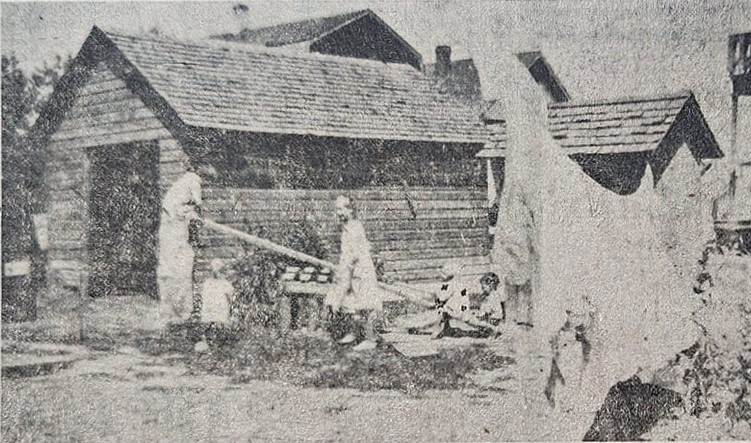
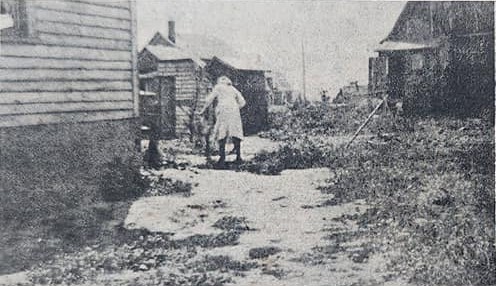
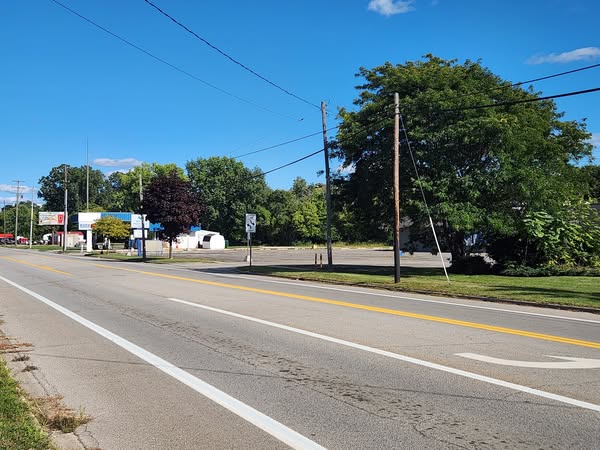

A Place Called Millerville from the top: A child’s playground in Millerville II? Laundry and life goes on in this part of Alma’s slum area; outhouses and a lone water pump appear in the crowded area of Millerville II; Millerville (I) appeared on this part of the south side of East Superior Street, looking east; another view of where Millerville (I) sat in the late 1910s – on the south side of East Superior looking west.
It was an area so vile that its history has been erased from Gratiot County’s past. Some referred to it as the Alma slums. Others called it the county’s largest red light district, which resulted from a housing boom that overtook Alma during the 1910s. Others knew it as a series of shacks, collectively referred to as “pink houses” on Alma’s east side, and known as Millerville (or Millersville) during World War I.
During that time, Alma nearly tripled in size, transforming from a village in 1910 to become the county’s largest city. This population growth was accelerated by many people who came to work at the Republic Truck, adding to a continued housing crisis.
Enter one man, J. L. (Joshua Leslie) Miller. Miller arrived in the Alma area in the 1880s as a real estate agent and businessman with a keen eye for generating profits. Eventually, Miller and his sons owned grocery stores and a shoe store, and he also recognized the opportunity to benefit from Alma’s growing housing needs. Miller quickly acquired areas on East Superior Street, adjacent to the Superior Gas Company, and extending to Bridge Street. This long, triangular-shaped area, located south of the Republic Truck Company, today includes Michigan Psychological Care, Admiral Petroleum Station, and All-American Glass Company. Miller quickly chopped this property into tiny parcels of cheap shacks, jamming them together with little regard for water or sanitation. By the fall of 1916, the area had become so overcrowded that some people resorted to living in tents.
Meanwhile, people arriving in Alma by train passed Millerville. State newspapers and trade magazines wrote about this location, and jokes and stories portrayed the city in an increasingly unfavorable light. City fathers sought to have something done and eventually succeeded by getting Miller and others to sell their line of shacks to Libby, McNeill, and Libby, supposedly to be used as a sidetrack. Afterward, the new Millerville buyers quickly received public praise for planning to remove Alma’s eyesore.
However, controversy over Millerville continued. On September 4, 1917, a young girl, Beatrice Epler, was murdered, and her body was discovered on Grover Avenue, southeast of the slums. Poor lighting and streets that were unfit for traffic made it an ideal place to dump a body. One of the defendants charged in the murder was Inez Johnston, who operated a house of ill repute in or near Millerville. The increased presence of prostitution in Alma also became a topic, leading to another problem: how to address social disease and the number of working girls who had drifted into Alma as the number of military men picking up Republic Trucks for the Army increased. Throughout the country, addressing social diseases during the World War I era became an issue involving military, state, and federal authorities. In Alma, more than one girl would be arrested and confined for inspection and treatment as carriers of disease, ending up in places like the Bay City hospital. According to the Alma Record, this issue, which involved twenty-five girls in Alma and social diseases, went on until at least 1920.
Although Millerville experienced a clean-up during the Epler trial, the story of slums and poor housing in Alma was far from over. Miller, who sold the slum area on East Superior Street, also owned another area known as “Millerville II.” Newspapers sarcastically attacked the second slum, deriding Miller as “the self-styled working man’s friend, Miller, known practically to everyone in Alma” – especially those willing to rent from him. The Alma Record again complained that, “The city should do something to make Millerville II more attractive for the hard-working folk and the children who live there and pay big rents for inferior homes. It is on the main highway and endangers the name of our good city.”
Millerville II was situated near Michigan Avenue on Highland Avenue and extended eastward, where Miller divided the lots into smaller sections, all of which had homes made of inexpensive materials. The buildings appeared unfinished; many had cracked foundations and were so close together that the porches in one area touched the street. Millerville II lacked city water, gas, or sewage, with over forty outhouses located on a single block, creating another eyesore in Alma.
The Alma Record published a series of photographs and articles on its front pages from November to December 1920. The pictures brought to the public’s attention the need to clean up Millerville II as well as the city’s Union Depot. The depot had numerous problems, including serving as a dumping ground for trash along the railroad, a poorly maintained waiting platform, dirty bathrooms, and the depot’s overall odor that frequently smelled like caged poultry.
The slum problems eventually led to a solution through the creation of the Alma Chamber of Commerce. By early 1921, the chamber attracted over 500 members and gained the ability to advocate for property reform. Alma eventually obtained and installed sewer connections to Millerville II, cleaned it up, renamed it the Highland View addition, and replaced the Union Depot. Thirty years later, the Alma Record briefly wrote about those times and rejoiced, remembering that “Alma’s greatest eyesore, known as Millerville,” had since passed from existence.
Copyright 2025 James M Goodspeed
 Goodspeed's Gratiot County Historical Blog