
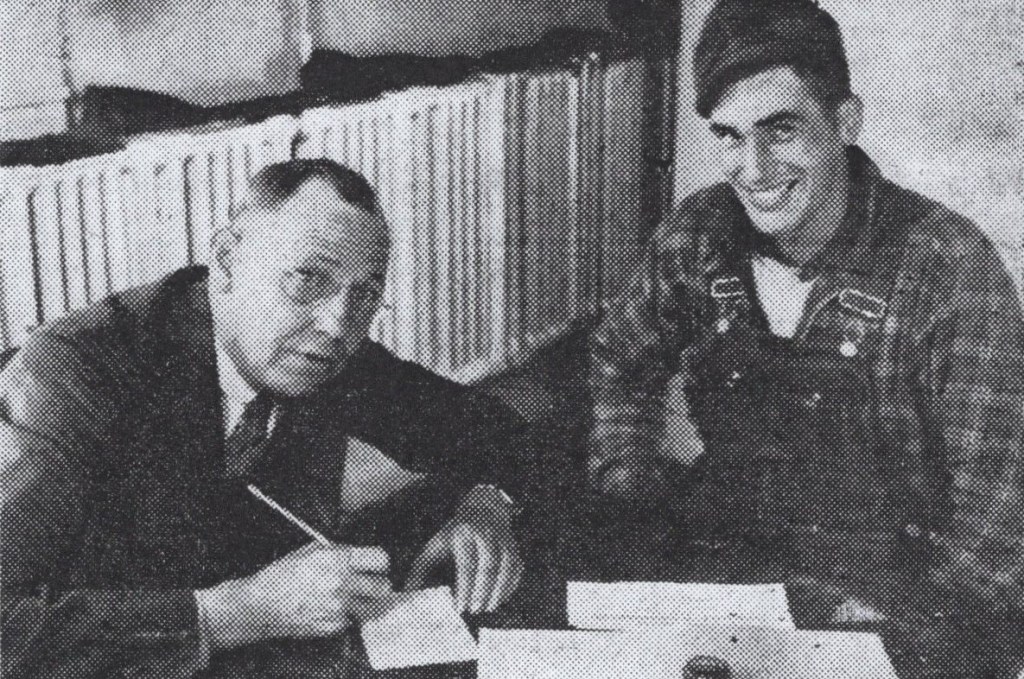


October 1940 photographs and events in Gratiot County from the top: “Dictators Take Notice” promoted the idea of registering for the first national draft since 1917; Walter O. Brown, a World War I veteran and Ithaca tailor, helps Roy Stewart register for the selective service draft in Ithaca; Wendell Willkie for President advertisements seemed to be everywhere as was the theme “No Third Term” for FDR; “Aladdin” the magician appeared at Ithaca High School auditorium for Halloween night.
Gratiot Steps Toward War
As Hitler continued his bombings of England, several newspapers wondered how long the British Isles could hold out until the Nazis invaded. Mr. and Mrs. H. Abbey of Ithaca received a letter from a relative living in London, who described life under the bombings. Despite rationing, Londoners were not starving. Sometimes, there were two or three air raids per day, often continuing throughout the night. Still, the British were downing about fifty German airplanes daily. In fact, W.A. Hobson wrote that “If their air men come down alive they say it’s heaven, and are thankful to get here.”
Here in Gratiot County, young men slowly moved toward voluntary enlistments. Millard Morton and Don Freeman, both of Alma, joined up and were sent to Fort Bragg, North Carolina, for field artillery training. Paul Long of St. Louis enlisted in the United States Army. After being stationed at Fort Sheridan, Illinois, Long went to the Panama Canal Zone. James Seitner, also of St. Louis, enlisted with the 210th Coast Artillery, Anti-Aircraft Unit, in Detroit. He was drilling several nights a week and expected to be sent to the South in early 1941. William C. Bainbridge, Jr. of Alma, was also selected for Army Air Corps primary training in Lansing. On a lighter side, Alfonse (Dutch) Collins, an officer in the Michigan National Guard, was in the news for failing to quell a riot on Alma’s north side. Collins was called to River Avenue to help with the noise caused by scores of starlings. Collins went to the site with his shotgun and Number 4 shot, took aim a half dozen times, and missed every time. In fact, the result was the existence of more starlings than ever. Collins was chided in the neighborhood for his inability to hit more birds and for how he would ever shoot down enemy airplanes.
A wave of concern began to sweep through the United States regarding Fifth Column activity. Lieutenant Harold Mulbar of the Michigan State Police visited St. Louis and spoke to the St. Louis Rotary Club about potential subversive activity in the state.
The ongoing talk of war continued to promote the idea of a new armory in Alma. If Alma could raise $15,000, the federal government could provide an additional $45,000 through a WPA Project, according to Alma City Manager W.E. Reynolds. Plans also proceeded for the 1941 Tulip Festival in Holland, as fall planting of bulbs was underway. The planting continued, even though about ninety percent of the annual importation of tulip bulbs from the Netherlands had been halted due to the war.
What about complaints in Gratiot County newspapers about the President? The issue of Lend-Lease of old ships to England in exchange for locations in the Caribbean had editors up in arms. “America’s first dictator” (President Roosevelt) took a significant step toward involvement in the war by trading aging ships with England, thus demonstrating that the United States was taking sides. According to one editorial, FDR was deemed a sucker in the trade, as who would want interests in the Caribbean? Time and war would eventually prove the critics wrong. However, that was not the most significant concern about President Roosevelt’s actions, as another issue soon arose.
The Draft
On Tuesday, October 2, County Clerk Charles L. Hicks received instructions for the registration of all Gratiot County men aged 21 to 35. Hicks estimated that about 4,500 men in the county were subject to the draft. To prepare for the draft, the Selective Service Headquarters in Lansing sent 6,280 registration cards, 5,230 registration certificates, 290 registration placards, and 29 instruction sheets for each precinct in the county. In St. Louis, City Clerk Frank L. Housel asked the public for volunteers to help with the registration process as the city hall expected 500 St. Louis young men to appear. Alma expected 1,000 men and asked for 35 workers.
Registration took place on Wednesday, October 16, and each man was required to answer eleven questions, ranging from his name and address to his place of employment. As each man made his way to the election booths to register, he saw a large placard displaying an enlarged registration card along with instructions. Lines were congested early in the morning, at noon, and at night; however, in most cases, little waiting actually took place, as the lines tended to move along. Each man received a serial number, which was sent to Washington to be drawn in a lottery. The Gratiot County Herald published a list of registrants, organized by their order number and serial number. Russell Hazen Swinson of Alma had the first number.
When the registration process ended, a total of 3,716 men were available for the draft, and 187 men were expected to be called to service by June 1, 1941. The county draft board, which was located in Alma’s City Hall, was composed of A.D. Smedberg, C.R. Murphy, and Robert V. Reed. At the same time that the draft board was created, members were appointed to the district appeals board. Lawyers J. David Sullivan, Kenneth Montigel, Merrill Hendershot, and Charles Goggin were appointed to that board. One of the primary reasons for granting deferments was to address the needs of men with dependents. The draft board showed leniency in this regard. Occupational deferments soon became another issue and had to be dealt with on an individual basis. One of the first complaints recorded in the Alma Record concerning registration for the draft involved President Roosevelt’s son, Elliot Roosevelt, who joined the Air Corps as a captain. The younger Roosevelt received higher pay and allowances than most young men who would be drafted. Editors argued that Elliott Roosevelt should be drafted like all other young men.
And who made up the most considerable loss of Army aid from Alma? The group of thirty-one cavalry horses left Alma with the help of Private William Meredith from Troop B, 106th Cavalry, Michigan National Guard. The horses went to the remount station at Fort Reno, Oklahoma, and thus came the end of the long history of horse soldiers in Gratiot County.
Now, the nation awaited the first draft call planned for November 18.
Politics & Election of 1940
Politicians big and small appeared in Gratiot County, campaigning for election or re-election for their respective offices. Both sides of the candidates for governor appeared in the county beginning in early October. Murray D. Van Wagoner, Democratic candidate for governor, addressed an audience of 150 at the IOOF Hall in Alma. His speech focused on his plan to reduce the state’s deficit, and he stated that if he failed to do so, he should not be re-elected in two years. Republicans organized meetings in places like Robinson Auditorium in St. Louis, and 75 Young Republicans of Gratiot County held a meeting at the Wright Hotel in Alma. Governor Luren Dickinson even had a campaign rally at the St. Louis High School Gymnasium, alongside O.L. Smith, a noted Gratiot Republican who ran for governor in the state primary. The St. Louis High School band provided music for the program.
A “Willkie-For-President” headquarters appeared in downtown St. Louis, which was decked out in red, white, and blue colors. The headquarters was billed as one of the most attractive Wendell Wilkie campaign headquarters in mid-Michigan. Willkie supporters organized a reception committee to welcome visitors each week; among the first to do so were Charles S. Huntley, Mrs. Rolland Baum, and Mrs. Frank Housel. Heavy campaigning for Willkie for President could be seen in county newspapers, which asked readers if they wanted an inauguration (for Willkie) or a coronation (for another Roosevelt term). The main arguments for Willkie manifested themselves in the phrases “Vote No Third Term” or “Anti-Third Term.” Near election night, the headquarters offered free doughnuts to anyone who stopped in to show support for Wendell Willkie.
Life in the Depression and New Deal Projects
In a big affair, Gratiot County celebrated the dedication of Gratiot County Conservation League Park in early October. On a crisp, clear day, southwest of Alma, a large crowd of people turned out to celebrate the work done on the 53-acre park that the Gratiot County Conservation League purchased in 1937. Fifteen minutes before the program started, Alma city manager William E. Reynolds, Howard C. Riggle, benefactor of the park, and Dean Carter, NYA county director, were interviewed on the air by Saginaw’s WSAM station. A flag-raising ceremony then started the program, emceed by Dr. Thomas Carney, who introduced a series of speakers. The National Youth Administration (NYA) was recognized for having done much of the work over the previous two years with the help of federal aid, such as constructing the one-hundred-foot suspension bridge and working on the park’s landscaping. Even as winter approached, NYA boys continued to rake leaves and cut dead wood, planning to complete a lawn bowling green before the winter weather arrived.
The NYA also continued to benefit area high school students by allotting $2,268 to eleven high schools in the county. Approximately 65 students earned $3 to $6 a month during the school year for their work with NYA. The money earned by students went toward lunches, carfare, and school supplies.
WPA (Works Progress Administration) project work also continued in the county. A group of twenty-five men worked excavating six cement tennis courts at Wright Park. Another group of seventy-five WPA workers labored on street paving jobs on streets like Orchard, Walnut, Downie, and Wright Avenue. A shortage of summer labor and the oncoming winter season meant that some projects in Alma would have to wait until 1941. The WPA also suggested creating a possible skating pond, a roller skating project, and even a swimming pool in St. Louis. For the summer daily project, there were 587 young people in attendance, according to Coach Oldt. WPA projects also involved grading and widening different roads in the county. A bridge at Bridgeville was being repaired, and a new bridge was created over Beaver Creek at Lafayette Township, all with WPA labor.
The Gratiot County board of supervisors appointed a committee to explore the possibility of creating a future traveling library for the county with WPA labor by converting a traveling bus into a library. A $2,000 federal government funding to buy new books, along with book donations from Alma, St. Louis, and Ithaca libraries, would supply the necessary reading material for rural students.
Ten youths from Gratiot County took their examinations to serve in the Civilian Conservation Corps (CCC). The group was expected to work at Camp Axim in Cadillac. The ten included: Alger Anters, Wallace Cratsenburg, Donald and Lester Dunn, Victor Hall, Clyde LaVoy, Nile Liscomb, Cecil Skutt, Murl Smith, and Denver Welsh.
Other news involved a settlement between creditors of the late Bank of Elwell after a dozen possible suits. Assets would soon be divided among the creditors to bring the issue to a close. For the week ending August 31, 1940, the Alma Welfare Office processed compensation claims for $6,519. The Social Security representative for old age security will be late in appearing in Alma because of attendance at a conference in Cleveland, Ohio. Manager Joseph W. Ramsey of the Saginaw field office would be back on October 23.
Farming and Farm Issues
An early frost hit the county just as weigh stations for sugar plants opened during the second week of October for the estimated 2,260 sugar beet growers in Gratiot County. On Tuesday, October 8, both the St. Louis and Alma plants started taking beets from farmers. At the end of October, farmers received one of three types of payments for their sugar beets. First, there was payment on actual tonnage if it exceeded eighty percent of the normal yield of the farm. A deficiency payment was the second type paid if tonnage was less than eighty percent of the normal yield. A third payment was made for abandoning 1/3 of the normal yield if beets had been abandoned.
Other, more serious problems still faced Gratiot County farmers, such as the battle against the corn borer. One hybrid corn plot in Emerson Township, belonging to the Grover Brothers, showed that their corn, planted on June 2, had sixteen corn borers in just one stalk. With 40,000 acres of corn planted in Gratiot County during the year, it was estimated that the pest caused $400,000 worth of damage to the crop. Concerns over the seriousness of corn borer damage came out in a Gratiot County editorial urging farmers to take the issue seriously as they prepared for 1941.
Miss Helen White of St. Louis, Missouri, met with the executive board of the Gratiot Council of Churches. White, Regional Director for the Council of Women for Home Missions, gave final reports about the Mexican center that operated during the summer and revealed plans for Mexican migrant workers in 1941. Miss White also spoke to the annual convention of Gratiot County churches on “Michigan Migrants.” Much of the financial support for the Mexican center in Alma came from churches in the county, as well as Leonard Refineries, Michigan Sugar Company, Lake Shore Sugar Company, and Michigan Sugar Company Workers Association. Reverend Floyd Drake of Breckenridge was recognized for his tireless work for the Mexican school.
A variety of news items dealt with Gratiot farming. The People’s Elevator Company moved into new offices in Elwell in what had been known as the Bina Slingluff home. To make the mill more efficient, the building had been moved back 150 feet. Ward Bronson served as manager. In early October, the county announced that 4-H interest had peaked at 500 enrollments, and 61 schools asked for winter clubs. Country schools from Hetzman in Emerson Townships to Sunnylawn in Wheeler Township all wanted to join the growing 4-H enlistments. On October 1, the Farm Bureau held meetings in places like the Beebe Hall, where Sherman Edgar served as chairman. An egg grading demonstration, a discussion about the corn borer crisis, and the call to create a community scrapbook about life under a democracy all took place.
October meant pheasant season, and many farmers in the county dreaded the appearance of hunters on their farmlands. Before the start of pheasant season, fourteen hunting clubs restricted hunters by ordering that they obtain a pass from the farm owner before hunting his land. Sunday hunting was closed, mainly, and Gratiot County petitioned the state for a statewide hunting ban on Sundays. On opening day, “nimrods” could be seen on many wooded tracts and farms, taking their share of birds. However, a few were caught hunting too early and paid fines of up to $12.00. To warn hunters, a sunrise timetable had appeared in local papers to indicate when hunters could start shooting on the first day. Unfortunately, toward the end of October, surveys of pheasant and rabbit hunters suggested fewer of them were taken, possibly due to the cold, wet spring. A statewide dog quarantine to contain a rabies outbreak officially ended in late September in 42 counties. Gratiot County was one of the counties where the ban ended.
The holidays were not that far off, and a county-wide turkey tour to see 15,000 turkeys in Gratiot County took place on October 23. The success and importance of turkey farms in the county were evident as the tour members visited at least fifteen different turkey farms. On a sad note, Lawrence Nemcik of Bannister lost his barn and hay. A kerosene lantern was believed to be the cause of the fire.
The Long Arm of the Law in Gratiot County
The law doled out justice as October arrived. On the court docket, nineteen law cases, four chancery cases, and six chancery divorce cases awaited Judge Kelly Searl. During September, the court ruled on sixty convictions: 39 were for traffic law violations, and 21 were for other general offenses. The court collected a total of $448.85 in fines and costs. One person failed to pay the dog license fee and paid $6.85 in fines and costs. Judge Searl dismissed one case of bastardy when the couple agreed to marry. In some good news regarding dogs in Gratiot County, dog license fees generated $1,417.48 more than the amount paid to farmers who lost livestock to dogs from October 1939 through September 1940. The profit was attributed to owners keeping their dogs confined during a rabies outbreak and purchasing licenses.
Warren Glaser, 26, of Saginaw, was arrested for larceny of a diamond ring valued at $500 from a well-known Ithaca lady. The ring turned up at Wolverine Billard Hall in Saginaw after Glaser pawned it for $25. Upon arrival at the county jail, Glaser claimed he experienced severe stomach aches and had to be transferred to Smith Memorial Hospital. Doctors could find nothing wrong with Glaser, and he was handcuffed to his bed for another day. A pair of cattle thieves, Charles Vanatter of Eaton Rapids and Ashley Eaton of Detroit, awaited extradition to Gratiot County for trial on their crimes. Both men were serving 90-day jail sentences in Ingham County. Two St. Louis dentists’ offices were investigated by police when thieves stole gold fillings valued at $250. One dentist also claimed that over $200 in other filling material was also stolen.
The story of the troubled Cornelius Eichorn again appeared in circuit court. Eichorn had been arrested and convicted for repeated driving violations, resulting in his license being suspended. He recently wrecked his car a year earlier by smashing it into a large tree. Now, his wife, Effie Smith Eichorn, appeared in court to contest her divorce from Cornelius, desiring a settlement for herself and her young son. Cornelius Eichorn owned 120 acres of land in Emerson Township, and the hearing for the case lasted nearly an entire Monday in court. Mrs. Nellie Ranchun, poultry and egg buyer from Detroit, appeared in court for swindling Harry Bolyard of Middleton. Ranchun first agreed to buy eggs at 15 ½ cents a dozen from Bolyard. When Harry wasn’t around, Ranchun managed to negotiate a deal with his son for 13 cents. The younger Bolyard, unaware of the prior agreement, was a victim of Ranchun’s shrewd tactics. Justice Potter did not see it that way and awarded Harry Bolyard the full amount, as well as damages of $25.75.
A series of Ashley businesses experienced break-ins and robberies by at least two men. Joe Liska’s grocery, Ashley State Bank, and Martella’s beer garden were all broken into, with slightly less than $50 taken from each place. The thieves also made off with cigarettes and other goods, even though one robber was seen walking in front of a house in the village. A getaway car quickly scooped him up and sped out of town, and the search for the robbers continued. Other news about Martella’s beer garden was also not very good. Three men (Mike Minarik and Nicholas Vanatter of Ashley and Dennis Wingle of Ithaca) were arrested as a result of a drunken brawl. Minarik and Wight paid fines; Vanatter, along with his brother, awaited trial on assault and battery charges.
Over in Seville Township, Dewey Parks, 62, got into a fight with his tenant farmer, Hiram De Camp. Parks, who had only one arm, picked up DeCamp and took him from his car during an altercation. Parks was severely beaten and suffered broken ribs. Problems related to family affairs were cited as the cause of the fight. With the arrival of pheasant season in the county, Conservation Officer C.B. Smith found himself very busy checking and arresting hunters for illegal hunting. On opening day near Ashley, six hunters were arrested for hunting before the 7:00 a.m. start time. Each paid $11.85 in fines and costs.
More news about the Dewey Glinkie embezzlement case continued. A surety company reimbursed Gratiot County for $3,169.55, the amount Glinkie stole from the county. The ongoing search for Dewey Glinkie continued in an effort to bring him to justice.
Over at the Gratiot Circuit Court chamber on one Tuesday, a tax-reverted land sale took place. Bidders purchased a total of 148 out of 388 available land parcels, including 150 vacant lots in Alma, significantly contributing to the sales, especially in five Alma subdivisions. Two hundred eighty acres of land for sale around Half Moon Lake in Seville Township were also purchased by interested parties.
As remodeling continued in the basement of the courthouse, Mrs. Fred Hunter reached an agreement with the board of supervisors to operate a detention home for children in her house in Ithaca. Hunter agreed to offer two barred rooms, one for boys and one for girls. The county would furnish the rooms, and the rent would cost $2 per week. The county agreed to pay $1 per day for each child and fees for extra care.
Gratiot County’s Health Issues and Concerns
The Gratiot County summer dental program informed the public that the twelve-week clinic, held in Ithaca, Alma, and St. Louis, had 805 initial visits from children, with an additional 116 appointments. Over 1,000 teeth were extracted, and over 600 fillings were performed on patients. A total of 49 students refused treatment. Doctor Gerald Barrow served as the dentist in charge.
The State Health Commissioner urged parents across Michigan to be on guard against infantile paralysis. In October, over fifty cases were reported in just three days, and through October 16, the 1,022 reported cases exceeded last year’s total of 904. Fifty-eight Michigan counties reported incidences of poliomyelitis. Symptoms included fever, nausea, irritability, leg stiffness, pain, and tenderness in the arms and legs. Doctors urged parents to have their children diagnosed and treated if suspected of contracting the disease. Only one out of three or four cases was believed actually to turn into paralysis.
Mental health issues also confronted Gratiot County. Roy Foote, age 56 and a former resident of Lafayette Township, was found dead at his home in Lansing Township, a victim of suicide. Foote had become dispondent over several financial reverses and took his life in his car by carbon monoxide poisoning. In another incident, Joseph Guszak, age 65 of Ashley, took his own life by slashing his wrists, abdomen, and throat with a set of scissors. Guszak had been dead approximately three days when he was discovered at his shack northeast of Ashley. When first seen by a neighbor through a window, Guszak appeared to be asleep in bed. Returning later, the neighbor noticed that Guszak had not moved and entered the building only to find Guszak deceased. The Sheriff’s department stated that Guszak was an alien and believed he had a wife and children in Chicago. It was not the first time that he threatened to kill himself, as he had previously been detained by the Sheriff’s department until released into the care of friends.
And Then There was Halloween
To celebrate the Halloween season, the Ithaca village council and Chamber of Commerce provided Aladdin, a professional magician who performed in the Ithaca High School auditorium. The Alma city commission heard a proposal by NYA and WPA recreation leaders for Alma’s annual Halloween party. Celebrations there included a parade from the Tourist Park, downtown, to Rademacher Motor Sales Garage. Back at the park, activities, bonfires, and contests took place until 10:00 p.m.The leaders ordered 800 noisemakers, confetti serpentine streamers, and rubber balls for the participants, as well as 200 toy balloons to be released from the tops of various buildings. Those who found the balloons were eligible for certain prizes. In places like Alma and St. Louis, authorities warned pranksters that waxing windows and other pranks would be taken seriously.
And So We Do Not Forget
Murray D. Wagoner, Democratic nominee for governor, held a gathering at the Alma IOOF Hall. Wagoner recalled his work in Gratiot County as a young University of Michigan graduate in 1922, when he received his first engineering assignment to work on the construction of the Honeyoye Bridge, located west of Alma on M-46. It was his first supervisory position as an engineer for the state highway department…Russell DeVrires of Alma lost a large load of fruit and vegetables on his travels east of St. Louis after other drivers told DeBrires that his load was getting away from him. He lost four bushels of cucumber pickles and thirty dozen ears of corn due to a broken tail gate, which was at fault. The items he retrieved (going all the way back to Breckenridge) were heavily damaged….The St. Louis Cardinals baseball team sent a scout to Alma to sign Carl Schultz to a major league contract. Past attempts to sign Schultz had failed, as he had signed an agreement in 1939, and things did not work out…Zane Betts of Alma was admitted to Smith Memorial Hospital for an injured knee. Betts received a cast and was then released… Mazey of Perrinton led all St. Louis Softball League hitters with a .556 average for the 1940 season. Rowley and Church led the team batting category with a .382 average. Brink of Rowley and Church was one of five players to have five home runs on the season…The St. Louis High School Home Economics Club sponsored the first dance for the first home football game. The “Krimson Kickoff” allowed participants to “kick” for 3 ½ hours, and a pair of red and black goal posts decorated each end of the gym…The St. Louis Leader published a list of dates and information about flag rules and use. Instructions and a list of holidays told readers where and how the flag should be displayed.
The Meteor Flying Club of Ithaca gave its members ninety minutes of flying instruction before piloting a plane. George F. Shores of Lansing served as instructor. The club had fifteen members and a 180-acre flying field two miles northeast of Ithaca…Alma merchants prepared for the merchants’ window night on November 27. The event featured the first display of holiday street decorations and the start of the holiday season in Alma…Alma schools planned to close for Armistice Day on November 11. Last year, the school only shut down for half of a day…Two Alma men, R.V. Hamp and Wayne Croton, both Alma Trailer Company workers, met their end while duck hunting near Bay Port, near Bay City. It turned out that the two men shot one duck, threw it into the boat, and when they got to shore, experienced a big surprise. A large skunk was on board the boat and ate half of the dead duck. After picking up the duck, the skunk ceremoniously “anointed” both men who attempted to flee the ship all to no avail….The Jean Bessac Chapter of the DAR completed its work of leading the creation and presentation of a patriotic pageant on the Alma College athletic field in early October. The pagent honored the golden jubilee of the founding of the Daughters of the American Revolution….The Alma City Commission again discussed the idea of establishing a Gratiot County Airport. The city hoped that a state program would provide as much as $80,000 toward the building of the airport…A.C. Sholty of the Alma Dairy announced he had installed a new bottling outfit of the sucker type. It was considered to be among the best bottling equipment available.
Frank Rudeck of Alma moved his Bass Lake cottage a total of eighteen miles in one day, courtesy of Vance Moving of Ithaca. The cottage came right down M-46 and to its destination via State and Downie streets, dodging branches and tree limbs along the way. The cottage was placed on a foundation at 209 West Downie, where the cottage became the bottom part of a new house. An upper level would then be added one story higher, along with a new roof…Buy a Fireside Ventu-Rotor heater at Mitchell Furniture Company in St. Louis. Save 1/3 of fuel costs, air forced principle gives good circulation, liberal allowance for your old stove…George Tugen, Ithaca High School right end, made a big catch and helped Ithaca defeat Chesaning 19-9 in football. Ithaca players Williams, Mellinger, and Stahl also contributed to big plays in the game…Wayland Payne, a 1940 Fulton Township Schools graduate, took off for Florida on a bicycle. Leaving on October 8, he expected to be in Florida around November 1…George Brent, Virginia Bruce, and Brenda Marshal all starred in “The Man Who Talked Too Much” at the Alma Theatre. Tickets cost ten and fifteen cents…A group of forty different pupils from across Gratiot County came together in Ithaca at the direction of county school administrator Donald L. Baker. The group rehearsed for a thirty-minute broadcast on WKAR at Michigan State College. After the presentation, the students visited the college campus and toured the Capitol. Baker mentioned that this program replaced the usual Gratiot Spring Musical Festival in 1941…A curriculum workshop for rural teachers took place in North Star. A group of 41 teachers signed up to take the classes on Monday evenings from 4 to 10 p.m. for 18 weeks. The workshop allowed teachers to earn credits toward their teaching degrees.
Paul L. McKee, a popular widowed clerk at the Alma Post Office, told a local newspaper about his postal stamp collection, which included over 20,000 foreign stamps and a large assortment of domestic stamps dating back to 1851. McKee had been collecting for over 25 years…Reed’s Dance Band appeared at the Danceland Ballroom every Wednesday and Saturday in Alma…The North Star Bearcats were the undisputed champions of the Gratiot County baseball league. The team went 15-1 for the summer…Newark School Number 4 had the highest attendance in a one-room rural school in the county, with 46 students. Julia Fahey taught that group. The smallest one-room school was Emerson Number 8, which had five students and was taught by Doris Cowdrey…Dr. Leslie Howe was honored at the Wright Hotel in Alma by the Tri-County Medical Society for fifty years of service as a country doctor…Over at St. Louis High School, Superintendent Nurnberger and Coach Oldt got up early on the first day of pheasant season and each brought home one pheasant. Both men returned to SLHS for the start of the school day…While Alma prepared for Halloween celebrations in town, a local column reminded youngsters that soaping windows was not welcome. Please bring your energy to the Halloween party in the city…Carson Clapp opened Clapp’s Hardware on Mill Street in St. Louis in the former Kroger store. The Clapp family had a long history of involvement in the hardware business, with stores in North Star and Alma.
Clark Gable and Joan Crawford appeared in “Strange Cargo” at the Ideal Theatre in Ithaca. Viewers also watch the “Deadwood Dick” episode, a color classic, and view screen snapshots. All for only a dime…Wanda Gabrion and Norma Gay made their first appearances as drum majorettes at Ithaca High School’s game against Shepherd. Both belonged to the baton twirling class offered during the summer at Ithaca…A new tavern at the St. Louis CSA Hall announced Saturday dancing starting November 2 for only fifty cents a person, supper included. Three big door prizes would be given out, and a Lansing orchestra would perform music…The St. Louis Softball Association announced that it had a balance of $81.56 in the bank after all bills were paid for the 1940 season. T. Jefferson Hoxie served as treasurer…Alma Schools sponsored Adult Education classes for any member of the Alma community not regularly enrolled in public schools or college.
And that was Depression and War during October 1940.
Copyright 2025 James M. Goodspeed
 Goodspeed's Gratiot County Historical Blog