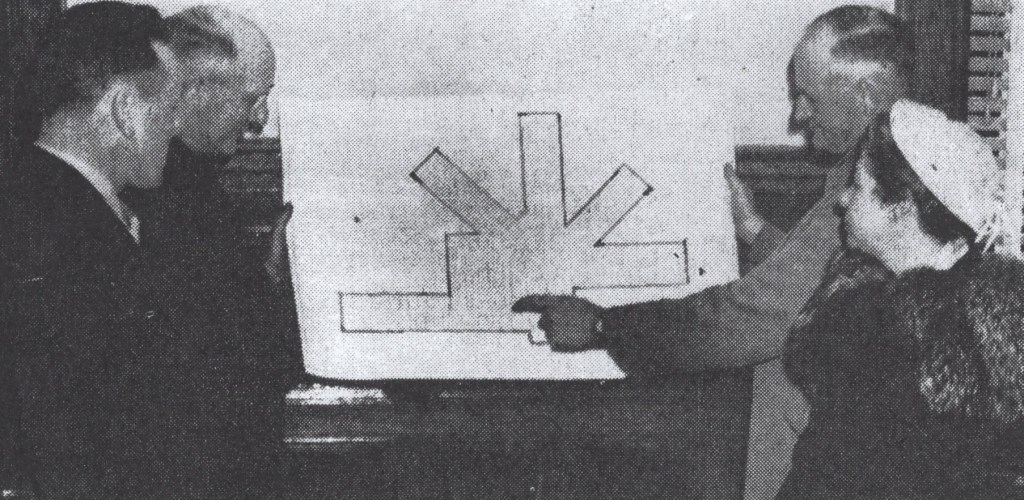
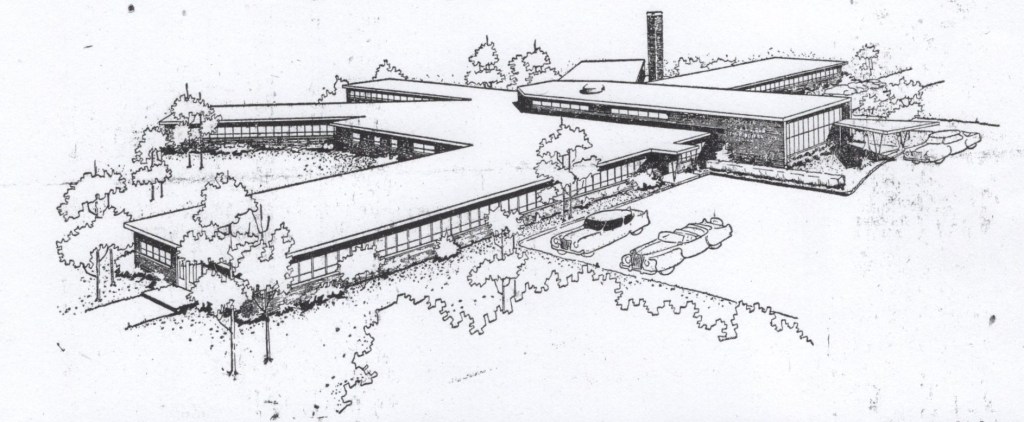
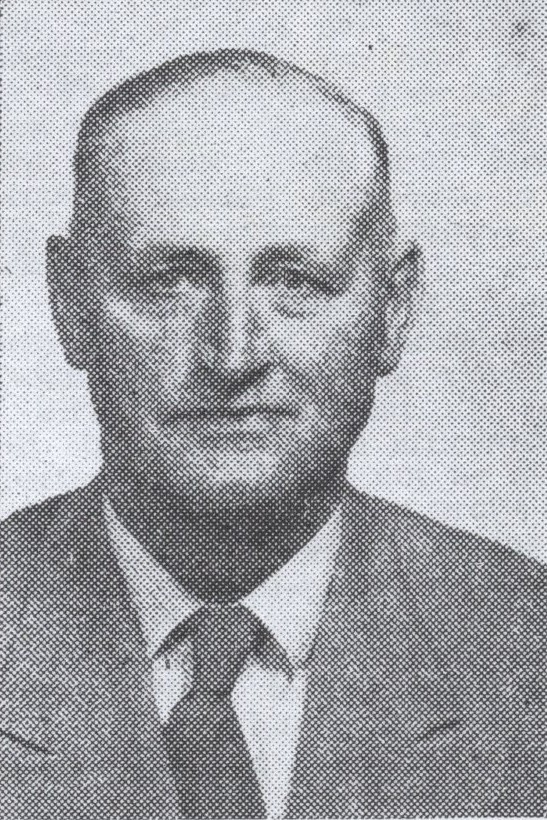
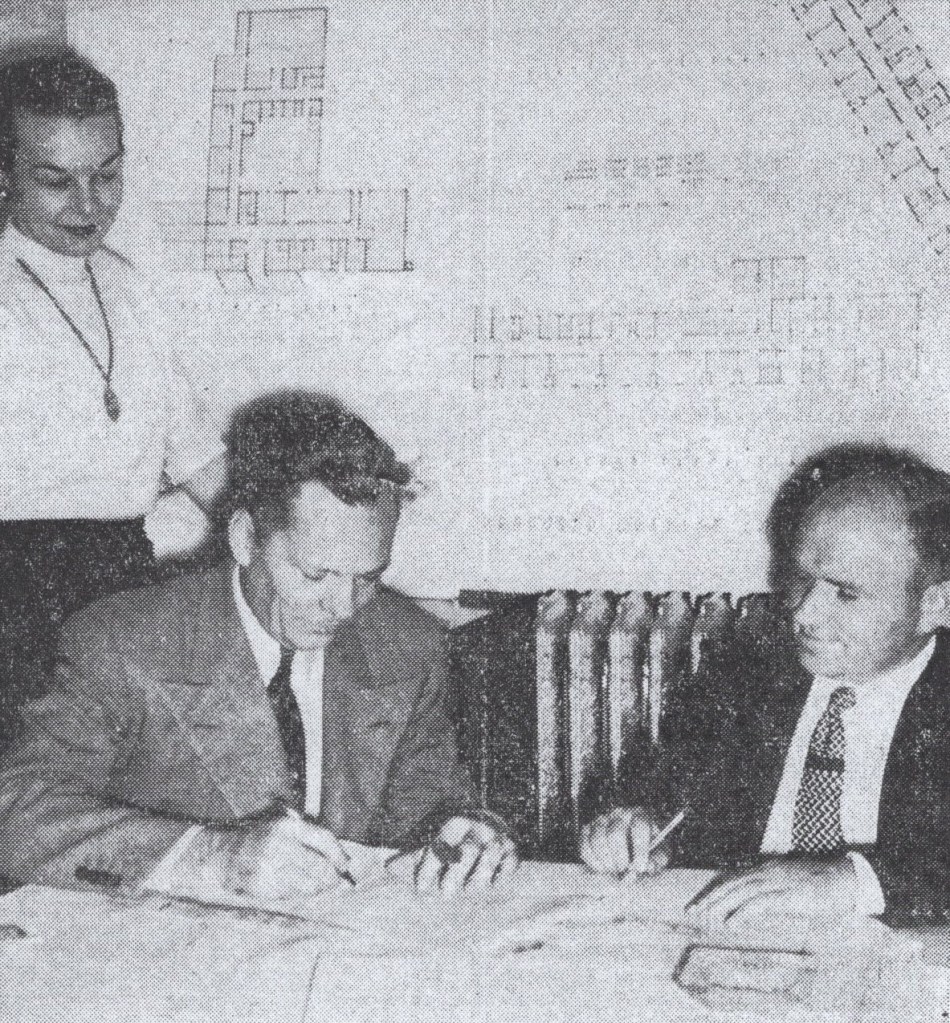
The Gratiot County hospital fund drive moves forward (from top): A set of proposed hospital plans was presented to public meetings in late January 1953. From left: Dale Misenhelder, C.L. Seeley, Paul Raycraft, and Mrs. Don Mulholland attended the presentation at the Gratiot County Courthouse; An architect’s preliminary drawing of the new Gratiot Community Hospital. The new hospital would provide care for 75 patients. Paul Raycraft of Arcada Township led meetings in two areas of Gratiot County in February 1953 to discuss the new hospital; Chairman Earle Brenneman signed the applications for federal funds for the hospital. Mrs. Robert Fandell, hospital office manager (left), and Joseph Homminga, deputy director of the Office of Hospital Survey and Construction in Lansing, look on. An architect’s drawing of the hospital is on the wall behind them.
Fundraising Ideas
After Gratiot County residents committed to building a new hospital, the real work began by obtaining a charter and starting fundraising. The newly created Board of Trustees then agreed on the name “Gratiot Community Hospital” and interviewed three architectural firms to develop the new hospital’s design. Ultimately, the trustees hired Clark R. Ackley as architect. The Board then set up the first campaign office for fundraising in Room 27 of the Merchants Building in downtown Alma.
The trustees, consisting of nine prominent citizens, had attorney Gordon Netzorg file for the official hospital charter. They also announced a goal of raising $500,000 in a fund drive planned from March 10 to April 7, 1953. The Board learned that $400,000 in matching federal funds would be available, according to the State Office of Hospital Survey, and this spurred the group on in its goal of raising the large initial sum. This new hospital would have 75 beds, more than the 29 available at Smith Memorial Hospital. Still, as trustee chairman Earle Brenneman stated to the Board, this drive would be a big challenge as it aimed “to secure the largest sum ever sought in a fundraising campaign in this area” of Michigan. Choosing the location of the new hospital also required a central location, like Alma. Before the idea of Gratiot Community Hospital, many people went to different hospitals in St. Johns, Owosso, Carson City, Mt. Pleasant, or Edmore for treatment. Having a new hospital in Alma meant that more people in the county (and even some areas outside Gratiot) would be served, resulting in more patients.
Earliest Donors and Donations
To start the fund drive, the Board hoped that the primary sources of donations would come from advance gifts from firms, foundations, and individual donors, with a focus on both commercial and rural donors. Before the drive started, the Board discussed some early ideas for approaching donors. For instance, medical professionals might give as much as $60,000 if asked. A limited residential canvas would take place later, and the Board believed people tended to offer at their workplaces. A rural campaign was also discussed, and Paul R. Raycraft suggested an introductory meeting for civic leaders in the northern half of Gratiot County on Thursday, January 29, at Alma City Hall. Another meeting for those from southern Gratiot would take place on January 30 at the Gratiot County Courthouse. In both meetings, civic leaders heard about the proposed hospital, had their questions answered, and viewed the architect’s preliminary drawings.
Just before the start of the drive, the Board of Trustees received a personal report from Miss Lou Nickerson about the current conditions at Smith Memorial Hospital. Nickerson, also a member of the new hospital trustees, had been associated with Smith Memorial since 1944. She told the group that Smith Memorial opened in 1934 with only 10 beds. Now, in February 1953, the hospital was operating with up to 39 patients a day and employed 45 full-time employees. In 1953, Michigan hospitals were considered at bed capacity when they reached 85 percent. At Smith, the average capacity in the previous year was 90 percent, and Nickerson added that “R.B. Smith was dangerously overcrowded and any minor epidemic in the county could create a serious crisis.” She also concluded her report by reminding the trustees that Smith was initially built and opened to hold only 10 beds. She also reported that Smith offered to donate $50,000 from its cash reserves as well as its most modern equipment to the new hospital. The Smith Memorial Board of Trustees proposed donating all of this to help kick off the fundraising.
Another New Hospital in St. Louis?
In late February, news about the idea of building a new hospital popped up on the front pages of the St. Louis Leader. This plan involved a 25-bed osteopathic hospital on the corner of South Main and State Street in St. Louis (the current location of the St. Louis Free Methodist Church). The plans for this new hospital began a year earlier, and attorney Alfred Fortino reported that funds were available to start construction and purchase land at the proposed site. This hillside location, measuring 275 feet of frontage on South Main and 410 feet on State Street, would be a two-story hospital staffed by osteopathic physicians. A drawing of the new hospital also appeared in the newspapers. However, over time, discussion and plans for this new hospital in St. Louis ended, apparently due to the idea and progress of a larger one in neighboring Alma.
Official Fundraising Begins
To raise funds for the new Gratiot Hospital, Gratiot County needed to know why the public should donate. Why ask the public for money? Why not require patients to pay for their own care and operate the hospital like a business? The answer came in a full-page advertisement in the Alma Record and Gratiot County Herald. First, all patients admitted to the hospital would receive treatment, regardless of their financial situation. All patients received care, and no one would be rejected. The full page ad concluded its explanations for raising money by stating that this hospital was “not a hotel. It is a house of mercy.” Second, an estimated 80% of the hospital’s costs were for patient care, and the hospital operated 24 hours a day. Unseen services, such as food, laundry, and building maintenance, also required funding.
A large donation from the work sector, a $100,000 gift from the Redman Foundation of Alma at the end of February, launched corporate contributions. Barely a week later, Leo, Joe, and Benjamin Simon’s families of Alma gave the first family gift of $3,600. The Simons announced they wished to have it put toward the new building’s entry. For those who gave gifts of $300 to $600, or bought furniture for the hospital, their names appeared on wall units or bronze tablets. In early March, rural fundraising began with a kick-off supper at Ithaca Presbyterian Church, attended by 200 people. Leaders, like FRED Raycraft, proposed that there be no rural goal and instead encouraged those in the country to pledge to semi-annual giving, starting with a minimum of $60. Those who wanted to make specific monetary gifts could also contribute toward the construction of new hospital rooms, such as $ 1,200 for a single room or $ 3,600 for a private room.
After fielding frequent questions about the exact location of the Gratiot Hospital, the Board of Trustees announced that the hospital would be located near the existing Masonic Home and the new Consumers Power Company building. Some wished that the hospital had been further east of Alma. However, this new location could draw patients from as far away as Edmore.
In early April, the drive passed the halfway point but appeared to be stalling. By April 2, $261,000 had been raised – just one half of the goal. As a result, the Board wanted to extend the drive. A week later, $294,000, or almost 59 percent of the goal, was reached. By April 16, the drive had raised $59,314, bringing the total to $356,312. As more corporate donors, such as Detroiter Coach ($4,000) and Leonard Refineries ($26,000), contributed, the goal topped $400,000. Two more corporate gifts from Michigan Chemical and Alma Piston Company improved the total, along with contributions from employees of various companies and even from the Mennonite community. All of these got the total to $440,000 in early May.
However, the drive hit a bump in early June. The Lansing office of Hospital Survey on Construction, which previously encouraged the new hospital project and anticipated Federal aid, announced that Federal aid for hospital projects had been cut by one-third after the United States House of Representatives reduced aid to all Federal projects. Apparently, the reductions and cuts came at the end of 20 years of Democratic control, as a result of the Depression and World War II. Also, a change in the White House meant a more conservative approach with the new President, Dwight Eisenhower, and the end of the Truman years. Now, the Board of Trustees and supporters of a new hospital faced the challenge of raising even more money to offset the reduction in federal aid.
Search and Confirmation for Final Hospital Site
In late July 1953, the search for the exact site of the new hospital narrowed to several choices. One of these involved a nine-acre site west of Wright Avenue and north of the Masonic Home. Smith Hospital previously purchased the area and offered it as a gift for the location of the new hospital. However, as the Board examined the possibility of this location, it realized that the area was zoned for residential use only. While pondering this problem, the Board was approached by James E. Ryan, President of Alma Trailer, who offered to trade a spot on the opposite side of Wright Avenue on 10.4 acres and approximately 400 feet east of Wright Avenue. Ryan offered to trade locations at no cost to the new hospital. A primary concern in the proposal was that the 400-foot area east of the avenue was held in a trust for a possible future park. The deal was made, and Clark Ackley, Lansing architect, went to work on preliminary plans and drawings of the new hospital, which he submitted in September.
Plans Appear Ready/Federal Funding Improves
After Ackley submitted the hospital plans and the Board approved them, the Board learned that the issue with reduced federal funding had changed and would now be available up to 48 percent of the drive, or $454 656. What caused the change in stance on Federal funding was unclear, but the availability of the previously announced aid now eased concerns of many on the Board and within the drive. However, the Board learned that, to qualify for this Federal aid, another $60,000 in pledges had to be received by January 1, 1954. The drive also had to raise its maximum number of pledges by April 1. In addition, 75 percent of the local share for the project had to be in cash before the release of Federal matching funds. With these deadline requirements, the drive now asked people to prepay their pledges. As winter approached, the main project for the new hospital involved water main construction in the north section of Alma, and the hope was that pledges would come in by the Federal aid deadline.
As 1954 approached, those involved in fundraising for a new hospital in Gratiot County hoped that the dream of the first county hospital would soon enter its construction phase.
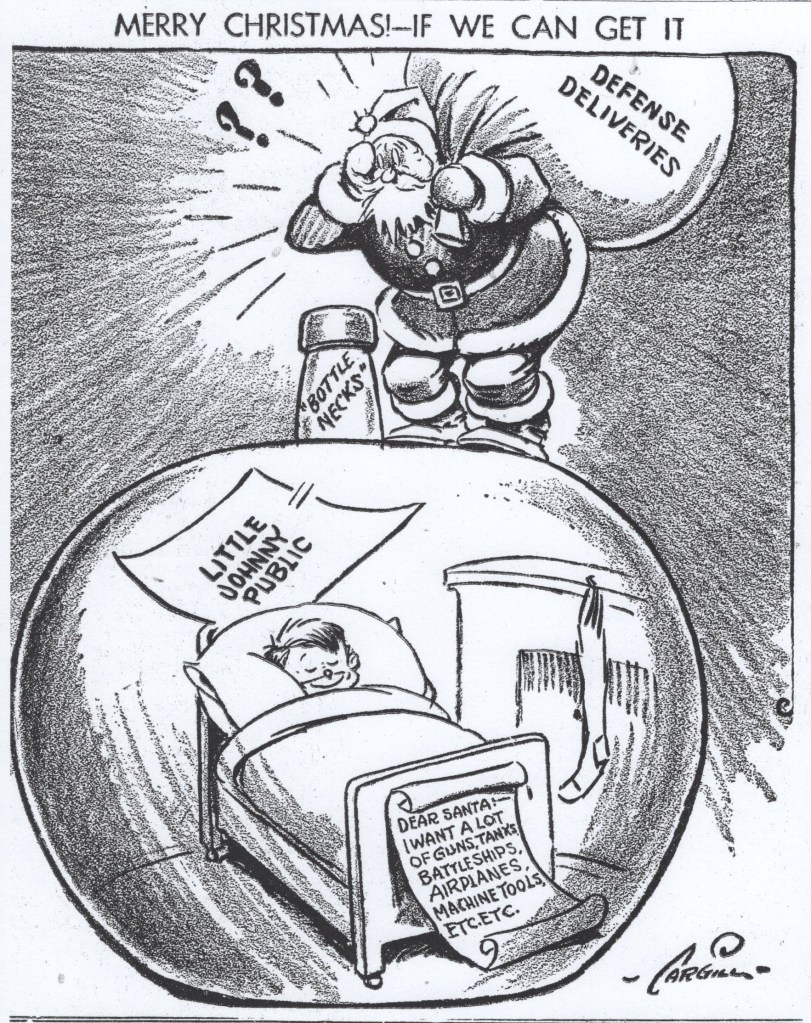
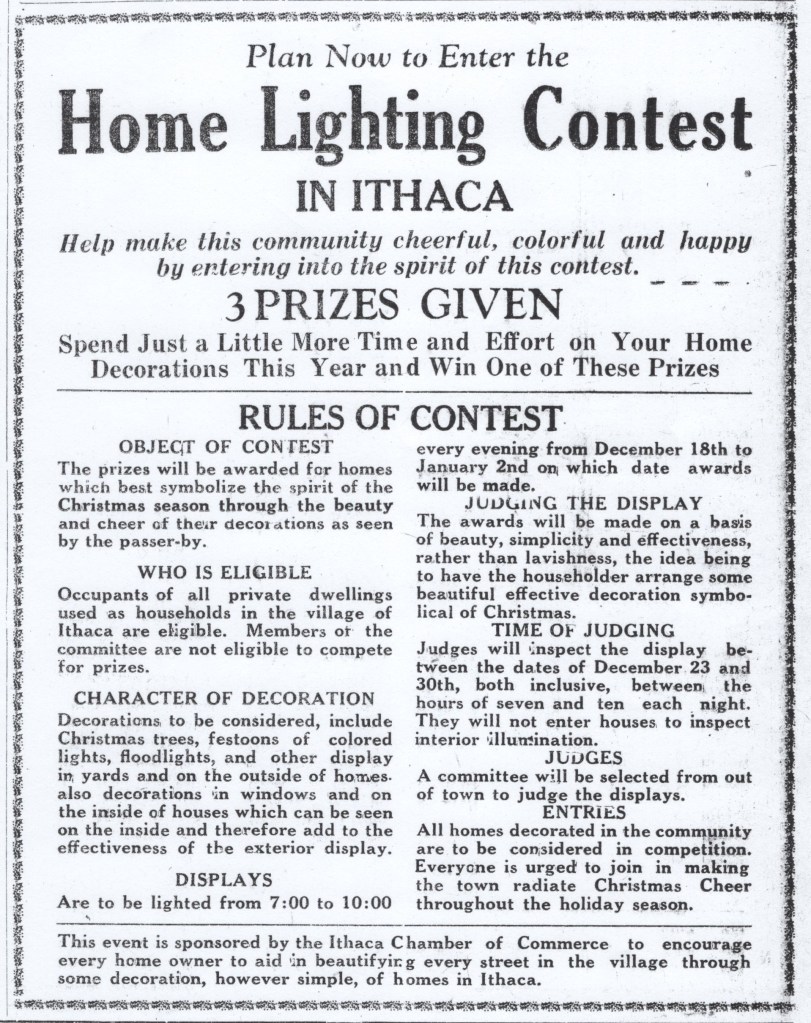
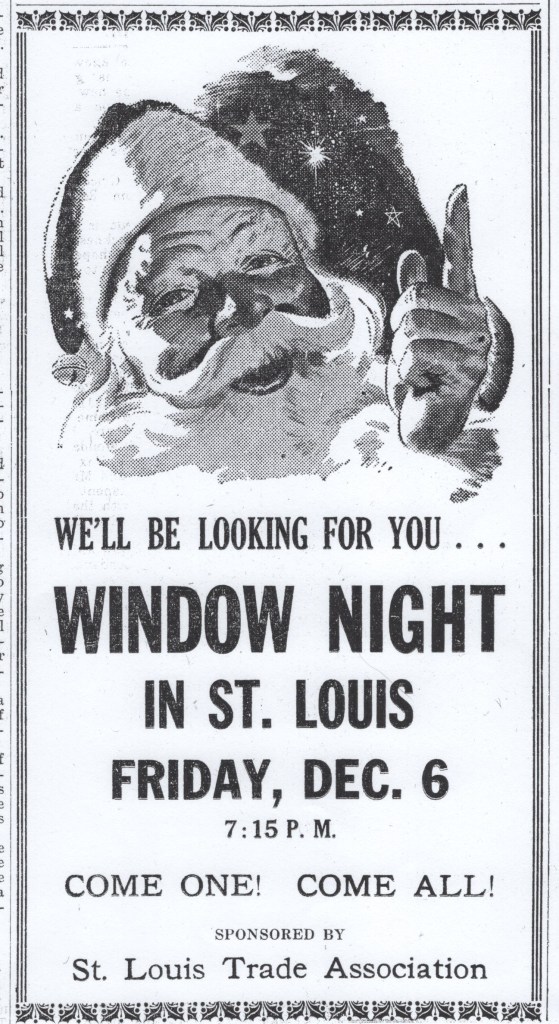
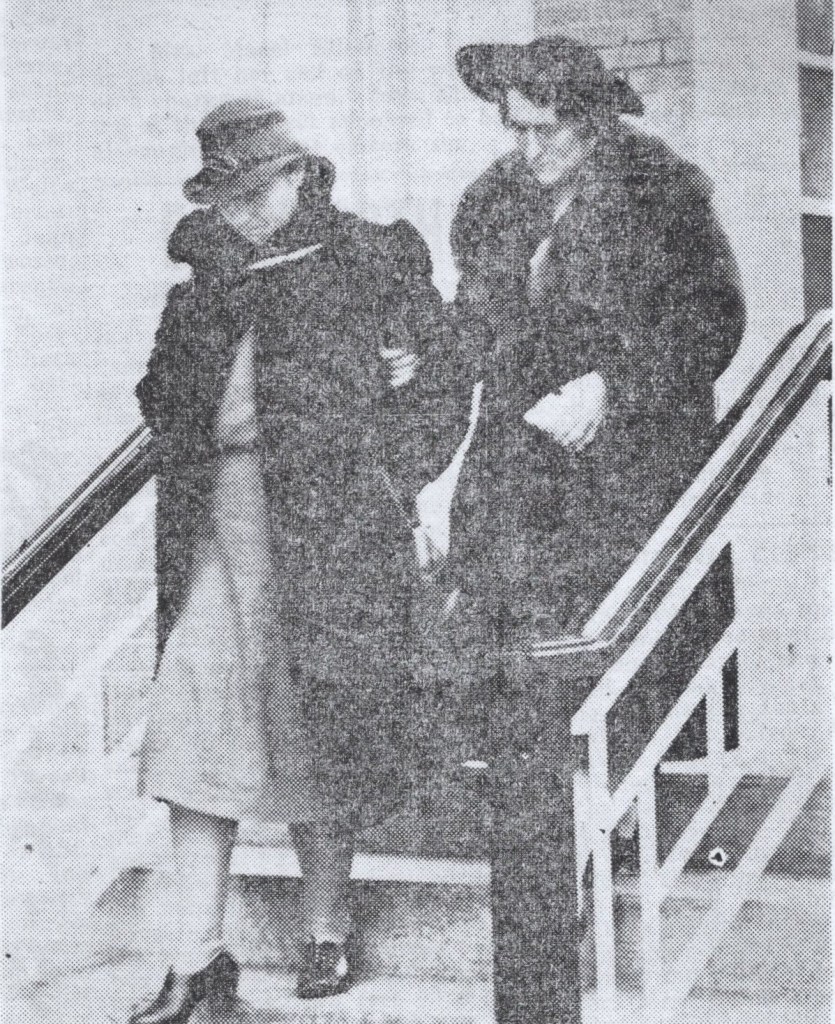
Gratiot County, through December 1940, pictures from the top: How to balance Christmas expectations with a growing defense movement? Alma Record cartoon; A Home Lighting contest in Ithaca urged the public to dress up their houses for the Christmas holiday – and win some prizes; Window Night in St. Louis officially kicked off the Christmas shopping season in town; The Mazel Ellsworth arson incident occupied the newspapers and Ithaca as she faced examination. Ellsworth (left) and matron, Mrs. William Nestle, head to the courthouse from the jail; Ithaca farmer, Sherman Edgar, appeared in the news with his homemade airplane, which he flew regularly.
In December, the trickle of young men volunteering to join the Army grew. Still, the Gratiot County Draft Board warned that more men would soon be called to meet the needs of Selective Service.
As winter began, New Deal social programs expanded to employ more Gratiot residents wanting work. The pay wasn’t the highest, but these jobs still drew many applicants.
Farmers attended meetings to learn how to address problems such as the European corn borer and farm plans for 1941. The Strand Theatre hosted some of these farmer programs.
It was Christmas in Gratiot County. However, no one knew that it would be the last peacetime Christmas season the county would experience for over years.
More Preparations for War
To many in Gratiot County and across the nation, being drafted meant a step toward involvement in the European war. Readers of the Gratiot County Herald found the names and order of those drafted on four pages of its December 5 issue. Despite the number called, an estimated fifteen percent of the 14,500 men in Michigan were deemed unfit because they failed a physical. In anticipation of the second call for selectees, eighteen Gratiot volunteers said they were ready to go, but two failed their physicals.
Lyle Whittier, head of the Gratiot Draft Board, stated that some registrants had failed to complete their draft questionnaires, and he expected the number of Gratiot men with incomplete questionnaires to almost quadruple in January. As a result, the Draft Board examined an average of 2 young men daily at Alma City Hall to meet the January quota. Another problem with the Draft Board concerned married men and exemptions. One of the early questions asked if the wife relied on the husband for a “normal source of support.” There were also a few challenges with those who appeared to evade the selection process. This problem involved two men: one who could not be found and another who failed to provide the specific information required for the draft. Still, by the end of December, the Board announced that Gratiot County now had 33 volunteers. One member of the group was married with a small child, but he still met with the Board and said he and his wife agreed that he should volunteer.
Just before Christmas, nineteen volunteers needed for the second draft quota planned to leave Alma for Saginaw on January 7 at 5:35 pm. They arrived in Saginaw at 7:30 that evening. The group spent their last night as civilians at the Franklin Hotel, then reported for duty early the next morning for testing and induction. Wyomah Vick, one of the first four Gratiot volunteers to leave in November, wrote a letter to the Gratiot Draft Board stating that he was in the 25th Infantry in Arizona and had trained in a machine gun company. Vick wrote that he was grateful for the experience he was having in the Army. The War Department proved generous with holiday leave during December, allowing many men to travel home by suspending training from December 21 to January 2. Furloughs often went up to fifteen percent of the enlisted strength in a unit. They were limited to those who enlisted before November 1, 1940.
Despite the drafting of young men, there were plenty of voices warning that the United States should not go to war with Nazi Germany. The National Observer, a forecaster of political and war events, believed the United States would be in the war by June 1941. Critics of those against American men in the draft made comparisons and warnings about the men lost in the last World War of 1917-18. The Alma Record-Alma Journal even ran a lengthy editorial on December 12 entitled “Keeping America Out of War.” It urged America to stay out of foreign wars and for foreign wars to keep out of America.
One veteran of the World War, Albert Johnson of Alma, received a federal summons to report to Detroit to inspect manufactured trucks for the Army. Johnson served in Europe during the last war. The remainder of Battery B, 177 Field Artillery (the former Battery B, 106th Michigan Cavalry), moved from the back of the Wright Hotel to the cavalry barn. These men awaited an anticipated April 1941 call-up. Yet, who would replace those National Guard troops once they left the county? Some argued for the need to form “Home Guard Units” by calling on veterans of the World War of 1917-1918 to serve in that capacity.
Help for Greek Families
Alma men of Greek ancestry organized a fund as part of a national movement to help families of Greek soldiers who fought against Fascist Italy. James Stavros, James Stamas, and George Goutis solicited funds in Alma to help Greek families disrupted by the war between Greece and Italy. In a short time, $700 had been raised for food, medicine, and clothing to be sent overseas. Coney Island Restaurant (donating $200), the State Sweet Shop ($100), and the Main Café ($100) were among a long list of donors. The Greek War Relief Association continued to run national advertisements across America to ask for help during December. Lists of even more Alma donors for the cause followed later that month.
Depression and the New Deal
Several New Deal programs continued to function in Gratiot County during December 1940. The Works Progress Administration (WPA) announced a new project to improve M-57 by installing drain tile, culverts, and fences; surfacing; replacing bridges; and cutting brush. The work done on M-57 west to the Montcalm County line preceded a plan for hard surfacing and completion of the highway. Two-thirds of a St. Louis sidewalk project, also sponsored by the WPA, was halted for the winter, and men working on it were transferred to the M-57 work. Twenty-five men continued working on the construction of six tennis courts at Wright Park. Also, the WPA sponsored a school lunch program for fifty children, a growing library project in three communities, and an active recreation division in Alma, Ithaca, and St. Louis. In 1940, the WPA spent $260,685 in Gratiot County and provided work for 261 people, the majority of whom were over 40.
The National Youth Administration (NYA) remained active in Gratiot County. NYA workers raked leaves and cut wood for the Gratiot County Conservation League, further improving the appearance of the Alma park. Dean Carter, the county director, announced that 50 more Gratiot youths could join the NYA, tripling the NYA workforce. Some of the new projects they could be part of included a Breckenridge school board project, Ithaca clerical work, a public works project for the St. Louis city government, and a new program in Riverdale. All of these members were between the ages of 16 and 24, worked 60 hours a month, and received $18 in pay.
Other public programs included the Works Progress Administration (WPA), which offered first-aid training at the St. Louis Seventh-day Adventist Church. Darrell Milstead and Lester Fillhard led the classes. The WPA also planned a city-wide table tennis tournament at the Republic and Wright Park recreation centers. The Civilian Conservation Corps (CCC) sent a call for enrollment for young men, ages 17 to 23 ½, at the Gratiot County Department of Social Welfare in the basement of the courthouse. A Social Security representative planned to be at Alma City Hall on December 18 to assist with claims and provide additional information.
In other news, a group of 35 civic leaders in the county sought to receive aid from the state board of vocational education to hire a supervisor to oversee technical training for young people. The principal goal was to reduce waste caused by young people’s idleness. Gratiot was one of six counties to experience this grant. Donald L. Baker, the county school commissioner, issued a call for donations of footwear and clothing for students in need. Baker stated that some students in the county were absent from school because they lacked shoes. Finally, a Progressive Townsend Club No. 2 special meeting at the Ithaca village hall had good attendance and prepared for a Christmas program. It now had over 200 members.
Farming, Hunting, and the Outdoors
Even though it was December, the topic of sugar beets remained on farmers’ minds. In early December, Gratiot beet growers received their initial payment of $5 per ton of sugar beets, less the cost of field labor and seed. Another sugar beet payment would be available in the spring, with the final payment coming in October. After a two-month run of beets at the St. Louis Lake Shore Company plant, work started to close down around December 16. This closure meant the end of work for 325 men at the plant. In all, St. Louis believed it had sliced 72,000 tons of beets during the 1940 harvest.
The fourth annual Farmers’ Institute took place at the Strand Theatre in Alma on December 12 and drew 700 farmers. Sponsored by the Alma Chamber of Commerce, the program included talks on various agricultural issues, motion pictures, musical entertainment, and a free noon meal at one of three churches in town. In Ithaca, a large group of 40 community committee members involved in the agricultural conservation program met to discuss the ongoing threat posed by the European corn borer. The pest first appeared in the county in the 1920s, but returned in 1940, causing an estimated $400,000 in damage to Gratiot crops. The committee decided to ask farmers to sign an agreement to follow specific practices to prevent the spread of the corn borer in 1941. However, all farmers needed to come together to end the scourge. Some of the ideas included plowing all cut corn under by May 15, and shredding or hauling away all fodder in shocks and stalks. All farmers had to pay attention to the program, as if one farmer in a section did not, the insect could still move to a new location miles away.
There were other winter meetings for area farmers in December. Dairy manufacturers from the area attended a dairy meeting at the Park Hotel on December 16. This meeting was one of 12 held across the state, sponsored by the Michigan Department of Agriculture. Farmers received a free meal and then listened to a series of presentations on the manufacture of dairy products and the latest developments to improve them. Alma Production Credit Association held its annual meeting at the Strand Theatre earlier in the month. It drew 492 men and women who farmed in Gratiot, Montcalm, Isabella, Mecosta, and Clare counties, who listened to reports, elected officers, and enjoyed music. Losses from bad debts and loans in 1940 amounted to only 1% of total loans.
The federal government again warned aliens to register at their local post office. As of December 1, a total of 301 aliens were registered at the Ithaca post office. Across the county, 860 individuals had registered by the December 26 deadline.
Other things, good and bad, happened on the farms and in the outdoors in Gratiot County. Frank Nelson of Ashley suffered a serious facial injury when a horse kicked him, knocking him unconscious. Nelson went to Smith Memorial Hospital with injuries to the face, forehead, and limbs. No one knew why the horse, a non-kicker, reacted as it did. Because some dog owners failed to pay their licenses by June 1, they faced fines. More than 500 dogs in the county had been disposed of because of unpaid taxes, disease, or being strays. Ithaca native Parks Allen, a Central State student, was in the news as he gave talks, wrote articles, and appeared on radio programs in mid-Michigan about nature conservation. Allen graduated from Ithaca in 1931. A pair of hunting accidents ended badly for two young men in Gratiot County. Lester Billings, 16, of St. Louis, died instantly while hunting rabbits near Carson City when his gun discharged while going over a fence. Another Wheeler youth, Alton Tryon, 18, was shot through the leg while hunting near Wheeler. Tryon’s hunting companion was holding the gun when it accidentally went off while hunting sparrows. Dr. A.H. Rotermund of Wheeler treated Tryon’s wounds.
The Long Arm of the Law in Gratiot
A total of 53 people were convicted in court in November, with 29 for traffic law violations—some of the other convictions dealt with game law violations, drunk and disorderly, and illicit cohabitation. Two men who were part of a gang of four from outside Gratiot County faced arrest for two local robberies at Ithaca gas stations in late November. The pair participated in 29 break-ins across central and southern Michigan. The name of Cornelius Eichorn again continued to be in the news for drunken driving arrests earlier in the fall. He had to pay $50 fine, costs, and serve 15 days in jail. James Brogan of Stockbridge went before the judge for reckless driving north of Ithaca, after striking a wagon drawn by horses driven by Daniel Fisher. Fisher lost both horses and received a wrecked wagon. Brogan got a $63.60 fine and costs, or jail time, for the incident.
The most bizarre news in the courts during December dealt with a case involving Mrs. Glen Ellsworth, age 34, of Ithaca. Ellsworth was arrested for setting part of her house on fire after claiming it was an accident. Strangely, the sheriff found Ellsworth’s furniture and belongings in the center of one room, and there was a strong kerosene odor. The sheriff was not so sure it was an accident and had her put in jail on a $3,000 bond. Ellsworth soon went on a hunger strike while proclaiming her innocence. News came out that the contents of her father-in-law’s house had been insured for $300, and the dwelling for $800. Also, after starting the incident, Ellsworth went back inside the house to check on the fire and took along one daughter.
Claiming that she had a weak stomach and was unable to eat anything, Ellsworth went on a 12-day fast at one point. Ellsworth even failed a lie detector test in Lansing, even though she claimed the results were inaccurate. Whenever she talked about her four children and the fire incident, Ellsworth broke into uncontrollable tears and shaking. In response to her self-imposed hunger strike, the judge appointed matrons to observe Ellsworth and to try to get her to sip broth. When that failed, the judge placed her in solitary confinement and cut off visitation from family members. At the end of December, Ellsworth broke her fast. Eventually, she became well enough to attend her examination, even though it was without a lawyer.
Health News
Christmas Seals sales took place in the county. However, children did not participate in house-to-house campaigns as they did last Christmas. Anyone wishing to buy Christmas Seals only had to contact their local school to obtain seals, which helped sponsor what turned out to be the sixth TB clinic in the last five years. Doctor C.F. Dubois of Alma announced that of 215 TB tests given recently at Alma High School, 10 percent returned positive. Most of those tests included juniors and seniors. Herman Berg, age 45 of Alma, who worked as traffic manager for Michigan Oil Refineries, died after spending several months at Ingham County sanitarium, from tuberculosis. In addition to all of this news, the Michigan health department warned Gratiot County that a potential flu epidemic could soon hit the area. Influenza had been detected on the West Coast and was headed this direction, and cough, fever, and back and leg pain were all symptoms.
Christmas Season 1940
“Window Night,” where area merchants displayed items for sale in their front windows, kicked off the Christmas season. Alma, St. Louis, and Alma each chose a night to open for Christmas officially, and each made it a big celebration. A total of 25 businesses in St. Louis participated in the program. Later in the month, a “Santa Claus Skills Contest” was sponsored in St. Louis with participating merchants leaving clues in their windows. G.E. Marr also opened the GEM Theater two days before Christmas to offer a free children’s movie.
On Friday, November 29, Alma welcomed Santa Claus to town in a parade that started at 7 o’clock, going one way down East Superior Street, then turning around and repeating the procession in the opposite direction. Both the Alma High School and city bands led the parade as children left the sidewalks and jumped onto Santa’s float. On December 17, the Strand Theater offered a free Tuesday matinee to young people who wanted to see a movie if they contributed one canned good. Manager Victor Jaeckel announced that a crowd of 900 children donated 51 baskets of canned goods and foodstuffs. To top off the night, the city of Alma again lit up a large white cross on the top of the city hall tower. On Christmas Eve, Santa appeared again in the town, this time at the Tourist Park, where he oversaw the distribution of 1,800 sacks of candy and peanuts. The Alma Police and WPA Recreation Department helped Santa hand out the goodies.
In Ithaca, a Home Lighting Contest encouraged residents to create a community holiday spirit by decorating their homes. Three prizes went to the top homes that would be judged between December 23 and New Year’s. Each home in Ithaca had to have its lights displayed between seven and ten o’clock each evening. On Saturday, December 14, the Ithaca Chamber of Commerce sponsored Santa’s arrival at the Ithaca High School gymnasium, complete with Santa coming down a chimney. Santa also encouraged Ithaca youth to write him letters addressed to the North Pole. The American Legion helped the Chamber ensure that each child in attendance received a sack of candy.
St. Louis held a Home Decorating Contest offering prizes of $1 to $5 for the homes that best symbolized Christmas. Alma also had a similar contest with awards of $5 to $10 in two categories: individual homes and businesses. The Garden Club in Breckenridge offered a contest for those who registered before December 21. Early in December, the Breckenridge school held a Christmas program for the community.
As Christmas events went on across the county, there were calls to remember those families and young people who needed help in St. Louis. Both the Nonpareil and Emergency committees of the Community Council called for donations of 100 girls’ dresses. The Community Christmas League in Alma planned to help 200 families and organized a Christmas party for up to 534 students in the community who needed to experience a nice Christmas. The Knights of Pythias Lodge 49 of St. Louis provided a turkey dinner for 100 children who had been invited. The Alma Elks Club had a program for 149 boys and girls, ages 5 to 13. The party offered candy, nuts, and ice cream. A group of 150 Girl Scouts in the Alma Council presented Santa with a $26.50 check to be used by the Alma Community Christmas League for those in need in Alma. The Girl Scouts raised the money on their own, and this was the third year that the program took place. A total of 25 Alma organizations helped create 200 food baskets and a program that entertained an estimated 500 young people and adults at the Alma High School gymnasium. The program had a large Christmas tree at the front of the gym, and an appearance by Santa (played by George Urtel, Alma city treasurer) to entertain the audience. Workers handed out neatly packaged gifts of sweaters for boys and dresses for girls as each family left the gym.
And So We Do Not Forget
Residents observed a beautiful white swan on the upper pond north of Sumner. Rumors stated that one of its legs had been shot off by hunters. Still, viewers watched as the bird played and dove for food…Clark Gable, Spencer Tracy, Claudette Colbert, and Hedy Lamarr starred in “Boom Town” at Ithaca’s Ideal Theatre. Tickets cost ten cents, but “Boom” only appeared for one night on December 5…Gratiot residents prepared to view the “Cunningham Comet,” the largest comet appearance since Haley’s Comet in 1910. Best to view the comet with the naked eye, newspapers warned, even though it was 90 million miles away…The history of the Christmas Card in America appeared in the St. Louis Leader. The note recorded that Christmas cards go back to 1846…St Louis Cooperative Creamery sold Milkmaker Dairy Concentrate, which contained 34 percent protein. Phone 131 in St. Louis…Interdenominational Revival Services began on December 8 at the Sumner Community Church for two weeks. Evangelist Reverend T.A. Harris of Mt. Pleasant led the services each night except Saturday…Fulton Seniors visited the Pompeii Bank for four hours, learning about its departments, the inner workings of the bank, and modern electrical machinery. Students asked questions about burglary systems, the operation of the vault’s time lock, and safety deposit boxes.
Hall Lumber Company in St. Louis paid a Christmas bonus of $650 to its employees; those who had been with the company for one year or longer received $100. One person who worked for 6 months received $50…Reverend Floyd Drake of Breckenridge’s Methodist Church fell and broke his upper left arm while arranging Christmas decorations in the church. Drake found himself at Smith Memorial Hospital, and doctors worked on the fractures. He soon returned home to rest and heal…Riverdale received a new postmistress. Miss Helen Young took over the job her father held after serving as an assistant for many years. She had been in charge of the office since her father’s death…A tremendous ten-hour snowstorm hit Gratiot County beginning early Saturday morning, November 30, enabling residents to start the month of December with a foot of snow. Blowing winds continued to cause problems as workers in Alma worked on Sunday to reopen the city to traffic. It took 22 hours of labor in St. Louis to clear the snow with 27 men and six trucks. The Alma Record stated it might take workers two weeks to get the county back to completely safe travel….The Gratiot County Herald advertised on Christmas Eve for the New Year Baby Contest, now in its eleventh year. The contest opened midnight on New Year’s Eve and closed on midnight January 11…Revival services at the North Star Church of the Nazarene closed after bringing 35 people to the altar on the last night. Sunday School attendance reached 195 pupils. Reverend L.G. Wright from Geneva, Indiana, led the meetings.
The Nummer-Giles Company moved from an office in the Wright House Hotel in Alma to new headquarters at 109 Mill Street in St. Louis. The company has sold fluorescent light bulbs since March 1939…Construction started on a new oil pipeline from Ithaca to North Star to carry gas from Cook No. 1 well in section four of North Star Township, along with gas from other wells in that area…Pung Motor Sales in Alma offered new Buick automobiles starting at $935 for the Business Coupe. See Pung at 315-317 East Superior Street…Apolonio Gonzales, 26, and Norma Swift, 18, both of Wheeler, became the latest of Cupid’s victims, along with Leo Davis, 22, of Hamilton Township, and Annabelle Wenzel, 18, of Lafayette Township…Order your roses and poinsettias early for Christmas, especially if you want them sent telegraph. Townsend’s of Alma and St. Louis offered free delivery for local orders… Clapp’s Hardware in St. Louis established a new appliance department in its basement. Now, interested buyers could see the new R.C.A. radios and A.B.C. washer models…The St. Louis High School senior class presented the comedy “What a Life” under the direction of Mrs. Grace Niggeman. The play previously had a large Broadway run… Dick’s Wholesale Station held its grand opening in December. Midwest three-star gas sold for fourteen cents a gallon.
Trappers may sell hides and fur to Michigan Fur Company, located in the Berman Building in Ithaca. “Make it a habit” – sell your furs to Berman…The annual Red Cross drive in Alma started November 11 and, so far, has raised $790 in memberships for 1941… C.G. Larry’s Hardware in Ithaca sold Sunbeam Mixmaster food mixers for $23.75. Too big? Buy an “Eskimo” mixer for only $12.95 – in large size…Chemistry teacher Marion Woodford from Fulton Schools took two busloads of students to the St. Louis sugar beet plant. He had help chaperoning from agriculture teacher Don McCormick. The students received a complete tour of the plant…The First Bank of Ashley invited people to join the 1941 Christmas Club so that next Christmas, families would have less financial stress…Dick Plankenhorn and Jay Stahl led the Ithaca basketball team as it started its season in December. Plankenhorn could only play through December as he was in his eighth semester of eligibility. Stahl led the team in scoring through his four years on the team.
And that was December 1940, during the Depression and War in Gratiot County.

 Goodspeed's Gratiot County Historical Blog