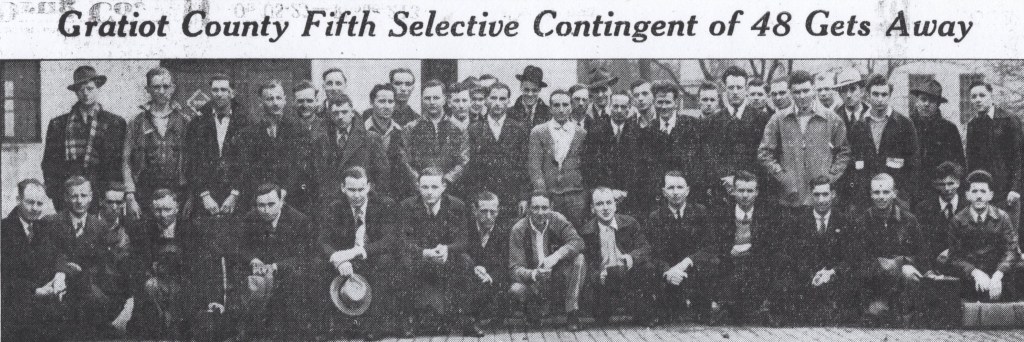
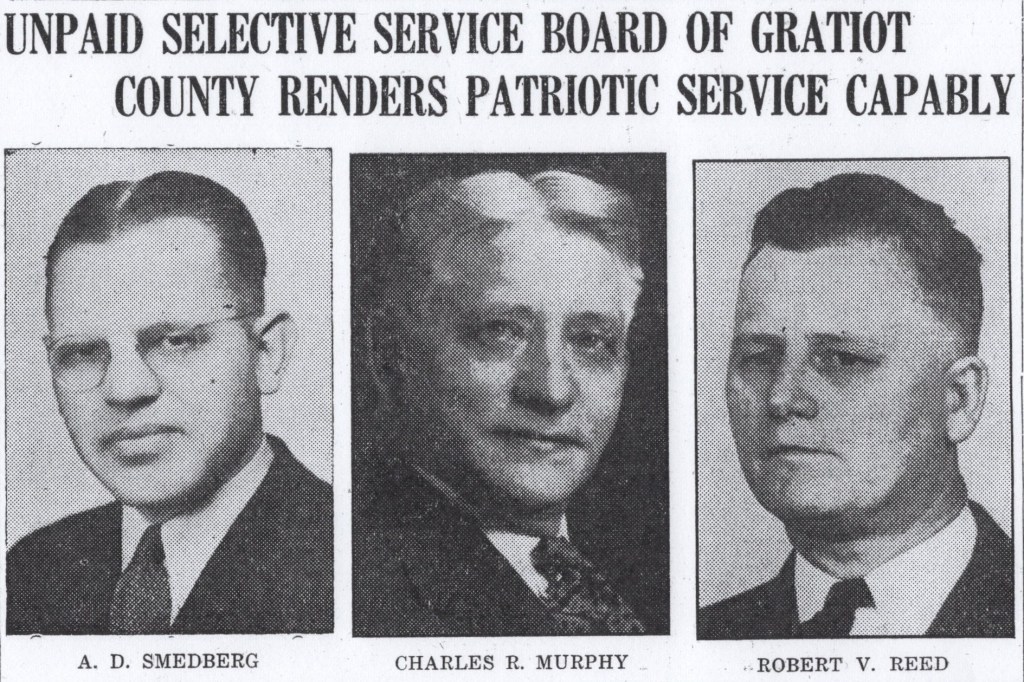
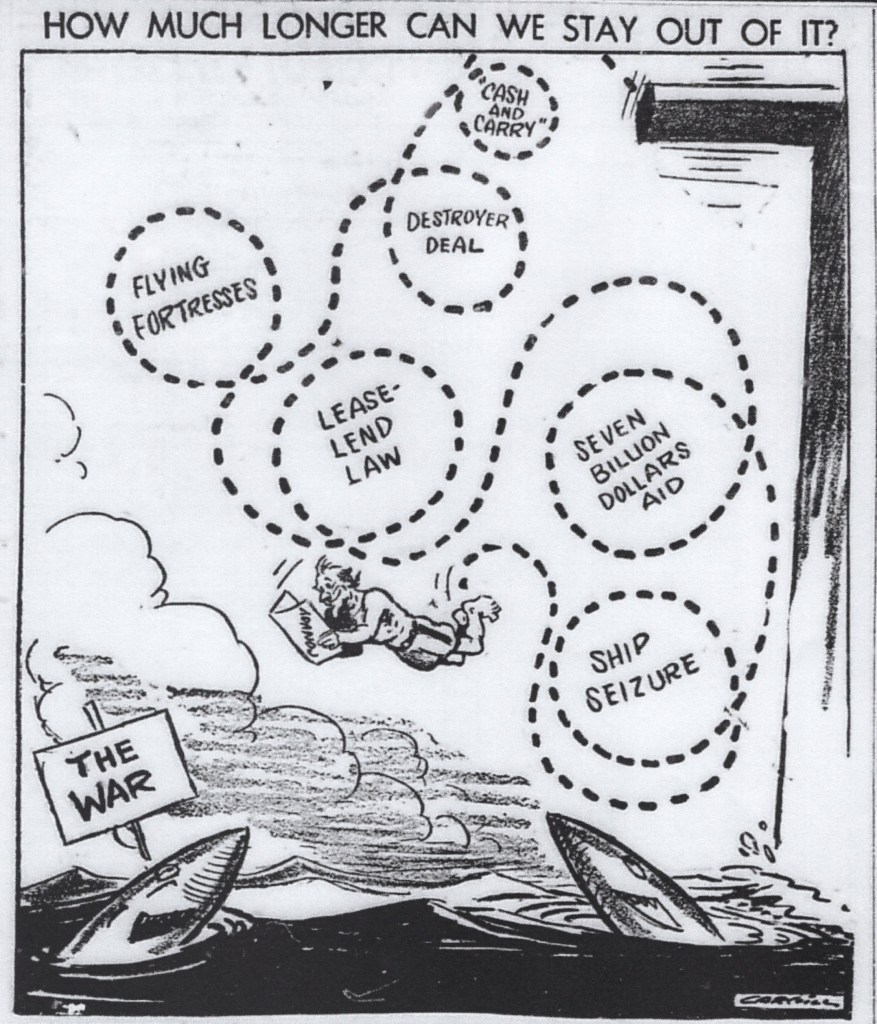
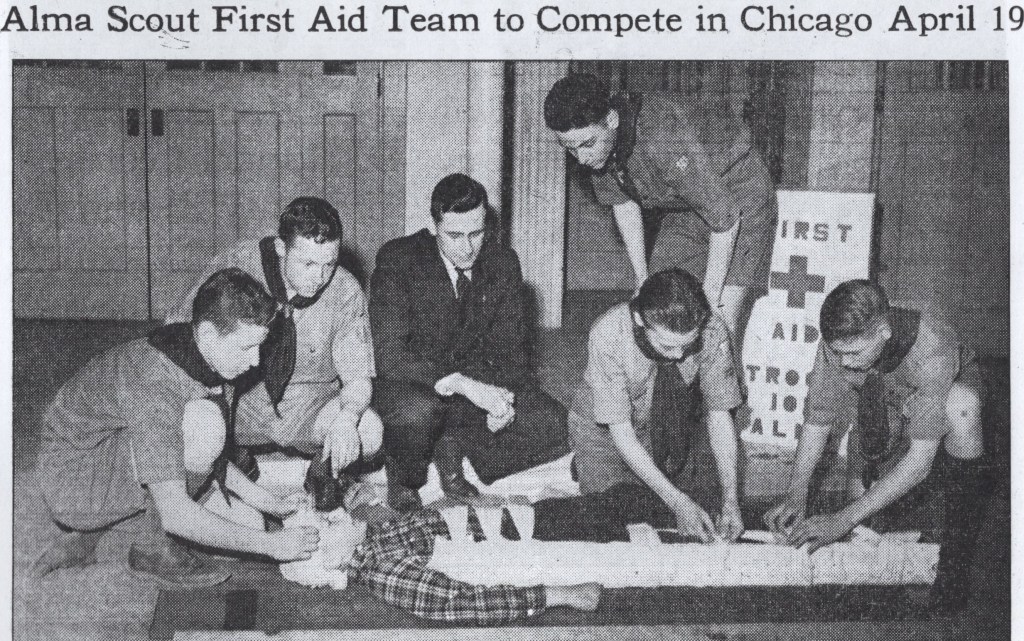
From the top: The fifth group of young men to leave Gratiot County as a result of the Selective Service. Unfortunately, no names go with this photograph; members of the Gratiot County Draft Board wanted the public to know that they served without pay; a cartoon from the April 17, 1941 issue of the Gratiot County Herald asks the question, how long can Gratiot County stay out of the war?; a group of boys from Alma Boy Scout Troop 101 formed a first aid team to complete in state contests. From left: William Fishbeck, Tom Stein, Scoutmaster David Gainey, Vance Fulton, Paul Kaufmann, and Dale McClure.
The numbers started growing: 48, 67, 56, 44, representing the number of men who volunteered or joined the Selective Service. All the while, more families confronted the possibility that these young men might soon see war.
Defense industry jobs kept cropping up in advertisements. However, many of them appeared out of state at this point. Who would leave Gratiot County to go that far to find work?
There was significant activity in Gratiot County as a result of the WPA and NYA New Deal programs. All of the programs kept people busy and paid a small wage. Most of all, the programs gave people something to do.
Health needs and problems made the news, as did those who broke the law in the county.
It was April 1941 in Gratiot County, and spring was coming.
The War in April 1941
The sights and sounds of young men going off to the military, many as a result of the Selective Service, increased in Gratiot County. A group of 48 men left the county on April 1 and appeared in a group photograph taken on a street in Alma. Two of them were volunteers, who included Darwin Hagerman of Ithaca and Henry Russell of Wheeler. Two men in the group failed their exam, and two failed admission because they were too young or had no draft numbers. Carlton Van Horn of Alma and Floyd Ludwick of Breckenridge, both volunteers, took the place of those rejected from the April 1 contingent.
They were not gone long before a community testimonial dinner was held at Alma College to mark the Alma National Guard unit’s departure. The George W. Meyers American Legion Post sponsored a dinner for 65 men who composed the 177th Field Artillery and were scheduled to go to Fort Knox. A crowd estimated at 400 attended the dinner. When it was time to depart from Alma, several hundred people gathered on Friday, April 18, to see the young men off to Detroit. A week later, news emerged that the May quota required 44 men for its next part in the draft. Oral B. Smith of St. Louis was sent with the group of 48 men early in the month. Still, he was a member of the National Guard and failed to include that he had already enlisted through the Guard. His Selective Service questionnaire did not contain that information. The Gratiot Draft Board hoped to get him back so he could join the group headed to Fort Knox, meaning another would have to take his place.
The Gratiot County draft board added eight more members to make it easier for registrants to seek guidance without having to travel far. Some of those added to the board included: George Cordray of Ashley, Fred Passenger and Dr. Howard Burchard of Ithaca, and Alfred Wolansky of North Star. None of the board members held paid positions; they were only doing their patriotic duty.
During World War II, newspapers began publishing stories about the status of individuals who left Gratiot County to serve their country. Former Alma attorney William R. Kelley is prepared to leave his practice in Ann Arbor for Fort Benning, Georgia. Kelley had been a captain in the Army Reserve. Private Ray Ward of St. Louis was part of a group of 290men sent to Camp Lee, Virginia. Edsel Marvin Alma made the news for replacing Vincent Battle of Riverdale for the March selections because Battle played professional baseball. Marvin took his place as a volunteer, and Battle’s appeal was yet to be heard by the appeal board. Privates Carl Brown, Clarence Malone, and Joseph Mazey of Alma were all sent to Camp Livingston, Louisiana. Another group, consisting of Steven Monarik and Joe Jisa of Bannister, Paul Harp of Ashley, and Darwin Hagerman of Ithaca, was part of a group of 258 men sent to Aberdeen Proving Grounds, Maryland.
The saddest story involving future service members dealt with Bruce Harper, 20, of Alma, who was in the Alma National Guard. Harper was one of several men who helped to deliver a caravan of house trailers from the Alma Trailer plant to Wilmington, North Carolina, as part of a defense contract for shipyard workers. Fifty of the gray and silver trailers, measuring 15 feet long, left Alma on March 29 on the first consignment, and the caravan made headlines in Washington, D.C., and Wilmington. Tragedy struck when he began his return home in a car belonging to Willard Blakely of 110 State Street, who only drove as far as Washington, D.C., because Blakely’s driver’s license had expired. Bruce Harper was killed in a traffic accident near Frostburg, Maryland, which involved several cars and the death of another local driver. Just a week after being inducted into the Army, Harper was dead. A funeral with military rites took place in his honor in Alma, before being laid to rest in Clinton County, where he was born. Harper left behind his mother and two sisters. His father died three years earlier and was known for operating an Alma gas station.
A variety of news bits dealt with Gratiot County and the war. Defense Bonds and Postal Savings Stamps were to go on sale starting May 1 at local post offices. The local Red Cross schools offered first-aid courses to the public. These courses lasted 12 weeks, and Alma Boy Scout Troop 101 was pictured in the Alma Record and Alma Journal demonstrating what they learned. The Alma team participated in several Michigan contests and took first place in Saginaw. The Greek Relief fund, led by James Stamas, noted that the drive in Alma had raised $909.69, with Banner Liner Service and Harlan Niles each donating $5. Eleven other people participated as recent donors. More defense jobs opened in a list of out-of-state positions in the St. Louis Leader. Designers, Marine pipe fitters, clerks, clerk typists, and more were on the list. Apply at the Alma office of the Michigan State Employment Service in the city hall. Finally, there was still talk in Alma about building a new armory, even though the cost appeared to be $180,000. Mayor W.E. Reynold discussed the possibility with a United States Army official from Lansing.
The Depression and the New Deal in April 1941
To continue combating unemployment, the Gratiot County Board of Social Welfare budgeted $78,400 for welfare recipients and purposes. Direct relief accounted for most of the budget, totaling $32,000. Another $10,000 went toward repairing the county farm buildings, the infirmary, and a new dairy barn. The committee had a long discussion about issuing welfare stamps instead of cash, and Chairman C.J. Chambers proposed that a state or federal representative come to the board to discuss the idea. Cotton mattress-making programs opened in seven centers across the county to begin planning the production of cotton mattresses for those who needed them. At the first meetings, a tick-making demonstration was held at Newark Grange Hall, and each group selected a supervisor and an assistant for that location. Originally, the Gratiot County Fairgrounds stored the cotton for the mattresses.
The WPA remained active in Gratiot County through various activities. A group of 24 boys and girls at the Republic School and the Salvation Army worked under WPA direction to create their own archery equipment. The WPA also sponsored kite tournaments in Ashley, Riverdale, Breckenridge, Perrinton, and Ithaca, a week after a successful tournament took place in Alma. Over at Riverdale, Virgil Jessup was in charge, with Robert Nunn and Mr. Wood serving as judges. Eighteen students participated, and 25 people attended the event. Lyle Raby had two first-place awards. The second annual marble tournament was planned for May 3 to 10 in Alma. An entry blank appeared on the front page of the April 24 issue of the Alma Record-Alma Journal.
To keep up with WPA art and craft training, three Alma leaders (James Carter, Sadie Colburn, and Andrew Brenner) attended a conference at Turner Hall in Flint. The Lincoln School P.T.A. Donated roller skates to the WPA to be used as part of the toy library, lent to boys and girls. Now, a section of pavement needed to be blocked off so that boys and girls could skate. “Bird House Building” in St. Louis was also a WPA program, which ran until May 15 under the direction of Reverend Wayne Davis. The rules stated that each contestant must do their own work, be of school age, and may create any birdhouse that they want. Prizes totaled five dollars, and the houses would be returned to each contestant. Adults also benefited from WPA programs and wanted to use the WPA centers at Wright Park, the Salvation Army, and the Republic Center on Tuesday, Wednesday, and Thursday evenings. Attendants had to be over the age of sixteen. The WPA also turned the Washington School playground into a softball field. Clifford Sain and Francis Van Horn oversaw the use of the diamond from 3:30 until dark, including on weekends. The diamond and backstop were repaired, and the WPA Department furnished catching equipment, balls, and bats.
The NYA also sponsored outdoor activities by planning a new Michigan National Youth Administration junior baseball program that would take place in Alma, St. Louis, Ithaca, Breckenridge, Riverdale, and Ashley. The woodcraft department began construction of a replica model farm to be purchased soon by the Alma Rotary Club as a youth fresh-air camp. The Rotary Club used the model for display purposes related to the new fresh air camp.
The Long Arm of the Law in April 1941
The Gratiot County Prosecutor, Robert H. Baker, reported that the county had 66 convictions in March. Of these, 48 were traffic law violations, and the rest were miscellaneous offenses. Some of the latter included creating a disturbance at an ice rink, malicious destruction of a steam engine, and checks issued without funds. Four men who became involved in an oil truckers’ strike all faced the judge and pleaded guilty. They were all from outside Gratiot County and attempted to stop, pull over, or halt local workers involved in their deliveries. Two chose to pay fines, but two others received up to 90 days in jail.
Area youth also found themselves in trouble with the law over the theft of magazines, which had been occurring for some time. In fact, one justice of the peace discovered that a “lending library” of stolen magazines occurred in Breckenridge, where the items circulated among young readers. One youth got 15 days in jail while another went directly to the county juvenile court. Two more St. Louis youths found guilty of theft received only a good lecture because of the small amount of stolen items.
The Mazel Ellsworth arson case seemed to finally head to its conclusion when Ellsworth planned to appear in court and plead guilty. Ellsworth had been held in jail since early January for setting her furniture on fire to collect insurance. Ellsworth was sent to the Detroit House of Corrections for a term of 8 months to 20 years. After pondering evidence for 3 ½ hours, a jury acquitted Nicholas Buckler, 50, of Gaylord, on a statutory charge against a Riverdale girl, and he received his freedom. The Gratiot Board of Supervisors approved a plan to obtain a new detention home for delinquent, unfortunate children in Ithaca. The previous plan to find an adequate home failed, and now a committee has been authorized to buy a dwelling with rent not exceeding $25 a month and to pay no more than $500 for remodeling the structure.
Health and Gratiot County
Some people in the county continued to promote the idea of a county health department by holding a panel discussion at the Gratiot County Courthouse. Those on the panel included a local dentist, school superintendent, county school commissioner, and a mother. In another event, the county commissioners appropriated $200 toward the county’s share of funding a free dental clinic for underprivileged children for 12 weeks during the summer. Dr. Thomas Carney received recognition in the Detroit Free Press, which would soon name him Alma’s mayor on May 1. Carney received recognition and praise for his work in Alma, which started in 1915, not only as a local doctor but as the city’s health inspector.
Local newspapers carried a variety of health-related issues as they affected people and their families. Mr. and Mrs. Ford Antes of Ithaca welcomed their 19th child to the family, 13 of whom were still living. Mrs. Antes gave birth to her son at 46. Other stories were not as kind. Sandra Simmons, 2, of St. Louis, suffered severe lacerations to her face as a result of being thrown through the back window of a car during an accident. She remained in fair condition in Smith Memorial Hospital. Other patients could be found at Smith Memorial. Steve Soliak of Ithaca fractured his left femur when a sheep he was attempting to shear knocked him down. Ivan Monroe of St. Louis suffered a gunshot wound in his left knee while trying to clean a revolver that discharged. Near Middleton, young Gene Dowling experienced an attack of the measles. Since Christmas, Gene had endured scarlet fever, influenza, chicken pox, and the mumps.
Those who died from sickness reminded people to take their health seriously. Mrs. Francis Weaver, 26 of Lafayette Township, died from an attack of ptomaine poisoning related to canned meat. Her death came after giving birth to a son on March 29. Weaver could not survive the attack, and other family members also suffered from the poisoning but lived. The deaths of infants also happened. Jane Anne Kent of Ashley, 2 months old, died from strangulation due to phlegm. She was found dead in her crib. The suicide of Joseph W. Plott of New Haven reminded residents of the issue of mental health. Plott was despondent over his physical health, went to Alma and purchased a .22 rifle, and stopped 1 ½ miles from home, where he took his own life.
Farming News
What did a farmer do during the last month of winter? Why, go smelt dipping, of course. Approximately 150 commercial fishermen on Little Bay de Noc in the Upper Peninsula were busy supplying fresh smelt for the Lenten season in places like Ithaca. A single pound net could yield 1,000 pounds of fish if fishermen were in the right place at the right time. Smelt dipping was fast becoming one of Michigan’s fastest-growing sports as area residents moved to different places in the state to dip smelt. Farmers could also go to see Leslie D. Reeves in Ithaca for a Friday night showing of free moving pictures in Reeves’s showroom. The movies featured the new Case pickup hay baler and the new V-C and S-C tractors. A total of
More activities took place. Don Sharkey Farm Machinery of St. Louis had at least eleven pieces of used farm machinery for sale, as well as four good horses. A total of 99 new members joined the Gratiot County Farm Bureau, bringing the membership to 240. A victory meeting was held at Bethany Community Hall, with a potluck dinner. Sugar beet farmers received good news from Michigan Sugar Company in Alma and from the Lake Shore Sugar Company in St. Louis. They received checks for fifty cents per ton for their 1940 crop. This money raised their total payment from the factories to $5.50 a ton for the last season. The Gratiot County Ministerial Association held its meeting at the Alma Church of God and heard Reverend Floyd Drake of Breckenridge talk about “Migrant Work in Gratiot County.”
Getting out and doing things impacted many in the county, including farmers. Spring break-up, winter frost, and water created some of the worst conditions in recent history. Cars and trucks became bogged down in holes on roads as boils and mud holes gave drivers fits. In an attempt to help prepare Gratiot’s roads, the county highway department’s drivers worked 60 hours a week on them.
Life on Gratiot County farms could also be dangerous, with its share of injuries and even death. Raymond Schneider, 17 of Ithaca, had his arm mangled and broken when it got caught in a lime spreader while working southwest of town. He was admitted to Smith Memorial Hospital with fractures in many places.
And So We Do Not Forget
Lanshaw Hardware reminded area fishermen that the trout fishing season starts April 26. Get your fly rod, flies, reels, and kreels at Lanshaw’s…Fleming Shoe Company in St. Louis offered the largest array of saddle shoes in white buck with brown or black calf saddle, and with sueded soles. Shoes started at $1.98 a pair…A terrible fire destroyed the Bannister public school, resulting in a total loss of $14,000. Custodian Lewis Cox arrived at school and unlocked it before 8 o’clock, only to discover that the south wing and the top of the building were aflame. Most items inside the school were quickly lost…The Gratiot County Herald installed a new automatic press nicknamed the “Little Giant.” Walter O. Brown of Ithaca appeared in an installment of “Gratiot Men at Work” in the Gratiot County Herald. Brown, a World War veteran, operated his shop over Goodwin’s Drug Store in Ithaca…Fresh smelt at Winget’s Market in Ithaca cost only three cents a pound. Buy all you want – no limit…A Donkey basketball game in the Riverdale gymnasium drew one of the largest crowds ever on a Thursday night. Area farmers challenged Riverdale business men. In overtime, the farmers won 22-20…Fulton school athletes were honored at a sports banquet in Middleton. Participants from football and basketball (boys and girls) received their letters, and Mrs. Holliday and her freshman girls gave a nice dinner.
Doud’s Drug Store in Alma put up a new sign advertising Swift’s ice cream…An addition to Hicks’ Brothers Grocery went up at 630 East Superior in Alma. The addition measured 20×50 feet and was one story high… Mr. Erickson took his St. Louis High School students to a debate contest in Ann Arbor. The group planned to spend the day on campus, then watch a championship debate in Hill Auditorium…Philip Morton, 12, of Alma represented Alma Schools’ patrols by going on a trip to Washington, D.C., courtesy of the Automobile Club of Michigan. Morton, who attended Republic School, was the first Alma Republic student to be so honored…Spencer Tracy, Mickey Rooney, and Bob Watson starred in “Men of Boys Town” at the Strand Theatre. Tickets were ten and twenty cents, which included the news…The Gratiot Conservation League planned to transplant 350 white pine and jack pine trees that were formerly seedlings on the 53-acre park outside of Alma. Boy Scouts originally helped to set the seedlings in two large 4×50-foot frames…The Alma High School Senior and Junior bands planned to perform a double concert on April 23. The performance included 95 instruments and R.A. Yoder directed…The George W. Meyers American Legion Post in Alma wanted to purchase a resuscitator for the county. There were no plans for fundraising as yet, only a desire to inform residents of the plan.
The sun came out, and the thermometer shot up on April 13 when the temperature hit 83 degrees by six o’clock that Sunday evening. Two days later, the temp hit 78 degrees, but little rain covered the area in that span…The St. Louis City Council designated May 5-9 as “Spring Clean-Up Week” in town. Residents were urged to clean up their property and place non-burnable rubbish in containers for pickup…Dr. B.N. Robinson opened his new clinic in St. Louis on East Saginaw Street, located in a remodeled section of his brick residence…Reverend R.J. Tuttle and Reverend W.T. Roberts spoke at Good Friday services at the Alma Methodist Church, courtesy of the Alma Church Federation. Each spoke on the topic “Seven Last Words”…Alma Schools were prepared to take a five-day Easter vacation and allowed teachers to go home for the holiday…Lobdell Emery of Alma planned to add a $10,000 addition to their plant. The area provided space for bicycle rims…The Alma Rotary Club proposed purchasing a 30-acre farm in Montcalm County to serve as a fresh-air camp for underprivileged children in the area. The farm was located 17 miles northwest of Alma, and the total cost for purchase and improvements would total $2500…A new mayor and council members took office at St. Louis City Hall. Photographs appeared on the front page of the St. Louis Leader…Carson Clapp spoke to the St. Louis Rotary Club about his journey as part of a long line of hardware merchants in his family. Born in North Star, Clapp’s father set up a store in Alma. Clapp graduated from Alma Schools and Culver Military Academy.
The St. Louis Hatchery hatched 30,000 chicks weekly and had 39 years of experience in the hatching business. See W.V. Hess for your order of chicks…Alma city employees constructed a dip net and placed it at the State Street Bridge to help game fish swim over the dam. Last year, people started using small hand-dip nets, but bigger nets were better because they helped the fish reach their spawning areas…Carl Bush, Consumers Power county lineman, suffered bad burns on both hands when he contacted a live wire on a pole north of Alma on Bridge Street. He was taken to Carney-Wilcox Hospital for treatment. Bush’s safety equipment saved him from other serious injuries.
And that was Depression and War in Gratiot County during April 1941.
Copyright 2026 James M. Goodspeed
 Goodspeed's Gratiot County Historical Blog