Gratiot County’s Finest Hour – July 1944: “Drought, Rationing, Farming, and Defending Gratiot County”

IMG_20190707_150200337.jpgIMG_20190707_150150679.jpgIMG_20190707_150142293.jpg

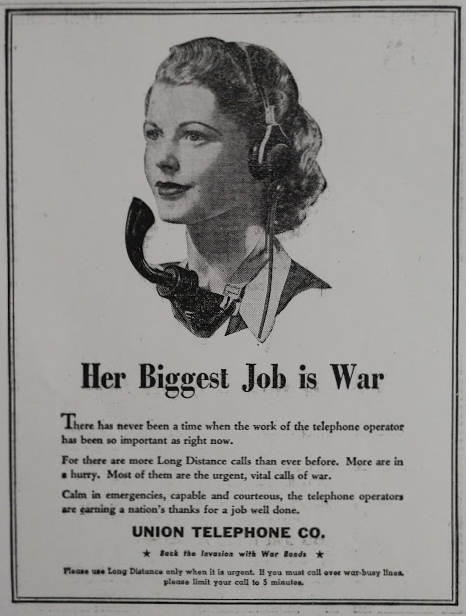
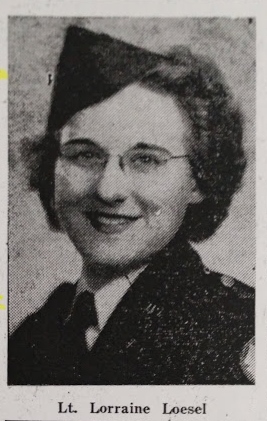
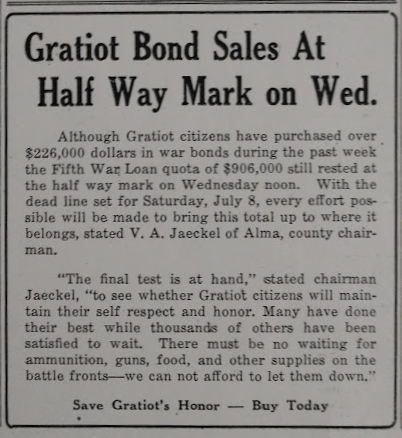
Above: Union Telephone Company Advertisement; Lt. Lorraine Loesel, from Alma, served as a nurse in New Guinea; Gratiot County worked to fulfill its quota for the Fifth Loan quota in July 1944.

     In July 1944, a walk down a town or village in Gratiot County on a Saturday night seemed quite peaceful. Unlike conditions in England, the soft lights from stores and street lamps made it easy to walk the streets. Cars honked as they went by. Drivers sometimes whistled or yelled at a young lady. People went into drug stores to get a Coke inside or to discuss which movie to see. Children lined up at water fountains to deal with the heat.

     People would gather at corners to talk. Inside a store,  a lady would hear, “Sorry Ma’am, I don’t have any more of that item. It is rationed, but I expect more soon.” She might also be told, “I’m sorry. I can’t give you that cut of meat, but I can give you another one. You don’t have enough points.” Men and women who finished their shopping carried their purchases to their cars in baskets or bags that they brought with them.

      In all of this, it was the July heat that held people’s attention. A prolonged drought had hit the county and farmers desperately needed rain.  Overseas, the invasion of France started its second month. In the Pacific, residents learned about the many islands that became battle sites. It was the third summer that Gratiot County was at war.


Rationing Continues

     Food rationing on behalf of the war effort continued in July, although in some cases point values went down a little. Vegetable juices and tomato sauces all dropped in points as canning season started.  Certain cheeses, canned asparagus, peas, and tomatoes all picked up point values even though there had been zero point values on them for a few weeks. Rationing also resumed on specific cuts of lamb so that more people had access to them.  The Gratiot County Rationing Office continued to post notices that meats, butter, and canned milk all had to use  Red Stamps A8 through Z8, all located in Ration Book Number 4. The stamps were worth 10 points each, and there was no restriction on their use.

      Late in the month, the Office of Price Administration increased rationing points on creamery butter. It turned out that people were using too many Red Stamps to buy more butter than the government allowed. Gratiot County residents were encouraged to practice canning for the winter. A canning center opened in Middleton on July 13 and it intended to remain open for the rest of the summer. Although there was no charge to use the canning center, people still needed to make appointments. Free tin cans and sealers were offered to those who did not have them.

     Prices and costs went up on other things as well. Clothing made from cotton textiles increased by over thirty percent. Cotton clothing, underwear, sheets, and work clothes also were affected. This increase was due to the Bankhead Amendment, which just became law.  In some parts of the United States,  women reacted angrily that rubber shortages affected corset sales. Many people just had to make do without things.

     A call continued for people to donate their junk for the war effort. At the end of the month, the Ithaca Boy Scouts held their first pickup of paper, rags and waste fats. Tin cans were also wanted, and donors needed only to cut off both ends of each can, turn the ends inside, and then flatten them. Residents were urged to combine trips into town and to drop off tin at designated collection centers. However, donations appeared to be in decline through the summer.  One of the exciting contributions of “war scrap” took place in St. Louis when Frank Housel, the city manager, received approval from the city council to tear down the city jail and donate the metal doors and sides. The jail had not been used for six years, and the city needed the space at the highway barn.

     An essential area of rationing dealt with automobiles in the county. Starting July 10, the Office of Price Administration set ceiling prices on 23 makes of automobiles. These cars ranged from types made between 1937 through 1942 and had two rates: “as is” and “warranty.” Whenever anyone purchased a vehicle, both the buyer and seller had to fill out a transfer certificate and then submit it to the county rationing board. A 1937 Chevrolet Town Sedan now had a ceiling base price with warranty for $365 and “as is” for $340. A more recent 1942 model would have costs of $940 and $995 respectively.  Those looking to buy used trucks did not face these regulations. Still, in the previous eighteen months prices on used cars rose between twenty to thirty percent.

     Tires and gasoline also remained desirable and essential items for people in Gratiot County. On July 6, the county ration board issued certificates for 348 tires. Almost two weeks later, another 314 certificates were given out; Grade 1 tires made up the most substantial requests.  Farmers saw less and less machinery ending up on rationing lists. The list was almost half the amount that had from the year before.  Among the items included combines, corn pickers, manure spreaders, and mowers.

     Two particular items frequently ended up being in the news as a result of crime: gasoline and tires. An Alma man, Charles Wright, had stolen gas, tires, tubes and wheels for over two months in the Ithaca and Emerson Township areas. He often took the tires and wheels directly off of the vehicles which had been jacked up and left on wooden 4×4’s. Wright was finally caught east of Alma when a dog woke up a farmer, causing the farmer to discover Wright’s abandoned car.  The farmer found that the thief also had drained gasoline from a tractor. After a trial in front of Judge Paul R. Cash, Wright received three to five years in prison.

“Any Bonds Today? Wanna Buy a Bond?”

     Raising money for the Fifth Loan Drive was on, and the county tried to meet its goal. Over in St. Louis, sales reports showed that the city had oversubscribed by $1, 136. At the end of July, St. Louis was over its goal by 20 percent. Few towns in Michigan could say that they had such enthusiastic support. However, Gratiot County, as a whole, was stuck at 45 percent of its goal, or $409,350 of its $906,000 quota. Michigan also had trouble raising money with only about 51 percent of its aim. Thursday, July 6 was proclaimed “Save Michigan’s Honor Day” to try and reach one hundred million dollars in war bonds. Things started to improve slightly in Alma. On July 13 the city announced that it had it exceeded its quota of $179,300 by almost $21,000!

      Out in the countryside, bond sellers went door to door in all townships of the county. By mid-month, another $18,100 in bonds had been sold in Emerson Township, led by the urging of township supervisor Ray Plank.  The bankers’ division also had success in meeting its goal of $754, 800. The Gratiot Board of Supervisors invested county funds with an F.S.U. defense bond for $10,000. Also making the news was the Concordia Society in St. Louis Zion Lutheran Church which bought a $200 bond.  Members donated fifty cents each in place of having a bake sale. In spite of the progress in bond sales, Gratiot County still was short over $160,000 in its total for July. Some people believed some rural areas still had not been visited and asked to subscribe to the drive.

Life, Work, and Crops on Gratiot County’s Farms

     Late on the evening of Tuesday, July 11, the rain started to fall in Gratiot County. The badly needed rain came as the county had been in a long drought for two and a half weeks, and some feared that a significant crop failure was occurring. Beans needed the moisture the most, and they got it. The rain brought with it helped crop values jump several hundred thousand dollars. Sweet corn had been fighting European corn borer, and fire blight attacked apple and pear trees.  Even with the rain, farmers were told to look out for grain weevils, which damaged wheat that would be kept in warm, humid conditions. Farmers fumigated their grain storage, keeping grain in clean and tight bins, especially watching when temperatures in the bins rose above 65 degrees Fahrenheit.

      The Gratiot County AAA told farmers interested in wheat loans to contact the office as soon as possible. Number 2 wheat was worth $1.44 a bushel.   Any farmer who kept his wheat in storage and delivered it in April of 1945 got to keep the seven-cent per bushel storage fee. The loans were offered until December 1944. For any farmer who took out a loan, members of the AAA visited the farm and measured and inspected the bins. The reason that the AAA offered loans was to encourage farmers in the county to keep wheat at home and open more room at elevators for the fall’s bean harvest.  Still, Gratiot farmers continued to take their grain into area elevators as July progressed. Reluctantly, elevators took the wheat – which averaged 35 to 40 bushels per acre in Gratiot County.

    Other situations and problems faced farmers that July. The Farm Security Administration offered loans for farmers who wanted to purchase their first family farm. These farms could be newly constructed, or older ones that needed work done to them. These loans came out of a law passed in 1937, which was known as the Bankhead-Jones Farm Tennant Act. If a farmer wanted to apply for the loan, their application would be reviewed by three farmers who sat on a committee and passed their recommendations on to Secretary of Agriculture. The three committeemen in Gratiot County included Clarence Derby (Ithaca), James Skayrd (Ashley), and H. Bird Clark (Alma).

     Milk and cream subsidy payments went out to farmers in early July. Milk paid 35 cents per hundred and six cents a pound of cream. Anyone in Ashley who wanted their check had to show up at the village hall and bring all slips for the months of May and June.  It was also cherry picking time in Michigan, and although Gratiot County did not grow cherries, over 150 people signed up and volunteered to go to northern Michigan to help harvest cherries. By contacting the Gratiot  County Agricultural Agent at the courthouse, they came into contact with the Women’s Land Army, which offered information and assistance to these workers. Directions, gasoline, and rides were provided as long as people in each car pledged to pick a minimum of 80 hours and fill out reports to cover their gas. By the end of July, 211 people from Gratiot County went north to pick cherries.

     The need for farm labor always remained a problem. Some area farmers tried new inventions to help. Stacy came up with a portable crosscut saw that operated by using a washing machine engine. He put the device on skids and was able to move it wherever he needed to cut wood. Clyde Downs of Newark used a pipe on the back of a spring tooth drag to break up thick chunks of soil.  Sherman Edgar of Beebe equipped both sides of his tractor with an A-frame, which he attached to two cultivators. By doing this, he could cultivate six rows of beans or beets at a time, instead of only two. He also put two umbrellas on top for shelter from the hot sun.

     Farmers were also told that if they could find farm help from men over age thirty, they should hire help as soon as possible. Most 18-26-year-olds with farm deferments were expected to be drafted in the fall if Germany was still in the war. An estimated 15,000 men in this age group had deferments in Michigan. Over 14,000 farmers in Michigan had asked the state for farm help. In Gratiot County, 64 farmers requested assistance, and 52 of them received it.  A total of 44 men and 11 youths made up the requested farm help.

The Draft and the V-12 Program

      A group of 24 Gratiot County men made up the only group who left for the war. On Friday, July 7, a chartered bus left Alma. This announcement did not tell which men were going into the Army or the Navy as the Gratiot County Draft Board had yet to receive an official report.  Among the men who left included Lowell Quidort (St. Louis), Richard Stewart (Breckenridge), Olmer Sims, Jr. (Ithaca), and Kenneth Bishop (Bannister).

     Over at Alma College, a group of 213 men enrolled in the V-12 naval training unit program, making it the highest enrollment in the program thus far. The V-12 commander at the college, Lieutenant Julius E. Scott, said that 118 men in the group were new;  the rest returned for further training in the program. Of those who returned, 42 came from the United States fleet and had seen significant sea duty.  Some had even won decorations for their service.

Gratiot’s Servicemen and Servicewomen

     Letters, pictures, and announcements kept people informed about who served Gratiot County during the war, where they were, and what they were doing.

    Roland Leslie of Middleton attended gunnery school at Great Lakes, Illinois, after entering the service in May. Cadet-Midshipman Patrick Goostrey of Ithaca wrote an article for the United States Merchant Marine Cadet Corps’ magazine, Polaris. It told the history of shipping with the American South Africa Line. Goostrey was the magazine’s feature editor.  Private John First of Perrinton received his Wings and Boots after completing training at Fort Benning, Georgia. First would serve as a paratrooper during the war; however, he was allowed to come home for a ten-day furlough before shipping out.

     After serving sixteen months in the South Pacific aboard the USS Chandler, F 1/c Alfred Schaeffer made a surprise visit home to Ithaca to see his parents. He was one of five Schaeffer sons; his brother, David, was killed in France less than a week after D-Day. Alfred Schaeffer was soon headed to New York to attend Naval School.  Technician Fifth Grade Chester H. Saunders of Breckenridge served as a driver with a balloon anti-aircraft battery in Italy. His unit had downed five enemy aircraft during their first year of deployment. Saunders had been part of the Salerno, Italy invasion.

       Melvin J. Thrush of Ithaca was in Australia and had been promoted to supply clerk. Thrush married an Australian girl, and he had been in Australia for 25 months. Joe Hudson of Riverdale survived the D-Day invasion and sounded in a letter like he had made it back to England. Hudson had seen the White Cliffs of Dover and thought they had been a beautiful sight. Private Robert Kerr of Ashley was at Camp Wolters, Texas after entering the service in March. He wished that people would send him letters. Sadly, Kerr would die in Europe during the war. Sergeant Andrew Gager of Middleton had been awarded the Good Conduct Medal while in England. He served as an aircraft instrument specialist and worked on Mustang Fighters.

      Surprising news came from Russia where Staff Sergeant Harlan Stahl served with the United States Eastern Command of Strategic Air Forces in Europe. Stahl’s mission was to help the Russians build air bases in a limited amount of time. He also helped with work on heavy bombers.  Both the Americans and Russians seemed to be getting along. Corporal Delbert Gould told his parents in St. Louis that he was in Panama for the past two months doing clerical work and guard duty. He first joined the Army in March 1941 and had been home three times during this period. Gould served with the 150th Infantry.

      The family of Lieutenant Galon Mallory of Elwell received the Air Medal while with the 15th AAF in Italy. Mallory had been a bombardier aboard the Salty Dog, a B-24 Liberator that was involved in missions over Central Europe, northern Italy and southern France. Mallory joined the AAF in March 1943. Private Joseph Deming of Bannister received a transfer to the Infantry. He had served with the 595th AA Automatic Weapons Battalion. Deming had been in the service since January 1941. Since then, Deming had been sent to California, Alaska, and Fort Bliss. He had already been awarded the Asiatic Pacific Ribbon and American Defense Ribbon. Gordon Peters of Perrinton received his wings and graduated from air pilot’s school in Texas. He awaited assignment either as an instructor or to be sent to the war zone. Sergeant Joseph Jisa’s wife in Bannister received word that her husband had been promoted to Staff Sergeant and that he was stationed at Corsica. Jisa had been in North Africa, Sicily and Sardinia. Sergeant Burton Cronkite of Breckenridge was an airplane and hydraulic specialist with the Ninth Air Force Service Command. He had been inducted in March 1942.

     The Hospodar Brothers from North Shade Township, Michael and Frank, both came home for a short time. Corporal Michael Hospodar had been in the Aleutian Islands for 26 months and served in the Coast Guard Artillery since March 1941. His brother,  Private Frank Hospodar, had been a POW guard at Sidnau, Michigan after being in North Africa. Twin brothers Kieth and Kenneth McDonald, who had previously lived in Ashley, were pictured in the newspaper. Both entered the service in April 1943 and overseas since February 1944. According to the news, they had always been together and “have been granted special permission by the President to always stay together.” Tech Sergeant Roland Reeves of Ithaca was in Northern Ireland, serving with the United States Army Depot.

     Corporal Henry Klein from Ithaca came home on a five-day furlough to Alma. He had completed combat crew training school in Sioux City, Iowa. Klein trained as a gunner in a heavy bomber crew. An Alma High school graduate and former student at Alma College, Klein was just short of his degree when he entered the service in February 1943. Lieutenant A.E. Brenneman of Alma was commissioned as a second lieutenant in the Marine Corps Reserve in Pensacola, Florida.  He would be placed on active duty at a training center and then possibly sent to a combat zone. Brenneman would be one of Gratiot’s men to be killed during the Korean War.

     Gratiot County also received news telling about the role of women in the service. “Somewhere in New Guinea,” Lieutenant Lorraine Loesel of Alma was part of a unit of ward nurses who served there. Loesel’s unit arrived in New Guinea in September 1943 at the foothills of the Owen Stanley Mountains. Loesel was one of a group of doctors, nurses, dentists, and clerks who built a hospital on the grounds of an old native mission. An Alma High School graduate, Loessel became a public nurse for the City of Detroit Public Health before embarking for the Pacific in July 1943. Amelia Lapaugh of Elwell enrolled at Naval Training School at Iowa State. She was an Alma High School graduate and hoped to become a petty officer and serve in the United States. Private First Class Linda Thompson of Perrinton served as an Air WAC at Stockton Field, California. She was in charge of enlisted service records. Lieutenant Phil Goodrich from Ithaca became engaged to Margaret Wilkinson, a Yeoman 2nd Class in the SPARS. Both met while stationed in Seattle, Washington.

      The call for women to serve as WACs and WAVES continued through 1944. The need for women in the WACS was dire as a result of the invasion of Europe. Dr. T.J. Carney, chairman of the Gratiot County Defense Council, shared a letter from the United States Army expressing the need for women in the county to consider becoming a WAC. Interested women could contact Mrs. H.A. Christensen of Alma or go to the Office of Civil Defense, which was located in City Hall in Alma.

     Then there letters, letters and more letters – each telling something about the war. Corporal Earl Emery wrote from Italy that he had been to Rome. The city had been untouched from the fighting and Emery was impressed about how clean Rome was. He spent two days there, however, while at Vatican City he could only visit St. Peter’s Cathedral as it was the only thing open to American troops. Emery thought the Coliseum was in good shape for its age. He also saw the Holy Stairs and the catacombs. Emery wrote, “Sure wish I had studied my Ancient History better when (my teacher) as trying to teach me. But then I never thought I was ever going to see any of it.”

      Captain Ted Osborne wrote his grandparents, the Leo Schaeffers, about what he saw in Italy. Of particular interest was the state of the vineyards. Although the Italians raised wheat and it was harvest season, Osborne thought that they “do things backward here.” The vineyards were plowed by hand, and only a third of the land was cultivated. Volcanic rock made it so that only spots with up to twelve inches of soil could be used at all. “Plowing is done mostly with a jackass and the old pointed stick for a plow, that was used in biblical times.” Big landowners seemed to control almost all of the land and they distributed it to sharecroppers. When wheat was threshed it seemed that a lot of it fell to the ground and was wasted. “My God, these people are poor. (It) seems to be the normal state for them though,” Osborne wrote.

        Corporal Don Bigler also wrote to his parents in Alma that he had located his brother near the Italian front. The two spent two days in a foxhole together – it was the first time they had seen each other in two years. Bigler explained what the Anzio Express was and how they learned to tell which type of shell the Germans fired at them. The men in the other Bigler’s outfit could not understand why anyone would spend a three-day pass in a foxhole on the front.  Still, Don Bigler did it.

     Also in Europe, 2nd Lieutenant Stanley Bailey of Breckenridge wrote about his involvement with the invasion of France. As a pilot on the 9th Troop Carrier Command, Bailey said he had “a ring-side seat at the world’s greatest show.” On his first trip across the English Channel, Bailey thought he could have walked across on all of the boats. The next time he flew over it, he could have crossed on a bridge of airplanes. Flying a C-47 on D-Day was his first action in the war.

     Writing from the Pacific, Dale Phelps told his parents that things seemed to be going well for him in New Guinea. Phelps had been in combat but had not even been scratched. He was receiving much mail (sometimes ten letters a day), and he had picked up several Japanese souvenirs such as a rifle, flag and watch. However, he was having trouble sending the gun home. Phelps wrote his letter on captured Japanese stationery.  Private John Brzak wrote to his sister in Ashley and told her that he had received some wounds. “I’ll be okay as I’m going to pay (the Japanese) back for what they did and have done for my brother Tony’s sake.” Tony Brzak was a Japanese prisoner of war. John Brzak believed that the war would soon end and that he aimed to find his brother.

      Finally, Corporal Lee Wright, a United States Marine, wrote from Saipan to his mother in Alma.  Amid the terrible fighting there, Wright wrote that his prayers and faith had pulled him through. “I had a few very close shaves, but I am still kicking. If it hadn’t been for his being beside me, Mom, I don’t know what would have happened.” Before the fighting on Saipan, Wright had been in New Zealand, the Hawaiian Islands, the Marshall Islands, and then Saipan.

The Wounded, POWs, MIA, KIA

     News reached St. Louis that Private Robert Furtaw had been seriously wounded in France on D-Day. Furtaw’s mother received a telegram regarding his status. Then came the news in mid-July that Furtaw had been killed. A message reached the Frank Foster family in Newark that their son had suffered wounds after D-Day and was hospitalized. They had no further information. The same was true for Don Baker of Elwell who had been in France. Lieutenant R.J. Hanson was wounded on Saipan, but his wounds were not serious. Hanson’s father formerly worked for Republic Truck Company. Although he did not mention it in his letter to home, John Brzak of Ashley received the Purple Heart for being wounded in the Pacific. Brzak’s captain wrote a detailed and moving letter of John Brzak’s service after being wounded.  Harold Overmier, formerly of St. Louis, was in a hospital in California after being injured by shrapnel while on his boat somewhere in the Pacific.

     In early July, Sergeant Archie McFarlane of St. Louis was still missing in action. The day before the initial news came to the family in St. Louis about his disappearance, the family buried Archie’s father, who had just died.  Robert L. Parks of Alma remained missing. A radioman, Parks had been missing since February in the Pacific.

      Then came the news of those who paid the ultimate price for Gratiot County. Ralph Vandemark died of typhus in New Guinea. At his funeral, three Alma boys served as pallbearers.  General MacArthur sent the family his condolences. While in India, Private Delbert Stites from Vestaburg died as a result of drowning. Stites had been in the Army. In late July, the mother of Lt. Ronald Nesen learned that her son died when his plane crashed in the English Channel. Nesen, a waist gunner on a B-17, was with a crew returning from a raid over the Friedrichshafen, Germany when it was attacked just off the French coast. In late July, news came that Private Earl Whittum had been killed in action in France on June 25.

      To remember and honor those from Alma who had been killed in the war thus far, the first community-wide memorial service was planned for July 23 at the Tourist Park on East Superior Street. An afternoon vesper service was to take place there earlier that day.  A service also took place in Ithaca on Sunday, July 2 for D.C. Furgason who had been killed in Italy prior in the year.

      Hard news also had to be faced with the growing list of Prisoners of War. Sergeant Benny Zamarron of Ashley was now in a German POW camp. His status was confirmed in late June when the Zamarron’s received news from the International Red Cross. His picture also appeared on the front page of the Gratiot County Herald.  Articles started to appear in county newspapers regarding POW status, what people could and could not send to them, and how the Red Cross planned to help POW families. The Gratiot County POW Committee was made of up of Mrs. Wilbert Hansen, Mrs. M.J. Haley, and Reverend J. C. Thompson.

Life in Gratiot County During July 1944

      Gratiot County’s Congressman, Representative Fred L. Crawford, made a stop in Ithaca to talk to the Gratiot County Republican convention. Crawford stated that he thought the war would be over by the end of the year. Japan should fall by 1946…Loren Nelson of Ashley was one of several local young people who were part of a pen pal correspondence with English children. The connections between the two groups started when Loren Nelson’s older brother asked an English woman to do some stitching for him while stationed in England. When the elder Nelson tried to pay her, the English mother only asked for help in setting up pen pals. Corporal Nelson arranged for his brother  – and other youngsters in Ashley- to write to England. The partnership quickly took off in early 1942…Clare Redman became vice-commander of the Alma George Myers American Legion Post…The Gratiot County Herald wanted more servicemen pictures for the paper…Half year automobile plates started going on sale on July 15…The wife of Seaman Jerry Derry had been shot in a freak accident in Fort Pierce, Florida. Mrs. Derry was hit by a stray bullet while standing near the couple’s window. Seaman Derry was from Eureka.

     The Board of Directors of the St. Louis Co-Operative Creamery published a large advertisement in the St. Louis Leader in defense of Seventh Day Adventists. An article had appeared in the Lansing State Journal suggesting that Adventists were not patriotic because of their choices in limiting how much cream and cheese they ate. The St. Louis Creamery wanted people to know that Adventists were patriotic Americans and that many purchased and used milk and cream products just like other Americans…Maynard Strouse took over the Fleming Shoe Store in St. Louis and now operated it as the Strouse Shoe Store…William Bataan, Assistant County Agricultural Agent, announced that he was leaving his position that he had held for the past year. He was now the Agricultural Agent for Luce and Mackinaw counties…A meeting was planned at the Park Hotel in St. Louis regarding the steps to be taken to purchase land for a proposed new county airport…Five thousand pairs of black market nylon hoses that had been confiscated by authorities went on sale in Greensboro, North Carolina. The cost? $1.65 and the line was four blocks long…The St. Louis First Methodist Church prepared to hang a new service flag with 70 stars on it. Included were two recently killed St. Louis servicemen: Murvel Peacock and Gaylord Hanley…It was time to think about planning for Christmas packages for members of the armed forces. They needed to be mailed by October 15…Leonard Refineries started construction on a new administration building on the recently acquired Fred E. Burt farm…A Social Security representative would be in Alma on July 19 at the U.S. District Employment Office in Alma. Anyone needing help or having questions could see the representative.

A recent poll said that seventy percent of Americans favored a peacetime draft to support and maintain the armed forces. Most believed that a one year term of service was appropriate…Gratiot County had more sugar beet growers than any other county in the state…Teacher Adele Cavanaugh of St. Louis published a weekly column reminding the public of those young men and women who had left to defend the county during a time of war. Cavanaugh referred to them by their first names and what she remembered about each of them. Each week ended with a  wish that each would return home to Gratiot County safely…”Double Indemnity” starring Fred MacMurray, Barbara Stanwyck, and Edwin G. Robinson played at the Strand Theatre…The Red Cross rooms over the Ithaca Post Office were open every afternoon except on Saturdays. A new quota had been sent to Ithaca for July…The Sailors Quartet of the  V-12 Program from Mt. Pleasant played and led the services at the St. Louis Baptist Church when the pastor was absent.

And that was July 1944 during Gratiot’s Finest Hour of World War II.

Copyright 2019 James M Goodspeed
Gratiot County’s Finest Hour: June 1944 – “INVASION!”

GCH D-Day.JPGIMG_20190608_205559861.jpgIMG_20190608_205616291.jpgIMG_20190608_205624363.jpg

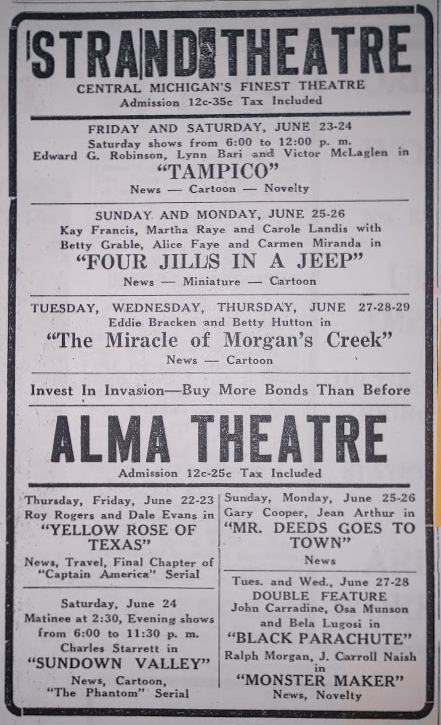
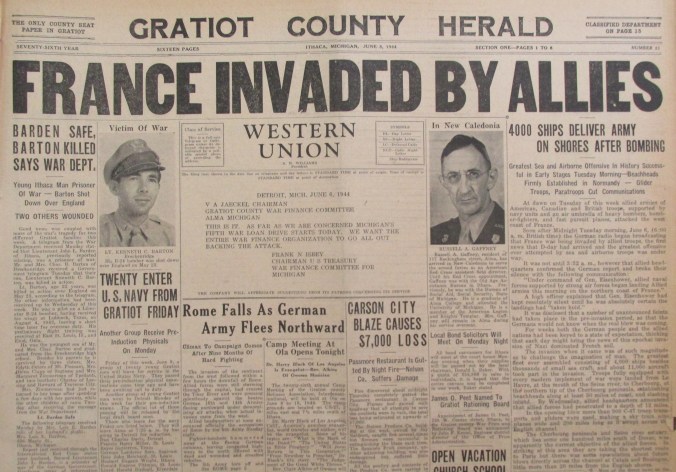
Above: Front page June 8, 1944 issue of the Gratiot County Herald; Fifth War Loan announcement for Gratiot County; News about John L. Barden, POW in Germany; Strand Theatre playbill from the week of June 22, 1944.

       It was finally here: the Allies started the invasion of Hitler’s Fortress Europe. It was D-Day, the invasion of Normandy, the greatest invasion force ever assembled in world history. So now, Gratiot County played its part in this part of World War II.

D-Day Arrives in Gratiot County

       Actual news of the Invasion hit Gratiot County at ten o’clock in the morning of June 6, 1944. The Gratiot Defense Council, located in Sheriff Nestle’s office in Ithaca, released the news that they received from Lansing. Sirens went off, bells rang, and factory whistles sounded.  Across Gratiot County, people ceased activity for one minute of silence. Factories stopped working, schools stopped, as did all traffic. County newspapers described the event as solemn, serious, and even prayerful. Several churches in Ithaca opened for services at 8:00 PM that evening and these services were more important than anything else taking place. People prayed for divine guidance for the times that were ahead.

        Almost two weeks before D-Day, places like St. Louis had already prepared citizens for the event. City Manager Frank Housel asked people to be prepared to offer a silent prayer and go to church if it was possible. Churches across the county had been asked to open their doors to the public on the day of the invasion.

Our Men on D-Day

      It would be at least one week after D-Day before the first news arrived concerning what Gratiot men were in the Normandy Invasion. For some Gratiot County families, it would be weeks before they heard anything. The first letter to reach the county came from Private Leland Lytle of Alma who wrote to his family just before he took off for France. Lytle, in only two short paragraphs, summarized the angst and challenges ahead for Gratiot’s men, “Today is a day which will go down in history, a day that millions of people have been waiting for.” Another letter came from Dick Fishbeck who made it to the beach and told of how he was dealing with German snipers. “Right now, I am thanking God for pulling me out of some of the jams I got into the first day.”

       Others, like Donald Shurr from Breckenridge, flew beachhead missions with a C-47. Because he dodged enemy fire and was forced to seek cloud cover when he came out of the clouds his paratroopers were dropped well off of their drop zones – something that was a common occurrence on D-Day.

       The saddest and most gripping news of those who died on “the longest day” revolved around Sergeants Archie McFarlane of St. Louis and Marvin Fenner of Alma. What was most startling about them was that two local men ended up on the same B-17, “Pack of Trouble.”  Then came the news:  the plane had been hit over the English Channel on June 12 (“D plus 6”) and had suffered a mid-air breakup, causing it to crash into the Channel. Only one member of the crew survived and made it to shore.  Neither McFarlane or Fenner’s bodies were ever recovered.  Adding to the tragedy of the deaths of the men was the news that McFarlane’s father died only three days before the news arrived about the younger McFarlane’s death.

      As weeks went on, more news arrived concerning Gratiot’s men in France. Private Lyle Remboski (Alma) was seriously wounded and in an English hospital. Sergeant Raymond Grachek (Alma), Private Robert Furtaw (Ithaca),  and Gordon Batchelder (St. Louis) were all wounded. The first MIA on Normandy, Paratrooper Marshall Mockridge of Breckenridge, soon became a prisoner of war. News of more deaths came in weeks later. Killed in action were Private Earl Whittum (who had ties to Alma) and Private David Schaeffer (Ithaca).

       There were those like the family of Miles Arner Douglas from Emerson Township who felt lucky about what news they received. Douglas had been shot down over France and was miraculously rescued and helped by the French Underground. Douglas made it back to England and flew more missions over France until early December 1944 when his P-47, “Miss Isabelle,”  flew into a hill while he was trying to land in the fog. Douglas and his two wingmen all perished.

Others Killed, Wounded, Missing

      Other men died. Lieutenant Kenneth Barton of Breckenridge died over England on May 23. Barton had been a Breckenridge High School graduate, as well as graduating from Central Michigan College. Corporal Ralph Vandemark died from scrub typhus disease while in New Guinea. He had been in an infantry company. Mrs. Herbert Abbey of Ithaca received a letter from her son’s chaplain. Captain Abbey died in an airplane crash in South America. The chaplain wrote a Mothers Day letter to Mrs. Abbey, telling her what the chaplain thought her son would say to her to help cope with her grief. Captain Clay Bullis had been declared MIA since April 18. However, his family was notified that he had been killed while on a mission over Italy.  Another Gratiot man, Lieutenant Russell W. Criswell died in an airplane accident on March 30 in California. A funeral for Private Laurel Evans took place June 10 in Indiana. Evans, whose parents lived in Alma, died in a drowning accident at Camp Campbell, Kentucky.

      The wounded included Private Junior Rockefellow from Perrinton. Rockefellow had been wounded at Anzio. So was Private Alfred Donnly from Riverdale and he was on his way home after being seriously injured.  Kenneth Kirkey of Breckenridge suffered injuries to his hand and arm while in New Guinea. He was in a hospital there. Fireman Frank Chapman from Alma had just returned home from the Philadelphia Naval Hospital after suffering injuries while aboard a ship in the Solomon Islands on July 5, 1943. Chapman’s ship had been torpedoed and then sank.

      Lois Barden of Ithaca received a message through the International Red Cross that her husband, Lieutenant  John Barden, was captured as a prisoner of war by the Germans at Stalag Luft III prison camp. It was Barden’s second mission, and he was only twenty years old.  Sergeant George Mahin of Alma also was a POW in Germany. Mahin had been shot down over France. The family of Sergeant Benny Zamarron of Ashley also received a letter from the Adjutant General in Washington, D.C. about the fate of their son.  Zamarron’s B-17 had gone down over Perleberg, Germany after suffering a mid-air collision. However, names and detailed information about the others on board could not be shared with the Zamarron family. Sergeant John Prout, who had operated the Hi-Speed Gas Station in Ithaca before entering the service, had been missing since May 29 over Austria. Prout had been on a B-24 and was flying missions out of Italy. Staff Sergeant Vernon Bishop of Bannister was announced as missing over France since May 4. He had been in Europe for only a month when it happened. Finally, Lieutenant Tommy Roberts had a brother living in Newark Township. Roberts had been missing over New Guinea since early January. He was serving with the Photo-Reconnaissance Squadron in a P-38.  His last letter to the family described bitter fights with the Japanese. Roberts sent Japanese souvenirs home such as Japanese boots, a silk scarf, and a silk flag.

June Mailbag From Our Men and Women Abroad

       Local newspapers carried the letters of many Gratiot men and women who were fighting and serving abroad. Writing from India, Orval Shaw described how he and others were eating their usual dinner of Spam as there was no beef to eat. The temperature never fell below 75 degrees. While on guard duty one night, Shaw heard a noise and shot at a snake measuring seven feet long. He also wrote that shaves and haircuts were very cheap. Corporal Thomas Horn II also was in the CBI (China-Burma-India) Theater. To see a movie he and the others in his group flew into India once a week. Usually, the men got to see a film two or three times after they arrived. Mail was appreciated, a “haner” swept the living area, made the beds and put down the mosquito nets. Horn’s men were also setting up a softball league.

      In the Pacific, Private Norris Morse wrote that he had first seen combat in the Marshall Islands and he urged readers of the Gratiot County Herald to buy more war bonds. Because of air attacks from “Washington Machine Charlie” (Japanese bombers), Morse could out dig a groundhog by how fast he could dig a trench. He added, “The fear that fills your mind from the first sound of the siren until the all-clear signal is something that I cannot express in words.” Private Kenneth Gross sent a letter indicating that he had been a chauffeur for General Hap Arnold and Admiral King. Gross confessed his nervousness, “Frankly, I was scared to death. When I saw so many stars (on their uniforms), I thought the sky was falling. They’re both good guys too.”

      Private Johnnie Trefil from Fulton Center surprised his mother by having a dozen roses sent to her on Mothers Day. Trefil ordered the flowers by telegraph from somewhere in England.   Private Fred E. Guild sent word home that he was somewhere in England. Guild was a paratrooper. Sergeant Dale Glazier from Middleton was somewhere in Europe with the Manufacturing and Repair Section that worked on planes. His work helped to keep bombers and flyers maintained and up to date. Glazier received a special commendation from General Spaatz for the job done for improving his depot production.  At the Anzio Beachhead in Italy, Private Rollin Adams from Elm Hall wrote from “West Main Street-East Main Street”  which was in a small valley. At that location, the men washed their clothes and took a bath. Private Warren Collison’s family in Ithaca held a 22nd birthday party for him even though Collison was stationed in Italy. Private Leland Perry’s family in Alma received a letter from him. Perry received a package from home and was disappointed that it only consisted of candles. Still, he considered the candles to be useful. Perry had not heard a radio for two months and wanted to take a real bath. He had not washed his head in over one month.

      Margie Street, a Pharmacists Mate, Second Class and stationed in Norfolk, Virginia, detailed her work in the WAVES. While at a Naval Air Station, Street’s task involved working with a Low-Pressure Chamber Technique where up to twenty men entered a chamber and wore oxygen masks. As the controls raised the pressure inside, the effects simulated high altitude flying. Dorothy Doepker, a Pharmacists Mate, Third Class had to come home to Alma due to the death of her sister. Doepker had been a former beauty operator.

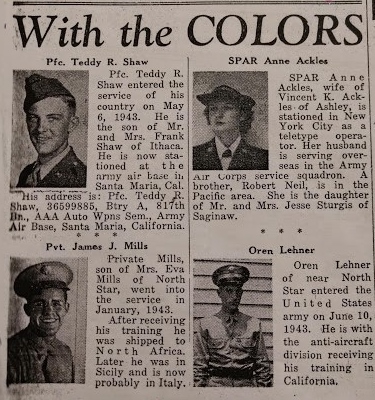
      Three Peterson brothers from Newark Township (Ray, Roberts, and Larry) had their pictures in “With the Colors” in the Gratiot County Herald. Ray was with the Marines, Robert was in New Guinea with the Army, and Larry served as an instructor at Fort Sill, Oklahoma.  Ray Helman, also from Newark Township, had been home on leave from Italy. Fifty relatives attended a gathering in his parents’ home before Helman left for a camp in North Carolina. Helman had been in North Africa and Italy for sixteen months. David Swigart from Alma continued Marine Corps training. Men in his platoon ranged from the ages of 18 to 30.

     Captain Donald Brice from Alma received a promotion and was home visiting family after spending 21 months in the Aleutian Islands. Sergeant Andrew Gager of Middleton was in England, and his assignment was with a ground crew for planes. His wife was living in Lansing.

The Draft Continues

      On June 8, a group of 31 men left Gratiot County for Fort Sheridan, Illinois to enter the Army. Almost all of them were under the age of 26 unless they volunteered. Also, at least 25 in the group were fathers. Some of these men included Merlyn Lewis of Breckenridge and Harry Penington from Wheeler. One week later, six men left for the Navy. Albert Knapp and Orville Kirkby were among them.  At the end of June, ten more men left for the Army with James Deardorff of Riverdale, Clyde Wiseman of Ithaca, and Floyd Thompson from Alma in that group.

      Over at Alma College, 48 apprenticed seamen completed their work on June 24 for the V-12 Program. Another group of 37 would transfer to other schools to complete the program at those colleges. Lieutenant Julius Scott expected another quota of 205 to enter the program starting July 1.

The Gratiot County Red Cross

       The Red Cross continued to call upon people to help with its work. Mrs. Frank Iseman of Ithaca told readers of the Gratiot County Herald that there was now an urgent need for more surgical dressings. “Every wound must be dressed – not just some wounds, or certain wounds, but all wounds, large or small, must be dressed and dressed often.” In Alma, the maximum number of volunteers working there reached a high of six. More surgical dressings were needed, as were more volunteers. The headquarters opened every Monday evening for two hours, and four days each week with morning and afternoon hours. Ithaca also called for volunteers and opened their room, located over the post office, every afternoon except on weekends.

     The Red Cross also worked in other ways. On June 22, a group of service trainees visited Fort Custer and got an up-close view of the work at the camp. They visited the station hospital where they learned that the cookie baskets for patients there never remained full. The cookies made great prizes for the men who played bingo during their recovery. After lunch at the Service Club, they saw men training on the Infiltration Course, navigating a simulated minefield, and then observed how men reacted in “Hitlerville.” Young officers here prepared for how to enter an enemy village and how to take it house by house. The Gratiot Red Cross group also witnessed men operating K-9 dogs as well as those soldiers training in ju-jitsu.

       An essential function of the Red Cross in Gratiot County continued to be helping prisoner of war families. A select committee made up of members Mrs. Wilbert Hansen, Mrs. M.J. Haley, and Reverend J.C. Thompson helped to prepare articles and communications about Gratiot men who were in enemy territory. The Red Cross remained the place where POW families could turn when asking for help and encouragement during this time.

Loans, Bonds and Doing Your Part in Gratiot County

      Early in June, the start of the Fifth War Loan Campaign began. Michigan moved up the date of this drive to coincide with the D-Day Invasion in France. This loan drive also called a “second front invasion,” told Gratiot County that it needed to raise $1,382,000. On top of this, all of this money was supposed to be raised between June 6-9! Local chairpersons were chosen to lead the drives in their respective communities.  Fred Leiter in Riverdale and Louis Federspiel in Breckenridge took on their duties. Each township had its quota for each type of bonds that were being sold. For example,  Fulton Township had to raise $32,900 worth of E Bonds and $18,700 value of F, G, and other notes.  “Buy Yourself Some Khaki!” was the slogan people heard.

     However, over two weeks later, the county was short $906,000 in sales. The government and press resorted to a tactic used in World War I: publishing facts, and even names, of organizations or people who had given their share.  References to the Normandy Invasion and the plight of men in the invasion force also occurred regularly. Another means of stirring people to buy bonds included printing statistics about how much money each bank in the county had in savings accounts. Since savings accounts had increased substantially since before Pearl Harbor – and the economy allowed more Gratiot people to work – shouldn’t there be more money to invest in the current bond campaign? People were asked to stop farming, working, and traveling to take time and buy bonds.

     To do its part, Michigan Chemical went on the record at the end of the month as saying that the company had taken in half of its $15,000 quota from its workers. Franklin Curtis then stated that Michigan Chemical promised to meet its goal by July 1.

      Even the Strand Theatre urged patrons to buy bonds. “Invest in Invasion- Buy More Bonds Than Before” ran with its movie advertisements.  Movies during the week  where the ad appeared included “Tampico,” “Four Jills in a Jeep,” and “The Miracle of Morgan’s Creek.”

Rationing Goes On

      Gratiot County continued to face the issue of rationing and conserving things on behalf of the war effort.  The Office of Price Administration sent out news that Sugar  37 had been canceled as many housewives incorrectly tried to use it to obtain sugar for canning.  However, Sugar Stamp 37 would be good starting June 16 for five pounds of sugar. Best of all, the stamp remained good in the future.  A pound of waste fat also was good for two meat ration points or four cents.

      Victory gardeners received instructions about how to protect their gardens with poison bait for cutworms, white grubs, and crickets – as well as root maggots. Those who planted that spring could expect that two pounds of asparagus could yield one canned quart. One bushel of peas equaled about five canned quarts, but a bushel of tomatoes produced twelve quarts. Fulton Township School offered a community canning project for the summer. It started June 28 and operated five days a week, from 8:00 AM to 5:00 PM. Lillian McKinney conducted the program in the home economics room in Middleton. All of this was done at no cost to the public – if ladies brought their jars. Those who used tin cans for canning paid a small charge. In other news, the War Labor Board had not yet decided what to do about reservations people made for the new Alma Frozen Food Locker. The reservations had been submitted May 31.

      People continued to be asked to take care of their tin. When a collection amounted to a carload, it would be shipped off to a detinning mill. Anyone in Alma could call City Hall for instructions about where to place their tin, or place the tin at a small building which was located near the river on East Superior Street. In St. Louis, the highway barn on Saginaw Street also accepted tin.  When it came to automobiles, the county would issue up to 192 tire and tube permits in mid-July. According to the OPA, the status of used car rationing would be announced once they were placed below price ceilings.

Farming, Farmers and the Upcoming Growing Season

      Farmers who had potatoes for sale were to contact the AAA office in Ithaca. The Lake Shore Sugar Beet  Company could turn the potatoes into animal feed for the war effort. Calls for more egg production went out in the county. The egg quota was raised due to the fear that farmers would butcher their chickens instead of using them to produce eggs. A severe shortage of eggs was feared.

      Certain men worked to place youth farm labor in the county. The upcoming pickle crop and work in the muck fields would need help. However, farmers were reminded that these youth were not skilled workers. L.A.Schroeder of Breckenridge and Graydon Blank from Alma were in charge of organizing farm laborers there.

       On a lighter side, the phrase “Corncobs Help to Win” appeared in the newspapers as they were needed for the war effort. Corncobs helped to keep airplanes free from carbon, and they could also be ground up and used for air blasting equipment. The East Coast and Mississippi Valley areas had high demands for these corncobs. The AAA continued to ask homemakers to use oleomargarine over butter due to the war. Using butter substitutes seemed to be a challenge for families that wanted their butter.

      Another issue dealing with the war that Gratiot County dealt with was migrant field labor.  An estimated 30,000 Mexican workers would be coming into the United States to work in the fields in the summer of 1944.  In early June, a special train with 200 Mexican Nationals arrived in Alma. The workers were spread out around the county, wherever farmers had housing and work for them. Another 60 workers headed for Isabella County. With the influx of migrant workers came the birth of migrant schools. Starting June 26, the East Minister Chapel in Alma opened. In Alma and Breckenridge, centers there offered lunches for the migrants that were furnished by people in the community. A Vacation Bible School took place in Breckenridge. At the Beebe Township Hall, two ladies were in charge and offered craft work and recreation. Daycare was also provided for those migrant women who worked in the fields.  Evening activities for migrants also took place in the evenings at these locations. An estimated $400 was spent in 1943 on summer projects like these in Gratiot County.

And So That We Do Not Forget….

       A war bond display at the First State Bank of Alma showed that your bond purchase went toward the new truck-trailer capable of carrying huge boilers to ships for sailing overseas…Company C  from the Michigan State Troops of Alma prepared to leave for field maneuvers at Church’s ranch one weekend…The Orin Riker American Legion Post in Ithaca raised almost $400 with 2000 poppy sales…Negro singers in Wheeler held the attention of a Wheeler church on one Sunday night, courtesy of Bay City’s Second Baptist Church…Gratiot County farmers learned that they could have dust layer to put in front of their homes. However, they had to spread it themselves…The St. Louis Sugar Beet Factory faced charges from a state official that the factory was killing fish in the Pine River because of discharge from potato processing…Dwellers in Middleton were fascinated by an opossum on Main Street that carried five young…Claude Watson from California and 1944 Nominee for President appeared at Alma College. He was a candidate on the Prohibition ticket. His message was “God’s Program for a Clean Government”…News about the fighting near Rome, Italy appeared on front pages. The breakout from the Anzio Beachhead was taking place…Elmer E.West, a World War I veteran in the county, died from complications of tuberculosis at a sanitarium in Howell, Michigan…Blue Star Mothers in Gratiot County urged people to turn in names of their family members who were serving in the war. The building of a county memorial remained a goal and people would soon be urged to donate to the construction of a memorial with the names of all of Gratiot County’s men and women on it. Pictures of these men and women could be placed in the window of the J.C. Penney Store in  Alma…Leonard Refineries showed free movies at Alma High School about safety and fire prevention. Also, two war films would be shown, including fighting on Guadalcanal…Women’s Land Camps (WLA) would be operating this summer in Michigan. Women who joined up worked to help with the summer fruit harvest. Each worker had to commit to work a minimum of three days in a row and earn their board…The first softball game played under the lights in Ithaca at the fairgrounds took place when Croziers Rascals faced the Newark All-Stars. Newark won by the score of 16-15. The games generated  a lot of community interest…Ordnance plants needed women workers. Interested women needed only to apply at City Hall in Alma. Please bring your birth certificate and statement of when you would be available…”The On Wheels Parade and Free Show” in mid-June in Ithaca drew 250 children on 150 bicycles. Over 1,000 spectators showed up to watch the parade. It was an excellent opportunity to make War Stamp sales…It was already time to start thinking about Christmas mail to men and women abroad. September 15 to October 15 would be the time that the post office accepted packages, but they had to be under five pounds and meet specific size requirements…Finally, farmers on both sides of the Maple River continued to fight over drainage issues. A new drain survey was called for.

       And that was June 1944 in Gratiot County during World War II.

Copyright 2019 James M Goodspeed

Gratiot County’s Finest Hour, Remembering World War II at 75: May 1944 –“Things are Getting Better, or Aren’t They?”

IMG_20190519_074721176.jpgIMG_20190519_074658324.jpgIMG_20190519_081045227.jpgIMG_20190519_074817448.jpg

Above: May 1944 Consumers Power Company advertisement from Gratiot County Herald; May 25, 1944, St. Louis Leader advertisement Michigan Chemical Corporation; June and Jean Knapp from Alma served Gratiot County as a WAC and WAVES respectively; Family War Bond advertisement Gratiot County Herald.

          It was May, it was warm, and yet life was not entirely right in Gratiot County. There was a war going on.

          While some rationing improved for people in the county,  people could not get all of the kinds of food that they had before Pearl Harbor. Gratiot County servicemen – and servicewomen – went to and reported from all parts of the United States and the world. Letters and pictures from these men and women regularly appeared in local newspapers. Bad news arrived in the form of those missing, wounded, and killed. The numbers of casualties and deaths also kept growing.

          In the midst of all of this, Allied successes on the war fronts promoted speculation among civilians that the war could end in 1944. However, no one knew that the war would go on longer than hoped. Many of those who did the fighting thought the war would be long before peace ever came.

          And then there was “invasion talk” as a new front on the European continent was soon to be launched by the Western Allies.

Soldiers and Servicewomen in the News

         There was no shortage of reports from those in the service. Corporal Leslie D. Romine of Alma helped supply the front in the Mediterranean as a convoy commando. Romine drove trucks with supplies over mountains and deserts to help keep the Army moving.  He had been in the war for 19 months.  In service for exactly one year, Privates June and Jean Knapp of Alma had their pictures appear together in the Alma Record. June was a WAC, and Jean served as Aviation Machinist’s Mate Second Class in the WAVES. June served as a telephone operator at Sedalia Air Force Base in Missouri, while her sister was stationed at Ellyson field in Pensacola, Florida.

        Fordson Essex, age 17 and from Alma, started naval indoctrination training at Great Lakes Naval Training Center.  Lieutenant Lewis Jolls of Ithaca received recognition for being a pilot of a B-17. Jolls had been on several missions already and sent a picture of his plane and crew of the “Hell’s Belle” back to Ithaca. Jolls worked for the Gratiot County Herald before the war. Private Maynard Dodge of Middleton made it safely to North Africa. He had trained as a dental technician at Camp Grant, Illinois.

        Some families received news regarding men injured in action. Lieutenant Norman Keon had been in New Guinea since October. In early April, he was driving a jeep through the mountains when it went off the road, fracturing his collarbone and causing serious facial injuries.  After being rescued from his overturned jeep, Keon was unconscious for two days due to the shock from the incident.  Another former Gratiot County man, Dr. Earl S. Oldham, served in the Navy Medical Corps. He wrote that he failed to miss any of the invasions that had occurred in New Guinea since Christmas. Sergeant Leo Coonrod was stationed in Panama with a bomb squadron, but he had been transferred to the Galapagos Islands. He graduated from Alma High School in 1939.

        Once and awhile news came home to Gratiot County when men made it safely to the war theater. Howard and Robert Comstock of St. Louis were featured in the Gratiot County Herald. Howard Comstock was a Paratrooper with the 82nd Airborne and had seen action in North Africa, Sicily, and Italy.  Robert, who had been attached to the Army Air Forces while in the United States, arrived safely in England.  Another pair of brothers in the Army, James and Peter Surdennik of Fulton Township, both arrived in England. They hoped to meet each other before “The Big Push” into Europe got started. Their father worked as a barber in Ithaca, and their mother had recently been ill during the winter. However, she was doing better.

       Some men who came home from the war did so as a result of an injury. Kenneth Langin was one who had spent two years overseas, including the North African invasion. Langin suffered from shell shock and now worked in a hospital. Marine Sergeant Jack Horr returned as a result of wounds incurred at Tarawa. Wounded on the first day of action, Horr continued fighting until again being wounded the second day. Two days later, Horr received a concussion from a Japanese shell that led to him being hospitalized. He had been in the Marines since 1936 and had fought on Guadalcanal. Horr’s family was originally from Ithaca. Corporal Hubert Eicher of Ithaca suffered a broken neck in Ireland. He was in a neck and upper body cast, but Eicher was up and moving in a Red Cross hospital. Private Russell Shepard suffered face and hand wounds while on the Anzio Beachhead. Somewhere in the Southwest Pacific  Private Russell Augustine of St. Louis had been wounded. No other details had been released about him.

       One of the developing themes in Gratiot County war news involved those servicemen who married overseas. The term “war bride” was yet to be used.  Mr. and Mrs. G.V. Wright of Alma received a letter that their son, Lt. Norman S. Wright, married an English girl in March. The new Mrs. Wright served as a Red Cross organizer and fire warden. They now lived in London.  In Northern Ireland, Lieutenant Commander Gordon Lamb, whose parents lived in Alma, was going to marry Miss Florence Walker in June. Lamb was a medical officer, and he had been in Northern Ireland for over two years.

       The urgency of the war could now be seen in how young high school students were called, even before some officially graduated. Adolf Faust of St. Louis was unable to attend Commencement because he had enlisted as a cadet in the United States Corps and had to report for duty on May 24. Faust had a perfect All-A record and was co-valedictorian of the Class of 1944. Of the seventeen graduates at Ashley High School, three of the boys were absent as they were in the Navy. Their fathers received diplomas for them. The song “Anchors Away” was also played in their honor at the start of the service. These students included: Charles Probst, Jr., George Shaw, and Glenn Reeb. Edwin Mumby was in attendance, but he would soon be inducted. Over in Breckenridge, William C. Newsom received a newspaper as a birthday gift. He had been a member of the Breckenridge Class of 1943 and he missed graduation because he had been inducted into the Navy.

Letters Tell of War

       Private William K. Stoffs wrote to his mother in Carson City that he was in the Marshall Islands. What he had encountered had been front page news, such as fighting in places like Tarawa. Stoffs saw the raising of the flag there and remarked that “it’s a mighty feeling to see Old Glory” raised on Tarawa. Private Jay Stahl of Ithaca also wrote home to tell his parents that he did not think that he would be home for Christmas in 1944. Writing from somewhere in the South Pacific, his current location was wet and muddy. He was standing at times in mud up to his hips, and sand steadily blew into his face.  A short distance away, a mass of tangled vines and underbrush showed him how dense the jungle could be. With no place to go or nothing to do, he and others had to make up their entertainment. Still, the coconut trees were beautiful as were the evening stars.

        Private Bill Allen also wrote from New Guinea and asked readers of the Gratiot County Herald to send him newspapers. He could not write much about his location due to censorship rules. However, he wrote that he learned to talk to the natives in pigeon English. They often asked him, “How about a cigarette, Joe?” regardless of where he went. New Guinea was beautiful, but it could also be an awful place due to its climate and setting. Still, Allen valued the work of the Red Cross there. He and other men were always glad to see a Red Cross girl. After being overseas for nine months, he and other men had a new slogan to inspire hope for returning home:  “Golden Gate in ’48.’”  Private Ronald Vining added to the descriptions of life on New Guinea. He wrote that “In comparison with the United States, there is the likeness and  comparison as there is between a thorn and a beautiful  red Irish rose.” He and other men lamented their first days there. However, he added, “It is only natural that we should have a bad impression of this land, as we are new here and have not come to know the different angles that we shall have to know to live in ease.”

        Out in Australia, Private Wendell T. Fairchild told his mother in Elwell that he received the gum that she mailed to him. He was writing from a table that he had obtained and kept a radio on it. The song that he was currently listening to was “When the Lights Go on Again All Over the World.” Life was monotonous for him and he could not tell his mother much, except for the 19-day furlough that was soon approaching. Ensign O.L. Lippert, a Navy pilot aboard the PBM Mariner, typed a letter to his mother on V-Mail stationery because he thought he could get more words on it. He desired to receive more mail as he had nothing but time on his hands. Lippert spent his time swimming and climbing mountains. Aside from “a beautiful sunburn,” he had walked five miles of beach line and watched fifteen-foot waves approach him. Yes, there were native girls around, but “personally they aren’t so hot, although they are friendly enough. I think too much of Lillian to even think about them.” He now sported a mustache, and he wanted his mother to know that he had arrived okay. Lippert was from Alma.

Missing in Action, Killed in Action, Prisoner of War

        News concerning the number of men missing, killed in action, or those who became prisoners of war came as the spring of 1944 continued.

      Sergeant Harold Waldron of Breckenridge was aboard a B-17 when his plane went missing over Germany on April 13. Soon it was announced that Waldron was a POW.  One week later, Sergeant George Mahin also was reported missing in a similar incident. Mahin was recently married, and he was a 1942 Alma High School graduate. Also missing was Private William McGill of Elwell. McGill was listed as missing in action in the Mediterranean area.

       Newspapers found much to write about regarding two local men who had been shot down over Germany. Lieutenant Ronald Nesen of St. Louis was missing in action on April 24. He was a 1934 St. Louis High School graduate and he had worked at Lockheed Aircraft in California. His wife also was a teacher in the St. Louis Schools. Nesen had been overseas barely one month when his B-17 went down.

       Another story that newspapers followed with interest centered around Ithaca’s John L. Barden.  On April 29, Lieutenant Barden’s P-51 Mustang was hit after he strafed an airport southwest of Berlin. In Ithaca on the next day, April 30, Barden’s father listened to the radio concerning a report that 2,000 American planes had taken part in a raid over Germany. Only 5 Mustangs and 4 B-17s had been lost in the raid. The father wondered if his son had been one of the Mustangs that was lost. He was correct. Lois Barden was at work when she received a telegram stating that her husband was missing. As she and her family grieved the uncertainty of the situation, Lois Barden soon received a letter from the wife of one of the men who were on the same mission. Sammy Hewatt sent a letter to Lois Barden regarding a message she had received from her husband. Sergeant Hewatt went on the same mission as John Barden and saw Barden parachute out of his plane and make it safely to the ground. Lois was told to be encouraged because Sergeant Barden most certainly had survived and was now a prisoner of war.

      Other Gratiot County men also became associated with the acronym “POW.” Lieutenant Dale Beery from St. Louis had been one since mid-March.  Another story that Gratiot residents would follow for the rest of the war dealt with the status of Benny Zamarron of Ashley. He would be reported as missing in action. However, soon Zamarron was also a POW. Bits of  Zamarron’s story appeared through the remainder of the war in Europe.

The Draft Continues

        On May 12, 39 selective service registrants left for Detroit to join the Army. Among the names of those aged 18 through 25, including Stanley Worden and Robert Richardson of St. Louis, Orland Keefer and Charles Greenway of Alma,  Harry Schaub and Arlo Gould of Ithaca, and Virgil Barton of North Star. Six days later, another 48 men left on May 18 – 22 for the Navy and 26 for the Army.  A few of the men in the second group included Lewis Joley of Wheeler, Steve Plesko of Ashley, and Oliver Smith of Bannister.

       The Gratiot County Selective Service Board published an announcement that all boys who reached the age of 18 had to register with the draft board in Alma. They needed to bring a birth certificate or proof of their birth with them to register.

Conserving, Saving, Rationing – Some Good News but  Continued Sacrifice Expected

       With the spring planting season approaching, Alma Victory Garden Chairman E.L. Mutchler told residents without gardens that they could have a victory garden plot for one dollar. Various places in Alma offered five-acre gardens such as College Street near the football field, and on Rockingham Avenue. Eight lots were ready on Williams Street and another eight at the entrance of Conservation Park. Gardeners were told to plant early vegetables on one side of their gardens and place radishes, carrots, beets, and lettuce in between hills of corn. A continuous supply of fresh vegetables could be expected – and canned and saved for the winter.

       Good news on May 1 arrived in the county when all meat except beef steaks and beef roasts became ration free.  While people could not take previous red points and put them toward obtaining bigger sirloin steaks, a person could purchase all the hamburger, pork, and other non-rationed meats that one wanted. The reason for the relaxation on red points came as more hogs and beef entered the markets nationwide. Also, current Lend-Lease requirements for meat had been filled and stocks for the armed forces increased. Best of all, a person could buy all the hamburger that they wanted! Butter points were cut and vegetables stopped. Even creamery butter dropped from 16 to 12 points a pound.  For a “Recipe of the Week” in early May, housewives read that Swiss, American, and Muenster cheeses could all be eaten even if the cheese dried out. They could grate them and place on spaghetti, soup or with vegetables.

        Other non-edible things still had to be rationed. Gasoline stamps 11A  was good for three gallons of gas over the next six weeks. Stamps B2, B3, C2, and C3 all could get five gallons of gas. Tires also continued to be rationed. Those with “B” and “C” rations cold get new Grade I tires. “A” book stamps now allowed for the purchase of Grade 3 tires. While local rationing boards still had to screen applicants as there would not be enough tires for everyone who wanted them. Recapped tires were not eligible for replacement. Despite all of this, 590 tires and tubes had been issued by the county ration board; 27 of them were truck tires.

       Paper salvage also continued, and Gratiot County asked people to save every scrap of their newspapers, magazines, and scraps of paper for pickup. A.O. Ensign led the Ithaca Boy Scouts on May 12 for their pickup. Ithaca housewives were asked to place “Stop Sign” posts in their windows if they had things to donate. On May 27, Boy Scouts wearing the Civilian Defense badges “Volunteers on Duty”  (also called the OCD insignia) helped housewives and others in Alma with picking up their paper items. Alma residents were also asked to contribute clean tin cans.   While the collection of Gratiot fats fell over 45 percent from April, “thrifty people” were called upon in newspapers to make up for this in May.  After all, the Gratiot County Herald recorded, “The enemy chuckles with glee in the gurgles of water through grease-clogged drains, cheers in the crackle of burning paper; and the rattle of tin cans on the dump is the ‘death rattle’ of a good ‘soldier’ cheated of its right to go to war.”  Finally, if you had nothing to help with rationing and salvage pickups, a person could always pray for local men at war.

       Gratiot County also received news about the Fifth War Loan quota that it was expected to rise. Chairman Victor A. (Doc) Jaeckel of Alma announced that $1,382,000 would be the goal and the drive would run June 12 through July 8. This goal was an increase of $209,000 from the previous drive. Each township would have a quota to raise, and residents could expect the house to house canvassers to make contact with them. “Buy More than Before” would be the theme of the Fifth War Loan Drive.

Farming in Gratiot County

       Farmers throughout the county were urged to contract for sugar beets. Area companies believed that almost every farm near them had some acreage that could raise beets. Any farmer who had not been contacted by a company field man and who was interested needed only to call the sugar company.  Even the smallest acreage of sugar beets in 1944 would be important to the nation’s need for sugar.

         The St. Louis Lakeshore Sugar Company started a new process of drying potatoes and using the pulp for livestock feed. After going through a slicer, a drying machine dried the pulp. It then went onto a boxcar for delivery. The War Food Administration and AAA provided the equipment.

        Other problems appeared on the horizon, even though it had been great weather for planting.  Oats and barley, along with sugar beets and soybeans, had been planted in the county. However, shortages of corn made it difficult for farmers to feed their hogs and cattle as they could not get large loads of their stock to market due to embargoes. Because they had to hang onto the livestock, they also had to feed them. Help on the farms also remained in short supply, to the extent that many farmers worked seven days a week in the fields.

       Michigan Governor Harry F. Kelly designated May as “More Michigan Food Month.” Conferences took place in different parts of the state to focus public attention on the need to see food production as a battle to be won in 1944. Farmers were urged to grow as much food as possible, sell more, and to find more uses of Michigan foods.


And So We Do Not Forget…

                Swift and Company in Alma still needed 55 women to work at egg breaking so that powdered eggs could be shipped to the armed forces. Women who were hired would be expected to work six nine-hour days each week and they but make over $30 in wages…The first call went out for milkweed floss pickers who to help out later in the summer. Gratiot County had may children who were asked to pitch in, pick up the floss, and help send it to Petoskey for processing…The American Legion prepared for its May 27 Poppy Sale. The Legion needed volunteer workers…The Michigan State Health Department started a project to get penicillin and larger blood supply to all people in the state…Alma Blue Star Mothers decided to promote the county-wide drive to establish a memorial for all of Gratiot County’s servicemen…J. C. Penney’s in Alma displayed pictures of area servicemen in their front store window. They asked for pictures and welcomed donations for the county memorial. Their goal was $2000…The Alma Rotary showed the movie “Our Enemies, the Japs” to Rotarians. The movie depicted how the Japanese were trained from childhood to hate and fight their enemies. Also, it described the Japanese value of thriftiness with land use…Lieutenants Martha Foster and Joan King appeared at Alma City Hall in their WAC uniforms. Their goal was to recruit more women…The William Fields American Legion Post in Ithaca prepared for the Memorial Day parade and services. All veterans from the current war were urged to wear their uniforms. .. A memorial service was scheduled in Breckenridge to start at the village hall with a parade of veterans from World War I and World War II veterans…St. Louis played Fulton for the Valley C Conference baseball championship. To get to the championship, St. Louis defeated St. Charles.  Oren Sebring drove in three runs for the Crimson Tide…The Alma Frozen Food Locker Plant claimed to be having a brisk business. It looked like more space would have to be added to the existing locker because people wanted to rent their freezers…The Gratiot County Red Cross created a Prisoner of War committee to help families of Gratiot’s POWs…Alma College drama club students staged the play “Janie” in the Alma High School auditorium. ..The Seaver Hotel in Ithaca reopened for business, offering meals every day…Harry Schaeffer, age 79 from Elm Hall, narrowly escaped being dragged to death by a pet steer. The animal was blind, and Schaeffer got a rope entangled around his feet while the steer dragged him…The Automobile Club of Michigan awarded a $25 war bond to Alfred Dubay. Dubay served as captain of the Alma safety patrol team…Secretary of the Navy Frank Knox died in Washington, D.C. Knox had been an Alma College student. A memorial service took place at the college…Thirty Blue Star Mothers met in Ithaca at the Thompson Home Library. They planned on decorating graves on the evening of May 27…Michigan Chemical Corporation wanted men for war work…The Ideal Theatre in Ithaca was playing “This is the Army Now” and “Sahara”…Labor troubles continued at the Alma Trailer Company. An estimated 100 men had walked off the job. The group made up about one-third of the labor force. One of the reported parts of contention involved the difference of pay for men at Alma Trailer compared to those in city plants doing the same work…Students at Fulton Township Schools presented the play “Who Killed Aunt Caroline” in the school gymnasium…Alma’s City Newsstand was now under new management. Bert and Sadie Colburn were the original owners…Baccalaureate Service for Ashley High School took place at the Methodist Church. Ashley graduated seventeen students with the Class of 1944…The WCTU wanted all sale of liquor in Gratiot County to be stopped. It met at the Sowers Methodist Church for its annual convention…The Ithaca Church of God held its State Convention for two days for its Home and Foreign Missionary Society…The Czechoslovak National Alliance Branch of St. Louis sponsored a movie in Czechoslovak language on May 7…Leonard Refineries purchased 73 acres of land by buying the Fred Burt farm…and General Douglas MacArthur requested that his name not be nominated for President in 1944. MacArthur for President Clubs across the country stopped all efforts to promote a nomination of the General.

       And that was Gratiot County during World War II in May 1944.

Copyright 2019 James M Goodspeed

Gratiot County’s Finest Hour, Remembering World War II at 75: April 1944 –“Involved in the Heart of the War Effort”

IMG_20190415_222749230.jpgIMG_20190415_222808177_BURST000_COVER_TOP.jpgIMG_20190415_222818392.jpg

Above: H.B. Thompson and the Bannister ZCBJ follows the call to do all they can in the war effort; Gratiot men like Marshall Lumsden came home on leave after seeing action on the war front; the ominous news of those who would not come back included those like Jim Cermak of Bannister.

      Well into the third full year of the war, more and more men and women left Gratiot County to serve the country during World War II. With these departures came the sad news of those killed, missing, or prisoners of war. Still, the United States continued to call men and women to support the war effort in their neighborhoods, on their farms, and within their towns. The year 1944 would be the biggest challenge yet. How would Gratiot County respond? People seemed to understand that a war was yet to be won and that they had to live up to the responsibilities to help Gratiot County do its part.


News Continues to Arrive Concerning Gratiot’s Servicemen

     Probably the main item of news in April 1944 dealt with Gratiot County’s men in the service, where they were and what they were doing.  Letters from overseas reached families who then shared them with county newspapers. In some cases, men came home on leave and shared their experiences of being in the war.

    Edson Farnsworth of Pleasant Valley came home on furlough after 22 months in Alaska and Kodiak Island. A resident of Bailey Corners, Fred Pietscher, also spent two years in Alaska and had two weeks at home before heading to Fort Sheridan, Illinois for reassignment.  George Fuller, an Alma High School graduate who also attended Alma College, joined the Army Air Force in April 1942 and had flown on three of the first four American daylight bombing raids over Berlin. While at home, Fuller got the news that he had received the Distinguished Flying Cross.

    Staff Sergeant Russell Whitford of Ashley returned to Gratiot County after spending three years in China. He first joined the National Guard in 1939 and entered the Army in April 1941. In March 1942, Whitford headed for India and over four months flew many missions to China as a radio operator on transport planes.  He met General Chenault and remarked that he had lived for over a year on buffalo meat, rice, water, toast, and gravy. According to his mother, eating at the Whitford home was hard for him to get used to again, but he did it.  Another Gratiot Airman, Lieutenant Marshall Lumsden of Ithaca, also was home in Gratiot County after completing 97 missions as a fighter and bomber pilot for the 12th Army Air Force Fighter Group in North Africa, Sicily, and Italy. Lumsden hoped to return to action in England in anticipation of the impending invasion of Europe.

     Letters and photographs gave glimpses of some of the things that members of the armed forces encountered that spring at various places. Merle Brauher wrote from somewhere in the Pacific that he was only steps from the Pacific Ocean. However, there was not a place he had not been that did not have ants. Lizards varied from a few inches to two feet long and scared him because they lived in coconut trees. He also thought that 1944 would be the year that the war would end. Staff Sergeant Richard Goostrey of Ithaca sent a picture home which showed him cradling a Chinese child. Goostrey served with the Army Air Corps as an aerial photographer and liaison pilot. He had been in both India and China for a year.

     Private Bill Gallagher of Alma told his parents that he had lost all of his personal belongings and pictures while on the move from North Africa to Italy.  He did have time to take a cruise over Italy in a B-24, taking photographs from the waist gunner’s position.  His group purchased a small sheep from natives and had a barbecue, but a bombing alert took place, and they had to head for cover.  After two hours, the men returned and finished their meal.  Gallagher also found Italians to be very friendly, but he wanted his parents to send him basketball trunks and shoes for his spare time. Another Alma boy, Private Leland Perry, told about doing guard duty over a military cemetery in Italy, close to the front. Perry had been behind German lines while on patrol duty. Nolan MacLaren, “somewhere in Italy,” received two Gratiot County newspapers per month and hoped that the others would eventually catch up with him. “It’s nice to have something to read while being in your fox hole,” he stated.  News also came to Ithaca that Miss Georgiana Peet, who served as a WAC in North Africa, had been promoted to corporal.

     Other letters, like the one from Atlantic Seaman Myron Humphrey of Alma, told about his experiences in British territory. While he made $78 a month, Humphrey thought of taking out $37.50 bond each time he was paid. Natives sold wire bracelets, streets were made of brick and were dirty, and palm trees were everywhere. The stores where he was at had doors where only the top half opened. He thought the food to be unsanitary, but he could pay a native to climb up and get a cocoanut for six pennies. Swimming and drinking cocoa became his favorite pastimes.

    Lighter news came when the Isham brothers from Fulton Township, Charles and Gerald, met up in England. They had not seen each other in almost two years. At the age of 19, William Lanshaw of Alma graduated from Turner Field in Albany, Georgia and he received his commission as a Second Lieutenant in the Army Air Force. Lanshaw was a 1942 Alma High School graduate who did one year at Central Michigan College of Education before joining the Air Force.

Then there were the Wounded, KIA, MIA, POW

    The Iler Family in Newark Township received the news that their son, Elton, had been seriously wounded in New Guinea and had to be hospitalized in Australia. The Ilers received a letter from Elton’s superior office telling them of his dedication and courage during battle.

    Tragic stories of young men who died while defending the country came in spurts that April. Two deaths at the start of the month came when Lt. Russell Criswell of North Star died in a plane crash in California. Criswell was aboard a transport plane that started across the ocean and had to return when something went wrong. The plane went down, and seven of the nine crew members perished.  Lieutenant Benjamin Fricke also was killed when he and six other crew members who were aboard a B-24 Liberator crashed into the side of a mountain at El Paso, Texas.

    Other deaths also occurred. Sergeant Carleton Madar, who had been raised by his grandparents in Ithaca, drowned accidentally off of Guadalcanal. Madar had been with the 40th Infantry Division. Floyd Carlson, who had family in St. Louis, also died in a drowning in the Pacific theater.  Private Jim Cermak of Ashley was killed in action in Bougainville in March.  However, the news was just now reaching the Cermak family. The family of D.C.Furgason of Ithaca received their son’s Purple Heart Award. Furgason had been killed in Italy in January.

     Families had to deal with other disheartening news. Sergeant David Somerville, whose grandparents were in Ithaca, had been declared missing in action over Germany. Sommerville served as a machine gunner on a bomber. Lieutenant Dale Beery of Alma also was reported missing as of March 16. His wife, who was living at Sault St. Marie, had just received the news. Beery graduated from St. Louis High School in 1934, was a Michigan State College graduate, and had been a high school coach Swartz Creek and Rockford.  The Alma Record also reported that Staff Sergeant Alfred Grosskopf, a former resident, had been missing in action since December 11. Grosskopf worked for the Alma Trailer Company before enlisting in September 1941.


Men Continually Called to the Draft

     Early that April, 175 Gratiot County men planned to leave for Detroit for their pre-induction physical examinations. A list of 300 men who passed exams in late March appeared later in the newspapers. Among the names included: Emiel Robbe of Ashley, Floyd Conner from Sumner; Robert Riedel of Ithaca; and Keelan Nixon of Bannister.  These departures took place in the wake of a nationwide moratorium on drafting men over 26 years of age, although this age group still had to report for their examinations. Approximately 300 men in Michigan in this group ended up being told to go home and wait, but they were informed that this pause would only last 30 days. Selective Service in Michigan also planned to review the status of 12,000 more deferred men in the state in industry and agriculture. The government also expected a total rejection rate of approximately thirty percent of all younger men who could not pass their physicals.

     Still, Gratiot County moved forward with pre-induction meetings for potential draftees. David Gearhart of Alma acted as county coordinator to set up the program which took place April 19 at the Gratiot County courthouse. Men who passed their pre-induction physicals and who could be called to the service were urged to attend, along with their families. The program answered questions such as what do with insurance policies, what to take after being inducted, the role of the Red Cross, and how to create personal wills. Representatives from the Red Cross, American Legion, Selective Service, area schools, County Board of Supervisors, and the county clerk all attended to help answer inductee’s questions.

     On another note, Selective Service continued to deal with the question of what to do with farm deferments.  The local draft board heard that a plan was coming that scrapped the current way of assigning values to different types of farm work. Now the draft board would have the authority to grant a deferment if a man was “regularly engaged” in essential farm work and if he could not be replaced.  Approximately 1,500 men in Gratiot County had farm deferments in April 1944.  Individual farmers could still appeal to the local draft board if their hired man became reclassified in 1-A and eligible for the draft.

The Work and Role of the Red Cross Continues

     County Chairman Dr. Stanley C. Brown from Ithaca announced that the recent Red Cross countywide fund drive totaled $26,014. In many townships, groups in March and April planned activities to raise funds. The Riverdale Ladies’ Aid Society held a pot luck supper at the high school gymnasium, took up a free will offering, and auctioned off a nice quilt. Their efforts raised $126.19 for the Red Cross.  The commitment of people in the county ultimately showed itself by going over the expected quota by more than $5,500. While Alma led the drive with a total of $7668.03, districts like Breckenridge ($1,293.80), St.Louis ($5,199.51), and Ithaca ($5,059.33) all contributed. A district made up of southern and southeast Gratiot County townships gave $4,055.06 for the drive. Perrinton’s Red Cross drive aimed for $350, but it brought in $416 in funds.  All over Gratiot County, citizens oversubscribed and willingly gave when they were asked to support the Red Cross during a time of war.

     The Gratiot County Red Cross continued to help people in a variety of ways, especially by families informed about the status of mail from overseas. Receiving correspondence from a son or loved one was one of the most important things that families wanted that spring. Not hearing from someone was considered to be “good news” according to the Red Cross. When it came to “bad news,” official notifications of casualties always went to families first via the War or Navy Department. When people asked the Red Cross for help regarding why they had not heard from their loved one, the Red Cross reminded them that war conditions, transfers, special duty, and the lack of facilities to write home could all play a role with the issue of not receiving mail. If a family had not heard from a serviceman after four months, then they were encouraged to contact the local Home Service Officer from the Red Cross. While an investigation would be made into this situation, families would have to wait another sixty days after that before any more would take place as to why they had not heard from their serviceman. Starting in late 1943, the Adjutant General issued a regular report of the status of all MIAs to their families. The issue of POWs became even more relevant in the county as more men slowly were added to the ranks of those captured by the enemy.

Farming for the War Effort – Are You Doing Your Part?

     The need for farm labor remained significant in the spring of 1944. Those men who wanted to be farm registrants (those who were needed to work on the farm) had to attend a series of meetings in April. Initially, the sessions were to be monthly during the war and occurred during the evening at different high schools in the county. These meetings dealt with the issues of drafting farm laborers, ways to improve farm production, and how to fill out agricultural questionnaires. While draft registrants were expected to attend these meetings, the meetings were open to the public, and anyone could attend. One of the essential requirements for any man who wanted deferred draft status was that they had to be “regularly engaged” in farm labor to be classified as A-1 deferred. However, there were individuals in the county who thought that too many farm registrants acted “footloose and fancy-free” the moment that the draft board granted them a deferment. Also, some complained that some of the workers later tried to find jobs away from farms because they did not like the work or they were not committed to working in the first place.

      In other farm news, WKAR radio offered daily instructions about how farmers could keep up with spray practices for fruit farmers for those in the county who grew apples, pears, and plums. The Lake Shore Sugar Company announced that its last beet payment for 1943 would take place on May 1, 1944.  First payment in December had been $9.05 per ton of beets. To encourage Gratiot farmers to grow beets for the upcoming summer, the Farmers and Merchants Beet Sugar Association announced that farmers who contracted for beets would have trucking available at a reasonable price through the use of price controls on trucking costs.

     In addition to price controls and contracts, news came that more farm labor would be available in the upcoming summer. Mexican labor would be possible for blocking and thinning beets, hauling manure, and spring seeding. If farmers contacted local sugar companies, they would locate help.

      Another source of help in 1944 would be the presence of 5,000 German Prisoners of War. Local prison camps would have 300 German POWs, armed guards and workers were available for any farmer who lived within 35 miles of a camp. In early April, an estimated 75,000 German POWs were in the United States. Also, Jamaican workers were present in Gratiot County starting June 1. With only 500 Jamaicans available, any farmer who wanted help on the farm needed to contact William Battan, Assistant Agricultural Agent, at the courthouse. The state expected 7,000 Mexicans from Texas also to be present for working with sugar beets and field work for truck crops.

     With all of this potential help available, the government tried to put patriotic pressure on more farmers to grow sugar beets. A late April notice in the newspapers stated “FOOD IS A WEAPON!” and even though Gratiot County had such rich soil, it had barely contracted half the amount acres the government wanted to grow sugar beets in 1944.  With good prices, trucks and farm labor, farmers were confronted with the question “Are you doing YOUR part?”

Rationing and Bond Sales are a Part of Life in the County

     When it came to rationing, people in Gratiot County could use Stamp 18, good for one pair of shoes during the month of April. If they used Stamp 1 in Book 3 (with an airplane on it), it was suitable for a pair of shoes beyond April. Anyone wanting a stove still had to obtain a certificate from the ration board in order purchase one.

     Waste paper and tin drives took place in different places, usually under the direction of the Boy Scouts. Galo Chew led the Alma group with their pickup of things. Tin, even in short supply, was desperately needed for syrettes, also called “angels of mercy.”  Syrettes contained morphine, and every soldier carried them during combat. Motors, guns, ships, tanks, and planes all needed tin. However, used tin had to be cleaned, or it would be useless. Donors were told to rinse all tin cans, empty all food particles, remove labels and cut the ends off of each one, then flatten them. The call for “Waste to Salvage to War” program went on,  which picked up household fats. Every 40,000 pounds of fat from animals could grease a runway. Donated rags kept the machinery running smoothly in the Army, Navy and war plants.  Collections also took place for burlap bags, roofing felt, old wood-felt hats, or rope and twine, all for the war effort. “Tins – Fats – Rags” was the headline in newspapers that urged Gratiot County residents to make donations.

    The Office of Price Administration dropped tire inspections at the end of the month. The government believed that most drivers understood how to take care of their tires. Still, every owner was expected to keep updated records on their tires, especially if they ever wanted to apply for new ones. During one week in April, permits were issued for 149 tires and tubes in the county. Among the types available included Grade 1, Grade 3, Truck tires, Farm implement tires, and an assortment of tire tubes.

      With all of the rationing going on –and the enforcement that had gone with it up to this point of the war-  leadership in the county changed. Charles L. Hicks resigned his post on the Rationing Board because people with competitive public offices could not serve on the boards. He had been with the Rationing Board since 1942. Often the Saginaw District Office of Price Administration made appointments. Sometimes members of the Gratiot County OPA Board made surprise inspections of stores across the county. On one day, three OPA board members visited fourteen stores to see if stores had corrected prior violations concerning rationing sales. They found that most of the violations dealt with not correctly posting ceiling prices, beef and pork prices, soap lists, and incorrect grading of cut beef and pork. After their inspections, the OPA determined that 23 stores in the county were in complete compliance, and only four were in violation.

     Regarding bond sales, the Ithaca seventh grade class purchased $146.90 worth of defense bonds and stamps in one week. Every single student in the room contributed to the purchase. The government announced that the Fifth War Bond Loan would start June 12. The United States Treasury planned to raise sixteen million dollars for the war effort with this drive.

 Then There was Life in Gratiot County –  Unless We Forget:

Nearly 300 Alma children were immunized against diphtheria at the junior high, Republic and Hillcrest schools…the Gratiot Conservation League discussed improving the park entrance on Ely Highway south of Alma as a memorial for the men at war… Gratiot County Democrats met at the Ithaca courthouse to choose delegates for the state convention. They strongly supported the idea of a fourth term for FDR…J.L. Barden in Ithaca asked owners of World War I pictures, relics, and souvenirs to come to the store and pick them up. They had been on display in Barden’s window…”With the Colors” ran weekly front page pictures in the Gratiot County Herald of Gratiot County men and women who were either at war or who were going off to war…the Sowers WSCS group met at the Sowers Church to view an exhibit about China and India. Richard Goostrey’s mother-in-law attended the church. Goostrey had been stationed in India and China as an aerial photographer…the Strand Theatre in Alma ran the headline “BUY MORE WAR BONDS”. “The Bridge of San Luis Rey” was one of the key movie features…One of the debates in the county was “Should Gratiot Pay a Bounty on Fox?”…Among marriage licenses in early April was that of Maurice Judd Paine, 19, of Fulton Township and Lucille Marion Abbot, 20, of Maple Rapids…Professor Richter of Alma College gave a talk to the Ithaca Rotary Club about his escape from Nazi Germany in 1938…Fulton High School held a community athletic banquet to honor its championship basketball team in the school gymnasium. The featured speaker was Dr. E.C. Beck from Central Michigan College of Education. Beck taught in the English Department…Alva Cook, a World War I hero and disabled veteran, received the Silver Star for Gallantry in Action. Cook had been seriously wounded on the fields of France…A crowd estimated between 400 and 500 parents and teachers head Donald W. Hunter speak at Alma High School auditorium on the topic of “American Youth at the Crossroads.” Hunter warned listeners about the rising tide of juvenile delinquency…the Maple Grove school in North Star burned to the ground. It was insured for $2,000 and the contents for $300. All 22 children went to Ashley for the remainder of their school year…plans for a new Food Locker Plant in Alma were announced…on Saturday, April 15, Middleton lost all power due to an ice storm. Telephone lines were down in several places…talk of a cross channel invasion of Europe started to circulate in the press. Possibly the invasion would take place between April and June as air attacks alone would not defeat Nazi Germany…Mrs. Walter Dietrich was collecting names of service men and women for the Honor Roll in Ithaca…William Troub of Middleton said he would look after the names of those who served in the Army and Navy. Parents needed only mail him the names…the Emmanuel Episcopal Diocese officially deeded the Episcopal Church of St. Louis to the city…the Gratiot Red Cross Chapter received a certificate signed by President Franklin D. Roosevelt “for distinguished achievement in the 1944 war fund.”…a rehabilitation program in Alma for returning war veterans was in the news…finally, businessmen in Bannister placed a notice in the post office requesting the names of all its men and women who were in the war… and that was April 1944 in Gratiot County.

Copyright 2019 James M Goodspeed
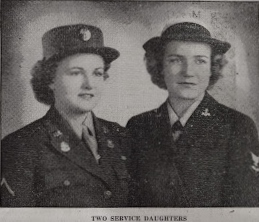


Gratiot County’s Finest Hour, Remembering World War II at 75: March 1944 – “Winter Fades, The War Does Not”

IMG_20190318_052510045_BURST000_COVER_TOP.jpgIMG_20190318_052438127.jpgIMG_20190318_052448871.jpg

Above: Girls from Alma High School dehydrate eggs for the Armed Forces while working after school at Swift & Company in Alma; a group of farmers in Lafayette Township basks in the milder than usual March 1944 weather; notices of servicemen from the March 9, 1944 issue of the Gratiot County Herald. 


     It was March 1944, and an early spring reached Gratiot County, Michigan. Farmers were at work in their fields, and they heard the government’s call to grow more crops in 1944 for the war effort.  Still, many wondered if they could harvest all that they were being asked to plant.

     Amidst the stories of those Gratiot County men and women abroad was the reality that some would not be coming back home. There seemed to be the seeds of growing optimism that the United States and its Allies had turned a corner against the Axis. However, the war was far from being home, and people in Gratiot County again realized that it would be a long road to victory.


Farming

     As March began, the need for more farm laborers for the upcoming summer was very much on the minds of area farmers. Leaders of the Gratiot County Youth Labor Committee were called to the courthouse in Ithaca to prepare for the 1944 crop season. Discussions took place about getting more youths to work on farms. Superintendents of area schools and agriculture teachers made up lists of boys and girls who would be asked to volunteer their time to work.

    Gratiot County’s farm commodities had been making a difference in the war effort and had been shipped to different parts of the world. Creamery butter,  dried whole eggs, cheese, dried pea, and navy beans made up the list. St. Louis shipped over 223,000 pounds of creamery butter in 1943. Breckenridge had sent over 2.1 million pounds of navy beans. Alma led the county with its 80,000 pounds of American cheese. The War Food Administration pushed the importance of raising more food in 1944 as the Lend-Lease Program needed it. Even in places like Alma, which raised 11,300 bags of dry beans, the government wanted more.

    To encourage Gratiot County farmers to raise more food, the AAA (Agricultural Adjustment Administration) held a farmer’s rally at the Ithaca High School gymnasium. A special guest speaker, Duncan Moore, a well-known radio announcer, spoke to the farmers about the need for more massive crop production in 1944. The rally took place following a concert by the Ithaca High School band, poetry readings and vocals by high school students.

     Victory Gardeners in St. Louis were asked to combine orders for seeds, but to only order what would be used.  The Strand Theatre was the location for the annual meeting of the Alma Beet Growers Association, following a dinner and election of officers.  The government repeatedly encouraged county farmers to sign up for more sugar beets. Because of the need for home use, as well as making alcohol for explosive and synthetic rubber, Gratiot County was asked to grow double the 1943 amount, which had been 64,232 acres. Still, many county farmers could never remember a more uncertain time to raise beets. Because the progress of the war had been slow,  and that there had been a lack of labor, they feared that the increased crops would go to waste. Also, gasoline for tractors was a concern, as well as getting machinery repair parts, overall shortages of machinery, and most of all there was  Gratiot County’s weather.

      As an incentive to persuade the farmers, new contracts offered $13 per ton of beets. However, the farmers remained wary of the lack of farm help to work the beet fields. The government countered by saying that migratory labor would be available and these workers would stay in the county until all work was completed and the crops harvested. Beet farmers could also receive more significant consideration in obtaining draft deferments for needed farm workers for corn, beans, and the sugar beets.

Men and Women in the Service

     A total of 38 men passed pre-induction exams and had to leave the county in March. The Army called men on March 16, and a total of 22 made up the group. The Navy took another 16 men on the next day. Among the Navy men inducted included Leo Aumaugher of Wheeler and Ernest Rozen of Ashley. Some of the Army inductees included Randal Stafford of St. Louis and Jack Lowry of Alma. The Gratiot County Draft Board had been told to speed up inductions in response to Michigan’s call for 300,000 more men for the service, as well as creating a significant reserve pool.

     The news abounded with announcements and updates of Gratiot County’s men and women who had gone off to war and of those who served stateside.  Miss Nola Blair of Middleton completed her work as a registered nurse and was being sent to Kentucky. Anne Ackles, whose husband was from Ashley and who served in the Army Air Corps in Europe, now served as a SPAR and teletype operator in New York City. Private James J. Mills of North Star had been shipped to North Africa, moved to Sicily and now was in Italy. Private Milton Rozen of Ashley entered the service in January 1943 and now trained at William Northern Field in Tullahoma, Tennessee. Lieutenant Robert H. Reed of Alma became a combat pilot after completing advanced flying school training. Major Frank W. Iseman became Lieutenant Colonel Iseman and was now the Director of Ground Training at Sioux City Army Air Base.

     Word arrived that Lieutenant John W. Shong returned from combat missions as a torpedo bomber at Guadalcanal. After flying missions almost every other day early in that campaign, Shong now served as a flight instructor at Fort Lauderdale, Florida.  He received a medal for meritorious achievement in fighting the Japanese. Lieutenant Frederick Rearick also was home after serving as a Marine at Guadalcanal and New Caledonia. Rearick spoke to groups in the county about what he had experienced in the Pacific war while in combat. Royal F. David, whose father was from Lafayette Township, had served for 21 months in New Guinea and had fought in the Battle of Buna with the 32nd Infantry Division. David spent several months in the hospital with malaria fever and then was discharged. Private Fred Hicks from St. Louis won the right to wear the Wings and boots of the 82nd Airborne after completing his fifth jump of the war at Sicily. Hicks would be involved with many decisive battles in the 82nd Airborne during the war. Brothers Russell and Glenn Sipe from Alma reunited in the Hawaiian Islands after not having seen each other in almost two years.  Russell had been in the Navy since August 1942, and his brother served in the Army since March 1943. Other Gratiot County men like Captain Stewart McFadden, an Alma High School, and Alma College graduate, defended the United States in places like Panama. McFadden had been there for nineteen months he received a promotion in the Army Air Force.

     Several of these servicemen and women wrote home about the war from Africa, Italy, and the Pacific. Charles Barden from Ithaca wrote to his parents, telling them of his challenges of traveling in India to find another Ithaca native, Frank Klein. Barden remarked that a few other servicemen tried to buy and resell fire opals in hopes of making money back home. Barden mailed a few of them back home for his parents to see. John Hoyt, a chaplain from St. Louis, told of his experiences from Africa. The poverty and inability to converse in different languages challenged him. Still, Hoyt remarked that “…I heard someone say that a soldier will get out of the army just what he puts into it.”

      Across the county, stories regularly came in about how Gratiot County treated its sons and daughters at home. The Wheeler Methodist Church held a service where 200 people gathered to honor them. Reverend Kenneth McBryde presided over the ceremony in which he read the name of every man from the Wheeler area who was in the service.  Of a total of 69 names, 63 of them had a family member present for this service.  Twenty-seven of the men served overseas. The minister also lit four gold candles to represent the men who had died. These included:  Donald Hartenburg, D.C. Furgason, and Gerald Steward, and a Lt. Lapino. Over at Elwell, a church added two stars to the fifty-two that already existed on the community service flag. The new stars represented Ramon Fink (Army Air Corps) and Wallace Humphrey (Marines). The George Myers American Legion Post in Alma initiated a large class of new members, including twenty men who now would be considered World War II veterans, all honorably discharged.

      The hardest news in the county involved the growing list of those who died in the war.  In early March, Ithaca and Ashley experienced shock with what they heard. Private D.C. Furgason was killed in Italy on the Anzio Beachhead on January 27 during the invasion. Furgason would be Ithaca’s first son to die in the war, and he was only nineteen years old. John Paksi of Ashley and Robert Parks from Alma both appeared in the news at the same time as Furgason’s death. Paksi and Parks had been reported as missing in action. Private Edgar Hitchcock of Pleasant Valley also died in Italy in early February.  Arnold Riedel, a Breckenridge High School graduate, also died there while serving in the Infantry. Special services for  Reidel took place at the Breckenridge Methodist Church soon after news of his death was confirmed. Gratiot families also were struck with the announcement of those deemed as missing in action. Mrs. George Lanshaw of Alma was told that her brother, Robert Wellman, had become missing in action on March 9 during a mission over Germany. In early February, Mrs. Lanshaw had just received a letter from Robert that he had completed fifteen missions over Germany and that he hoped to reach the lucky number of twenty-five so that he could come back home. Robert Wellman served as radio operator on a B-24 Liberator on a B-24, and he had been missing since a flight over Germany on March 9.

Red Cross Action

     The Gratiot County Red Cross continued to serve and ask for the county’s support during March 1944. The organization proclaimed in the Gratiot County Herald, “THE RED CROSS IS HERE!” and that was in Gratiot County “ALL THE TIME.” A long list of achievements by volunteers educated the public about what the county unit had accomplished.  Turtle neck sweaters, gloves, helmets, rifle mitts, socks, sweaters, navy scarfs, pieced lap covers, as well as civilian garments and surgical dressings – members of the Red Cross had done all of this.  The upcoming War Fund Campaign was planned for the end of March, and a workers meeting took place in the courthouse in Ithaca.  Mrs. Cecil Marr headed the St. Louis unit, and she reminded volunteers that they were entitled to wear their service pins if they had served enough time. She hoped that more eligible volunteers would wear the badges in public. The St. Louis chapter sought to raise its share of the $19,500 needed for the countywide drive. The chapter held a special dinner at the CSA Hall to do its part, which drew 250 people and aimed to raise money for the St. Louis quota of $2,600. Frank Housel, city chairman, announced that St. Louis also planned to hold two more benefit parties. One of them at the St. Joseph church raised $100 and then a Tag Dale sale on a Saturday brought in almost the same amount.

     The three-day county campaign late that month succeeded beyond expectations. Every district reported raising more than their higher expected quota. People county wide gave more than $4,000 over the initial goal of $19,500. Gratiot County again proved that it cared about and supported the work and efforts of the Red Cross.

Rationing

    Gratiot County residents continued to conserve resources for the war effort. The Gratiot County Road Commission in Ithaca became the location of a central truck tire inspection station. This site existed to make sure that drivers got the maximum mileage on their tires. A dealer committee made up of six men, headed by James Giles of Alma, re-inspected trucks and commercial vehicles of owners that wanted new tires. Those in  Gratiot County who had gasoline ration books felt the pinch when they learned that they would experience a cut from their allowance of three gallons to two gallons of gas per week.  The government continued to crack down on black market sales and coupon counterfeiters, who drained off an estimated 2.5 million gallons of gasoline every day in America. Smaller things that Gratiot people could do to help with the war included saving tin cans in St. Louis and taking them to the city highway garage and placing them in a particular bin.

     When it came to food rationing, certain foods could only be purchased with Green Stamps, K, L, and M in Book Four through March 20. However, selected blue stamps would be good for processed foods through the end of May. Point reductions for pork and beef products took the public by surprise because the government believed that more would be available for the public in 1944. Good news also came with the announcement that homemakers would again be able to have 35 pounds of sugar for each of their family members. Any family that canned and preserved food could apply for a maximum of 250 pounds of sugar to use for canning. All that a person had to do was pick up an application form at the county rationing office in Ithaca and mail it to the Office of Price Administration.  To entice farmers to grow sugar beets, they would receive another 25 pounds of sugar that came from their crops. The company with whom the farmer signed a contract would be the place that provided the sugar. No ration stamps would be required.

And so that we do not forget…

     Postage rates would jump at the end of the month from six to eight cents for airmail…St. Louis played Fulton in the regional basketball tournament at Mt. Pleasant…The Bank of Ithaca warned residents that they needed to build their savings accounts with war bonds…Swift and Company needed fifty women for egg candling and breaking. No experience was necessary…The unusually mild winter allowed farmers to get into the fields very early in March. Men from the Tom Londry farm in Lafayette Township had their picture in the paper while preparing their fields…A diphtheria clinic took place for Alma children for treatment. An estimated 300 school children under the age of ten were believed to be at risk…St. Louis announced that it would move its clocks ahead one hour starting April 2. Other Gratiot communities were expected to follow; however, Saginaw had tried earlier in March to move the time forward but changed its minds and went back to War Time until April 2…St.Louis became the site of two different hitchhiking stations, one along the intersection of US-27 and M-46 at the Hi-Speed Service Station. A motorist saw signs that said that soldiers waiting there needed a ride. The other station would sit on the south side of the city near the city limits. Talk continued of placing a third station on the east side of town for soldiers who wanted to travel to Saginaw…Finally, there would be no liquor bonus during the April rationing period. However, rum, wine, and Vermouth remained unrationed.

    So, that was March 1944 during World War II in Gratiot County.

Copyright 2019 James M Goodspeed

Gratiot County’s Finest Hour, Remembering World War II at 75: February 1944 – “Drives, Drives, Drives”

IMG_20190131_124527925.jpgIMG_20190131_124519501.jpgIMG_20190131_124459584.jpg

Above: Advertisements from the Alma Record-Alma Journal and Gratiot County Herald during February 1944; “The Spirit of Gratiot County,” the result of successful war bond drives in the county in 1943.

     It was February 1944, and if you had lived in Gratiot County at the time, it was late winter. People were speculating on who would be the next President of the United States. Wendell Willkie, a Republican candidate, boasted that he was best able to lead the country during the war. It was now the Republicans time to lead the country. After all, FDR had served an unprecedented three terms as President – he was done, or was he?

     War news continued to focus on places like the invasion in Italy near the Anzio Beach Head, as well as places like New Guinea and Guadalcanal.   Gratiot County continued to hear that…

It Was About Paper, Blood, and Bonds

     “Are you ready for the pickup?” That was the question that residents in Gratiot County faced in early February 1944. In St. Louis, Breckenridge, Ithaca and Alma, Boy Scouts prepared to canvass the communities to pick up paper for their second wastepaper drive of 1944. The need for paper containers for overseas shipments of supplies made paper drives an essential part of the war effort in Gratiot County. Every type of paper, including envelopes, tissue, corrugated paper, and cardboard, were among the targets of the drive. Gratiot residents were asked to wrap their bundles and place them near the street. People were urged to perform a patriotic duty by carrying large packages and not asking for paper sacks. Paper bags in the county became harder to locate as supplies had been cut by one third. In some places, the youngest Gratiot County residents helped to do their part.

      One story from Middleton told how two small girls walked out into the country before school started in order pick up papers from a farm home. When asked why they wanted  paper, a little boy stated, “To smash the Axis.”  Still, in other places like Alma, school children caused problems because they opened bundles of waste paper that residents set out by the curb. Why? The children were looking for “colored comics” (comic books), and then the wind scattered papers along many streets. The Boy Scouts still managed to pick up an estimated 8 tons of salvage with help from drivers and trucks from the Little Rock Lumber and Coal Company, the Home Lumber& Fuel Company and the Masonic Home.

     Another call went out in Gratiot County for people to volunteer and donate blood. The Red Cross called for a total of 360 people to give blood at the Presbyterian Church, where a doctor and four nurses waited. People were urged to donate a pint of blood as stocks of blood plasma were very low at hospitals, such as those in Lansing, had been depleted.  For county needs, a portion of the donations would be sent back to Gratiot County for its standing supply.  “Your blood may save the life of your neighbor” was a motto used by the Red Cross to encourage Gratiot residents to donate blood.

     When it came to their money, Gratiot County residents heard the call to support the Fourth War Loan. The county had only about two weeks to reach its goal. To motivate people to buy more bonds, a picture of a B17 Bomber appeared in the Gratiot County Herald to show bond subscribers where their money was going. The “Spirit of Gratiot” came off the line in January and was on its way to the front to fight the enemy.  While it was not clear which plant the plane came from (either Seattle or Renton, Washington; Wichita, Kansas; or Vancouver, British Columbia), the image of the aircraft demonstrated what Gratiot County could contribute if it continued to buy war bonds.

        St. Louis quickly raised $42,000 worth of bonds with Michigan Chemical raising $15,075. Both Ernest Ode and Percy Medd purchased $500 worth of bonds to get the company over its goal of raising $15,000. Within a short time, 44 workers at the St. Louis Cooperative Creamery raised $1023.25, which was over its $1000 goal. To celebrate their giving, the workers and their families then held a progressive Pedro party, with the help of Mayor Schnepp.  Schnepp gave away two $25 war bonds in a raffle to the workers.  The St. Louis school system also pitched in to help. During the previous semester, students raised $3933.70 worth of bonds, half of it purchased by the grade school alone. Also, the sophomore class raised $387.45 by itself, the most of any grade.

     Over at Alma, the city was barely halfway toward its goal with less than five days left to its deadline. However, reports of sales from the countryside around Alma had not yet been tallied. Canvassers sought to cover every mile around Alma to get the sales going. Once Alma’s corporations announced their sales, the county raised another $83, 851.75, well over its goal of 1.173 million dollars. Among the most significant purchases came from industrial plants, the public schools, Rotary Club, Lions Club, Odd Fellows, Masons, and the Elks. Still, sales of E Bonds lagged, and the Gratiot County Herald published a notice with the headline, “HAVE YOU DONE YOUR SHARE?”

Rationing – We Have to Do It

     A monthly “Ration Calendar” reminded everyone in Gratiot County about the need to ration items such as processed fruits and vegetables, meats and cheeses, sugar, shoes, gasoline, tires, fuel oil, and even stoves. Green stamps G, H, and J were good through late February, but green stamps K, L, and M would be good throughout the month. Stamps 10 in A book were good for three gallons of gasoline over the next six weeks. However, those buying gas had to have their state and license numbers written on the face or top of each coupon upon receiving the ration book. A new food rationing system using tokens went into effect in late March. No one could use more than nine tokens at a time on any one purchase. Anyone with a question or problem could visit the ration office in Ithaca, which was open each weekday from 10 a.m. to 5 p.m.

     The government anticipated that the supply of canned foods would be smaller in 1944 than the previous two years of the war, which meant that victory gardening remained an essential job in Gratiot County. O.I. Gregg, state extension officer, came to the county and gave lectures at Breckenridge High School, Alma High School, and the Gratiot County Court House. Basil McKenzie, Breckenridge  Schools Superintendent, invited the Breckenridge public to come to the high school to hear Gregg’s presentation. The overall goal was to get people in Gratiot County to increase the sizes of their victory gardens, as well as how to get their plots started earlier. Although 720,000 Victory Gardens existed in Michigan in 1943, a goal of 792,000 gardens had bee set in 1944.

Life on Gratiot’s Farms

     Gratiot County’s farmers continued to support the war effort.  Even though it was only February, farmers were encouraged to sign beet contracts for 1944. They would receive $12.50 per ton of sugar beets and meetings in St. Louis and Alma urged farmers to sign up to grow bigger crops. The Office of War Information told farmers that losses that they suffered while operating their farms were deductible on their income tax.

    The County AAA met to try and find ways to grow more food in 1944. Farmers heard that they would receive more gas to grow more crops. A setback occurred when the Chairman of the AAA in Gratiot County, Harold Mouser, suddenly and tragically died from a heart attack while attending a basketball game at Alma High School. Mouser had several duties in the county, and he had served four terms as chairman.

The Draft – Gratiot Men Go to War

     One of the most significant issues with the draft in Gratiot County in February 1944 concerning the status of men who were supposed to be involved in agricultural work. These men carried what was called 2C and 3C classifications. However, they could be called into meetings to fill out agricultural questionnaires. Some of the questions that these men had to answer involved how many acres and types of crops that they planned to be working on, and how much livestock they produced. The Gratiot County USDA war board and country draft board then looked over the questionnaires.

     Some people in Gratiot County questioned why some men held 2C and 3C status. If they left their occupation or changed their address, even for a temporary time without telling the draft board, these men could be immediately eligible for the draft. They also had to notify authorities if they looked for winter work and other jobs. Warnings went out that they would keep their status only as long as replacements in Gratiot County could be found for them regarding the draft.

      However, some citizens questioned the 2C and 3C status because their sons served in the war. “A Disgusted Farmer,” wrote a letter to the Gratiot County Herald that explained their view of things: “It is not right to take fathers when many single men are left, and many of them are playing or pretending to work…(There is) Also the milk racket. A farmer buys a milk truck, usually a worn out affair at a high price, and then proceeds to get son deferred. There are too many on the road, driving unnecessary miles. You can count from three to five going past many a corner. One way to stop this is to draft some of the drivers.”

     In the midst of this issue men still went off to war. The draft took twelve Gratiot County registrants in February. Six went to the Army and six to the Navy. Paul J. Hrncharik of Bannister was one of those entering the Army; Maynard D. Peacock from St.Louis entered the Navy. Over at Alma College, 75 apprentice seamen in the V-12 Program left the program for other assignments. A farewell for the group took place in the college chapel. Alma College did not give out diplomas because those engaged in civilian programs would return in June for the regular commencement services. The Navy and Alma College both wanted the V-12 Program to continue in March.

    For others, the third Army-Navy College Qualifying Test for the Army Specialized Training Program and the Navy’s V-12 Program took place at Fulton Township Schools.  Students between the ages 17 and 21 received the tests at the Perrinton school building. They either were graduates or would graduate from high school by July 1, 1944. Similar examinations were scheduled for March at St. Louis High School.

Letters to Home

     Letters from members of the armed forces that February described life in their respective theatres of the war. Brothers Raymond and Lyle Meyers made it to England. Lyle Meyers enjoyed the warmer weather there, and he was appreciative of the five letters he received the day before. Meyers received nineteen on mail call on that day. During his trip to England, Meyers wrote a letter home on his birthday, although he did not think it was terrific because he was seasick. At his current location, his unit was able to get passes to visit a nearby town, but regarding the use of English money, he said that “I have a feeling I am going to get all mixed up on this English money. Guess  I’ll just give them what they want of it. Ha.” Lyle had already been to the local Red Cross station to ask for help in finding his brother.

     Richard Fishbeck had also found a Red Cross Canteen. It had great sandwiches and occasionally a bottled Coke. He also discovered what the English called the “Pub,” which is “more like pleasant meeting places where men can drink and talk over the events of the day.”  The two essential beverages served there were beer and cider. Russell Howe wrote that there were no buildings higher than 100 feet tall in the area he was stationed in England. Also, the mud was terrible, and people rode bicycles everywhere they went.

     Howard Comstock of St. Louis wrote from Italy. Just before New Years, he had his picture taken, and he hoped to mail one home. He commented that “you will probably agree that whatever else, I’m not exactly anemic.” Comstock was also looking for news about where his brother. He joked that while he had been in the hospital, he was in good shape.  “When you are in the hospital you get A BATH,” Comstock laughed.  Soon, he would be near Mt. Vesuvius, although it was frigid there. Buildings were damp and most had no heat. He told his parents that “You would not believe the way these people live. They are a thousand years behind the times. We found a great many people living in caves in Sicily. However, I guess a good cave is as good as most of their houses.” Toward the end of January, he still had not received any Christmas packages.

      Captain John C. Baxter from Breckenridge also shared similar feelings about what he saw in North Africa. At Djelfa, 200 miles south of Algiers, the oddities of the new cultures that he encountered amused him. An Arab in full sheik dress ran toward him while Baxter was trekking through some dunes. Baxter and friends discovered what a curiosity he was to the twenty-five year old North African. Cigarettes were excellent trading items while he encountered different tribes. Camel caravans moved along the roads that Baxter traveled. However, many Arabs disliked having their pictures taken. Women were especially reluctant to speak to Americans and avoided them.  Commenting about what he witnessed, Baxter wrote that “Civilization in this area, I would say, has not advanced any during the last 1000 years and the methods used were as primitive as those mentioned in the Bible.”

     Seaman Duane Sartor of Alma wrote that he had been a part of the force that took the Marshall Islands. He was very close and saw the heaving bombings. “The islands are low and covered with palm trees. We saw pictures of them after the bombardment, and they were covered with bomb pits.” At that point of the war, he stated that the operation was the largest in Naval history. Sartor lamented that he would be glad to get back home and again attend church regularly. He had not been in church since he was in Alma. Sartor missed church services that were held on his ship for Christmas because he had to do fire watch.

Men and Women in the Service

     Pictures and news articles reminded Gratiot County of the many young men and women who served the county. Austin E. Brenneman was at a Naval air station at Pensacola, Florida and he had just completed flight training in the Marine Corps Reserve. Brenneman would yearn to fight for the United States during the war, but he would not see as much action as he wanted. Brenneman would be among the first men to die for Gratiot County during the Korean War. Corporal Carl E. Bard of Emerson Township was recovering from wounds suffered in Italy when a German airplane strafed his position.  A bomb missed him by twenty feet, covering  Bard in nearly three feet of dirt and rocks. The news reached Gratiot County that this had happened on December 11, 1943 – exactly one year after Bard joined the service. Sergeant Paul Hanning was home from Alaska on furlough, and he was visiting his family in Alma. After a year in Alaska, Hanning was on his way to California.

     The Hospodar Family who resided in North Shade Township was featured on WJR Radio in Detroit during the 4th War Loan Drive. The Hospodars received a $50 war bond from the USDA War Board. They had six sons and one daughter, and four of the boys were in the service. The youngest of the four just returned from North Africa where he guarded German Prisoners of War. The Hospodars continued to operate their 420-acre farm even though they were without help from several of their sons.

     Swift & Company of Alma reported that it was honored to say that 27 of its men were workers and now served to defend the United States.  Among some of these names of employees who served the country included Corporal Earl Oberst of Breckenridge, Corporal Marvin Fenner of Alma, and Private Bernard Marrin of Alma. Fenner would die in a bombing attack over Germany. Marrin had joined the 82nd Airborne, and he would be captured and became a prisoner of war in Germany. Another news item reported that Wayne Garrett of Breckenridge was in the Navy and he had received a Purple Heart for battle wounds incurred while fighting against both the Germans and the Japanese.

     Women from Gratiot County also served and were in the news. Mrs. Roberta Joslen, from Pompeii, served as a WAC since entering the service in May 1943. She was driving jeeps for the Army. Her husband, Gerald, was serving somewhere in New Guinea. Miss Hazel Dill, from Breckenridge, was now a Captain and served with the nurses’ corps overseas. Dill had graduated from nurses training school from the Ford Hospital in Detroit. A V-Mail from Private Melvin Thursh of Ithaca announced that he had married Joan Hanley, who was from Australia. Their wedding reception featured both American and Australian flags. Thrush was serving in the Army “down under.”

Those Who Paid the Ultimate Price

      More names and stories reached Gratiot County of those men who died defending the nation.  Seaman Gaylord Hanley,  a former St. Louis boy who was not yet eighteen years old, died on January 26 from injuries suffered from a fall while on duty. He had been on duty aboard the SS Hutchins. Staff Sergeant Carlton Madar, formerly of Alma, drowned off Guadalcanal. Madar had lived with and was raised by his grandparents in Ithaca before joining the Army. Madar had quickly become a Staff Sergeant.   More information trickled in about the death of Donald Curtis of Alma. He died in late November during a bombing mission over Germany.

     The list of Gratiot men who became prisoners of war also slowly continued to grow. Staff Sergeant J. Alfred Grosskopf, formerly of Alma, was captured after his B-17 went down during a raid over Emden, Germany. The family received a telegram that read, “Report just received that your son, Staff Sgt. James A. Grosskopf is a prisoner of war of the German government. Letter of information from Provost Marshal General follows.”

And Unless We Forget….

       Ira Wood and Clark Howland received national attention for their turkey farms that they operated in Newark Township…St. Louis High School had a meeting on “Post War Trends and Control for Agriculture”…The St. Louis Park Hotel showed motion pictures from the United States Navy to a group of 100 persons for a Ladies Night Party. The scenes taken at Pearl Harbor were especially moving….The IRS was coming to Breckenridge and was at the Farmers State Bank if anyone needed help…Swift & Company needed 50 women at once to help with egg candling and egg breaking – no experience was necessary…North Star Chapter No. 108 of the Blue Star Mothers had an all-day meeting at the home of Mabel Ecklebarger…another Blue Stars Chapter met in St. Louis… the Ithaca Blue Star Mothers continued to push for a countywide public memorial for all of Gratiot County’s men and women who were serving in the war. This same group asked people to bring pictures of every member of the armed forces to Beebe Furniture Store in Ithaca for display while the Blue Stars started to raise money for this project…

     February 29 was the last day that automobile license plates could be used from 1943. It was also the last day to pay dog taxes without a penalty. After this, the cost would be an additional $2 per dog…It was thought that upward of 20 people would appear February 16 to become naturalized citizens at the Gratiot County  Clerk’s Office. In the end, 18 of them did – each with their witnesses. Among the new citizens were: Anna Chapko, Middleton; Joseph Sourek and Frank Hanus of Ashley; Kate Hospodar of Perrinton…the American Legion in Alma offered to help veterans with their mustering out pay, as long as they had an honorable discharge since December 6, 1941…Boy Scout Troop No. 109 had a nice display in the window of the Community Hardware in St.Louis. The William Fields Post sponsored them…In St. Louis, City Manager Frank Housel reminded the St. Louis City Council that “Eastern War Time” would soon be resuming. Housel hoped that more communities would also move to adhere to it…the Gratiot County Herald joined in with the call for the creation of a county airport…and a March of Dimes card party at St. Louis High School on one Wednesday night raised over $150 for infantile paralysis…

And that was Gratiot County at war during February 1944.

Copyright 2019 James M Goodspeed
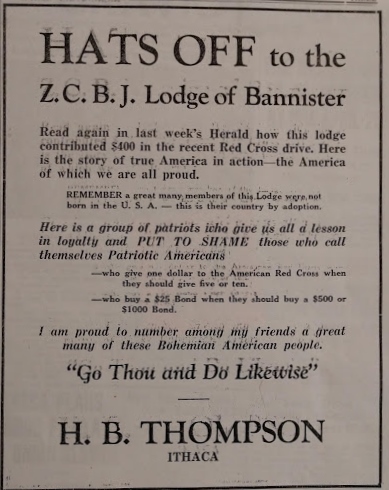
Gratiot County’s Finest Hour – Remembering World War II at 75: It was January 1944

IMG_2011.JPGIMG_2012.JPGIMG_2013.JPGIMG_2016.JPGIMG_2015.JPG

Above: Maps like this one kept Gratiot County readers informed about the geography of the war; paper drives called for people to donate for the war effort; Clara Wolford, from St. Louis, served as a WAC; Lt. Donald Curtis of Alma was KIA on a bombing mission over Germany. Images from January 1944 issues of the St. Louis Leader, Alma Record and Gratiot County Herald.

       It had been 25 months since Pearl Harbor. Gratiot County had already been at war – twice the amount of time that it had been at war in  World War I. This time the demands, commitment and support for this war proved to be much higher. There seemed to be no questions about loyalty. Almost everywhere in Gratiot County, people found a way to be involved in the war effort.

       The enemy in this world war seemed to be much more easily defined. The Japanese had bombed Pearl Harbor. Hitler, Hirohito, Tojo, Mussolini – all were the faces of the enemy. However, this time, unlike 1917-1918, far more Gratiot County men would die before this war ended.

        Many citizens did not ask what they could do to help Gratiot County in January 1944. They just asked how much. It was a different time.

       By January 1944 the war seemed to be taking a turn in favor of the Allies and Gratiot County would start hearing the word “invasion.” The war fronts were moving. One of the places that people read about in January 1944 was a place called Italy.

       If you had lived in Gratiot County in January 1944 you would have read about, heard about, or talked about:

Bonds, Rationing and Drives

        Gratiot County heard the call to support the war effort by buying bonds in the Fourth War Loan Drive. Between January 18 and February 15, the nation planned to raise $14 billion for the war. Gratiot County’s quota was $1,173,000.    In St. Louis, a kickoff breakfast took place at the Park Hotel, and Chairman John D. Kelley led the meeting where block leaders and workers heard about the goal of raising $67,000. Every township in the county had a goal, and every home could expect a visitor at their home asking for contributions. Under a column entitled, “YOUR RESPONSIBILITY,”  The St. Louis Leader told readers that “Government bonds are the safest investment in the world. If they were to lose their value, there would be nothing left of value in this country…What are you going to do …while more than 1,500 Gratiot fighting men are risking their lives?” By the end of the first week, the drive raised $118,000. Ithaca Township purchased $14,512.50 worth of bonds or about 41 percent of its goal.

       There were other ways to show support for the war. The Lansing State Board of Health planned on being in Alma in February with its mobile unit to collect blood from 360 residents. Those who wanted to donate only had to contact Dr. C.E. Burt of Ithaca, who chaired the blood plasma committee of the Red Cross. The Ithaca Boy Scouts collected over 8,000 pounds of scrap paper consisting of brown paper bags, cartons, newspapers, and items from wastebaskets. Even radio tubes were wanted. By the time they finished their drive, the troop had collected a total of nearly five tons worth of items.  Ithaca read in the newspaper that “This is not a one-week or one-month campaign, but the saving of wastepaper must continue for the duration.” Another notice encouraged people to help with paper drives because one hundred pounds of waste paper made 50 .75 millimeter shell containers.

        The Office of Price Administration (OPA) gave out 482 War Service Certificates to people in the Saginaw region who donated 100 or more hours to the War Price and Rationing Boards. Many of these recipients were from Gratiot County.  These volunteers often served after their workday ended by answering phones, filing cards, and helping to issue gas ration cards. The OPA did announce that ration stamps could be used in advance for meat. One provision under this announcement meant that farmers could sell half hogs or quarters of beef if buyers planned on freezing or canning the meat. Still, a person needed brown or red stamps to obtain meat.

        Other people in Gratiot County also heard about the President’s Ball to be held in Alma on January 28. This event coincided with President Roosevelt’s birthday. The ball, as well as March of Dimes parties in various parts of the county, raised money to buy wheelchairs, braces, shoes and other articles for residents who had contracted infantile paralysis. Alma’s Booster Club Hall, St. Louis High School’s gymnasium and the St. Louis Masonic Hall were a few of the places to host these parties.

The Red Cross

       During the war, the Gratiot County Red Cross proved to be very active. The Red Cross chapter in Ashley commemorated its first anniversary on January 7 by publishing a report of its work. In the past year, a total of 96 workers had contributed 3468 hours, had made approximately 50,000 dressings, including pads and sponges. The chapter operated Wednesday and Thursday afternoons and evenings and was chaired by Mrs. F.E. Robbennolt.  Ralph Tweedie kept and maintained fires in the building throughout 1943 for these meetings.

      A countywide call for more Red Cross workers came from Mrs. Charles Bloss, who served as the County Production Chairman of Sewing and Knitting. A notice in the Gratiot County Herald read, “There is a need for Red Cross sewing and knitting to be done. Now that the holidays are over, can we not get this work ready for our men in service at an early date?”

      An essential function of the Gratiot County Red Cross involved supporting families whose men became Prisoners of War. Private Bruce Mead of Riverdale was captured and sent to Stalag 2-B in Germany. Mead had been a captive for over a year, and a letter he wrote in late August 1943 appeared in the newspapers. Mead said that he continued to serve as a medic in the camp, had just received some reading material, and he had met many other POWS from various countries.  In the letter, he asked for toiletries, candy, things to read and peanuts “if it isn’t too much trouble.”

The Draft – Off to War

       Selective Service announced that it would provide at least a three-week notice to men for induction to the military. It also hoped to drastically curb the issue of occupational deferments for 18 to 21-year-old men, making another 115,000 non-fathers available to the nation. The over 400,000 farm workers in that age group remained unaffected, as well as those who came under industrial deferments. However, occupational deferments would no longer be granted to men under the age of 22. In February, all men listed as 2C and 3C draft registrants would be under review. This group consisted of men classified as necessary for agriculture. C.P. Milham, Gratiot County Agricultural Agent, oversaw the issue of these classifications. The USDA War Board then would make recommendations to the Gratiot County draft board whether each essential registrant was to remain on the farm.

       From Gratiot County, 15 men entered the service by January 20. The group made up of seven in the Army, four in the Navy, and four in the Marines. The Marines consisted of Bohus Chovanec (St.Louis), Dwayne Ancel (Wheeler), Wallace Humphrey (Elwell), and Gerald Knapp (Alma).

      In other news, 33 high school boys from across the county, age 17 or older,  took the Army Air Corps aviation cadet mental examination at Alma High School. A total of 29 passed the test and could go to Detroit for preliminary physical tests in February. If they passed the tests there, the boys would go to Kellogg Field in Battle Creek, Michigan.

Men and Women in the Service

      The newspapers regularly published the names of men and women who left the county to serve in the various arms of the military. Tom Nurnberger, Jr., sent a cable to his parents in St. Louis about his promotion to the rank of major. Nurnberger entered the army three years earlier and served in England with 5th Corps of Engineers, Headquarters Division.  Hugh Rodenbo from St. Louis, who was driving a truck for the army in England,  also wrote to his parents that he had married Phyllis Franks, who was a Corporal in the English Army.  Other county men like Seaman Myron Humphrey and Private Elmer Lint, both from Alma, ran into each other at the Stage Door Canteen in New York City.  Humphrey wrote that he met movie star Wendy Barrie there. The USO offered the men tickets for a good meal at a café. The two also saw Tommy Dorsey play the Paramount Theater. The former pastor of the Alma Presbyterian Church, Albert J. Anthony, re-entered the service and reported for duty in September 1942. Anthony, a   World War I veteran, served as a chaplain at Camp Fanning in Tyler, Texas.

        Then there was news of men who were in combat. Corporal Jarold C. Brown of Ithaca served as a paratrooper in the New Guinea campaign and had recently seen action in the Markham Valley. Lieutenant Royal Klein, also of Ithaca, maintained his gun position aboard a B-17 even after being severely wounded by 20 mm shells from a German Focke-Wulf during a raid over the Ruhr Valley in Germany. The B-17,  heavily hit with flak, limped back home with several injured crewmen. The plane was met and escorted by two British Spitfires back to England.

      WAC Corporal Clara A. Wolford,  St. Louis High School Class of 1938, served as a telephone operator at a switchboard handling war calls somewhere in England. Wolford entered the service at Daytona Beach, Florida on her twenty-second birthday in 1943. Marjorie Street, Phm 2/c, sent a letter home to her mother in Ithaca with grave news. Street wrote from a Charleston, South Carolina hospital that she was there with second-degree burns on her legs as a resulting from an accident when scalding liquid had accidentally spilled on her. She said that her status was improving, and she expected to recover. Mary Finette Marzolf, a WAVE from Ithaca, had been commissioned as an Ensign upon completion from officers training at the Naval Reserve Midshipman’s School at Northampton, Massachusetts. Marzolf was a former teacher before entering the service.

       Here in Gratiot County, Seaman First Class Jon Slavik was home on leave after seeing action in the Mediterranean Theater. On one landing operation, his ship was torpedoed and Slavik was knocked unconscious by shrapnel.  He managed to reawaken long enough to evacuate and spent an hour in the water before he was picked up. Slavik spent almost three months in tent hospitals in North Africa, as well as being hospitalized in St. Albans in Long Island, New York. For this, Slavik received the Purple Heart. He was one of three sons from an Ashley family, all who were in the war. Seaman First Class Joseph F. Divish of Perrinton also came home after seeing two years of fighting in Africa and Sicily. Divish had been at the Casablanca invasion, and his ship did patrol duty off of Gela, Licata and Palermo, Italy. He enlisted in the Navy two days before the attack upon Pearl Harbor.


Making the Ultimate Sacrifice

      The saddest news from the war dealt with those Gratiot County families who heard that they had lost someone in the war. This news frequently came weeks after their deaths, primarily as a result of the length of time it took to get communications home from the front. Sergeant Paul Gay of  St. Louis was killed in action over Germany on November 26, 1943. Gay had been aboard a B-17 over Germany. The family received notice that their son was missing in action on December 8, but it was over a month before confirmation of his death. Sergeant Gay’s last letters home, written in late November, made it back before Christmas. Gay entered the service in May 1942, and he was almost 30 years old.

      Lieutenant Donald Curtis had been missing since November 29, 1944, over Germany. An Alma High School graduate, he worked at the Gibson Hardware Store.  Many in Alma had hoped that he was still alive and the news of his death shook the community. Curtis had trained as a bombardier aboard a B-17 and entered the service on June 19, 1942, went overseas in May 1943 and was based in England.

      People in Wheeler received tragic news in mid-January that Private Don Hartenberg, a Breckenridge High School graduate, had been killed while serving in the Fifth Army in Italy.  Hartenberg, age 22, died December 8, 1944 – which was the first anniversary of his entry into the service. Before his service, Hartenberg worked for the Stork Oil Service.

And Let Us Not Forget That:

      Blue Star Mothers Chapter No. 1 of North Star met at the township hall. It planned a chili dinner to raise money. The chapter was grateful for the comic books that students from North Star District No.1 school donated for soldiers to read at the Fort Custer hospital…The Ideal Theatre in Ithaca featured Betty Grable in “Coney Island”…”With the Colors” was a regular front page feature with the Gratiot County Herald. It highlighted where young men and women were stationed and how readers could send cards and letters. Frequently stories dealt with families with more than one son who was at war. During this month,  Ithaca’s Jack and Dale Ecklebarger appeared in the feature…Farmers were told to ask for their ACP pay for plowing under clover, harvesting hayseed or signing their farm plan for 1944. They all had to sign a document SB-702 to get their money…The Gratiot County AAA announced that milk subsidy payments would be paid for those who qualified for October, November, December 1943. In Middleton, payments would be available at Maynard Dodge’s store…and, a new liquor law requirement in Gratiot County meant that purchasers and consumers of liquor between the ages of 21-25 had to carry a liquor purchase license. The license had to shown upon demand, and only the county clerk issued them.

     These events, people, places and things all made up Gratiot’s finest hour in January 1944.

Copyright 2019 James M Goodspeed
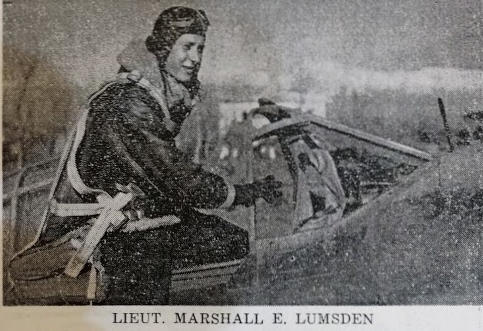
Thirty Who Dared to Serve Gratiot County in the World War –Addendum: What Was Learned

IMG_20181231_224440705.jpg

Above: Local newspapers like the Gratiot County Herald and the Alma Record regularly published lists of those Gratiot County men who died as the war went on.

       By the end of the World War in Europe a total of 116, 708 Americans had died. Along with these came another 204,000 who were wounded.  From Gratiot County, at least thirty men gave their lives in service to their country and our county.

       When I first considered doing these stories over four years ago, I attempted to find whatever had been written about these thirty men from newspapers like the Gratiot County Herald and the Alma Record. Broader searches into the Detroit Free Press and the Lansing State Journal also occasionally gave tidbits of information. However, most of what we know about these men came from Gratiot County newspapers.

      To attempt to broaden the stories, I turned to records in the National Archives, namely personal files that were put together when a soldier died. Most of our Gratiot men had a file, but a few did not.

       I hoped that by pulling all of these materials more might be known about each of the veterans – their backgrounds, their families, where they lived, where they went to school, what their hopes and dreams were,  as well as how each of them died.

       What I  did learn was that many of the men were single and unmarried. A few of them married and a couple of them had children.  Almost half of those who died did so in combat in Europe. Several died as a result of the Influenza Epidemic, a few as the result of accidents. One came home severely wounded, only to die a few months later. One was a boy, barely sixteen years old. In one case there is still one soldier whose death is as mysterious as his brief service record.

        Still, there are other Gratiot County men whose names appeared in the newspapers that also paid the ultimate price. Their names do not appear with the thirty that we have. Possibly family members chose not to come forward with their names – or there was no family member left after the war to do so. Sometimes more than one county claimed a veteran, depending on where they lived, went to school, or where they enlisted. This situation happened to at least two of Gratiot County’s men.

       One hundred years later, what we have left are distant memories of America’s first war on European soil, a war that Gratiot County was involved with for only twenty months. Many of these men who died during this time are buried in cemeteries within Gratiot County, in forgotten places, with markers and headstones that may be in disrepair or need cleaning.

        We owe them the opportunity to be remembered.

        These were the thirty who dared.

Copyright 2018 James M Goodspeed

Thirty Who Dared to Serve Gratiot County During the World War – Part 30: Samuel Benjamin Derby, “I was the Last to Die in Service to Gratiot County”

derby.JPG005251381_03758.jpg

Above: Samuel B. Derby’s name on the Gratiot County All Wars Memorial in Ithaca; Derby’s registration document.

       Samuel Benjamin Derby was born November 6, 1894, in Hailesboro, New York to John and Patience Derby.  The Derbys moved to Newark Township, and Samuel made a living as a cheesemaker and farmer before the war.

       On June 15, 1917, Derby registered for the draft and officially entered the Army on March 1, 1918. After arriving at Camp Greenleaf, Georgia he became a Private in the Medical Department Post Hospital.  Another record shows that Derby became a Corporal on April 9, 1918, in the Air Service Flying School, but he did not go overseas. On April 19, 1919, he was discharged.

          From there, Derby’s story is somewhat mysterious. In one case, Derby is mentioned as one of thirteen men who perished in a Niagara Falls Power Company accident in North Tonawanda, New York on November 6, 1920. There is evidence that suggests that a man by his name was living in New York in 1941. A marker bearing his name also appears in New York stating that he died in 1962. Which story is accurate?

         So, several questions exist. How and when did Samuel Benjamin Derby die? Since he appeared to die in another state after the war ended, how did his name appear among Gratiot County’s World War I dead?

         Regardless, Samuel Benjamin Derby became the last World War veteran to listed as having served Gratiot County.

Copyright 2018 James M Goodspeed
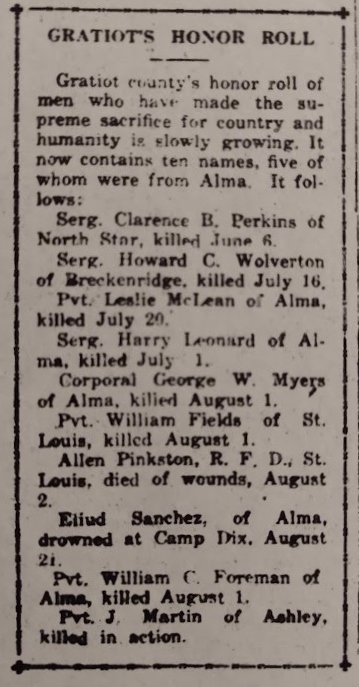
Thirty Who Dared to Serve Gratiot County in the World War – Part 29: Walter Young of North Star, “I Survived the Battlefield, but I Died at Home from My Wounds”

005251382_03086.jpgyoung.JPG

Above: Walter H. Young’s draft registration card; Young’s name as it appears on the Gratiot County All Wars Memorial in Ithaca, Michigan.

      Walter H. Young was born on January 27, 1895, in Ithaca, Michigan to Peter and Cynthia Young. Walter had one brother, James, who died in 1905. His parents made a living as farmers and Walter worked on the family farm when he entered the service. Young spent time on the Texas – Mexico border at Camp Jones, and he served as a private in Battalion B, 10th Field Artillery.

        The 10th Field Artillery fought in 1918 in battles such as Champagne-Marne,  St. Mihiel, and the Meuse-Argonne. At the Meuse-Argonne, the 10th Field Artillery attained the title “The Rock’s Support” because it helped the 3rd Division, famously known as “The Rock of the Marne.”  Somewhere Walter Young was severely wounded, and he ended up being in several hospitals before he came home.  Walter continued to suffer from his wounds for over a year. In April 1919, Walter’s mother died which put more pressure on Walter and his aging father to maintain the family farm. Tragedy struck in mid-September 1920 and Walter Young had to be sent to Dr. Hall’s Hospital in Pompeii.

       After struggling for several days, Young succumbed to the hemorrhaging of gastric ulcers. The doctor concluded that the wounds Young suffered in Europe somehow caused this death.

       Funeral services took place at the North Star Methodist Church, and Walter Young was buried in the North Star Cemetery.

      Walter Henry Young was a World War veteran who came home severely wounded, and who paid the ultimate price for his service to our country.

        Walter Young was only twenty-five years old when he died.

Copyright 2018 James M Goodspeed