We Remember Gratiot County and the Holocaust Part II: 1930-1945

From top photo: The Klein Brothers from Ithaca went off to war to defend Gratiot County and the nation; headlines from May 17, 1945 as Major T.S. Nurnberger of St. Louis writes home about seeing Buchenwald; Tony Kuna of Alma was one of several Gratiot County liberators. Kuna was at Gunskirchen Lager in Austria; a shot taken in Ohrdruf, the first image to appear in Gratiot County which showed evidence of the Nazi genocide.

It is challenging to describe Gratiot County’s connection to the Holocaust in the 1930s and World War II. In a sense, it would be easy to say that most citizens in Gratiot County knew much about the persecution and murder of the Jews and other groups. However, Gratiot County did little to help. One can only imagine how perplexing it was for those Jewish families in the county to hear and learn about what was happening in European countries that Hitler and the Nazis overran during this time. As these citizens read, listened, and learned about the Holocaust, Gratiot County mainly watched, like too much of America during that time.

The Depression and the Start of War, 1934-1941

The Alma Record and Alma Journal first published a photograph of Adolf Hitler about his rise to power in Germany on July 5, 1934. This picture showed Hitler’s first meeting with Italian dictator Benito Mussolini in Venice, Italy.  

A few Gratiot residents had some contact with Nazi Germany during the decade leading up to Pearl Harbor. One of the first to meet Germans who were sympathetic to the new government in Germany was Howard A. Potter, his wife, and Barker Brown, all of whom were originally from Ithaca. The trio belonged to a group of Harvard students who partook in a German Christmas at Cambridge University. While attending the party in a church basement, a larger group of American students entered the festively decorated room and met the German Consul Von Tippelskirch. The Potters were shocked when the table they were assigned had a flag next to it that featured a large red swastika. Fortunately, the students were comforted when they saw an American flag on a nearby stand. During that visit, the Potters and Brown quickly became engaged in conversation to try out their English and German speaking skills, as did other students at the party. After socializing and eating, the students pushed back the tables, and many in the group danced to the music. Ultimately, the Potters and Brown were all impressed by the cordial German atmosphere at the Christmas party.

Almost one year before World War II started, Margaret Randels, originally from Alma, studied for one month in Freiburg, Germany. At the end of their journey, she and another student, Mae Nelson of St. Louis, came home from Europe aboard the SS Deutschland after spending part of their summer touring Holland. Neither Randels nor Brown commented in the newspaper regarding their thoughts about Nazi Germany after they came home.

By 1936, Hitler made plans and reoccupied the Rhineland, a direct violation of the Versailles  Treaty, ending World War I. This action was Hitler’s first aggression leading to the start of the war. The front page of the March 19, 1936, Alma Record and Alma Journal issue showed photographs before Hitler prepared to occupy the Rhineland. As a result, discussions about the Nazis became more newsworthy in Gratiot County. As a result of Hitler’s actions, there was a new interest in what was happening with the Nazis. In October of that year, Dr. Theodore Schreiber, a German professor at Alma College, was called upon to share his knowledge of modern Germany with interested groups. In one case, Dr. Schreiber spoke to a meeting of 120 in a women’s group in Saginaw about what he knew regarding the history of Nazi Germany.

As the 1930s went on and the Nazis continued to take parts of Europe, the plight of refugees became an issue. The only evidence that Gratiot County did anything to help those escaping Germany and Europe occurred at the Union Thanksgiving Service in November 1936. The  Alma Methodist Episcopal Church took up a Thanksgiving offering to help “those pitiful exiles (who), with many Jews, have been driven from Germany by Nazi laws against ‘non-Aryans.” The church went on to state that since Jewish people in America helped fellow Jews, then the offering should be used to help Gentiles “to assist their own similarly.” Although the offering helped Gentiles in need, this event was the only one on record showing evidence that Gratiot County did anything regarding those escaping the Nazis and the impending Holocaust.

In 1937, readers of county newspapers also learned about the growing menace of the German Bund, organized by Fritz Kuhn in New York City. Through his group of American Nazis, Kuhn claimed that he had over 100,000 Americans who pledged support to the Bund and, in turn, Adolf Hitler. International tensions continued to rise as Hitler took Austria during the Anschluss in March 1937 and with the Sudetan Crisis a year later. Hitler was slowly absorbing parts of Europe. Otakar Prodrobsky, an Alma College student from Czechoslovakia, was immediately flooded with requests to speak to Gratiot County groups shortly after he arrived in Alma in the fall of 1938. Prodrobsky was from Prague and reported what it was like for him to live under the Nazis.

In Gratiot County, it took Kristallnacht, the extensive Nazi pogrom of November 9-10, 1938, to jolt some Gratiot County residents into learning more about the Holocaust. The editor of the Alma Record, H. S. Babcock, started his column “Uncle Sam and Hitlerism” with the story of what he had just heard in public. Babcock had someone tell him, “We are not interested in the German matter at all. If Hitler wants to kill off the Jews and take their property, that is their funeral and no concern of ours.” After spending six long paragraphs belaboring how trade relations between America and Nazi Germany had been damaged, as well as international relations, Babcock included excerpts of other columnists and their reactions to the persecution of Jews due to Kristallnacht. The column concluded that “A madness has been visited upon Germany. The disease is an old one: hatred; the cause: war.”  The column did not call out Hitler and Nazi Germany for their persecution of the Jews for what it was – the expansion and implementation of a long history of European antisemitism. About all that the column concluded was that in the end, “the fever of blind hate will run its course…and destroy the Germans themselves.” A month later, the Alma Record carried the story that 300,000 people awaited permission to leave Nazi Germany for the United States and that ninety percent of the group were Jews. It also stated that only 27,370 could be allowed into the country based on current immigration laws. That meant it would take eleven years to work through the list even if the United States agreed to let that many refugees in. As a result of Kristallnacht, American consulates in at least four places in Nazi Germany became flooded with long lines of applicants wanting to leave the country.

 In the spring of 1940, St. Louis hosted a significant witness to the growing Nazi occupation of Europe when Vojta Benes, brother to the former president of Czechoslovakia, spoke to 200 people at the St Louis High School auditorium. Benes had been active in politics in his country and toured the United States in 1938; then, he tried to return home just before Hitler took the Sudetanland. Benes fled to Poland and then found his way back to the United States. Benes described his country as “a prison camp for ten million people” under the Nazi Protectorate. He did not discuss the situation as it pertained to Jews in his country.

 In May 1940, the Gratiot County Red Cross took up collections in Alma for civilian relief in war-stricken Europe. The leading Gratiot County supporters of helping these refugees were members of the Newark Mennonite Church, which gave the most significant sum – $157.00 for refugees. Two other anonymous contributions of $25 each were also given – and that was it for Gratiot County.

Even before Pearl Harbor, Gratiot County, like the rest of the United States, became scared of “enemy aliens” in its midst. A nationwide program started (as one did before World War I) to identify “enemy aliens.” In late August 1940, the county post offices began registering and fingerprinting Gratiot County’s aliens who had four months to register, or they faced possible arrest, six months in jail, and a $1,000 fine. All were required to fill out a form and answer many questions. The first asked how long they had been in the United States and how they got to Gratiot County. By January 1941, 976 aliens registered in the county, with Ithaca leading the group with 415 aliens. Postmaster James O. Peet believed that the large numbers his office encountered in Ithaca existed because Ithaca was closest to Gratiot County’s sugar beet growing area.

The War, Service, and Encountering the Holocaust

Gratiot County readily sent its young men and women off to fight in Europe and the Pacific after the events at Pearl Harbor on December 7, 1941. The Second World War began, and Gratiot residents read about Japanese relocation camps when a picture of the new Manzanar camp appeared in the Alma Record and Alma Journal on April 2, 1942. The news of these camps for Japanese Americans did not appear to stir any other reactions from Gratiot readers.

As Gratiot County went to war, it was common for some Gratiot County households to see sons from large families empty and leave. A group of four, five, or more sons going off to war sometimes occurred. In one case, the Klein Family of Ithaca, who was Jewish, sent five sons to fight and two more to military service after World War II ended.

Edward and Rella (Spitz) Klein moved to Ithaca from Grand Ledge sometime before the start of the Great Depression. The Kleins quickly became involved in the county by operating Klein Brothers Shell Service in Ithaca and a  North Star furniture store. Edward Klein originally came from Hungary and still had family members in that country during the Holocaust. Records indicate that he had at least one relative who perished in Auschwitz, and there were probably more.

However, when it came time to serve Gratiot County during the war, all of the Kleins did their part. Franklin went first, entering early in 1941, and served with the 888th Ordinance H.M., Company Q in the China-Burma-India Theatre for two years. He also did another three years here in the United States. Royal, the oldest son, became a bombardier in the Army Air Corps, where he was wounded in action. Louis was the first to enter the Navy and served four years there. He later operated Klein Wall Paper and Paint in downtown Alma from 1949-1971.

Robert was a radio operator for 3 ½ years in the China-Burma-India Theater. Harold also entered the Navy and served in the Pacific aboard the USS Yorktown. Only 17, when he enlisted, Harold became involved in real estate after the war. Sons Richard and Milton served their country after the war ended. Richard later was in Korea. It is not clear where Milton served. However, the family confirmed that he, too, served his country.

The cost of the Klein family’s service in World War II was an extended family separation. It would be late February 1947 before the entire family again sat together at a dinner table. Fortunately, the Klein sons served their country and came home safely. Like some other large families in Gratiot County, the Klein brothers’ service appeared in the Gratiot County Herald for the many sons they sent to defend Gratiot County and the nation. Still, after the war, the family remained humble and quiet, humble, and went about trying to restart their lives.

News of the Death Camps Reach Gratiot County

That Hitler was carrying out the murder and extermination of the Jews of Europe was not unknown to Gratiot County residents. While Gratiot County newspapers did not explicitly mention the death camps, there were other ways that residents learned about what was taking place. In the summer of 1944, the Ionia Sentinel reported on the existence of Auschwitz Birkenau and how these victims came from several European countries. Likewise, the Owosso Argus Press ran a headline that the Nazis had murdered 1.715 million Jews in just two years. The first actual picture of a “slave labor camp” in the Vosges Mountains in eastern France appeared in the St. Louis Leader at Christmas 1944. The image mentioned how the SS used crematoriums to dispose of the bodies.

As Allied armies penetrated the Third Reich in April 1945, they discovered more concentration camps, and soldiers took pictures. An image of bodies found at Ohrdruf, Germany, was the first image of the Nazi genocide in the Gratiot County Herald on April 12, 1945.

Written testimony from letters of Gratiot County liberators soon appeared in local newspapers after the fall of Nazi Germany. In a letter dated April 20, 1945, Major T. S. Nurnberger, Jr. of St. Louis, wrote about his experiences after entering Buchenwald in Weimar, Germany. It was nine days after Americans first liberated the camp. As Nurnberger stood at the entrance of the Buchenwald Camp, which was located on the edge of a mountain, he saw a sign that welcomed American liberators. Nurnberger learned that 51,000 people had already died in the camp. After visiting the crematorium, Nurnberger saw bodies stacked “like cordwood” and two badly beaten SS men whom prisoners had killed. He then could not believe the number of people crammed into the empty bunks inside some barracks. He wrote, “The stench was so strong despite recent cleaning that it almost made me sick.” The next place he saw was an old pit containing 1500 dead, which needed a bulldozer to cover them. Concluding his letter, Major Nurnberger added, “This is your Germany of culture. This is (the) why behind the unconditional surrender of the Third Reich. I have had a bad dream, you say! Ah yes, and I have the pictures to prove it taken with my own camera.”

Norval Biddinger of Middleton also saw Buchenwald and wrote home to his mother about what he witnessed. In a June 3, 1945, letter  Biddinger began with his feelings about seeing the camp. He wrote, “I am mad all the way through and want to get this letter written while I still remember it.” He described seeing survivors who had “nothing left but skin and bones.” In one building, 1200 men were forced to live in barracks built for 100. Biddinger saw the crematoriums and recalled that prisoners killed 150 SS guards before the United States Army found them. Writing about its size, Biddinger said, “The whole camp covers an area no bigger than Middleton, and they crowded them in as many as 80,000 at one time.” Biddinger closed by saying that all his information was obtained firsthand from survivors still in the camp.

Other letters came to Gratiot County from men who witnessed the Nazi concentration camps. Private John D. Harnick of Ashley wrote about seeing furnaces and crematoriums but did not identify the camp. The same was true of Lloyd Peters of Ithaca, who was with General Patch’s Seventh Army.

Corporal Robert L. Brown of Ithaca saw the remains of murder at Gardelegen, where 800 prisoners were burned alive while trying to escape from a barn. Images from Gardelegen appeared in Life Magazine on May 7, 1945. The prisoners had been on a death march and were placed inside a 100 feet by 30 feet brick barn. A German Army sergeant saw the straw floor covered in oil, had the doors locked, and then set it on fire. Anyone trying to escape was shot by machine guns placed outside. After the fire, the Germans tried to bury some dead but could not cover the evidence before the Americans arrived. Only three people survived Gardelegen. Corporal Brown wrote about what he saw by stating, “I never witnessed anything so horrible in my life, and I hope I never shall. Ditches out in the back of the building were dug by these men before their cremation, I presume, but only a few were buried in them…” He closed, “Can you imagine such a thing? This doesn’t make for good reading. I know, but it is the truth…Perhaps you will read about it in the papers.”

Tony Kuna was probably one of Gratiot County’s longest-lived liberators. He later recalled and talked about what he saw. Kuna was in the 71st Infantry Division and attached to Patton’s Third Army as it penetrated Austria in early May 1945. Kuna was one of several liberators at Gunskirchen Lager, a subcamp of Mauthausen near Wels, Austria. Kuna’s division found a camp of 15,000 prisoners where approximately ten percent had perished. When Kuna entered one of the barracks, a prisoner begged for a cigarette. Kuna gave him one, thinking the prisoner wanted a smoke. Instead, the prisoner ate it, then suddenly died. Kuna recalled, “You don’t ever forget something like that. I was sent into the camp for guard duty and cried the whole time.” The Americans’ main problem with the survivors, as was in other liberated camps in 1945, was how to feed them. The se liberators met starving prisoners yet could not keep food down. At Gunskirchen, the best Army doctors could do was boil water and place bread in it to eat. In a twist, Tony Kuna’s experience with the Holocaust in Austria led to other lifelong connections. One survivor who later settled in Winsor, Ontario, Canada, once visited Kuna and brought a large meal to the Kuna home to remember this survivor’s liberation by the 71st Division at Gunskirchen Lager.

The Holocaust and Gratiot County After 1945

Although the war in Europe ended in May 1945, different parts of the Holocaust eventually came into contact with residents in Gratiot County. Coverage of the Nuremberg Trials started in November 1945. It ran for ten months as leaders of Nazi Germany went on trial for war crimes. In December, it was written that upward of 6 million Jews had been murdered in Hitler’s Holocaust. Sergeant Roy King, whose mother lived in Alma, was a member of the military police at Nuremberg and sat in the press gallery as an escort for General Powell. King wore earphones and heard the broadcast of the trial in front of him in five different languages.

Even before the trial concluded, the proceedings appeared in eight volumes for each  Michigan county that wanted copies. Gratiot County Circuit Court Judge Paul R. Cash announced that the books would be purchased and placed in the county courthouse law library where anyone could read them beginning in early 1947.

There would be other reminders of the Holocaust in Gratiot County after the Nuremberg Trials ended. Smaller trials of other Nazi perpetrators took place for a few years afterward. However, by 1950 the so-called “trials” for other criminals ended, even though countless Nazi perpetrators evaded justice. When Nazi perpetrator Adolf Eichmann’s trial occurred in the early 1960s, news and references to the Holocaust briefly appeared in newspapers. Probably the biggest stirring of memory and discussion of the Holocaust came to Gratiot County, as did other places in the United States when the NBC miniseries “The Holocaust” appeared on television in the spring of 1978. The story of the Family Weiss confronted Americans about the Holocaust and brought it to the forefront of American memory. Another encounter with the memory of the Nazi genocide occurred in the early 1990s when the movie “Schindler’s List” was shown in movie theatres. In response to the film, Michigan legislators made it possible for students, including those in Gratiot County, to go and see “Schindler’s List” at the Alma Cinemas. There would also be other avenues that Gratiot County residents could use to learn about the Holocaust. The Zekelman Holocaust Center  (first known as the Holocaust Memorial Center) in Bloomfield Hills, Michigan, opened to the public as the first Holocaust Memorial in the United States in 1981. In 1994. the United States Holocaust Memorial Museum opened in Washington, D.C., in 1993, and students visited there on group or individual trips.

Gratiot County residents knew about the Holocaust. What we learned about and what we actually did about it (and often did not do about it) were two different things. What we did do aside from financial support from what two churches and service members did in Europe is – not much.

Copyright 2023 James M Goodspeed

We Remember the 1960s: “Twelve Cents, the Alma News Stand, and Spider-Man”

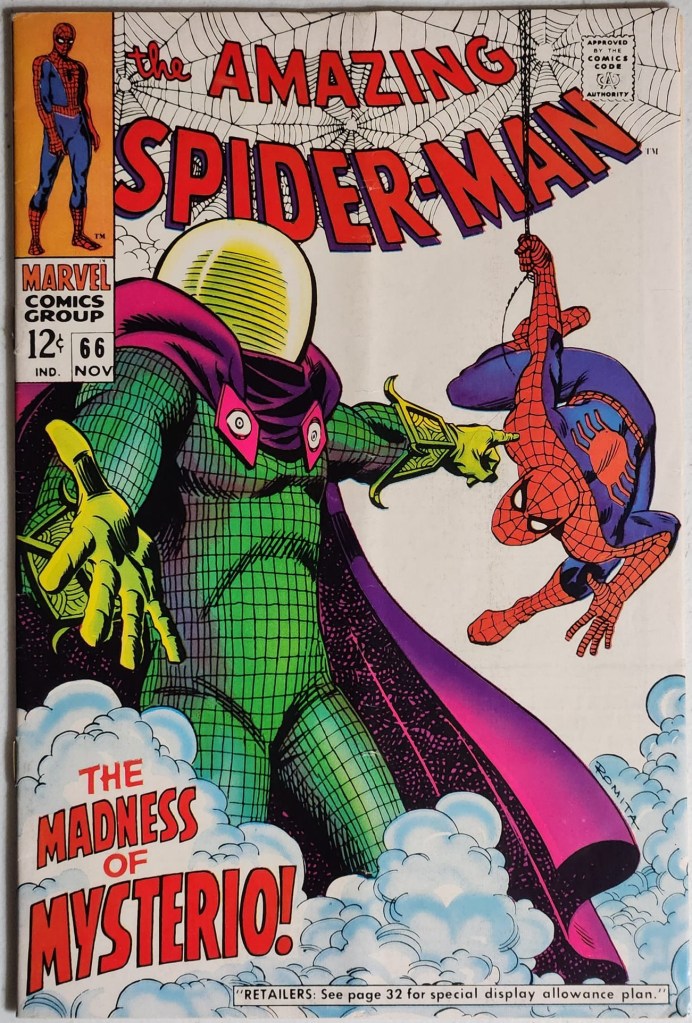
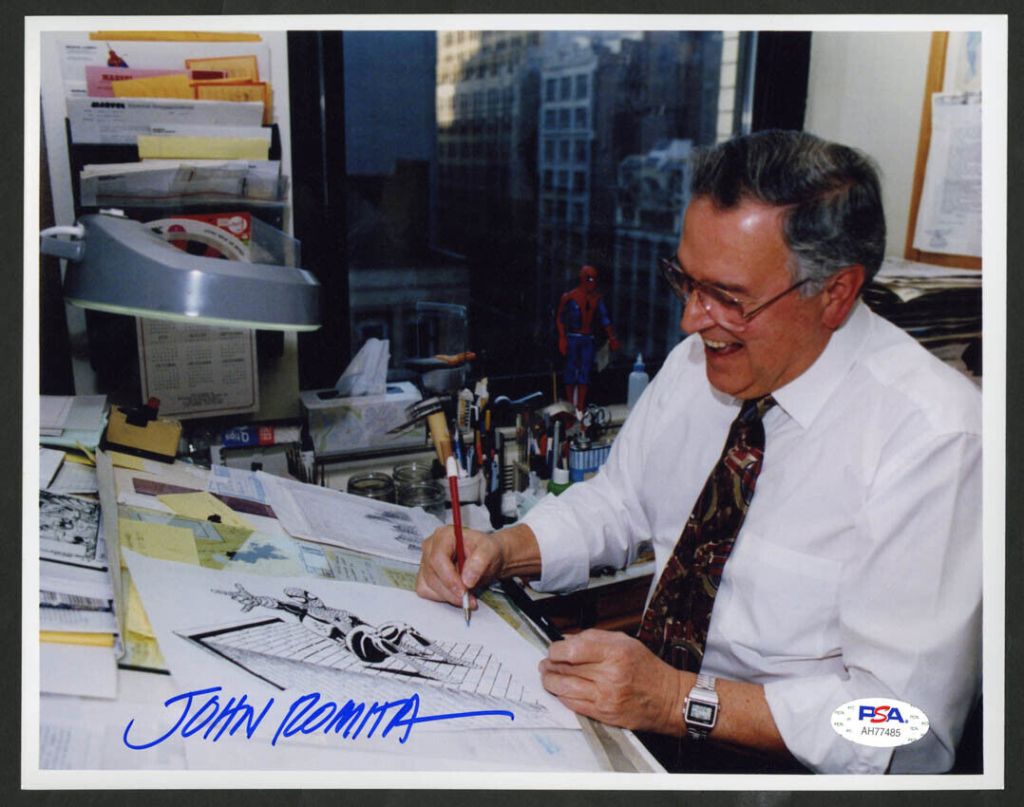
Above from left: Today’s home of the Alma News Stand (also to some as Superior News) on Superior Street; My copy of Amazing Spider-Man #66 originally purchased in the Rexall Drug Store in downtown St. Louis; John Romita, Sr., famed artist on the Amazing Spider-Man comic from the 1960s and 1970s.

Several weeks ago, an artist who affected my life growing up in Gratiot County died at 93.

John Romita, Sr., was most likely unknown to many Gratiot County residents except for some of us who were kids in the 1960s and 1970s. Romita, Sr. was a Marvel Comics artist who was the second to draw the Amazing Spider-Man starting in 1966 and running until the mid-1970s.

How could he be described? Romita drew the character as the young adult Peter Parker, who became a superhero a few years earlier due to a scientific spider’s bite. I was a comic book reader who followed Romita’s run on The Amazing Spider-Man beginning in 1968 when I first purchased an issue from inside the old Rexall Drug Store in downtown St. Louis. To this day, I can still see ASM #66 sitting on the metal rack and picking it up for a mere twelve cents. This issue had an iconic Mysterio cover and began a love affair with Spider-man and Marvel Comics that lasted about five years (on my first go-round). The comic rack at Rexall Drug was a favorite stopping place on a Friday night or Saturday morning when my father made his weekly trip to the old Commercial National Bank in St. Louis to cash his paycheck from Alma Products.

Somehow during this trip, I could squeeze a quarter out of my father, and I made regular trips into Rexall until it burned down. A fire took out the store on the northeast corner of Franklin and Mill Streets around 1970, which changed how I found my comic books. A St. Louis kid still had several choices at the intersection of those streets: Goods Package Shop, St. Louis Five & Dime, and Knapps Bakery. They were all exciting places for a baby boomer to visit with change in his hand. But, with the demise of Rexall Drug Store, I had to go elsewhere to find Spider-man. I do recall visiting Hanners Magazine Store in Ithaca (now the location of the Gratiot County Historical Museum) and seeing comics as they lined the shelves on one wall. Still, we didn’t stop in Ithaca as much as in Alma.

Fortunately for me, my father was an avid sports reader, and getting a copy of The Sporting News was something that he regularly did. To get his weekly paper, we traveled to Alma’s Superior Newsstand (or some of us called it “The News Stand”). While my father picked up his sports paper, I soon discovered that a large comic rack that spun to display comics on four or five levels was located around the corner from the entrance. It also faced Superior Street.

The stand made it easy for a kid to look in the window when a car went by or if he was walking by on the sidewalk. If the comic rack was full, you knew a new shipment of comics had just arrived. A bare or sparsely populated set of racks meant the comics had been picked over or the latest shipment had yet to make it to Superior News Stand (some called it the Alma News Stand). When I paid for my comics, I always gave Grandpa Naessens (we called him that, but I don’t believe that was his last name) my quarter, and he fished change out of a clean ashtray that he kept on the corner of the desk. Grandpa Naessens was also a memorable whistler, which he frequently did as he sat and looked out the window toward Superior Street.

And pick the comics I did. In the late 1960s, a Marvel comic (I was almost exclusively Marvel, although I respected and occasionally picked up a DC Superman or Batman) was only twelve cents. The price was neat as I could pick up two comics and pay the one-cent tax – all for a quarter. But quarters seemed hard to come by. I also remember that the time when turning in glass pop bottles only brought two cents each. It took some work to pick up a quarter, but something called “a weekly allowance” helped me with my comic book collecting.

A complication came in the summer of 1969 when Marvel and DC jumped the price of comics to fifteen cents. Within two years, books went to twenty cents each – which soon forced me to consider giving up comics and going to baseball cards.

But back to John Romita, Sr. He was considered the face and most important artist to draw Spider-Man, next to whom he succeeded an artist known as Steve Ditko. How do I describe the artwork? As a kid, the characters appeared lifelike,  human, and easier to relate to. After all, Peter Parker had been a teenager. Sometimes during the “Romita Sr. run” from issues #66-102, readers also met other Marvel artists. Jim Mooney and Gil Kane shared duties with Romita during the time. Still, the best books to me were drawn by JR Sr. The books also became highly collectible in time, and based on their condition, some reached the hundreds – and even thousands of dollars depending on what issue a kid picked up. Still, by 1972, the price of comics and my interest in the Detroit Tigers meant that I had largely moved on to collecting baseball cards.

I picked up one of the last John Romita, Sr. issues I purchased at the St. Louis IGA in the fall of 1972. After that, I had outgrown the books. But I kept my copies, which were stored -and read through the years. There was a certain smell that printed books of the 1960s, and 1970s had that you couldn’t imagine today. No, it was not the smell of mildew – it was good old-fashioned paper comics. Today’s versions are slick, magazine-style, but not so in the 1960s and 1970s in Gratiot County.

In the early 1980s, I returned to Marvel Comics and quickly found The Amazing Spider-man a favorite. This time, Spider-man was being drawn by a new Romita – John Romita, Jr. This Romita would, over time, also leave a similar iconic imprint on the character -much like his father did a generation earlier.

Today in Gratiot County, one would need help finding a weekly place that sells comic books. Why is this so? By the end of the 1990s, stores no longer carried comics, forcing readers and collectors to deal almost exclusively with “the comic book store” in their locality. One or two stores tried to do this in the county, but none exist today. One’s best bet is to get a subscription service or visit the closest stores in Mt. Pleasant, Saginaw, or Lansing – all of which can be a distance to get a “comic fix.”

But, for a baby boomer growing up in the 1960s -1970s in Gratiot County, comic books were a form of popular entertainment for kids who had a quarter to spend. And now, time to return to reading the most recent issue of The Amazing Spider-Man.

Copyright 2023 James M Goodspeed
We Remember 1964: “And Then there was the Suburbanette” – in Pine River Plaza

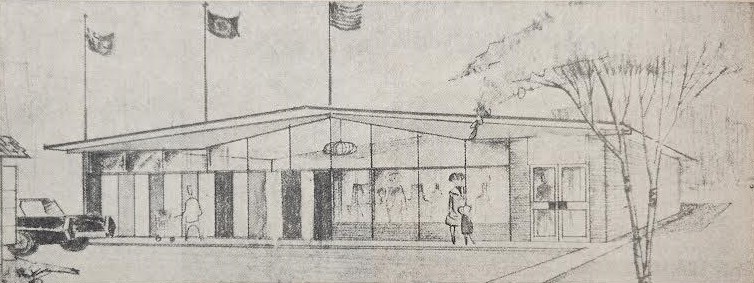
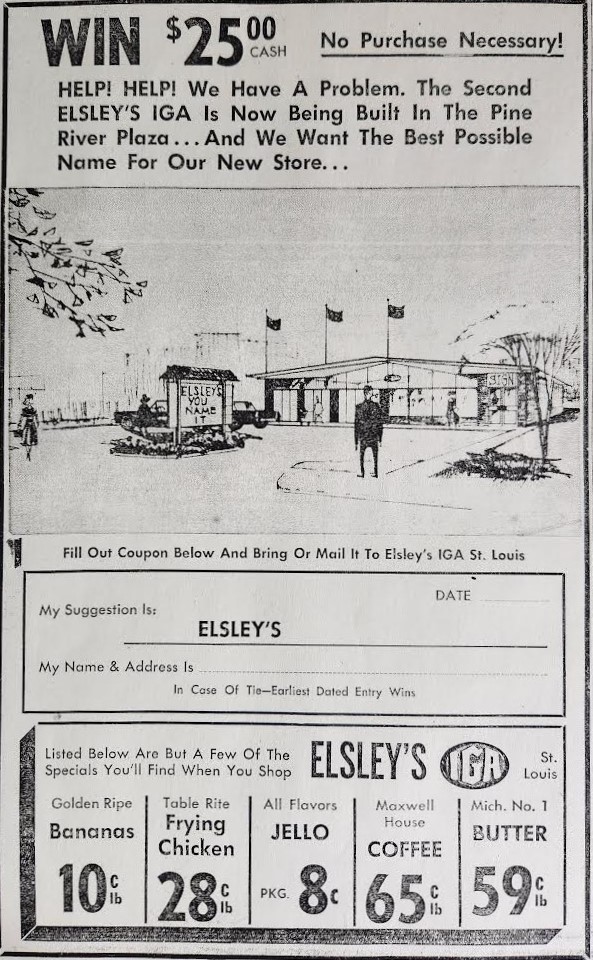
An early artist’s sketch of the proposed Suburbanette in Pine River Plaza, circa late 1963. The Suburbanette was the vision of Bert Elsley of St. Louis, who owned the St. Louis IGA.

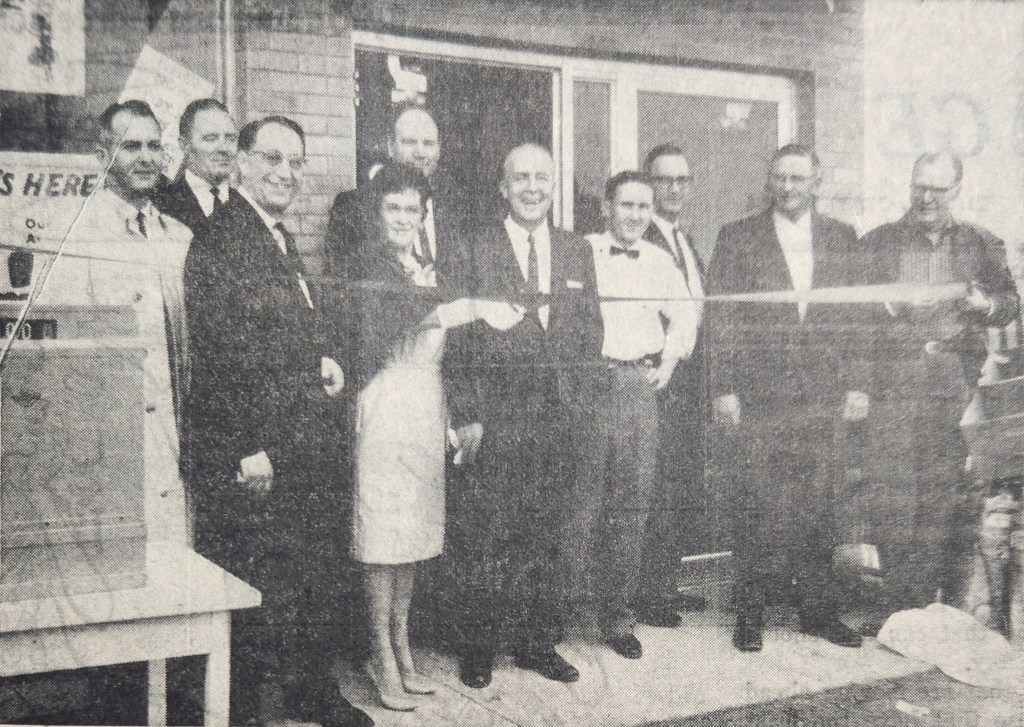
Mrs. Bert Elsley cuts the ribbon for the opening of the new Suburbanette in Pine River Plaza. The first three days brought in large crowds, and sold enough five cent hot dogs and Cokes to feed 5,000 customers.

The February 6, 1964 advertisement for a contest to name the new store. Who was the winner? St. Louis City Clerk-Treasurer Kenneth Barnum. He won $25 for the winning name.

As new entertainment flowed into Pine River Plaza in the early 1960s, a fourth building appeared. Bert Elsley had an idea. Elsely, the owner of Elsley’s IGA in St. Louis, decided to try to place a store next to Gratiot Lanes bowling alley and Leonard’s Outdoor gas station.

It was not a very big location for a store. The building, which Elsely leased, sat sixty feet off the road with a forty feet of store front. Inside, it had only 3,000 square feet of floor space. The Donald A. Wineland Company from Kawkawlin did the construction Still, Elsley said that the parking lot could hold at least 25 cars, and he envisioned having an outdoor summer market. When he first opened,  when  he needed more room because of all of the customers that came. Elsley’s store stayed open until 11:00 pm each evening, including Sundays. Soon, he operated from 7:30 am to 11:30 pm, seven days a week.

In February 1964, Elsely held a contest to name the location and the person with the best suggestion received $25. People in  St. Louis laughed when Elsley announced that the winner was Kenneth Barnum, who was the city clerk and manager. Barnum’s proposal was to name the new store “The Suburbanette.”

When the official opening of the Surbanette took place, Mrs. Elsley cut the ribbon. To encourage business in the first three days, Elsley had 27 door prizes to give to the first customers, including a portable TV set. Customers also indulged in five cent hot dogs and Cokes – to the tune of 5,000 people, according to Elsley.

Unfortunately, Bert Elsley suffered serious health problems in the next year and he was forced to sell the Suburbanette. A couple from Lakeview, Fred and Kathryn Harkens, bought the store and had operating hours of 10:00 am to 10:00 pm daily.

In mid-December 1970, the business changed hands again. This time, Gordon and Audrey Mackenzie bought the store and took it over that month. At the  grand opening, Gordon and other community leaders all wore Scottish kilts. Steve and Clark Mackenzie operated the store until February 2021 when Jameson and Sara Evitts bought Mackenzies.

Although the location that was known as the Suburbanette and later Mackenzies, it remains the second oldest operating business that originated in Pine River Plaza since the early 1960s. Not bad for the smallest store at the corner.

Copyright 2023 James M Goodspeed

We Remember 1968: The Travelodge Comes to Pine River Plaza

A late November 1967 drawing of the anticipated Travelodge in Alma. The hotel would sit on the northeast corner of Pine River Plaza.

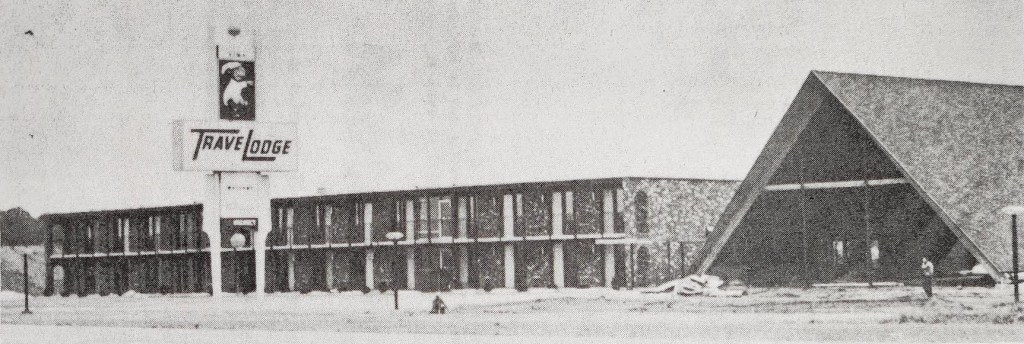
The newly constructed Alma Travelodge as it appeared at its appeared in July 1968.

With new bowling alleys, an outdoor center, and new places to eat, the Pine River Plaza at M-46 and Luce Road only lacked one thing – a new motel. In November 1967, newspapers reported that a Travelodge Motel would be constructed east of the Big Boy restaurant.

At the time, this Travelodge was one of 350 motels of that franchise in the United States and Canada. The Pine River Motel Company, owners of the Travelodge, included President Donald Wakely, Secretary  Roy Roach, and Treasurer Leon McNeill, Jr. Other board members included  Al Fortino, Alfonso Fortino, and Doctors Sylvio and Mario Fortino.

The motel aimed for a summer 1968 opening and would long be recognized for its large A-Frame on the west end. Inside, it had 50 units, with conference rooms and a large banquet hall that could feed 150 people or hold 500 for a meeting. The Travelodge also had a health club and a large indoor year-round pool, along with rooms that had wheelchair units and both single and double rooms. Lila L. Baldwin became the new resident manager after previously owning a ten-unit motel in Holt, Michigan.

In June 1968, the Travelodge officially opened and quickly became a well-known location for swimming, banquets, and meetings. Events ranged from attending one of the first presentations in the area about how to operate a microwave oven or listening to Vice President Gerald Ford talk to members of the Gratiot County Republican Party via telephone conference.

As time passed, the Travelodge represented a place to stay on the southeast corner of the Pine River Plaza. Following the construction of two bowling alleys, a Michigan Outdoors Center, a Suburbanette, and a restaurant, the Travelodge was the last piece of the Pine River Plaza.

Copyright 2023 James M Goodspeed
We Remember 1963: Big Boy Arrives in Pine River Plaza

An early March 1964 advertisement for the opening of the Alma Big Boy Restaurant in Pine River Plaza.

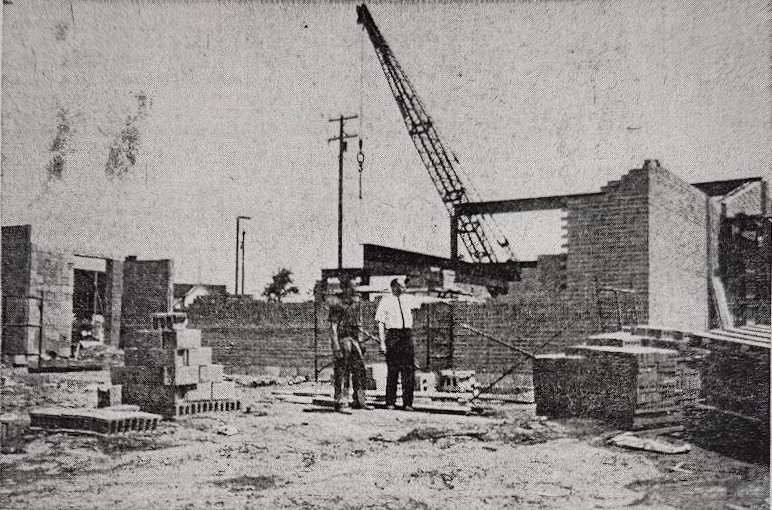
Contractor Harold Carter of Greenville shows new manager Jack Robbins of Alma around the Big Boy building site. It was June 1963.

The Big Boy himself greeted travelers for decades at the Pine River Plaza. Here he gets a cleaning and repair in July 1979.

On January 3, 1963, news came that the Pine River Plaza would soon have a new restaurant at the corners. This Big Boy Restaurant, one of 45 Elias Brothers restaurants in the United States, was owned by private operators who hoped to open for business that spring.

Harold Carter of Greenville built the Big Boy, which was constructed of brick and stone and had 3,500 square feet. It seated 120 people and had a drive-in with up to 60 Teletype phones for ordering. In addition to the drive-in, a banquet room inside held 40 people.

The Big Boy officially debuted on August 23, 1963, to coincide with the opening of Leonard’s Service Station. Newspapers also announced that the owners planned a golf driving range and miniature golf course east of the restaurant.

The hours of operation (6 am-1 am Sunday through Thursday, 6 am-3 am Friday-Saturday) gave customers a wide range of times to eat. By 1971, the Big Boy stayed open 24 hours a day.

Sometimes unusual things happened, such as when high winds blew the Big Boy off his perch during a wind and snow storm. In another instance, someone stole the Big Boy from his stand.

However, the Alma Big Boy in Pine River Township was a frequent stop to eat for decades for items like the Big Boy sandwich and Hot Fudge Ice Cream cake.

Copyright 2023 James M Goodspeed

We Remember 1963: When Michigan Outdoors Came to Gratiot County

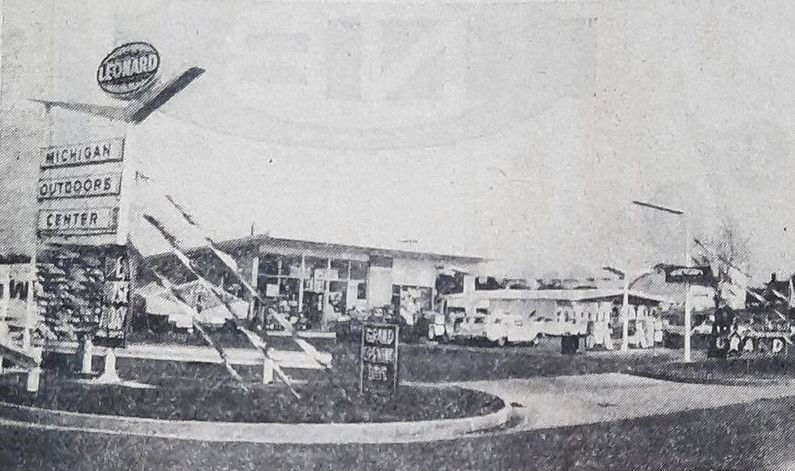
Above: A shot of Leonard’s Michigan Outdoors Center in 1964. The center sat on the southeast corner of Pine River Plaza, north of what is today Mackenzie’s Party Store.

John Wood was the first manager of the Michigan Outdoors Center; Dick Shaver worked as the station manager.

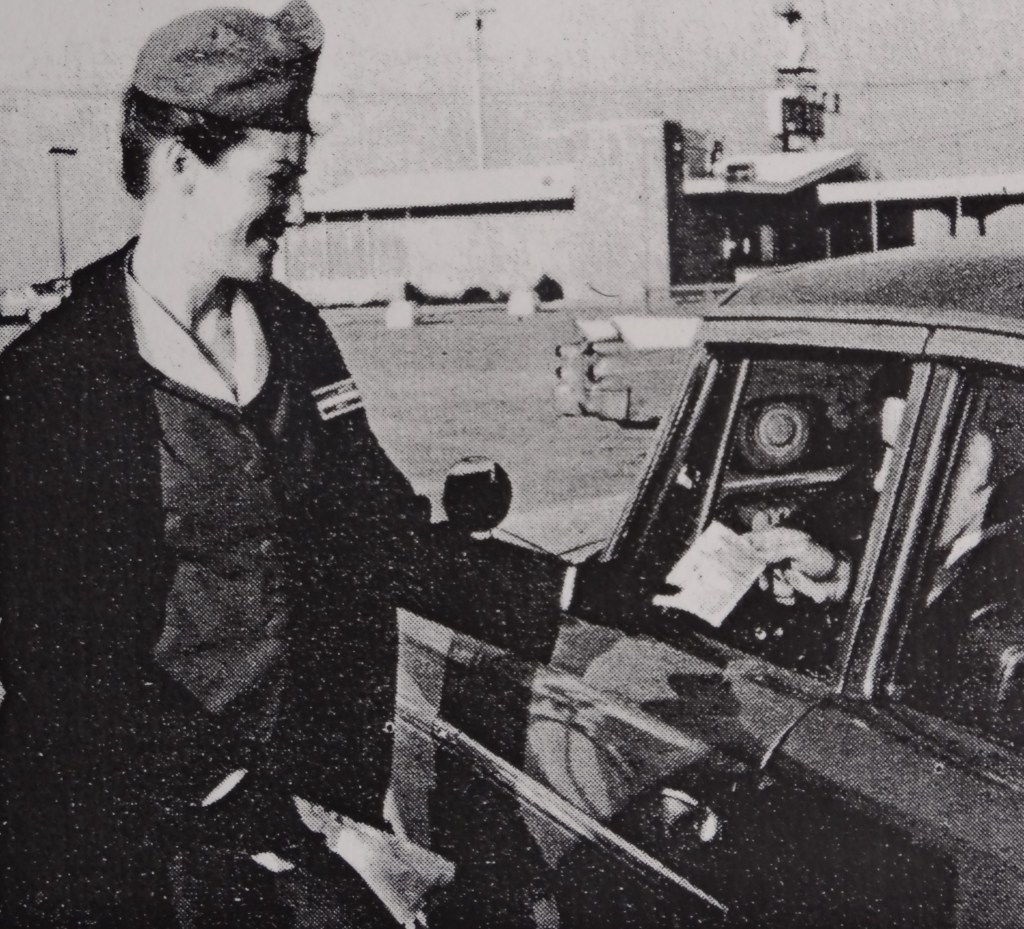
Station attendant Doris Parks helps a driver in 1967. Drivers could stop at Michigan Outdoors Center for coffee, directions, maps and just a break.

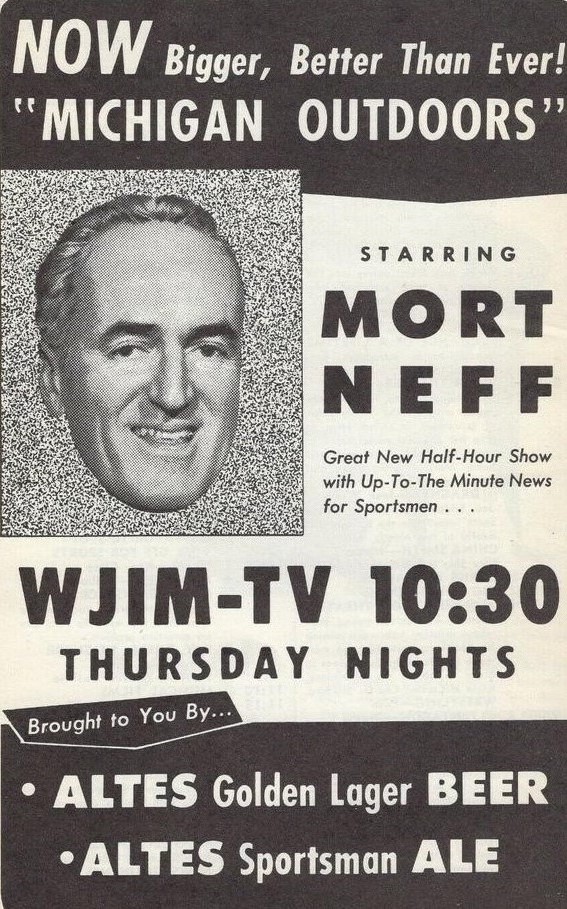
Mort Neff was the host of the “Michigan Out Doors” television program that started in the 1950s. Leonard’s Refineries became the show’s leading sponsor in 1956 and Neff made several appearances in Gratiot County during the program’s run.

In the early 1960s, Leonard’s Refineries of Alma had plans for a “Michigan Outdoors” Sales and Service Station. This station was located on the Pine River Plaza’s southeast corner at the corner of Alger Road and M-46.

 Leonard’s Michigan Outdoors station was constructed with a large paved parking lot and a display room that could be seen from the road. A gas station and car maintenance center sat next door. When drivers traveling along US-27 needed a break or directions, they could pull into the parking lot to be greeted by a hostess who offered free coffee, directions, and maps. John Wood became Leonard’s first manager, and the station opened on November 1, 1963.

The idea of a Michigan Outdoors station had roots in the 1950s. In 1956, Leonard’s Refineries initiated sponsorship of Mort Neff’s “Michigan Outdoors” television program. Mort Neff was one of Michigan’s leading ecologists and produced one of the largest outdoor shows in Michigan. Eight television stations carried the program on Thursday nights, encouraging Michigan outdoorsmen to think about the upcoming weekend, regardless of the season. One of the show’s highlights was a large Michigan map with a light on the back. If Neff told viewers, “The perch are biting off of the pier at Ludington,” the light would move across the state and rest on that location. The same could be said about hunting pheasants and other outdoor events in Michigan.

Mort Neff knew how to draw people, and it was said that when the map and light came on, another fifty fishermen or hunters from downstate Michigan would appear in the area to hunt or fish – all because of Mort Neff’s program. 

When it came to Mid-Michigan, Neff loved to fly his plane into nearby Maple Rapids to hunt or fish. He was also the featured speaker at local high schools. He once appeared for a fundraiser for the Gratiot County Humane Society. Mort packed them in that night, and the fundraiser was a sellout.

Leonard’s gas station is long gone today, but there once was a Michigan Outdoors Center in Pine River Plaza.

Copyright 2023 James M Goodspeed
We Remember 1962: When Bowling Came to Pine River Plaza

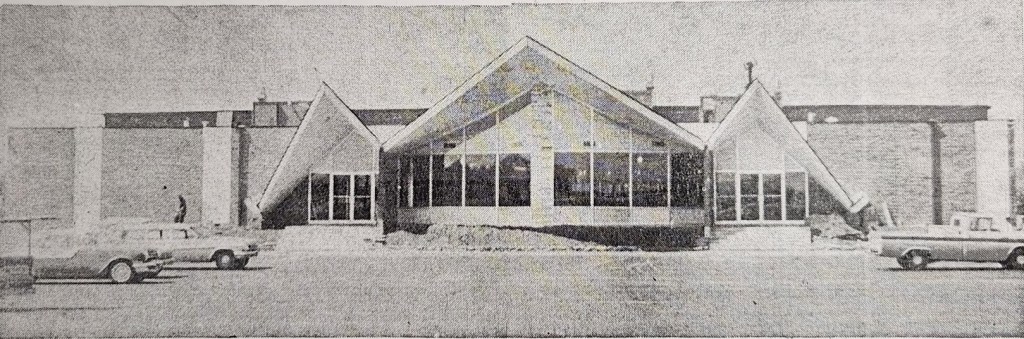
One of the first photographs of the completed 300 Bowl on the northwest corner of Pine River Plaza. It was late August 1962.

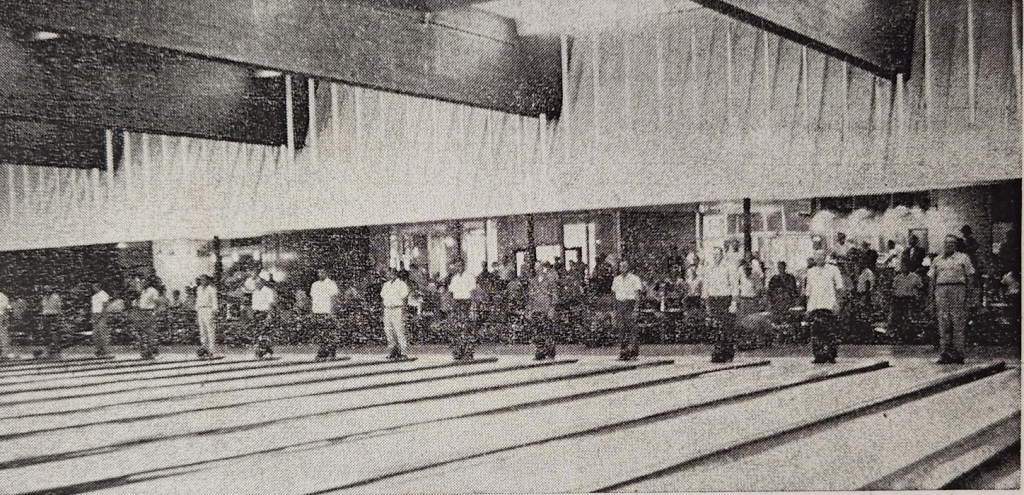
Above: Opening night, September 4, 1962. Everyone in the 300 Bowl stood for the National Anthem, then a bowler on each lane launched their ball down their respective alley – all at the same time.

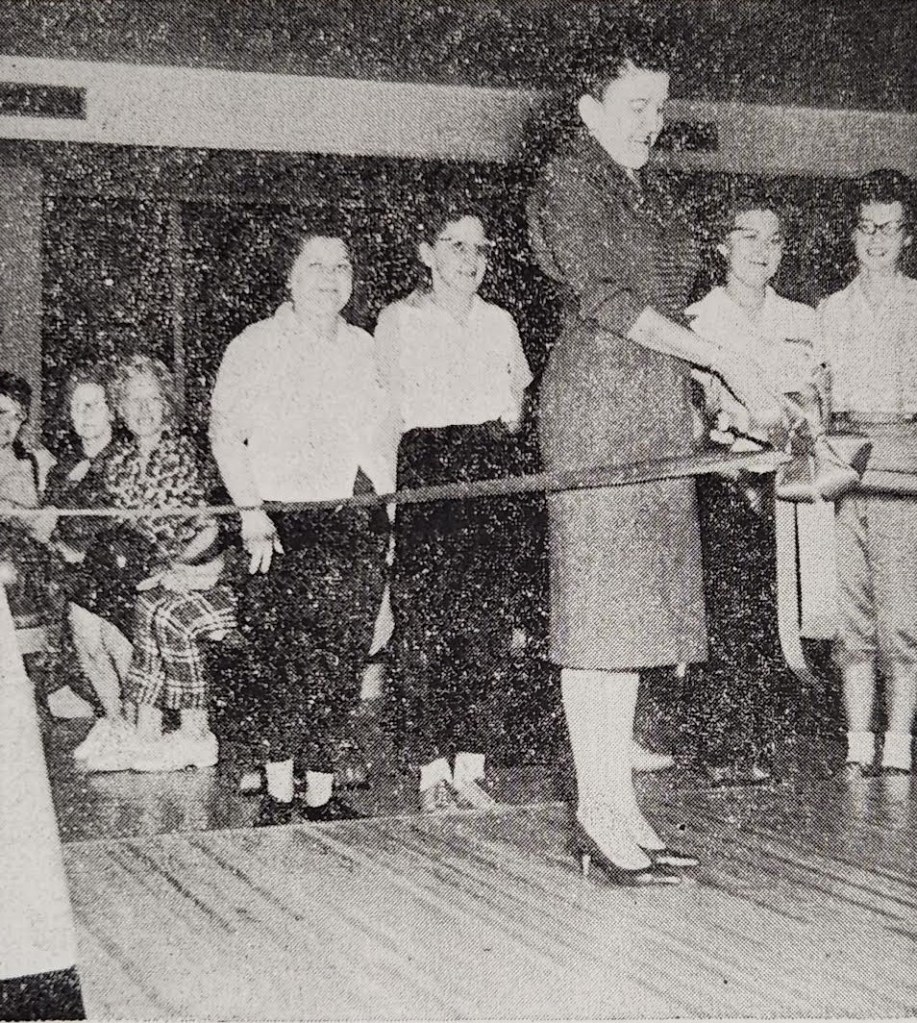
Margarette Mettert from Alma cuts the ribbon at Gratiot Lanes on September 24, 1962. Mettert was the secretary of the Central Michigan Women’s Bowling Association. The event marked the beginning of 16-team “Assorted Sixteen” league.

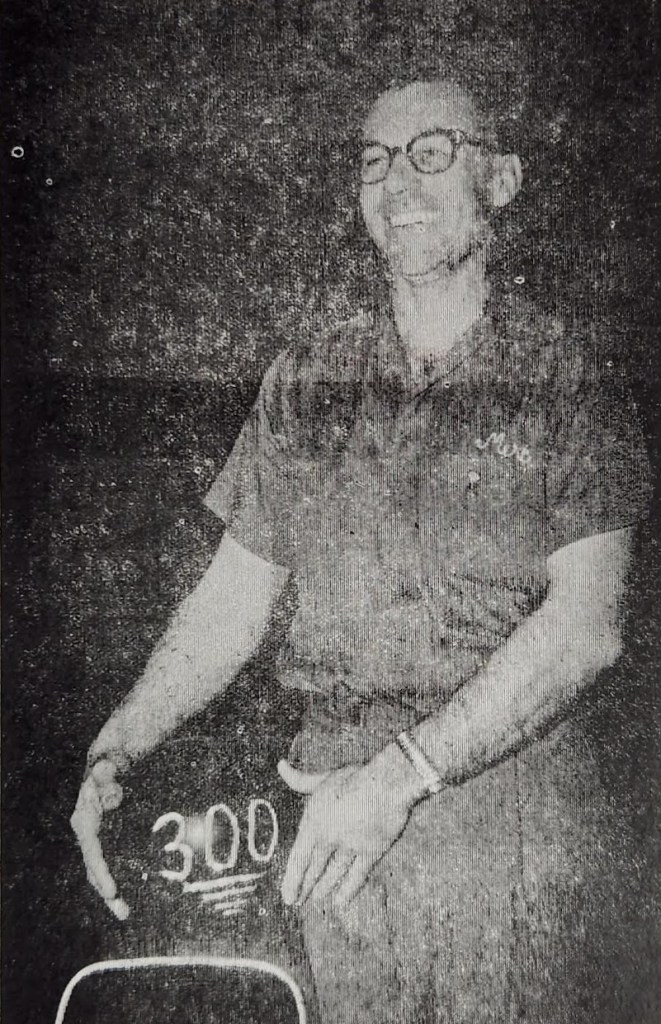
One very happy bowler. Mercer Cook of Alma throws the first 300 Game at Gratiot Lanes on a Saturday afternoon in 1963. Owner Ken Luneack awarded Cook with $100 and 100 free games at Gratiot Lanes.

It was known as the great bowling alley race.

In the spring of 1962, two new bowling alleys were among the first places to be built at the intersection of Alger Road and M-46. This new location, a product of the changes that brought the new US-27 Highway to Gratiot County, first held the 300 Bowl.

The 300 Bowl broke ground on April 26, 1962, and planned to have its alley up and operational by late July. Paul Cameron, the owner of the 300, said the new alley had 34 lanes and would be located on the northwest corner of the intersection.

Strahan Construction Company built the building, measuring 140×160 feet on 7 acres, with five features: a meeting room, tap room, snack bar, pro shop, and playroom for children. This bowling alley also featured Brunswick pinsetters and products. The cost for the 300 would be $600,000, and the lanes turned out to be the longest ever produced by Unit Structures, Incorporated of Peshtigo, Wisconsin. The lanes were so long that a special permit had to be obtained from the Highway Division to deliver them to Alma.

It took 8,000 nails to put each lane together, and each lane bed consisted of 3,200 linear feet of select Pine and Maple, fit tongue and groove, and nailed on each end. The individual lanes sat on a 2×4, 2×10 framework. Each end also had Maple to handle the ball’s impact and the pins. Pine wood with open grain made up the lanes’ middle and held each ball’s spin. Brunswick crews put together all of the lumber.

On September 1, 1962, the 300 Bowl opened. Manager Don Hall and well know bowlers Larry Graham and Rex Nelson also were present. A little over a week later, the action officially started when Alma Products and Alma Businessmen League opened league play. On that night at 7:00 pm, everyone in the alley stopped and stood for the National Anthem. A row of 24 men then threw their balls down their alley to initiate the 300 Bowl.

The public officially used the 300 on October 19, 1962. The alley opened at 10:00 am and remained open until the last person left that night.

However, another bowling alley soon opened across the intersection in the Pine River Plaza on the southeast side. Kenneth R. Luneack announced in April 1962 that he planned to open a 16-lane bowling alley,  Gratiot Lanes, which he did on September 13, 1962. Luneack also owned Riviera Lanes on Michigan Avenue in St. Louis.

At Gratiot Lanes, Luneack promoted using AMF lanes, equipment, and sales. He was also the first to offer the AMF Spare maker in his alley. When Gratiot Lanes opened on September 13, 1962, it offered the public three days of open bowling. About two weeks later, Gratiot Lanes officially opened, and Margarette Mettert, secretary of Central Michigan Women’s Bowling Association, cut the ribbon. The “Assorted 16” women’s league was the first league to use the alley.

Gratiot Lanes entered the news in January 1963, when Mercer Cook threw the first 300 game. On that day, everyone in the alley stopped to watch Cook as he moved frame by frame toward finishing his game on his way to a perfect 300. As a result, owner Kenneth Luneack awarded Cook $100 and 100 free games. Cook’s feat was said to be only the second recorded 300 game bowled on an area alley at that time!

As time passed, Alma’s 300 Bowl and Gratiot Lanes were home to many young and old bowlers who participated in league play or just went out for recreation at the alleys.

Copyright 2023 James M Goodspeed

We Remember Fall, 1954: The Discovery of the Ruskovic Mastodon

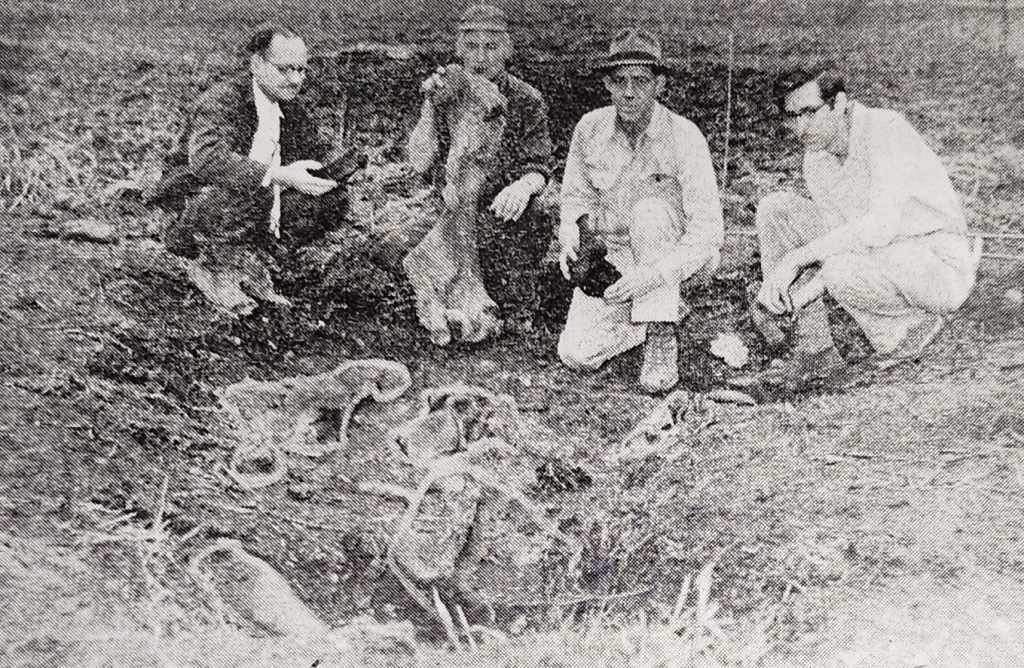
Above from left: Guy Weller, Ithaca Chamber of Commerce managerial secretary; John Ruskovic, who discovered the mastodon; Claude Hibbard, professor at University of Michigan; Byron Harrell, research assistant. Ruskovic found the remains while on the family farm in Emerson Township. The group sit the spot where the remains were found.

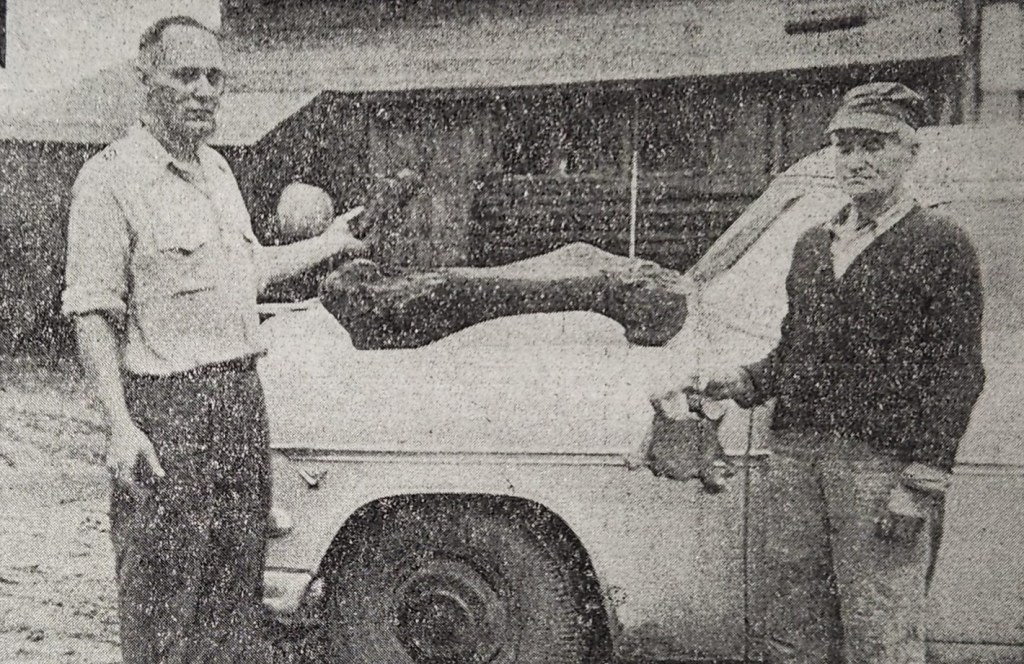
John Ruskovic (left) and his father, Joe, display a few of the mastodon bones found one week earlier on the Ruskovic farm in Emerson Township in October 1954. The large bones each weighed approximately 37 pounds.

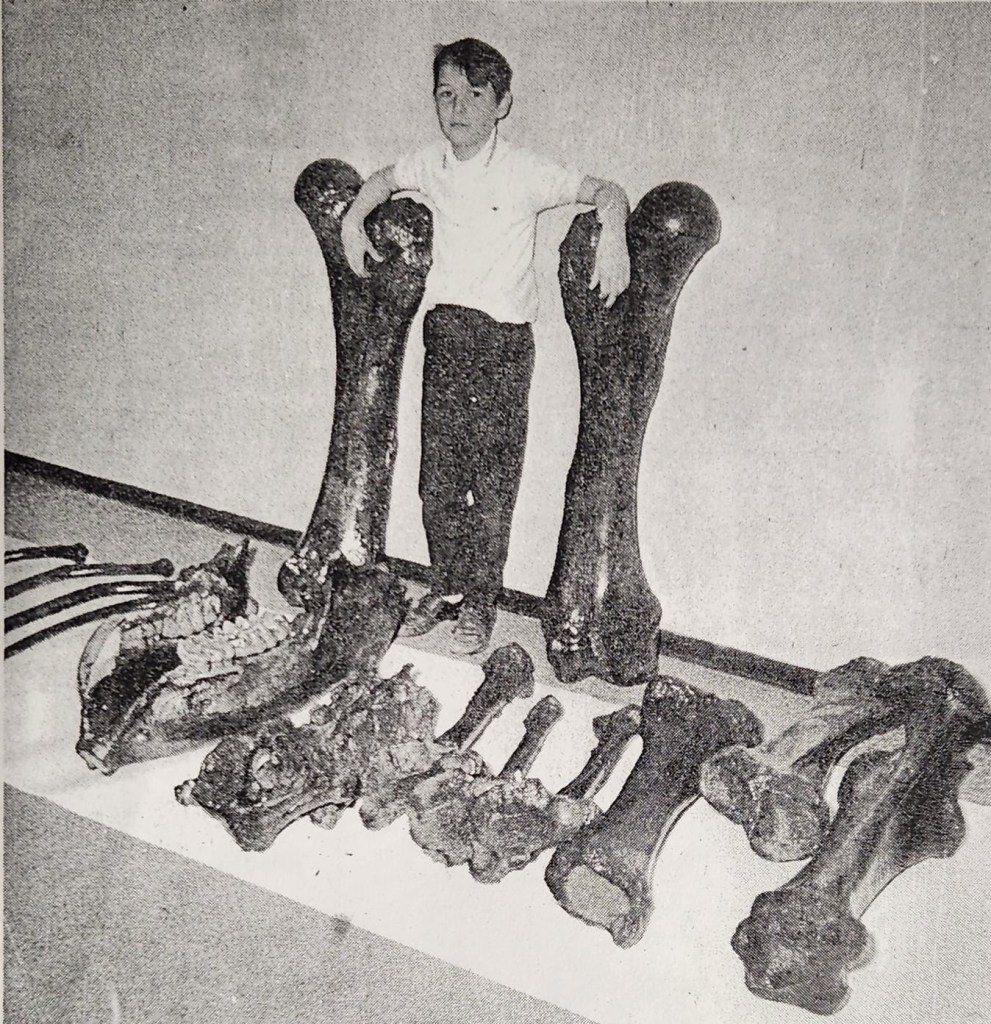
Johnny Musser of Alma stands next to bones of the Ruskovic mastodon in 1967. Musser’s grandfather purchased the bones and frequently displayed them at the Strand Theater, where the senior Musser was the owner and manager.

For approximately 9,000 years, it was beneath the surface in a swampy section of a farm in Section 17 of Emerson Township. Until then, it proved to be the most significant archaeological discovery in Gratiot County.

In late September 1954, John Ruskovic was plowing the swampy area of his father Joe’s farm when he hit and uncovered a bone weighing thirty-seven pounds. After contacting the Ithaca  Chamber of Commerce for help, someone came to the farm to see what exactly had been found. A geology professor from the University of Michigan, Dr. Clark Hibbard, arrived just after Joe Ruscovic’s granddaughter, Barbara Hennigar, dug up an almost complete jaw. The teeth were three inches square, and they told Dr. Hibbard that the remains belonged to a prehistoric mastodon.

Archaeologists would later conclude that the mastodon became extinct in the late Pleistocene period and lived in open spruce woodlands and spruce forests. In time many of them would be found in former swampy bogs by Michigan farmers while digging ditches or ponds.

Mastodons had been discovered before 1954 in other places in Michigan. This one was unique as it was almost complete, except for its tusks, upper head, and four upper leg bones. Dr. Hibbard worked with the family to keep the remains covered and fenced off as spectators and schoolchildren descended upon the farm. Adding even more exposure to the find, John Ruskovic took some of the bones to a LIFE magazine program that had been previously scheduled at Ithaca High School. A crowd of 640 people sat through the presentation. An artist showed sketches of what the animal initially looked like while the speaker displayed the bones.

“The Ruskovic Mastodon” would go on a journey after its initial discovery. Two weeks afterward, the Strand Theater arranged to have some of the remains placed in its lobby. Keith Musser, the Strand’s manager, invited people and schoolchildren to come and see the mastodon. In the 1960s, Musser purchased the bones from the Ruskovics for $500. On several occasions, Musser advertised that these could be seen at the theater. One picture taken in 1968 shows his grandson, a young John Musser, standing in the lobby next to the large bones. The bones were stored in barrels upstairs in the theater for some time after this. Eventually, Musser donated them to Alma College, where they remained.

Gratiot County would have other encounters with its prehistoric age, although none of the finds would be on this scale. In 1909 specimens were discovered on the William Pitt farm in Seville Township. Another happened not far from the Ruskovic farm in 1938 when farmer Max Burnham found a large lower tooth of a mastodon weighing five pounds. Burnham found it while excavating a mucky spot on his farm. Another important discovery happened in the Riverdale area in 1965 when Louis Thaller of Riverdale was excavating a hillside. Doctor Ronald O. Kapp from Alma College became interested, researched mastodons in the 1960s, and later wrote about these discoveries.

Copyright 2023 James M Goodspeed
We Remember “Christmas Season 1968: The Hong Kong Flu and Gratiot County”

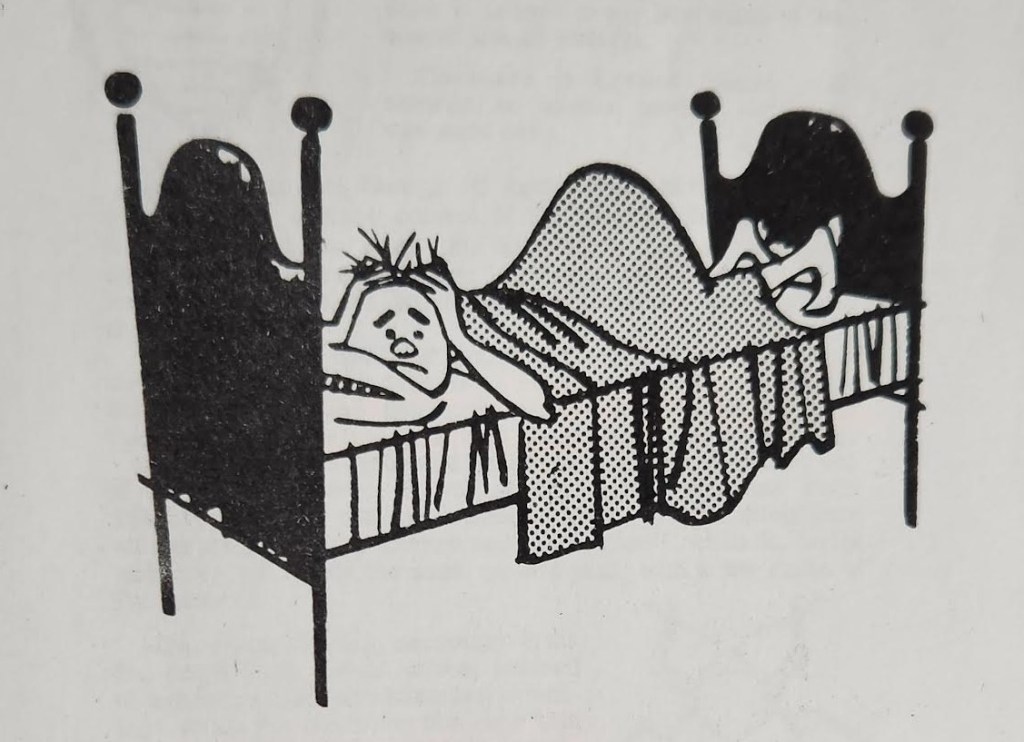
A cartoon appears in the December 16, 1968 issue of the Daily Record-Leader. On that day Central Michigan University announced that the semester would end one week early due to an outbreak on campus of the Hong Kong flu.

Two children in Iowa see a sign posted in response to the Hong Kong flu. An estimated 100,000 people in the United States died from the flu in 1968-1969.

Early in December 1968, Gratiot County sounded prepared for the flu season. At Alma’s Wright Avenue School, a small chicken pox epidemic affected the kindergarten class, causing eleven students to stay home. Because many students now took regular flu shots, county schools were not too concerned about flu season. Still, things in the mid-Michigan area soon gave reasons for concern.

News spread across the United States in 1968 that a new type of flu was at work – the Hong Kong flu, which originated in China during the summer and spread across the Pacific. Some medical experts thought this flu came to the United States as men came home from Vietnam. As a result, this flu kept an estimated 300,000 adults and children home in Los Angeles. In New York City, Adelphi University canceled its graduation ceremony. Actress Tallulah Bankhead, age 65, died from pneumonia, which she contracted after suffering from influenza. Hospitals in New York had reduced staff due to contracting the flu, and soon at least thirty states reported outbreaks of this new influenza.

In Detroit, two Catholic schools closed due to flu, with more than ten percent of students absent. Livonia Schools also did so because of the high number of sicknesses they encountered. In the business world, Chrysler Corporation knew that more workers were missing due to the flu, and General Motors noticed the same.

The symptoms of Hong Kong flu sounded familiar, with people suffering chills, fever, headaches, and extreme fatigue. In response, doctors prescribed bed rest as vaccines for this flu strain remained in short supply. Medical experts warned that victims contracted this strain because they had no previous immunity, striking quickly and in large numbers.

Near Gratiot County, things became more serious when Central Michigan University closed the week of December 16 as an average of one of six dormitory students came down with the flu. Classes ended a week earlier than scheduled that semester and would return on January 6. Over at American Coach Company, a DMH, Incorporated division in St. Louis, the factory announced that 21 workers out of 130 failed to come to work on Monday, December 16. Other factories in Alma, such as Alma Products, Lobdell-Emery, and Leonards, had absenteeism due to sickness, but not on the scale of DMH.

After Central Michigan University shut down, concern turned to Gratiot County’s schools, most of which tried to make it to Christmas Break without closing. On December 18, Alma Schools stated that 8 percent of students were sick (60/738); Ithaca had 50/800; Ashley had 30/200 and three teachers out. Breckenridge appeared to suffer the hardest early that week when 70/700 students called in sick. However, that number dropped to 42 students the next day. Despite the growing absenteeism, county schools remained open.

Another surprise in Gratiot County occurred when Gratiot Community Hospital closed its doors to visitors on December 20 and allowed only immediate family members in for visitation. Hospital administrator Douglas Webb commented about the change that “We just wanted to shut the door before the horses get out.”

As December 1968 went on, the effects of the Hong Kong flu stretched across the United States to the moon. President Lyndon B. Johnson went into the hospital on December 19  at Bethesda Naval Hospital with a low fever, cold, stuffy head, running nose, and rasping cough. Vice-President Hubert Humphrey contracted the flu, as did President-Elect Richard Nixon, who suffered from it while attending his daughter’s wedding. Because some schools, universities, and businesses closed early that December, airlines and bus lines expected traffic congestion to spread over the holiday break. Upon Apollo 8, astronauts Frank Borman, James Lowell, Jr., and William Anders experienced the “ping pong effect” of contracting and passing along the Hong Kong flu to each other. All the astronauts relied on Lomotil and Marezine to complete their mission.

According to the Centers for Disease Control, the Hong Kong flu killed 100,000 in the United States and at least one million worldwide. The second peak of this strain hit in late 1969 through early 1970.

A year later, this pandemic and its effects were meaningful as my family dealt with pneumonia and flu during the Christmas season of 1969. My brother, only five years old, was hospitalized briefly on Christmas Eve. Doctor Waggoner sounded hesitant to let my brother go home but released him. It was the only time I could remember my paternal grandparents coming over for Christmas Eve when we always went to their house.

While not as deadly as the Influenza Epidemic of 1918, this type of flu continued to affect our lives. Five years later, in 1973, Gratiot County dealt with a new strain and challenge known as the London flu.

Copyright 2022 James M Goodspeed
We Remember “The Christmas That Almost Wasn’t: The  Gratiot County Courthouse Fire of 1978”

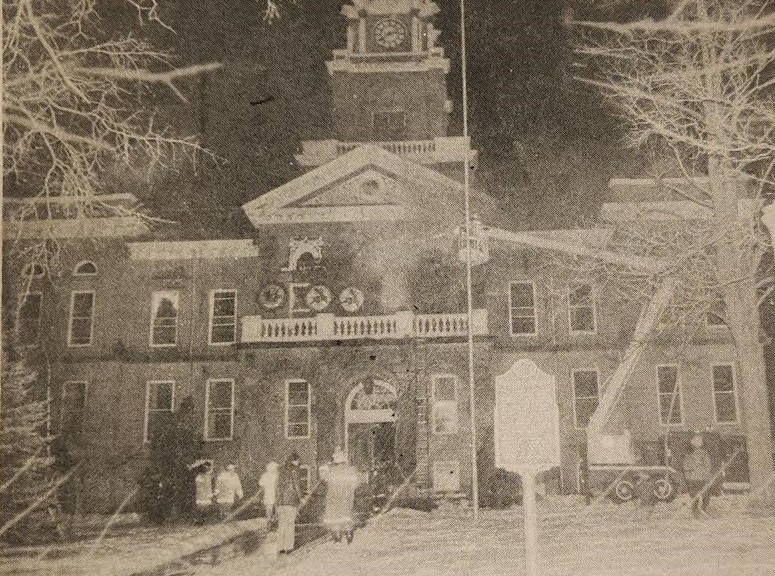
Firefighters from Ithaca, Alma and St. Louis work to put out the fire at the Gratiot County Courthouse on the evening of December 12, 1978.

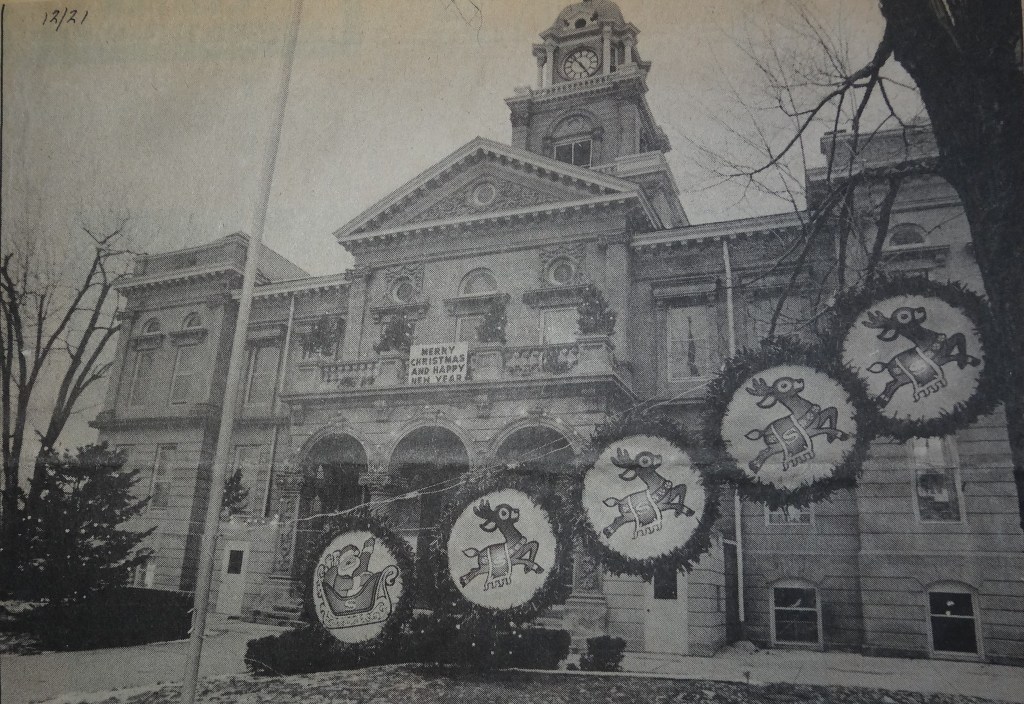
The Gratiot County Courthouse three years later in 1981.

For the better of fifteen years, the Gratiot County courthouse treated county residents to Christmas decorations representing the holiday spirit. However, two weeks before Christmas in 1978, Gratiot County almost lost the then 70-year-old national landmark.

It all started around 10:30 pm on that Tuesday night of December 12 when Sheriff Deputy Jerry Roslund reported for work. Roslund looked up and saw smoke coming out of the courthouse’s second floor. Upon approaching the main doors, he smelled smoke and immediately headed to the dispatch office next door. At 10:50 pm, dispatch called the Ithaca Fire Department, and the race to put out the fire began.

A group of approximately 45 men from three fire departments (Ithaca, Alma, St.Louis) worked with six large pumpers to control the fire. Firefighters worked furiously, fearing that if not quickly contained, a chimney effect would occur, with fire spreading up through the dome and rotunda shape of the building. They were fortunate that the slate roof that covered the building and the addition of recent insulation helped keep the fire from spreading.

The effort of firefighters contained the blaze within an hour. The Alma Fire Department remained on the scene for 4 hours, while Ithaca stayed on duty until 4:30 am. The presence of the fire marshall, use of hose, and cleanup continued on site until noon on December 13. The cause? An overloaded drop cord ran through the Circuit Court Office.

While firefighters saved the courthouse from a devastating fire, there was severe damage and a lot to clean up. Two rooms and the attic suffered the most, along with the circuit court office. Burned books and papers went out of the second-floor windows, and the original woodwork in the rooms suffered damage. The county-owned law library was lost, as was furniture.

As a result of the fire, Probate Court Judge James Harmony moved to the bottom floor. The offices of Clerk, Treasurer, Register of Deeds, Juvenile Office, and Probate Court all moved temporarily to other locations, such as the Ithaca Presbyterian Church. Damages to the courthouse were initially estimated at $150,000 to repair fully. Very soon, the Board of Commissioners applied for a $20,000 grant with the National Register of Historical Places Preservation Grant in Aid. With help from the Michigan History Division, $49,200 became available – if Gratiot County matched the grants, which the county did. Still, the county could only use the $98,400 available for architectural planning, not actual construction. The rebuilding and remodeling eventually started, and the courthouse received the work it needed to represent Gratiot County again. 

For many Gratiot County residents of the 1960s, the county courthouse represented the best of the Christmas season. People came from across Gratiot County to observe the many Christmas decorations that adorned our county and national landmark. Looking back at December 12, 1978, it is easy to forget that Gratiot County came very close to losing the courthouse.

Copyright 2022 James M Goodspeed