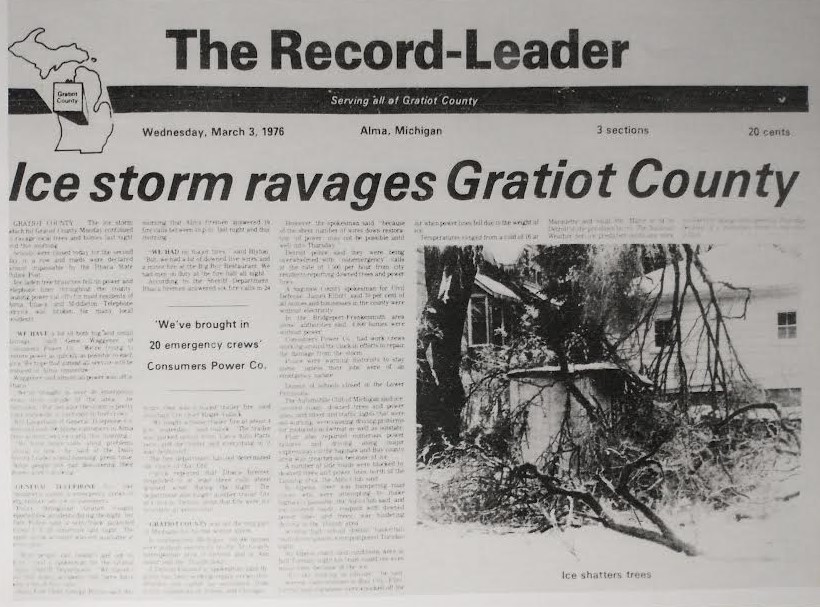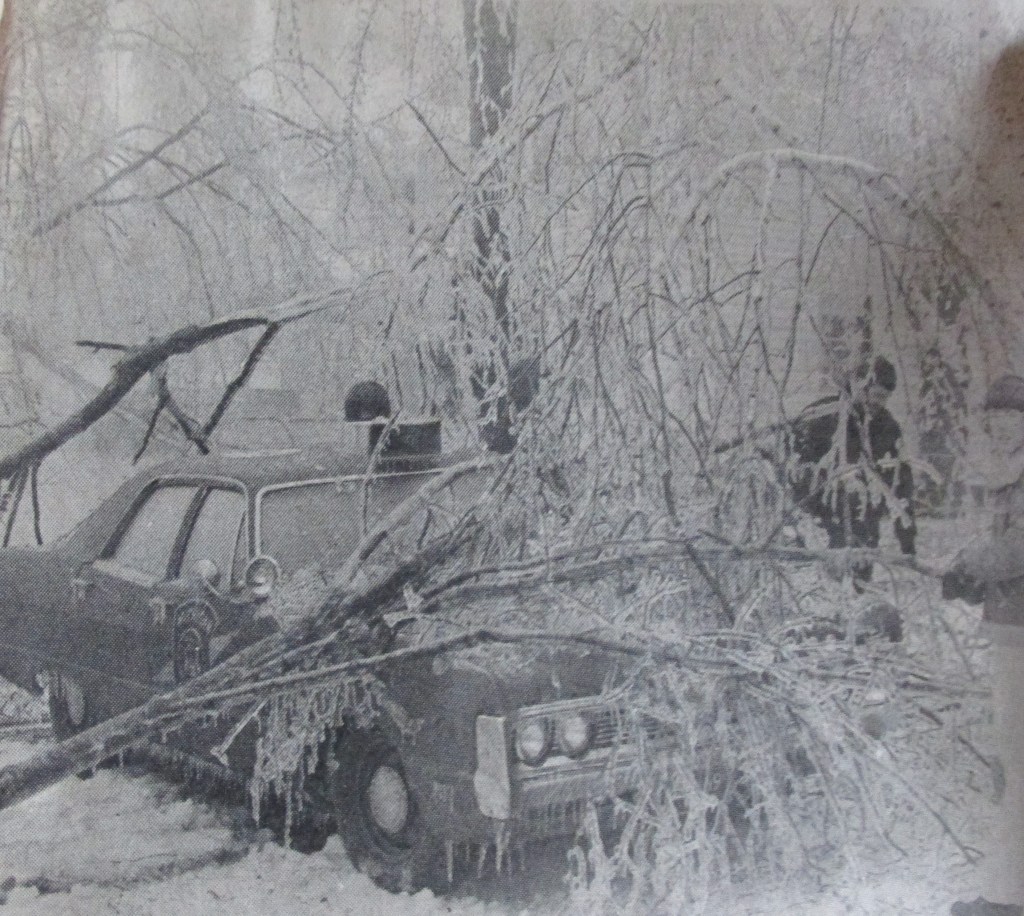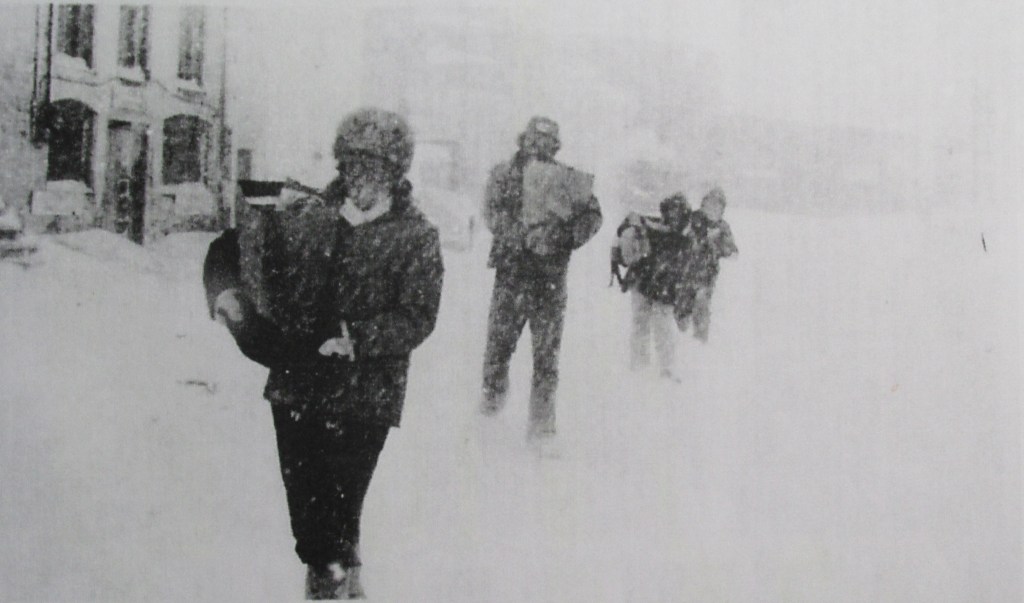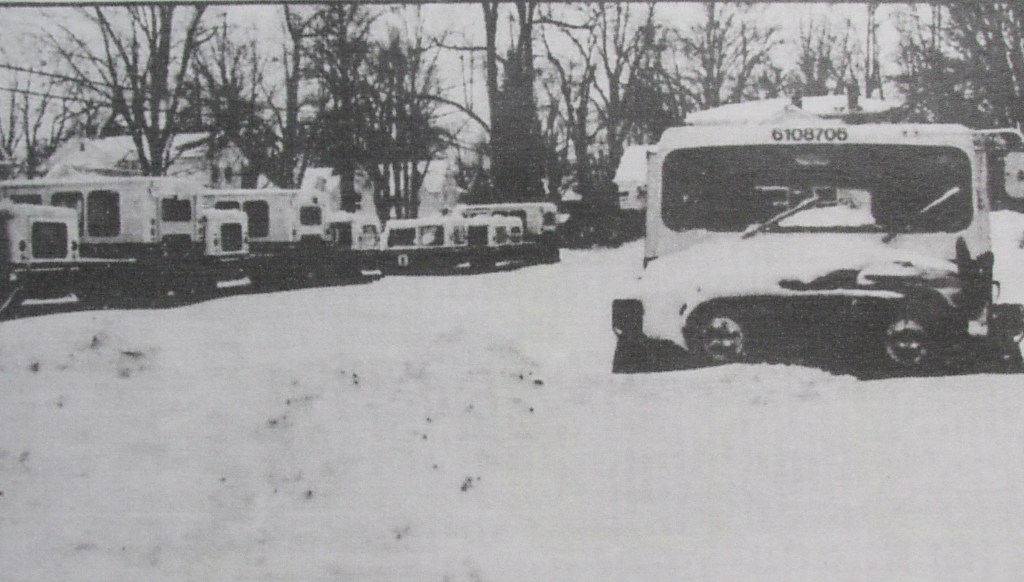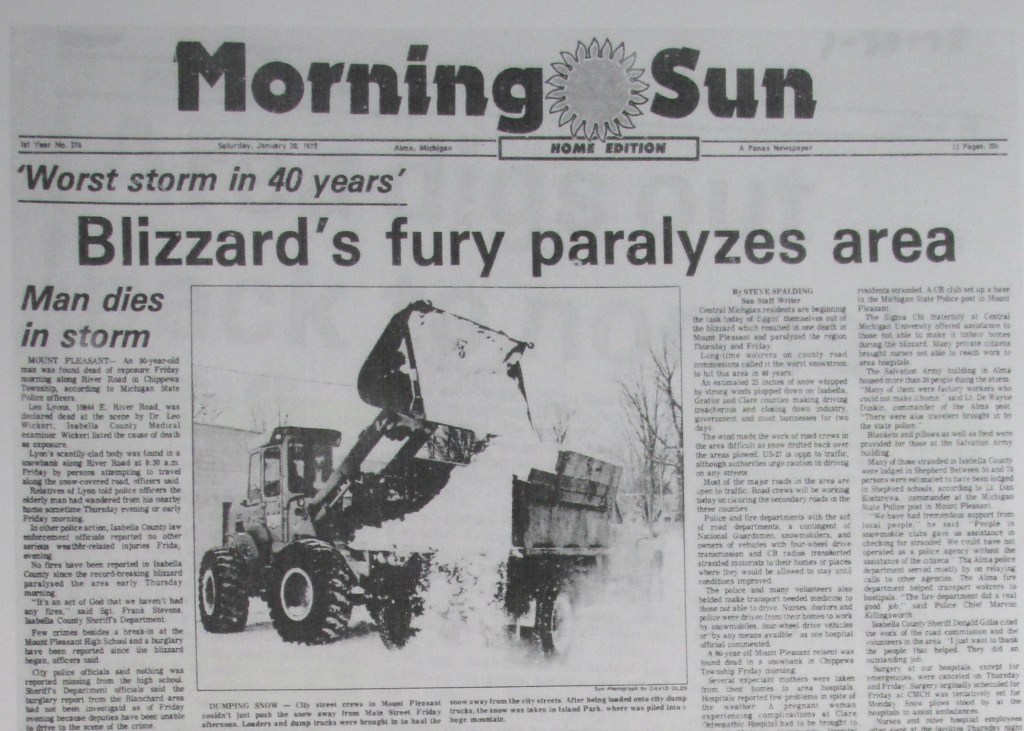
From top: An Ithaca family makes their way home on foot during “The Blizzard of 1978”; postal carrier trucks (probably in Alma?) show how mail delivery was shut down; an Ithaca resident tries to find his car which is buried beneath the snow; the front page of The Morning Sun during the storm.
The first day became known as “B-Day,” or “Blizzard Day,” as it first struck early in the early morning of January 26, 1978. By the time it ended six days later, some of Gratiot County’s oldest citizens had said it was the county’s worst snowstorm since 1936. It became known to many in the county as the Blizzard of 1978.
At first, weather forecasters predicted the storm to only yield about 4-14 inches of snow, along with northeast winds going up to 30 miles per hour. Soon, two ominous storm fronts, one from Mississippi and the other from Minnesota, combined to shut Gratiot County down starting early in the morning of Thursday, January 26. Instead, an estimated 24 inches of snowfall, with winds hitting as much as 60 miles per hour, created drifts up to 6-7 feet high, paralyzing the county.
Statewide on that first day, at least 60,000 people were without power due to winds knocking down power lines (the number would soon more than double). Schools closed, and the National Guard arrived to help those in need in many places in Michigan.
Early on that first morning of January 26, 1978, Gratiot County’s emergency Civil Defense coordinator, Dave Natali, set up a command post at his house. He started taking phone calls at 4:00 am. Natali attempted to coordinate responses with the Road Commission, State Police, and the Sheriff’s department to decide how to handle emergencies. Snowmobilers, CB radio users, and four-wheelers were all asked to help people in need. Four hours later, the Gratiot County Board of Commissioners chairman declared Gratiot County to be in a state of emergency.
County snowplows went out to work early in the morning, but road crews came to work with their sleeping bags, expecting a lengthy stay at the road commission. However, the commission ordered employees to stop working on the roads that Thursday afternoon due to the high winds and continual snow drifting. No matter how hard the road commission worked, no one could keep the roads open. An early estimate on that first day of the storm was that it would take three days to dig out, but in actuality, it would take Gratiot County twice as long. On Friday at 6:20 pm, President Jimmy Carter declared Michigan to be in a state of emergency, and at least 150,000 people were without power.
Amid the first day of the storm, some people in Alma remained at their jobs. The Main Café was especially busy in the morning with customers but slowed down and closed in the afternoon. Lillian Ankney got to work with help from her four-wheel-drive pick-up and kept the Main operating, along with Ray Croisant, who was bussing and cleaning. Ankney’s boss was in Florida, and she had the keys to the café, so she opened it, and the people soon started arriving. June Mernitz stayed at her desk at city hall. She remarked that “…people look to city hall as a command center, so we’ve got keep things moving here.” June and Rosemary Conners also joined her, working operating phones for Dial-a-Ride. The Alma Fire Department had an entire crew of 20 men working continuously, starting at 7:00 am. They remained on duty, helping the Alma community for another three days.
Over at Gratiot Community Hospital, employees like Peggy Kunik found a way to the hospital. She worked seventeen hours that day. Kunik explained, “There is no way a hospital can close down. And besides, I need the money.” Like the road commission workers, as many as fifty hospital employees brought their sleeping bags and supplies to stay at work for as long as needed. Nurses, doctors, and police across Gratiot County found rides into town via snowmobilers who offered to help them. At the same time, Alma Community Hospital postponed non-emergency surgeries, while at least four health emergencies in the county occurred where someone had to go to the hospital. A call from Breckenridge brought a person suffering convulsions. Two older adults stranded on US-27 had heart conditions, while two more in Alma experienced breathing problems. All ended up making it to the hospital. The one death reported in the mid-Michigan area during the blizzard occurred when an 80-year-old man was found dead from exposure near Mt. Pleasant.
Other places like the Pine Knot Bar boomed with business on the first day of the storm, running out of some beverages before the night ended. Over on the corner of Wright Avenue and Downey Street at the 7-11, business went “wall to wall” as people cleaned out bread, milk, and beer from the shelves. When asked about staying open during the storm, manager Anson Jaynes stated that “When we (7-11) say we’re open 365 days a year, 24 hours a day, we mean it.”
People stranded in the county needed help at different places, especially those whose cars ran into trouble on US-27. The Ithaca United Methodist Church put up seventeen people who needed to stay. The Alma Fire Department, Alma City Hall, Salvation Army headquarters, and even the jail offered to help people who needed a place to sleep, as did Alma College’s Athletic Complex and the old Masonic Home annex. Shepherd High School also opened its gymnasium for 75 people who waited out the storm.
The National Guard also went out to help Gratiot County during the blizzard. Company A, 1st Battalion, 125th Infantry, was called to report on Thursday afternoon. The armory itself housed 29 people in need, while members of the Guard took people to hospitals and nursing homes when needed. They also helped out at the Michigan State Police Post in Ithaca, where they enabled a total of 119 people to receive help.
Although offices stayed open, the mail nearly shut down in Alma, Ithaca, and St. Louis. Mail went out to Gratiot Community Hospital and Masonic Home, but as the postmaster put it, “It is pretty hard for workers to deliver mail in four feet of snow.” Over at St. Louis, a postal employee made it into work by traveling five miles using his snow skis. The St. Louis postmaster commented that he had some very dedicated workers.
As the storm and digging out from it proceeded, Gratiot County’s road crews dutifully served the county in terms of how long and how hard they worked. On average, road commission crews worked 50 hours over four days and started work at 4:00 am Thursday. In Ithaca, workers started even earlier at 3:00 am and had all they could do to clear their streets. They still worked 12 hours on Saturday and another 10 hours on Sunday. Cleaning curbed areas complicated the work in Ithaca. Also, the heavy snow in town meant that three pieces of snow equipment were needed, not just a street plow. Visibility at corners in Ithaca remained a problem for drivers for some time to come. Even though Alma snow removal employees worked a 19 hour day on the first day of the blizzard, it would take them more than two weeks to haul snow away from the city’s intersections, parking lots, and roadsides. Complicating some of the work in Alma were snowmobilers who got too close to plows while they worked. Visibility early in the storm also made snow removal treacherous at times for those trying to clear the streets in Alma.
Going into the following week, many Gratiot County schools remained closed for another two days until mid-week. After four days of the blizzard, a minimum of 24 inches had fallen in most areas, and snowdrifts now reached heights of 10-12 feet.
As the new week dawned and people started to crawl out from several days of being shut in, drivers were still being warned not to go out unless they needed to do so. Snowplows opened most roads by Wednesday, February 1, and schools reopened. Although there were no deaths in Gratiot County, 17 people in Michigan were now dead.
In the end, the blizzard of ’78 cost Gratiot County an estimated $74,000. After receiving money from federal disaster aid and the State Highway Department, the final total would be $52,250.
It was a time and season that we lived through for many of us – and one that we do not forget.
Above: Rains descended upon Gratiot County in early June 1945, flooding fields.
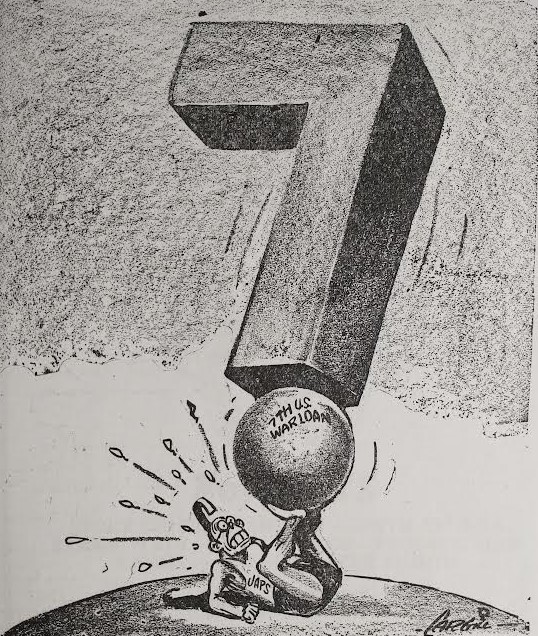
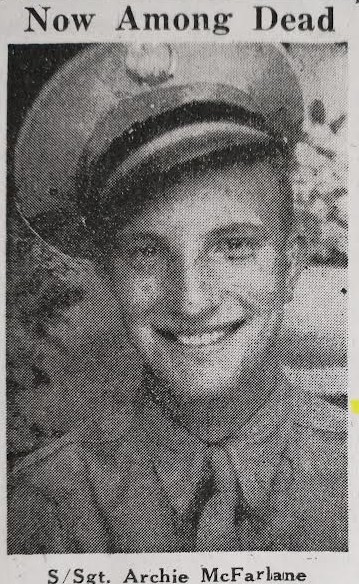
Above: An Alma College wartime wedding takes place for Norman Hearn and Winnona Clegg; the Seventh War Loan Drive met a lot of obstacles in Gratiot County; Sergeant Archie McFarlane of St. Louis was officially listed as killed in action, one year after he disappeared.
Heavy June rains dumped flooding on parts of Gratiot County, causing damage to farmers and homeowners. Interest and support for purchasing war bonds for the war effort now hit an all-time low.
In reality, war fatigue was setting in, even though Gratiot County just celebrated the defeat of Nazi Germany. Even though the war had ended in Europe, people learned that the rationing of many things continued indefinitely. Even while some Gratiot County men came home from Europe the news about the dead and wounded did not seem to end.
It was June 1945 in Gratiot County.
The Draft in June 1945
Although Europe started its second month of peace after Nazi Germany’s surrender, young men in Gratiot County continued to enter the draft. On June 6, sixteen men left for Detroit for pre-induction examinations. Another large group followed on two separate buses headed there on June 19 for induction. Several eighteen-year-olds made up this second contingent.
The news in Michigan now was that 48,000 men under age 26, who had previously been rejected for military service, now faced re-examination for probable induction into the armed forces. The State Selective Headquarters stated that ten to fifteen percent of these men would now be admitted due to lowered physical requirements. Previous factors such as flat feet, being underweight, teeth problems, or having hay fever, which formerly excused prior candidates, now could be assigned to duties with limited physical service.
Places like Ashley made a note of those who left the village that summer. On June 19, Paul Beck, Orville Ballard, Steve Paksi, Gerald Shaw, and James Vanek all now entered the service.
Rationing
Although the war in Europe was over, rationing in Gratiot County continued in June 1945.
The Office of Price Administration announced quotas of 2,000,000 civilian tires, but the tire situation remained critical as there still were not enough tires to go around for everyone. Early in June, the Gratiot Price Administration Board approved 183 applications, most of them being for grade one passenger tires. At the end of June, the board issued 242 certificates, but compulsory inspection of tires remained in effect for those who wanted new tires. Just purchasing a new car remained a dream for most people in Gratiot County as the War Production Board said that factories would only produce 691,018 new cars in the United States for the remainder of 1945.
Gratiot homemakers continued to feel the pinch of doing without certain food items. One of these areas dealt with sugar rationing. The price administration stopped issuing sugar in Michigan in late May when too many people applied for certificates for sugar canning. A total of 3,745 applications came in before the suspension of certificates, causing the board to issue a freeze on sugar rationing. By June 18, the county began to reissue canning sugar to eligible residents, but only in reduced quantities. The proposed June allotment of 42,325 pounds (later raised to 63,480 pounds) meant that many homemakers waited until July or August just to get sugar certificates.
Another food item, butter, also suffered from rationing. Some farmers in the county believed housewives saw butter as a luxury that they could not afford and protested about reduced butter purchases. With the increase of red points used for butter, women went for oleomargarine, which cost less. When oleo became scarce in stores, grocers had no problem having butter on hand. However, butter continued to go untouched, all because of raises in ration coupons for purchasing butter..
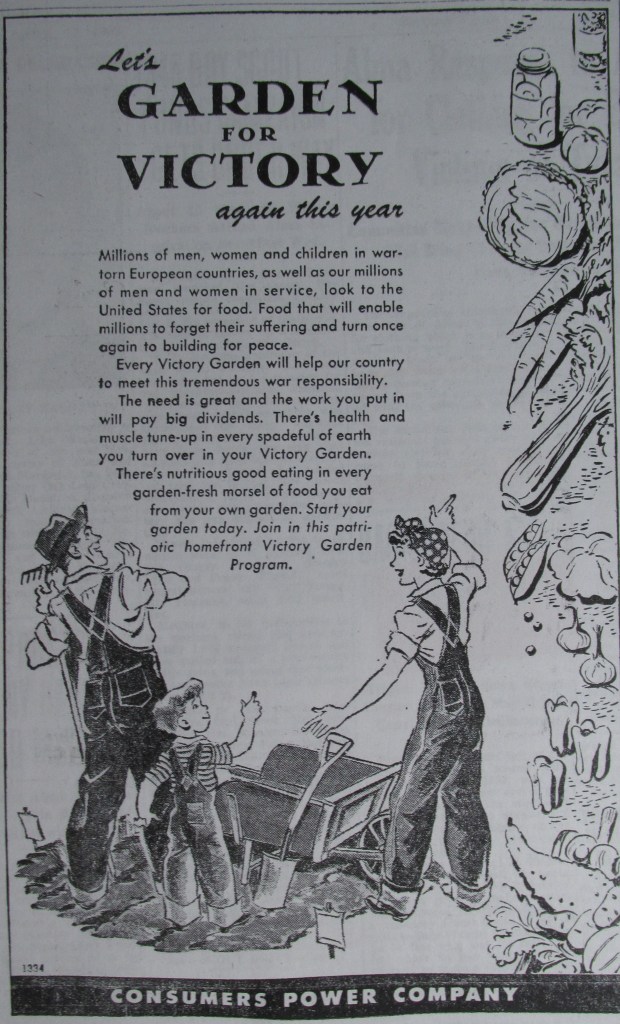
To prepare for the upcoming summer and harvest season, E.L. Mutchler, chairman of the Gratiot County Victory Garden committee, urged people to grow a Victory Garden. Concern spread that the country would not have enough of the right kinds of foods in the winter if people did not raise a garden. Seed dealers and vegetable seed salesmen said that sales were down as much as thirty percent from 1944, indicating that many in the county were not preparing for the anticipated food shortages.
Both tin and paper remained in demand, and citizens needed to do their part to recycle for the war effort. Alma, Ithaca, and St. Louis all had grocery stores designated as locations where housewives could deposit tin. Tin supplies reached their lowest level since Pearl Harbor. The public had to be careful in preparing and cleaning the container before dropping it off at designated locations. Boy Scouts did a tin and paper pickup in Alma on June 16. Boy Scouts in St. Louis held a similar drive at the end of June, picking up prepared materials from porches and curbsides. The Alma drive yielded 15,945 pounds of paper, and the tin went to a train car, which waited to accumulate a full load for when it would ship in August. Complacency and overconfidence about the end of the war in Japan were seen as reasons why more people in Gratiot County did not contribute to the two drives. However, five Boy Scouts received the General Eisenhower War Service Medal in Riverdale for each contributing over one thousand pounds of scrap paper during March and April 1945. Charles Smith, Gordon Hyde, Myron Sadler, Bernard Kellicutt, and Charles Langin were all recognized for their work. Twelve medals went to boys in Ithaca who had similar achievements. They included: Keith Vernon, Larry Trexler, Robert Simmet, Dale Vernon, Duane Vernon, Floyd Hall, Bob Pressley, Allyn Ensign, Donald Rinard, Bill Hill, Tom Haley, and Jimmie Rogers.
People with Gratiot County ties ran afoul of the law regarding rationing violations. Walter Girard, who worked in the Alma office of a Saginaw finance company, was indicted for trafficking in gasoline ration coupons. Girard worked for the OPA office as a chief investigator for the Saginaw area, including Gratiot County. In all, the men were charged with selling coupons amounting to 370,000 gallons of gasoline.
In another instance, Stella Daniels of Ashley took 1,000 live chickens and ducks to a farmers market in Hamtramck. Daniels planned to drop off her load of poultry for regular customers and sell her poultry at ceiling prices. A problem occurred when hundreds of other shoppers found out they could not purchase any of the fowl on Daniels’ truck. This food issue resulted in a stampede of women who knocked over empty poultry crates while demanding to make purchases. One man made off with the duck, but it was recovered. After things quieted down, a police captain notified Daniels that in the future, she could only sell her poultry to buyers who waited in line. If she wanted to continue honoring presales, Daniels had to have the poultry delivered beforehand and not brought to the market.
Bond Sales in Gratiot County
Newspapers still urged people to continue their support for the war effort by buying bonds. At the Puffer School, teacher Ruby Hoyt told the St. Louis Leader-Press that her students made their Defense Stamp goal of $250 for the school year. Her students also gathered up 2700 pounds of waste paper for rationing.
At the start of June, Alma achieved 84 percent of its quota for E Bond sales by purchasing $152,800 worth of bonds. A week later, the Gratiot County Herald announced that overall sales in the county were only at 39.7 percent of the county’s overall goal. People just were not buying war bonds, at least not at the rate that they did before V-E Day. A special bond show took place on June 19 at the Strand Theatre, in which those who purchased bonds could attend “Without Love,” starring Spencer Tracy and Katharine Hepburn. People who wanted to buy Bonds could do so in the Strand’s lobby. As the end of June approached, sales rose nearly to the 50 percent mark. A big factor in people not buying war bonds was that they believed the war was in its last stages with Japan after the defeat of Nazi Germany.
Farming in Gratiot County
As June began, Gratiot County encountered heavy rainfalls and flooding. Some farmlands in the county, such as sections 22 and 27 of Emerson Township, had up to 100 acres of cropland underwater, causing severe damage to farms as water submerged fields as well as gardens and basements. Despite this, Gratiot County’s agricultural agent, C.P. Milham, told farmers that they should prepare for a possible July and August drought.
Better news came to farmers who raised cattle in the county as the county AAA office offered payments to farmers who sought to increase meat production. Revenues amounted to fifty cents per hundredweight on choice cattle that weighed over 800 pounds. Gratiot County dairy herds did well with milk production. Supervisor Howard Kaufmann reported that tests on 347 cows in 26 different herds yielded an average of 34.4 pounds of butterfat. Kenneth McNabb of Ithaca had ten Jerseys heads that averaged over 50 pounds of butterfat.
Those who planted crops were warned about other potential problems in their fields. Farmers needed to be on the lookout for bean maggot damage, different types of mustard plants, and loose smut. The hay crop would probably be short due to the cold and wet weather. In better news, farmers found more farm machinery for sale on the market due to a broadening production of implements with rubber tires. More farmworkers were also available in Gratiot County under the Victory Farm Volunteers, which offer
offered young people work between the ages of 14-16. In an encouraging move, more youth turned in applications for summer work than had taken place in 1944. Farm wages were about double the amount paid early in the war in 1942.
Service Notes – Letters, People, Places
Letters from overseas continued to appear in the county’s newspapers. Some of the published letters appeared to be brief; others took up several columns of that week’s issue.
After spending a few days in Paris, France, Major F. W. Acton of Breckenridge told his mother that he was now in Northern Germany. Most of his letter described his visit to places like the Cathedral of Notre Dame. Most of the areas in Germany that he now saw reminded him of Northern Michigan with its trees and lakes. Corporal Doug Eastman wrote back to his wife and daughter in a letter dated May 25, 1945. He lamented the fact that he needed 13 more points to be discharged. Eastman said he had seen fighting with the 29th Infantry Division with the worst fighting near Julick, Germany. Private Leroy Brice of Alma served near Hamelyn, Germany, while convoying Russian civilians back to the Russian lines. Brice believed those in his convoy were happy to be headed back toward Russia because they were singing and shouting on the way to their drop-off point. Sergeant Victor Egres of Ashley wrote home to his neighbors. In late May, he was in Luckstedt, Germany, and thanked his friends for writing to him. Mail now was uncensored near Magdeburg, where the Americans previously fought Hitler Youth in a big battle. Egres worked as an interpreter, and he was surprised how much food the Germans had in that part of the country and the availability of Lugars and Mausers that the Americans picked up in trades. He was still sorry and moved by the number of friends he lost in the war against Germany.
Lieutenant Alfred McCuaig of Alma described his role as a Navy privateer based on Okinawa at sea. McCuaig’s plane sank a small Japanese oil ship near Shimona Island. Lieutenant Paul Snacker wrote home to his family that he was glad to hear that the war in Europe was over, “but I think some of the people back (home) are forgetting the Jap(anese).” Snacker planned on staying in the Pacific until the war ended. Corporal Leland Thum wrote to the family from his location in the Philippines. He appreciated seeing pictures from home, news of a family wedding, and he apologized that he could only send a Peso home in a letter for Mother’s Day. Merle Brauher of Middleton also was in the Philippines. Brauher told his sister that he expected the war to go on for a long time in the Pacific as “They will never give up. I have seen the Japanese blow themselves to death rather than surrender.” In one instance, Brauher tried to get a Japanese woman and her baby out of a cave, but he and his men had to kill a Japanese soldier before getting the civilians out. Brauher thought that Japanese children he encountered welcomed food and water and were generally unafraid of American soldiers. Corporal Bill Lapaugh wrote to his sister in Alma about how he enjoyed a fried chicken dinner in a Filipino home. The people there willingly traded food for cigarettes, soap, and other soldiers’ things. After almost seven months, Lapaugh got his Christmas package from Gratiot County. He was still thankful to receive it.
Private T.A. (Jim) Evey, originally from Sumner, wrote a long letter to his grandparents describing the intense fighting on Iwo Jima. Evey’s letter went into detail about his challenges on the front lines as he was in direct combat with the Japanese. The letter ended with him telling how he killed a pair of enemy soldiers after suffering a wound that put him in the hospital for five days. Elton Mills also wrote to his mother, describing how his fox-hole looked like a bathtub with the amount of rainwater that it had in it. The Army was trying to take the southern end of the island, and at times Mills got to sleep in a hammock.
While the war was over in Italy, Sergeant Elwin Gillis of Breckenridge described the farming areas around Foggia, Italy, as having wheat, oats, barley, all much like mid-Michigan farms. On one night, he went with a Major and flew in a B-25. In December, Private Glen Mutchler of Alma told his parents about his Bronze Star. Mutchler was amazed at the bread and wine that the civilians gave him as he passed through villages. The bread, which was whole grain and tasted good, was very hard. Some men in his outfit chipped their teeth while trying to eat it. Private Charles Allen of Alma told his parents that he had been in Italy only eight months, but he had been in Milan where he saw Mussolini’s body. “He sure was a mess and a few others with him. I will tell you about it when I get home,” Muchler added. Allen said he was growing tired of eating eggs but welcomed the wine.
Private Edwin McGillis described his experiences driving truck supplies in France, especially in the Cherbourg area on D-Day. McGillis drove over 100,000 miles on two trucks during his service in Europe, which involved seven countries. He thanked GMC for such well-built trucks. Lieutenant Harold Fandell of Alma served as a pilot on a B-24 Liberator with the 8th Air Force. Fandell and his cinnamon-colored cocker spaniel (named Buddy), which Fandell got for $52 from a London pet shop, appeared in a photograph. Lucky became the good luck mascot of Fandell’s outfit.
Where are Our Servicemen and Servicewomen?
Sergeant Andrew Gager of Middleton served as a mechanic with the Eighth Air Force Fighter Command in England. Gager worked on P-51 Mustangs. Staff Sergeant Willard Holton of St. Louis now served in the 9th Army of Occupation in Europe. Sergeant Georgiana Peet received the Certificate of Merit at a ceremony in Marseilles, France. She had been overseas for 21 months in Africa, Italy, and Southern France. Lieutenant Thayer Rayburn of Ithaca served with the 340th bomb Group, 12th Air Force during the Battle of the Brenner Pass in Northern Italy. In late May, Sergeant Willis Clark of Ithaca received the Bronze Star Medal for service in the Infantry Antitank Company, 101st Airborne. Clark was cited for his work with a mine-laying platoon. In one such instance, he and another officer found two minefields and neutralized dozens of mines along a vital road in enemy territory. In the end, Clark and his men removed 1,780 mines. Corporal Doyle Plank of Alma and Private Kenneth Cross of Ithaca continued to serve with the 12th Air Force in Italy. They were with a force that flew tactical support for ground forces in that theater of the war. Private Francis Burkett of St. Louis served with the 36th Division troops of the 7th Army, which crossed the Siegfried Line and saw bitter fighting in the city of Hagenau. Private Romaine Oswald returned to Miami, Florida, after 38 months as a truck driver in the Southwest Pacific. Oswald was a farmer from St. Louis. Lieutenant Lester Fenner, also from St. Louis, was still in Italy. He had been transporting jeeps of soldiers from Genoa to the East Coast. Fenner had been engaged in serious action near Mt. Gard and thought he would not survive at one time. Corporal Jerry Jeleneck of St. Louis received the Bronze Medal for his efforts in the Fifth Army front in Italy. Jeleneck was a radio operator with the 604th Field Artillery Battalion of the 10th Mountain Division. He received the Bronze Medal for laying wire lines during three days of heavy fighting against the enemy. Corporal Fred Terwilliger of Alma served with the 101st Airborne and made it to Berchtesgaden, home of Hitler’s Eagle’s Nest. He received the Bronze Star for heroism during fighting on Christmas Day against the Germans. Private Nester Higgins of Alma received the Silver Star and two French decorations for gallantry of action on March 20, 1945, at Ensheim, Germany. Higgins showed courage and gallantry in action when he held off an enemy attack upon his company’s position with only his Browning automatic rifle. His efforts allowed his company to withdraw safely from the area.
Lieutenant Colonel William Kyes of Elwell continued his work as pilot of a B-24 Liberator in the India-Burma Theater. His group knocked out its 100th Japanese bridge in late April. Steve Lacko of Ashley wrote to his mother that he received his Christmas box that she packed for him. It only took eight months to reach Lacko, but the fruit cake was the best he had ever eaten. Seaman 2/c Robert Wiles of New Haven Township was aboard a ship somewhere in the Pacific. Wiles enlisted in late July 1944 and had attended Great Lakes Training Center. In the Western Pacific, D.L. Karpal of the United States Navy fought aboard the USS Indianapolis. While the ship saw action at Okinawa, the Indianapolis was attacked by the Japanese while on the way home from delivering the Atomic Bomb. Brothers Oliver and Floyd Miller of Ithaca were both on Iwo Jima. Oliver was a United States Coast Guard member, while Floyd was a radio operator with the Army Signal Corps. After serving on the USS Franklin, Seaman Myron Humphrey wrote home to his parents. Humphrey was picked up at sea by the USS Pittsburgh during a battle in March. He was now on Guam. Private Philip Bolinger of St. Louis fought off bees and a Japanese enemy attack with the 31st Infantry Division on Mindanao in the Philippines. Bolinger and his platoon were caught in the open and had to fight off over 200 Japanese soldiers for thirty minutes, most of whom came at Bolinger and his men with only fixed bayonets. “In this half-hour, the Japanese were less effective than the bees,” one report said. Jack Cutshaw, water tenders second class, was aboard the USS Hancock when it downed 71 Japanese aircraft during a raid over Tokyo. The USS Hancock saw action at Okinawa, Iwo Jima, and the Philippines. Private Carl Denman of Alma served in China, where he trained Chinese soldiers for combat. Denman had been in Burma for almost one year before this. After many bombing missions over Western Europe as a bombardier navigator, Lieutenant W. Robert Wagner of Alma came home on a 30-day leave. He expected to end up in Sioux Falls, South Dakota, with his unit as they awaited orders. Lieutenant Ralph Scheifley came home to Alma on a week’s leave. Scheifley spent fourteen months on a minesweeper, and he received the Bronze Star for his work in landing supplies in Southern France. Fireman Russell Murphy and Seaman William F. Brown, both of Alma, completed amphibious training in Virginia. Murphy had already been in the Pacific, and Brown had seen action in Southern France. News came that Private Doris Hall served at the 25th WAC Hospital Company at Percy Jones Hospital in Battle Creek.
POW, WIA, KIA
Those who had been Prisoners of War under the Nazis either began their journey home or had just arrived back home. Lieutenant John Ellis Mix of Alma had been in a German POW camp since being captured on January 2 in Belgium. He wired his parents about his arrival in Boston, but he did not know when he would be home. Sergeant George Mahin, Jr. of Elwell, was liberated on May 3 in Austria after 13 months as a POW. He was expected home soon, according to the United States Adjutant General. Private Ted Barton of North Star had been a POW since December 26 and now returned to the United States Military Control on May 7. Private Irwin Morey of Wheeler came home in mid-June after spending nine months as a POW. Sergeant Claude Murdock came home to Perrinton on June 16 about the same time as Morey did. In late May, Murdock wrote a letter home to his sister explaining that he was slowly recovering from significant weight loss due to his time in a camp. When he got home, Murdock received a sixty-day furlough.
Sergeant Herb Whitaker of Ithaca was expected home after telephoning his parents from Standish, Massachusetts. Whitaker spent 2 ½ months in four different German camps. He had been shot down near Coblenz, Germany, while onboard a B-17 heading for Dresden. Lieutenant John Barden of Ithaca, who was home, told the Gratiot County Herald about his experiences as a POW. He spent almost exactly one year in German camps after his P-51 went down over Nordhausen. After being moved to Frankfort and then Sagan, Barden noted that he was marched toward Nurenburg and Mooseburg, where he was eventually liberated on April 29. Finally, Private Anson Foster of St. Louis came home on June 1. He had been taken prisoner on September 1 in Italy and spent time in Moosburg Camp and the Memmingen Prison. He also received a sixty-day furlough.
News continued to arrive about the many Gratiot men who were wounded while in the country’s service. Corporal Mike Mikula of Elwell suffered severe wounds to his right eye and face while in battle at St. Lo, France, in June 1944. He remained a patient at Wakeman General Hospital in Camp Atterbury, Indiana. After 240 liquid meals, five operations, seven hemorrhages, 106 shots of penicillin, and a pound of sulfa drugs, Mikulka now felt well enough to walk the 7 ½ miles of halls in the hospital. Mikula wrote, “…I am so glad I lived to see the Nazis defeated, and I do wish a similar disposition of the Japanese.” On Christmas Day, Private Ivan Coleman, Breckenridge High School graduate, suffered an eye injury and then a body wound in France on February 27. Coleman arrived in New York City after being in hospitals in France and England. Private Elsworth Tissue of Ithaca was wounded on Okinawa in late May. Fortunately, the wounds were not serious. Private Joe Kelly of Ashley suffered injuries from a Japanese thrown hand grenade on Okinawa. After surgery, he was on his way to a hospital in the United States.
Fireman First Class Earl Weaver, Jr. of Lafayette Township, was wounded aboard a ship hit by a Japanese suicide plane on May 1 after leaving Iwo Jima. Weaver was sent to another ship, but his wound was minor. Sergeant Virgil Nelson of Perrinton was wounded on May 20 while on Luzon. He had been overseas since September 1, 1944. Private Inel Townsend of Alma also received slight wounds while on Luzon with the United States 25th Infantry Division. Robert Rich of St. Louis received his discharge from Percy Jones Hospital on May 10. Rich went through four operations that left him with a three-inch stub of his left arm. Lieutenant Elder Thrice of Alma, who was now at Cheb, Czechoslovakia, had been wounded three ties, with the last wound coming on May 7. He was recovering and up and moving again. Private Marvin Haas of North Star was treated in Chickasha, Oklahoma, for wounds he suffered in Germany on February 7.
The news of those men who died in service to Gratiot County hit families and communities the hard during June and made their way into county newspapers. Sergeant John Townsend received the Bronze Star Medal after his death near Dancola, Luxembourg, on January 10. Townsend was buried in the United States Military Cemetery at Hamm, Luxembourg. His wife, Faith, received notice of her husband’s award from President Truman.
St. Louis residents learned that Private Melvin Thrush, who had previously been reported as missing in action in Italy on March 7, was now given up as dead. He left behind a wife and three children. Sergeant Archie McFarlane had previously been listed as missing over the English Channel while in an air raid over France. Strangely, another member on McFarlane’s plane was Alma’s, Sergeant Marvin Fenner. Both men had been missing for almost one year. One of the rare moments during the war was when two local Gratiot men served aboard the same plane, only to lose their lives in the same incident.
The Haag Family in Sumner was shocked to learn that their son-in-law, Private Ralph Rud, died of wounds he suffered on May 7 while fighting on Luzon as a member of Michigan’s 32nd “Red Arrow” Division. He died one week before his 26th birthday, leaving a wife and three daughters. Staff Sergeant Harold Bruce Phillips lost his life in a plane crash near the United States Marine Corps air station in Santa Anna, California. Phillips was on a routine flight and was headed back to land when a pilot in another plane lost sight due to fog. The two planes hit each other, and Bruce could not bailout. Phillips lived close to the Sumner area and graduated from Crystal High School in 1936. Before becoming a Marine, Phillips served nine months in the Canadian Army in 1941. Upon entering the Marine Corps, he saw action at Guadalcanal, Solomon Islands, and Bouganville. Along the way, he was wounded twice in the legs and suffered from malaria. Upon return to the United States, he married the nurse who cared for him in the South Pacific.
In Elwell, a Sunday School there dedicated its opening worship service to four boys who had paid the supreme sacrifice. They included: Willis LaPaugh, Marcus Steele, Howard Mahin, and Earl Langworthy.
And So We Do Not Forget
Planning for summer softball action started in Alma. Six Alma city teams played slow-pitch three nights a week on Mondays, Wednesdays, and Fridays at Conservation League Park. The United States Naval training station at Alma College planned to invite other fastpitch teams to play on Tuesdays, Saturdays, and Sundays. Fastpitch softball played under the lights, but games would not start until July…Leonard Refineries planned to market petroleum-based products after the war concluded. Only minor adjustments were anticipated at the plant to move from wartime to a civilian-based economy…Breckenridge High School’s graduating class of 1945 said goodbye on May 31 at the high school. Seven members were already in the service…The National Housing Administration-approved fifteen new dwellings in St. Louis. Under the quota, ten family dwellings could be built for sale and another five for rent…A new heating system, drinking fountain, new bathroom facilities, and redecorating the interior of the building were all planned at the St. Louis community center building…The Blue Star Mothers of Breckenridge sponsored a skating party at the Crystal skating rink. The group also planned a Father’s Night at the Methodist Church. Families were encouraged to bring pictures of their sons who served the country in the service. The chapter also bought two more $100 bonds…The veterans’ counseling center in Ithaca continued to see more activity as returning men from the service for advice and help with any questions they had while returning to life in Gratiot County…Easter Seals sales raised a total of $1,134.00 in the county. The sales took place through county rotary clubs and public schools.
The city of St. Louis received permission to drill a well at the corner of Corinth and Prospect streets north of the Pine River. One well in the city was down, and two others had been reconditioned…Heavy weekend rains fell upon Gratiot County in early June, resulting in a “freshet” which did damage but was heaviest along the Gratiot County-Saginaw County lines. Water reached the running boards of vehicles in some places…C.D. Sailer of 701 Michigan Avenue, St. Louis, had an egg laid by his Leghorn hen that measured 8 1/8 inches by 10 ½ inches around. Sailer found out that there was one normal-sized egg inside the larger one…Two Alma boys were caught and charged for siphoning gas out of Alma cars at the rear of the Chevrolet garage…George Kemp of Alma paid the price for leaving his car parked with the keys in the ignition. His Plymouth Coach, parked at Smith Memorial Hospital, came up missing early one Sunday morning. Kemp and the police found it a few hours later, parked in the spot where he left it. Joyriders returned the car…Most Alma merchants all agreed to close their stores on Thursday afternoons starting at noon for June, July, and August…Central Michigan College of Education graduated 124 students. Three belonged to Gratiot County: Katherine Kasel, Jessie Becker, and Orthelia Elaine Miller…Large numbers of children flocked to the second summer of activities put on by the Ithaca Recreation Department. On an opening afternoon, 135 children came to the sessions and 235 participated on the first full day. Coach Hiram Becker was the director. A wading pond for children in the village would be available later in the summer on the school grounds…Pompeii planned to play the Saginaw Colored Yanks in a baseball game. The Saginaw team consisted of players from the Saginaw Black Sox and Yankees…The Associated Women of the Gratiot County Farm Bureau held their first annual banquet at the Park Hotel in St. Louis. A group of 135 women enjoyed a duck dinner…Alfred Wolansky became the manager at the Merrill Plant of the Michigan Bean Company. Before this, Wolansky managed the Wheeler Plant of the Breckenridge Farmers Elevator…The Happyland Shows brought “sensational riding devices” to Alma under the sponsorship of the Alma Leslie McLean Post Veterans of Foreign Wars.
Ithaca Postmaster Clyde Daniels retired after nearly 45 years of service in the postal system. Daniels started out as a clerk working before and after school sorting mail…A Correlated Migrant and Vacation school program debuted in Breckenridge at the high school. Three Breckenridge churches helped provide food for lunches for the children. Miss Merle Wildman and Miss Rawlings came to work among the Mexican children…The Gratiot County Fair was planning to take place July 17-21. Harness racing would be coming back…The State Highway Department announced plans for widening one mile of US-27 in Ithaca, along with US-27 south to the southern city limits of St. Louis. There was also word that the highway from Main Street east to M-46 also would be improved…The Ideal Theatre in Ithaca featured “Eadie Was a Lady” starring Ann Miller and Joe Besser. Saturday was matinee day at 2:30 p.m…A new modern bowling alley with five alleys was planned to open in Ithaca in the fall above the Kroger Store in the Arnold Building. Four of the alleys would be used for team play, the other for open bowling…A tragedy occurred in New Haven Township when three-year-old William Eugene Bollinger was killed in a small brooder coop. The boy was killed instantly when the top door of the brooder fell on his neck while he tried to return an injured chick to the coop. Services were held for the boy at New Haven Center Church…Fifteen Sowers children surprised Arlan Edgar on his birthday…The Alma City Commission voted to purchase a new fire truck for approximately $10,000.00. The commission also voted to spend $685 in order to electrify the old clock in the city hall tower…Summer arrived in Alma on June 21, featuring temperatures of 77 degrees by 3:00 p.m. There was no rain on the first day of summer…The Breckenridge Public Library received $48.83 in a check from the State Board for Libraries. The library met its certification qualification for 1944-1945, and local tax support had been maintained for the library…Summer band took place at Ithaca Public Schools under the direction of William Ladd. The program planned to take over four and possibly as long as eight weeks. Junior bands started practice at 8:00 a.m…Doctor Thomas Carney of Alma left town for a week’s vacation at the old Carney homestead in New York, going by boat from Detroit to Buffalo…The St. Louis wading pool soon opened for children. So far, a cold, wet spring had dampened interest in the pool. However, several people applied for the job of pool supervisor…The Alma City Commission announced tentative plans for a new roller skating rink in Alma. Max Creaser of Lansing appeared before the commission to ask for a lease to start construction on the new rink near the west bank of the river south of the Superior Street Bridge…Finally, a Sadie Hawkins party on June 15 at the Alma Community Center. Prizes would go to the girl and boy best dressed as Li’l Abner and Sadie Hawkins.
And that was life in June 1945 during Gratiot County’s Finest Hour.
A key leader and visionary of the St. Louis Christmas bell displays was Dr. C. J. Bender. During Christmas 1969 Bender helped his neighbor, Mrs. Emma Frost, to hang her Christmas bell. At that time, it was estimated that St. Louis had 150 bells.A look down a St. Louis street (probably Delaware Street) in early December 1971. The bell population was said to number 300.Christmas bells line Saginaw Street at Christmas 1972.
It began with the dream of having an “Avenue of the Bells” and grew to become “Belltown USA.”
In the early 1960s, St. Louis, Michigan, was known for its displays of Christmas bells during the Christmas season. No other town or village in Gratiot County had as many red and white Christmas bells on display at Christmas as did St. Louis. The Christmas bells showcased a sense of holiday spirit and community participation for over a decade.
Starting in the early 1960s, the St. Louis City Council encouraged more residents to decorate their homes for Christmas. The council offered a plan where residents received free electricity to display fifty or more lights, put spotlights on three or more outdoor figures, and use at least 500 watts of electricity. This offer did not cause a resident to pay more for their December electrical bill than they did in November. All St. Louis residents had to do was call or write city hall to participate.
In 1961, Dr. C.J. Bender, a chiropractor, school board member, and mayor of St. Louis, suggested that residents create an “Avenue of the Bells” after some neighbors started hanging bells under their shade trees on East Saginaw Street. A total of 48 bells debuted that Christmas, most of which appeared up and down the street. It would be Dr. Bender who had the dream of having St. Louis known for its array of Christmas bells.
The growth of the Christmas bell displays was slow during much of the 1960s. However, by 1969, eight streets in St. Louis had 150 bells, including a cluster of five bells that hung overhead at Mill and Saginaw streets. Suddenly, more people wanted bells – and the supply, which came from Bronners in Frankenmuth – soon sold out. One of the problems was that residents waited too long to order the plastic eighteen-inch bells, which operated with a 100-watt bulb. It seemed that most people failed to plan when orders came out for the bells in the fall.
Regardless, demands for having more Christmas Bells in St. Louis continued to grow. For Christmas 1970, 61 new bells went up due to Girl Scout Troop #208’s work, which distributed order blanks in the city earlier in the fall. When the bells were gone, the City Council told residents to plan for an early order of 100 bells in the fall of 1971.
The bells for that Christmas in 1971 cost $20 each if people purchased in bulk, or $25 apiece. With an October deadline, people could put $5 down and pay the difference upon arrival. The St. Louis City Council purchased another 100 bells, which brought the city’s “bell population” to 450 as the displays now reached out into the Westgate subdivision and up into Orchard Hills.
By Christmas 1972, St. Louis had 500 bells as 80 more bells went up for the holiday season. By this time, residents could observe the display of bells that lined all four corners of the city park. After parking their cars, St. Louis High School basketball fans who sought to attend home games walked past the bells on and along Saginaw Street. The bells, which also lined the park, moved as if they were ringing as high winds and snow blew across the city park on a game night. It seemed that the display of the bells near the high school coincided each year with the start of the Sharks basketball season. At this time, the Christmas Bells also found their way along Washington Avenue (M-46).
By 1973, the St. Louis City Council and the St. Louis Jaycees promoted St. Louis as “Belltown USA.” From August to September, approximately 100 people placed orders for bells. The Jaycees offered to pay $3 toward each bell sold, while the buyer put down $5 and paid the balance when the bells arrived.
Although St. Louis residents continued to display their Christmas bells for many seasons to come, the early to mid-1970s was the high point for the sales. The first Energy Crisis, which came along in 1974 and hit America, causing sharp rises in gasoline and electricity costs, probably affected interest in purchasing and displaying more Christmas bells.
However, because of a visionary like Dr. C.J. Bender, many people would hang their bells outside at Christmas for years to come. What started as an avenue of Christmas bells on Saginaw Street eventually spread across St. Louis, Michigan, making the city a place to see during the holiday season.
Today, the question remains – just how many original bells still exist in St. Louis?
Author’s note – On the evening of December 22, 2021, I made a trip through parts of St. Louis to see how many bells St. Louis still had. Once I entered the city limits from State Road, I immediately saw four bells (1 appeared to be an original). Delaware Street from east to west had five bells (2 originals). I found bells in Orchard Hills (2), Westgate (4 bells – 2 original), and three on M-46 (all in the south window of Kubin’s Furniture). The city park was surrounded by approximately 20 bells (all newer designs), and a nice Christmas tree. So, I counted 38 bells in the city, 13 of them look like the originals. However, my journey did not cover all of St. Louis, and I am sure that there more this Christmas. Look for the bells.
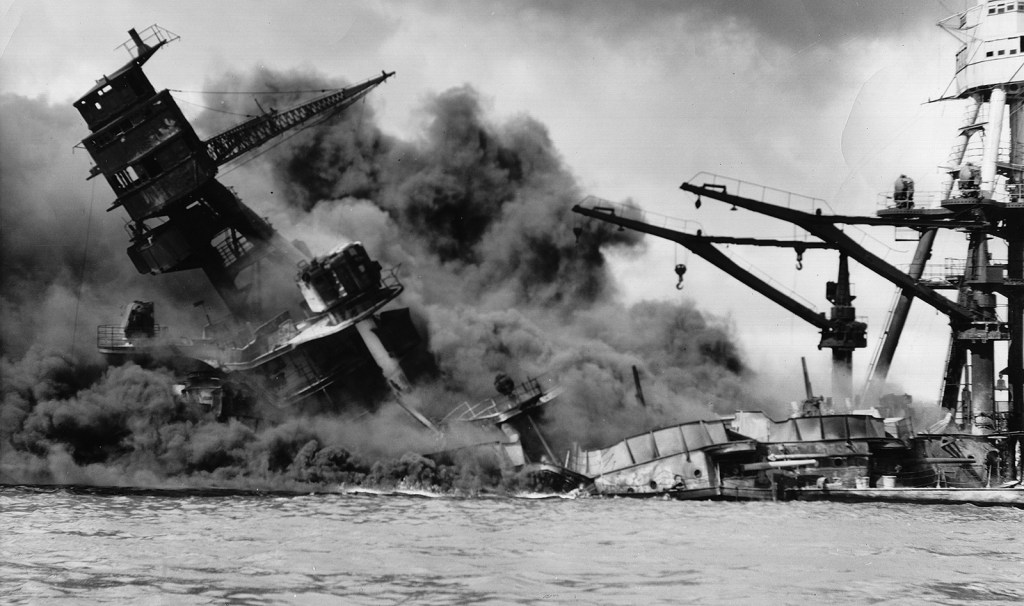
The Japanese attack at Pearl Harbor on December 7, 1941, devastated the American naval fleet and led the United States directly into World War II.
The following article first appeared in the Gratiot County Herald in December 2018.
Eighty years ago on December 4, 1941, it was a “Window Night” in Gratiot County, which marked the start of the Christmas shopping season in the towns of St. Louis, Alma, and Ithaca. Businesses stayed open late with lighted store windows. That weekend at the Strand Theater in Alma, viewers watched a musical movie entitled “Chocolate Soldier.” Over at St. Louis, the Boy Scouts helped the national defense effort by hosting a paper drive. A representative from the Public Works Reserves explained to the St. Louis City Council how they could eventually adjust from wartime to a peacetime economy. These events all took place in Gratiot County just days before the Japanese attack on Pearl Harbor. After December 7, the county, like the rest of America, was never the same.
As news of the attack arrived that Sunday, “general indignation” best described residents as they discussed what they had learned. Within hours of the attack, a previously scheduled group of 46 selective service men left for induction at Fort Custer near Battle Creek. Starting December 8, the telephone at the draft office in Alma rang repeatedly. Men who had previously changed their addresses now notified the office about how they could be found to join the military. Some men above the age of 28, who had been previously excluded from selective service because they were too old, now wanted to know how to enlist. In the first wave of men who immediately volunteered through the Alma office, fifteen joined the Navy, twelve went into the Army, while others headed to Lansing and Saginaw to enlist there. The Gratiot County Red Cross announced the week after the attack that the county needed to raise $5,100 for the national fund. Women wanted to sew and knit for soldiers and servicemen at the Alma Red Cross office.
Local families worried about the fate of their sons in the aftermath of Pearl Harbor. One of these involved Mervin DeMott of Pompeii, who was stationed aboard the US Dunlap. Within a week of the attack, DeMott wrote to inform his family that he was safe but he could not say more. Also, his Christmas presents had been mailed home. Marine Corporal Dale L. Peters of Breckenridge was stationed at Wake Island during the Japanese attack, along with former Ithaca resident Private Charles D. Sagash, who was at Corregidor.
Gratiot County readied itself throughout December. Leonard and Mid-West Refineries hired extra guards and put up fences around their plants to protect against sabotage. For further protection, the companies required fingerprints and photo identification buttons for employees. The Gratiot County clerk announced a huge demand of birth certificates took place in Ithaca because those wanting work in industrial plants needed one in order to apply for a job. Amateur short wave radio operators in the county had their licenses suspended for fear of sending messages to the enemy. County firemen underwent defense training for handling bombs and volunteers throughout the county learned how to provide basic Red Cross first aid. Lobdell Emory announced that it had received subcontracts for the defense effort, but for security concerns could not acknowledge exactly what it would be producing.
As December ended, citizens continued united in their response to the Pearl Harbor attack. The St. Louis City Council purchased $20,000 in Defense Bonds. In Alma, twenty county men quickly joined the National Guard Unit. By Christmas, one of the first painted “V” for Victory Signs appeared in the east window of the Alma Main Cafe.
The Seaver Hotel in Ithaca, Michigan as it looked in the late fall of 1971.It was a cold day in early January 1972 – but many curious and serious bidders sought to claim a piece of the Seaver Hotel. “In came the bidders.” Auctioneer Joe Helman prepares to sell off the items to the highest bidder from inside the Seaver Hotel.
Author’s note: This article first appeared in the November 11, 2021 issue of the Gratiot County Herald.
Fifty years ago in Ithaca, a landmark, known for its “Down on the Farm” chicken dinners, closed. Owners Gale and Mildred Irwin sold the Seaver Hotel ending decades of operating in Gratiot County.
The hotel’s history went back to 1890 when it opened under Joseph Seaver, an Ithaca businessman. Before World War I, a room could be rented for two dollars a week. In 1943, the Irwin’s purchased the Seaver Hotel, and it became a popular travel destination with thirty rooms and its famous chicken dinners. The hotel also became a place where several businesses got started in Ithaca. Dick’s Studio began its business in the basement shortly after World War II. At other times, a railway office and an insurance agency had offices inside the hotel. Several barbers worked in a room on the first floor over the years. Tony Sanchez first opened his shoe repair shop in the hotel, which was the last outside business in the hotel.
A surprising bit of news became public on November 2, 1971, when the Ithaca City Council announced the purchase of the Seaver Hotel for $35,000 as part of an urban renewal project. No tax monies were used as money came from the Gibbs Memorial Savings Account, a source of funds given to the city by Norton and Laura Gibbs in 1958. To further promote the deal, the city council promised residents that any future funds obtained from the sale of the hotel and lot would go back into the Gibbs account.
For the Irwin’s, it was a time to sell. Gale Irwin suffered from health problems, which ended the offering of chicken dinners and forced the Irwin’s to only rent rooms. For Ithaca, the purchase of the hotel meant it had a lot that measured 99 x 165 feet which was only a short walk from the new city hall and an anticipated new city library.
The Irwin’s faced a July 1972 deadline for closure, but first, there had to be an auction sale to dispose of the many items in the hotel. It turned out to be a big one. On a cold day, January 21, 1972, a capacity crowd came out as auctioneer Joe Helman sold off the hotel’s furnishings. People eagerly bid on items, and soon everything inside was gone.
Clearing the lot, removing the Seaver Hotel, proved to take a bit longer. The city council authorized city manager Lloyd Peters to raze the building, level, and fill in what had been the basement as soon as the weather permitted. By January 1973, a picket fence encircled what remained of the first floor, which became a target for graffiti. However, a month later, the hotel’s final remains were cleaned up and gone.
The hotel’s sign stayed, existing as the Chamber of Commerce’s bulletin board. The sign reminded people of events like voting in the state primary elections and the coming of a new downtown mall. On March 23, 1973, Gale Irwin was injured in an accident on U.S. 27. Irwin, a World War I veteran, passed away three days later.
A city parking lot now sits on the southwest corner of Center and Pine streets in Ithaca. Today, the lot hosts seasonal events and the farmers market, which takes place under a newly built pavilion. The sale and dismantling of the Seaver Hotel starting in late 1971 officially ended a business from Ithaca’s past.
Front Page of the Gratiot County Herald on May 2, 1918.Herman Wittig as he appeared in the Gratiot County jail on the afternoon of April 28, 1918.The Kimball Family marker as it looks today in the Ithaca Cemetery.Location of the northern half of the Wittig Farm as it looks today in Lafayette Township.
In the spring of 1918, residents were shocked by the murders of five people at the hands of Herman Wittig. The incident, subsequent arrest, and conviction of Herman Wittig went down in Gratiot County’s history as one of its quickest murder trials.
The Gratiot County Herald quickly deemed the Wittig murders an “affair to be one of the most gruesome in Gratiot County’s history.” The killing of a husband, wife, and three children took place in a dispute over money.
Herman Wittig
The crime centered aroundHerman Wittig, born in 1881 in Lafayette Township, the youngest of six children. His parents, Robert and Theresa Wittig, came from Germany, settling as farmers in Lafayette Township. After Theresa Wittig died, Herman purchased forty acres of land from his father in 1906 for $1400. When Robert died, the Wittig children appeared in probate court in 1914 to deal with their father’s estate. After an Ithaca teacher translated Robert’s letters, Herman Wittig emerged as the administrator by the court’s decision.
Soon after the hearing for his father’s estate, Herman Wittig farmed in Lafayette Township. Wittig’s name appeared in the news again in 1915 when he tracked down a neighboring chicken thief, Bard Seeley, who raided his chicken coop. Wittig followed the tracks of the robber, uncovered the remains of his butchered chickens, and then reported the incident to the Gratiot County undersheriff.
By one record in 1917, he owned 120 acres, three horses, and a cow. It also was a time where one’s German background could be suspect due to Germany’s role in the World War. Herman Wittig’s relative, Henry Wittig, operated the “Wittig Race Track” in that part of the county. In this place, horse races, wagering, food, and moonshine took place on a Sunday afternoon.
The Kimball Family
One couple, Willard and Cora Kimball, encountered hard times, needed work and a place to live. Despite his money and property, Herman Wittig needed help on his farm. The Kimballs and their three children lived in Port Huron, Michigan, before arriving in Gratiot County. Willard, age 28, had a generally good reputation there while operating a window cleaning business. However, after the United States entered the war, the Port Huron Draft Board wanted him to answer questions about possible induction into service. Despite all of this, the Kimballs made their way west and ended up in Gratiot County.
Life was not easy for the Kimballs. Once they arrived, they ended up on the farm working for, and staying with, Wittig. Local farm families, such as the Federspiels, brought food to the Kimballs to have enough to eat. A newspaper reported that the Kimball family “lived off the bounty of their neighbors,” allowing the Kimball children to visit neighbors regularly for food. Later, news appeared that Gratiot County officers investigated Mr. Kimball for not supporting his family financially. While staying with Herman Wittig, Cora Kimball kept house for him, and her husband did odd jobs such as fixing Wittig’s car.
Soon, Wittig -the bachelor- owed his visitors money, and the Kimballs wanted to be paid. It was then that a conflict erupted.
Five Murders on a Sunday Morning in Lafayette Township
On Saturday, April 27, 1918, Herman Wittig first went to a store, came home, and then decided to go crow hunting. Wittig did not feel well, later saying that he hunted to clear his head. Was Wittig drunk or upset for conflicts with the Kimballs? He visited his neighbors, the Bolbys and the Schermers, who invited Wittig in and offered him a meal. By 11:00 that evening, Wittig stumbled home and made his way upstairs, and soon fell asleep. Before going into the house, he threw his shotgun out of sight in the haymow in the barn. A newspaper later reported that Wittig had a drinking problem, and he had probably been drinking for several days.
As there would only be one surviving witness to the events in Lafayette Township, we have only Herman Wittig’s version of what occurred next.
Wittig was up at 7:00 the following morning, as were the Kimballs. They immediately continued their argument with Wittig over money that they believed was owed to them. Willard and Cora had approached Herman Wittig before about being paid for their work. Cora argued that she was owed five dollars a week for keeping house. Willard Kimball repaired Wittig’s car at the cost of forty dollars.
Herman Wittig marched toward the barn, leaving the house in haste and attempting to ignore the Kimballs again. Willard Kimball followed Wittig toward the barn while demanding payment and calling Wittig an obscenity. When Wittig reached the barn, he retrieved his sixteen gauge shotgun and warned Kimball to come no further, or he would shoot.
Kimball ignored the warning, continuing to demand money from Wittig. At a distance of ten feet, Wittig turned, aimed, and pulled the trigger, hitting Kimball on the left side of his head and neck. In Wittig’s own words, “Kimball dropped to the ground like a dog.” Cora Kimball witnessed the shooting and hid within the house. Wittig then dragged Willard Kimball’s body into the garage and covered the body with a horse blanket. In the process, Wittig emerged with a substantial amount of blood on his clothing.
Wittig later claimed that he waited approximately ninety minutes before entering the house. Once inside, Cora Kimball, shocked by witnessing the murder of her husband, defended herself with a butcher knife. She then hid with her three children inside their first-floor bedroom. Cora failed to make it out of the bedroom as Wittig pointed his shotgun at her and fired, blowing her head to pieces. Wittig also gave Cora a deep cut on her neck, thought to be with a knife or gun.
In the process of shooting Cora Kimball, the oldest child, Clarence, age seven, tried to defend his mother. Wittig hit the child with his gun, crushing his head. Wittig then strangled the two youngest children, Charles, age four, and Louise, age two, in their beds. Five Kimball family members now all lay dead on the farm of Herman Wittig.
Wittig then left the farm and wandered off into the neighborhood. Around noon, John Federspiel, a nearby farmer whose family gave food to the Kimballs, showed up on the farm. The Federspiels looked for young Clarence Kimball, who usually came each day to pick up food donations. On that Sunday, Clarence failed to appear. Curious because of how quiet it was on the farm, Federspiel tried to locate the Kimballs and Wittig. As he looked through the window of the Wittig house, he saw Cora Kimball’s body on the floor, next to one of her children. Federspiel immediately left and called Sheriff Bradford from Ithaca.
Sheriff Bradford, Deputy Clarence Wheeler, Prosecutor O.L. Smith, Coroner Will K. Ludwig, and Doctor C.E. Burt soon arrived at the Wittig farm. Although they were horrified by the deaths of Cora Kimball and her three children inside the house, the men were unable to locate Willard Kimball. Finally, Sheriff Bradford and Coroner Ludwig forced opened the locked garage where they found Willard Kimball’s body.
The question now was, “Where was Herman Wittig?” Word came to Sheriff Bradford that Wittig was at the Boyce Farm. While on his way there, the sheriff soon ran into Herman, who was returning home. When confronted with the killings, Wittig denied all involvement. Still, his tone changed after being questioned about a large amount of blood on his clothing. Wittig then confessed his crime but said he only killed the parents, denying anything about the children’s deaths. Later he stated that he did not intend to kill the children and did not remember doing so. What surprised the sheriff and the group from Ithaca most was that Wittig showed no sorrow or remorse for what had taken place on his farm earlier that morning.
A Long Sunday in Jail
Shortly after noon on Sunday, April 28, it was only a few hours since Wittig murdered the entire family. With his confession, Herman Wittig was immediately put under arrest and taken to the Ithaca jail. While in his cell, a stoic and unemotional Herman Wittig talked to a reporter of the Gratiot County Herald about what he did. Wittig also signed a full confession for the sheriff.
Orville Bowers, a photographer in Ithaca, drove out to the Wittig farm and took pictures of the murder scene. The photographs, one which showed the two youngest Wittig children dead in bed and another of Willard Kimball on the garage floor, appeared on the front page of the Gratiot County Herald. These pictures were among the first from a murder scene to be published on the front page of a Gratiot County newspaper. Bowers also took a shot of Herman Wittig while he was in jail on that Sunday. Wittig wore a late winter coat, appeared unshaven, hair uncombed, and stared blankly at the photographer. This picture of Wittig seemed to tell readers that he had little guilt or remorse for the murders that he had committed.
Swift Justice, A Life in Marquette Prison
The following day, Monday, April 29, 1918, at 10:00 am, Judge Moinet halted the infamous Beatrice Epler trial proceedings to focus on Herman Wittig. Because of the Epler proceedings (a trial that involved a young girl’s death in Alma and a house of ill repute), it would take something drastic to pause the Epler case. The Wittig Murders did just that.
As Wittig came to trial on Monday morning, some quickly pointed out that he was from a German family (America was now at war with Germany) and had substantial property. Another newspaper feared mob violence could soon erupt in Gratiot County over justice for the murdered Kimball family.
Herman Wittig’s confession, combined with his apparent lack of regret or remorse for what he did, made Judge Moinet’s job easy. Because Cora Kimball died in self-defense, Moinet believed that Wittig should be judged for second-degree murder. The Gratiot County Herald said that “the testimony and confession regarding the woman (Cora Kimball) did not certainly justify a decision of first-degree murder.” Moinet decided Wittig was guilty of second-degree murder and gave Wittig the maximum penalty – life in prison in Marquette Penitentiary.
Around noon on Monday, April 29, Herman Wittig found himself heading north toward Marquette. It would be a long journey in 1918, one in which there was no bridge over the Straits of Mackinac. The trip caused Wittig and his guards to spend one night in northern Michigan. On Tuesday, April 30, 1918, at 3:20 pm, Herman Wittig officially became a part of the prison population at Marquette Penitentiary, all within 72 hours of his crime.
Wittig in Prison
A few notes and photographs concerning Herman Wittig’s prison record exist today. Wittig’s picture showed that he finally got a shave when he entered Marquette, and he appeared in an open-collared shirt and coat. As in all of his photographs, he seemed severe and stoic. Wittig stood 5’ ¼”, weighed 145-150 pounds, had blue eyes and dark chestnut hair. Upon entering prison, Herman Wittig was only 36 years old.
The prison took pictures of an older Herman Wittig on March 13, 1941, and September 17, 1946. He appeared in a dress shirt, tie, and overcoat, with balding hair in both cases.
Herman Wittig met his maker on April 7, 1950, inside the hospital of Marquette Prison. He died from cancer of the stomach and liver and a heart valve problem. The time of death was 8:10 am. There are no records of any specific incidents involving Wittig in Marquette, nor is there any written correspondence he may have had with anyone. Wittig, age 69, never left the prison alive.
Results of the Kimball Murders
The remaining story of the Kimballs is as sad as their deaths. The death certificates on Willard and Cora Kimball state the cause of death as “murdered with shotgun” (Willard) and “murdered by Herman Wittig with shotgun” (Cora). Two different undertakers worked with the bodies, and two other burial places may exist today.
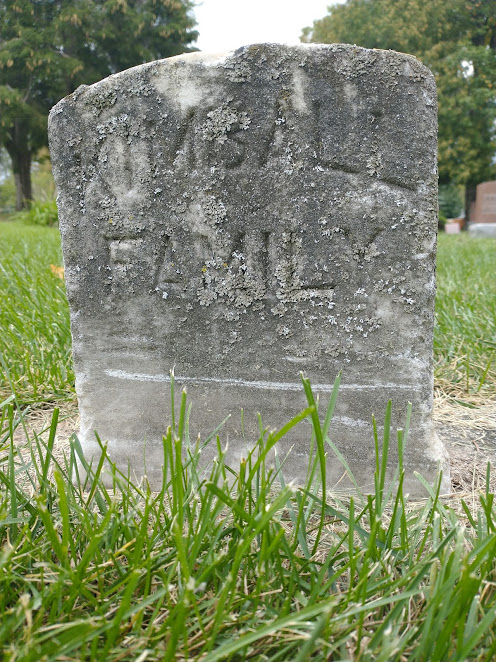
One source says Willard Kimball and a son are buried in Lafayette Cemetery, while Cora and two children are in Ithaca Cemetery. One wonders why the family might have been separated after their deaths. Cora’s informant was from Detroit; Willard’s was in Potterville, Michigan. Still, the family may be in a single plot in the Ithaca Cemetery, but it is hard to tell. In that cemetery, the only evidence that the Kimballs were in Gratiot County is a tiny, chalk-colored marker, which faintly reads “Kimball Family.”
Sheriff Bradford had a problem after the murders in finding family members. However, it is unclear why the Kimball family may rest in two different county cemeteries.
At least one member of Willard Kimball’s family was in the news in response to his brother’s death. William Kimball was arrested in Lansing on May 2, 1918, for disorderly conduct for window peeping. However, the police deemed William Kimball to be “temporarily demented” as a response to the death of his brother. Upon arrest, William Kimball carried a roll of newspapers and photographs of his brother’s murdered family.
Legacy
Today, the Wittig Murders stand as one of the most gruesome mass murders in Gratiot County’s history. During the spring of 1918, Because residents fixated on another high-profile murder case in Alma in 1918, the Wittig murders did not achieve a place in the county’s long-term memory.
Instead, in our county’s history, this murder case represents one of the quickest times between a crime, its judgment, and subsequent punishment – amounting to less than 72 hours.
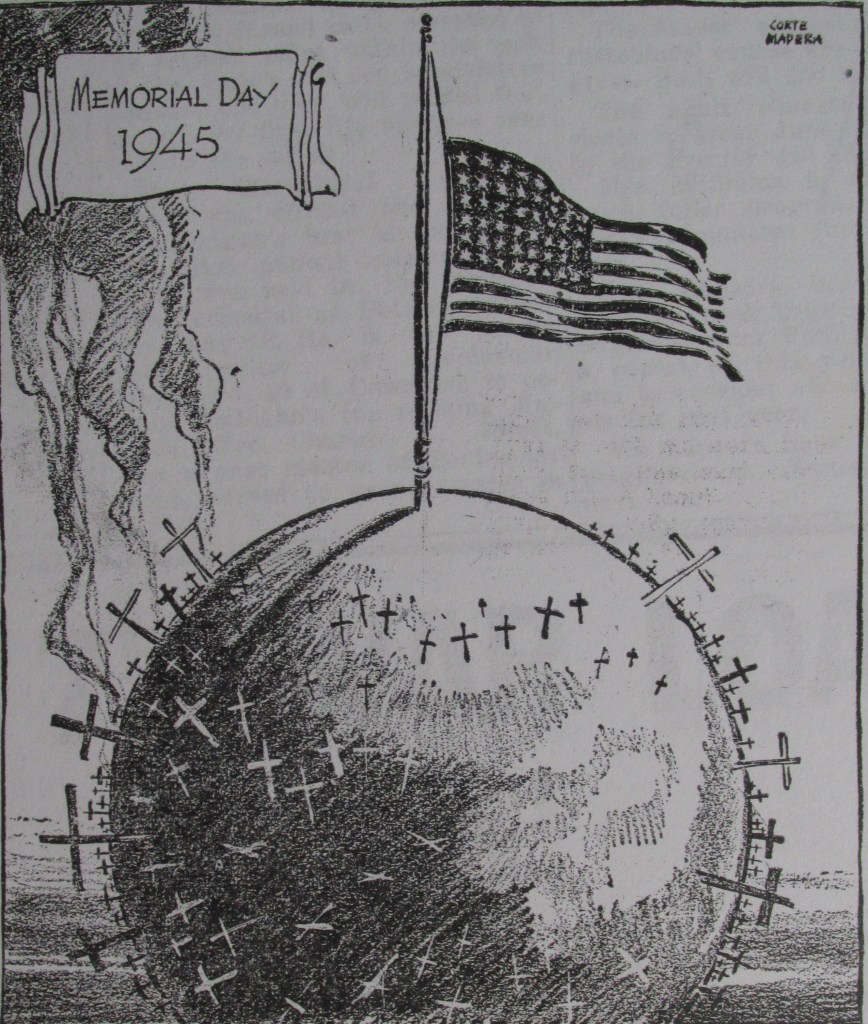
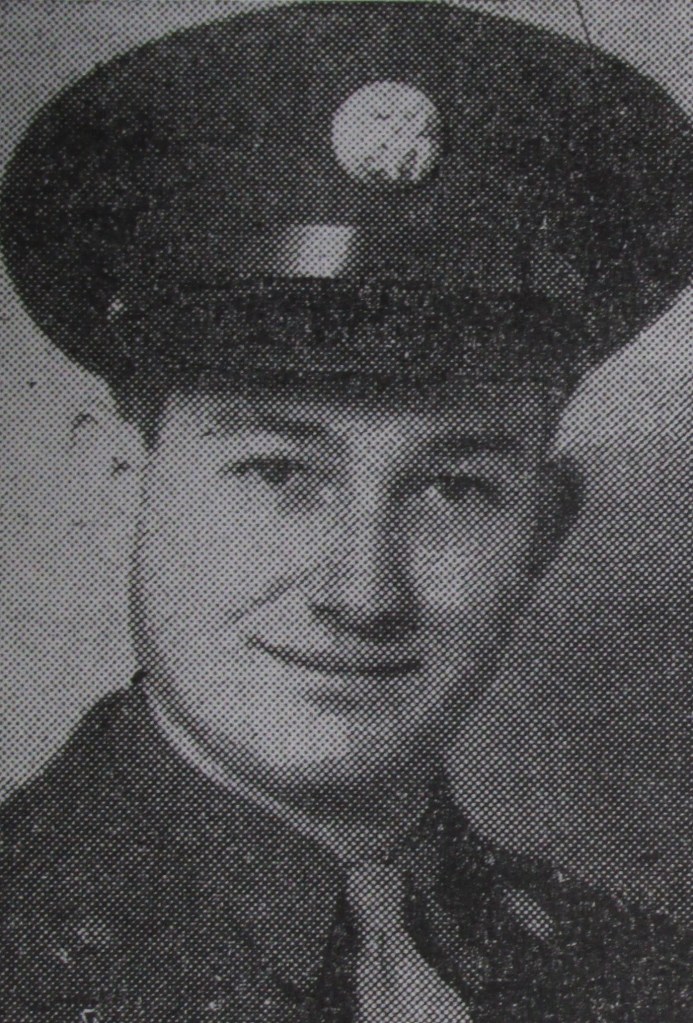
Above: Memorial Day 1945 and 7th War Loan advertisements from the Alma Record; Sergeant Melvin Lutz of St. Louis was one of several Gratiot County men whose deaths became news in May 1945 in the Gratiot County Herald.
After almost 42 months to the day since Pearl Harbor was bombed and the United States entered World War II, Gratiot County learned about the end of the war in Europe. Nazi Germany unconditionally surrendered on May 8, 1945.
However, May was still a month of the war. News of those who died fighting for the county continued to come from Europe. There were more calls for the county’s residents to buy bonds, engage in rationing, and keep Gratiot’s farms running.
In a moment, Gratiot County and the war ended in one part of the world, but its effects continued.
V-E Day Arrives in Gratiot County
By early May 1945, it was not a question of how Nazi Germany surrendered but when it would occur. Towns like Alma announced the news by using a loudspeaker on the city’s streets. People were urged to be calm, go to church, and remember that only one-half of the war had ended. Defeating Japan and ending the war in the Pacific was still down the road.
Newspaper announcements on the day of Germany’s surrender emphasized the need for gratitude for the end of the European war. News of Hitler’s death, followed by the surrender of German armies to both the Western Allies and the Russians, soon spread across the county. Businesses closed in Alma, as did the city schools. The Courthouse in Ithaca locked its doors for the day. However, the county rationing office remained in operation. Parades in St. Louis and Ithaca moved through the streets, celebrating the end of Nazi tyranny in Europe.
Flags also flew at half-mast in honor of Franklin D. Roosevelt, the President who died in April and who failed to see the war’s end. Mail delivery stopped, and 560 people attended services at Alma’s Methodist Church. Across Alma, most church doors in the city were open to the public on V-E Day for those who desired meditation or prayer. In compliance with President Harry Truman’s plea, industries kept working, and the President issued a proclamation making Sunday, May 13, 1945, a national day of prayer.
Bonds
The Seventh War Loan Campaign started May 14, and the county’s goal was to raise $772,000 in E Bonds. It soon was apparent that sales goal would be hard to attain. After one week sales amounted to only fifteen percent of its target. The city of Alma initially purchased $28 709 in bonds, most of which came from industries. Even schools helped out. Out at the Mull School, Marguerite Brown reported that her students purchased $97.25 worth of defense bonds and stamps. Students at the Mull School were also active by decorating fifty Easter napkins, making ten wash clothes, purchasing $2.00 worth of items for a refugee box, and giving $2.50 to the Junior Red Cross.
Movies made the rounds in the county as a way to encourage residents to purchase bonds. “Action in Anguar” and “Mr. and Mrs. America” were shown at the Pine River Farm Bureau program to encourage people to buy bonds. Two Alma College students, Apprentice Seaman Robert Shelp and Stanley Brink, introduced the movies. When sales at the end of May slowed in Gratiot County, readers of newspapers could easily see the advertisements that read, “Pour out your might in the Mighty 7th – Buy bigger bonds and More of them.”
Rationing, Rationing, Rationing
The Office Price Administration announced that another shoe ration stamp would arrive on August 1. Sugar rationing took a hit when the OPA said that the new yearly rate for sugar would now be fifteen pounds per person, down from twenty pounds. Lard was no longer worth ten points per pound.
Coal rationing would be cut to 80 percent of regular seasonal allotments for the 1945-1946 coal season. Buyers had to make their decisions for coal by May 15. At the May 3 meeting, the Gratiot rationing board issued 84 tire certificates, most going to Grade 1 tires. Boy Scouts in Alma planned to do a waste paper pickup in Alma on June 16. Previously on May 18, no copper wire would be issued for the remainder of May and all of June. While the county had discontinued power line extensions to farms, farmers who had electricity no longer had to worry about watching their use of electric lights for their animal units.
Tin cans remained essential for the war effort because Japan controlled 98% of the world’s tin supply. Both chain and independent grocery stores placed receptacles for tin deposits for people to drop off before entering the store.
Farming
As May arrived, farmers were already hard at work in the fields and farms in Gratiot County. Reports from Saginaw said that farmers would have an ample supply of farm labor for the 1945 farm season. Already 11,500 farm workers had been allocated to get help for the early farm season. Of these, 6,000 Texas Mexicans would arrive to block and thin beets. One group of 425 workers arrived in mid-May to work in mid-Michigan fields, with another 2,500 expected by June 1.
The United States Army continued to promise that 2,000 German prisoners of war would also be available again for farm labor, with a total rising to 6,000 POWs for Michigan, Illinois, and Indiana. Help was seriously needed in Michigan as 33,390 acres of sugar beets had been planted as of May 12.
Schools again encouraged students to help by working on farms. The county agricultural agent worked to place Gratiot County students with needy farmers. Students were urged to come forward and ask how to help local farmers.
Some bad news took place when a stiff spring frost followed a warm spring in Gratiot County, damaging wheat, alfalfa, and some fruits.
Sheep dipping in Gratiot County got off to a slow start due to the cold weather. A demonstration took place at Reo Sievert’s farm near Washington Center, and Guy Whittaker also hosted one on his farm in Hamilton Township. More farmers were dipping sheep at home this year rather than drive and transport flocks, probably due to gas rationing.
Farmers could get their dairy feed payments until June 1 in Gratiot County. Soybean farmers received price support of $2.04 per bushel for green and yellow soybeans. Effective May 13, area farmers had to register with the War Price and Rationing Board if they gave away or sold their meat. As a rule, farmers received a quota of dressed meat that they could sell each quarter. However, all meat sales had to be reported to the local board by the 15th of the month after each quarter. The shipping of eggs to England now changed from sending shelled eggs to dried eggs, as Europe now needed an estimated 10 million pounds of eggs overseas.
All farmers were urged to keep their tractors in the best working condition due to the war, and farmers needed to conduct a spring checkup on all equipment.
A Michigan State College farm expert, Karl T. Wright, reported that Michigan farmland prices were on the way up, with farm real estate prices 54 percent higher than before the attack on Pearl Harbor.
Things that continued to remain scarce for Gratiot farmers included copper wire, tires, and lumber. Fertilizer was expected to be more available in the future, but not until after the 1945 farm season ended.
The Draft
Even though America and its allies had won the first half of the war, there was little let-up in Gratiot County’s drafting of men. A group of fourteen men was inducted into the Army in early May, with a busload of 26 men leaving the county a week later. Several Alma men were in the group, including Gilbert Jones, Loren Humphrey, Verne Todd, Earl Peterson, and Alfred Mephan. All but two of the men entered the Army; the other two went to the Marines. Still, changes were coming in the draft. Men over the age of thirty were deferred indefinitely while fathers over 29 were now given sympathetic consideration. This included approximately 30,000 older men in the state. More than 2,300 Michigan men who would have been inducted in May and June now received temporary reprieves. A new p
point system soon allowed 1.3 million men to leave the United States Army if they accrued a total of 85 points to get their discharge. General Eisenhower said that he wished that men who had served in North Africa and Europe would be designated to remain in Europe in the Army of occupation rather than being sent to the Pacific.
In other Gratiot County draft news, Richard D. Gay resigned as chief clerk of the Gratiot County draft board due to health reasons. Gay had served for over three years, and Mrs. Gertrude Lokey now planned to replace him as chief clerk. Gay had previously replaced Lyle Whittier in the summer of 1942.
Service
Men and women who served Gratiot County appeared in the news.
Flight Officer Robert Medler of Alma received an Air Medal for meritorious service while serving aboard a B-17 in the 493rd Bomb Group. He had been in a group that successfully bombed a Messerschmitt factory in Regensburg, Germany. Sergeant Russell Howe of Breckenridge was part of the 101st Airborne Division when the division received a Presidential Citation for heroism and gallantry for the defense of Bastogne in December 1944. Sergeant El Jay Wyeth of Elwell served with the 298th Engineer Combat Battalion near Zwiefall, Germany in October 1944. Wyeth saw the enemy laying communication wire only 100 yards away from him, left the safety of his position and crawled to the wire, then cut it. His actions allowed his unit to hold its position for seven hours until support arrived. Sergeant Arland Murphy of Alma received his fifth Bronze Star for being in battle in five campaigns within the European Theater. He recently crossed the Rhine River with elements of the 17th Airborne Division. Corporal Thomas Cavanaugh of St. Louis received the Bronze Star for service with the 610th Ordinance Base while serving in a maintenance group. Cavanaugh’s mother, Adele Cavanaugh, kept St. Louis and Alma readers aware of the names of local boys through a column she wrote in those newspapers.
Sergeant Bernie Eagon of Alma was involved with the 8th Air Force when it dropped tons of food to civilians in parts of Holland. The Hollanders wrote messages like “Thank You” on the tops of their houses and waved flags while hoping for food and supplies. Eagon saw how German soldiers ducked beside trees when his plane went over. Corporal Harold Stadleberger of Sumner and Sergeant Maurice Pearson of Ashley belonged to the 609th Ordinance in England. Stadleberger served as a truck driver and Pearson as an automotive mechanic. Corporal Otto Christensen was with a Graves Registration Company somewhere in Europe. From Alma, he was the manager of Packard Store in town. The Gratiot County Herald featured a picture of three Carter boys from Breckenridge, Corporal Wayne Carter (Army), Bill Carter (Marines), and Lieutenant Clifford Carter (Navy). All were featured on the front page. Clifford was somewhere in the Atlantic, while Bill served in the South and Central Pacific. Private Steve Hanus of Ashley helped another soldier from the 260th Infantry captured Germans while near the front in Germany. It was odd because both Hanus and his compatriot were cooks who took an afternoon off in an attempt to round up enemy prisoners. It worked when their first captured German was told he would not be killed if he told his fellow soldiers to surrender. They did – all eleven of them, but Hanus was shocked when they got back to camp, and the eleven were identified as French prisoners that the Germans had once held. No one expressed any hard feelings, and they all parted ways. Private Walter Thrush of Ithaca arrived in Austria as the United States Third Army moved from Ansbach toward Hitler’s Redoubt, liberating Allied prisoners and capturing over 14,000 Germans. Sergeant Kenneth Brown of Alma, a 491st Heavy Bomb Group member, flew seven combat missions. He had been in the Army for thirteen months and operated as a turret gunner aboard a B-24. Private Charles Marrin of Alma left for Camp Meade, Maryland, after a twelve-day leave. He entered the service in December 1944 and finished training with the Armored Division at Fort Knox, Kentucky.
Out in the Pacific, Private Elwyn Hill, an Alma High School graduate, helped establish the Okinawa beachhead. He had been there one week with the 96th Infantry Division but then had to be hospitalized with jaundice. Billy Newson of St. Louis was only seventeen when he enlisted in the Navy, and he was now a carpenter’s mate in San Diego, California. Newson was assigned to the USS Kalinin Bay. Garfield Harris of Alma received an air medal for service as a radioman-gunner on a carrier-based dive bomber. Harris saw action in the Marianas, Philippines, Carolinas, and Formosa. Harris was also one of 100 Navy men who were invited to attend breakfast at a USO club on Mother’s Day. Each man received a personal letter from their mother.
Seaman First Class Richard Carter of Ithaca was aboard a ship that spent four days close to the Japanese mainland. Carter’s flat top sent waves of carrier planes into Japan for bombing missions against the Kyushu and Honshu Islands. Herbert Wright of Alma was one of three Michigan men on a 26 man patrol on the small Philippine Island of Glan. The group worked as a reconnaissance unit of the 31st Division and spent time with the people, whose women all wore special dresses, sponsored a special barbeque, and allowed the Americans to ride horses. George Divish of Middleton was promoted to Ship Serviceman-Laundry Third Class on May 1. Divish came home on a thirty-day leave in March but now was back somewhere in the Pacific. Motor Machinist George Mitchell of Ashley, age 39, was reassigned to the Atlantic Fleet’s Minecraft training center at Little Creek, Virginia. Mitchell previously served twenty months in African waters, then six months sea duty in the Southwest Pacific. Machinist Mate 3rd Class Charles Dolloff of Alma returned to Navy duty after a thirty-day leave. Dolloff and his fellow crew on a destroyer survived a Japanese suicide bomber’s attack. Dolloff had previously seen combat in several places such as Attu, Saipan, Guam, Tinian, and the Philippines and the invasion of Iwo Jima. Private Dan Davis of the United States Marines saw the fighting on Iwo Jima. Davis slept the night in his clothes before the attack and watched the bombardment before Marines went ashore. After two days, Davis went ashore as part of the reserves and slept along a ridge with caves. Davis later wrote his wife that he fought his biggest enemy to fulfill his duty, which was his fears. Corporal Bill Stewart of Alma also was on Okinawa. He wrote his wife about living in Japanese houses, watching the native women doing heavy work, carrying bundles on sticks across their shoulders. Corporal Leo Hoffman from St. Louis appeared in a picture on the front page of the May 24 issue of the Alma Record. He was among the first aviation men to land on the beach to help the Marine aircraft unit and served as an ordinance man. Captain Gordon Netzorg of Alma met his cousin, Sergeant Richard Soule, on Kwajalein, one of the Marshall Islands. The meeting took place when Netzorg’s plane stopped for refueling. Lieutenant Jack Redman continued to send long letters home to his family from his post in India. Netzorg now had his bearer who did his sewing, shoes and provided for his personal needs. Soldiers rented bicycles for $1.50 a week, however, sanitation was terrible everywhere, with malaria and smallpox being very prevalent.
Women from Gratiot County also continued to serve. Miss Beryle Virginia Bauer of Riverdale became a second lieutenant in the Army Nurse Corps. Bauer graduated from Grace Hospital School of Nursing in Detroit and was now assigned to Camp McCoy, Wisconsin. Private First Class Esther Bott from Breckenridge joined the Air WACs in late 1944 and now was in Alaska after being stationed in Great Falls, Montana. Private Edna Webb of Alma received the Good Conduct Medal for service as a WAC. She graduated from Alma High School and was a parachute inspector at Romulus Army Air Field. Ensign Betty Miller from Ashley passed her physical examination at Great Lakes and was on her way to Portsmouth, Virginia, to enter hospital nursing. Prior to this, Miller became a Registered Nurse at Hurley Hospital in Flint.
Finally, Sergeant Merle Chapin of Ashley became Gratiot County’s first veteran to be released from the Army on its new demobilization program. Sergeant Chapin was home on leave from the African and Italian war fronts. He was among the first 2500 men to come home to civilian life under the point plan.
The War-Time Initials: WIA, MIA, KIA, POW
The Wounded: WIA
While news about the number of Gratiot County’s wounded seemed lower in May, several men still suffered from the effects of the fighting. Sergeant Merton Peacock of St. Louis arrived at Percy Jones Hospital in Battle Creek, and his family members drove down to see him. One of five Peacock sons in the service, Merton, was wounded in Belgium in January after he had returned to duty from suffering earlier wounds. Private Leland Troub of North Shade had been injured in April while in France. Troub was now in a French hospital after being hit in the shrapnel in the hip. Private Hugh Cole, who had been in Italy for over two years, was seriously wounded in action. Cole was responding to treatment and was said to be recovering normally. Another Gratiot soldier, Lieutenant H.M. Dickinson of Middleton, also had been wounded in Italy and was now in the hospital. He had been with the 34th Division of the 5th Army in Italy for over 14 months. Private Berfield Acker of Alma, while serving in the infantry on Okinawa, took a Japanese bullet through his back and neck. Acker, who had previously seen campaigns in Attu and Leyte, wrote home to tell his parents about his condition. Lieutenant Robert Ankney of Alma wrote home that his luck “ran out” on April 25 on Okinawa. Ankney was evacuated after being hit in the leg and under his right eye by shrapnel. He was aboard the USS Comfort when the ship was hit by a Japanese suicide plane. A short distance from where the plane crashed, Ankney said a wall in his ward was caved in, but Ankney was unhurt. Private Enterline from Sumner Center had been wounded on Okinawa with the 383rd Infantry. His wife Doris received word that her husband had been wounded on April 4, but no other news was available. Private Kenneth Dancer of Wheeler was wounded in the hand while in Germany, but Dancer said it was not serious. He served with the 10th Armored Division and had been overseas since September 1944. Private Lorne Loomis of Alma was hospitalized in England after receiving wounds received in Germany on April 12. He had been a milk truck driver in Alma before entering the service. Private Joseph Nixon of Alma received the Purple Heart for wounds he got while taking German prisoners to an assembly area. He was now recuperating at the 127th General Hospital in France.
Those Who Paid the Ultimate Price: KIA
More details came in about Private Robert Oberlin, who died in Luzon while with the 187th Glider Infantry. His commanding officer wrote to Oberlin’s parents that he died while fighting at Mount Macolod and that he had been killed by enemy shellfire. Tech/5 Ernie Earegood of St. Louis died March 8, and a letter from his captain arrived in St. Louis. Earegood was killed near Lintfort, Germany, on the Cologne Plain, near the Roer and Rhine rivers. An enemy artillery shell hit the house Earegood lived in at the time, and he had been buried in Margraten, Holland. Private Fay Hopkins was killed on Luzon on April 12. Hopkins attended Alma Schools before he moved to Big Rapids. Private Dale Gelston died in Southern Germany in late April, and his funeral took place in Highland Park, Michigan. Previously wounded and hospitalized after being in Europe for only 16 weeks, Gelston was interred in Germany. His father had once been a pastor at the Presbyterian Church in Alma. Private Raymond Myers of Breckenridge died on April 11, and his memorial service took place in Wheeler. Myers saw action on D-Day in Normandy, went through Holland, and had entered Germany when he was killed. Sergeant Anthony Bajena from Alma died from scrub typhus in New Guinea. The news shocked his family as Bajena had been overseas 38 months with the Coast Guard Artillery Corps when he died. Before entering the service on May 5, 1941, Bajena worked at the waterworks in Alma. Equally shocking was the news of the death of young S/2c Cardwell Hoard of Ithaca. Hoard went to sea in early June 1944 aboard the USS Bunker Hill, but he came home for a short leave in December. Hoard died when his ship was hit by a Japanese suicide plane, and his body was buried at sea. Sergeant Walter Moore of Alma died in action in early January in France with the 12th Armored Division. Moore had been previously listed as missing until his wife received a telegram from the war department telling her that they now announced that Moore was dead. Information was learned about Corporal Oren Patterson’s death in early March after he crossed the Remagen Bridge. One day after crossing it and establishing a position, an artillery shell killed him. Patterson had been overseas only three weeks. Sergeant Melvin Lutz of St. Louis was killed on April 18 in Germany. He had been reported as missing. Lutz served in the 104th Infantry and was engaged to his girlfriend on her seventeenth birthday. The couple planned to marry as soon as Lutz returned home. Finally, after five years in the service and having only suffered minor facial wounds, Sergeant Hugh Rodenbo was killed in Germany in a motorcycle accident when he collided with a truck. Rodenbo was married to Phyllis Franks, a British ATS girl, and they had a daughter. Rodenbo was buried in a temporary American cemetery.
They Were Released: POWs Lieutenant William Gorringe of Alma, a POW since February 24, 1945, had been liberated from a German camp. John Ellis Mix of Alma was released from the Moosburg POW camp. A National Guardsman, Mix had been missing in Belgium for three months until his wife learned of his capture. Sergeant James Rockefellow, formerly of Alma, sent home an exciting letter to his grandmother concerning his liberation. He was now getting three meals a day and having a good bed to sleep in while being in a Belgian hospital and recovering from an infected foot. Sergeant Nolan Howe of Breckenridge sent word that he had been released. Howe was reported missing in September 1944. Private Paul Paulson was among some of the first Americans liberated from a German camp who arrived home in Gratiot County. His wife and daughter had been staying in New Haven. Sergeant John Kupres celebrated his liberation on April 25 by sending a letter to his parents. He wrote, “It is sure nice to be back with the Americans again and eating good food after having been a prisoner of the Germans for what seemed like ages.” He added, “I was so glad to see the Yanks who liberated us that I cried.” Private Marshal Mockridge’s mother received the good news that her son was now free. Although now in a European hospital, Mockridge let the people in Wheeler know that he was okay. Sergeant James Grosskopf of Alma was freed. He had spent more time in a German prisoner of war camp than many other Gratiot service members. Grosskopf, born and reared in Alma, was captured after his B-17 went down in a raid over Emden, Germany, and he had been a POW sinc
since December 11, 1943. “All well and safe. Hope to see you soon,” was the message sent via the Red Cross by Lieutenant Dale Beery of St. Louis. His wife had not heard from him since Christmas when a note arrived from Stalag Luft 111. Lieutenant Beery had not yet seen his young son. News about the safety and liberation of Johnnie Gall of St. Louis reached his family. On August 9, 1944 – six months to the day he left St. Louis for training camp and his daughter’s first birthday – Gall was reported missing in action in Europe. A telegram from Gall did not say where he was, but this was good news for his family. Information about other Gratiot POWs also appeared in county newspapers. Sergeant George Jenkins (Breckenridge), Sergeant Herbert Whittaker (home not listed), Sergeant Edmund Moreno (Arcada Township), Private Jack Little (North Star), Private Irvin Morey (Breckenridge), and Sergeant Dean Button (Alma) also were POWs who had been freed. Their families now planned and hoped for a quick reunion in Gratiot County.
And So We Do Not Forget From May 1945
At Fulton Schools, Norma Downing was Valdictorian and Doloris Litwiller was Salutatorian for the Class of 1945. Downing planned to work at Bordens in Perrinton after graduation while Litwiller planned to attend Lansing Business University in the fall…”A Song to Remember,” starring Paul Muni and Merle Oberon played at the Strand Theatre in Alma. Admission was 12-35 cents, tax included…Michigan school districts could expect an additional $7 per pupil in state aid for the next school year…Dr. Richard Waggoner spoke to Gratiot County nurses on the topic of “Caudalanesthesia” at the home of Mrs. Albin Rademacher…the Gratiot County Council of Veterans Affairs was told that 80,000 Michigan men would be discharged with the ending of the war in Europe. Living quarters, emergency counseling, and returning men to work were all issues that Michigan faced in 1945…Chapter 108 of the Blue Star Mothers met May 1 in North Star. The group raised $1.50 through a contest of discovering who had a dime hidden in their piece of cake…Alma was in process of locating a new city water well as the test well drilled at Delaware and North streets was found to be inadequate. The next location to drill would be on the east side of Alma…Workers at the St. Louis Creamery delayed a strike and continued their work when employees and management agreed on a date for an election. Workers voted 16-6 to delay the strike. A week later, employees voted 22-3 in favor of joining the American Federation of Labor, Teamsters Union…Arthur Dietz, who operated the City News Stand in Alma for 23 years, sold his business to Kenneth Carter. The News Stand resided at 222 ½ East Superior Street…
A county TB clinic was scheduled on May 29 at Alma Junior High School. Anyone who wanted to be x-rayed needed to call Miss Cecil Wolfe, Alma public health nurse, just telephone 211…the Alma Commission decided that the city needed a new fire truck – and preferably two. The anticipated cost for both would be $7,000 -$10,000…A total of 107 Alma seniors graduated on May 31 at Alma High School…Various war souvenirs appeared in the north display window at the Alma Consumers Power Company. Privates Lester Higgins and Nolan Conrad sent home German knives, bayonets, a German flag, and other articles from Germany. An elaborate German officer’s uniform appeared on the display of the window of Star Dry Clears on East Superior Street…The first Lobdell Emery employee to receive a paid vacation for the summer was Private Donald McGillis, Jr. McGillis came home on his way to Fort Meade, Maryland, on a ten-day furlough…Starting July 1, all newspapers mailed to men in the Navy, Marines, or Coast Guard must be wrapped in a specially marked wrapper. This new rule planned on conserving shipping space…The Gratiot County Board of Supervisors acted upon its new plan to meet monthly. A total of 18 standing committees reported to the supervisors…A fire and explosion destroyed a large tool shed and its contents that belonged to August Neitzke in Breckenridge. The fire resulted in $8,000 in losses, and Neitzke was lucky to escape without suffering severe burns.
The Lester Allen woods in Emerson Township hosted 150 Boy Scouts from various Gratiot troops for a weekend “camporee.” Gratiot County would receive new maps from the State Highway Department. The map highlighted state trunk lines in red and county roads in black…Ithaca High School’s senior prom took place in the school auditorium. For this year, all high school students could attend, and several alumni service members also attended. The St. Johns High School orchestra furnished the music…Memorial Day observances took place in Ithaca and North Star, led by the Orin Riker Post of the American Legion. A service also took place on Sunday at the Breckenridge Congregational Church…Poppy Day took place in Gratiot County on the last Saturday in May…Ithaca High School graduated 49 seniors on May 31. Before this, the seniors held their annual picnic at Crystal Lake on May 28…President Truman asked Gratiot County to observe Flag Day on June 14. A notice appeared in the May 31 issue of the Alma Record…
Road oil would be available for laying of dust on country roads this summer. Property owners who wanted the oil had to pay 1.75 cents per square yard of the road to be treated. Contact the Road Commission in Ithaca for your order…The Ithaca School newspaper, The Fortnight Growler, was one of 127 national winners in the eighth annual school press project that focused on the topic of tuberculosis…The Ithaca business section had new flags to fly for Memorial Day due to help from the American Legion Post and Boy Scout Troop 111…Melvin Fisk of Ashley rolled his car three times due to an accident while coming home from work on May 8. Fisk attempted to avoid hitting a flock of pheasants in the road. Fisk suffered injuries to his back and hip, and was forced to go to the Alma hospital. Special Mother’s Day services took place at the Middleton Methodist Church. Each mother in attendance received a flower in their honor. Mrs. Alice Wright and Mrs. Alice Bolyard received plants…Ashley High School graduation took place on May 24 in the school auditorium. This year to Niagara Falls, the annual senior trip would take place after graduation on May 26…Classes ended at the Beebe School on May 12 with a picnic dinner. It was announced that Mrs. Maurice Buckingham would return as a teacher in the fall…Eight students graduated from the North Star School on May 22. Commencement took place at the Church of the Nazarene…Over at the Ideal Theatre in Ithaca, “Around the World,” starring Kay Kyser and Joan Davis played to audiences…Ithaca’s Memorial and Community Building Program continued to ask the public about ideas for a Memorial Building…Irene Robbe flew Grace Johnson from the farm up to Johnson’s Airport. Freda Zimmerman and Harmon Gruesbeck became two more members of the Honor Roll of Solo Students…If materials could be obtained, automotive industry leaders said that 200,000 new automobiles would be produced in 1945, starting July 1.
And that was Gratiot County’s finest hour during May 1945.
Above images from Gratiot County in April 1945: Victory Garden planting time; FDR dies; Clothing donation time in the county for needy people of Europe; Private Bernard Marrin, 82nd Airborne, became a freed POW; War maps keep the public informed on the war in Europe; WACs were always needed.
“The Worst or Best of Times?”
The President of the United States died who guided the nation through the Great Depression and passed away before a world war ended. The government asked for more rationing. A warm spring arrived, and farm officials already were warned that a summer drought might take place. While draft numbers seemed to slow down and level off, men kept leaving for induction to the military. Young men died on the war fronts, and notices kept arriving at the homes of those who had been killed.
It was April 1945 in Gratiot County.
FDR Dies & Gratiot Reacts
News reached Gratiot County in the late afternoon of Thursday, April 12, that President Franklin D. Roosevelt was dead. For many younger residents in the county, FDR was the only President they had known in their lifetime. Roosevelt, age 63, was the first President to die in office during wartime, and he had served twelve years, one month, and eight days. The President’s death seemed especially sad given that the war in Europe was headed toward its conclusion.
On the following Saturday, life in Gratiot County slowed down in respect to FDR’s funeral at Hyde Park, New York. Special memorial services took place at Alma High School on Friday and again at Alma College on Sunday. At Alma High School, Principal Ward Shults delivered a memorial address before the student body. A naval ceremony scheduled at Alma College was now scaled back and changed to a memorial service for Roosevelt. President Roy Hamilton delivered the main address at Alma College’s chapel service with several townspeople in attendance. Regardless of where people were on that Saturday, they stopped at 4 p.m. Gratiot time for a moment of silence in honor of the President.
Several ministers in Alma spoke about the President from their pulpits on Sunday after his death. Other groups paused throughout the coming days to honor FDR. The St. Louis Rotary Club devoted time to a eulogy of the President. The Ithaca Boy Scouts assembled on the main street in Ithaca next to a flag pole for a short memorial tribute to President Roosevelt. Recently freed POW, Private Bruce Fields, offered prayer, and the group recited the Pledge of Allegiance. The city displayed the flag at half-mast.
It was hard to believe for many that President Franklin D. Roosevelt was gone. Yet, the country moved on to another chapter as it sought to conclude World War II.
Rationing
At the start of April, a nationwide crackdown took place on counterfeit ration books. The item most copied dealt with liquor stamps, so war ration book number four took effect on April 1. Rationing boards hoped that by issuing new books and new liquor stamps, everyone who wanted to purchase whiskey or gin legitimately could have one bottle throughout the summer.
In addition to alcohol, most Gratiot County residents seemed to be concerned about sugar rationing news. No canning permits were available until May 1, and housewives had to apply directly to the rationing board for sugar canning permits. Each person received no more than 20 pounds each and no more than 160 pounds per family. A Boy Scout scrap pickup in Alma picked up 14,900 pounds of paper, along with about one ton of tin cans. Carl Shook supervised the pickup, and different businesses in Alma donated trucks. Over in St. Louis, leaders planned another tin pickup. A downtown window display showed residents the many uses and needs for tin for the war effort. The Alma Montgomery Ward store realized that it was hard to advertise spring merchandise due to rationing and the war effort. It pledged to use its advertising space to support National Victory Garden programs and government-sponsored appeals.
One of the most extensive drives in April asked for clothing donations for the United Clothing Collection. Alma residents needed to donate 40,000 pounds of clothing and bedding for needy people in different parts of the world. Citizens were encouraged to donate clean clothing that had been washed but not ironed. There was no regulation about the size or shape of the items, and all age groups needed. Different locations for drop-offs included the Strand Theater lobby, Rademacher’s Garage, Home Fuel and Oil Company, Gratiot Farmer’s supply, the post office lobby, to name a few. All six schools in the city also operated as drop-off points. In all, Alma had fifteen depositories, and then the sorting and packing of clothes began as the next step would be to send the clothing to a central depot. As April went along, the response from Alma residents was slow. As late as April 19, the city was far from its goal of 40,000 pounds, and a week later, it was not even half, even though people only had to place the items on the curb. If you lived in Ithaca, the American Legion Auxillary and the Ithaca schools headed the drive. Residents could also leave things at the depot beneath the Gratiot County Abstract office. To help with the drive, the Student Council at Ithaca High School planned a Juke Box dance and asked for discarded clothing for admission.
Over at St. Louis, Roy Chatfield and Russell Carlson led the clothing drive and asked people to bring donations to the Red Cross rooms. The St. Louis drive anticipated ending on April 8, and Girl Scout troops in St. Louis planned on a house to house campaign to ask for clothing. St. Louis hoped to raise eight tons of apparel through all of its donations. When it came to preparing people for the Victory Garden program, the city of Alma announced that it had provided 68 community plots in 1944. Those who wished to have a garden plot in 1945 needed to contact E.L. Mutchler at telephone 861 Red. Interested gardeners could also contact the Binkley’s, Mrs. Madeline Ross Smith, Charles O. Ward, John Luchini, or Ren Smith. The Gratiot County Agricultural Agent reminded gardeners that not all seeds were the same in terms of quality for harvest. Over twenty different vegetables and their best respective seed brands appeared in county newspapers. Tomato growers could plant Victor Early, Stokesdale Midseason, and Rutgers Lake brands. To protect the gardens, Alma dog and cat owners needed to monitor their pets and keep them from disturbing area gardens. Dogs were easier to control than cats.
At the start of April, the county board issued 98 certificates for tires. Most of these (82) went for grade 1 tires. At the end of April, another 93 permits went for more tires.
Any citizens wanting coal or coke to burn had to fill out a declaration card with their dealer before May 15. Only eighty percent of last year’s quota would be available in 1945.
The Office of Price Administration from the district office in Saginaw sent a representative to Ithaca to help merchants fill out pricing charts. The OPA stated that many Ithaca merchants filled out their charts incorrectly and needed to fix them. A similar meeting also took place at the Alma High School auditorium to address OPA order Number 580, instructing merchants on how to fill out charts to set ceiling prices for goods.
Housewives needed to try harder and contribute more household fats to help with the nation’s low fats and oils supplies. When butchering time came, housewives needed to avoid waste fats, either for hogs or cattle. Amidst all of the rationing news that month, the government said that rationing would continue for some time after the war ended. In fact, an OPA representative from the Saginaw District, to which Gratiot County belonged, told the Ithaca Rotary Club that they should expect rationing to go for a “considerable period after the war.”
In one special case, Alma citizens were asked to help donate household items for Arthur Lee and his wife. A disabled World War I veteran, Lee, and his wife lost their home in the 600 block on Bridge Street to a fire. Finally, newspapers noted that Miss Ethel Gould of St. Louis salvaged and prepared over 1,000 tin cans for St. Louis pickups. The Alma Record commented, “This rates her as one of the biblical Marthas, or one of the Marys and a good patriot of the U.S.A.”
Red Cross
The work of the Red Cross in Gratiot County continued in April. Miss Marian Blitz, a Red Cross representative from Grand Rapids, came to Alma to speak to the Gratiot County Nurses’ Association members. The Army had a goal of recruiting 5,000 more women as nurses by May 1, 1945. While all nurses in the county with A-1 classification had reported for war duty, Blitz told possible recruits that they could complete a home nursing course in as little as 12 hours. The training was also available at the Kellogg Foundation in Battle Creek to train local groups.
The county’s recent Red Cross War Fund campaign raised $31,288.68 and surpassed its goal of $25,700. The National Chairman, Colby M. Chester, sent a letter to county chairman Dr. Stanley C. Brown of Ithaca expressing appreciation for the county’s support of the campaign. Areas like District Number 5 demonstrated how the Red Cross drive exceeded expectations. Ashley raised $571.25; Elba Township, $1113.25; Perrinton $475. 80; Middleton, $619.00; and North Shade township, $594.63. The district ended up being over $800 above its quota.
In the window of the Gratiot County Red Cross Home Service room in Ithaca, people could examine the German war trophies sent home and now were on loan. German flags, a helmet, officer’s cap, armband, money, and a propaganda paper in German signed by General Eisenhower were just some of the things on display.
Farming in April 1945
Problems awaited Gratiot County farmers as they looked to the upcoming farming season. There were plenty of calls for farmers to grow more crops. Libby McNeill and Libby tried to persuade farmers to sign contracts to produce pickles in the county. The company offered a guaranteed contract for prices as well as a secure market.
Both the Alma and St. Louis sugar beet factories wanted farmers to sign more beet contracts. More than 900 farmers signed beet contracts with the St. Louis factory, and the factory’s minimum goal was 9000 Gratiot acres. The sugar companies proclaimed that a farmer could net a minimum of $20 to $30 profit per acre, which was ten times the amount made in the late 1930s. Bean storge stocks were at a very low level, and farmers were encouraged to grow soy and white pea beans. Gratiot County led the state to plant reed canary grass, which was best suited for low, wet places. A coarse grass, it made excellent pasture, average hay, and a good seed crop.
The Gratiot Dairy Herd Improvement Association made up of 360 cows, produced 276,624 pounds of milk and butterfat in March. The herd also had 13,996 pounds of butter. Kenneth McNabb of Ithaca and Arthur Parrish of Breckenridge were just a few of the farmers in the association.
Farmers heard about possible drought conditions in 1945 based on reports in Central and South America. Australia also suffered from its worst drought in history. Would these conditions ultimately reach mid-Michigan? That was a question for farmers.
Because of labor shortages in factories, a need for fertilizer occurred early in the spring. It was not clear if it paid to fertilize corn in the county, and farmers were urged to be cautious with their supplies. Concerns about adequate farm labor for 1945 also rested upon the minds of Gratiot farmers. The county agricultural agent wanted county farmers to tap all available farm help before relying on outside workers. Any farmer looking for adult or teenage workers needed to call the agent’s office for information on farm help.
Farmers were urged to do their part to help meet the county’s goal for the United Nations Clothing Collection program. While towns and villages in the county were holding drives, farm families were asked to bring clothing into Alma or other locations to contribute clothing. Hopefully, Gratiot County would do its share to give unused clothing that would benefit unfortunate people in Europe due to bombings and the loss of their homes.
Lastly, the Office of Price Administration threatened actions against anyone buying black-market meat in the county. Farmers and slaughterers in the Alma and St. Louis areas came under investigation, with both buyers and sellers of black-market meat facing severe consequences. Charles W. Colburn of Alma was one such individual named in the inquiry and Harry Burt of St. Louis. Both men faced arraignment in Bay City on May 1.
Those Who Served
Sergeant Bryant Betts of Alma served in New Guinea for several months and sent word that he was recovering from malaria. Staff Sergeant Dudley Erickson of Alma arrived in France and served with the Air Transport Command of the United States Army Forces, where his assignment dealt with the chemical warfare section. Louis Schneider of Alma started a new floor covering business and continued working hard without the three sons he sent off to serve the country. Eldest son Louis R. Schneider served as a lieutenant in the 380th Air Service Group in Karachi, India. Lieutenant Theodore J. Schneider was in the air service and served at Childress, Texas Army Airport. Youngest son Private Eugene N. Schneider, went into the Army in late 1944 and fought with the 60th Infantry in Germany. Word came to Alma that Private Fred Guild, Jr. fought at Bastogne with the 101st Airborne Division. Private Marvin Clark, a truck driver in France, entered his eighth European country in 2 ½ years of service. Lieutenant LaVern Doepker of Alma received the Bronze Star for his service during the Battle of the Bulge while fighting with the 106th Infantry Division. Corporal Charles Simonovic of St. Louis received his third Bronze Star in six months overseas. Simonovic now entered his fifth European country in Germany. Private Floyd Freed of Alma served with the 3833rd Gasoline Supply Company in France, which moved over 16, 000,000 gallons of gasoline and oil to the fighting fronts. Staff Sergeant Leslie Romine of Alma had been recently promoted and was somewhere in France with the 1246th Labor Supply Company. Lieutenant Jack Eastman completed a B-17 bombing mission over Berlin with the 15th Air Force. Clara Wolford of St. Louis, a WAC since December 1942, was promoted to Staff Sergeant. Wolford served in England and France as a chief telephone operator in a communications unit. Not yet age 25, Wolford had served overseas for twenty months.
Private Donald Good of St.Louis continued to send home letters after he crossed the Rhine River with the 39th Infantry. He described himself as another “dirty dogface” who had just dug his third fox hole in one day. Staff Sergeant Gwendell Boyer of Ithaca received an air medal for service as an aerial gunner based in England. The Austin family of Elwell had four sons in the military: Leon (Pacific), John (Great Lakes Pacific), Ira (guarding POWs at Camp Fannin), and Laurence (Pacific). Lawrence Shively of Ithaca received a citation for his service aboard the USS President Jackson. Shively saw action at Iwo Jima. Private Opal Stead of Ithaca served as a WAC and was at Fort Custer. She had been working at the Postal Directory of the Post Office. Corporal Julius Zatik of Breckenridge was in Germany with the 182nd Field Artillery Battalion in the 6th Army Group. Zatik had been near the Maginot Line firing 155 mm. howitzers. Private John Trefil sent home a large box of mementos from Germany, including a large German flag and money, among other things.
Over in Italy, Private Leland Perry’s unit, the 88th Division, commemorated one year on the Italian war front. The division saw action starting in the Garigliano River area, and most of these men made up the first all-selective service infantry division to see action in Europe. Perry sent home an article commemorating the division’s efforts in Italy. Corporal Donald Bigler served with the 403rd Antiaircraft Artillery Gun Battalion in Italy’s Po Valley. In the Pacific Theatre, MM/ 3C James Wolfe of Alma received a citation for his work when his ship, the USS President Jackson, which landed the first troops on Iwo Jima from February 19 to March 6, 1945. Birdseye Ringle of Hamilton Township appeared in a photograph giving first aid to a Japanese child in Okinawa. Both Staff Sergeant Earl Hall of Alma and Private Walt Hartig of St. Louis had lived close to each other in Gratiot County. However, they finally met while fighting the Japanese in the Philippines. Hall was with the 150th Field Artillery Battalion; Hartig was in the motor section. While fighting in the Zambales Mountains, the two met and discovered that they were practically neighbors. Frank Starry of St. Louis fought alongside the Chinese against Japanese troops with the 475th Infantry. Charles Randall of Perrinton just made staff sergeant in the Philippines. Overseas for fifteen months, Randall had been injured on Luzon. Sergeant Virgil Nelson sent home a box of things from the Philippines, including a Japanese flag, watch, pen, and money.
Here at home, Paul VanAlstine of Riverdale completed his first steps at the Naval Training Center at Great Lakes, Illinois. Randall Weeks of Alma reported for duty at the Atlantic Amphibious training base at Camp Bradford, Virginia, and expected to gain training aboard the LST (landing ship, tank). Marine Sergeant Don Zinn had been discharged and sent home due to illness. Zinn enlisted in November 1940. Private Romaine Oswald was expected home very soon from New Guinea. Corporal Lloyd Eberly, the former superintendent of Fulton Schools, continued to teach at the AAF Convalescent Hospital at Fort Thomas, Kentucky. Eberly taught geography to approximately 30 to 40 men in each class at least twice a week. The former superintendent’s job was to get injured men’s minds off their injuries and think about something else for a little while.
Letters Home to Gratiot County
Letters continued to come home to Gratiot County from the war fronts. Young men in Europe hoped for a quick end to the war. Lieutenant George Newman was with a flight training group in England. While on a pass, he got to hear the London Philharmonic play at the Royal Albert Hall in the top balcony – for all three hours of the performance. Chaplain Albert Anthony, formerly from Alma, sent home an Easter program from a service he held with a British chaplain in Italy. Anthony had a jeep and two assistants to carry out his work. Other than that, his life was similar to any soldier. He yearned for the day that all Gratiot men would be home during peacetime.
Another letter from Germany came from Private Lyle Goward, who formerly worked at Leonard Refineries. Goward told his parents that he could now tell them what Army he was in and what battles he faced. Recently he had been in the Colmar Pocket, and he had served in the First, Seventh, and Ninth Armies. Of particular interest was spearheading a drive and fighting alongside French Moroccans and the Free French Army. The Free French Army was not afraid of driving up to the front lines with their lights on, yelling, and leaving on their flashlights. French Moroccan soldiers also took their wives with them, and wore turbans and goatees. Supposedly, they fought for 100 francs to do work for American soldiers. They also brought back the ears of the Nazis that they killed when in action. Private LeRoy Brice of Alma sent home propaganda leaflets that had dropped behind the German lines near Dusseldorf, Germany. The message from the 84 U.S. Infantry Division told the Germans how to surrender and concluded with “THE RAILSPLITTERS”-BETTER BE CAPTURED THAN KILLED.”
Staff Sergeant Earle Trudgen of Ithaca, a former music teacher, told about handling German prisoners of war with the Ninth Army in Germany. His current location offered enough area to control and watch the prisoners properly. One of his most moving moments occurred when a German woman and her small child came to the fence to look for her older son. The mother begged the office to visit with her son for a few moments, and Trudgen observed how the “son,” barely fifteen years old, shook hands with his mother and how the trio quickly broke into tears upon their reunion. Trudgen had to turn away from the sight. This meeting was also a memorable event as it was the same day he learned of President Roosevelt’s death. Private Gerald Clark of Wheeler wrote home that he suffered wounds on April 3 in Germany. Writing from a French hospital, Clark told his sister of his leg wound, which required an immediate tourniquet – and how he also had to place one on a fellow soldier who was also wounded in the same location and same battle. Private Clark closed by telling his family that there was no way they could know what war was like in Germany – and that he did not want his family to know either. Only a battle could teach a person what war indeed was.
More mail kept coming in from the Pacific fronts. Lieutenant Jack Redman wrote from Burma to tell his wife and parents that he had arrived in India after being in Casablanca and Cairo. Redman intensely disliked Casablanca as it was one of the dirtiest cities he had ever visited. He was often surrounded by native boys who tried to sell him countless items, and they begged for cigarettes and gum. Cairo was cleaner, had more cars, but still had many beggars. The nights in both places were freezing, and Redman wore his winter clothes. Private Wallace Thayer wrote home from a hospital in Hawaii after being on Iwo Jima. He had five pieces of shrapnel in his leg, one below the knee and three in the ankle. While on crutches, he said he was lucky as others on Iwo had lost their legs. Fighting somewhere in the Pacific, Charles Keck, Jr. of Ithaca wrote about jungle fighting against the Japanese. Sometimes it took hours only to advance a few yards and had been injured by a bayonet. Constant rain, wet clothes, and the vain hope for the weather to change were all things he mentioned. Somewhere in the Dutch East Indies, Corporal Delbert Welch told his mother that he sincerely appreciated the fruit cake package he received. Somehow Welch and other men received ice cream, which seldom happened. An absence of air attacks and fighting meant that things were going well for Welch.
The Dreaded Initials: POW, MIA, WIA, KIA
Prisoners of War
As the war in Europe seemed to be headed toward its final stages, more and more news arrived about those Gratiot County men who had been prisoners of war. A few of them either came home or were headed home. Still, many families anxiously awaited news about the status of their POW. Private Bruce Mead was one of the first POWs formerly held by the Germans who made it home. He had been a chaplain in a camp and now spoke to different groups and families about the POW experience. Speaking engagements seemed to keep Mead busy while he was home on a sixty-day furlough. At one meeting, people from 27 different Gratiot County families attended a “Next of Kin” meeting in Ithaca to ask questions and learn about POWs held by Germany or Japan, many of whom were sons or husbands.
Lois Barden of Ithaca went to Selfridge Air Force Base to receive an Oak Leaf Cluster in honor of her husband, Lieutenant John Barden, who had been a POW for almost one year. Paratrooper Bernard Marrin of Alma was returned to military control on April 1. Marrin had been missing and a POW since February 7, had spent time in prison and a hospital. Staff Sergeant Joseph Thomas surprised his parents and arrived home in Alma after being taken prisoner September 1, 1944, in France. The Russians had liberated Thomas. The mother of Lieutenant John Mix received a surprise letter from her son, who had been missing since January 2 in Belgium. The letter broke months of silence about the whereabouts of Lieutenant Mix. Lieutenant Philip Hanson, formerly of Alma, also got a letter home to his parents in Ionia. While he was alive and had been in a POW hospital, Hanson lost his right foot after being captured when his tank had been knocked out, and he was unable to retreat in battle. Hanson had been a POW since early December 1944, but he stated that he was being treated relatively well in a Luftwaffe hospital.
News also came to Private Gale Ludwick’s family in Alma regarding their son, who had been a Japanese prisoner since the spring of 1942. Ludwick was captured either on Corregidor or Bataan. An Air Corps electrical engineer, news about him came from a letter from a buddy who made it back to Springfield, Missouri. Staff Sergeant Clean Dewey had been liberated and told how he met Ludwick in Cabanatuan prison camp in 1942. The two worked together in the camp’s mess, fixing watches for tobacco and extra food. The Ludwick family anxiously awaited more news about their son. Those Missing in Action
Sergeant Herbert Whittaker remained missing in action. His family still held out hope that he had survived a plane crash as two others from his crew did. Both of those men were POWs in Germany. Whittaker’s B-17 was on a mission to Dresden on February 14 when it went down. Foster Girvin of Elm Hall was missing on December 4, 1944. His wife finally received a letter from him that he was a POW. Private Melvin Thrush was believed to be alive after being reported MIA. A friend sent a letter from Italy to Thrush’s wife in St. Louis. Supposedly Thrush’s outpost had been overrun in early March, and he disappeared. Two other Gratiot County men who were missing included Clyde Daymon of Riverdale and Private Merlin Lewis of Wheeler.
Wounded in Action
It seemed that even with the war drawing toward a close, reports continued of more and more casualties. Lieutenant Mark Anderson of St. Louis suffered a broken shoulder blade and shrapnel wounds in his leg on March 26 in Germany. He had to be flown to a hospital in England. Private Walter Stadlberger, Jr., formerly of Alma, was believed to be a casualty at the Remagen Bridge. Stadlberger fought with the 15th Infantry Division of the Eighth Army. Lieutenant Steve Keglovitz of Ithaca, a former teacher, had to be treated for head injuries, concussions, and shrapnel wounds. Keglovitz was going to spend some time in a French hospital. Private Vincent Wright of Alma was wounded in Germany while fighting with the 329th Regiment, one of two groups to cross the Rhine River. Wright was in an English hospital too. Private Arlo Gould from Ithaca received the Purple Heart for injuries in combat he received with the 36th Division. Gould was surprised when a chaplain told him that another Ithaca man, Max Eicher, was wounded and recovering in the same hospital. Sergeant Merton Peacock of St. Louis continued to recover in an English hospital from being wounded in Belgium on January 17. Private Joseph Preston Nixon suffered a bullet wound to his left forearm on March 15. Nixon fought with the Seventh Army and 103rd Division in Southern France. He was an Alma High School graduate and had briefly attended Alma College before entering the service in 1943. Staff Sergeant Carlton Jones experienced severe wounds on March 15 and had to be sent to a hospital in England. Serving with Patton’s Third Army, Jones discovered he was close to his brother, who also had been injured and hospitalized only a few miles from him. Private Charles Bennett of Alma was now in Vaughn General Hospital in Hines, Illinois. Bennett, who served with the armored infantry as a cook and rifleman, suffered broken legs from a booby trap. Upon admission, Bennett received penicillin and blood plasma for treatment. Private Robert Hornacek was one of four men to survive an attack in his company while in Germany. The result? Hornacek was wounded on his 19th birthday and was sent to a hospital in Germany.
Those Who Paid the Ultimate Price – Killed in Action
Hard news came to Private Raymond L. Myers’ family in Wheeler. Myers died April 11, 1945, while in Germany. A member of the 29th Division, 224th Field Artillery, it was not clear how he died. Newspapers commented how sad it was that Myers never got to have a furlough home during his 22 months in the Army. Private Volney Loomis’ nearly three-year-old son claimed his father’s Purple Heart. Loomis died in Belgium on January 4, 1945, and was buried in Eastern France. The Perrinton Methodist Church held a memorial service for Private Henry Iler, who died in France on January 3. Iler left behind a wife and two children. Private Howard Sheldon of Breckenridge was killed in action in Germany on March 22, 1945. Sheldon arrived in Europe in October 1944, and he served with the Seventh Army. News arrived in Ithaca that Corporal Robert Ebright was killed off China’s coast on March 15 while attacking Japanese shipping. Ebright had been overseas only a few months. He also worked in the Gratiot County Herald office before his service. Staff Sergeant William Gorsuch died March 2 aboard a B-17 when his plane collided with another one over the English Channel. Gorsuch’s body was never found. The family of Lieutenant Vern Salden of Breckenridge received more news about his death earlier in October 1944. Upon trying to take off for his mission, his plane left altitude, crashed, and he was killed. Two observers stated that the plane’s descent happened quickly, and Salden probably did not fear the crash. Private Frederick Davis of St. Louis died at the Marine Hospital in Detroit. Davis was injured during training at Selfridge Field and was discharged in October 1943. He had been sick for eight weeks, and the funeral took place at St. Louis Baptist Church.
And So We Do Not Forget
Alma police pledged to be part of a nationwide six-week program to check brakes on all cars involved in traffic violations and accidents…Two Gratiot men ended their lives one weekend due to discouragement. Carl Martin of St. Louis took his own life as a result of drinking anti-freeze and a knife. Martin’s wife recently died. Durward Iler ended his life on his father’s farm in Newark Township with a shotgun. Iler and took had recently been classified 1-A for selective service and was going to leave his wife…Ronald Horton of Ithaca set a high school record for hopping on his left foot for 40 minutes. Horton was in the eighth grade…The Riverdale Senior Class presented the play “Hullabaloo” in the high school gymnasium. The event raised $63.00…The Ithaca High School baseball team opened its eight-game season at Fulton. Both teams were very inexperienced due to draft calls. However, Vernon Hirschman of Ithaca was a returning letter winner at first base at Ithaca…Miss Kate Leininger, a missionary in China for 25 years, spoke at the Ithaca Free Methodist Church. Leininger had been interned in a Japanese camp in China and returned to America aboard the SS Gripsholm…Mrs. Chester Bolyard of Middleton suffered severe burns when her housecoat caught on fire while standing near a small heater. Luckily her husband helped her to tear off the coat after he just entered the house for breakfast. She suffered burns on her back…The Ithaca Ministerial Association sponsored a periodic Union service each Wednesday before Easter…Forest fires in an area covering 500 acres burned the game area east of Ithaca. The fire spread into Saginaw County and took twelve hours to contain. Another fire broke out on the Jay Borough farm in Hamilton Township. Local newspapers called for the need for a fire tower in the county to monitor future blazes…The Rathbone School had 22 pupils enrolled. The boys started playing softball on February 27, and the school raised $48.20 for Defense Stamps so far, although sales had slowed…”Woodie and Randall flew over Crystal” from Johnson’s Airport in another report from “Hangar Tales” in the Gratiot County Herald.
The Ithaca Fox and Gun Club planned to hold a fish supper at the Muscott Hall…The State Highway Department completed its final survey for widening M-46 from the east city limit west to US-27…The Thompson Home Library in Ithaca was the site on one Friday night for a Boy Scout Court of Honor Ceremony. Ronald Sadler of Troop 101 of Alma received the Eagle Badge…Alice Bishop of Bannister was confirmed to a postmastership by the Michigan senate…News reached Gratiot County that famous reporter Ernie Pyle died from a Japanese sniper’s bullet while on a small island off of Okinawa…”Mr. Skellington,” starring Bette Davis and Claud Rains, appeared at Ithaca’s Ideal theatre…The Ithaca Methodist Church prepared to honor its 75th anniversary in Ithaca. Dr. Alfred Way, a pastor there from 1909-1913, would give the main address…Little interest appeared in township elections with only two tickets in the field. Only one democrat was elected to office – Walter Dayringer…Ithaca decided to proceed with a plan to build a community building in the village. One assistant lady staff member was going to be hired to help Coach Hi Becker with the recreational program…Dr. Thomas Carney of Alma lost in his attempt to “three-peat” as Alma’s city mayor. He would be replaced by Dr. Emory Remsberg even thought it had been a fairly close race…The counselor for Gratiot County Council of Veterans Affairs, Chester Robinson, spoke to the Ithaca Rotary Club about “The Returning Veteran.” Robinson highlighted the issues facing Americans faced with the return of 15 million men and women when the war ends… The Ionia Free Fair planned to open again this summer. It had last operated in 1942.
Alma city commissioners planned on closing the east side library. Librarian Lucille Wright believed that the city could move to one library if it pledged to keep the 1945 budget on a level to the previous year…Gratiot County Agricultural Agent C.P. Milham warned that Gratiot County could face a drought in 1945. The soil in the county was already dry at a level reaching down eight inches below the topsoil…Juvenile delinquency raised its head in Gratiot County. Seven boys ranging in age from seven to fifteen appeared in juvenile court for frequenting pool rooms, window peeping, and breaking and entering private buildings. Judge Mildred Taft was very busy dealing with a current “crime wave” of adolescent behavior…A Sox Shuffle was scheduled at the Alma Community Center where young people may only wear socks on the dance floor. Almost 300 junior and senior high students recently attended activities at the center…Alma Commissioners continued to hear complaints about student misbehavior in the city’s pool rooms. What should be done?…A 60 mile per hour gale hit Gratiot County in mid-April. Temperatures dropped below freezing, but most damage seemed to be limited to power lines in Alma. A barn on the Jennie Fisher Farm east of Ithaca collapsed, as did one on the Simcox Farm. Wayne Hull lost a chicken coop in Hamilton Township. Wayne Hull also lost his garage. …The Reynolds B. Smith Hospital in Alma had a staff of fifteen doctors, a superintendent, three registered nurses, nine nurse aides, two cooks, a housekeeper, tray girl, janitor, and a laundress…Teachers across Gratiot County were expected to administer achievement tests to students in all rural schools. The Thursday and Friday prior to closing for summer was the targeted date for the tests. It would cost each student twelve cents for the supplies and tests…A total of 301 property descriptions for tax sales were listed in the Alma Record. These sales involved properties whose taxes had not been paid before 1942.
A total of 27 Gratiot County students were among the 3,641 students at Michigan State College…Alma Girl Scouts planned to go house to house for their annual finance campaign. A goal of raising $1,250 had been set…The sale of milk at the Perrinton Borden Milk Plant did well in 1944. Borden plants at Perrinton, Mt. Pleasant, and West Branch took in 97,000,000 pounds of milk and paid farmers $2,755,321.37. Business was good…Detroit car factories said that 250,000 new cars would be made starting in October…Former Alma basketball player Sam Fortino was honored at an Alma Lions Club meeting as winner of the Detroit Free Press best collegiate player award for Michigan…Ken Catlin and Neil Fulton pitched Alma to a 9-8 win over Fulton in baseball…And news reached the county that the Edmore Coliseum experienced a fire that caused $10,000 in damages. The movie theatre first opened in 1922.
And that was Gratiot County’s Finest Hour in April 1945
Above: Alma Daily Record Leader front page from August 8, 1974.
It was a time many in Gratiot County wanted to forget, a seemingly endless drama that played out in America for over two years. The end came with public disgrace, and many who remember the 1970s knew its name, “Watergate.”
This crisis started in June 1972 with a group of “plumbers” who organized break-ins at the Democratic National Headquarters in Washington, D.C. Within the following year, Senate Hearings investigated the break-in to the DNC headquarters. Soon, connections between the plumbers and the White House emerged. As Senate hearings took place, Americans learned that the President of the United States kept secret tapes of his meetings in the Oval Office.
The existence of the Watergate Tapes would be the center of a tug of war for almost two years between Richard Nixon and the Senate. Eventually, the President would fire the Watergate Special Prosecutor in what was called “The Saturday Night Massacre in October 1973. To add to the nation’s problems, the Vice President of the United States, Spiro T. Agnew, resigned due to a personal scandal, which led to the nomination and appointment of a Michigan Congressman to fill Agnew’s place.
When Watergate finally ended, for the first time in history, the United States President resigned rather than be removed from office. The word most associated with this time, “Watergate,” was well known among Gratiot County residents from 1972-1974.
For many in Gratiot County, a traditionally conservative Republican stronghold, it was hard to believe that President Richard M. Nixon would ever intentionally deceive or lie to the American public. Indeed the President of the United States would never swear in private, conduct himself in ways that were un-Presidential, or commit a felony to cover up an investigation? Yet, by the time the Watergate Scandal had run its course, these were the things that people in Gratiot County eventually learned. Despite the President’s infamous saying to the contrary in a 1973 news conference, Richard M. Nixon appeared to be a crook.
An advertisement in the Daily Record Leader attempted to sell readers a 1973 news yearbook with the title “A Year of Internal Struggle.” The title was an apt description of America that year, as it featured the resignation of Vice President Spiro T. Agnew for income tax evasion. Several people in Gratiot County spoke out about Agnew’s crime and resignation, and all of them expressed disappointment in Agnew. Comments ranged from Arnold Bransdorfer’s lament (“It’s a tragic thing for our country. However it reveals a system of justice in our country that exempts no citizen”) to St. Louis Police Chief Herb Wolford’s discouragement (“I’m very disappointed in Agnew…from the way he first defended himself against charges, I didn’t think he was guilty. It’s a dark day in our history”). A pair of construction workers in Alma both thought Agnew should no longer be Vice President. One commented, “It proves there are felons in the United States government.” An Alma housewife wondered what was going on in America’s future with the President involved in Watergate and the Vice President resigning in disgrace. An Alma College student said that Agnew was just an example of crimes that went on all the time with politicians. In his opinion, Agnew just got picked on by other politicians and the press.
Still, in early 1974 a steady stream of Nixon support existed in Gratiot County. Keith Kellogg, age 81 and a former State Representative, wrote one of the first letters to the editor in the Daily Record Leader that expressed continued support for Nixon. Kellogg argued that other Presidents had suffered scandals – and that President Richard Nixon was also facing a hostile press and still was “answering their vindictive, hatred-filled questions” at press conferences. Kellogg ended his letter with what would be a saying from Republicans and Nixon supporters in Gratiot County for the next few months: “Nixon…Keep him on the job.”
However, starting in early January 1974, there were also voices in Michigan calling for Nixon’s impeachment. A rally of 75 people, organized by Michigan Citizens for Impeachment, took place in downtown Bay City. In response to the continual Watergate investigations, some in Gratiot County organized themselves as a group called Michigan Citizens for Support of President Nixon. Sally McKellar became the organization’s leader after being appointed by Gratiot County Republican Chairman Richard J. Allen. Allen stated that many of these support groups were springing up all over the state, all with people proclaiming their support for President Nixon with full-page advertisements. McKellar quickly requested an appeal to the Gratiot County public to buy a full-page ad in county newspapers. She later said that within a few hours, she had the money in hand to purchase the ad.
Within days, an advertisement in the Daily Record Leader asked county residents who supported Nixon to cut out one of four coupons to mail to representatives in Washington, D.C. An article below Nixon’s picture reminded readers that Nixon had won the 1972 election with over 60 percent of the vote. He had been successful with American foreign policy, and that while he made mistakes, “(Nixon) has done nothing to betray our trust.” According to the advertisement, Congressional adversaries and an anti-Nixon news media both “dramatized and prolonged” events related to the Watergate break-in. A total of 59 “contributors” in Gratiot County signed their names in support of Nixon, along with two local businesses and “several anonymous donors.”
Within two days, the coupons of support for Nixon had flooded into Congressman Elford A. Cederberg’s office. Cederberg told the Daily Record Leader that he had 80 coupons and several letters of support for President Nixon. These writers indicated to Cederberg that Gratiot County wanted Watergate to end and that it needed to end swiftly. To Cederberg, these Gratiot County coupons and letters mandated clearing the President, getting the political crisis over with, and moving on. Senator Robert Griffin also received “signed coupons” of support – more than 1,150 of them, as well as 177 letters of support for Nixon. A story circulated at that time that Griffin would rather resign as Senate Republican Whip than impeach Nixon. However, Griffin’s aide denied the report as untrue, and Griffin continued supporting the President.
Unfortunately, events in the late winter of 1974 proved that moving on from Watergate would not be easy for Gratiot County people. As more letters appeared in Gratiot County newspapers, support for the President seemed to be more divided. Some local citizens proclaimed unwavering support for the President; others voiced their belief that Nixon should be impeached. Another thought about the crisis was that Nixon should say that he had terrible aides around him and admit that their actions brought on the mess. In other words, he should blame his advisors.
In February 1974, it appeared that Michigan Republicans were becoming concerned about the upcoming state primaries and elections in the late summer and fall. Republicans planned to tell Michigan voters that there was much more for America to be concerned about other than Watergate, and voters should get Watergate out of the way. Still, Michigan voters sent a message during the special February election for a successor for United States Representative Gerald R. Ford, who had become Nixon’s Vice-President. Since World War I, Ford’s district, the Michigan 5th District in Grand Rapids, had been in Republican hands. All of that changed when Democrat Richard F. VanderVeen upset the Republican candidate. After this shocking defeat, even Michigan Governor William G. Milliken now recognized that the public voted for Democrat VanderVeen as a referendum on Watergate. Michigan voters started to send a message – they had had enough of Richard Nixon and enough of Watergate.
In Gratiot County, potential apathy about politics due to Watergate now concerned Republican leaders. In response, Vice President Ford attempted to motivate Gratiot County Republicans to campaign hard in the upcoming elections. On March 30, Ford planned to speak by phone to Gratiot County Republicans at the Lincoln Day Dinner at the Alma Travel Lodge Motel. A total of 161 attendees listened to a taped recorded message in which Ford answered five questions that had previously been submitted to him. However, Ford made no mention of Watergate, and he stated that 1974 would not be a bad year for Republicans – if the party got out and worked for county candidates. “If we have the determination (this fall),” Ford proclaimed, “we will win.”
Soon after Ford’s Lincoln Day Dinner message, President Richard Nixon announced a campaign rally to test his popularity. The rally was Nixon’s first since the Watergate crisis broke. For this experiment, the President chose to visit three small towns in Michigan’s Thumb area (Cass City, Bad Axe, and Sandusky). However, he planned to bypass major cities like Bay City, Saginaw, and Flint. Before the trip ever started, an anonymous threat was made on the President’s life if he came to Michigan but, nothing came of the threat. Before he ever arrived in Michigan, Nixon was dogged by his recent confession that he had under-reported his income, but he agreed to pay back all of his past due taxes. Complicating the initial news of Nixon’s visit, Michigan Governor William G. Milliken said he would not ask Nixon to campaign on the governor’s behalf when he came to Michigan. Like other Republican candidates up for reelection that year, Milliken feared getting too close to Nixon and Watergate. Still, when Nixon arrived in Michigan, Milliken was right there to greet him.
A crowd estimated at 5,000 people, which started arriving hours before the President’s plane arrived, packed into Tri-City Airport in Freeland to welcome Nixon. Cars backed up in lines at least four miles from the airport as many people from mid-Michigan wanted to see Nixon. While the crowd seemed largely friendly, some signs amidst the throngs read “Kick the Bum Out,” “If You Love Us, Leave Us,” and “Nixon is the Nation’s No. 1 Crook.”
As he toured the Thumb area, an estimated 20,000 people turned out along the 57-mile route that Nixon traveled. During the entire trip, the President never mentioned Watergate or any of his political troubles, keeping to what appeared to be a traditional campaign plan. In the end, the Michigan visit was a litmus test for Nixon to explore his popularity during Watergate in what was an area that was supposedly safe Republican territory.
Regardless of the Michigan trip, by the end of April 1974, Watergate still refused to go away. President Nixon tried to convince the American public in a 35-minute television address that he was innocent by handing over 1200 pages of edited transcripts from the controversial White House tapes. For some time, a political tug of war had taken place about the recordings and the Senate Watergate Committee’s demands to listen to all of the tapes. Because these transcripts were edited, many in Gratiot County remained skeptical that the transcripts would clear Nixon. While some loyal Nixon supporters believed that the country needed to get beyond Watergate, those polled in a local survey sounded like they believed Nixon to be guilty of something. Mrs. Allen Ropp of Alma stated that she thought the President “was trying to defend, to justify himself, in what he’s done.” Gerald Mayes of Alma had voted Republican for a long time and voted for Nixon, “But I wouldn’t do it again,” he added. Others interviewed in Gratiot County thought that Nixon was still hiding something, that he should have given up the tapes long ago, or that the politicians should never have opened up the Watergate investigation in the first place. Sally McKellar, a staunch Nixon supporter and Gratiot County Republican Party member, still firmly stated that “I have faith in the President.”
The problem with Nixon’s turnover of the Watergate transcripts that day was that he failed to share 42 actual tapes that had been subpoenaed. The neatly stacked, blue leather-bound transcripts that Nixon sat next to during his television address that night were unable to stop the crisis or the demands for all of the Watergate tapes.
As spring turned to summer, Vice President Gerald R. Ford’s unwavering support for Nixon continued. Ford stated that he still believed that Nixon was innocent of any crimes or a cover-up, but by the heart of summer, this all started to change. The Chairman of the Michigan State Republican Party came to Alma in late June to urge Gratiot County Republican leaders not to let Watergate distract them. State Chairman William McLoughlin confessed, “Watergate is with us regardless, but we must not fall into the debate trap with the Democrats.” McLoughlin urged the Gratiot leaders to get Republicans to find independent voters “and wet nurse them until election day.” Also, the party needed to contact potential voters by mail and make personal contacts for their votes. Also, Gratiot County Republicans needed to target eighteen-year-old voters.
In the late summer of 1974, Watergate entered its final stretch. Panax, the company that owned Alma’s Daily Record Leader, issued an editorial lamenting the attacks on President Nixon. It also argued that Nixon and Henry Kissinger, Nixon’s Secretary of State, “are being accorded less consideration than muggers on a dark street.” The column indirectly criticized the Watergate reporting, which exposed the break-in as far back as the summer of 1972. Panax did not think much of writers using “unattributed sources and unconfirmed leaks” at the Washington Post, which exposed Watergate. In another way, Panax seemed to be critical (or jealous) of the exposure and accolades that writers like Bob Woodward and Carl Bernstein received for their reporting and writing that broke open the Watergate scandal.
To the very end, with Watergate, politics remained politics in Gratiot County. Democratic County Chairman Allen Ropp echoed those critical of Nixon by arguing that all of the Watergate tapes had to be turned over to the public. Nixon also needed to resign immediately. Sally McKellar, the Republican Chairman, disagreed, and then she said this: “I do not feel the tapes should be turned over…I wish Richard Nixon would have burned the tapes and said now what the ‘hell’ you going to do about it?” To McKellar, the news media had overblown the entire Watergate crisis. Surprisingly, in the last days of the scandal, both party leaders in Gratiot County agreed on one thing: Watergate had hurt and would continue to harm Americans in both parties, and it had seriously damaged the country.
As early as August 1, 1974, it appeared that Richard Nixon would soon face impeachment. Republican Representative John Ashbrook of Ohio believed that Nixon would be impeached by a 3-1 margin in the House of Representatives. Four days later, Nixon made the stunning admission that he had withheld information from Congress about Watergate, specifically regarding a tape from June 23, 1972, that recorded how Nixon used the CIA to stop an FBI investigation into the Watergate break-in. Nixon reviewed the tape in May 1973 and then withheld the information from his lawyers and his closest supporters. Even Vice President Gerald Ford was shocked. With the President’s admission on that day, impeachment in Nixon’s own words was a “foregone conclusion.”
Voting in the Michigan primary elections across Gratiot County was extremely light on August 6. County Clerk Eva Smith commented that “There just doesn’t seem to be much interest in a primary election, and this is such an important election.” Panax issued another editorial in the Daily Record Leader, ending its column by changing its course and saying, “We haven’t lost faith in the presidency, we have lost faith in Richard M. Nixon and he must resign.”
And that was what happened as Nixon announced his resignation as President of the United States. Just before noon on Thursday, August 8, 1974, Richard Nixon and his wife held an emotional farewell meeting with the White House staff. They then walked with Vice President Ford and his wife toward a helicopter on the White House grounds, Nixon waving good bye one last time. In moments, the Nixons were gone and supposedly, Watergate was over. Or was it?
Many Gratiot County residents were asked about their reactions on August 8 about the Nixon resignation. Some said Nixon should not be prosecuted for any crimes, that stepping down from office was enough of a punishment, according to Sally McKellar, Gratiot County Republican chairman. She still tried to deflect the enormity of what had happened by saying, “I think (Nixon) has suffered enough.” Gratiot County Clerk Eva Smith commented that “We ought not be vindictive. We are all human ad we all make mistakes. (Nixon) is also human, and he made his mistakes.” Robert Henderson, Chairman of the Gratiot County Board of Commissioners, thought it was best for the nation that Nixon resigned. He said, “I think (Nixon) was a victim of circumstances. I believe (Watergate) could have happened to other presidents under the right conditions.” Strong sentiments said the resignation was the best result given the Watergate scandal. However, more would come out into the open.
Many Gratiot County residents hoped that a resignation would end Watergate, as did many legislators. About a week later, Representative John Engler of Mt. Pleasant told a Gratiot County Republican Party Convention in Ithaca that there was more fallout ahead. He was right. The first non-elected United States President, Gerald R. Ford, had been sworn in and enjoyed a brief honeymoon with America and the press. It all ended one month after the Nixon resignation when President Ford told the nation on television that he granted Nixon a “full, free and absolute pardon.” Many Americans – and many Gratiot County residents – were stunned.
There would be no trial of Richard M. Nixon. President Ford told Americans that it was for the good of the nation that Nixon not face a lengthy and drawn-out trial (such would not be the case for most of his aides). Most of those interviewed in Gratiot County thought the pardon was unfair and that Nixon had gotten away with a crime. Historians would debate the Nixon pardon for years to come.
For President Gerald R. Ford, it meant in the end that he would not be re-elected to office in 1976. Another struggle that Ford soon encountered after the pardon dealt with his plan for pardoning draft evaders from the Vietnam War. Ford proposed allowing draft evaders to do two years of community service for being allowed back into the country. The proposal met almost as sharp a reaction in Gratiot County as the Nixon pardon did. While a few people were quoted as liking the idea, many thought it was wrong. Moving the nation ahead from Watergate and Vietnam proved to be hard for President Ford and the country to do after Nixon resigned. On a side note, the Alma City Commission adopted a resolution in late August 1974 to formally invite Ford to the 1976 Highland Festival. Not much seemed to come from the invitation.
For this writer, the Watergate era left some vivid memories, even though I was a young teen when it all transpired. As the Watergate hearings took place in the summer of 1973, I remember my father parking his pickup in the driveway and doing something he seldom did. After a long day of work at Alma Products, he sat in the truck, parked halfway up the driveway, listening to John Dean give testimony about Richard Nixon’s knowledge of the Watergate cover-up. Apparently, the news was shocking enough for my father to stop him for several minutes as he listened to Dean’s testimony. I seem to recall him saying, “He (John Dean) is one of these guys who knows what was happening (in the White House).”
In the early evening of Wednesday, August 7, 1974, I was sitting in the upper deck of Tiger Stadium watching the Detroit Tigers play the Cleveland Indians. It was a disappointing visit for me. Just the day before, the Tigers traded Gratiot County native Jim Northrup to the Montreal Expos. Sometime early in the game that night, the Tigers announcer came on the air to tell the sparse crowd of 12,408 fans that President Nixon would resign from office at noon the next day. I clearly remember a group of young adults sitting behind me, discussing and arguing amongst themselves about what should happen to Nixon. The Tigers won that night, minus a long time Gratiot County player, and a President resigned his office.
After a very late night at Tiger Stadium, I remember everyone sleeping in the following day. For some reason, I turned on the television and watched the coverage of Richard Nixon’s last hour or two in office before he left the White House on that day in August 1974.
It was all a thing called Watergate, and for some of us in Gratiot County, we remember those times too well.
Above, clockwise from upper left: The Gratiot Theatre debuts in 1948; Fourteen cents Wednesday movie nights; Howe Memorial Library, the former theater; 1948 Opening Headline; Earl Peterson plays at the Gratiot, 1950s; the front door as it looks today.
It was constructed with a Quonset hut over seventy years ago, but today it serves as the village library. For almost ten years, Breckenridge’s village had one of Gratiot County’s newest movie houses, known as the Gratiot Theatre.
Before World War II ended, some businessmen already had the idea of opening a new movie theater in Breckenridge. In March 1945, they announced tentative plans to construct an L-shaped building with an entrance on Saginaw Street, situated between the Chisolm store and village hall. A shortage of building materials during the war, such as lumber, meant that this movie house would be built with cinder blocks. Builders also hoped that the new theater would have new shops go in around it. However, three years would pass before the idea of a movie theater came to being.
Building a new movie theater in Breckenridge was crucial to improving the business district after the war. In early March 1948, a $70,000 theater debuted, made from a large Quonset hut and first called “The Gratiot.” This time, five local businessmen sponsored the construction and leased the building to Jack McCluskey, who also operated the Central Theater in Merrill. The Breckenridge theater’s entrance measured two stories high, with a 40 by 100-foot auditorium and an 18 by 40-foot lobby.
The entrance featured a $5,000 marquee, and inside the main floor sloped toward the screen, which allowed easy viewing for 500 people. A crying room existed for mothers with children. There were also hearing aids available for the deaf, and the Gratiot Theatre had modern restrooms. A new, current air conditioning system costing $6,000 changed the air every ten minutes.
In the early spring of 1948, flyers encouraged people to come and see “Central Michigan’s finest small-town theatre.” One of the first movies featured “State Fair,” starring Dick Haymes, Jeanne Crain, and Dana Andrews. Anyone wanting upcoming movie programs could have them mailed to them upon request.
Owners frequently used promotions to get viewers into the Gratiot Theatre. During Christmas 1949, the theater gave away free turkeys on one Wednesday night. Barbershop quartets benefiting the American Legion held performances beginning in 1950. Another regular feature was “14 Cents Wednesday Nights.” In late 1952, Earl Peterson, “Michigan’s Singing Cowboy,” appeared on stage. Peterson and his group, Sons of the Golden West, came to the Gratiot more than once to give performances.
In early February 1953, Cassidy Theaters Incorporated of Midland took over the Gratiot Theatre operations. The Gratiot then became the fifth theater in the Cassidy chain with the Strand Theater in Alma. Keith Musser, who headed the Strand, came to Breckenridge as manager. Musser also brought some of the ideas for promotions that he used in Alma to get people into the Gratiot Theatre. One of these near Easter 1953 advertised that ticket purchasers could win a free baby Lepus from the stage. Curious and excited people around Breckenridge who went to the show that night found out that Keith Musser was giving away free rabbits.
While management tried to continue to make the Gratiot Theatre successful, it apparently could not compete with a new drive-in theater in Gratiot County and movie houses in both Alma and St. Louis. Although movies continued in Breckenridge for a few more years, by early 1956, the Gratiot Theatre closed its doors.
After it closed, the former theater became known as the village “Civic Center” and housed the firehouse, a library, and the city restrooms. The old lobby of the Gratiot became the village library and held some 2,000 books in the early 1960s. Some find it surprising that Breckenridge ever had a movie theater, but it did.
Today, from the street, the village library in Breckenridge has a large front that partially covers the Quonset hut roof, a reminder that movies played there in the late 1940s and 1950s.