Our County in Depression and War: August 1939, “Life Amidst the Winds of War”

Above from the top: Alma held its annual Jubillee Festival in late August. Ruth Abbot, Thelma Hahn (Queen), and Roberta Romine made up the Queen’s Court. An estimated 20,000 people came to Alma for the festival; What the tornado left in Seville Township. The Frank French farm was severely damaged by a tornado that hit in mid-August; Tax time- Moratorium Taxes, a way for people to keep their property during the Depression, were due.

The following is the start of a long monthly series about Gratiot County late in the Depression and running up through 1943. The opening article describes life in the county just before another world war broke out in Europe.

The Depression Is On

People who tried to keep their property learned that the next installment was due on moratorium taxes. These delayed taxes prevented owners from losing their property during the Depression in Gratiot County. Taxpayers who paid by August 31 avoided penalty, and people who had taxes from 1935 or earlier that went back to the state had until September 30 without interest but with a 6 percent collection fee. William G. Federspiel, Gratiot County treasurer, signed the notice.

Paving of Alma’s Center Street slowed down, but there were hopes for completion before the end of the year. The holdup revolved around WPA (Works Progress Administration) workers with eighteen weeks of continuous work who had been laid off for temporary discharge by the program. The Alma City Manager claimed he was short 75 WPA workers to do the job necessary for paving. Before this, workers had completed about two blocks of paving each week. When completed, the next goal was to pave the street between Center and West Superior. At the end of August, work moved again to Elwell and Lincoln streets. However, the shortage of WPA workers continued as the city received only five men from transfers in other projects.

Crime in Gratiot County During the Late 1930s

The long arm of the law reached out and dealt with several Gratiot lawbreakers. Five men who were caught dynamiting fish on the Bad River in July near the county line faced arraignment in Merrill. All the men (William Stadler, John Gath, Milan Stadler, Henry Wagner, and Lewis Gath) pled guilty and paid a fine and court costs of $31. 85. It also came out that the men had been doing this on the river for some time. In another part of the county, Fay Bragg and N.J. McCullough of Alma were caught in possession of ten undersized bluegills while fishing on Half-Moon Lake. They each pled guilty and paid a fine and costs of $11.85.

A rash of robberies across Gratiot County took place that targeted elevators for break-ins. Thieves blew safes in five different elevators early on one Monday morning, which resulted in a take of $600 in cash. The thieves kept their eyes on the money and left valuable items like silverware alone. The sheriff believed that the same gang of experts broke into Wheeler Farms Elevator, W.F. Bradford’s Bean Elevator, Breckenridge Bean and Grain, Hart Elevator Company, and the North Star Elevator Company. The Wheeler Farms Elevator got hit first. Police officers who first arrived on the scene said nitroglycerin blew the safes open to avoid ruining the contents. The search in the county was now on for this group of expert burglars.

In another story, Gratiot County Deputy Sheriff Clark Marr arrested a 24-year-old girl for selling and transporting illegal liquor on a Saturday afternoon in Newark Township. It turned out that Mary Sibley of St. Johns had a quart of moonshine whiskey in her car. Sibley was jailed, and Marr obtained a search warrant to search her vehicle. Marr learned that he needed to search the Frank Mazeski house in Newark Township, where he found 30 gallons of distilled liquor and more liquor about to be distilled. Marr turned the case over to Federal authorities, who took the people involved to Bay City to appear in Federal Court.

Farming Late in the Great Depression

Some of the prices for farm goods during the Depression in Gratiot County involved Swift’s Brookfield Butter, which cost 26 cents a pound. Two cans of corn cost 25 cents. Pillsbury Flour cost 73 cents for 24 ½ pounds. Also, beet sugar costs $1.19 for 25 pounds.

One of the largest shipments of beef cattle to ever leave Ithaca did so in late August. Keith and Robert Kellogg of Newark Township sent a total of 109 head of cattle by the Ann Arbor Railroad that averaged 1,135 pounds each. The Kellogg’s received $10,850.30 for their cattle.

Then, there were tragedies on the farm such as when lightning struck three barns, one home, and a chicken coup on August 29. Del Hibner’s barn southwest of Ithaca was one of these and burned to the ground that afternoon. After the bolt hit the west side of the barn, it burned up in a matter of minutes, resulting in the loss of pigs, hay, and straw. The Ithaca Fire Department arrived and saved the grain, but the barn was uninsured. While working on his field, a spark from Lester Mann’s thresher hit his barn, causing it to burst into flames. The Carson City Fire Department arrived but could not save the barn, which was a total loss. Mann said that he had some insurance. Robert Anderson of Sickles lost his chicken coop early on a Saturday morning, claiming that he had been dealing with chicken thieves, and one of them had probably set fire to the coop. The building was a former garage with no electrical wiring, causing Mann to believe that arson was the cause.

Another tragedy occurred when a severe windstorm hit the county in early August. On August 8, a severe tornado came across northwest Gratiot County, leaving wreckage from Elwell to Midland County. The storm demolished the Frank French farm, resulting in the loss of the house and the barn. Although the French family saw the tornado coming, the husband, wife, and son, Charles, tried to make it to the basement just as the tornado hit. Wreckage covered the three of them, and neighbors tried pulling them out. All suffered severe cuts and bruises, and Charles sustained a broken ankle. Both mother and son had to be taken to Smith Memorial Hospital for treatment. The French house was taken entirely off its foundation, smashing its contents and spreading them across the section. The family also lost their barn, garage, chicken coop, and ten trees from their front yard.

In another sad story that month, someone found eight-year-old Billy Parks of Bannister unconscious on the Gratiot Saginaw County Line and was believed to be the victim of a hit-and-run incident. It turned out that Billy and his brother Charles ran away from home. Once the boys returned home, Mrs. Parks claimed that Billy suffered from “spells” that rendered him unconscious for as many as three or four days at a time.

Finally, “marihuana” appeared in Gratiot County for the second time in two summers. It turned out that a group of four Mexican workers, ranging from 39 to 65 and who lived five miles north of Bannister, were arrested for growing and distributing. All four came to Gratiot County from Mexico and Texas to work in the pickle and beet fields. The sheriff found a total of two dozen plants, 3 ½ feet high, along with bags of seed and some weed mixed with tobacco. The Federal Narcotic Bureau of Detroit then came to Ithaca to take charge of the case.

In the Good Old Summertime: Fairs, Harvest Festivals, Celebrations

A massive crowd descended upon Alma on July 30-31. An estimated 2,000 people came from 9 states and 72 cities for the second annual Former Republic Truck Employees Reunion, which took place at  Conservation League Park. Softball games, dance at Bass Lake, and Murphy’s German Band performances entertained the crowds.

What was summer in Gratiot without the County Fair which ran from August 8-12 in Ithaca and featured Raum’s Circus and Gigantic Stage Show. One of the key acts was “The Stratosphere Man,” who performed an aerial act from 130 feet above the ground. Also,  Barkoots Midway offered rides, and the Gratiot 4-H Club had displays at the fair. A horse-pulling contest, the Red Devil Drivers, and the Famous Fisher Body 25-Piece Band offered concerts every night at 7:00 p.m. There was also horse racing on Wednesday – Friday afternoons with purses ranging from $250-$300.

There were also smaller celebrations in the county. Riverdale had a large Homecoming on Saturday, August 5. The day featured various races and a baseball game between the Saginaw Black Sox and the Riverdale team at Mead  Field. Perrinton also had its largest crowds in several years when it had a Homecoming event on Friday night and all day Saturday at the end of July.

Another significant event in Alma in late August was the eighth annual Harvest Jubilee Festival that occurred August 24-25. Some activities involved soapbox racing, a Jitterbug Contest, a pony race, model boat races in Wright Park, and a huge parade. A speed boat regatta was the weekend’s event highlight on the mill pond. This parade, the largest Alma had until then, featured a float with Queen of the Harvest, Miss Thelma Hahn, and attendants Miss Roberta Romine and Miss Ruth Abbot on a  Consumers Power Company float. An estimated 20,000 people came to Alma for the Harvest Jubilee.

Sports in Gratiot County

Ten teams competed in early August as the St. Louis Softball League started its second half. The St. Louis Sugar Company team led the league then with a perfect 4-0 mark. In just a few weeks, Alma and St.Louis held a regional softball tournament played under the lights at both locations. When the first game opened at St. Louis on a Monday night, every bleacher seat was taken by spectators as they watched the Clare team eke out a 4-3 win over the Alma Elks. Competition was tough, and in one game, it took a week to resolve a semi-final game that featured Rathbone against Lobdell-Emery. A heated controversy between Rathbone and the umpire occurred during the seventh inning, which caused the game not to be finished until the following week. In the end, Lobdell-Emery won.

Girls’ softball also took place in Gratiot County. A group of ten girls from the Ithaca area took on nine other area teams and finished 7-3-1. Nola Zoss and Reba Benson handled the team’s pitching duties.

In other sporting events, Mrs. Alex Hendershot of Alma won the Central Michigan Golf Championship in Portland, Michigan. Hendershot defeated Miss May Rose Shuller, a 19-year-old rival. Clarence and Phil Goodrich (father and son) played in the finals of the Ithaca Golf Championship. Clarence previously won the championship four times (1930-1933), and Phil claimed the honors in 1936. The golfer’s championship match took place in early September.

The Winds of War – News from Europe

It seemed inevitable that European conflict would soon break out as war clouds gathered on the horizon in August. As a result, that month, the Alma Record ran a column entitled “Our Place in a World War.” Even as President Roosevelt headed into the last year of his second term in office, the columnist urged  America to make war preparations. Every male in America needed to be ready for a war that appeared to be coming.

News about Nazi food rationing showed that Germany was already readying for war and unwilling to see the country blockaded into submission as it was over in a war twenty years earlier. Gas, sugar, breakfast foods, tea, and soap were all rationed. Magazines on county newsstands, such as Cosmopolitan, featured stories like “The One Man Hitler Fears!” – an article about Heinrich Himmler, head of the SS. A series of articles also appeared in the Gratiot County Herald, which traced the events of the last week in Europe as Hitler issued demands to England for the Danzig Corridor. President Roosevelt appealed to resolve the crisis peacefully. However, Hitler refused to back down from his demands about Poland.

And So We Do Not Forget

The dog days of August descended on Gratiot County with hot and muggy weather…The St. Louis City Council considered buying the old Gratiot County Bank Building for $7,000 for city offices…Mrs. Adeline Phillips received her postmaster commission from  President Roosevelt, effective July 28. She was the first postmaster appointed by a new act eliminating term limits. She had been acting postmaster since January 19, 1936, and replaced Frank House…A group of one hundred rural teachers from the county met at the Gratiot County Court House for an opening teachers’ meeting with County School Commissioner Donald L. Baker in charge. The group met in the courtroom… 143 attended the Federspiel Reunion at Boice’s Grove southeast of Wheeler. The group comprised the descendants of Balthazar Federspiel, who came to America during the Napoleonic Wars…Oren Riker Post No. 328 members in Ithaca named Russell Allen as Commander. Post dues cost two dollars for the year…The new consolidation of Middleton and Perrinton schools meant a special school election took place. Dr. James Sarven, John Reynolds, Clifford Price, Will Kellogg, and Arthur Ringle were elected school board members…The Bannister Methodist Church held a three-day Rededication Program from August 11-13…Several Alma people went to Owosso to listen to Thomas Dewey, New York District attorney, and Owosso native…Ralph and Richard Bobe of Alpena planned to open a roller skating rink in the rear of the Park Hotel. The two men were working to paint and decorate the building in anticipation of opening in early September…

“Mr. Moto’s Last Warning” headlined the movies at Ideal Theatre in Ithaca…A group of 300 out-of-town guests attended the Frances E. Burns Maccabee Memorial Hospital on State Street in Alma. At least five states were represented, as well as Canada…The state welfare commission cut fifteen people from the state welfare commission’s payroll, saving the state $4,900 monthly…Earl Ziesse, a printer and stereotype at the Alma Record, tried to catch little striped kitties invading his garage in town. Unfortunately, Ziesse discovered that he needed help to dispatch the skunk from his trap– which a local policeman did. However, the aroma persisted for some time…The Fulton Center School reunion drew a group of 130 made up of former teachers, students, patrons, and friends…The Alma City Commission heard a proposal for a new subdivision on Philadelphia Avenue from Superior Street to the Pine River…The Alma Record reported the city building activity was at its highest since the heyday of the Republic Truck Company…Updike Coffee Shoppe at 126 West Superior Street in Alma is closed for redecorating. Former chefs at the Wright Hotel, the Updikes offered home-cooked meals and pastries…The Strand Theatre featured Randolph Scott, Nancy Kelly, and Binnie Barnes in “Frontier Marshal”…Down the street, the Alma Theatre showed “Mutiny on the Bounty” starring Clark Gable and Charles Laughton…The annual Church of God Camp Meeting started August 17, two miles east of St. Louis…Finally, the wear on weeds took place in Breckenridge. Notices in town warned citizens to cut wild morning glory, tumbleweed, prickly lettuce, and catnip before their seeds mature.

And that was August 1939 in Gratiot County.

Copyright 2024 James M. Goodspeed
We Remember “The Importance of Scrapbooks in Gratiot County’s History”

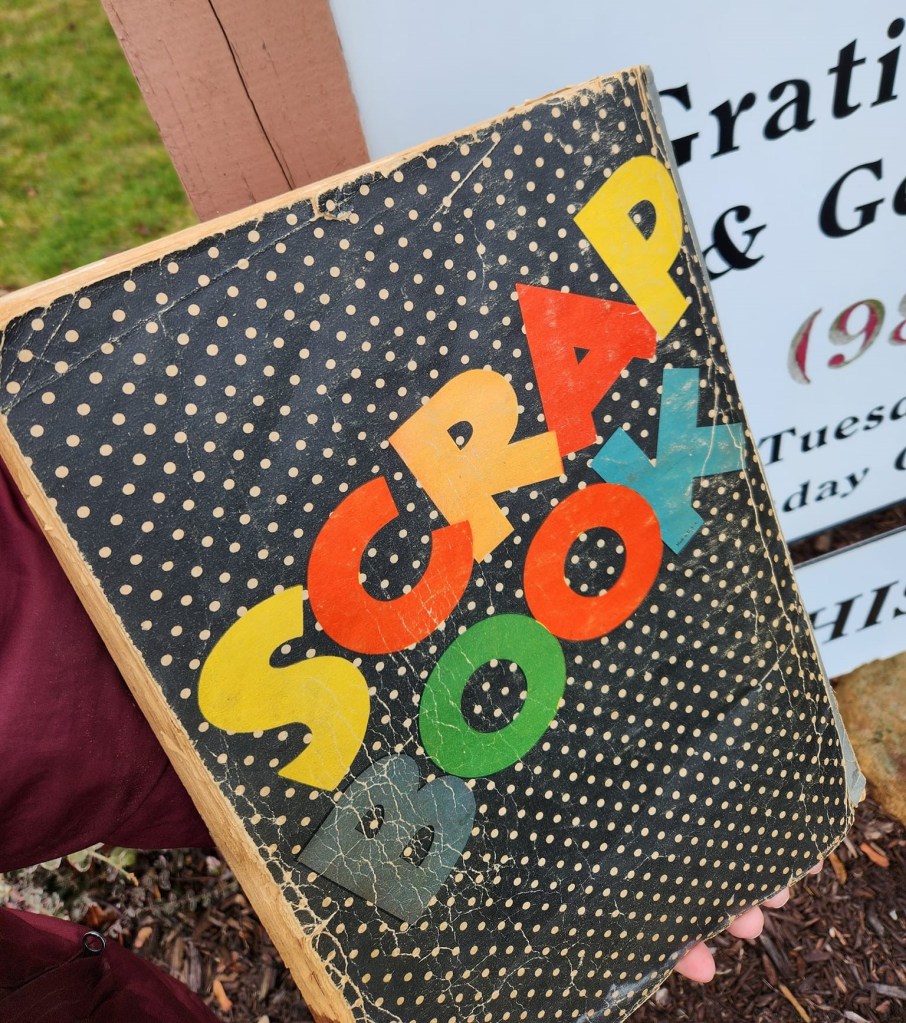
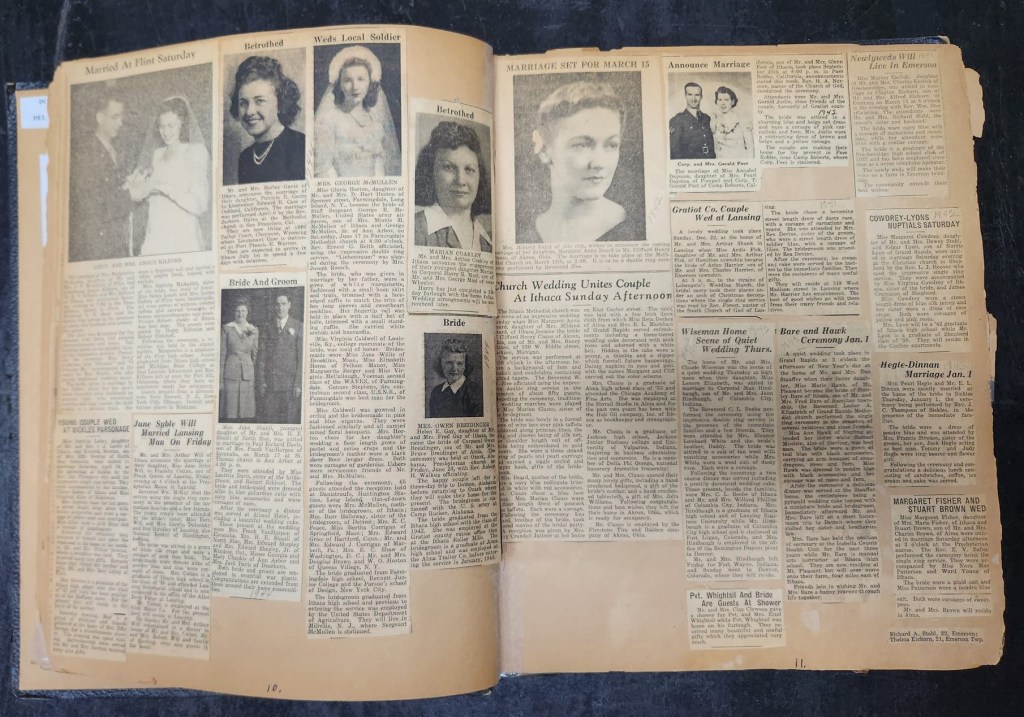
Above from top: The many items inside of this scrapbook tells the story of a lot of work clipping, pasting and preserving history; this scrapbook donated to the Gratiot County Historical and Genealogical Library in Ithaca held a collection from Mason County, Michigan during the 1930s and 1940s; inside of a loaned scrapbook that was allowed to be copied and placed on file in the GCHGS library.

Scrapbooks. Today, they may be a thing of the past for younger Americans. However, for those of us who are Baby Boomers and older, scrapbooking was a part of our lives.

I clearly remember my paternal grandmother’s scrapbooks she put together in the World War II era. Most of them were colorful pictures and advertisements from magazines and newspapers. Then, there were those articles and pictures from newspapers of the times.

During the 1970s, I kept my scrapbooks of Detroit sports teams, especially the Detroit Tigers. Although the tape is aging and the pages are frail, I still have my scrapbooks.

Most people need to realize that their scrapbooks may contain important articles, pictures, and clippings from Gratiot County newspapers that are no longer in existence. There are gaps in our county’s history where specific issues -and sizeable runs- must be located if they exist.

Critical years from the St. Louis Leader-Breckenridge American need to be included: 1948-1952, 1954, 1955, and 1956. The entire run of the Gratiot County Herald from 1919 is unavailable. None of these issues exist, and vital records of what happened in St. Louis and Breckenridge in those years are gone and lost to history.

I once asked historian David McMacken why he thought “runs” of these issues could be missing. He felt that in Gratiot County, every business with a long history probably had a fire at some time. Newspaper publishers were the same and probably lost papers due to fire. Things sometimes got to where they should be when a newspaper publisher moved. Another reason is that some issues may have been mislaid somewhere or pitched to the junk.

What can be done about our missing history of newspapers in Gratiot County? Scrapbooks with clippings and pictures from these missing years may still exist, although “clipped,” edited, and taped inside of scrapbooks. The contents of Gratiot’s scrapbooks are essential to the county’s history.

The Gratiot County Historical and Genealogical Society in Ithaca has been fortunate in its history to have had the chance to look at scrapbooks. In the past, people like Del DeVust, Anna Blair, and Olive Clark either donated their scrapbooks or allowed the library to copy articles and pictures. When loaned, the library afterward returned the scrapbooks to these owners. As a result, we have many articles and photographs that would not otherwise exist in the library’s collection.

I have often lived by the “scrapbook mantra” whether in my family, at garage sales, or flea markets – never throw out a scrapbook. Especially those that appear well taken care of or have pictures and news articles.

This leads back to a pair of scrapbooks that recently went to the Mason County Historical Society in Ludington, Michigan. The books belonged to a former Gratiot County Historical and Genealogical Society member who was deceased and left an extensive collection of items to the Society. These scrapbooks did not fit our collections’ focus and goal, so I contacted Mason County to see if they wanted these 1930-1940s era scrapbooks. Sure enough, they did and were mailed out to Ludington, Michigan.

What does this mean for Gratiot County scrapbook owners, readers, and enthusiasts?

In these collections, essential parts of our county’s history may still exist. If you decide to pitch out someone’s old scrapbooks with pictures and news clippings, please consider the potential historical value before you do so.

Even if you do not want to get rid of your scrapbooks, you might consider letting GCHGS look at them to take pictures or carefully make a copy of them. But above all else, please take care of and respect the old scrapbooks.

Note: The Gratiot County Historical and Genealogical Society gladly receives donations of items about Gratiot County’s history. However, the Society is most interested in items directly connected to a person, event, theme, or idea directly connected to Gratiot County’s past.

GCHGS is open on Tuesdays from 1-5 p.m. You can contact the director, Elizabeth VanDyke, with questions about donations or loans of materials at 989-875-6232.

Copyright 2024 James M. Goodspeed
We Remember the Underside of Gratiot County’s History, Epilogue: “What Should We Learn from the 1920s Ku Klux Klan?”

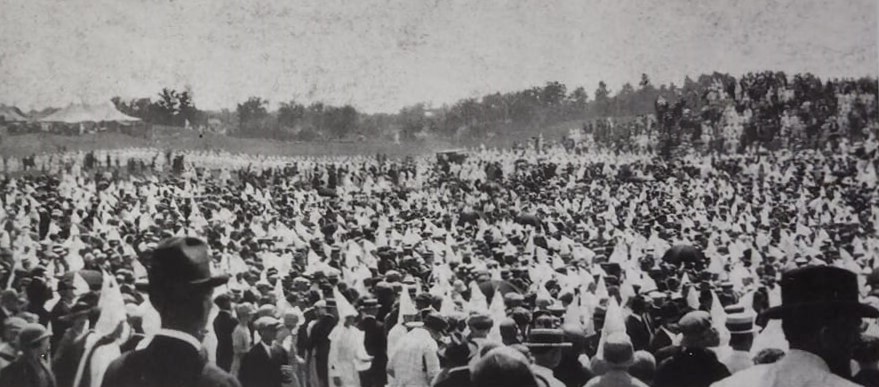
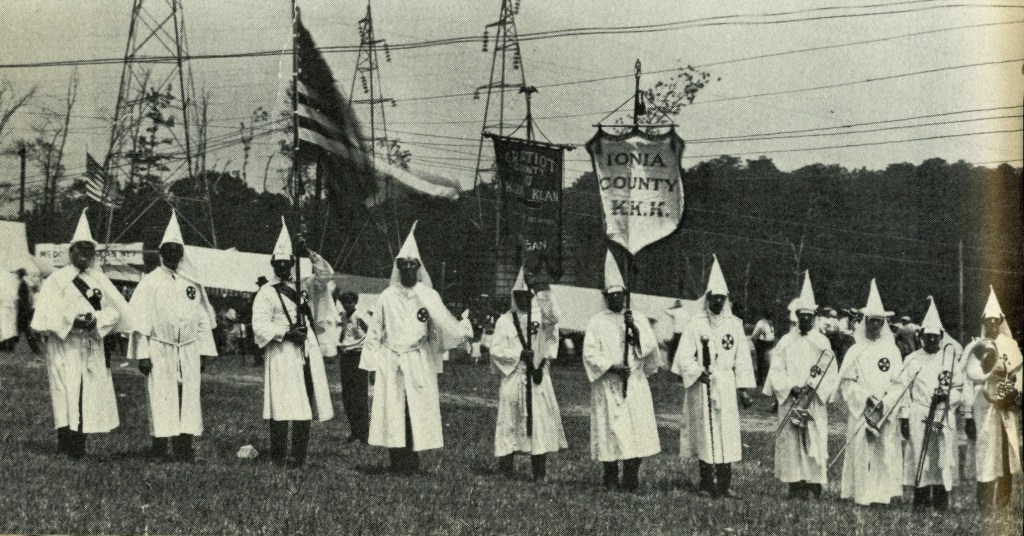
Above: A Ku Klux Klan meeting takes place in Michigan during the 1920s. The reverse of the photograph reads “Gratiot County.” Looking at the elevation in the background, could this location be in either south or southwest Gratiot County? Or, is it somewhere in Arcada Township? Photo courtesy of Tami Haskett Smith.

The British author and poet Thomas Hardy once wrote, “Though a good deal is too strange to be believed, nothing is too strange to have happened.” The first time I heard this quote, journalist James P. O’Donnell used it after seeing Hitler’s bunker in Berlin in the summer of 1945. O’Donnell then wrote an account of Hitler’s last days and adapted it for a 1980s movie on HBO.

Looking back over one hundred years ago in Gratiot County, there has been much that seemed to be too strange about the activity of the Ku Klux Klan to have happened here – but it did.

Growing up in Gratiot County, I never once heard anything firsthand about the 1920s KKK, even though I had four grandparents who grew up during that period. In my life, the closest I came to contact with the Klan was as a student when I overheard a story told by an upperclassman at my high school. As I remember his account, in the early 1970s, a student brought a grandfather’s Klan uniform to school as part of a presentation to a history class. Years later, nothing came from my investigation into tracking down the story.

In 2009, I was in a class at Central Michigan University, “American Social History, 1865-Present,” taught by Dr. Stephen Jones. The first assigned book was James Loewen’s  Sundown Towns: A Hidden Dimension of American Racism. Loewen’s book examined the history of how white communities in the Midwest and the North gradually pushed out and removed Black communities from their midst, creating “sundown towns.”

As I read the book, I soon found Michigan connections. One dealt with writings regarding Owosso, Michigan – where I had family members and my paternal grandparents lived for a short time. While investigating Loewen’s treatment of Owosso as a “sundown town,” the role of the Ku Klux Klan appeared in the 1920s. References to the Klan in other parts of Michigan (like Alma, Michigan) immediately got my attention. At the time of that reading, I remembered that a former CMU history professor, Dr. Calvin Enders,  researched the Klan in Michigan during the 1970s and 1980s. Although I did my M.A. degree under Enders’ supervision in the 1980s, we never talked about the Klan very much (even though Dr. Enders was deep into Michigan KKK research).

By the time I came along in 2009, Dr. Enders’  wife donated his papers and research to the Clarke Historical Library in Mt. Pleasant, where my investigation into the Gratiot KKK began. I was stunned by what I found and read.

The Klan was very active in the 1920s, and at least one incident regarding Gratiot County Realm No. 24 garnered state and national news. As I investigated the sources on my early trips, I am sure other researchers in the library heard me mumbling or proclaiming as I went through Gratiot County sources, “I can’t believe this.” The history was that gripping, and despite what Hardy and O’Donnell said, it was hard to believe.

During an early trip to the Clarke, I found that the curator was becoming increasingly interested in what I was doing regarding Gratiot County and the Klan. He politely asked questions about my research and then asked me to visit his office. I wondered what research rule I had broken, but he told me I was not in trouble. Instead, he told me another story about the Gratiot Klan from the 1920s.

A few months before my research began, the curator received a phone call from someone in Gratiot County who had materials that they considered donating to the Clarke. The only stipulation was that names had to be removed from the documents – in one case, it was the original KKK Realm No. 24 charter. The donor wanted to preserve history and offer it to the Clarke Library. Still, he did not wish to reveal names that were associated with the Klan in 1920s Gratiot County.

Under proper archival procedure and rules with donations, the curator would accept the items but could not delete or tamper with names or other information. History was history, and it had to be preserved. Unfortunately,  when the anonymous Gratiot Klan donor heard this, he decided not to donate the items.

At this meeting, I was asked whether I knew anything about these Gratiot Klan documents and charter or if I could investigate where the items were. Unfortunately, as I was starting research, I couldn’t help. But, I became interested in finding the Klan items.

As of this writing, I have not located the Gratiot Klan charter items dealing with Realm No. 24. Since 2009, despite this, I have traveled across Michigan, Indiana, and even to the Library of Congress in Washington, D.C., to try and find as much as I could about the KKK in our county’s history.

What I learned – and what Gratiot County should learn – is that nothing is too strange to have happened in our midst. The Klan was here, and many of its activities and actions today seem alarming. What is even more shocking is that most people in Gratiot County today don’t know that the Klan was here, that it was highly active, and that it fostered division, disharmony, and intolerance in Gratiot County.

It is disturbing to me that at least two generations living in Gratiot County in the early 20th century heard about the Klan or must have known someone involved with it. 

And then, somehow, over time, people erased the 1920s Ku Klux Klan Realm No. 24 from Gratiot County’s memory.

It was not too strange to have happened here.

Copyright 2024 James M. Goodspeed
We Remember the Underside of Gratiot County, The Ku Klux Klan Part IV. “Klan Conclusions: 1926-1931”

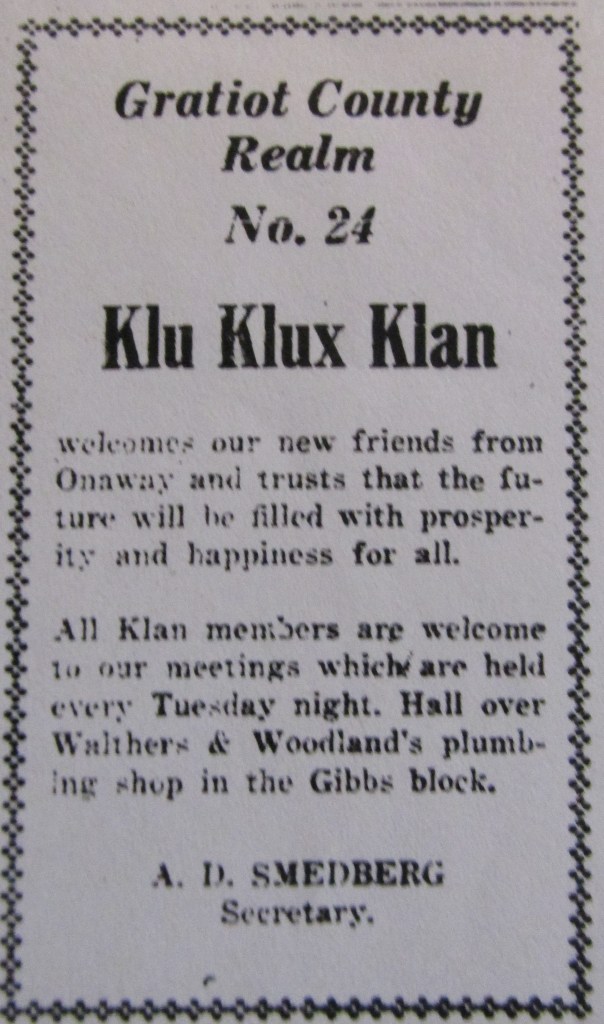
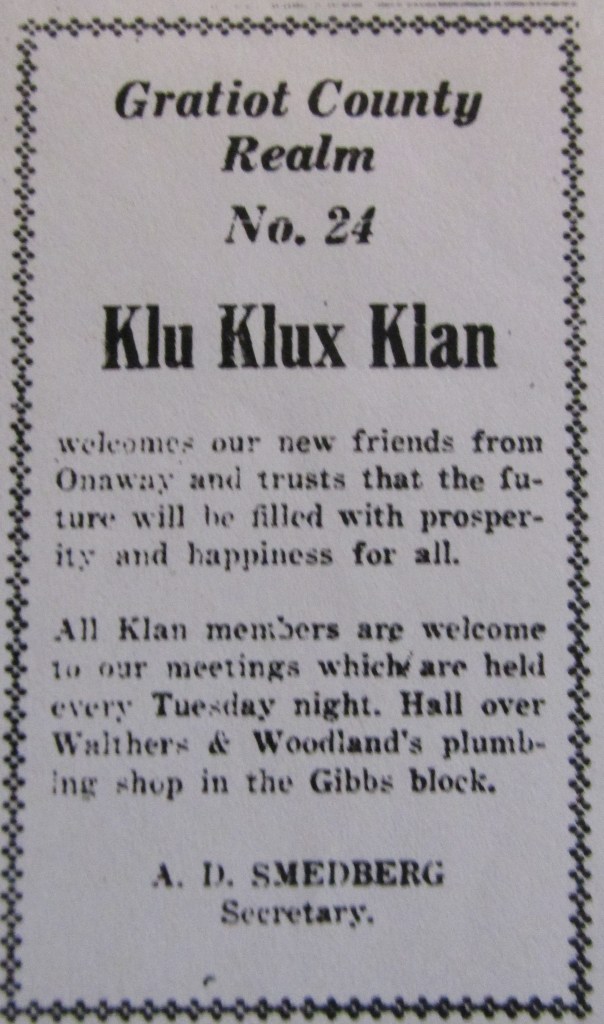
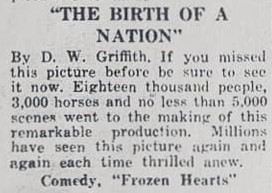
From top to bottom: Realm No. 24 welcomes Lobdells to Alma – and identifies a Klan member; more than one county theatre, like Ithaca’s Ideal Theatre, sought to cash in on Klan activity during the mid-1920s by re-showing “The Birth of a Nation” – which glorified the Klan; “The Sower” links American patriotism of the 1920s and the Ku Klux Klan, dated July 15, 1924; Ku Klux Klan items from the 1920s on display in the Henry Ford Museum in Dearborn, Michigan as they appeared in 2009.

The following is another in a series of articles on the Gratiot County Ku Klux Klan, which was very active in the county during the 1920s.

  Following the aftermath of the King-Garner Trial of 1926 in Ithaca, the decade gradually saw the decline of Gratiot County Realm No. 24. The attention that the trial brought to Gratiot County, along with a national decline of the  Ku Klux Klan following a sex and political scandal in Indiana, led to the erosion of its popularity.

  However, the Klan still had its supporters and followers. Names like Otto Hawley and Herbert A. Becker of Alma, Margaret Smith and R.A. Anderson of St. Louis, G.W. Anderson, James and Margaret Esenlord, and M. Alspaugh of Arcada Township all posted bail for Lewis King and the Garners during their trials in Gratiot County. One of the supporters admitted in newspapers that he even invited King to Gratiot County to hold his religious meetings.

  Out in Arcada Township, the Ku Klux Klan campground attempted to make a go of it – and did for at least two years. At one point, it advertised itself as a haven for Klansmen, Tri-K Girls, American Krusaders, and Junior Klansmen. The campground eventually closed, probably due to lack of financial support, or the owners possibly decided to end the farm’s designation as a Klan gathering spot.

  An exciting event occurred in the Alma Record in 1926 when the newspaper welcomed  Lobdell Emery from Onaway, Michigan, to Alma. Among those groups buying ads welcoming this new company to Alma was Gratiot County Ku Klux Klan No. 24. The advertisement stated that it “Welcomes our new friends from Onaway…All Klan members are welcome to our meetings, which are held every Tuesday night.” Beneath the ad, Klan secretary A.D. Smedberg of Alma signed his name. Smedberg attended the University of Michigan and Ferris Institute and later was the purchasing agent for New Moon Homes in Alma. Smedberg also ran for Mayor of Alma.

  Another name from the Gratiot Klan slowly surfaced. At Alma College, one member of the Board of Trustees was  Klansman Stephen S. Nisbett, active in the  Newaygo County KKK and President of Gerber Baby Foods. He eventually served on the board for 22 years.

  The historical record is scant regarding those who took a public stand against the Klan. One of these, Reverend R.A. Gelston of the Alma First Presbyterian Church, went to the pulpit one Sunday to declare that the Klan had no place in Alma and that people should be aware of its divisiveness and damage to the community. During the peak of Klan activity in Alma, one could also read statements in church notices during its height. One could attend an evening service about “The Fiery Cross ” at one end of town.” Up the street, another church countered with “The Cross on which Christ Died.”

  In Alma, the Klavern operated its headquarters at 110 ½ East Superior Street until at least 1931. Before its demise, a popular activity of the Gratiot Klan was holding picnics at places like Crystal Lake in Montcalm County, complete with a good, old-fashioned sermon. During one Christmas at the start of the Depression, the Klan announced that it would distribute Christmas baskets to needy families in the Alma area. Realm No. 24 also periodically trumpeted the importance of its meetings – such as when the Grand Dragon of the state Ku Klux Klan, George W. Carr of Owosso, appeared in Alma.

  For some in Gratiot County, Klan enthusiasm was slow to pass. While the Great Depression took place, it was common for families to hold weekly house parties for entertainment. One group from Arcada Township did so at the former location of the Klan campground. What was the group’s name for its monthly parties? The Klitter Klatter Klub.

Next time: Part V. “Klan Confusion – What Should Gratiot County Learn from the History of the KKK?”

Copyright 2023 James M Goodspeed

We Remember the Underside of Gratiot County, The Ku Klux Klan Part III. “County Conundrums: Trouble with the Klan, 1925-1926”

Gratiot County Klan news from the mid-1920s: The top of the front page of the Gratiot County Knighthawk, the Klan newspaper published in the county in August 1928; the Gratiot Klan was very active in participating in state KKK affairs as this notice from 1926 indicates; three Klan preachers entered Gratiot County in the summer of 1925, led meetings which lead to a riot and then faced charges which ultimately went to the State Supreme Court; even small communities like Sumner members participated in Klan meetings such as the one in New Haven in the late summer of 1924.

This is part three in a four part series on the Gratiot County Ku Klux Klan and it activity in Gratiot County during the 1920s.

Alma had a problem with the Klan in the summer of 1925 when three out-of-state itinerant “preachers” held religious meetings in Wright Park. Before their initial one-week engagement ended, Alma Mayor Creaser attempted to find the trio and inform them that their permit would not be renewed because of the controversy of these meetings.

              Lewis J. King, George Garner, and R. C. Garner were well-known in the Midwest in pro-Klan circles. At one time, they claimed to be Protestant Christians who converted from Catholicism; King himself professed to be an ex-priest and sold books about his conversion and anti-Catholic teachings at his meetings.

              Coinciding with King’s meetings was the spreading of a scurrilous rumor by the Ku Klux Klan that Catholics at St. Mary’s Church were secretly stockpiling a horde of guns and ammunition in the basement of the church.

              When King appeared at Wright Park the evening after being told that his meetings were over, he and a large group of supporters approached the main gate, where they encountered Alma Mayor Creaser and several police officers. At that point, “The Riot in the Park” began.

              King argued that he had a right to hold a public meeting and that the large crowd behind him did, too. Resisting the officers, they stormed the gate, yelled for the crowd to follow, and barged into the park, running over Creaser and the police officers while knocking over fences in their way. One of the Garners, draped in an American flag, was seen out front leading the crowd. As a result, Lewis J. King continued his inflammatory preaching in Wright Park for yet another night in Alma.

              The next day, the Alma City Commission fielded numerous complaints from the public and had the three offenders arrested. After making bail, King defied the Commission by conducting a meeting at the Alma Christian Church. Meanwhile, over ninety people signed a petition concerning the arrests, demanding Mayor Creaser’s resignation. Bolstered by this support, King again tried to hold meetings in the park but then agreed to move them onto a private lot in northwest Alma.

              On August 2, weeks after the incident in the park, the police arrested the preachers for defying a city order, resisting officers, and inciting the public. However, the men made bail again and continued holding revival meetings and pubic baptisms on the Pine River. During one of these King-Garner meetings in Alma, a crowd of 300-500 Klansmen dressed in full Klan attire showed up in support.

              In November, the King-Garner trial, which took place in Ithaca, gained statewide attention. Gratiot County Prosecutor Romaine Clark and the state Assistant Attorney General led the prosecution. According to the Alma Record, “a large crowd that jammed the courtroom and overflowed into the corridors” listened intently to the proceedings during the trial. Clark moved quickly, forcing King to admit he had never been a Catholic priest, that he never became a citizen of the United States despite living here for over fifteen years, and that he had been involved in dozens of conflicts and fights across the United States – all involving his religious meetings.

              After 4 ½ hours of deliberations, the jury found King and the Garners guilty of resisting a police officer. However, the defense requested a thirty-day appeal, and each man was released on $3,000 bail (provided by several Gratiot County residents). Meanwhile, the case worked its way up to the State Supreme Court.

              One year later, the men lost their appeal; King received one to two years in Jackson State Prison, while the Garners were sentenced to eighteen months in Ionia. However, in the end, none of the men served more than four months for their crime.

  Copyright 2023 James M. Goodspeed
We Remember the Underside of Gratiot County: The Ku Klux Klan Part II. “Crowds and Capers: Klan Fever Hits Gratiot, 1924-1925”

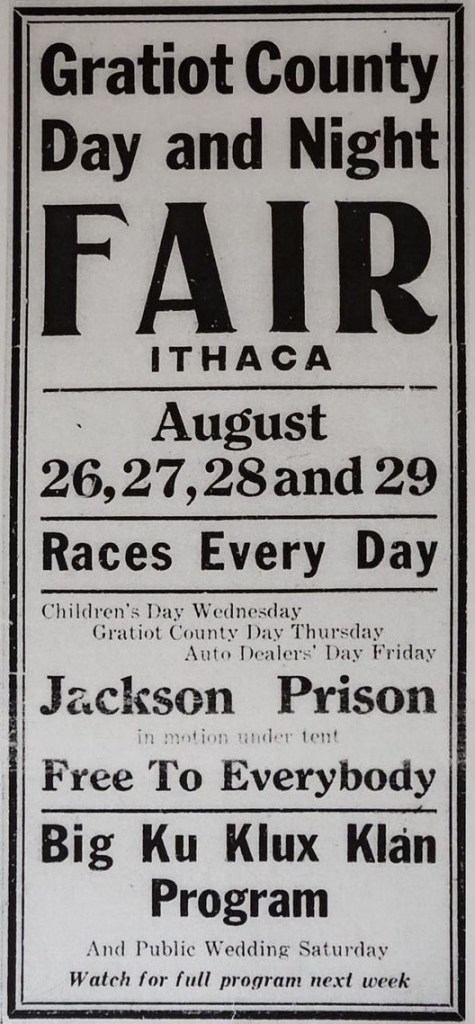
From the top, the Ku Klux Klan in Gratiot County: A Ku Klux Klan meeting takes place somewhere in the mid-Michigan area in the mid-1920s; The Gratiot County Fair held “Klan Day” and an official KKK wedding; Lewis J. King was one of a trio of so-called evangelists who came to Gratiot County under the auspices of the Klan. The three men would cause an uproar in the county before they left; A notice about the new Klan Kampground in Arcada Township.

The following is part two of a four part story concerning the Ku Klux Klan in Gratiot County during the 1920s – and a forgotten part of this county’s history which appeared one hundred years ago.

They called themselves the Invisible Empire of the Ku Klux Klan, Realm Number 24. If there was anything that many Gratiot County residents found out in the 1920s about the Ku Klux Klan, it was not invisible, and many people in the county were curious about it. This public interest was the case from 1924 to 1925 when the Klan peaked in popularity and attention within Gratiot County.

Starting in 1924, the KKK went on the offensive in southeast Gratiot by holding meetings at the packed Ashley Christian Church and a hall in Bannister, where hundreds also came. In this area of the county, the Klan attempted to intimidate and harass Catholics who were of Slovak, Czech, and Polish descent. The Klan then went and burned crosses on the property of both Father Nimrichter and the Slovacek family. The Slovaceks faced Klan members who came onto their property and threatened them to leave the community. In response, some Slovacek men used pitchforks to drive off these masked intruders.

The late summer and fall of 1924 witnessed more efforts by the Klan to try and convince people that it was growing in membership and as a movement. In August, “Klan Day” took place at the Ithaca Fair; anyone attending events at the fairgrounds could have their cars parked by Klan members. The Gratiot County Herald reported that earlier that day, over 12,000 people came into Ithaca to observe  200 Klansmen, many of whom were on horseback, lead a float with an Ithaca High School student on it dressed as Cupid. It was the largest number of people to assemble for a gathering in Ithaca until that time in history.

  The parade encouraged people to come to the grandstand that night to witness mid-Michigan’s first official “Klan wedding.”  At the beginning of the week, an article in the Gratiot County Herald informed anyone who wanted to buy the bride a gift about how they could do so. Reverend Leon May of the Forest Hill Church of Christ, a Klan member and Grand Kludd (state chaplain) of the Michigan KKK, performed the wedding. And yes, the couple purchased a valid marriage license.

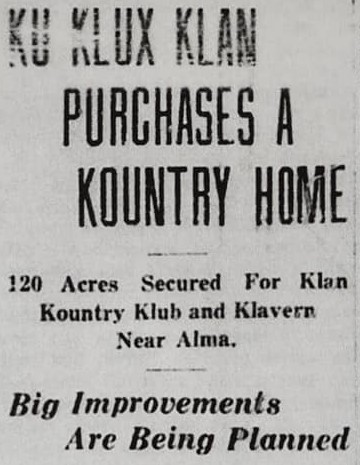
The KKK soon received state and local attention when it announced the purchase of a 120-acre farm in Arcada Township to make it the first Ku Klux Klan Kountry Klub Klavern in Michigan. The klavern operated at that location for at least two years. One meeting in October 1925 attracted over 300 Klansmen, Klanswomen, Juniors, Tri-K girls, and American Krusaders. This entourage participated in picnics, golf,  tennis, and baseball games between Klan teams as far away as Lansing and Saginaw.

In July 1925, the ugliest incident in Gratiot County’s chapter of the KKK took place in Alma’s Wright Park. Three self-professed evangelists came to Alma from Indiana to conduct so-called religious revival meetings.   Afterward, Lewis J. King, George Garner, and R.C. Garner eventually left Alma in such turmoil that the after-effects of these “meetings” dragged on in Gratiot County for another sixteen months.

Most did not know that King and the Garners had been invited here by some county residents and that the trio had a long list of arrests across the Midwest for disorderly conduct, disturbing the peace, and being general nuisances. All happened wherever they went  for what they advertised in the name of “White, Anglo-Saxon, Protestant Christianity and One Hundred Percent Americanism.” The Gratiot County Ku Klux Klan showed its support for the three men by regularly attending their meetings in Alma in large numbers while in complete Klan dress. However, in Alma, it seemed that issues with the Klan were like a powder keg that was about to explode.

Copyright 2023 James M Goodspeed


We Remember the Underside of Gratiot County’s History: Part I. “The Coming of the Ku Klux Klan to Gratiot County, 1923-1924”

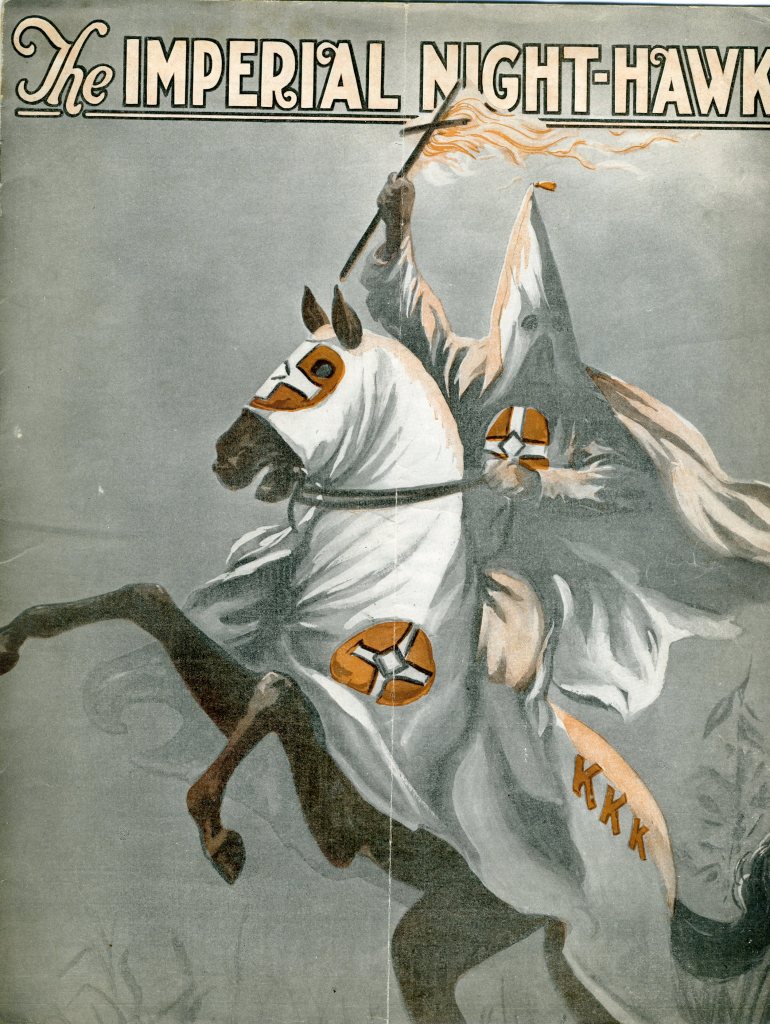
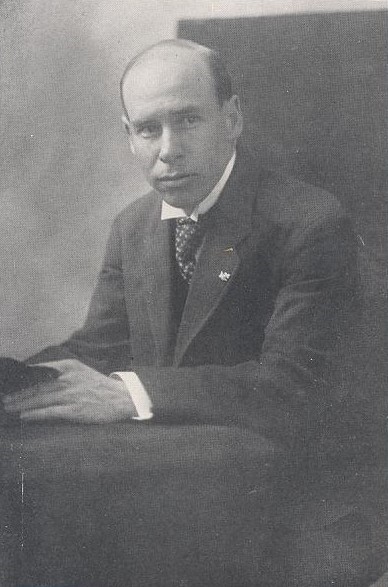
Above: Some members of Gratiot County Ku Klux Klan Realm No. 24 members appear at July 4, 1927 Klan gathering in Jackson, Michigan; a Klan publication that belonged to a Michigan KKK member in the 1920s; President Harry Crooks of Alma College became a KKK target when refused to let Alma College students attend Klan activities or become Klan members in Alma; an advertisement from the Alma Record sponsored by the Gratiot Klan – and which identified one of its members who later ran for mayor of Alma.

The Ku Klux Klan first appeared in Gratiot County just over 100 years ago. For a short period of time, the Klan flourished by conducting parades, recruiting members, holding meetings, harassing targets, and by trying to connect with county churches. The following is part one of a four part series about Realm No. 24 and its activities in Gratiot County – during a place and time that was fertile soil for the KKK.

One evening in January 1923, Detroiter A.G. Struble witnessed an unforgettable sight as he drove north along the old Alma Road, just inside the Gratiot County line. While taking his family to Mt. Pleasant to attend a funeral, Struble met five men on horseback fully dressed in Ku Klux Klan apparel, each with long spears and lights. Although called to stop, Struble kept driving.

              The presence of the Klan in Gratiot County during the 1920s was part of a movement that swept across parts of the United States, spewing its anti-Catholic, anti-immigrant, and anti-Jewish message. Boasting its “100% American” agenda, the Ku Klux Klan supposedly stood for law and order, control of alcohol, support for public education, and, above all, white Protestantism. Nationally, the KKK claimed a membership between two to five million people, with its most substantial followings in the Midwest. Michigan had the nation’s eighth-largest membership, with 70,000 Klansmen.

               Starting in 1923, Gratiot County became the home of Realm No.24; for three of those years, “Klan fever” attracted both followers and those curious about the Klan. In October 1923, the first attempt of the Klan to recruit members drew between 500 and 700 people and took place south of Alma. Later in December, the Klan burned its first cross on Christmas Eve in town.

              The Klan was most active in 1924 as it tried to gain credibility with local churches by either holding services, gaining the support of pastors,  having  Klan members attend a church, or offering a public gift. If the Klan could obtain the support of a pastor or gain his membership, it would gain access to another audience. This connection between the Klan and church happened in Alma when the Christian Church held a Klan-sponsored revival meeting, and the pastor gave sermons in support of the Klan. If an announcement from a church stated that the preacher would provide “A Christian Interpretation of Klancraft,” it was a pro-KKK message.

I In Alma and at the Breckenridge Baptist Church, the Klan exhibited one of its 1920s trademarks: the use or donation of “the Illuminated Cross.”  With the lighting of the new cross in the sanctuary,  Klansmen would march down the aisles and sing “America.”  Klansmen also knelt at the altar while playing “The Old Rugged Cross.” All occurred to impress the congregation and send a message that the Klan was in the community, supposedly in numbers large enough to warrant attention and support.

As the KKK began to take off in 1924, it started its first attacks upon local people and groups that it deemed to be its enemies. It first did this through an often-used weapon – the local KKK newspaper, The Nighthawk. When Alma College President Harold Crooks urged students not to listen to or attend Klan recruitment meetings, he then became a target.

Using The Knighthawk, the Klan falsely accused and slandered Crooks by accusing him of having pro-German sympathies during World War I. In response to the attack, approximately one hundred Alma College students marched two abreast from the college through downtown Alma to the Klan headquarters at 210 ½ East Superior Street. Upon arrival, the students purchased all available copies of The Nighthawk, formed a circle, and publicly burned them, shouting, “Yay, Prezi!”  To commemorate the protest, the Alma College yearbook that year featured a picture regarding the burning and captioned it: “Kluck! Kluck! Kluck!”

Copyright 2023 James M Goodspeed

We Remember 1969: “Patches, Alma’s Cat Lady, and the Birth of the Gratiot County Humane Society”

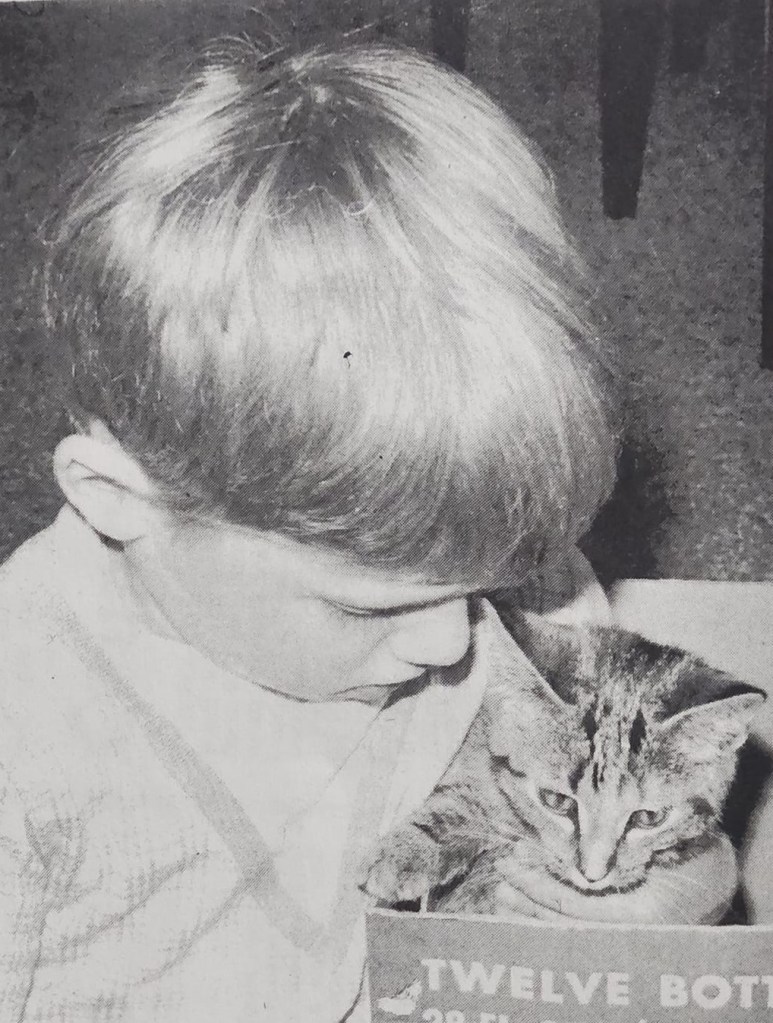
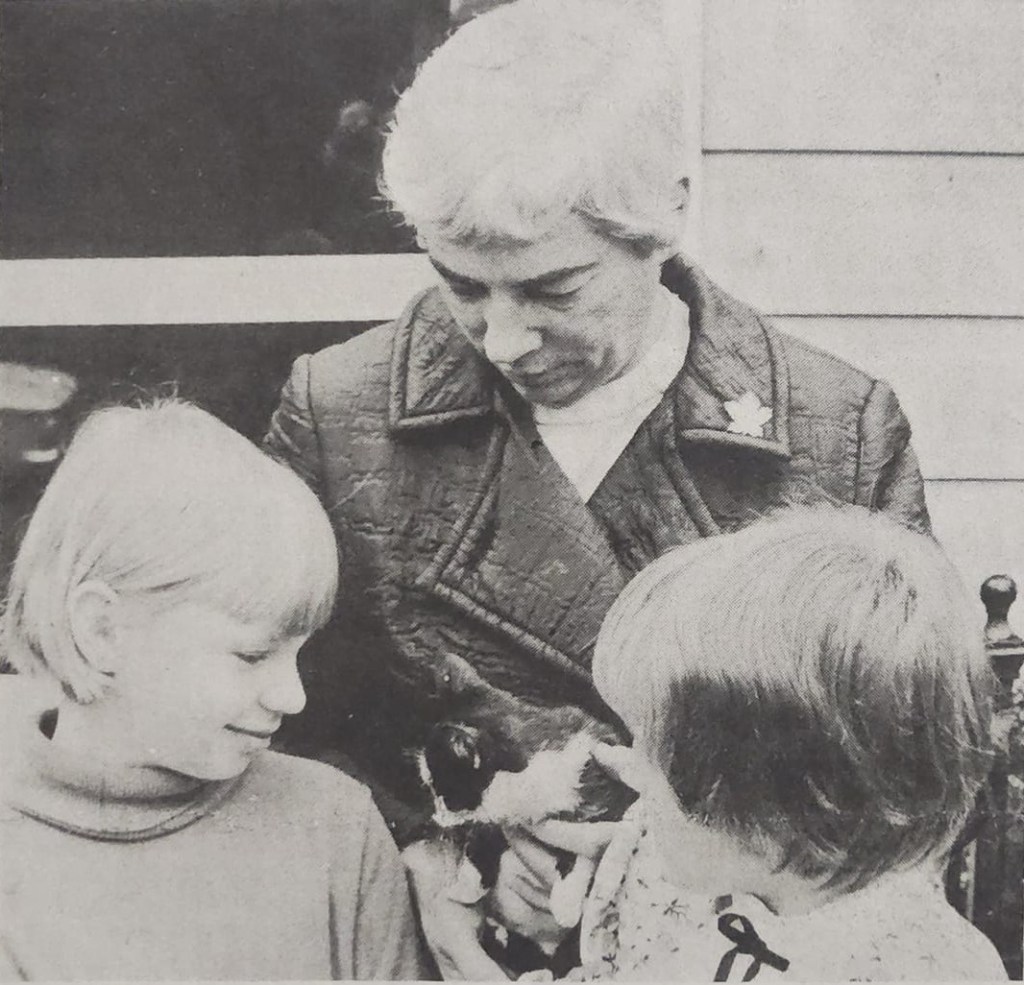
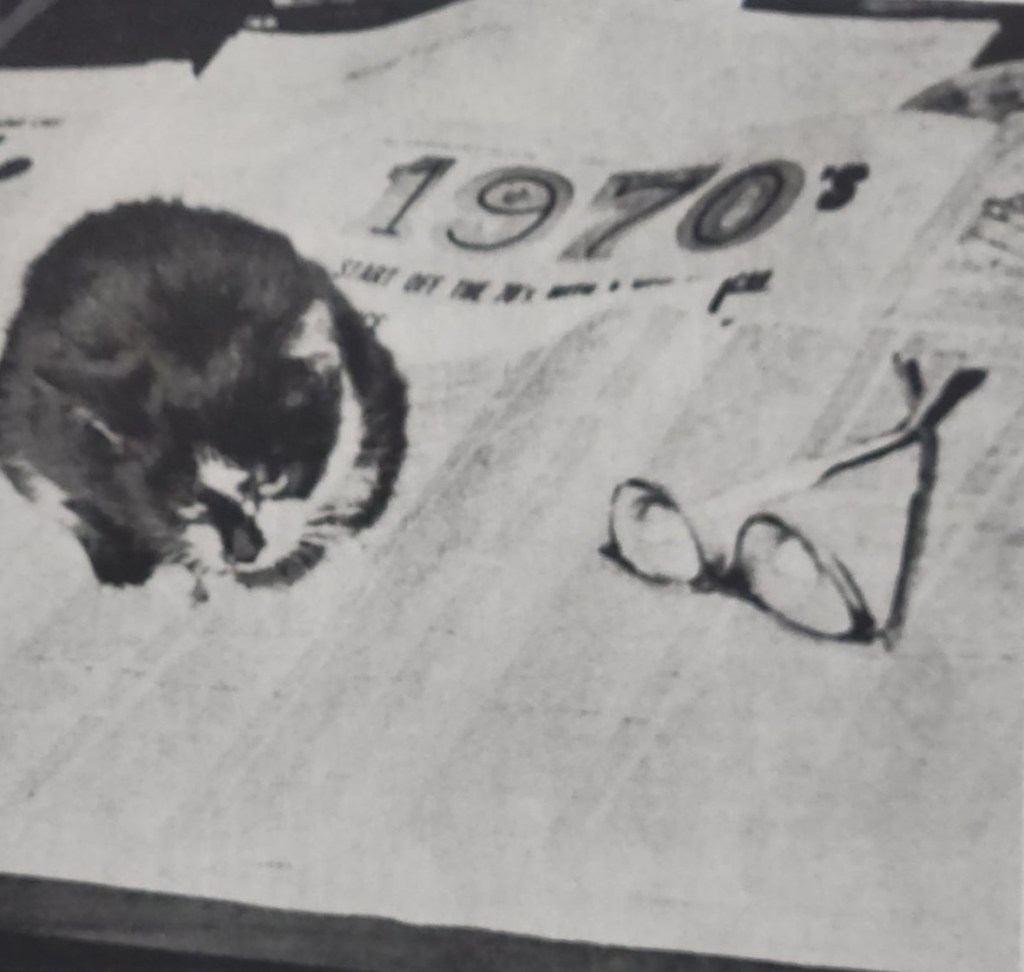
Above from top: “The Alma Cat Lady,” Margaret Russell and two Alma citizens reunite with Patches, an Alma Post Office visitor; Patches waits for someone to claim him as he rests on a telephone book at the Northwood Research Center; Christopher Griffiths looks at the unexpected visitor to the Griffiths house in the fall of 1969.

It all started when a lost kitten found the “Alma Cat Lady.” In late September 1969, a young kitten (soon named Patches) wandered across Alma and ended up in the Alma Post Office. Although the kitten quickly became a favorite of the Alma postal staff, a call went out to Margaret Russell, who was unofficially known to many in the city as “Alma’s cat lady.” When a stray and needy cat or kitten in town turned up, people knew they should call Margaret Russell, who cared deeply about Alma’s homeless animals.

In the 1960s, animals, like puppies and young dogs in Gratiot County, had nowhere to go. Max Harrell, then the Gratiot County Dog Warden, kept the animals at his residence in Riverdale. If someone wanted to adopt an unwanted puppy, the cost in 1967 was $3.50. However, cats and kittens were another county problem.

By the late 1960s in Alma, Margaret Russell quietly became the defender and hero of lost and unwanted cats in town. Russell, a Canadian who came to Alma with her husband, an Alma College professor, worked as Executive Secretary for Northwood Institute and later at the McClure Oil Company. Russell once told the Alma Record that her house soon seemed to have an invisible mark over the door, indicating that any unwanted or lost animal would find a home there. People in the city called Russell frequently to help rescue and find a home for Alma’s unwanted cats and kittens. Many times, Russell privately paid for treatment, medicine, spaying, or neutering and then tried to find a home for the pet.

How did the kitten Patches find his way into the Alma Post Office that day in the fall of 1969? This stray was a bit of a mystery; some thought the kitten gained entry through the mail drop box. Upon discovery, the Post Office named the kitten and quickly called Margaret Russell for help. Soon, a picture of Patches on top of a phone book at the Northwood Research Center appeared in the Alma Daily Record Leader newspaper dated September 24, 1969. The picture and story helped Patches find his way back to the Gibbs family, who lived eight blocks north of the Post Office and promptly reclaimed him. The story about Patches also allowed Russell to voice her concern publicly that the unwanted animals of Gratiot County needed help, and they needed it now. Shortly after the Patches incident, Mike Cameron found a declawed Siamese cat wandering around his Alma home. After the story appeared in the newspaper, he adopted it after the cat went unclaimed. Two weeks later, the Griffiths family at 717 Gratiot Avenue discovered a kitten placed in a box and left it on the doorstep. While one child in the family wanted the kitten, there was a newborn at home, which meant the kitten could not stay. Who could help find a place for another unwanted pet in Alma? Again, the Griffiths family turned to Margaret Russell for help.

Through these three incidents in late 1969, Margaret Russell spoke about the need and vision for a Humane Society in Gratiot County. Others in Gratiot County quickly joined Russell at an exploratory meeting, which took place at 5801 Golfside Drive. On December 4, another meeting occurred at the Alma Arts and Crafts Center to formally announce the plans for a Humane Society in Gratiot County. Sixty people turned out to hear Douglas Culmer from the Michigan Federation of Humane Societies, who told the group that they would soon be involved in much-needed work in Gratiot County. Culmer also informed the group that having a humane society meant considering the needs of more than just small animals.

Officers who were elected that evening at the first meeting of the Gratiot County Humane Society included Margaret Russell (who served as president), William Budge, Dr. Wilmer Smith, Mike Cameron, and Sheryl Mastej – who were all Alma residents. Still, board members comprised people from across the county to demonstrate that the new society reflected the needs beyond just Alma. St. Louis members included Dr. Frank Hedges, Lucille Peckinpaugh, Bea Smith, Ed Jacomo, and Janet Clark. Ginny Wilson represented Ithaca; Jessie Mesik served from Breckenridge. Other board members included Doris Strong, Reverend M. Florean Stark, and Leo Washburn. Mary Brewer of St. Louis served as an alternate.

The group moved quickly to apply for a tax identification number. Dr. Wilmer Smith offered to serve as a liaison between the society and other veterinarians in Gratiot County. Becoming a member cost only $1-$25 annually, but anyone who gave more than $25 became a society patron. The group also moved to establish temporary shelters, and volunteers from St. Louis and Alma came forward to offer warm, heated places to house the animals who needed immediate help. The Gratiot County Humane Society also established its meeting date on the first Thursday of the month.

By the end of December 1969, this group of concerned citizens first established the Gratiot County Humane Society. The vision of a place for homeless and unwanted animals in Gratiot County started to take shape.

Copyright 2023 James M Goodspeed

We Remember Tony’s Restaurant in St. Louis, 1985-2020

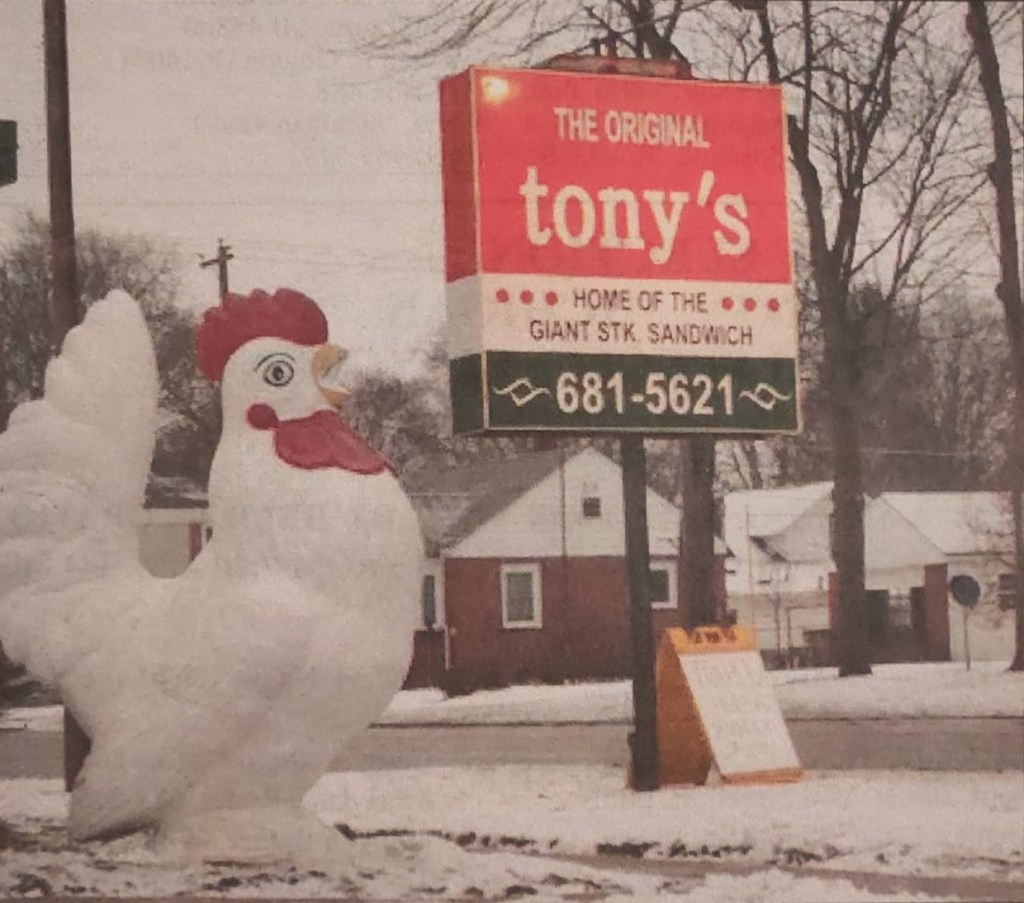
Tony’s Restaurant history from the top: A winter’s day with Tony’s chicken sign out front on West Washington Street (M-46); Mike Zwingman started working for the Lagalo brothers soon after Tony’s opened. He went on to manage and own Tony’s in St. Louis. Photo was taken 1989-1990; Business soon boomed after Tony’s opened, prompting the first remodel of the restaurant. in 1986. Within a short time an addition would be added to the north. Advertisement from January 1986.

Sometime in the mid-1980s, Joe and Pauline Nako decided to leave the restaurant business. As a result, a drive-in that had been in town for almost 30 years, the Dandy, closed. Finding a buyer took some time, but the Nakos eventually sold out to the Lagalo Brothers from Saginaw, and what had been known as the Dandy became Tony’s Restaurant.

The Lagalo brothers, Phil and Doug, did much searching before they purchased the Dandy. Both men looked around mid-Michigan and wanted a drive-in restaurant. Still, available drive-ins had become scarcer over the years. When they bought the Dandy in St. Louis (in addition to four others the brothers owned in the Saginaw area), it enabled the Lagalos to continue a philosophy that father Butch Lagalo started after he returned home from World War II. This philosophy was to “Give the people what they pay for,” a theme Butch’s father invented while operating grocery stores in Italy. The Lagalos also developed an Italian chef logo with assistance from a Saginaw News artist, which the Lagalos displayed on a sign outside the restaurant where drivers could see it while passing by. In a short time, Tony’s Restaurant became known as the place of giant steak sandwiches, spaghetti dinners, and giant ice cream sundaes, all because of their size and quality. When asked about Tony’s big helpings, Doug Lagallo replied, “We serve large portions. One of our fries, we’re told, is enough for three or four people.”  

On May 8, 1985, 29 years after the Nakos opened the Dandy, the Lagalos opened Tony’s Restaurant in St. Louis. Once again, St. Louis had a drive-in restaurant. When Tony’s first opened, the drive-in tried to continue the old practice of having waitresses run to cars with trays. Still, it did not work out as the business inside was too busy. In fact, it was standing room only inside Tony’s for the first four months of business in 1985. The customers just started coming – and coming – and coming. Within a year, Tony’s was open seven days a week from 8:00 a.m. to 10 p.m. on weekdays and until 11 p.m. on Fridays and Saturdays. The Lagalos ensured that the famous Dandy chicken remained out front, and they put the name “Dandy”  beneath Tony’s neon sign. Some changes continued when the Lagalos added more booths. They built a wall between the cooks and diners (there had never been one before, and customers could see everything the cooks were doing firsthand). Not long before, an addition had to go on the back of Tony’s in the summer of 1990 to help deal with the growing business. Despite the changes, the Lagalos managed to keep an old, black-and-white original photograph of the Dandy on the wall inside, which the Nakos must have taken when they first opened in the 1950s. For the Lagalo brothers, St. Louis was turning out to be good for business.

The story of  Tony’s Restaurant took another turn just after it started in 1985. Three days after opening, a former delivery man, Mike Zwingman, was hired, and he immediately learned how to run the grill. Zwingman first met the Lagalos while working as a ham salesman. Although he took the new job, Zwingman had to drive a distance from St. Charles to work. Over time, Mike became assistant manager, working there for about ten years until he bought Tony’s from the Lagalos. It was a big step, and Zwingman initially wondered if he made the right decision as he was concerned about the debt involved. However, numerous people encouraged him to operate Tony’s, and the customers and business kept growing.

Zwingman remodeled the relatively new north side of the restaurant, making it what some called “The Beatles Room,” a non-smoking area. It also contained almost all of Zwingman’s personal Beatles collection. The front of Tony’s became a smoking section and was known for its Three Stooges décor. Approximately eighty people could fit into Tony’s on a busy day or night. Customers quickly responded to ten-cent coffee and free refills. Far and away, the biggest draw was breakfast. Ice cream sales, Tony’s trademark,  did not make money but drew in first-time customers. If you were naïve enough to order or receive an ice cream sundae, then heaven help you. Waitresses told you that the next one was paid for if you managed to eat the entire mountain of ice cream. I never saw anyone in my family or friends eat sundae as a whole – but everyone walked away awed by Tony’s. Mike Zwingman also put in a coin machine in the entryway, which was the only one of its kind in the area, and it took in several hundred dollars each month.

Another source of success for Mike Zwingman’s running of Tony’s concerns how he treated his workers. Five of his waitresses worked for him for thirty years each. The ladies joked that they would retire simultaneously; they enjoyed their work that much. Zwingman kept good waitresses because he paid more per hour than anyone around him, and other restaurants envied the fact that they had more turnover than Tony’s.

Some memorable times would be when business boomed under Zwingman’s ownership. Whenever the St. Louis Church of God Campmeeting was in session in August, it meant all hands on deck. Staff members could not take time off during those ten days as church campers swarmed to Tony’s. In  May 1997, Gratiot County experienced hurricane-like winds during a severe spring storm that shut the county down for days. With power out almost everywhere, St. Louis offered Mike to use some of its generators if he would feed the city workers. Mike agreed, and within one week, Tony’s sold out of everything in stock as word got out that Tony’s had electricity and food and was open for business. 

Another memorable business period at Tony’s occurred during the COVID pandemic. When Mike Zwingman reopened for business in June and July 2000, he and his staff saw the busiest and most remarkable period that Tony’s ever had, one that Zwingman still appreciates from the St. Louis community to this day.

As is sometimes true of good stories, they can end in tragedy. On August 20, 2020, Tony’s met a tragic ending when a fire broke out at night in the grill area. The fire, which took place in the grill area during the night after everyone went home, left Mike  Zwingman without a business, his workers out of jobs, and St. Louis out of one of its landmarks. Many were shocked and saddened to go past Tony’s and see the chicken standing in front of a burned-out restaurant. Despite this setback, Zwingman considered rebuilding and reopening on March 8, 2021 – the Nakos anniversary of opening the Dandy – but it was not to be. The cost of a complete rebuild was too much. If he had been a younger owner, Zwingman thought he could try to reopen. However, after serious contemplation, Zwingman was forced to notify his workers that Tony’s was done for good. It was unbelievably hard to tell his workers and customers that Tony’s was a thing of the past, but Zwingman eventually demolished the lot, put it up for sale, and retired.

After decades of what started as a  1950s drive-in, which evolved into a sit-down restaurant, came to an end in St. Louis. Looking back, many people still remember the location in St. Louis at 518 West Washington for the giant chicken, king-size helpings of food, and good times.

Copyright 2023 James M. Goodspeed
We Remember “The Dandy”

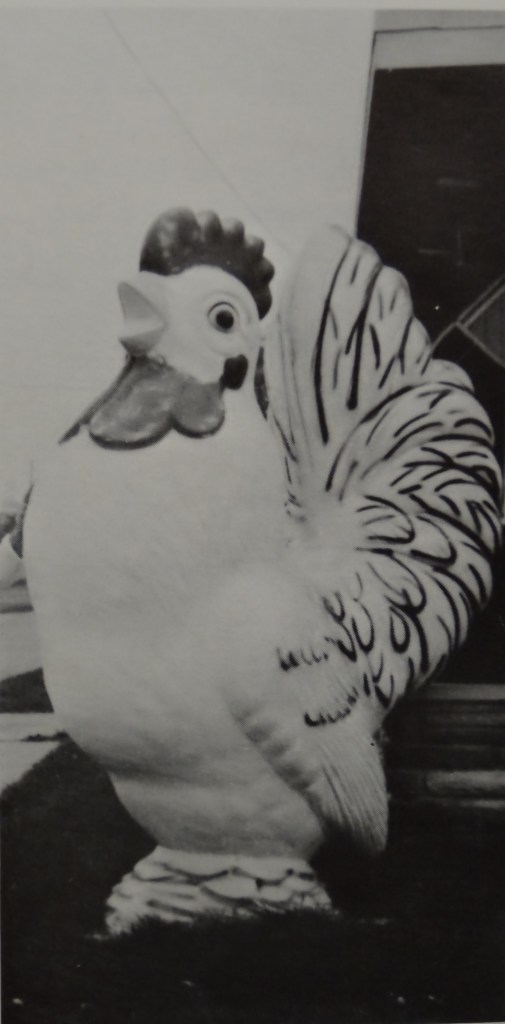
From the top: The Dandy as it appeared in the 1960s, before acquiring its mascot; Joe Nako poses out front while Pauline appears in the window; the first Dandy advertisement – opening for business in 1957; the famous Dandy chicken, circa 1971.

For nearly thirty years, customers in St. Louis found tasty meals at the Dandy Drive-In. When it closed, many feared that the restaurant, a product of the 1950s drive-in experience, was gone forever. Although another well-known St. Louis landmark opened as Tony’s Restaurant, the spot was known as the Dandy to old-timers.

At one time, an old bicycle shop was said to be on the property, and several trees dotted the back of the lot. After a fire a few years ago, someone found the remains of an old foundation on the property, suggesting that the Dandy was not the first business at this location.

The Dandy officially opened for business on April 4, 1957, and owners Joe and Pauline Nako offered free root beer, ginger ale, and cokes to anyone who pulled in for curb service. The Nako’s full last name was Nakonieczny, and the couple first came to St. Louis to own and operate the Colony House in downtown St. Louis. The Colony House was a small restaurant on the north side of Washington Street (M-46) and sat between the Meteor Bar and two gas stations.

The Nakos were from Detroit. During World War II, Joe, born in 1917 in Detroit, served with Battery C, 420 CA (AA) in the Pacific and Aleutian Islands. Nako entered the service in October 1941 and was on active duty until May 1944. On August 17, 1945, Nako was discharged at Camp Sheridan. Pauline Nako was born in Detroit on April 8, 1915, and came from Lithuanian descent. Joe and Pauline married at Blessed Sacrament Church in Detroit in 1947 and soon came to St. Louis to start a business.

One of the complications in learning about the history of the Nakos and the Dandy was that they did not appear to have family members in the community. Also, the couple was notorious for keeping advertising at the Dandy to a minimum. Still, the Nakos started a tradition that continued even after the Dandy closed: word of mouth. This was the best source for reaching customers, and word of mouth in and around St. Louis worked well.

Joe and Pauline opened the Dandy on April 4, 1957, by offering customers free root beer, ginger ale, and cokes for whoever requested curb service. The Dandy closed on Mondays, but by the early 1960s, it had a tradition of being one of the few late-night places to eat and stayed open until midnight. The Dandy usually opened in March and closed at Christmas. The other three months were “off months” for the Nakos, and customers waited for the restaurant’s re-opening each spring.

Different decades leave different memories of what one could eat at the Dandy. The Nakos were known as family people, and many customers flocked there on Sundays for chicken dinners. The “Dandy Burger” was a giant hamburger with a special sauce that reminded some of today’s Big Mac. Pauline Nako soon had customers coming in to taste her wonderful pies. Several former employees remembered how Joe and Pauline operated the Dandy. While Joe maintained the kitchen, Pauline ran the front and was willing to train almost anyone to be a waitress. Joe had the reputation of being the fatherly owner who was known for having a listening ear to his workers. Pauline could be a bit stern at times. However, many knew Pauline also had a heart for her workers.

The Nakos created a well-known mascot in St. Louis when Joe purchased and placed “The Chicken” out front of the Dandy. The fiberglass chicken was a mainstay in St. Louis for decades – “Just look for the chicken” was the famous saying about how to find the Dandy. It is unclear where the Nakos got the chicken, but one story illustrates how well-known the bird was. In one instance, it was reported that a group of boys from a Saginaw high school made off with the fowl as a prank. Fortunately, Joe Nako was able to get the chicken back. This time, Joe cemented the chicken firmly into the ground so that it would never be able to fly away again.

Under the Nakos, the Dandy remained in business until the 1980s. Pauline Nako passed in 2001, and Joe did shortly after that. Both were buried in Oak Grove Cemetery in St. Louis. Before Joe sold the place to the Lagalos Brothers from Saginaw, stories indicate that the Dandy sat vacant for a few years until a new location to eat started with Tony’s Restaurant.

Copyright 2023 James M Goodspeed