Gratiot County in Depression and War: January 1941, “The Start of the Last Year of Peace”

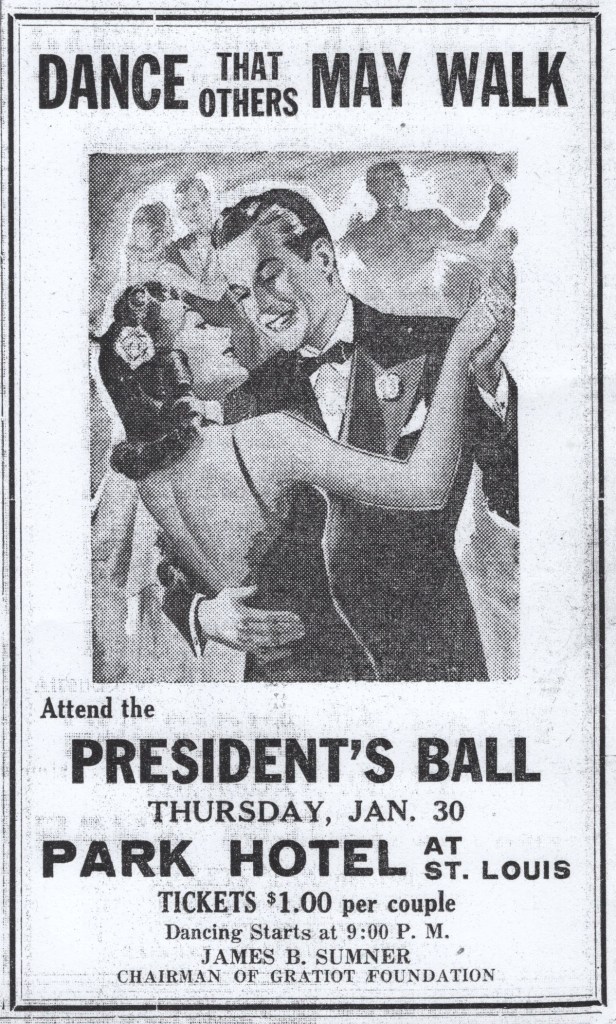
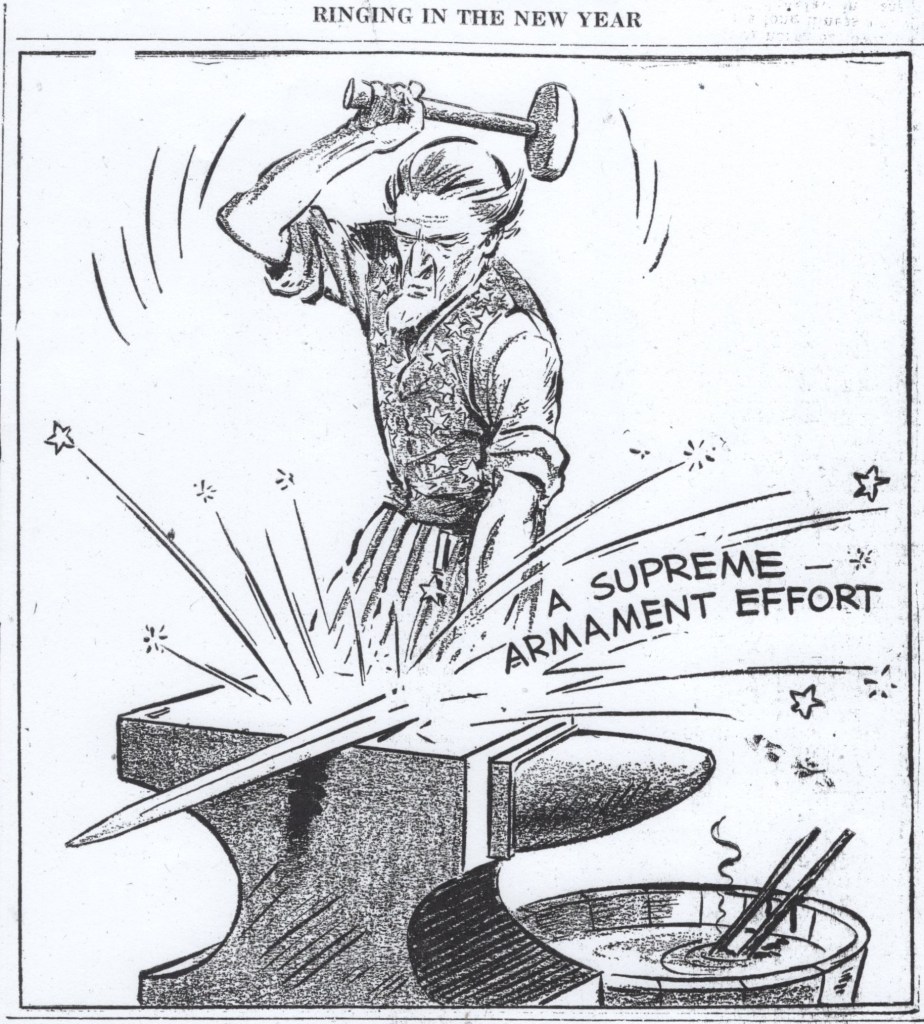
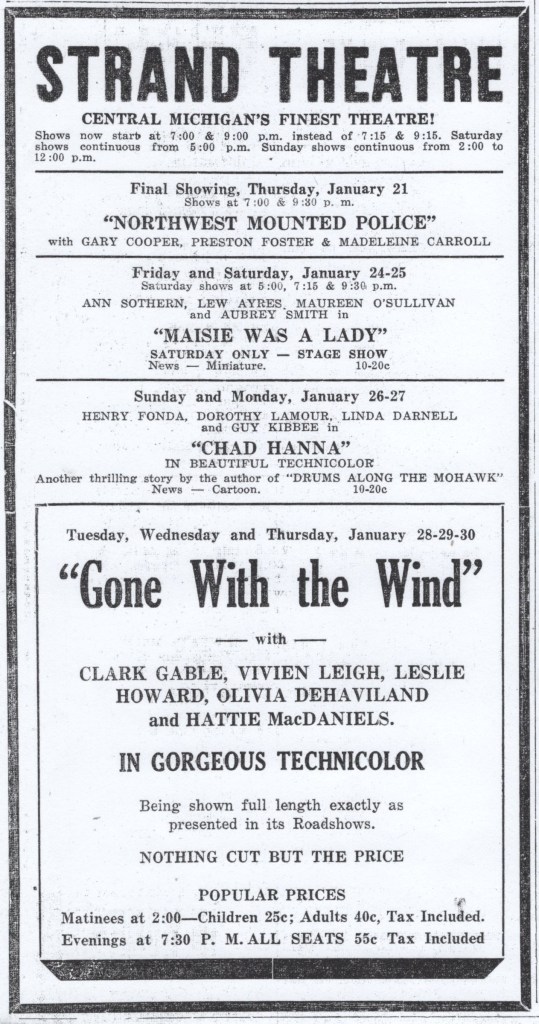
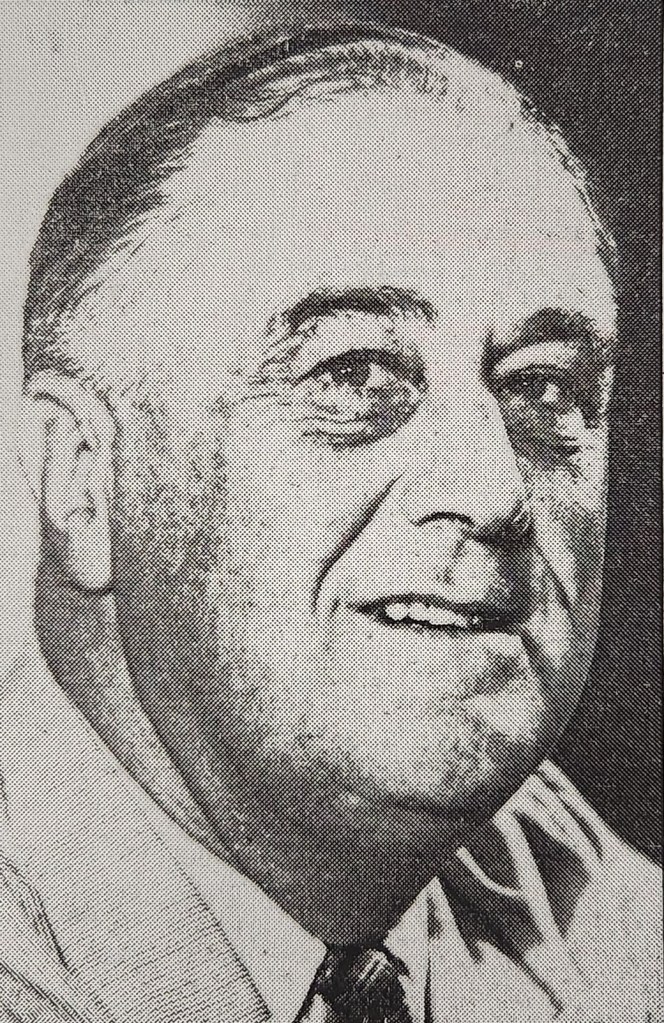
From the top: The St. Louis Park Hotel prepared for the annual “President’s Ball” to raise money for the fight against infantile paralysis; the New Year began with more calls from President Roosevelt to prepare and arm the great “arsenal of Democracy” in wake of the war over England; “Gone With the Wind” made its second appearance in Alma – a tradition of reappearing at least once each decade until the Strand (II) closed in the early 1990s.

Christmas and New Year’s ended quietly in Gratiot County, but talk of America’s involvement in the European war increased.

Another group of young men left for the military even as a line of volunteers dwindled, meaning that the draft board would soon be forced to call men to serve.

The National Youth Administration remained very active by taking in young people to work on various projects.

And winter hit Gratiot County, sometimes shutting down towns and villages, even for just a day or two.

It was January 1941 in Gratiot County.

The Holidays Pass Peacefully

Just before New Year’s, local towns and villages revealed the winners of their Christmas home lighting contests. Milton Townsend, chairman of the St. Louis contest, announced that Carl Johnson of 422 East Washington won first place and was awarded five dollars. For the first time in St. Louis, the city sponsored the contest, but for some reason, there were fewer entries than in 1939. The Alma Chamber of Commerce awarded first place to Paul Woodland of 510 Republic Avenue (personal home) and to the Michigan Masonic Home (institution/business category), which received $10. Over at Breckenridge, the Garden Club rated B.C. Wood first place for the most original display; Mary Shepard got second for the most appropriate; Doctor E.S. Oldham placed third for the most individual; and Walter Neitzke won fourth for the most extensive display.

On Christmas Day, the St. Louis Leader noted that the St. Louis Knights of Pythias Lodge Number 49 held a dinner for 86 children in the lodge quarters above city hall. Following the dinner, each child received a free theatre ticket and a sack of candy from Santa Claus. The lodge put on the entire program and dinner.

“A Nation in an Undeclared War?”

That was what a column in the Alma Record-Alma Journal declared in early January. “We are at war without having declared war” with Nazi Germany, claimed the columnist, by helping Great Britain, and that “the die is cast.” When will war be declared and by whom? In response to concerns that America would soon be involved in a war, President Roosevelt called up America to be “the great arsenal of democracy” and to prepare to defend the nation as Nazism threatened the entire globe. The race to help Great Britain, according to President Roosevelt, had to include the construction and export of more planes, ships, guns, and freighters.

Across Gratiot County, the tone of speeches and presentations also implied that war was not far off. Professor Ray Hamilton of Alma College described Nazi Germany as having a pagan government as he spoke to the Ithaca Rotary Club. Hamilton also said that a former Alma College professor was now being investigated for un-American activities. Other voices, formerly from outside the United States, warned the county about Imperial Japan’s status and actions. Dr. K. Ping spoke to the Alma Rotary Club about why he believed the Japanese would ultimately be defeated, in part because they took over too much of China and could not control it. Ping also stated that both the Communist and Nationalist Chinese had put aside their own differences to unite to fight the Japanese. Doctor Elmer Boyer, recently from Korea, gave a pair of talks in Alma about the harsh life under Japanese rule. As Christianity grew in Korea, the Japanese were very oppressive toward Koreans and extremely distrustful of all Americans.

The Gratiot County Draft Board invited men to volunteer early and join the Army or Navy, even as nineteen men made up the January quota and prepared to leave for Saginaw. Among them were Carl Deline, Herbert Wolford, and William Keon, all of St. Louis. As men were called, the Draft Board realized it would soon be interviewing men who were not volunteers. Members of the board, such as Lyle Whittier, attended meetings, including the one at the Alma Rotary Club, to explain the examination and classification process for the next 14 men to be called in February. Already, Alma lost some of its young men, like Captain H.L. Freeman, who headed the National Guard in Alma and who had been called to Fort Custer.

In other events related to the theme of war, the Redman Trailer Company of Alma became one of eight businesses nationwide approached by the government to build house trailers capable of holding eight bunks for soldiers. Such a contract meant that the Alma Company would need to expand its plant and employ day and night shift workers. A letter from David Glass, Alma College graduate, arrived home explaining his training with the aviation corps at Pensacola, Florida. A total of 976 aliens had registered in Gratiot County by the late December deadline. Ithaca postmaster James O. Peet announced that 415 aliens appeared to register as required by law. Many of those registered were of “foreign extraction” who worked in the sugar beet and farm fields. In other words, they were migrant workers. The Greek Relief Fund in Alma continued to grow from donations. By mid-January, the fund had raised $831.94 to buy supplies for the relief of the families of Greek soldiers who died as a result of fighting Italy. Over 500 local communities across the United States organized Greek relief funds. In Alma, James Stamas, George Goutis, and James Stavros formed the committee. The Alma Record openly endorsed the relief and asked readers to do the same. Doctor and Mrs. B.N. Robinson of Alma received word that Mrs. Robinson’s parents were safe and living in Southern France. It was the first word they had had of the parents since the Nazi invasion in June. The DeWachters formerly resided in Paris and had evacuated from the city. Word reached Alma through American citizens who met the DeWachters in Biarritz.

Life in the Great Depression/New Deal Programs

During the winter of 1941, the National Youth Administration sought to expand its work in Gratiot County by providing young people with work experience through gainful activities. One of these events involved planning the Alma Ice Carnival on Saturday, February 1. Several NYA boys worked as a crew to get an arena ready on the Pine River. The boys sought to create a track almost 300 feet long for various events, including speed skating, sled events, and several novelty events to take place that afternoon.

Alma Schools embraced the idea of using the old Washington School for classes that could enroll up to 100 young people. By offering woodworking classes for boys and home economics for girls, this NYA program dovetailed with the idea of preparing young people for the national defense program. As such, the federal government would cover almost all the expenses associated with ten-week classes that ran for eight hours a week. A.C. Heying would oversee shop work there while Mrs. Marvin Utter would have charge of the home economics classes.

The Works Progress Administration and the St. Louis City Council discussed spring work projects for eight city blocks, including curbs, gutters, and storm sewers. It would cost St. Louis $12,386, but the WPA covered $8,112 of the amount. Areas around North Pine, Washington, Mill, and Center streets were targeted. At the same meeting, city clerk Frank Housel told the city council that 15 able-bodied men owed the county labor on the roads, which amounted to $2 per day. This “work or no relief” policy in the county emerged earlier in 1940. On a lighter WPA note, Darrell Milstead, County WPA recreation director, said the WPA was testing a “toy lending library” at the Republic School recreation center. In this program, a boy or girl would check out a toy for up to two weeks, then return it to the school. If no one was waiting for the toy, the boy or girl could check it out again.

The Long Arm of the Law

During December 1940, 46 people were convicted of crimes, bringing in $222.75 in fines and $232.80 in costs. Three people were sent to Jackson prison and three to the county jail. A number of the court appearances involved game law violations such as carrying a loaded shotgun in a vehicle, violating the Horton’s Trespass Law, or transporting dressed venison. William Batten, 21, of Detroit, and Charles Van Atter, 31, of Eaton Rapids, stood mute to stealing a calf from the George Bates farm during the past summer. Batten got a $25 fine and costs, or 30 days in jail (where he initially went), and Van Atter went to prison on a $200 bond default. The two men picked up the Bates calf, which stood near the edge of the road, and made off with it. There was no word on what had happened to the calf.

Three area men were arrested, and more details emerged about the February 1939 break-in at the Lobdell-Emery plant, where 960 pounds of Downmetal and scrap aluminum were stolen. Arrests of Carl Baker, formerly of Alma, Charles Langin of St. Louis, and Charles Thompson of Alma meant more appearances in front of Justice Howard Potter in Ithaca. Baker had been the key suspect in the cases and was finally apprehended in Kalamazoo. The other men denied knowledge of the crime and requested an examination. This 1939 crime amounted to $100 worth of stolen metals.

Other various crimes and situations made the January newspapers. Russell Smith, Alma’s “heating engineer,” again caused trouble for officers and appeared in court on pretenses for not completing heating repairs. Smith had still not paid his nearly $10 fine for court costs. Hazel Ellsworth remained lodged in the county jail on charges of arson. Ellsworth appeared to be off her hunger strike, but continual attempts to harm herself meant she was under constant watch by a jail matron. Norman Skaggs, 22, of Cheboygan, appeared in court and pleaded guilty to starting a December 1939 fire on the Clarence Clark farm, three miles south of Alma. Skaggs claimed he started the fire while Clark was away, all on a whim. Skaggs hoped he might gain more work by rebuilding a barn to better support his wife and child. Skaggs left the area after the fire and could not make it on being paid five cents a bushel for husking corn. Skaggs now made a complete confession, asked for his punishment, and wanted to clear the matter.

The biggest news of the month concerned a strike by sixteen drivers at the Kress and Son trucking operation in Grand Rapids, which transported Midwest Refineries’ products. When replacements were hired for the striking drivers, several Kress and Son trucks were stopped in Alma and south of Ithaca. When a group of five men stopped a car south of Ithaca and told the driver he had better leave for his own good, the driver walked to the sheriff’s office and filed a complaint. In another instance, one Kress truck was sabotaged while enroute from Owosso. The A.F. of L. union called for the strike, and later that month, fifteen men appeared in court, charged with infringements against Kress Trucking. All seemed to have attorneys supported by the union, and they were released on bonds ranging from $250 to $ 1,000 each. Later, Roland Reitz, 45, of Saginaw, received a $50 fine and $60 in costs for his involvement in a truck holdup in Alma. The sheriff’s department called in special deputies and the Alma Police Department to address a strike situation.

Gratiot Farmers and the Winter

The snow was deep, and the weather was cold, but Gratiot farmers turned out for different programs to get them thinking about the 1941 farming season. The St. Louis Beet Growers Association held its 10th annual program at St. Louis High School and was impressed by the 1,100 people who attended – well above the anticipated number. International Harvester had a meeting for forty dealers at the Park Hotel in St. Louis, with luncheon served in the main dining room. Adolph and Henry Schnepp organized the meeting’s program. The St. Louis Co-operative Association held the city’s second big program of the winter, also at St. Louis, and planned to offer a tour of the new $50,000 creamery on North Mill Street. A group of 500 farmers and wives was anticipated for the February 1 assembly.

In other farming-related news, Breckenridge offered a 10-week adult education course in agriculture. It started on January 15 and was held on Tuesday evenings. Frank Longnecker of Vestaburg made the county newspapers when he announced that one of his pullets laid two oversized eggs in one month. The latest measured 6 ½ and 8 ¾ in circumference and weighed six ounces. A rabid skunk attacked Robert Monroe’s heifer southeast of St. Louis. Monroe saw the skunk bite the heifer on the head, then killed the skunk. The head was then sent to Doctor Frank Erwin, who had it analyzed in Lansing. The skunk was positive for rabies, and Monroe was told to give his heifer a series of shots to save the animal. He also watched the rest of his herd for fear that other rabid animals had attacked and bitten them.

Health Matters

Much of the Gratiot news about health in January centered on infantile paralysis. During the Depression, the annual President’s Benefit Ball took place in St. Louis on January 30 at the Park Hotel to raise money to combat the disease. As a result of recent fundraising, the Gratiot County Chapter of the National Foundation for Infantile Paralysis supported seven cases without making the recipients’ names public. As of January 1941, the group had $300 in its balance and hoped to raise more money through the President’s Ball to support those who needed braces, special shoes, or appliances. Tickets for the ball went on sale, and members were asked to fill coin collection boxes and folders that held $2 each in dimes. Vere Nunn, cashier at Commercial Savings Bank in St. Louis, served as treasurer of the chapter.

Still, other people and events related to health matters were tied to Gratiot County. Two people who were x-rayed at a recent Michigan Tuberculosis Association clinic in the county faced immediate hospitalization. A total of 39 people attended the clinic; 25 of them had been x-rayed before. Of that group, two were deemed active, three were suspect active, and five healed of tuberculosis.

A wave of influenza hit Alma Public Schools hard, with four teachers out and fifteen percent of the student body absent on one day. By mid-January, local doctors believed that the worst of the flu had passed. William Lator, an Ashley High School sophomore, was in critical condition at Smith Memorial Hospital with blood poisoning. Lator had been sick for two months after receiving a scratch or prick while working in the woods. After admission, he improved slightly after a blood transfusion. Two-year-old Alfred Roberts of Middleton also nursed an infected arm. When his mother left the little fellow alone for a moment, she found him caught in the wringer. The rollers caused nasty wounds and required seventeen stitches to close, and then became very uncomfortable due to inflammation. This toddler also fell into a bucket of boiling water a year earlier, then later drank kerosene. Needless to say, young Alfred had seen more than his share of troubles. Another sad Middleton story involved the discovery of Charles Luscher, 69, who was found frozen to death in a ditch southeast of Middleton. He had been there approximately 2 ½ days and was found carrying bottles of beer and some meat, only two rods from his shack. Another sad story took place near Sumner, where Melvin Blackburn was found in a snowbank on the Ben Humphrey farm. Little hope of recovery was given due to prolonged exposure to cold weather and snow.

And So We Do Not Forget

Basketball games between two Fulton teams and Fulton alumni took place before New Year’s. In both cases, the alumni won: the girls’ alumni defeated the Fulton girls 26-16, and the boys’ alumni defeated the Fulton boys 28-23…The Gratiot-Clinton Bar Association feted Circuit Court Judge Kelly S. Searl by having a dinner in his honor at the St. Louis Park Hotel. A collection of approximately 175 circuit court judges, lawyers, and friends attended the dinner…Seventeen people enrolled in citizen classes at St. Louis High School on Monday nights. Three in the group took a course on “English for Newer Americans” led by Grace Niggeman. Some of the students included Anna Sabatavich, Mary Yanik, Anna Simonovic, and Cyril Sedlacek…The city play “Womanless Wedding” was again a big hit at St. Louis High School under the direction of the St. Louis Lions Club. John Brown starred as the bride and Doctor T.D. Gilson is the groom. Proceeds went to the Sight Conservation and Health Welfare fund of the Lions Club.

The final cost of the new county road garage outside Ithaca was $53,871.73 and was primarily funded by state funds. A complete financial report appeared in the St. Louis Leader…A group of 153 people in Porter Royalty Pool, Incorporated, found themselves dividing oil royalties after the state Supreme Court ruled on a case dating back to 1933. In a unanimous decision, the court dismissed charges by Glenn and Mildred Hathaway and 24 others, thus releasing the money…The Kroger Grocery and Baking Company moved to a new location on Mill Street early in 1940 and introduced self-service, which many customers liked. Oren L. Boyd worked as a manager and appeared in the newspaper…A wet, soggy snow left six inches in Gratiot County on Sunday, December 29, and lasted into the evening. It took workers in places like St. Louis most of the night to clear enough roads and streets for people to get around the next day.

A group of 400 people attended the annual stockholders meeting of the Redman Wholesale Grocery Company in Alma. The meeting took place at the Alma Methodist Church, which offered the group a free meal and entertainment after listening to financial reports and the election of officers…Two different groups of Alma people headed to Mexico for a few weeks to avoid the Gratiot County winter. Lester Welch, assistant manager at Martins, led a group of tourists to Durango, Monterey, and Mexico City. James Clark, JC Penney assistant manager, took his family on a three-week trip to Mexico…Temperatures in Alma on January 13 dropped to zero, but rose to 18 degrees above two days later…Alma’s ice rinks opened after the freeze south of the State Street bridge and on one above the dam. Snow had been removed to allow skating there, and it proved very popular with skaters…Cupid’s arrow struck Maynard Peackock, 23, of St. Louis, and Bertha Dickens, 22, of Alma as they tied the knot.

The Gratiot County Herald checked up on the 1940 winners of the baby contest. One year later, Judith Joan Russell, Elm Hall, Lee Arnold Cowles of Alma, and David William Seaman, also of Alma, all had their photographs and biographies as one-year-olds on the front page…The winner of the 1941 Baby Contest went to Raymond Kennedy, Jr., son of Mr and Mrs. Raymond Kennedy of Alma. He appeared at 2:56 a.m. at Carney-Wilcox Hospital and weighed 8 ½ pounds…Doctor Lewis Berg, psychiatrist, sociologist, lecturer, and columnist, spoke during the Town Hall Series at Ithaca High School gymnasium on “The Successful Personality.” Rotary clubs from around Gratiot County sponsored the presentation…One of the Detroit Tigers’ “G-Men,” Charley Gehringer, was the first Detroit Tiger to sign a 1941 contract…Jay Stahl of Ithaca received the Ballard Trophy at Ithaca High School for his football season, as well as being the team captain…A collection of former Ithaca High School football players from the 1906 to 1909 championship teams showed up for the all-sports banquet sponsored by the Ithaca Chamber of Commerce to honor Coach Steve Keglovitz.

”Gone with the Wind” for the second time reappeared at the Strand Theatre in Alma for three dates on January 28-30. Evening tickets cost 55 cents, and one showing took place at 7:30 pm… George Gates took over the location of “Bill’s Popcorn Stand” in Alma on the Masonic property south of the Consumers Power Company building on South State Street. Gates now mainly sold apples and sweet cider…Ben East, wildlife lecturer and writer, appeared at Alma High School on January 14 to show moving pictures on “Islands of the Inland Seas.” The Gratiot County Conservation League supported the presentation…Mrs. Rebecca Louise Stevens, age 107, and the former wife of Dr. L. S. Stevens in Alma, passed away in San Diego, California. Doctor Stevens passed in 1899 and was buried in Riverside Cemetery…Lem Rowley of the Rowley and Church gas station in St. Louis did a neighborly thing for a person in need. Walter Gibbs lost his two Irish Setters and had little hope for their coming home. When neighbor Don Keane heard noises in his father’s barn a week later, he found the two dogs in a holding box, in poor shape and worn out. When called upon by Keane, Lem Rowley helped find the rightful owners of the two setters. Needless to say, Walter Gibbs was thrilled and grateful for the return of his two dogs.

And that was Gratiot County during the Depression and the War in January 1941.

Copyright 2026 James M. Goodspeed
Gratiot County in Depression and War, November 1940: “NO THIRD TERM! Elections and Draft as Winter Approaches”

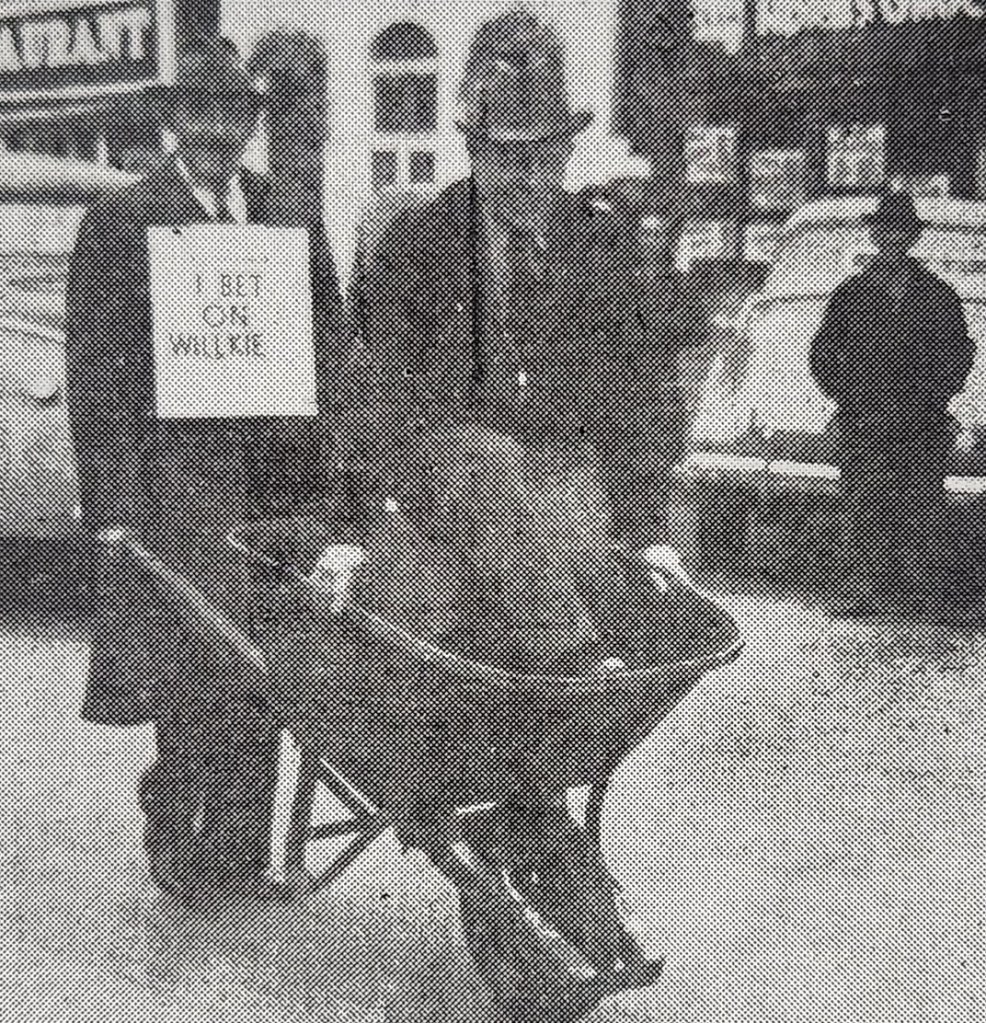
November 1940 in Gratiot County from the top: President Franklin Delano Roosevelt loses Gratiot County for the first time in his three elections, but wins the Presidency in the rest of the nation; John Giles of St. Louis, Vice President and General Manager of Michigan Salt Company, wheels George Hart down Mill Street from Washington Avenue. Giles bet on Wendell Willkie for President, and had to wheel Hart through downtown St. Louis. George Hart, as manager of Hart Brothers Elevator, prepares Gratiot’s first Selective Service Group to leave Alma for the military. Grant Angelus, Forest Proctor, Roy Bigler, and Wyomah Vick made up the group. They received their draft notices early – all near Coleman, Michigan. Derwerd Cary, Charles Van Deventer, and George Cary showcase their successwith a Thanksgiving poem and prayer as it appeared in a local newspaper near the Holiday.

The Nazi Luftwaffe increasingly bombed and decimated English cities as the air war over Great Britain continued.

Franklin Delano Roosevelt was nominated and ran for an unprecedented third term as President of the United States. The prelude to the national draft began as several thousand Gratiot men registered in each township.

A terrible November storm struck Gratiot County as the holidays appeared on the horizon.

It was November 1940 in Gratiot County.

The World at War

As the war raged in the battle over Great Britain, foreign correspondent Orin W. Kaye, Jr. of Lansing, told members of the Alma Rotary and Lions Clubs that he believed England would not be dismembered or conquered by the Nazis. Kaye had been in Paris when the Germans invaded and stated that he believed that morale would be the deciding factor in the war. Before and after the dinner, the group sang patriotic songs and other popular numbers. The program came on the heels of German bombings on Birmingham and Coventry. The Nazis boasted that the attack on Coventry was the “greatest air attack in the history of aerial warfare” as it laid waste to the city and resulted in over 1,000 casualties. 

In other news, state budget director Gus Hartman announced that he rejected any plans to build new armories in Michigan in 1941 due to the war. The state military establishment requested $3.5 million to develop and improve armories across the state. To commemorate Armistice Day, students at St. Louis High School held a program in the high school gymnasium with help from the William Fields American Legion Post. Commander Milton Townsend was one of two speakers. The program concluded with the playing of Taps. Over at Alma, plans for an Armistice parade with floats, bands, and American Legion members had to be changed due to the weather, even though the Alma City Band and Alma High School Band marched downtown and arrived at East Superior Christian Church, where a service was held.

With the war continuing in Europe, Sheriff William Nestle set out for Washington, D.C., where a national defense conference took place. Much of the conference centered on how police and sheriff’s departments would step in to cover duties previously performed by the National Guard in their areas. William B. Kyes, formerly of Elwell, left for the Officers Training Corps of the Air Division of the United States  Army at Parks Air College in East St. Louis. Kyes took a three-month course, then would go to either Texas, Alabama, or California to finish his training. Since June, Kyes had taught at Freeport High School.

Alien registration continued in Gratiot County, with 601 aliens registered as of November 21. All aliens age fourteen and older had to register in person. Those under the age had to be registered by their parents or guardians. Any change of address needed to be reported to one of three post offices in the county.

New Deal Life During the Depression

The Works Progress Administration (WPA) announced that the Stillwell Junior High gymnasium opened on Monday evenings to boys and girls not attending Alma schools. While NYA boys and girls were encouraged to use the gym, the facilities remained open to other students from 7 pm to 8 pm for girls and 8 pm to 9 pm for boys. Lester Fillhard, WPA recreation director, served as supervisor.

Foreman and timekeepers from WPA projects met at Alma’s city hall to form a national defense council. Organized by the federal government, the councils were formed mainly “for the purpose of detecting and nipping any subversive activities” within federal aid groups. Even though some WPA workers faced layoffs for a week, upon returning to work, they continued preparing the grounds in Wright Park for new tennis courts. The group removed trees and stumps, then waited for the excavation and grading of the ground to be completed before installing the courts.

The NYA (National Youth Administration) role in Gratiot increased by 100 people to carry out new projects, such as rehabilitating used toys for Christmas gifts for needy children and expanding girls’ sewing and home economics projects. Project workers earned $18 a month, and some foremen, aged 17 to 24, received as much as $24 for 60 hours of work. The NYA program provided young people with practical experience through useful work and aimed to encourage good work habits. Jack Acker, WPA recreation leader at Alma’s Republic Recreation Center, oversaw a new club called the “East End Canaries.” Eighteen boys and girls participated in the first meeting that promoted recreational activities of a “wholesome nature.” Benie Simons served as president of the newly formed club, and its first project was to host a Christmas party. In November, fifty NYA workers received Red Cross first-aid training, and a notice went out that any youth over the age of seventeen could receive instruction.

Two WPA recreational leaders from Alma went to Flint for a special recreational training institute. Lester Fillhard and Jack Acker represented Alma at the meetings. Darrell Milstead, county WPA leader, announced that NYA workers continued repairing Christmas toys in the basement of the Salvation Army (toy shop). The NYA and the Salvation Army hoped that every child in Alma would have a toy for Christmas.

At the Gratiot County Courthouse, the Bureau of Social Aid moved to make way for the Community Welfare Department. Both had new locations due to changes in the courthouse basement. The bureau had two NYA workers.

The Election of 1940 – No Third Term?

In November 1940, Gratiot County and the rest of the nation faced an unprecedented situation. Should the United States re-elect the President of the United States to a third term in office? The United States Constitution then did not bar Presidents from a third term. However, by tradition, two terms of office had been the maximum that any then-sitting President held. Now, President Franklin D. Roosevelt had been called by his fellow Democrats to run again for office – and Gratiot County was floored.

Roosevelt won convincingly in the county in 1932, and then by a much narrower margin in 1936. Now, Republicans everywhere warned people of the threat of a Democratic “dictatorship” with mounted signs and advertisements in Gratiot County that read “No Third Term!”. Another issue bantered by Republican opponents centered on the continued deficit that Michigan and the nation ran in operating Roosevelt’s New Deal programs. Republicans asked, why was the deficit as high in 1940 as it had been in 1932? The answer was the Great Depression—an economic nightmare the nation had never experienced before. Unfortunately for Roosevelt opponents in Gratiot County (which elected Republican Wendel Willkie), FDR won a third term in office.

The Draft

Following the national draft lottery in Washington, D.C., 155 Gratiot men were among the first called to military service. The public found out who these men were by reading the long lists printed in the Alma Record-Alma Journal. Three men from Alma headed the list: Russell Swinson, Joe Prahin, and Louis DeRosia. However, before any of the list were officially called,  at least a half dozen men volunteered. Soon, four men stepped forward as the first volunteers from Gratiot County. The four included Grant Angelus and Roy Bigler of Alma; Forest Proctor of Ithaca; and Wyomah Vick of Alma, who recently moved to Edmore. A special program at the George W. Myers Post of the Alma American Legion recognized the volunteers, and each received a gift package from the Alma Community Christmas League. Inside were things like writing paper, a fountain pen, candy, and two packages of cigarettes. The Salvation Army chaplain also gave each volunteer a small testament. On this wet, snowy day in Alma, a parade assembled at Alma City Hall, then made its way down to the bus station on East Superior Street. The four volunteers rode in an automobile with signs on the side that read “Gratiot’s First Volunteers” along with their individual names. It was not long after this that another 12 men requested that the Gratiot County Draft Board accept them as Gratiot County’s following volunteers.

Halloween, Thanksgiving, Christmas

Over in St. Louis, 500 children drank nearly 40 gallons of cider and ate 100 dozen doughnuts. Just before the Halloween festivities, someone threw a cabbage head through Colonel J.M. Thrasher’s large front window on Main Street. Police continued to investigate who the culprit might be. New Deal programs like the NYA and WPA helped sponsor a Halloween gathering in Alma, where 500 children also turned out for a parade from the Tourist Park to Rademacher Motor Sales garage starting at 7:30 pm. Helpers inserted toy balloons with prize slips into the balloons, then let them loose from the tops of several downtown businesses. A bonfire back at the Tourist Park concluded the night.

A Woman’s Page Editor in the Alma Record-Alma Journal suggested an ideal Thanksgiving menu with four types of dishes. Just how many were realistic for most people’s Thanksgiving dinners was a matter of conjecture. Turkey, duck, and chicken were the main choices. Gilmore’s Grocery in St. Louis (“Where Values are Quality”) urged shoppers not to forget that they could get all their Thanksgiving trimmings at Gilmore’s. For Thanksgiving, the Gratiot County Herald published a copy of “The First Thanksgiving Proclamation” by President George Washington.

By golly, Christmas was just around the corner in Gratiot County, and the Santa Claus Club held its first meeting in Ithaca’s village hall to plan the community programs. Alma led all the festivities with its Window Night on November 29, featuring new flashing lights on the main street, a parade, and the debut of Christmas trees along light poles. The Strand Theatre offered a free matinee to children who donated a canned good. St. Louis planned to kick off the official Christmas shopping season on December 6 with Window Night. At 7:15 on that Friday night, the fire siren would sound and Santa would appear on the streets. The St. Louis Lions Club and the GEM Theater planned to sponsor a free children’s movie. Merchants with the best decorated windows also received prizes, and the St. Louis Trade Association expected visitors from throughout Gratiot and Midland counties. St. Louis also planned a home lighting contest for the best-decorated homes in the city. Ithaca planned its Window Night with Santa on December 14. Breckenridge sponsored its annual Christmas lighting contest sponsored by the Breckenridge Garden Club.

 November Storms and Farming

On Monday, November 11, 1940, a storm with cyclone-level winds descended across parts of the United States. Gratiot County was one of the places that bore the full brunt of this 50-60 mph storm. In St. Louis, Mary Hoffman was sent to Smith Memorial Hospital after a gust of wind shoved her against the wall of a building with enough force to break her arm. Telephones, signs, and poles across the city were seriously damaged. The storm toppled the brick chimney of Alma’s First Baptist Church, sending it crashing through the roof of the church’s east room. The Beebe store in Emerson Township had its entire roof torn off by the weather. High winds also attacked the farm of Valois and Paul Todd, outside of Middleton, which also had the roof ripped off of their east barn. Other county farmers who lost their barns included John Wilk (northwest of Alma) and Fred Flegel (Sickles). The first estimates placed the damages in the county at tens of thousands of dollars, and according to the Gratiot County Herald, “hardly a single community escaped without some damage.”

Michigan Sugar estimated that 40,000 tons of beets sliced so far only accounted for one-half of the expected yield in the Alma region. Beet fields yielded an average of 8 ½ to 9 tons per acre, which was then considered average production. A freeze-up resulting from the hurricane storm that hit Gratiot delayed the harvest by about a week; however, warmer temperatures allowed farmers to complete the remaining 2,000 to 3,000 acres left in the Gratiot area. In other harvest news, Herman Hoffer of Ashley had a tremendous corn yield of 60 bushels per acre. Reports said that Hoffer’s yield from five acres of ground was as much as the average American farmer received from ten acres. Hoffer planted and harvested DeKalb 204 on his farm. When it came to milk production, the Gratiot Dairy Herd Improvement Association recognized Ralph Densmore and his Holsteins of Elwell for leading the area with an average production of 1569 pounds of milk and 48.79 pounds of fat. A.J. Neitzke of Breckenridge was second with his Brown Swiss yielding 1040 pounds of milk and 41.66 pounds of milk fat.

Newspapers highlighted other farming news in November. Evart Denney, a recent graduate of Ohio University, took over the duties as manager of the 700-acre Balmoral Farms. He replaced Peter McClelland, who had managed the farm since 1925. Instructors prepared for a ten-week night class at St. Louis High School sponsored by the Smith-Hughes Agricultural Program. The program prepared teachers at the area high schools to teach students with help from the Michigan State College extension department. The Future Farmers of America Chapter at St. Louis High School also held its fifth annual community fair on November 28-29. The Breckenridge FFA also helped provide the program of free movies, corn husking contests, music by their bands, a style show, and ended with a school judging contest. At least 65 boys and girls participated in the fair.

Alma Production Credit Association prepared for its sixth annual meeting at the Strand Theatre. The meeting gave members updates on the organization’s business and financial reports. It featured a free noon-day luncheon for several hundred farmers and their wives. In some unfortunate news, Harzey Fisher of Crystal was seriously injured while working on the Henry Tompson farm near Sumner. Fisher got his coveralls caught in the drive shaft of a corn picker as it went around a tree. Harzey held onto the lever until the shaft stopped; however, the force of the shaft stripped off the coveralls, pants, and underwear, and heavily lacerated his leg. Fisher was transported to Edmore Hospital for observation and treatment.

If it is November, the Nimrods are Here

As the nimrods descended upon Gratiot County to hunt pheasants, so did the game warden. However, overall pheasant hunting was considered poor in Gratiot County. Still, George Howe and Robert Lee of Alma were arrested for stalking on lands northeast of St. Louis without permission. They each paid a fine of $14.85. On the last day of pheasant season, Gus Claerhout and Claude Taylor jumped a fox on the Jack Dicken farm south of Ithaca. The male fox fought the collie the pair had with them until Taylor shot the nice male. Some of those from the county who went deer hunting came home with a buck. Leo Podgoresek led a group of successful hunters from Riverdale, including Vera Johnson, who shot her first buck five times to make sure he dropped. Charles Smith of Elm Hall brought in a very nice 16-point buck. A group of 16 game wardens enforced a blockade at the intersection of M-46 and US-27, northwest of Alma, to monitor illegal hunting. The wardens did a car check on each vehicle and found eight violators that day. Violations included carrying a loaded weapon in the car, removal of the sex of a deer, hunting without a proper license, and possession of birds shot out of season. Fines ranged from $10.85 to $50.00, depending on the case.

The Long Arm of the Law, Health Matters

During the previous month, Gratiot courts reported 91 convictions, including 20 for game violations. Some of the less common offenses included possession and sale of adulterated food, failure to send a child to school, and failure to pay a dog license. Fines and total costs brought in $287.55 to the county. Daniel Fisher, age 70 of Ithaca, suffered a concussion and lost both of his horses when his wagon was hit by a Stockbridge driver on a hill just north of Ithaca. While the wagon was unlit, the driver was cited for driving too fast and for causing the accident. Edward Vela, age 18, Mexican beet worker, and Geraldine Pego, of Indian descent and age 19, were arraigned on a morals charge. Vela got four months, and Vela received sixty days in the county jail. St. Louis police picked up a trio of violators on a drunken driving spree in a car with small children. Jessie Joseph (Fisher), Joseph Williams, and Edwin Burr, all of Mt. Pleasant, were arrested and served thirty days each for failure to pay fines of $25 to $35 each. Joseph (Fisher) and Williams were identified as being Indians. On a more positive note, Mrs. J.H. Keep, janitress at the Strand Theatre, turned over to management a wallet containing $106. A light cable and aisle seat kept the wallet out of sight until Keep found it. It turned out that the wallet had been lost by a Detroit salesman who watched a movie at the theatre some ten days earlier. Mrs. Keep was commended for honesty in turning in the wallet to Strand manager V.A. Jaeckel.

One of the most critical health issues in the county remained the battle against tuberculosis, and the Michigan Tuberculosis Association held a clinic at Alma High School. Tuberculin tests were given, and the Vollmer patch test was used for the first time. A total of 215 students at both the middle and high schools took the tests conducted by Dr. Charles DuBois. After examinations, anyone who tested positive had to undergo an X-ray. At Smith Memorial Hospital in Alma, the R.B. Smith Auxiliary purchased a modern incubator for premature babies. The incubator, engineered by the Ford Hospital, allowed the hospital to transport babies 20 miles without changing the incubator’s internal temperature. The device had an automatic thermostat, humidity control, and oxygen intake controls.

And So We Do Not Forget

Murray Brown of Kalamazoo moved to Alma to open a photographic studio in the southeast corner room of the Wright Hotel. Go to the first floor to find his studio…Henry Fonda and Jackie Cooper starred in “The Return of Frank James” at the Strand Theatre in Alma. Tickets were ten and twenty cents – all for a movie, news, and cartoon…Mrs. Reid Brazell served as chairperson of the Alma Red Cross. Brazell urged the Gratiot community to support the Red Cross as it helped with disasters across the country…A new brick covering went up over the office entrance to Carney-Wilcox Hospital. With the latest addition, the staff could now keep the area clear of snow and slush during the winter…Alma Iron and Metal Company solicited muskrat, mink, and skunk hides. Highest prices paid.

More window-soaping in St. Louis prompted Mayor Sumner to warn that repeat offenders would face harsh punishment if caught. While Halloween had been fun, the continued soaping of windows was too much, and Sumner asked the St. Louis police force to apprehend all “soapers”…The Brice Store in North Shade Township burned to the ground on November 13. Owner Henry Fockler was awakened by his dog at 3:00 am and called the Perrinton and Carson City fire departments for help. Unfortunately, a strong west wind quickly fanned the flames, resulting in a total loss. Fockler had some insurance on the building, which was a landmark in North Shade Township.

The Alma First Presbyterian Church held its annual bazaar on November 7. A roast chicken dinner costs fifty cents for adults, twenty-five cents for children twelve and under…Denver Hole of 412 Ely Street in Alma announced that he was returning to the blacksmith trade. Following training with his father in the old Charles Fishbeck shop,  and after trying another job, Hole opened a shop in the back of the Consumers Power Company and was turning out trailer hitches for motorists…Tex Ritter starred in “Rhythm of the Rio Grande” at the Alma Theatre. Shows cost only ten and fifteen cents—and it was air-conditioned…Art Farnsworth of Alma moved his used car headquarters to a new location on East Superior at the Bridge Street approach. He advertised nine vehicles, including a 1940 Plymouth 2-door…Mrs. Fred Bennett filled in for her husband as a truck driver for the St. Louis Fire Department while he went on a hunting trip. Mrs. Bennett was the only known fire truck driver in the United States.

Professor Arpyal Toth wrote from Budapest, Hungary, to the Alma Chamber of Commerce requesting copies of local newspapers. The card came written in legible English…Mr and Mrs. P.H. Deal of Elwood, Indiana, arrived in Alma to take over the running of the kitchen at the Wright Hotel. Vern Daymon of Elwell was hired as the new night clerk..Oliver Haight of Alma celebrated his 87th birthday by going deer hunting with his grandson near Oil City. The pair brought home a buck on the second day of hunting…New Christmas toys started to appear in Alma as Santa and “Window Night” on November 29 approached…The sale of deer licenses in Alma was up by approximately two-thirds from a year ago. Dick’s Package Shop sold 285 licenses, with Mapes Hardware close behind at 225.

Gene Autry and Smiley Burnette starred in “Carolina Moon” at Ithaca’s Ideal Theatre…An estimated 300 volunteers for the Gratiot County Red Cross fanned out across the county in an attempt to increase membership in a drive from November 11-30…The Ithaca Methodist Church invited the community on Thanksgiving Night  to see the new motion pictures, “Life of Christ” and “Passion Play.” The film was produced in Europe, the Holy Land, and Egypt…The McCormack Store in Ithaca had a new, modern black-and-white glass front. New modern lettering was added to the top of the entrance in black on a white background. The owners stated that the new glass brick admitted 74 percent natural light.  Also, dry goods and vegetables would now be placed on one side of the display window…Stovall Studio and Camera Shop of Alma advertised itself as “The Old Reliable Studio of Central Michigan.” Photographs made great Christmas gifts…The Ithaca Yellow Jackets finished their season 5-0-2 and did not give up a single point.

The Alma Theatre wanted patrons to know that a new seating plan included only one aisle through the center of the theatre, replacing the old two-aisle pattern. This allowed for closer seating to the screen, which raised seating capacity to 324 people… Redman Trailer planned to build a new building on East Superior Street that would cost $6000. Made of cinder blocks, it would measure 70×90 feet and stand 10 to 14 feet high…After 20 years of planning and wishing, a new Gratiot County Road Commission building opened in Ithaca, and an estimated 1,000 people attended a two-day open house. Music and dancing were provided, along with tours.

And that was Depression and War in Gratiot County during November 1940.

Copyright 2025 James M. Goodspeed