
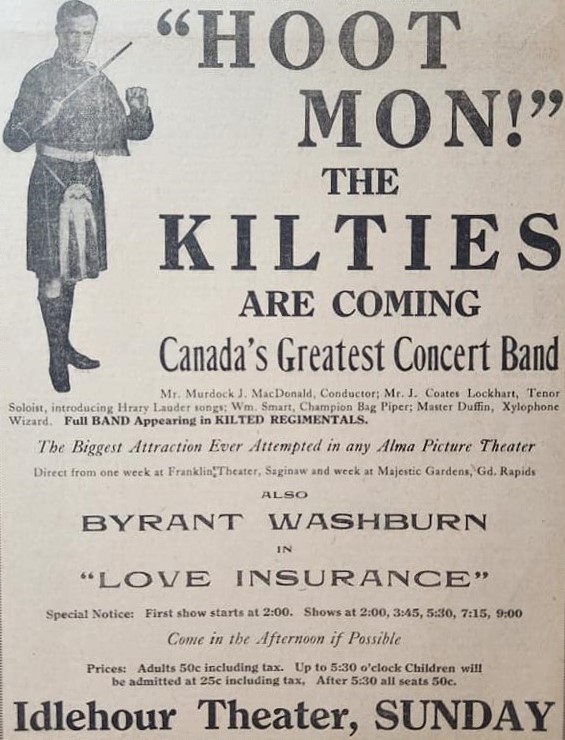

Movies in Alma in 1919 from the top: Houdini at the Idlehour Theater in May 1919; the Kilties come to Alma at the Idlehour, October 1919; “washed air” arrives at the Idlehour prior to the onset of summer, June 1919.
In mid-January 1919, after closing due to the Influenza Epidemic, theatres such as “The Liberty” and “The Idlehour” attempted to reconnect with Alma moviegoers. During the first week of reopening, something new happened in Alma, as both theatres showed different movies each night to attract business.
Although proprietor Gilbert Genesta announced the previous fall that he sold his interests in the Liberty, he soon opened another movie theatre in Alma. This time, in April 1919, Genesta planned to lease part of the Studebaker garage in the Spinney block and offered what the Alma Record deemed a “cheap grade of pictures” that would show for only ten cents. By August, Genesta had acquired a new lease, and he planned to make massive improvements inside, hoping to seat between 800 and 1,000 people. “Genesta’s Ten Cent Theatre” planned to make money by showing movies that did not appear elsewhere in town featuring Mary Pickford, Charlie Chaplin, and D.W. Griffith.
However, Genesta sold this theatre again to R.J. McLaughlin of St. Johns, who renamed it “The Regent.” The Regent ran for a while but eventually closed. Was this deal Genesta’s plan all along, or was he just a restless owner and entertainer who needed to be on the move? Although he claimed he was moving to California, Genesta would revisit and perform in Alma throughout the 1920s. In 1930, Genesta’s death in Frankfort, Kentucky, shocked Gratiot County. While performing his trademark water barrel escape, Genesta could not escape and died as a result of being trapped. Newspapers reported that his death was due to an equipment malfunction. Geneseta did not know it that night, but his barrel was damaged when it was unloaded at the theatre earlier in the day, resulting in his inability to open the escape lid properly.
Another reason Genesta left the county’s theatre business when he did was possibly due to the big news that came to Alma in May 1919. Two Detroit engineers, L. Francis Murphy and Horace H. Esselstyn, announced they had secured lots just west of city hall to build Alma’s first modern movie theatre. It would be 52 feet wide and 132 feet long, with a brick front and seats for at least 800 people. This theatre had a fully equipped stage to offer big attractions and a new heating and ventilation system for seasonal use. The basement contained the heating plant, coal, and dressing rooms. With all this room, Strand ownership hoped that major Vaudeville programs would perform there. Although the new owners modeled the theatre after “The Majestic Theatre” in Detroit, they settled on a new name for their theatre in Alma. It would be called “The Strand Theatre.”
While it planned to open in 1919, it would be late May 1920 before the Strand offered its first show. Constructed by Broughton and Son, the total investment in the building exceeded $125,000, and many in Alma wondered if the new theatre would survive. However, on the opening Saturday night, 950 people jammed inside to watch the Strand’s first show. Victor Gipe from Detroit was hired to play the new $10,000 orchestral pipe organ. People arrived early to listen to Gipe’s music due to his reputation as one of the best “picture players” in Michigan.
As the first show closed, Manager C.A. Miller stepped onto the stage to tell the audience that the more money they spent on the Strand, the better the pictures would be. A photographer then came on the stage, snapped a flashlight picture of the audience, and the Strand was off and running – a run that would last for over 70 years in Alma.
The opening of the Strand Theatre coincided with the period many called the Roaring Twenties – a decade of new motion pictures, vaudeville, and the coming of “Talkies.”
Copyright 2024 James M. Goodspeed
 Goodspeed's Gratiot County Historical Blog