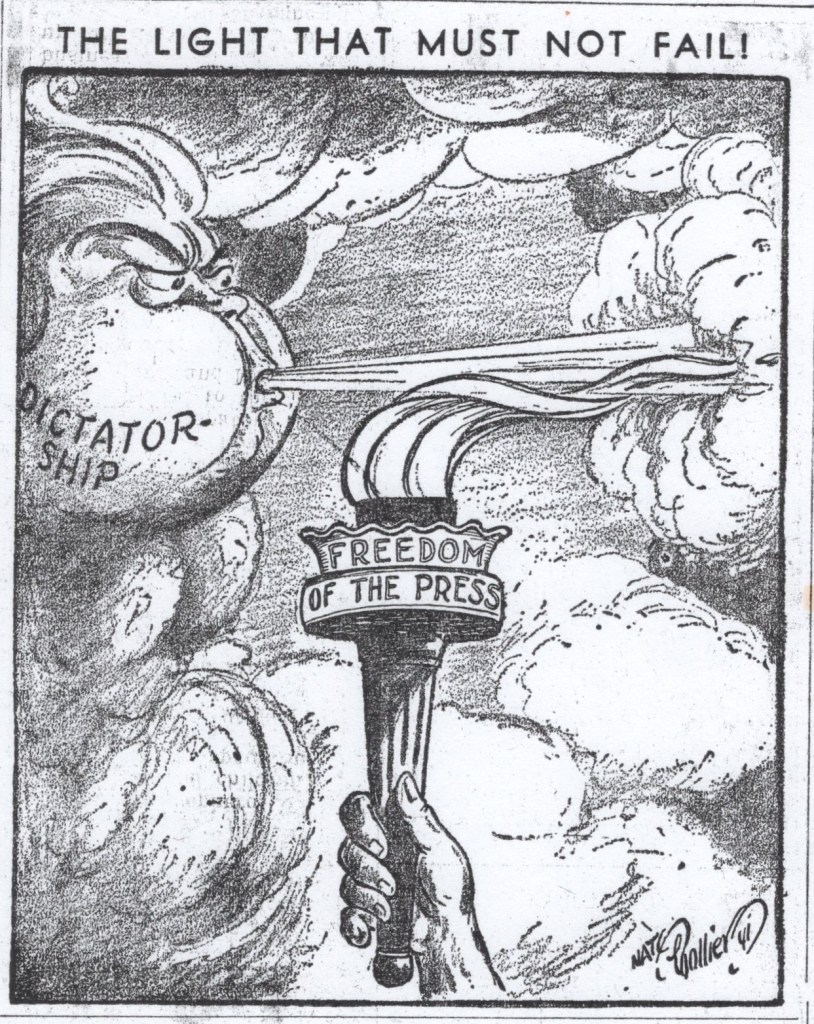

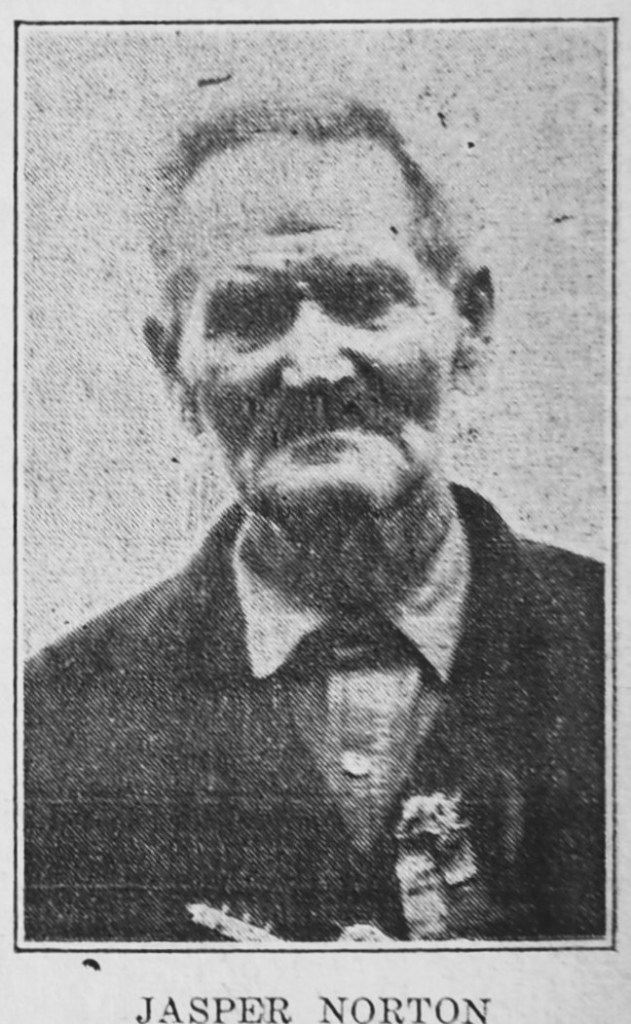
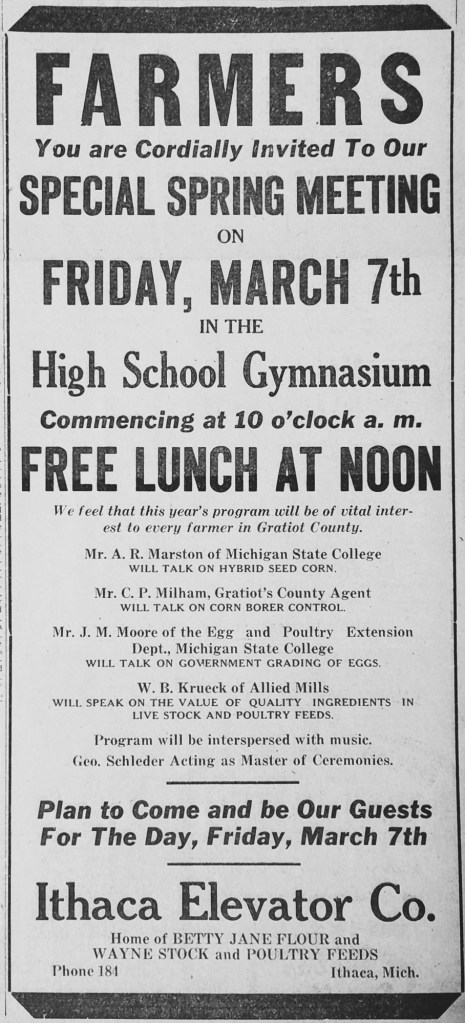
February 1941 from the top: “The Light That Must Not Fail” from February 20, 1941, Alma Record-Alma Journal; the St. Louis boys basketball team celebrates a league championship; Gratiot County loses its last tie to the Civil War as Elm Hall resident Jasper Norton passes; winter was in full stride but Gratiot County farmers could find several things to do like attending this meeting in Ithaca in late February.
The dead of winter continued into February with the holidays long over.
News from the war involving Nazi Germany and England continued to sound troubling.
The third set of Gratiot’s young men went off as volunteers stepped up for training.
Communities experienced some of the New Deal programs that gave people – especially young people – something to do.
Yet even in winter, Gratiot County farmers planned for the upcoming farming season.
It was February 1941 in Gratiot County
News as Gratiot County Drifts Toward War
War news from England continued to sound grim as that island nation endured relentless Nazi attacks, later termed “The Blitz.” To illustrate the impact locally, Mrs. Frank Altenberg of Newark Township hosted her uncle, William T. Hill, visiting from England in 1939. Hill now sent a letter to a Carson City family member, which was published in the Gratiot County Herald, describing how his family in Belvidere, Kent, withstood nightly raids. Hill wrote, “We had not had a raid for nearly 48 hours. In fact, we were all able to go to bed last night, also the night before; that is the first time since the end of August, so you can bet it came as a treat.” Hill added the sentiment shared by many Britons: “It’s a great thing we can rely on your country for the great help we are getting. As long as the U.S.A. keeps us going with ships and planes, we will find the men to man them until Hitler and his murderers are finished.”
While Gratiot County’s residents read news from overseas, debates about American involvement intensified at home. Some Americans continued to oppose President Roosevelt’s Lend-Lease policy, which allowed the United States to aid Great Britain. Republicans complained that Roosevelt wielded more power than Prime Minister Churchill and that America failed to hold Roosevelt accountable for his policies. Regardless, the Lend-Lease Act, which provided free food, oil, and materials to several nations, would soon be signed into law, and Gratiot County residents were urged to read the act (H.R. Bill 1776) for themselves in the Gratiot County Herald. To understand why America should help Britain, maps in local newspapers continued to educate the American public about the Axis threat spreading to other countries, especially in the Mediterranean. Some maps showed probable Nazi invasion routes and bombing plans in their attempts to fully conquer the West.
As these international discussions continued, Gratiot County residents sought tangible ways to help those affected by war. Gratiot people could help Europe by contributing to the Greek Relief Fund. Led by James Stamas of Alma, this drive raised funds for the families of Greek soldiers in need of food, medicine, or clothing. By early February, it raised $866.19. Nationally, on February 8, the National Broadcasting Company aired an hour-long radio program called “Calling America” to request more Greek Relief funds. Among early donors in February in Alma were Walker’s Electric Shop, Dr. R.A. Wilcox, and Clarence Hankel.
One word that occurred repeatedly in Gratiot County and in America was “defense,” as in defense classes and school defense projects. Alma city and school officials reached an agreement with the National Youth Administration to lease the Washington School building and hold classes there. Under this agreement, the NYA held shop classes for young men and women ages 17 to 24. Programs included mechanical work for men and weaving, sewing, and a hot-lunch project for women. The Alma Board of Education agreed to condition the building for use; the city paid for heating ($150 per month); and the NYA provided trained instructors, full shop equipment, and all electrical needs. Newspapers reported that the program hoped to enroll more than 100 young men. Another set of defense classes was planned at St. Louis High School for young men between 18 and 25 who were out of school. These classes focused on carpentry, blueprint reading, maintenance, and building construction. Twelve men were needed, and Art Stinson served as shop instructor. After the first meeting, 16 men attended the class. By the end of February, LeRoy W. Layman supervised male activities in the woodworking shop. Layman had served as production man and superintendent of the Alma Trailer plant. Mrs. Frank Bennett supervised the girls’ and young women’s work with weaving, sewing, and the hot lunch projects. Bennett was also from Alma.
The American Legion attempted to engage with World War veterans by distributing voluntary questionnaires, regardless of whether respondents were members of the Legion. The questionnaires asked veterans to fill them out in order to “assist constituted authorities in certain capacities if requested, as well as reporting on the qualifications and capacities” for national defense. All participation was declared voluntary.
For most people, the draft most clearly tied Gratiot County to a possible war. To fill Gratiot County’s third service quota, 14 volunteers left for Saginaw on February 12. They met friends and relatives at Alma draft headquarters, then went to the American Legion Hall. A bus picked them up at 5:45. The group included Marcus Steele of Elwell and Franklin Frank Klein of Ithaca. When four men failed their physicals, three men from Breckenridge (Matthew Feith, Don Eugene Randall, and Tony Zoster) and one from Alma (Selas George Cole) volunteered to replace them. Many from around the state complained that men passed county physicals but failed Army physicals.
The Traveling Flying Cadet Examining Board came to Saginaw to recruit young men to become flyers. The board spent one week in Saginaw and invited young men from Alma College who had at least 2 years of schooling to consider joining and becoming ranked as high as second lieutenants. If a young man was on track to graduate in June, he could apply now and request that his training appointment be deferred until the summer. All these young applicants had to do was get to the Saginaw National Guard Armory. Those who missed this opportunity would have to go to Selfridge Field.
To present Army life after induction as pretty good, the Gratiot Draft Board sometimes published a letter from someone who entered the service. William Leonard of St. Louis wrote, “The Army is not so bad. There is enough to eat and enough to do to keep us out of mischief. We have 13 weeks of hard drilling, and then it is quite easy.” Leonard also loved the weather while serving with the 6th Coast Artillery Regiment at Fort Baker in San Francisco, California. Clarence Husted, 19, of Ithaca, appeared on the front page of the Gratiot County Herald after he enlisted in the Army Air Corps and went off to Scotts Field, an Army training field in southern Illinois. An only son, Husted’s father was a World War veteran who died from tuberculosis contracted during his service. He died when his son was only a year old.
While Gratiot County looked forward to new challenges, it also paused to honor its past. One veteran’s story from the past was published in February, as the county recognized the loss of its last Civil War veteran. Jasper Norton of Elm Hall died at the age of 95 after living an unusually active life around his home and village. Norton enlisted in the Union Army at age 16 as a member of Company D, 12th Michigan Infantry. He saw action in many skirmishes and was wounded at the Battle of Camden, Arkansas. He married in 1871 and moved to Elm Hall. Jasper Norton’s death marked Gratiot County’s last tie to the Civil War.
Life in Gratiot County During the Depression and New Deal Programs
Signs of the Great Depression were still evident among Gratiot residents in February. The welfare committee of the St. Louis City Council and Nonpareil Club called for donations of new or slightly used clothing for adults and children. Donations could be left in the fire department room at City Hall. The AAA office in Gratiot County announced that it received over 600 applications for one carload of cotton mattresses. A group of seven people representing home economics groups in the county went to Mt. Pleasant to learn how to stuff and make cotton mattresses for AAA. Work on creating mattresses for Gratiot County would be done on rainy days and in the evenings during the spring. Anyone who wanted to see what the mattresses looked like could visit the Gratiot County courthouse to view some on display.
Overall job placements in the county exceeded those for January 1940, according to the Alma district office of the Michigan State Unemployment Service. A total of 99 placements for regular and temporary jobs took place. Regular jobs lasted more than 1 month; temporary jobs lasted less than 1 month. The MESC office in Alma advertised openings for skilled positions, including bench molders, floor molders, turret lathe operators, tool grinders, and automatic screw machine operators. How many people in the county actually were qualified was another question. Another concern in February centered on Consumers Power workers, who were rumored to go on strike in early March. What would happen to lights and electricity?
Probably the saddest story involving the Depression involved an altercation between Theodore Adams of Alma for his assault and battery upon C.J. Chambers, Gratiot County social welfare commission director. Adams claimed his family was in dire need and faced eviction from their home, and he had been denied access to the director’s office. After being involved in an argument, Adams waited for Chambers, grabbed him by the neck, and forced him against a wall. Observers called the Sheriff’s department, who soon arrived and stopped the altercation. Theodore Adams went to court, pled guilty, and accepted jail time rather than pay $14.85 in fines and costs. Adams claimed it was now up to the county to support his family. Newspapers reported that Adams had difficulty finding work to support his family. The family apparently received relief while Adams was in jail.
New Deal programs from the National Youth Administration (NYA) and Works Progress Administration (WPA) remained very active during the winter months. After a week of preparation by NYA workers, the planned Ice Carnival in Alma had to be postponed due to a February thaw. As a result, the planned speed and feature skating contest above the dam had to be postponed due to melting ice. However, people could come to view the snow sculptures of an igloo and a fortress, as well as use the sled slide at Turck Beach. A week later, the postponed speed skating and novelty contests took place despite a gale that made skating on the river difficult. Approximately 50 girls, boys, and adults participated in the carnival. Loren Eyer and Phyllis Babcock were among several first-place winners. A group of NYA boys was responsible for keeping the ice in good condition, as the weather permitted. Another part of being involved in a NYA program meant that workers in Gratiot County eventually became eligible for NYA health exams. Those employed in out-of-school projects underwent physical exams in Ingham, Clinton, Livingston, and Eaton counties. Designed to find physical flaws in NYA youth, these exams were expected to be offered in Gratiot County in the near future.
The WPA Recreation Department received permission from the Alma city manager to use the public address system during times when people skated on the river. Skaters heard music on Tuesday and Thursday nights and Sunday afternoons. The WPA also set up floodlighting for skaters. The Sawkins Music Company offered the use of suitable records for skating. Other towns in Gratiot County also wanted WPA workers and their programs, but were informed that a WPA leader assigned to that location meant the town had to provide housing and that the worker would first have to complete two weeks of WPA training. A new recreation project began in Riverdale, offering both indoor and outdoor programs under the direction of John Porter of Alma. Some of the work there included plans to bank and flood the school playground for skating. Also, the high school gymnasium would be used one night each week for indoor recreation for adults and young people. The WPA honored its workers by offering its first family night at Alma High School for 300 workers and their families. Children’s contests included cracker-eating and balloon-blowing. Lester Fillhard and Harry Scholtz played their electric guitars for entertainment, and Reverend Gilbert Appelhof gave a short talk on family life. Grace Rowell and Darrell Milstead served as the program’s leaders, as the program was expected to go on monthly.
Farming in Gratiot County – in the Winter!
February 1941 featured a variety of news events related to farmers, even as winter continued. Large crowds of interested farmers visited the new St. Louis Co-Operative Creamery. The new processing plant cost $55,000, and an estimated 800 people attended the Creamery’s annual business meeting in the St. Louis High School auditorium. Over 1,000 people attended the association’s lunches, many of them at local restaurants that hosted the overflow. During the meeting, Fred Pernert retired as director of the Creamery but continued as manager. Pernert had served the association for 25 years.
A big issue for farmers and hunters involved the proposal to ban all Sunday hunting in Gratiot County. If the ban went into effect, even landowners would be prohibited from hunting on their land on the Sabbath. Some in the county saw the ban as a good way to stop careless hunters from damaging their crops and fields, many of whom came from outside Gratiot County during pheasant season. Another argument was that some farmers could only hunt on Sundays because of their work. In response to concerns from both sides, county hunting club officers planned to meet in early March to learn more about the proposal.
A sad bit of hunting news appeared in newspapers when John Young died in a hunting accident north of Elwell. It happened when Young tried to step over a low wire fence, lost his balance, and discharged his gun, killing him instantly. The public recalled that Young worked at Swift and Company in Alma for 26 years as yard manager and was considered a national expert on duck raising. More bad news came from the Ray Swigart in southern Gratiot County when a 2 ½ year boy, Garth Redman, drowned in a creek 1 ¼ miles south of Middleton. The boy had played with a puppy and followed the dog near a stream, apparently falling into the swift waters. While an observer found the lad and called for help, the child failed to respond to resuscitation.
In other farm news, Fulton farmers watched moving pictures at the Fulton Farmers Club at the home of W.G. Troub. Up at Alma FFA held a father-son banquet in the Junior High Gymnasium on February 20. After dinner, Walter Illsley, a Muskegon farm boy who lived in Germany for 10 months, planned to talk about his experiences in Germany, Denmark, and Norway. Illsley attended Michigan State College. The Gratiot County Social Welfare Commission struggled with the issue of 125 Mexican beet migrant workers who stayed in Gratiot County during the winter and applied for relief. As state laws permitted them to return home, sugar beet companies were contacted to ask how to return the workers. The problem of employing underage field workers in beet fields has resurfaced, this time in claims that farmers and companies received federal subsidies and violated the law by using young workers. If confirmed, growers in both St.Louis and Alma could be affected by these penalties, dating back to 1939.
Farmers received invitations to attend a special spring meeting at Ithaca High School Gymnasium on March 7, and a free lunch would be served. On the other end of the village, “Get Acquainted Day” took place at Johnson Farm Equipment Store on a Saturday. A group of 600 people attended the program, received a cafeteria-style lunch, and listened to music performed by the Johnson family. In other news, education programs continued at the state and county levels, and farmers were warned again to be on guard against the corn borer problem in 1941. As a reminder, Gratiot County suffered more damage from corn borer in 1940 than any other Michigan county. People were also told that last year’s six-month dog quarantine effect seemed to be wearing off in the 47 lower Michigan counties. A rise in rabies-related infections occurred after 32 dog heads were sent to Lansing for rabies testing. This all meant more quarantines in the future.
The Long Arm of the Law
Reports in local newspapers showed that 48 cases appeared in county courts in January. Most of the violations involved traffic incidents, but five involved illegal trapping and transporting venison. As a result, fines and costs raised $299.45 for the county. However, there were disturbing cases like the theft of Mrs. Ruth Hutchins’ 1935 Chevrolet Coach from in front of the Alma Library on a Friday night. Thanks to a tip, the car was later found in the front yard of the home of one John Delmont Evans, 18, of Edmore. It turned out that Evans was home from training at Camp Custer and took the car when he discovered it running on the street in Alma. Upon discovery by the State Police, the Mrs. Hutchins’ Coach was found outside of Edmore missing its spare tire (which had been sold), stalled in a snowbank and covered in mud, had a broken front bumper, a torn rear fender, and contained a dry radiator. Basically, Mrs. Hutchins’ car was ruined. In response to this, John Delmont Evans found himself locked up in the guardhouse at Camp Custer while his father continued to hope that Army life would settle down his wayward son.
Another tough case in the county involved Miss Henrietta Kerby, 92, of Arcada Township. Kerby’s nephew asked the Gratiot probate court to appoint a guardian for the elderly lady, as her mental faculties had declined. An estate worth an estimated $20,000 was the reason family members became concerned about the lady’s decline, and that she had somehow deeded 280 acres of land near Houserville to Mr. and Mrs. Clark Wood on a life lease. As Kerby was bedridden and unable to conduct her affairs, Judge Matthews was now involved and heard the matter. The ever-drinking, ever-driving Cornelius Eichorn of Emerson Township received a $20 fine, $30 in costs, and 15 days in jail for driving without a license. Eichorn was a very familiar name in the courts in 1940-1941. Mrs. Mazel Ellsworth’s story continued in the local jail and in the courtroom as her arson charges progressed, even after she had spent almost two months in jail for failing to provide a $1,000 bond. After considerable time in jail, she confessed to starting a fire in her home to collect insurance money, then she changed her mind and renounced her plea in front of the judge, talking in a barely audible tone of voice. The drama continued. In another case, William Farrell, 50, of Alma, was charged with committing offenses with two CCC boys who were hitchhiking on a trunk highway. Farrell’s attorney said the story and charges were false and would be proven in a March trial.
In other lawful matters, a total of 29 descriptions sold at the state land board’s auction at the courthouse for $4,869. Most of the properties were in Alma, and more than 100 people attended the auctions. The last day to pay 1940 taxes for Alma taxpayers was February 28. Pet owners ere were warned that unpaid dog licenses would be returned to the county treasurer for final settlement. Then there was news that a new citizenship program for aliens who wanted American citizenship was held at St. Louis High School. Fourteen people then received cards to take their final examinations under sponsorship from the Jean Bessac Chapter of the DAR. Some of those who later attended their naturalization hearing at the Ithaca courthouse included Joseph Hassen, a native of Syria and resident of St. Louis; Joseph Witschi, a native of Switzerland and resident of St. Louis Route 2; and John Pappademetrakopoulos, a native of Greece and resident of Alma. In the end, nine of the candidates received citizenship, three continued the process, and two were denied. At the end of their confirmation, the group learned about the American flag, took the Pledge of Allegiance, and received a miniature flag of their own.
Twenty-three years after Gratiot County’s “Trial of the Century,” Alma attorney J. David Sullivan found a link to the trial in a table drawer in the Gratiot County Circuit Court chamber. Notes regarding the trial of Albert Eichorn for the murder of Beatrice Epler could be found on a yellow sheet of paper that somehow survived over two decades. Strangely, the current Judge Kelly Searl served as the attorney in the case and identified his own handwriting after viewing the paper. Another then participant, Attorney Charles Goggin of Alma, also remembered the case and Albert Eichorn’s involvement when he was shown the document. The paper had been inside the drawer since 1918.
Issues of Health and Living in Gratiot County
Warnings and consequences about poor public health remained in the news. Doris McCumber of Fulton Township lost her 2 ½ month old baby to sudden pneumonia. She and her family were devastated. A St. Louis woman, Mary Koval, 52, lost her two-year battle against tuberculosis at the Ingham County Tuberculosis Hospital in Lansing. She was born in Austria-Hungary, came to Chicago at age sixteen, returned to Austria, and then came to the United States for good. The Kovals lived near St. Louis for the last five years.
The creation of a countywide health department and the presence of a county health nurse for everyone remained a topic of discussion and debate. Smith Memorial Hospital announced that the new incubator at the hospital was serving the Switzer twins, who were born prematurely. Jimmy and Johnny Switzer were the sons of Franklin Switzer of Mio and formerly of Shepherd.
And So We Do Not Forget
The county planned on six more weeks of winter as the groundhog saw his shadow on Sunday, February 2…Rowley and Church in St. Louis planned to enlarge and improve their gas station. They just received a wholesale and retail distributorship of products from Roosevelt Oil Company in Mt. Pleasant. As a result, the station planned a three-day sale of its new products…The Alma Ministerial Association planned to lead a series of inter-church preaching mission services from March 17-21. Services would take place in different Alma churches each night…Charles L. Delavan, age 89, died in Florida after being hit by a car in Fernandino, Florida. Delavan was active in Alma business affairs for nearly fifty years and was the son of the man who built the first brick store in Alma…Wyllys’ Distributing Company in Alma advertised Firestone tractor tires and tractor oil for $2.50 per 5 gallons. Wyllys’ did business across from Leonard Refineries.
“Gone With the Wind” returned to Gratiot County for the second time at the Strand Theatre for three days. Movie receipts equaled those received in the spring of 1940. Matinees cost 40 cents and evening showings 55 cents (down from 75 and $1.10 in 1940). Some in the audience watched the movie for the second or third time. Ithaca’s Ideal Theatre also featured a short run of the same movie…Hickerson Chevrolet on Gratiot Avenue in Alma advertised their new 1941 Chevrolet – “Eye it, Try it, Buy it!” with its 90 horsepower engine, Tiptoe-Matic Clutch, and box-girder frame. No price advertised….Talented actress Cornelia Otis Skinner held the attention of over 600 people in the audience at Alma High School’s auditorium as she gave a one-person performance of character sketches and monologues. Skinner largely used scarves of different sizes, shapes, and colors to affect the characters she played. Four Gratiot County Rotary Clubs sponsored the event…Alfred J. Fortino, 26, of Alma, married Mary Alice Damon, 24, of Romeo, Michigan.
Healthy Horehound Candy was again in the news from St. Louis. A Detroit News columnist bemoaned the lack of places still making the famous candy. Walter H. Fuller of St. Louis wrote to the columnist to remind him that St. Louis had been a center of the candy industry for over forty years and sent the paper samples. The editorial staff agreed that the St. Louis candy was the best…The Gratiot County Rural School Festival is planned as six district events, beginning the week of May 12. The performances featured chorus singing, folk games, and high school bands. The program shifted to different locations after two years in Alma…A Boy Scout pancake supper at St. Louis High School drew over 100 eaters for over 500 pancakes and raised $27.25 for new troop equipment…Mrs. W.G. Troub of Middleton suffered a serious injury when she was hit by a Newark Township driver as she crossed the street in front of her home…The rush was on as people waited until the last minute to renew their license plates before the March 1 deadline. Applicants got them on the second floor of the Alma Record building and the County Clerk’s office in Ithaca. Better get there early!
The St. Louis High School basketball team won the Valley C Championship title by defeating Ithaca, 30-18. The win was the team’s ninth league victory in a row. Elliot Oldt coached the young St. Louis men…The Danceland Ballroom in Alma underwent changes in management and entertainment. Jim Hanners took over the management while Bernie Blair led as the new “sax man.” Gents cost 35 cents, and ladies are admitted for only 15 cents…See Gene Autry and Smiley Burnette in “Ridin’ on a Rainbow” at the Alma Theatre for 10 and 15 cents for news, cartoon, and picture people…The Varsity Shop in Alma offered Ernest Hemingway’s “For Whom the Bell Tolls” as the first installment of the Book-of-the-Month-Club for $2.75…The thermometer in Alma on early Monday morning, February 17, hit two below zero, only a degree away from the coldest day so far in Gratiot County…For St. Valentine’s Day, pick up your red heart-shaped boxes at almost any candy, drug, or dime store in the county.
The Vestaburg Independents beat the Riverdale Tartars in basketball in the Riverdale gymnasium on a Monday night. The final score: Vestaburg 38, Riverdale 31…Delbert and Darrell Towersey found out that guns caused problems as they engaged in target practice on the way home from school. After school one Friday, the boys aimed for one target, hit it, and then a ricochet hit Delbert in the eye. Medical treatment indicated no permanent injury, and he returned to school the next week. Fredrickson Motor Sales of Alma moved again, this time to the old Elks’ temple building at 315-317 East Superior Street. Prior to this, Pung Motor Sales occupied the location, which was originally home to John Hall’s McHugh Motor Company…People in the county mourned the death of young Maurice Slavins, 18, an active 4-H leader and participant from New Haven Township. Slavens, who attended Ithaca High School, died from diabetic complications.
Buy an ABC Washer for $59.95 from Consumers Power Company in Alma. Save $20, pay $5 down, and as little as 53 cents per week…Optometrist Harvey B. Thompson of Ithaca debuted as the first in a series of “Gratiot Men at Their Work” in the Gratiot County Herald. Thompson learned to become an optometrist through diligent study at home, correspondence courses, and the best available books…Tom Worden of Pompeii lost his garage in an early Tuesday morning fire. While moving to the rooms over his garage, he built a fire in the living room and went down to unload his truck. By the time he returned, the entire upstairs was engulfed in flames. He saved many of his contents in the garage but had no insurance on the house or its contents…The Gideons held a rally in Ithaca on February 9 and also supplied speakers to many churches in the county. A group of Christian businessmen and salesmen, the Gideons, placed Bibles in many places for people to encounter and read…Edward G. Robinson starred in “A Dispatch from Reuters” at the Ideal Theatre for three nights. Admission costs 10 and 15 cents for a movie, news, Merrie Melody, and a Pete Smith Specialty.
The Fulton Pirates basketball team defeated Laingsburg 39-16 at home. Many fouls on both sides marred the game. Babcock, McKenna, Brauher, Kennett, and Cole made up the starting lineup for Fulton…John L. Allen, age 80, died in Flushing, Michigan. Allen was believed to be the first white child born in Gratiot County, the son of Hamilton and Phoebe Allen in Wheeler Township…Buy a DeSoto from N.J. Roth in Breckenridge. Drivers did not have to use the gear shift lever or clutch for normal driving.
And that was February 1941 in Gratiot County, during the Depression and War.
Copyright 2026 James M. Goodspeed




 Goodspeed's Gratiot County Historical Blog