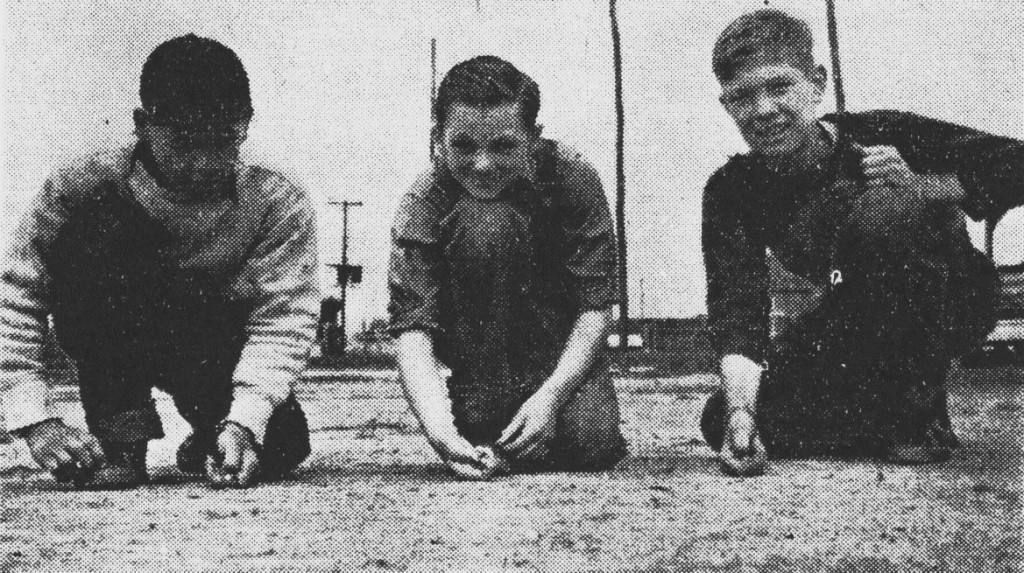


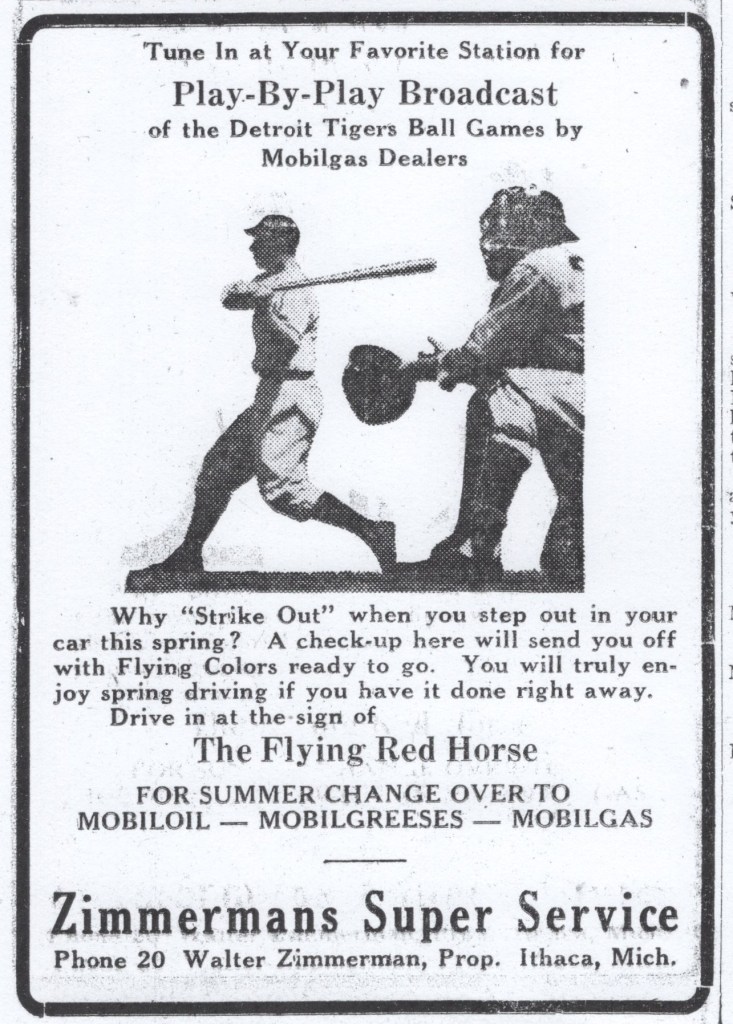
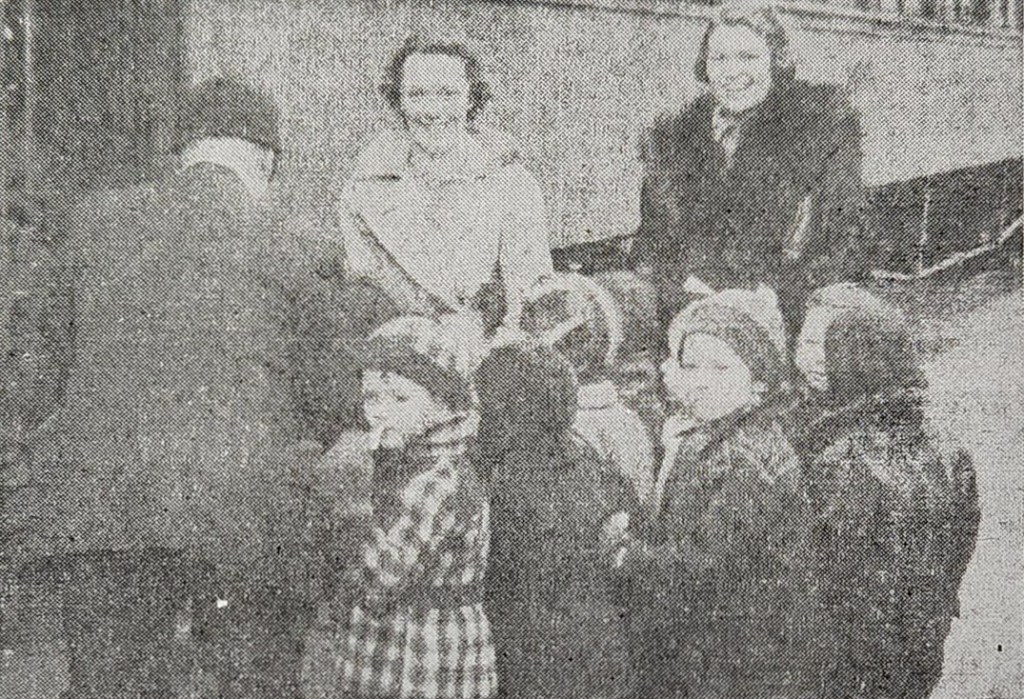
People and events in Gratiot County during May 1940 from the top: Franklin Wheeler, Bruce Benton, and Darwin Beard participated in the first annual marble tournament in the county. The Works Progress Administration sponsored the county wide event; Hamilton Township received a fire wagon like the one in this photograph to combat a raging fire along parts of the east county line; before high school graduations, county high schools, like the one at Fulton, recognized their top students; Gratiot County residents who were Detroit Tigers fans listened to their favorite team on the radio.
The Phony War was over in Europe. Americans learned a new Nazi term – “blitzkrieg,” or “lightning warfare as the Nazis marched into and occupied parts of Western Europe.
Residents saw spring go cold and wet as farmers tried to work in the fields. Schools let out for the approaching summer.
It was May 1940 in Gratiot County.
The World at War
Winter was over, spring was in the air, and the war in Europe exploded as Hitler invaded Western Europe. Here in Gratiot County, the news regarding the war was not good. County newspapers began publishing maps of the war and front-page news segments about what happened as a result of the Nazi and Soviet invasions. Finns slaughtered their cattle herds before the arrival of Soviet troops, abandoning homes and farms as the Russians moved further west. German fighting planes regularly challenged the British fleet near Norway and surprised the British from German and Norwegian bases. In northern France, the Germans pounded the French at the Meuse through Hitler’s use of “lightning warfare.” The war spread through Holland, Luxembourg, and Belgium as the Allied help failed to save these countries. France surrendered on May 10. By the end of the month, Hitler’s army had the British and Allied armies pinned to within fifteen miles of the English Channel and stood less than seventy miles from Paris. At the end of the month, Belgium also surrendered.
People in Gratiot County read about actions that President Roosevelt ordered concerning war preparedness. Part of this dealt with the continued sales of armaments to France and Britain. Roosevelt also announced plans to train 50,000 pilots in a three-month program starting in July for the Civil Aeronautics Authority. Many of these recruits were to come from colleges and schools that now cooperated with the CAA. Before a peace rally taking place on the campus of the University of Michigan, someone put a Nazi flag up one of the flag poles. A university employee got the flag by climbing up the pole, and it was immediately taken down.
Troop B, 106th Cavalry of Alma, took in five recruits in the county. Captain Howard Freeman announced that he had received a patent from the government for a target holder and projectile receiver invention. Probably the county’s best opportunity to help others came from a Red Cross appeal for funds to help refugees in Europe who lost their homes and had been overrun by the Nazis. Locally, the Gratiot County Red Cross sought to raise $960 for its War Relief Fund. People could find boxes at different locations in the county for their donations. One group, the Mennonite Church in Newark Township, led all the fundraising and donated $154.20 – the single most prominent example of giving in the county. The International Harvester Store in Ithaca and Mrs. Francis Kellogg of Newark Township each gave $25, bringing the total to $247 at the end of May. In other war news related to Gratiot County, Reverend Charles E. Scott, an Alma College graduate and missionary to China, spoke at the college and church groups about Japan’s occupation of China. Scott vividly described Japan’s plans to destroy China and replace it with Japanese culture, along with removing Christianity. He also told how Chinese bandits killed his daughter and her husband and how an elderly farmer miraculously spared their infant daughter.
May also ended with the need to remember Gratiot County’s veterans of the past. The St. Louis Leader republished a letter from World War I, which Corporal William Shippey mailed home on December 10, 1918. Shippey wrote from Luxembourg exactly five months after he entered the service and described how homes and the land looked better than in France. The weather had been cold, but Shippey had six blankets and many clothes. Even as he prepared to follow his unit into Germany as a part of the Army of Occupation, he asked people to keep plenty of eggs and ham for him to eat when he returned home, but unfortunately, this would not happen. Corporal Shippey died of complications of the influenza epidemic on February 6, 1919. He would later be buried in Oak Grove Cemetery in St. Louis.
Another old veteran from Gratiot County’s past was also in the news. Jasper Norton of Elm Hall was believed to be the county’s last surviving Civil War veteran. At age 94, Norton still had good health, remained active in Elm Hall, and could be seen regularly on the streets. Norton enlisted in the Union Army at age 16 and later reenlisted with Company D, Twelfth Michigan Infantry. He fought at the Battle of White River in Camden, Arkansas, and other engagements and was once wounded in action. Norton represented the county’s last link to the Civil War.
Products of the New Deal
Two New Deal programs in Gratiot County offered work to the unemployed
. The NYA (National Youth Administration) announced employment to 141 part-time workers during May and June, an increase of over forty workers thus far. These young people worked on projects in Conservation Park or school work programs in ten different high schools in the county. The most a NYA worker could earn a month was six dollars for active work. The NYA also planned to hire up to ten additional young women for sewing projects at the Salvation Army building in Alma. Miss Grace Rowell oversaw the project work. If Congressional appropriations came through, Gratiot County might employ as many as forty to sixty more workers for these projects. While local vandals continued to destroy some NYA work in Conservation Park, workers continued to build a circular drive and parking spaces. Police and NYA leaders continued monitoring the park at night, hoping to end the destruction.
The WPA (Works Progress Administration) had a lot of activity and news. At the start of May, twenty-three WPA workers were on the rolls in Gratiot County despite layoffs and cuts to the program. Congress cut the WPA program in Michigan by 11,500 workers in May. While most of the work was laying concrete slabs for forty blocks in Alma in 1939, there were still nine blocks to go. Workers continued pavement work on Allen Avenue from Ely to Marshall Street. Also, workers continued to establish sewer and water connections on Allen Avenue.
One of the other goals of the WPA programs was to provide recreational activities for youth. At least four locations in Alma (Civic Recreational Center, Wright Park, Washington School Center, Salvation Army Center) offered afternoon and evening activities to the public. The WPA Recreation Department also provided a marble tournament to engage youth across Gratiot County. Three district tournaments in Alma, Ithaca, and St. Louis occurred for youths aged fourteen and younger. The Marble King Tournament, sponsored by the NYA and the Gratiot County Herald, drew fifty-nine boys in the semi-finals, which took place over ten days of action in the three districts. The finals took place at Washington School in Alma, and lunch was offered to all boys during a mid-day break, courtesy of the Alma Chamber of Commerce. Glen Strouse and Oran Sebring of St. Louis took first and second place, and St. Louis Junior High School received the king trophy.
To engage and educate more of Gratiot County about the WPA, a week-long open house entitled “This Work Pays Your Community Week” took place in Alma. Before the open house, a sponsors and workers dinner occurred at Stillwell Junior High in Alma, and sixty-one people attended. By the end of the week, an estimated 3,000 people walked through. They saw the WPA exhibits in the county that dealt with adult education, recreation, a library project, a school lunch program, and a writer’s project. The WPA also announced a free training course in forestry at the Salvation Army Building, which lasted until the fall. It met three mornings during the week with one Monday night study period. Any interested adult could take the class.
Farm Life & Farm News, May 1940
Spring brought people and animals to the farm news. Farmers planned for their annual sheep dipping locations and dates in the county. However, the county agent announced that Gratiot County would have to purchase a new dipping tank and trailer to help with the spring dipping. Once obtained, farmers around the county hosted and helped dip 716 sheep. On the first day, Delbert Pullman of Emerson Township was the first to use the new portable trailer and mounted tank. Gary Vanderbeek, who lived northwest of Alma, also made the news with his sheep when one ewe gave birth to quadruplets. The mother nursed all four lambs and gained much attention from visitors.
Gratiot County woke up early one Sunday morning to a raging fire that covered over 4,000 acres of woods in Hamilton Township. Conservation officer C.B. Smith delivered a fire trailer with spray pumps, water cans, axes, and shovels for twenty-five men to S.A. Boettcher of Hamilton Township to fight the fire. A crew of twenty men fought the fires until help from providential rains fell upon eastern Gratiot County. The fire started two miles from the Gratiot-Saginaw county line. The fire was probably set intentionally by someone, and it took a heavy toll on wildlife and forestry.
The Junior and Senior Farm Bureau held regular meetings at the Beebe town hall. Parks Allen, a local naturalist, spoke about “Forestry,” the loss of forests, and the idea of a reforestation project to encourage local people to plant trees on their farms in Gratiot County. Allen reported that only fifteen percent of the original forests in the county were still standing. The Alma-St. Louis airport, located on the northeast side of Alma, had been abandoned and was being plowed up for farming purposes. The area consisted of one hundred acres of land. May also saw the organization of four 4-H Clubs in Gratiot County. The Newark Green Gardens Club, The Careful Canners Club, The Five Star Workers of Bridgeville, and The Happy Nine all joined the ranks of existing clubs. Only four counties in Michigan exceeded Gratiot County’s total number of youth involved in 4-H, and the program reached over 25 percent of Gratiot’s rural youth.
In anticipation of the arrival of Mexican beet workers, a school for their children was planned to open at the Washington School Building in Alma on June 3. An enrollment of up to 150 children was expected. Miss Helen White of St. Louis, Missouri, who served in the Women’s Council for Home Missions, was in charge of the program. Children received one meal per day, a recreational program, a craft program, and religious training. NYA workers would assist Miss White, and the WPA program provided the cook. A preaching service and Sunday school would also be held at the school on Sundays.
Farmers eagerly awaited the start of construction of the new St. Louis Co-operative Creamery. Secretary Fred Penert said the building would be a story and a half high and measure 92 by 100 feet. The face of the creamery, projecting toward Mill Street, would be made of brick, while the rest of the structure would be made of cement blocks. Penert stated that the cost would be $20,000.
Farmers tired of the persistent, wet weather that afflicted the county in May had another option for their time. Head for stretches of the Pine River to catch perch! One popular location for area fishermen consisted of the inlets around Quanicassee, where regular and persistent perch runs resulted in good fishing.
Gratiot County’s Health Issues
One C.B. Dibble of Michigan State College reminded Gratiot County families how important it was to stop breeding flies instead of just swatting them. The average fly in the county could breed a hatch of new flies every three days if not managed. Due to the county’s wet weather, moisture, and manure, Dibble urged families to watch out for the fly. Of particular interest was the presence of moisture in feed lots that bred flies.
The sixth annual Easter Seal campaign concluded in Gratiot County, and sales totaled $3597.02, an increase of $436.99 from 1939. Four area Rotary Clubs provided the leadership and time to get area youth involved in selling seals. In Alma, 19,824 Easter Seals were sold, and Breckenridge kids sold 3,325 seals.
Gratiot residents heard the hard news that Gratiot County Probate Judge James G. Kress had to be taken to Smith Memorial Hospital due to nervous exhaustion. County coroner and justice of the peace Howard Potter also sought help at Carney-Wilcox Hospital in Alma for lung trouble. He went home after several weeks, showing improvement.
Other news at R.B. Smith Hospital centered around an automobile accident in late May, where Mary Cerny (Bannister), Ruth Hopkins (St. Louis), and Rose Ann Lennox (also St. Louis) all had to be admitted due to an automobile accident. Hopkins was in the worst shape, having suffered lacerations over her entire body and a slight concussion. Lennox sustained a broken ankle and abrasions. In some better news at Smith Memorial, Miss Georgianna Fruehauf from the nursing staff returned to work after a short vacation.
Doctor Georgiana V. Mills, Michigan Department of Health lecturer, offered a series of free health classes to women in Gratiot County. Mills planned to give a series of lectures each Tuesday afternoon and run weekly for five weeks. Her first lecture’s theme would be on first aid.
The Gratiot County X-ray clinic, which offered free X-rays in Ithaca in early May, announced it had found thirteen tuberculosis cases. Forty-six people had X-rays taken at the Ithaca Methodist Church with support from the Michigan Tuberculosis Association. One case of T.B. was said to be inactive, and two suspect adult cases and ten primary infections were found. The sale of Christmas Seals made the clinic possible.
Gratiot residents also received warnings about the dangers of contracting hydrophobia. The illness results from a virus transmitted usually by dog bites and can be received by either humans or other animals. Those who believed they had been bitten by a rabid animal needed to cauterize the wound and seek help. If untreated, paralysis of the muscles, especially in the mouth, led to the old image of “frothing at the mouth.” Residents were warned to look out for escaped dogs considered rabid.
The Long Arm of the Law in Gratiot County
Gratiot County prosecuting attorney Robert H. Baker announced that 54 people had been convicted in Gratiot’s courts of crimes and misdemeanors, which resulted in $292.85 in fines and costs. A total of 35 convictions related to traffic violations. Some of the other convictions came from breaking (20), assault and battery (20), simple and grand larceny (4), and second and third felonies (5).
In larger profile cases, Forrest Hunter of Alma was convicted of breaking at the Lobdell-Emery plant. He was found guilty. Another man, Leo Rex Rawlings of North Star, was also convicted of the same crime. These two and Clyde Mills, also of North Star, attempted to steal 1,000 pounds of aluminum. Emil De Sander was finally convicted of cattle rustling, but at the end of the month, he appealed to get a new trial. De Sander’s name had been in the county newspapers since the beginning of the year. Jim Vlasich of Lafayette found himself in the county jail on the charge of assault on his 72-year-old mother. The issue had been an argument over money matters, and Vlasich broke his mother’s arm in the argument.
In a somewhat odd case, the case of the Church of God in Hamilton Township versus Excelsior Steel Furnace Company reached closure. In contrast, James Wheeler of the Central Heating Company had partly installed the furnace, and Cressor Heating Company finished it. Because Wheeler defaulted on the project, to whom did the church pay – Wheeler or Cressor? The trustees wanted to pay the bill but were unsure where the payment went. The case was settled for $625, and the church was removed from the suit by Judge Searl, who ruled that the Cressor Company was to be paid first, then the remainder of the fee went to James Wheeler. The trustees just wanted to pay their bill!
The Dewey Glinke embezzlement investigation in the county treasurer’s office was concluded, and two state auditors stated that Glinke made off with a total of $3,160. The county would have to pay between $800 and $1000 for expenses owed to the two state auditors, bringing the total amount of money lost to nearly $4,000. The big question continued to be “Where is Dewey Glinke?” Sheriff William Nestle interviewed Glinke’s wife in Port Huron, but Mrs. Glinke said she had not heard from her soon-to-be ex-husband since February. Glinke claimed he was now in Coral Gables, Florida.
Treasurer William G. Federspiel’s office prepared to handle a rush of delinquent taxes before a tax sale occurred. Initially, Federspiel thought there would be over 800 descriptions offered up for sale. He believed the “rush” of payments lowered the number to about 600. All of those rushing to pay their taxes to avoid a sale now had to pay a six percent interest fee.
End of School Days, Softball Days, Decoration Day
The 1939-1940 school year ended, and schools announced who would and would not be returning to teach in the fall of 1940. F.H. McKibben would come back as Ithaca Public School’s superintendent. He was superintendent in the Ithaca system for twelve years and eight years. Five teachers would not be returning in the fall. The Gratiot County Herald quoted the issue: “It is understood that the rule of the local school board in not hiring married teachers is responsible for most of the vacancies.” By May 20, over one-half of the rural schools had already closed for the summer, and Eighth Grade Graduation in the county was set for June 5. Before adjourning for the summer, Donald Baker, Gratiot County school commissioner, reminded teachers that a school census must be taken between May 1 and 20. The census was necessary for school funding, and all students from five to nineteen would be included.
Notices of high school graduations and announcements of top scholars appeared in the county newspapers. Over at Ashley High School, Gizella Lator and Evangline Parks were Co-Valedictorian. Helen Lator was a Saluatorian. Bannister honored Ernest Boog (Saluatorian) and Lillian Ensign (Valedictorian). Ashley graduated thirty students, and Bannister had four. St. Louis High School held its first outdoor graduation on the newly constructed Wheeler Field. Joan Pomeroy and Henry Parfitt were honored at Fulton Schools as valedictorian and salutatorian. A total of seventy-three students would graduate in the Class of 1940. If the rain held off, up to 1200 people could sit in the new stands for the ceremony. If chased off by rain, graduation would occur in the high school auditorium here, where 850 could jam inside. Hope for no rain or cooler temperatures.
Also, the St. Louis Softball League started a new fast-pitch softball season in St. Louis. The league had nine teams, and the season was from May 23 to July 12. On opening night, a parade of players and the St. Louis High School band marched from downtown to the softball field. Fred J. Thompson, president of the league, threw out the first pitch. Perrinton defeated Michigan Salt by 16-9 in the season’s first game.
On a more somber note, poppies were sold in St. Louis on May 25 to honor those who died in World War I (World War I to us). A Decoration Day program planned a parade of Legionnaires, the St. Louis High School Band, and Boy and Girl Scouts marching from downtown to the cemetery. Alma College professor Roy M. Hamilton from the English Department gave the address.
And So We Do Not Forget
Medler Electric Company in Alma sold Thor Washers for $54.50. Buyers got a washer, wringer, and ironer all in one. Just stop by at Medler’s opposite the Fire Hall…WSAM Radio opened as Saginaw’s radio station. Tune in at 1200 to hear the Voice of Saginaw…Leslie D. Reeves of Ithaca married Nellie C. Grayson of Paxton, Illinois…Earle Trudgen again directed and led the Spring Concert in Ithaca. This would be the first of seven concerts by the Ithaca High School Band…Fulton High School Athletic Association held its annual sports banquet in the Perrinton gym. It drew 130 people who dined on roast pork. Captain Ronald Vining accepted the baseball awards…Bowling season concluded in early May in Ithaca. Ithaca’s top men’s team planned to bowl the top women’s team to see who was better. Two opponents included Elsie Ringle and Bill Ginther…The Pere Marquette railroad in St. Louis repainted all its buildings for $500. The depot received new paint inside and out, and the walls and furniture were either painted, sanded, or varnished. The freight house also got a new paint job. The “St. Louis” sign on the top of the depot was the first to be painted…The Fulton baseball team defeated Corunna by the score of 9-5. After combining tryouts from Middleton and Perrinton, Coach Lloyd Eberly had thirty boys to choose from…Fleming Clothing Company of Ithaca offered Hummingbird Hose to buyers who shopped for Mother’s Day. Hose costs 79 cents to $1.15, depending on the thread types…Clara Kellsey, longtime postmistress at Bannister, died at age 61. She had been a postmistress for many years.
A naturalization examiner planned to be in Ithaca on June 5 to accept petitions and conduct preliminary exams for those interested in becoming United States citizens…Buy a Pontiac for only $783 at Pung Motor Sales in Alma or Whitney Motor Sales in Ithaca. A Pontiac averaged 20 to 21 miles per gallon – on long trips…Doctor Frank Thornburgh of Alma received honors from the Homeopathic Medical Society of Michigan. Thornburgh was also reelected as the group’s historian…The Nafzigger farm, 2 ½ miles west of Alma, was hit by a lightning bolt on the corner of the barn, setting it on fire. However, because the fire did not spread across the barn roof very quickly, the Alma Fire Department was able to put it out. The initial damage was only five dollars…Edward R. Goggin of Alma received his Bachelor of Laws from Notre Dame University. Goggin attended the University of Michigan in his first year, then transferred to Notre Dame. He planned to join his father’s practice in Alma…The Caldwell Comedians announced they would perform in St. Louis under the big tent starting on Memorial Day. The company consisted of 25 people, an up-to-date orchestra, and a new program for each performance over the four nights it would be in town.
Continued rains in Gratiot County have delayed work on the construction of Gratiot County’s Highway Garage in Ithaca. There was still hope that the building would be completed by the end of summer. The Gratiot County Road Commission approved contracts for the purchase of cinder and cement blocks for construction…Leo Simon of Alma received permission to move his junk yard from Pine Avenue to a new location south of the Pere Marquette switch tracks, between the Sinclair oil tanks west of State Street and property owned by the Little Rock Lumber and Coal Company. By making the move, the city of Alma hoped there would be a relief of truck and vehicle traffic in that original area…Wright’s Funeral Home on Woodworth Avenue in Alma put up a new artistic sign at the entrance to the business…The fifteen-by-five-foot sign “St. Louis Welcomes You” was erected and was placed above the street between Meteor Café and Young’s Department Store at the intersection of Mill and Washington streets. The words “St. Louis” appeared in red with the caption “Welcomes You,” which could be seen in blue. The sign cost $499 and was paid for by the St. Louis Trade Association.
St. Louis High School commencement services would occur outside on Wheeler Field on June 7 for the first time in the school’s history. A crowd of 1200 people could sit and watch the ceremonies from the bleachers. The backup plan in case of rain meant that graduation would be held in the school auditorium, but only 850 people could attend…Bert Hicks and Son operated their Alma grocery business as the “Biggest Little Store in Town.” Rolled Rump Roast beef cost 25 cents a pound, Bliss coffee 17 cents a pound, and icing sugar only 23 cents for 3 pounds…Laurel and Hardy made a one-night appearance in “A Chump at Oxford” at the Strand Theatre in Alma. Tickets were ten and twenty cents…The city of Alma prepared to put its new 2200-gallon tank to use for flushing streets. The tank sat on a city truck connecting to the power plant and piping. The large tank could flush at least two city blocks before refilling…A large group of 125 seventh and eighth-grade students from Gratiot’s rural schools went on a day trip to Greenfield Village in Dearborn. This was the second group of Gratiot students to travel to Dearborn in May. Take your lunch with you, it will be a long day.
The St. Louis Trade Association agreed to pay $100 for lumber and costs to construct a portable bandstand. It measured twenty feet square and stood five feet above the ground. The bandstand was planned to sit on the vacant lot between Starry and Kelley’s barber shop and Howard’s body shop…Doctor John Wirt Dunning, Alma College President, announced a donation of $25,000 to construct a new chapel on campus…You could buy a new Speed Queen washer at Walker’s Electric Shop in Alma for $49.50. See it at Walker’s, across from the Strand Theatre…The Main Café in Alma installed a new Walrus modern fountain to stay up-to-date with new equipment…The city of Alma revealed its new bright yellow lines for parking and stop signs in yellow block print on the pavement…Gittleman’s in Alma contracted with Skelton Heating Service of Ithaca to install new air conditioning. The system had a ten-ton capacity and could handle 4,000 cubic feet of air per minute. A similar system was used in the Strand Theatre….The Alma High Bands gave two concert performances in the senior high auditorium on May 24. A group of 50 Alma Senior members showed off their natty new uniforms…
Have you been missed in the census? A coupon appeared in the Alma Record and could be filled out and returned to the district supervisor in Saginaw County to let them know. Several people in Gratiot County were against answering census questions…The Alma Lions Club planned to shoot the upcoming film in Alma. “We’re in the Movies” would reflect life in Alma by producing a two-hour movie with local people. Central Michigan Bus Lines of Alma applied to end bus service between Alma and Howard City. Building permits in Alma showed an increase in building activity in the city. A total of $ 15,580 came in requesting that new homes, garages, and remodeling of homes be allowed to start. The amount surpassed 1939. Was the Depression ending?… Alma Lodge Number 1275, Loyal Order of the Moose, was formed with a ceremony in the Rotary Room at the Wright Hotel…The St. Louis City Council accepted a bid of $600 for a contract with Michigan Chemical Corporation to purchase calcium chloride to lay dust on the city’s streets during the summer. The council also agreed to a license fee of $25 annually for any trailer lot amounting to one quarter of an acre or bigger.
George W. Stewart, J.C. Penney Company store manager, left for a two-day district convention to select winter blankets for the upcoming winter. Sales could begin in July…Victor Jaeckel, Alma Strand Theatre manager, announced that the Strand would show a new MGM patriotic movie entitled “The Flag Speaks.” Although he could not get the film for Flag Day, Jaeckel planned to show the movie as an added feature attraction on June 4-5…On a sad note, in Ithaca, the courthouse flag went to half-staff, and all county offices closed during the funeral of Ralph E. Petit, a 79-year-old courthouse custodian. Petit died of complications of heart trouble. According to the Alma Record, Petit, who lived his entire life in Gratiot County, was “Kindly, affable and accommodating and possessing sterling characteristics inculcated by a training that impressed upon him the true values of life.” The Petit home was overflowing with those who attended his funeral service.
And that was the Depression and War during May 1940 in Gratiot County.
Copyright 2025 James M Goodspeed


 Goodspeed's Gratiot County Historical Blog