Gratiot County During Depression and War, December 1940: “Gratiot’s Last Peacetime Christmas”

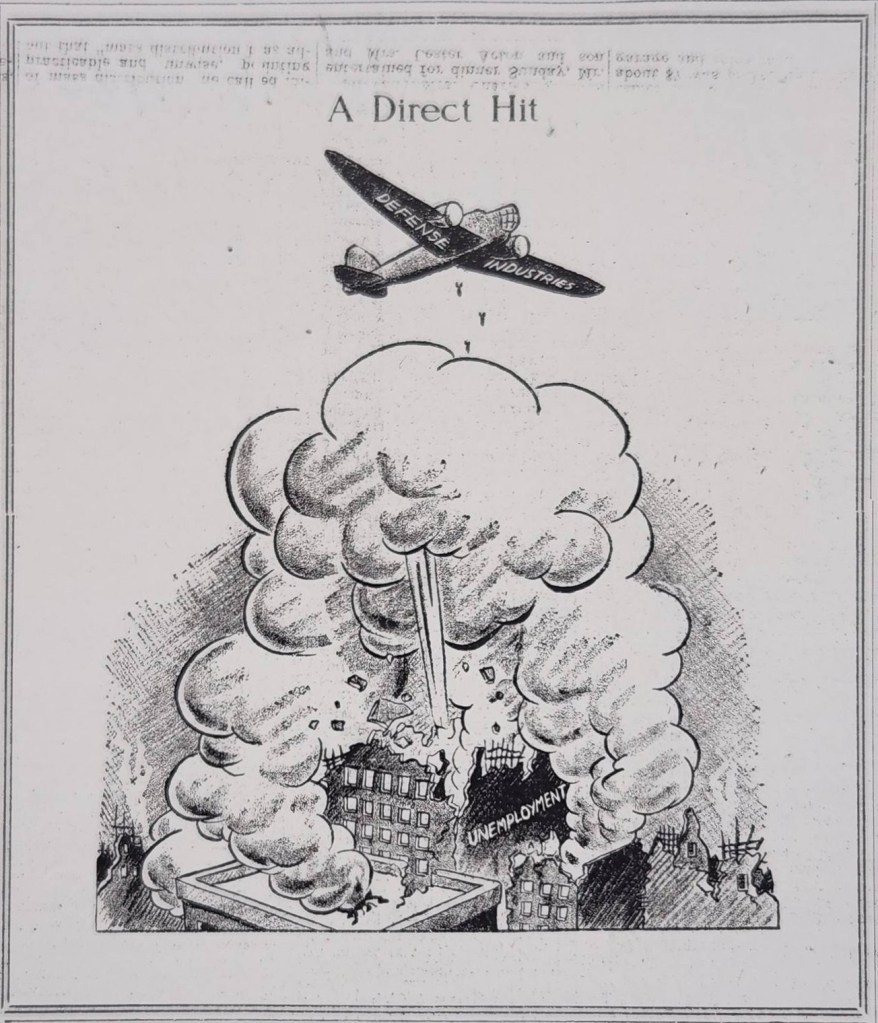
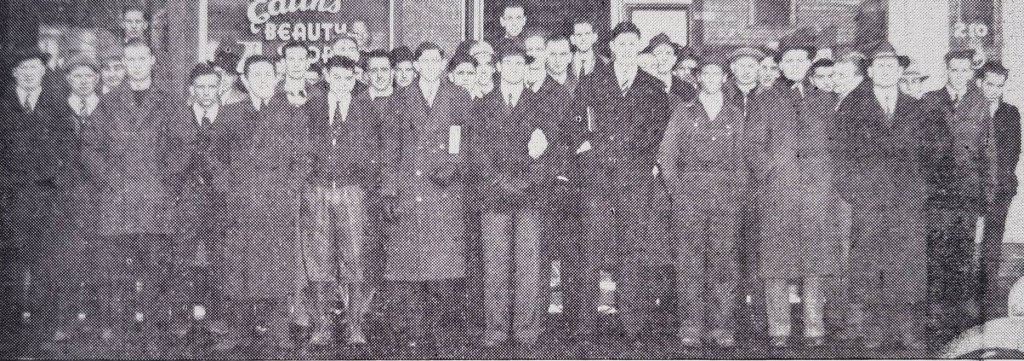
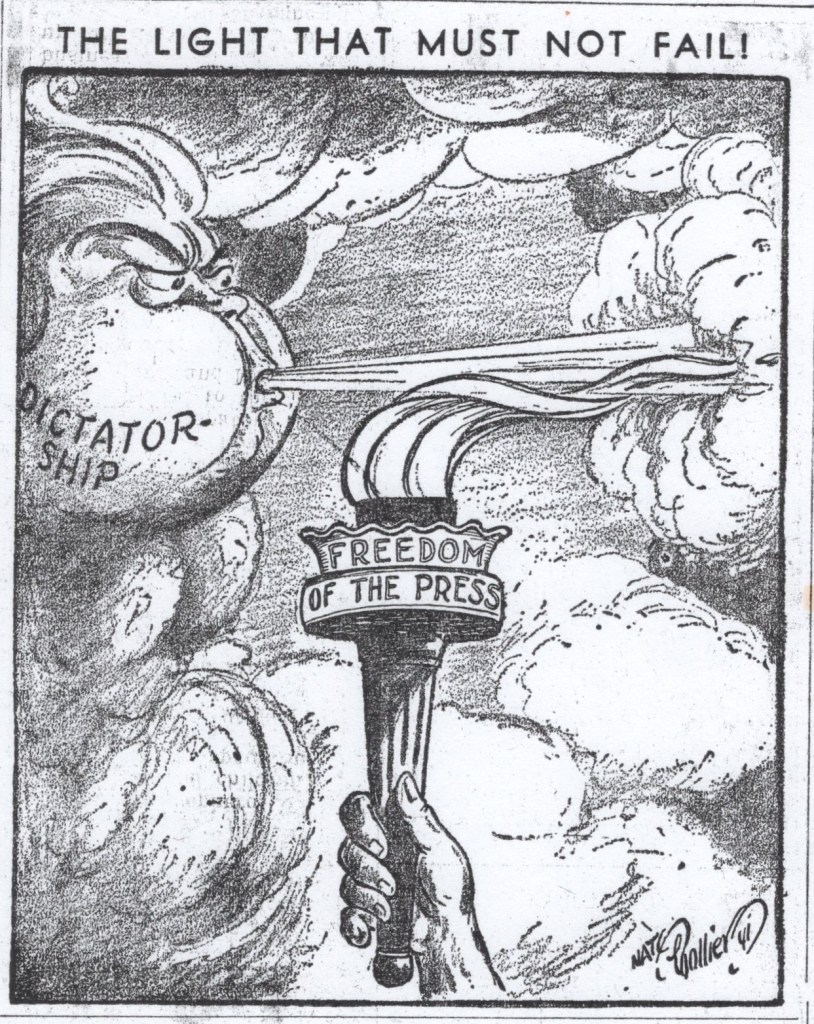
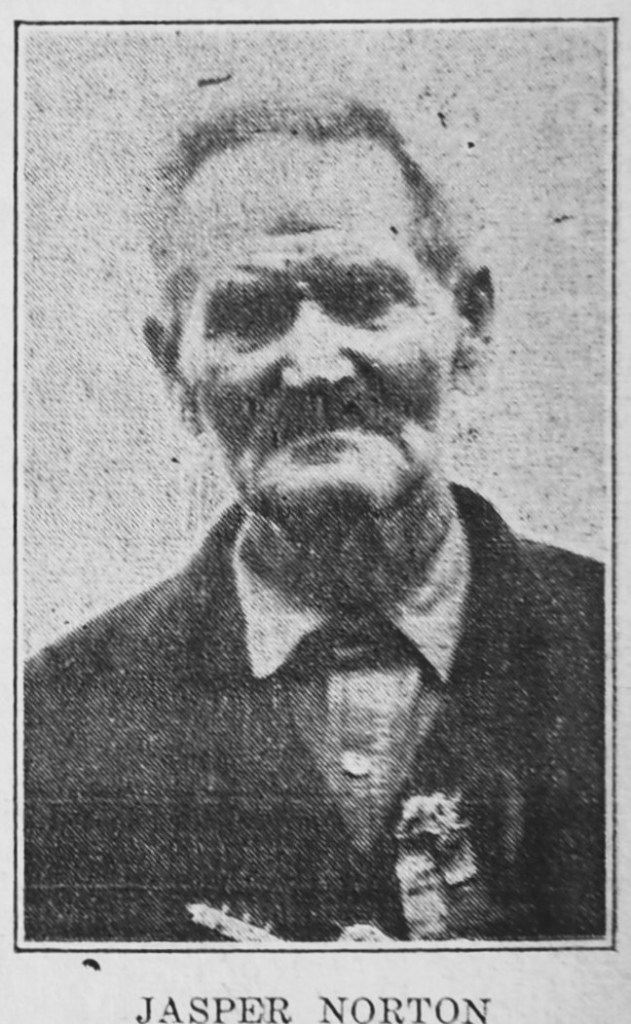
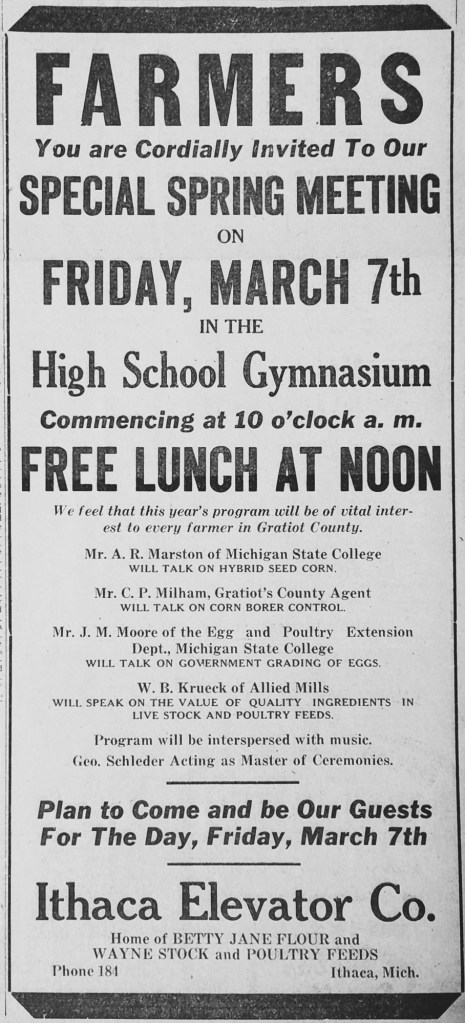
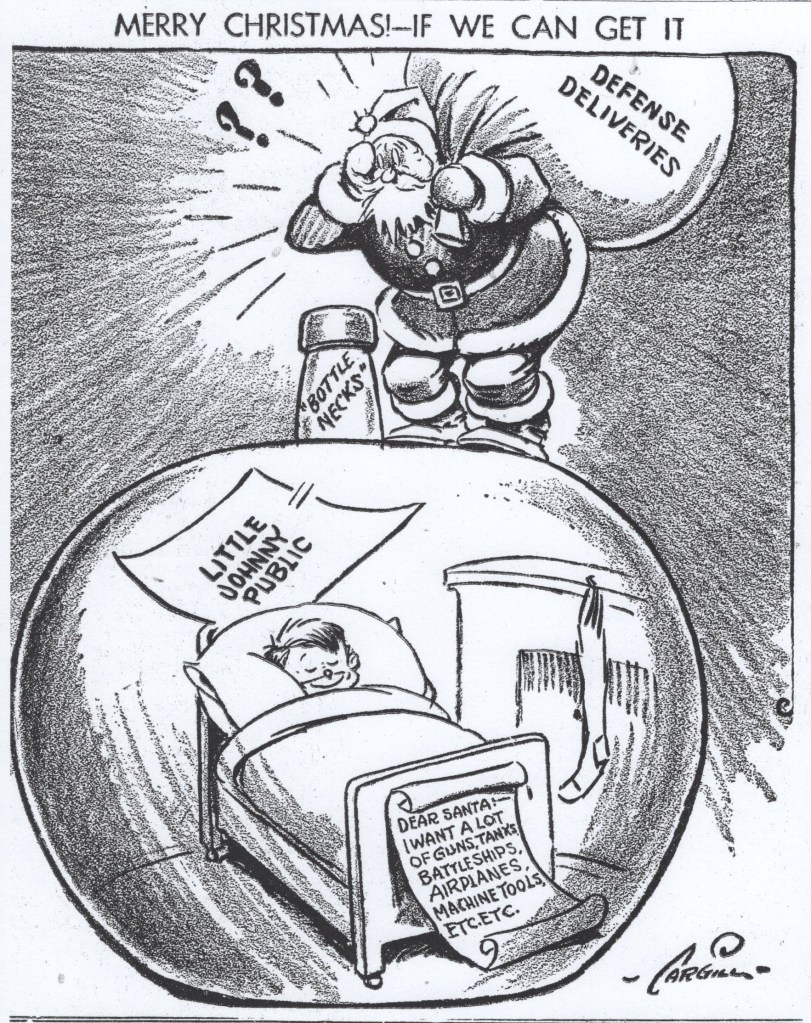
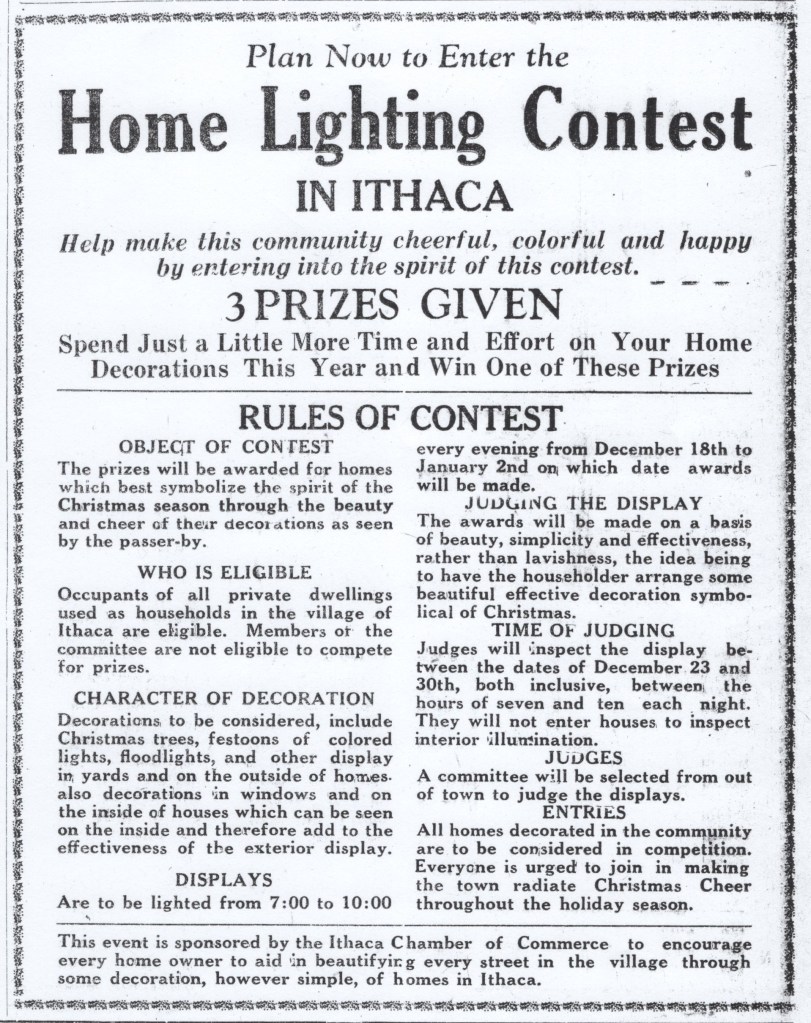
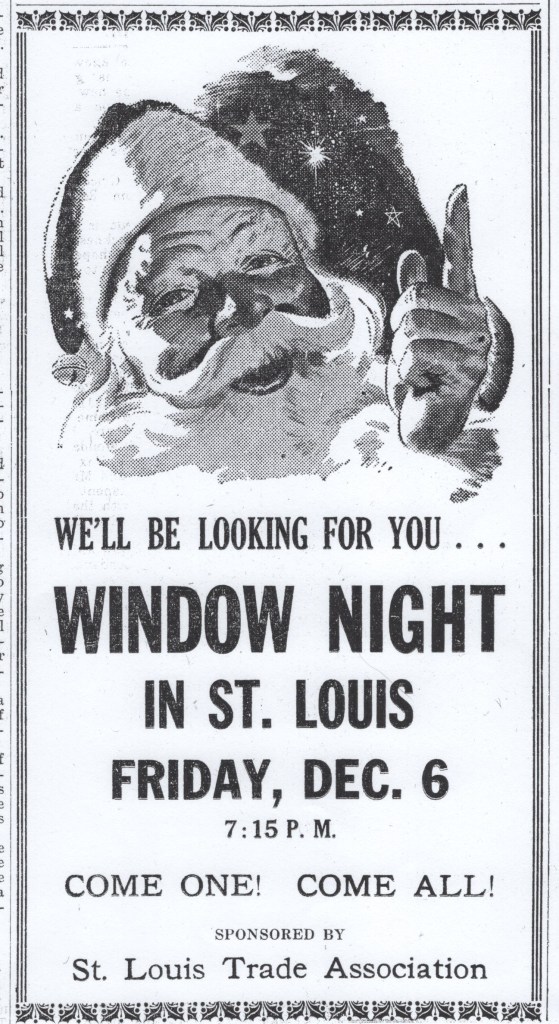
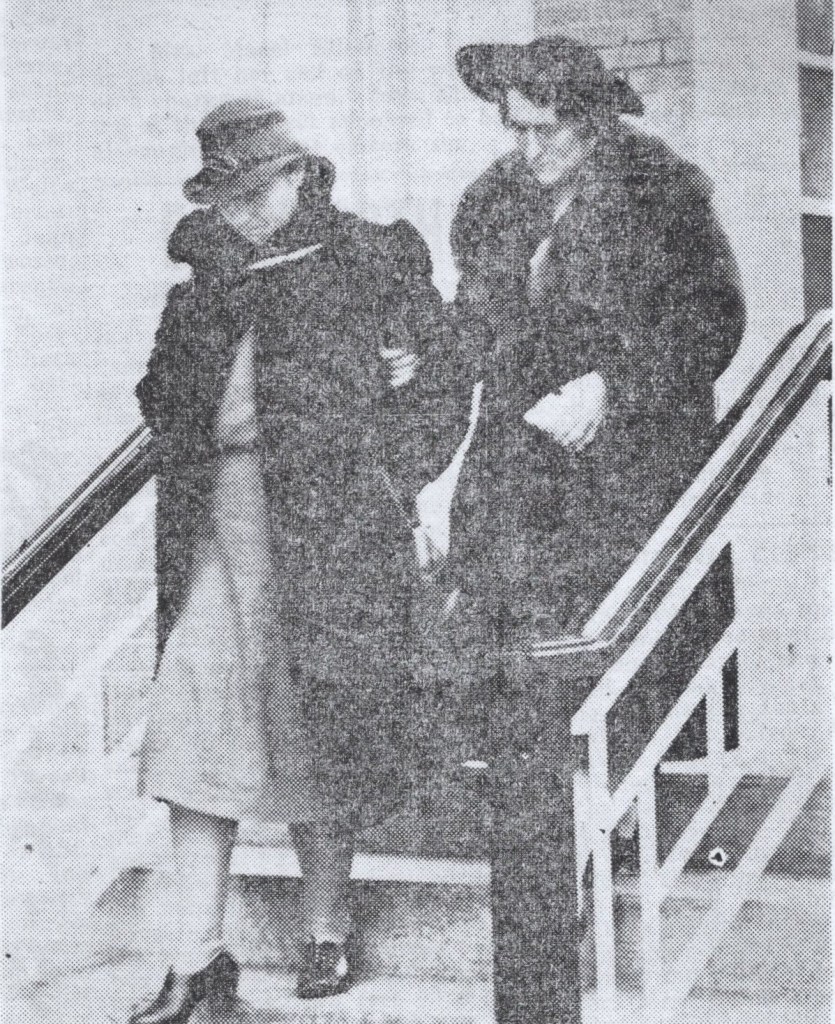
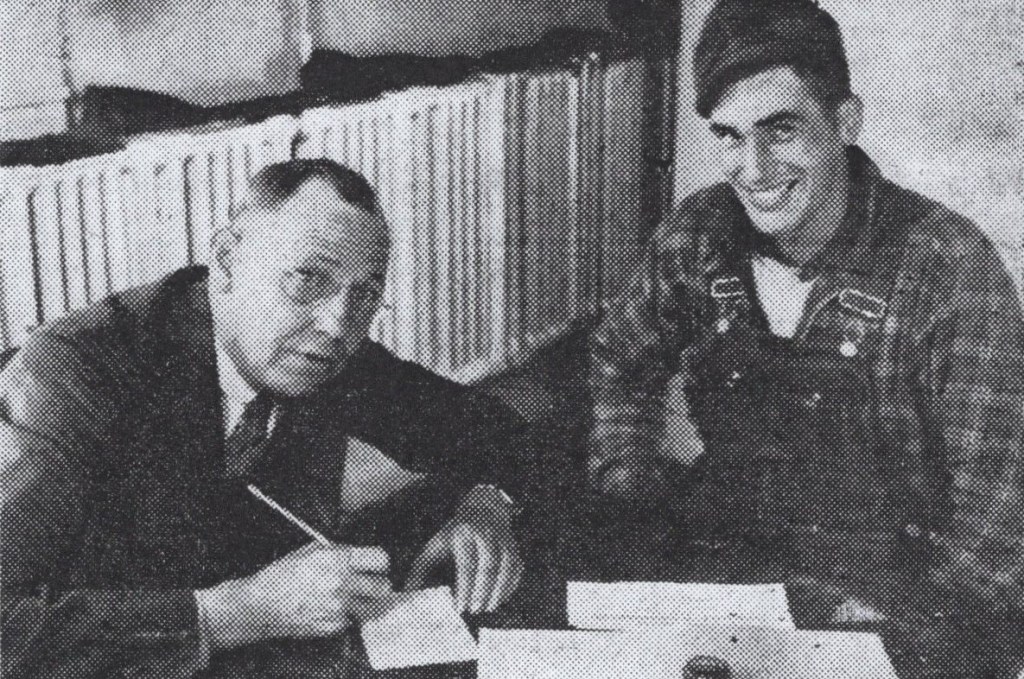
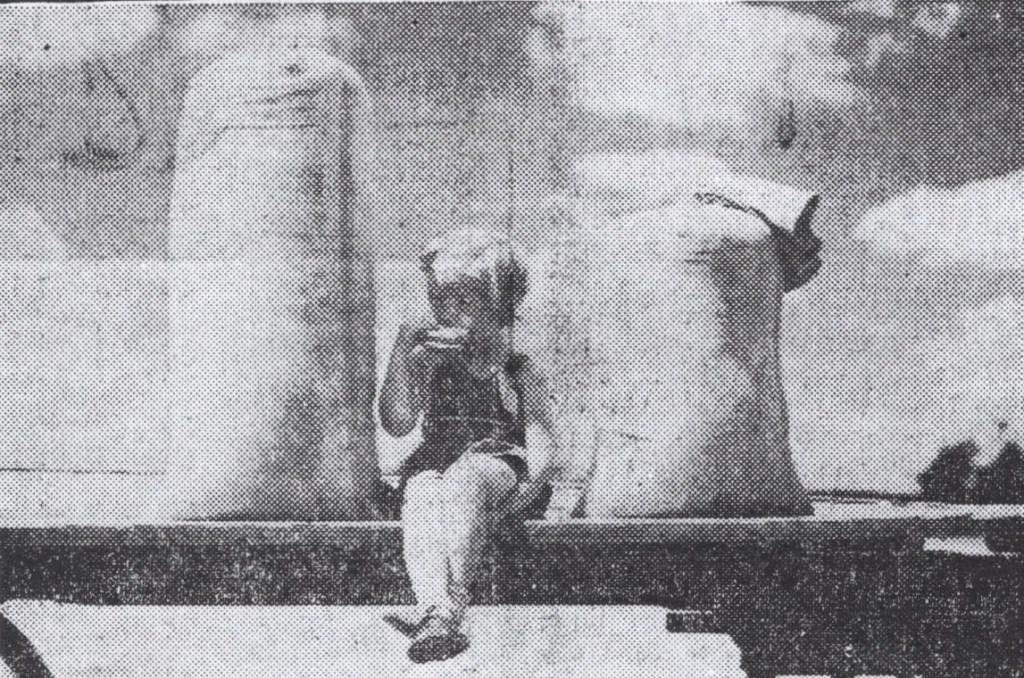
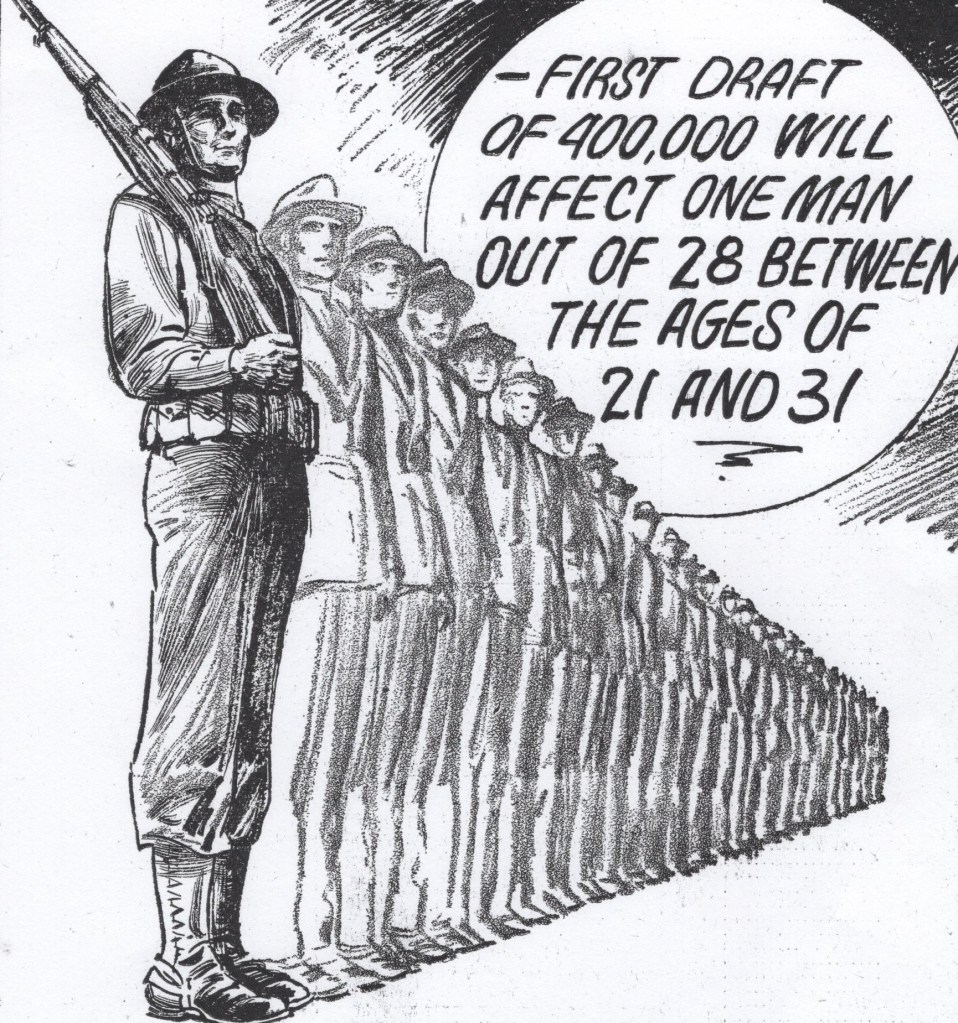
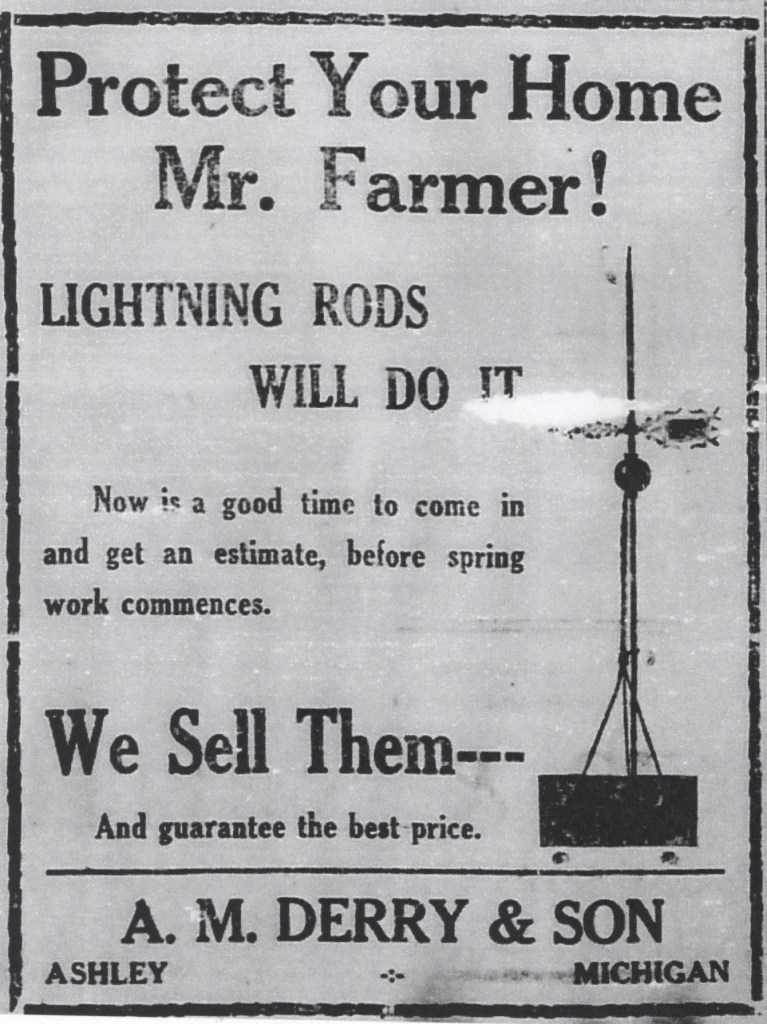
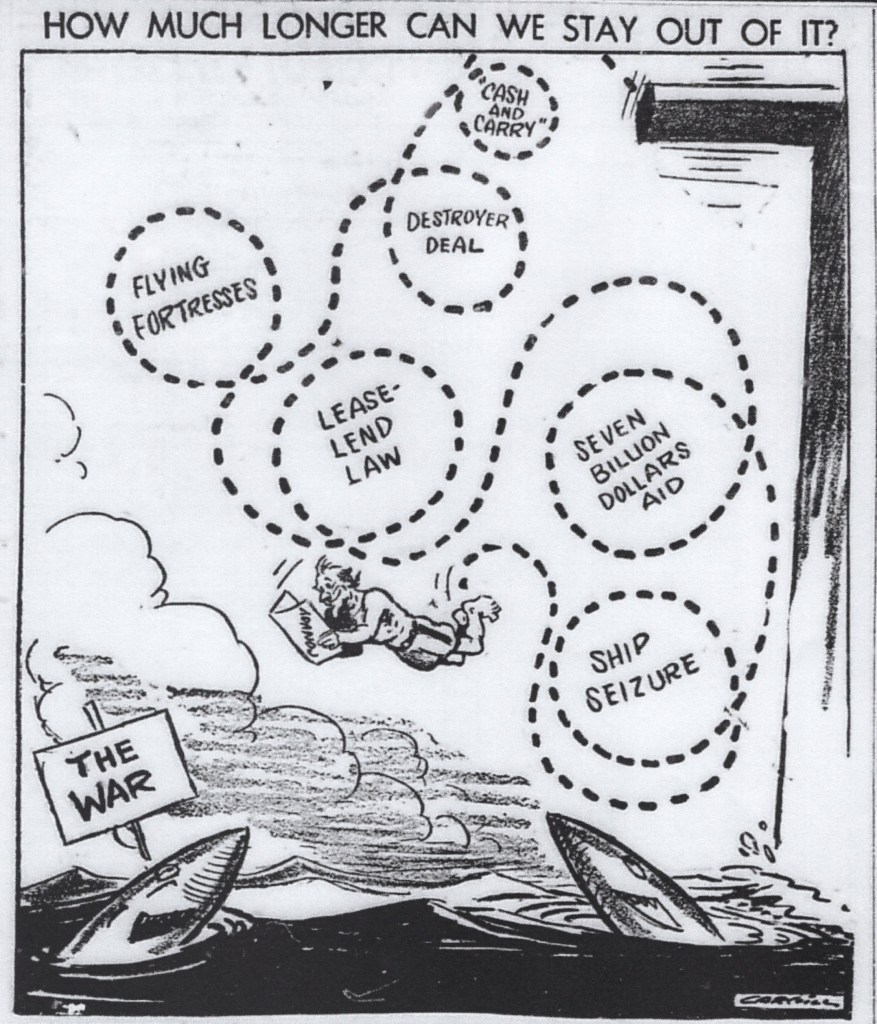
Gratiot County, through December 1940, pictures from the top: How to balance Christmas expectations with a growing defense movement? Alma Record cartoon; A Home Lighting contest in Ithaca urged the public to dress up their houses for the Christmas holiday – and win some prizes; Window Night in St. Louis officially kicked off the Christmas shopping season in town; The Mazel Ellsworth arson incident occupied the newspapers and Ithaca as she faced examination. Ellsworth (left) and matron, Mrs. William Nestle, head to the courthouse from the jail; Ithaca farmer, Sherman Edgar, appeared in the news with his homemade airplane, which he flew regularly.

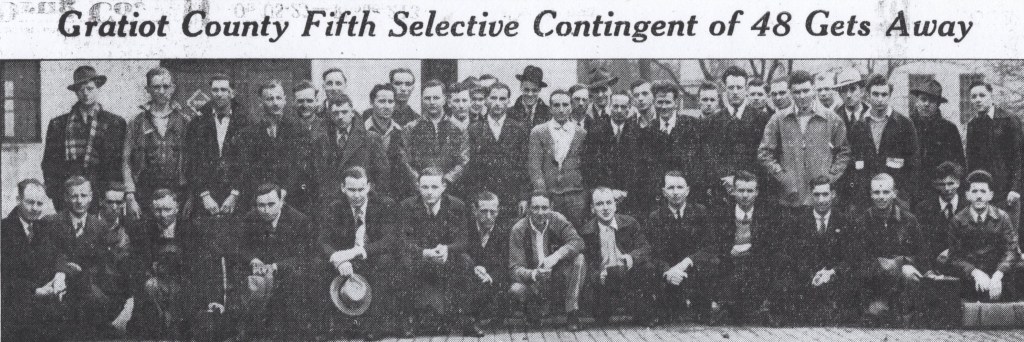
In December, the trickle of young men volunteering to join the Army grew. Still, the Gratiot County Draft Board warned that more men would soon be called to meet the needs of Selective Service.

As winter began, New Deal social programs expanded to employ more Gratiot residents wanting work. The pay wasn’t the highest, but these jobs still drew many applicants.

Farmers attended meetings to learn how to address problems such as the European corn borer and farm plans for 1941. The Strand Theatre hosted some of these farmer programs.

It was Christmas in Gratiot County. However, no one knew that it would be the last peacetime Christmas season the county would experience for over years.

More Preparations for War

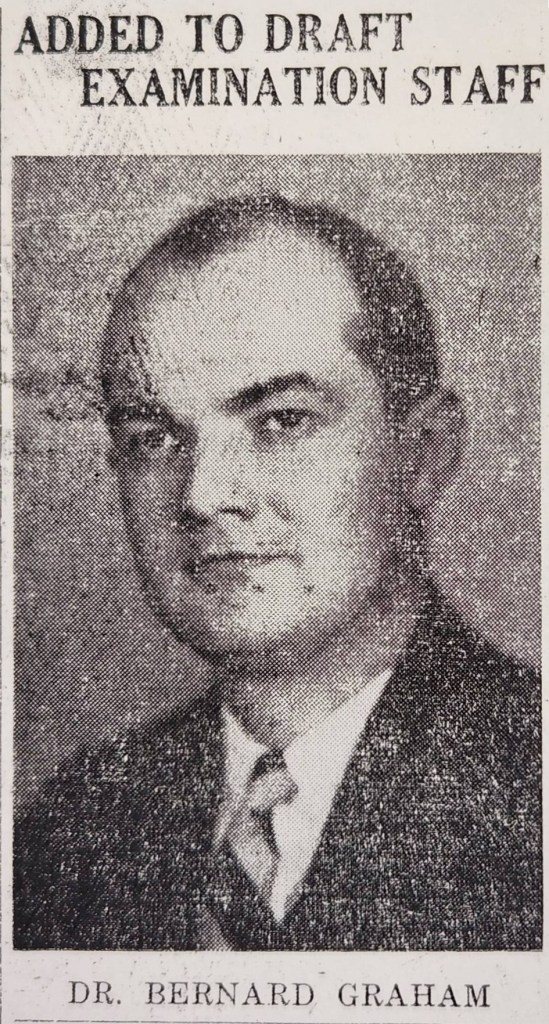
To many in Gratiot County and across the nation, being drafted meant a step toward involvement in the European war. Readers of the Gratiot County Herald found the names and order of those drafted on four pages of its December 5 issue. Despite the number called, an estimated fifteen percent of the 14,500 men in Michigan were deemed unfit because they failed a physical. In anticipation of the second call for selectees, eighteen Gratiot volunteers said they were ready to go, but two failed their physicals.

Lyle Whittier, head of the Gratiot Draft Board, stated that some registrants had failed to complete their draft questionnaires, and he expected the number of Gratiot men with incomplete questionnaires to almost quadruple in January. As a result, the Draft Board examined an average of 2 young men daily at Alma City Hall to meet the January quota. Another problem with the Draft Board concerned married men and exemptions. One of the early questions asked if the wife relied on the husband for a “normal source of support.” There were also a few challenges with those who appeared to evade the selection process. This problem involved two men: one who could not be found and another who failed to provide the specific information required for the draft. Still, by the end of December, the Board announced that Gratiot County now had 33 volunteers. One member of the group was married with a small child, but he still met with the Board and said he and his wife agreed that he should volunteer.

Just before Christmas, nineteen volunteers needed for the second draft quota planned to leave Alma for Saginaw on January 7 at 5:35 pm. They arrived in Saginaw at 7:30 that evening. The group spent their last night as civilians at the Franklin Hotel, then reported for duty early the next morning for testing and induction. Wyomah Vick, one of the first four Gratiot volunteers to leave in November, wrote a letter to the Gratiot Draft Board stating that he was in the 25th Infantry in Arizona and had trained in a machine gun company. Vick wrote that he was grateful for the experience he was having in the Army. The War Department proved generous with holiday leave during December, allowing many men to travel home by suspending training from December 21 to January 2. Furloughs often went up to fifteen percent of the enlisted strength in a unit. They were limited to those who enlisted before November 1, 1940.

Despite the drafting of young men, there were plenty of voices warning that the United States should not go to war with Nazi Germany. The National Observer, a forecaster of political and war events, believed the United States would be in the war by June 1941. Critics of those against American men in the draft made comparisons and warnings about the men lost in the last World War of 1917-18. The Alma Record-Alma Journal even ran a lengthy editorial on December 12 entitled “Keeping America Out of War.” It urged America to stay out of foreign wars and for foreign wars to keep out of America.

 One veteran of the World War, Albert Johnson of Alma, received a federal summons to report to Detroit to inspect manufactured trucks for the Army. Johnson served in Europe during the last war. The remainder of Battery B, 177 Field Artillery (the former Battery B, 106th Michigan  Cavalry), moved from the back of the Wright Hotel to the cavalry barn. These men awaited an anticipated April 1941 call-up. Yet, who would replace those National Guard troops once they left the county? Some argued for the need to form “Home Guard Units” by calling on veterans of the World War of 1917-1918 to serve in that capacity.

Help for Greek Families

Alma men of Greek ancestry organized a fund as part of a national movement to help families of Greek soldiers who fought against Fascist Italy. James Stavros, James Stamas, and George Goutis solicited funds in Alma to help Greek families disrupted by the war between Greece and Italy. In a short time, $700 had been raised for food, medicine, and clothing to be sent overseas. Coney Island Restaurant (donating $200),  the State Sweet Shop ($100), and the Main Café ($100) were among a long list of donors. The Greek War Relief Association continued to run national advertisements across America to ask for help during December. Lists of even more Alma donors for the cause followed later that month.

Depression and the New Deal

Several New Deal programs continued to function in Gratiot County during December 1940. The Works Progress Administration (WPA) announced a new project to improve M-57 by installing drain tile, culverts, and fences; surfacing; replacing bridges; and cutting brush. The work done on M-57 west to the Montcalm County line preceded a plan for hard surfacing and completion of the highway. Two-thirds of a St. Louis sidewalk project, also sponsored by the WPA, was halted for the winter, and men working on it were transferred to the M-57 work. Twenty-five men continued working on the construction of six tennis courts at Wright Park. Also, the WPA sponsored a school lunch program for fifty children, a growing library project in three communities, and an active recreation division in Alma, Ithaca, and St. Louis. In 1940, the WPA spent $260,685 in Gratiot County and provided work for 261 people, the majority of whom were over 40.

The National Youth Administration (NYA) remained active in Gratiot County. NYA workers raked leaves and cut wood for the Gratiot County Conservation League, further improving the appearance of the Alma park. Dean Carter, the county director, announced that 50 more Gratiot youths could join the NYA, tripling the NYA workforce. Some of the new projects they could be part of included a Breckenridge school board project, Ithaca clerical work, a public works project for the St. Louis city government, and a new program in Riverdale. All of these members were between the ages of 16 and 24, worked 60 hours a month, and received $18 in pay.

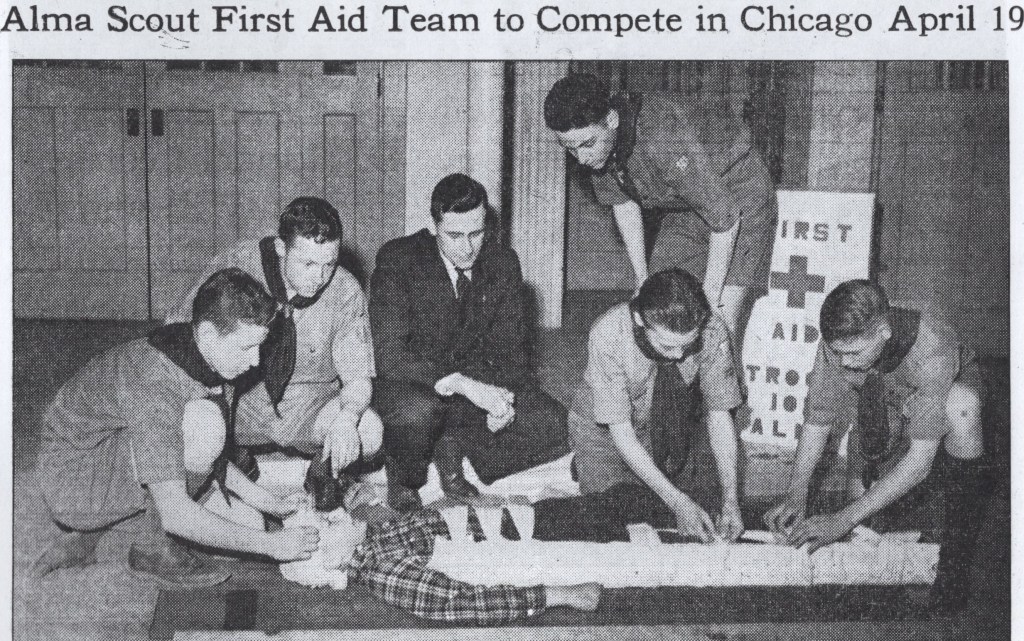
Other public programs included the Works Progress Administration (WPA), which offered first-aid training at the St. Louis Seventh-day Adventist Church. Darrell Milstead and Lester Fillhard led the classes. The WPA also planned a city-wide table tennis tournament at the Republic and Wright Park recreation centers. The Civilian Conservation Corps (CCC) sent a call for enrollment for young men, ages 17 to 23 ½, at the Gratiot County Department of Social Welfare in the basement of the courthouse. A Social Security representative planned to be at Alma City Hall on December 18 to assist with claims and provide additional information.

In other news, a group of 35 civic leaders in the county sought to receive aid from the state board of vocational education to hire a supervisor to oversee technical training for young people. The principal goal was to reduce waste caused by young people’s idleness. Gratiot was one of six counties to experience this grant. Donald L. Baker, the county school commissioner, issued a call for donations of footwear and clothing for students in need. Baker stated that some students in the county were absent from school because they lacked shoes. Finally, a Progressive Townsend Club No. 2 special meeting at the Ithaca village hall had good attendance and prepared for a Christmas program. It now had over 200 members.

Farming, Hunting, and the Outdoors

Even though it was December, the topic of sugar beets remained on farmers’ minds. In early December, Gratiot beet growers received their initial payment of $5 per ton of sugar beets, less the cost of field labor and seed. Another sugar beet payment would be available in the spring, with the final payment coming in October. After a two-month run of beets at the St. Louis Lake Shore Company plant, work started to close down around December 16. This closure meant the end of work for 325 men at the plant. In all, St. Louis believed it had sliced 72,000 tons of beets during the 1940 harvest.

The fourth annual Farmers’ Institute took place at the Strand Theatre in Alma on December 12 and drew 700 farmers. Sponsored by the Alma Chamber of Commerce, the program included talks on various agricultural issues, motion pictures, musical entertainment, and a free noon meal at one of three churches in town. In Ithaca, a large group of 40 community committee members involved in the agricultural conservation program met to discuss the ongoing threat posed by the European corn borer. The pest first appeared in the county in the 1920s, but returned in 1940, causing an estimated $400,000 in damage to Gratiot crops. The committee decided to ask farmers to sign an agreement to follow specific practices to prevent the spread of the corn borer in 1941. However, all farmers needed to come together to end the scourge. Some of the ideas included plowing all cut corn under by May 15, and shredding or hauling away all fodder in shocks and stalks. All farmers had to pay attention to the program, as if one farmer in a section did not, the insect could still move to a new location miles away.

There were other winter meetings for area farmers in December. Dairy manufacturers from the area attended a dairy meeting at the Park Hotel on December 16. This meeting was one of 12 held across the state, sponsored by the Michigan Department of Agriculture. Farmers received a free meal and then listened to a series of presentations on the manufacture of dairy products and the latest developments to improve them. Alma Production Credit Association held its annual meeting at the Strand Theatre earlier in the month. It drew 492 men and women who farmed in Gratiot, Montcalm, Isabella, Mecosta, and Clare counties, who listened to reports, elected officers, and enjoyed music. Losses from bad debts and loans in 1940 amounted to only 1% of total loans.

The federal government again warned aliens to register at their local post office. As of December 1, a total of 301 aliens were registered at the Ithaca post office. Across the county, 860 individuals had registered by the December 26 deadline.

Other things, good and bad, happened on the farms and in the outdoors in Gratiot County. Frank Nelson of Ashley suffered a serious facial injury when a horse kicked him, knocking him unconscious. Nelson went to Smith Memorial Hospital with injuries to the face, forehead, and limbs. No one knew why the horse, a non-kicker, reacted as it did. Because some dog owners failed to pay their licenses by June 1, they faced fines. More than 500 dogs in the county had been disposed of because of unpaid taxes, disease, or being strays. Ithaca native Parks Allen, a Central State student, was in the news as he gave talks, wrote articles, and appeared on radio programs in mid-Michigan about nature conservation. Allen graduated from Ithaca in 1931. A pair of hunting accidents ended badly for two young men in Gratiot County. Lester Billings, 16, of St. Louis, died instantly while hunting rabbits near Carson City when his gun discharged while going over a fence. Another Wheeler youth, Alton Tryon, 18, was shot through the leg while hunting near Wheeler. Tryon’s hunting companion was holding the gun when it accidentally went off while hunting sparrows. Dr. A.H. Rotermund of Wheeler treated Tryon’s wounds.

The Long Arm of the Law in Gratiot

A total of 53 people were convicted in court in November, with 29 for traffic law violations—some of the other convictions dealt with game law violations, drunk and disorderly, and illicit cohabitation. Two men who were part of a gang of four from outside Gratiot County faced arrest for two local robberies at Ithaca gas stations in late November. The pair participated in 29 break-ins across central and southern Michigan. The name of Cornelius Eichorn again continued to be in the news for drunken driving arrests earlier in the fall. He had to pay $50 fine, costs, and serve 15 days in jail. James Brogan of Stockbridge went before the judge for reckless driving north of Ithaca, after striking a wagon drawn by horses driven by Daniel Fisher. Fisher lost both horses and received a wrecked wagon. Brogan got a $63.60 fine and costs, or jail time, for the incident.

The most bizarre news in the courts during December dealt with a case involving Mrs. Glen Ellsworth, age 34, of Ithaca. Ellsworth was arrested for setting part of her house on fire after claiming it was an accident. Strangely, the sheriff found Ellsworth’s furniture and belongings in the center of one room, and there was a strong kerosene odor. The sheriff was not so sure it was an accident and had her put in jail on a $3,000 bond. Ellsworth soon went on a hunger strike while proclaiming her innocence. News came out that the contents of her father-in-law’s house had been insured for $300, and the dwelling for $800. Also, after starting the incident, Ellsworth went back inside the house to check on the fire and took along one daughter.

Claiming that she had a weak stomach and was unable to eat anything, Ellsworth went on a 12-day fast at one point. Ellsworth even failed a lie detector test in Lansing, even though she claimed the results were inaccurate. Whenever she talked about her four children and the fire incident, Ellsworth broke into uncontrollable tears and shaking. In response to her self-imposed hunger strike, the judge appointed matrons to observe Ellsworth and to try to get her to sip broth. When that failed, the judge placed her in solitary confinement and cut off visitation from family members. At the end of December, Ellsworth broke her fast. Eventually, she became well enough to attend her examination, even though it was without a lawyer.

Health News

Christmas Seals sales took place in the county. However, children did not participate in house-to-house campaigns as they did last Christmas. Anyone wishing to buy Christmas Seals only had to contact their local school to obtain seals, which helped sponsor what turned out to be the sixth TB clinic in the last five years. Doctor C.F. Dubois of Alma announced that of 215 TB tests given recently at Alma High School, 10 percent returned positive. Most of those tests included juniors and seniors. Herman Berg, age 45 of Alma, who worked as traffic manager for Michigan Oil Refineries, died after spending several months at Ingham County sanitarium, from tuberculosis. In addition to all of this news, the Michigan health department warned Gratiot County that a potential flu epidemic could soon hit the area. Influenza had been detected on the West Coast and was headed this direction, and cough, fever, and back and leg pain were all symptoms.

Christmas Season 1940                                                            

“Window Night,” where area merchants displayed items for sale in their front windows, kicked off the Christmas season. Alma, St. Louis, and Alma each chose a night to open for Christmas officially, and each made it a big celebration. A total of 25 businesses in St. Louis participated in the program. Later in the month, a “Santa Claus Skills Contest” was sponsored in St. Louis with participating merchants leaving clues in their windows. G.E. Marr also opened the GEM Theater two days before Christmas to offer a free children’s movie.

 On Friday, November 29, Alma welcomed Santa Claus to town in a parade that started at 7 o’clock, going one way down East Superior Street, then turning around and repeating the procession in the opposite direction. Both the Alma High School and city bands led the parade as children left the sidewalks and jumped onto Santa’s float. On December 17, the Strand Theater offered a free Tuesday matinee to young people who wanted to see a movie if they contributed one canned good. Manager Victor Jaeckel announced that a crowd of 900 children donated 51 baskets of canned goods and foodstuffs. To top off the night, the city of Alma again lit up a large white cross on the top of the city hall tower. On Christmas Eve, Santa appeared again in the town, this time at the Tourist Park, where he oversaw the distribution of 1,800 sacks of candy and peanuts. The Alma Police and WPA Recreation Department helped Santa hand out the goodies.

In Ithaca, a Home Lighting Contest encouraged residents to create a community holiday spirit by decorating their homes. Three prizes went to the top homes that would be judged between December 23 and New Year’s. Each home in Ithaca had to have its lights displayed between seven and ten o’clock each evening. On Saturday, December 14, the Ithaca Chamber of Commerce sponsored Santa’s arrival at the Ithaca High School gymnasium, complete with Santa coming down a chimney. Santa also encouraged Ithaca youth to write him letters addressed to the North Pole. The American Legion helped the Chamber ensure that each child in attendance received a sack of candy.

St. Louis held a Home Decorating Contest offering prizes of $1 to $5 for the homes that best symbolized Christmas. Alma also had a similar contest with awards of $5 to $10 in two categories: individual homes and businesses. The Garden  Club in Breckenridge offered a contest for those who registered before December 21. Early in December, the Breckenridge school held a Christmas program for the community.

As Christmas events went on across the county, there were calls to remember those families and young people who needed help in St. Louis. Both the Nonpareil and Emergency committees of the Community Council called for donations of 100 girls’ dresses. The Community Christmas League in Alma planned to help 200 families and organized a Christmas party for up to 534 students in the community who needed to experience a nice Christmas. The Knights of Pythias Lodge 49 of St. Louis provided a turkey dinner for 100 children who had been invited. The Alma Elks Club had a program for 149 boys and girls, ages 5 to 13. The party offered candy, nuts, and ice cream. A group of 150 Girl Scouts in the Alma Council presented Santa with a $26.50 check to be used by the Alma Community Christmas League for those in need in Alma. The Girl Scouts raised the money on their own, and this was the third year that the program took place. A total of 25 Alma organizations helped create 200 food baskets and a program that entertained an estimated 500 young people and adults at the Alma High School gymnasium. The program had a large Christmas tree at the front of the gym, and an appearance by Santa (played by George Urtel, Alma city treasurer) to entertain the audience. Workers handed out neatly packaged gifts of sweaters for boys and dresses for girls as each family left the gym.

And So We Do Not Forget

Residents observed a beautiful white swan on the upper pond north of Sumner. Rumors stated that one of its legs had been shot off by hunters. Still, viewers watched as the bird played and dove for food…Clark Gable, Spencer Tracy, Claudette Colbert, and Hedy Lamarr starred in “Boom Town” at Ithaca’s Ideal Theatre. Tickets cost ten cents, but “Boom” only appeared for one night on December 5…Gratiot residents prepared to view the “Cunningham Comet,” the largest comet appearance since Haley’s Comet in 1910. Best to view the comet with the naked eye, newspapers warned, even though it was 90 million miles away…The history of the Christmas Card in America appeared in the St. Louis Leader. The note recorded that Christmas cards go back to 1846…St Louis Cooperative Creamery sold Milkmaker Dairy  Concentrate, which contained 34 percent protein. Phone 131 in St. Louis…Interdenominational Revival Services began on December 8 at the Sumner Community Church for two weeks. Evangelist Reverend T.A. Harris of Mt. Pleasant led the services each night except Saturday…Fulton Seniors visited the Pompeii Bank for four hours, learning about its departments, the inner workings of the bank, and modern electrical machinery. Students asked questions about burglary systems, the operation of the vault’s time lock, and safety deposit boxes.

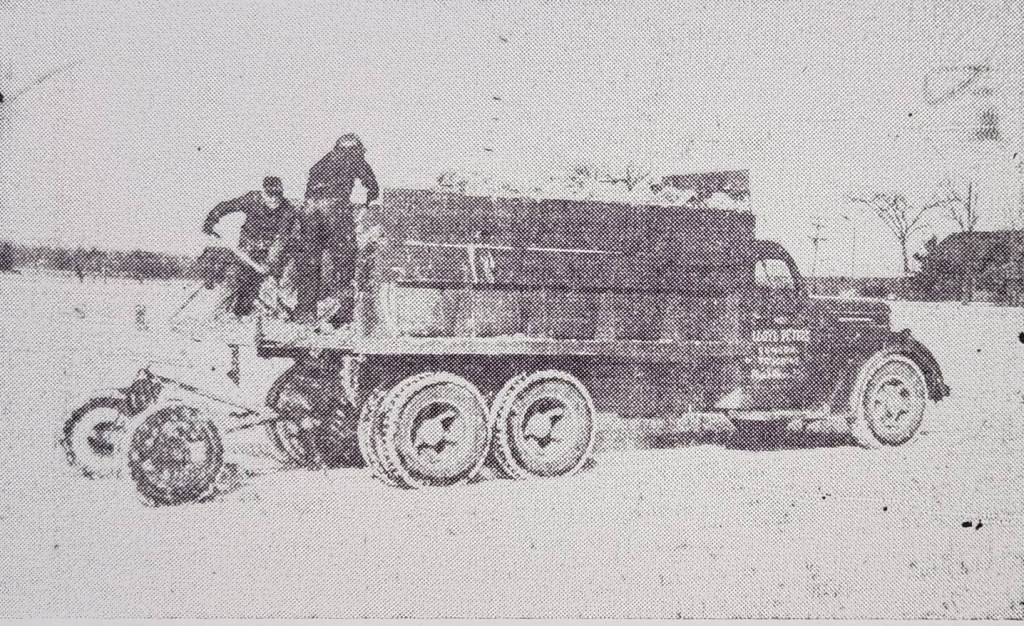
Hall Lumber Company in St. Louis paid a Christmas bonus of $650 to its employees; those who had been with the company for one year or longer received $100. One person who worked for 6 months received $50…Reverend Floyd Drake of Breckenridge’s Methodist Church fell and broke his upper left arm while arranging Christmas decorations in the church. Drake found himself at Smith Memorial Hospital, and doctors worked on the fractures. He soon returned home to rest and heal…Riverdale received a new postmistress. Miss Helen Young took over the job her father held after serving as an assistant for many years. She had been in charge of the office since her father’s death…A tremendous ten-hour snowstorm hit Gratiot County beginning early Saturday morning, November 30, enabling residents to start the month of December with a foot of snow. Blowing winds continued to cause problems as workers in Alma worked on Sunday to reopen the city to traffic. It took 22 hours of labor in St. Louis to clear the snow with 27 men and six trucks. The Alma Record stated it might take workers two weeks to get the county back to completely safe travel….The Gratiot County Herald advertised on Christmas Eve for the New Year Baby Contest, now in its eleventh year. The contest opened midnight on New Year’s Eve and closed on midnight January 11…Revival services at the North Star Church of the Nazarene closed after bringing 35 people to the altar on the last night. Sunday School attendance reached 195 pupils. Reverend L.G. Wright from Geneva, Indiana, led the meetings.

The Nummer-Giles Company moved from an office in the Wright House Hotel in Alma to new headquarters at 109 Mill Street in St. Louis. The company has sold fluorescent light bulbs since March 1939…Construction started on a new oil pipeline from Ithaca to North Star to carry gas from Cook No. 1 well in section four of North Star Township, along with gas from other wells in that area…Pung Motor Sales in Alma offered new Buick automobiles starting at $935 for the Business Coupe. See Pung at 315-317 East Superior Street…Apolonio Gonzales, 26, and Norma Swift, 18, both of Wheeler, became the latest of Cupid’s victims, along with Leo Davis, 22, of Hamilton Township, and Annabelle Wenzel, 18, of Lafayette Township…Order your roses and poinsettias early for Christmas, especially if you want them sent telegraph. Townsend’s of Alma and St. Louis offered free delivery for local orders… Clapp’s Hardware in St. Louis established a new appliance department in its basement. Now, interested buyers could see the new R.C.A. radios and A.B.C. washer models…The St. Louis High School senior class presented the comedy “What a Life” under the direction of Mrs. Grace Niggeman. The play previously had a large Broadway run… Dick’s Wholesale Station held its grand opening in December. Midwest three-star gas sold for fourteen cents a gallon.

Trappers may sell hides and fur to Michigan Fur Company, located in the Berman Building in Ithaca. “Make it a habit” – sell your furs to Berman…The annual Red Cross drive in Alma started November 11 and, so far, has raised $790 in memberships for 1941… C.G. Larry’s Hardware in Ithaca sold Sunbeam Mixmaster food mixers for $23.75. Too big? Buy an “Eskimo” mixer for only $12.95 – in large size…Chemistry teacher Marion Woodford from Fulton Schools took two busloads of students to the St. Louis sugar beet plant. He had help chaperoning from agriculture teacher Don McCormick. The students received a complete tour of the plant…The First Bank of Ashley invited people to join the 1941 Christmas Club so that next Christmas, families would have less financial stress…Dick Plankenhorn and Jay Stahl led the Ithaca basketball team as it started its season in December. Plankenhorn could only play through December as he was in his eighth semester of eligibility. Stahl led the team in scoring through his four years on the team.

And that was December 1940, during the Depression and War in Gratiot County.

Copyright 2025 James M. Goodspeed

Gratiot County in Depression and War, October 1940: “The Draft, Elections, Halloween”

October 1940 photographs and events in Gratiot County from the top: “Dictators Take Notice” promoted the idea of registering for the first national draft since 1917; Walter O. Brown, a World War I veteran and Ithaca tailor, helps Roy Stewart register for the selective service draft in Ithaca; Wendell Willkie for President advertisements seemed to be everywhere as was the theme “No Third Term” for FDR; “Aladdin” the magician appeared at Ithaca High School auditorium for Halloween night.

Gratiot Steps Toward War

As Hitler continued his bombings of England, several newspapers wondered how long the British Isles could hold out until the Nazis invaded. Mr. and Mrs. H. Abbey of Ithaca received a letter from a relative living in London, who described life under the bombings. Despite rationing, Londoners were not starving. Sometimes, there were two or three air raids per day, often continuing throughout the night. Still, the British were downing about fifty German airplanes daily. In fact, W.A. Hobson wrote that “If their air men come down alive they say it’s heaven, and are thankful to get here.”

Here in Gratiot County, young men slowly moved toward voluntary enlistments. Millard Morton and Don Freeman, both of Alma, joined up and were sent to Fort Bragg, North Carolina, for field artillery training. Paul Long of St. Louis enlisted in the United States Army. After being stationed at Fort Sheridan, Illinois, Long went to the Panama Canal Zone. James Seitner, also of St. Louis, enlisted with the 210th Coast Artillery, Anti-Aircraft Unit, in Detroit. He was drilling several nights a week and expected to be sent to the South in early 1941. William C. Bainbridge, Jr. of Alma, was also selected for Army Air Corps primary training in Lansing. On a lighter side, Alfonse (Dutch) Collins, an officer in the Michigan National Guard, was in the news for failing to quell a riot on Alma’s north side. Collins was called to River Avenue to help with the noise caused by scores of starlings. Collins went to the site with his shotgun and Number 4 shot, took aim a half dozen times, and missed every time. In fact, the result was the existence of more starlings than ever. Collins was chided in the neighborhood for his inability to hit more birds and for how he would ever shoot down enemy airplanes.

A wave of concern began to sweep through the  United States regarding Fifth Column activity. Lieutenant Harold Mulbar of the Michigan State Police visited St. Louis and spoke to the St. Louis Rotary Club about potential subversive activity in the state.

The ongoing talk of war continued to promote the idea of a new armory in Alma. If Alma could raise $15,000, the federal government could provide an additional $45,000 through a WPA Project, according to Alma City Manager W.E. Reynolds. Plans also proceeded for the 1941 Tulip Festival in Holland, as fall planting of bulbs was underway. The planting continued, even though about ninety percent of the annual importation of tulip bulbs from the Netherlands had been halted due to the war.

What about complaints in Gratiot County newspapers about the President? The issue of Lend-Lease of old ships to England in exchange for locations in the Caribbean had editors up in arms. “America’s first dictator” (President Roosevelt) took a significant step toward involvement in the war by trading aging ships with England, thus demonstrating that the United States was taking sides. According to one editorial, FDR was deemed a sucker in the trade, as who would want interests in the Caribbean? Time and war would eventually prove the critics wrong. However, that was not the most significant concern about President Roosevelt’s actions, as another issue soon arose.

The Draft

On Tuesday, October 2, County Clerk Charles L. Hicks received instructions for the registration of all Gratiot County men aged 21 to 35. Hicks estimated that about 4,500 men in the county were subject to the draft. To prepare for the draft, the Selective Service Headquarters in Lansing sent 6,280 registration cards, 5,230 registration certificates, 290 registration placards, and 29 instruction sheets for each precinct in the county. In St. Louis, City Clerk Frank L. Housel asked the public for volunteers to help with the registration process as the city hall expected 500 St. Louis young men to appear. Alma expected 1,000 men and asked for 35 workers.

Registration took place on Wednesday, October 16, and each man was required to answer eleven questions, ranging from his name and address to his place of employment. As each man made his way to the election booths to register, he saw a large placard displaying an enlarged registration card along with instructions. Lines were congested early in the morning, at noon, and at night; however, in most cases, little waiting actually took place, as the lines tended to move along. Each man received a serial number, which was sent to Washington to be drawn in a lottery. The Gratiot County Herald published a list of registrants, organized by their order number and serial number. Russell Hazen Swinson of Alma had the first number.

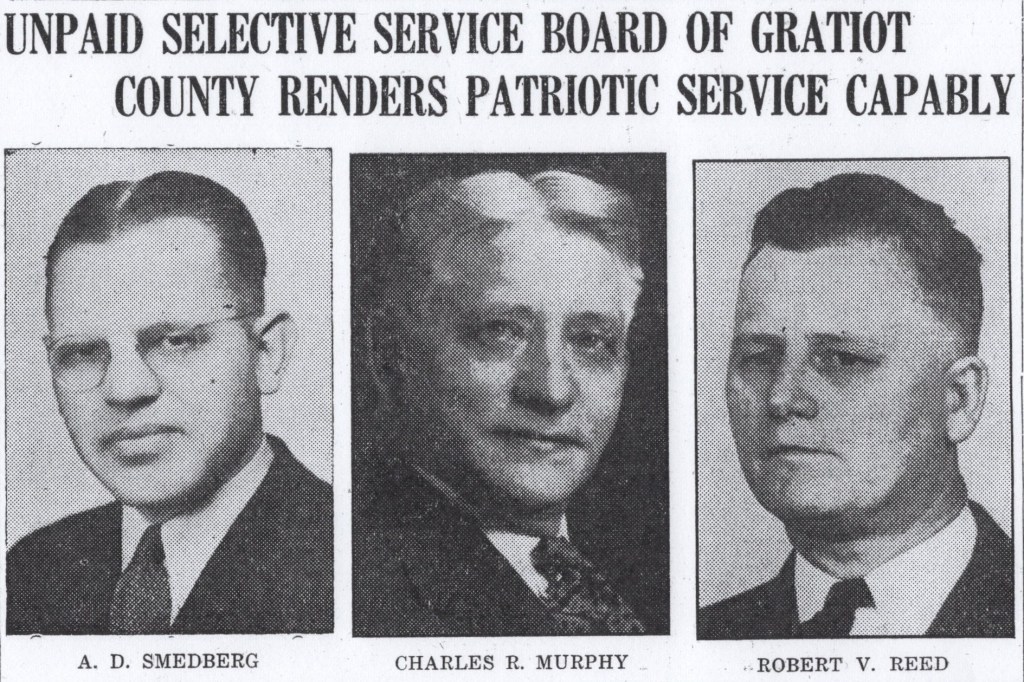
When the registration process ended, a total of 3,716 men were available for the draft, and 187 men were expected to be called to service by June 1, 1941. The county draft board, which was located in Alma’s City Hall, was composed of A.D. Smedberg, C.R. Murphy, and Robert V. Reed. At the same time that the draft board was created, members were appointed to the district appeals board. Lawyers J. David Sullivan, Kenneth Montigel, Merrill Hendershot, and Charles Goggin were appointed to that board. One of the primary reasons for granting deferments was to address the needs of men with dependents. The draft board showed leniency in this regard. Occupational deferments soon became another issue and had to be dealt with on an individual basis. One of the first complaints recorded in the Alma Record concerning registration for the draft involved President Roosevelt’s son, Elliot Roosevelt, who joined the Air Corps as a captain. The younger Roosevelt received higher pay and allowances than most young men who would be drafted. Editors argued that Elliott Roosevelt should be drafted like all other young men.

And who made up the most considerable loss of Army aid from Alma? The group of thirty-one cavalry horses left  Alma with the help of Private William Meredith from Troop B, 106th Cavalry, Michigan National Guard. The horses went to the remount station at Fort Reno, Oklahoma, and thus came the end of the long history of horse soldiers in Gratiot County.

Now, the nation awaited the first draft call planned for November 18.

Politics & Election of 1940

Politicians big and small appeared in Gratiot County, campaigning for election or re-election for their respective offices. Both sides of the candidates for governor appeared in the county beginning in early October. Murray D. Van Wagoner, Democratic candidate for governor, addressed an audience of 150 at the IOOF Hall in Alma. His speech focused on his plan to reduce the state’s deficit, and he stated that if he failed to do so, he should not be re-elected in two years. Republicans organized meetings in places like Robinson Auditorium in St. Louis, and 75 Young Republicans of Gratiot County held a meeting at the Wright Hotel in Alma. Governor Luren Dickinson even had a campaign rally at the St. Louis High School Gymnasium, alongside O.L. Smith, a noted Gratiot Republican who ran for governor in the state primary. The St. Louis High School band provided music for the program.

A “Willkie-For-President” headquarters appeared in downtown St. Louis, which was decked out in red, white, and blue colors. The headquarters was billed as one of the most attractive Wendell Wilkie campaign headquarters in mid-Michigan. Willkie supporters organized a reception committee to welcome visitors each week; among the first to do so were Charles S. Huntley, Mrs. Rolland Baum, and Mrs. Frank Housel. Heavy campaigning for Willkie for President could be seen in county newspapers, which asked readers if they wanted an inauguration (for Willkie) or a coronation (for another Roosevelt term). The main arguments for Willkie manifested themselves in the phrases “Vote No Third Term” or “Anti-Third Term.” Near election night, the headquarters offered free doughnuts to anyone who stopped in to show support for Wendell Willkie.

Life in the Depression and New Deal Projects

In a big affair, Gratiot County celebrated the dedication of Gratiot County Conservation League Park in early October. On a crisp, clear day, southwest of Alma, a large crowd of people turned out to celebrate the work done on the 53-acre park that the Gratiot County Conservation League purchased in 1937.  Fifteen minutes before the program started, Alma city manager William E. Reynolds, Howard C. Riggle, benefactor of the park, and Dean Carter, NYA county director, were interviewed on the air by Saginaw’s WSAM station. A flag-raising ceremony then started the program, emceed by Dr. Thomas Carney, who introduced a series of speakers. The National Youth Administration (NYA) was recognized for having done much of the work over the previous two years with the help of federal aid, such as constructing the one-hundred-foot suspension bridge and working on the park’s landscaping. Even as winter approached, NYA boys continued to rake leaves and cut dead wood, planning to complete a lawn bowling green before the winter weather arrived.

The NYA also continued to benefit area high school students by allotting $2,268 to eleven high schools in the county. Approximately 65 students earned $3 to $6 a month during the school year for their work with NYA. The money earned by students went toward lunches, carfare, and school supplies.

WPA (Works Progress Administration) project work also continued in the county. A group of twenty-five men worked excavating six cement tennis courts at Wright Park. Another group of seventy-five WPA workers labored on street paving jobs on streets like Orchard, Walnut, Downie, and Wright Avenue. A shortage of summer labor and the oncoming winter season meant that some projects in Alma would have to wait until 1941. The WPA also suggested creating a possible skating pond, a roller skating project, and even a swimming pool in St. Louis. For the summer daily project, there were 587 young people in attendance, according to Coach Oldt. WPA projects also involved grading and widening different roads in the county. A bridge at Bridgeville was being repaired, and a new bridge was created over Beaver Creek at Lafayette Township, all with WPA labor.

The Gratiot County board of supervisors appointed a committee to explore the possibility of creating a future traveling library for the county with WPA labor by converting a traveling bus into a library. A $2,000 federal government funding to buy new books, along with book donations from Alma, St. Louis, and Ithaca libraries, would supply the necessary reading material for rural students.

Ten youths from Gratiot County took their examinations to serve in the Civilian Conservation Corps (CCC). The group was expected to work at Camp Axim in Cadillac. The ten included: Alger Anters, Wallace Cratsenburg, Donald and Lester Dunn, Victor Hall, Clyde LaVoy, Nile Liscomb, Cecil Skutt, Murl Smith, and Denver Welsh.

Other news involved a settlement between creditors of the late Bank of Elwell after a dozen possible suits. Assets would soon be divided among the creditors to bring the issue to a close. For the week ending August 31, 1940, the Alma Welfare Office processed compensation claims for $6,519. The Social Security representative for old age security will be late in appearing in Alma because of attendance at a conference in Cleveland, Ohio. Manager Joseph W. Ramsey of the Saginaw field office would be back on October 23.

Farming and Farm Issues

An early frost hit the county just as weigh stations for sugar plants opened during the second week of October for the estimated 2,260 sugar beet growers in Gratiot County. On Tuesday, October 8, both the St. Louis and Alma plants started taking beets from farmers. At the end of October, farmers received one of three types of payments for their sugar beets. First, there was payment on actual tonnage if it exceeded eighty percent of the normal yield of the farm. A deficiency payment was the second type paid if tonnage was less than eighty percent of the normal yield. A third payment was made for abandoning 1/3 of the normal yield if beets had been abandoned.

Other, more serious problems still faced Gratiot County farmers, such as the battle against the corn borer. One hybrid corn plot in Emerson Township, belonging to the Grover Brothers, showed that their corn, planted on June 2, had sixteen corn borers in just one stalk. With 40,000 acres of corn planted in Gratiot County during the year, it was estimated that the pest caused $400,000 worth of damage to the crop. Concerns over the seriousness of corn borer damage came out in a Gratiot County editorial urging farmers to take the issue seriously as they prepared for 1941.

Miss Helen White of St. Louis, Missouri, met with the executive board of the Gratiot Council of Churches. White, Regional Director for the Council of Women for Home Missions, gave final reports about the Mexican center that operated during the summer and revealed plans for Mexican migrant workers in 1941. Miss White also spoke to the annual convention of Gratiot County churches on “Michigan Migrants.” Much of the financial support for the Mexican center in Alma came from churches in the county, as well as Leonard Refineries, Michigan Sugar Company, Lake Shore Sugar Company, and Michigan Sugar Company Workers Association. Reverend Floyd Drake of Breckenridge was recognized for his tireless work for the Mexican school.

A variety of news items dealt with Gratiot farming. The People’s Elevator Company moved into new offices in Elwell in what had been known as the Bina Slingluff home. To make the mill more efficient, the building had been moved back 150 feet. Ward Bronson served as manager. In early October, the county announced that 4-H interest had peaked at 500 enrollments, and 61 schools asked for winter clubs. Country schools from Hetzman in Emerson Townships to Sunnylawn in Wheeler Township all wanted to join the growing 4-H enlistments. On October 1, the Farm Bureau held meetings in places like the Beebe Hall, where Sherman Edgar served as chairman. An egg grading demonstration, a discussion about the corn borer crisis, and the call to create a community scrapbook about life under a democracy all took place.

October meant pheasant season, and many farmers in the county dreaded the appearance of hunters on their farmlands. Before the start of pheasant season, fourteen hunting clubs restricted hunters by ordering that they obtain a pass from the farm owner before hunting his land. Sunday hunting was closed, mainly, and Gratiot County petitioned the state for a statewide hunting ban on Sundays. On opening day, “nimrods” could be seen on many wooded tracts and farms, taking their share of birds. However, a few were caught hunting too early and paid fines of up to $12.00. To warn hunters, a sunrise timetable had appeared in local papers to indicate when hunters could start shooting on the first day. Unfortunately, toward the end of October, surveys of pheasant and rabbit hunters suggested fewer of them were taken, possibly due to the cold, wet spring. A statewide dog quarantine to contain a rabies outbreak officially ended in late September in 42 counties. Gratiot County was one of the counties where the ban ended.

The holidays were not that far off, and a county-wide turkey tour to see 15,000 turkeys in Gratiot County took place on October 23. The success and importance of turkey farms in the county were evident as the tour members visited at least fifteen different turkey farms. On a sad note, Lawrence Nemcik of Bannister lost his barn and hay. A kerosene lantern was believed to be the cause of the fire.

The Long Arm of the Law in Gratiot County

The law doled out justice as October arrived. On the court docket, nineteen law cases, four chancery cases, and six chancery divorce cases awaited Judge Kelly Searl. During September, the court ruled on sixty convictions: 39 were for traffic law violations, and 21 were for other general offenses. The court collected a total of $448.85 in fines and costs. One person failed to pay the dog license fee and paid $6.85 in fines and costs. Judge Searl dismissed one case of bastardy when the couple agreed to marry. In some good news regarding dogs in Gratiot County, dog license fees generated $1,417.48 more than the amount paid to farmers who lost livestock to dogs from October 1939 through September 1940. The profit was attributed to owners keeping their dogs confined during a rabies outbreak and purchasing licenses.

Warren Glaser, 26, of Saginaw, was arrested for larceny of a diamond ring valued at $500 from a well-known Ithaca lady. The ring turned up at Wolverine Billard Hall in Saginaw after Glaser pawned it for $25. Upon arrival at the county jail, Glaser claimed he experienced severe stomach aches and had to be transferred to Smith Memorial Hospital. Doctors could find nothing wrong with Glaser, and he was handcuffed to his bed for another day. A pair of cattle thieves, Charles Vanatter of Eaton Rapids and Ashley Eaton of Detroit, awaited extradition to Gratiot County for trial on their crimes. Both men were serving 90-day jail sentences in Ingham County. Two St. Louis dentists’ offices were investigated by police when thieves stole gold fillings valued at $250. One dentist also claimed that over $200 in other filling material was also stolen.

The story of the troubled Cornelius Eichorn again appeared in circuit court. Eichorn had been arrested and convicted for repeated driving violations, resulting in his license being suspended. He recently wrecked his car a year earlier by smashing it into a large tree. Now, his wife, Effie Smith Eichorn, appeared in court to contest her divorce from Cornelius, desiring a settlement for herself and her young son. Cornelius Eichorn owned 120 acres of land in Emerson Township, and the hearing for the case lasted nearly an entire Monday in court. Mrs. Nellie Ranchun, poultry and egg buyer from Detroit, appeared in court for swindling Harry Bolyard of Middleton. Ranchun first agreed to buy eggs at 15 ½ cents a dozen from Bolyard. When Harry wasn’t around, Ranchun managed to negotiate a deal with his son for 13 cents. The younger Bolyard, unaware of the prior agreement, was a victim of Ranchun’s shrewd tactics. Justice Potter did not see it that way and awarded Harry Bolyard the full amount, as well as damages of $25.75.

A series of Ashley businesses experienced break-ins and robberies by at least two men. Joe Liska’s grocery, Ashley State Bank, and Martella’s beer garden were all broken into, with slightly less than $50 taken from each place. The thieves also made off with cigarettes and other goods, even though one robber was seen walking in front of a house in the village. A getaway car quickly scooped him up and sped out of town, and the search for the robbers continued. Other news about Martella’s beer garden was also not very good. Three men  (Mike Minarik and Nicholas Vanatter of Ashley and Dennis Wingle of Ithaca) were arrested as a result of a drunken brawl. Minarik and Wight paid fines; Vanatter, along with his brother, awaited trial on assault and battery charges.

Over in Seville Township, Dewey Parks, 62, got into a fight with his tenant farmer, Hiram De Camp. Parks, who had only one arm, picked up DeCamp and took him from his car during an altercation. Parks was severely beaten and suffered broken ribs. Problems related to family affairs were cited as the cause of the fight. With the arrival of pheasant season in the county, Conservation Officer C.B. Smith found himself very busy checking and arresting hunters for illegal hunting. On opening day near Ashley, six hunters were arrested for hunting before the 7:00 a.m. start time. Each paid $11.85 in fines and costs.

More news about the Dewey Glinkie embezzlement case continued. A surety company reimbursed Gratiot County for $3,169.55, the amount Glinkie stole from the county. The ongoing search for Dewey Glinkie continued in an effort to bring him to justice.

Over at the Gratiot Circuit Court chamber on one Tuesday, a tax-reverted land sale took place. Bidders purchased a total of 148 out of 388 available land parcels, including 150 vacant lots in Alma, significantly contributing to the sales, especially in five Alma subdivisions. Two hundred eighty acres of land for sale around Half Moon Lake in Seville Township were also purchased by interested parties.

As remodeling continued in the basement of the courthouse, Mrs. Fred Hunter reached an agreement with the board of supervisors to operate a detention home for children in her house in Ithaca. Hunter agreed to offer two barred rooms, one for boys and one for girls. The county would furnish the rooms, and the rent would cost $2 per week. The county agreed to pay $1 per day for each child and fees for extra care.

Gratiot County’s Health Issues and Concerns

The Gratiot County summer dental program informed the public that the twelve-week clinic, held in Ithaca, Alma, and St. Louis, had 805 initial visits from children, with an additional 116 appointments. Over 1,000 teeth were extracted, and over 600 fillings were performed on patients. A total of 49 students refused treatment. Doctor Gerald Barrow served as the dentist in charge.

The State Health Commissioner urged parents across Michigan to be on guard against infantile paralysis. In October, over fifty cases were reported in just three days, and through October 16, the 1,022 reported cases exceeded last year’s total of 904. Fifty-eight Michigan counties reported incidences of poliomyelitis. Symptoms included fever, nausea, irritability, leg stiffness, pain, and tenderness in the arms and legs. Doctors urged parents to have their children diagnosed and treated if suspected of contracting the disease. Only one out of three or four cases was believed actually to turn into paralysis.

Mental health issues also confronted Gratiot County. Roy Foote, age 56 and a former resident of Lafayette Township, was found dead at his home in Lansing Township, a victim of suicide. Foote had become dispondent over several financial reverses and took his life in his car by carbon monoxide poisoning. In another incident, Joseph Guszak, age 65 of Ashley, took his own life by slashing his wrists, abdomen, and throat with a set of scissors. Guszak had been dead approximately three days when he was discovered at his shack northeast of Ashley. When first seen by a neighbor through a window, Guszak appeared to be asleep in bed. Returning later, the neighbor noticed that Guszak had not moved and entered the building only to find Guszak deceased. The Sheriff’s department stated that Guszak was an alien and believed he had a wife and children in Chicago. It was not the first time that he threatened to kill himself, as he had previously been detained by the Sheriff’s department until released into the care of friends.

And Then There was Halloween

To celebrate the Halloween season, the Ithaca village council and Chamber of Commerce provided Aladdin, a professional magician who performed in the Ithaca High School auditorium. The Alma city commission heard a proposal by NYA and WPA recreation leaders for Alma’s annual Halloween party. Celebrations there included a parade from the Tourist Park, downtown, to Rademacher Motor Sales Garage. Back at the park, activities, bonfires, and contests took place until 10:00 p.m.The leaders ordered 800 noisemakers, confetti serpentine streamers, and rubber balls for the participants, as well as 200 toy balloons to be released from the tops of various buildings. Those who found the balloons were eligible for certain prizes. In places like Alma and St. Louis, authorities warned pranksters that waxing windows and other pranks would be taken seriously.

And So We Do Not Forget

Murray D. Wagoner, Democratic nominee for governor, held a gathering at the Alma IOOF Hall. Wagoner recalled his work in Gratiot County as a young University of Michigan graduate in 1922, when he received his first engineering assignment to work on the construction of the Honeyoye Bridge, located west of Alma on M-46. It was his first supervisory position as an engineer for the state highway department…Russell DeVrires of Alma lost a large load of fruit and vegetables on his travels east of St. Louis after other drivers told DeBrires that his load was getting away from him. He lost four bushels of cucumber pickles and thirty dozen ears of corn due to a broken tail gate, which was at fault. The items he retrieved (going all the way back to Breckenridge) were heavily damaged….The St. Louis Cardinals baseball team sent a scout to Alma to sign Carl Schultz to a major league contract. Past attempts to sign Schultz had failed, as he had signed an agreement in 1939, and things did not work out…Zane Betts of Alma was admitted to Smith Memorial Hospital for an injured knee. Betts received a cast and was then released… Mazey of Perrinton led all St. Louis Softball League hitters with a .556 average for the 1940 season. Rowley and Church led the team batting category with a .382 average. Brink of Rowley and Church was one of five players to have five home runs on the season…The St. Louis High School Home Economics Club sponsored the first dance for the first home football game. The “Krimson Kickoff” allowed participants to “kick” for 3 ½ hours, and a pair of red and black goal posts decorated each end of the gym…The St. Louis Leader published a list of dates and information about flag rules and use. Instructions and a list of holidays told readers where and how the flag should be displayed.

The Meteor Flying Club of Ithaca gave its members ninety minutes of flying instruction before piloting a plane. George F. Shores of Lansing served as instructor. The club had fifteen members and a 180-acre flying field two miles northeast of Ithaca…Alma merchants prepared for the merchants’ window night on November 27. The event featured the first display of holiday street decorations and the start of the holiday season in Alma…Alma schools planned to close for Armistice Day on November 11. Last year, the school only shut down for half of a day…Two Alma men, R.V. Hamp and Wayne Croton, both Alma Trailer Company workers, met their end while duck hunting near Bay Port, near Bay City. It turned out that the two men shot one duck, threw it into the boat, and when they got to shore, experienced a big surprise. A large skunk was on board the boat and ate half of the dead duck. After picking up the duck, the skunk ceremoniously “anointed” both men who attempted to flee the ship all to no avail….The Jean Bessac Chapter of the DAR completed its work of leading the creation and presentation of a patriotic pageant on the Alma College athletic field in early October. The pagent honored the golden jubilee of the founding of the Daughters of the American Revolution….The Alma City Commission again discussed the idea of establishing a Gratiot County Airport. The city hoped that a state program would provide as much as $80,000 toward the building of the airport…A.C. Sholty of the Alma Dairy announced he had installed a new bottling outfit of the sucker type. It was considered to be among the best bottling equipment available.

Frank Rudeck of Alma moved his Bass Lake cottage a total of eighteen miles in one day, courtesy of Vance Moving of Ithaca. The cottage came right down M-46 and to its destination via State and Downie streets, dodging branches and tree limbs along the way. The cottage was placed on a foundation at 209 West Downie, where the cottage became the bottom part of a new house. An upper level would then be added one story higher, along with a new roof…Buy a Fireside Ventu-Rotor heater at Mitchell Furniture Company in St. Louis. Save 1/3 of fuel costs, air forced principle gives good circulation, liberal allowance for your old stove…George Tugen, Ithaca High School right end, made a big catch and helped Ithaca defeat Chesaning 19-9 in football. Ithaca players Williams, Mellinger, and Stahl also contributed to big plays in the game…Wayland Payne, a 1940  Fulton Township Schools graduate, took off for Florida on a bicycle. Leaving on October 8, he expected to be in Florida around November 1…George Brent, Virginia Bruce, and Brenda Marshal all starred in “The Man  Who Talked Too Much” at the Alma Theatre. Tickets cost ten and fifteen cents…A group of forty different pupils from across Gratiot County came together in Ithaca at the direction of county school administrator Donald L. Baker. The group rehearsed for a thirty-minute broadcast on WKAR at Michigan State College. After the presentation, the students visited the college campus and toured the Capitol. Baker mentioned that this program replaced the usual Gratiot Spring Musical Festival in 1941…A curriculum workshop for rural teachers took place in North Star. A group of 41 teachers signed up to take the classes on Monday evenings from 4 to 10 p.m. for 18 weeks. The workshop allowed teachers to earn credits toward their teaching degrees.

Paul L. McKee, a popular widowed clerk at the Alma Post Office, told a local newspaper about his postal stamp collection, which included over 20,000 foreign stamps and a large assortment of domestic stamps dating back to 1851. McKee had been collecting for over 25 years…Reed’s Dance Band appeared at the Danceland Ballroom every Wednesday and Saturday in Alma…The North Star Bearcats were the undisputed champions of the Gratiot County baseball league. The team went 15-1 for the summer…Newark School Number 4 had the highest attendance in a one-room rural school in the county, with 46 students. Julia Fahey taught that group. The smallest one-room school was Emerson Number 8, which had five students and was taught by Doris Cowdrey…Dr. Leslie Howe was honored at the Wright Hotel in Alma by the Tri-County Medical Society for fifty years of service as a country doctor…Over at St. Louis High School, Superintendent Nurnberger and Coach Oldt got up early on the first day of pheasant season and each brought home one pheasant. Both men returned to SLHS for the start of the school day…While Alma prepared for Halloween celebrations in town, a local column reminded youngsters that soaping windows was not welcome. Please bring your energy to the Halloween party in the city…Carson Clapp opened Clapp’s Hardware on Mill Street in St. Louis in the former Kroger store. The Clapp family had a long history of involvement in the hardware business, with stores in North Star and Alma.

Clark Gable and Joan Crawford appeared in “Strange Cargo” at the Ideal Theatre in Ithaca. Viewers also watch the “Deadwood Dick” episode, a color classic, and view screen snapshots. All for only a dime…Wanda Gabrion and Norma Gay made their first appearances as drum majorettes at Ithaca High School’s game against Shepherd. Both belonged to the baton twirling class offered during the summer at Ithaca…A new tavern at the St. Louis CSA Hall announced Saturday dancing starting November 2 for only fifty cents a person, supper included. Three big door prizes would be given out, and a Lansing orchestra would perform music…The St. Louis Softball Association announced that it had a balance of $81.56 in the bank after all bills were paid for the 1940 season. T. Jefferson Hoxie served as treasurer…Alma Schools sponsored Adult Education classes for any member of the Alma community not regularly enrolled in public schools or college.

And that was Depression and War during October 1940.

Copyright 2025 James M. Goodspeed

Gratiot County in Depression and War, September 1940: “Gratiot Goes Back to School Again”

Gratiot in September 1940, from the top: Going back to school again and learning about impending warfare, September 12, 1940, cartoon from the Gratiot County Herald; Gratiot County Conservation League Park is dedicated. A combination of members, volunteers, along with NYA and WPA workers, made the use of the park possible in late September 1940; Elwood Mellinger, captain of the Ithaca football team, as it prepared to face St. Louis on September 20, 1940.

Another cold, wet fall meant it would be a challenge to bring in another Gratiot harvest.

It was a time when America prepared for a peacetime draft – its first draft since 1917.

What,  Roosevelt runs for a third term as President? No President had done so in the nation’s history.

Residents also learned that the WPA programs would soon come to an end after five years of operation.

What was going on?

 It was September 1940 in Gratiot County.

Europe at War, Preparation at Home

As Hitler continued to attempt a conquest of Great Britain, the only remaining obstacle to his domination of Western Europe, Gratiot County prepared for war. Although the Führer boasted to England that “I am coming,” England countered by conducting another of its early air raids upon the city of Berlin.

Even before entering the fall elections, President Franklin D. Roosevelt spoke freely and openly about the need to prepare the nation for war, and instituting a peacetime draft now became a reality. All American young men between the ages of 21 and 35 had to register for possible conscription by October 16. Roosevelt’s initial goal was to mobilize 400,000 men by early 1941 and 900,000 by the spring of that year. All registrants would carry a registration card, and those who failed to register would be considered evaders.

As a result, Gratiot County received approval from President Roosevelt to form its first draft board in twenty years. Four men, Dr. C.F. Dubois (medical examiner), Charles R. Murphy, A.D. Smedberg, and Robert Reed, headed the Alma board. All served without pay. Ahead of the draft, six local men signed up at the Alma post office on one weekend to join the United States Marine Corps. Robert Hennigar, Burson Youry, Paul Dintaman, and Lyle Goward of Alma, along with Donald Zinn and Richard Horton of Vestaburg, expected to go to Saginaw for their formal physicals. If they passed the examination, the group of men would be sent for Marine training at Parris Island, South Carolina.

Men involved in Troop B, National Guard, of Alma, returned from drills in Wisconsin. However, Captain Howard L. Freeman believed that the unit would soon be called into service as part of the 210th Coast Artillery, an anti-aircraft unit. Two weeks later, that assignment changed again, and the group would be known as Battery B of the 177th Field Artillery. The Alma battery needed to increase its strength from the current roster of 60 men to a total of 122 men between the ages of 21 and 35. At this time, one Michigan newspaper reported that many National Guardsmen would be sent south in October to Camp Beauregard, Louisiana, for a year of training. President Roosevelt soon signed an order calling up over 60,000 men in the National Guard for a one-year period of service. Sadly, a result of this order meant that the horse cavalry unit, long a part of Alma and Gratiot County’s history, would soon depart for Illinois.

 Photographs in county newspapers, such as the Alma Record and Gratiot County Herald, demonstrated the hardships of war as well as this nation’s preparation to be drawn into the conflict. In an attempt to feed its population during war, England used all of its land to raise food, including growing wheat in London parks. Londoners also paid an admission fee to see a recently shot down German Messerschmitt fighter for the “Buy a Spitfire” fund. In Santa Monica, California, one plant worked to produce the world’s largest bomber, a four-motored aircraft with a 210-foot wingspan. It held a crew of ten men and could fly 6000 miles on a bombing mission. In Springfield, Massachusetts, a plant there produced 1000 Garand semi-automatic rifles daily. The plant commander urged the War Department to expand production. Two inventors of the concrete pillbox, a concrete dome-shaped shelter that builders could set in five hours, demonstrated it in front of the Army and congressional leaders. These small fortresses could be used in America to guard its borders.

Depression Life Continues

The New Youth Administration (NYA) continued work in the county as 80 young men and women received permission from the program to work more hours, and therefore, more pay. Thirty-five young women worked on various projects, including recreational activities at Conservation League Park and maintenance tasks at Alma City Hall. All project workers were required to take and complete their initial air courses. A few NYA members worked with WPA supervisors at places holding girls’ activities at Wright Park for handicrafts or at wood games activities for young people at Republic School. James Carter oversaw the woodcraft project at the Salvation Army Center. As Halloween approached, the NYA staff led interested children in creating paper masks using clay, which would be displayed at the indoor recreation centers. Two Gratiot County students, Elroy Prince of Ithaca and Darwin Snyder of Breckenridge, attended a short NYA  agricultural course at Michigan State College. A total of thirty students made up the group, attended class, lived in a barracks, and worked part-time. At different Gratiot County high schools, student aid workers on the NYA payroll earned $6 each month once they received NYA certification.

The Works Progress Administration (WPA) offered further training to members from Gratiot County who traveled to Hoyt Park Field House in Saginaw. Director Darrell Milstead, recreation director, led the group as it learned about fall sports activities, arts, crafts, administration, and first aid. Among those who attended were Hazel Markham (from Ithaca), Henry Sholtz and Lester Fillhard (St. Louis), James Carter, Jack Acker, Lowell Williams, and Eldon Lott (Alma). The WPA program, which had operated nationally for several years, received news in late September that all WPA work would end by June 1941. The program director urged WPA leaders across the nation to complete their existing projects within the allotted time and avoid initiating new ones. An increase in funds for defense appropriations and an overall atmosphere of the need to train for national defense meant an end to WPA programs.

People who had past accounts with the Elwell Bank received good news from Charles H. Goggin, President of Alma First Bank of Alma. He announced a possible agreement to disperse the liquidated assets of the former Elwell Bank. Litigation continued in court in Ithaca, but an announcement was expected soon. A hundred former bank depositors had filed suit to get money from the Alma Bank, which they claimed was also tied to the Elwell bank’s collapse. The judge granted ten days for any other former depositors to file their claims for money.

Over at the Ithaca courthouse, work began on the new social welfare offices and Gratiot Bureau of Social Aid, which planned to relocate from Alma. The two new offices, expected to open in the courthouse basement, and the remodeling meant that a new entrance would be created on the south side of the building. The new rooms would now occupy what was formerly known as the youth detention area and janitor’s living quarters.

Health and Gratiot County

The  Children’s Free Dental Clinic continued its work in the county after completing its time in St. Louis. A dentist worked on a total of 222 St. Louis children with 335 cavities filled and 185 teeth extracted. Another 29 children had their teeth cleaned. The Child Study Club sponsored the clinic, which provided free healthcare to underprivileged children. Doctor G.V. Barrows did the dental work and was assisted by Beth Hicks. Several children from Wheeler and Breckenridge attended the clinic as well.

The public received warnings about outbreaks of infantile paralysis in sixteen different Michigan counties. Believed to be a seasonal disease that peaked in late August and early September, a total of 272 cases were discovered in the state during September. In related news, Leonard Hubbard, 29, a popular Vestaburg musician, died of the disease only one week after contracting it. He left behind a wife and three children. In other health news, a Bannister man took his own life after years of battling illness. Frank Goldman, age 67, hung himself in his barn early one morning. Goldman suffered from being unable to eat and sleep due to health problems. In another twist, he was scheduled for the next step of becoming a naturalized citizen the day after his death. Goldman farmed in the community for 28 years.

The Long Arm of the Law in Gratiot County

August 1940 proved to be a busy month for the courts as a variety of offenses resulted in 47 convictions. Only 18 in the group were found to have committed serious crimes, and most of the others were due to traffic offenses. Fines totaled $258.30, with an additional $162.80 for costs. Some of the serious crimes involved one man being sent to Jackson Prison and four others to the county jail. Otis Andrews was sent to Jackson for violating probation for a third offense of drunk driving and got six months to two years. Andrews was warned that if he ever showed up in court again, he would be immediately sent back to Jackson.

 Lawrence Lutz, 18, of St. Louis, was found guilty of carrying an unloaded concealed weapon without a license. He only got a year’s probation and was ordered to attend church with his parents every Sunday. Four men were convicted of fishing law violations for setting an illegal set line on the Maple River. They each paid $10 for a fine and $6.85 for costs. Another person unlawfully used an automobile and got three years’ probation and $200 for damages to the car.

The Alma City Commission had its first reading of a proposed ordinance regarding trailers in the city. If accepted, the new ordinance would regulate trailer families and individuals from taking up residence on vacant lots or yards. Those wishing to reside in trailers had to do so at a licensed trailer camp and pay $15 for a yearly license. The trailer camp owner was also required to provide a service building, showers, toilets, laundry facilities, drinking water, and a list of other amenities. Anyone parking a trailer next to a homeowner in Alma could only do so for two weeks at a time.

Regarding elections and politics, Gratiot County gave favorite son O.L. Smith a nearly 2-1 advantage over incumbent Luren Dickinson for the Michigan Governor’s race in the state primary election. Unfortunately, Dickinson trounced his opponents across the state to gain the nomination. He would face off against Democrat Murray D. Wagoner in November. One of the most interesting and spirited contests involved three candidates for Probate Judge. Mildred Taft, daughter of the late Probate Judge James G. Kress, won the primary election after being appointed by the Governor to fill out her deceased father’s remaining term. Taft would serve as Probate Judge until 1963.

Naturalization hearings continued at a good pace in the county as ten residents from six different countries applied to become American citizens. For this ceremony on September 19, something new happened. This time, DAR chapters from Alma and Ithaca organized a short march to the court. At the same time, bugles played and Boy Scouts accompanied the group. Alma DAR chairman, Miss Lou Nickerson, gave a brief talk on the Constitution, then Mrs. Floyd Barnes explained the meaning of the American flag. Each new citizen received a citizen’s manual with a copy of the Constitution, which included the Pledge of Allegiance. Each citizen also received a small 4×6-inch flag. Although fifteen candidates faced examination for citizenship, these ten were accepted, while the other five continued further study. Members in the group originally came from places like Croatia, England, Russia, Germany, Poland, and Slovakia.

Alien registrations also continued at post offices across the county. In Alma on one Wednesday afternoon, a total of 18 aliens registered. The Alma postmaster, J.L. Winslow, commented that several persons believed they were American citizens, but upon investigation learned they were not.

Farming

Farmers were urged not to cut their alfalfa but to wait at least until the end of September, unless used for silage or molasses. It was essential to let alfalfa store up root reserve for 1941. Sugar beets appeared to have a later-than-usual harvest due to low sugar content. The heavy rains in late August and early September meant a delay in harvesting. The Michigan Sugar Company announced it had 9,000 acres set aside for raw material for the Alma plant. A new beet dump and piler took care of a load of beets in one minute. Over at St. Louis, the Lake Shore Sugar Company had 10,000 measured acres of beets to harvest. Still, a late white frost hit Gratiot County at the very end of September. County Agent C.P. Milham announced that the enemy of all farmers, the corn borer, caused over $200,000 in damage to county farms. For many in the county, the amount could have meant profit or loss for the season. To combat the corn borer, shredding dry stalks and plowing under others by June 1 had to be a goal for all farmers, according to Milham.

In other farm news, a group of nine Junior Farm Bureau members attended Waldenwood Leadership Training Camp at Hartland, Michigan. A total of seventy-eight young people from thirteen countries attended. From Gratiot County, John Kelly, Gerald Lake, George Cox, Marion Wang, Eugene Oberst, Margaret Douglas, Edward Hooper, Lowell Quidort, and Dorothy Gibson all went. Another 24 schools proposed forming 4-H clubs in the county, bringing the total number of 4-H clubs to 42. The Beebe 4-H Club had 11 members and was led by Mrs. Helen Muscott.

Mexican night entertainment took place in Alma on September 28, coinciding with the dedication of Conservation Park. Mexican talent, recruited by Pastor Albert Mareno of Shepherd, performed a program at the Alma Tourist Park, located west of the Christian Church. Finally, pheasants surprised Dick Brown and his daughter in Alma as a rooster and three hens were flushed from behind the Brown home inside the city. Young daughter Brown is very excited to see the pheasants.

And So We Do Not Forget

Thirty boys showed up for the first St. Louis football practice of the year. The Labor Day practice marked the beginning of preparations for the season’s first game against Ithaca, just three weeks away. Coach Elliot Oldt was seeking guards and tackles to fill the ranks vacated by last year’s graduating seniors…Fulton School in Middleton and Perrinton started school on September 3, and Superintendent Eberly announced the school had four new teachers. Fulton had a total enrollment of 434 students. Grades seven through nine met in Middleton, while grades ten through twelve had classes in Perrinton. The district had five school buses…” When the Daltons Rode,” starring Randolph Scott and Kay Francis, appeared at the Strand Theatre in Alma. Tickets were ten and twenty cents…Ithaca Public Schools opened with an enrollment of 597 students. Kindergarten had forty-eight students; the senior class was made up of sixty students…The Perrinton softball team finished first and was the winner of the 1940 fastpitch softball season in St. Louis. Rowley and Church finished as runners-up.

The public was invited to observe the dedication of the Gratiot County Conservation League Park in Alma on September 28 at 1:30 p.m. Activities included a flag presentation and raising, public address, and horse pulling contest…The Pentecostal Faith Riverside Tabernacle church dedicated its new building at 523 Michigan Avenue in St. Louis. The new building seated 100 people…Students, buy your new fountain pens at Green’s Jewelry in Alma. The fountain pens only cost 29 cents each…Work on the new Gratiot County highway garage continued. The $65,000 structure is planned to open on November 1. Situated in East Ithaca on the south side of US-27…The Lincoln School in Alma received a trophy from the Automobile Club of Michigan for the number of safety contacts it had during the previous school year. One of the achievements of the Lincoln School was its use of school safety patrols by children. Lincoln placed first among forty other Michigan schools for the award…Harold Woodley of Alma saw the excavation for his new house begin in late September, marking the start of construction on his $6,300 residence on West Superior Street. The new home would be just east of the Lester Purdy Riverside Dairy farm.

Alma Schols began the new school year with approximately 1,750 students. This included 225 non-resident students who paid tuition to attend school in Alma…A “Pageant of America” was planned to be performed on the Alma College athletic field on October 4. An estimated 500 people from Alma organizations and leading citizens were involved in presenting this program. The Jean Bessac DAR Chapter led the organization of the pageant…Radio station WJR, the state’s most powerful radio station, planned to have two announcers in Alma for its “Michigan Speaks” series. Jack Garrison and Duncan Moore planned to broadcast from the streets of the city to gauge county voting preferences for the upcoming 1940 Presidential Election between President Roosevelt and challenger Wendell Wilkie…Otis Brantley, chef at the Main Café in Alma, and Claude LaVoy of Riverdale hit it big while fishing on the Maple River near Matherton. They caught two of the largest catfish seen in Alma in a long time. One was over 4 ½ feet long and weighed 45 pounds…The Michigan Masonic Home has a new V-shaped electronic sign in front of the home. It turns on automatically at 7:30 p.m. so that anyone passing by on US-27 can see it.

An open house was scheduled at George W. Stewart’s new home on 612 Liberty Street in Alma. James Medcoff, a contractor and builder, designed and built the new house using materials from the Little Rock Lumber and Coal Company in Alma. The new home cost $3,500 to construct…Senior Elwood Mellinger, left tackle, served as Ithaca football captain for the team…A tragedy occurred in Elm Hall when an explosion and fire took out the Hoxie General Store on a Friday morning. A combination of a kerosene heater and cook stove malfunction caused the fire, which resulted in $4000 in damages. George Mack and his wife had insurance on the building and contents, but it would only cover part of the loss… Roy Rogers and Gabby Hayes starred in “Saga of Death Valley” at the Ideal Theatre in Ithaca. Catch a Saturday matinee for only a dime…James Redman, 20, Alma, married Opal Jean Hahn, age 18, of Alma, and became the latest of Cupid’s victims…Miss Virginia Hetzman of Alma was runner-up at the State Fair for the dress she made and wore for the style revue. Hetzman had been involved in Martha Jean Conklin’s 4-H club for the past seven years…A representative from the Saginaw field office of the Social Security Bureau, Alma, will be Available on September 18 for two hours to answer questions and provide assistance to those applying for Social Security. Meet the rep at the office of the Michigan State Employment Service in Alma’s city hall…Finally, someone (or something) shut down ten telephone lines and twenty-five telephones in Ithaca. In this case, a fox squirrel ate through the leaden sheath of an aerial cable on St. John’s Street. The squirrel gnawed through the lines, exposing them to water. It was the second time in five years that Union Telephone had to address this problem.

And that was Depression and War in Gratiot County during September 1940.

Copyright 2025 James M. Goodspeed

We Remember “Those L & L Laws: Lewd and Lascivious Behavior in Old Gratiot County”

Above: A post-World War I circuit court record of one Gratiot County couple who were arrested and tried for the crime of cohabitation. Ellis Mumby, age 26, was found guilty and sentenced to six months in the Ionia Reformatory.

In December 1921, there came a knock at the door of the dwelling of Joseph Yucek and Sophia Lastuk, who then lived in a remote part of North Shade Township. The Gratiot County sheriff, along with his deputy, tells the couple, “You are both under arrest.” The couple is loaded into the sheriff’s car, and the group begins the trip back to Ithaca. Upon arrival, Joseph and Sophia are held in custody until their court appearance.

Once in front of the judge, the pair is asked how they desire to plead. The pair face a potential judgment of either jail time, fines, or being sent to Jackson State Prison or the Women’s Reformatory in Detroit. If they are lucky, they get only a fine.

What was their crime? Joseph Yucek and Sophia Lastuk have been found in violation of lewd and lascivious behavior – the crime in Gratiot County of living together outside the bounds of marriage.

For many at that time, it was called cohabitating. However, the public might later call it “shacking up,” “living in sin,” “moving in,” “a trial marriage,” or “living together.” Today, most people find it absurd that such a law would deal with a couple’s personal lives, as it did for Yucek and Lastuk. However, arrests for cohabitating did happen here in Gratiot County, and they happened frequently in the 1920s and 1930s.

 Starting during World War I and running up until World War II, Gratiot County circuit court records show that at least 33 couples appeared in court for the crime of cohabitation. It is often difficult to determine the exact consequences for many of these cohabitating couples who were arrested for “L and L” or “L and L (lewd and lascivious) behavior.” Many experienced consequences for being caught. Upon examination, these circuit court cases frequently only reveal the names of the offenders, where they lived, and the charges brought against them.

The following is a brief list of some of the couples in Gratiot County who were brought to court for “L and L.” In the spring of 1922, Earl Berry and Mildred Lyon were the first in the group to each receive a sentence of six months to a year in prison. Berry spent his time in Ionia, but it is unclear where Lyon went. In another case in 1925, a couple identified as Archie Bell Johnson and Lena Dunkel were found not only guilty of violating the marriage law, but also were taken into custody to be treated for a social disease (syphilis). In 1926, Durwood Jones and Genevieve Dickerson from St. Louis were each sentenced to four days in jail and subsequently served probation for their offense. They got off relatively easily. Possibly, they agreed to separate or get married. In late 1926, Steve Skibinski and a young girl named Clara Cass were busted after checking in at the Wright House in Alma after someone tipped off police because they looked suspicious. Their contrasting age differences were probably a tip-off, and someone contacted the Alma police. Skibinski was quite a bit older than Cass. It is not clear what their consequences were.

 In October 1927, Donald Girvin was arrested for being unlawfully wed to another woman while trying to remarry and was convicted of committing perjury. As in similar cases, one of the parties involved did not disclose their actual legal age for marriage. Usually, the girl was sixteen or younger and might only wed with the permission of her parents. By lying about her age, the girl was guilty of perjury. There were also cases where someone faced arrest for lying or claiming ignorance about not being legally divorced in another county before getting married and committing bigamy. In one case, Donald Robinson and Mabel Ottinger were arrested for “L and L.” Still, they also got off relatively easily in January 1932, paying only a $25 fine. In another case in 1936, Levi Hunnnicut and a girl named Geraldine got a $40 fine and had to pay 50 cents a week in probation fees as part of their punishment. In still another case in late 1937, two couples were caught cohabiting in Gratiot County at the same time. It is unclear what the connection was between the two arrests, only that their charges came under “L and L.”

One would ask today, why would these people be arrested, and why was this particular “crime” such a concern in Gratiot County? Looking back, there could have been several reasons why couples faced prosecution for “L and L” crimes.

First, the role of the church in early 20th-century Gratiot County likely had a significant impact on why couples hid or concealed this behavior. In both Catholic and Protestant churches, marriage was considered in high esteem. It was what couples were supposed to commit to at the appropriate time. Yet, cohabitation in Gratiot County happened and was most likely an open secret in many areas. Another reason for prosecuting this crime involved both legal requirements and health considerations. One similarity between getting married in 1925 and 2025 is the process of applying for and paying for a valid marriage license. Marriage licenses, like other licenses, remained a public record, but also brought in money as a source of county revenue.

 Gratiot County’s frowning upon cohabitation may also have been health-related. The period starting in the 1910s in Gratiot County saw considerable reform in personal health, as people survived the influenza epidemic and still battled numerous diseases like smallpox, diphtheria, and tuberculosis, among others. Going another step, confronting, confining, and treating what were then called “social diseases” (venereal diseases) increased in the World War I era at the local, state, and federal levels. Alma was particularly involved in arresting and confining women who possessed social diseases during World War I, a result of the increase in prostitution due to the presence of Army men who came to town to pick up trucks for the Republic Truck Company. The need to regulate social diseases made the front page of newspapers like the Alma Record.

Still, the topic of cohabitation in Gratiot County overlooked one intriguing aspect of Gratiot’s society, which involved identifying cohabitating couples. How would the Gratiot County sheriff’s office in Ithaca ever know that a couple like Joseph Yucek and Sophia Lastuk, who lived in a farmhouse in a remote section of North Shade Township in 1921, were cohabitating? Who told the sheriff, and how did he find out?

The answer is that there was a “hotline” in Gratiot County, which reported cohabitation, as well as other crimes, such as alcohol during Prohibition. This “hotline” (or telegraph or gossip line)  was operated by individuals in Gratiot County who reported what they thought they knew or saw directly to the sheriff. In effect, this Gratiot County grapevine often tipped off law enforcement and regularly reported on fellow citizens.

Since residents told the sheriff that they thought someone was brewing moonshine whiskey, transporting, or selling it in Gratiot County, many had no problem reporting that their neighbors or the new people in their section were unlawfully living together. A bigger historical question is how many people knew about these cohabitating couples and how concerned these couples were regarding their personal lives.

Whatever readers think about cohabitation in 2025, today it is viewed as a private matter.

But back in our past, it was treated as a crime in Gratiot County.

Copyright 2025 James M Goodspeed

Gratiot County During Depression and War, August 1940: “Summer and Life Goes On”

Above from the top: Wheat harvest was coming in, and young Beverly Kay Gulick of Ithaca lacked nothing to eat. The two sacks represented how much wheat the United States had in its possession (left) and how much it would consume in the next year (right). The message was that the country had much to avoid a famine – unlike parts of Europe who suffered from the war; a new county highway garage went up in Ithaca with the goal of completion by November 1; “One Out of Every 28” was the title of this cartoon, which foretold an impending draft of young American men in the wake of the European war.

A warm late summer in Gratiot County provided what crops needed after a poor start.

As war spread over Europe, most people in Gratiot County seemed unconcerned; even talk of a draft was in the works.

And FDR appeared to be willing to run for a third term as President. What would Gratiot County voters do to avoid a dictatorship?

It was August 1940 in the county.

War News Comes to Gratiot

Plenty of news articles and photographs warned Gratiot County that a world war covered parts of Europe as the Nazis now threatened to invade the British Isles. As “the Blitz” continued over parts of England, citizens prepared to handle both early morning “feeler raids,” as well as more brutal attacks over northwestern England and up and down the coasts of Scotland. Cities like Southampton, Dover, and Hastings all became targets as barrage balloons tried to deter German planes.

The Alma City Commission continued discussions of the city’s involvement with a new National Guard Armory for Troop B, 106th Cavalry. Because the federal government talked of taking the National Guard, combining it with the training of army recruits, and removing horses due to mechanization, the commission did not favor a push for a new armory. Soon, Troop B left Alma in early August for intensive maneuvers in Wisconsin. A total of 63 members went on this trip. Captain Howard L. Freeman led the Alma group.

A photograph of the original glass jar used in 1917 by the Secretary of War to draft Americans for World War I appeared in the Gratiot County Herald. How long before young men would be drafted for another war? A U.S. Army recruiting party came to Alma and St. Louis to demonstrate the use of a searchlight for aerial spotting of aircraft. For this two-hour demonstration, the recruiters also brought along two scout cars, rolling equipment, anti-aircraft, and anti-tank guns. Byron Bradley of St. Louis made the news for being accepted into the Air Corps division in Lansing. He left the same night to begin training at Scottsfield, Illinois.

With Hitler’s conquest of Europe, attention turned to millions of people who were already hungry, and fall was coming. The Michigan Children’s Aid Society announced that it would be discussing the issue of care for refugee children during its summer conference in St  Joseph, Michigan. The Children’s Bureau of the Federal Government asked the Society to make facilities available for refugee children.

In news of another war in another part of Gratiot County’s past, Jasper Norton of Elm Hall, believed to be Gratiot County’s last surviving Civil War veteran, celebrated his ninety-fifth birthday. Norton was born August 2, 1845, and entered the Union Army at the age of sixteen as a private in Company D, 12th Regiment, Michigan Infantry. He reenlisted in the Army in 1864 and was honorably discharged on February 15, 1866. Private Norton was wounded in the right thigh in a battle near Camden, Arkansas. Up until a few years ago, Norton regularly helped with work on his farm and still took daily automobile trips out to his farm outside of Elm Hall.

New Deal Social Programs at Work in Gratiot

New Deal social programs such as the NYA (National Youth Administration) and WPA (Works Progress Administration) continued to be active in Gratiot County during the summer months.

Much of the NYA work dealt with recreation programs. Wheeler Field in St. Louis saw much community activity with programs like a doubles tennis tournament, horseshoe pitching tourney, shuffleboard, men’s night activities, and the town’s first public dance. NYA workers built the new shuffleboard and equipment, then they went and painted the court on the west walk near the grade school. More than 90 NYA workers were on the monthly payroll, with young workers receiving either $24 a month for 80 hours of service in the “A” class or $18.40 monthly for those in the “B” class. Several of these NYA workers were involved in activities in both the St. Louis and Alma recreation departments.

WPA projects and workers continued in the county. The Gratiot County Road Commission applied to the WPA for help with the construction of a bridge in Lafayette Township, three miles south of Breckenridge. It was hoped that the WPA would authorize a dozen men for help with this needed project of widening the bridge area and modernizing the bridge’s structure. St. Louis planned to use WPA workers for its sidewalk project to start at the end of August. The city also wanted work done, lengthening sewers and water mains in St. Louis. Over 100 men worked in Alma, pouring concrete on Walnut Street and River Avenue, as well as widening streets in the city. An increase in workers now meant that the city might be able to complete the forty-block project, which started in 1939. When this was finished, the city wanted to start work on another 15 blocks. WPA workers also planned to construct six tennis and six shuffleboard courts in Wright Park.

 WPA workers were also authorized to help with alien registration at local post offices in the county. Each worker’s job was to assist aliens in filling out registration forms, fingerprinting, and explaining the requirements of the registration law.

With summer in full tilt, recreation programs in Alma, Ithaca, and St. Louis all continued to draw large numbers of participants. Over in Ithaca, a new recreational center opened at the county fairgrounds. A new softball field with lights has now become the place to play softball each night of the week except Wednesday. Alma held another water carnival, which drew many people to Turck’s Beach on a Friday night. The beach drew in the crowds. During a hot August spell from August 22-28, the count showed that 6,400 people attended activities or went swimming at the beach.

For those who wanted to stay indoors in August, another Townsend Club meeting took place for Progressive Townsend Club Number 2 in Ithaca at the village hall. “Very good attendance” resulted in choosing delegates for the 8th congressional district convention in Saginaw.

Health and Gratiot County

Most of the health news during August 1940 dealt with hospitals and the topic of rabies.

Carol Jean Harrington, age 5 of Ithaca, fell off her bicycle and fractured her left elbow. She was x-rayed at Smith Memorial Hospital in Alma and then sent home. Dean Breidinger of St. Louis was the victim of burns to his body and left hand while trying to clean a paint brush in the boiler room at Leonard Refinery in St. Louis. His condition was satisfactory. Gerald Smith of Alma, like Dean Breidinger,  was treated at Smith Memorial Hospital for injuries suffered while riding his horse. The horse stumbled, threw Smith, and he fractured his left leg below the knee. John Wilberding, his mother, and grandmother, all of Shepherd, were also treated for a traffic accident on US-27 three miles south of Shepherd while on their way to a Catholic picnic. Wilberding’s party was not at fault for the accident.

Newspapers said that reports of rabies declined by 33 percent since May; however, there was no immediate ban on the free movement of dogs in Gratiot County. Law enforcement officials stressed that dogs had to be kept on a leash in public and boarded up while at home.  Some dog owners hoped for a reprieve in terms of allowing dogs to train for the upcoming hunting season, which was on the minds of Gratiot County hunters.

To support children in the county who needed dental care, the free twelve-week dental clinic continued. After five weeks at Ithaca High School, the clinic relocated to Alma Junior High School for the next four weeks. This dental treatment was given to underprivileged families in the county.

Farming

What would Gratiot County farmers do without such often unpredictable weather and tragedy, especially in the heart of summer? A large fire in New Haven Township at the Arthur Akin farm did $20,000 worth of damage to five buildings. Electrical problems may have been the cause, and Akin had only partial insurance. Akin also lost his sheep barn, hay, and grain, along with three cattle and a hog. Another fire at the George Baker farm in Emerson Township, at nearly the same time, was caused by children playing with matches and a cap gun. Luckily, the children narrowly escaped the fire.

Above-normal heat and moisture helped the summer’s crops catch up after a poor spring weather. The sugar beet crop looked very good, and the beans showed significant improvement. More rain at the end of the month appeared to be helping; however, farmers wondered if the crops would be ready before the first freeze and the onset of cold weather in the fall.

 All seemed well until Monday, August 19, when an unusual wind of “tornadic proportions” came from the northwest and hit Alma, taking out 13 Union Telephone company telephone poles between the city and along US-27 on the old Ithaca Road. Fred O’Boyle’s trailer camp east of Alma was hit the hardest with flying limbs and downed trees near the surrounding trailers.

In other Gratiot farming news, St. Louis beet growers enjoyed a picnic sponsored by the Lake Shore Sugar Company. A group of 650 people came to the Gratiot County fairgrounds in Ithaca for three hours of entertainment. One of the best friends Gratiot sugar beet growers had was United States Representative Fred L. Crawford, who came out against Eastern seaboard refiners who took too much sugar from places like Cuba. Crawford feared the government would turn the sugar market over to Cuba and that the United States would stop producing sugar. A group of 28 boys returned from a five-day trip sponsored by Future Farmers of America. The group traveled through the Upper Peninsula and into Wisconsin. Omer Garberson and Leroy Roslund were just two of the young men in the group.

Farmers were warned about the damaging effects of the corn borer on the county’s corn crop. Farmers had limited options to control the pest, except to place corn in the silo, run fodder through shredders, or to clean plow all stubble and stocks under in early summer.  Turkey growers in central Michigan gathered for a meeting at the Gratiot County courthouse to plan the grading and marketing of turkeys, which would be shipped to Detroit. Thanksgiving and the Christmas season were not that far away. A.J. Neitzke led the ten highest herds in the Gratiot Dairy Herd Improvement Association during the month of July. Neitzke’s Brown Swiss yielded 999 pounds of milk and 39.52 pounds of fat on one test. On a more sober note, Hill’s Fox Farm in Alma offered $5 and $8 for dead horses to feed animals at their fox farm. Just send a card to Hill’s, and they would make contact.

The Long Arm of the Law in August 1940

The Gratiot County prosecuting attorney, Robert H. Baker, reported 79 violations of the law and subsequent cases. Of that number, 76 resulted in convictions, with fines totaling $294.65 and costs amounting to $246.

David Lavoy, 17 of Alma, pled guilty to stealing Ray Updegraff’s pocketbook. He got a fine of $31.15 or 345 days in jail. The law came down hard on Roched Alvey, 52, a Cleveland, Ohio, rug salesman who failed to have a peddler’s license. Alvey claimed his World War I veteran’s peddling license was sufficient. He spent 20 days in jail instead of paying the $30 fine and costs. His tune changed after two days in the county jail, and he was able to raise the money to get out. Ganro Mejia, an Alma Mexican, 43, was arrested by Alma police for carrying a loaded revolver. He received a ten-day jail sentence and two years’ probation. Meija was not to retake a weapon unless he had a license. Harmon Burrell, 27, an Alma man of color, was arrested for carrying concealed weapons and was sentenced to Jackson Prison for six to eight months. Burrell had a homemade dagger that he exposed during an argument in the Alma Coney Island Restaurant. More violence occurred when Staley Druska, 51, of Bannister, was arrested for having a bloody fight with Steve Gruska. Druska attacked Gruska with a knife and hammer. That trial was assigned for later in the month.

 Patrick Long of Alma made the news for being arrested for two different cases on the same day.  First, he briefly escaped from the Alma jail after being arrested for passing counterfeit checks, but was rearrested and brought before a judge. He had to pay $36.85 in fines and costs in addition to the amounts of the checks. After arraignment in Alma, he was taken to Justice J.L. Smith’s court in St. Louis for failure to appear for a traffic violation ticket on July 4. He had to pay $8.00 or spend ten days in jail. Finally, Maynard Isham, Lloyd Willert, and M.H. Sheridan, all of Perrinton, pleaded guilty to a fine of $16.85 each for violating state laws by fishing with set lines in the Maple River.

Several articles in local newspapers addressed the issue of alien registration, which became a state and federal requirement. Part of this need to register seemed tied to events in Europe as the United States slowly drifted toward war. The St. Louis Leader stated that it believed many aliens existed in Gratiot County. Starting August 27 through December 26, aliens of all ages had to register at one of the post offices in Alma, St. Louis, or Ithaca. All had to register and be fingerprinted, and those under the age of fourteen had to be registered by a parent or guardian. Also, those who could not speak English had to furnish their own interpreters. Aliens who started the citizenship process but had not completed it still had to register with the authorities.  The Department of Justice would mail a proof of registration to each person who completed the process in the form of a receipt card. Some of the questions that aliens had to answer involved how long they anticipated being in the United States, and for how long they planned to stay. Other questions asked about their method and ways of transportation into the country, whether they had any military service, listing organizations they belonged to, and how these activities helped a foreign government. Failure to register by the end of December may result in a six-month jail term and a $1,000 fine.

The Alma postmaster claimed that each registration would take approximately thirty minutes to complete, and fingerprinting was part of the process. There was no cost for the Gratiot alien registration process. On the first day, registration took place at the St. Louis post office. Postmaster Adeline Philips reported that ten aliens had registered so far.

In sad news, Judge James G. Kress, a probate judge in Gratiot County for twenty years, passed away after a prolonged illness. Kress was born in Alma in 1866 and had a long career as an attorney and judge. He was laid to rest in Alma’s Riverside Cemetery.

And So We Do Not Forget

A.H. Beebe, the caretaker of the Alma Pine River Country Club golf course, described his ten-year collection of golf tees. He currently had 210 different tees made of wood, wire, rubber, bakelite, white bone, tin, plastic, and celluloid…Alma’s New Moon Trailer published a new illustrated folder of new trailers for sale. The Alma Record printed 20,000 folders for distribution…James Kline of Ithaca was now in charge of the new locker storage plant, the first freezer plant in Gratiot County, and had 200 lockers to rent…Gay’s 5 & 10 in Alma had a new American flag in the window made out of red, white, and blue jelly candies…Three Ashley residents, Kenneth McComber, Lyden, and Wendal Wright sang ballads on the Prairie Farmer-WLS Home Talent program over radio station WLS in Chicago on Saturday afternoon, August 10…Leonard Refineries held its first annual employee picnic for workers in the Alma and St. Louis plants. Approximately 300 people attended the picnic at Lake Lansing…The 1940 District Class C softball tournament started at Conservation Park Field in Alma on Sunday, August 11. In the opening game, Lobdell-Emery played the Newsboys…Matthews, located at 222 East Superior in Alma, had a daily fountain feature of a double peach sundae for only ten cents.

The 1940 Gratiot County school census had 9,568 students, a drop of 260 students from the previous year. Alma had a gain of 29 students and a student enrollment of 2,216…Ira Nusabaum, a twenty-year employee at the O.E. Buccaning’s Beehive Restaurant, was found dead in his apartment over the Alma establishment.  When he did not appear for work, another employee went to check on Nausbaum, who had passed from an apparent heart attack. Nausbaum had worked for the Buccanings for twenty years…Alma Bowling Alleys are prepared to reopen for the fall bowling season. “Mauling the maples” was soon to start in Alma…The contest for the oldest battery in Gratiot County ended when Robert Fisher of Sumner Township, who produced a thirteen-year-old battery from a 1927 Model T Ford…Jack Catlin, formerly from Alma, signed a contract with the St. Louis Cardinals farm club and was assigned to Worthington, Minnesota, farm club. Catlin formerly played for the Pure Oil baseball club on Sundays in St. Louis…A group of young men from Ithaca formed a flying club on the George Reed farm in North Star.  Reed, a licensed pilot, began working with ten young men to complete their eight hours of dual instruction courses before flying an airplane…Several news articles appeared in county newspapers about the apparent 1940 Republican nominee for President, Wendell Wilkie…Marian Smith, daughter of the late Dr. R.B. Smith, married Alton Norris in the Smith family gardens in Alma. Miss Smith was given in marriage by her brother, Lieutenant Reynolds C. Smith. Seventy friends and family attended the wedding.

In Alma, the Beehive Restaurant at 322 North State Street and G.J. Maier at 115 East Superior Street both installed fluorescent lighting. Maier was using Westinghouse lights…A busy harvest season in the county meant that members of the county’s board of supervisors were forced to postpone their first annual picnic at Conservation League Park…In Michigan Mid-State Baseball action, Beal City played St. Louis in a double header at the St. Louis softball field on Sunday, August 4…A new sign sponsored by St. Louis Lions Club and Frank Champion was placed two miles south of St. Louis on US-27. The sign read, “The Lions Club welcomes you to St. Louis, Michigan, center of the Nation’s Playground, straight ahead, scenic route to Mackinaw”… St Louis schools planned to open Tuesday, September 3, for the upcoming school year. The teaching staff had only one new addition from last year…The annual August Northrup Birthdays took place at the home of Lyle Bartrem. While the plans originally were for an outdoor party, weather changes forced it indoors…Mid-West Refineries acquired two new refineries as part of a business expansion.  The six-year-old company voted to purchase the stock of Imperial Refining Corporation of Grand Rapids, along with its two refining plants…The intense late July heat resulted in lower attendance at the Republic Truck Reunion. Approximately 900 people attended a Sunday picnic at Conservation Park. A total of 438 former Republic workers participated in the picnic…In an unusual yet sad story, a double funeral was held for Mr. and Mrs. Peter Brillhart in Ithaca. The elderly couple passed away within six hours of each other. J.L. Barden and Sons handled the services.

A new St. Louis restaurant, the Colony House, opened with an exterior in the Colonial style, featuring knotty cedar panels. The business had room for 42 people at one time. While it featured meals and lunches, the Colony House also had a soda fountain service…Marriage licenses included John Hein, 25, of Bethany Township, and Margaret Kostka, 25, of Emerson Township. Good luck to Cupid’s victims…Walter Brown, Ithaca tailor and World War I veteran, gave a talk at the Park Hotel for the St. Louis Rotarians about the history of clothing, as well as his exhibits on button types, including the potato button…Claire Trevor and John Wayne starred in “Dark Command” for two nights at the Ideal Theatre in Ithaca. Tickets were ten and fifteen cents…A new lighted softball diamond in Ithaca, located at the county fairgrounds, hosted games every Wednesday night, except on Wednesdays, which were avoided due to the free programs offered in downtown Ithaca. The official opening of the new field took place on August 5…The 47th annual Central State Camp Meeting of the Church of God ran August 16-25 east of St. Louis. Reverend. W. T. Wallace of Louisville, Kentucky, served as camp evangelist…The new Ithaca Post Office opened on August 1 in the old Ithaca National Bank building…The village of Perrinton held its fifth annual homecoming days on July 26-27. The event was primarily sponsored by the Perrinton firemen, who managed to break even with the cost of the event through a Ladies Aid Society dinner. Events included a free show, a softball game between Perrinton All-Stars and Rowley and Church, a tug of war, free music from the Vocational Band, a popularity contest, and a contest to catch a greased pig…and St. Louis saw its biggest building boom in ten years with several home and businesses were going up in and around the city. Most of the new homes cost between $3,000 and $6,000 to construct. Many of the new buildings were made of brick.

And that was Gratiot County during the Depression and War in August 1940.

Copyright 2025 James M. Goodspeed
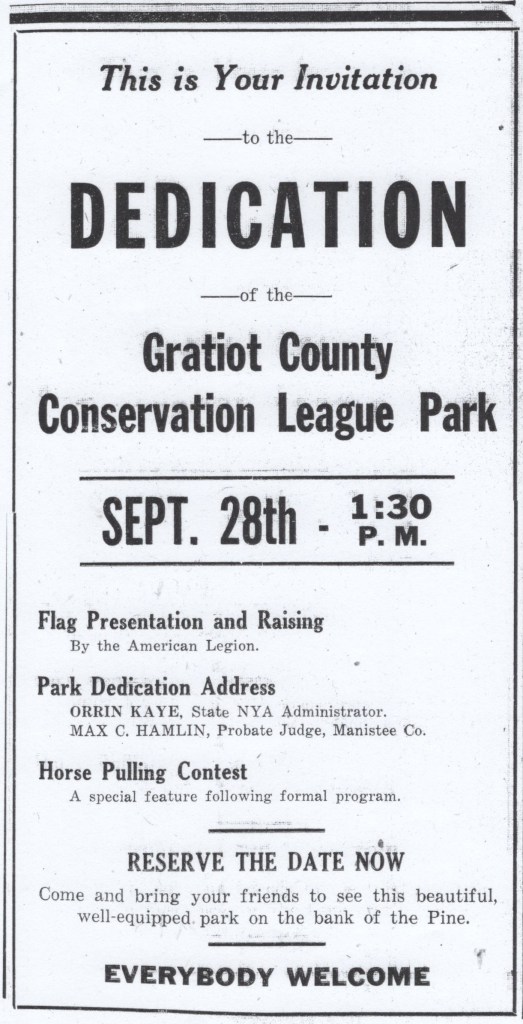
“Lightning hit me in Gratiot County!” Thirty Years of Deaths, Disasters, and Destruction, 1896-1926

Above: August 14, 1913, headline from the Gratiot County Herald; in 1915, A.M. Derry & Son of Ashley sold lightning rods to interested farmers.

Some say lightning never strikes twice in the same place. Others do not worry about being hit at all. Unfortunately for many in Gratiot County’s past, death and destruction by lightning strikes were common and something to be feared.

 In 1913, Gratiot historian Willard Tucker cited over a dozen instances of lightning disasters in a book of the county’s history up until World War I. However, his short collection of lightning stories is only a small sample of the many stories that can be found later in twentieth-century Gratiot County.

 Tucker started his coverage with a terrible incident that took place in Elba Township in 1896, which claimed more than one victim. A young boy, Charles Hubbard, age 9, was working with his father in the family’s granary when a bolt of lightning hit Charles, killing him instantly. His father, Stephen Hubbard, was also hit by the same strike but eventually survived, in what was the first story of those who shared lightning strikes. It happened again five years later when Walter Price and John Cumberworth both died on the Roy Cumberworth farm near Ithaca on July 5, 1901. In that case, Roy Cumberworth, who was standing near the other two men, somehow avoided being hit by the same bolt of lightning.

Records show that houses in towns and villages were sometimes hit. Sol Eicher’s house on St. John Street in Ithaca was struck by a tremendous lightning bolt, which Eicher and his wife barely escaped in August 1912. That night, Eicher awoke thinking he had heard a loud noise outside his window, got up, looked outside, saw nothing, and then returned to bed. Another loud crash soon occurred, and this time he awoke to find his bed covered in plaster, a result of the entire ceiling and side walls of the bedroom falling on him and his wife. Upon going outside, Eicher saw that a lightning strike had stripped the siding twelve feet down the side of the house. Upon more inspection upstairs, Eicher found that two big holes could be seen above his bed as well as in the neighboring bedroom. As the family started cleaning up the mess, they ended up removing three bushels of plaster just from their daughter’s bedroom alone. Down below the upstairs windows,  the Eichers saw that the porch floor had been split in two.

There are stories of other homes that were also hit by lightning. William Carroll in northeast Seville Township had the top of his chimney and shingles torn off his roof in March 1904. Carroll had just stepped onto his porch after returning from the barn with a lantern after returning from the barn when the force of a strike nearly threw him to the ground. Still, Carroll survived. In November 1924, the DeArmond home, located at 136 Allen Street in Alma, was struck by a bolt of lightning that entered through an open window and then started a fire. Luckily, the entire family was on the ground floor when the incident happened, and DeArmond activated the fire alarm. On the way to the house, the fire truck en route stopped at South Woodworth Avenue for a train when a Chevrolet Coupe driven by Earl Clapp hit the back end of the fire truck. No one was seriously injured, and firefighters safely arrived and extinguished the fire.

Across Gratiot County, there might be no limit to the number of barns struck during a lightning storm. A terrible storm lasting nearly twenty-four hours in August 1913 struck over a dozen barns across the county. During the ordeal, E.A. Stowe of Forrest Hill lost his barn and ninety tons of hay worth $1500. Almost all of the barns or homes hit in this storm were total losses, and the Gratiot County Herald estimated that lightning caused at least $50,000 worth of damage. A year later, in late August 1914, lightning storms covering two successive nights destroyed another six barns in the county.

In most cases,  Gratiot farmers lacked sufficient insurance to cover the full damage to their property, while many farmers often had no insurance at all. In one instance, William Holliday and his wife from Alma wintered in Kalkaska in April 1905. They prepared to return to their summer home near Alma just before it was hit by lightning. A neighbor who witnessed the strike attempted to salvage some of the things inside. Still, the fire was too intense and resulted in a total loss as it had no insurance coverage. James Greenlee, near North Star in 1925, lost $4,700 in a fire caused by lightning from his 40×70 barn, which contained farm tools, wagons, straw, shovels, hoes, and cultivators. Luckily, Greenlee had let all of the livestock out of the barn earlier that night, or he might have lost them as well. His insurance covered $3,000 for losses, more than most farmers had at that time.

The result of a lightning strike often left tremendous physical damage, especially for livestock. A.K. Overmeyer of Emerson (Beebe) was able to get his two horses and buggy out of his barn after a strike in June 1913. Still, he lost all of his harnesses and 65 chickens. He received $362 in insurance claims, but it would not cover all of his losses. In July 1923, several county farmers experienced significant personal losses from lightning strikes. A 6:00 a.m. storm caused a fire on the Kinney farm near Ithaca, which quickly went up in flames. The family watched as their barn and a shed burned, which housed a cow and calf, as well as several farm implements, and four tons of hay. All of it quickly went up in flames. Sadly, insurance only covered half their damages. Clarence Shields of Emerson noticed that his horses and cows were acting strangely after the same storm. He then figured out that two of the horses were now deaf. It was not uncommon for other Gratiot lightning strikes to leave farm animals severely burned, blind, or deaf if they had been standing near a lightning strike.

Encounters with lightning sometimes created almost unbelievable stories in the newspapers. William Gephart of Breckenridge was struck and killed in July 1913 when he returned home from a day on the Pine River. While one and a half miles north of Wheeler, he headed to the Chase residence to take cover from the approaching storm. Gephart hitched the horse in the barn, stepped to the buggy to get a rubber blanket to cover the lunch basket, and then was hit by lightning. Strangely, Gephart had no visible marks on his body, just a torn hat and shirt. A Mexican migrant worker, Ysac Rojo, was killed by lightning, and another worker was seriously injured in Fulton Township in July 1926. Rojo and his brother made the mistake of taking shelter under a tree during a storm on the R. C. Blank farm when lightning struck the tree. The strike then burned a hole through Ysac Rojo’s cap, shattered his shoes, but left the rest of his body unmarked. Joe Rojo, who survived, was taken to St. John’s Hospital after suffering severe burns.

Some places in Gratiot County were hit twice by lightning. Ellsworth Wright’s barn near Breckendridge was destroyed in July 1924 for the second time in five years. In both cases, Wright’s barn burned to the ground, and the second time, he lost all of his barn’s contents. Another Breckenridge farmer, Frank Oberst, suffered $7,000 in damages from an August 1925 lightning strike. During the storm, a tenant on the Oberst farm was able to rescue Oberst’s Durham cattle and horses out of the barn. This second barn, measuring 40 feet by 84 feet, had a cement floor with a basement. Unfortunately for Oberst, insurance only covered part of the second loss. In a strange twist, Oberst lost his first barn on the same spot two years earlier.

A Gratiot farmer’s defense against lightning strikes was to buy lightning rods and insurance from county agents, such as W.H. Tenney of St. Louis. Just before World War I, Tenney sold lightning rods made of 98 percent pure copper, which came with patent curved brackets. H.J. Zubler of Breckenridge also sold U.S. Government Lightning Rods, claiming, “If these rods were good enough for government buildings, they ought to be able to fill the bill for you. (The) Same make of rods are used on Gratiot County Farm Buildings.” In March 1915, A.M. Derry and Son of Ashley sold lightning rods and advertised that “Now is a good time to come in and get an estimate, before spring work commences. We sell them—and guarantee the best price.” In the 1920s, businesses like Boothe and Binger of North Star also advertised the sale of lightning rods. They handled 18-gauge, 32-strand cable rods.

About twenty years ago, I visited my paternal grandmother’s last surviving sibling, who still lived on the old Bliss family farm west of Ithaca in Newark Township. As I spoke with my great-uncle about family history, he pointed out the lightning rods and insulators that sat overhead above his porch, then the trio of lightning rods that appeared on the top of the old barn. Aaron Bliss smiled about how some local antique collector with an eye for old lightning rods and insulators had stopped more than once to encourage him to sell off the rods. My uncle only smiled, suggesting that he was happy to keep and trust the devices that had probably spared the Bliss family’s home and barn from hard Gratiot County lightning storms for many decades.

Copyright 2025 James M. Goodspeed
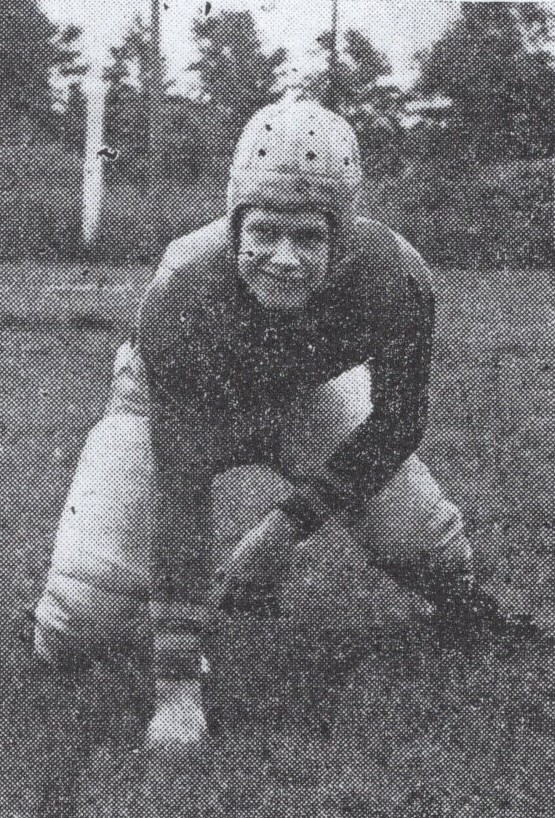
Gratiot County in Depression and War: “The Good Old Summer Time in July 1940″

From top to bottom: Doctor G.V. Barrow of Ann Arbor works on one of his patients during the Gratiot County free dental clinic in Ithaca. Barrow treated eighteen cases each day for several weeks. The clinic then moved to Alma and concluded in St. Louis; this FFA showmanship event at the Gratiot County Fair featured stock raised by young future farmers from Gratiot; meanwhile, the Battle of Britain was in full swing in Europe. Could England survive Hitler’s bombings?; would President Franklin D. Roosevelt be nominated for a third term as President? The Democratic Convention in Chicago soon revealed that the President would indeed accept a run again for a third term.

The late spring and summer of 1940 proved to be cooler and wetter than many residents in Gratiot County wished. Newspapers warned readers that the war in Europe could soon escalate into a global conflict. Across Gratiot County, Depression-era programs continued to operate, providing respite, entertainment, and activities for both children and adults.

People could enjoy the isolation of quiet country towns, villages, and hamlets.

It was July 1940 in Gratiot County.

The World at War

Gratiot residents began reading about a potentially growing global conflict. A group of 30,000 United States troops was now placed on high alert in the Panama Canal Zone. Bombing raids by Hitler’s Luftwaffe upon Britain became known as “The Blitz.” Maps illustrated the time and distance it took to fly German bombers from their bases to targets in England. Then, there were maps illustrating how Americans, Soviets, and the Japanese all had potential areas of conflict in the Pacific. Would there soon be a “Pacific War” involving the United States? In all of this, most Americans seemed to forget that the Japanese Empire had been at war in places like China since 1937.

Here in Gratiot County, the Red Cross said that it needed only $400 to reach its goal for the War Relief Fund. They hoped to raise the balance to $1,920 by July 10. Twenty-two Michigan communities in southern Michigan agreed that military education for high and junior high school students was beneficial and necessary. The government hoped that between 10,000 and 15,000 defense workers would receive training in this way. The only question was what kind of training to provide and how far it should extend. Some, like Professor Howard McLusky from Michigan, argued that a long ideological fight involving dictatorships and democracies would soon start, and courses in high schools should prepare students for it. State Superintendent Dr. Eugene B. Elliott argued that Michigan schools had to prepare students with both strong minds and strong bodies; however, he failed to mention that he believed the United States would be directly involved in a war.

The issue of a third term in the White House arose in newspapers regarding President Franklin D. Roosevelt’s status at the Democratic Convention in Chicago. Keynote speaker Senator Alben Barkley spoke on behalf of Roosevelt and stated that the President had declared all delegates free to vote for the Democratic candidate of their choice. Still, the President did not say he would refuse a renomination. As a result, newspapers ran the headline “Way to Third Term Cleared by Roosevelt.” Within a week, FDR accepted the renomination and left the issue of a third term up to the voters.

Over at Ithaca, a hefty call for copies of birth certificates nearly swamped the county clerk’s office. Why? Numerous Gratiot residents needed them to demonstrate their citizenship status to work in plants supplying materials to Britain, as well as for anticipated home defense needs. Requests for birth certificates were received in Ithaca by phone, in person, registered mail, and air mail. Birth certificates were also necessary for those traveling to Canada for vacation or fishing. These certificates cost fifty cents each.

Depression Life, July 1940

The Gratiot County supervisors okayed the move of the county welfare office from Alma to the basement of the courthouse in Ithaca. Part of the reason for the move was a cost-saving measure that eliminated the need to rent space. The final move was contingent upon state approval.

The terms “recreation” and “recreation programs” gained a lot of attention in Alma for Turck’s Beach, and places across town where miniature golf, tennis, playgrounds, wading pools, as well as boys’ and girls’ softball and baseball all took place. There were also activities such as handicrafts, dancing, and an interest in archery. These activities took place across Alma in various locations, including Wright Park, Alma High School, some elementary schools, and the basement of the Salvation Army. The month of July, usually hot and steamy in Gratiot County, soon turned unseasonably cold and wet, thus dampening some of the swimming at Turck’s Beach. Despite the cooler weather, a large crowd gathered at the beach to enjoy a swimming show and water carnival, as well as demonstrations on how to operate a canoe and perform a rescue from drowning. Bill Moody, the head lifeguard, conducted some of the performances. At the same time, Dr. W.E. MacInnes gave a brief talk about Red Cross safety. A second water carnival was planned for early August at Turck’s Beach. Many of those who worked at these places that offered recreation had NYA workers or were tied to NYA projects.

Are you older and concerned about your finances in old age? Attend a Townsend Club meeting in the county. Townsend Club Number 2 held meetings every Monday at the Ithaca village hall. Doctor Townsend himself appeared on the front pages of local newspapers under “Doctor Townsend Says…”. Townsend billed his old age pension plan as “a movement to unite the peoples of the earth in one great brotherhood” – and ensure that every older American received an old age pension.

WPA work continued on the 1939 paving project, even though it was the summer of 1940. A crew of 65 men built new curves and gutters on streets where they paved last year. The project poured a slab on three blocks of River Avenue, then planned to move on to shorter works on Walnut, Euclid, Allen, and Orchard streets. Work was progressing more slowly in July, according to City Manager W.E. Reynolds, because in 1939, he had between 90 and 130 men working on projects. Now, regulations lowered the number to only 50 workers. Alma petitioned for an additional fifteen blocks for paving. Still, the city had not yet received approval from the federal government.

Migrant Workers, Weather, Fair in July

A reasonably large turnout was observed at Alma’s Washington School for the county’s migrant school open house held at the end of June. Almost one hundred visitors came to the open house on a Thursday night. Following this program, another 126 Mexican workers and their children attended the program’s first Family Night. Migrant center workers from Mt. Pleasant and Kenton, Ohio, joined with the Alma staff to discuss work in their respective centers. The Alma school officially enrolled up to 100 children in woodcraft, English, citizenship, table manners, and singing. This group also included sixteen toddlers and babies. By the end of July, the numbers dropped to 55 children as migrant families moved on to other work in the state. Gertrud Herman,  Merle Farnie, and Grace Rowell lead the programs at the center. Rowell, accompanied by Reverends Drake and Moreno, took a group of the older migrant children to the Gratiot County Fair to see the rodeo. A field day was also held for the older children from Alma and the Mt. Pleasant centers before the centers’ closing. The center held its final Family Night on July 25, marking the end of the program. By the time the Alma Center closed, over 400 visitors from across the state of Michigan came to Alma to see how the Washington School’s migrant center worked with children, and many migrant mothers hoped that Alma would open another program like this in 1941. This migrant center was the first such project supported by the Gratiot County Council of Churches and the Council of Women for Home Missions.

Gratiot County’s weather continued to challenge area farmers that summer. A cold and wet late spring had crops lagging during planting season, while hay, oats, wheat, and barley were unusually heavy due to the rains. A warmer July was allowing crops to start catching up, but many appeared to be below average and needed a warm late summer and an extended growing season. More Gratiot farmers planted soybeans, but the increase was not as significant as in other parts of the state. And then came a classic Gratiot cloudburst on July 8, which flooded a large section of Emerson Township. The storm affected an area in Emerson Township that measured 2 ½ miles north and south and 5 miles east and west, and it was hit with heavy winds. The Riley Aldrich farm was completely submerged in water, as were the farms of other farmers in the area. Aldrich’s grandson appeared in a Gratiot County Herald photograph with water standing halfway up his boots.

Many farm families not affected by the storm later requested help from the Gratiot Road Commission to spread spot oil in front of their homes and down their roads to deal with the dust. Farmers paid one cent per square yard, and the final cost depended upon how many times the road was oiled.

Visiting the 75th annual Graiot County Fair in Ithaca was a highlight of summer and took place from July 23 to 27. Before opening the fair, officials installed a new automatic starting system for horse racing, which would take place over four days of the fair. The fair featured the most extensive 4-H exhibits, the C.R. Ranch rodeo, Roman chariot races, horse pulling, and a large midway. Children’s Day on July 23 offered free admission to children under the age of twelve, and rides cost only a nickel.

In other news, the Farm Security Administration announced the expansion of the Farm Tenant program in Gratiot County. This program allowed former farm tenants to buy their farms under government long-term contracts. Tenant farmers were encouraged to apply to the program. Need to dip sheep? A sheep dipping demonstration took place on the Paul Burnham farm in Bethany Township and Max Church’s farm in Arcada. County Agent C.P. Milham asked Gratiot farmers to declare war on sow thistles, urging them to seek out and destroy the plants. Sow thistles grew to three feet in height, and had yellow blossoms like dandelions, which could smother a crop due to their dense mat of leaves.

The Long Arm of the Law in July 1940

The Fourth of July weekend in the county was rough on several drivers. Overall, a total of six traffic accidents injured seven people and claimed one life. Franklin Kunkel, age 22, of Riverdale, was killed in an accident when his Ford roadster crashed into another car near the Honeyoye Bridge, miles west of Alma. Kunkel tried to pass another vehicle before entering the bridge, then went off the road after striking another car. Instances of drunkenness made their way to court as a group of people from Owosso were arrested east of Alma for drunk driving. A familiar sight in Alma, Frank (Frenchy) LaBart returned to Alma after eight years. LaBart managed to bang up several cars in front of the Kroger Store while trying to park his vehicle. He was charged with drunk driving and served 45 days in jail rather than pay $56 in fines. Lillian Berted, age 29 of Alma, was arrested in Breckenridge for public drunkenness. Although initially pleading not guilty, she later changed her plea and paid a fine of $13. R.L. Lalonde of Ithaca received a fine and costs of $28.85 for driving wildly past a WPA flagman and road workers south of Alma. Lalonde was cited for reckless driving.

 Leo Gusman, a Mexican from Eaton Rapids, was arrested for driving without a license. Gusman’s penalty was paying $12.30, and he still had to spend five days in jail. Howard Sparks from Clinton County was arrested for illegally selling fireworks. He paid $16.45 rather than go to jail. Jenasio Mejia, “an Alma Mexican,” was arrested near the Michigan Sugar Company factory for carrying a concealed weapon. He was held in the county jail for having a loaded revolver and six extra shells. Someone, an itinerant peddler in Alma, was passing forged checks in Alma on behalf of Parke, Davis, and Company of Detroit. The forger had already passed one in Clare for $15.00. Be on the lookout for the crook. Two beet workers, Steve Grusky and Stanley Druska, got into a heated battle just south of Bannister. Both were arrested and hauled off to jail. In late July, Otto Morro, St. Louis street commissioner, announced that the first crop of wild marihuana in town had been located in an alley between North and Center streets. A citizen identified the plants and reported them to the authorities.

In some other instances that involved calling for the police, an 18-year-old girl in Alma jumped off the Superior Street Bridge just after midnight on July 17. Thankfully, the water was only four feet deep, but the fifteen-foot drop did more damage. She later admitted that she wanted to take her own life after parting with her male escort. Still, a sister arrived at the police station and escorted the jumper home the next day. In another tragedy, the first drowning of the summer took place at the Washington Township gravel pit, just east of the B-Z-B gas station. Herman Wallen of Perrinton, age 22, was probably killed after diving into the bottom, as a cut on the head suggested he had hit bottom; possibly he also suffered an epileptic seizure. Wallen was considered an excellent swimmer.

Another story in the Dewey Glinkie case appeared in local newspapers. Ginkie, who had stolen over $3,000 in county funds several months earlier, was in the news as Sheriff William Nestle traced a lead to Canandaigua, New York, where someone found Ginkie’s Social Security card and notebook in a mailbox. The card had been issued in Ohio, and the notebook contained Glinkie’s handwriting. Yet, the collection of notes failed to specifically tell who was helping Glinkie or who knew of his whereabouts. Before this, Glinkie had connections to Port Huron and Detroit. So, the hunt for Dewey Glinkie continued.

The county got excited when former county prosecutor Ora L. Smith announced that he was running for the Michigan Republican gubernatorial nomination for the 1940 election. Smith formally announced his candidacy on the radio station WJR in Ithaca. Several parades took place in the county to honor and support Smith. In other court news, Kelly S. Searl, a circuit court judge, began his 26th year as a judge in Ithaca. The Alma City Commission denied the use of its tourist park for house trailers. The city only charged $1.50 per week for short stays or 25 cents per day. The commission was concerned that long-term occupancy by house trailers would run up the cost of electricity and turn the area into a “trailer park.” Currently, there are 75 to 100 families or groups in Alma living in trailers.

Gratiot County Health Matters

A pair of Gratiot County residents, Vere Allen (Arcada Township) and Ruth Johnson (St. Louis), each suffered bites from their dogs. Both animals were euthanized, and their heads were sent to Lansing for rabies testing. Thirteen-year-old Anna Macey of Alma was also bitten on her thigh while riding her bike near the Wright Hotel. Police impounded the dog for observation for ten days due to concerns of rabies. The county sheriff was increasingly concerned that residents were becoming more careless about letting their animals roam rather than being quarantined. In St. Louis, many residents complained about the number of running dogs in town. Doctor D.K. Barstow warned residents that the only way to be safe from rabies was to get their dog(s) vaccinated. For those who resorted to only leashing or penning their dogs, Barstow reminded them that a leash could not keep another rabid animal from biting the family pet. Rabies vaccinations were good for a year. A statewide quarantine had been in place for 47 counties since April. During the first three months of the quarantine, County Dog Warden Howard Evitts of Pompeii announced that 160 dogs had been euthanized in Gratiot County so far.

Better health news came from the news of lower TB death rates in Gratiot County. A report showed that eight people died of TB in 1938 and seven in 1939. Vera Karajoff of Alma had to be admitted to Smith Memorial Hospital for a serious injury to her ankle. Initially, a fracture was a concern; however, Karajoff only had a severe sprain. How she did it was not reported. Charles Federspiel was released from Smith after an X-ray check-up on his fractured left arm. Federspiel broke his arm in a jumping incident. In sad news, in Ashley, grocery store owner Clarence Duprey, age 46, took his own life. He left a wife and three daughters. Newspapers listed no cause for the death.

The Gratiot County free dental clinic entered its third week in July. Dr. G. V. Barrow of Ann Arbor saw an average of eighteen cases each day in Ithaca. The clinic soon planned to move on to Alma and then to St. Louis. Approximately 400 young people received dental care in Ithaca alone from the clinic.

And So We Do Not Forget

The new C.S.A. Hall in St. Louis planned a two-day celebration for its dedication with a grand opening. A Grand March from the Park Hotel to the hall on Michigan Avenue kicked off the activities on Saturday, July 6…Notices for the upcoming performances on the Chesaning Showboat appeared in local newspapers. A cast of 125 performers, along with Jimmy Raschel’s Band, planned two-hour shows from July 11 to July 14 in Chesaning…Jean Arthur and Fred Mac Murray appeared in “Too Many Husbands” at the Ideal Theatre in Ithaca on July 4 for a one-night show. Roy Rogers appeared July 5-6 in “The Days of Jesse James.” Tickets were ten cents for matinees…The Saginaw Black Socks edged the Ithaca Independents by the score of 2-0 in a special Sunday game in Ithaca. North Star defeated the Balmoral Indians by a 7-0 score…Cupid’s victims included Marvin Neal, age 22, of Alma, and Narlene Tracy, age 19, also of Alma. Good luck to the newlywed.

Mrs. Clifford Brewer of St. Louis became the new Central Michigan women’s golf champion at Clare. Brewer defeated two previous champions on her way to the title…Vera Patterson of Ithaca set a new ladies’ golf record at the Gratiot Country Club by turning in a 37 on nine holes. Muriel Pettit held the previous record with a 39…A Reverend F.R. Davidson petitioned the Alma City Commission to set up a portable tabernacle of Masonite pressed wood for religious services in Alma. Davidson represented the General Council of the Assembly of God…The Gratiot County Board of Supervisors adopted a resolution allowing the closing of county offices and the driver’s license examination bureau in the courthouse on Saturdays. While some offices in the courthouse had previously been closed during a slow summer season, the supervisors stated that some offices could remain open on Saturdays as needed in the future…George Stewart, J.C. Penney’s manager, took a two-week vacation to spend time with family on Crystal Lake…More new paint jobs in Alma included work on Wilkins’ Economy Market, Reed’s Popular Priced store, and Gay’s 5 & 10c store.

Sidney Toler and Marjorie Weaver starred in “Charlie Chan’s Murder Cruise” on July 7-8 at the Alma Theatre. Tickets were ten and fifteen cents…The Alma Chamber of Commerce announced an outline for the program and activities for the 1940 Harvest Jubilee in late August…Former employees of the Alma Republic Truck Company planned to hold a reunion on July 27-28 in Conservation Park in Alma. A total of 1,313 letters were sent to former employees in 23 different states, inviting them to the reunion. This reunion would be the third such one held in Alma…Buy a new single-wall washing machine at Walker’s Electric Shop for only $39.50. A double-wall machine only costs ten dollars more.

Finally, over at St. Louis, a balloon ascension and jumper captivated the city on a Saturday night. The St. Louis Trade Association sponsored the event on July 6. Large crowds turned out to watch the balloon, put together by the Winkler Brothers of Lansing, fill with hot air next to the newly erected bandstand. After it filled with enough air to allow it to tower above all the buildings in St. Louis, it began to rise skyward and headed northeast. Many feared the jumper would end up in the Pine River. However, after reaching its maximum height, the jumper bailed out. It deployed two parachutes, the second of which was decorated in red and blue. How did it end? The jumper found himself in a cornfield just north of the city. The balloon ascension was just one of a series of regular Saturday night programs created by the St. Louis Trade Association that summer.

And that was Depression and War in Gratiot County in July 1940.

Copyright 2025 James M Goodspeed

Gratiot County in Depression and War, June 1940: “Summer is Coming, and so is War”

News and life in Gratiot County during June 1940 (from the top): The cartoon “Smoke” implies what many in Gratiot County began to realize – war was coming and the nation needed to prepare; James and Billie Vanderbeek of Pine River Township show off their proud “mama” and her quadruplets; unidentified Boy Scouts take in a “Camporee” at Ithaca’s Woodland Park; there was nothing like a Sunday county league baseball game in St. Louis – which one could see for only a quarter.

As Gratiot County slowly warmed up to another summer, events in Europe exploded as Nazi Germany invaded and conquered much of Western Europe.

Life in the United States began to slowly drift toward war as President Roosevelt developed plans that included large munitions plants as well as training young people for a potential national emergency.

Still, one could appreciate small-town life. How many believed that a world war in Europe could affect places like Ithaca, Alma, St. Louis, or Breckenridge?

It was June 1940 in Gratiot County.

The War in Europe in June 1940

Troubling news about the Nazi conquest of Western Europe appeared on the front pages of county newspapers. German troops crossed the Marne in France, and the nation’s collapse and surrender seemed imminent, with the outcome seemingly only a matter of days. In addition, Italy joined the war on the side of Nazi Germany and Mussolini announced Italy’s rights to Corsica, Malta, Tunisia and the Suez Canal.

In response to the events in Europe, President Roosevelt announced a draft plan to mobilize an estimated 7.5 million young men and women for noncombatant training. The President emphasized the need to train young people in “general disciplinary courses” in anticipation of a national emergency. Unlimited quotas for Army recruits were being accepted at Camp Ord, California, and Fort Lewis, Washington. Recruiters in Lansing were now available for any in Gratiot County who desired to volunteer. President Roosevelt also recommended a chain of government munitions plants across the country. The nation took another step toward preparing for war by examining thirty sites, which cost $376,000,000.

Locally, the war began to have a gradual impact on local people. Captain C.H. Reed, who operated a local fuel business in Alma, was called to active duty with the Army at Fort Brady, Sault Ste. Marie. Reed had previously supervised several CCC camps in the state. Approximately sixty members of the Troop B, 106th Cavalry of Alma, prepared to go to Wisconsin in August for 21 days of training. Before this date, the group had never trained for more than 15 days in the summer. Second Lieutenant Frank W. Iseman, an Ithaca High School graduate and a graduate of West Point, continued his training in the Air Corps Flying School. Iseman would ultimately serve as the director of operations of the 502nd Bombardment Group in the Pacific. A former Gratiot County youth, John C. Seipp of Fulton Township, passed the entrance exam to the United States Naval Academy at Annapolis, Maryland. After his family moved to Lansing, he attended Lansing Eastern High School. The Gratiot County Red Cross announced that the county reached the unit’s goal of raising $1,920 to help refugees during the war.

The Gratiot County Herald ran a very long editorial entitled “What Hitlerism Means.” The editor attempted to educate Gratiot County residents about how this war would be different from previous wars in history. It warned that Hitler would not settle for a few territories but was bent on European and, ultimately, world domination by Nazi Germany. What happened with the collapse and fall of France stood as a warning to the world that this would not be a short European war unless more countries capitulated to Adolf Hitler.

Many Social Program Activities in June 1940

June brought opportunities for New Deal programs that affected many in Gratiot County. At least three New Deal social programs collaborated to provide opportunities for children, young people, and adults to stay engaged and occupied during the late stages of the Great Depression.

Several WPA workers volunteered to help pour a concrete floor in the shelter house at Conservation League Park. After completing the 30×50-foot floor, all of these workers received a free yearly membership in the Conservation League. The shelter house encouraged more people from Gratiot to use the park for walking, picnicking, and other recreational activities.

With the warm summer weather, many young people traveled to Turck’s Beach in Alma to go swimming. The number of swimmers necessitated a program and its oversight. Both the NRA and WPA provided a total of 35 workers to watch swimmers and oversee the beach house. Over 200 swimmers turned out for the first swimming lessons at the beach. Thirty youngsters also expressed interest in participating in the new canoeing program. The main reason for the need for so many workers centered around the fact that the program, like others in the New Deal, only paid them for part-time work. Bill Moody was in charge of supervising the beach area, assisted by Bud Stearns, Don Martin, Jim Sebring, and Robert Parks. Two large towers went up on the beach so that lifeguards could watch all of the swimmers. Three wading pools were also constructed for young children on Michigan Avenue, in Wright Park, and near Hillcrest School. This type of pool also allowed families with young children to find a spot to cool off without having to go to the beach.

 In addition to Turck’s Beach, in Alma, 50 boys and 80 girls wanted to participate in a softball league. Another 40 boys, aged 15 to 17, wished to participate in a baseball league. That organization came under the direction of the NYA.

 More boys and girls in St. Louis also wanted their own recreation programs. Elliot Oldt started a program at Wheeler Field where boys and girls played a variety of sports on the field, including horseshoe pitching, badminton, softball, boxing, and croquet, among others. Ruth Walker supervised the activities for those under the age of eleven. One of the nicest draws in St. Louis now centered around new tennis courts. Tennis courts became so popular that Alma had six new courts constructed through the Wright Park improvement plan, which the WPA funded. The plan also called for new shuffleboard courts.

For young women not interested in athletics, the NYA planned a homemakers’ training school, which would accommodate up to twenty girls. They would be hired to learn food preparation, home management, laundry work, budgeting, and sewing. The NYA would pay the wages for these women. At least four other programs like this existed in the state of Michigan. Due to the numerous programs in the Alma area, the WPA recreation director, Darrell Milstead, was granted his own office in Alma City Hall.

Out on the streets of Alma, the WPA continued work on the 1939 paving project. The city believed it would soon be completed, as 20 new WPA workers would be coming to Alma, which meant potentially having as many as 70 WPA men working on Alma’s streets.

In other Depression-related news, Ithaca Townsend Club Number 1 met at the Masonic Hall and planned to show a movie in Woodland Park. Progressive Townsend Club Number 2 held its monthly meeting at the village hall. Because the Texaco gas station and Hanssen Grocery on East Center both had Townsend trade cards, members were encouraged to visit those businesses. The Townsend program was an alternate pension plan for the elderly, which commanded a very popular message to many in Gratiot County. Two Alma men, David Gerhard, Consumers Power Company manager, and H. S. Babcock, Alma Record publisher, went to the dedication of the new seven-million-dollar plant on Saginaw Bay. The featured speaker for the program was Wendell Willkie, who would soon be the Republican nominee for President in 1940. Boys between the ages of 17 and 24 could apply for enrollment in the Civilian Conservation Corps. Visit the Gratiot County Department of Social Welfare office located at 614 East Superior Street in Alma.

The Long Arm of the Law in Gratiot County

Some law officers thought Gratiot experienced fewer court appearances during June, and the jail count supported this notion. At one point, only three people were in the county jail, which had a capacity of up to twenty-two. Still, traffic violations generated the most revenue in terms of fines, totaling $466.84.

 James Vlasich was bound over to appear in the circuit court for intent to commit significant bodily harm to his mother. John Hagen of St. Louis was in trouble for driving his car on the sidewalk in St. Louis. Most of the others making appearances did so for drunk driving, like Stanley Furly, an oil pumper in the Porter oil field. He received sixty days of jail time and a $59.35 fine. And then there was the familiar face of Cornelius W. Eichorn of Emerson Township. Eichorn was picked up for reckless driving east of St. Louis this time and had no driver’s license. Eichorn was developing a habit of not driving safely. He was released on a $100 bond. In another strange case, Marvin Cooper of Arcada Township confessed to driving his tractor over three blocks of newly surfaced blacktop in Ithaca. The tractor’s lugs did much damage to the surface.

Claud Offill, formerly of Elm Hall, lost his appeal from a 1929 sentencing for assaulting Deputy Sheriff Ray Helman. Offill shot Helman twice and was on the run for twelve hours before being caught. He received a ten- to twenty-year sentence at Jackson State Prison and was now in the eleventh year of his sentence. Offill claimed his confession of assault and battery of his wife was coerced, but the high court rejected Offill’s argument. He stayed in prison.

In other news, Alma, James Campbell, Chief of Police, warned residents to stop disregarding parking tickets, which would now result in formal complaints in court. Those citizens who paid their dog taxes before the June 1 deadline brought in $2,045 in May. Howard Evitts of Pompeii, the county dog warden, would be out collecting delinquent dog taxes for those who had not paid. The Alma police department announced they were reducing their force to four officers upon the retirement of Patrolman Gus Herron. Herron, 72, served Alma for 21 years. Mildred Taft announced that she was running for probate judge. This position oversaw a team of 21 individuals who process naturalization applications in Gratiot County.

And among the last of the news was the name of a new drug that appeared in Gratiot County – “marihuana weed.” The Michigan State Police issued warnings about this new drug in mid-Michigan, and it was now a federal offense for growing, possessing, selling, purchasing, or transporting Marihuana. Police also said continuous smoking of it would lead to insanity. In the wild, the drug grew to a maximum height of 3 to 6 feet. The police also warned Sunday drivers, Boy Scouts and Girl Scouts, hikers, and farmers to be on the lookout for the illegal weed.

Health Issues and Events

To start a new dental parlor in Alma, R.B. Davies planned to open his office in his mother’s home on 226 North State Street. Davies, an Alma High School, Alma College, and the University of Michigan Department of Dentistry, returned home with good references and an eagerness to serve his patients. A twelve-week free dental clinic came to Gratiot County, sponsored by the James Couzin’s Fund of Michigan (also called The Children’s Fund of Michigan). Parents of children under sixteen who are in need received letters inviting them to receive free treatment. The clinic would be in Ithaca for five weeks, then move to Alma for four weeks, and end in St. Louis after a three-week stay. The first free dental clinic in the county was established in 1937.

William Kinney, age 57, of Arcada Township, took his own life with a shotgun. He had faced poor health and despondency due to his inability to work in his trade as a paper hanger and painter. Before he passed, he claimed to be shooting a crow, but coroner G.V. Wright disagreed. Kinney left behind his widow and two children.

Chase Farrar of Route 3, Alma, went to Smith Memorial Hospital for treatment of a gunshot wound in his left forearm. Farrar was wounded while driving a tractor and had been hit from a long distance. Robert Hinderline of Alma reported that his son had been admitted to Smith for treatment for severe burns. The young Hinderline was thought to have played with firecrackers, but the culprit was a dynamite cap from a friend’s car. The boy received heavy burns around his lips and left hand when the cap exploded. Karl Wigglesworth of Breckenridge survived electrocution from a 4800-volt line on a telephone pole near Sickles. He and another Consumers Power Employee, Leland Helfer of Ithaca, were working on the line when Wigglesworth accidentally touched a hot stick and took the jolt with his left hand and right hip, which rested on a service wire. Thankfully, the cool work of fellow worker Helfer helped free him. Wigglesworth was in Smith Memorial Hospital with a burned left hand and right hip, but survived the ordeal.

St. Louis city residents received another notice, reminding them that they had until July 1 to have their noxious weeds cut. Those who failed to cut their weeds would have the city highway crew do it, and the cost would be charged to their city taxes. Heavy June rains left many properties and vacant lots full of weeds.

Dr. Georgia V. Mills delivered a health lecture at St. Louis High School titled “Preventing Communicable Diseases.” Topics included the spread of contagious diseases, quarantines, vaccination, and the danger of tuberculosis. The St. Louis Child Study Club and the Michigan Department of Health sponsored Mills.

Farming & Outdoors in June 1940

Weeds, bugs, and fungi all grew well during June as the onslaught of cool, wet weather brought an abundance of all three to Gratiot County. Gratiot County agricultural agent C.P. Milham noted that some of the growth in the fields resulted from some farmers who used nitrogen fertilizer. Heavier soils in the county needed straight phosphate, while those planting grains needed a potash combination fertilizer.

Sheep dipping continued across parts of Gratiot County. A new portable dipping rig allowed participating farmers to treat 7,000 sheep and lambs thus far. One of the sites to be included in the upcoming weeks is Milton Snyder’s farm in Pompeii and C.K. Tuttle’s farm in Fulton Township. More farmers offered to host a sheep dipping session. Garl Vanderbeek of Pine River Township still had his quadruplet lambs, which were now almost two months old. While deliveries of quadruplet lambs were not extremely rare, having all four survive this far was. E.E. Stahl’s farm, six miles north of St. Louis, continued to welcome a strange visitor among his herd of cows. A small fawn regularly appeared among the cows, following the herd to pasture. The Stahl family could usually reach within a few feet of the small animal.

Bill Harper’s Hardware in Houserville had John Deere hay loaders for sale. The McCormick-Deering Store in Ithaca offered a smoker (demonstration) for its new harvester-thresher on June 18.

The Bailey family west of Pleasant Valley experienced a tragedy when young Dale Edward Bailey, age 15, died as a result of being pinned under a tractor. Young Bailey was plowing a field and did not return home for dinner that evening. His young sister went out to find Bailey and came upon the accident, which had the boy pinned face down between the fender and wheel of the overturned tractor. Death probably came from suffocation.

Four new 4-H clubs were organized in late June, bringing the county’s total to 20 and enrolling 212 members. The new clubs included the Good Luck Canners (in Ithaca), Pompeii Willing Workers, Happy Farmers Livestock and Crops Club (Ephert School), and Our Gang (Bannister).

In June, stricter enforcement of quarantine for dogs across the state led to a decrease in rabies cases. It also led to a reduction in dog attacks on livestock. In 1939, the state reported farmers suffered a loss of $125,000 in livestock. Most of the dogs in both questions were believed to be strays from towns and villages rather than those from farms.

Gratiot County prepared to open its first school for children of Mexican beet workers. Reverend Floyd Drake of Breckenridge, president of the Gratiot County Council of Churches and Schools, devised the idea and organized support for the school. The school planned to open in the abandoned Washington School in Alma. It would be under the direction of Gertrude Herman of Grand Rapids. She had three staff members who planned to host children aged four to fourteen, and a host of NYA (National Youth Administration) workers cleaned and prepared the building. The school planned to host up to one hundred students, and forty showed up on the first day. At the end of June, visitors from different out-of-state churches visited Alma to see the school; at least two were from New York. An open house invited Gratiot residents to view the program and facilities. 

Finally, in an attempt to get outdoors and enjoy a day fishing for trout on the Pine River, Don Lemon of Alma had a startling experience. While casting for fish, Lemon stepped on a large rattlesnake while walking on the bank. Lemon claimed the rattlesnake was as large around as his wrist, and he quickly changed locations to continue fishing.

And So We Do Not Forget

In Michigan Mid-State League Baseball, St. Louis Pure Oil played Alma Merchants on Sunday, June 9, at the St. Louis softball field. The admission cost was twenty-five cents…The St. Louis Trade Association sponsored its first Saturday night entertainment event, featuring a band concert by the St. Louis High School band. Herbert Saylor conducted the concert on a vacant lot on Mill Street…The Ithaca High School class of 1915 reunited on the school grounds in Ithaca on Saturday, June 22. Silas Partee invited all past members to attend along with their families, as this was the twenty-fifth anniversary of the reunion…The Ola Camp Meeting opened with Dr. Nathan Cohen Beskin, an evangelist and a Jewish convert to Christianity. Beskin was known nationally as an outstanding evangelist…Miss Mae Nelson offered piano and clarinet lessons in Ithaca for 75 cents a lesson. Contact Mrs. Mike Haley for more information…The Bannister area was shocked and saddened by the sudden death of young Esther Lillian Thomas. Thomas was only 14 years old and died just before her eighth-grade graduation. Esther had strong ties to her community, school, and church.

According to the recent census results, Gratiot County gained 2,429 people since 1930. A total of 35,938 people were recorded in the census, with Alma and St. Louis accounting for the majority of the increase. Elba Township lost fifty-five people, but Emerson Township only three…The Ithaca Masonic Lode prepared for the arrival of Dick Lewis, a 1913 Ithaca High School graduate who experienced success in the manufacturing field. Lewis planned to bring thirty-five entertainers for an evening program in Ithaca…Michigan Chemical Corporation planned to build a new brine well in the northwest corner of the Jake Wolford Farm just north of Oak Grove Cemetery…Spencer Tracy and Hedy Lamarr starred in “I Take This Woman” at the Ideal Theatre in Ithaca. All seats were only ten cents…The village of Ashley has lost a beloved citizen, Mrs. Emma Jane Duncan, who passed away at the age of 81. Her husband, a Civil War veteran, moved to Ashley in 1900. Many knew her for her willingness to help those who were sick and in distress. She also worked at the Ashley post office for six years…Alfred J. Fortino received his LLD degree from the University of Michigan. A 1933 Alma High School graduate, he attended and graduated from Alma College before pursuing his law degree…The Alma Chamber of Commerce has announced the committees for the upcoming Alma Harvest Jubilee, scheduled for August 22-23. Finance, entertainment, parade, and publicity committees all planned to go to work after the Fourth of July…A group of 150 Boy Scouts attended the annual Boy Scout Camporee at Ithaca’s Woodland Park. The camp operated for two days, and every four or more Scout patrols were required to provide their unit’s camping equipment. Some events included signaling, water boiling, and a flapjack contest.

Four St. Louis men purchased the Gratiot County bank building from owner H.J. Stroupe. St. Louis voters earlier turned down the idea of turning the building into the city hall. The new owners included W.V. Hess, Vere Nunn, Fred Tryon, and Ralph Goggin…Van’s Wallpaper, the Byerly store, and Almy’s Food Market in Alma all had new signs on their stores…Prepare for the opening of bass season by purchasing Shakespeare Famous Tackle at C.G. Larry Hardware in Ithaca – the Fisherman’s Headquarters…Tom Brown and Constance Moore starred in “Ma! He’s Making Eyes at Me” at the Alma Theatre. News, oddity, and comedy for only ten or fifteen cents on July 2-3…The Saginaw Black Socks came to Ithaca to play the Ithaca Independents at the Ithaca fairground on June 30 at 2:30 p.m…Skippy LaMore’s Comedians would be St. Louis for one week beginning July 1. The group planned to present seven plays in a beautiful tent theater for only ten cents…The Czechoslovak Society of America opened a new two-story building with a two-day dedication ceremony. Construction of the new hall began two years ago and measured sixty feet wide by eighty feet long…F.M. Vandercook celebrated his 90th birthday in St. Louis. Vandercook was a pioneer newspaperman who owned and operated different papers in St. Louis and Ithaca. He published the first daily paper in St. Louis in 1893…A Fourth of July celebration was scheduled for Lumberjack Park. This “old time celebration” featured patriotic addresses, the Breckenridge Community Band, hog calling, husband calling, and a free movie. One could even buy a chicken dinner from the camp cook, Mrs. C.A. Field.

Several Alma people traveled to Detroit to watch the Tigers defeat the Yankees. A group of eight led by James Kline, a meat cutter at Bert Hicks and Sons store, watched the close game. Others from Alma, like G.A. Giles, saw the Tigers take a doubleheader from the Athletics…Alma High School graduate Carl Shultz was assigned to play for the Union City, Tennessee, team in the Kitty League. The St. Louis Cardinals system signed Schultz…Earl Willert’s barbershop at 212 East Superior got an entirely new fluorescent lighting system courtesy of Everett Giles, electrician and Strand Theatre operator…Persistent rain forced the postponement of the Alma City Band’s opening concert. The group had twenty-five members…Miss Lois  Brainard, age 15 and a student at Alma High School, was selected in  “Alma’s Glamour Girl Contest.” Brainard reigned as queen over festivities for the Alma Lions Club production of the local movie, “We’re in the Movies Now.”  Margaret Atkinson finished second…Thompson’s in St. Louis advised customers to join their Blanket Club. Plan for winter – lay away a 72 by 90-inch virgin wool, moth-proofed blanket. A deposit of fifty cents and payments of only twenty-five cents a week got you the extra-large winter blanket…Gratiot’s leading naturalist, Parks Allen, wrote an article that described the different types of water birds he saw during a trip to East Tawas. Allen remarked that only three types of gulls could be found: the herring, long-billed, and Bonaparte’s gull… The Balmoral Indians defeated Shell Oil by a score of 7-4 in the season’s opening game in Ithaca.

Turck Beach in Alma is prepared to open to the public. Dressing rooms had been refurbished, repainted, and cleaned up. William Moody, Jr., will act as supervisor…Reverend R.J. Tuttle accepted the call to become the new pastor of the Alma Church of God. Tuttle completed a two-week church revival, and the congregation invited him to remain as pastor…Ten-year-old Charles Federspiel, son of Gratiot County Treasurer William G. Federspiel, was taken to Smith Memorial Hospital after suffering a double fracture of his left arm below the elbow. Young Charles obtained the injury by trying to jump off a brush pile. Unfortunately, he caught his foot on one of the branches…Recreation bowling alleys at 215 West Superior in Alma closed for the summer. Manager V.G.Case believed they would reopen after August 30…Joseph L. Winslow’s name went to the Senate for confirmation for his second term as Alma Postmaster. Winslow recently completed his civil service exam in Saginaw. H.R. Leuth of Medler Electric Company received the electrical work contract for the new St. Louis Co-Operative Creamery, which was under construction. The contract was worth more than $3,000…The Gratiot County Conservation League hosted a successful pancake supper, attracting 250 people and raising nearly $100 to enhance the park. Some prizes awarded to attendees included over forty pints of maple syrup… Gittleman’s Style Shop installed a new air conditioning system on West Superior Street in Alma. Weighing ten tons, the new system would constantly maintain a temperature of fifty percent relative humidity.

And that was the Depression and War in Gratiot County in June 1940.

Copyright 2025 by James M. Goodspeed

We Remember Gratiot County During Depression and War: May 1940, “Spring Has Sprung – And So Has the War”

People and events in Gratiot County during May 1940 from the top: Franklin Wheeler, Bruce Benton, and Darwin Beard participated in the first annual marble tournament in the county. The Works Progress Administration sponsored the county wide event; Hamilton Township received a fire wagon like the one in this photograph to combat a raging fire along parts of the east county line; before high school graduations, county high schools, like the one at Fulton, recognized their top students; Gratiot County residents who were Detroit Tigers fans listened to their favorite team on the radio.

The Phony War was over in Europe. Americans learned a new Nazi term – “blitzkrieg,” or “lightning warfare as the Nazis marched into and occupied parts of Western Europe.

Residents saw spring go cold and wet as farmers tried to work in the fields. Schools let out for the approaching summer.

It was May 1940 in Gratiot County.

The World at War

Winter was over, spring was in the air, and the war in Europe exploded as Hitler invaded Western Europe. Here in Gratiot County, the news regarding the war was not good. County newspapers began publishing maps of the war and front-page news segments about what happened as a result of the Nazi and Soviet invasions. Finns slaughtered their cattle herds before the arrival of Soviet troops, abandoning homes and farms as the Russians moved further west. German fighting planes regularly challenged the British fleet near Norway and surprised the British from German and Norwegian bases. In northern France, the Germans pounded the French at the Meuse through Hitler’s use of “lightning warfare.” The war spread through Holland, Luxembourg, and Belgium as the Allied help failed to save these countries. France surrendered on May 10. By the end of the month, Hitler’s army had the British and Allied armies pinned to within fifteen miles of the English Channel and stood less than seventy miles from Paris. At the end of the month, Belgium also surrendered.

People in Gratiot County read about actions that President Roosevelt ordered concerning war preparedness. Part of this dealt with the continued sales of armaments to France and Britain. Roosevelt also announced plans to train 50,000 pilots in a three-month program starting in July for the Civil Aeronautics Authority. Many of these recruits were to come from colleges and schools that now cooperated with the CAA. Before a peace rally taking place on the campus of the University of Michigan, someone put a Nazi flag up one of the flag poles. A university employee got the flag by climbing up the pole, and it was immediately taken down.

Troop B, 106th Cavalry of Alma, took in five recruits in the county. Captain Howard Freeman announced that he had received a patent from the government for a target holder and projectile receiver invention. Probably the county’s best opportunity to help others came from a Red Cross appeal for funds to help refugees in Europe who lost their homes and had been overrun by the Nazis. Locally, the Gratiot County Red Cross sought to raise $960 for its War Relief Fund. People could find boxes at different locations in the county for their donations. One group, the Mennonite Church in Newark Township, led all the fundraising and donated $154.20 – the single most prominent example of giving in the county. The International Harvester Store in Ithaca and Mrs. Francis Kellogg of Newark Township each gave $25, bringing the total to $247  at the end of May. In other war news related to Gratiot County, Reverend Charles E. Scott, an Alma College graduate and missionary to China, spoke at the college and church groups about Japan’s occupation of China. Scott vividly described Japan’s plans to destroy China and replace it with Japanese culture, along with removing Christianity. He also told how Chinese bandits killed his daughter and her husband and how an elderly farmer miraculously spared their infant daughter.

May also ended with the need to remember Gratiot County’s veterans of the past. The St. Louis Leader republished a letter from World War I, which Corporal William Shippey mailed home on December 10, 1918. Shippey wrote from Luxembourg exactly five months after he entered the service and described how homes and the land looked better than in France. The weather had been cold, but Shippey had six blankets and many clothes. Even as he prepared to follow his unit into Germany as a part of the Army of Occupation, he asked people to keep plenty of eggs and ham for him to eat when he returned home, but unfortunately, this would not happen. Corporal Shippey died of complications of the influenza epidemic on February 6, 1919. He would later be buried in Oak Grove Cemetery in St. Louis.

Another old veteran from Gratiot County’s past was also in the news. Jasper Norton of Elm Hall was believed to be the county’s last surviving Civil War veteran. At age 94, Norton still had good health, remained active in Elm Hall, and could be seen regularly on the streets. Norton enlisted in the Union Army at age 16 and later reenlisted with Company D, Twelfth Michigan Infantry. He fought at the Battle of White River in Camden, Arkansas, and other engagements and was once wounded in action. Norton represented the county’s last link to the Civil War.

Products of the New Deal

Two New Deal programs in Gratiot County offered work to the unemployed

. The NYA (National Youth Administration) announced employment to 141 part-time workers during May and June, an increase of over forty workers thus far. These young people worked on projects in Conservation Park or school work programs in ten different high schools in the county. The most a NYA worker could earn a month was six dollars for active work. The NYA also planned to hire up to ten additional young women for sewing projects at the Salvation Army building in Alma. Miss Grace Rowell oversaw the project work. If Congressional appropriations came through, Gratiot County might employ as many as forty to sixty more workers for these projects. While local vandals continued to destroy some NYA work in Conservation Park, workers continued to build a circular drive and parking spaces. Police and NYA leaders continued monitoring the park at night, hoping to end the destruction.

The WPA (Works Progress Administration) had a lot of activity and news. At the start of May, twenty-three WPA workers were on the rolls in Gratiot County despite layoffs and cuts to the program. Congress cut the WPA program in Michigan by 11,500 workers in May. While most of the work was laying concrete slabs for forty blocks in Alma in 1939, there were still nine blocks to go. Workers continued pavement work on Allen Avenue from Ely to Marshall Street. Also, workers continued to establish sewer and water connections on Allen Avenue.

One of the other goals of the WPA programs was to provide recreational activities for youth. At least four locations in Alma (Civic Recreational Center, Wright Park, Washington School Center, Salvation Army Center) offered afternoon and evening activities to the public. The WPA Recreation Department also provided a marble tournament to engage youth across Gratiot County. Three district tournaments in Alma, Ithaca, and St. Louis occurred for youths aged fourteen and younger. The Marble King Tournament, sponsored by the NYA and the Gratiot County Herald, drew fifty-nine boys in the semi-finals, which took place over ten days of action in the three districts. The finals took place at Washington School in Alma, and lunch was offered to all boys during a mid-day break, courtesy of the Alma Chamber of Commerce. Glen Strouse and Oran Sebring of St. Louis took first and second place, and St.  Louis Junior High School received the king trophy.

To engage and educate more of Gratiot County about the WPA, a week-long open house entitled “This Work Pays Your Community Week” took place in Alma. Before the open house, a sponsors and workers dinner occurred at Stillwell Junior High in Alma, and sixty-one people attended. By the end of the week, an estimated 3,000 people walked through. They saw the WPA exhibits in the county that dealt with adult education, recreation, a library project, a school lunch program, and a writer’s project. The WPA also announced a free training course in forestry at the Salvation Army Building, which lasted until the fall. It met three mornings during the week with one Monday night study period. Any interested adult could take the class.

Farm Life & Farm News, May 1940

Spring brought people and animals to the farm news. Farmers planned for their annual sheep dipping locations and dates in the county. However, the county agent announced that Gratiot County would have to purchase a new dipping tank and trailer to help with the spring dipping. Once obtained, farmers around the county hosted and helped dip 716 sheep. On the first day, Delbert Pullman of Emerson Township was the first to use the new portable trailer and mounted tank. Gary Vanderbeek, who lived northwest of Alma, also made the news with his sheep when one ewe gave birth to quadruplets. The mother nursed all four lambs and gained much attention from visitors.

Gratiot County woke up early one Sunday morning to a raging fire that covered over 4,000 acres of woods in Hamilton Township. Conservation officer C.B. Smith delivered a fire trailer with spray pumps, water cans, axes, and shovels for twenty-five men to S.A. Boettcher of Hamilton Township to fight the fire. A crew of twenty men fought the fires until help from providential rains fell upon eastern Gratiot County. The fire started two miles from the Gratiot-Saginaw county line. The fire was probably set intentionally by someone, and it took a heavy toll on wildlife and forestry.

The Junior and Senior Farm Bureau held regular meetings at the Beebe town hall. Parks Allen, a local naturalist, spoke about “Forestry,” the loss of forests, and the idea of a reforestation project to encourage local people to plant trees on their farms in Gratiot County. Allen reported that only fifteen percent of the original forests in the county were still standing. The Alma-St. Louis airport, located on the northeast side of Alma, had been abandoned and was being plowed up for farming purposes. The area consisted of one hundred acres of land. May also saw the organization of four 4-H Clubs in Gratiot County. The Newark Green Gardens Club, The Careful Canners Club, The Five Star Workers of Bridgeville, and The Happy Nine all joined the ranks of existing clubs. Only four counties in Michigan exceeded Gratiot County’s total number of youth involved in 4-H, and the program reached over 25 percent of Gratiot’s rural youth.

In anticipation of the arrival of Mexican beet workers, a school for their children was planned to open at the Washington School Building in Alma on June 3. An enrollment of up to 150 children was expected. Miss Helen White of St. Louis, Missouri, who served in the Women’s Council for Home Missions, was in charge of the program. Children received one meal per day, a recreational program, a craft program, and religious training. NYA workers would assist Miss White, and the WPA program provided the cook. A preaching service and Sunday school would also be held at the school on Sundays.

Farmers eagerly awaited the start of construction of the new St. Louis Co-operative Creamery. Secretary Fred Penert said the building would be a story and a half high and measure 92 by 100 feet. The face of the creamery, projecting toward Mill Street, would be made of brick, while the rest of the structure would be made of cement blocks. Penert stated that the cost would be $20,000.

Farmers tired of the persistent, wet weather that afflicted the county in May had another option for their time. Head for stretches of the Pine River to catch perch! One popular location for area fishermen consisted of the inlets around Quanicassee, where regular and persistent perch runs resulted in good fishing.

Gratiot County’s Health Issues

One C.B. Dibble of Michigan State College reminded Gratiot County families how important it was to stop breeding flies instead of just swatting them. The average fly in the county could breed a hatch of new flies every three days if not managed. Due to the county’s wet weather, moisture, and manure, Dibble urged families to watch out for the fly. Of particular interest was the presence of moisture in feed lots that bred flies.

The sixth annual Easter Seal campaign concluded in Gratiot County, and sales totaled $3597.02, an increase of $436.99 from 1939. Four area Rotary Clubs provided the leadership and time to get area youth involved in selling seals. In Alma, 19,824 Easter Seals were sold, and Breckenridge kids sold 3,325 seals.

Gratiot residents heard the hard news that Gratiot County Probate Judge James G. Kress had to be taken to Smith Memorial Hospital due to nervous exhaustion. County coroner and justice of the peace Howard Potter also sought help at Carney-Wilcox Hospital in Alma for lung trouble. He went home after several weeks, showing improvement.

Other news at R.B. Smith Hospital centered around an automobile accident in late May, where Mary Cerny (Bannister), Ruth Hopkins (St. Louis), and Rose Ann Lennox (also St. Louis) all had to be admitted due to an automobile accident. Hopkins was in the worst shape, having suffered lacerations over her entire body and a slight concussion. Lennox sustained a broken ankle and abrasions. In some better news at Smith Memorial, Miss Georgianna Fruehauf from the nursing staff returned to work after a short vacation.

Doctor Georgiana V. Mills, Michigan Department of Health lecturer, offered a series of free health classes to women in Gratiot County. Mills planned to give a series of lectures each Tuesday afternoon and run weekly for five weeks. Her first lecture’s theme would be on first aid.

The Gratiot County X-ray clinic, which offered free X-rays in Ithaca in early May, announced it had found thirteen tuberculosis cases. Forty-six people had X-rays taken at the Ithaca Methodist Church with support from the Michigan Tuberculosis Association. One case of T.B. was said to be inactive, and two suspect adult cases and ten primary infections were found. The sale of Christmas Seals made the clinic possible.

Gratiot residents also received warnings about the dangers of contracting hydrophobia. The illness results from a virus transmitted usually by dog bites and can be received by either humans or other animals. Those who believed they had been bitten by a rabid animal needed to cauterize the wound and seek help. If untreated, paralysis of the muscles, especially in the mouth, led to the old image of “frothing at the mouth.” Residents were warned to look out for escaped dogs considered rabid.

The Long Arm of the Law in Gratiot County

Gratiot County prosecuting attorney Robert H. Baker announced that 54 people had been convicted in Gratiot’s courts of crimes and misdemeanors, which resulted in $292.85 in fines and costs. A total of 35 convictions related to traffic violations. Some of the other convictions came from breaking (20), assault and battery (20), simple and grand larceny (4), and second and third felonies (5).

In larger profile cases, Forrest Hunter of Alma was convicted of breaking at the Lobdell-Emery plant. He was found guilty. Another man, Leo Rex Rawlings of North Star, was also convicted of the same crime. These two and Clyde Mills, also of North Star, attempted to steal 1,000 pounds of aluminum. Emil De Sander was finally convicted of cattle rustling, but at the end of the month, he appealed to get a new trial. De Sander’s name had been in the county newspapers since the beginning of the year. Jim Vlasich of Lafayette found himself in the county jail on the charge of assault on his 72-year-old mother. The issue had been an argument over money matters, and Vlasich broke his mother’s arm in the argument.

In a somewhat odd case, the case of the Church of God in Hamilton Township versus Excelsior Steel Furnace Company reached closure. In contrast, James Wheeler of the Central Heating Company had partly installed the furnace, and Cressor Heating Company finished it. Because Wheeler defaulted on the project, to whom did the church pay – Wheeler or Cressor? The trustees wanted to pay the bill but were unsure where the payment went. The case was settled for $625, and the church was removed from the suit by Judge Searl, who ruled that the Cressor Company was to be paid first, then the remainder of the fee went to James Wheeler. The trustees just wanted to pay their bill!

The Dewey Glinke embezzlement investigation in the county treasurer’s office was concluded, and two state auditors stated that Glinke made off with a total of $3,160. The county would have to pay between $800 and $1000 for expenses owed to the two state auditors, bringing the total amount of money lost to nearly $4,000. The big question continued to be “Where is Dewey Glinke?” Sheriff William Nestle interviewed Glinke’s wife in Port Huron, but Mrs. Glinke said she had not heard from her soon-to-be ex-husband since February. Glinke claimed he was now in Coral Gables, Florida.

Treasurer William G. Federspiel’s office prepared to handle a rush of delinquent taxes before a tax sale occurred. Initially, Federspiel thought there would be over 800 descriptions offered up for sale. He believed the “rush” of payments lowered the number to about 600. All of those rushing to pay their taxes to avoid a sale now had to pay a six percent interest fee.

End of School Days, Softball Days, Decoration Day

The 1939-1940 school year ended, and schools announced who would and would not be returning to teach in the fall of 1940. F.H. McKibben would come back as Ithaca Public School’s superintendent. He was superintendent in the Ithaca system for twelve years and eight years. Five teachers would not be returning in the fall. The Gratiot County Herald quoted the issue: “It is understood that the rule of the local school board in not hiring married teachers is responsible for most of the vacancies.” By May 20, over one-half of the rural schools had already closed for the summer, and Eighth Grade Graduation in the county was set for June 5. Before adjourning for the summer, Donald Baker, Gratiot County school commissioner, reminded teachers that a school census must be taken between May 1 and 20. The census was necessary for school funding, and all students from five to nineteen would be included.

Notices of high school graduations and announcements of top scholars appeared in the county newspapers. Over at Ashley High School, Gizella Lator and Evangline Parks were Co-Valedictorian. Helen Lator was a Saluatorian. Bannister honored Ernest Boog (Saluatorian) and Lillian Ensign (Valedictorian). Ashley graduated thirty students, and Bannister had four. St. Louis High School held its first outdoor graduation on the newly constructed Wheeler Field. Joan Pomeroy and Henry Parfitt were honored at Fulton Schools as valedictorian and salutatorian. A total of seventy-three students would graduate in the Class of 1940. If the rain held off, up to 1200 people could sit in the new stands for the ceremony. If chased off by rain, graduation would occur in the high school auditorium here, where 850 could jam inside. Hope for no rain or cooler temperatures.

Also, the St. Louis Softball League started a new fast-pitch softball season in St. Louis. The league had nine teams, and the season was from May 23 to July 12. On opening night, a parade of players and the St. Louis High School band marched from downtown to the softball field. Fred J. Thompson, president of the league, threw out the first pitch. Perrinton defeated Michigan Salt by 16-9 in the season’s first game.

On a more somber note, poppies were sold in St. Louis on May 25 to honor those who died in World War I (World War I to us). A Decoration Day program planned a parade of Legionnaires, the St. Louis High School Band, and Boy and Girl Scouts marching from downtown to the cemetery. Alma College professor Roy M. Hamilton from the English Department gave the address.

And So We Do Not Forget

Medler Electric Company in Alma sold Thor Washers for $54.50. Buyers got a washer, wringer, and ironer all in one. Just stop by at Medler’s opposite the Fire Hall…WSAM Radio opened as Saginaw’s radio station. Tune in at 1200 to hear the Voice of Saginaw…Leslie D. Reeves of Ithaca married Nellie C. Grayson of Paxton, Illinois…Earle Trudgen again directed and led the Spring Concert in Ithaca. This would be the first of seven concerts by the Ithaca High School Band…Fulton High School Athletic Association held its annual sports banquet in the Perrinton gym. It drew 130 people who dined on roast pork. Captain Ronald Vining accepted the baseball awards…Bowling season concluded in early May in Ithaca. Ithaca’s top men’s team planned to bowl the top women’s team to see who was better. Two opponents included Elsie Ringle and Bill Ginther…The Pere Marquette railroad in St. Louis repainted all its buildings for $500. The depot received new paint inside and out, and the walls and furniture were either painted, sanded, or varnished. The freight house also got a new paint job. The “St. Louis” sign on the top of the depot was the first to be painted…The Fulton baseball team defeated Corunna by the score of 9-5. After combining tryouts from Middleton and Perrinton, Coach Lloyd Eberly had thirty boys to choose from…Fleming Clothing Company of Ithaca offered Hummingbird Hose to buyers who shopped for Mother’s Day. Hose costs 79 cents to $1.15, depending on the thread types…Clara Kellsey, longtime postmistress at Bannister, died at age 61. She had been a postmistress for many years.

A naturalization examiner planned to be in Ithaca on June 5 to accept petitions and conduct preliminary exams for those interested in becoming United States citizens…Buy a Pontiac for only $783 at Pung Motor Sales in Alma or Whitney Motor Sales in Ithaca. A Pontiac averaged 20 to 21 miles per gallon – on long trips…Doctor Frank Thornburgh of Alma received honors from the Homeopathic Medical Society of Michigan. Thornburgh was also reelected as the group’s historian…The Nafzigger farm, 2 ½ miles west of Alma, was hit by a lightning bolt on the corner of the barn, setting it on fire. However, because the fire did not spread across the barn roof very quickly, the Alma Fire Department was able to put it out. The initial damage was only five dollars…Edward R. Goggin of Alma received his Bachelor of Laws from Notre Dame University. Goggin attended the University of Michigan in his first year, then transferred to Notre Dame. He planned to join his father’s practice in Alma…The Caldwell Comedians announced they would perform in St. Louis under the big tent starting on Memorial Day. The company consisted of 25 people, an up-to-date orchestra, and a new program for each performance over the four nights it would be in town.

Continued rains in Gratiot County have delayed work on the construction of Gratiot County’s Highway Garage in Ithaca. There was still hope that the building would be completed by the end of summer. The Gratiot County Road Commission approved contracts for the purchase of cinder and cement blocks for construction…Leo Simon of Alma received permission to move his junk yard from Pine Avenue to a new location south of the Pere Marquette switch tracks, between the Sinclair oil tanks west of State Street and property owned by the Little Rock Lumber and Coal Company. By making the move, the city of Alma hoped there would be a relief of truck and vehicle traffic in that original area…Wright’s Funeral Home on Woodworth Avenue in Alma put up a new artistic sign at the entrance to the business…The fifteen-by-five-foot sign “St. Louis Welcomes You” was erected and was placed above the street between Meteor Café and Young’s Department Store at the intersection of Mill and Washington streets. The words “St. Louis” appeared in red with the caption “Welcomes You,” which could be seen in blue. The sign cost $499 and was paid for by the St. Louis Trade Association.

St. Louis High School commencement services would occur outside on Wheeler Field on June 7 for the first time in the school’s history. A crowd of 1200 people could sit and watch the ceremonies from the bleachers. The backup plan in case of rain meant that graduation would be held in the school auditorium, but only 850 people could attend…Bert Hicks and Son operated their Alma grocery business as the “Biggest Little Store in Town.” Rolled Rump Roast beef cost 25 cents a pound, Bliss coffee 17 cents a pound, and icing sugar only 23 cents for 3 pounds…Laurel and Hardy made a one-night appearance in “A Chump at Oxford” at the Strand Theatre in Alma. Tickets were ten and twenty cents…The city of Alma prepared to put its new 2200-gallon tank to use for flushing streets. The tank sat on a city truck connecting to the power plant and piping. The large tank could flush at least two city blocks before refilling…A large group of 125 seventh and eighth-grade students from Gratiot’s rural schools went on a day trip to Greenfield Village in Dearborn. This was the second group of Gratiot students to travel to Dearborn in May. Take your lunch with you, it will be a long day.

The St. Louis Trade Association agreed to pay $100 for lumber and costs to construct a portable bandstand. It measured twenty feet square and stood five feet above the ground. The bandstand was planned to sit on the vacant lot between Starry and Kelley’s barber shop and Howard’s body shop…Doctor John Wirt Dunning, Alma College President, announced a donation of $25,000 to construct a new chapel on campus…You could buy a new Speed Queen washer at Walker’s Electric Shop in Alma for $49.50. See it at Walker’s, across from the Strand Theatre…The Main Café in Alma installed a new Walrus modern fountain to stay up-to-date with new equipment…The city of Alma revealed its new bright yellow lines for parking and stop signs in yellow block print on the pavement…Gittleman’s in Alma contracted with Skelton Heating Service of Ithaca to install new air conditioning. The system had a ten-ton capacity and could handle 4,000 cubic feet of air per minute. A similar system was used in the Strand Theatre….The Alma High Bands gave two concert performances in the senior high auditorium on May 24. A group of 50 Alma Senior members showed off their natty new uniforms…

Have you been missed in the census? A coupon appeared in the Alma Record and could be filled out and returned to the district supervisor in Saginaw County to let them know. Several people in Gratiot County were against answering census questions…The Alma Lions Club planned to shoot the upcoming film in Alma. “We’re in the Movies” would reflect life in Alma by producing a two-hour movie with local people. Central Michigan Bus Lines of Alma applied to end bus service between Alma and Howard City. Building permits in Alma showed an increase in building activity in the city. A total of $ 15,580 came in requesting that new homes, garages, and remodeling of homes be allowed to start. The amount surpassed 1939. Was the Depression ending?… Alma Lodge Number 1275, Loyal Order of the Moose, was formed with a ceremony in the Rotary Room at the Wright Hotel…The St. Louis City Council accepted a bid of $600 for a contract with Michigan Chemical Corporation to purchase calcium chloride to lay dust on the city’s streets during the summer. The council also agreed to a license fee of $25 annually for any trailer lot amounting to one quarter of an acre or bigger.

George W. Stewart, J.C. Penney Company store manager, left for a two-day district convention to select winter blankets for the upcoming winter. Sales could begin in July…Victor Jaeckel, Alma Strand Theatre manager, announced that the Strand would show a new MGM  patriotic movie entitled “The Flag Speaks.” Although he could not get the film for Flag Day, Jaeckel planned to show the movie as an added feature attraction on June 4-5…On a sad note, in Ithaca, the courthouse flag went to half-staff, and all county offices closed during the funeral of Ralph E. Petit, a 79-year-old courthouse custodian. Petit died of complications of heart trouble. According to the Alma Record, Petit, who lived his entire life in Gratiot County, was “Kindly, affable and accommodating and possessing sterling characteristics inculcated by a training that impressed upon him the true values of life.” The Petit home was overflowing with those who attended his funeral service.

And that was the Depression and War during May 1940 in Gratiot County.

Copyright 2025 James M Goodspeed

Gratiot County in Depression and War, April 1940: “Peace and Isolation”

From top to bottom, life in April 1940: A new neon sign appears in county newspapers. The sign at the corner of Washington and Mill Streets is considered one of the nicest in mid-Michigan; a WPA mural done by Joe Cox, entitled “Harvest,” is hung on the north wall of the Alma Post Office; a group of English women prepare for anticipated air raids in London.

The long winter leaves Gratiot County, and the spring thaw takes place.

In Europe, it meant the resumption of Hitler’s war. “The Phony War” was over as the Nazis invaded Scandanavia, Denmark and prepared to invade Western Europe.

Farmers got ready to work their fields, and people carried on their lives in an isolated area of mid-Michigan. How many quiet springs would be left?

It was April 1940 in Gratiot County.

Winter War Becomes the Spring War

As winter ended in Europe, the “phony war” ended. Nazi Germany now started to make its anticipated aggressive moves toward the West – on land and sea. Gratiot County saw and read about these events through articles and photographs published in county newspapers.

British citizens in London anticipated air raids, as did French ground crews who believed invasion was imminent. French soldiers passed their time in places like the Maginot Line, waiting for the Germans to attack. Australian troops (Anzacs) in Palestine believed that they too faced a Nazi invasion of the Middle East. The Italian navy moved toward the Dardenelles to help the Nazis.

Hitler ordered his troops to occupy Denmark, and the Danes barely resisted. The situation in Poland was far worse as Warsaw lay in ruins and Jews were forced to wear the yellow triangle and walk in the gutters instead of on the street. The Nazis had also attacked Norway and moved to occupy the city of Trondheim on the east coast. The naval war between Germany and England began when Hitler proclaimed he was there to protect them.

In Brooklyn, New York, a group of seventeen men known as the Brooklyn Boys went on trial for plotting to overthrow the government. The United States Army tested new tanks at Camp Ord, California. In St. Louis, Michigan, Vojta Benes, brother of the former President of Czechoslovakia, spoke to groups about how he escaped his country before the Nazis occupied it. Ottakar Podrabsky, a Czech college student who escaped and enrolled at Alma College, explained what life was like with blackouts and preparations for a Nazi occupation. Both speakers asked Gratiot County residents for moral support during the European crisis.

Depression Life May 1940

The issue of a lack of money and social issues in Gratiot County continued in the news.

 One of the growing responses to the problems of the elderly remained the popularity of Townsend Clubs. The Townsend Plan was another proposed way of providing pensions for the elderly, and these programs attracted large numbers of interested people. Over in Elwell, a meeting at the Odd Fellows Hall drew sixty people who gathered to see a movie about the Townsend Plan. An even bigger group of 300 interested people appeared at the St. Louis Park Hotel to hear state spokesman Ira Brinker. Dr. Townsend also had regular newspaper columns, such as the Alma Record.

The cost and care of indigent residents in Gratiot County continued to concern those on the board of supervisors. Part of this concern centered upon a potentially growing financial deficit for the cost of care now that Gratiot County had taken over responsibilities from the state. The county received $223.79 a month for total care of all indigents and already had a deficiency of $788.96, and this was only a few months into the county’s role of managing these costs. Much discussion occurred about the need for sworn written statements from county doctors when a child or adult indigent needed to be sent to a place like the University of Michigan Hospital for treatment. An auditor told the commission that if the current rate of debt continued, the county faced a $78,400 bill in October 1941.

Over in St. Louis, the Community Council led the discussion of creating a community chest that could be used in part to help care for needy families. One way to do this was to create a card system for disadvantaged families and places where donations like clothes and shoes could be stored, such as the city hall and the Gratiot County bank building. The bank building was presented as a site where women repaired clothes. The greatest need in St. Louis was shoes for the needy.

All of the discussion about the needs of people across the county occurred during what the Gratiot County Herald labeled “New Deal Defeatism” – or disenchantment with the deficits created by the New Deal. In 1932, the Herald cited the nation’s unemployment at ten million people – the same number a WPA administrator claimed was the rate in 1940. With so many out of work, looking for jobs, and the nation’s deficit growing, how could the New Deal programs be worth supporting?

Places like St. Louis faced financial issues tied to a New Deal program. Residents of St. Louis voted down two bond issues, one of which involved paving sidewalks with additional money from the WPA. That bond would cost taxpayers $32,000, the city $12,000, and the WPA $76,000.  There was still interest in the sidewalk proposal, but voters needed more details. The other bond issue, which involved buying the Gratiot County Bank building for a new city hall, went down overwhelmingly.

However, people could still see New Deal programs at work in Gratiot County. NYA workers trimmed trees in Wright Park and faced problems with removing stumps. In 1938, the city removed trees under a state forestry expert’s direction to increase sunlight in the park. Now, the city had to deal with how to get the stumps out of the ground, which required stump-pulling equipment.  Without the equipment, it was impossible to remove all of the unsightly, decaying stumps. The NYA also planned to help Alma by working to enlarge the city’s summer programs for youth. Alma High School coach Floyd Lear was contacted to oversee the summer program. WPA workers in Alma continued to work on terracing and seeding streets south of Superior Street on Gratiot Avenue and toward Gratiot. The city also planned to work with the WPA to complete curbing on several streets.

The most beautiful work done by a New Deal program in 1940 was done by Joseph H. Cox of Indianapolis, Indiana. Cox, a University of Iowa instructor, completed a large mural mounted inside the north wall of the Alma post office lobby. Many people turned out to watch as the mural, entitled “Harvest,” depicting harvesters stopping from their work to drink water from a long-handled dipper,  was placed on the wall. Another part of the mural showed a one-horse wagon loaded with grain, with farm buildings in the background. Cox came to Alma to supervise the hanging of his mural.

Farming, Outdoors

Unseasonably cold weather in April meant spring planting lagged as farmers waited for spring to arrive. Some called this time in Gratiot “backward spring,” as the only thing being planted so far had been oats. The Gratiot County farm agent commented that more farmers intended to grow more beans than sugar beets. However, many farmers believed that an overproduction of beans would occur and reconsidered their sugar beet acreage.

A group of 1,096 farmers in Gratiot County signed up for farm plans under the AAA (Agricultural Adjustment Administration). The number of sign-ups represented 52 percent of all farms in the county. By signing up with AAA, these farm plans monitored soil depletion, acreage allotments, goals for soil building, and the maximum payment every farmer could receive in 1940.

Farmers who planned to use sugar beet labor were required to pay the same rates as they did in 1939. Those beet growers who wanted benefit payments from the Sugar Act of 1937 had to comply with these wages. In anticipation of the upcoming farm season, Mexican sugar beet workers in Texas faced physical examinations to receive health certificates before they came to Michigan to work in the fields. Michigan doctors who traveled to Texas to examine potential workers looked for tuberculosis and venereal diseases. In 1939, 126 laborers were denied work due to health issues. Of that group, 86 had tuberculosis. The total cost of the examinations was $2,500. Michigan beet growers were supposed to have sanitary living conditions, quarters, and return transportation to Texas.

Problems with rabies and dogs occurred on and off farms as spring began. Clifford McKellar and Dr. D.J. Shepherd of Breckenridge brought charges against Bethany Township tenant farmer Floyd Ludwig. Ludwig shot an English setter belonging to McKellar and Shepherd after he claimed the dog wandered onto his property and lunged at him. However, after getting his gun, Ludwig shot the dog on an adjacent property belonging to someone else. Ludwig was jailed for defaulting on a $500 bond and awaiting an examination. The dog was valued at $200.   Miss Martha Carlson of St. Louis experienced sadness when her beloved collie dog, Laddie, was ordered to be put to sleep for his aggressive behavior. Laddie had been in court a year before due to his attacks on other neighbors. In one case, Laddie attacked a man who was plowing on nearby property by tearing off the man’s shoe. While the trial was held in Justice J.L. Smith’s court in St.Louis, the dog’s owner was in Detroit and could not attend the hearing, petitioning the court for leniency through her sister—a sad case for all those involved.

That spring, a bigger issue with animals and Michigan was rabies. 47 counties south of Town Line 21 now faced immediate compliance with quarantining all dogs starting April 1 due to a rabies outbreak. All dogs in Alma had to be confined; if on the street, they had to be on a leash. All stray dogs would be picked up and impounded. Newspapers like the Gratiot County Herald supported the quarantine and believed it was the only way to end the scourge of rabies. Howard Evitts, the county dog warden, also announced that he planned to place dog traps in areas where farmers notified him about the loss of sheep. Dogs caught in these traps would be disposed of upon notification.

The topic of banning Sunday hunting remained a hot issue. Two of three newly formed hunting clubs in the county supported banning Sunday hunting, partly to control the number of hunters invading the county on weekends. Clubs in New Haven and North Shade supported the ban; one in the Seville Township area did not.

There were other things related to farming and farming during April. A new freezer locker storage plant will open in Ithaca – the first in Gratiot County. This locker is expected to open in the old Nelson Produce Company, which Mrs. Gertrude Brown owned. A total of 300 lockers would be available. Interested people could view 700 exhibits by Gratiot County winter 4-H clubs at Alma High School’s gymnasium. Of the approximate 990 girls and boys who worked on projects, 875 finished them. This exhibit, the largest ever assembled in the county, featured girls’ clothing, handicrafts, electrical work, hot lunch, and food preparation.

The C. R. Ranch Rodeo Company agreed to perform at the 1940 Gratiot County Fair. Suckers were running up the Pine River, you could buy live ones at George Gates’ vegetable and fruit stand in Alma on State Street north of the post office. Michigan Mutual Windstorm Insurance Company offered insurance for high winds and tornadoes. Buy chick mash for baby chicks at the Middleton Farmers Elevator Company in Middleton. It only costs $2.35 for 100 pounds of mash.

Health in Gratiot County

Smith Memorial Hospital in Alma received good news when the State Supreme Court upheld its tax exemption. Before this, the city claimed the hospital owed almost $2,000 in realty taxes. Because it argued that the Smith was a charitable, non-profit institution, it was exempt from those taxes. The high court affirmed the decision made in Judge Kelly Searl’s court in 1938 that the hospital did not have to pay those taxes.

A variety of health issues continued to plague the county. The Michigan Tuberculosis Association offered a chest X-ray clinic starting in Ithaca at the Methodist Church to deal with tuberculosis. Those who had a positive tuberculin test after attending clinics in Ithaca and Crystal were encouraged to participate in the clinic. Metal signs went up in public places across the state as well as in the county, warning about the dangers of syphilis. Made by prison industries in southern Michigan and numbering 26,000, the signs appeared in public places such as washrooms and warned of the symptoms of venereal disease. A group of citizens met with the Children’s Fund of Michigan representatives to offer another summer dental clinic. The clinic mirrored the one provided in 1937, in which indigent children who could not afford it received free dental care. The Gratiot County Board of Supervisors appropriated $200 for the clinic.

In sad news, Samuel Mills of Emerson Township, age 58, took his own life after battling nervous depression and despondency for almost fifteen years. Mills had been under doctors’ care for some time. Mills, his brother, and their wives farmed 80 acres of their own and worked the Thomas farm of 240 acres adjacent to theirs. Samuel Mills was found early one morning by his sister-in-law in the cellar. A shotgun had been used as the instrument. Mills left behind a wife, two children, and his brother’s family.

The Long Arm of the Law, April 1940

Crimes and law-breaking of all kinds and levels appeared in the spring of 1940. During March, Prosecuting Attorney Robert H. Baker announced that 58 convictions were reached in court. 41 cases involved traffic violations, while 17 others involved other various offenses. Still, the court received $308.65 in fines and costs.

What were some of the offenses? Six of the cases dealt with breaking, and one with vagrancy. The notorious “Trailer Thief” Ross Smith, father of Michigan’s first trailer baby born in a stolen trailer from Redman Trailer in Alma, was released from jail three years ago. Smith failed to pay $200 in restitution, and then he disappeared. When he turned himself in to the authorities in Traverse City, Smith was sent back to Gratiot County, where Judge Searl gave him six months to five years in Jackson Prison. A jury convicted Leo Rawlings of North Star of stealing nearly 1,000 pounds of aluminum and scrap metal from Lobdell-Emery in Alma. It took the jury only 35 minutes to find Rawlings guilty.

Sixteen couples found themselves in court for chancery cases, in other news involving the law. The Dewey Glinke embezzlement case continued as the county sought to determine how much money Glinke stole from the county in late 1939. County supervisors have now announced that $3,078 in stolen funds is certain. The county would probably owe another $500 for paying two clerks who assisted the auditor general’s office with the case research. During the winter, a few taxpayers outside the county still needed to be contacted to determine if Glinke had stolen their payments. The Glinke case continued for several years in an attempt to find him and bring him to justice.

In other news, the Wheeler Township Board denied two beer license renewals by Orville Wilk and Steve Brenz, both outside Breckenridge. The FBI moved into Michigan—or so it was announced. FBI investigator Chief O. John Rogge said he planned to investigate corruption in high places. One Frank McKay profited from selling over $90,000 in bonds to finance the Blue Water Bridge at Port Huron.

And what else stirred up the Gratiot people in April 1940? It had to be the national census. Many residents spoke out about consenting to being interviewed for the national census of 1940. A list of 25 census enumerators appeared in newspapers to inform readers who would be knocking on their doors. Some, like Ethel Dunn of Elwell, sought out people in Seville Township. Mabel Lippert toiled in Alma’s second ward. Urban enumerators received 40 cents per name, while those in the country got up to 30 cents for each farm they recorded. Individuals like W.G. Davis and H.O. Butler of Ithaca protested being asked to contribute information to the census and being paid to interview them. Butler went so far as to organize the Gratiot County Vigilance Committee and hold a meeting at the Ithaca Circuit Courtroom. A total of 200 people showed up to oppose participating in the census, who did not want President Roosevelt or Uncle Sam to know about their status in 1940.

And So We Do Not Forget

A welcome sign was placed at Conservation League Park outside of Alma. The sign encouraged public use of the park and explained future planned improvements…John G. Young, Riverdale postmaster, died after being ill for two weeks. Young had been postmaster since 1910…the J.J. Newberry Store in Alma planned to open after completing a false front, new trimming, and a new stairway.  The fountain bar, a public favorite, remained untouched and ready to continue its service for eager customers. The store planned to rent the upstairs rooms…Area schools prepared for the county achievement tests for two days in early May. Seventh and eighth grade students would take their tests on May 2; the rest had the day off. On May 3, all fifth and sixth-grade students were tested while the rest had a free day. Make sure and bring two well-sharpened pencils and a lunch…Since May 1, 1939, the St. Louis Fire Department answered 61 calls for fires, including 4 in just one week in early April. The department responded to 40 fires in 1939, an increase of 21 fires…Buy your baseball equipment at the Varsity Shop in Alma. Baseball shoes cost only $2.15; gloves and mitts started at 69c, and bats ranged from 25c to $1.75…St Louis put up a large neon sign at the Washington and Mill Streets intersection. It measured 15 feet long and 5 feet high. Newspapers stated that St. Louis was the only city in mid-Michigan with such an attractive sign.

Eight students graduated from the St. Louis Business Institute in the previous three months. Four of the graduates already had jobs. Some graduates included Phyllis Alward, Bette Comstock, and Geraldine Humm from St. Louis…Resident V.K. Beshgetoor described a horrifying incident he witnessed on his way home to Alma. Beshgetoor motored through Shepherd when he saw a young boy inching near passing cars on a bike in northbound traffic. The boy took a tumble off his bike and missed being run over by a truck by only inches. Beshgetoor commented that after being scared for his life, he wondered how parents would allow their children to ride bicycles in such heavy traffic…The Porter-Yost field in Midland Township had 341 wells running and made a daily run of 4,754…The Ford Motor Company provided a Mercury 8 1940 test car for the Rademacher Motor Sales in Alma. Its average mileage is 22.3 miles per gallon.

Go to McIntyre’s Drug Company in St. Louis and order a treat. On April 28, customers could enjoy a free tree from the New Arctic Soda Bar…St Louis Schools expected its teaching staff to return for the 1940-41 school year. The only one not returning was kindergarten teacher Miss Ellen Strom…Mr and Mrs. M.D. Fisher opened their home to host the Gratiot County Rural Letter Carriers’ Association and Auxiliary. The group enjoyed a meal of chop-suey…Jackie Cooper and Betty Field starred in “Seventeen” at the Strand Theatre. Tickets cost 10c and 20c. A local newsreel ran every Wednesday and Thursday nights…The St. Louis Park Hotel offered regular duck dinners for 75c. Frankenmuth style cost $1.00. “Why eat at home when you can dine with us at these prices?”… Sixteen-year-old Richard Hetzman pf
Alma was chosen to represent the George W. Myers American Legion as a delegate at Wolverine Boys’ State in East Lansing in late June…The Sawkins Music House sold the 1940 Norge Steri-Seal Washer and a vacuum cleaner for $69.95. Buyers could also pay $1 a week. Interested customers could see for themselves at the Builders Show in the Alma High School gymnasium April 25-27…The Alma Oddfellows Hall hosted thirteen boxing matches for the Alma Athletic Club before a large crowd. Four of the bouts ended in knockouts…Alma High School returned five lettermen for the upcoming track season. Four of the five were seniors…County school children again sold Easter Seals for the benefit of handicapped children. This year, the thirty schools sold a combined $498.45 in seals…Most St. Louis Trade Association members wanted to close their businesses on Wednesday nights and offer entertainment programs on Saturday evenings…

Resident Theodore Bloss made the news for his friendship with neighboring fox squirrels. Bloss had been friendly with several of them for the past four years and had them visiting Bloss on his back porch and eating out of his hand…Burlingame & Son of St. Louis offered the new 1940 Chevrolet Master 85 Business Coupe for $659. Phone 282 to contact the business..Alma Girl Scouts launched their annual cookie sale. Crisp, crunchy butter cookies with chocolate and vanilla flavor appeared like the Girl Scout trefoil. Only 25 cents a box…St Louis Michigan Chemical Corporation displayed its new custom-built salt machine, which could produce one per minute. The blocks were sold to feed cattle…The Alma Builders Shows started on Thursday, April 25, and ran the rest of the week at the Alma High School gymnasium. Sawkins Music House showed moving pictures in the smaller gymnasium each evening…Monroe’s Drug Store in St. Louis sold vitamins, antiseptine, nose drops, and Tread Easy Foot Powder, see the advertisement in the St. Louis Leader-Breckenridge American….An article in the Alma Record told how a migration of Amish settlers left Canada and the United States for Mexico in the 1920s. Now, some of the followers established communities in Maryland…Fleming Shoe Company in St. Louis sold  nurses’ Oxfords for $1.98 a pair…Engineers in Montcalm County studied plans to increase the water level in Rock Lake. Plans called for transferring water from Marl Lake, a quarter of a mile away…Alma High School prepared to show 400 feet of film entitled “Land of the Free,” movies taken of students while they were in the building. The school recently purchased movie equipment to show a four-reel movie…

Bert Hicks &  Son continued remodeling their grocery store on the corner of Woodworth and Superior Streets in Alma. C.A. Hicks (“Bert”) had been in the grocery business for 37 years, 10 of those for himself. For the upcoming grand opening, Hicks planned to have a SunshinebBiscuit and Maxwell House coffee demonstration for all of those in attendance…James Merodeas joined James Stamas and Steve John as Alma State Sweet Shop partners. Merodeas came to the business with an excellent record as a cook…The Triangle Coal & Oil Company in Alma displayed a new thermometer on their building. In this way, motorists who stopped for gas or oil could easily read the temperature and realize the need to buy more coal for heating during cold weather…Mrs. Inez Brainard of St. Louis established the “Willard J. Brainard Loan Fund” to assist any St. Louis High School students who sought to further their education. Mrs. Brainard established the fund as a way of honoring her son, who died from fatal burns in an incident in 1939…Buy linseed oil, turpentine, and Moore’s House Paint at the Davis-Wolansky Hardware Company in North Star…A total of $498.45 was raised during the Seventh Annual Crippled Children’s Seal drive. Over 30 schools in Gratiot County participated in the program…66 schools renewed their Junior Red Cross subscriptions, which resulted in $100.63 to the Gratiot County Red Cross…Barbara Stanwyck and Fred MacMurray starred in “Remember the Night” at the Ideal Theatre in Ithaca.  Admission was 15 and 10 cents…

The thawing of heavy snow in Middleton left much of the village with high water in vacant lots, on streets, and on main roads. School buses could not travel some main routes to pick up students on a Friday. Still, robins and turtledoves could be heard and seen in Middleton…The Ithaca High School Junior Class presented “The Eyes of Tlaloc,” a mystery play, in the high school gymnasium…Mr. Harwood’s St. Louis High School English class polled students about their favorite radio program. Kate Smith’s program and “The Hit Parade” came in at the top of the most listened to on the radio…Bobby Erskin was lucky to have parents and grandparents who wintered in Dunedin, Florida. Bobby loved the Detroit Tigers, saw the Tigers in spring training, and served as one of two Tigers batboys. Ersikine brought home cracked bats used by Rudy York and Roy Cullinbine…Buy a new 6.2 cubic foot 1940 Westinghouse refrigerator for $112.75 at Walker’s Electric Shop in Alma.

And that was war and Depression life in Gratiot County during April 1940.

Copyright 2025 James M. Goodspeed