
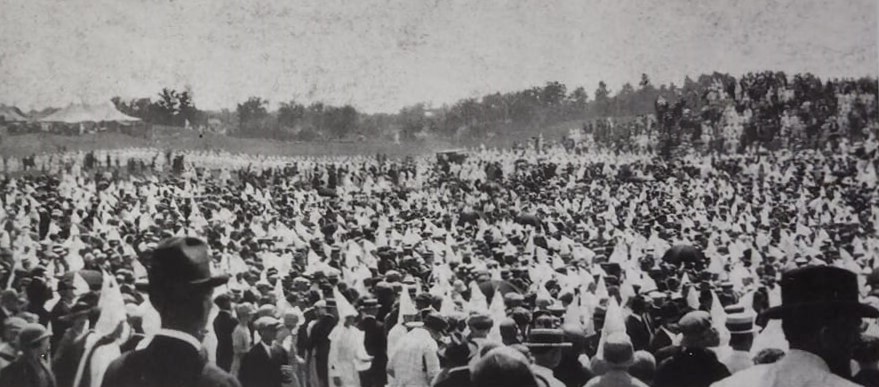
Above: A Ku Klux Klan meeting takes place in Michigan during the 1920s. The reverse of the photograph reads “Gratiot County.” Looking at the elevation in the background, could this location be in either south or southwest Gratiot County? Or, is it somewhere in Arcada Township? Photo courtesy of Tami Haskett Smith.
The British author and poet Thomas Hardy once wrote, “Though a good deal is too strange to be believed, nothing is too strange to have happened.” The first time I heard this quote, journalist James P. O’Donnell used it after seeing Hitler’s bunker in Berlin in the summer of 1945. O’Donnell then wrote an account of Hitler’s last days and adapted it for a 1980s movie on HBO.
Looking back over one hundred years ago in Gratiot County, there has been much that seemed to be too strange about the activity of the Ku Klux Klan to have happened here – but it did.
Growing up in Gratiot County, I never once heard anything firsthand about the 1920s KKK, even though I had four grandparents who grew up during that period. In my life, the closest I came to contact with the Klan was as a student when I overheard a story told by an upperclassman at my high school. As I remember his account, in the early 1970s, a student brought a grandfather’s Klan uniform to school as part of a presentation to a history class. Years later, nothing came from my investigation into tracking down the story.
In 2009, I was in a class at Central Michigan University, “American Social History, 1865-Present,” taught by Dr. Stephen Jones. The first assigned book was James Loewen’s Sundown Towns: A Hidden Dimension of American Racism. Loewen’s book examined the history of how white communities in the Midwest and the North gradually pushed out and removed Black communities from their midst, creating “sundown towns.”
As I read the book, I soon found Michigan connections. One dealt with writings regarding Owosso, Michigan – where I had family members and my paternal grandparents lived for a short time. While investigating Loewen’s treatment of Owosso as a “sundown town,” the role of the Ku Klux Klan appeared in the 1920s. References to the Klan in other parts of Michigan (like Alma, Michigan) immediately got my attention. At the time of that reading, I remembered that a former CMU history professor, Dr. Calvin Enders, researched the Klan in Michigan during the 1970s and 1980s. Although I did my M.A. degree under Enders’ supervision in the 1980s, we never talked about the Klan very much (even though Dr. Enders was deep into Michigan KKK research).
By the time I came along in 2009, Dr. Enders’ wife donated his papers and research to the Clarke Historical Library in Mt. Pleasant, where my investigation into the Gratiot KKK began. I was stunned by what I found and read.
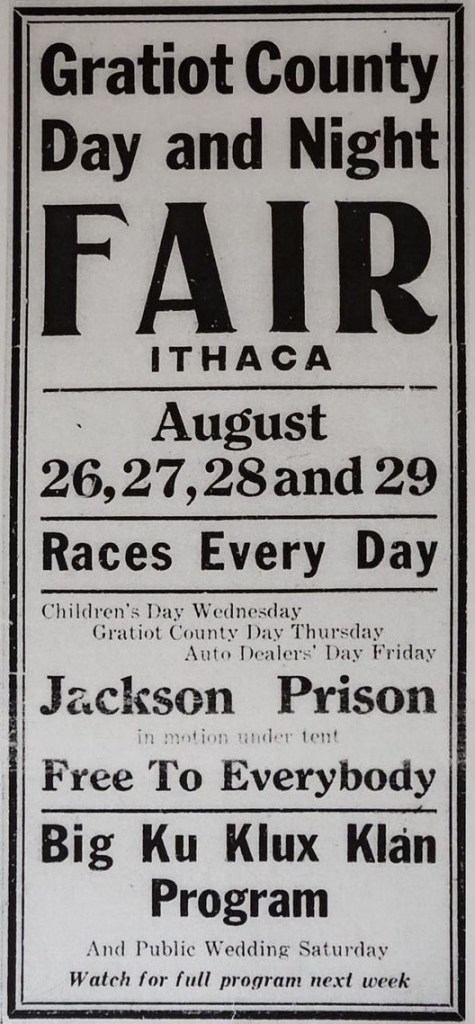
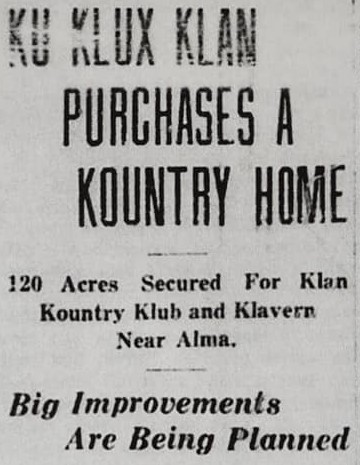
The Klan was very active in the 1920s, and at least one incident regarding Gratiot County Realm No. 24 garnered state and national news. As I investigated the sources on my early trips, I am sure other researchers in the library heard me mumbling or proclaiming as I went through Gratiot County sources, “I can’t believe this.” The history was that gripping, and despite what Hardy and O’Donnell said, it was hard to believe.
During an early trip to the Clarke, I found that the curator was becoming increasingly interested in what I was doing regarding Gratiot County and the Klan. He politely asked questions about my research and then asked me to visit his office. I wondered what research rule I had broken, but he told me I was not in trouble. Instead, he told me another story about the Gratiot Klan from the 1920s.
A few months before my research began, the curator received a phone call from someone in Gratiot County who had materials that they considered donating to the Clarke. The only stipulation was that names had to be removed from the documents – in one case, it was the original KKK Realm No. 24 charter. The donor wanted to preserve history and offer it to the Clarke Library. Still, he did not wish to reveal names that were associated with the Klan in 1920s Gratiot County.
Under proper archival procedure and rules with donations, the curator would accept the items but could not delete or tamper with names or other information. History was history, and it had to be preserved. Unfortunately, when the anonymous Gratiot Klan donor heard this, he decided not to donate the items.
At this meeting, I was asked whether I knew anything about these Gratiot Klan documents and charter or if I could investigate where the items were. Unfortunately, as I was starting research, I couldn’t help. But, I became interested in finding the Klan items.
As of this writing, I have not located the Gratiot Klan charter items dealing with Realm No. 24. Since 2009, despite this, I have traveled across Michigan, Indiana, and even to the Library of Congress in Washington, D.C., to try and find as much as I could about the KKK in our county’s history.
What I learned – and what Gratiot County should learn – is that nothing is too strange to have happened in our midst. The Klan was here, and many of its activities and actions today seem alarming. What is even more shocking is that most people in Gratiot County today don’t know that the Klan was here, that it was highly active, and that it fostered division, disharmony, and intolerance in Gratiot County.
It is disturbing to me that at least two generations living in Gratiot County in the early 20th century heard about the Klan or must have known someone involved with it.
And then, somehow, over time, people erased the 1920s Ku Klux Klan Realm No. 24 from Gratiot County’s memory.
It was not too strange to have happened here.
Copyright 2024 James M. Goodspeed

 Goodspeed's Gratiot County Historical Blog