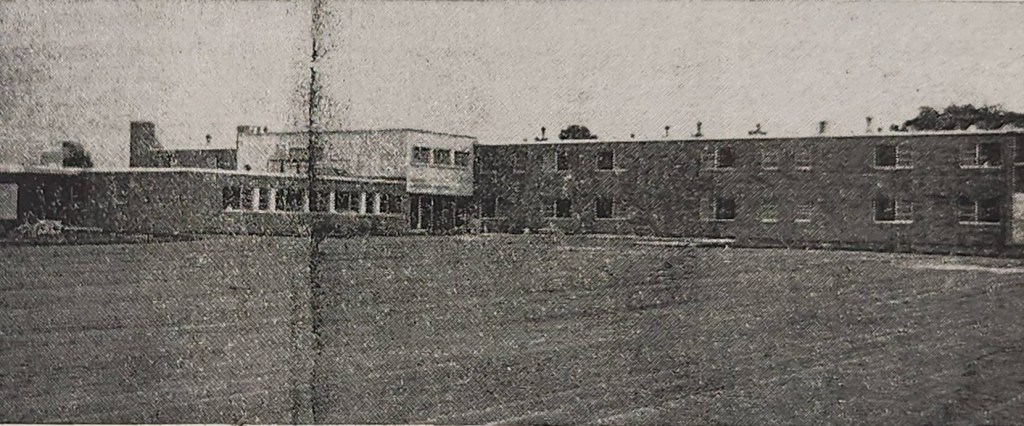
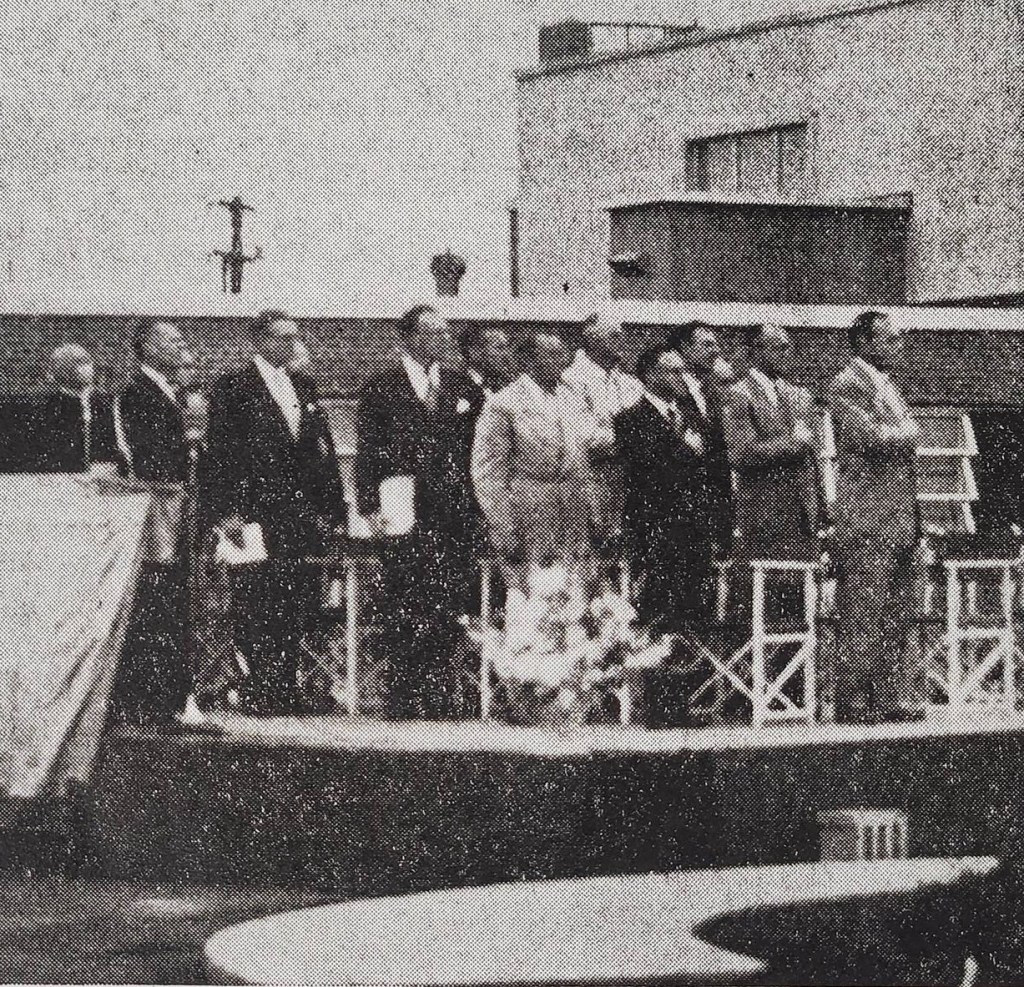
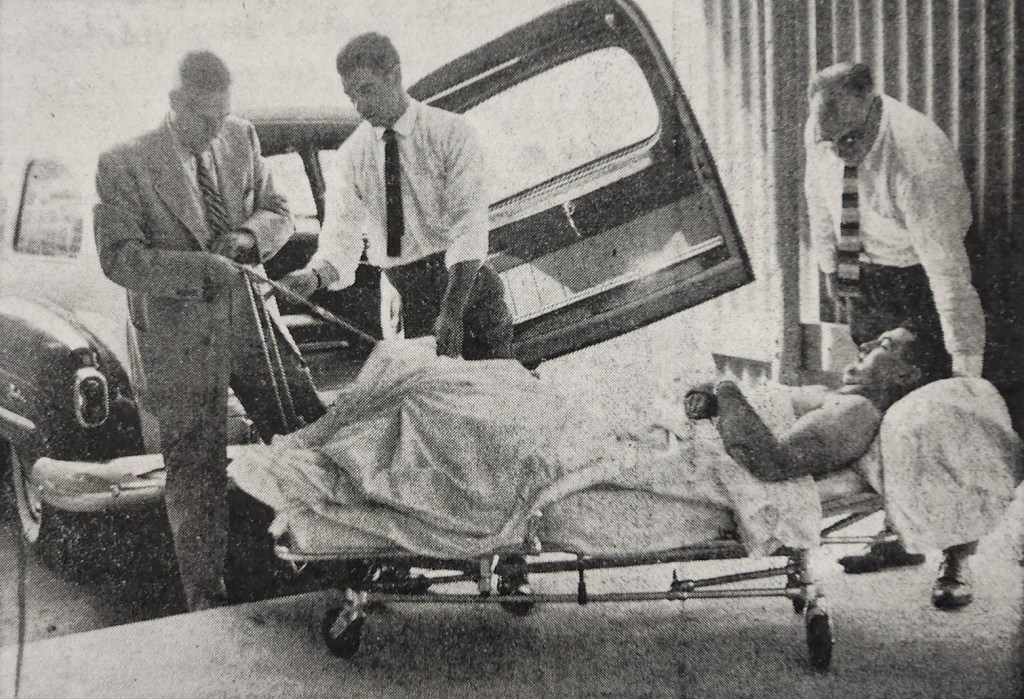
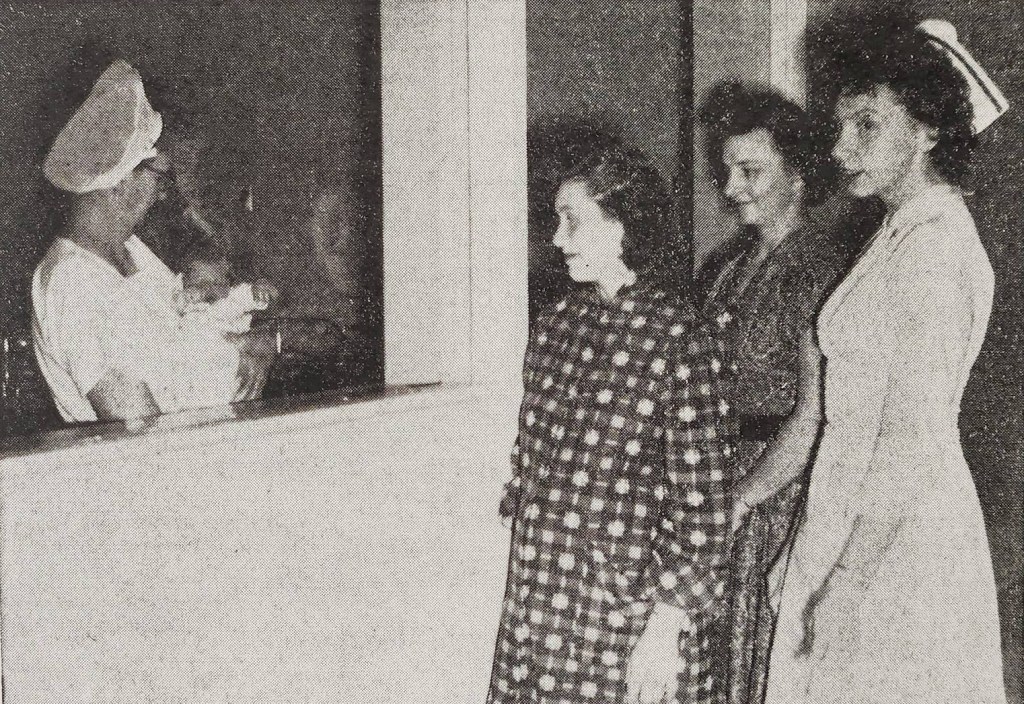
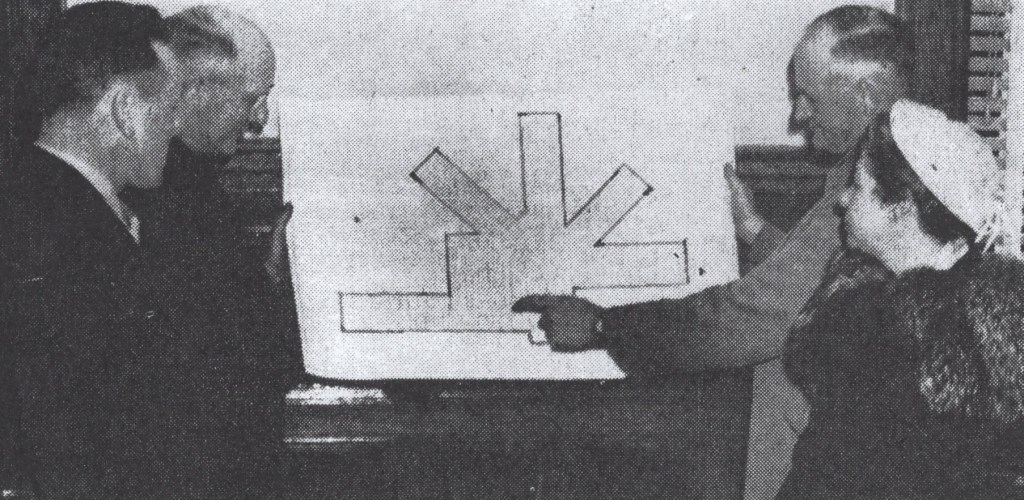
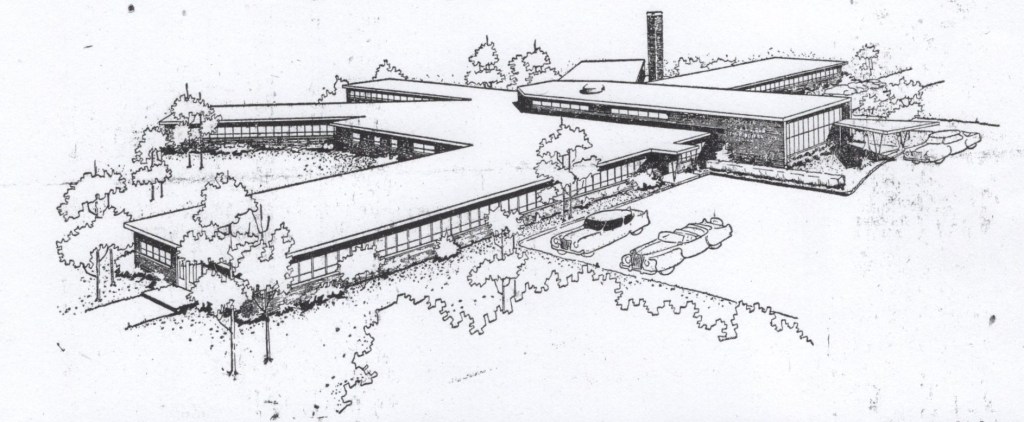
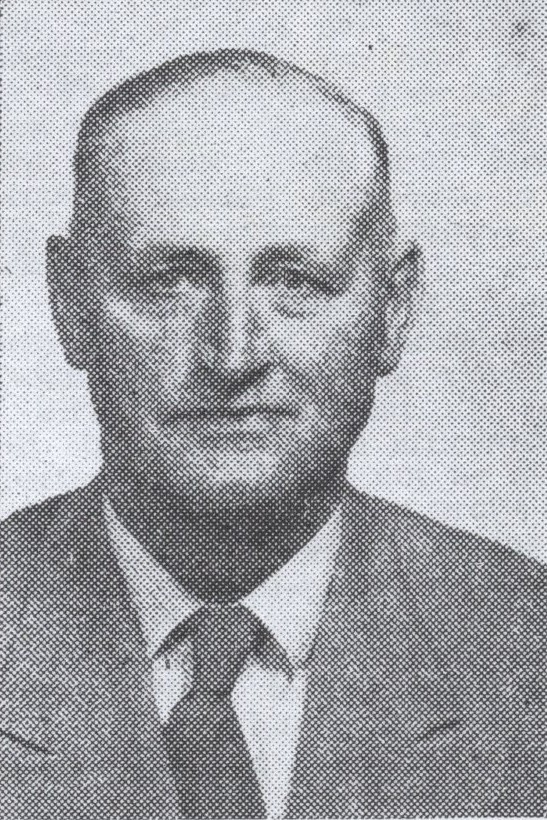
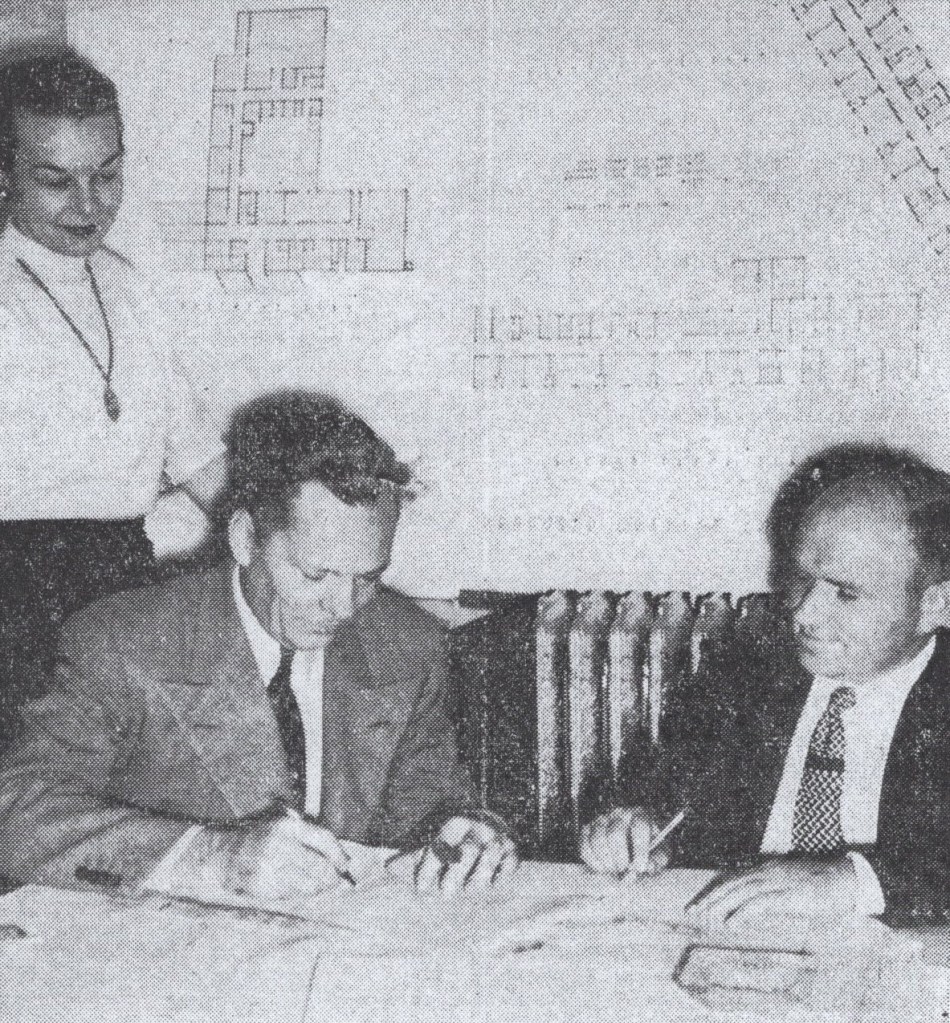
The Gratiot County hospital fund drive moves forward (from top): A set of proposed hospital plans was presented to public meetings in late January 1953. From left: Dale Misenhelder, C.L. Seeley, Paul Raycraft, and Mrs. Don Mulholland attended the presentation at the Gratiot County Courthouse; An architect’s preliminary drawing of the new Gratiot Community Hospital. The new hospital would provide care for 75 patients. Paul Raycraft of Arcada Township led meetings in two areas of Gratiot County in February 1953 to discuss the new hospital; Chairman Earle Brenneman signed the applications for federal funds for the hospital. Mrs. Robert Fandell, hospital office manager (left), and Joseph Homminga, deputy director of the Office of Hospital Survey and Construction in Lansing, look on. An architect’s drawing of the hospital is on the wall behind them.
Fundraising Ideas
After Gratiot County residents committed to building a new hospital, the real work began by obtaining a charter and starting fundraising. The newly created Board of Trustees then agreed on the name “Gratiot Community Hospital” and interviewed three architectural firms to develop the new hospital’s design. Ultimately, the trustees hired Clark R. Ackley as architect. The Board then set up the first campaign office for fundraising in Room 27 of the Merchants Building in downtown Alma.
The trustees, consisting of nine prominent citizens, had attorney Gordon Netzorg file for the official hospital charter. They also announced a goal of raising $500,000 in a fund drive planned from March 10 to April 7, 1953. The Board learned that $400,000 in matching federal funds would be available, according to the State Office of Hospital Survey, and this spurred the group on in its goal of raising the large initial sum. This new hospital would have 75 beds, more than the 29 available at Smith Memorial Hospital. Still, as trustee chairman Earle Brenneman stated to the Board, this drive would be a big challenge as it aimed “to secure the largest sum ever sought in a fundraising campaign in this area” of Michigan. Choosing the location of the new hospital also required a central location, like Alma. Before the idea of Gratiot Community Hospital, many people went to different hospitals in St. Johns, Owosso, Carson City, Mt. Pleasant, or Edmore for treatment. Having a new hospital in Alma meant that more people in the county (and even some areas outside Gratiot) would be served, resulting in more patients.
Earliest Donors and Donations
To start the fund drive, the Board hoped that the primary sources of donations would come from advance gifts from firms, foundations, and individual donors, with a focus on both commercial and rural donors. Before the drive started, the Board discussed some early ideas for approaching donors. For instance, medical professionals might give as much as $60,000 if asked. A limited residential canvas would take place later, and the Board believed people tended to offer at their workplaces. A rural campaign was also discussed, and Paul R. Raycraft suggested an introductory meeting for civic leaders in the northern half of Gratiot County on Thursday, January 29, at Alma City Hall. Another meeting for those from southern Gratiot would take place on January 30 at the Gratiot County Courthouse. In both meetings, civic leaders heard about the proposed hospital, had their questions answered, and viewed the architect’s preliminary drawings.
Just before the start of the drive, the Board of Trustees received a personal report from Miss Lou Nickerson about the current conditions at Smith Memorial Hospital. Nickerson, also a member of the new hospital trustees, had been associated with Smith Memorial since 1944. She told the group that Smith Memorial opened in 1934 with only 10 beds. Now, in February 1953, the hospital was operating with up to 39 patients a day and employed 45 full-time employees. In 1953, Michigan hospitals were considered at bed capacity when they reached 85 percent. At Smith, the average capacity in the previous year was 90 percent, and Nickerson added that “R.B. Smith was dangerously overcrowded and any minor epidemic in the county could create a serious crisis.” She also concluded her report by reminding the trustees that Smith was initially built and opened to hold only 10 beds. She also reported that Smith offered to donate $50,000 from its cash reserves as well as its most modern equipment to the new hospital. The Smith Memorial Board of Trustees proposed donating all of this to help kick off the fundraising.
Another New Hospital in St. Louis?
In late February, news about the idea of building a new hospital popped up on the front pages of the St. Louis Leader. This plan involved a 25-bed osteopathic hospital on the corner of South Main and State Street in St. Louis (the current location of the St. Louis Free Methodist Church). The plans for this new hospital began a year earlier, and attorney Alfred Fortino reported that funds were available to start construction and purchase land at the proposed site. This hillside location, measuring 275 feet of frontage on South Main and 410 feet on State Street, would be a two-story hospital staffed by osteopathic physicians. A drawing of the new hospital also appeared in the newspapers. However, over time, discussion and plans for this new hospital in St. Louis ended, apparently due to the idea and progress of a larger one in neighboring Alma.
Official Fundraising Begins
To raise funds for the new Gratiot Hospital, Gratiot County needed to know why the public should donate. Why ask the public for money? Why not require patients to pay for their own care and operate the hospital like a business? The answer came in a full-page advertisement in the Alma Record and Gratiot County Herald. First, all patients admitted to the hospital would receive treatment, regardless of their financial situation. All patients received care, and no one would be rejected. The full page ad concluded its explanations for raising money by stating that this hospital was “not a hotel. It is a house of mercy.” Second, an estimated 80% of the hospital’s costs were for patient care, and the hospital operated 24 hours a day. Unseen services, such as food, laundry, and building maintenance, also required funding.
A large donation from the work sector, a $100,000 gift from the Redman Foundation of Alma at the end of February, launched corporate contributions. Barely a week later, Leo, Joe, and Benjamin Simon’s families of Alma gave the first family gift of $3,600. The Simons announced they wished to have it put toward the new building’s entry. For those who gave gifts of $300 to $600, or bought furniture for the hospital, their names appeared on wall units or bronze tablets. In early March, rural fundraising began with a kick-off supper at Ithaca Presbyterian Church, attended by 200 people. Leaders, like FRED Raycraft, proposed that there be no rural goal and instead encouraged those in the country to pledge to semi-annual giving, starting with a minimum of $60. Those who wanted to make specific monetary gifts could also contribute toward the construction of new hospital rooms, such as $ 1,200 for a single room or $ 3,600 for a private room.
After fielding frequent questions about the exact location of the Gratiot Hospital, the Board of Trustees announced that the hospital would be located near the existing Masonic Home and the new Consumers Power Company building. Some wished that the hospital had been further east of Alma. However, this new location could draw patients from as far away as Edmore.
In early April, the drive passed the halfway point but appeared to be stalling. By April 2, $261,000 had been raised – just one half of the goal. As a result, the Board wanted to extend the drive. A week later, $294,000, or almost 59 percent of the goal, was reached. By April 16, the drive had raised $59,314, bringing the total to $356,312. As more corporate donors, such as Detroiter Coach ($4,000) and Leonard Refineries ($26,000), contributed, the goal topped $400,000. Two more corporate gifts from Michigan Chemical and Alma Piston Company improved the total, along with contributions from employees of various companies and even from the Mennonite community. All of these got the total to $440,000 in early May.
However, the drive hit a bump in early June. The Lansing office of Hospital Survey on Construction, which previously encouraged the new hospital project and anticipated Federal aid, announced that Federal aid for hospital projects had been cut by one-third after the United States House of Representatives reduced aid to all Federal projects. Apparently, the reductions and cuts came at the end of 20 years of Democratic control, as a result of the Depression and World War II. Also, a change in the White House meant a more conservative approach with the new President, Dwight Eisenhower, and the end of the Truman years. Now, the Board of Trustees and supporters of a new hospital faced the challenge of raising even more money to offset the reduction in federal aid.
Search and Confirmation for Final Hospital Site
In late July 1953, the search for the exact site of the new hospital narrowed to several choices. One of these involved a nine-acre site west of Wright Avenue and north of the Masonic Home. Smith Hospital previously purchased the area and offered it as a gift for the location of the new hospital. However, as the Board examined the possibility of this location, it realized that the area was zoned for residential use only. While pondering this problem, the Board was approached by James E. Ryan, President of Alma Trailer, who offered to trade a spot on the opposite side of Wright Avenue on 10.4 acres and approximately 400 feet east of Wright Avenue. Ryan offered to trade locations at no cost to the new hospital. A primary concern in the proposal was that the 400-foot area east of the avenue was held in a trust for a possible future park. The deal was made, and Clark Ackley, Lansing architect, went to work on preliminary plans and drawings of the new hospital, which he submitted in September.
Plans Appear Ready/Federal Funding Improves
After Ackley submitted the hospital plans and the Board approved them, the Board learned that the issue with reduced federal funding had changed and would now be available up to 48 percent of the drive, or $454 656. What caused the change in stance on Federal funding was unclear, but the availability of the previously announced aid now eased concerns of many on the Board and within the drive. However, the Board learned that, to qualify for this Federal aid, another $60,000 in pledges had to be received by January 1, 1954. The drive also had to raise its maximum number of pledges by April 1. In addition, 75 percent of the local share for the project had to be in cash before the release of Federal matching funds. With these deadline requirements, the drive now asked people to prepay their pledges. As winter approached, the main project for the new hospital involved water main construction in the north section of Alma, and the hope was that pledges would come in by the Federal aid deadline.
As 1954 approached, those involved in fundraising for a new hospital in Gratiot County hoped that the dream of the first county hospital would soon enter its construction phase.
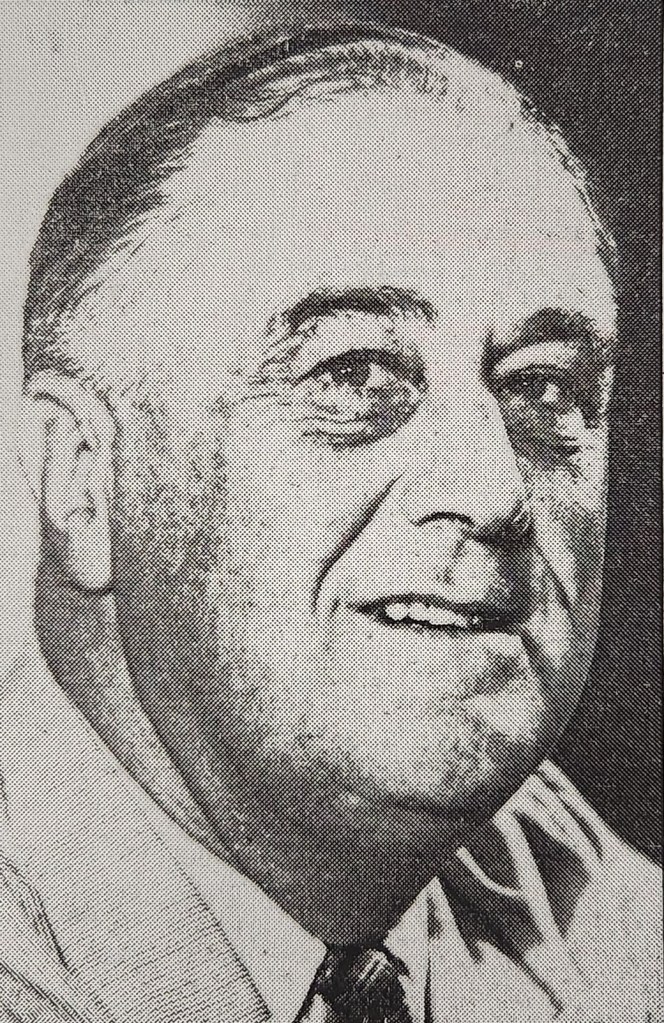
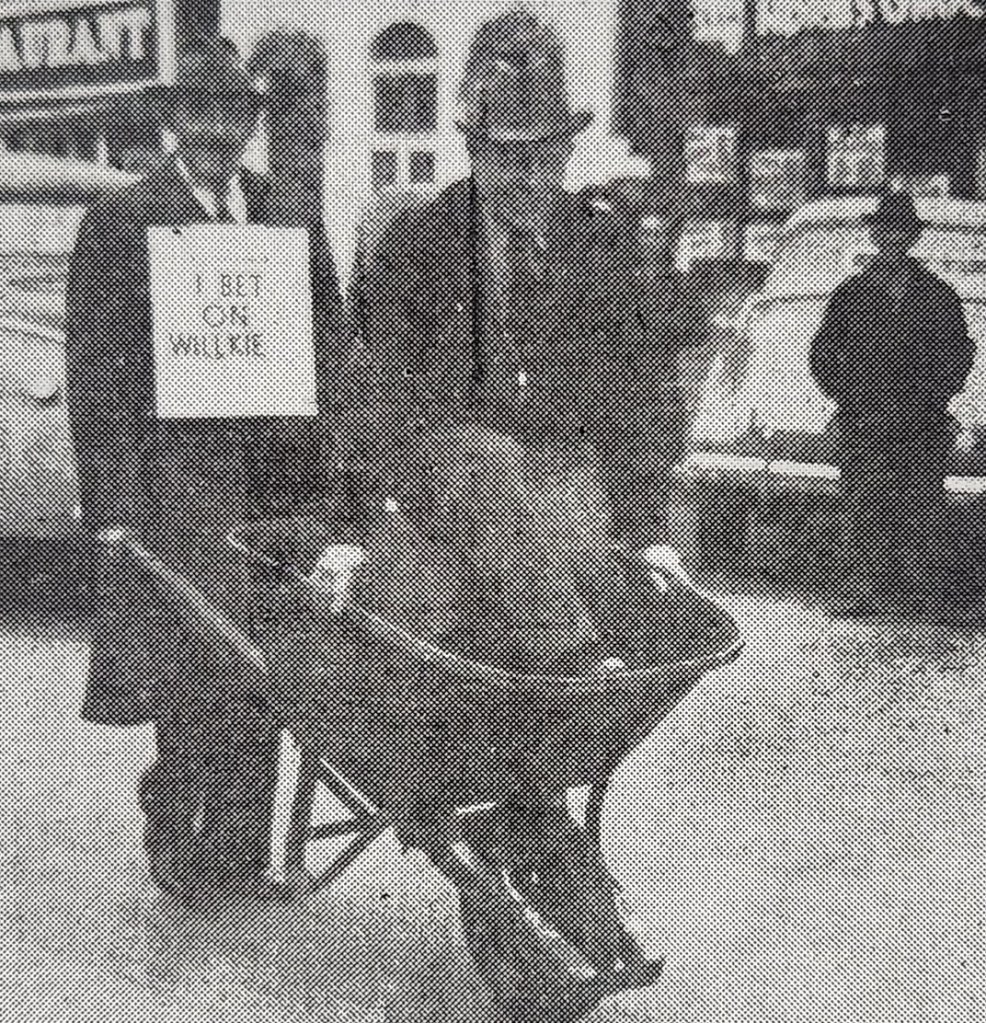
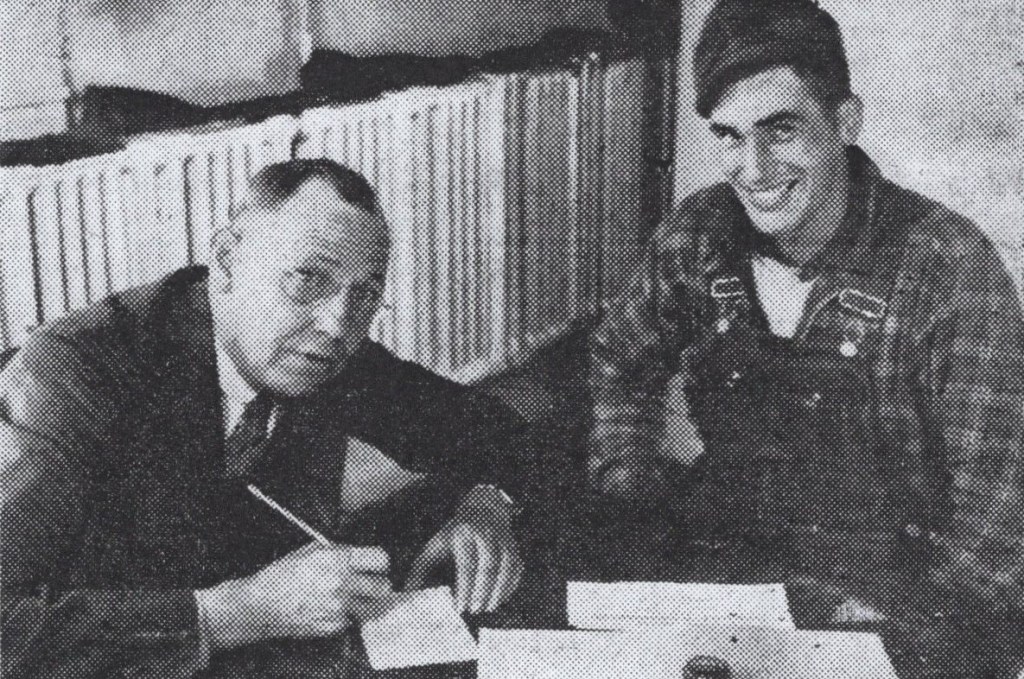
November 1940 in Gratiot County from the top: President Franklin Delano Roosevelt loses Gratiot County for the first time in his three elections, but wins the Presidency in the rest of the nation; John Giles of St. Louis, Vice President and General Manager of Michigan Salt Company, wheels George Hart down Mill Street from Washington Avenue. Giles bet on Wendell Willkie for President, and had to wheel Hart through downtown St. Louis. George Hart, as manager of Hart Brothers Elevator, prepares Gratiot’s first Selective Service Group to leave Alma for the military. Grant Angelus, Forest Proctor, Roy Bigler, and Wyomah Vick made up the group. They received their draft notices early – all near Coleman, Michigan. Derwerd Cary, Charles Van Deventer, and George Cary showcase their successwith a Thanksgiving poem and prayer as it appeared in a local newspaper near the Holiday.
The Nazi Luftwaffe increasingly bombed and decimated English cities as the air war over Great Britain continued.
Franklin Delano Roosevelt was nominated and ran for an unprecedented third term as President of the United States. The prelude to the national draft began as several thousand Gratiot men registered in each township.
A terrible November storm struck Gratiot County as the holidays appeared on the horizon.
It was November 1940 in Gratiot County.
The World at War
As the war raged in the battle over Great Britain, foreign correspondent Orin W. Kaye, Jr. of Lansing, told members of the Alma Rotary and Lions Clubs that he believed England would not be dismembered or conquered by the Nazis. Kaye had been in Paris when the Germans invaded and stated that he believed that morale would be the deciding factor in the war. Before and after the dinner, the group sang patriotic songs and other popular numbers. The program came on the heels of German bombings on Birmingham and Coventry. The Nazis boasted that the attack on Coventry was the “greatest air attack in the history of aerial warfare” as it laid waste to the city and resulted in over 1,000 casualties.
In other news, state budget director Gus Hartman announced that he rejected any plans to build new armories in Michigan in 1941 due to the war. The state military establishment requested $3.5 million to develop and improve armories across the state. To commemorate Armistice Day, students at St. Louis High School held a program in the high school gymnasium with help from the William Fields American Legion Post. Commander Milton Townsend was one of two speakers. The program concluded with the playing of Taps. Over at Alma, plans for an Armistice parade with floats, bands, and American Legion members had to be changed due to the weather, even though the Alma City Band and Alma High School Band marched downtown and arrived at East Superior Christian Church, where a service was held.
With the war continuing in Europe, Sheriff William Nestle set out for Washington, D.C., where a national defense conference took place. Much of the conference centered on how police and sheriff’s departments would step in to cover duties previously performed by the National Guard in their areas. William B. Kyes, formerly of Elwell, left for the Officers Training Corps of the Air Division of the United States Army at Parks Air College in East St. Louis. Kyes took a three-month course, then would go to either Texas, Alabama, or California to finish his training. Since June, Kyes had taught at Freeport High School.
Alien registration continued in Gratiot County, with 601 aliens registered as of November 21. All aliens age fourteen and older had to register in person. Those under the age had to be registered by their parents or guardians. Any change of address needed to be reported to one of three post offices in the county.
New Deal Life During the Depression
The Works Progress Administration (WPA) announced that the Stillwell Junior High gymnasium opened on Monday evenings to boys and girls not attending Alma schools. While NYA boys and girls were encouraged to use the gym, the facilities remained open to other students from 7 pm to 8 pm for girls and 8 pm to 9 pm for boys. Lester Fillhard, WPA recreation director, served as supervisor.
Foreman and timekeepers from WPA projects met at Alma’s city hall to form a national defense council. Organized by the federal government, the councils were formed mainly “for the purpose of detecting and nipping any subversive activities” within federal aid groups. Even though some WPA workers faced layoffs for a week, upon returning to work, they continued preparing the grounds in Wright Park for new tennis courts. The group removed trees and stumps, then waited for the excavation and grading of the ground to be completed before installing the courts.
The NYA (National Youth Administration) role in Gratiot increased by 100 people to carry out new projects, such as rehabilitating used toys for Christmas gifts for needy children and expanding girls’ sewing and home economics projects. Project workers earned $18 a month, and some foremen, aged 17 to 24, received as much as $24 for 60 hours of work. The NYA program provided young people with practical experience through useful work and aimed to encourage good work habits. Jack Acker, WPA recreation leader at Alma’s Republic Recreation Center, oversaw a new club called the “East End Canaries.” Eighteen boys and girls participated in the first meeting that promoted recreational activities of a “wholesome nature.” Benie Simons served as president of the newly formed club, and its first project was to host a Christmas party. In November, fifty NYA workers received Red Cross first-aid training, and a notice went out that any youth over the age of seventeen could receive instruction.
Two WPA recreational leaders from Alma went to Flint for a special recreational training institute. Lester Fillhard and Jack Acker represented Alma at the meetings. Darrell Milstead, county WPA leader, announced that NYA workers continued repairing Christmas toys in the basement of the Salvation Army (toy shop). The NYA and the Salvation Army hoped that every child in Alma would have a toy for Christmas.
At the Gratiot County Courthouse, the Bureau of Social Aid moved to make way for the Community Welfare Department. Both had new locations due to changes in the courthouse basement. The bureau had two NYA workers.
The Election of 1940 – No Third Term?
In November 1940, Gratiot County and the rest of the nation faced an unprecedented situation. Should the United States re-elect the President of the United States to a third term in office? The United States Constitution then did not bar Presidents from a third term. However, by tradition, two terms of office had been the maximum that any then-sitting President held. Now, President Franklin D. Roosevelt had been called by his fellow Democrats to run again for office – and Gratiot County was floored.
Roosevelt won convincingly in the county in 1932, and then by a much narrower margin in 1936. Now, Republicans everywhere warned people of the threat of a Democratic “dictatorship” with mounted signs and advertisements in Gratiot County that read “No Third Term!”. Another issue bantered by Republican opponents centered on the continued deficit that Michigan and the nation ran in operating Roosevelt’s New Deal programs. Republicans asked, why was the deficit as high in 1940 as it had been in 1932? The answer was the Great Depression—an economic nightmare the nation had never experienced before. Unfortunately for Roosevelt opponents in Gratiot County (which elected Republican Wendel Willkie), FDR won a third term in office.
The Draft
Following the national draft lottery in Washington, D.C., 155 Gratiot men were among the first called to military service. The public found out who these men were by reading the long lists printed in the Alma Record-Alma Journal. Three men from Alma headed the list: Russell Swinson, Joe Prahin, and Louis DeRosia. However, before any of the list were officially called, at least a half dozen men volunteered. Soon, four men stepped forward as the first volunteers from Gratiot County. The four included Grant Angelus and Roy Bigler of Alma; Forest Proctor of Ithaca; and Wyomah Vick of Alma, who recently moved to Edmore. A special program at the George W. Myers Post of the Alma American Legion recognized the volunteers, and each received a gift package from the Alma Community Christmas League. Inside were things like writing paper, a fountain pen, candy, and two packages of cigarettes. The Salvation Army chaplain also gave each volunteer a small testament. On this wet, snowy day in Alma, a parade assembled at Alma City Hall, then made its way down to the bus station on East Superior Street. The four volunteers rode in an automobile with signs on the side that read “Gratiot’s First Volunteers” along with their individual names. It was not long after this that another 12 men requested that the Gratiot County Draft Board accept them as Gratiot County’s following volunteers.
Halloween, Thanksgiving, Christmas
Over in St. Louis, 500 children drank nearly 40 gallons of cider and ate 100 dozen doughnuts. Just before the Halloween festivities, someone threw a cabbage head through Colonel J.M. Thrasher’s large front window on Main Street. Police continued to investigate who the culprit might be. New Deal programs like the NYA and WPA helped sponsor a Halloween gathering in Alma, where 500 children also turned out for a parade from the Tourist Park to Rademacher Motor Sales garage starting at 7:30 pm. Helpers inserted toy balloons with prize slips into the balloons, then let them loose from the tops of several downtown businesses. A bonfire back at the Tourist Park concluded the night.
A Woman’s Page Editor in the Alma Record-Alma Journal suggested an ideal Thanksgiving menu with four types of dishes. Just how many were realistic for most people’s Thanksgiving dinners was a matter of conjecture. Turkey, duck, and chicken were the main choices. Gilmore’s Grocery in St. Louis (“Where Values are Quality”) urged shoppers not to forget that they could get all their Thanksgiving trimmings at Gilmore’s. For Thanksgiving, the Gratiot County Herald published a copy of “The First Thanksgiving Proclamation” by President George Washington.
By golly, Christmas was just around the corner in Gratiot County, and the Santa Claus Club held its first meeting in Ithaca’s village hall to plan the community programs. Alma led all the festivities with its Window Night on November 29, featuring new flashing lights on the main street, a parade, and the debut of Christmas trees along light poles. The Strand Theatre offered a free matinee to children who donated a canned good. St. Louis planned to kick off the official Christmas shopping season on December 6 with Window Night. At 7:15 on that Friday night, the fire siren would sound and Santa would appear on the streets. The St. Louis Lions Club and the GEM Theater planned to sponsor a free children’s movie. Merchants with the best decorated windows also received prizes, and the St. Louis Trade Association expected visitors from throughout Gratiot and Midland counties. St. Louis also planned a home lighting contest for the best-decorated homes in the city. Ithaca planned its Window Night with Santa on December 14. Breckenridge sponsored its annual Christmas lighting contest sponsored by the Breckenridge Garden Club.
November Storms and Farming
On Monday, November 11, 1940, a storm with cyclone-level winds descended across parts of the United States. Gratiot County was one of the places that bore the full brunt of this 50-60 mph storm. In St. Louis, Mary Hoffman was sent to Smith Memorial Hospital after a gust of wind shoved her against the wall of a building with enough force to break her arm. Telephones, signs, and poles across the city were seriously damaged. The storm toppled the brick chimney of Alma’s First Baptist Church, sending it crashing through the roof of the church’s east room. The Beebe store in Emerson Township had its entire roof torn off by the weather. High winds also attacked the farm of Valois and Paul Todd, outside of Middleton, which also had the roof ripped off of their east barn. Other county farmers who lost their barns included John Wilk (northwest of Alma) and Fred Flegel (Sickles). The first estimates placed the damages in the county at tens of thousands of dollars, and according to the Gratiot County Herald, “hardly a single community escaped without some damage.”
Michigan Sugar estimated that 40,000 tons of beets sliced so far only accounted for one-half of the expected yield in the Alma region. Beet fields yielded an average of 8 ½ to 9 tons per acre, which was then considered average production. A freeze-up resulting from the hurricane storm that hit Gratiot delayed the harvest by about a week; however, warmer temperatures allowed farmers to complete the remaining 2,000 to 3,000 acres left in the Gratiot area. In other harvest news, Herman Hoffer of Ashley had a tremendous corn yield of 60 bushels per acre. Reports said that Hoffer’s yield from five acres of ground was as much as the average American farmer received from ten acres. Hoffer planted and harvested DeKalb 204 on his farm. When it came to milk production, the Gratiot Dairy Herd Improvement Association recognized Ralph Densmore and his Holsteins of Elwell for leading the area with an average production of 1569 pounds of milk and 48.79 pounds of fat. A.J. Neitzke of Breckenridge was second with his Brown Swiss yielding 1040 pounds of milk and 41.66 pounds of milk fat.
Newspapers highlighted other farming news in November. Evart Denney, a recent graduate of Ohio University, took over the duties as manager of the 700-acre Balmoral Farms. He replaced Peter McClelland, who had managed the farm since 1925. Instructors prepared for a ten-week night class at St. Louis High School sponsored by the Smith-Hughes Agricultural Program. The program prepared teachers at the area high schools to teach students with help from the Michigan State College extension department. The Future Farmers of America Chapter at St. Louis High School also held its fifth annual community fair on November 28-29. The Breckenridge FFA also helped provide the program of free movies, corn husking contests, music by their bands, a style show, and ended with a school judging contest. At least 65 boys and girls participated in the fair.
Alma Production Credit Association prepared for its sixth annual meeting at the Strand Theatre. The meeting gave members updates on the organization’s business and financial reports. It featured a free noon-day luncheon for several hundred farmers and their wives. In some unfortunate news, Harzey Fisher of Crystal was seriously injured while working on the Henry Tompson farm near Sumner. Fisher got his coveralls caught in the drive shaft of a corn picker as it went around a tree. Harzey held onto the lever until the shaft stopped; however, the force of the shaft stripped off the coveralls, pants, and underwear, and heavily lacerated his leg. Fisher was transported to Edmore Hospital for observation and treatment.
If it is November, the Nimrods are Here
As the nimrods descended upon Gratiot County to hunt pheasants, so did the game warden. However, overall pheasant hunting was considered poor in Gratiot County. Still, George Howe and Robert Lee of Alma were arrested for stalking on lands northeast of St. Louis without permission. They each paid a fine of $14.85. On the last day of pheasant season, Gus Claerhout and Claude Taylor jumped a fox on the Jack Dicken farm south of Ithaca. The male fox fought the collie the pair had with them until Taylor shot the nice male. Some of those from the county who went deer hunting came home with a buck. Leo Podgoresek led a group of successful hunters from Riverdale, including Vera Johnson, who shot her first buck five times to make sure he dropped. Charles Smith of Elm Hall brought in a very nice 16-point buck. A group of 16 game wardens enforced a blockade at the intersection of M-46 and US-27, northwest of Alma, to monitor illegal hunting. The wardens did a car check on each vehicle and found eight violators that day. Violations included carrying a loaded weapon in the car, removal of the sex of a deer, hunting without a proper license, and possession of birds shot out of season. Fines ranged from $10.85 to $50.00, depending on the case.
The Long Arm of the Law, Health Matters
During the previous month, Gratiot courts reported 91 convictions, including 20 for game violations. Some of the less common offenses included possession and sale of adulterated food, failure to send a child to school, and failure to pay a dog license. Fines and total costs brought in $287.55 to the county. Daniel Fisher, age 70 of Ithaca, suffered a concussion and lost both of his horses when his wagon was hit by a Stockbridge driver on a hill just north of Ithaca. While the wagon was unlit, the driver was cited for driving too fast and for causing the accident. Edward Vela, age 18, Mexican beet worker, and Geraldine Pego, of Indian descent and age 19, were arraigned on a morals charge. Vela got four months, and Vela received sixty days in the county jail. St. Louis police picked up a trio of violators on a drunken driving spree in a car with small children. Jessie Joseph (Fisher), Joseph Williams, and Edwin Burr, all of Mt. Pleasant, were arrested and served thirty days each for failure to pay fines of $25 to $35 each. Joseph (Fisher) and Williams were identified as being Indians. On a more positive note, Mrs. J.H. Keep, janitress at the Strand Theatre, turned over to management a wallet containing $106. A light cable and aisle seat kept the wallet out of sight until Keep found it. It turned out that the wallet had been lost by a Detroit salesman who watched a movie at the theatre some ten days earlier. Mrs. Keep was commended for honesty in turning in the wallet to Strand manager V.A. Jaeckel.
One of the most critical health issues in the county remained the battle against tuberculosis, and the Michigan Tuberculosis Association held a clinic at Alma High School. Tuberculin tests were given, and the Vollmer patch test was used for the first time. A total of 215 students at both the middle and high schools took the tests conducted by Dr. Charles DuBois. After examinations, anyone who tested positive had to undergo an X-ray. At Smith Memorial Hospital in Alma, the R.B. Smith Auxiliary purchased a modern incubator for premature babies. The incubator, engineered by the Ford Hospital, allowed the hospital to transport babies 20 miles without changing the incubator’s internal temperature. The device had an automatic thermostat, humidity control, and oxygen intake controls.
And So We Do Not Forget
Murray Brown of Kalamazoo moved to Alma to open a photographic studio in the southeast corner room of the Wright Hotel. Go to the first floor to find his studio…Henry Fonda and Jackie Cooper starred in “The Return of Frank James” at the Strand Theatre in Alma. Tickets were ten and twenty cents – all for a movie, news, and cartoon…Mrs. Reid Brazell served as chairperson of the Alma Red Cross. Brazell urged the Gratiot community to support the Red Cross as it helped with disasters across the country…A new brick covering went up over the office entrance to Carney-Wilcox Hospital. With the latest addition, the staff could now keep the area clear of snow and slush during the winter…Alma Iron and Metal Company solicited muskrat, mink, and skunk hides. Highest prices paid.
More window-soaping in St. Louis prompted Mayor Sumner to warn that repeat offenders would face harsh punishment if caught. While Halloween had been fun, the continued soaping of windows was too much, and Sumner asked the St. Louis police force to apprehend all “soapers”…The Brice Store in North Shade Township burned to the ground on November 13. Owner Henry Fockler was awakened by his dog at 3:00 am and called the Perrinton and Carson City fire departments for help. Unfortunately, a strong west wind quickly fanned the flames, resulting in a total loss. Fockler had some insurance on the building, which was a landmark in North Shade Township.
The Alma First Presbyterian Church held its annual bazaar on November 7. A roast chicken dinner costs fifty cents for adults, twenty-five cents for children twelve and under…Denver Hole of 412 Ely Street in Alma announced that he was returning to the blacksmith trade. Following training with his father in the old Charles Fishbeck shop, and after trying another job, Hole opened a shop in the back of the Consumers Power Company and was turning out trailer hitches for motorists…Tex Ritter starred in “Rhythm of the Rio Grande” at the Alma Theatre. Shows cost only ten and fifteen cents—and it was air-conditioned…Art Farnsworth of Alma moved his used car headquarters to a new location on East Superior at the Bridge Street approach. He advertised nine vehicles, including a 1940 Plymouth 2-door…Mrs. Fred Bennett filled in for her husband as a truck driver for the St. Louis Fire Department while he went on a hunting trip. Mrs. Bennett was the only known fire truck driver in the United States.
Professor Arpyal Toth wrote from Budapest, Hungary, to the Alma Chamber of Commerce requesting copies of local newspapers. The card came written in legible English…Mr and Mrs. P.H. Deal of Elwood, Indiana, arrived in Alma to take over the running of the kitchen at the Wright Hotel. Vern Daymon of Elwell was hired as the new night clerk..Oliver Haight of Alma celebrated his 87th birthday by going deer hunting with his grandson near Oil City. The pair brought home a buck on the second day of hunting…New Christmas toys started to appear in Alma as Santa and “Window Night” on November 29 approached…The sale of deer licenses in Alma was up by approximately two-thirds from a year ago. Dick’s Package Shop sold 285 licenses, with Mapes Hardware close behind at 225.
Gene Autry and Smiley Burnette starred in “Carolina Moon” at Ithaca’s Ideal Theatre…An estimated 300 volunteers for the Gratiot County Red Cross fanned out across the county in an attempt to increase membership in a drive from November 11-30…The Ithaca Methodist Church invited the community on Thanksgiving Night to see the new motion pictures, “Life of Christ” and “Passion Play.” The film was produced in Europe, the Holy Land, and Egypt…The McCormack Store in Ithaca had a new, modern black-and-white glass front. New modern lettering was added to the top of the entrance in black on a white background. The owners stated that the new glass brick admitted 74 percent natural light. Also, dry goods and vegetables would now be placed on one side of the display window…Stovall Studio and Camera Shop of Alma advertised itself as “The Old Reliable Studio of Central Michigan.” Photographs made great Christmas gifts…The Ithaca Yellow Jackets finished their season 5-0-2 and did not give up a single point.
The Alma Theatre wanted patrons to know that a new seating plan included only one aisle through the center of the theatre, replacing the old two-aisle pattern. This allowed for closer seating to the screen, which raised seating capacity to 324 people… Redman Trailer planned to build a new building on East Superior Street that would cost $6000. Made of cinder blocks, it would measure 70×90 feet and stand 10 to 14 feet high…After 20 years of planning and wishing, a new Gratiot County Road Commission building opened in Ithaca, and an estimated 1,000 people attended a two-day open house. Music and dancing were provided, along with tours.
And that was Depression and War in Gratiot County during November 1940.
October 1940 photographs and events in Gratiot County from the top: “Dictators Take Notice” promoted the idea of registering for the first national draft since 1917; Walter O. Brown, a World War I veteran and Ithaca tailor, helps Roy Stewart register for the selective service draft in Ithaca; Wendell Willkie for President advertisements seemed to be everywhere as was the theme “No Third Term” for FDR; “Aladdin” the magician appeared at Ithaca High School auditorium for Halloween night.
Gratiot Steps Toward War
As Hitler continued his bombings of England, several newspapers wondered how long the British Isles could hold out until the Nazis invaded. Mr. and Mrs. H. Abbey of Ithaca received a letter from a relative living in London, who described life under the bombings. Despite rationing, Londoners were not starving. Sometimes, there were two or three air raids per day, often continuing throughout the night. Still, the British were downing about fifty German airplanes daily. In fact, W.A. Hobson wrote that “If their air men come down alive they say it’s heaven, and are thankful to get here.”
Here in Gratiot County, young men slowly moved toward voluntary enlistments. Millard Morton and Don Freeman, both of Alma, joined up and were sent to Fort Bragg, North Carolina, for field artillery training. Paul Long of St. Louis enlisted in the United States Army. After being stationed at Fort Sheridan, Illinois, Long went to the Panama Canal Zone. James Seitner, also of St. Louis, enlisted with the 210th Coast Artillery, Anti-Aircraft Unit, in Detroit. He was drilling several nights a week and expected to be sent to the South in early 1941. William C. Bainbridge, Jr. of Alma, was also selected for Army Air Corps primary training in Lansing. On a lighter side, Alfonse (Dutch) Collins, an officer in the Michigan National Guard, was in the news for failing to quell a riot on Alma’s north side. Collins was called to River Avenue to help with the noise caused by scores of starlings. Collins went to the site with his shotgun and Number 4 shot, took aim a half dozen times, and missed every time. In fact, the result was the existence of more starlings than ever. Collins was chided in the neighborhood for his inability to hit more birds and for how he would ever shoot down enemy airplanes.
A wave of concern began to sweep through the United States regarding Fifth Column activity. Lieutenant Harold Mulbar of the Michigan State Police visited St. Louis and spoke to the St. Louis Rotary Club about potential subversive activity in the state.
The ongoing talk of war continued to promote the idea of a new armory in Alma. If Alma could raise $15,000, the federal government could provide an additional $45,000 through a WPA Project, according to Alma City Manager W.E. Reynolds. Plans also proceeded for the 1941 Tulip Festival in Holland, as fall planting of bulbs was underway. The planting continued, even though about ninety percent of the annual importation of tulip bulbs from the Netherlands had been halted due to the war.
What about complaints in Gratiot County newspapers about the President? The issue of Lend-Lease of old ships to England in exchange for locations in the Caribbean had editors up in arms. “America’s first dictator” (President Roosevelt) took a significant step toward involvement in the war by trading aging ships with England, thus demonstrating that the United States was taking sides. According to one editorial, FDR was deemed a sucker in the trade, as who would want interests in the Caribbean? Time and war would eventually prove the critics wrong. However, that was not the most significant concern about President Roosevelt’s actions, as another issue soon arose.
The Draft
On Tuesday, October 2, County Clerk Charles L. Hicks received instructions for the registration of all Gratiot County men aged 21 to 35. Hicks estimated that about 4,500 men in the county were subject to the draft. To prepare for the draft, the Selective Service Headquarters in Lansing sent 6,280 registration cards, 5,230 registration certificates, 290 registration placards, and 29 instruction sheets for each precinct in the county. In St. Louis, City Clerk Frank L. Housel asked the public for volunteers to help with the registration process as the city hall expected 500 St. Louis young men to appear. Alma expected 1,000 men and asked for 35 workers.
Registration took place on Wednesday, October 16, and each man was required to answer eleven questions, ranging from his name and address to his place of employment. As each man made his way to the election booths to register, he saw a large placard displaying an enlarged registration card along with instructions. Lines were congested early in the morning, at noon, and at night; however, in most cases, little waiting actually took place, as the lines tended to move along. Each man received a serial number, which was sent to Washington to be drawn in a lottery. The Gratiot County Herald published a list of registrants, organized by their order number and serial number. Russell Hazen Swinson of Alma had the first number.
When the registration process ended, a total of 3,716 men were available for the draft, and 187 men were expected to be called to service by June 1, 1941. The county draft board, which was located in Alma’s City Hall, was composed of A.D. Smedberg, C.R. Murphy, and Robert V. Reed. At the same time that the draft board was created, members were appointed to the district appeals board. Lawyers J. David Sullivan, Kenneth Montigel, Merrill Hendershot, and Charles Goggin were appointed to that board. One of the primary reasons for granting deferments was to address the needs of men with dependents. The draft board showed leniency in this regard. Occupational deferments soon became another issue and had to be dealt with on an individual basis. One of the first complaints recorded in the Alma Record concerning registration for the draft involved President Roosevelt’s son, Elliot Roosevelt, who joined the Air Corps as a captain. The younger Roosevelt received higher pay and allowances than most young men who would be drafted. Editors argued that Elliott Roosevelt should be drafted like all other young men.
And who made up the most considerable loss of Army aid from Alma? The group of thirty-one cavalry horses left Alma with the help of Private William Meredith from Troop B, 106th Cavalry, Michigan National Guard. The horses went to the remount station at Fort Reno, Oklahoma, and thus came the end of the long history of horse soldiers in Gratiot County.
Now, the nation awaited the first draft call planned for November 18.
Politics & Election of 1940
Politicians big and small appeared in Gratiot County, campaigning for election or re-election for their respective offices. Both sides of the candidates for governor appeared in the county beginning in early October. Murray D. Van Wagoner, Democratic candidate for governor, addressed an audience of 150 at the IOOF Hall in Alma. His speech focused on his plan to reduce the state’s deficit, and he stated that if he failed to do so, he should not be re-elected in two years. Republicans organized meetings in places like Robinson Auditorium in St. Louis, and 75 Young Republicans of Gratiot County held a meeting at the Wright Hotel in Alma. Governor Luren Dickinson even had a campaign rally at the St. Louis High School Gymnasium, alongside O.L. Smith, a noted Gratiot Republican who ran for governor in the state primary. The St. Louis High School band provided music for the program.
A “Willkie-For-President” headquarters appeared in downtown St. Louis, which was decked out in red, white, and blue colors. The headquarters was billed as one of the most attractive Wendell Wilkie campaign headquarters in mid-Michigan. Willkie supporters organized a reception committee to welcome visitors each week; among the first to do so were Charles S. Huntley, Mrs. Rolland Baum, and Mrs. Frank Housel. Heavy campaigning for Willkie for President could be seen in county newspapers, which asked readers if they wanted an inauguration (for Willkie) or a coronation (for another Roosevelt term). The main arguments for Willkie manifested themselves in the phrases “Vote No Third Term” or “Anti-Third Term.” Near election night, the headquarters offered free doughnuts to anyone who stopped in to show support for Wendell Willkie.
Life in the Depression and New Deal Projects
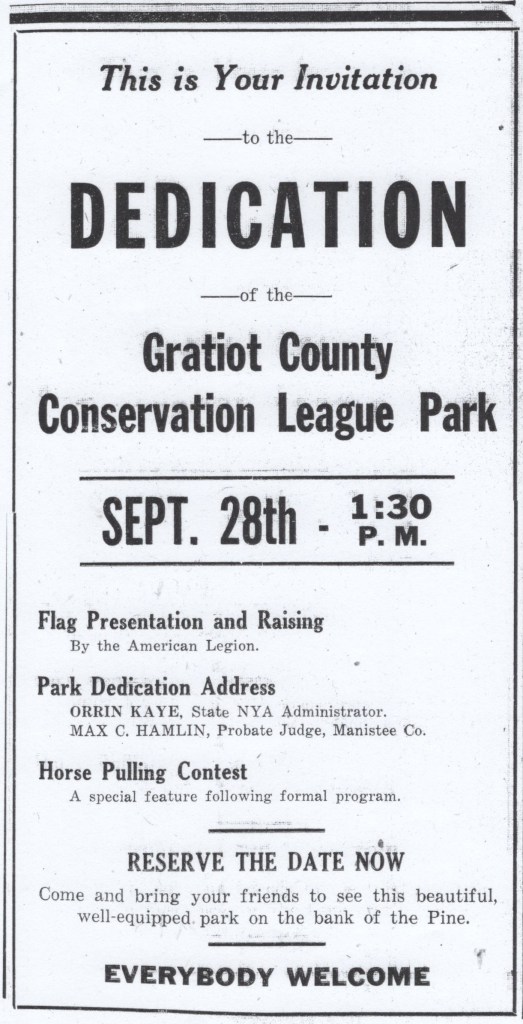
In a big affair, Gratiot County celebrated the dedication of Gratiot County Conservation League Park in early October. On a crisp, clear day, southwest of Alma, a large crowd of people turned out to celebrate the work done on the 53-acre park that the Gratiot County Conservation League purchased in 1937. Fifteen minutes before the program started, Alma city manager William E. Reynolds, Howard C. Riggle, benefactor of the park, and Dean Carter, NYA county director, were interviewed on the air by Saginaw’s WSAM station. A flag-raising ceremony then started the program, emceed by Dr. Thomas Carney, who introduced a series of speakers. The National Youth Administration (NYA) was recognized for having done much of the work over the previous two years with the help of federal aid, such as constructing the one-hundred-foot suspension bridge and working on the park’s landscaping. Even as winter approached, NYA boys continued to rake leaves and cut dead wood, planning to complete a lawn bowling green before the winter weather arrived.
The NYA also continued to benefit area high school students by allotting $2,268 to eleven high schools in the county. Approximately 65 students earned $3 to $6 a month during the school year for their work with NYA. The money earned by students went toward lunches, carfare, and school supplies.
WPA (Works Progress Administration) project work also continued in the county. A group of twenty-five men worked excavating six cement tennis courts at Wright Park. Another group of seventy-five WPA workers labored on street paving jobs on streets like Orchard, Walnut, Downie, and Wright Avenue. A shortage of summer labor and the oncoming winter season meant that some projects in Alma would have to wait until 1941. The WPA also suggested creating a possible skating pond, a roller skating project, and even a swimming pool in St. Louis. For the summer daily project, there were 587 young people in attendance, according to Coach Oldt. WPA projects also involved grading and widening different roads in the county. A bridge at Bridgeville was being repaired, and a new bridge was created over Beaver Creek at Lafayette Township, all with WPA labor.
The Gratiot County board of supervisors appointed a committee to explore the possibility of creating a future traveling library for the county with WPA labor by converting a traveling bus into a library. A $2,000 federal government funding to buy new books, along with book donations from Alma, St. Louis, and Ithaca libraries, would supply the necessary reading material for rural students.
Ten youths from Gratiot County took their examinations to serve in the Civilian Conservation Corps (CCC). The group was expected to work at Camp Axim in Cadillac. The ten included: Alger Anters, Wallace Cratsenburg, Donald and Lester Dunn, Victor Hall, Clyde LaVoy, Nile Liscomb, Cecil Skutt, Murl Smith, and Denver Welsh.
Other news involved a settlement between creditors of the late Bank of Elwell after a dozen possible suits. Assets would soon be divided among the creditors to bring the issue to a close. For the week ending August 31, 1940, the Alma Welfare Office processed compensation claims for $6,519. The Social Security representative for old age security will be late in appearing in Alma because of attendance at a conference in Cleveland, Ohio. Manager Joseph W. Ramsey of the Saginaw field office would be back on October 23.
Farming and Farm Issues
An early frost hit the county just as weigh stations for sugar plants opened during the second week of October for the estimated 2,260 sugar beet growers in Gratiot County. On Tuesday, October 8, both the St. Louis and Alma plants started taking beets from farmers. At the end of October, farmers received one of three types of payments for their sugar beets. First, there was payment on actual tonnage if it exceeded eighty percent of the normal yield of the farm. A deficiency payment was the second type paid if tonnage was less than eighty percent of the normal yield. A third payment was made for abandoning 1/3 of the normal yield if beets had been abandoned.
Other, more serious problems still faced Gratiot County farmers, such as the battle against the corn borer. One hybrid corn plot in Emerson Township, belonging to the Grover Brothers, showed that their corn, planted on June 2, had sixteen corn borers in just one stalk. With 40,000 acres of corn planted in Gratiot County during the year, it was estimated that the pest caused $400,000 worth of damage to the crop. Concerns over the seriousness of corn borer damage came out in a Gratiot County editorial urging farmers to take the issue seriously as they prepared for 1941.
Miss Helen White of St. Louis, Missouri, met with the executive board of the Gratiot Council of Churches. White, Regional Director for the Council of Women for Home Missions, gave final reports about the Mexican center that operated during the summer and revealed plans for Mexican migrant workers in 1941. Miss White also spoke to the annual convention of Gratiot County churches on “Michigan Migrants.” Much of the financial support for the Mexican center in Alma came from churches in the county, as well as Leonard Refineries, Michigan Sugar Company, Lake Shore Sugar Company, and Michigan Sugar Company Workers Association. Reverend Floyd Drake of Breckenridge was recognized for his tireless work for the Mexican school.
A variety of news items dealt with Gratiot farming. The People’s Elevator Company moved into new offices in Elwell in what had been known as the Bina Slingluff home. To make the mill more efficient, the building had been moved back 150 feet. Ward Bronson served as manager. In early October, the county announced that 4-H interest had peaked at 500 enrollments, and 61 schools asked for winter clubs. Country schools from Hetzman in Emerson Townships to Sunnylawn in Wheeler Township all wanted to join the growing 4-H enlistments. On October 1, the Farm Bureau held meetings in places like the Beebe Hall, where Sherman Edgar served as chairman. An egg grading demonstration, a discussion about the corn borer crisis, and the call to create a community scrapbook about life under a democracy all took place.
October meant pheasant season, and many farmers in the county dreaded the appearance of hunters on their farmlands. Before the start of pheasant season, fourteen hunting clubs restricted hunters by ordering that they obtain a pass from the farm owner before hunting his land. Sunday hunting was closed, mainly, and Gratiot County petitioned the state for a statewide hunting ban on Sundays. On opening day, “nimrods” could be seen on many wooded tracts and farms, taking their share of birds. However, a few were caught hunting too early and paid fines of up to $12.00. To warn hunters, a sunrise timetable had appeared in local papers to indicate when hunters could start shooting on the first day. Unfortunately, toward the end of October, surveys of pheasant and rabbit hunters suggested fewer of them were taken, possibly due to the cold, wet spring. A statewide dog quarantine to contain a rabies outbreak officially ended in late September in 42 counties. Gratiot County was one of the counties where the ban ended.
The holidays were not that far off, and a county-wide turkey tour to see 15,000 turkeys in Gratiot County took place on October 23. The success and importance of turkey farms in the county were evident as the tour members visited at least fifteen different turkey farms. On a sad note, Lawrence Nemcik of Bannister lost his barn and hay. A kerosene lantern was believed to be the cause of the fire.
The Long Arm of the Law in Gratiot County
The law doled out justice as October arrived. On the court docket, nineteen law cases, four chancery cases, and six chancery divorce cases awaited Judge Kelly Searl. During September, the court ruled on sixty convictions: 39 were for traffic law violations, and 21 were for other general offenses. The court collected a total of $448.85 in fines and costs. One person failed to pay the dog license fee and paid $6.85 in fines and costs. Judge Searl dismissed one case of bastardy when the couple agreed to marry. In some good news regarding dogs in Gratiot County, dog license fees generated $1,417.48 more than the amount paid to farmers who lost livestock to dogs from October 1939 through September 1940. The profit was attributed to owners keeping their dogs confined during a rabies outbreak and purchasing licenses.
Warren Glaser, 26, of Saginaw, was arrested for larceny of a diamond ring valued at $500 from a well-known Ithaca lady. The ring turned up at Wolverine Billard Hall in Saginaw after Glaser pawned it for $25. Upon arrival at the county jail, Glaser claimed he experienced severe stomach aches and had to be transferred to Smith Memorial Hospital. Doctors could find nothing wrong with Glaser, and he was handcuffed to his bed for another day. A pair of cattle thieves, Charles Vanatter of Eaton Rapids and Ashley Eaton of Detroit, awaited extradition to Gratiot County for trial on their crimes. Both men were serving 90-day jail sentences in Ingham County. Two St. Louis dentists’ offices were investigated by police when thieves stole gold fillings valued at $250. One dentist also claimed that over $200 in other filling material was also stolen.
The story of the troubled Cornelius Eichorn again appeared in circuit court. Eichorn had been arrested and convicted for repeated driving violations, resulting in his license being suspended. He recently wrecked his car a year earlier by smashing it into a large tree. Now, his wife, Effie Smith Eichorn, appeared in court to contest her divorce from Cornelius, desiring a settlement for herself and her young son. Cornelius Eichorn owned 120 acres of land in Emerson Township, and the hearing for the case lasted nearly an entire Monday in court. Mrs. Nellie Ranchun, poultry and egg buyer from Detroit, appeared in court for swindling Harry Bolyard of Middleton. Ranchun first agreed to buy eggs at 15 ½ cents a dozen from Bolyard. When Harry wasn’t around, Ranchun managed to negotiate a deal with his son for 13 cents. The younger Bolyard, unaware of the prior agreement, was a victim of Ranchun’s shrewd tactics. Justice Potter did not see it that way and awarded Harry Bolyard the full amount, as well as damages of $25.75.
A series of Ashley businesses experienced break-ins and robberies by at least two men. Joe Liska’s grocery, Ashley State Bank, and Martella’s beer garden were all broken into, with slightly less than $50 taken from each place. The thieves also made off with cigarettes and other goods, even though one robber was seen walking in front of a house in the village. A getaway car quickly scooped him up and sped out of town, and the search for the robbers continued. Other news about Martella’s beer garden was also not very good. Three men (Mike Minarik and Nicholas Vanatter of Ashley and Dennis Wingle of Ithaca) were arrested as a result of a drunken brawl. Minarik and Wight paid fines; Vanatter, along with his brother, awaited trial on assault and battery charges.
Over in Seville Township, Dewey Parks, 62, got into a fight with his tenant farmer, Hiram De Camp. Parks, who had only one arm, picked up DeCamp and took him from his car during an altercation. Parks was severely beaten and suffered broken ribs. Problems related to family affairs were cited as the cause of the fight. With the arrival of pheasant season in the county, Conservation Officer C.B. Smith found himself very busy checking and arresting hunters for illegal hunting. On opening day near Ashley, six hunters were arrested for hunting before the 7:00 a.m. start time. Each paid $11.85 in fines and costs.
More news about the Dewey Glinkie embezzlement case continued. A surety company reimbursed Gratiot County for $3,169.55, the amount Glinkie stole from the county. The ongoing search for Dewey Glinkie continued in an effort to bring him to justice.
Over at the Gratiot Circuit Court chamber on one Tuesday, a tax-reverted land sale took place. Bidders purchased a total of 148 out of 388 available land parcels, including 150 vacant lots in Alma, significantly contributing to the sales, especially in five Alma subdivisions. Two hundred eighty acres of land for sale around Half Moon Lake in Seville Township were also purchased by interested parties.
As remodeling continued in the basement of the courthouse, Mrs. Fred Hunter reached an agreement with the board of supervisors to operate a detention home for children in her house in Ithaca. Hunter agreed to offer two barred rooms, one for boys and one for girls. The county would furnish the rooms, and the rent would cost $2 per week. The county agreed to pay $1 per day for each child and fees for extra care.
Gratiot County’s Health Issues and Concerns
The Gratiot County summer dental program informed the public that the twelve-week clinic, held in Ithaca, Alma, and St. Louis, had 805 initial visits from children, with an additional 116 appointments. Over 1,000 teeth were extracted, and over 600 fillings were performed on patients. A total of 49 students refused treatment. Doctor Gerald Barrow served as the dentist in charge.
The State Health Commissioner urged parents across Michigan to be on guard against infantile paralysis. In October, over fifty cases were reported in just three days, and through October 16, the 1,022 reported cases exceeded last year’s total of 904. Fifty-eight Michigan counties reported incidences of poliomyelitis. Symptoms included fever, nausea, irritability, leg stiffness, pain, and tenderness in the arms and legs. Doctors urged parents to have their children diagnosed and treated if suspected of contracting the disease. Only one out of three or four cases was believed actually to turn into paralysis.
Mental health issues also confronted Gratiot County. Roy Foote, age 56 and a former resident of Lafayette Township, was found dead at his home in Lansing Township, a victim of suicide. Foote had become dispondent over several financial reverses and took his life in his car by carbon monoxide poisoning. In another incident, Joseph Guszak, age 65 of Ashley, took his own life by slashing his wrists, abdomen, and throat with a set of scissors. Guszak had been dead approximately three days when he was discovered at his shack northeast of Ashley. When first seen by a neighbor through a window, Guszak appeared to be asleep in bed. Returning later, the neighbor noticed that Guszak had not moved and entered the building only to find Guszak deceased. The Sheriff’s department stated that Guszak was an alien and believed he had a wife and children in Chicago. It was not the first time that he threatened to kill himself, as he had previously been detained by the Sheriff’s department until released into the care of friends.
And Then There was Halloween
To celebrate the Halloween season, the Ithaca village council and Chamber of Commerce provided Aladdin, a professional magician who performed in the Ithaca High School auditorium. The Alma city commission heard a proposal by NYA and WPA recreation leaders for Alma’s annual Halloween party. Celebrations there included a parade from the Tourist Park, downtown, to Rademacher Motor Sales Garage. Back at the park, activities, bonfires, and contests took place until 10:00 p.m.The leaders ordered 800 noisemakers, confetti serpentine streamers, and rubber balls for the participants, as well as 200 toy balloons to be released from the tops of various buildings. Those who found the balloons were eligible for certain prizes. In places like Alma and St. Louis, authorities warned pranksters that waxing windows and other pranks would be taken seriously.
And So We Do Not Forget
Murray D. Wagoner, Democratic nominee for governor, held a gathering at the Alma IOOF Hall. Wagoner recalled his work in Gratiot County as a young University of Michigan graduate in 1922, when he received his first engineering assignment to work on the construction of the Honeyoye Bridge, located west of Alma on M-46. It was his first supervisory position as an engineer for the state highway department…Russell DeVrires of Alma lost a large load of fruit and vegetables on his travels east of St. Louis after other drivers told DeBrires that his load was getting away from him. He lost four bushels of cucumber pickles and thirty dozen ears of corn due to a broken tail gate, which was at fault. The items he retrieved (going all the way back to Breckenridge) were heavily damaged….The St. Louis Cardinals baseball team sent a scout to Alma to sign Carl Schultz to a major league contract. Past attempts to sign Schultz had failed, as he had signed an agreement in 1939, and things did not work out…Zane Betts of Alma was admitted to Smith Memorial Hospital for an injured knee. Betts received a cast and was then released… Mazey of Perrinton led all St. Louis Softball League hitters with a .556 average for the 1940 season. Rowley and Church led the team batting category with a .382 average. Brink of Rowley and Church was one of five players to have five home runs on the season…The St. Louis High School Home Economics Club sponsored the first dance for the first home football game. The “Krimson Kickoff” allowed participants to “kick” for 3 ½ hours, and a pair of red and black goal posts decorated each end of the gym…The St. Louis Leader published a list of dates and information about flag rules and use. Instructions and a list of holidays told readers where and how the flag should be displayed.
The Meteor Flying Club of Ithaca gave its members ninety minutes of flying instruction before piloting a plane. George F. Shores of Lansing served as instructor. The club had fifteen members and a 180-acre flying field two miles northeast of Ithaca…Alma merchants prepared for the merchants’ window night on November 27. The event featured the first display of holiday street decorations and the start of the holiday season in Alma…Alma schools planned to close for Armistice Day on November 11. Last year, the school only shut down for half of a day…Two Alma men, R.V. Hamp and Wayne Croton, both Alma Trailer Company workers, met their end while duck hunting near Bay Port, near Bay City. It turned out that the two men shot one duck, threw it into the boat, and when they got to shore, experienced a big surprise. A large skunk was on board the boat and ate half of the dead duck. After picking up the duck, the skunk ceremoniously “anointed” both men who attempted to flee the ship all to no avail….The Jean Bessac Chapter of the DAR completed its work of leading the creation and presentation of a patriotic pageant on the Alma College athletic field in early October. The pagent honored the golden jubilee of the founding of the Daughters of the American Revolution….The Alma City Commission again discussed the idea of establishing a Gratiot County Airport. The city hoped that a state program would provide as much as $80,000 toward the building of the airport…A.C. Sholty of the Alma Dairy announced he had installed a new bottling outfit of the sucker type. It was considered to be among the best bottling equipment available.
Frank Rudeck of Alma moved his Bass Lake cottage a total of eighteen miles in one day, courtesy of Vance Moving of Ithaca. The cottage came right down M-46 and to its destination via State and Downie streets, dodging branches and tree limbs along the way. The cottage was placed on a foundation at 209 West Downie, where the cottage became the bottom part of a new house. An upper level would then be added one story higher, along with a new roof…Buy a Fireside Ventu-Rotor heater at Mitchell Furniture Company in St. Louis. Save 1/3 of fuel costs, air forced principle gives good circulation, liberal allowance for your old stove…George Tugen, Ithaca High School right end, made a big catch and helped Ithaca defeat Chesaning 19-9 in football. Ithaca players Williams, Mellinger, and Stahl also contributed to big plays in the game…Wayland Payne, a 1940 Fulton Township Schools graduate, took off for Florida on a bicycle. Leaving on October 8, he expected to be in Florida around November 1…George Brent, Virginia Bruce, and Brenda Marshal all starred in “The Man Who Talked Too Much” at the Alma Theatre. Tickets cost ten and fifteen cents…A group of forty different pupils from across Gratiot County came together in Ithaca at the direction of county school administrator Donald L. Baker. The group rehearsed for a thirty-minute broadcast on WKAR at Michigan State College. After the presentation, the students visited the college campus and toured the Capitol. Baker mentioned that this program replaced the usual Gratiot Spring Musical Festival in 1941…A curriculum workshop for rural teachers took place in North Star. A group of 41 teachers signed up to take the classes on Monday evenings from 4 to 10 p.m. for 18 weeks. The workshop allowed teachers to earn credits toward their teaching degrees.
Paul L. McKee, a popular widowed clerk at the Alma Post Office, told a local newspaper about his postal stamp collection, which included over 20,000 foreign stamps and a large assortment of domestic stamps dating back to 1851. McKee had been collecting for over 25 years…Reed’s Dance Band appeared at the Danceland Ballroom every Wednesday and Saturday in Alma…The North Star Bearcats were the undisputed champions of the Gratiot County baseball league. The team went 15-1 for the summer…Newark School Number 4 had the highest attendance in a one-room rural school in the county, with 46 students. Julia Fahey taught that group. The smallest one-room school was Emerson Number 8, which had five students and was taught by Doris Cowdrey…Dr. Leslie Howe was honored at the Wright Hotel in Alma by the Tri-County Medical Society for fifty years of service as a country doctor…Over at St. Louis High School, Superintendent Nurnberger and Coach Oldt got up early on the first day of pheasant season and each brought home one pheasant. Both men returned to SLHS for the start of the school day…While Alma prepared for Halloween celebrations in town, a local column reminded youngsters that soaping windows was not welcome. Please bring your energy to the Halloween party in the city…Carson Clapp opened Clapp’s Hardware on Mill Street in St. Louis in the former Kroger store. The Clapp family had a long history of involvement in the hardware business, with stores in North Star and Alma.
Clark Gable and Joan Crawford appeared in “Strange Cargo” at the Ideal Theatre in Ithaca. Viewers also watch the “Deadwood Dick” episode, a color classic, and view screen snapshots. All for only a dime…Wanda Gabrion and Norma Gay made their first appearances as drum majorettes at Ithaca High School’s game against Shepherd. Both belonged to the baton twirling class offered during the summer at Ithaca…A new tavern at the St. Louis CSA Hall announced Saturday dancing starting November 2 for only fifty cents a person, supper included. Three big door prizes would be given out, and a Lansing orchestra would perform music…The St. Louis Softball Association announced that it had a balance of $81.56 in the bank after all bills were paid for the 1940 season. T. Jefferson Hoxie served as treasurer…Alma Schools sponsored Adult Education classes for any member of the Alma community not regularly enrolled in public schools or college.
And that was Depression and War during October 1940.
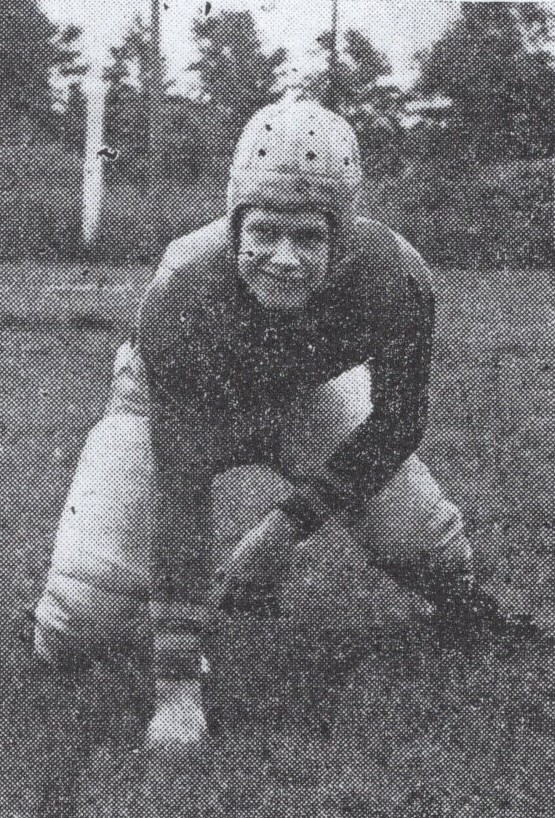
Gratiot in September 1940, from the top: Going back to school again and learning about impending warfare, September 12, 1940, cartoon from the Gratiot County Herald; Gratiot County Conservation League Park is dedicated. A combination of members, volunteers, along with NYA and WPA workers, made the use of the park possible in late September 1940; Elwood Mellinger, captain of the Ithaca football team, as it prepared to face St. Louis on September 20, 1940.
Another cold, wet fall meant it would be a challenge to bring in another Gratiot harvest.
It was a time when America prepared for a peacetime draft – its first draft since 1917.
What, Roosevelt runs for a third term as President? No President had done so in the nation’s history.
Residents also learned that the WPA programs would soon come to an end after five years of operation.
What was going on?
It was September 1940 in Gratiot County.
Europe at War, Preparation at Home
As Hitler continued to attempt a conquest of Great Britain, the only remaining obstacle to his domination of Western Europe, Gratiot County prepared for war. Although the Führer boasted to England that “I am coming,” England countered by conducting another of its early air raids upon the city of Berlin.
Even before entering the fall elections, President Franklin D. Roosevelt spoke freely and openly about the need to prepare the nation for war, and instituting a peacetime draft now became a reality. All American young men between the ages of 21 and 35 had to register for possible conscription by October 16. Roosevelt’s initial goal was to mobilize 400,000 men by early 1941 and 900,000 by the spring of that year. All registrants would carry a registration card, and those who failed to register would be considered evaders.
As a result, Gratiot County received approval from President Roosevelt to form its first draft board in twenty years. Four men, Dr. C.F. Dubois (medical examiner), Charles R. Murphy, A.D. Smedberg, and Robert Reed, headed the Alma board. All served without pay. Ahead of the draft, six local men signed up at the Alma post office on one weekend to join the United States Marine Corps. Robert Hennigar, Burson Youry, Paul Dintaman, and Lyle Goward of Alma, along with Donald Zinn and Richard Horton of Vestaburg, expected to go to Saginaw for their formal physicals. If they passed the examination, the group of men would be sent for Marine training at Parris Island, South Carolina.
Men involved in Troop B, National Guard, of Alma, returned from drills in Wisconsin. However, Captain Howard L. Freeman believed that the unit would soon be called into service as part of the 210th Coast Artillery, an anti-aircraft unit. Two weeks later, that assignment changed again, and the group would be known as Battery B of the 177th Field Artillery. The Alma battery needed to increase its strength from the current roster of 60 men to a total of 122 men between the ages of 21 and 35. At this time, one Michigan newspaper reported that many National Guardsmen would be sent south in October to Camp Beauregard, Louisiana, for a year of training. President Roosevelt soon signed an order calling up over 60,000 men in the National Guard for a one-year period of service. Sadly, a result of this order meant that the horse cavalry unit, long a part of Alma and Gratiot County’s history, would soon depart for Illinois.
Photographs in county newspapers, such as the Alma Record and Gratiot County Herald, demonstrated the hardships of war as well as this nation’s preparation to be drawn into the conflict. In an attempt to feed its population during war, England used all of its land to raise food, including growing wheat in London parks. Londoners also paid an admission fee to see a recently shot down German Messerschmitt fighter for the “Buy a Spitfire” fund. In Santa Monica, California, one plant worked to produce the world’s largest bomber, a four-motored aircraft with a 210-foot wingspan. It held a crew of ten men and could fly 6000 miles on a bombing mission. In Springfield, Massachusetts, a plant there produced 1000 Garand semi-automatic rifles daily. The plant commander urged the War Department to expand production. Two inventors of the concrete pillbox, a concrete dome-shaped shelter that builders could set in five hours, demonstrated it in front of the Army and congressional leaders. These small fortresses could be used in America to guard its borders.
Depression Life Continues
The New Youth Administration (NYA) continued work in the county as 80 young men and women received permission from the program to work more hours, and therefore, more pay. Thirty-five young women worked on various projects, including recreational activities at Conservation League Park and maintenance tasks at Alma City Hall. All project workers were required to take and complete their initial air courses. A few NYA members worked with WPA supervisors at places holding girls’ activities at Wright Park for handicrafts or at wood games activities for young people at Republic School. James Carter oversaw the woodcraft project at the Salvation Army Center. As Halloween approached, the NYA staff led interested children in creating paper masks using clay, which would be displayed at the indoor recreation centers. Two Gratiot County students, Elroy Prince of Ithaca and Darwin Snyder of Breckenridge, attended a short NYA agricultural course at Michigan State College. A total of thirty students made up the group, attended class, lived in a barracks, and worked part-time. At different Gratiot County high schools, student aid workers on the NYA payroll earned $6 each month once they received NYA certification.
The Works Progress Administration (WPA) offered further training to members from Gratiot County who traveled to Hoyt Park Field House in Saginaw. Director Darrell Milstead, recreation director, led the group as it learned about fall sports activities, arts, crafts, administration, and first aid. Among those who attended were Hazel Markham (from Ithaca), Henry Sholtz and Lester Fillhard (St. Louis), James Carter, Jack Acker, Lowell Williams, and Eldon Lott (Alma). The WPA program, which had operated nationally for several years, received news in late September that all WPA work would end by June 1941. The program director urged WPA leaders across the nation to complete their existing projects within the allotted time and avoid initiating new ones. An increase in funds for defense appropriations and an overall atmosphere of the need to train for national defense meant an end to WPA programs.
People who had past accounts with the Elwell Bank received good news from Charles H. Goggin, President of Alma First Bank of Alma. He announced a possible agreement to disperse the liquidated assets of the former Elwell Bank. Litigation continued in court in Ithaca, but an announcement was expected soon. A hundred former bank depositors had filed suit to get money from the Alma Bank, which they claimed was also tied to the Elwell bank’s collapse. The judge granted ten days for any other former depositors to file their claims for money.
Over at the Ithaca courthouse, work began on the new social welfare offices and Gratiot Bureau of Social Aid, which planned to relocate from Alma. The two new offices, expected to open in the courthouse basement, and the remodeling meant that a new entrance would be created on the south side of the building. The new rooms would now occupy what was formerly known as the youth detention area and janitor’s living quarters.
Health and Gratiot County
The Children’s Free Dental Clinic continued its work in the county after completing its time in St. Louis. A dentist worked on a total of 222 St. Louis children with 335 cavities filled and 185 teeth extracted. Another 29 children had their teeth cleaned. The Child Study Club sponsored the clinic, which provided free healthcare to underprivileged children. Doctor G.V. Barrows did the dental work and was assisted by Beth Hicks. Several children from Wheeler and Breckenridge attended the clinic as well.
The public received warnings about outbreaks of infantile paralysis in sixteen different Michigan counties. Believed to be a seasonal disease that peaked in late August and early September, a total of 272 cases were discovered in the state during September. In related news, Leonard Hubbard, 29, a popular Vestaburg musician, died of the disease only one week after contracting it. He left behind a wife and three children. In other health news, a Bannister man took his own life after years of battling illness. Frank Goldman, age 67, hung himself in his barn early one morning. Goldman suffered from being unable to eat and sleep due to health problems. In another twist, he was scheduled for the next step of becoming a naturalized citizen the day after his death. Goldman farmed in the community for 28 years.
The Long Arm of the Law in Gratiot County
August 1940 proved to be a busy month for the courts as a variety of offenses resulted in 47 convictions. Only 18 in the group were found to have committed serious crimes, and most of the others were due to traffic offenses. Fines totaled $258.30, with an additional $162.80 for costs. Some of the serious crimes involved one man being sent to Jackson Prison and four others to the county jail. Otis Andrews was sent to Jackson for violating probation for a third offense of drunk driving and got six months to two years. Andrews was warned that if he ever showed up in court again, he would be immediately sent back to Jackson.
Lawrence Lutz, 18, of St. Louis, was found guilty of carrying an unloaded concealed weapon without a license. He only got a year’s probation and was ordered to attend church with his parents every Sunday. Four men were convicted of fishing law violations for setting an illegal set line on the Maple River. They each paid $10 for a fine and $6.85 for costs. Another person unlawfully used an automobile and got three years’ probation and $200 for damages to the car.
The Alma City Commission had its first reading of a proposed ordinance regarding trailers in the city. If accepted, the new ordinance would regulate trailer families and individuals from taking up residence on vacant lots or yards. Those wishing to reside in trailers had to do so at a licensed trailer camp and pay $15 for a yearly license. The trailer camp owner was also required to provide a service building, showers, toilets, laundry facilities, drinking water, and a list of other amenities. Anyone parking a trailer next to a homeowner in Alma could only do so for two weeks at a time.
Regarding elections and politics, Gratiot County gave favorite son O.L. Smith a nearly 2-1 advantage over incumbent Luren Dickinson for the Michigan Governor’s race in the state primary election. Unfortunately, Dickinson trounced his opponents across the state to gain the nomination. He would face off against Democrat Murray D. Wagoner in November. One of the most interesting and spirited contests involved three candidates for Probate Judge. Mildred Taft, daughter of the late Probate Judge James G. Kress, won the primary election after being appointed by the Governor to fill out her deceased father’s remaining term. Taft would serve as Probate Judge until 1963.
Naturalization hearings continued at a good pace in the county as ten residents from six different countries applied to become American citizens. For this ceremony on September 19, something new happened. This time, DAR chapters from Alma and Ithaca organized a short march to the court. At the same time, bugles played and Boy Scouts accompanied the group. Alma DAR chairman, Miss Lou Nickerson, gave a brief talk on the Constitution, then Mrs. Floyd Barnes explained the meaning of the American flag. Each new citizen received a citizen’s manual with a copy of the Constitution, which included the Pledge of Allegiance. Each citizen also received a small 4×6-inch flag. Although fifteen candidates faced examination for citizenship, these ten were accepted, while the other five continued further study. Members in the group originally came from places like Croatia, England, Russia, Germany, Poland, and Slovakia.
Alien registrations also continued at post offices across the county. In Alma on one Wednesday afternoon, a total of 18 aliens registered. The Alma postmaster, J.L. Winslow, commented that several persons believed they were American citizens, but upon investigation learned they were not.
Farming
Farmers were urged not to cut their alfalfa but to wait at least until the end of September, unless used for silage or molasses. It was essential to let alfalfa store up root reserve for 1941. Sugar beets appeared to have a later-than-usual harvest due to low sugar content. The heavy rains in late August and early September meant a delay in harvesting. The Michigan Sugar Company announced it had 9,000 acres set aside for raw material for the Alma plant. A new beet dump and piler took care of a load of beets in one minute. Over at St. Louis, the Lake Shore Sugar Company had 10,000 measured acres of beets to harvest. Still, a late white frost hit Gratiot County at the very end of September. County Agent C.P. Milham announced that the enemy of all farmers, the corn borer, caused over $200,000 in damage to county farms. For many in the county, the amount could have meant profit or loss for the season. To combat the corn borer, shredding dry stalks and plowing under others by June 1 had to be a goal for all farmers, according to Milham.
In other farm news, a group of nine Junior Farm Bureau members attended Waldenwood Leadership Training Camp at Hartland, Michigan. A total of seventy-eight young people from thirteen countries attended. From Gratiot County, John Kelly, Gerald Lake, George Cox, Marion Wang, Eugene Oberst, Margaret Douglas, Edward Hooper, Lowell Quidort, and Dorothy Gibson all went. Another 24 schools proposed forming 4-H clubs in the county, bringing the total number of 4-H clubs to 42. The Beebe 4-H Club had 11 members and was led by Mrs. Helen Muscott.
Mexican night entertainment took place in Alma on September 28, coinciding with the dedication of Conservation Park. Mexican talent, recruited by Pastor Albert Mareno of Shepherd, performed a program at the Alma Tourist Park, located west of the Christian Church. Finally, pheasants surprised Dick Brown and his daughter in Alma as a rooster and three hens were flushed from behind the Brown home inside the city. Young daughter Brown is very excited to see the pheasants.
And So We Do Not Forget
Thirty boys showed up for the first St. Louis football practice of the year. The Labor Day practice marked the beginning of preparations for the season’s first game against Ithaca, just three weeks away. Coach Elliot Oldt was seeking guards and tackles to fill the ranks vacated by last year’s graduating seniors…Fulton School in Middleton and Perrinton started school on September 3, and Superintendent Eberly announced the school had four new teachers. Fulton had a total enrollment of 434 students. Grades seven through nine met in Middleton, while grades ten through twelve had classes in Perrinton. The district had five school buses…” When the Daltons Rode,” starring Randolph Scott and Kay Francis, appeared at the Strand Theatre in Alma. Tickets were ten and twenty cents…Ithaca Public Schools opened with an enrollment of 597 students. Kindergarten had forty-eight students; the senior class was made up of sixty students…The Perrinton softball team finished first and was the winner of the 1940 fastpitch softball season in St. Louis. Rowley and Church finished as runners-up.
The public was invited to observe the dedication of the Gratiot County Conservation League Park in Alma on September 28 at 1:30 p.m. Activities included a flag presentation and raising, public address, and horse pulling contest…The Pentecostal Faith Riverside Tabernacle church dedicated its new building at 523 Michigan Avenue in St. Louis. The new building seated 100 people…Students, buy your new fountain pens at Green’s Jewelry in Alma. The fountain pens only cost 29 cents each…Work on the new Gratiot County highway garage continued. The $65,000 structure is planned to open on November 1. Situated in East Ithaca on the south side of US-27…The Lincoln School in Alma received a trophy from the Automobile Club of Michigan for the number of safety contacts it had during the previous school year. One of the achievements of the Lincoln School was its use of school safety patrols by children. Lincoln placed first among forty other Michigan schools for the award…Harold Woodley of Alma saw the excavation for his new house begin in late September, marking the start of construction on his $6,300 residence on West Superior Street. The new home would be just east of the Lester Purdy Riverside Dairy farm.
Alma Schols began the new school year with approximately 1,750 students. This included 225 non-resident students who paid tuition to attend school in Alma…A “Pageant of America” was planned to be performed on the Alma College athletic field on October 4. An estimated 500 people from Alma organizations and leading citizens were involved in presenting this program. The Jean Bessac DAR Chapter led the organization of the pageant…Radio station WJR, the state’s most powerful radio station, planned to have two announcers in Alma for its “Michigan Speaks” series. Jack Garrison and Duncan Moore planned to broadcast from the streets of the city to gauge county voting preferences for the upcoming 1940 Presidential Election between President Roosevelt and challenger Wendell Wilkie…Otis Brantley, chef at the Main Café in Alma, and Claude LaVoy of Riverdale hit it big while fishing on the Maple River near Matherton. They caught two of the largest catfish seen in Alma in a long time. One was over 4 ½ feet long and weighed 45 pounds…The Michigan Masonic Home has a new V-shaped electronic sign in front of the home. It turns on automatically at 7:30 p.m. so that anyone passing by on US-27 can see it.
An open house was scheduled at George W. Stewart’s new home on 612 Liberty Street in Alma. James Medcoff, a contractor and builder, designed and built the new house using materials from the Little Rock Lumber and Coal Company in Alma. The new home cost $3,500 to construct…Senior Elwood Mellinger, left tackle, served as Ithaca football captain for the team…A tragedy occurred in Elm Hall when an explosion and fire took out the Hoxie General Store on a Friday morning. A combination of a kerosene heater and cook stove malfunction caused the fire, which resulted in $4000 in damages. George Mack and his wife had insurance on the building and contents, but it would only cover part of the loss… Roy Rogers and Gabby Hayes starred in “Saga of Death Valley” at the Ideal Theatre in Ithaca. Catch a Saturday matinee for only a dime…James Redman, 20, Alma, married Opal Jean Hahn, age 18, of Alma, and became the latest of Cupid’s victims…Miss Virginia Hetzman of Alma was runner-up at the State Fair for the dress she made and wore for the style revue. Hetzman had been involved in Martha Jean Conklin’s 4-H club for the past seven years…A representative from the Saginaw field office of the Social Security Bureau, Alma, will be Available on September 18 for two hours to answer questions and provide assistance to those applying for Social Security. Meet the rep at the office of the Michigan State Employment Service in Alma’s city hall…Finally, someone (or something) shut down ten telephone lines and twenty-five telephones in Ithaca. In this case, a fox squirrel ate through the leaden sheath of an aerial cable on St. John’s Street. The squirrel gnawed through the lines, exposing them to water. It was the second time in five years that Union Telephone had to address this problem.
And that was Depression and War in Gratiot County during September 1940.
From top to bottom, life in April 1940: A new neon sign appears in county newspapers. The sign at the corner of Washington and Mill Streets is considered one of the nicest in mid-Michigan; a WPA mural done by Joe Cox, entitled “Harvest,” is hung on the north wall of the Alma Post Office; a group of English women prepare for anticipated air raids in London.
The long winter leaves Gratiot County, and the spring thaw takes place.
In Europe, it meant the resumption of Hitler’s war. “The Phony War” was over as the Nazis invaded Scandanavia, Denmark and prepared to invade Western Europe.
Farmers got ready to work their fields, and people carried on their lives in an isolated area of mid-Michigan. How many quiet springs would be left?
It was April 1940 in Gratiot County.
Winter War Becomes the Spring War
As winter ended in Europe, the “phony war” ended. Nazi Germany now started to make its anticipated aggressive moves toward the West – on land and sea. Gratiot County saw and read about these events through articles and photographs published in county newspapers.
British citizens in London anticipated air raids, as did French ground crews who believed invasion was imminent. French soldiers passed their time in places like the Maginot Line, waiting for the Germans to attack. Australian troops (Anzacs) in Palestine believed that they too faced a Nazi invasion of the Middle East. The Italian navy moved toward the Dardenelles to help the Nazis.
Hitler ordered his troops to occupy Denmark, and the Danes barely resisted. The situation in Poland was far worse as Warsaw lay in ruins and Jews were forced to wear the yellow triangle and walk in the gutters instead of on the street. The Nazis had also attacked Norway and moved to occupy the city of Trondheim on the east coast. The naval war between Germany and England began when Hitler proclaimed he was there to protect them.
In Brooklyn, New York, a group of seventeen men known as the Brooklyn Boys went on trial for plotting to overthrow the government. The United States Army tested new tanks at Camp Ord, California. In St. Louis, Michigan, Vojta Benes, brother of the former President of Czechoslovakia, spoke to groups about how he escaped his country before the Nazis occupied it. Ottakar Podrabsky, a Czech college student who escaped and enrolled at Alma College, explained what life was like with blackouts and preparations for a Nazi occupation. Both speakers asked Gratiot County residents for moral support during the European crisis.
Depression Life May 1940
The issue of a lack of money and social issues in Gratiot County continued in the news.
One of the growing responses to the problems of the elderly remained the popularity of Townsend Clubs. The Townsend Plan was another proposed way of providing pensions for the elderly, and these programs attracted large numbers of interested people. Over in Elwell, a meeting at the Odd Fellows Hall drew sixty people who gathered to see a movie about the Townsend Plan. An even bigger group of 300 interested people appeared at the St. Louis Park Hotel to hear state spokesman Ira Brinker. Dr. Townsend also had regular newspaper columns, such as the Alma Record.
The cost and care of indigent residents in Gratiot County continued to concern those on the board of supervisors. Part of this concern centered upon a potentially growing financial deficit for the cost of care now that Gratiot County had taken over responsibilities from the state. The county received $223.79 a month for total care of all indigents and already had a deficiency of $788.96, and this was only a few months into the county’s role of managing these costs. Much discussion occurred about the need for sworn written statements from county doctors when a child or adult indigent needed to be sent to a place like the University of Michigan Hospital for treatment. An auditor told the commission that if the current rate of debt continued, the county faced a $78,400 bill in October 1941.
Over in St. Louis, the Community Council led the discussion of creating a community chest that could be used in part to help care for needy families. One way to do this was to create a card system for disadvantaged families and places where donations like clothes and shoes could be stored, such as the city hall and the Gratiot County bank building. The bank building was presented as a site where women repaired clothes. The greatest need in St. Louis was shoes for the needy.
All of the discussion about the needs of people across the county occurred during what the Gratiot County Herald labeled “New Deal Defeatism” – or disenchantment with the deficits created by the New Deal. In 1932, the Herald cited the nation’s unemployment at ten million people – the same number a WPA administrator claimed was the rate in 1940. With so many out of work, looking for jobs, and the nation’s deficit growing, how could the New Deal programs be worth supporting?
Places like St. Louis faced financial issues tied to a New Deal program. Residents of St. Louis voted down two bond issues, one of which involved paving sidewalks with additional money from the WPA. That bond would cost taxpayers $32,000, the city $12,000, and the WPA $76,000. There was still interest in the sidewalk proposal, but voters needed more details. The other bond issue, which involved buying the Gratiot County Bank building for a new city hall, went down overwhelmingly.
However, people could still see New Deal programs at work in Gratiot County. NYA workers trimmed trees in Wright Park and faced problems with removing stumps. In 1938, the city removed trees under a state forestry expert’s direction to increase sunlight in the park. Now, the city had to deal with how to get the stumps out of the ground, which required stump-pulling equipment. Without the equipment, it was impossible to remove all of the unsightly, decaying stumps. The NYA also planned to help Alma by working to enlarge the city’s summer programs for youth. Alma High School coach Floyd Lear was contacted to oversee the summer program. WPA workers in Alma continued to work on terracing and seeding streets south of Superior Street on Gratiot Avenue and toward Gratiot. The city also planned to work with the WPA to complete curbing on several streets.
The most beautiful work done by a New Deal program in 1940 was done by Joseph H. Cox of Indianapolis, Indiana. Cox, a University of Iowa instructor, completed a large mural mounted inside the north wall of the Alma post office lobby. Many people turned out to watch as the mural, entitled “Harvest,” depicting harvesters stopping from their work to drink water from a long-handled dipper, was placed on the wall. Another part of the mural showed a one-horse wagon loaded with grain, with farm buildings in the background. Cox came to Alma to supervise the hanging of his mural.
Farming, Outdoors
Unseasonably cold weather in April meant spring planting lagged as farmers waited for spring to arrive. Some called this time in Gratiot “backward spring,” as the only thing being planted so far had been oats. The Gratiot County farm agent commented that more farmers intended to grow more beans than sugar beets. However, many farmers believed that an overproduction of beans would occur and reconsidered their sugar beet acreage.
A group of 1,096 farmers in Gratiot County signed up for farm plans under the AAA (Agricultural Adjustment Administration). The number of sign-ups represented 52 percent of all farms in the county. By signing up with AAA, these farm plans monitored soil depletion, acreage allotments, goals for soil building, and the maximum payment every farmer could receive in 1940.
Farmers who planned to use sugar beet labor were required to pay the same rates as they did in 1939. Those beet growers who wanted benefit payments from the Sugar Act of 1937 had to comply with these wages. In anticipation of the upcoming farm season, Mexican sugar beet workers in Texas faced physical examinations to receive health certificates before they came to Michigan to work in the fields. Michigan doctors who traveled to Texas to examine potential workers looked for tuberculosis and venereal diseases. In 1939, 126 laborers were denied work due to health issues. Of that group, 86 had tuberculosis. The total cost of the examinations was $2,500. Michigan beet growers were supposed to have sanitary living conditions, quarters, and return transportation to Texas.
Problems with rabies and dogs occurred on and off farms as spring began. Clifford McKellar and Dr. D.J. Shepherd of Breckenridge brought charges against Bethany Township tenant farmer Floyd Ludwig. Ludwig shot an English setter belonging to McKellar and Shepherd after he claimed the dog wandered onto his property and lunged at him. However, after getting his gun, Ludwig shot the dog on an adjacent property belonging to someone else. Ludwig was jailed for defaulting on a $500 bond and awaiting an examination. The dog was valued at $200. Miss Martha Carlson of St. Louis experienced sadness when her beloved collie dog, Laddie, was ordered to be put to sleep for his aggressive behavior. Laddie had been in court a year before due to his attacks on other neighbors. In one case, Laddie attacked a man who was plowing on nearby property by tearing off the man’s shoe. While the trial was held in Justice J.L. Smith’s court in St.Louis, the dog’s owner was in Detroit and could not attend the hearing, petitioning the court for leniency through her sister—a sad case for all those involved.
That spring, a bigger issue with animals and Michigan was rabies. 47 counties south of Town Line 21 now faced immediate compliance with quarantining all dogs starting April 1 due to a rabies outbreak. All dogs in Alma had to be confined; if on the street, they had to be on a leash. All stray dogs would be picked up and impounded. Newspapers like the Gratiot County Herald supported the quarantine and believed it was the only way to end the scourge of rabies. Howard Evitts, the county dog warden, also announced that he planned to place dog traps in areas where farmers notified him about the loss of sheep. Dogs caught in these traps would be disposed of upon notification.
The topic of banning Sunday hunting remained a hot issue. Two of three newly formed hunting clubs in the county supported banning Sunday hunting, partly to control the number of hunters invading the county on weekends. Clubs in New Haven and North Shade supported the ban; one in the Seville Township area did not.
There were other things related to farming and farming during April. A new freezer locker storage plant will open in Ithaca – the first in Gratiot County. This locker is expected to open in the old Nelson Produce Company, which Mrs. Gertrude Brown owned. A total of 300 lockers would be available. Interested people could view 700 exhibits by Gratiot County winter 4-H clubs at Alma High School’s gymnasium. Of the approximate 990 girls and boys who worked on projects, 875 finished them. This exhibit, the largest ever assembled in the county, featured girls’ clothing, handicrafts, electrical work, hot lunch, and food preparation.
The C. R. Ranch Rodeo Company agreed to perform at the 1940 Gratiot County Fair. Suckers were running up the Pine River, you could buy live ones at George Gates’ vegetable and fruit stand in Alma on State Street north of the post office. Michigan Mutual Windstorm Insurance Company offered insurance for high winds and tornadoes. Buy chick mash for baby chicks at the Middleton Farmers Elevator Company in Middleton. It only costs $2.35 for 100 pounds of mash.
Health in Gratiot County
Smith Memorial Hospital in Alma received good news when the State Supreme Court upheld its tax exemption. Before this, the city claimed the hospital owed almost $2,000 in realty taxes. Because it argued that the Smith was a charitable, non-profit institution, it was exempt from those taxes. The high court affirmed the decision made in Judge Kelly Searl’s court in 1938 that the hospital did not have to pay those taxes.
A variety of health issues continued to plague the county. The Michigan Tuberculosis Association offered a chest X-ray clinic starting in Ithaca at the Methodist Church to deal with tuberculosis. Those who had a positive tuberculin test after attending clinics in Ithaca and Crystal were encouraged to participate in the clinic. Metal signs went up in public places across the state as well as in the county, warning about the dangers of syphilis. Made by prison industries in southern Michigan and numbering 26,000, the signs appeared in public places such as washrooms and warned of the symptoms of venereal disease. A group of citizens met with the Children’s Fund of Michigan representatives to offer another summer dental clinic. The clinic mirrored the one provided in 1937, in which indigent children who could not afford it received free dental care. The Gratiot County Board of Supervisors appropriated $200 for the clinic.
In sad news, Samuel Mills of Emerson Township, age 58, took his own life after battling nervous depression and despondency for almost fifteen years. Mills had been under doctors’ care for some time. Mills, his brother, and their wives farmed 80 acres of their own and worked the Thomas farm of 240 acres adjacent to theirs. Samuel Mills was found early one morning by his sister-in-law in the cellar. A shotgun had been used as the instrument. Mills left behind a wife, two children, and his brother’s family.
The Long Arm of the Law, April 1940
Crimes and law-breaking of all kinds and levels appeared in the spring of 1940. During March, Prosecuting Attorney Robert H. Baker announced that 58 convictions were reached in court. 41 cases involved traffic violations, while 17 others involved other various offenses. Still, the court received $308.65 in fines and costs.
What were some of the offenses? Six of the cases dealt with breaking, and one with vagrancy. The notorious “Trailer Thief” Ross Smith, father of Michigan’s first trailer baby born in a stolen trailer from Redman Trailer in Alma, was released from jail three years ago. Smith failed to pay $200 in restitution, and then he disappeared. When he turned himself in to the authorities in Traverse City, Smith was sent back to Gratiot County, where Judge Searl gave him six months to five years in Jackson Prison. A jury convicted Leo Rawlings of North Star of stealing nearly 1,000 pounds of aluminum and scrap metal from Lobdell-Emery in Alma. It took the jury only 35 minutes to find Rawlings guilty.
Sixteen couples found themselves in court for chancery cases, in other news involving the law. The Dewey Glinke embezzlement case continued as the county sought to determine how much money Glinke stole from the county in late 1939. County supervisors have now announced that $3,078 in stolen funds is certain. The county would probably owe another $500 for paying two clerks who assisted the auditor general’s office with the case research. During the winter, a few taxpayers outside the county still needed to be contacted to determine if Glinke had stolen their payments. The Glinke case continued for several years in an attempt to find him and bring him to justice.
In other news, the Wheeler Township Board denied two beer license renewals by Orville Wilk and Steve Brenz, both outside Breckenridge. The FBI moved into Michigan—or so it was announced. FBI investigator Chief O. John Rogge said he planned to investigate corruption in high places. One Frank McKay profited from selling over $90,000 in bonds to finance the Blue Water Bridge at Port Huron.
And what else stirred up the Gratiot people in April 1940? It had to be the national census. Many residents spoke out about consenting to being interviewed for the national census of 1940. A list of 25 census enumerators appeared in newspapers to inform readers who would be knocking on their doors. Some, like Ethel Dunn of Elwell, sought out people in Seville Township. Mabel Lippert toiled in Alma’s second ward. Urban enumerators received 40 cents per name, while those in the country got up to 30 cents for each farm they recorded. Individuals like W.G. Davis and H.O. Butler of Ithaca protested being asked to contribute information to the census and being paid to interview them. Butler went so far as to organize the Gratiot County Vigilance Committee and hold a meeting at the Ithaca Circuit Courtroom. A total of 200 people showed up to oppose participating in the census, who did not want President Roosevelt or Uncle Sam to know about their status in 1940.
And So We Do Not Forget
A welcome sign was placed at Conservation League Park outside of Alma. The sign encouraged public use of the park and explained future planned improvements…John G. Young, Riverdale postmaster, died after being ill for two weeks. Young had been postmaster since 1910…the J.J. Newberry Store in Alma planned to open after completing a false front, new trimming, and a new stairway. The fountain bar, a public favorite, remained untouched and ready to continue its service for eager customers. The store planned to rent the upstairs rooms…Area schools prepared for the county achievement tests for two days in early May. Seventh and eighth grade students would take their tests on May 2; the rest had the day off. On May 3, all fifth and sixth-grade students were tested while the rest had a free day. Make sure and bring two well-sharpened pencils and a lunch…Since May 1, 1939, the St. Louis Fire Department answered 61 calls for fires, including 4 in just one week in early April. The department responded to 40 fires in 1939, an increase of 21 fires…Buy your baseball equipment at the Varsity Shop in Alma. Baseball shoes cost only $2.15; gloves and mitts started at 69c, and bats ranged from 25c to $1.75…St Louis put up a large neon sign at the Washington and Mill Streets intersection. It measured 15 feet long and 5 feet high. Newspapers stated that St. Louis was the only city in mid-Michigan with such an attractive sign.
Eight students graduated from the St. Louis Business Institute in the previous three months. Four of the graduates already had jobs. Some graduates included Phyllis Alward, Bette Comstock, and Geraldine Humm from St. Louis…Resident V.K. Beshgetoor described a horrifying incident he witnessed on his way home to Alma. Beshgetoor motored through Shepherd when he saw a young boy inching near passing cars on a bike in northbound traffic. The boy took a tumble off his bike and missed being run over by a truck by only inches. Beshgetoor commented that after being scared for his life, he wondered how parents would allow their children to ride bicycles in such heavy traffic…The Porter-Yost field in Midland Township had 341 wells running and made a daily run of 4,754…The Ford Motor Company provided a Mercury 8 1940 test car for the Rademacher Motor Sales in Alma. Its average mileage is 22.3 miles per gallon.
Go to McIntyre’s Drug Company in St. Louis and order a treat. On April 28, customers could enjoy a free tree from the New Arctic Soda Bar…St Louis Schools expected its teaching staff to return for the 1940-41 school year. The only one not returning was kindergarten teacher Miss Ellen Strom…Mr and Mrs. M.D. Fisher opened their home to host the Gratiot County Rural Letter Carriers’ Association and Auxiliary. The group enjoyed a meal of chop-suey…Jackie Cooper and Betty Field starred in “Seventeen” at the Strand Theatre. Tickets cost 10c and 20c. A local newsreel ran every Wednesday and Thursday nights…The St. Louis Park Hotel offered regular duck dinners for 75c. Frankenmuth style cost $1.00. “Why eat at home when you can dine with us at these prices?”… Sixteen-year-old Richard Hetzman pf Alma was chosen to represent the George W. Myers American Legion as a delegate at Wolverine Boys’ State in East Lansing in late June…The Sawkins Music House sold the 1940 Norge Steri-Seal Washer and a vacuum cleaner for $69.95. Buyers could also pay $1 a week. Interested customers could see for themselves at the Builders Show in the Alma High School gymnasium April 25-27…The Alma Oddfellows Hall hosted thirteen boxing matches for the Alma Athletic Club before a large crowd. Four of the bouts ended in knockouts…Alma High School returned five lettermen for the upcoming track season. Four of the five were seniors…County school children again sold Easter Seals for the benefit of handicapped children. This year, the thirty schools sold a combined $498.45 in seals…Most St. Louis Trade Association members wanted to close their businesses on Wednesday nights and offer entertainment programs on Saturday evenings…
Resident Theodore Bloss made the news for his friendship with neighboring fox squirrels. Bloss had been friendly with several of them for the past four years and had them visiting Bloss on his back porch and eating out of his hand…Burlingame & Son of St. Louis offered the new 1940 Chevrolet Master 85 Business Coupe for $659. Phone 282 to contact the business..Alma Girl Scouts launched their annual cookie sale. Crisp, crunchy butter cookies with chocolate and vanilla flavor appeared like the Girl Scout trefoil. Only 25 cents a box…St Louis Michigan Chemical Corporation displayed its new custom-built salt machine, which could produce one per minute. The blocks were sold to feed cattle…The Alma Builders Shows started on Thursday, April 25, and ran the rest of the week at the Alma High School gymnasium. Sawkins Music House showed moving pictures in the smaller gymnasium each evening…Monroe’s Drug Store in St. Louis sold vitamins, antiseptine, nose drops, and Tread Easy Foot Powder, see the advertisement in the St. Louis Leader-Breckenridge American….An article in the Alma Record told how a migration of Amish settlers left Canada and the United States for Mexico in the 1920s. Now, some of the followers established communities in Maryland…Fleming Shoe Company in St. Louis sold nurses’ Oxfords for $1.98 a pair…Engineers in Montcalm County studied plans to increase the water level in Rock Lake. Plans called for transferring water from Marl Lake, a quarter of a mile away…Alma High School prepared to show 400 feet of film entitled “Land of the Free,” movies taken of students while they were in the building. The school recently purchased movie equipment to show a four-reel movie…
Bert Hicks & Son continued remodeling their grocery store on the corner of Woodworth and Superior Streets in Alma. C.A. Hicks (“Bert”) had been in the grocery business for 37 years, 10 of those for himself. For the upcoming grand opening, Hicks planned to have a SunshinebBiscuit and Maxwell House coffee demonstration for all of those in attendance…James Merodeas joined James Stamas and Steve John as Alma State Sweet Shop partners. Merodeas came to the business with an excellent record as a cook…The Triangle Coal & Oil Company in Alma displayed a new thermometer on their building. In this way, motorists who stopped for gas or oil could easily read the temperature and realize the need to buy more coal for heating during cold weather…Mrs. Inez Brainard of St. Louis established the “Willard J. Brainard Loan Fund” to assist any St. Louis High School students who sought to further their education. Mrs. Brainard established the fund as a way of honoring her son, who died from fatal burns in an incident in 1939…Buy linseed oil, turpentine, and Moore’s House Paint at the Davis-Wolansky Hardware Company in North Star…A total of $498.45 was raised during the Seventh Annual Crippled Children’s Seal drive. Over 30 schools in Gratiot County participated in the program…66 schools renewed their Junior Red Cross subscriptions, which resulted in $100.63 to the Gratiot County Red Cross…Barbara Stanwyck and Fred MacMurray starred in “Remember the Night” at the Ideal Theatre in Ithaca. Admission was 15 and 10 cents…
The thawing of heavy snow in Middleton left much of the village with high water in vacant lots, on streets, and on main roads. School buses could not travel some main routes to pick up students on a Friday. Still, robins and turtledoves could be heard and seen in Middleton…The Ithaca High School Junior Class presented “The Eyes of Tlaloc,” a mystery play, in the high school gymnasium…Mr. Harwood’s St. Louis High School English class polled students about their favorite radio program. Kate Smith’s program and “The Hit Parade” came in at the top of the most listened to on the radio…Bobby Erskin was lucky to have parents and grandparents who wintered in Dunedin, Florida. Bobby loved the Detroit Tigers, saw the Tigers in spring training, and served as one of two Tigers batboys. Ersikine brought home cracked bats used by Rudy York and Roy Cullinbine…Buy a new 6.2 cubic foot 1940 Westinghouse refrigerator for $112.75 at Walker’s Electric Shop in Alma.
And that was war and Depression life in Gratiot County during April 1940.