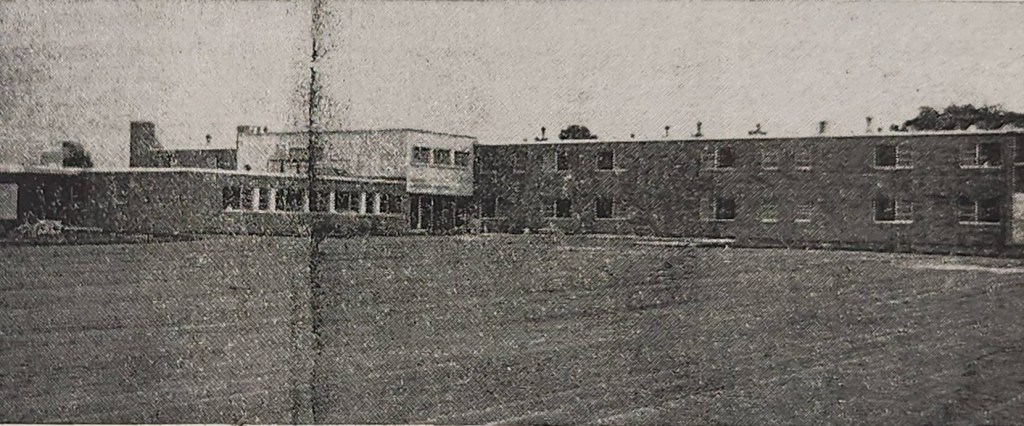
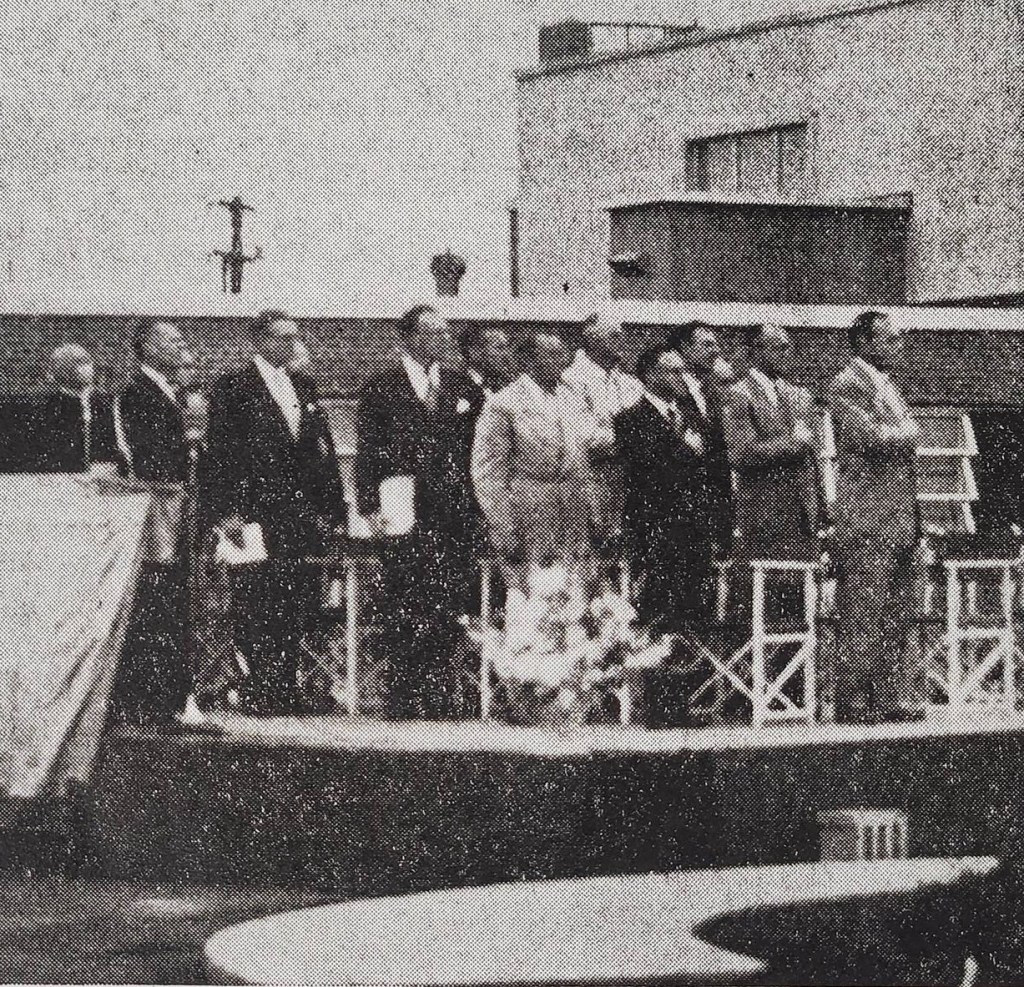
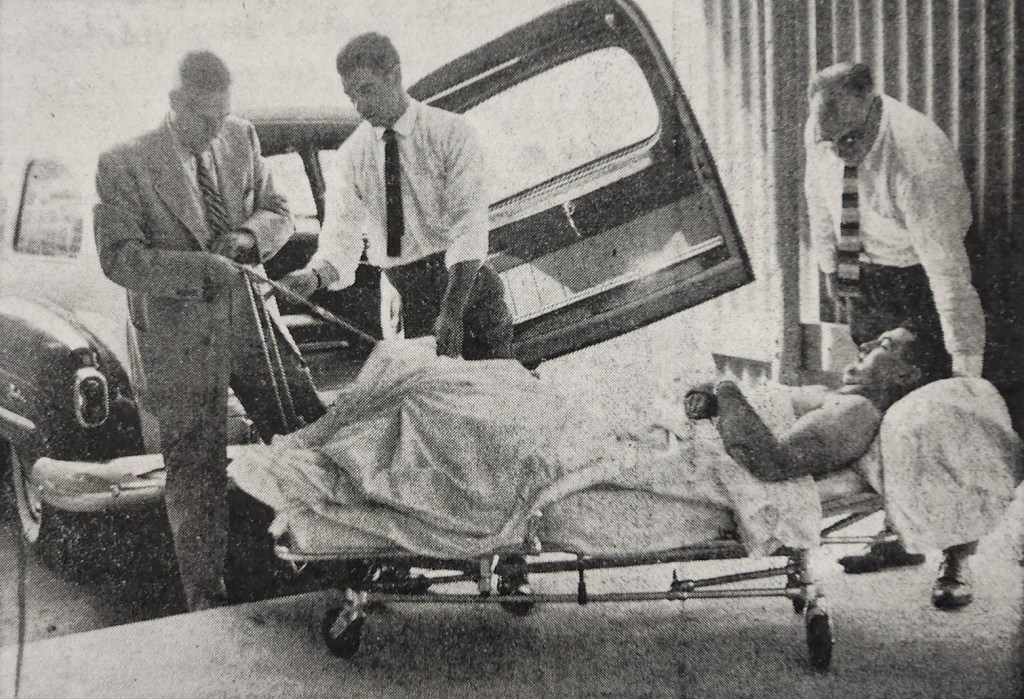
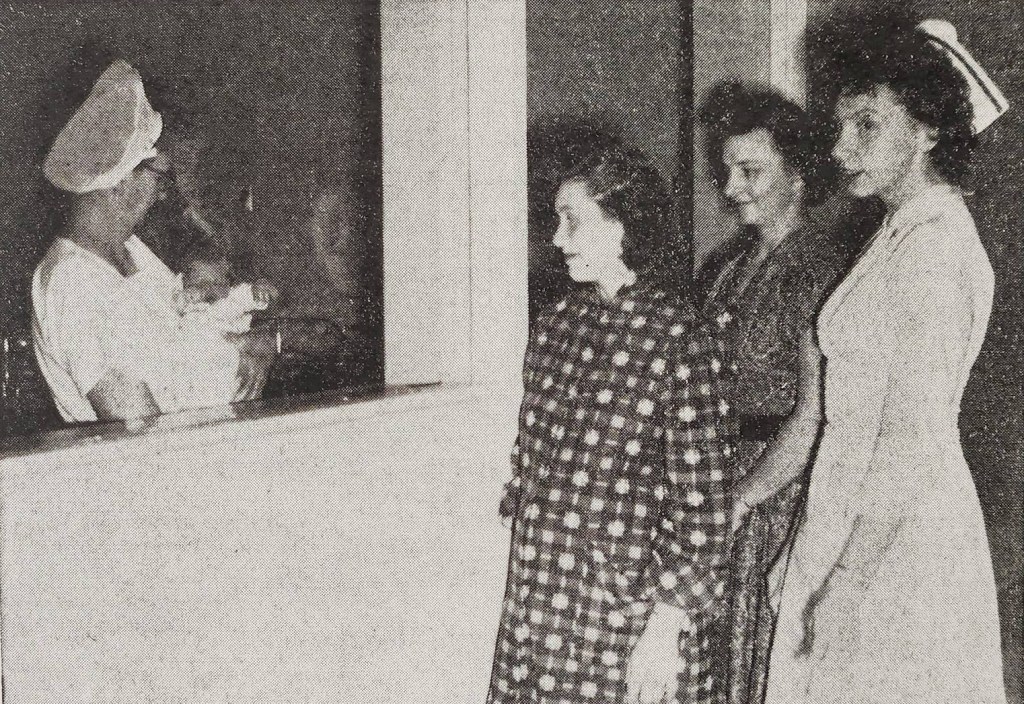
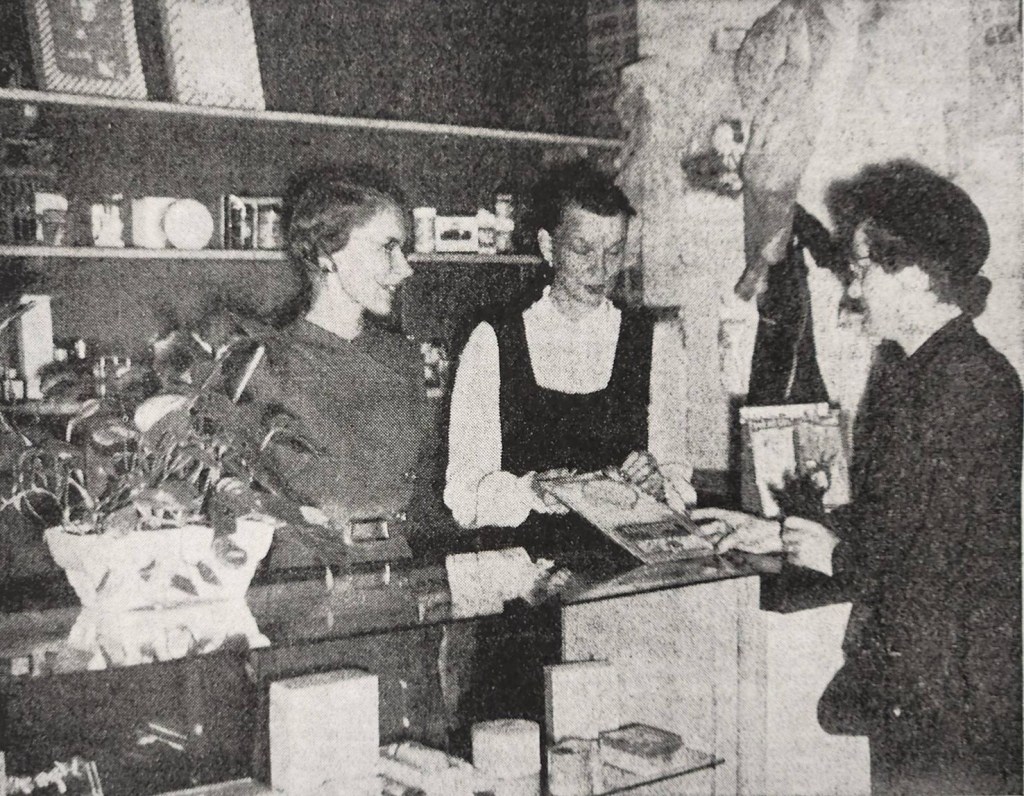
Gratiot Community Hospital events in 1955 from the top: A photograph of the hospital as it appeared in late February 1955. The new entrance was in the light colored area in the center; the dedication ceremony took place on August 28, 1955, with 500 people in attendance. An open house took place afterward; the first patient admitted to Gratiot Community Hospital was William Raycraft of Alma. Dr. Kenneth Wolfe, who admitted the first patient to Smith Memorial 22 years earlier, was honored for bringing the first patient to GCH; Mrs. Charles Hinton of Vestaburg (center) had the first baby in GCH, a girl. The family received several gifts from Alma merchants; the Hospital Lobby Shop was one of the early projects handled by the Gratiot Community Hospital Auxiliary. Mrs. Donald Nelson and Mrs. David Van Slyters wait for Mrs. Ray Bentley from St. Louis early in the shop’s opening.
The start of 1955 marked a pivotal chapter in the effort to build Gratiot Community Hospital, as the community rallied around a common goal and took meaningful steps toward making a new county hospital in Gratiot County.
The year began with the first baby born in Gratiot County at nearby Smith Memorial Hospital. Charles Fay Thompson arrived at 7:48 p.m. on New Year’s Day, weighing 7 pounds and 5 ounces, and his parents were Mr. and Mrs. Harold Thompson of 112 Winsor Street in Alma. This birth was unique: the Thompson child would be the last “first baby of the year” at Smith Memorial, which closed later that summer.
Throughout the winter, to ensure progress continued, builders completely enclosed the hospital and installed temporary heating so interior work could advance despite the cold. During this stage, Hospital Administrator Art Allaben kept his offices in the Alma City Hall, maintained a full-time secretary, and offered hours from 9 a.m. to 5 p.m. daily. Some people either came to the office or mailed letters of interest to seek positions at the new hospital, but hiring did not begin until late spring. In early March, public interest grew when a new photograph of the hospital, taken from the west, appeared in the Alma Record under the headline, “New Hospital Has Fine Appearance.” Donor recognition efforts continued during this period, including an announcement that James E. Ryan, president of Alma Trailer Company, fulfilled his pledge by donating $25,000 to the project, and he commented that the donation was an example of what the entire trailer industry could do to be involved and active in the community.
As spring turned to summer and construction continued, a change in the timeline became necessary. In June, the Board of Trustees realized that the hospital would not be ready by the original July 1 date. They set a new target of September 1, attributing the delay to the need to procure the necessary equipment to begin construction of the hospital. Around this time, Administrator Allaben announced that Alice LaPaugh had been hired as director of nurses, having previously held a similar position at Smith Memorial Hospital. Miss Constance Lucia of Ann Arbor was hired as LaPaugh’s assistant. The hospital also introduced a program to recruit and train a group of Grey Ladies under the direction of the Gratiot American Red Cross. These volunteers needed to be over 21, have a doctor’s note confirming their good health, and be “willing to help their fellowman.” The gray poplin uniform each Grey Lady wore cost them $7, and the Gratiot Red Cross furnished the insignia. Additionally, the new hospital launched a call for teachers for “Home Care for the Sick,” introducing a five-day training program to help people care for their own sick and others during a disaster.
Near the end of summer, the Board of Trustees announced the dedication ceremony for the new hospital would be held on August 28. Planning entered its final stages as the hospital anticipated large crowds, and it asked Consumers Power Company for permission to use its parking lot for potential overflow parking. An open house was planned so everyone in Gratiot County could tour the new facility, which now featured 86 beds and 20 bassinets. The first patients were expected to arrive by early September, especially from Smith Memorial Hospital.
On August 28, 1955, Gratiot Community Hospital opened. Despite overcast weather, a large platform hosted officials and speakers. Reverend Bernard Didier was the toastmaster, and Dr. Edward T. Thompson delivered the dedicatory address. The $1,000,000 project was celebrated as a joint effort of industrialists, civic groups, and citizens. After the ceremony, the crowd toured the new hospital.
After this dedication, the first patient, William Raycraft, arrived by ambulance from Dewey Funeral Home on September 19. Dr. Kenneth Wolfe oversaw his admission, who admitted the first patient at Smith Memorial Hospital 22 years earlier. Also starting that day, patients and equipment were moved from Smith Memorial to the new hospital, temporarily cluttering the facility as staff organized it.
Early in the hospital’s opening, Mrs. Charles Hinton delivered the first baby, a girl, on September 21, with Dr. Silvert and Mrs. Delores Jones assisting. Alma merchants honored the family. On October 7, Mrs. Leon Woodbury had the first twin girls, delivered by Dr. Loren Burt and RN Doris Jessup. Jessup was also the mother of Alma’s triplets, born in town some years earlier. Admissions reached 57 patients by this milestone.
By October, a new lobby shop opened for short daily hours, chaired and staffed by Mrs. David VanSluyter. The Women’s Hospital Auxiliary held its annual meeting, with 90 attendees, and recruited volunteers and requested sewing machine donations. The auxiliary focused on public relations, fundraising, and volunteer services, and later introduced a room-service cart for patients through the lobby shop.
As 1955 came to a close, more activities took place at the new hospital. Earle Brenneman, chairman of the hospital’s fundraising efforts for two years, was recognized at a dinner held at Van Dusen Commons at Alma College. Brenneman served dutifully and led the campaign to raise funds for the new hospital. The hospital also needed nurse aides and offered training classes beginning in early December. Applicants were preferred to be at least high school graduates. An enlarged Board of Directors held its first meeting and, among its first tasks, started a search for a new hospital administrator after Arthur Allaben, who had held the position for a year, resigned. The board set hospital rates for multiple rooms at $12 each, semi-private rooms at $15 each, and private rooms at $20 each. Most of the hospital’s rooms were semi-private.
Just before Christmas, Gratiot Hospital received a $20,700 grant from the Ford Foundation to enhance facilities, train staff, and conduct research. The hospital also named Dr. Bernard J. Graham as chief of staff for 1956, with Dr. R.L. Waggoner as vice chief.
Gratiot County now had its community hospital up and running after years of planning, fundraising, and building.
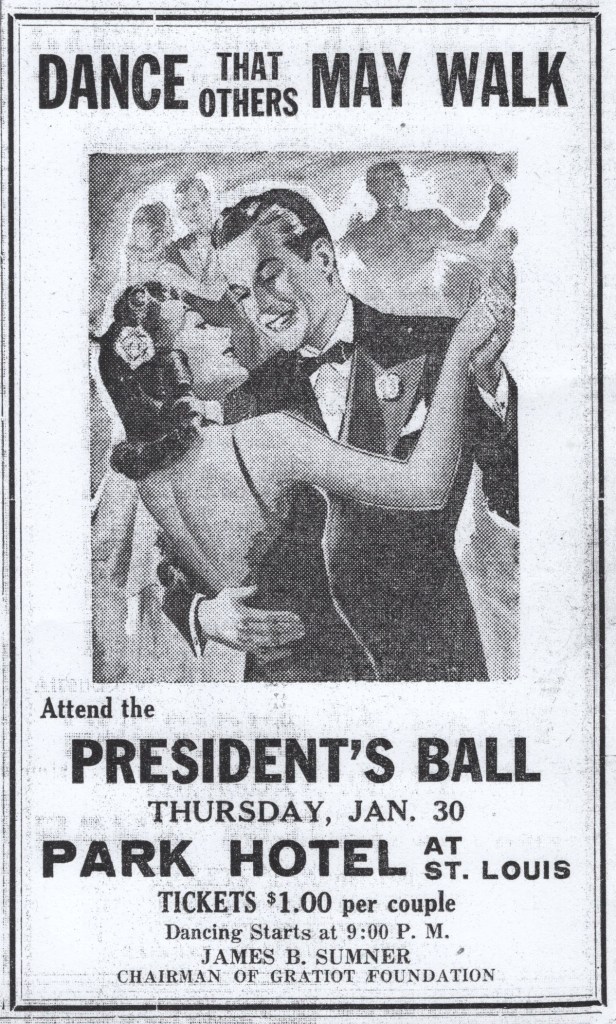
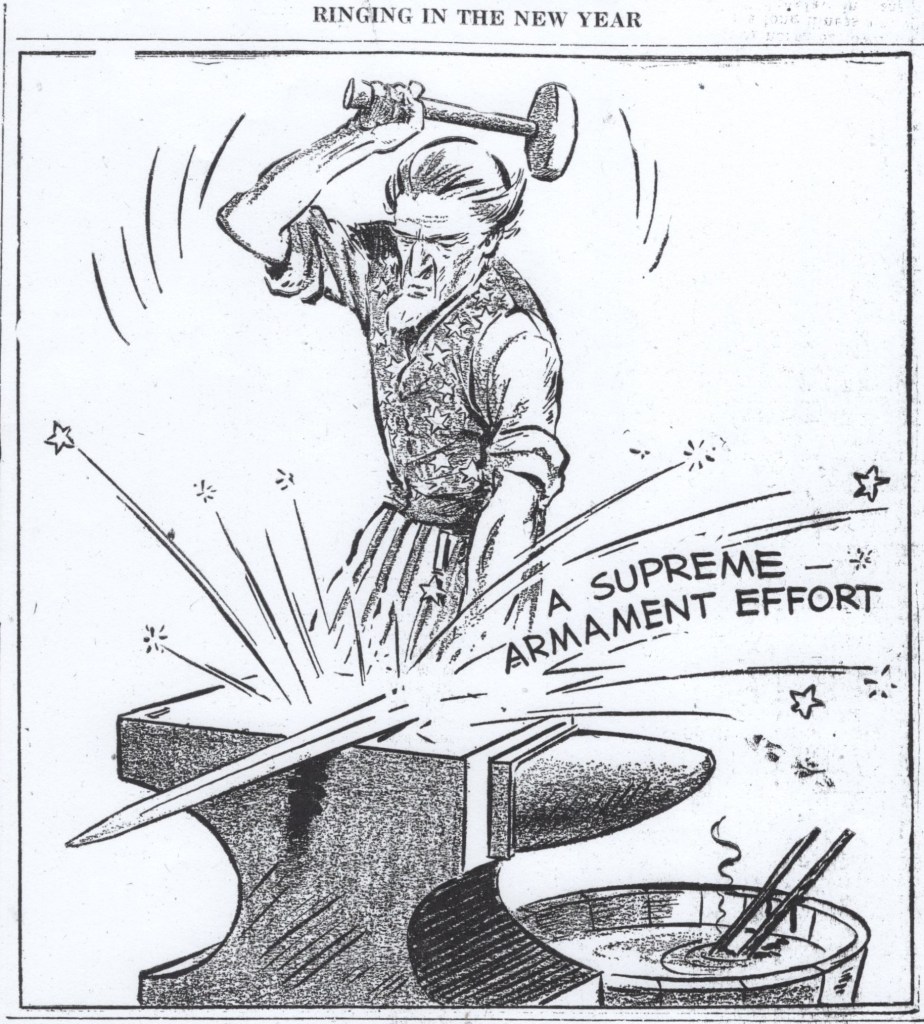
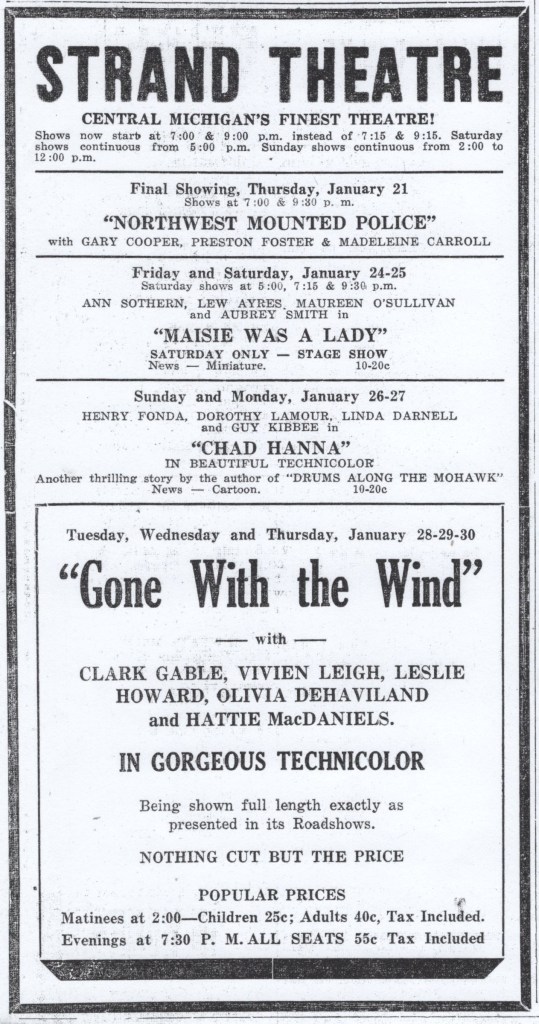
From the top: The St. Louis Park Hotel prepared for the annual “President’s Ball” to raise money for the fight against infantile paralysis; the New Year began with more calls from President Roosevelt to prepare and arm the great “arsenal of Democracy” in wake of the war over England; “Gone With the Wind” made its second appearance in Alma – a tradition of reappearing at least once each decade until the Strand (II) closed in the early 1990s.
Christmas and New Year’s ended quietly in Gratiot County, but talk of America’s involvement in the European war increased.
Another group of young men left for the military even as a line of volunteers dwindled, meaning that the draft board would soon be forced to call men to serve.
The National Youth Administration remained very active by taking in young people to work on various projects.
And winter hit Gratiot County, sometimes shutting down towns and villages, even for just a day or two.
It was January 1941 in Gratiot County.
The Holidays Pass Peacefully
Just before New Year’s, local towns and villages revealed the winners of their Christmas home lighting contests. Milton Townsend, chairman of the St. Louis contest, announced that Carl Johnson of 422 East Washington won first place and was awarded five dollars. For the first time in St. Louis, the city sponsored the contest, but for some reason, there were fewer entries than in 1939. The Alma Chamber of Commerce awarded first place to Paul Woodland of 510 Republic Avenue (personal home) and to the Michigan Masonic Home (institution/business category), which received $10. Over at Breckenridge, the Garden Club rated B.C. Wood first place for the most original display; Mary Shepard got second for the most appropriate; Doctor E.S. Oldham placed third for the most individual; and Walter Neitzke won fourth for the most extensive display.
On Christmas Day, the St. Louis Leader noted that the St. Louis Knights of Pythias Lodge Number 49 held a dinner for 86 children in the lodge quarters above city hall. Following the dinner, each child received a free theatre ticket and a sack of candy from Santa Claus. The lodge put on the entire program and dinner.
“A Nation in an Undeclared War?”
That was what a column in the Alma Record-Alma Journal declared in early January. “We are at war without having declared war” with Nazi Germany, claimed the columnist, by helping Great Britain, and that “the die is cast.” When will war be declared and by whom? In response to concerns that America would soon be involved in a war, President Roosevelt called up America to be “the great arsenal of democracy” and to prepare to defend the nation as Nazism threatened the entire globe. The race to help Great Britain, according to President Roosevelt, had to include the construction and export of more planes, ships, guns, and freighters.
Across Gratiot County, the tone of speeches and presentations also implied that war was not far off. Professor Ray Hamilton of Alma College described Nazi Germany as having a pagan government as he spoke to the Ithaca Rotary Club. Hamilton also said that a former Alma College professor was now being investigated for un-American activities. Other voices, formerly from outside the United States, warned the county about Imperial Japan’s status and actions. Dr. K. Ping spoke to the Alma Rotary Club about why he believed the Japanese would ultimately be defeated, in part because they took over too much of China and could not control it. Ping also stated that both the Communist and Nationalist Chinese had put aside their own differences to unite to fight the Japanese. Doctor Elmer Boyer, recently from Korea, gave a pair of talks in Alma about the harsh life under Japanese rule. As Christianity grew in Korea, the Japanese were very oppressive toward Koreans and extremely distrustful of all Americans.
The Gratiot County Draft Board invited men to volunteer early and join the Army or Navy, even as nineteen men made up the January quota and prepared to leave for Saginaw. Among them were Carl Deline, Herbert Wolford, and William Keon, all of St. Louis. As men were called, the Draft Board realized it would soon be interviewing men who were not volunteers. Members of the board, such as Lyle Whittier, attended meetings, including the one at the Alma Rotary Club, to explain the examination and classification process for the next 14 men to be called in February. Already, Alma lost some of its young men, like Captain H.L. Freeman, who headed the National Guard in Alma and who had been called to Fort Custer.
In other events related to the theme of war, the Redman Trailer Company of Alma became one of eight businesses nationwide approached by the government to build house trailers capable of holding eight bunks for soldiers. Such a contract meant that the Alma Company would need to expand its plant and employ day and night shift workers. A letter from David Glass, Alma College graduate, arrived home explaining his training with the aviation corps at Pensacola, Florida. A total of 976 aliens had registered in Gratiot County by the late December deadline. Ithaca postmaster James O. Peet announced that 415 aliens appeared to register as required by law. Many of those registered were of “foreign extraction” who worked in the sugar beet and farm fields. In other words, they were migrant workers. The Greek Relief Fund in Alma continued to grow from donations. By mid-January, the fund had raised $831.94 to buy supplies for the relief of the families of Greek soldiers who died as a result of fighting Italy. Over 500 local communities across the United States organized Greek relief funds. In Alma, James Stamas, George Goutis, and James Stavros formed the committee. The Alma Record openly endorsed the relief and asked readers to do the same. Doctor and Mrs. B.N. Robinson of Alma received word that Mrs. Robinson’s parents were safe and living in Southern France. It was the first word they had had of the parents since the Nazi invasion in June. The DeWachters formerly resided in Paris and had evacuated from the city. Word reached Alma through American citizens who met the DeWachters in Biarritz.
Life in the Great Depression/New Deal Programs
During the winter of 1941, the National Youth Administration sought to expand its work in Gratiot County by providing young people with work experience through gainful activities. One of these events involved planning the Alma Ice Carnival on Saturday, February 1. Several NYA boys worked as a crew to get an arena ready on the Pine River. The boys sought to create a track almost 300 feet long for various events, including speed skating, sled events, and several novelty events to take place that afternoon.
Alma Schools embraced the idea of using the old Washington School for classes that could enroll up to 100 young people. By offering woodworking classes for boys and home economics for girls, this NYA program dovetailed with the idea of preparing young people for the national defense program. As such, the federal government would cover almost all the expenses associated with ten-week classes that ran for eight hours a week. A.C. Heying would oversee shop work there while Mrs. Marvin Utter would have charge of the home economics classes.
The Works Progress Administration and the St. Louis City Council discussed spring work projects for eight city blocks, including curbs, gutters, and storm sewers. It would cost St. Louis $12,386, but the WPA covered $8,112 of the amount. Areas around North Pine, Washington, Mill, and Center streets were targeted. At the same meeting, city clerk Frank Housel told the city council that 15 able-bodied men owed the county labor on the roads, which amounted to $2 per day. This “work or no relief” policy in the county emerged earlier in 1940. On a lighter WPA note, Darrell Milstead, County WPA recreation director, said the WPA was testing a “toy lending library” at the Republic School recreation center. In this program, a boy or girl would check out a toy for up to two weeks, then return it to the school. If no one was waiting for the toy, the boy or girl could check it out again.
The Long Arm of the Law
During December 1940, 46 people were convicted of crimes, bringing in $222.75 in fines and $232.80 in costs. Three people were sent to Jackson prison and three to the county jail. A number of the court appearances involved game law violations such as carrying a loaded shotgun in a vehicle, violating the Horton’s Trespass Law, or transporting dressed venison. William Batten, 21, of Detroit, and Charles Van Atter, 31, of Eaton Rapids, stood mute to stealing a calf from the George Bates farm during the past summer. Batten got a $25 fine and costs, or 30 days in jail (where he initially went), and Van Atter went to prison on a $200 bond default. The two men picked up the Bates calf, which stood near the edge of the road, and made off with it. There was no word on what had happened to the calf.
Three area men were arrested, and more details emerged about the February 1939 break-in at the Lobdell-Emery plant, where 960 pounds of Downmetal and scrap aluminum were stolen. Arrests of Carl Baker, formerly of Alma, Charles Langin of St. Louis, and Charles Thompson of Alma meant more appearances in front of Justice Howard Potter in Ithaca. Baker had been the key suspect in the cases and was finally apprehended in Kalamazoo. The other men denied knowledge of the crime and requested an examination. This 1939 crime amounted to $100 worth of stolen metals.
Other various crimes and situations made the January newspapers. Russell Smith, Alma’s “heating engineer,” again caused trouble for officers and appeared in court on pretenses for not completing heating repairs. Smith had still not paid his nearly $10 fine for court costs. Hazel Ellsworth remained lodged in the county jail on charges of arson. Ellsworth appeared to be off her hunger strike, but continual attempts to harm herself meant she was under constant watch by a jail matron. Norman Skaggs, 22, of Cheboygan, appeared in court and pleaded guilty to starting a December 1939 fire on the Clarence Clark farm, three miles south of Alma. Skaggs claimed he started the fire while Clark was away, all on a whim. Skaggs hoped he might gain more work by rebuilding a barn to better support his wife and child. Skaggs left the area after the fire and could not make it on being paid five cents a bushel for husking corn. Skaggs now made a complete confession, asked for his punishment, and wanted to clear the matter.
The biggest news of the month concerned a strike by sixteen drivers at the Kress and Son trucking operation in Grand Rapids, which transported Midwest Refineries’ products. When replacements were hired for the striking drivers, several Kress and Son trucks were stopped in Alma and south of Ithaca. When a group of five men stopped a car south of Ithaca and told the driver he had better leave for his own good, the driver walked to the sheriff’s office and filed a complaint. In another instance, one Kress truck was sabotaged while enroute from Owosso. The A.F. of L. union called for the strike, and later that month, fifteen men appeared in court, charged with infringements against Kress Trucking. All seemed to have attorneys supported by the union, and they were released on bonds ranging from $250 to $ 1,000 each. Later, Roland Reitz, 45, of Saginaw, received a $50 fine and $60 in costs for his involvement in a truck holdup in Alma. The sheriff’s department called in special deputies and the Alma Police Department to address a strike situation.
Gratiot Farmers and the Winter
The snow was deep, and the weather was cold, but Gratiot farmers turned out for different programs to get them thinking about the 1941 farming season. The St. Louis Beet Growers Association held its 10th annual program at St. Louis High School and was impressed by the 1,100 people who attended – well above the anticipated number. International Harvester had a meeting for forty dealers at the Park Hotel in St. Louis, with luncheon served in the main dining room. Adolph and Henry Schnepp organized the meeting’s program. The St. Louis Co-operative Association held the city’s second big program of the winter, also at St. Louis, and planned to offer a tour of the new $50,000 creamery on North Mill Street. A group of 500 farmers and wives was anticipated for the February 1 assembly.
In other farming-related news, Breckenridge offered a 10-week adult education course in agriculture. It started on January 15 and was held on Tuesday evenings. Frank Longnecker of Vestaburg made the county newspapers when he announced that one of his pullets laid two oversized eggs in one month. The latest measured 6 ½ and 8 ¾ in circumference and weighed six ounces. A rabid skunk attacked Robert Monroe’s heifer southeast of St. Louis. Monroe saw the skunk bite the heifer on the head, then killed the skunk. The head was then sent to Doctor Frank Erwin, who had it analyzed in Lansing. The skunk was positive for rabies, and Monroe was told to give his heifer a series of shots to save the animal. He also watched the rest of his herd for fear that other rabid animals had attacked and bitten them.
Health Matters
Much of the Gratiot news about health in January centered on infantile paralysis. During the Depression, the annual President’s Benefit Ball took place in St. Louis on January 30 at the Park Hotel to raise money to combat the disease. As a result of recent fundraising, the Gratiot County Chapter of the National Foundation for Infantile Paralysis supported seven cases without making the recipients’ names public. As of January 1941, the group had $300 in its balance and hoped to raise more money through the President’s Ball to support those who needed braces, special shoes, or appliances. Tickets for the ball went on sale, and members were asked to fill coin collection boxes and folders that held $2 each in dimes. Vere Nunn, cashier at Commercial Savings Bank in St. Louis, served as treasurer of the chapter.
Still, other people and events related to health matters were tied to Gratiot County. Two people who were x-rayed at a recent Michigan Tuberculosis Association clinic in the county faced immediate hospitalization. A total of 39 people attended the clinic; 25 of them had been x-rayed before. Of that group, two were deemed active, three were suspect active, and five healed of tuberculosis.
A wave of influenza hit Alma Public Schools hard, with four teachers out and fifteen percent of the student body absent on one day. By mid-January, local doctors believed that the worst of the flu had passed. William Lator, an Ashley High School sophomore, was in critical condition at Smith Memorial Hospital with blood poisoning. Lator had been sick for two months after receiving a scratch or prick while working in the woods. After admission, he improved slightly after a blood transfusion. Two-year-old Alfred Roberts of Middleton also nursed an infected arm. When his mother left the little fellow alone for a moment, she found him caught in the wringer. The rollers caused nasty wounds and required seventeen stitches to close, and then became very uncomfortable due to inflammation. This toddler also fell into a bucket of boiling water a year earlier, then later drank kerosene. Needless to say, young Alfred had seen more than his share of troubles. Another sad Middleton story involved the discovery of Charles Luscher, 69, who was found frozen to death in a ditch southeast of Middleton. He had been there approximately 2 ½ days and was found carrying bottles of beer and some meat, only two rods from his shack. Another sad story took place near Sumner, where Melvin Blackburn was found in a snowbank on the Ben Humphrey farm. Little hope of recovery was given due to prolonged exposure to cold weather and snow.
And So We Do Not Forget
Basketball games between two Fulton teams and Fulton alumni took place before New Year’s. In both cases, the alumni won: the girls’ alumni defeated the Fulton girls 26-16, and the boys’ alumni defeated the Fulton boys 28-23…The Gratiot-Clinton Bar Association feted Circuit Court Judge Kelly S. Searl by having a dinner in his honor at the St. Louis Park Hotel. A collection of approximately 175 circuit court judges, lawyers, and friends attended the dinner…Seventeen people enrolled in citizen classes at St. Louis High School on Monday nights. Three in the group took a course on “English for Newer Americans” led by Grace Niggeman. Some of the students included Anna Sabatavich, Mary Yanik, Anna Simonovic, and Cyril Sedlacek…The city play “Womanless Wedding” was again a big hit at St. Louis High School under the direction of the St. Louis Lions Club. John Brown starred as the bride and Doctor T.D. Gilson is the groom. Proceeds went to the Sight Conservation and Health Welfare fund of the Lions Club.
The final cost of the new county road garage outside Ithaca was $53,871.73 and was primarily funded by state funds. A complete financial report appeared in the St. Louis Leader…A group of 153 people in Porter Royalty Pool, Incorporated, found themselves dividing oil royalties after the state Supreme Court ruled on a case dating back to 1933. In a unanimous decision, the court dismissed charges by Glenn and Mildred Hathaway and 24 others, thus releasing the money…The Kroger Grocery and Baking Company moved to a new location on Mill Street early in 1940 and introduced self-service, which many customers liked. Oren L. Boyd worked as a manager and appeared in the newspaper…A wet, soggy snow left six inches in Gratiot County on Sunday, December 29, and lasted into the evening. It took workers in places like St. Louis most of the night to clear enough roads and streets for people to get around the next day.
A group of 400 people attended the annual stockholders meeting of the Redman Wholesale Grocery Company in Alma. The meeting took place at the Alma Methodist Church, which offered the group a free meal and entertainment after listening to financial reports and the election of officers…Two different groups of Alma people headed to Mexico for a few weeks to avoid the Gratiot County winter. Lester Welch, assistant manager at Martins, led a group of tourists to Durango, Monterey, and Mexico City. James Clark, JC Penney assistant manager, took his family on a three-week trip to Mexico…Temperatures in Alma on January 13 dropped to zero, but rose to 18 degrees above two days later…Alma’s ice rinks opened after the freeze south of the State Street bridge and on one above the dam. Snow had been removed to allow skating there, and it proved very popular with skaters…Cupid’s arrow struck Maynard Peackock, 23, of St. Louis, and Bertha Dickens, 22, of Alma as they tied the knot.
The Gratiot County Herald checked up on the 1940 winners of the baby contest. One year later, Judith Joan Russell, Elm Hall, Lee Arnold Cowles of Alma, and David William Seaman, also of Alma, all had their photographs and biographies as one-year-olds on the front page…The winner of the 1941 Baby Contest went to Raymond Kennedy, Jr., son of Mr and Mrs. Raymond Kennedy of Alma. He appeared at 2:56 a.m. at Carney-Wilcox Hospital and weighed 8 ½ pounds…Doctor Lewis Berg, psychiatrist, sociologist, lecturer, and columnist, spoke during the Town Hall Series at Ithaca High School gymnasium on “The Successful Personality.” Rotary clubs from around Gratiot County sponsored the presentation…One of the Detroit Tigers’ “G-Men,” Charley Gehringer, was the first Detroit Tiger to sign a 1941 contract…Jay Stahl of Ithaca received the Ballard Trophy at Ithaca High School for his football season, as well as being the team captain…A collection of former Ithaca High School football players from the 1906 to 1909 championship teams showed up for the all-sports banquet sponsored by the Ithaca Chamber of Commerce to honor Coach Steve Keglovitz.
”Gone with the Wind” for the second time reappeared at the Strand Theatre in Alma for three dates on January 28-30. Evening tickets cost 55 cents, and one showing took place at 7:30 pm… George Gates took over the location of “Bill’s Popcorn Stand” in Alma on the Masonic property south of the Consumers Power Company building on South State Street. Gates now mainly sold apples and sweet cider…Ben East, wildlife lecturer and writer, appeared at Alma High School on January 14 to show moving pictures on “Islands of the Inland Seas.” The Gratiot County Conservation League supported the presentation…Mrs. Rebecca Louise Stevens, age 107, and the former wife of Dr. L. S. Stevens in Alma, passed away in San Diego, California. Doctor Stevens passed in 1899 and was buried in Riverside Cemetery…Lem Rowley of the Rowley and Church gas station in St. Louis did a neighborly thing for a person in need. Walter Gibbs lost his two Irish Setters and had little hope for their coming home. When neighbor Don Keane heard noises in his father’s barn a week later, he found the two dogs in a holding box, in poor shape and worn out. When called upon by Keane, Lem Rowley helped find the rightful owners of the two setters. Needless to say, Walter Gibbs was thrilled and grateful for the return of his two dogs.
And that was Gratiot County during the Depression and the War in January 1941.
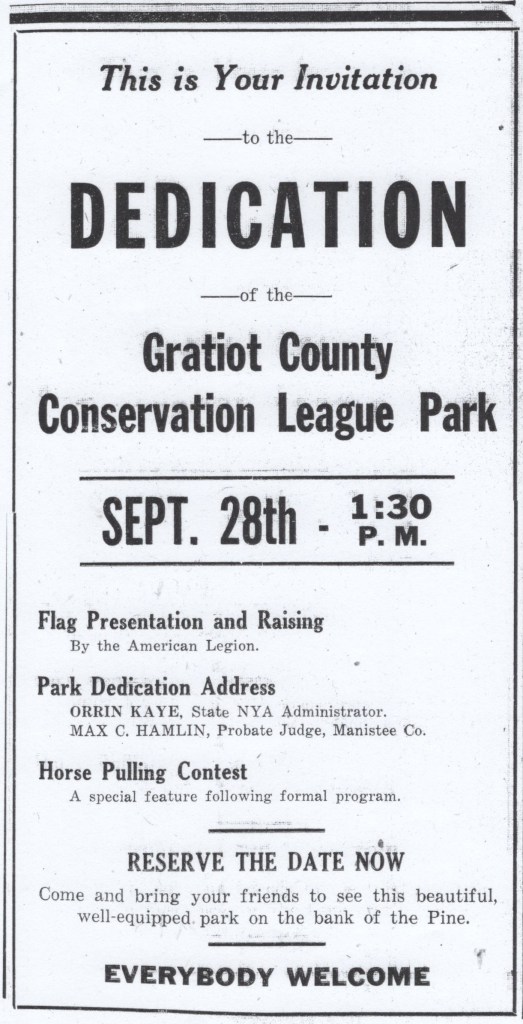
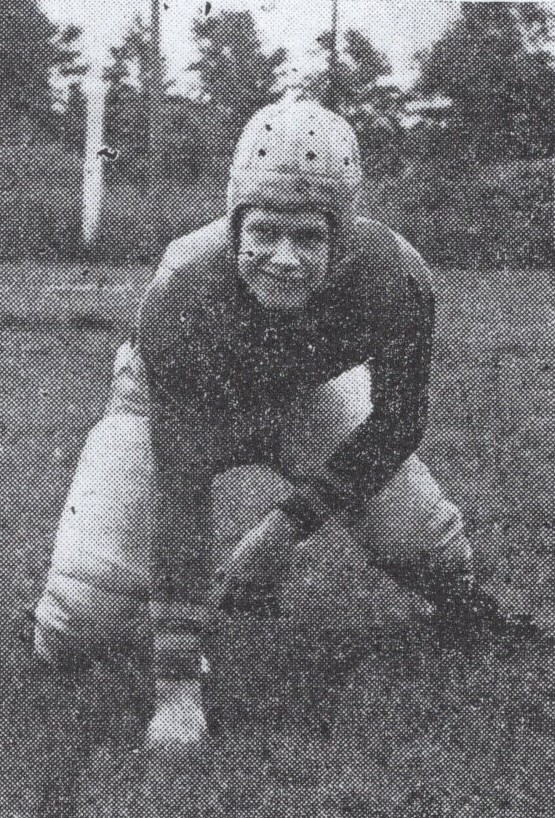
Gratiot in September 1940, from the top: Going back to school again and learning about impending warfare, September 12, 1940, cartoon from the Gratiot County Herald; Gratiot County Conservation League Park is dedicated. A combination of members, volunteers, along with NYA and WPA workers, made the use of the park possible in late September 1940; Elwood Mellinger, captain of the Ithaca football team, as it prepared to face St. Louis on September 20, 1940.
Another cold, wet fall meant it would be a challenge to bring in another Gratiot harvest.
It was a time when America prepared for a peacetime draft – its first draft since 1917.
What, Roosevelt runs for a third term as President? No President had done so in the nation’s history.
Residents also learned that the WPA programs would soon come to an end after five years of operation.
What was going on?
It was September 1940 in Gratiot County.
Europe at War, Preparation at Home
As Hitler continued to attempt a conquest of Great Britain, the only remaining obstacle to his domination of Western Europe, Gratiot County prepared for war. Although the Führer boasted to England that “I am coming,” England countered by conducting another of its early air raids upon the city of Berlin.
Even before entering the fall elections, President Franklin D. Roosevelt spoke freely and openly about the need to prepare the nation for war, and instituting a peacetime draft now became a reality. All American young men between the ages of 21 and 35 had to register for possible conscription by October 16. Roosevelt’s initial goal was to mobilize 400,000 men by early 1941 and 900,000 by the spring of that year. All registrants would carry a registration card, and those who failed to register would be considered evaders.
As a result, Gratiot County received approval from President Roosevelt to form its first draft board in twenty years. Four men, Dr. C.F. Dubois (medical examiner), Charles R. Murphy, A.D. Smedberg, and Robert Reed, headed the Alma board. All served without pay. Ahead of the draft, six local men signed up at the Alma post office on one weekend to join the United States Marine Corps. Robert Hennigar, Burson Youry, Paul Dintaman, and Lyle Goward of Alma, along with Donald Zinn and Richard Horton of Vestaburg, expected to go to Saginaw for their formal physicals. If they passed the examination, the group of men would be sent for Marine training at Parris Island, South Carolina.
Men involved in Troop B, National Guard, of Alma, returned from drills in Wisconsin. However, Captain Howard L. Freeman believed that the unit would soon be called into service as part of the 210th Coast Artillery, an anti-aircraft unit. Two weeks later, that assignment changed again, and the group would be known as Battery B of the 177th Field Artillery. The Alma battery needed to increase its strength from the current roster of 60 men to a total of 122 men between the ages of 21 and 35. At this time, one Michigan newspaper reported that many National Guardsmen would be sent south in October to Camp Beauregard, Louisiana, for a year of training. President Roosevelt soon signed an order calling up over 60,000 men in the National Guard for a one-year period of service. Sadly, a result of this order meant that the horse cavalry unit, long a part of Alma and Gratiot County’s history, would soon depart for Illinois.
Photographs in county newspapers, such as the Alma Record and Gratiot County Herald, demonstrated the hardships of war as well as this nation’s preparation to be drawn into the conflict. In an attempt to feed its population during war, England used all of its land to raise food, including growing wheat in London parks. Londoners also paid an admission fee to see a recently shot down German Messerschmitt fighter for the “Buy a Spitfire” fund. In Santa Monica, California, one plant worked to produce the world’s largest bomber, a four-motored aircraft with a 210-foot wingspan. It held a crew of ten men and could fly 6000 miles on a bombing mission. In Springfield, Massachusetts, a plant there produced 1000 Garand semi-automatic rifles daily. The plant commander urged the War Department to expand production. Two inventors of the concrete pillbox, a concrete dome-shaped shelter that builders could set in five hours, demonstrated it in front of the Army and congressional leaders. These small fortresses could be used in America to guard its borders.
Depression Life Continues
The New Youth Administration (NYA) continued work in the county as 80 young men and women received permission from the program to work more hours, and therefore, more pay. Thirty-five young women worked on various projects, including recreational activities at Conservation League Park and maintenance tasks at Alma City Hall. All project workers were required to take and complete their initial air courses. A few NYA members worked with WPA supervisors at places holding girls’ activities at Wright Park for handicrafts or at wood games activities for young people at Republic School. James Carter oversaw the woodcraft project at the Salvation Army Center. As Halloween approached, the NYA staff led interested children in creating paper masks using clay, which would be displayed at the indoor recreation centers. Two Gratiot County students, Elroy Prince of Ithaca and Darwin Snyder of Breckenridge, attended a short NYA agricultural course at Michigan State College. A total of thirty students made up the group, attended class, lived in a barracks, and worked part-time. At different Gratiot County high schools, student aid workers on the NYA payroll earned $6 each month once they received NYA certification.
The Works Progress Administration (WPA) offered further training to members from Gratiot County who traveled to Hoyt Park Field House in Saginaw. Director Darrell Milstead, recreation director, led the group as it learned about fall sports activities, arts, crafts, administration, and first aid. Among those who attended were Hazel Markham (from Ithaca), Henry Sholtz and Lester Fillhard (St. Louis), James Carter, Jack Acker, Lowell Williams, and Eldon Lott (Alma). The WPA program, which had operated nationally for several years, received news in late September that all WPA work would end by June 1941. The program director urged WPA leaders across the nation to complete their existing projects within the allotted time and avoid initiating new ones. An increase in funds for defense appropriations and an overall atmosphere of the need to train for national defense meant an end to WPA programs.
People who had past accounts with the Elwell Bank received good news from Charles H. Goggin, President of Alma First Bank of Alma. He announced a possible agreement to disperse the liquidated assets of the former Elwell Bank. Litigation continued in court in Ithaca, but an announcement was expected soon. A hundred former bank depositors had filed suit to get money from the Alma Bank, which they claimed was also tied to the Elwell bank’s collapse. The judge granted ten days for any other former depositors to file their claims for money.
Over at the Ithaca courthouse, work began on the new social welfare offices and Gratiot Bureau of Social Aid, which planned to relocate from Alma. The two new offices, expected to open in the courthouse basement, and the remodeling meant that a new entrance would be created on the south side of the building. The new rooms would now occupy what was formerly known as the youth detention area and janitor’s living quarters.
Health and Gratiot County
The Children’s Free Dental Clinic continued its work in the county after completing its time in St. Louis. A dentist worked on a total of 222 St. Louis children with 335 cavities filled and 185 teeth extracted. Another 29 children had their teeth cleaned. The Child Study Club sponsored the clinic, which provided free healthcare to underprivileged children. Doctor G.V. Barrows did the dental work and was assisted by Beth Hicks. Several children from Wheeler and Breckenridge attended the clinic as well.
The public received warnings about outbreaks of infantile paralysis in sixteen different Michigan counties. Believed to be a seasonal disease that peaked in late August and early September, a total of 272 cases were discovered in the state during September. In related news, Leonard Hubbard, 29, a popular Vestaburg musician, died of the disease only one week after contracting it. He left behind a wife and three children. In other health news, a Bannister man took his own life after years of battling illness. Frank Goldman, age 67, hung himself in his barn early one morning. Goldman suffered from being unable to eat and sleep due to health problems. In another twist, he was scheduled for the next step of becoming a naturalized citizen the day after his death. Goldman farmed in the community for 28 years.
The Long Arm of the Law in Gratiot County
August 1940 proved to be a busy month for the courts as a variety of offenses resulted in 47 convictions. Only 18 in the group were found to have committed serious crimes, and most of the others were due to traffic offenses. Fines totaled $258.30, with an additional $162.80 for costs. Some of the serious crimes involved one man being sent to Jackson Prison and four others to the county jail. Otis Andrews was sent to Jackson for violating probation for a third offense of drunk driving and got six months to two years. Andrews was warned that if he ever showed up in court again, he would be immediately sent back to Jackson.
Lawrence Lutz, 18, of St. Louis, was found guilty of carrying an unloaded concealed weapon without a license. He only got a year’s probation and was ordered to attend church with his parents every Sunday. Four men were convicted of fishing law violations for setting an illegal set line on the Maple River. They each paid $10 for a fine and $6.85 for costs. Another person unlawfully used an automobile and got three years’ probation and $200 for damages to the car.
The Alma City Commission had its first reading of a proposed ordinance regarding trailers in the city. If accepted, the new ordinance would regulate trailer families and individuals from taking up residence on vacant lots or yards. Those wishing to reside in trailers had to do so at a licensed trailer camp and pay $15 for a yearly license. The trailer camp owner was also required to provide a service building, showers, toilets, laundry facilities, drinking water, and a list of other amenities. Anyone parking a trailer next to a homeowner in Alma could only do so for two weeks at a time.
Regarding elections and politics, Gratiot County gave favorite son O.L. Smith a nearly 2-1 advantage over incumbent Luren Dickinson for the Michigan Governor’s race in the state primary election. Unfortunately, Dickinson trounced his opponents across the state to gain the nomination. He would face off against Democrat Murray D. Wagoner in November. One of the most interesting and spirited contests involved three candidates for Probate Judge. Mildred Taft, daughter of the late Probate Judge James G. Kress, won the primary election after being appointed by the Governor to fill out her deceased father’s remaining term. Taft would serve as Probate Judge until 1963.
Naturalization hearings continued at a good pace in the county as ten residents from six different countries applied to become American citizens. For this ceremony on September 19, something new happened. This time, DAR chapters from Alma and Ithaca organized a short march to the court. At the same time, bugles played and Boy Scouts accompanied the group. Alma DAR chairman, Miss Lou Nickerson, gave a brief talk on the Constitution, then Mrs. Floyd Barnes explained the meaning of the American flag. Each new citizen received a citizen’s manual with a copy of the Constitution, which included the Pledge of Allegiance. Each citizen also received a small 4×6-inch flag. Although fifteen candidates faced examination for citizenship, these ten were accepted, while the other five continued further study. Members in the group originally came from places like Croatia, England, Russia, Germany, Poland, and Slovakia.
Alien registrations also continued at post offices across the county. In Alma on one Wednesday afternoon, a total of 18 aliens registered. The Alma postmaster, J.L. Winslow, commented that several persons believed they were American citizens, but upon investigation learned they were not.
Farming
Farmers were urged not to cut their alfalfa but to wait at least until the end of September, unless used for silage or molasses. It was essential to let alfalfa store up root reserve for 1941. Sugar beets appeared to have a later-than-usual harvest due to low sugar content. The heavy rains in late August and early September meant a delay in harvesting. The Michigan Sugar Company announced it had 9,000 acres set aside for raw material for the Alma plant. A new beet dump and piler took care of a load of beets in one minute. Over at St. Louis, the Lake Shore Sugar Company had 10,000 measured acres of beets to harvest. Still, a late white frost hit Gratiot County at the very end of September. County Agent C.P. Milham announced that the enemy of all farmers, the corn borer, caused over $200,000 in damage to county farms. For many in the county, the amount could have meant profit or loss for the season. To combat the corn borer, shredding dry stalks and plowing under others by June 1 had to be a goal for all farmers, according to Milham.
In other farm news, a group of nine Junior Farm Bureau members attended Waldenwood Leadership Training Camp at Hartland, Michigan. A total of seventy-eight young people from thirteen countries attended. From Gratiot County, John Kelly, Gerald Lake, George Cox, Marion Wang, Eugene Oberst, Margaret Douglas, Edward Hooper, Lowell Quidort, and Dorothy Gibson all went. Another 24 schools proposed forming 4-H clubs in the county, bringing the total number of 4-H clubs to 42. The Beebe 4-H Club had 11 members and was led by Mrs. Helen Muscott.
Mexican night entertainment took place in Alma on September 28, coinciding with the dedication of Conservation Park. Mexican talent, recruited by Pastor Albert Mareno of Shepherd, performed a program at the Alma Tourist Park, located west of the Christian Church. Finally, pheasants surprised Dick Brown and his daughter in Alma as a rooster and three hens were flushed from behind the Brown home inside the city. Young daughter Brown is very excited to see the pheasants.
And So We Do Not Forget
Thirty boys showed up for the first St. Louis football practice of the year. The Labor Day practice marked the beginning of preparations for the season’s first game against Ithaca, just three weeks away. Coach Elliot Oldt was seeking guards and tackles to fill the ranks vacated by last year’s graduating seniors…Fulton School in Middleton and Perrinton started school on September 3, and Superintendent Eberly announced the school had four new teachers. Fulton had a total enrollment of 434 students. Grades seven through nine met in Middleton, while grades ten through twelve had classes in Perrinton. The district had five school buses…” When the Daltons Rode,” starring Randolph Scott and Kay Francis, appeared at the Strand Theatre in Alma. Tickets were ten and twenty cents…Ithaca Public Schools opened with an enrollment of 597 students. Kindergarten had forty-eight students; the senior class was made up of sixty students…The Perrinton softball team finished first and was the winner of the 1940 fastpitch softball season in St. Louis. Rowley and Church finished as runners-up.
The public was invited to observe the dedication of the Gratiot County Conservation League Park in Alma on September 28 at 1:30 p.m. Activities included a flag presentation and raising, public address, and horse pulling contest…The Pentecostal Faith Riverside Tabernacle church dedicated its new building at 523 Michigan Avenue in St. Louis. The new building seated 100 people…Students, buy your new fountain pens at Green’s Jewelry in Alma. The fountain pens only cost 29 cents each…Work on the new Gratiot County highway garage continued. The $65,000 structure is planned to open on November 1. Situated in East Ithaca on the south side of US-27…The Lincoln School in Alma received a trophy from the Automobile Club of Michigan for the number of safety contacts it had during the previous school year. One of the achievements of the Lincoln School was its use of school safety patrols by children. Lincoln placed first among forty other Michigan schools for the award…Harold Woodley of Alma saw the excavation for his new house begin in late September, marking the start of construction on his $6,300 residence on West Superior Street. The new home would be just east of the Lester Purdy Riverside Dairy farm.
Alma Schols began the new school year with approximately 1,750 students. This included 225 non-resident students who paid tuition to attend school in Alma…A “Pageant of America” was planned to be performed on the Alma College athletic field on October 4. An estimated 500 people from Alma organizations and leading citizens were involved in presenting this program. The Jean Bessac DAR Chapter led the organization of the pageant…Radio station WJR, the state’s most powerful radio station, planned to have two announcers in Alma for its “Michigan Speaks” series. Jack Garrison and Duncan Moore planned to broadcast from the streets of the city to gauge county voting preferences for the upcoming 1940 Presidential Election between President Roosevelt and challenger Wendell Wilkie…Otis Brantley, chef at the Main Café in Alma, and Claude LaVoy of Riverdale hit it big while fishing on the Maple River near Matherton. They caught two of the largest catfish seen in Alma in a long time. One was over 4 ½ feet long and weighed 45 pounds…The Michigan Masonic Home has a new V-shaped electronic sign in front of the home. It turns on automatically at 7:30 p.m. so that anyone passing by on US-27 can see it.
An open house was scheduled at George W. Stewart’s new home on 612 Liberty Street in Alma. James Medcoff, a contractor and builder, designed and built the new house using materials from the Little Rock Lumber and Coal Company in Alma. The new home cost $3,500 to construct…Senior Elwood Mellinger, left tackle, served as Ithaca football captain for the team…A tragedy occurred in Elm Hall when an explosion and fire took out the Hoxie General Store on a Friday morning. A combination of a kerosene heater and cook stove malfunction caused the fire, which resulted in $4000 in damages. George Mack and his wife had insurance on the building and contents, but it would only cover part of the loss… Roy Rogers and Gabby Hayes starred in “Saga of Death Valley” at the Ideal Theatre in Ithaca. Catch a Saturday matinee for only a dime…James Redman, 20, Alma, married Opal Jean Hahn, age 18, of Alma, and became the latest of Cupid’s victims…Miss Virginia Hetzman of Alma was runner-up at the State Fair for the dress she made and wore for the style revue. Hetzman had been involved in Martha Jean Conklin’s 4-H club for the past seven years…A representative from the Saginaw field office of the Social Security Bureau, Alma, will be Available on September 18 for two hours to answer questions and provide assistance to those applying for Social Security. Meet the rep at the office of the Michigan State Employment Service in Alma’s city hall…Finally, someone (or something) shut down ten telephone lines and twenty-five telephones in Ithaca. In this case, a fox squirrel ate through the leaden sheath of an aerial cable on St. John’s Street. The squirrel gnawed through the lines, exposing them to water. It was the second time in five years that Union Telephone had to address this problem.
And that was Depression and War in Gratiot County during September 1940.
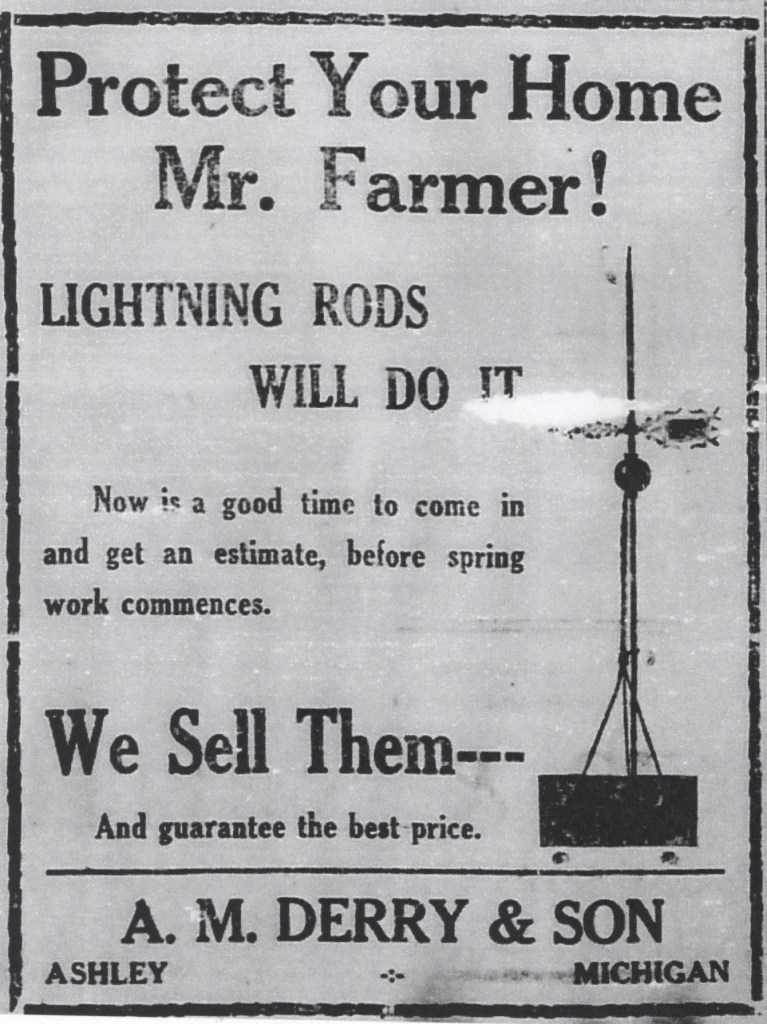
Above: August 14, 1913, headline from the Gratiot County Herald; in 1915, A.M. Derry & Son of Ashley sold lightning rods to interested farmers.
Some say lightning never strikes twice in the same place. Others do not worry about being hit at all. Unfortunately for many in Gratiot County’s past, death and destruction by lightning strikes were common and something to be feared.
In 1913, Gratiot historian Willard Tucker cited over a dozen instances of lightning disasters in a book of the county’s history up until World War I. However, his short collection of lightning stories is only a small sample of the many stories that can be found later in twentieth-century Gratiot County.
Tucker started his coverage with a terrible incident that took place in Elba Township in 1896, which claimed more than one victim. A young boy, Charles Hubbard, age 9, was working with his father in the family’s granary when a bolt of lightning hit Charles, killing him instantly. His father, Stephen Hubbard, was also hit by the same strike but eventually survived, in what was the first story of those who shared lightning strikes. It happened again five years later when Walter Price and John Cumberworth both died on the Roy Cumberworth farm near Ithaca on July 5, 1901. In that case, Roy Cumberworth, who was standing near the other two men, somehow avoided being hit by the same bolt of lightning.
Records show that houses in towns and villages were sometimes hit. Sol Eicher’s house on St. John Street in Ithaca was struck by a tremendous lightning bolt, which Eicher and his wife barely escaped in August 1912. That night, Eicher awoke thinking he had heard a loud noise outside his window, got up, looked outside, saw nothing, and then returned to bed. Another loud crash soon occurred, and this time he awoke to find his bed covered in plaster, a result of the entire ceiling and side walls of the bedroom falling on him and his wife. Upon going outside, Eicher saw that a lightning strike had stripped the siding twelve feet down the side of the house. Upon more inspection upstairs, Eicher found that two big holes could be seen above his bed as well as in the neighboring bedroom. As the family started cleaning up the mess, they ended up removing three bushels of plaster just from their daughter’s bedroom alone. Down below the upstairs windows, the Eichers saw that the porch floor had been split in two.
There are stories of other homes that were also hit by lightning. William Carroll in northeast Seville Township had the top of his chimney and shingles torn off his roof in March 1904. Carroll had just stepped onto his porch after returning from the barn with a lantern after returning from the barn when the force of a strike nearly threw him to the ground. Still, Carroll survived. In November 1924, the DeArmond home, located at 136 Allen Street in Alma, was struck by a bolt of lightning that entered through an open window and then started a fire. Luckily, the entire family was on the ground floor when the incident happened, and DeArmond activated the fire alarm. On the way to the house, the fire truck en route stopped at South Woodworth Avenue for a train when a Chevrolet Coupe driven by Earl Clapp hit the back end of the fire truck. No one was seriously injured, and firefighters safely arrived and extinguished the fire.
Across Gratiot County, there might be no limit to the number of barns struck during a lightning storm. A terrible storm lasting nearly twenty-four hours in August 1913 struck over a dozen barns across the county. During the ordeal, E.A. Stowe of Forrest Hill lost his barn and ninety tons of hay worth $1500. Almost all of the barns or homes hit in this storm were total losses, and the Gratiot County Herald estimated that lightning caused at least $50,000 worth of damage. A year later, in late August 1914, lightning storms covering two successive nights destroyed another six barns in the county.
In most cases, Gratiot farmers lacked sufficient insurance to cover the full damage to their property, while many farmers often had no insurance at all. In one instance, William Holliday and his wife from Alma wintered in Kalkaska in April 1905. They prepared to return to their summer home near Alma just before it was hit by lightning. A neighbor who witnessed the strike attempted to salvage some of the things inside. Still, the fire was too intense and resulted in a total loss as it had no insurance coverage. James Greenlee, near North Star in 1925, lost $4,700 in a fire caused by lightning from his 40×70 barn, which contained farm tools, wagons, straw, shovels, hoes, and cultivators. Luckily, Greenlee had let all of the livestock out of the barn earlier that night, or he might have lost them as well. His insurance covered $3,000 for losses, more than most farmers had at that time.
The result of a lightning strike often left tremendous physical damage, especially for livestock. A.K. Overmeyer of Emerson (Beebe) was able to get his two horses and buggy out of his barn after a strike in June 1913. Still, he lost all of his harnesses and 65 chickens. He received $362 in insurance claims, but it would not cover all of his losses. In July 1923, several county farmers experienced significant personal losses from lightning strikes. A 6:00 a.m. storm caused a fire on the Kinney farm near Ithaca, which quickly went up in flames. The family watched as their barn and a shed burned, which housed a cow and calf, as well as several farm implements, and four tons of hay. All of it quickly went up in flames. Sadly, insurance only covered half their damages. Clarence Shields of Emerson noticed that his horses and cows were acting strangely after the same storm. He then figured out that two of the horses were now deaf. It was not uncommon for other Gratiot lightning strikes to leave farm animals severely burned, blind, or deaf if they had been standing near a lightning strike.
Encounters with lightning sometimes created almost unbelievable stories in the newspapers. William Gephart of Breckenridge was struck and killed in July 1913 when he returned home from a day on the Pine River. While one and a half miles north of Wheeler, he headed to the Chase residence to take cover from the approaching storm. Gephart hitched the horse in the barn, stepped to the buggy to get a rubber blanket to cover the lunch basket, and then was hit by lightning. Strangely, Gephart had no visible marks on his body, just a torn hat and shirt. A Mexican migrant worker, Ysac Rojo, was killed by lightning, and another worker was seriously injured in Fulton Township in July 1926. Rojo and his brother made the mistake of taking shelter under a tree during a storm on the R. C. Blank farm when lightning struck the tree. The strike then burned a hole through Ysac Rojo’s cap, shattered his shoes, but left the rest of his body unmarked. Joe Rojo, who survived, was taken to St. John’s Hospital after suffering severe burns.
Some places in Gratiot County were hit twice by lightning. Ellsworth Wright’s barn near Breckendridge was destroyed in July 1924 for the second time in five years. In both cases, Wright’s barn burned to the ground, and the second time, he lost all of his barn’s contents. Another Breckenridge farmer, Frank Oberst, suffered $7,000 in damages from an August 1925 lightning strike. During the storm, a tenant on the Oberst farm was able to rescue Oberst’s Durham cattle and horses out of the barn. This second barn, measuring 40 feet by 84 feet, had a cement floor with a basement. Unfortunately for Oberst, insurance only covered part of the second loss. In a strange twist, Oberst lost his first barn on the same spot two years earlier.
A Gratiot farmer’s defense against lightning strikes was to buy lightning rods and insurance from county agents, such as W.H. Tenney of St. Louis. Just before World War I, Tenney sold lightning rods made of 98 percent pure copper, which came with patent curved brackets. H.J. Zubler of Breckenridge also sold U.S. Government Lightning Rods, claiming, “If these rods were good enough for government buildings, they ought to be able to fill the bill for you. (The) Same make of rods are used on Gratiot County Farm Buildings.” In March 1915, A.M. Derry and Son of Ashley sold lightning rods and advertised that “Now is a good time to come in and get an estimate, before spring work commences. We sell them—and guarantee the best price.” In the 1920s, businesses like Boothe and Binger of North Star also advertised the sale of lightning rods. They handled 18-gauge, 32-strand cable rods.
About twenty years ago, I visited my paternal grandmother’s last surviving sibling, who still lived on the old Bliss family farm west of Ithaca in Newark Township. As I spoke with my great-uncle about family history, he pointed out the lightning rods and insulators that sat overhead above his porch, then the trio of lightning rods that appeared on the top of the old barn. Aaron Bliss smiled about how some local antique collector with an eye for old lightning rods and insulators had stopped more than once to encourage him to sell off the rods. My uncle only smiled, suggesting that he was happy to keep and trust the devices that had probably spared the Bliss family’s home and barn from hard Gratiot County lightning storms for many decades.


 Goodspeed's Gratiot County Historical Blog