
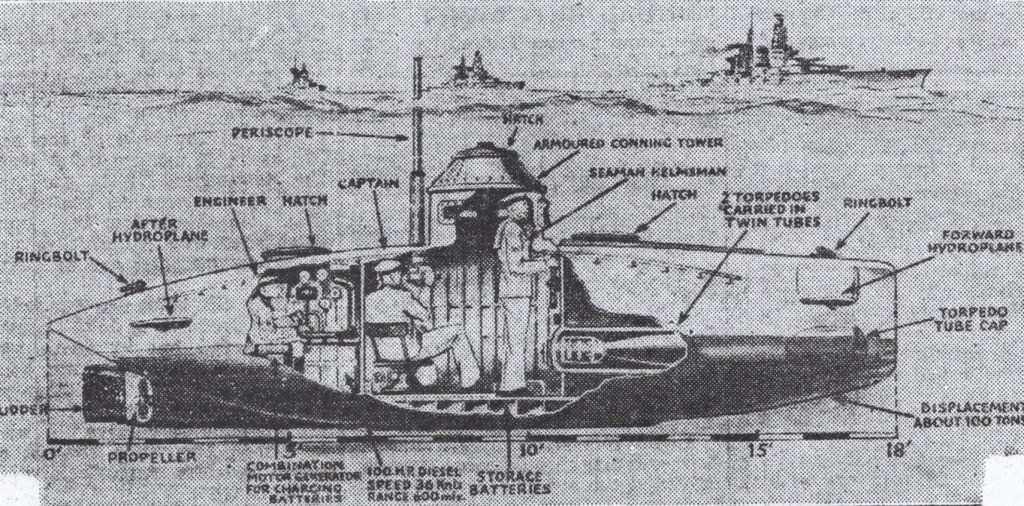


January 1940 photos from top to bottom: Fred Pernert, manager at the St. Louis Co-operative Creamery, took on the role as county chairman for the Finnish Relief Fund; a picture of Japan’s new three-man pocket submarine appeared in the newspapers; “Mugsey,” the Holstein cow belonged to J. Ward Doyle of Breckenridge. No other cow in the county produced milk at cost as Mugsey did; the dean of American League umpires, George Moriarty, appeared at Ithaca High School.
By January, the holidays passed, and winter finally arrived in Gratiot County, dumping snow and creating colder temperatures. As a new year started, residents wondered if the Depression was beginning to end.
What would happen in Europe as fighting continued?
It was January 1940 in Gratiot County.
Images of War in Gratiot County
County newspapers continued to provide Gratiot readers with glimpses of the fighting taking place in the world. Most news stories seemed to pay attention to Nazi Germany. However, in January, news coverage focused on the Russian invasion of Finland, which took place near the Arctic Circle. Here, Finnish soldiers endured bombings and had to flee to neighboring Norway for refuge. During some of the fighting, the Finns wore white uniforms as camouflage, while Russians fought in their traditional dark suits. Names of Finnish cities like Turku, Hanko, and Tornio all now became newsworthy while they endured Russian attacks. Over in St. Louis, Fred Pernert, manager of the St. Louis Co-operative Creamery, accepted the chairmanship of the Finnish Relief Fund. Pernert received the request from President Herbert Hoover to serve as chairman. This fund sought to help the Finns as they fought for principles similar to America’s. Supporters could send money to the Creamery office or Commercial Savings Bank. In St. Louis, Rotarians heard a speech from John L. Giles entitled “Communism in the United States.” Giles went on to explain his experience with Communist propaganda and urged listeners to be aware of the dangers of “the Reds.”
A cartoon entitled “The Middle Man” in county newspapers depicted the predicament neutral nations found as they tried to sail through the British Blockade, which contained German sea mines. This problem echoed events over twenty years earlier when the United States tried to stay out of the First World War while trading with European nations. In an ironic twist, the Gratiot County Herald showed Japan’s new three-person vest pocket submarine, which started production. Small submarines like this appeared at Pearl Harbor in December 1941.
News coverage also featured two Gratiot men who served the country while the rest of the world was at war. Fireman First Class Arthur Wood of Alma came home on a ten-day pass to spend the holidays with his parents. Fireman Wood, in the service for four years and ten months, told the Alma Record about what he saw during fighting at Soochow Creek, China, in 1937 and rescuing the crew of the gunboat Panay in 1939. Wood was also involved in the rescue of the steamship President Hoover near the island of Formosa. Other journeys led to Vladivostok, Russia; Manila, Philipines; Siam; and journeys through Alaskan and Chinese waters. Over time, the young sailor managed to keep a record of his journeys in a picture album. Sergeant Chester Harvey of the 106th Cavalry of Alma was the other serviceman to return to Gratiot County. Harvey went to Fort Riley, Kansas, for three months of training to prepare for a promotion as a commissioned officer. Harvey, an Alma College graduate, also had the record as one of the best shots from Troop B.
The Depression Rolls Onward
One of the new developments in Gratiot County by 1940 concerned changes for those requesting welfare. The Gratiot County Social Welfare Board made a presentation to the County Board of Supervisors regarding hospitalization for those on welfare, especially afflicted children. Mable Clelland, county agent, was ordered by the Supervisors to handle investigations of the sick and disabled children until the state appointed a person to replace him. One positive report showed that the county had 113 fewer relief cases than a year ago. The Supervisors then transferred $10,000 from the general fund to the social welfare fund, giving it a balance of $24,000 for the upcoming year.
The biggest news concerning welfare centered around Gratiot County’s new program unofficially called Work for Relief. Relief clients who wanted assistance now had to do work provided by the county. One type of employment meant cutting brush along county highways for $1.50 daily. The question was then asked, what about the many clients who would not be able to labor cutting brush? To answer this question, the board asked physicians to designate those unfit for such labor. Still, “work or no relief” caused relief clients to appear at one of five county garages on the first day to get their work assignment, which entailed working eight hours daily. Twenty-two showed up at Alma, eighteen in Breckenridge, ten at Ithaca, nine at Ashley, and seven in Middleton. To help the clients, the county road commissioners furnished tools and supervision.
The Works Progress Administration (WPA) continued in Gratiot County, although it sometimes lacked favor from some, like the Gratiot supervisors. Mr. Morrell, a WPA legal advisor, proposed a five-year federal relief project involving compiling a Gratiot County history to the supervisors. The project would employ five people, and the federal government would finance it with $4,000. Gratiot County had to pay $300. The results? The Board flatly turned the offer down. One commissioner likened the project to a dog chasing a train. What would the dog do with the train once the dog caught the train? In other words, what would the long-term benefit be for creating the history of Gratiot County? In other news, Alma Junior High hosted a state WPA Project where Gladys Bradshaw Perry, state supervisor of the Michigan State College WPA Project, brought an extensive collection of toys created by WPA workers. The collection consisted of stuffed dolls and animals, educational toys, doll beds, and various games done by WPA workers. The federal government paid wages for the workers, and materials came from sponsors and co-sponsors, all in an attempt to give the unemployed jobs and the opportunity to learn a trade. The WPA also did other things in the county, such as holding a city-wide ping pong tournament. Both WPA recreation leaders, Jack Acker and Wilford McWilliams, oversaw the program. Other WPA recreation programs occurred at Alma’s Wright Park, the Old Republic School, the Republic skating rink, and the city skating rink. Over at St. Louis, a new skating rink debuted through the Community Council, which opened weeknights and weekend afternoons. The WPA and NYA (National Youth Administration) had members overseeing activities at the rink. In addition to a weekend of working to create good ice, skaters also had a warming house for taking a break from skating. Over at East Alma Recreation, the WPA sponsored Junior Bug-a-boo, Senior Bug-a-boo, and Girls Doodle Bug clubs. Participants enjoyed food, music, crafts, and dance instruction.
The other significant New Deal Program in Gratiot County concerned the NYA (National Youth Administration). Vernon Davis of Alma was one of only 200 young people chosen to take a two-year program that educated young men interested in aviation. Davis enrolled at the Waterloo Project at Camp Cassidy, which trained men in mechanical engineering. The young men in this program lived in cottages, each with a leader (Davis was elected as one). NYA workers would also be involved with 2,150 Gratiot youth in a nationwide survey to determine unemployment problems for those ages 16-24. The survey attempted to determine how many young people were out of school and did not have jobs. Some of the NYA workers in the county helped conduct the study. Here in Gratiot County, NYA members worked clearing the ground of dead logs around Conservation League Park, built tables and benches, a shelter house, and rebuilt a log cabin. Around city hall, boys in the NYA did shop work and cleaned and painted walls. Over at Alma Schools, several worked in woodworking classes. A sewing project sponsored by the city of Alma involved NYA, and the Salvation Army employed ten unmarried young women aged 18 to 25. The project had help from a local company that loaned machines so the women could condition old clothing and create layettes for newborn children.
In other news, the Townsend Club followers continued to hold meetings in the county. President Charles Reed, who oversaw the Alma club, invited Reverend George Gullen from Detroit to attend a program at the American Legion Hall over Reed’s Shoe Store. Gullen represented the Townsend movement in the state as its attorney. Another Townsend meeting occurred at the St. Louis Park Hotel, where Harry Elliot, a national speaker, planned to discuss the Townsend Plan. Over 200 people attended the program, ending with Edgerton Crandell playing the xylophone.
New Deal programs like the WPA, NYA, and others often faced criticism from Americans who believed the programs to be a waste of government dollars. One such program gave the public millions of surplus apples at seventy cents a bushel. Because farmers could hardly get twenty-five cents a bushel for apples, a critic wondered why the government paid seventy cents for each bushel it planned to give away without helping farmers. On top of that, too many apples seemed to go to waste, and to this county newspaper, the government just seemed to be “shaking the tree.”
The Outdoors, Farming, and Farm Issues in January 1940
After the holidays, Alma urged Christmas tree owners to deposit their used trees at Conservation Park. The previous winter, large flocks of birds appeared and used the trees as shelter. The Gratiot County Herald ran a story about a new winter sport – ice fishing in Michigan. However, a new law prohibited using lights at night to catch bluegills. In another topic relating to fishing, Michigan sugar beet executives met to discuss the issue of epidemic fish killings again in places like the Pine River below Alma and St. Louis. The large number of fish killed was attributed to the sugar beet plant’s inadequate treatment facilities. It took ten miles of chasing, but hunter Charles Boots shot a red box west of Bridgeville along the Maple River but a second red fox got away, and many had been seen between Bridgeville and Maple Rapids. Henry B. Gulick of Mason, Michigan, grew up in Lafayette Township. He recalled what hunting was like as far back as the 1870s in Gratiot County and described the abundance of bears, which made hunting very successful. Within three hours on one hunting day in 1884, Gulick and his family shot three bears in Section 24, and with the help of their wagon, they had them back home by noon. The largest bear weighed 450 pounds.
Farmers met at different shows and meetings as the 1940 winter moved forward. The Middleton Methodist Church hosted the Gratiot-Clinton District Association of Farmers. Middleton merchants furnished roasted meat for the noon potluck meal as a break from the whole day of meetings. Don Sharkey from St. Louis hosted one of three tractor shows in January. Sharkey, who sponsored one meeting at the Community Hardware Company’s implement building, highlighted the use of John Deere tractors and implements. One of the features of the meetings included free talking movies and a free lunch. The St. Louis Beet Growers Association held its ninth annual meeting in the St. Louis High School auditorium. The meeting was expected to draw 500 to 600 farmers, and the Lutheran, Episcopal, Christian Church, and American Legion Auxiliary provided a meal. When the day ended, over 800 people attended. News came from Washington that a government sugar beet program would take place in 1940, but payment rates would be the same as in 1938 and 1939.
Some of the controversial news involving farmers that winter dealt with the sensitive issue of ending Sunday hunting in Gratiot County. The Gratiot County Board of Commissioners voted 18 to 6 to petition the state legislature to allow a referendum vote on the issue. Clinton County also sought to ask the state the same thing. A group of ministers in the Gratiot County Council of Churches and Sunday Schools approached the commissioners and urged an end to Sunday hunting. However, a ban would not be enforced for at least one year. Opinions on both sides of the issue appeared in local newspapers. H.O. Butler wrote a long letter to the Gratiot County Herald telling readers that he was against a ban on Sunday hunting, saying, “It is no more wicked to hunt on Sunday than on any other one of the five remaining work days.” He added that if preachers did more of their job preaching “the truth, the whole truth, and nothing but the truth” from the scriptures, there would be no hunting on Sundays as more hunters would be in church. Butler also added that he did not hunt or own a gun.
H.J. Pinter and D.W. Olson announced the opening of Blue Ribbon Hatchery in Alma, located one block south of city hall. The owners planned to buy poultry and sell Blue Ribbon poultry feeds to the public. Swift and Company of Alma published a fifteen-page annual Yearbook of Swift and Company that covered what the company did in the past year. “Mugsey,” a Holstein owned by J. Ward Doyle of Breckenridge, appeared in the news as a record-grade cow. Mugsey produced 17,708 pounds of milk and 739.7 pounds of butterfat during 1939, returning to owner Doyle $229.79 above feed cost. Doyle wanted to know if any other cow in the county had a higher producing grade.
Breckenridge was busy that January as it hosted its 12th annual community fair. The Future Farmer Chapter and Breckenridge merchants sponsored the two-day event, which enabled 800 people to view exhibits of farm produce, sewing and home economics, and handcraft projects.
Gratiot County also took a moment to pause and reflect on the history of farming. A long article in the Gratiot County Herald reminded readers of the vital role of the County Extension Agent. The article reminded readers that Gratiot County’s first agent went on duty starting in 1917. The current agent, C.P. Milham, provided the history and details.
The Long Arm of the Law in Gratiot County in Winter
If anyone wanted to know the status of lawbreakers, they only needed to read the newspapers. During the previous month, the prosecuting attorney, Robert H. Baker, announced that thirty convictions occurred, with an additional 21 traffic violation convictions. Eight people in the group were convicted of illegally trapping muskrats. Another offense, passing bad checks without sufficient funds, had five culprits.
January began with a settlement in the farm accounting case of Rowland Sexton, a Flint minister, and Maurie Arman. Arman operated as a tenant on Sexton’s farm near Houserville for nine years. The pair settled the accounting issue after evidence was taken to circuit courts. Fines and costs brought in approximately $280 to the court.
Various stories behind some criminal cases contained a mixture of sadness, grief, and even disbelief. Berniece Barry, wife of a Porter Township oil worker, failed to have her driver’s license after being involved in a traffic accident. It cost her $55.05 or 60 days in jail. Cornelius Eichorn, reported to be a well-to-do farmer in Emerson Township, made a petition to regain his automobile license, which had been suspended when Eichorn drove his car against a car off of US-27. Eichorn had not been allowed to drive for several months. Eichorn’s wife petitioned the court to speak on her husband’s behalf in a February hearing. Mike Miczek of Middleton was brought before Judge Potter for stealing coal from Middleton Farmers Elevator. He paid $18.15 for fines and costs or spent 20 days in jail. Newell Little of Wheeler got the book thrown at him when the court sentenced him from 7 ½ to 22 ½ years for forgery. Little forged the name of William Kipp of Wheeler to a check amounting to $12.50. Little had a long line of forgery offenses that came up at sentencing. Kipp was sent to Jackson Prison as a second-offense felon.
Richard Storms, a WPA worker in Alma, stood mute after being arrested for assaulting his wife, who was trying to find medicine for a sick baby. Storms wanted the baby to stop crying and beat her. Storms was allowed to return home while awaiting trial as long as he “lived in accord” with his wife. Theodore Orwig, age 18, of Alma, broke into Clare Shunk’s car on an Alma street. Orwig had previous probation terms and, therefore, went to jail for ninety days.
Jesse Perez’s attorneys attempted to bring his three-year-old murder case back to court. Perez argued that he did not understand the implications of his confession to a murder he committed in Seville Township in 1936. Perez was convicted of killing another Mexican beet worker, Gonzola Silba, after a dispute while working in the field.
Probably the most talked about topic in Gratiot County in January remained the Dewey Glinke embezzlement case. The probe of Glinke’s efforts to embezzle funds from the Gratiot County treasurer’s office now went to state auditors, and Gratiot County had to pay the state for the audits. Had Glinke been manipulating records for only one or two years or more? To know for sure, auditors now suggested a complete probe of Glinke’s work, which went back five years. The current Glinke defalcations ran up to $1,800. Despite this scandal, the state auditor commended and sympathized with County Treasurer William Federspiel for his cooperation and determination in getting to the bottom of Glinke’s crime.
Norman Prange of St. Louis tested the city of Alma’s peddling laws. He made $1 on a sale at one of his door-to-door stops and was arrested after he failed to pay a $40 license fee. The case was to be reviewed in February, as his lawyer argued that the transaction involved interstate commerce. Finally, In the February 1940 term, two county women, Mrs. Never Hole of Alma and Pearl Strong of St. Louis, served jury duty. The rest of the jury pool consisted of men.
And So We Do Not Forget
The Alma First Methodist Church started holding Lenten season evangelistic services over two weeks. Reverend Edward Patsch of East Liverpool, Ohio, served as evangelist…Eugene T. Walker of Alma wrote a letter to the Alma Record Alma Journal regarding his memories of operating thrashing machines during harvest times in Arcada and Sumner Township. Walker described how he threshed a total of 927,194 bushels of grain in his lifetime. Walker also collected and owned old thresher catalogs, which he loaned to interested readers…Gratiot County Treasurer William G. Federspiel announced that citizens of the county continued to conduct good tax collections. Roughly 58 percent of assessed taxes had been paid so far…Viewers continued to see Alma’s Local News Reel on Wednesday and Thursday nights at the Strand Theatre. Also, Billy Farrell entertained audiences from 6:45 to 7:15 p.m. during intermissions each night. Farrell played the Hammond Organ before features on Tuesday and Friday nights…Alma City Manager William Reynolds laid the rules for those using the city skating rink. The number one rule said no games of “I got it,” “Crack the whip,” or “Tag”…The hamlet of Pompeii witnessed a fire that caused over $7,000 worth of damage to the home of L.E. Passenger, which turned out to be a complete loss. Pompeii had no fire department, and all calls had to be answered by the fire department at Perrinton…Members of the Alma Fire Department planned the upcoming annual fireman’s ball. The ball took place on Washington’s birthday.
Used car sales in Alma remained very brisk. Hickerson Chevrolet Sales said it had more used car sales during the winter than could be remembered. Usually, car buyers wait until after winter to make their purchases, but not this January…Mr. Bourikas at the Main Café in Alma announced that the new modern fireproof addition enabled him to keep up with his growing business. The new 20×24 floor space connected to the dining room and helped him serve the busy crowds on Saturday and Sunday nights…The Newberry Store in Alma announced a new addition that called for an 80 percent addition to its existing space. Newberrys planned to lease the adjacent store building, which belonged to Floyd Luchini. The Simi Café that operated next door planned to move. A 40-foot addition in the back of Newberry’s allowed more space. A partition between the two buildings would be removed, and the store would have different entry locations…The first fatal traffic accident of 1940 took place in Wheeler Township when Lawrence Bartlett, age 29, died when his car collided with one from Ricard Jessup, age 19, of Wheeler. Bartlett, who died at Smith Memorial Hospital, failed to stop on M-46 and crossed in front of the Jessup vehicle.
Red Cross contributions thus far totaled $2,230.90. An increase of 408 new members raised the total from this time last year. Emerson Township had 61 members and contributed $75.60….The newsreel man from the Strand Theatre made his way to Grayling to watch the crowning of the Snow Queen during Grayling’s Winter Festival. The queen, Miss Pauline Merrill, previously lived in St. Louis and Breckenridge and was well known in Alma. The movies will be shown before the show each day until February 4. The film also featured several Detroit Tigers players who attended the festival…Bernard Gallagher, who worked at Bragg’s Standard Oil service station, was taken to Wilcox-Carney Hospital for acute appendicitis. After emergency surgery, Gallagher was resting and had much improved…Mr. and Mrs. Louis Gittleman, owners of their style shop in Alma, traveled to Detroit for a fashion show. The Gittlemans hoped to obtain new merchandise for the Alma store and the ones they owned in Greenville and Ionia…St. Louis Community Council announced that the new skating rink for children would soon open on Wheeler Field. Adults who wanted to skate used the rink on the newly lighted softball field…The Alma Public Library continued to grow as demands for books in practical arts, history, and special sciences doubled. The Masonic Home received 442 books on loan from the library, and the Gleaner Home received 108 books…The Gratiot County Farm Bureau held its fourth annual meeting in the basement of the Ithaca Methodist Church. After the business meeting, a potluck dinner occurred at noon, followed by special singing by Mrs. Neikirk. Mrs. Hearn played the piano…The movie “Beau Geste,” starring Gary Cooper, Ray Milland, and Susan Hayward, played at the Strand Theatre in Alma. Tickets were ten and twenty cents…January 22-26 became known as Health Week for Gratiot County, according to county school commissioner Donald L. Baker. All teachers in the county stressed the importance of good health with students. Topics included keeping the body clean, proper care for teeth, getting physical examinations by the family doctor, vaccinations, and good sources of drinking water…Redman Trailer sales experienced a 200 percent increase for 1939 compared to the previous year. The company sold 400 trailers and grossed $220,000. The company employed sixty men with a payroll of $38,000.
The Gratiot County Herald announced its tenth annual baby contest. A list of rules about those who entered the first babies born in 1940 could be found in the January 4, 1940 newspaper. The first prize involved a baby bed with a mattress or a high chair with a waterproof tray. First place went to Judith Joan Russell of St. Louis, born at 4:18 a.m. on January 1 to Mr. and Mrs. Rolland Russell…Young Dale Paul Todd of Middleton won the Gratiot County Herald’s New Year’s Baby Contest in 1939 and celebrated his first birthday on January 1. Now walking around the house using chairs and furniture, young Dale Todd weighed 25 pounds and measured 29 inches…Roy W. Richards of Alma was appointed enumerator for the 1940 census. Richards began a check-up of business property, but the population count would not start until April 1…Alma’s new sander now sanded three blocks of the road with the same material that formerly only did one road…E.R. Erickson and Edwin Harwood completed work at the University of Michigan to obtain their master’s Degrees. Harwood taught English and wrote a thesis for his degree; Erickson chose to do extra work hours instead of the thesis. Both men taught at St. Louis High School…The St. Louis Rollers women’s bowling team, outfitted in their new uniforms, won two of three games at Alma Recreation Alleys. St. Louis merchants donated the uniforms…Over 100 couples attended the annual J-Hop held at St. Louis High School auditorium on a Friday evening. Giant white stars hung from the light blue ceiling while the orchestra’s stage displayed blue lights on Christmas trees. Kenneth Harrier, vice-president of the class, led the grand march along with Elaine Ellsworth. Several classes had graduated in attendance from as far back as 1934…462 Gratiot County teachers with teacher certificates filed their oath of allegiance. Those who had not filed had 60 days to do so.
“The Wizard of Oz” made its first movie appearance in Gratiot County when it debuted at the Ideal Theatre in Ithaca on January 11. Admission was 15 cents and 10 cents…The Perrinton Community Hall underwent renovations, and new seats and furniture were installed. Upon completion, the Fulton High School basketball team planned to play its home games at the hall… Noted columnist and radio speaker Boake Carter appeared in Ithaca as part of the Gratiot Town Hall series. Carter was initially supposed to appear in October, but with the outbreak of war in Europe, he remained in Washington. Carter’s reputation as one of the finest radio speakers of his day meant good attendance for his program…The Gratiot County Rural Letter Carrier’s Association held a potluck supper at the home of Mr. and Mrs. Albert Knapp in Alma…Ithaca Schools gave out standardized tests to students on two days in mid-January. Superintendent McKibben said the tests revealed whether the schools expected too much or too little for children in each grade. The scores told whether students performed at their grade level, or higher or lower…The Ballard Trophy at Ithaca High School went to Ralph Cheney for the most valuable member of the 1939 football team. Elwood Mellinger was announced as captain of the 1940 team…The Mellinger School planned a P.T.A. meeting later in January. George (Elmer) Schleder and his “amateurs” would provide entertainment….The Union Telephone Company issued its 1940 telephone directory with 3,094 names of subscribers. Alma had 1,350 telephone stations… The Christmas weather seemed somewhat light, but cold temps in January dropped to the mercury to four above zero…The Ithaca High School Athletic Club sponsored the dean of American League Umpires, George Moriarty, who spoke at the Ithaca High School gym. Moriarty also showed a movie entitled “Touching All Three Bases.” The Ithaca High School Athletic Club sponsored the event, and entrance was free.
And that was January 1940 in Gratiot County during Depression and War.
Copyright 2024 James M. Goodspeed
 Goodspeed's Gratiot County Historical Blog