Gratiot County During Depression and War: “October 1941, Blessed Peace, but Preparations for War”

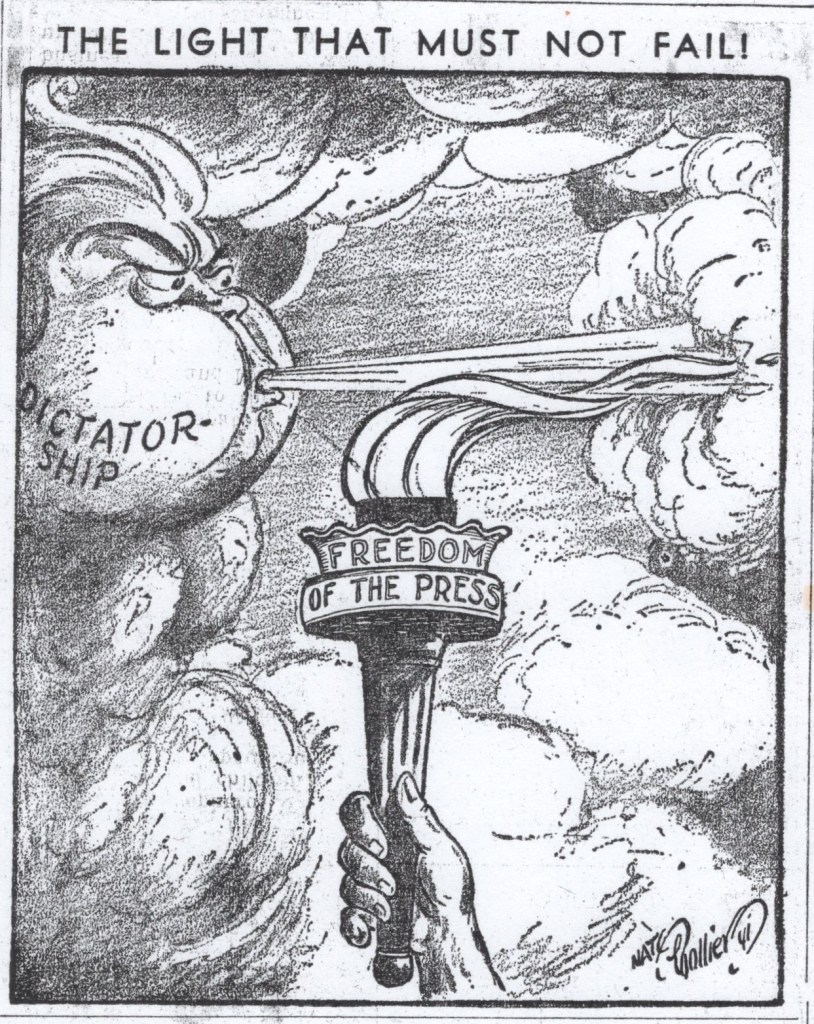
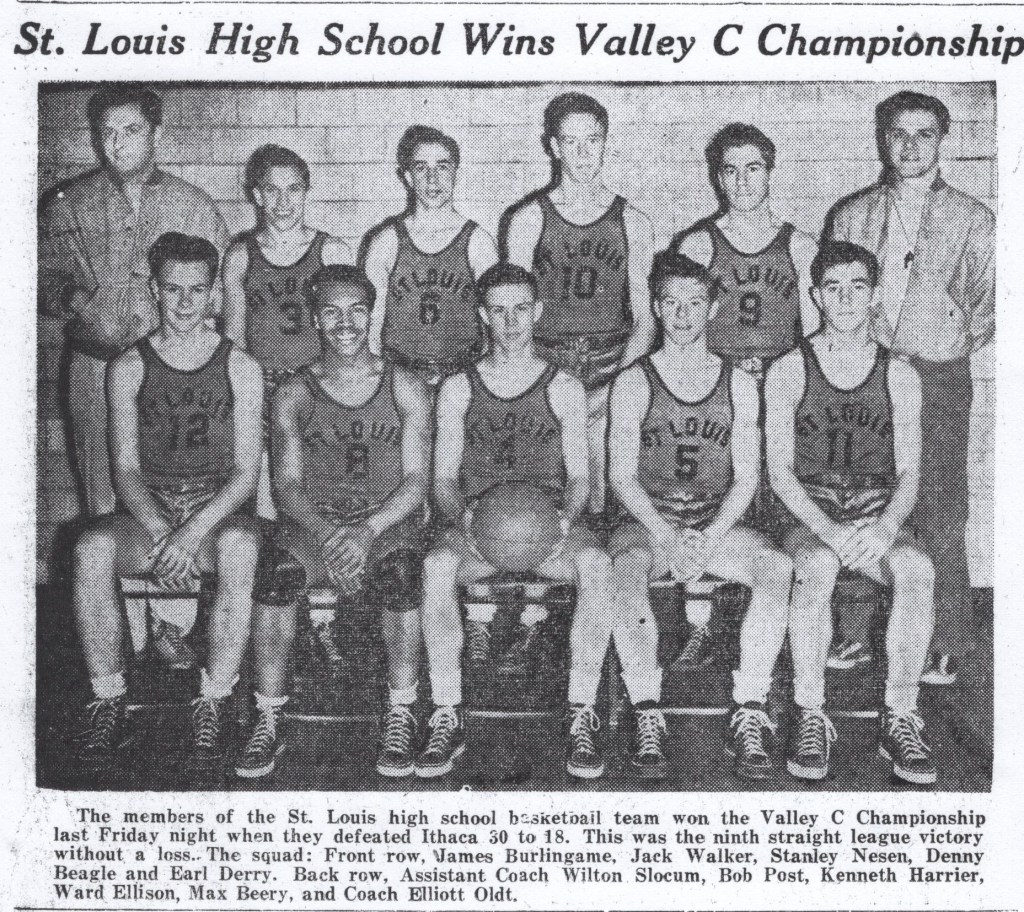
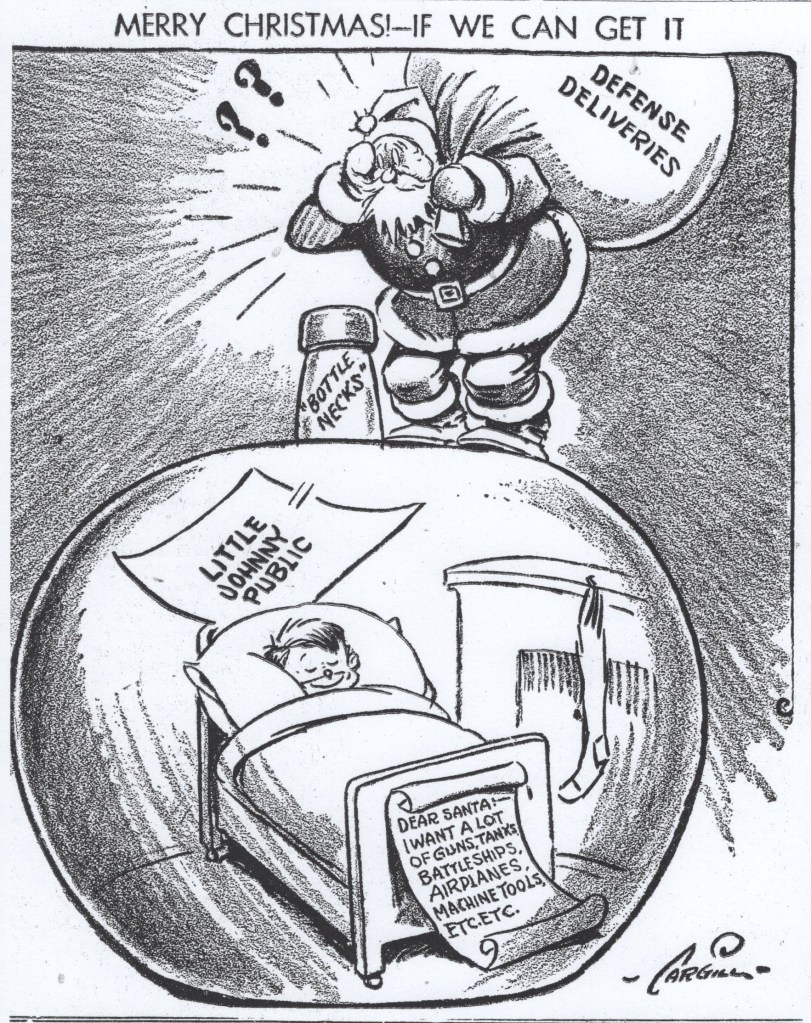
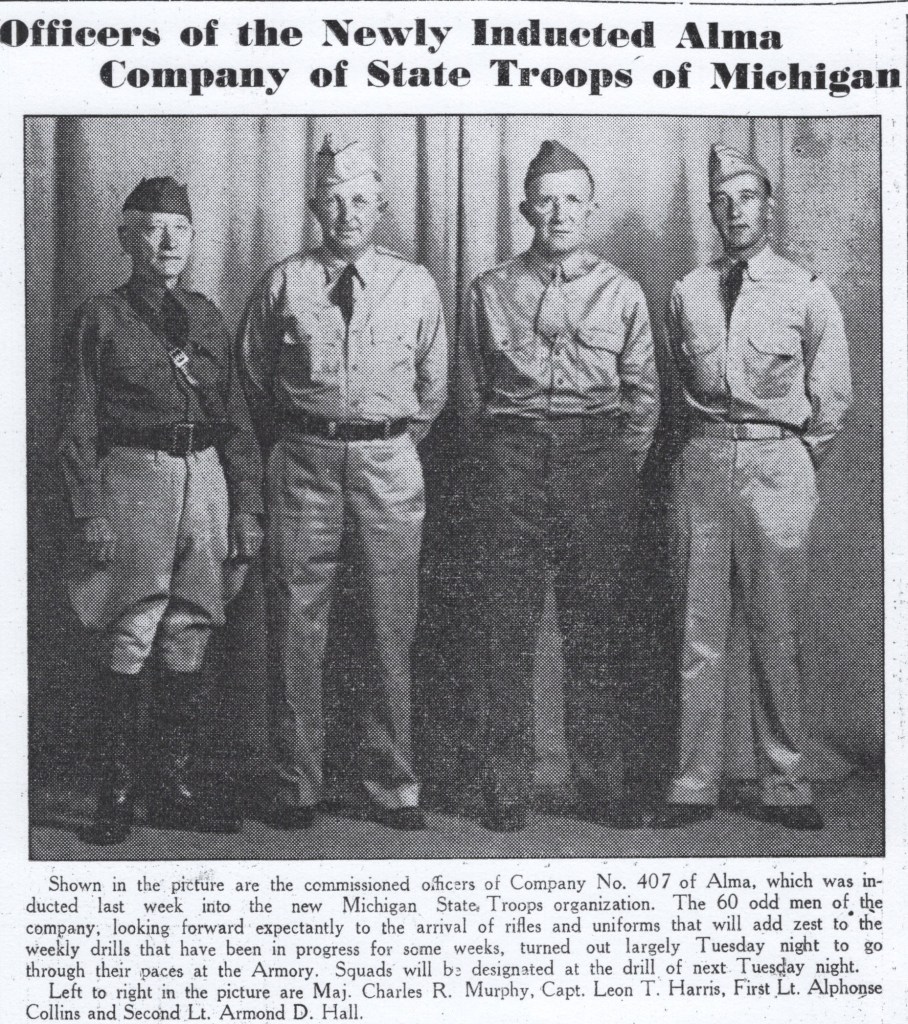
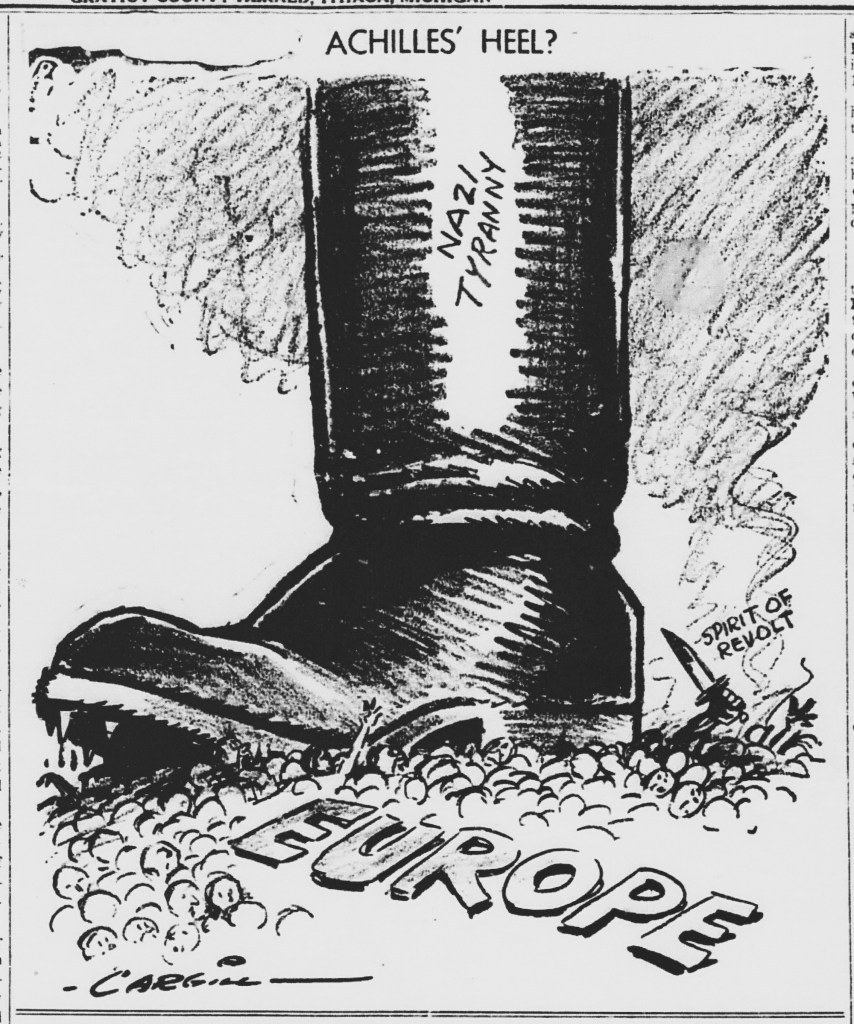
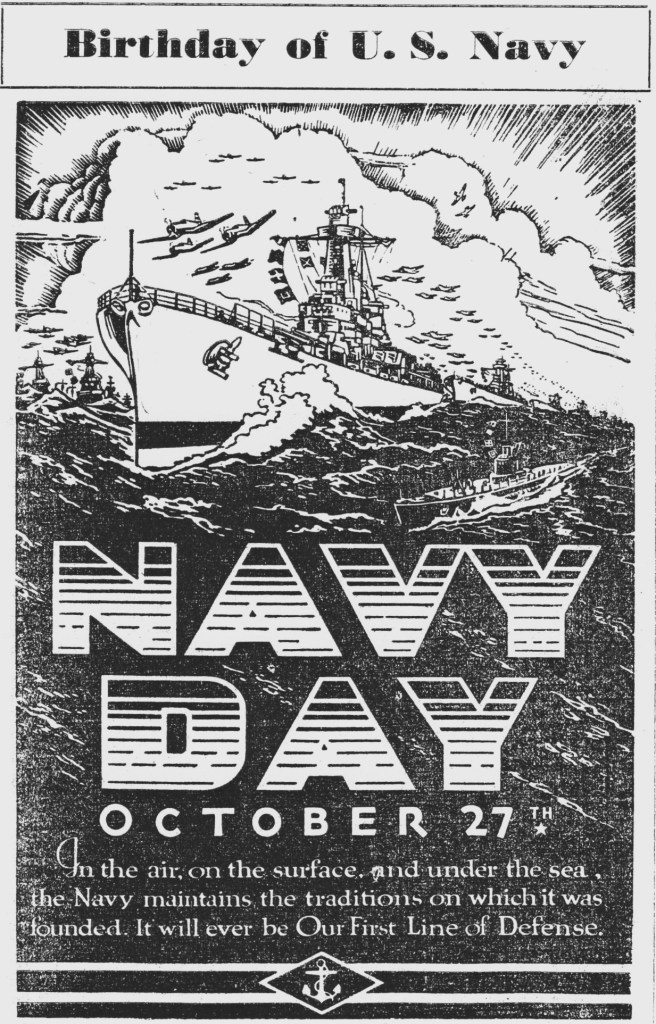
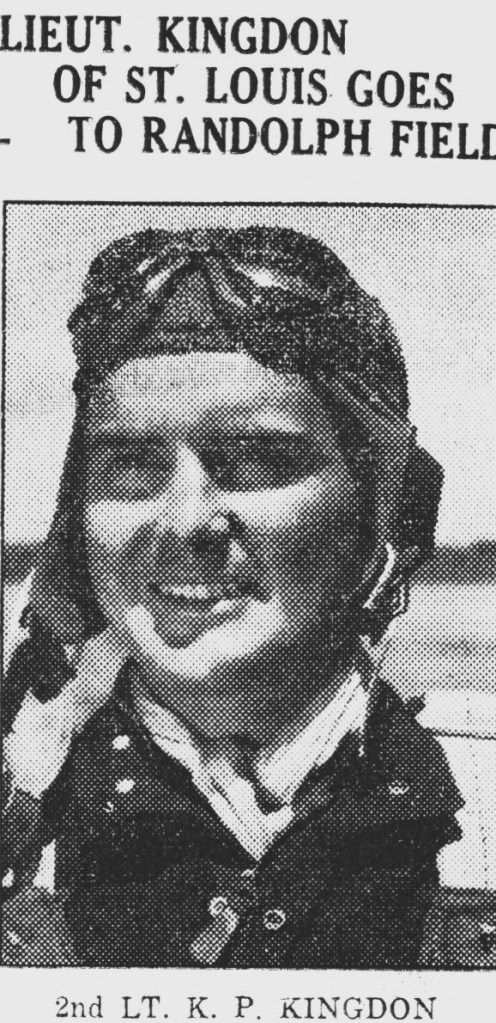
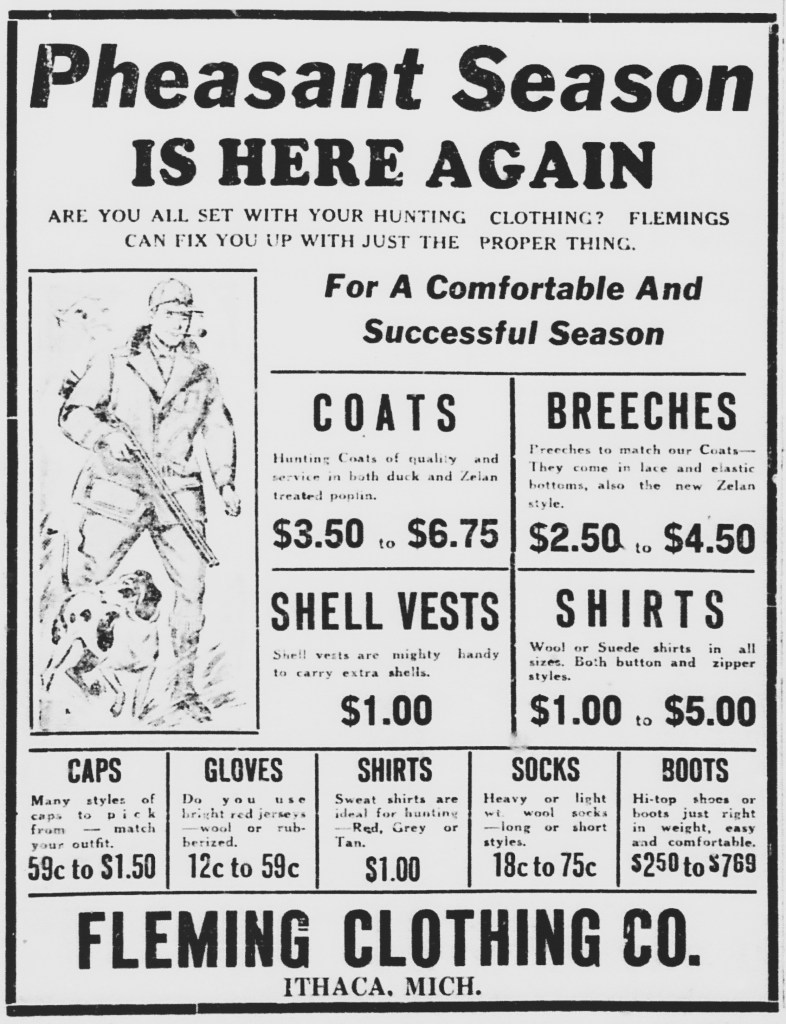
October 1941, from the top: Newly commissioned officers of Company 407 of Alma. The “Home Guards” were back; Over two years of Nazi tyranny in Europe made people hope for uprisings and revolts; Navy Day debuted in Gratiot County on October 27, 1941; Lieutenant Kenneth P. Kingdon of St. Louis graduated from Kelly Field and was assigned to be a flight instructor at Randolph Field, Texas. Kingdon’s story was just one of several that appeared in October newspapers. The names and numbers of men coming and going from Gratiot County increased as 1941 entered its last quarter; pheasant season descended upon Gratiot County, drawing hordes of hunters from outside the country to hunt the Ring-neck pheasant.

President Roosevelt’s speeches and radio addresses to the nation sounded as if United States involvement in the war was drawing closer.

Some of Gratiot County’s young men briefly came home from recently entering Selective Service. A short visit home could be worth the long trip from Louisiana, the Carolinas, or even Texas.

The county’s earliest calls for aluminum and waste paper collection drives were only a foretaste of what would happen the next year. But no one knew this.

Out in the Gratiot County countryside, pheasant and rabbit season was about to open. Farmers prepared for the arrival of many out-of-county hunters – and they worried about how their crops, animals, and farmland would be treated.

The last peacetime holiday season was fast approaching. But again, no one realized just how quiet life really was.

It was October 1941 in Gratiot County.

War Talk and War Preparation Movement in October 1941

“The shooting has started,” President Franklin D. Roosevelt said in an address to the nation in late October. War seemed imminent for the United States, but how and where would it begin? Nazi U-boat attacks upon shipping in the Atlantic caused Roosevelt to warn the world that “We Americans have cleared our decks and taken our battle stations. The forward march of Hitlerism can be stopped – and it will be stopped.”

Throughout October, many news items strengthened feelings that war with Germany was just around the corner. Early in October, the Gratiot County draft board announced that fourteen men had to appear at the county draft board offices on November 3 to report to Detroit for their final examinations. This came after the county did not have to provide men for selective service in October or November because it had filled all previous quotas on schedule. The Greyhound bus carrying the group was scheduled to leave Alma at 6:00 pm (following a dinner at the American Legion Hall), and they would stay at the Fort Shelby Hotel. After their examinations, the men would return home and have ten days to take care of all personal matters before entering the service.

While it had been nearly six months since the Alma anti-tank battery left the county for federal service, the 407th Company of Michigan State Troops was organized and was activated. Captain Leon Thomas Harris commanded the unit and had 57 officers and men. A formal induction service was held at the Alma Masonic Temple after the men marched down there from the armory. The group awaited a shipment of rifles, and 44 of the men received measurements for new uniforms. While more men entered the service, 33 others became eligible for early release because they were 28 years of age or older. The first three offered discharge started with Private Albert Tussell of Wheeler. Upon discharge, Russell immediately joined the enlisted corps and was one of four Russell brothers serving from Gratiot County. Ward Young of Ithaca and Harold Cook of Riverdale were the other men to receive early discharge.

Other men also came home in October, but only on furlough. A group of 42 men from Louisiana and the Carolinas returned for a 12-day leave. About 30 of them belonged to the anti-tank battery, which left the county earlier in 1941. Several stated that they liked the idea of being home for the start of pheasant season in Gratiot County. As these men returned home, readers learned where they had been. Private Willard Haag and Private Allen Fairbanks came home to a chicken dinner in their honor. Haag had been at Fort Custer; Fairbanks at Fort Clairbourne, Louisiana. Private Harry Oberlin was invited to a party in his honor at the Ray Peck home. Cider and doughnuts welcomed Oberlin and sixteen friends. Private Duane Gamble of Newark came home to Perrinton to visit for a few days after becoming a licensed radio operator at Scott Field, Illinois. Private Franklin Klein came home from Fort Sheridan, Illinois, after spending eight weeks training in automotive mechanics. He was one of 41 graduates in his group, and he expected to be sent back to Fort Custer with the 56th Quartermaster Regiment. Private Gerald Gilbert of Alma headed the other way as others came home. Gilbert was one of 113 selectees from Fort Custer to be sent to Camp Wallace, Texas, to prepare at the Coast Artillery Replacement Training Center. News arrived that Lieutenant Kenneth Kingdon of St. Louis was assigned to Randolph Field, Texas, as a flight instructor. Kingdon had just graduated from Kelly Field as one of 31 officers who completed basic training at the “West Point of the Air” that summer. When Kingdon got home to St. Louis, he stayed with his parents for five days.

In October 1941, one branch of the military openly recruited more Gratiot men for service. Alma Record editor R.A. Babcock and Leslie C. Struble of St. Louis became official “Navy editors” who helped with a Navy campaign to get Gratiot young men to join the new “Two-Ocean” Navy. To carry out the recruitment drive, the Navy opened a recruiting station in St. Louis. Those young men who wanted more information could get it at the Alma Record office or the St. Louis Leader office. At the end of the month, Gratiot County officially joined and promoted Navy Day on October 27, hoping to draw more men to the service. One St. Louis youth, Reinhold Faust, decided to join the Marine Corps and was headed to Parris Island for his first assignment.

Civilians exhibited their patriotic spirit and supported those in the military..  The Gratiot Red Cross prepared for its annual roll call drive to raise $ 3,450, double what it raised a year ago. A group of twelve Gratiot County men completed a ten-hour ARC course in advanced first aid and lined up to receive the Red Cross First Aid pin. Breckenridge participants included Thomas J. Roth, Dr. D.J. Shepard, Louis Federspiel, and Richard Paulus. The Jean Torrence Chapter of the Daughters of the American Revolution donated 55 cans of jellies and jam, along with a large collection of current magazines, for men at Fort Custer. Gratiot County Boy Scouts organized a countywide waste paper salvage drive. This came in response to a call from Washington for a nationwide paper-collection effort. A greater nationwide effort was needed to collect aluminum pots and pans, which had been donated earlier in the summer but had not been picked up and shipped for melting. Soon, Gratiot County would get involved in other forms of metal drives. The Gratiot County Defense Council formed in Ithaca to address the county’s defense needs and goals; in this case, the main focus was firefighting. Alma Postmaster J. L. Winslow reported that more people bought national defense bonds and stamps during September. These sales included bonds amounting to $3,356.

Some glad and sad news rounded out the month. The Alma Elks and the four-county American Legion Posts planned a large Armistice Day parade in Alma, with over 20 floats from industrial and business firms and seven bands. Red flares and aerial bombs went off during the parade to honor Gratiot County’s World War I veterans. In sad news, Claud Jessup, originally from North Star Township, died while stationed at Guantanamo Naval Base, where he served for most of the previous fifteen years. Mrs. Emma Jessup of Ithaca, Claud’s mother, after much deliberation about long-distance travel and concern because of advancing age, decided to travel to Cuba to visit her son. After she left Ithaca on October 14, her son suffered a cerebral hemorrhage the next day and passed at Guantanamo Bay. Emma Jessup had no way of knowing what happened and could not be reached until she reached Cuba. Mother and son were reunited, but in an unexpected tragedy.

New Deal Programs at Work in Fall 1941; Depression Needs

WPA (Works Progress Administration) workers received good news that the WPA planned to increase pay. Howard O. Hunter, WPA commissioner, said he believed pay increases would average about ten percent. Gratiot County workers earned $44.40 a month at the time. Only one person over the age of eighteen from a single family could work in the program, and the WPA workforce averaged 234 people during 1941. By September, a total of 157 WPA workers existed in the entire county. For some of their jobs, Alma WPA workers prepared to finish pouring concrete slabs on three blocks of River Street. St. Louis also hoped that WPA workers over there would complete a major sewer project. WPA workers completed about fifty blocks of street improvements over the past three years. Places like State, Iowa, and Superior streets were all WPA projects.

On Depression-related issues, the county still debated the status of a new welfare agent. The board of supervisors agreed to defer action on accepting the new agent who was appointed by the state of Michigan. Mrs. Mary McIlwain of St. Louis would be paid $5 per day or $2.50 per half day for each day she worked, plus another four cents per mile until the matter reached a resolution. Meanwhile, the issue continued until next month. The Gratiot County welfare association agreed to adopt the federal food stamp system. Each set of stamps had different colors and was supplied by mail-order service from state headquarters in Lansing. One of the biggest issues county commissioners faced was the cost of hospitalization, medical care, the infirmary, and the county poor farm. The previous year’s costs reached $84,959.86, and the commissioners aimed to reduce costs by deciding where to treat patients. The County Road Commission worked with the Department of Social Welfare to employ the unemployed by cutting brush along the county’s highways during the winter months. Most of the workers gladly received groceries and coal in exchange for their work.

Health Matters in Gratiot County

Newspapers reported on health issues, including the ongoing war against tuberculosis. Approximately 15,000 people in Michigan received “Health” magazine, which featured the success of over 3,700 rural Michigan schools that sold Christmas seals. During the previous year, 101 rural Gratiot schools sold Christmas seals to raise money to fight tuberculosis. The Yound School in Newark Township, taught by teacher Martha Wangerin, led the sales, received mention, and was followed by teacher Miss Nellie Peck’s Frost School in Wheeler. The issue featured letters written by many Michigan students. Newspapers also reminded readers that sixty-six people died from tuberculosis, a rate of 22 per 10,000 people in the county.

To combat disease in Gratiot County, places like Alma Public Schools held a diphtheria immunization clinic, led by Dr. Charles Dubois, city health officer and physician. Immunization cost twenty-five cents; however, any payment was welcome. Parents of children in kindergarten through second grade who could not afford the shots received them for free. The county board of supervisors reported that a free summer dental clinic took place in Ithaca, Alma, and St. Louis for underprivileged children. A total of 869 children and young people received free care courtesy of the Children’s Fund of Michigan.

Individual accounts of those who had health needs dotted the October 1941 news. Mrs. Lydia Gulick of Ithaca was hit by an automobile while walking near her home in Ithaca and was taken to Smith Memorial Hospital. Eight-year-old Mary Jo Young of Elwell suffered a slight head injury when she was hit by a car in downtown Elwell. One tragic story of the month centered around the fate of fifteen-year-old Betty Steggal of Middleton when a car she was in crashed and hit a telephone pole in Owosso early one Sunday morning. Steggal was killed instantly, but the driver suffered only cuts and bruises. In still another tragic accident in the county, Robert L. Hulwick, 19, of St. Louis, was killed in a traffic accident when he tried to pull out around a truck on Michigan Avenue and struck Carleton Van Horn, 20, a private in the U.S. Coastal Artillery. Hulwick tried to avoid the car and truck but struck an elm tree.

Ansel Jones of St. Louis headed to Smith Hospital with a smashed index finger he received at work. Mrs. Florence Aldrich, wife of an Ithaca doctor, was admitted at Smith due to first- and second-degree burns on her face and hands received when hot paraffin exploded while in their home. The Baby Dattos girl was placed in an incubator at Smith Memorial in order to help her with concerns about her health. Arland Carter of Elwell injured a finger on his left hand while he was cleaning a gun during hunting on his father’s farm. In another hunting accident, Bert Dicken of Arcada Township had to be taken to Smith Memorial after Dicken’s relative accidentally shot him. In this case, the other hunter stubbed his toe, fell, and discharged the shotgun about 120 feet away from Dicken, who received shots in his shoulder, neck, and both legs. Only one pellet was removed from Dicken’s body, and he was told to return for observation. Lavern Mitchell of St. Louis went to Smith Memorial after falling from a pear tree at his home. He dislocated a shoulder and fractured his left heel bone.

The Long Arm of the Gratiot County Law

In September, the county made 86 arrests. Offenders paid $424.35 in fines; costs reached $573.09. Some of those who appeared in court were charged with crimes like cohabitation (lewd and lascivious conduct), habitual drunkenness, disorderly conduct, indecency and obscene conduct in the presence of minor girls, indecent language, and several related to hunting violations.

While in court, Norman Prange of St. Louis received an injunction to stop orders and taking goods in Ithaca on behalf of the Cook Coffee Company of Bay City. The injunction told the city of Ithaca that it could not restrain coffee sales, as they were legally protected from interference with interstate commercial business. Frank and Emma Burch appeared in court because they were illegally married, as Frank Burch had not received a legal separation and divorce from his first wife. He thought a legal paper served on him by his first wife was a prelude to his divorce when the first wife showed up after this second marriage. Burch agreed to child support and immediately filed for divorce. The court deemed the situation an innocent mistake by Mr. Burch. A hearing was held for Roy Lewis, formerly of Alma, who asked for his release from Southern Michigan Prison in Jackson. Lewis was committed there as a criminal sexual psychopath and claimed he was cured. Judge Kelly Searl continued the Lewis case for another six months.

Other cases that month involved embezzlement charges against a truck driver who failed to turn over money for transporting lime for Lake Shore Sugar Company in St. Louis. Two St. Louis boys also stole an automobile in Mt. Pleasant and ended up in the state vocational school for boys in Lansing. Another Alma man sold a chattel-mortgaged radio and got a fine of $35.85 or he had to spend 60 days in jail. A rash of hunting violations occurred when hunters shot hen pheasants, had too many birds in possession, and started hunting too early on opening day – as well as transporting loaded firearms. Carl Lumbert of Midland County heard a “not guilty” verdict in a case involving entering a slaughterhouse near Perrinton. Then Lumbert was immediately arrested for breaking and entering in Montcalm County. Louis Hernandez, a Mexican beet-field worker who lived near the Gratiot-Isabella county line, was arrested for driving under the influence. Friends of Hernandez paid a $54.85 fine to avoid jail time and to get Hernandez back to work in the beet fields.

In other news, Alma Chief of Police Earl Willert attended a defense training meeting at the Fort Shelby Hotel in Detroit. The meeting attracted law enforcement officers from across the state to discuss home defense issues. Finally, about 250 Gratiot descriptions of property went up for sale in Ithaca at the courthouse, drawing 74 bids and $1,377.50 in sales. Most of the properties consisted of vacant lots in Alma and St. Louis. Although more than one hundred people turned up for the sale, competitive bidding remained slow.

Farmers, Farming, and Hunting

A downpour hit the county in one week in early October, bringing almost five inches of rain. These heavy rains then slowed sugar beet and bean harvest and worried bean farmers, who had experienced harsh midsummer heat followed by an abnormally dry summer. As a result, loads of sugar beets arriving at county stations remained slow.

If it is October, then the deluge of hunters upon Gratiot County was about to begin. Pheasant and rabbit hunters from around the state were about to descend upon the county, making Gratiot farmers nervous. Many farmers hoped for a “peaceful invasion” through the Horton Trespass Law, which required hunters to have written permission to hunt on private property. County farmers frequently complained about open gates, cutting or crushing wire fences, shooting at stock, or letting stock out of their enclosures. Many in the farm community saw hunters as either “good” or “bad.” State reports of the current pheasant population suggested that this season could produce a bumper crop of pheasants. Still, fewer hunting area clubs said they would be open so that hunters could turn to the 5,000 to 6,000 acres open to hunters in southeast Gratiot and western Saginaw counties.

This October hunting season saw some unusual pheasant stories. Alma students Jack Detloff and Duane Morton were at the Alma Newsstand when a pheasant flew into the large window of the Compton Shop and broke its neck. Unsure of what to do, the two boys took the pheasant to the police station, where they were told that they could keep the bird. In another case, farmer Paul Raycraft of Arcada Township shot not one, but two albino pheasants. It was the first recorded instance of killing two albinos in one day in Gratiot County (and in the state of Michigan). Raycraft told the Gratiot County Herald that he had seen the birds with albinism in the summer and fall, but was surprised to bag two in one day. At the end of the month, the Michigan Chemical Corporation held a stag pheasant banquet for employees at the St.Louis Park Hotel. Employees who took opening day off worked together to gather enough pheasants for the dinner.

Regarding other farm news in October, thirty-one schools requested an organization of forty-two 4-H Clubs in the county. County Agent C.P. Milham believed more schools would request even more clubs by month’s end. Farmers, do you have nothing to do in the winter? Evening schools on farming would again be held in Breckenridge, St. Louis, Ithaca, Alma, Ashley, Perrinton, and Middleton. The winter classes would focus on soils.

Halloween and Thanksgiving Approach Gratiot County

Three Gratiot communities continued their Halloween traditions and programs for youngsters while one dropped out. The St. Louis Lions Club arranged games, contests, and a costume parade. Halloween night saw a parade of costumed children start at the foot of Mill Street near the creamery, then parade down to Mill and Saginaw, turn east, and proceed to the city park. After contestants arrived, they marched over a lighted stage for judges to view the costume contest. The Fritz Family then entertained the crowds in the high school gymnasium beginning at 7:00 pm. The Breckenridge Rotary Club sponsored a Halloween party and parade. The parade, led by the high school band, started at the Roth garage. The Ithaca Chamber of Commerce sponsored a program in the Ithaca High School gymnasium. The city of Alma was the only town not to hold the annual Halloween festivities, as “the times call for close economy in municipal administration.” In other words, the city did not want to spend the money this Halloween. Remember, “All America Loves ‘Em. Serve Donuts at Your Halloween Party” read an advertisement for National Doughnut Week, October 27 to November 1.

As Thanksgiving season neared, Gratiot County began a tradition that continued throughout the 1940s with the creation of the first Turkey Festival. On the night of October 21, the first Turkey Festival opened at the Alma Odd Fellows Hall, sponsored by the Turkey Growers Association, Alma Chamber of Commerce, and the county extension office. After a talk by a poultry specialist from Michigan State College, the program featured movies and entertainment, culminating in the crowning of the first turkey queens, Colleen Townsend of North Star and Wanda Gabrion of Ithaca. A fifteen-pound, four-ounce tom watched over the festivities and became one of the night’s prizes. Two hundred people attended the program, which cost seventy-five cents per ticket. Turkey growers from six other mid-Michigan counties could not match Gratiot County, which led the group with 30,000 turkeys on 129 different farms. Swift and Company of Alma had 15,000 turkeys; Hoyt’s Turkey Hatchery hatched 30,000 poults; Marshall Michaels of Alma raised 1,700 turkeys; and Francis Brauher of Middleton had 1,000 turkeys on his farm.

And So We Do Not Forget

The Middleton Methodist Church held its annual Rally Day on Sunday, October 5. After the service, the church served a potluck dinner in the dining room…Carl Lanshaw of Wheeler was recognized for 27years in business as Lanshaw’s Hardware Store. Recognized for his sound business judgment, Lanshaw served as president of Farmers and Merchants State Bank of Merrill. Lanshaw was an outstanding catcher during his playing days in mid-Michigan…A rare Kirtland Warbler visited the bushes on the lawn of Mrs. J.L. Winslow of Alma. It stayed a few minutes before taking off. The visit seemed unique, as Kirtland’s Warblers are found farther north and must have been heading south for the winter…Fred McMurray and Madeleine Carroll starred in “One Night in Lisbon” at the Ideal Theatre in Ithaca. All seats were ten cents with a penny tax…William Havelka, 21, married Nola Zoss, 19, both of Emerson Township. Kiel Eckelbarger, 21, of North Star Township, and Vera McVeigh, 20, of New Haven Township, also became victims of Cupid’s Arrows and obtained their marriage licenses…Mayor T. Jefferson Hoxie reported to the Alma buildings committee that 690 people visited the city restroom during the week of October 12. Most of the traffic came on a Saturday, with the largest number being 282.

Sixty people enrolled in adult education in St. Louis. Six classes were offered, and Wilton Slocum, chairman of the council adult education classes, stated that “The attendance and interest are very gratifying”…The Gratiot County district of the Michigan Educational Association held its first meeting with over 150 teachers in attendance at Alma High School on a Tuesday night…The New Haven Church planned its annual homecoming service on October 26. Otho Winger was scheduled for two services that day, with a basket dinner in between at noon…The North Star Bearcats finished the 1941 season with a record of 18-4, the third year in a row that the team won the county baseball league…A total of 35 owners in the Porter Oil Pool received a judgment of $787,993 to be split among them. The money had been impounded for years as it worked its way through the courts. Cash recipients ranged from $665 to $162,922. Anyone hindering the results of the suit would be penalized $10,000 if they brought suit against this judgment….Those who showed up to work on reforestation in Conservation League Park on October 5 received a free chicken-and-dumplings dinner. Work starts at 9:00 am, a break for lunch, then a return to the mission…Riverdale got a good scare at the end of September when the Hyde Building caught on fire and cotton for the use of mattresses was threatened. The cotton was necessary to make mattresses under the AAA program, but most of it was spared, and the fire was put out…Riverdale teachers also received honors from the Riverdale Methodist Church. The church sponsored a party one Thursday evening, followed by games and refreshments.

Alma College dedicated the new Dunning Chapel. About 700 people attended the program, filling the seating…Leo Simon of Alma received a building permit to construct an addition to the Alma Iron and Metal Headquarters on State Street, just north of the bridge. The addition would cost an estimated $1,600 to complete…The Mullet School enrolled 16 students for the 1941-1942 school year. Gertrude L. Howe served as the teacher…See the 1942 Ford V-8 and Six, as well as the Mercury Eight, on display at Rademacher Motor Sales in Alma…The Three Mesquiteers starred in “The Trail Blazers” at the Alma Theatre. Tickets for children cost ten cents and a penny tax. Adults cost eighteen cents and two cents tax…The Alma Chamber of Commerce recommended creating a community chest to receive contributions and donations for future charitable and social purposes. The idea came about because of the success of the Alma Mardi Gras held in September. All chamber members who were queried soundly renounced any future ideas of a downtown carnival for future summer festivals…Saul Sharp of St. Louis brought in his second crop of raspberries for the season. Although his berries usually ripened in June, this batch came about due to the recent unseasonably warm weather in the county.

Workers installed a new flagpole on top of St. Louis City Hall after clearing the top of the railing near the fire siren. Previously, the pole sat as part of the old tower, which was slated for remodeling. The city also insulated the police booth for the winter by treating the windows, door, and walls of the structure near the corner of Mill and Washington…Aubrey Faurot of St. Louis lived out his dream as an entrepreneur by continuing to operate a wallpaper, paint, and men’s store starting in April 1940. A St. Louis High graduate, he previously worked for Raycraft Drug Store and took a course at Warner’s Practical Institute of Pharmacy in Sandusky, Ohio. His wife, Ednamae, and daughter, Susan, age 6, help out in the store…The American Legion and Elks Lodge of Alma sponsored a national defense poster contest in local schools in October. The contest had two divisions: grades K-8 and 9-12, and was open to all students in the county. The poster had to measure 16×24 inches, and first prize was five dollars. St. Louis citizens sounded concerned about the dead end of Mill Street near the Pere Marquette Railroad on the south side of the city. Children kept going under or crawling through the barrier and train cars that blocked their route to school and downtown. Over 100 people signed a petition asking that part of Mill Street be opened to traffic and pedestrians.

Mr. and Mrs. R.C. Kerr of Ashley celebrated their fiftieth wedding anniversary. Reverend Charles and Delia Richards of Bridgeville celebrated their 45th anniversary…Get your vitamins! Read about the need for vitamins by getting a booklet at Burhards’ Drug Store in Ithaca…Fulton School planned to have a band in 1941. Over 35 students showed outstanding ability to be in a band by passing a recent test. Bring on the band…The Sickles Sewing Club met at the Dayringer residence in Sickles. A Sickles birthday club was also in operation…Gratiot County observed Fire Prevention Week from October 5-11. This followed a proclamation from President Roosevelt announcing that fire was an enemy to the nation that had to be faced…Alma College students (all males) held their annual Pajama Parade down Superior Street as a rite of gentle hazing. After a day of fun, students headed to the Strand Theatre for a free onstage show.

And that was Depression and War in October 1941.

Copyright 2026 James M. Goodspeed

Wayback Wednesday: Gratiot County Remembers Gold Star Mother Ella Smith, 1930

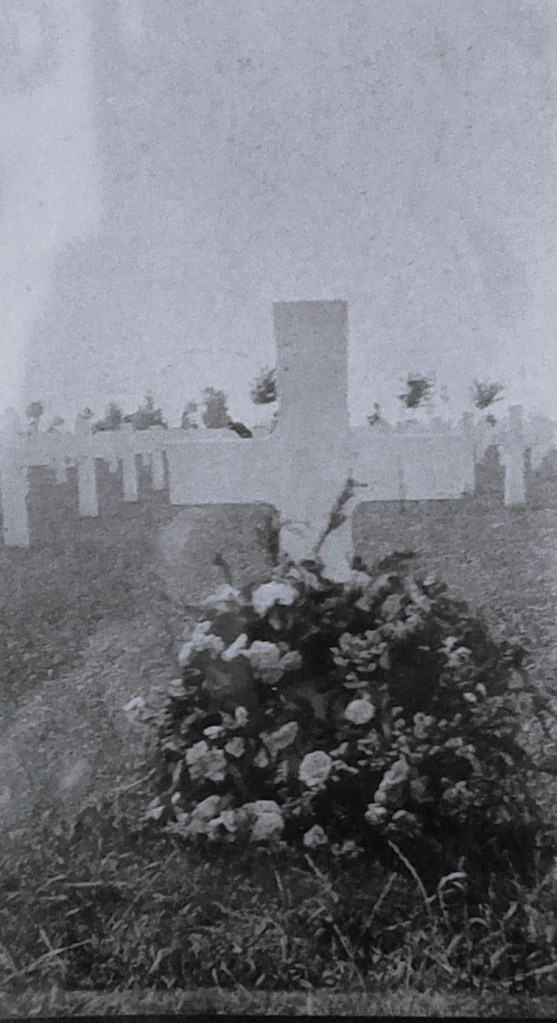
Above: Ella Smith of Perrinton was Gratiot County’s only Gold Star Mother who traveled to her son’s grave in France in 1930 as part of a government program; Private Lyle Smith was one of thirty Gratiot County men who died during World War I: Meuse Argonne Cemetery as it looks today; Private Lyle Smith’s grave on the day Ella visited the gravesite; Marker for Lyle Smith as it appears now in Fulton Center Cemetery in southern Gratiot County’s Fulton Township.

“Every marker is of the whitest marble, and they take such wonderful care of everything. I do not think I ever felt worse in my life than when I knelt by Lyle’s grave and placed a beautiful wreath of roses on it. Had a good cry, then felt better. Felt as if I had been to a funeral.”

              So wrote Mrs. Ella Smith of Perrinton, who in 1930 was Gratiot County’s only Gold Star Mother to visit the grave of her son, one of many who died on the battlefields in France during World War I. The Gold Stars were mothers and widows of those men who died serving our country.

              By the end of President Calvin Coolidge’s administration in 1929, legislation encouraged mothers to travel to France to visit the graves of their sons or husbands who had not been sent home after the war. Over 17,000 women were eligible for this fully paid trip provided by the government. By the fall of 1933, an estimated 6,693 women made the journey.

               Smith left Gratiot County in early June, 1930 and was transported to France aboard the S.S. President Harding along with 2,026 other war widows. She met women from fifteen different states; forty were from Michigan.    

              In Paris, Ella Smith and other Gold Star Mothers were placed in hotels based on which cemetery they visited. In this case, she was one of 112 women headed for the Meuse-Argonne Cemetery. Part of the trip included seeing the best and worst of post-war France. Visiting memorials, churches, and cultural sites was easier than viewing some scenes in the countryside. There, French women pushed two-wheel carts, led their horses, while seeing constant images of destroyed woods along the shell-torn countryside. 

              On June 17, 1930, Smith arrived at the cemetery. After participating in a tea service, the women were given the section number where their son or husband was buried. Upon arriving at that row, an officer gave a wreath to place on the grave. The government also had a photographer present to photograph each woman standing next to the grave. The Gold Stars then had six hours to spend in the cemetery.  

              Upon leaving, Smith’s group headed to the nearby area of the Argonne Forrest where Private Lyle D. Smith died. She wrote, “I presume I am now on land where Lyle was around the cemetery, for here is where the 26th Division was stationed.” As part of the Sixth Division, he had been there on September 26, 1918, when he sent his last letter home. He was killed October 4, just over one month before the Armistice was signed.

              Today, the base of Lyle D. Smith’s marker in the Fulton Center Cemetery reads, “Buried in France.”

Copyright 2026 James M. Goodspeed

Gratiot County During Depression and War: April 1941, “Off the Gratiot Men Go to Service”

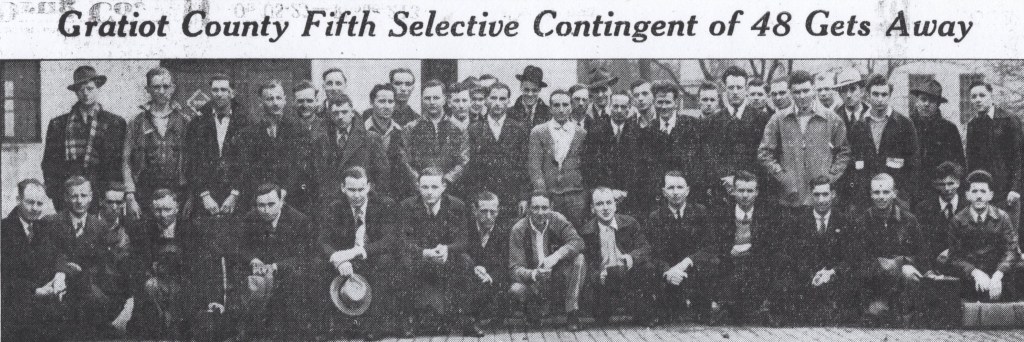
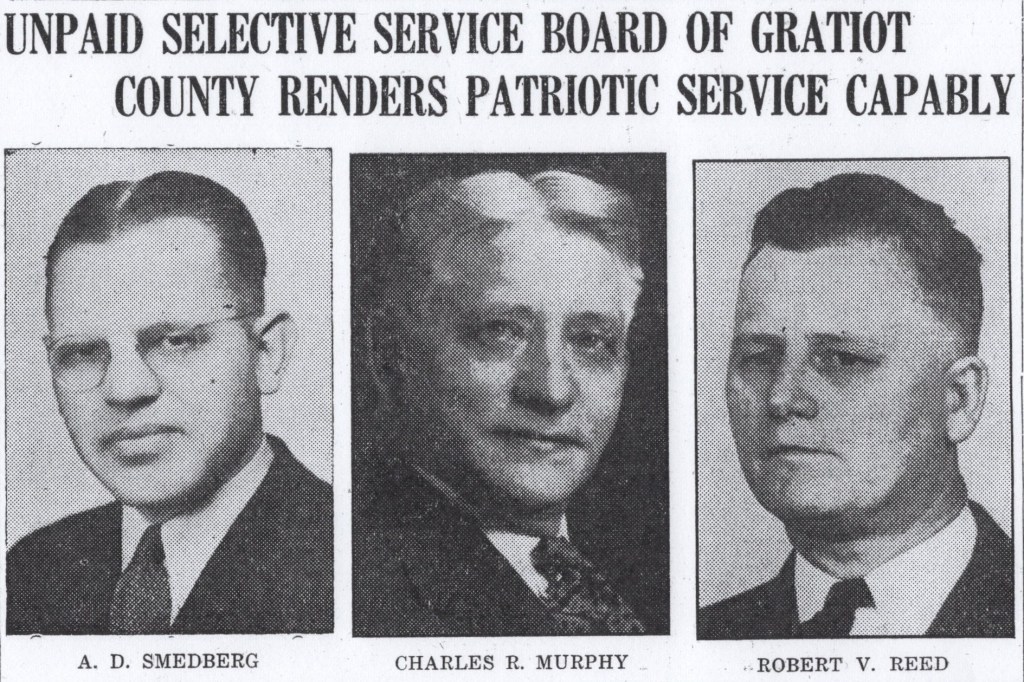
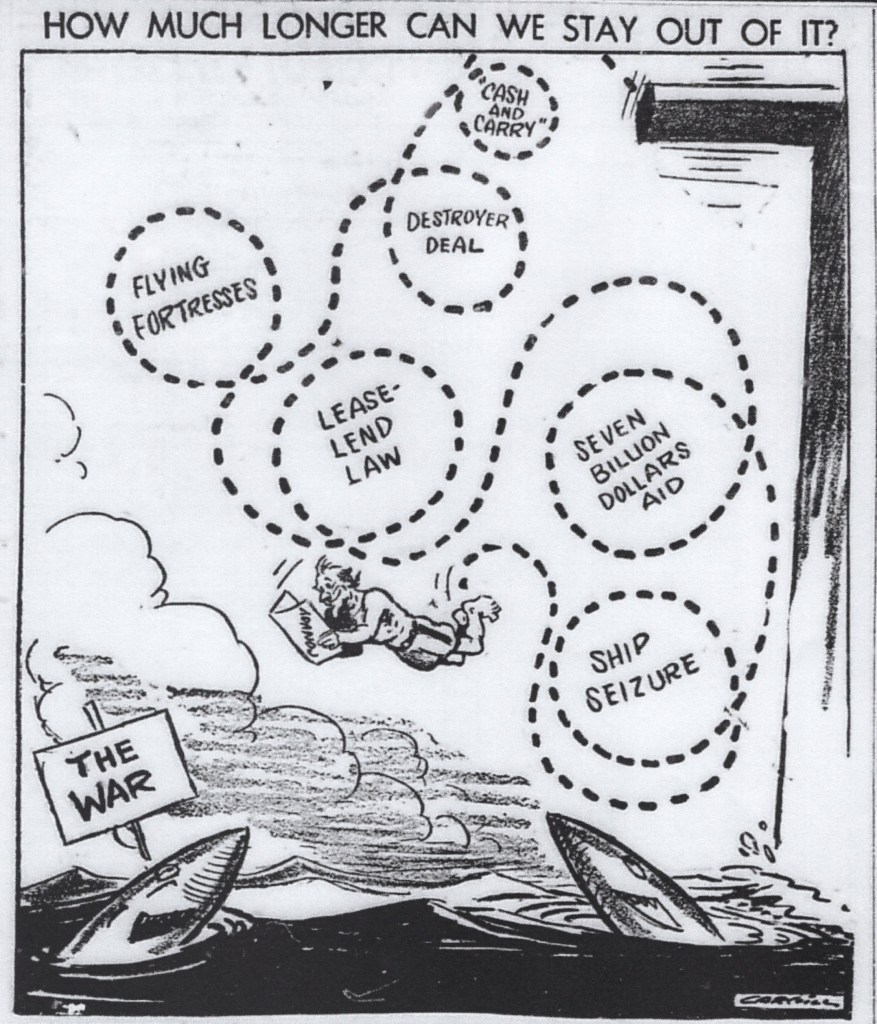
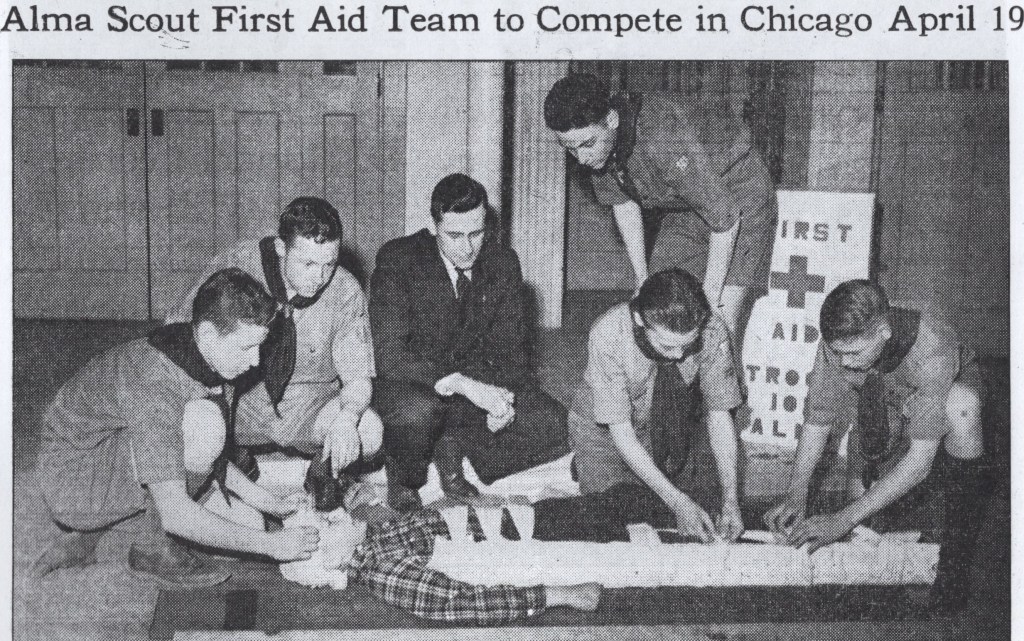
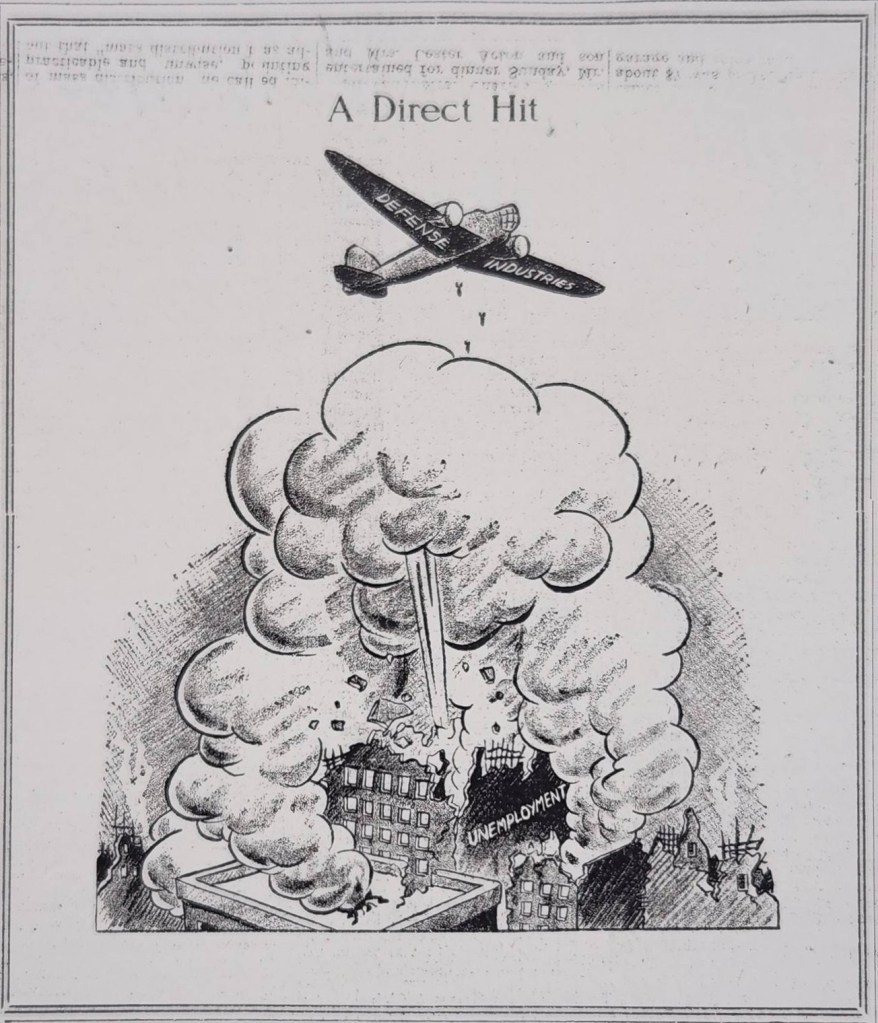
From the top: The fifth group of young men to leave Gratiot County as a result of the Selective Service. Unfortunately, no names go with this photograph; members of the Gratiot County Draft Board wanted the public to know that they served without pay; a cartoon from the April 17, 1941 issue of the Gratiot County Herald asks the question, how long can Gratiot County stay out of the war?; a group of boys from Alma Boy Scout Troop 101 formed a first aid team to complete in state contests. From left: William Fishbeck, Tom Stein, Scoutmaster David Gainey, Vance Fulton, Paul Kaufmann, and Dale McClure.

The numbers started growing: 48, 67, 56, 44, representing the number of men who volunteered or joined the Selective Service. All the while, more families confronted the possibility that these young men might soon see war.

Defense industry jobs kept cropping up in advertisements. However, many of them appeared out of state at this point. Who would leave Gratiot County to go that far to find work?

There was significant activity in Gratiot County as a result of the WPA and NYA New Deal programs. All of the programs kept people busy and paid a small wage. Most of all, the programs gave people something to do.

Health needs and problems made the news, as did those who broke the law in the county.

It was April 1941 in Gratiot County, and spring was coming.

The War in April 1941

The sights and sounds of young men going off to the military, many as a result of the Selective Service, increased in Gratiot County. A group of 48 men left the county on April 1 and appeared in a group photograph taken on a street in Alma. Two of them were volunteers, who included Darwin Hagerman of Ithaca and Henry Russell of Wheeler. Two men in the group failed their exam, and two failed admission because they were too young or had no draft numbers. Carlton Van Horn of Alma and Floyd Ludwick of Breckenridge, both volunteers, took the place of those rejected from the April 1 contingent.

They were not gone long before a community testimonial dinner was held at Alma College to mark the Alma National Guard unit’s departure. The George W. Meyers American Legion Post sponsored a dinner for 65 men who composed the 177th Field Artillery and were scheduled to go to Fort Knox. A crowd estimated at 400 attended the dinner. When it was time to depart from Alma, several hundred people gathered on Friday, April 18, to see the young men off to Detroit. A week later, news emerged that the May quota required 44 men for its next part in the draft. Oral B. Smith of St. Louis was sent with the group of 48 men early in the month. Still, he was a member of the National Guard and failed to include that he had already enlisted through the Guard. His Selective Service questionnaire did not contain that information. The Gratiot Draft Board hoped to get him back so he could join the group headed to Fort Knox, meaning another would have to take his place.

The Gratiot County draft board added eight more members to make it easier for registrants to seek guidance without having to travel far. Some of those added to the board included: George Cordray of Ashley, Fred Passenger and Dr. Howard Burchard of Ithaca, and Alfred Wolansky of North Star. None of the board members held paid positions; they were only doing their patriotic duty.

During World War II, newspapers began publishing stories about the status of individuals who left Gratiot County to serve their country. Former Alma attorney William R. Kelley is prepared to leave his practice in Ann Arbor for Fort Benning, Georgia. Kelley had been a captain in the Army Reserve. Private Ray Ward of St. Louis was part of a group of 290men sent to Camp Lee, Virginia. Edsel Marvin Alma made the news for replacing Vincent Battle of Riverdale for the March selections because Battle played professional baseball. Marvin took his place as a volunteer, and Battle’s appeal was yet to be heard by the appeal board. Privates Carl Brown, Clarence Malone, and Joseph Mazey of Alma were all sent to Camp Livingston, Louisiana. Another group, consisting of Steven Monarik and Joe Jisa of Bannister, Paul Harp of Ashley, and Darwin Hagerman of Ithaca, was part of a group of 258 men sent to Aberdeen Proving Grounds, Maryland.

The saddest story involving future service members dealt with Bruce Harper, 20, of Alma, who was in the Alma National Guard. Harper was one of several men who helped to deliver a caravan of house trailers from the Alma Trailer plant to Wilmington, North Carolina, as part of a defense contract for shipyard workers. Fifty of the gray and silver trailers, measuring 15 feet long, left Alma on March 29 on the first consignment, and the caravan made headlines in Washington, D.C., and Wilmington. Tragedy struck when he began his return home in a car belonging to Willard Blakely of 110 State Street, who only drove as far as Washington, D.C., because Blakely’s driver’s license had expired. Bruce Harper was killed in a traffic accident near Frostburg, Maryland, which involved several cars and the death of another local driver. Just a week after being inducted into the Army, Harper was dead. A funeral with military rites took place in his honor in Alma, before being laid to rest in Clinton County, where he was born. Harper left behind his mother and two sisters. His father died three years earlier and was known for operating an Alma gas station.

A variety of news bits dealt with Gratiot County and the war. Defense Bonds and Postal Savings Stamps were to go on sale starting May 1 at local post offices. The local Red Cross schools offered first-aid courses to the public. These courses lasted 12 weeks, and Alma Boy Scout Troop 101 was pictured in the Alma Record and Alma Journal demonstrating what they learned. The Alma team participated in several Michigan contests and took first place in Saginaw. The Greek Relief fund, led by James Stamas, noted that the drive in Alma had raised $909.69, with Banner Liner Service and Harlan Niles each donating $5. Eleven other people participated as recent donors. More defense jobs opened in a list of out-of-state positions in the St. Louis Leader. Designers, Marine pipe fitters, clerks, clerk typists, and more were on the list. Apply at the Alma office of the Michigan State Employment Service in the city hall. Finally, there was still talk in Alma about building a new armory, even though the cost appeared to be $180,000. Mayor W.E. Reynold discussed the possibility with a United States Army official from Lansing.

The Depression and the New Deal in April 1941

To continue combating unemployment, the Gratiot County Board of Social Welfare budgeted $78,400 for welfare recipients and purposes. Direct relief accounted for most of the budget, totaling $32,000. Another $10,000 went toward repairing the county farm buildings, the infirmary, and a new dairy barn. The committee had a long discussion about issuing welfare stamps instead of cash, and Chairman C.J. Chambers proposed that a state or federal representative come to the board to discuss the idea. Cotton mattress-making programs opened in seven centers across the county to begin planning the production of cotton mattresses for those who needed them. At the first meetings, a tick-making demonstration was held at Newark Grange Hall, and each group selected a supervisor and an assistant for that location. Originally, the Gratiot County Fairgrounds stored the cotton for the mattresses. 

The WPA remained active in Gratiot County through various activities. A group of 24 boys and girls at the Republic School and the Salvation Army worked under WPA direction to create their own archery equipment. The WPA also sponsored kite tournaments in Ashley, Riverdale, Breckenridge, Perrinton, and Ithaca, a week after a successful tournament took place in Alma. Over at Riverdale, Virgil Jessup was in charge, with Robert Nunn and Mr. Wood serving as judges. Eighteen students participated, and 25 people attended the event. Lyle Raby had two first-place awards. The second annual marble tournament was planned for May 3 to 10 in Alma. An entry blank appeared on the front page of the April 24 issue of the Alma Record-Alma Journal.

To keep up with WPA art and craft training, three Alma leaders (James Carter, Sadie Colburn, and Andrew Brenner) attended a conference at Turner Hall in Flint. The Lincoln School P.T.A. Donated roller skates to the WPA to be used as part of the toy library, lent to boys and girls. Now, a section of pavement needed to be blocked off so that boys and girls could skate. “Bird House Building” in St. Louis was also a WPA program, which ran until May 15 under the direction of Reverend Wayne Davis. The rules stated that each contestant must do their own work, be of school age, and may create any birdhouse that they want. Prizes totaled five dollars, and the houses would be returned to each contestant. Adults also benefited from WPA programs and wanted to use the WPA centers at Wright Park, the Salvation Army, and the Republic Center on Tuesday, Wednesday, and Thursday evenings. Attendants had to be over the age of sixteen. The WPA also turned the Washington School playground into a softball field. Clifford Sain and Francis Van Horn oversaw the use of the diamond from 3:30 until dark, including on weekends. The diamond and backstop were repaired, and the WPA Department furnished catching equipment, balls, and bats.

The NYA also sponsored outdoor activities by planning a new Michigan National Youth Administration junior baseball program that would take place in Alma, St. Louis, Ithaca, Breckenridge, Riverdale, and Ashley. The woodcraft department began construction of a replica model farm to be purchased soon by the Alma Rotary Club as a youth fresh-air camp. The Rotary Club used the model for display purposes related to the new fresh air camp.

The Long Arm of the Law in April 1941

The Gratiot County Prosecutor, Robert H. Baker, reported that the county had 66 convictions in March. Of these, 48 were traffic law violations, and the rest were miscellaneous offenses. Some of the latter included creating a disturbance at an ice rink, malicious destruction of a steam engine, and checks issued without funds. Four men who became involved in an oil truckers’ strike all faced the judge and pleaded guilty. They were all from outside Gratiot County and attempted to stop, pull over, or halt local workers involved in their deliveries. Two chose to pay fines, but two others received up to 90 days in jail.

Area youth also found themselves in trouble with the law over the theft of magazines, which had been occurring for some time. In fact, one justice of the peace discovered that a “lending library” of stolen magazines occurred in Breckenridge, where the items circulated among young readers. One youth got 15 days in jail while another went directly to the county juvenile court. Two more St. Louis youths found guilty of theft received only a good lecture because of the small amount of stolen items.

The Mazel Ellsworth arson case seemed to finally head to its conclusion when Ellsworth planned to appear in court and plead guilty. Ellsworth had been held in jail since early January for setting her furniture on fire to collect insurance. Ellsworth was sent to the Detroit House of Corrections for a term of 8 months to 20 years. After pondering evidence for 3 ½ hours, a jury acquitted Nicholas Buckler, 50, of Gaylord, on a statutory charge against a Riverdale girl, and he received his freedom. The Gratiot Board of Supervisors approved a plan to obtain a new detention home for delinquent, unfortunate children in Ithaca. The previous plan to find an adequate home failed, and now a committee has been authorized to buy a dwelling with rent not exceeding $25 a month and to pay no more than $500 for remodeling the structure.

Health and Gratiot County

Some people in the county continued to promote the idea of a county health department by holding a panel discussion at the Gratiot County Courthouse. Those on the panel included a local dentist, school superintendent, county school commissioner, and a mother. In another event, the county commissioners appropriated $200 toward the county’s share of funding a free dental clinic for underprivileged children for 12 weeks during the summer. Dr. Thomas Carney received recognition in the Detroit Free Press, which would soon name him Alma’s mayor on May 1. Carney received recognition and praise for his work in Alma, which started in 1915, not only as a local doctor but as the city’s health inspector.

Local newspapers carried a variety of health-related issues as they affected people and their families. Mr. and Mrs. Ford Antes of Ithaca welcomed their 19th child to the family, 13 of whom were still living. Mrs. Antes gave birth to her son at 46. Other stories were not as kind. Sandra Simmons, 2, of St. Louis, suffered severe lacerations to her face as a result of being thrown through the back window of a car during an accident. She remained in fair condition in Smith Memorial Hospital. Other patients could be found at Smith Memorial. Steve Soliak of Ithaca fractured his left femur when a sheep he was attempting to shear knocked him down. Ivan Monroe of St. Louis suffered a gunshot wound in his left knee while trying to clean a revolver that discharged. Near Middleton, young Gene Dowling experienced an attack of the measles. Since Christmas, Gene had endured scarlet fever, influenza, chicken pox, and the mumps.

Those who died from sickness reminded people to take their health seriously. Mrs. Francis Weaver, 26 of Lafayette Township, died from an attack of ptomaine poisoning related to canned meat. Her death came after giving birth to a son on March 29. Weaver could not survive the attack, and other family members also suffered from the poisoning but lived. The deaths of infants also happened. Jane Anne Kent of Ashley, 2 months old, died from strangulation due to phlegm. She was found dead in her crib. The suicide of Joseph W. Plott of New Haven reminded residents of the issue of mental health. Plott was despondent over his physical health, went to Alma and purchased a .22 rifle, and stopped 1 ½ miles from home, where he took his own life.

Farming News

What did a farmer do during the last month of winter? Why, go smelt dipping, of course. Approximately 150 commercial fishermen on Little Bay de Noc in the Upper Peninsula were busy supplying fresh smelt for the Lenten season in places like Ithaca. A single pound net could yield 1,000 pounds of fish if fishermen were in the right place at the right time. Smelt dipping was fast becoming one of Michigan’s fastest-growing sports as area residents moved to different places in the state to dip smelt. Farmers could also go to see Leslie D. Reeves in Ithaca for a Friday night showing of free moving pictures in Reeves’s showroom. The movies featured the new Case pickup hay baler and the new V-C and S-C tractors. A total of

More activities took place. Don Sharkey Farm Machinery of St. Louis had at least eleven pieces of used farm machinery for sale, as well as four good horses. A total of 99 new members joined the Gratiot County Farm Bureau, bringing the membership to 240. A victory meeting was held at Bethany Community Hall, with a potluck dinner. Sugar beet farmers received good news from Michigan Sugar Company in Alma and from the Lake Shore Sugar Company in St. Louis. They received checks for fifty cents per ton for their 1940 crop. This money raised their total payment from the factories to $5.50 a ton for the last season. The Gratiot County Ministerial Association held its meeting at the Alma Church of God and heard Reverend Floyd Drake of Breckenridge talk about “Migrant Work in Gratiot County.”

Getting out and doing things impacted many in the county, including farmers. Spring break-up, winter frost, and water created some of the worst conditions in recent history. Cars and trucks became bogged down in holes on roads as boils and mud holes gave drivers fits. In an attempt to help prepare Gratiot’s roads, the county highway department’s drivers worked 60 hours a week on them.

Life on Gratiot County farms could also be dangerous, with its share of injuries and even death. Raymond Schneider, 17 of Ithaca, had his arm mangled and broken when it got caught in a lime spreader while working southwest of town. He was admitted to Smith Memorial Hospital with fractures in many places.

And So We Do Not Forget

Lanshaw Hardware reminded area fishermen that the trout fishing season starts April 26. Get your fly rod, flies, reels, and kreels at Lanshaw’s…Fleming Shoe Company in St. Louis offered the largest array of saddle shoes in white buck with brown or black calf saddle, and with sueded soles. Shoes started at $1.98 a pair…A terrible fire destroyed the Bannister public school, resulting in a total loss of $14,000. Custodian Lewis Cox arrived at school and unlocked it before 8 o’clock, only to discover that the south wing and the top of the building were aflame. Most items inside the school were quickly lost…The Gratiot County Herald installed a new automatic press nicknamed the “Little Giant.” Walter O. Brown of Ithaca appeared in an installment of “Gratiot Men at Work” in the Gratiot County Herald. Brown, a World War veteran, operated his shop over Goodwin’s Drug Store in Ithaca…Fresh smelt at Winget’s Market in Ithaca cost only three cents a pound. Buy all you want – no limit…A Donkey basketball game in the Riverdale gymnasium drew one of the largest crowds ever on a Thursday night. Area farmers challenged Riverdale business men. In overtime, the farmers won 22-20…Fulton school athletes were honored at a sports banquet in Middleton. Participants from football and basketball (boys and girls) received their letters, and Mrs. Holliday and her freshman girls gave a nice dinner.

Doud’s Drug Store in Alma put up a new sign advertising Swift’s ice cream…An addition to Hicks’ Brothers Grocery went up at 630 East Superior in Alma. The addition measured 20×50 feet and was one story high… Mr. Erickson took his St. Louis High School students to a debate contest in Ann Arbor. The group planned to spend the day on campus, then watch a championship debate in Hill Auditorium…Philip Morton, 12, of Alma represented Alma Schools’ patrols by going on a trip to Washington, D.C., courtesy of the Automobile Club of Michigan. Morton, who attended Republic School, was the first Alma Republic student to be so honored…Spencer Tracy, Mickey Rooney, and Bob Watson starred in “Men of Boys Town” at the Strand Theatre. Tickets were ten and twenty cents, which included the news…The Gratiot Conservation League planned to transplant 350 white pine and jack pine trees that were formerly seedlings on the 53-acre park outside of Alma. Boy Scouts originally helped to set the seedlings in two large 4×50-foot frames…The Alma High School Senior and Junior bands planned to perform a double concert on April 23. The performance included 95 instruments and R.A. Yoder directed…The George W. Meyers American Legion Post in Alma wanted to purchase a resuscitator for the county. There were no plans for fundraising as yet, only a desire to inform residents of the plan.

The sun came out, and the thermometer shot up on April 13 when the temperature hit 83 degrees by six o’clock that Sunday evening. Two days later, the temp hit 78 degrees, but little rain covered the area in that span…The St. Louis City Council designated May 5-9 as “Spring Clean-Up Week” in town. Residents were urged to clean up their property and place non-burnable rubbish in containers for pickup…Dr. B.N. Robinson opened his new clinic in St. Louis on East Saginaw Street, located in a remodeled section of his brick residence…Reverend R.J. Tuttle and Reverend W.T. Roberts spoke at Good Friday services at the Alma Methodist Church, courtesy of the Alma Church Federation. Each spoke on the topic “Seven Last Words”…Alma Schools were prepared to take a five-day Easter vacation and allowed teachers to go home for the holiday…Lobdell Emery of Alma planned to add a $10,000 addition to their plant. The area provided space for bicycle rims…The Alma Rotary Club proposed purchasing a 30-acre farm in Montcalm County to serve as a fresh-air camp for underprivileged children in the area. The farm was located 17 miles northwest of Alma, and the total cost for purchase and improvements would total $2500…A new mayor and council members took office at St. Louis City Hall. Photographs appeared on the front page of the St. Louis Leader…Carson Clapp spoke to the St. Louis Rotary Club about his journey as part of a long line of hardware merchants in his family. Born in North Star, Clapp’s father set up a store in Alma. Clapp graduated from Alma Schools and Culver Military Academy.

The St. Louis Hatchery hatched 30,000 chicks weekly and had 39 years of experience in the hatching business. See W.V. Hess for your order of chicks…Alma city employees constructed a dip net and placed it at the State Street Bridge to help game fish swim over the dam. Last year, people started using small hand-dip nets, but bigger nets were better because they helped the fish reach their spawning areas…Carl Bush, Consumers Power county lineman, suffered bad burns on both hands when he contacted a live wire on a pole north of Alma on Bridge Street. He was taken to Carney-Wilcox Hospital for treatment. Bush’s safety equipment saved him from other serious injuries.

And that was Depression and War in Gratiot County during April 1941.

Copyright 2026 James M. Goodspeed
“Murder on the St. Louis High Banks”: The Percy Kiter Murder Case, 1922

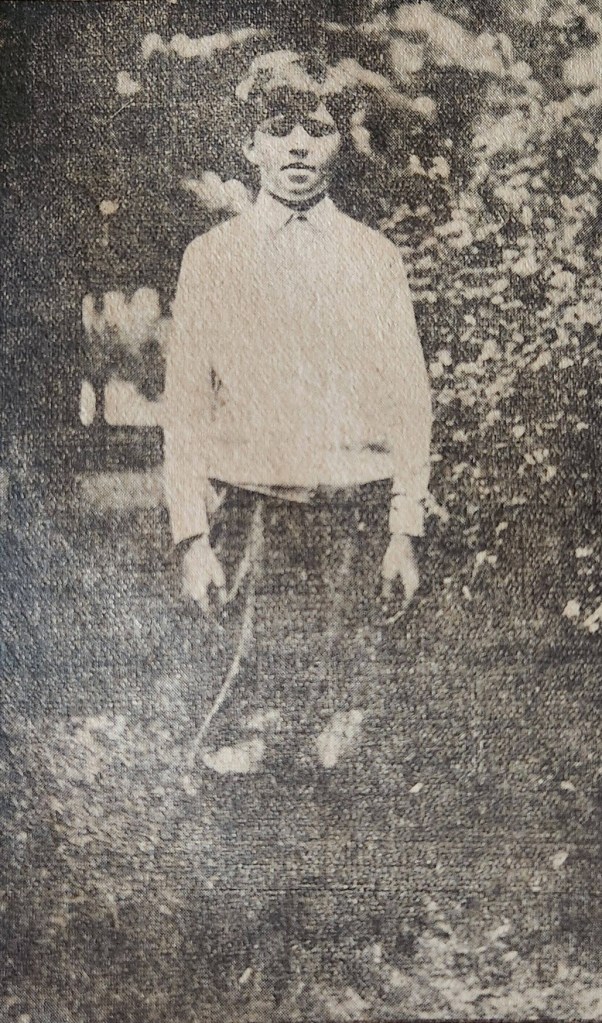
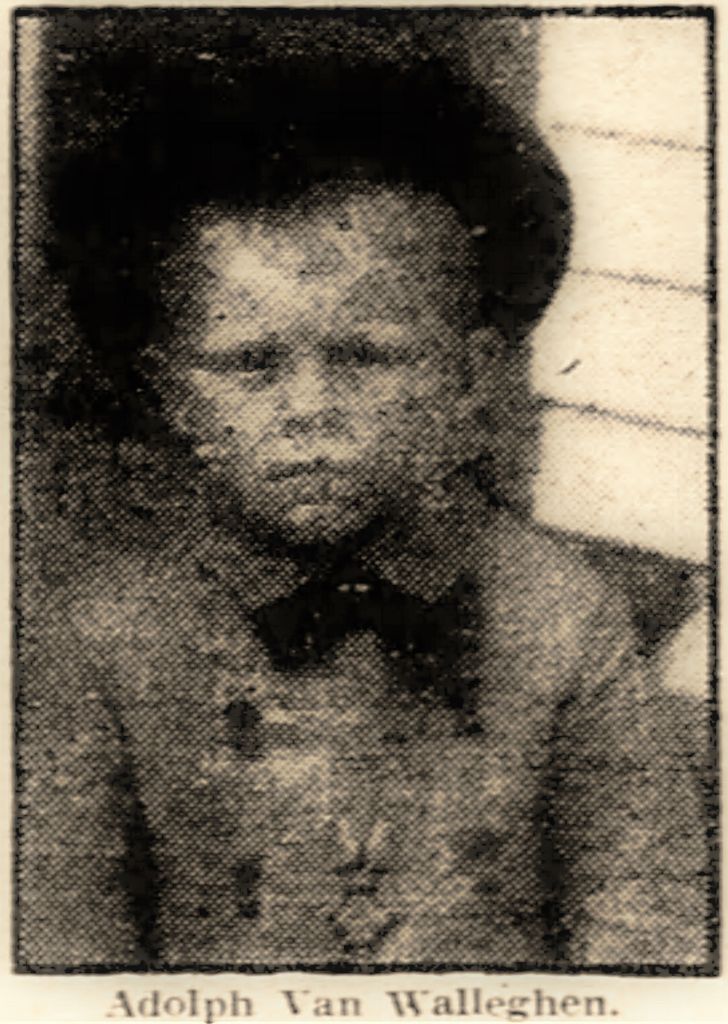
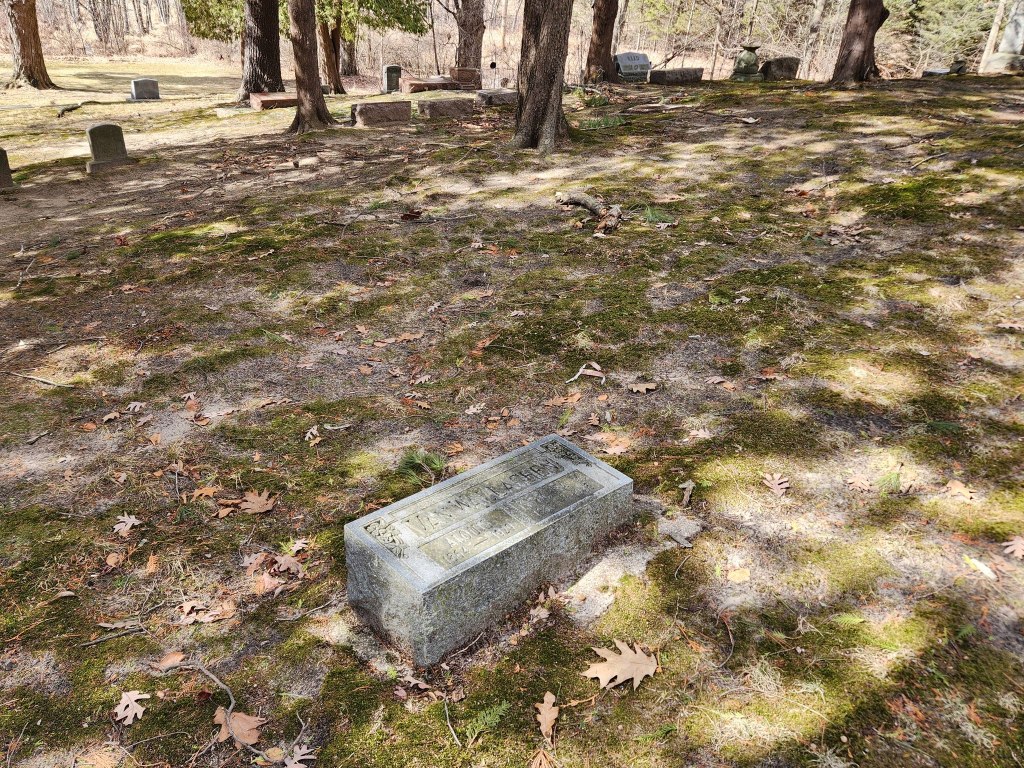
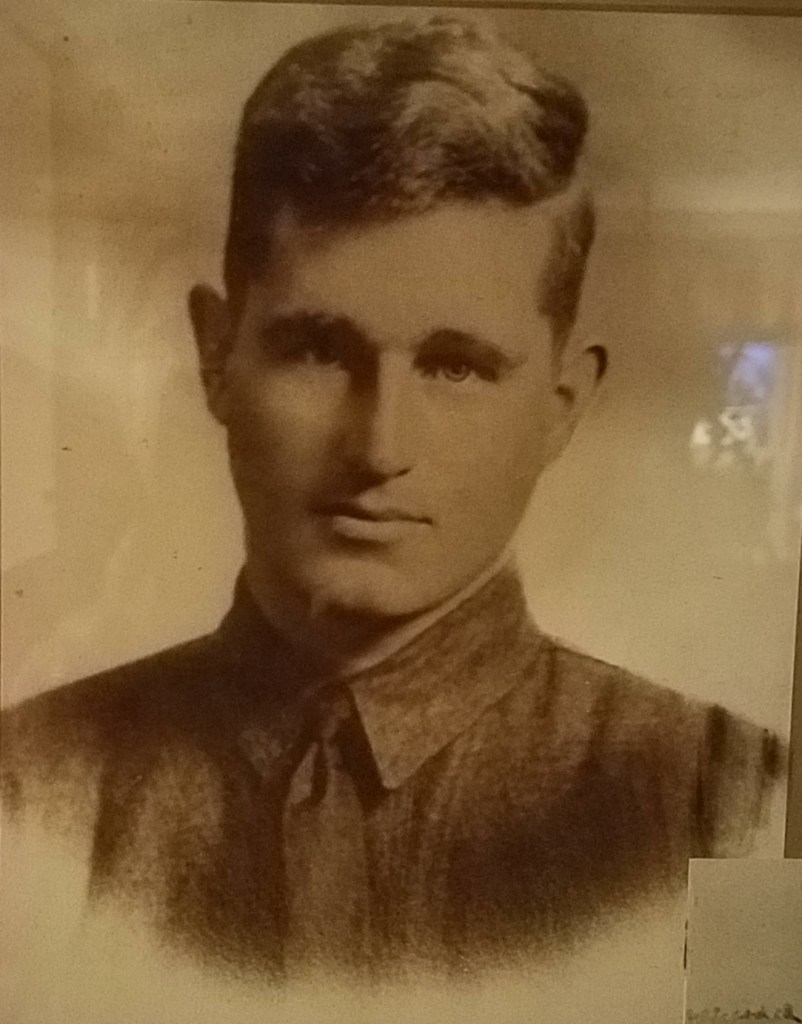
Above from the top: Percy Kiter in an undated photograph that appeared in the June 8, 1922 issue of the Gratiot County Herald; a very young Adolph “George” Wallaghen in a photograph taken years before his murder; looking northwest along the Pine River in toward the possible area of the St. Louis “high banks,”; opposite of the former location of Velsicol plant; family burial plot of the Wallaghen family in Oak Grove Cemetery in St. Louis; the only marker on the family plot belongs to the Wallaghen parents.

“Murder on the St. Louis High Banks”: The Percy Kiter Murder Case, 1922

Gratiot County newspapers called it a bloody and shocking juvenile crime which was unequaled in the history of mid-Michigan. And it happened because of a missing pipe and nine cents.

It happened in 1922, in St. Louis, and this tragic murder left a deep mark on the city’s history for the next thirty-five years. For many people living in St. Louis, the death of a young boy was the most terrible event since the town’s earliest settlement.

An Early Summer School Day in St. Louis

This murder took place on an early summer’s day as the school year came to a close at the Oak Grove School northwest of St. Louis. The compact, square box-shaped school, with its three narrow windows on each side and a small set of steps leading to the front door, was located near the Oak Grove cemetery. Because of the school’s location, students frequently walked a short distance to the nearby Pine River or to town by crossing the millpond bridge.

As summer approached and the school year ended, young boys went swimming in the Pine River. One of these spots, known to many as the local swimming hole, was on the north side of the Pine River and sat near a spring. Farmlands abutted the river, and the northern area on that side contained what locals called the “high banks” shores. These river banks sometimes dropped by 20 feet or more in some spots to the edge of the Pine.

Before the 1920s, it was not unusual in Alma or St. Louis for youth to engage in activities in town that concerned the merchants. Theft, vandalism, and horseplay all caused business owners to be on the lookout for unaccompanied children. Youthful offenses ranged from stealing money from an unattended cash register to taking fruit without paying. Knocking over stands and even breaking windows put businesses on alert. Incidents became so frequent in Alma that the police chief stepped up efforts to crack down on misbehavior by arresting youngsters.

On May 31, 1922, young Percy Kiter made a trip into town and back after finishing his examinations. Two other boys, Alex Wallaghen and Donald Smith, also left the school with Kiter and also wanted to have a good time, so they pooled their money, and Kiter went into town to purchase a pipe and tobacco. However, this morning, their time together changed their lives.

Three Boys, Tobacco, and Nine Cents

Percy Kiter, 12, was the second of eight children. The Kiters moved to St. Louis from Grand Rapids, and his father, Perry Kiter, worked on a tile ditching machine, also known as a “ditcher.”

Following Kiter around on that morning was Adolph “George” Wallaghen, age 13, one of two sons born to Alouis and Sidonie Van Wallaghen. The family moved to St. Louis from Detroit sometime before 1920. Both parents were immigrants from Belgium, but appear to have arrived in Gratiot County during a time of Belgian immigration early in the World War I era. An immigrant train arrived in Alma in February 1915, bringing 30 families courtesy of the Burt, Sharrar, and Moore Company. Although the Wallaghens were not on that train, they were one of several Belgian families in the county. The Walleghen family spoke Flemish at home, and later changed their last name to just “Wallaghen.” Alouis Wallaghen worked as a laborer in the St. Louis area.

The third party in this story was young Donald Smith, who was 10 years old. Little is known about Smith’s background, and his name does not appear in any records tied to the Oak Grove School. His father’s name was Ira, and Ira Smith had a farm not far from the river. Donald Smith appears as the young follower who went along with the older students just to belong and for fun. Due to his youth, Smith was intimidated by his peers. One interesting aspect of this story of these boys is that newspapers described them as being a bit older than they really were. For instance, Van Wallegen was about 4 months away from turning 14. Likewise, Percy Kiter was only 3 months shy of being 13, yet newspapers “rounded off” their ages. Consequently, the reports portrayed a story involving childhood and early teenage years.

During a break from morning examinations on Wednesday, May 31, the three decided to go for a swim and a smoke about three-quarters of a mile above the St. Louis dam. Although the boys obtained the tobacco and pipe, they had no matches. That job went to Donald Smith, who made the trip into town but returned empty-handed. Percy Kiter then decided to make another trip and came back; this time, he had just three matches. As the boys gathered close to the bank upon Kiter’s approach, George Wallaghen teasingly accused Kiter, saying he would tell Kiter’s parents about Kiter stealing things in town and about his smoking. A war of words immediately broke out between the two boys over Kiter’s thefts and smoking.

As Wallaghen bent down to take off his shoes to go swimming, Percy Kiter hit him hard in the head, knocking him down. When Wallaghen attempted to get back up, Kiter hit him a second time, then kicked him, sending Walleghen backward down a steep bank that extended fifteen to twenty feet deep toward the water. On the way down, Alex Wallaghen hit a branch of a tree that jutted out of the water, which had come to rest there after winter storms. As Kiter jumped down the bank after Wallaghen, he approached Wallaghen and continued choking him and hitting him. It was then that Kiter saw blood come from Wallaghen’s ears and nose. As Kiter examined Walleghen, Kiter realized that a sharp tree branch had lodged in the back of Wallaghen’s head. Kiter then checked for a heartbeat, but Wallaghen was dead.

The Cover-Up

Upon realizing that George Wallaghen was dead, Percy Kiter instantly ordered Donald Smith to come down to help him and dispose of the body. Young Donald Smith also came down the bank, frightened and intimidated by Kiter. Kiter and Smith then stripped the body, folded the clothes, and took a moment to try to wash the blood off the back of Wallaghen’s shirt. The two then pushed the body out into the Pine River with a large forked stick in an attempt to make the incident look like a drowning. The stick left gouge marks on Wallaghen’s neck. Just before they climbed and left the high banks, Percy Kiter went back to Alex Wallaghen’s clothes. Kiter took nine cents out of the pocket (another report said a dime), and the remaining tobacco, pipe, and matches they were going to use that day. The two boys then made their way toward school, where Kiter attended another session of school examinations after lunch. Just as the two boys left the high banks, Percy Kiter threatened Donald Smith again, telling him never to say anything about what happened. One boy was dead, another intimidated, and a third just went about his business at school.

By late evening, George Wallaghen’s parents began searching for their son, who had not come home for dinner. The search continued into the next day, when a farmer, while dragging his ground near the high banks, went to the nearby spring for a drink and found Wallaghen’s clothing. Soon afterward, some men returned to the location, and Wallaghen’s body was discovered and removed from the river. Soon, a woman recalled seeing the three boys walking toward the high banks, prompting the police to question Percy Kiter and Donald Smith. Smith seemed very nervous, under pressure, and unwilling to talk. Once the police separated the two boys and questioned them separately, the story gradually came out, especially from Donald Smith. The two boys’ stories seemed to agree – Kiter did the kicking, pushing, and choking of Alex Wallaghen. Smith helped move the body due to pressure and threats from Kiter. It took until Friday afternoon to learn the full story of Alex Wallaghen’s death. But once in jail, Percy Kiter finally confessed fully to his role in the murder of his school “chum.”

The inquiry and police work covered six days from the murder until the official announcement that appeared in local and state newspapers. The delay in releasing the investigation was due to the police and the prosecuting attorney wanting to make sure they had the facts, the story, and the guilty party all in line. One of the hidden aspects of the murder investigation involved the fact that the coroner’s jury judged that Wallaghen had no water in his lungs. This fact ended any speculation of the event being an accidental drowning. Instead, it was declared a murder, and a violent one at that.

Prosecution, Judgment, Consequences

Although Percy Kiter confessed to the death of his schoolmate, Wallaghen, there were limitations on what charges Gratiot County prosecuting attorney Romaine Clark could bring before Judge James G. Kress due to Kiter’s age. When Kiter appeared before the judge ten days after the murder, as a minor, Percy Kiter could only be sent to the Industrial School in Lansing until his eighteenth birthday. That length of sentence would be true if Kriter proved he could be a “model inmate.” If not, he would remain there until age twenty-one.

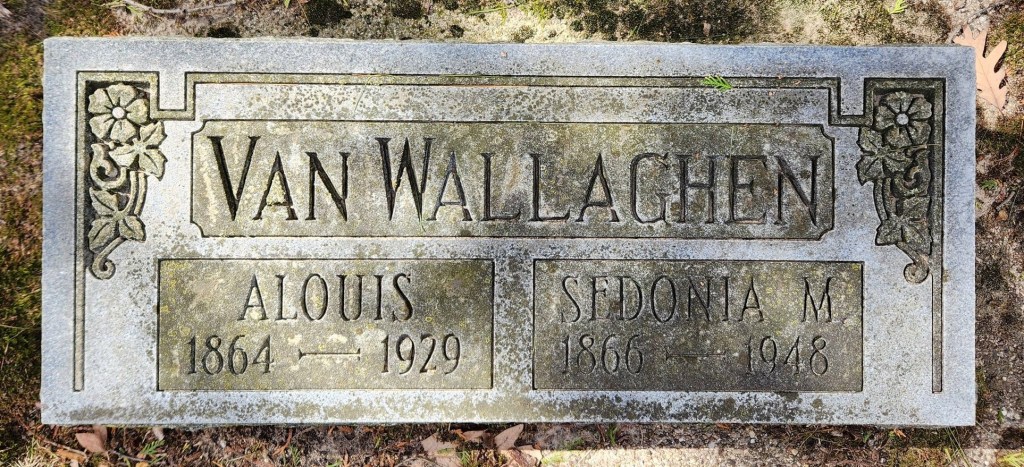
Life was hard for the Wallaghens after the death of their son, who was buried in the family plot in the North Section of Oak Grove Cemetery under what today are several trees. Alouis, the father, died in 1929 and was buried next to his son. He left his wife, Sedonia, who worked as a housemaid for others until she died in 1948 in St. Louis. Strangely, George Wallaghen never had a marker placed on his grave, but his parents’ names appear on theirs. Their other son, Emil, moved out of the St. Louis area and became a social worker.

Donald Smith disappeared back into history, old enough to have witnessed a murder, seemingly granted grace as a child who was intimidated under threats and pressure into helping to cover up a crime. Nothing appears on Smith in any school records. However, Donald Smith’s name appeared in the news again in the 1930s when he suffered a serious injury in a traffic accident.

There was more to the story of Percy Kiter, who served his time and was released back into life in St. Louis by 1930. It is not clear whether he left the Lansing Industrial School at age eighteen or twenty-one. Still, in the 1930 census, he is listed as a common laborer and the eldest of the remaining Kiter children still at home in St. Louis. Married by 1940, Kiter, his wife, and two children moved to Carson City, where Kiter worked as a truck driver for Guy Gossett. Throughout the 1920s and 1930s, the Kiter family held reunions outside St. Louis. By 1950, Percy Kiter moved to California, where he worked as a mechanic and did auto repair at a garage. He eventually died on November 23, 1974, in Riverside, California.

A Wallet, $22, and a Small Boy

However, in retracing Percy Kiter’s later years, a strange story was found. One day during the Christmas season in 1933, Kiter worked on a CWA project in St. Louis. The Depression was on, and money was hard to come by. On his way across town to a gas station one day, Kiter lost his pocketbook that contained $22 and papers. After advertising for its recovery in the newspaper, Kiter gave up and forgot about his loss. About a month later, a ten-year-old boy appeared at the CWA worksite and asked if someone had lost his wallet. It turned out the boy had found the wallet, but his mother insisted they keep the money, as times were hard and Christmas was coming. A month later, the mother regained the money and sent her son to find Kiter to return the wallet, cash, and papers. Upon finding the owner, the boy handed over the items to an astonished Percy Kiter, who wanted to give him a reward, which he refused. Kiter was so excited at the return of his money that, as he showed his fellow workers, he had failed to get the boy’s name.

Did Kiter pause at any time to remember that this boy was the same age as Donald Smith, whom he had coerced into helping to cover up a murder almost twelve years earlier? How often did Kiter think about the other boy he murdered, George Wallaghen, by knocking him down a steep bank on the high banks and choking him as he died?

These questions were all part of the lives of children and teens in St. Louis’s past. And so the story of a murder on the St. Louis high banks moved into history, where a kid killed a kid for a smoke and nine cents.

Copyright 2026 James M. Goodspeed

Gratiot County During Depression and War, March 1941: “Where is Spring?”

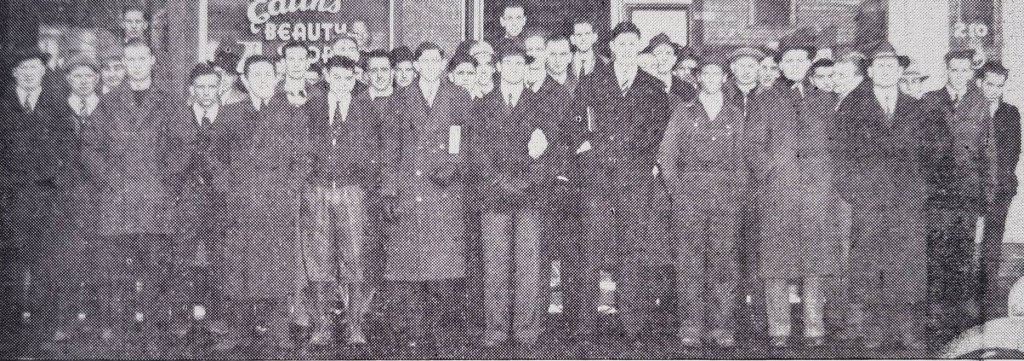
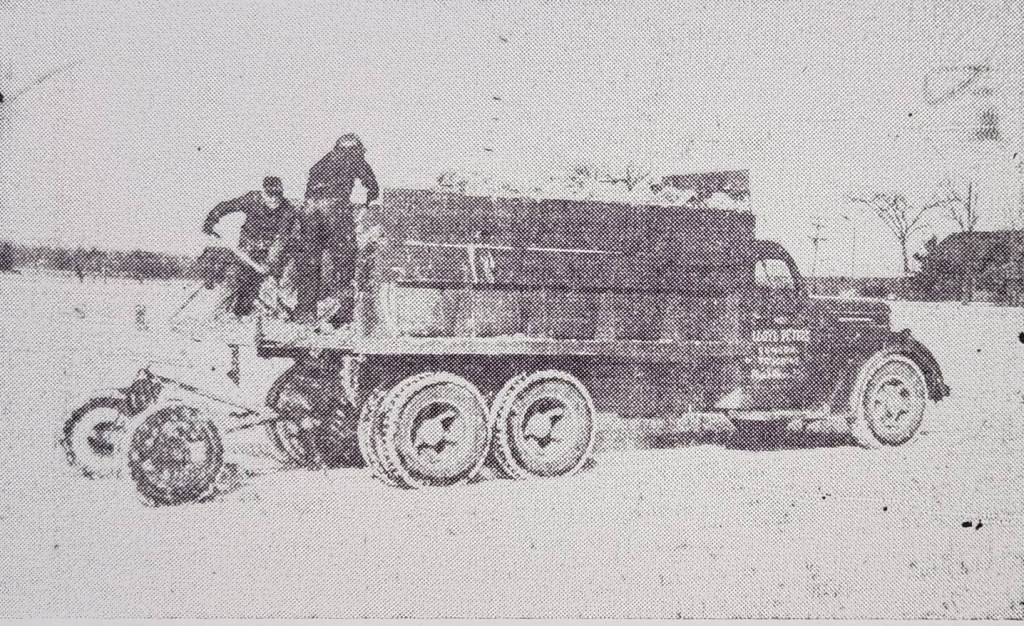
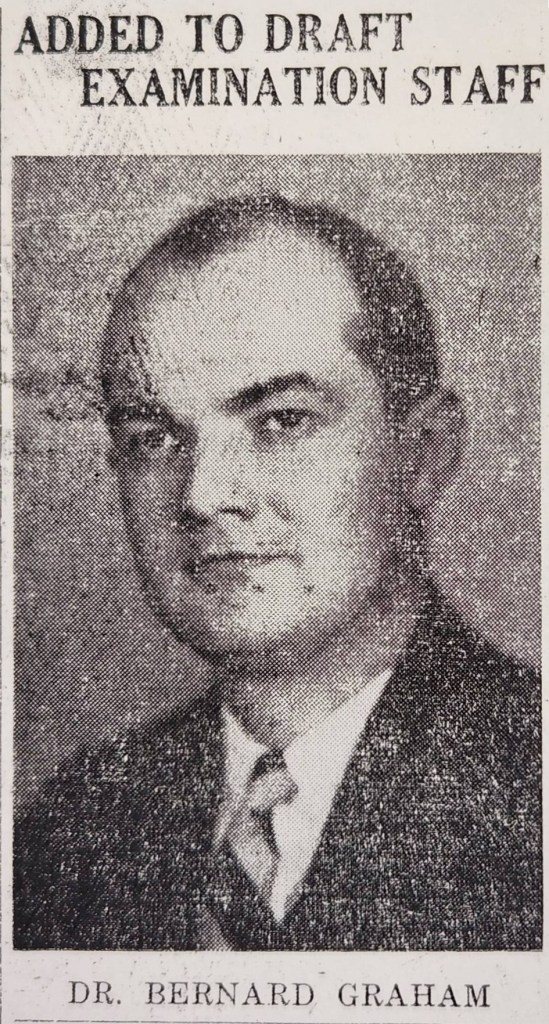
From the top: A March 4, 1941, cartoon from the St. Louis Leader illustrated how the European war affected Gratiot County’s problems with unemployment. War meant jobs; this contingent of men left Alma for Saginaw to be inducted into the Army. The photo was presumably taken at 210 East Superior Street. Another group of 49 men would leave before April 1; Lloyd Peters delivers the county’s first load of lime to the John Wertz farm in Emerson Township. Wertz ordered 16 tons for his farm with the idea that it would help production; Dr. Bernard Graham of Alma joined the Draft Board to help with physicals for men in Alma. The increased requests for more men each month meant another doctor (or two) was badly needed. Graham volunteered.

In like a lion, out like a lamb. March was supposed to be the gateway to spring in Gratiot County. Farmers held and attended various meetings in anticipation of the upcoming farming season, even though the forecasts for many crop prices seemed bleak for 1941.

However, for another forty young men from the county, they went off to the Army as part of the Selective Service – and the numbers kept growing.

New Deal programs offered help and hope for young adults in the county.

Late winter had its share of the sick.

The arm of the law kept up with lawbreakers, ensuring they were found and apprehended.

It was March 1941 in Gratiot County.

War Appears on the Horizon; Draft Continues

President Roosevelt received Senate approval of the Lend-Lease bill, which meant that America could now openly help England in its fight against the Nazis. Lend-Lease remained a matter of debate among many Americans who wanted the country to stay out of the European war. Roosevelt also warned the country needed to weather the oncoming storm, but to use the time as a means of sacrifice and service to the country. One of the greatest missions for Americans was to get involved in factory work and help to get goods to “the frontlines of Democracy.” The United States Attorney General stated the nation had 6,249 aliens who needed to be deported. The A.G. also stated that anyone belonging to the Communist Party or the German-American Bund should also be deported as illegal aliens. A bill at work in the House of Representatives said that these “illegals” had 90 days to leave the country or face imprisonment.

The draft continued to call more and more men into service. A total of 40 men left Alma, bringing the total number to date to 77 (50 were volunteers). A photograph of the early March contingent, presumably taken at 210 East Superior Street in front of Edith’s Beauty Shop, appeared on the front page of local newspapers. Among the group of 40 were 13 volunteers, including Elwin Gillis of Breckenridge, Michael Hospodar of Perrinton, and George Martin of St. Louis.  In one of the photos, a dog could be seen running in front of the group of men just as the picture was taken. Five of the men were eventually sent back home because they did not pass their physical.

Not very long after this group left Alma, the draft board announced that April’s call for men would rise to 49 and that the group would leave for Detroit on March 31.  In order to help with the growing number of draftees in Alma, Dr. Bernard Graham was added to the draft medical examining board, along with Dr. John Rottschafer.

Because the Army wanted to double the size of its armored force, those drafted or in the National Guard could be kept in service for over a year. Members of the reorganized Troop B, 106th Cavalry, National Guard, prepared for actual induction to the Army on April 1. Captain Howard Freedman stated that 70 enlisted men and three officers made up this group. They would head to Fort Knox, Kentucky. A Navy representative visited the Alma Post Office on March 14 to interview men aged 17 to 31 as possible candidates. Ronald Charles Wood enlisted in the Marine Corps and ended up at San Diego, California. A St. Louis graduate, he attended Central State Teachers College for one year and now wanted to be involved with aerial photography after completing his training.

Gratiot County newspaper readers did not know it yet, but a pattern started regarding news from young men who would be involved in war. Robert Nesen, a former employee at the St. Louis Post Office, took a course in aeronautical engineering at the Curtiss-Wright Technical Institute in Los Angeles, California. The school was one of seven in the country that trained mechanics for the Army. Francis Henry Miller of Ithaca, who left in the January contingent of men, wrote from Fort Baker in San Francisco, California. He took up cooking, trained on 12-inch guns, and found the colors of green trees and flowers in bloom to be strange to see. He was one of two boys who left Alma in that group. Then there was Lieutenant Reynolds B. Smith, originally from Alma, who spoke to the Alma Rotary Club about his experiences as a graduate of the United States Naval Academy. He now oversaw a shipbuilding assignment at Bay City. Smith would be the first Alma man killed in World War II. Mrs. George Tangalakis of St. Louis announced that she received word that two members of her family had been wounded while fighting in the Balkans. This was the first word Tangalakis received about her family in several months.

Sad news arrived in St. Louis that Leslie E. McGill, a World War veteran, unexpectedly died in the Veterans Hospital in Indianapolis, Indiana. Although he had been there for eight weeks for treatment as a “shell victim” (probably shell-shock), it was believed that he was recovering and received encouraging reports about his condition. McGill entered the war at age 18 and, after returning to civilian life, became a purchaser of airplane engines for General Motors. McGill also passed on the twenty-fifth anniversary of the death of his grandmother, Mrs. Harvey Atwell, of St. Louis, a well-known citizen.

More of the Depression and New Deal Programs

If a person in Gratiot County wanted to see a New Deal program at work, they would have observed the New Deal Youth Administration (NYA) or the Works Progress Administration (WPA). The Washington School in Alma continued to undergo work to repair the building for a boys’ workshop. The upper floor of the school would also be used for a girls’ sewing, weaving, and hot lunch project.  LeRoy Layman and Mrs. John S. Morgan, both of Alma, oversaw the programs.

The WPA merged Gratiot and Midland counties to create a new area headed by Darrell Milstead, who came to Alma last August. Lester Fillhard, Milstead’s assistant, took over much of the oversight of the Gratiot County program. WPA recreation projects now existed in Alma, St. Louis, Riverdale, Midland, and Coleman. The toy library project in Alma remained very popular in the community, with 80 boys and girls checking out toys. The WPA also held a “Kite Karnival” contest on March 22 at Cavalry Field, offering eight categories for entrants. Another contest took place on March 29, courtesy of the Gratiot County Herald, and took place simultaneously in Riverdale, Breckenridge, Perrinton, Ithaca, and Ashley. The Herald planned on awarding 40 silver medals to first-place winners in eight events. Some of the Alma winners included: Darrell Milstead, Jr., youngest flyer; Marion McCormick, best homemade kite; and Bennie Sammons, longest string out.

Another New Deal program, Social Security, held a presentation at the St. Louis Rotary Club meeting. Mr. Ramsey, from the Social Security Office in Saginaw, used sound slides to illustrate how phases of the Social Security program worked and how it applied to different types of workers. Townsend Club Number 2 met at the Ithaca village hall for their regular meeting. The Townsend Plan was believed to be an alternative to Social Security and had many interested followers in Gratiot County.

Job opportunities seemed to accompany the rumblings of war. At least ten types of openings appeared at the State Employment District Office in Alma’s city hall. Jobs such as sewing machine operators and automatic screw machine operators were needed. W.N. Irish, manager of the Alma office, said that a statewide drive to find workers for national defense jobs was now in effect, and workers were needed.

Farmers and Farming Issues in March 1941

One of the main events in Gratiot County in March 1941 was a series of meetings with farmers. A group of 82 people met for a rural-urban meeting at Elm Hall. In the group were 38 Rotarians who wanted to promote good relations between farmers and club members. All enjoyed a chicken dinner prepared by the Ladies Aid of Elm Hall church.

The Alma Beet Growers Association held its annual meeting at the Strand Theater in Alma. A series of lectures and programs ran throughout the day, with a lunch break at area restaurants. A group of over 1,100 farmers and their wives attended the meeting. Over in Saginaw, another 250 Gratiot farmers attended a meeting with farmers from the Central Michigan area. One of the main issues in these meetings concerned marketing the large grain surpluses anticipated in the fall and shrinking overseas markets due to the war. Another concern that farmers faced centered around the drop in sugar sales. The U.S. Department of Agriculture reduced its acreage allotment by 18 percent for 1941.

A variety of other items made the news on the farm. Brauher and Purdy of Ithaca advertised the 1940 Massey-Harris Clipper threshing model. The business also held a Massey-Harris Farm Equipment meeting on March 12 and offered free moving pictures to those interested in learning about new products. The State Highway Conference distributed new county-wide maps that showed the county, mile by mile, with highways, roads, and streets. The Gratiot County Road Commission received the map for use in improvements and maintenance operations.  Farmers continued to watch the issue of banning Sunday hunting in the county. A state law appeared to be on the way, then stalled in the legislature. Some farmers liked the idea of no hunting in order to keep out-of-county hunters away from their property. Another group in the county believed that Sundays were the only time they got to hunt. The debate went on. Area hunting groups continued to meet and discuss maintenance of their own hunting areas in the county. Topics such as trespass, sportsmanship, game law violations, and property destruction were discussed.

The first lime spreading in the county took place on the John Wertz farm in Emerson Township. Wertz received lime by calling the Agricultural  Conservation office in Ithaca. The AAA farm program promoted the use of lime in order to improve farming across the nation.  Lloyd Peters delivered the lime. The Gratiot County Herald featured a front-page article about John Swartzmiller, age 91, of Ithaca. Swartzmiller recalled seeing Abraham Lincoln as a boy in Tiffin, Ohio. Swartzmiller first came to North Star Township in 1878, cleared land, and put up a house in 1886. Now, he was still active at his home on East Center Street. Finally, Howard Evitts, Gratiot County dog warden, swore out eight warrants for those who had not paid their 1940 dog tax. Although 750 owners were delinquent at one time, only a dozen were left unpaid by March. The warden estimated a total of 6,000 dogs in Gratiot County. Jack Aldrich, 19, of St. Louis, was sentenced to 10 days in jail, a fine, and costs totaling $9.25 for failing to pay his dog tax.

Health and Health Issues

With the arrival of the Easter Season, news about Easter Seals came. This March campaign was the eighth annual in Gratiot County and benefited handicapped children. A group of twenty-four people made up the chairmen’s committee and worked with all area schools to ask children to sell Easter Seals. All four Rotary Clubs in the county supported the drive, as $298.51 had been raised in the campaign in 1940. Some of those helped by the 1940 campaign received corrective shoes and medicines from the University Hospital in Ann Arbor. The debate and call for a county health unit continued as chairman John D. Kelly of St. Louis informed the public about the need for the organization. Chief among the positions was that of sanitary engineer, whose duties included safe water supplies, clean and safe milk, stream pollution, and sanitation at restaurants, campsites, and picnic grounds. The projected cost of a functioning health unit in Gratiot County was estimated at $14,000 to 16,000 annually, with a doctor serving as the health officer earning $4,000 annually.

Some health news in March proved sad and alarming. Young Thomas Wilbur Hubbard, nearly four years old, died from an attack of influenza, followed by measles and pneumonia, in Lansing Hospital. He had two siblings and was the son of Mr. and Mrs. Wilbur Howard of Ithaca. Mrs. George Garrett, 48, from Porter Township, died from second and third-degree burns over much of her body after an explosion in her home. Garrett attempted to take off grease from work clothes using gasoline. The fire also destroyed the Garrett home. Her husband was an oil field worker, and she left behind six children at home and a daughter in Cincinnati, Ohio.

The biggest health-related story in March 1941 in Gratiot County involved migrant labor and a young girl’s operation at Carson City Hospital. Frank Vargez, 45, a beet worker on the Dennis O’Connell farm in North Shade Township, was arrested on charges of statutory rape involving a 12-year-old Mexican girl. Vargez lived with the girl’s family and supported them financially. After the girl was taken to Carson City, she safely delivered a healthy seven-pound boy via c-section. It turned out that a group of 50 osteopaths visiting the hospital for the dedication of a new wing observed the birth. The news of the patient and the baby traveled far in Michigan and made the front page of several newspapers. As soon as word reached the sheriff’s office in Ithaca, Vargez was arrested and taken to jail on $1,000 bond. The girl’s father was incapacitated and unable to work, and the family recognized that Vargas was the father of the child and provider for the family, with no apparent outward concern. Vargez awaited trial as March ended, and Gratiot County received considerable publicity regarding the arrest.

The Long Arm of the Law in March 1941

Prosecuting Attorney Robert H. Baker reported 51 convictions and 4 dismissals for February.  Among these were two convictions for failure to pay dog taxes, driving away with someone’s vehicle, and removal of improperly vaccinated hogs. The courts received $151.30 in fines and $186.55 in total costs.

An interesting series of offenders and their stories found their way into county newspapers. William Farrell of Alma was charged with indecent conduct by two CCC boys he picked up on the highway. That trial was yet to come. Herman Ginsberg and George Foster, who said they represented Consumers Supply Company of Saginaw, were arrested for selling silverware without a license. Both men argued that they sold on time-payment plans and accepted sales tax as a down payment. Future time payments were then to be made by the purchaser. They also claimed they were exploring the possibilities of setting up an Alma store. Both challenged the city ordinances on permits to peddle, and both lost in court. Their fines exceeded the cost of buying a permit in the first place.

A third Saginaw man, Walter Granger, was arrested and convicted in a strike disorder case. Granger was one of a series of men who interfered with an oil truck delivery during a strike in Alma. He got a $60 fine or 60 days in jail. He took the fine. Granger was also represented by a Saginaw attorney. In a lighter story, “aged derelict” Mary Buckler, 67 of Gaylord, asked for a night’s stay in the county jail after being stranded in Ithaca. Upon arrival in her “accommodations” for the night,  the snow-white-haired Buckler popped out a package of cigarettes, lit one up, and declared that it was her only bad habit – and that it was not an addiction.

Local law officials were also involved in a pair of serious accidents in the county. A crash involving four cars and a cattle truck at the garage corners at Wheeler and M-46 occurred when Foster McAllister tried to duck between the cars and an oncoming truck, smashing up cars and gas pumps at a nearby gas station. Damages were estimated at $1,000, and one 14-year-old was sent to Smith Memorial Hospital for treatment for cuts and bruises. Stanley Furley suffered a skull fracture and was unconscious. McAllister did not judge the distances of oncoming vehicles and did not see oncoming traffic. Another couple and their family were seriously injured northwest of Alma at the Bartley Crossing when the car of Earl Clifton Ray hit an oncoming locomotive of a southbound passenger train. Ray died, and his wife lost part of her right leg. Two children were less seriously injured and treated. Mrs. Ray also suffered a broken right arm.

Sheriff William Nestle was involved in an operation at Smith Memorial and was sent home to recover. Things appeared to be going well for the sheriff in terms of recovery.

And So We Do Not Forget

Former St. Louis graduates Maurice Pernert, Marshall Greene, Hilmer Leyrer, and Elliott Oldt (who moved to St. Louis early in life) were all successful basketball coaches at various locations across the state. Coach Oldt led St. Louis to its second championship (one in football, the other in basketball)…Both city workers and NYA youths helped to clean St. Louis sidewalks and streets after a heavy storm in early March. Snowball-throwing by kids was strictly monitored and enforced…Mrs. Park Strouse of Wheeler wrote a long column about her trip to Texas and Mexico. She noted that the Rio Grande Valley was full of American tourists…Kernen’s Style Shoppe sold new spring sweaters in pastel shades for a dollar…Lieutenant Reynolds B. Smith, United States naval officer, spoke to the Alma Rotary Club. Smith was stationed in the Bay City shipyards and oversaw the construction of a naval vessel…The early March snowstorm and cold snap held up the tapping of trees in Alma’s Conservation Park. Tapping of Maple trees was set to begin when the weather changed…Sawkins Music House in Alma announced its newly remodeled basement, which sells refrigerators, stoves, and washing machines.  The floor received new linoleum and lighting.

A cast of sixty men performed “Womanless Wedding” at the Ideal Theatre in Ithaca. Made by locals, the play was a big hit, drawing a large crowd…Gladys Peters of Ithaca’s Reliable Tire Shop was featured as general business manager on the front page of the Gratiot County Herald’s “People at Work.” A week later, J.L. Barden of Ithaca appeared. Henry McCormack was also featured in a series about people in their workplaces…Ray’s Groceries and Meats opened in St. Louis and was operated by Mr. and Mrs. Ray Boivin at 501 South Maple Street. Phone 157 for an order. Roland Mann previously owned the business…The Bethany Dunkards Club held a meeting at Mr. and Mrs. Ray Barnes’ home. They played Chinese checkers until midnight and enjoyed friedcakes, cheese, and coffee. The host and hostess received a new electric clock as a token of appreciation for the evening…Music meetings for Gratiot County rural school teachers at four places, including the Ashley gymnasium…The Fulton High School basketball team lost to Perry High School, 31-21, in a battle between western and eastern division leaders…The Gideons placed over 150 Bibles in local schools. Between 75 and 100 of them went to Alma College students…Alma City Manager W.E. Reynolds purchased a used 140-horsepower diesel engine as a backup for the city in case power went out while pumping city water. The cost was $3,000.

The St. Louis Lions Club sponsored a birdhouse contest until May 15.  First prize was $1.50, and all birdhouses would be returned to their owners…The St. Louis Junior Class planned to perform ”Man Bites Dog,” a three-act play, in early April. Miss Alma Weston and Wilton Slocum, teachers, directed the play… Circuit Judge Kelly S. Searl planned to run for re-election in the 29th Judicial Circuit.  He had practiced law for over 25 years…Orville L. The Church of Alma declared himself a candidate for Alma city commissioner…Once the sap started running in late March, 50 to 60 sap buckets appeared in Alma’s Conservation Park. On Sunday, March 30, a “boiling bee” was scheduled, and hopes were high that the group would exceed the 1940s results of 20 gallons of syrup…The Masonic Lodge in Middleton held a banquet at the Methodist Church, with 84 people in attendance. Green-colored decorations appeared in a St. Patrick’s Day theme…Knapp’s Bakery in St. Louis completed its second year in business. Lloyd Knapp reminded locals that he had his own delivery truck for service for his baked goods…One hospital in Alma incorporated under the new name of Carney-Wilcox-Miller Hospital, Incorporated…Alma Trailer Company on Michigan Avenue had to hire more men, possibly for a night shift, to keep up with orders for new trailers. New workers were being hired daily.

A group of pastors visited the county from March 17-21 for Lenten messages in Alma. A different church was chosen each night for speakers from Flint, Saginaw, and Midland…St. Louis High School students participated in the annual speech contest. Winona Gerhardt was in charge of the contest… Mr. and Mrs. C.F. Otto of Perrinton observed their fiftieth wedding anniversary on March 14. They lived in Perrinton for 39 years…A talk for parents in Ithaca on “Problems of the Adolescent and Sex Education” was held at the Ithaca High School gymnasium. It was hoped that husbands would be in attendance with their wives in the meeting…W.C. Fields appeared at Ithaca’s Ideal Theatre in “The Bank Dick.” Serial, Terrytoon, Stranger Than Fiction, all for only ten cents…Judge J. Lee Potts of Ithaca, age 87, planned to run again and work as a judge in Ithaca. In fact, he planned to work for several more years…The St. Louis City Council voted on a resolution to pursue plans for a new sewage disposal plant. St. Louis, like other cities along the Pine River, had been advised by the State to plan and build a new plant…”Alma Days” took place on March 21-22 to bring customers to town for a bunch of deals. See advertisements in the Alma Record-Alma Journal.

James Hamp of St. Louis received a gold medal as champion trailer coach driver. Hamp represented Alma Trailer Company at the International Sportsmen’s and Trailer Show in Chicago. Hamp drove for Alma Trailer for the last five years…Gaylord Hanley of St. Louis celebrated his fifteenth birthday. His mother and family hosted a Sunday dinner, and guests attended. Hanley later served in the Navy during World War II, saw action in New Guinea, and was tragically killed in a fall from a ship on January 26, 1944.

And that was Gratiot County during the Depression and war in March 1941.

Copyright 2026 James M. Goodspeed

The History of Gratiot Community Hospital, Part IV: “Behold, A New Hospital in 1955!”

Gratiot Community Hospital events in 1955 from the top: A photograph of the hospital as it appeared in late February 1955. The new entrance was in the light colored area in the center; the dedication ceremony took place on August 28, 1955, with 500 people in attendance. An open house took place afterward; the first patient admitted to Gratiot Community Hospital was William Raycraft of Alma. Dr. Kenneth Wolfe, who admitted the first patient to Smith Memorial 22 years earlier, was honored for bringing the first patient to GCH; Mrs. Charles Hinton of Vestaburg (center) had the first baby in GCH, a girl. The family received several gifts from Alma merchants; the Hospital Lobby Shop was one of the early projects handled by the Gratiot Community Hospital Auxiliary. Mrs. Donald Nelson and Mrs. David Van Slyters wait for Mrs. Ray Bentley from St. Louis early in the shop’s opening.

The start of 1955 marked a pivotal chapter in the effort to build Gratiot Community Hospital, as the community rallied around a common goal and took meaningful steps toward making a new county hospital in Gratiot County.

The year began with the first baby born in Gratiot County at nearby Smith Memorial Hospital. Charles Fay Thompson arrived at 7:48 p.m. on New Year’s Day, weighing 7 pounds and 5 ounces, and his parents were Mr. and Mrs. Harold Thompson of 112 Winsor Street in Alma. This birth was unique: the Thompson child would be the last “first baby of the year” at Smith Memorial, which closed later that summer.

Throughout the winter, to ensure progress continued, builders completely enclosed the hospital and installed temporary heating so interior work could advance despite the cold. During this stage, Hospital Administrator Art Allaben kept his offices in the Alma City Hall, maintained a full-time secretary, and offered hours from 9 a.m. to 5 p.m. daily. Some people either came to the office or mailed letters of interest to seek positions at the new hospital, but hiring did not begin until late spring. In early March, public interest grew when a new photograph of the hospital, taken from the west, appeared in the Alma Record under the headline, “New Hospital Has Fine Appearance.” Donor recognition efforts continued during this period, including an announcement that James E. Ryan, president of Alma Trailer Company, fulfilled his pledge by donating $25,000 to the project, and he commented that the donation was an example of what the entire trailer industry could do to be involved and active in the community.

As spring turned to summer and construction continued, a change in the timeline became necessary. In June, the Board of Trustees realized that the hospital would not be ready by the original July 1 date. They set a new target of September 1, attributing the delay to the need to procure the necessary equipment to begin construction of the hospital. Around this time, Administrator Allaben announced that Alice LaPaugh had been hired as director of nurses, having previously held a similar position at Smith Memorial Hospital. Miss Constance Lucia of Ann Arbor was hired as LaPaugh’s assistant. The hospital also introduced a program to recruit and train a group of Grey Ladies under the direction of the Gratiot American Red Cross. These volunteers needed to be over 21, have a doctor’s note confirming their good health, and be “willing to help their fellowman.” The gray poplin uniform each Grey Lady wore cost them $7, and the Gratiot Red Cross furnished the insignia. Additionally, the new hospital launched a call for teachers for “Home Care for the Sick,” introducing a five-day training program to help people care for their own sick and others during a disaster.

Near the end of summer, the Board of Trustees announced the dedication ceremony for the new hospital would be held on August 28. Planning entered its final stages as the hospital anticipated large crowds, and it asked Consumers Power Company for permission to use its parking lot for potential overflow parking. An open house was planned so everyone in Gratiot County could tour the new facility, which now featured 86 beds and 20 bassinets. The first patients were expected to arrive by early September, especially from Smith Memorial Hospital.

On August 28, 1955, Gratiot Community Hospital opened. Despite overcast weather, a large platform hosted officials and speakers. Reverend Bernard Didier was the toastmaster, and Dr. Edward T. Thompson delivered the dedicatory address. The $1,000,000 project was celebrated as a joint effort of industrialists, civic groups, and citizens. After the ceremony, the crowd toured the new hospital.

After this dedication, the first patient, William Raycraft, arrived by ambulance from Dewey Funeral Home on September 19. Dr. Kenneth Wolfe oversaw his admission, who admitted the first patient at Smith Memorial Hospital 22 years earlier. Also starting that day, patients and equipment were moved from Smith Memorial to the new hospital, temporarily cluttering the facility as staff organized it.

Early in the hospital’s opening, Mrs. Charles Hinton delivered the first baby, a girl, on September 21, with Dr. Silvert and Mrs. Delores Jones assisting. Alma merchants honored the family. On October 7, Mrs. Leon Woodbury had the first twin girls, delivered by Dr. Loren Burt and RN Doris Jessup. Jessup was also the mother of Alma’s triplets, born in town some years earlier. Admissions reached 57 patients by this milestone.

By October, a new lobby shop opened for short daily hours, chaired and staffed by Mrs. David VanSluyter. The Women’s Hospital Auxiliary held its annual meeting, with 90 attendees, and recruited volunteers and requested sewing machine donations. The auxiliary focused on public relations, fundraising, and volunteer services, and later introduced a room-service cart for patients through the lobby shop.

As 1955 came to a close, more activities took place at the new hospital. Earle Brenneman, chairman of the hospital’s fundraising efforts for two years, was recognized at a dinner held at Van Dusen Commons at Alma College. Brenneman served dutifully and led the campaign to raise funds for the new hospital. The hospital also needed nurse aides and offered training classes beginning in early December. Applicants were preferred to be at least high school graduates. An enlarged Board of Directors held its first meeting and, among its first tasks, started a search for a new hospital administrator after Arthur Allaben, who had held the position for a year, resigned. The board set hospital rates for multiple rooms at $12 each, semi-private rooms at $15 each, and private rooms at $20 each. Most of the hospital’s rooms were semi-private.

Just before Christmas, Gratiot Hospital received a $20,700 grant from the Ford Foundation to enhance facilities, train staff, and conduct research. The hospital also named Dr. Bernard J. Graham as chief of staff for 1956, with Dr. R.L. Waggoner as vice chief.

Gratiot County now had its community hospital up and running after years of planning, fundraising, and building.

Copyright 2026 James M Goodspeed

Gratiot County During Depression and War, February 1941: ‘What to Do as Winter Continues”

February 1941 from the top: “The Light That Must Not Fail” from February 20, 1941, Alma Record-Alma Journal; the St. Louis boys basketball team celebrates a league championship; Gratiot County loses its last tie to the Civil War as Elm Hall resident Jasper Norton passes; winter was in full stride but Gratiot County farmers could find several things to do like attending this meeting in Ithaca in late February.

The dead of winter continued into February with the holidays long over.

News from the war involving Nazi Germany and England continued to sound troubling.

The third set of Gratiot’s young men went off as volunteers stepped up for training.

Communities experienced some of the New Deal programs that gave people – especially young people – something to do.

Yet even in winter, Gratiot County farmers planned for the upcoming farming season.

It was February 1941 in Gratiot County

News as Gratiot County Drifts Toward War

War news from England continued to sound grim as that island nation endured relentless Nazi attacks, later termed “The Blitz.” To illustrate the impact locally, Mrs. Frank Altenberg of Newark Township hosted her uncle, William T. Hill, visiting from England in 1939. Hill now sent a letter to a Carson City family member, which was published in the Gratiot County Herald, describing how his family in Belvidere, Kent, withstood nightly raids. Hill wrote, “We had not had a raid for nearly 48 hours. In fact, we were all able to go to bed last night, also the night before; that is the first time since the end of August, so you can bet it came as a treat.” Hill added the sentiment shared by many Britons: “It’s a great thing we can rely on your country for the great help we are getting. As long as the U.S.A. keeps us going with ships and planes, we will find the men to man them until Hitler and his murderers are finished.”

While Gratiot County’s residents read news from overseas, debates about American involvement intensified at home. Some Americans continued to oppose President Roosevelt’s Lend-Lease policy, which allowed the United States to aid Great Britain. Republicans complained that Roosevelt wielded more power than Prime Minister Churchill and that America failed to hold Roosevelt accountable for his policies. Regardless, the Lend-Lease Act, which provided free food, oil, and materials to several nations, would soon be signed into law, and Gratiot County residents were urged to read the act (H.R. Bill 1776) for themselves in the Gratiot County Herald. To understand why America should help Britain, maps in local newspapers continued to educate the American public about the Axis threat spreading to other countries, especially in the Mediterranean. Some maps showed probable Nazi invasion routes and bombing plans in their attempts to fully conquer the West.

As these international discussions continued, Gratiot County residents sought tangible ways to help those affected by war. Gratiot people could help Europe by contributing to the Greek Relief Fund. Led by James Stamas of Alma, this drive raised funds for the families of Greek soldiers in need of food, medicine, or clothing. By early February, it raised $866.19. Nationally, on February 8, the National Broadcasting Company aired an hour-long radio program called “Calling America” to request more Greek Relief funds. Among early donors in February in Alma were Walker’s Electric Shop, Dr. R.A. Wilcox, and Clarence Hankel.

One word that occurred repeatedly in Gratiot County and in America was “defense,” as in defense classes and school defense projects. Alma city and school officials reached an agreement with the National Youth Administration to lease the Washington School building and hold classes there. Under this agreement, the NYA held shop classes for young men and women ages 17 to 24. Programs included mechanical work for men and weaving, sewing, and a hot-lunch project for women. The Alma Board of Education agreed to condition the building for use; the city paid for heating ($150 per month); and the NYA provided trained instructors, full shop equipment, and all electrical needs. Newspapers reported that the program hoped to enroll more than 100 young men. Another set of defense classes was planned at St. Louis High School for young men between 18 and 25 who were out of school. These classes focused on carpentry, blueprint reading, maintenance, and building construction. Twelve men were needed, and Art Stinson served as shop instructor. After the first meeting, 16 men attended the class. By the end of February, LeRoy W. Layman supervised male activities in the woodworking shop. Layman had served as production man and superintendent of the Alma Trailer plant. Mrs. Frank Bennett supervised the girls’ and young women’s work with weaving, sewing, and the hot lunch projects. Bennett was also from Alma.

The American Legion attempted to engage with World War veterans by distributing voluntary questionnaires, regardless of whether respondents were members of the Legion. The questionnaires asked veterans to fill them out in order to “assist constituted authorities in certain capacities if requested, as well as reporting on the qualifications and capacities” for national defense. All participation was declared voluntary.

For most people, the draft most clearly tied Gratiot County to a possible war. To fill Gratiot County’s third service quota, 14 volunteers left for Saginaw on February 12. They met friends and relatives at Alma draft headquarters, then went to the American Legion Hall. A bus picked them up at 5:45. The group included Marcus Steele of Elwell and Franklin Frank Klein of Ithaca. When four men failed their physicals, three men from Breckenridge (Matthew Feith, Don Eugene Randall, and Tony Zoster) and one from Alma (Selas George Cole) volunteered to replace them. Many from around the state complained that men passed county physicals but failed Army physicals.

The Traveling Flying Cadet Examining Board came to Saginaw to recruit young men to become flyers. The board spent one week in Saginaw and invited young men from Alma College who had at least 2 years of schooling to consider joining and becoming ranked as high as second lieutenants. If a young man was on track to graduate in June, he could apply now and request that his training appointment be deferred until the summer. All these young applicants had to do was get to the Saginaw National Guard Armory. Those who missed this opportunity would have to go to Selfridge Field.

To present Army life after induction as pretty good, the Gratiot Draft Board sometimes published a letter from someone who entered the service. William Leonard of St. Louis wrote, “The Army is not so bad. There is enough to eat and enough to do to keep us out of mischief. We have 13 weeks of hard drilling, and then it is quite easy.” Leonard also loved the weather while serving with the 6th Coast Artillery Regiment at Fort Baker in San Francisco, California. Clarence Husted, 19, of Ithaca, appeared on the front page of the Gratiot County Herald after he enlisted in the Army Air Corps and went off to Scotts Field, an Army training field in southern Illinois. An only son, Husted’s father was a World War veteran who died from tuberculosis contracted during his service. He died when his son was only a year old.

While Gratiot County looked forward to new challenges, it also paused to honor its past. One veteran’s story from the past was published in February, as the county recognized the loss of its last Civil War veteran. Jasper Norton of Elm Hall died at the age of 95 after living an unusually active life around his home and village. Norton enlisted in the Union Army at age 16 as a member of Company D, 12th Michigan Infantry. He saw action in many skirmishes and was wounded at the Battle of Camden, Arkansas. He married in 1871 and moved to Elm Hall. Jasper Norton’s death marked Gratiot County’s last tie to the Civil War.

Life in Gratiot County During the Depression and New Deal Programs

Signs of the Great Depression were still evident among Gratiot residents in February. The welfare committee of the St. Louis City Council and Nonpareil Club called for donations of new or slightly used clothing for adults and children. Donations could be left in the fire department room at City Hall. The AAA office in Gratiot County announced that it received over 600 applications for one carload of cotton mattresses. A group of seven people representing home economics groups in the county went to Mt. Pleasant to learn how to stuff and make cotton mattresses for AAA. Work on creating mattresses for Gratiot County would be done on rainy days and in the evenings during the spring. Anyone who wanted to see what the mattresses looked like could visit the Gratiot County courthouse to view some on display.

Overall job placements in the county exceeded those for January 1940, according to the Alma district office of the Michigan State Unemployment Service. A total of 99 placements for regular and temporary jobs took place. Regular jobs lasted more than 1 month; temporary jobs lasted less than 1 month. The MESC office in Alma advertised openings for skilled positions, including bench molders, floor molders, turret lathe operators, tool grinders, and automatic screw machine operators. How many people in the county actually were qualified was another question. Another concern in February centered on Consumers Power workers, who were rumored to go on strike in early March. What would happen to lights and electricity?

Probably the saddest story involving the Depression involved an altercation between Theodore Adams of Alma for his assault and battery upon C.J. Chambers, Gratiot County social welfare commission director. Adams claimed his family was in dire need and faced eviction from their home, and he had been denied access to the director’s office. After being involved in an argument, Adams waited for Chambers, grabbed him by the neck, and forced him against a wall. Observers called the Sheriff’s department, who soon arrived and stopped the altercation. Theodore Adams went to court, pled guilty, and accepted jail time rather than pay $14.85 in fines and costs. Adams claimed it was now up to the county to support his family. Newspapers reported that Adams had difficulty finding work to support his family. The family apparently received relief while Adams was in jail.

New Deal programs from the National Youth Administration (NYA) and Works Progress Administration (WPA) remained very active during the winter months. After a week of preparation by NYA workers, the planned Ice Carnival in Alma had to be postponed due to a February thaw. As a result, the planned speed and feature skating contest above the dam had to be postponed due to melting ice. However, people could come to view the snow sculptures of an igloo and a fortress, as well as use the sled slide at Turck Beach. A week later, the postponed speed skating and novelty contests took place despite a gale that made skating on the river difficult. Approximately 50 girls, boys, and adults participated in the carnival. Loren Eyer and Phyllis Babcock were among several first-place winners. A group of NYA boys was responsible for keeping the ice in good condition, as the weather permitted. Another part of being involved in a NYA program meant that workers in Gratiot County eventually became eligible for NYA health exams. Those employed in out-of-school projects underwent physical exams in Ingham, Clinton, Livingston, and Eaton counties. Designed to find physical flaws in NYA youth, these exams were expected to be offered in Gratiot County in the near future.

The WPA Recreation Department received permission from the Alma city manager to use the public address system during times when people skated on the river. Skaters heard music on Tuesday and Thursday nights and Sunday afternoons. The WPA also set up floodlighting for skaters. The Sawkins Music Company offered the use of suitable records for skating. Other towns in Gratiot County also wanted WPA workers and their programs, but were informed that a WPA leader assigned to that location meant the town had to provide housing and that the worker would first have to complete two weeks of WPA training. A new recreation project began in Riverdale, offering both indoor and outdoor programs under the direction of John Porter of Alma. Some of the work there included plans to bank and flood the school playground for skating. Also, the high school gymnasium would be used one night each week for indoor recreation for adults and young people. The WPA honored its workers by offering its first family night at Alma High School for 300 workers and their families. Children’s contests included cracker-eating and balloon-blowing. Lester Fillhard and Harry Scholtz played their electric guitars for entertainment, and Reverend Gilbert Appelhof gave a short talk on family life. Grace Rowell and Darrell Milstead served as the program’s leaders, as the program was expected to go on monthly.

Farming in Gratiot County – in the Winter!

February 1941 featured a variety of news events related to farmers, even as winter continued. Large crowds of interested farmers visited the new St. Louis Co-Operative Creamery. The new processing plant cost $55,000, and an estimated 800 people attended the Creamery’s annual business meeting in the St. Louis High School auditorium. Over 1,000 people attended the association’s lunches, many of them at local restaurants that hosted the overflow. During the meeting, Fred Pernert retired as director of the Creamery but continued as manager. Pernert had served the association for 25 years.

A big issue for farmers and hunters involved the proposal to ban all Sunday hunting in Gratiot County. If the ban went into effect, even landowners would be prohibited from hunting on their land on the Sabbath. Some in the county saw the ban as a good way to stop careless hunters from damaging their crops and fields, many of whom came from outside Gratiot County during pheasant season. Another argument was that some farmers could only hunt on Sundays because of their work. In response to concerns from both sides, county hunting club officers planned to meet in early March to learn more about the proposal.

A sad bit of hunting news appeared in newspapers when John Young died in a hunting accident north of Elwell. It happened when Young tried to step over a low wire fence, lost his balance, and discharged his gun, killing him instantly. The public recalled that Young worked at Swift and Company in Alma for 26 years as yard manager and was considered a national expert on duck raising. More bad news came from the Ray Swigart in southern Gratiot County when a 2 ½ year boy, Garth Redman, drowned in a creek 1 ¼ miles south of Middleton. The boy had played with a puppy and followed the dog near a stream, apparently falling into the swift waters. While an observer found the lad and called for help, the child failed to respond to resuscitation.

In other farm news, Fulton farmers watched moving pictures at the Fulton Farmers Club at the home of W.G. Troub. Up at Alma FFA held a father-son banquet in the Junior High Gymnasium on February 20. After dinner, Walter Illsley, a Muskegon farm boy who lived in Germany for 10 months, planned to talk about his experiences in Germany, Denmark, and Norway. Illsley attended Michigan State College. The Gratiot County Social Welfare Commission struggled with the issue of 125 Mexican beet migrant workers who stayed in Gratiot County during the winter and applied for relief. As state laws permitted them to return home, sugar beet companies were contacted to ask how to return the workers. The problem of employing underage field workers in beet fields has resurfaced, this time in claims that farmers and companies received federal subsidies and violated the law by using young workers. If confirmed, growers in both St.Louis and Alma could be affected by these penalties, dating back to 1939.

Farmers received invitations to attend a special spring meeting at Ithaca High School Gymnasium on March 7, and a free lunch would be served. On the other end of the village, “Get Acquainted Day” took place at Johnson Farm Equipment Store on a Saturday. A group of 600 people attended the program, received a cafeteria-style lunch, and listened to music performed by the Johnson family. In other news, education programs continued at the state and county levels, and farmers were warned again to be on guard against the corn borer problem in 1941. As a reminder, Gratiot County suffered more damage from corn borer in 1940 than any other Michigan county. People were also told that last year’s six-month dog quarantine effect seemed to be wearing off in the 47 lower Michigan counties. A rise in rabies-related infections occurred after 32 dog heads were sent to Lansing for rabies testing. This all meant more quarantines in the future.

The Long Arm of the Law

Reports in local newspapers showed that 48 cases appeared in county courts in January. Most of the violations involved traffic incidents, but five involved illegal trapping and transporting venison. As a result, fines and costs raised $299.45 for the county. However, there were disturbing cases like the theft of Mrs. Ruth Hutchins’ 1935 Chevrolet Coach from in front of the Alma Library on a Friday night. Thanks to a tip, the car was later found in the front yard of the home of one John Delmont Evans, 18, of Edmore. It turned out that Evans was home from training at Camp Custer and took the car when he discovered it running on the street in Alma. Upon discovery by the State Police, the Mrs. Hutchins’ Coach was found outside of Edmore missing its spare tire (which had been sold), stalled in a snowbank and covered in mud, had a broken front bumper, a torn rear fender, and contained a dry radiator. Basically, Mrs. Hutchins’ car was ruined. In response to this, John Delmont Evans found himself locked up in the guardhouse at Camp Custer while his father continued to hope that Army life would settle down his wayward son.

Another tough case in the county involved Miss Henrietta Kerby, 92, of Arcada Township. Kerby’s nephew asked the Gratiot probate court to appoint a guardian for the elderly lady, as her mental faculties had declined. An estate worth an estimated $20,000 was the reason family members became concerned about the lady’s decline, and that she had somehow deeded 280 acres of land near Houserville to Mr. and Mrs. Clark Wood on a life lease. As Kerby was bedridden and unable to conduct her affairs, Judge Matthews was now involved and heard the matter. The ever-drinking, ever-driving Cornelius Eichorn of Emerson Township received a $20 fine, $30 in costs, and 15 days in jail for driving without a license. Eichorn was a very familiar name in the courts in 1940-1941. Mrs. Mazel Ellsworth’s story continued in the local jail and in the courtroom as her arson charges progressed, even after she had spent almost two months in jail for failing to provide a $1,000 bond. After considerable time in jail, she confessed to starting a fire in her home to collect insurance money, then she changed her mind and renounced her plea in front of the judge, talking in a barely audible tone of voice. The drama continued. In another case, William Farrell, 50, of Alma, was charged with committing offenses with two CCC boys who were hitchhiking on a trunk highway. Farrell’s attorney said the story and charges were false and would be proven in a March trial.

In other lawful matters, a total of 29 descriptions sold at the state land board’s auction at the courthouse for $4,869. Most of the properties were in Alma, and more than 100 people attended the auctions. The last day to pay 1940 taxes for Alma taxpayers was February 28. Pet owners ere were warned that unpaid dog licenses would be returned to the county treasurer for final settlement. Then there was news that a new citizenship program for aliens who wanted American citizenship was held at St. Louis High School. Fourteen people then received cards to take their final examinations under sponsorship from the Jean Bessac Chapter of the DAR. Some of those who later attended their naturalization hearing at the Ithaca courthouse included Joseph Hassen, a native of Syria and resident of St. Louis; Joseph Witschi, a native of Switzerland and resident of St. Louis Route 2; and John Pappademetrakopoulos, a native of Greece and resident of Alma. In the end, nine of the candidates received citizenship, three continued the process, and two were denied. At the end of their confirmation, the group learned about the American flag, took the Pledge of Allegiance, and received a miniature flag of their own.

Twenty-three years after Gratiot County’s “Trial of the Century,” Alma attorney J. David Sullivan found a link to the trial in a table drawer in the Gratiot County Circuit Court chamber. Notes regarding the trial of Albert Eichorn for the murder of Beatrice Epler could be found on a yellow sheet of paper that somehow survived over two decades. Strangely, the current Judge Kelly Searl served as the attorney in the case and identified his own handwriting after viewing the paper. Another then participant, Attorney Charles Goggin of Alma, also remembered the case and Albert Eichorn’s involvement when he was shown the document. The paper had been inside the drawer since 1918.

Issues of Health and Living in Gratiot County

Warnings and consequences about poor public health remained in the news. Doris McCumber of Fulton Township lost her 2 ½ month old baby to sudden pneumonia.  She and her family were devastated. A St. Louis woman, Mary Koval, 52, lost her two-year battle against tuberculosis at the Ingham County Tuberculosis Hospital in Lansing. She was born in Austria-Hungary, came to Chicago at age sixteen, returned to Austria, and then came to the United States for good. The Kovals lived near St. Louis for the last five years.

The creation of a countywide health department and the presence of a county health nurse for everyone remained a topic of discussion and debate. Smith Memorial Hospital announced that the new incubator at the hospital was serving the Switzer twins, who were born prematurely. Jimmy and Johnny Switzer were the sons of Franklin Switzer of Mio and formerly of Shepherd.

And So We Do Not Forget

The county planned on six more weeks of winter as the groundhog saw his shadow on Sunday, February 2…Rowley and Church in St. Louis planned to enlarge and improve their gas station. They just received a wholesale and retail distributorship of products from Roosevelt Oil Company in Mt. Pleasant. As a result, the station planned a three-day sale of its new products…The Alma Ministerial Association planned to lead a series of inter-church preaching mission services from March 17-21. Services would take place in different Alma churches each night…Charles L. Delavan, age 89, died in Florida after being hit by a car in Fernandino, Florida. Delavan was active in Alma business affairs for nearly fifty years and was the son of the man who built the first brick store in Alma…Wyllys’ Distributing Company in Alma advertised Firestone tractor tires and tractor oil for $2.50 per 5 gallons. Wyllys’ did business across from Leonard Refineries.

“Gone With the Wind” returned to Gratiot County for the second time at the Strand Theatre for three days. Movie receipts equaled those received in the spring of 1940. Matinees cost 40 cents and evening showings 55 cents (down from 75 and $1.10 in 1940). Some in the audience watched the movie for the second or third time. Ithaca’s Ideal Theatre also featured a short run of the same movie…Hickerson Chevrolet on Gratiot Avenue in Alma advertised their new 1941 Chevrolet – “Eye it, Try it, Buy it!” with its 90 horsepower engine, Tiptoe-Matic Clutch, and box-girder frame. No price advertised….Talented actress Cornelia Otis Skinner held the attention of over 600 people in the audience at Alma High School’s auditorium as she gave a one-person performance of character sketches and monologues. Skinner largely used scarves of different sizes, shapes, and colors to affect the characters she played. Four Gratiot County Rotary Clubs sponsored the event…Alfred J. Fortino, 26, of Alma, married Mary Alice Damon, 24, of Romeo, Michigan.

Healthy Horehound Candy was again in the news from St. Louis. A Detroit News columnist bemoaned the lack of places still making the famous candy. Walter H. Fuller of St. Louis wrote to the columnist to remind him that St. Louis had been a center of the candy industry for over forty years and sent the paper samples. The editorial staff agreed that the St. Louis candy was the best…The Gratiot County Rural School Festival is planned as six district events, beginning the week of May 12. The performances featured chorus singing, folk games, and high school bands. The program shifted to different locations after two years in Alma…A Boy Scout pancake supper at St. Louis High School drew over 100 eaters for over 500 pancakes and raised $27.25 for new troop equipment…Mrs. W.G. Troub of Middleton suffered a serious injury when she was hit by a Newark Township driver as she crossed the street in front of her home…The rush was on as people waited until the last minute to renew their license plates before the March 1 deadline. Applicants got them on the second floor of the Alma Record building and the County Clerk’s office in Ithaca. Better get there early!

The St. Louis High School basketball team won the Valley C Championship title by defeating Ithaca, 30-18. The win was the team’s ninth league victory in a row. Elliot Oldt coached the young St. Louis men…The Danceland Ballroom in Alma underwent changes in management and entertainment. Jim Hanners took over the management while Bernie Blair led as the new “sax man.” Gents cost 35 cents, and ladies are admitted for only 15 cents…See Gene Autry and Smiley Burnette in “Ridin’ on a Rainbow” at the Alma Theatre for 10 and 15 cents for news, cartoon, and picture people…The Varsity Shop in Alma offered Ernest Hemingway’s “For Whom the Bell Tolls” as the first installment of the Book-of-the-Month-Club for $2.75…The thermometer in Alma on early Monday morning, February 17, hit two below zero, only a degree away from the coldest day so far in Gratiot County…For St. Valentine’s Day, pick up your red heart-shaped boxes at almost any candy, drug, or dime store in the county.

The Vestaburg Independents beat the Riverdale Tartars in basketball in the Riverdale gymnasium on a Monday night. The final score: Vestaburg 38, Riverdale 31…Delbert and Darrell Towersey found out that guns caused problems as they engaged in target practice on the way home from school. After school one Friday, the boys aimed for one target, hit it, and then a ricochet hit Delbert in the eye. Medical treatment indicated no permanent injury, and he returned to school the next week. Fredrickson Motor Sales of Alma moved again, this time to the old Elks’ temple building at 315-317 East Superior Street. Prior to this, Pung Motor Sales occupied the location, which was originally home to John Hall’s McHugh Motor Company…People in the county mourned the death of young Maurice Slavins, 18, an active 4-H leader and participant from New Haven Township. Slavens, who attended Ithaca High School, died from diabetic complications.

Buy an ABC Washer for $59.95 from Consumers Power Company in Alma. Save $20, pay $5 down, and as little as 53 cents per week…Optometrist Harvey B. Thompson of Ithaca debuted as the first in a series of “Gratiot Men at Their Work” in the Gratiot County Herald. Thompson learned to become an optometrist through diligent study at home, correspondence courses, and the best available books…Tom Worden of Pompeii lost his garage in an early Tuesday morning fire. While moving to the rooms over his garage, he built a fire in the living room and went down to unload his truck. By the time he returned, the entire upstairs was engulfed in flames. He saved many of his contents in the garage but had no insurance on the house or its contents…The Gideons held a rally in Ithaca on February 9 and also supplied speakers to many churches in the county. A group of Christian businessmen and salesmen, the Gideons, placed Bibles in many places for people to encounter and read…Edward G. Robinson starred in “A Dispatch from Reuters” at the Ideal Theatre for three nights. Admission costs 10 and 15 cents for a movie, news, Merrie Melody, and a Pete Smith Specialty.

The Fulton Pirates basketball team defeated Laingsburg 39-16 at home. Many fouls on both sides marred the game. Babcock, McKenna, Brauher, Kennett, and Cole made up the starting lineup for Fulton…John L. Allen, age 80, died in Flushing, Michigan. Allen was believed to be the first white child born in Gratiot County, the son of Hamilton and Phoebe Allen in Wheeler Township…Buy a DeSoto from N.J. Roth in Breckenridge. Drivers did not have to use the gear shift lever or clutch for normal driving.

And that was February 1941 in Gratiot County, during the Depression and War.

Copyright 2026 James M. Goodspeed

Gratiot County During Depression and War, December 1940: “Gratiot’s Last Peacetime Christmas”

Gratiot County, through December 1940, pictures from the top: How to balance Christmas expectations with a growing defense movement? Alma Record cartoon; A Home Lighting contest in Ithaca urged the public to dress up their houses for the Christmas holiday – and win some prizes; Window Night in St. Louis officially kicked off the Christmas shopping season in town; The Mazel Ellsworth arson incident occupied the newspapers and Ithaca as she faced examination. Ellsworth (left) and matron, Mrs. William Nestle, head to the courthouse from the jail; Ithaca farmer, Sherman Edgar, appeared in the news with his homemade airplane, which he flew regularly.

In December, the trickle of young men volunteering to join the Army grew. Still, the Gratiot County Draft Board warned that more men would soon be called to meet the needs of Selective Service.

As winter began, New Deal social programs expanded to employ more Gratiot residents wanting work. The pay wasn’t the highest, but these jobs still drew many applicants.

Farmers attended meetings to learn how to address problems such as the European corn borer and farm plans for 1941. The Strand Theatre hosted some of these farmer programs.

It was Christmas in Gratiot County. However, no one knew that it would be the last peacetime Christmas season the county would experience for over years.

More Preparations for War

To many in Gratiot County and across the nation, being drafted meant a step toward involvement in the European war. Readers of the Gratiot County Herald found the names and order of those drafted on four pages of its December 5 issue. Despite the number called, an estimated fifteen percent of the 14,500 men in Michigan were deemed unfit because they failed a physical. In anticipation of the second call for selectees, eighteen Gratiot volunteers said they were ready to go, but two failed their physicals.

Lyle Whittier, head of the Gratiot Draft Board, stated that some registrants had failed to complete their draft questionnaires, and he expected the number of Gratiot men with incomplete questionnaires to almost quadruple in January. As a result, the Draft Board examined an average of 2 young men daily at Alma City Hall to meet the January quota. Another problem with the Draft Board concerned married men and exemptions. One of the early questions asked if the wife relied on the husband for a “normal source of support.” There were also a few challenges with those who appeared to evade the selection process. This problem involved two men: one who could not be found and another who failed to provide the specific information required for the draft. Still, by the end of December, the Board announced that Gratiot County now had 33 volunteers. One member of the group was married with a small child, but he still met with the Board and said he and his wife agreed that he should volunteer.

Just before Christmas, nineteen volunteers needed for the second draft quota planned to leave Alma for Saginaw on January 7 at 5:35 pm. They arrived in Saginaw at 7:30 that evening. The group spent their last night as civilians at the Franklin Hotel, then reported for duty early the next morning for testing and induction. Wyomah Vick, one of the first four Gratiot volunteers to leave in November, wrote a letter to the Gratiot Draft Board stating that he was in the 25th Infantry in Arizona and had trained in a machine gun company. Vick wrote that he was grateful for the experience he was having in the Army. The War Department proved generous with holiday leave during December, allowing many men to travel home by suspending training from December 21 to January 2. Furloughs often went up to fifteen percent of the enlisted strength in a unit. They were limited to those who enlisted before November 1, 1940.

Despite the drafting of young men, there were plenty of voices warning that the United States should not go to war with Nazi Germany. The National Observer, a forecaster of political and war events, believed the United States would be in the war by June 1941. Critics of those against American men in the draft made comparisons and warnings about the men lost in the last World War of 1917-18. The Alma Record-Alma Journal even ran a lengthy editorial on December 12 entitled “Keeping America Out of War.” It urged America to stay out of foreign wars and for foreign wars to keep out of America.

 One veteran of the World War, Albert Johnson of Alma, received a federal summons to report to Detroit to inspect manufactured trucks for the Army. Johnson served in Europe during the last war. The remainder of Battery B, 177 Field Artillery (the former Battery B, 106th Michigan  Cavalry), moved from the back of the Wright Hotel to the cavalry barn. These men awaited an anticipated April 1941 call-up. Yet, who would replace those National Guard troops once they left the county? Some argued for the need to form “Home Guard Units” by calling on veterans of the World War of 1917-1918 to serve in that capacity.

Help for Greek Families

Alma men of Greek ancestry organized a fund as part of a national movement to help families of Greek soldiers who fought against Fascist Italy. James Stavros, James Stamas, and George Goutis solicited funds in Alma to help Greek families disrupted by the war between Greece and Italy. In a short time, $700 had been raised for food, medicine, and clothing to be sent overseas. Coney Island Restaurant (donating $200),  the State Sweet Shop ($100), and the Main Café ($100) were among a long list of donors. The Greek War Relief Association continued to run national advertisements across America to ask for help during December. Lists of even more Alma donors for the cause followed later that month.

Depression and the New Deal

Several New Deal programs continued to function in Gratiot County during December 1940. The Works Progress Administration (WPA) announced a new project to improve M-57 by installing drain tile, culverts, and fences; surfacing; replacing bridges; and cutting brush. The work done on M-57 west to the Montcalm County line preceded a plan for hard surfacing and completion of the highway. Two-thirds of a St. Louis sidewalk project, also sponsored by the WPA, was halted for the winter, and men working on it were transferred to the M-57 work. Twenty-five men continued working on the construction of six tennis courts at Wright Park. Also, the WPA sponsored a school lunch program for fifty children, a growing library project in three communities, and an active recreation division in Alma, Ithaca, and St. Louis. In 1940, the WPA spent $260,685 in Gratiot County and provided work for 261 people, the majority of whom were over 40.

The National Youth Administration (NYA) remained active in Gratiot County. NYA workers raked leaves and cut wood for the Gratiot County Conservation League, further improving the appearance of the Alma park. Dean Carter, the county director, announced that 50 more Gratiot youths could join the NYA, tripling the NYA workforce. Some of the new projects they could be part of included a Breckenridge school board project, Ithaca clerical work, a public works project for the St. Louis city government, and a new program in Riverdale. All of these members were between the ages of 16 and 24, worked 60 hours a month, and received $18 in pay.

Other public programs included the Works Progress Administration (WPA), which offered first-aid training at the St. Louis Seventh-day Adventist Church. Darrell Milstead and Lester Fillhard led the classes. The WPA also planned a city-wide table tennis tournament at the Republic and Wright Park recreation centers. The Civilian Conservation Corps (CCC) sent a call for enrollment for young men, ages 17 to 23 ½, at the Gratiot County Department of Social Welfare in the basement of the courthouse. A Social Security representative planned to be at Alma City Hall on December 18 to assist with claims and provide additional information.

In other news, a group of 35 civic leaders in the county sought to receive aid from the state board of vocational education to hire a supervisor to oversee technical training for young people. The principal goal was to reduce waste caused by young people’s idleness. Gratiot was one of six counties to experience this grant. Donald L. Baker, the county school commissioner, issued a call for donations of footwear and clothing for students in need. Baker stated that some students in the county were absent from school because they lacked shoes. Finally, a Progressive Townsend Club No. 2 special meeting at the Ithaca village hall had good attendance and prepared for a Christmas program. It now had over 200 members.

Farming, Hunting, and the Outdoors

Even though it was December, the topic of sugar beets remained on farmers’ minds. In early December, Gratiot beet growers received their initial payment of $5 per ton of sugar beets, less the cost of field labor and seed. Another sugar beet payment would be available in the spring, with the final payment coming in October. After a two-month run of beets at the St. Louis Lake Shore Company plant, work started to close down around December 16. This closure meant the end of work for 325 men at the plant. In all, St. Louis believed it had sliced 72,000 tons of beets during the 1940 harvest.

The fourth annual Farmers’ Institute took place at the Strand Theatre in Alma on December 12 and drew 700 farmers. Sponsored by the Alma Chamber of Commerce, the program included talks on various agricultural issues, motion pictures, musical entertainment, and a free noon meal at one of three churches in town. In Ithaca, a large group of 40 community committee members involved in the agricultural conservation program met to discuss the ongoing threat posed by the European corn borer. The pest first appeared in the county in the 1920s, but returned in 1940, causing an estimated $400,000 in damage to Gratiot crops. The committee decided to ask farmers to sign an agreement to follow specific practices to prevent the spread of the corn borer in 1941. However, all farmers needed to come together to end the scourge. Some of the ideas included plowing all cut corn under by May 15, and shredding or hauling away all fodder in shocks and stalks. All farmers had to pay attention to the program, as if one farmer in a section did not, the insect could still move to a new location miles away.

There were other winter meetings for area farmers in December. Dairy manufacturers from the area attended a dairy meeting at the Park Hotel on December 16. This meeting was one of 12 held across the state, sponsored by the Michigan Department of Agriculture. Farmers received a free meal and then listened to a series of presentations on the manufacture of dairy products and the latest developments to improve them. Alma Production Credit Association held its annual meeting at the Strand Theatre earlier in the month. It drew 492 men and women who farmed in Gratiot, Montcalm, Isabella, Mecosta, and Clare counties, who listened to reports, elected officers, and enjoyed music. Losses from bad debts and loans in 1940 amounted to only 1% of total loans.

The federal government again warned aliens to register at their local post office. As of December 1, a total of 301 aliens were registered at the Ithaca post office. Across the county, 860 individuals had registered by the December 26 deadline.

Other things, good and bad, happened on the farms and in the outdoors in Gratiot County. Frank Nelson of Ashley suffered a serious facial injury when a horse kicked him, knocking him unconscious. Nelson went to Smith Memorial Hospital with injuries to the face, forehead, and limbs. No one knew why the horse, a non-kicker, reacted as it did. Because some dog owners failed to pay their licenses by June 1, they faced fines. More than 500 dogs in the county had been disposed of because of unpaid taxes, disease, or being strays. Ithaca native Parks Allen, a Central State student, was in the news as he gave talks, wrote articles, and appeared on radio programs in mid-Michigan about nature conservation. Allen graduated from Ithaca in 1931. A pair of hunting accidents ended badly for two young men in Gratiot County. Lester Billings, 16, of St. Louis, died instantly while hunting rabbits near Carson City when his gun discharged while going over a fence. Another Wheeler youth, Alton Tryon, 18, was shot through the leg while hunting near Wheeler. Tryon’s hunting companion was holding the gun when it accidentally went off while hunting sparrows. Dr. A.H. Rotermund of Wheeler treated Tryon’s wounds.

The Long Arm of the Law in Gratiot

A total of 53 people were convicted in court in November, with 29 for traffic law violations—some of the other convictions dealt with game law violations, drunk and disorderly, and illicit cohabitation. Two men who were part of a gang of four from outside Gratiot County faced arrest for two local robberies at Ithaca gas stations in late November. The pair participated in 29 break-ins across central and southern Michigan. The name of Cornelius Eichorn again continued to be in the news for drunken driving arrests earlier in the fall. He had to pay $50 fine, costs, and serve 15 days in jail. James Brogan of Stockbridge went before the judge for reckless driving north of Ithaca, after striking a wagon drawn by horses driven by Daniel Fisher. Fisher lost both horses and received a wrecked wagon. Brogan got a $63.60 fine and costs, or jail time, for the incident.

The most bizarre news in the courts during December dealt with a case involving Mrs. Glen Ellsworth, age 34, of Ithaca. Ellsworth was arrested for setting part of her house on fire after claiming it was an accident. Strangely, the sheriff found Ellsworth’s furniture and belongings in the center of one room, and there was a strong kerosene odor. The sheriff was not so sure it was an accident and had her put in jail on a $3,000 bond. Ellsworth soon went on a hunger strike while proclaiming her innocence. News came out that the contents of her father-in-law’s house had been insured for $300, and the dwelling for $800. Also, after starting the incident, Ellsworth went back inside the house to check on the fire and took along one daughter.

Claiming that she had a weak stomach and was unable to eat anything, Ellsworth went on a 12-day fast at one point. Ellsworth even failed a lie detector test in Lansing, even though she claimed the results were inaccurate. Whenever she talked about her four children and the fire incident, Ellsworth broke into uncontrollable tears and shaking. In response to her self-imposed hunger strike, the judge appointed matrons to observe Ellsworth and to try to get her to sip broth. When that failed, the judge placed her in solitary confinement and cut off visitation from family members. At the end of December, Ellsworth broke her fast. Eventually, she became well enough to attend her examination, even though it was without a lawyer.

Health News

Christmas Seals sales took place in the county. However, children did not participate in house-to-house campaigns as they did last Christmas. Anyone wishing to buy Christmas Seals only had to contact their local school to obtain seals, which helped sponsor what turned out to be the sixth TB clinic in the last five years. Doctor C.F. Dubois of Alma announced that of 215 TB tests given recently at Alma High School, 10 percent returned positive. Most of those tests included juniors and seniors. Herman Berg, age 45 of Alma, who worked as traffic manager for Michigan Oil Refineries, died after spending several months at Ingham County sanitarium, from tuberculosis. In addition to all of this news, the Michigan health department warned Gratiot County that a potential flu epidemic could soon hit the area. Influenza had been detected on the West Coast and was headed this direction, and cough, fever, and back and leg pain were all symptoms.

Christmas Season 1940                                                            

“Window Night,” where area merchants displayed items for sale in their front windows, kicked off the Christmas season. Alma, St. Louis, and Alma each chose a night to open for Christmas officially, and each made it a big celebration. A total of 25 businesses in St. Louis participated in the program. Later in the month, a “Santa Claus Skills Contest” was sponsored in St. Louis with participating merchants leaving clues in their windows. G.E. Marr also opened the GEM Theater two days before Christmas to offer a free children’s movie.

 On Friday, November 29, Alma welcomed Santa Claus to town in a parade that started at 7 o’clock, going one way down East Superior Street, then turning around and repeating the procession in the opposite direction. Both the Alma High School and city bands led the parade as children left the sidewalks and jumped onto Santa’s float. On December 17, the Strand Theater offered a free Tuesday matinee to young people who wanted to see a movie if they contributed one canned good. Manager Victor Jaeckel announced that a crowd of 900 children donated 51 baskets of canned goods and foodstuffs. To top off the night, the city of Alma again lit up a large white cross on the top of the city hall tower. On Christmas Eve, Santa appeared again in the town, this time at the Tourist Park, where he oversaw the distribution of 1,800 sacks of candy and peanuts. The Alma Police and WPA Recreation Department helped Santa hand out the goodies.

In Ithaca, a Home Lighting Contest encouraged residents to create a community holiday spirit by decorating their homes. Three prizes went to the top homes that would be judged between December 23 and New Year’s. Each home in Ithaca had to have its lights displayed between seven and ten o’clock each evening. On Saturday, December 14, the Ithaca Chamber of Commerce sponsored Santa’s arrival at the Ithaca High School gymnasium, complete with Santa coming down a chimney. Santa also encouraged Ithaca youth to write him letters addressed to the North Pole. The American Legion helped the Chamber ensure that each child in attendance received a sack of candy.

St. Louis held a Home Decorating Contest offering prizes of $1 to $5 for the homes that best symbolized Christmas. Alma also had a similar contest with awards of $5 to $10 in two categories: individual homes and businesses. The Garden  Club in Breckenridge offered a contest for those who registered before December 21. Early in December, the Breckenridge school held a Christmas program for the community.

As Christmas events went on across the county, there were calls to remember those families and young people who needed help in St. Louis. Both the Nonpareil and Emergency committees of the Community Council called for donations of 100 girls’ dresses. The Community Christmas League in Alma planned to help 200 families and organized a Christmas party for up to 534 students in the community who needed to experience a nice Christmas. The Knights of Pythias Lodge 49 of St. Louis provided a turkey dinner for 100 children who had been invited. The Alma Elks Club had a program for 149 boys and girls, ages 5 to 13. The party offered candy, nuts, and ice cream. A group of 150 Girl Scouts in the Alma Council presented Santa with a $26.50 check to be used by the Alma Community Christmas League for those in need in Alma. The Girl Scouts raised the money on their own, and this was the third year that the program took place. A total of 25 Alma organizations helped create 200 food baskets and a program that entertained an estimated 500 young people and adults at the Alma High School gymnasium. The program had a large Christmas tree at the front of the gym, and an appearance by Santa (played by George Urtel, Alma city treasurer) to entertain the audience. Workers handed out neatly packaged gifts of sweaters for boys and dresses for girls as each family left the gym.

And So We Do Not Forget

Residents observed a beautiful white swan on the upper pond north of Sumner. Rumors stated that one of its legs had been shot off by hunters. Still, viewers watched as the bird played and dove for food…Clark Gable, Spencer Tracy, Claudette Colbert, and Hedy Lamarr starred in “Boom Town” at Ithaca’s Ideal Theatre. Tickets cost ten cents, but “Boom” only appeared for one night on December 5…Gratiot residents prepared to view the “Cunningham Comet,” the largest comet appearance since Haley’s Comet in 1910. Best to view the comet with the naked eye, newspapers warned, even though it was 90 million miles away…The history of the Christmas Card in America appeared in the St. Louis Leader. The note recorded that Christmas cards go back to 1846…St Louis Cooperative Creamery sold Milkmaker Dairy  Concentrate, which contained 34 percent protein. Phone 131 in St. Louis…Interdenominational Revival Services began on December 8 at the Sumner Community Church for two weeks. Evangelist Reverend T.A. Harris of Mt. Pleasant led the services each night except Saturday…Fulton Seniors visited the Pompeii Bank for four hours, learning about its departments, the inner workings of the bank, and modern electrical machinery. Students asked questions about burglary systems, the operation of the vault’s time lock, and safety deposit boxes.

Hall Lumber Company in St. Louis paid a Christmas bonus of $650 to its employees; those who had been with the company for one year or longer received $100. One person who worked for 6 months received $50…Reverend Floyd Drake of Breckenridge’s Methodist Church fell and broke his upper left arm while arranging Christmas decorations in the church. Drake found himself at Smith Memorial Hospital, and doctors worked on the fractures. He soon returned home to rest and heal…Riverdale received a new postmistress. Miss Helen Young took over the job her father held after serving as an assistant for many years. She had been in charge of the office since her father’s death…A tremendous ten-hour snowstorm hit Gratiot County beginning early Saturday morning, November 30, enabling residents to start the month of December with a foot of snow. Blowing winds continued to cause problems as workers in Alma worked on Sunday to reopen the city to traffic. It took 22 hours of labor in St. Louis to clear the snow with 27 men and six trucks. The Alma Record stated it might take workers two weeks to get the county back to completely safe travel….The Gratiot County Herald advertised on Christmas Eve for the New Year Baby Contest, now in its eleventh year. The contest opened midnight on New Year’s Eve and closed on midnight January 11…Revival services at the North Star Church of the Nazarene closed after bringing 35 people to the altar on the last night. Sunday School attendance reached 195 pupils. Reverend L.G. Wright from Geneva, Indiana, led the meetings.

The Nummer-Giles Company moved from an office in the Wright House Hotel in Alma to new headquarters at 109 Mill Street in St. Louis. The company has sold fluorescent light bulbs since March 1939…Construction started on a new oil pipeline from Ithaca to North Star to carry gas from Cook No. 1 well in section four of North Star Township, along with gas from other wells in that area…Pung Motor Sales in Alma offered new Buick automobiles starting at $935 for the Business Coupe. See Pung at 315-317 East Superior Street…Apolonio Gonzales, 26, and Norma Swift, 18, both of Wheeler, became the latest of Cupid’s victims, along with Leo Davis, 22, of Hamilton Township, and Annabelle Wenzel, 18, of Lafayette Township…Order your roses and poinsettias early for Christmas, especially if you want them sent telegraph. Townsend’s of Alma and St. Louis offered free delivery for local orders… Clapp’s Hardware in St. Louis established a new appliance department in its basement. Now, interested buyers could see the new R.C.A. radios and A.B.C. washer models…The St. Louis High School senior class presented the comedy “What a Life” under the direction of Mrs. Grace Niggeman. The play previously had a large Broadway run… Dick’s Wholesale Station held its grand opening in December. Midwest three-star gas sold for fourteen cents a gallon.

Trappers may sell hides and fur to Michigan Fur Company, located in the Berman Building in Ithaca. “Make it a habit” – sell your furs to Berman…The annual Red Cross drive in Alma started November 11 and, so far, has raised $790 in memberships for 1941… C.G. Larry’s Hardware in Ithaca sold Sunbeam Mixmaster food mixers for $23.75. Too big? Buy an “Eskimo” mixer for only $12.95 – in large size…Chemistry teacher Marion Woodford from Fulton Schools took two busloads of students to the St. Louis sugar beet plant. He had help chaperoning from agriculture teacher Don McCormick. The students received a complete tour of the plant…The First Bank of Ashley invited people to join the 1941 Christmas Club so that next Christmas, families would have less financial stress…Dick Plankenhorn and Jay Stahl led the Ithaca basketball team as it started its season in December. Plankenhorn could only play through December as he was in his eighth semester of eligibility. Stahl led the team in scoring through his four years on the team.

And that was December 1940, during the Depression and War in Gratiot County.

Copyright 2025 James M. Goodspeed
Gratiot County in Depression and War, October 1940: “The Draft, Elections, Halloween”

October 1940 photographs and events in Gratiot County from the top: “Dictators Take Notice” promoted the idea of registering for the first national draft since 1917; Walter O. Brown, a World War I veteran and Ithaca tailor, helps Roy Stewart register for the selective service draft in Ithaca; Wendell Willkie for President advertisements seemed to be everywhere as was the theme “No Third Term” for FDR; “Aladdin” the magician appeared at Ithaca High School auditorium for Halloween night.

Gratiot Steps Toward War

As Hitler continued his bombings of England, several newspapers wondered how long the British Isles could hold out until the Nazis invaded. Mr. and Mrs. H. Abbey of Ithaca received a letter from a relative living in London, who described life under the bombings. Despite rationing, Londoners were not starving. Sometimes, there were two or three air raids per day, often continuing throughout the night. Still, the British were downing about fifty German airplanes daily. In fact, W.A. Hobson wrote that “If their air men come down alive they say it’s heaven, and are thankful to get here.”

Here in Gratiot County, young men slowly moved toward voluntary enlistments. Millard Morton and Don Freeman, both of Alma, joined up and were sent to Fort Bragg, North Carolina, for field artillery training. Paul Long of St. Louis enlisted in the United States Army. After being stationed at Fort Sheridan, Illinois, Long went to the Panama Canal Zone. James Seitner, also of St. Louis, enlisted with the 210th Coast Artillery, Anti-Aircraft Unit, in Detroit. He was drilling several nights a week and expected to be sent to the South in early 1941. William C. Bainbridge, Jr. of Alma, was also selected for Army Air Corps primary training in Lansing. On a lighter side, Alfonse (Dutch) Collins, an officer in the Michigan National Guard, was in the news for failing to quell a riot on Alma’s north side. Collins was called to River Avenue to help with the noise caused by scores of starlings. Collins went to the site with his shotgun and Number 4 shot, took aim a half dozen times, and missed every time. In fact, the result was the existence of more starlings than ever. Collins was chided in the neighborhood for his inability to hit more birds and for how he would ever shoot down enemy airplanes.

A wave of concern began to sweep through the  United States regarding Fifth Column activity. Lieutenant Harold Mulbar of the Michigan State Police visited St. Louis and spoke to the St. Louis Rotary Club about potential subversive activity in the state.

The ongoing talk of war continued to promote the idea of a new armory in Alma. If Alma could raise $15,000, the federal government could provide an additional $45,000 through a WPA Project, according to Alma City Manager W.E. Reynolds. Plans also proceeded for the 1941 Tulip Festival in Holland, as fall planting of bulbs was underway. The planting continued, even though about ninety percent of the annual importation of tulip bulbs from the Netherlands had been halted due to the war.

What about complaints in Gratiot County newspapers about the President? The issue of Lend-Lease of old ships to England in exchange for locations in the Caribbean had editors up in arms. “America’s first dictator” (President Roosevelt) took a significant step toward involvement in the war by trading aging ships with England, thus demonstrating that the United States was taking sides. According to one editorial, FDR was deemed a sucker in the trade, as who would want interests in the Caribbean? Time and war would eventually prove the critics wrong. However, that was not the most significant concern about President Roosevelt’s actions, as another issue soon arose.

The Draft

On Tuesday, October 2, County Clerk Charles L. Hicks received instructions for the registration of all Gratiot County men aged 21 to 35. Hicks estimated that about 4,500 men in the county were subject to the draft. To prepare for the draft, the Selective Service Headquarters in Lansing sent 6,280 registration cards, 5,230 registration certificates, 290 registration placards, and 29 instruction sheets for each precinct in the county. In St. Louis, City Clerk Frank L. Housel asked the public for volunteers to help with the registration process as the city hall expected 500 St. Louis young men to appear. Alma expected 1,000 men and asked for 35 workers.

Registration took place on Wednesday, October 16, and each man was required to answer eleven questions, ranging from his name and address to his place of employment. As each man made his way to the election booths to register, he saw a large placard displaying an enlarged registration card along with instructions. Lines were congested early in the morning, at noon, and at night; however, in most cases, little waiting actually took place, as the lines tended to move along. Each man received a serial number, which was sent to Washington to be drawn in a lottery. The Gratiot County Herald published a list of registrants, organized by their order number and serial number. Russell Hazen Swinson of Alma had the first number.

When the registration process ended, a total of 3,716 men were available for the draft, and 187 men were expected to be called to service by June 1, 1941. The county draft board, which was located in Alma’s City Hall, was composed of A.D. Smedberg, C.R. Murphy, and Robert V. Reed. At the same time that the draft board was created, members were appointed to the district appeals board. Lawyers J. David Sullivan, Kenneth Montigel, Merrill Hendershot, and Charles Goggin were appointed to that board. One of the primary reasons for granting deferments was to address the needs of men with dependents. The draft board showed leniency in this regard. Occupational deferments soon became another issue and had to be dealt with on an individual basis. One of the first complaints recorded in the Alma Record concerning registration for the draft involved President Roosevelt’s son, Elliot Roosevelt, who joined the Air Corps as a captain. The younger Roosevelt received higher pay and allowances than most young men who would be drafted. Editors argued that Elliott Roosevelt should be drafted like all other young men.

And who made up the most considerable loss of Army aid from Alma? The group of thirty-one cavalry horses left  Alma with the help of Private William Meredith from Troop B, 106th Cavalry, Michigan National Guard. The horses went to the remount station at Fort Reno, Oklahoma, and thus came the end of the long history of horse soldiers in Gratiot County.

Now, the nation awaited the first draft call planned for November 18.

Politics & Election of 1940

Politicians big and small appeared in Gratiot County, campaigning for election or re-election for their respective offices. Both sides of the candidates for governor appeared in the county beginning in early October. Murray D. Van Wagoner, Democratic candidate for governor, addressed an audience of 150 at the IOOF Hall in Alma. His speech focused on his plan to reduce the state’s deficit, and he stated that if he failed to do so, he should not be re-elected in two years. Republicans organized meetings in places like Robinson Auditorium in St. Louis, and 75 Young Republicans of Gratiot County held a meeting at the Wright Hotel in Alma. Governor Luren Dickinson even had a campaign rally at the St. Louis High School Gymnasium, alongside O.L. Smith, a noted Gratiot Republican who ran for governor in the state primary. The St. Louis High School band provided music for the program.

A “Willkie-For-President” headquarters appeared in downtown St. Louis, which was decked out in red, white, and blue colors. The headquarters was billed as one of the most attractive Wendell Wilkie campaign headquarters in mid-Michigan. Willkie supporters organized a reception committee to welcome visitors each week; among the first to do so were Charles S. Huntley, Mrs. Rolland Baum, and Mrs. Frank Housel. Heavy campaigning for Willkie for President could be seen in county newspapers, which asked readers if they wanted an inauguration (for Willkie) or a coronation (for another Roosevelt term). The main arguments for Willkie manifested themselves in the phrases “Vote No Third Term” or “Anti-Third Term.” Near election night, the headquarters offered free doughnuts to anyone who stopped in to show support for Wendell Willkie.

Life in the Depression and New Deal Projects

In a big affair, Gratiot County celebrated the dedication of Gratiot County Conservation League Park in early October. On a crisp, clear day, southwest of Alma, a large crowd of people turned out to celebrate the work done on the 53-acre park that the Gratiot County Conservation League purchased in 1937.  Fifteen minutes before the program started, Alma city manager William E. Reynolds, Howard C. Riggle, benefactor of the park, and Dean Carter, NYA county director, were interviewed on the air by Saginaw’s WSAM station. A flag-raising ceremony then started the program, emceed by Dr. Thomas Carney, who introduced a series of speakers. The National Youth Administration (NYA) was recognized for having done much of the work over the previous two years with the help of federal aid, such as constructing the one-hundred-foot suspension bridge and working on the park’s landscaping. Even as winter approached, NYA boys continued to rake leaves and cut dead wood, planning to complete a lawn bowling green before the winter weather arrived.

The NYA also continued to benefit area high school students by allotting $2,268 to eleven high schools in the county. Approximately 65 students earned $3 to $6 a month during the school year for their work with NYA. The money earned by students went toward lunches, carfare, and school supplies.

WPA (Works Progress Administration) project work also continued in the county. A group of twenty-five men worked excavating six cement tennis courts at Wright Park. Another group of seventy-five WPA workers labored on street paving jobs on streets like Orchard, Walnut, Downie, and Wright Avenue. A shortage of summer labor and the oncoming winter season meant that some projects in Alma would have to wait until 1941. The WPA also suggested creating a possible skating pond, a roller skating project, and even a swimming pool in St. Louis. For the summer daily project, there were 587 young people in attendance, according to Coach Oldt. WPA projects also involved grading and widening different roads in the county. A bridge at Bridgeville was being repaired, and a new bridge was created over Beaver Creek at Lafayette Township, all with WPA labor.

The Gratiot County board of supervisors appointed a committee to explore the possibility of creating a future traveling library for the county with WPA labor by converting a traveling bus into a library. A $2,000 federal government funding to buy new books, along with book donations from Alma, St. Louis, and Ithaca libraries, would supply the necessary reading material for rural students.

Ten youths from Gratiot County took their examinations to serve in the Civilian Conservation Corps (CCC). The group was expected to work at Camp Axim in Cadillac. The ten included: Alger Anters, Wallace Cratsenburg, Donald and Lester Dunn, Victor Hall, Clyde LaVoy, Nile Liscomb, Cecil Skutt, Murl Smith, and Denver Welsh.

Other news involved a settlement between creditors of the late Bank of Elwell after a dozen possible suits. Assets would soon be divided among the creditors to bring the issue to a close. For the week ending August 31, 1940, the Alma Welfare Office processed compensation claims for $6,519. The Social Security representative for old age security will be late in appearing in Alma because of attendance at a conference in Cleveland, Ohio. Manager Joseph W. Ramsey of the Saginaw field office would be back on October 23.

Farming and Farm Issues

An early frost hit the county just as weigh stations for sugar plants opened during the second week of October for the estimated 2,260 sugar beet growers in Gratiot County. On Tuesday, October 8, both the St. Louis and Alma plants started taking beets from farmers. At the end of October, farmers received one of three types of payments for their sugar beets. First, there was payment on actual tonnage if it exceeded eighty percent of the normal yield of the farm. A deficiency payment was the second type paid if tonnage was less than eighty percent of the normal yield. A third payment was made for abandoning 1/3 of the normal yield if beets had been abandoned.

Other, more serious problems still faced Gratiot County farmers, such as the battle against the corn borer. One hybrid corn plot in Emerson Township, belonging to the Grover Brothers, showed that their corn, planted on June 2, had sixteen corn borers in just one stalk. With 40,000 acres of corn planted in Gratiot County during the year, it was estimated that the pest caused $400,000 worth of damage to the crop. Concerns over the seriousness of corn borer damage came out in a Gratiot County editorial urging farmers to take the issue seriously as they prepared for 1941.

Miss Helen White of St. Louis, Missouri, met with the executive board of the Gratiot Council of Churches. White, Regional Director for the Council of Women for Home Missions, gave final reports about the Mexican center that operated during the summer and revealed plans for Mexican migrant workers in 1941. Miss White also spoke to the annual convention of Gratiot County churches on “Michigan Migrants.” Much of the financial support for the Mexican center in Alma came from churches in the county, as well as Leonard Refineries, Michigan Sugar Company, Lake Shore Sugar Company, and Michigan Sugar Company Workers Association. Reverend Floyd Drake of Breckenridge was recognized for his tireless work for the Mexican school.

A variety of news items dealt with Gratiot farming. The People’s Elevator Company moved into new offices in Elwell in what had been known as the Bina Slingluff home. To make the mill more efficient, the building had been moved back 150 feet. Ward Bronson served as manager. In early October, the county announced that 4-H interest had peaked at 500 enrollments, and 61 schools asked for winter clubs. Country schools from Hetzman in Emerson Townships to Sunnylawn in Wheeler Township all wanted to join the growing 4-H enlistments. On October 1, the Farm Bureau held meetings in places like the Beebe Hall, where Sherman Edgar served as chairman. An egg grading demonstration, a discussion about the corn borer crisis, and the call to create a community scrapbook about life under a democracy all took place.

October meant pheasant season, and many farmers in the county dreaded the appearance of hunters on their farmlands. Before the start of pheasant season, fourteen hunting clubs restricted hunters by ordering that they obtain a pass from the farm owner before hunting his land. Sunday hunting was closed, mainly, and Gratiot County petitioned the state for a statewide hunting ban on Sundays. On opening day, “nimrods” could be seen on many wooded tracts and farms, taking their share of birds. However, a few were caught hunting too early and paid fines of up to $12.00. To warn hunters, a sunrise timetable had appeared in local papers to indicate when hunters could start shooting on the first day. Unfortunately, toward the end of October, surveys of pheasant and rabbit hunters suggested fewer of them were taken, possibly due to the cold, wet spring. A statewide dog quarantine to contain a rabies outbreak officially ended in late September in 42 counties. Gratiot County was one of the counties where the ban ended.

The holidays were not that far off, and a county-wide turkey tour to see 15,000 turkeys in Gratiot County took place on October 23. The success and importance of turkey farms in the county were evident as the tour members visited at least fifteen different turkey farms. On a sad note, Lawrence Nemcik of Bannister lost his barn and hay. A kerosene lantern was believed to be the cause of the fire.

The Long Arm of the Law in Gratiot County

The law doled out justice as October arrived. On the court docket, nineteen law cases, four chancery cases, and six chancery divorce cases awaited Judge Kelly Searl. During September, the court ruled on sixty convictions: 39 were for traffic law violations, and 21 were for other general offenses. The court collected a total of $448.85 in fines and costs. One person failed to pay the dog license fee and paid $6.85 in fines and costs. Judge Searl dismissed one case of bastardy when the couple agreed to marry. In some good news regarding dogs in Gratiot County, dog license fees generated $1,417.48 more than the amount paid to farmers who lost livestock to dogs from October 1939 through September 1940. The profit was attributed to owners keeping their dogs confined during a rabies outbreak and purchasing licenses.

Warren Glaser, 26, of Saginaw, was arrested for larceny of a diamond ring valued at $500 from a well-known Ithaca lady. The ring turned up at Wolverine Billard Hall in Saginaw after Glaser pawned it for $25. Upon arrival at the county jail, Glaser claimed he experienced severe stomach aches and had to be transferred to Smith Memorial Hospital. Doctors could find nothing wrong with Glaser, and he was handcuffed to his bed for another day. A pair of cattle thieves, Charles Vanatter of Eaton Rapids and Ashley Eaton of Detroit, awaited extradition to Gratiot County for trial on their crimes. Both men were serving 90-day jail sentences in Ingham County. Two St. Louis dentists’ offices were investigated by police when thieves stole gold fillings valued at $250. One dentist also claimed that over $200 in other filling material was also stolen.

The story of the troubled Cornelius Eichorn again appeared in circuit court. Eichorn had been arrested and convicted for repeated driving violations, resulting in his license being suspended. He recently wrecked his car a year earlier by smashing it into a large tree. Now, his wife, Effie Smith Eichorn, appeared in court to contest her divorce from Cornelius, desiring a settlement for herself and her young son. Cornelius Eichorn owned 120 acres of land in Emerson Township, and the hearing for the case lasted nearly an entire Monday in court. Mrs. Nellie Ranchun, poultry and egg buyer from Detroit, appeared in court for swindling Harry Bolyard of Middleton. Ranchun first agreed to buy eggs at 15 ½ cents a dozen from Bolyard. When Harry wasn’t around, Ranchun managed to negotiate a deal with his son for 13 cents. The younger Bolyard, unaware of the prior agreement, was a victim of Ranchun’s shrewd tactics. Justice Potter did not see it that way and awarded Harry Bolyard the full amount, as well as damages of $25.75.

A series of Ashley businesses experienced break-ins and robberies by at least two men. Joe Liska’s grocery, Ashley State Bank, and Martella’s beer garden were all broken into, with slightly less than $50 taken from each place. The thieves also made off with cigarettes and other goods, even though one robber was seen walking in front of a house in the village. A getaway car quickly scooped him up and sped out of town, and the search for the robbers continued. Other news about Martella’s beer garden was also not very good. Three men  (Mike Minarik and Nicholas Vanatter of Ashley and Dennis Wingle of Ithaca) were arrested as a result of a drunken brawl. Minarik and Wight paid fines; Vanatter, along with his brother, awaited trial on assault and battery charges.

Over in Seville Township, Dewey Parks, 62, got into a fight with his tenant farmer, Hiram De Camp. Parks, who had only one arm, picked up DeCamp and took him from his car during an altercation. Parks was severely beaten and suffered broken ribs. Problems related to family affairs were cited as the cause of the fight. With the arrival of pheasant season in the county, Conservation Officer C.B. Smith found himself very busy checking and arresting hunters for illegal hunting. On opening day near Ashley, six hunters were arrested for hunting before the 7:00 a.m. start time. Each paid $11.85 in fines and costs.

More news about the Dewey Glinkie embezzlement case continued. A surety company reimbursed Gratiot County for $3,169.55, the amount Glinkie stole from the county. The ongoing search for Dewey Glinkie continued in an effort to bring him to justice.

Over at the Gratiot Circuit Court chamber on one Tuesday, a tax-reverted land sale took place. Bidders purchased a total of 148 out of 388 available land parcels, including 150 vacant lots in Alma, significantly contributing to the sales, especially in five Alma subdivisions. Two hundred eighty acres of land for sale around Half Moon Lake in Seville Township were also purchased by interested parties.

As remodeling continued in the basement of the courthouse, Mrs. Fred Hunter reached an agreement with the board of supervisors to operate a detention home for children in her house in Ithaca. Hunter agreed to offer two barred rooms, one for boys and one for girls. The county would furnish the rooms, and the rent would cost $2 per week. The county agreed to pay $1 per day for each child and fees for extra care.

Gratiot County’s Health Issues and Concerns

The Gratiot County summer dental program informed the public that the twelve-week clinic, held in Ithaca, Alma, and St. Louis, had 805 initial visits from children, with an additional 116 appointments. Over 1,000 teeth were extracted, and over 600 fillings were performed on patients. A total of 49 students refused treatment. Doctor Gerald Barrow served as the dentist in charge.

The State Health Commissioner urged parents across Michigan to be on guard against infantile paralysis. In October, over fifty cases were reported in just three days, and through October 16, the 1,022 reported cases exceeded last year’s total of 904. Fifty-eight Michigan counties reported incidences of poliomyelitis. Symptoms included fever, nausea, irritability, leg stiffness, pain, and tenderness in the arms and legs. Doctors urged parents to have their children diagnosed and treated if suspected of contracting the disease. Only one out of three or four cases was believed actually to turn into paralysis.

Mental health issues also confronted Gratiot County. Roy Foote, age 56 and a former resident of Lafayette Township, was found dead at his home in Lansing Township, a victim of suicide. Foote had become dispondent over several financial reverses and took his life in his car by carbon monoxide poisoning. In another incident, Joseph Guszak, age 65 of Ashley, took his own life by slashing his wrists, abdomen, and throat with a set of scissors. Guszak had been dead approximately three days when he was discovered at his shack northeast of Ashley. When first seen by a neighbor through a window, Guszak appeared to be asleep in bed. Returning later, the neighbor noticed that Guszak had not moved and entered the building only to find Guszak deceased. The Sheriff’s department stated that Guszak was an alien and believed he had a wife and children in Chicago. It was not the first time that he threatened to kill himself, as he had previously been detained by the Sheriff’s department until released into the care of friends.

And Then There was Halloween

To celebrate the Halloween season, the Ithaca village council and Chamber of Commerce provided Aladdin, a professional magician who performed in the Ithaca High School auditorium. The Alma city commission heard a proposal by NYA and WPA recreation leaders for Alma’s annual Halloween party. Celebrations there included a parade from the Tourist Park, downtown, to Rademacher Motor Sales Garage. Back at the park, activities, bonfires, and contests took place until 10:00 p.m.The leaders ordered 800 noisemakers, confetti serpentine streamers, and rubber balls for the participants, as well as 200 toy balloons to be released from the tops of various buildings. Those who found the balloons were eligible for certain prizes. In places like Alma and St. Louis, authorities warned pranksters that waxing windows and other pranks would be taken seriously.

And So We Do Not Forget

Murray D. Wagoner, Democratic nominee for governor, held a gathering at the Alma IOOF Hall. Wagoner recalled his work in Gratiot County as a young University of Michigan graduate in 1922, when he received his first engineering assignment to work on the construction of the Honeyoye Bridge, located west of Alma on M-46. It was his first supervisory position as an engineer for the state highway department…Russell DeVrires of Alma lost a large load of fruit and vegetables on his travels east of St. Louis after other drivers told DeBrires that his load was getting away from him. He lost four bushels of cucumber pickles and thirty dozen ears of corn due to a broken tail gate, which was at fault. The items he retrieved (going all the way back to Breckenridge) were heavily damaged….The St. Louis Cardinals baseball team sent a scout to Alma to sign Carl Schultz to a major league contract. Past attempts to sign Schultz had failed, as he had signed an agreement in 1939, and things did not work out…Zane Betts of Alma was admitted to Smith Memorial Hospital for an injured knee. Betts received a cast and was then released… Mazey of Perrinton led all St. Louis Softball League hitters with a .556 average for the 1940 season. Rowley and Church led the team batting category with a .382 average. Brink of Rowley and Church was one of five players to have five home runs on the season…The St. Louis High School Home Economics Club sponsored the first dance for the first home football game. The “Krimson Kickoff” allowed participants to “kick” for 3 ½ hours, and a pair of red and black goal posts decorated each end of the gym…The St. Louis Leader published a list of dates and information about flag rules and use. Instructions and a list of holidays told readers where and how the flag should be displayed.

The Meteor Flying Club of Ithaca gave its members ninety minutes of flying instruction before piloting a plane. George F. Shores of Lansing served as instructor. The club had fifteen members and a 180-acre flying field two miles northeast of Ithaca…Alma merchants prepared for the merchants’ window night on November 27. The event featured the first display of holiday street decorations and the start of the holiday season in Alma…Alma schools planned to close for Armistice Day on November 11. Last year, the school only shut down for half of a day…Two Alma men, R.V. Hamp and Wayne Croton, both Alma Trailer Company workers, met their end while duck hunting near Bay Port, near Bay City. It turned out that the two men shot one duck, threw it into the boat, and when they got to shore, experienced a big surprise. A large skunk was on board the boat and ate half of the dead duck. After picking up the duck, the skunk ceremoniously “anointed” both men who attempted to flee the ship all to no avail….The Jean Bessac Chapter of the DAR completed its work of leading the creation and presentation of a patriotic pageant on the Alma College athletic field in early October. The pagent honored the golden jubilee of the founding of the Daughters of the American Revolution….The Alma City Commission again discussed the idea of establishing a Gratiot County Airport. The city hoped that a state program would provide as much as $80,000 toward the building of the airport…A.C. Sholty of the Alma Dairy announced he had installed a new bottling outfit of the sucker type. It was considered to be among the best bottling equipment available.

Frank Rudeck of Alma moved his Bass Lake cottage a total of eighteen miles in one day, courtesy of Vance Moving of Ithaca. The cottage came right down M-46 and to its destination via State and Downie streets, dodging branches and tree limbs along the way. The cottage was placed on a foundation at 209 West Downie, where the cottage became the bottom part of a new house. An upper level would then be added one story higher, along with a new roof…Buy a Fireside Ventu-Rotor heater at Mitchell Furniture Company in St. Louis. Save 1/3 of fuel costs, air forced principle gives good circulation, liberal allowance for your old stove…George Tugen, Ithaca High School right end, made a big catch and helped Ithaca defeat Chesaning 19-9 in football. Ithaca players Williams, Mellinger, and Stahl also contributed to big plays in the game…Wayland Payne, a 1940  Fulton Township Schools graduate, took off for Florida on a bicycle. Leaving on October 8, he expected to be in Florida around November 1…George Brent, Virginia Bruce, and Brenda Marshal all starred in “The Man  Who Talked Too Much” at the Alma Theatre. Tickets cost ten and fifteen cents…A group of forty different pupils from across Gratiot County came together in Ithaca at the direction of county school administrator Donald L. Baker. The group rehearsed for a thirty-minute broadcast on WKAR at Michigan State College. After the presentation, the students visited the college campus and toured the Capitol. Baker mentioned that this program replaced the usual Gratiot Spring Musical Festival in 1941…A curriculum workshop for rural teachers took place in North Star. A group of 41 teachers signed up to take the classes on Monday evenings from 4 to 10 p.m. for 18 weeks. The workshop allowed teachers to earn credits toward their teaching degrees.

Paul L. McKee, a popular widowed clerk at the Alma Post Office, told a local newspaper about his postal stamp collection, which included over 20,000 foreign stamps and a large assortment of domestic stamps dating back to 1851. McKee had been collecting for over 25 years…Reed’s Dance Band appeared at the Danceland Ballroom every Wednesday and Saturday in Alma…The North Star Bearcats were the undisputed champions of the Gratiot County baseball league. The team went 15-1 for the summer…Newark School Number 4 had the highest attendance in a one-room rural school in the county, with 46 students. Julia Fahey taught that group. The smallest one-room school was Emerson Number 8, which had five students and was taught by Doris Cowdrey…Dr. Leslie Howe was honored at the Wright Hotel in Alma by the Tri-County Medical Society for fifty years of service as a country doctor…Over at St. Louis High School, Superintendent Nurnberger and Coach Oldt got up early on the first day of pheasant season and each brought home one pheasant. Both men returned to SLHS for the start of the school day…While Alma prepared for Halloween celebrations in town, a local column reminded youngsters that soaping windows was not welcome. Please bring your energy to the Halloween party in the city…Carson Clapp opened Clapp’s Hardware on Mill Street in St. Louis in the former Kroger store. The Clapp family had a long history of involvement in the hardware business, with stores in North Star and Alma.

Clark Gable and Joan Crawford appeared in “Strange Cargo” at the Ideal Theatre in Ithaca. Viewers also watch the “Deadwood Dick” episode, a color classic, and view screen snapshots. All for only a dime…Wanda Gabrion and Norma Gay made their first appearances as drum majorettes at Ithaca High School’s game against Shepherd. Both belonged to the baton twirling class offered during the summer at Ithaca…A new tavern at the St. Louis CSA Hall announced Saturday dancing starting November 2 for only fifty cents a person, supper included. Three big door prizes would be given out, and a Lansing orchestra would perform music…The St. Louis Softball Association announced that it had a balance of $81.56 in the bank after all bills were paid for the 1940 season. T. Jefferson Hoxie served as treasurer…Alma Schools sponsored Adult Education classes for any member of the Alma community not regularly enrolled in public schools or college.

And that was Depression and War during October 1940.

Copyright 2025 James M. Goodspeed
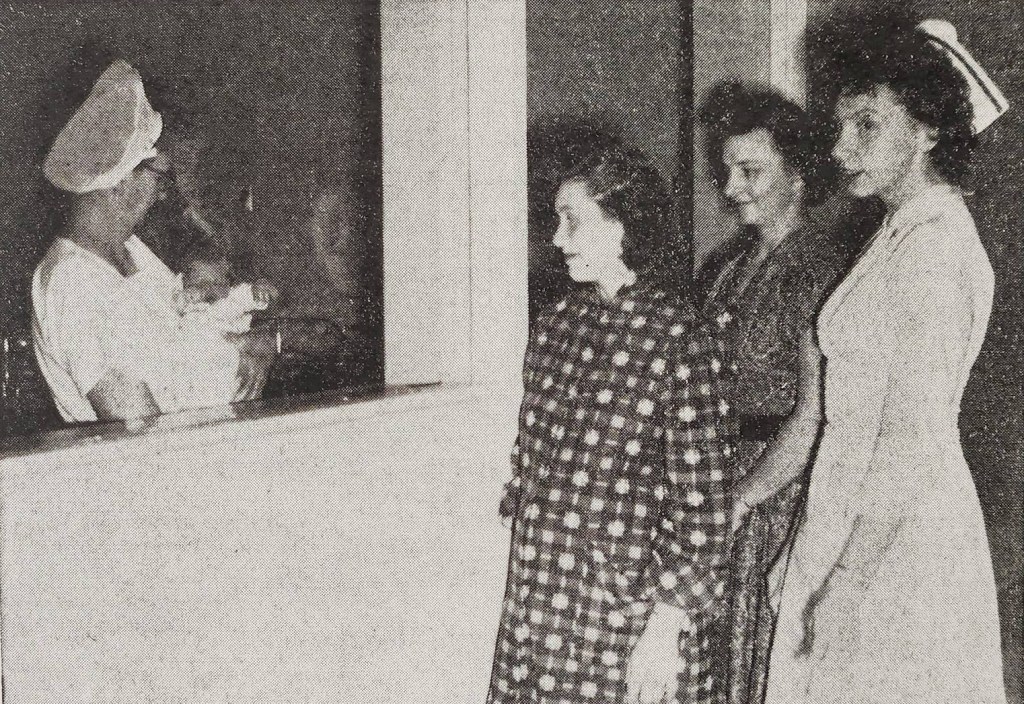
We Remember “Those L & L Laws: Lewd and Lascivious Behavior in Old Gratiot County”

Above: A post-World War I circuit court record of one Gratiot County couple who were arrested and tried for the crime of cohabitation. Ellis Mumby, age 26, was found guilty and sentenced to six months in the Ionia Reformatory.

In December 1921, there came a knock at the door of the dwelling of Joseph Yucek and Sophia Lastuk, who then lived in a remote part of North Shade Township. The Gratiot County sheriff, along with his deputy, tells the couple, “You are both under arrest.” The couple is loaded into the sheriff’s car, and the group begins the trip back to Ithaca. Upon arrival, Joseph and Sophia are held in custody until their court appearance.

Once in front of the judge, the pair is asked how they desire to plead. The pair face a potential judgment of either jail time, fines, or being sent to Jackson State Prison or the Women’s Reformatory in Detroit. If they are lucky, they get only a fine.

What was their crime? Joseph Yucek and Sophia Lastuk have been found in violation of lewd and lascivious behavior – the crime in Gratiot County of living together outside the bounds of marriage.

For many at that time, it was called cohabitating. However, the public might later call it “shacking up,” “living in sin,” “moving in,” “a trial marriage,” or “living together.” Today, most people find it absurd that such a law would deal with a couple’s personal lives, as it did for Yucek and Lastuk. However, arrests for cohabitating did happen here in Gratiot County, and they happened frequently in the 1920s and 1930s.

 Starting during World War I and running up until World War II, Gratiot County circuit court records show that at least 33 couples appeared in court for the crime of cohabitation. It is often difficult to determine the exact consequences for many of these cohabitating couples who were arrested for “L and L” or “L and L (lewd and lascivious) behavior.” Many experienced consequences for being caught. Upon examination, these circuit court cases frequently only reveal the names of the offenders, where they lived, and the charges brought against them.

The following is a brief list of some of the couples in Gratiot County who were brought to court for “L and L.” In the spring of 1922, Earl Berry and Mildred Lyon were the first in the group to each receive a sentence of six months to a year in prison. Berry spent his time in Ionia, but it is unclear where Lyon went. In another case in 1925, a couple identified as Archie Bell Johnson and Lena Dunkel were found not only guilty of violating the marriage law, but also were taken into custody to be treated for a social disease (syphilis). In 1926, Durwood Jones and Genevieve Dickerson from St. Louis were each sentenced to four days in jail and subsequently served probation for their offense. They got off relatively easily. Possibly, they agreed to separate or get married. In late 1926, Steve Skibinski and a young girl named Clara Cass were busted after checking in at the Wright House in Alma after someone tipped off police because they looked suspicious. Their contrasting age differences were probably a tip-off, and someone contacted the Alma police. Skibinski was quite a bit older than Cass. It is not clear what their consequences were.

 In October 1927, Donald Girvin was arrested for being unlawfully wed to another woman while trying to remarry and was convicted of committing perjury. As in similar cases, one of the parties involved did not disclose their actual legal age for marriage. Usually, the girl was sixteen or younger and might only wed with the permission of her parents. By lying about her age, the girl was guilty of perjury. There were also cases where someone faced arrest for lying or claiming ignorance about not being legally divorced in another county before getting married and committing bigamy. In one case, Donald Robinson and Mabel Ottinger were arrested for “L and L.” Still, they also got off relatively easily in January 1932, paying only a $25 fine. In another case in 1936, Levi Hunnnicut and a girl named Geraldine got a $40 fine and had to pay 50 cents a week in probation fees as part of their punishment. In still another case in late 1937, two couples were caught cohabiting in Gratiot County at the same time. It is unclear what the connection was between the two arrests, only that their charges came under “L and L.”

One would ask today, why would these people be arrested, and why was this particular “crime” such a concern in Gratiot County? Looking back, there could have been several reasons why couples faced prosecution for “L and L” crimes.

First, the role of the church in early 20th-century Gratiot County likely had a significant impact on why couples hid or concealed this behavior. In both Catholic and Protestant churches, marriage was considered in high esteem. It was what couples were supposed to commit to at the appropriate time. Yet, cohabitation in Gratiot County happened and was most likely an open secret in many areas. Another reason for prosecuting this crime involved both legal requirements and health considerations. One similarity between getting married in 1925 and 2025 is the process of applying for and paying for a valid marriage license. Marriage licenses, like other licenses, remained a public record, but also brought in money as a source of county revenue.

 Gratiot County’s frowning upon cohabitation may also have been health-related. The period starting in the 1910s in Gratiot County saw considerable reform in personal health, as people survived the influenza epidemic and still battled numerous diseases like smallpox, diphtheria, and tuberculosis, among others. Going another step, confronting, confining, and treating what were then called “social diseases” (venereal diseases) increased in the World War I era at the local, state, and federal levels. Alma was particularly involved in arresting and confining women who possessed social diseases during World War I, a result of the increase in prostitution due to the presence of Army men who came to town to pick up trucks for the Republic Truck Company. The need to regulate social diseases made the front page of newspapers like the Alma Record.

Still, the topic of cohabitation in Gratiot County overlooked one intriguing aspect of Gratiot’s society, which involved identifying cohabitating couples. How would the Gratiot County sheriff’s office in Ithaca ever know that a couple like Joseph Yucek and Sophia Lastuk, who lived in a farmhouse in a remote section of North Shade Township in 1921, were cohabitating? Who told the sheriff, and how did he find out?

The answer is that there was a “hotline” in Gratiot County, which reported cohabitation, as well as other crimes, such as alcohol during Prohibition. This “hotline” (or telegraph or gossip line)  was operated by individuals in Gratiot County who reported what they thought they knew or saw directly to the sheriff. In effect, this Gratiot County grapevine often tipped off law enforcement and regularly reported on fellow citizens.

Since residents told the sheriff that they thought someone was brewing moonshine whiskey, transporting, or selling it in Gratiot County, many had no problem reporting that their neighbors or the new people in their section were unlawfully living together. A bigger historical question is how many people knew about these cohabitating couples and how concerned these couples were regarding their personal lives.

Whatever readers think about cohabitation in 2025, today it is viewed as a private matter.

But back in our past, it was treated as a crime in Gratiot County.

Copyright 2025 James M Goodspeed