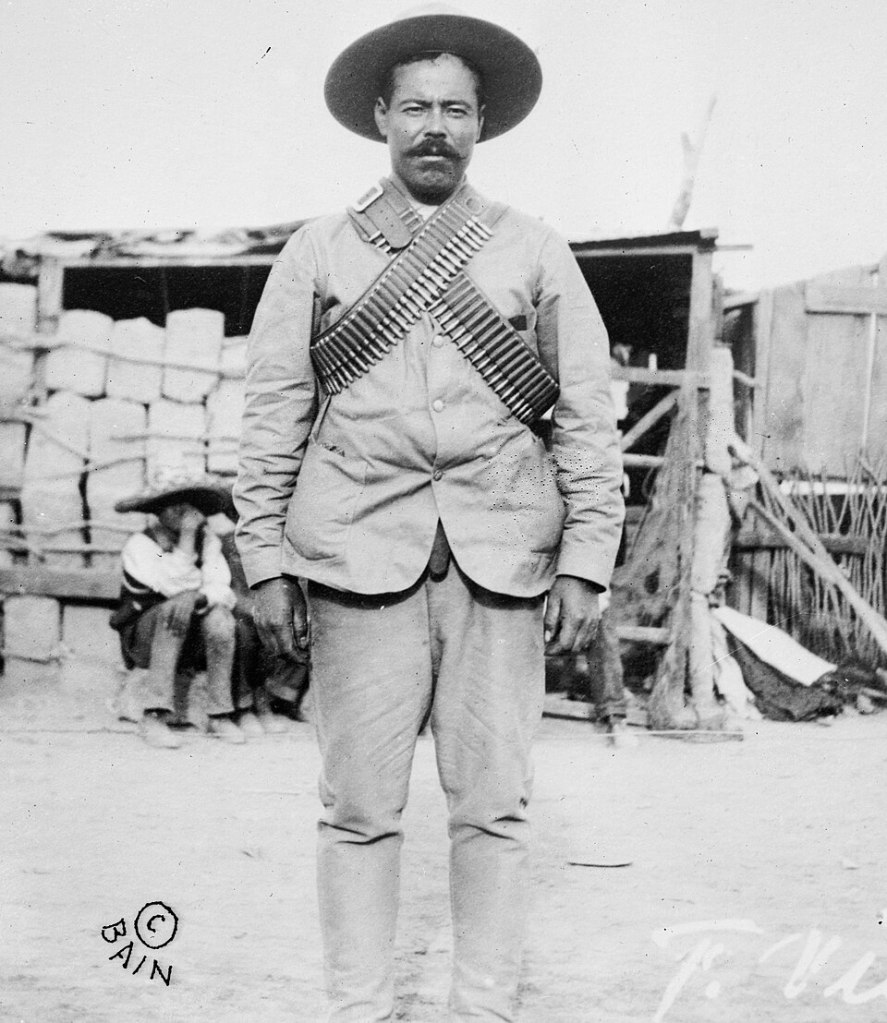
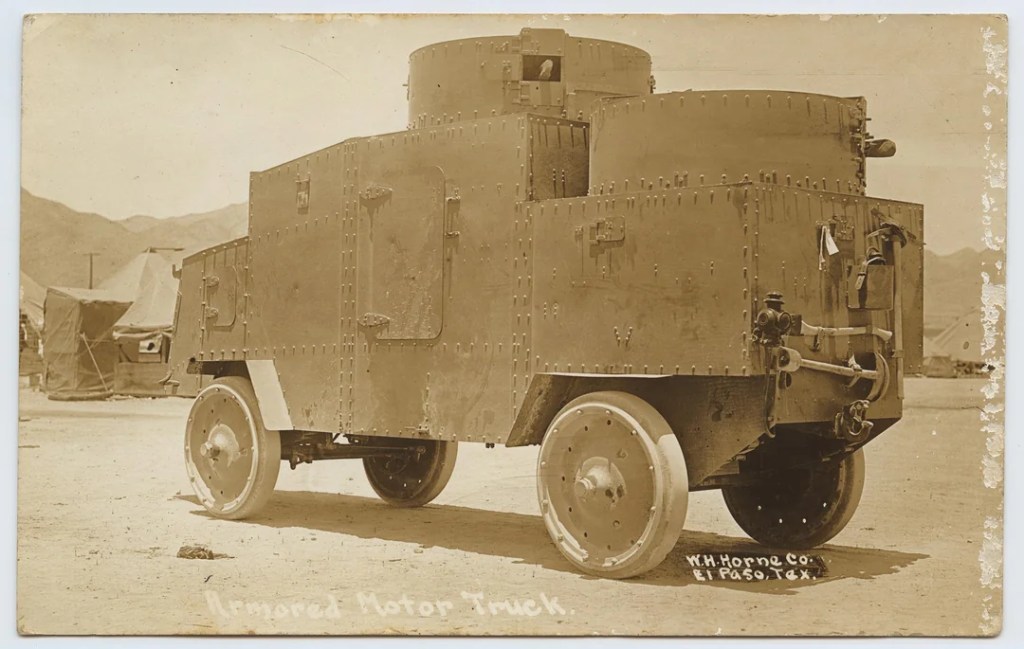
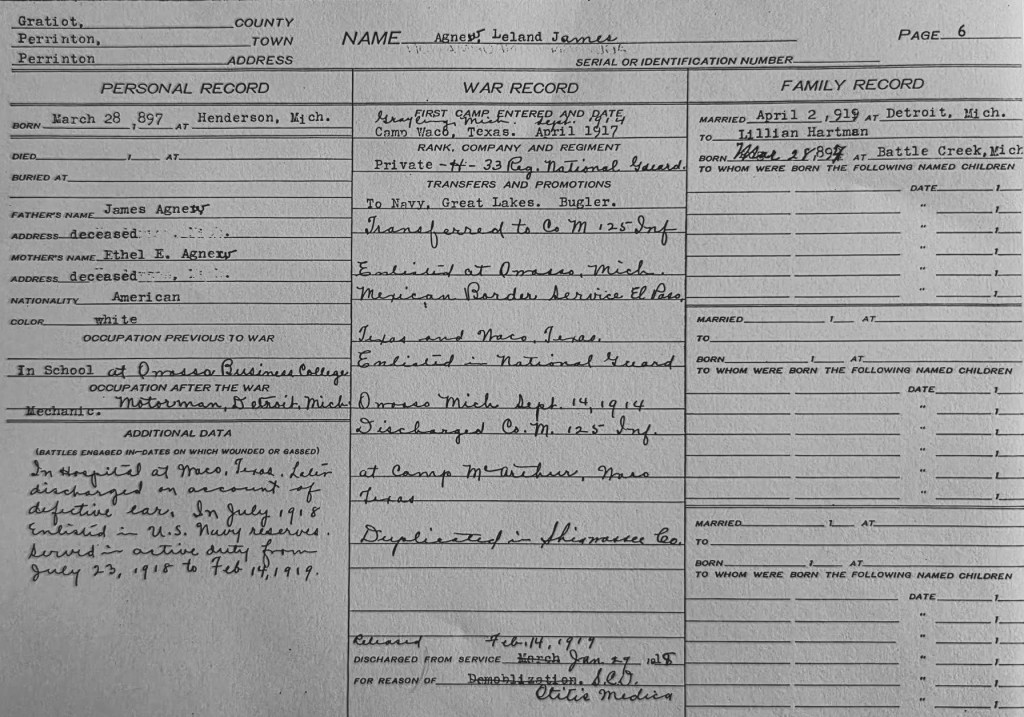
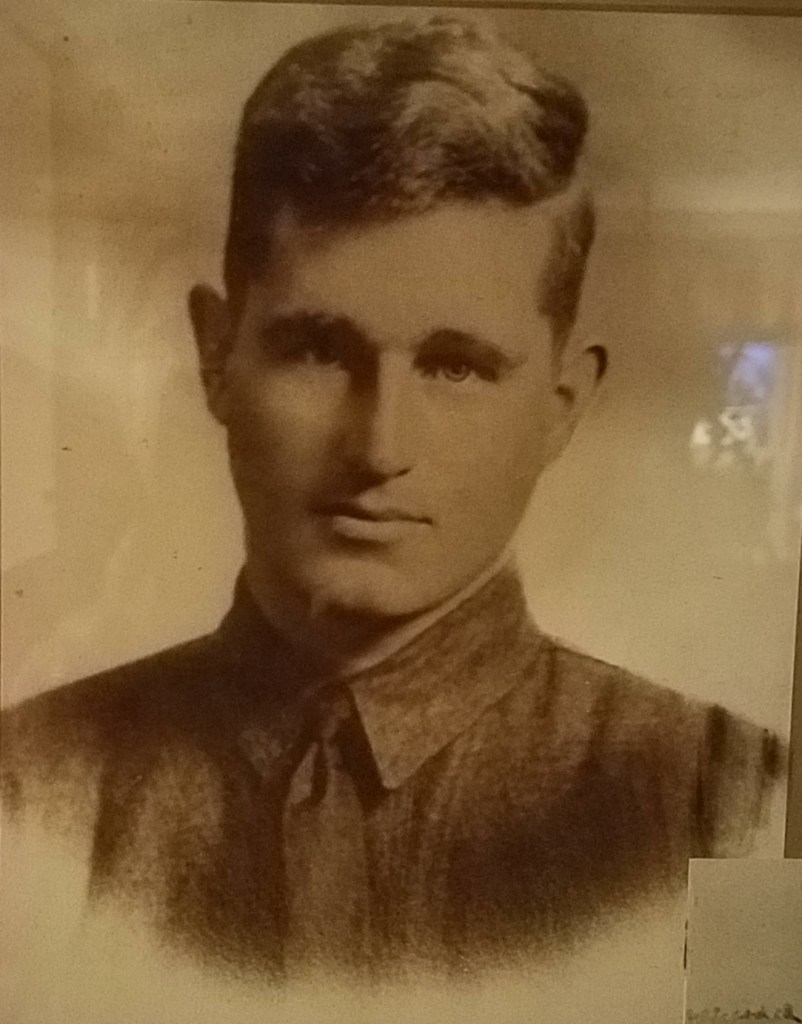
Above, from the top: Mexican leader Pancho Villa led border raids into the United States, making him one of the military and government’s most wanted men in the 1910s; armored vehicles like this one entered the Border War. Republic Truck in Alma designed an armored vehicle similar to this type; Leland Agnew of Perrinton was one of several Gratiot County men who served in the Border War, then in World War I in Europe. His post-World War I record tells a story of his service for the county.
During the 1910s, the United States was drawn into conflict along the border with Mexico due to the Mexican Revolution. Consequently, American troops were stationed along the border from the Gulf of Mexico to the western edge of New Mexico. Between 1914 and 1916, various skirmishes occurred, involving some men from Gratiot County in what became known as the Border War.
In April 1914, Walter L. Hawk, whose parents lived in Riverdale, was wounded while serving as a boatswain aboard the Battleship Minnesota during the American Marines’ landing at Veracruz to seize the waterfront. An unnamed nephew of Benedict and Mesdames Cushing of Alma was also wounded alongside Hawk.
In May 1914, Gratiot County contributed to the war effort with the Armored Republic Motor Truck, which was referred to as “a land battleship.” A group of 100 fully armored trucks, equipped with machine guns, was soon sent to the army. These “battleships” could travel at twenty miles per hour on roads and cover five hundred miles from base. Additionally, the trucks had flanges that allowed them to run on railroad tracks at speeds of up to forty miles per hour. This innovation marked a new era in warfare, replacing traditional army mules.
Skirmishes along the Mexican border increased in 1916 when factions, led by Pancho Villa, attacked Columbus, New Mexico. In response, President Woodrow Wilson ordered the army, led by General John Pershing, to go after the “Villastas.” In March, John Fetro of Ashley received a letter from his brother describing the raid. In Columbus, eight soldiers had been killed, and the hotel, along with other buildings, had been burned. Sergeant Ira Fetro and four companies of men patrolled an area twenty-two miles outside of Columbus. While searching for Villa, Fetro wrote, “Now we sleep with our guns in bed with us.”
John Watson of Breckenridge and Lieutenant Ely of Alma witnessed the hangings of two captured raiders in the Columbus jail yard. In the meantime, the Alma Record informed readers about the details of how the men went to the gallows. The inability to capture Pancho Villa and others infuriated citizens in the United States. Eventually, both the military and the United States government realized that only a complete occupation of Mexico could resolve the Border War. As a result, the National Guard received orders to place 117,000 men along the border. Nearly 3,000 came from Michigan.
The 33rd Regiment from Grayling, Michigan, along with other units that were sent to the border, quickly became dissatisfied with their assignments upon arrival at Camp Cotton, Texas. Sergeant Floyd T. Smith of Alma wrote home that his men were upset that they had been mustered into the regular army and were limited to staying in camp. Worst of all, their pay had been reduced from two dollars per day in the National Guard to the army salary of fifty cents a day.
By early 1917, most of the rebel groups had fallen apart. Although the army never captured Pancho Villa, they did catch his top two lieutenants. Later, many men who served during the Border War were eventually sent to France when war was declared in Europe. Military records from several of these Gratiot County men, like Leland Agnew of Perrinton, later stated that they had been in the “Mexican Border Service.”
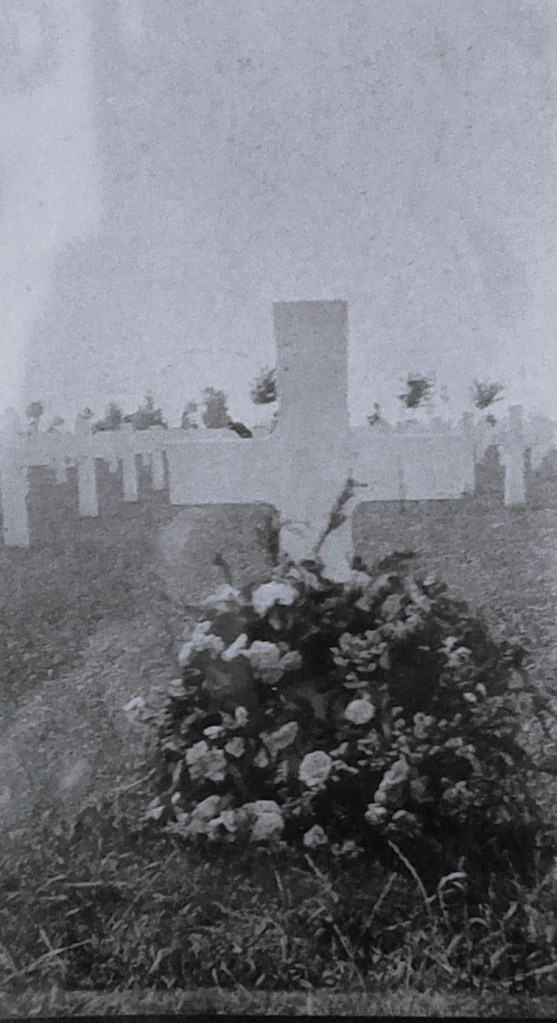
Above: Ella Smith of Perrinton was Gratiot County’s only Gold Star Mother who traveled to her son’s grave in France in 1930 as part of a government program; Private Lyle Smith was one of thirty Gratiot County men who died during World War I: Meuse Argonne Cemetery as it looks today; Private Lyle Smith’s grave on the day Ella visited the gravesite; Marker for Lyle Smith as it appears now in Fulton Center Cemetery in southern Gratiot County’s Fulton Township.
“Every marker is of the whitest marble, and they take such wonderful care of everything. I do not think I ever felt worse in my life than when I knelt by Lyle’s grave and placed a beautiful wreath of roses on it. Had a good cry, then felt better. Felt as if I had been to a funeral.”
So wrote Mrs. Ella Smith of Perrinton, who in 1930 was Gratiot County’s only Gold Star Mother to visit the grave of her son, one of many who died on the battlefields in France during World War I. The Gold Stars were mothers and widows of those men who died serving our country.
By the end of President Calvin Coolidge’s administration in 1929, legislation encouraged mothers to travel to France to visit the graves of their sons or husbands who had not been sent home after the war. Over 17,000 women were eligible for this fully paid trip provided by the government. By the fall of 1933, an estimated 6,693 women made the journey.
Smith left Gratiot County in early June, 1930 and was transported to France aboard the S.S. President Harding along with 2,026 other war widows. She met women from fifteen different states; forty were from Michigan.
In Paris, Ella Smith and other Gold Star Mothers were placed in hotels based on which cemetery they visited. In this case, she was one of 112 women headed for the Meuse-Argonne Cemetery. Part of the trip included seeing the best and worst of post-war France. Visiting memorials, churches, and cultural sites was easier than viewing some scenes in the countryside. There, French women pushed two-wheel carts, led their horses, while seeing constant images of destroyed woods along the shell-torn countryside.
On June 17, 1930, Smith arrived at the cemetery. After participating in a tea service, the women were given the section number where their son or husband was buried. Upon arriving at that row, an officer gave a wreath to place on the grave. The government also had a photographer present to photograph each woman standing next to the grave. The Gold Stars then had six hours to spend in the cemetery.
Upon leaving, Smith’s group headed to the nearby area of the Argonne Forrest where Private Lyle D. Smith died. She wrote, “I presume I am now on land where Lyle was around the cemetery, for here is where the 26th Division was stationed.” As part of the Sixth Division, he had been there on September 26, 1918, when he sent his last letter home. He was killed October 4, just over one month before the Armistice was signed.
Today, the base of Lyle D. Smith’s marker in the Fulton Center Cemetery reads, “Buried in France.”
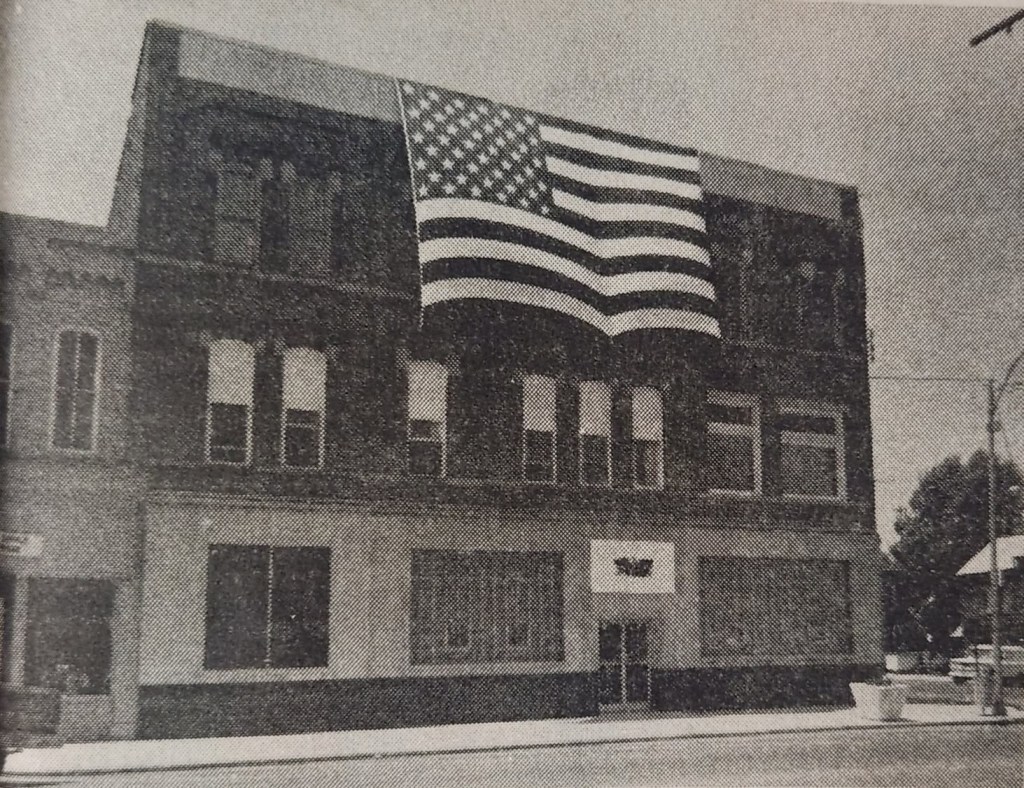
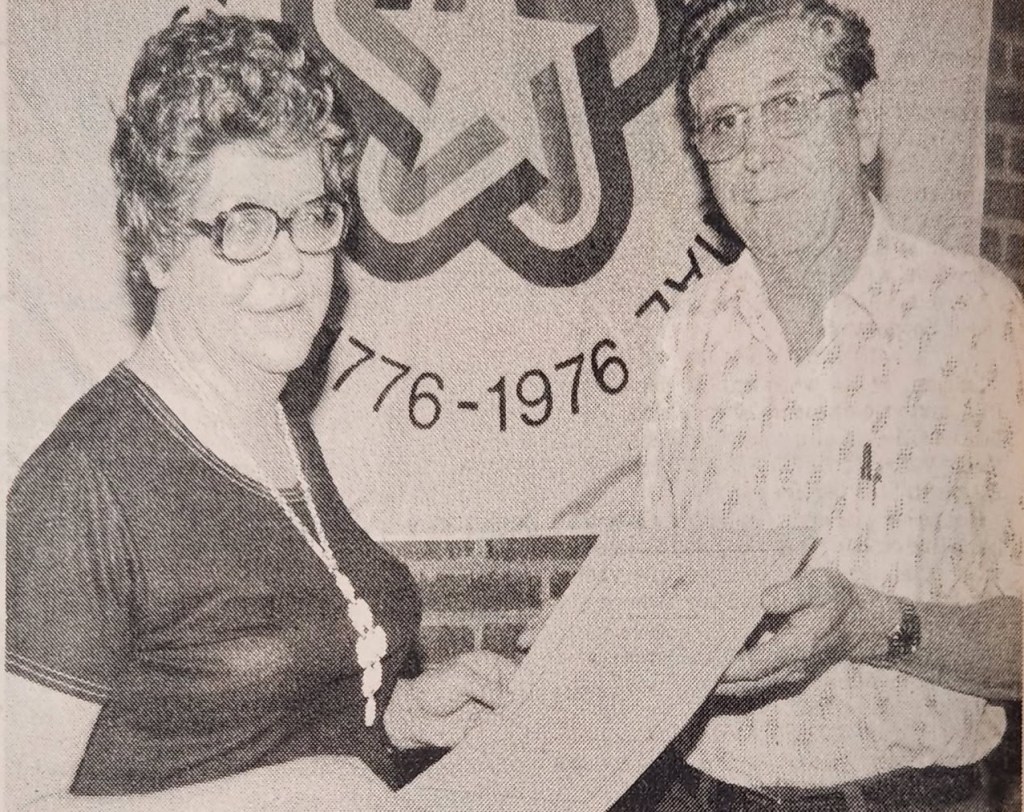
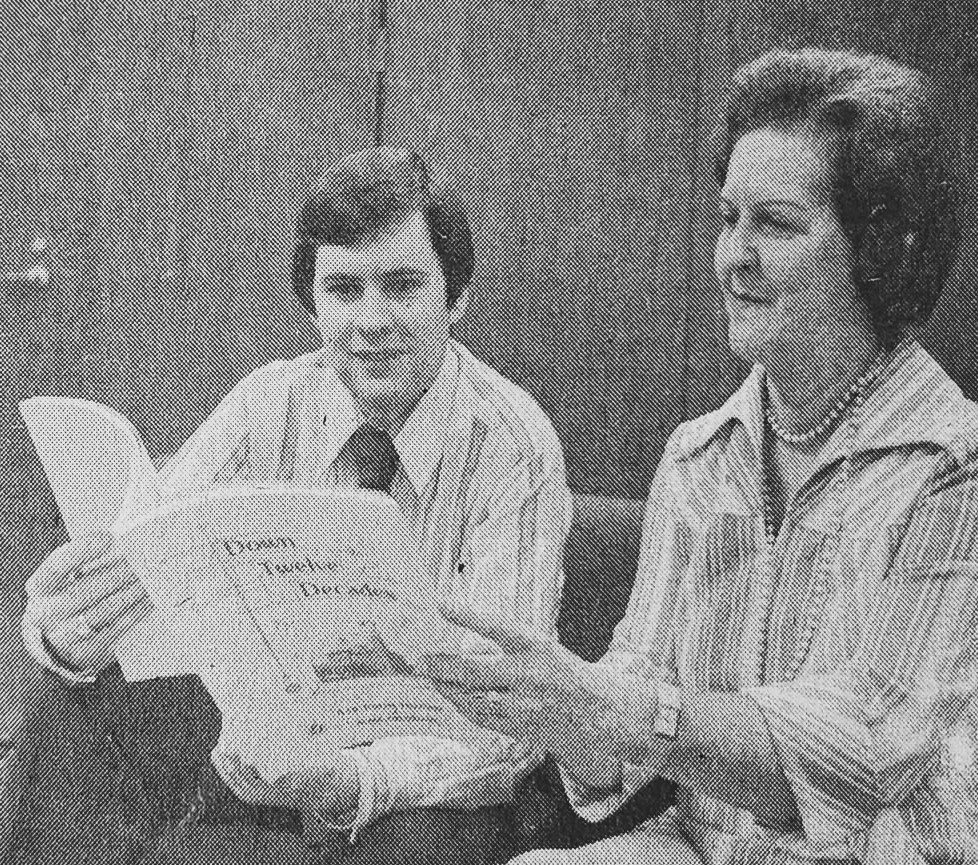
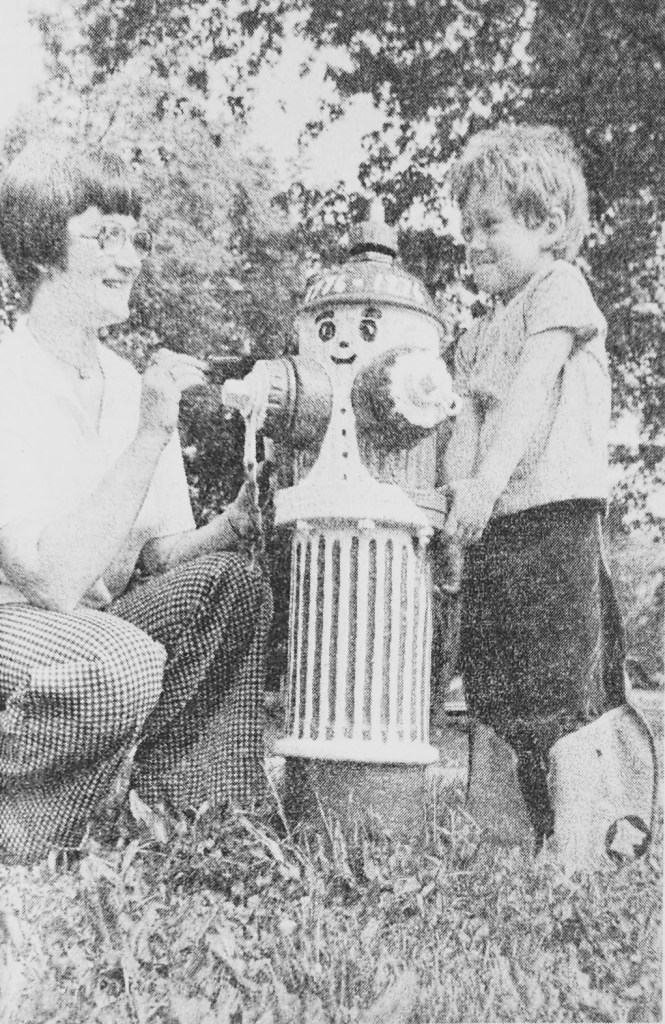
Celebrating the Bicentennial from the top: St. Louis prepares to kick off its summer festival by displaying a giant flag constructed by the St. Louis High School Future Homemakers of America; Ione Houlden of Ithaca chaired the Bicentennial program. Ithaca was the first to receive Bicentennial status in the county. Houlden holds the Bicentennial Award letter she shared with Ithaca Mayor Robert Atkinson. The letter came from President Gerald Ford; County historians David McMacken and Louise Davenport worked together to produce a history of Alma through its first 200 years; The St. Louis “Paint-a-Plug Squad” went to work dressing up the city’s fire plugs in Bicentennial colors and design. Here, Sheri Gall and her son work on a St. Louis plug.
Today, the Wayback Machine goes back to recent Gratiot County history and looks at the nation’s Bicentennial. What were we doing fifty years ago, and what was happening in the county and nation in 1976?
The United States in 1976
Apple Computer was founded. The Viking I & II spacecraft landed on Mars. The NBA/ABA merged leagues. “Don’t Go Breakin’ My Heart” was the #1 hit of the year in July by Elton John/Kiki Dee. One of the movie box office hits was “All the President’s Men” with Robert Redford and Dustin Hoffman. Saturday Night Live had its first full season on NBC. And – there was a funky, exciting baseball player in Detroit called “The Bird” – Mark Fidrych.
Without seeking to stoke any current political feelings, it needs to be said that the nation’s Bicentennial was much bigger and more visible than the United States’ Bicentennial in 2026. There was just a bigger buildup and bigger expectations in 1976. Why was this so?
Several big political and social factors at work culminated in the mid-1970s:
-The end of United States involvement in the Vietnam War came to an end (1972-73).
-Watergate – There was resulting political shock, dismay, and fatigue over this lingering political scandal in Washington.
– A soft economy that started by the mid-1970s would extend into the next decade.
– The first Energy Crisis in 1973 – a result of the Arab Oil Embargo due to the Yom Kippur War in Israel/Egypt.
– In short, the Bicentennial gave Americans something to look forward to and enabled them to forget about some of these lingering national issues.
There had been some national anniversaries before the Bicentennial that centered on previous birthdays:
-The big one – Centennial in St. Louis and Ithaca (1876) – Read David McMacken’s Taming the Wilderness for coverage.
-1926 – 150th– The only big celebration recorded appears to be in St. Louis!
-1951 – 175th – The Korean War was going on, and there was not much movement for celebrations.
-1976 – The Gratiot County Herald recorded a lot of Bicentennial news, but not much appeared in the Alma newspaper.
One could ask, how soon did America start promoting the Bicentennial? This might be a matter of debate, but I can remember a speaker during the Pasadena Rose Parade around 1972 or 1973 who commented, “We (the nation) will be gearing up for the nation’s big birthday in 1976.” In Gratiot County, things really started to move in the fall of 1975.
The Bicentennial Takes Off in Gratiot County
In Gratiot County, news items began appearing in local newspapers starting that fall, such as Collotype, a type of Bicentennial printing at Alma College. The Gratiot County Herald asked readers to contribute to its Bicentennial Cookbook. Newspapers started running bits of American history from the past 200 years, such as “Great American Happenings.” But the real kickoff in Gratiot County concerning the nation’s Bicentennial took place in the little village of Perrinton, in southern Gratiot County. On Saturday, November 8, 1976, Perrinton held a Bicentennial program that honored veterans, provided lunch, featured old-fashioned games and costume contests, and dedicated the VFW flagpole in downtown Perrinton. What made the Perrinton celebration unique was that it had applied for and received official Bicentennial status (the second place in the county to do so, and the first to celebrate it).
As the new year began, Gratiot County celebrated its first “Bicentennial Baby,” Mr. and Mrs. Gary Curtis of 315 Linwood in Alma. He weighed 4 lbs, 10 oz and was born at 12:36 p.m. on January 1! St. Louis celebrated its first Bicentennial baby when Mr. and Mrs. Alfonso Alegria of 510 South Mill had a girl weighing 7 lbs 10 oz. She was born January 7 at 5:39 p.m. The Ithaca Chamber of Commerce sponsored its annual community dinner, which included Carol Evans, a member of the United States Bicentennial Board. This kicked off Ithaca’s plans to celebrate the Bicentennial that summer. Ione Houlden was the Ithaca chairman for planning this event. One of the centers of the Ithaca celebrations was the courthouse, a national landmark. By early March, St. Louis also approved a Bicentennial celebration involving a Girl Scout parade scheduled for March 12. But something got in the way that month that interrupted the Bicentennial – it was the terrible ice storm of March 1976! Gratiot County and much of Michigan were temporarily paralyzed by the ice storm (unless you were in St. Louis and had access to city power). Gratiot County adopted a Bicentennial song in early March, composed by the grandson of County Clerk Eva Smith. The chorus went:
“Two hundred years in America, the land of freedom, foremost in all the world, in all the world. May she always be A land of liberty, and her flag forever wave.” The verses said: “Thirteen original colonies, that’s how it all began, Harbor of strength and unity, freedom for ev’ry man. “Trial and Tribulation Challenge her ev’ry day – Spirit of this great nation, stronger in ev’ry way.”
In the spring of 1976, Professor Gordon Beld started writing a regular series of historical sketches dealing with early America. These appeared in the Gratiot County Herald starting in April. St. Louis High School’s Future Homemakers of America class surprised everyone by creating a large 20×30-foot American flag (more about that later). Bicentennial colors” began showing up around the county. Over in Ithaca, a group of boys led by Ron Gruesbeck painted their basketball court and backboard in red, white, and blue. The court was a meeting place for boys on the block to play basketball,
The month of May meant Memorial Day and annual patriotic themes. The Alma Jaycees worked with the Alma Bicentennial Committee to sponsor “Profile 76” at the Alma High School gym. Tickets were free, but needed to be picked up to measure attendance. Perrinton was back in the news with its fifth annual “Loyalty Day” on May 1, which had a parade, Fulton High School marching band, speeches in front of the VFW Post, and the awarding of Voice of Democracy speech winners. The Seville Township Bicentennial committee was also in the news as the group designed a Bicentennial quilt and gifted it to President Gerald R. Ford. The quilt had a map on the reverse of Seville Township and Gratiot County, along with 100 names of those who wanted their name on it – for only$1 per name! Elaine Lockwood of rural Ithaca designed the quilt, and it was sent to the President in November. Gratiot Community Hospital also joined its annual National Hospital Week with the theme of “HEALTHY BIRTHDAY, AMERICA.” It ran from May 9 – May 15. Mayors from Alma, St. Louis, and Ithaca each signed a proclamation supporting and promoting the week. Hey, men, do you need a new “leisure suit”? You could get $17.76 off a new one at Miller’s Men Shop in Alma (the actual cost was $22.24 after the promotion).
But by the end of May, Gratiot County residents heard about the upcoming planned celebrations that would take place over the summer of 1976. Ithaca’s Frontier Festival and Heritage Days in Ithaca were among the events. The St. Louis Bicentennial Committee promoted a “Paint-a-Plug” squad that went around the city and painted fire hydrants decorated in red, white, and blue. Some of the members who did the painting included Betty Gall, Sheri Gall, Judy Sparling, and Jane Barker. Ashley kindergarten students in Marie Shelton’s class wanted to give America a birthday party. So, they created a 9×13-foot birthday cake in a colonial flag design. It took 143 cakes, involving 15 pounds of sugar and ten pounds of powdered sugar, all painted in a colonial flag design. After the program, the entire school and many parents devoured the cake. The Gratiot County Board of Commissioners also got involved in the Bicentennial by holding their June meeting at the Wheeler Township Hall – a move designed to be more accessible to other parts of Gratiot County. This was the first time that the Commissioners met outside of the County Seat. After the meeting, a square dance organized by Gladys Rausch and music by Dave Bailey’s group (and fiddling by Chairman MacDonald) entertained the group. Regular attendance for a meeting increased by over 50 people that night in Wheeler! Over at Lumberjack Park, Lumberjack Days had a Bicentennial flavor featuring flag raising and planting of the Bicentennial flag, along with a costume ball in best colonial attire. The celebration lasted three days at Lumberjack Park. Bannister had a Flag Day ceremony as they dedicated a new flag and a new flagpole.
But what about the bigger towns and the Bicentennial? For the three-day St. Louis Festival in June, St. Louis dedicated a special monument, “Valor for God and Country,” and the big American flag was hung from the top of the old bank building in downtown St. Louis after the city’s parade marched with over 60 entries. The St. Louis VFW also held a flag-burning ceremony to show the public how old and worn-out flags were to be properly disposed. During the week of July 4 (which fell on a Sunday), the St. Louis Pony League Tournament was held at the St. Louis softball park. Bill Shrum announced some of the games and once told the crowd, “What a way to celebrate the Bicentennial – by playing baseball!”
Ithaca and Breckenridge entered the Bicentennial Spirit starting in late June 1976. The Ithaca Bicentennial Committee planted two small sugar maple trees on the Ithaca City Hall lawn on June 18. These trees grew from a 100-year-old tree near Niles, Michigan, planted in 1876 to observe the Centennial. At the end of June, the Lafayette Presbyterian Church saw 50 people dress up in Bicentennial costumes. The services, musical presentation, and noon potluck dinner drew 150 people.
However, the big draw in Ithaca in late June involved the Ithaca Frontier Festival, which ran from Thursday through Sunday, June 24-27. In addition to the many Ithaca-related events like the calf scramble, Sheriff Posse Queen, garden tractor contests, rodeo, harness racing, and a parade. During the parade, Ithaca elementary school children carried the giant flag from St. Louis. The Fifth Artillery of Michigan Civil War reenactment group demonstrated cannon work on the courthouse lawn.
The penultimate celebration and events occurred in the county in July. The little crossroads of Sickles had a car show on one day in early July. However, the big celebration took place on Heritage Weekend in Ithaca with Ione Houlden, Bicentennial chairman, overseeing the program, which involved the rededication of the Gratiot County Courthouse, a costume contest, and a concert on the courthouse lawn. The day ended with presentations of a Bicentennial opera entitled “Tall Trees,” based on Michigan’s lumbering era, at North Elementary School gymnasium. Earlier in 1976, the courthouse received national historic site status. The weather for Heritage Weekend in Ithaca was perfect.
As summer came to a close in Gratiot County, so did many of the Bicentennial observances. The Seville Church of God and the old French School celebrated on August 21-22, when people attended programs on horseback, in buggies, by wagon, and on foot.
Today, there are still at least three important legacies in Gratiot County that came out of the nation’s Bicentennial celebrations :
-Bicentennial coins – although a little uncommon, they can be found in change.
-Alma Bicentennial book “Down Twelve Decades, A Pictorial History of Alma” by David McMacken and Louise Davenport is a key read in starting to learn about Gratiot County’s past. You can still buy a copy at the Alma Public Library.
-St. Louis Bicentennial flag – a giant flag made by Betty Paton’s Future Homemakers of America at St.Louis High School! It is still in storage, has been hung on buildings, and was even displayed over the bridge when St. Louis Police Chief Teed died.
Keith Kellogg, a Newark Township farmer who served in the Michigan Legislature, was called upon to speak at the Gratiot County Courthouse ceremony in July. He made several observations about the Bicentennial celebration in Ithaca. Kellogg said this, and it is still true today: “In conclusion, at nearly 84 years of age, like many, many fellow Americans, being one of God’s chosen few, among the millions inhabiting the surface of this earth, I am grateful to the Creator of all things for privileging me to live out my life in such a land as this. Anyone even born here has little to complain about.”
In the midst of the 1970s, the national Bicentennial – and Gratiot County’s participation in it – enabled people to celebrate America’s 200th birthday.
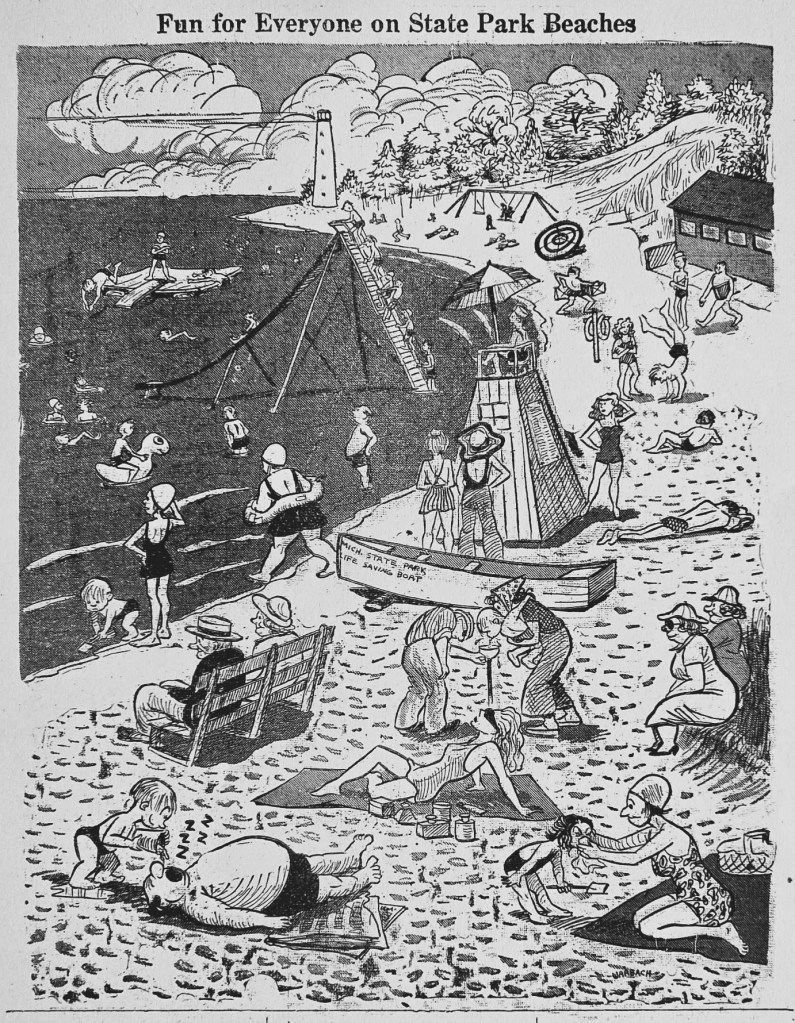
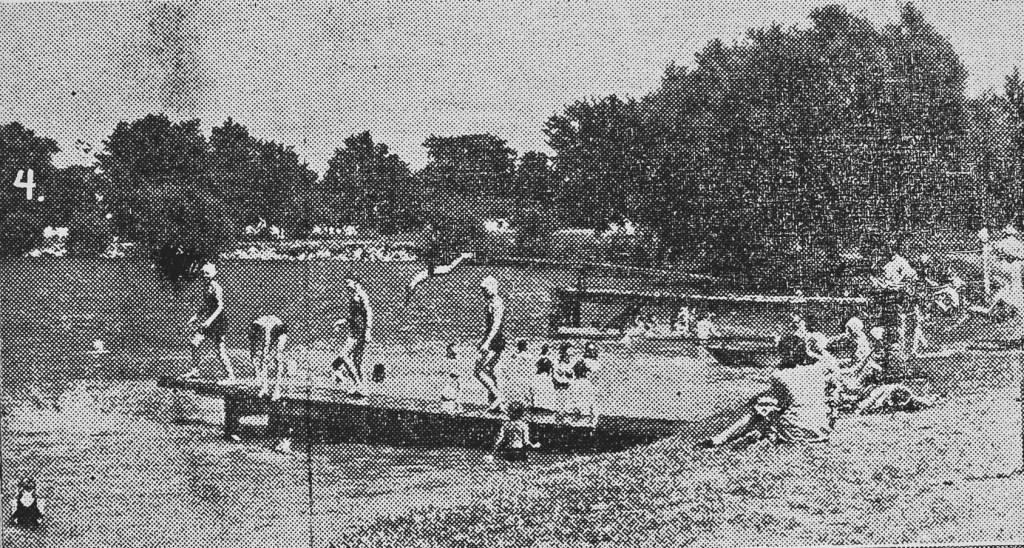
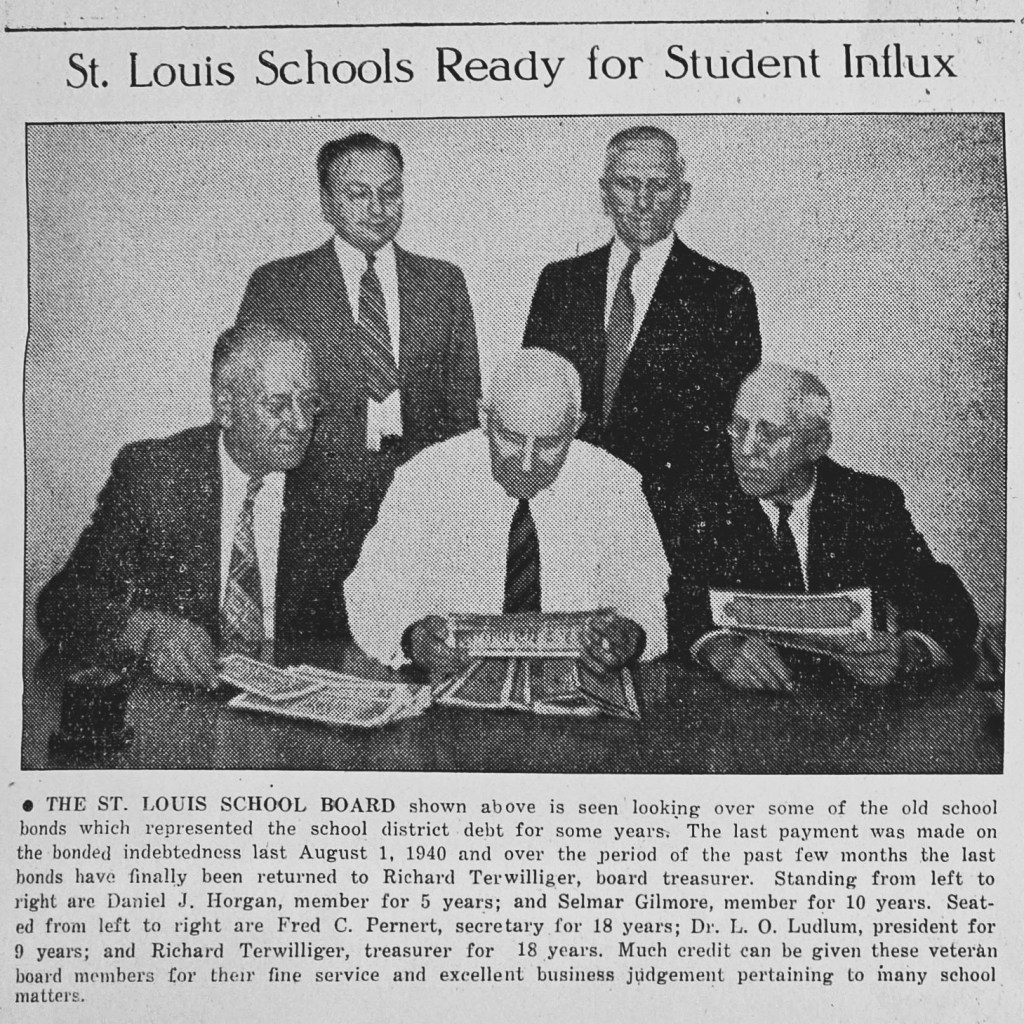
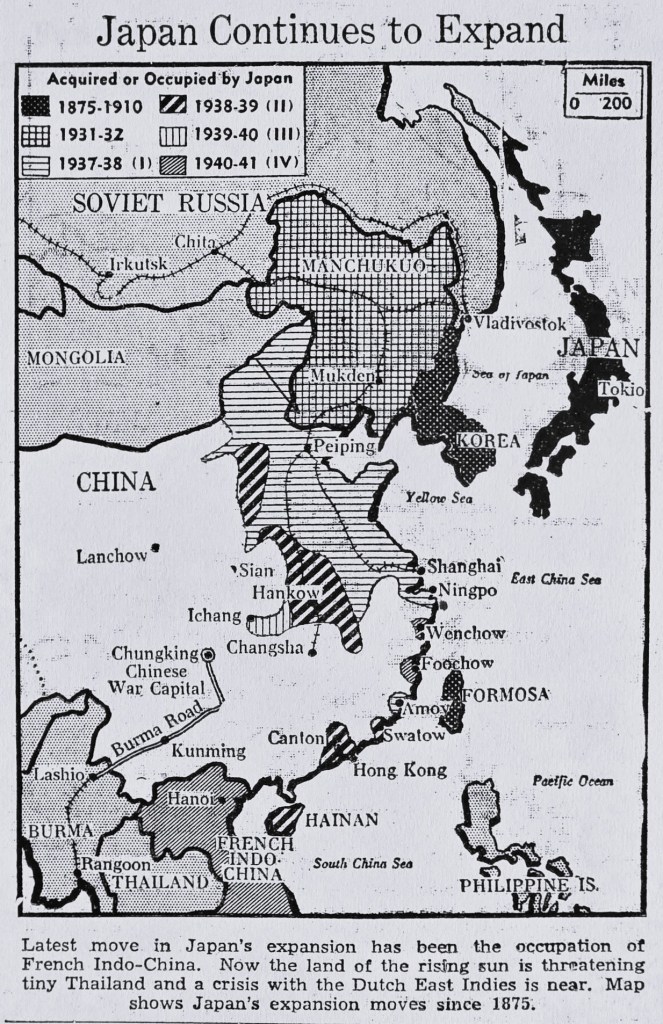
Above from the top: There was nothing like going to a State Park beach in 1941; Then, if you could not travel you hit Gratiot’s most familiar place to swim – Turck’s Park (or Turck’s Beach) in Alma above the dam; The St. Louis Board of Education members prepared to welcome students back to the 1941-1942 school year; Japan’s expansion across Asia warned of problems yet to come.
The middle of the summer of 1941 had been very hot and very dry. How could a person not think that war was inevitable?
More people left WPA work for better-paying jobs in other places in mid-Michigan, or Lansing, or even Detroit. Still, unemployment rolls in the county continued to climb, and New Deal jobs went unfilled.
Gratiot County always had need for the law, and both the young and the old could be offenders.
Every community needed a good hospital, and Gratiot County had at least two which treated some tragic and unusual injuries.
It was August 1941 in Gratiot County.
Gratiot Prepares for War
As Gratiot County entered August, there was plenty of news suggesting that a war was coming. Gratiot boys then in the military continued to make the front pages of county newspapers, and would do so in increasing numbers throughout the rest of 1941.
William Kyes of Elwell got his wings and became a second lieutenant in the Army at Kelly Field, Texas. He was headed to Pearl Harbor and then onto the Philippines. Before he left, he married Wilma Wieland, a fellow teacher at Freeport, Michigan. Lieutenant Kenneth Church of Alma served as an officer in charge of battery firing at Fort Leonard Wood, Missouri. He was one of five overseeing the targets that day. Major Howard Freeman, also at Fort Leonard Wood, came home on furlough and said that the Alma antibattery unit in Missouri carried on dutifully despite the oppressive summer heat. Sergeant Clyde Washburn, also at Fort Leonard Wood, soon would probably be given a discharge due to his condition with ulcers, according to Freeman. Private William T. Nurnberger, son of the St. Louis Schools Superintendent, enlisted in the Army in 1939 and had been in the Hawaiian Islands. While home on leave, he told the St. Louis Rotary Club about what life was like there through colored motion pictures. Nurnberger stated that he believed defense of the islands was very good in case of attack and that he believed a Japanese invasion to be only a slight risk. Nurnberger had recently been assigned to Selfridge Field.
The status of more Gratiot men could be read in the papers. Corporal Norman Keon of St. Louis became the champion rifle shot of Battery A at Camp Davis, North Carolina. He outshot 230 other men who tried for the high score. He was attached to the 94th Coast Artillery at Camp Davis. Locally, Major Charles Murphy said that 36 men were enrolled in the Alma unit of the Michigan State Troops. In fact, he believed enough prospects were available to have the company at a full strength of 57 men. Elmer Diller of Ithaca became the seventh and last registered conscientious objector to leave Gratiot County. Diller was assigned to Camp Dennison, Iowa, and left August 27. Want to help homesick sons in the military? Visit them at Camp Davis, North Carolina, as the Criswell and Zoss families did. The families also got to visit the ocean beaches and go swimming while they were there. In another case, a group of five boys from Camp Forrest, Tennessee wanted to come home so badly that they hired a local teen who drove the homesick service members back to Michigan for short visits – all for a very tidy fee. At least two in this group made a short visit home to Gratiot County.
A ninth contingent of Gratiot men left for the service as a result of the draft, this time made up of only ten men. When one was forced to drop out due to being rejected on his health examination, a replacement came from Muskegon and took his place. This was Gratiot’s smallest contingent since November 1940. Big news came August 14 when Congress voted to retain draftees for an 18-month extension beyond their initial term. These men also received a $10 increase in pay each month, up from $30. However, Michigan draftees over the age of 28 may soon be released back to private life.
Then there were the consequences of war talk and continued war preparations. The St. Louis Aluminum Drive in July raised 340 pounds and was now taken off to Lansing. Boy Scout Master Murvil Peacock was in charge of the Scouts as they made the aluminum drive a success by going house to house and accepting drop-off contributions. In all, the county turned in 1,627 pounds of aluminum. Want to hear of patriotism? Robert Stone, age 14 of East Alma, was the second person and youngest boy to purchase a $25 defense bond. After saving enough to fill one book of stamps, he had another $2.80 in stamps to start another album. Even the Alma postmaster was impressed by the young boy’s thrift and drive. Stone lived with Mr. and Mrs. H. Dafoe of East Superior Street. Doctor T. J. Carney was named chairman of the Gratiot County Defense Council by Governor Murray Waggoner. Five other members made up the group, which included Ray McCall, Roy Hamilton, Daniel McCuaig, and Harry Patterson. The Red Cross received materials for children’s snowsuits, toddlers’ outfits, nightgowns, baby shirts, and terry cloth diapers. Now, the Red Cross in the county needed more volunteers. Just call Mrs. William Ellis at telephone 489.
As all of these things in the nation took place in August, newspapers lamented that Americans would “soon be taxed down to their underwear” to pay for war preparations. The largest tax bill in the country’s history passed the House and was headed to the Senate. The Federal Reserve Board announced that it was seeking to curb installment buying and to require bigger down payments for purchases. Over at Alma, the Redman Trailer Plant had to shut down half of its workforce on a Wednesday due to lack of materials amidst high demand for trailers. The plant employed 150 men and had trouble keeping up with orders.
Another county newspaper carried the headline “America We Once Knew Declared Gone Forever.” In other words, war is coming whether America wants it or not. Americans learned that President Franklin D. Roosevelt met with Prime Minister Winston Churchill at sea aboard the British Prince of Wales in the North Atlantic. After their meeting, the two announced an eight-point plan entitled “Design for the World of Tomorrow.”
The Depression Continues? Get People to Work
While more people in the county could find work, there continued to be problems and discussions about the unemployed. One of the county’s concerns involved caseloads at the Gratiot County Department of Social Welfare, where people received more aid than at any other time in the office’s history. In May 1941, 1,324 people or cases received $ 25,392. And yet, money was running out by July. What was happening? The Gratiot Old Age Assistance roll also was growing, with 47 new applicants asking for help.
People in the county could continue to apply for new cotton mattresses if they lived outside of Alma or St. Louis and had a net income less than $500. Starting in September, new mattresses would be made in town halls in Washington Center, New Haven Center, Newark Grange Hall, Bethany Gleaner Hall, and Riverdale. Those who remained behind on their Moratorium Taxes had until August 31 to make their payments. Payments for installments went as far back as 1932, according to William G. Federspiel, Gratiot County Treasurer. For those who wanted an old-age pension, Townsend Clubs continued to hold regular meetings across the county. Ithaca Townsend Club No. 1 held one at the Alma Tourist Park. Other Townsend followers attended meetings at Clifford Lake as well as a Progressive Townsend Club meeting at the Ithaca Village Hall. Later in the month, three clubs united to hold a picnic dinner. In each of these meetings, well-known Townsend speakers came to the county.
While some people remained unemployed in the county, many others continued to find employment through New Deal programs like WPA projects. In fact, many of these workers were leaving the WPA for jobs that paid more money. A shortage of WPA workers in St. Louis meant that some projects, like curbing and paving sidewalks, as well as sewer work, would be delayed until winter. Most WPA men were now working on an M-57 state highway project or in Alma paving streets. Alma workers concentrated their efforts on laying concrete on Prospect Avenue south of Superior Street. Prospect Street still had much more work to do. Other WPA work in Alma dealt with the recreation centers at Republic Center, the Salvation Army Craft Shop, Turck Park Beach, and Alma City Hall. The WPA also was involved in selling hot lunch meals for ten and fifteen cents at Alma High School. The NYA, another New Deal program, continued to remind Gratiot residents that it helped 93 students over the past 10 months with part-time jobs. This summer had also witnessed an NYA junior baseball schedule with eight games. Breckenridge emerged as the league winner (8-0) and entered state playoff contests against Ingham County. The NYA also looked after the health of its youth. During the first half of 1941, 71 workers were given health examinations by Gratiot County. Some needed dental care, had eye and throat ailments, and were referred to their family doctors for treatment.
The Long Arm of the Law in Gratiot County
During July 1941, 67 people were convicted in court, with 53 paying fines for traffic violations—some of the other crimes involved fishing unlawfully and another for unlawful disposal of chattel mortgaged property.
Lawbreakers were prevalent, and the month started with a very disturbing case that occurred at the Ithaca fairgrounds. Charles Hull, 59, of Ithaca was arrested and convicted of unnatural conduct with three calves. Hull was sentenced to 2 ½ to5 years in Southern Michigan prison. Steve Doroff, 26, of Cicero, Illinois, was arrested for impersonating a federal officer when he visited Alma police headquarters and asked about police officers and certain industries in the city. Doroff was also intoxicated and was held pending an FBI investigation. Later, the impersonator got a fine of $13.35 and ten days in jail. His mother paid Doroff’s fine.
Late in the month, two gangs of youth, totaling around fifty, descended upon the Ithaca fairgrounds from St. Louis and Ithaca on a Sunday at midnight. Other participants came from Perrinton and outlying areas from both ends of the county. Most of the gang members appeared to be in their late teens and damaged four cars by throwing rocks, battering fenders, and breaking car windows. Some of the gang members’ cars blocked entrances to the grounds and were rammed by those wishing to escape. The conflict started at the St. Louis roller rink and spilled over to the next night. When the group took their fight to the St. Louis athletic field, city authorities forced them out of town, and then they moved to Ithaca. After police arrived at the fight in Ithaca, they managed to get the names of the drivers of those cars involved in the rammings in Ithaca. Law enforcement also stated that they had started the process of tracking down the names of the other participants in the “gang war.”
A piece of positive law news dealt with the largest group of people petitioning for citizenship in several years. First there were fifteen petitions for citizenship, then the number grew to twenty-five, and finally twenty-nine candidates. Ten different nationalities were represented by those who filed petitions with the county clerk. Some of those who applied included: Joseph Minarek, Banister (Czechoslovakia); Harry Teveil, Alma (Norway); Angelo Renos, Alma (Greece); Anton Zsoter, Breckenridge (Hungary); and Victorine DeVuyst, Ithaca (Belgium). Gratiot County DAR chapters planned classes where applicants could study and prepare for the final examination.
Gratiot’s Health Matters & Concerns
A host of accidents in Gratiot County brought several people to Smith Memorial Hospital in Alma for treatment. Gerald Freeman, age 6 of Vestaburg, was brought in after injuring his left hand while trying to unload a shotgun shell. It went off and tore off the ends of two fingers to the first knuckle. The boy found the shell when they moved into their new home. Betty Brecht, age five, of Sumner, fractured her thigh when she fell off a horse. Gerald Terwilliger, a 2-year-old boy of Alma, had a dog bite him on the face over on Hillcrest Street. He received treatment and was released. Jess Martinez, 35, of Farwell, lost two fingers when they became caught in shears while working at Alma Iron and Metal. He was brought in for surgery and treatment. In another instance, Leonard Rench of 715 Pine in Alma was rushed to the home of Dr. Rex Wilcox on West End Street when Rench fell off scaffolding while painting Wilcox’s house. He broke both heel bones and was rushed to Carney-Wilcox-Miller Hospital.
In another sad story, two Breckenridge High School boys drowned in Madison Lake north of Elwell. The two were playing around inside the boat when it turned over. Arthur Hardy, Jr., 15, and James Tyron, 16, both were unable to swim and drowned in 20 feet of water. Witnesses saw the boys stand up in the boat and try to splash each other with water. As men from two boats made their way to the spot where the boat capsized, they could find neither of the boys. Nearby fishermen used a casting rod and hook to find the boys about 30 minutes after the incident happened, took the boys to shore, but resuscitation failed.
In other health news, Florence Thompson resigned as superintendent of Smith Memorial Hospital as of September 1. A farewell party brought many people in from the city, and she received several gifts. Miss Cecil Wolf, a registered nurse, planned to arrive in Alma by September 3 to work as a community/school nurse for Alma Schools. Wolf came from Sanilac, and in addition to her school work, she planned to attend meetings and address needs related to community health problems. Health officials still had concerns about tuberculosis in the county. After an X-ray survey of 76 Gratiot residents, one proved to be active, 8 were suspect, and 9 had recovered from TB. Ten cases of primary infection also appeared – people who had never been X-rayed for the first time. Regarding concerns about another disease, the State Health Commission stated that all students entering school for the first time needed to be vaccinated for smallpox.
As summer approached its end, local doctors made the news. Dr. Thomas Carney welcomed a group of Alma Rotarians and Rotary Anns to his cottage in Montcalm County. An estimated eighty people came for horseshoes, softball, other sports, and ended the day with a large campfire. Those in attendance contributed to a needed Rotary children’s camp in 1942. Out on the road, Dr. F.C. Thornburgh and his wife sought to get away to the East. However, as the Thornburghs returned home, they became involved in an accident forty miles north of Pittsburgh. They were seriously shaken up and bruised, had $250 worth of damage to their car, and needed to return home to Alma by bus. Another Pennsylvania doctor caused the accident and took responsibility for seeing the Thornburghs get home.
Life on the Farm & Farm Matters
Summertime meant fairs, picnics, and watching the crops. The St. Louis Lake Shore Sugar Company sponsored its third annual picnic for 700 people at the fairgrounds in Ithaca. A large array of grand champions at the Gratiot County Fair made the news. Balmoral Farms’s Ayrshire cow won an award for Robert Overmyer. Carl Vanderbeek’s Belgian mare won as well. The first consequential rain since July 23 fell on the county, encouraging many farmers who became increasingly concerned about drought conditions and saw bean blossoms dropping off and no beans in the pods. There was some good news that the county’s corn crop seemed to be better at combating the corn borer, which had been affected during the drought.
Farm prices appeared to be helping local farmers to the extent that some asked, “Should I pay down my debt, or buy more Gratiot farmland?” The county extension agent advised farmers to work on paying off their debts, especially with the war going on in Europe and its need for more food, which meant more demand and better prices. Don Sharkey of John Deere Farm Machinery east of St. Louis had used farm machinery for sale. Corn binders, corn huskers, cultivators, potato diggers, grain separators, tractor plows – all for sale. Finally, hunting season was on the horizon. The state urged Gratiot communities to follow the Williamston area plan, join together, and ask for signs and tickets to issue to hunters who were allowed to hunt on their farmlands and attempted to regulate who hunted on their property and at what times.
And So We Do Not Forget
Those in St. Louis saw the disappearance of an old landmark when the outside stairway on the north side of the Wheeler McIntyre Building on the corner of Saginaw and North Mill was torn down. The stairway was in operation for more than fifty years as people sought the offices upstairs. The bottom remained the main floor of the St. Louis D & C Store…Over 80 people attended the Gratiot County officials picnic at Conservation League Park in Alma. Mayor Thomas Carney gave the main speech…Grant Hess of St. Louis planned to reestablish the water bath business at the Park Hotel and Sanitarium in an arrangement with the Michigan Mineral Water Sales. Before this, C.S. Huntley of New York City and some local citizens sought to distribute the water through various sales…Alma planned for its Mardi Gras celebration from September 10-12 with a parade, costume contest/parade, speedboat races, a soapbox derby, rides, and concessions…The 10th annual St. Louis-Belle Isle Association picnic took place at Woodside Triangle in Detroit. Mayor T.J. Hoxie was one of several special guests…Emerson Church held its picnic at Conservation Park. Emery Anderson served as song leader.
Dr. F.R. McNabb’s race horse, Dalehurst, won two firsts and one second at the Ionia Free Fair. The total purse was worth $1000…Robert Taylor, Brian Donlevy and Ian Hunter starred in “Billy the Kid” at the Strand Theatre. Cost was ten and twenty cents for tickets – and it was in technicolor!…M.J. Haley of Ithaca resigned as village clerk to become general manager of the Gratiot County Abstract Company. He and F.H. McKibben now were sole owners of the company…The Lake Shore Sugar Company held its annual community dinner and program of sports and music at the Ithaca fairgrounds. Different contests involved balloons, pie eating, tug of war, hog calling, and egg throwing, which kept people entertained…Leonard Refineries planned to put up four big storage tanks, each capable of holding 25,000 barrels of oil. Residents soon were unhappy with some of the details, and the deal became a bit of a debate as the summer continued….A lumberjack and rivermen reunion occurred at Lumberjack Park north of Riverdale on Labor Day…Parents in Sumner planned to send their ninth- and tenth-grade students to Alma. Alma Schools planned to pick up the students as parents paid a yearly fee for transportation.
The Pompeii Methodist church held a homecoming for the church’s fiftieth anniversary on Sunday, August 10…Alma Recreation Bowling Alleys opened for the upcoming season starting Friday, August 15. Phone 646 for information…O.L. Church of Alma had its Superior Street sign repainted and relettered. Ebright Sign Company did the work…The Gratiot County Fair kicked off its five-day event starting on a Tuesday…Alma Chamber of Commerce debated establishing a new trailer park in the city to entertain those from out of town…St. Louis Schools Superintendent T.S. Nurnberger was feted for the work he had done since arriving in July 1932. A terrible fire in February 1933 destroyed the main school building, which was rebuilt and opened only nine months later. Board members continued to be impressed with Nurnberger’s work…Pure Oil Company’s entire operations in Michigan were shut down when the first major strike was called by 350 workers, which affected 650 oil wells…The Ithaca Elevator Company offered “The Wayne ‘Magic’ Circus” to viewers at the Ithaca High School Gymnasium for one free show on August 12.
Fulton Center School held its 29th reunion on August 6. Despite hot 90-degree weather, 90 people showed up for the turnout… V.K. Beshgetoor and his wife celebrated their 49th anniversary with their family. Beshgetoor was an ardent prohibitionist and often supported the history of Armenia…Irene Dunn and Cary Grant starred in “Penny Serenade” at the Ideal Theatre in Ithaca. It only cost ten and fifteen cents to get in, and movies ran continuously on Sundays starting at 3:00 p.m…The Church of God Camp Meeting was held August 21-31, two miles east of St. Louis on M-46…After much bickering, Flint Yellow Dogs agreed to come to Rathbone Park to play the Alma Merchants on August 18. The Yellow Dogs, players of color who were rated as one of the best teams in the state, agreed to come. However, admission would be increased to ten cents for children and twenty cents for adults due to the cost of getting the Yellow Dogs to come to Rathbone…Mary Miller, age 11, and Phyllis Beebe, 13, won the park’s Allen Nature Study contest sponsored by the Gratiot County Herald. Miller from the Davis School and Beebe, from Pleasant View School, kept scrapbooks, followed the Herald’s Nature Study Column, and combined them with outside reading and nature observations in parts of the county.
Ithaca Schools said school would start Tuesday, September 2. Better get ready!… Norton E Gibbs, Ithaca businessman, was noted in “Gratiot Men at Their Work” on the front of the August 21, 1941 issue of the Gratiot County Herald. Gibbs’ father helped found the Ithaca Lumber and Coal Company. Norton had been manager of the company for 25 years….Vernice Tuttle Allen supplied a list of teachers at the Fulton Center School starting in 1861 and ending in 1902…Over the past four years, Jean Simmet of Ithaca corresponded with fourteen different pen pals in ten different countries from a project she started in a foreign language class at Ithaca High School. A few of the letters appeared in the newspaper, including one from Scotland…When Leonard Refineries held its summer picnic at Lake Lansing, it drew 275 people. President J. W. Leonard was in attendance… Finally, another bond issue at Banister failed in a vote – the fourth attempt to have a new school after fire destroyed the former one. The last bond issue was for $7500 and lifted a 15 mill tax limitation.
Above: It is work time in 1911 on the Duflo Farm near Middleton.
The following is part three of a three-part series on farming and its dangers in Gratiot County’s past.
When one looks at the dangers involved with farming and farm life, one encounters the bizarre, the strange, and the unexpected. These elements frequently appeared in the lives of ordinary people on Gratiot County farms. Even while farm families tended to their daily routines, danger and death could strike without warning, often in unbelievable ways. To many of us, these events seem unimaginable, yet these tragedies happened here in the county’s history.
Some instances, like tripping or falling on things on the farm, had the capacity to maim both young and old, such as barbed wire or farm equipment. In late August 1912, Howard Pettitt worked to fill in an excavation site on his farm 2 ½ miles northwest of Alma. Pettitt’s seven-year-old son, who was watching his father work, was eager to ride on the tractor back to the house. As the boy ran toward his father’s tractor, he ran directly into a barbed-wire fence which had been set up for a pole trace. The collision resulted in a deep wound across the boy’s face and lip, which required seven stitches to close. Luckily, in the end the Pettitt boy lived with only a minor scar. In another case, A year later, Dewey Parks of Alma fell on a spike tooth drag after hurrying off to keep his horses out of another part of his field. Parks tripped on a lever attached to the drag and landed with such force that he had to be rushed to the doctor. He lived, but because of his injury, he ended up missing much of his remaining fall work.
Children on the farm encountered injury and potential death right around them. Hattie Brzycki, age seven, lived on the old Bentley farm northwest of Perrinton in March 1922. Hattie’s older brother found some dynamite caps on another farm, and his mother told him to throw them away. Hattie later found the discarded caps, picked one up, and took it to the kitchen. With a fire in the kitchen stove, Hattie opened the door and threw the cap inside. In an instant, a large explosion resulted, which took off the girl’s three fingers and the thumb of her right hand, and a piece of the cap landed in her right eye. Although the doctor said she would recover, there was a strong possibility that she would lose the eye. In another case, Little Andy Yencher of Ashley accidentally swallowed sulphuric acid on a Saturday morning while out at the milk station. Yencher, a very smart young boy, believed he was swallowing water and downed the liquid. After being discovered, he was rushed to Dr. Pankhurst’s office in North Star, where he was in serious condition for two days.
Just carrying out the most basic routines of daily life could lead to death in Gratiot County. P.H. Hevel, a well-known farmer who lived 7 ½ miles northeast of St. Louis, was killed during a cave-in at a gravel pit in August 1925. Hevel was working and filling his wagon at the Van Rankin gravel pit, west of the Burlingame School, when a side of gravel collapsed on him while he loaded the wagon. The cave-in pinned him against his wagon with such pressure that it squashed him and caused internal injuries. Watchers tried to dig Hevel out and then rushed him to a Shepherd doctor, where Hevel, age 65, soon died. In another case, Archie Dunn and his wife and baby from near Ithaca nearly died from gas fumes while they slept in February 1927. When Dunn failed to show up for chores the next morning, the owner of the farm he lived on went looking for Archie. The owner was shocked when he found Mrs. Dunn collapsed near the door. It also turned out that Archie Dunn had stumbled around the house while trying to light a morning fire. After the owner pulled Mrs. Dunn outside, he then located the husband and child. He quickly opened a window and let in fresh air, which revived all three Dunns. After checking the Dunns’ coal burner, it was discovered that gas was escaping through another opening, and Dunn failed to open his windows that night due to high winds. Luckily, the three Dunns were spared a certain death, thanks to a neighbor who showed up at the right time.
Then there were dangers from unintentional carelessness. In February 1928, the four-year-old boy of Howard Howd, who lived four miles northwest of Breckenridge, was playing with shears and fell on them, landing them in his throat and cutting his jugular vein. The boy bled to death in a matter of minutes. In late June 1929, Paul Hatzke, who lived northeast of Wheeler, died from working with another object when something went wrong. He was attending to an emery wheel and sharpening blades that were driven at high speed by his nearby tractor. As Hatzke smoothed up the wheel, the stone broke, throwing a large piece of it back in his face and crushing his skull, killing him instantly. Two other neighbors witnessed the incident, but it happened so quickly that they could do nothing to save Hatzke.
Sometimes farming ended in the most bizarre tragedies. In October 1931, Elwell farmer Ray Miller, age 40, shot and killed himself by accident when the shotgun he carried on a horse-drawn rake fell to the ground and discharged. Miller was dead instantly. The rake he operated at the time was piling bean pods when the accident occurred. Miller’s body, when found, had been badly mangled as it was caught in the machine as his horses ran wildly around the field because they were scared by the gunshot. On top of all this, Miller’s wife witnessed this entire incident from a distance as it unfolded on the Wickman farm. Another farmer in December 1938 near Bannister, Carl Kellsey, age 59, broke his neck when he went up to the hay mow to bring down feed for his cattle. Somehow, the farmer lost his balance and fell to the barn floor, damaging his head and shoulders. Kellsey lay there paralyzed for over an hour until his wife came looking for him. He lingered for less than a week before he died from complications from a broken neck.
One would not think so, but people could even drown on the farm. In May 1939, John Linden Hiebert, a 22-month-old boy from Newark Township, died tragically when he fell into a milk cooling tank and drowned. The little boy had been missing for only 15 minutes when an older brother found him that Sunday evening during milking time. John Linden had been sent back to the house by his brothers as milking began, but the little Hiebert turned around and quietly came back to the milk room. Within minutes, the boy slipped into the tank unnoticed while playing in the water. This was the second loss for the Hiebert family as they lost another little boy a few years earlier. The Hiebert father had also died before the birth of his youngest son. In another instance, a Gratiot child drowned in April 1942 when he fell into his grandparents’ cistern northeast of St. Louis. Wayne Schultheiss, age 2, curiously looked beneath the boards covering the basement cistern when he suddenly fell in and drowned. After a while, his mother went looking for the missing boy, found him in the cistern, and frantically pulled Wayne out of the water. After getting him out, several people worked on Wayne to try to resuscitate him. Sadly, after two hours of work, their efforts proved ineffective.
Even playing with an innocent rope could result in loss of life. In November 1930, Richard Stoddard, age eleven, was playing with other children in reenacting a Wild West show on his grandparents’ farm north of St. Louis. Stoddard and the other children were playing in the barn, and as the oldest in the group, Richard demonstrated how people were hanged with a rope tied in a slipknot. After getting up on a box and having it give way beneath him, he reached up to grasp the rope for a while but could not untie the knot. As Richard became unconscious, one of the smallest children ran inside to tell what had happened. While the rest of the family initially laughed at the child’s story, the child convinced the adults to come to the barn, where they found a lifeless Richard Stoddard hanging by a rope. After taking Stoddard down, the family called for the doctor and used artificial respiration until he arrived. Fortunately, the boy suffered no broken bones and, in a few days, seemed like his old self.
Who said farming and farm life in Gratiot County was not dangerous?