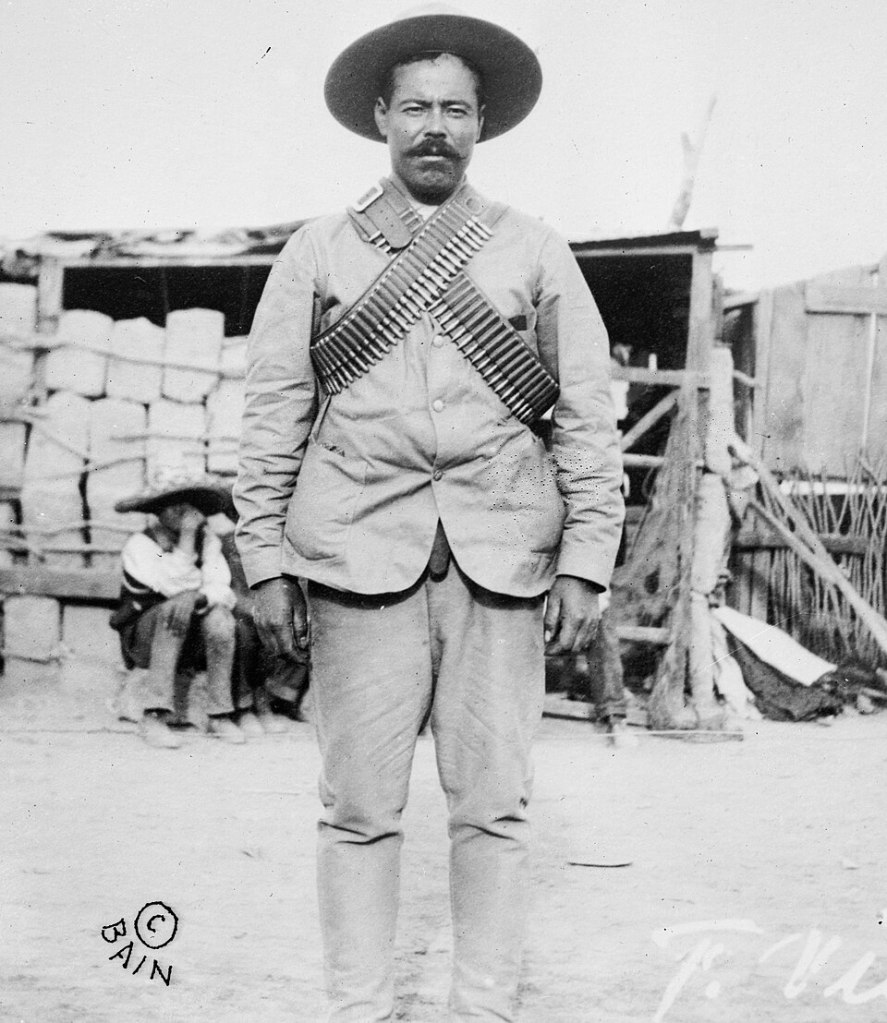
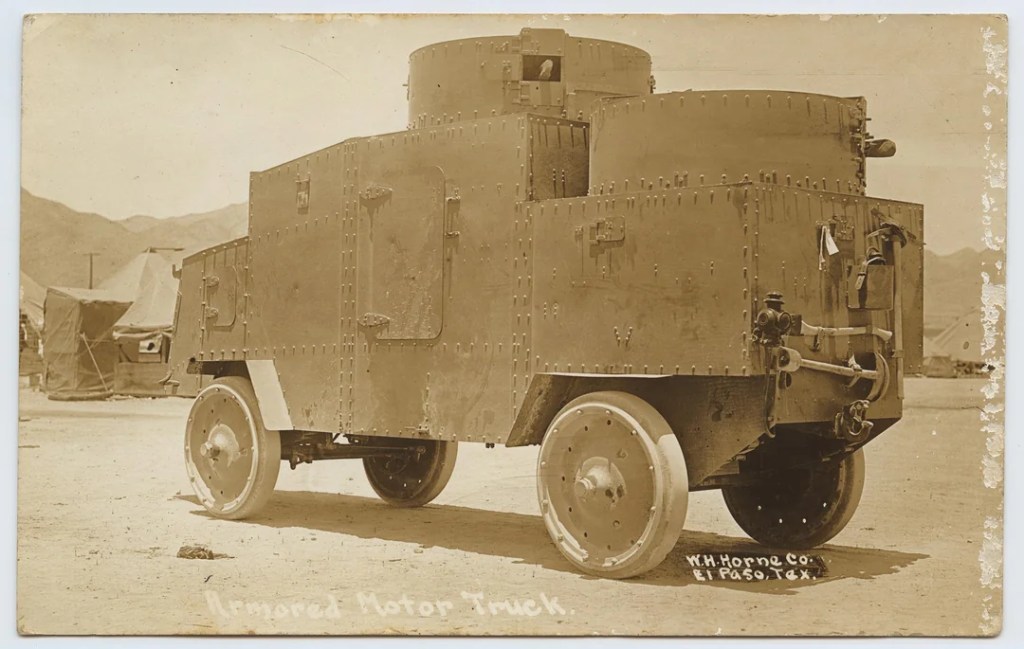
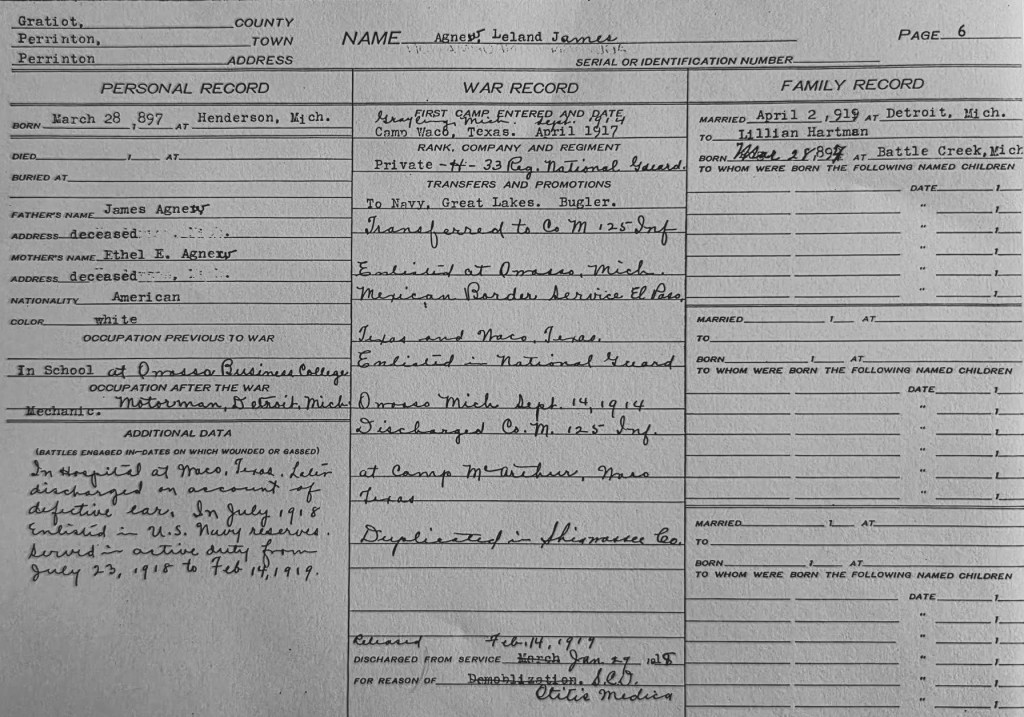
Above, from the top: Mexican leader Pancho Villa led border raids into the United States, making him one of the military and government’s most wanted men in the 1910s; armored vehicles like this one entered the Border War. Republic Truck in Alma designed an armored vehicle similar to this type; Leland Agnew of Perrinton was one of several Gratiot County men who served in the Border War, then in World War I in Europe. His post-World War I record tells a story of his service for the county.
During the 1910s, the United States was drawn into conflict along the border with Mexico due to the Mexican Revolution. Consequently, American troops were stationed along the border from the Gulf of Mexico to the western edge of New Mexico. Between 1914 and 1916, various skirmishes occurred, involving some men from Gratiot County in what became known as the Border War.
In April 1914, Walter L. Hawk, whose parents lived in Riverdale, was wounded while serving as a boatswain aboard the Battleship Minnesota during the American Marines’ landing at Veracruz to seize the waterfront. An unnamed nephew of Benedict and Mesdames Cushing of Alma was also wounded alongside Hawk.
In May 1914, Gratiot County contributed to the war effort with the Armored Republic Motor Truck, which was referred to as “a land battleship.” A group of 100 fully armored trucks, equipped with machine guns, was soon sent to the army. These “battleships” could travel at twenty miles per hour on roads and cover five hundred miles from base. Additionally, the trucks had flanges that allowed them to run on railroad tracks at speeds of up to forty miles per hour. This innovation marked a new era in warfare, replacing traditional army mules.
Skirmishes along the Mexican border increased in 1916 when factions, led by Pancho Villa, attacked Columbus, New Mexico. In response, President Woodrow Wilson ordered the army, led by General John Pershing, to go after the “Villastas.” In March, John Fetro of Ashley received a letter from his brother describing the raid. In Columbus, eight soldiers had been killed, and the hotel, along with other buildings, had been burned. Sergeant Ira Fetro and four companies of men patrolled an area twenty-two miles outside of Columbus. While searching for Villa, Fetro wrote, “Now we sleep with our guns in bed with us.”
John Watson of Breckenridge and Lieutenant Ely of Alma witnessed the hangings of two captured raiders in the Columbus jail yard. In the meantime, the Alma Record informed readers about the details of how the men went to the gallows. The inability to capture Pancho Villa and others infuriated citizens in the United States. Eventually, both the military and the United States government realized that only a complete occupation of Mexico could resolve the Border War. As a result, the National Guard received orders to place 117,000 men along the border. Nearly 3,000 came from Michigan.
The 33rd Regiment from Grayling, Michigan, along with other units that were sent to the border, quickly became dissatisfied with their assignments upon arrival at Camp Cotton, Texas. Sergeant Floyd T. Smith of Alma wrote home that his men were upset that they had been mustered into the regular army and were limited to staying in camp. Worst of all, their pay had been reduced from two dollars per day in the National Guard to the army salary of fifty cents a day.
By early 1917, most of the rebel groups had fallen apart. Although the army never captured Pancho Villa, they did catch his top two lieutenants. Later, many men who served during the Border War were eventually sent to France when war was declared in Europe. Military records from several of these Gratiot County men, like Leland Agnew of Perrinton, later stated that they had been in the “Mexican Border Service.”
Copyright 2026 James M. Goodspeed

