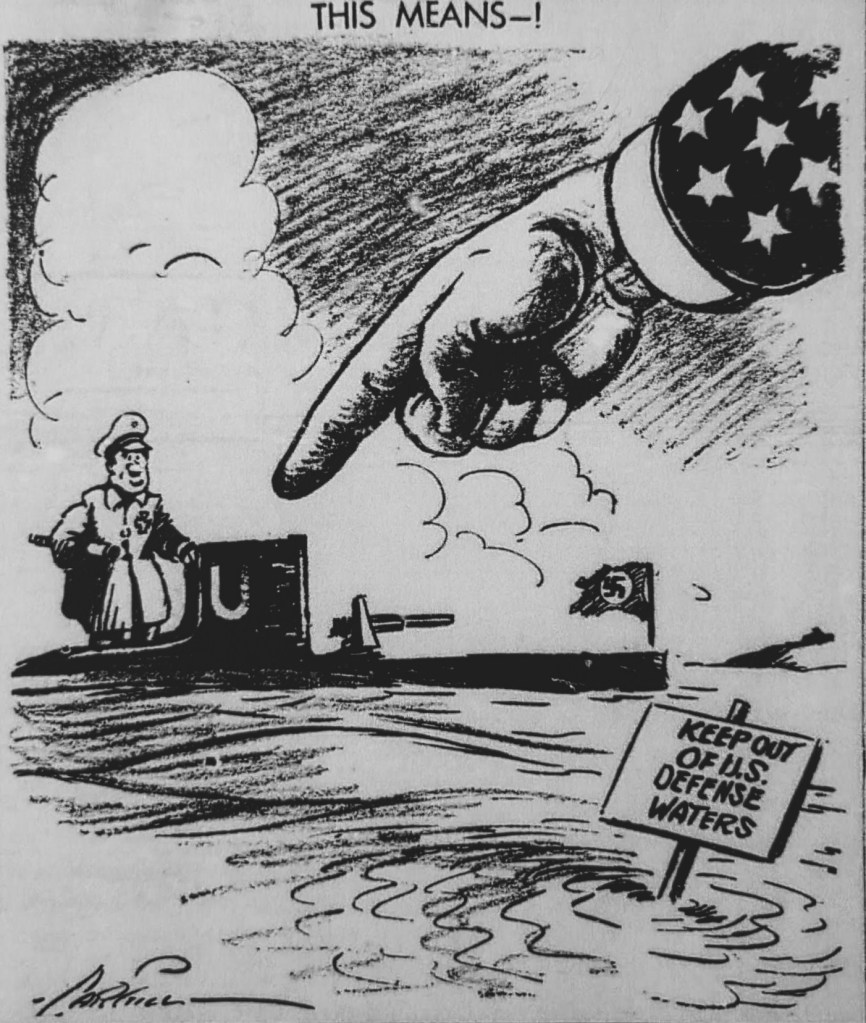
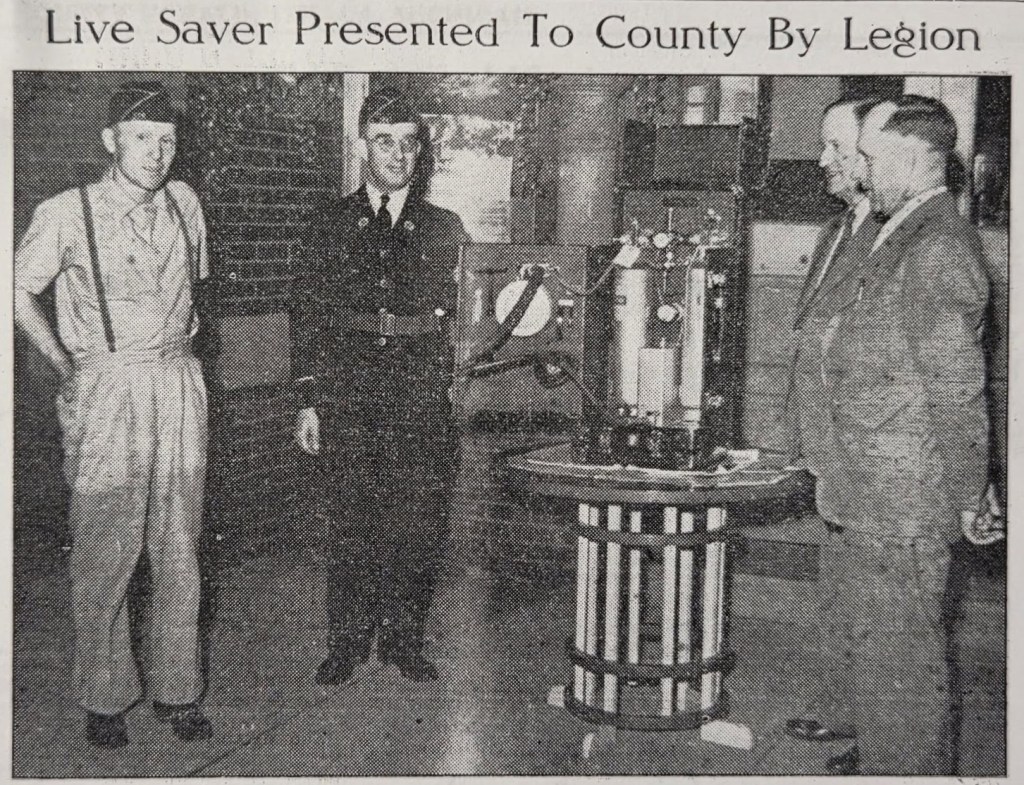
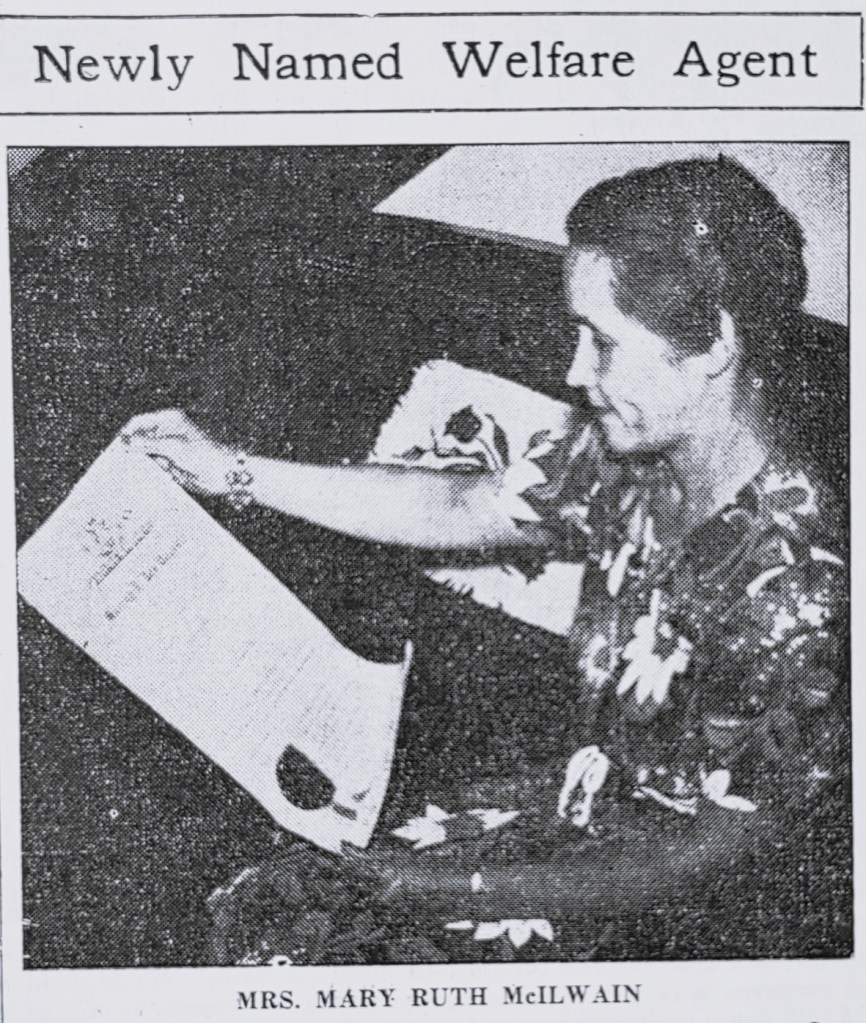

Above: “This Means-!” that President Roosevelt warns Nazis to stay out of American waters; American Legion posts from Alma, St. Louis, Ithaca, and Breckenridge worked to raise funds for a county resuscitator for emergencies in the county; Mary Ruth McIlwain became the new county welfare agent, much to the consternation of local officials; The Goostreys, Dick and Don, purchased a plane and hoped to become flight instructiors in Ithaca.
President Roosevelt warned Nazi Germany regarding the presence of its U-boats in and near American waters. For the first time in nearly a year, no young men were drafted from the county.
Unemployment remained a problem – especially for those who claimed financial aid. Many in Gratiot County believed everyone could work who wanted to work – even for those who could work for a government New Deal program.
Crimes were both common and uncommon. Farmers faced the tragedy of fires and received help from fellow farmers.
It seemed like the county had a rash of accidents and incidents involving children and youth.
It was September 1941 in Gratiot County, and people could sense that war was not that far off.
United States Warns a World at War
By the early fall of 1941, the Nazis claimed and occupied the Ukrainian “bread basket,” an area west of the Dnieper River. Some wondered when the Nazis would completely defeat the Soviet Union as the Germans continued their invasion of Eastern Europe. As England continued to fight the air war against Germany and planned for a Nazi invasion of the British Isles, thousands of British children were sent to live in the countryside as part of the evacuation effort from Britain’s biggest cities. The British retaliated against Germany by bombing Berlin and parts of industrial Germany, some with American-built flying fortresses.
With events going on in the North Atlantic that threatened the United States, The Saginaw News asked the question (and it appeared in county newspapers): is the country committed to a shooting war with Nazi Germany? Maybe, as President Roosevelt gave a radio address on November 11, where he warned Hitler that any attacks upon American vessels by warships or U-boats that entered “waters, the protection of which is necessary for American defense” would be shot on sight.
Back in Gratiot County, the county draft board told the public that it did not believe that there would be a selective service call for September. However, a letter from the state cited that Gratiot County should expect heavy quotas for both October and November call-ups. The county had about 20 classified as A-1 candidates ready to go, and it was expected that a number of 21-year-olds who registered July 1 would be in the next group to go. The Army declared a new process starting in November in which regular Army doctors would give final physical examinations to draftees two weeks to 45 days before they left for camp. This new approach meant every man would know whether he was physically qualified for induction. It also alleviated the issue of local physicians who declared men fit, but whom the Army rejected upon arrival at camp.
In the meantime, the board would evaluate the status of up to sixty Gratiot men under 28 who had married since the draft began nearly a year earlier. The board would investigate whether any of the men married to avoid being drafted. Another concern before the Gratiot board involved a series of unsigned letters sent to the board regarding deferments based on dependents. Apparently, several citizens believed that some young men unfairly received deferments. In response, the draft board asked informants to come forward and share information at Alma City Hall, but they would be allowed to do so in complete secrecy. Unsigned letters meant the board would give no formal attention to the matters. Another issue that had been before the board earlier in 1941 dealt with conscientious objectors – in this case, those who claimed objector status because they were Mennonites. A Gratiot County Herald article explained that some of these men had earlier gone to Camp Denison in Crawford County and were supported by the Mennonite churches.
The continued growth of the Alma unit of the Michigan state troops meant that enough men were available to fill the 57 officers and men. In just two months, men joined up to replace the anti-tank unit, which left earlier in 1941. The state planned to issue rifles and uniforms for these men. A couple of Gratiot men returned home on furlough that September. Sergeant Roland Reeves got a six-day leave from Fort Benning, Georgia. Also, Corporal Donald McMullen made it home from Camp Davis, North Carolina, for a ten-day visit. Both men appeared fit and glad to see home again.
A couple of other events and people that September had ties to military news. Gratiot County formed its first Defense Board and made its first issue of business a discussion of how to re-employ men once they were discharged from the military. No one could envision that this would be a moot point for the next four years. Commander Earl Rhynard, head of the George W. Myers American Legion Post in Alma, urged all former veterans to help the Legion urge people to support national defense measures. Legion posts from Alma, St. Louis, Breckenridge, and Ithaca came together to formally present a new resuscitator, which the posts themselves raised for the new machine. The resuscitator would be used for any emergency in the county. Milton Townsend, Lyle Whittier, Charles Hicks and Aubrey Mellinger made the formal donation to the county. Finally, Gratiot mourned the loss of another of its remaining ties to the Civil War. Myrus Scofield, 93, formerly from the Riverdale area, died at his daughter’s home in Eaton Rapids. Scofield entered the army in Columbus, Ohio, in 1863 and served in Volunteer Cavalry, Company D, 12th Regiment. He came to Gratiot County in 1872.
The Depression and New Deal Programs in Gratiot County
While the Depression brought challenges, Gratiot still did not face the problems shown in a photograph taken in England that appeared in the St. Louis Leader. Here, a swap market meant that Londoners could trade surplus farm products for other needed things without using their ration coupons. Ration coupons? What were those? Gratiot County would never use ration coupons, would it?
To offer work for those qualified in the county, a WPA project was expected in St. Louis, which would allow a blacktop of surfaces in the city to replace a concrete paving project. But this was all talk now. Miss Peggy Shaw of Alma took over duties as the girls’ NYA workshop took place in the Washington School building. A total of 93 young people in 10 programs in the county benefited from National Youth Administration programs, which disbursed $2,528.43 to those involved. The Townsend Clubs remained active by observing September 14 as Founders Day for the Townsend National Recovery Plan. All Townsend Clubs in the mid-Michigan area were urged to plan some activity on that day.
What really stirred up Gratiot residents? The appointment of a new welfare agent upset people for two reasons. First, Governor Murray Van Wagoner appointed Mrs. Mary Ruth McIlwain of St. Louis as the new county welfare agent, but without the recommendation of Probate Judge Mildred Taft. It was unclear why the governor did so, but Gratiot people did not like it. Second, the new agent would be paid $145 per month, up from the $100 the state previously paid. While McIlwain was a Central Michigan College graduate and taught for two years in St. Louis, there was a fuss, and the board of supervisors had yet to determine her final pay and duties. Most likely, the debate about a new welfare agent’s pay and duties was overshadowed by a record disbursement of funds for old age assistance and aid to dependent children – neither of which had any relation to Social Security. A total of 1,168 persons received old age assistance in Gratiot County during September.
The Arm of the Law in September 1941
The arm of the law was still a long one as fall began in Gratiot County. In August, Gratiot County had 60 convictions, bringing in $323.32 in fines and costs. Some of the more serious crimes involved contributing to the delinquency of a minor, embezzlement, disturbing the peace, and simple larceny. Habitual drunkenness and drunk driving appeared in several stories.
On the more lurid side, an Alma garbage collector was convicted of using a black snake whip upon his wife. The husband attacked his wife while she was milking the cows, then followed her into the house and received a beating. Ford Dunevant got 60 days in jail and a $75 fine in court costs. Two Wheeler youths were convicted of rustling two calves from a roadside where they were tied at the Robert Most farm. Keith Thompson and Douglas Eastman had to pay $35 each, $17.50 in court costs, and a $25 fine. A St. Louis couple, Fern Wells and Harry Casner, were convicted of lewd and lascivious cohabitation. Casner got 30 days in jail, and the couple received two years’ probation. Clyde Gantz of Clare pled guilty to using indecent language in the presence of women while in the Tangalakis restaurant in St. Louis. He was fined $19.05 and threatened with 25 days in jail if he did not pay. Joe Pechacek of St. Louis pleaded guilty to letting his dog run at large. The dog allegedly participated in a pair of attacks on rabbits belonging to Earl Nestle of St. Louis. While the other dog was destroyed, there was no solid proof that Pechacek’s dog participated in the attack that cost Nestle 32 rabbits. He was told to tether his dog and keep it at home, and Nestle applied to the county for repayment of lost stock due to the attacks of predatory dogs.
In more positive news, a large group of 31 people applied to become United States citizens after appearing before Judge Kelly Searl in Ithaca, making it one of the largest groups to apply in county history. Two people failed to be admitted but were expected to do so the next time they had proper papers completed. In this group, seven ladies who lost their citizenship due to marriage took the oath of allegiance and were readmitted. Effie Udel, Leontine Netzorg, and Rosie LaCross, all of Alma, were among them. After the group’s formal registration, members of the Jean Bessac Chapter, DAR of Alma, and the Jean Torrence Chapter of Ithaca held a customary ceremony with help from the Boy Scouts. Each admitted member received a small American flag and heard a talk on “Americanism” by Miss Lou Nickerson.
Farm News, Events and Farmers in the News
Heading into the harvest season, farm news featured several different stories. Farmers dealt with overcoming disasters, such as Ward Boyle hosting a barn raising to replace the one that recently burned. Forty or more men showed up to help him raise the barn, which sat on a 36×50 foundation. Ladies from the Congregational Church provided lunch for the workers, and Ervin Brown, who showed up with his airplane, gave several people their first views of the area from the sky. Mrs. E.N. Day, who lived northeast of Ithaca, lost her barn to a lightning strike during an electrical storm early in September. Luckily, the Ithaca Fire Department arrived in time to save the house and other buildings. A small amount of hay and alfalfa was lost. Mark Morse of Sethton lost a large modern dairy farm early one Saturday morning. Fortunately, wind from one direction kept the flames from the house and Morse’s two horses were in the pasture. Neighbors telephoned the family to warn them of the fire, which took 25 tons of hay and over a thousand bushels of oats. It was unclear how the fire started.
In other news, Michigan State College invited students to the Gratiot County courthouse to learn about short courses available in the winter. The courses covered agriculture, farming, and other topics. A group of 22 Alma FFA boys took a trip through Canada under the leadership of Graydon Blank. The group stopped at Niagara Falls, the Buffalo stockyards, and the ore docks in Cleveland. At the end of the trip, the group saw the Tigers play the Yankees in Detroit. To get their 1941 sugar beet payments, all farmers had to have their fields measured in Gratiot County. Hunters in Gratiot County had to wear special colored tags, which would be shipped in September. Tenant farmers who wanted a loan through the Bankhead-Jones Act faced a closing date for their applications, which were due October 1. The Gratiot County Dairy Herd Improvement Association had their first annual potluck dinner and picnic at Conservation Park. A.J. Neitzke of Breckenridge served as the association’s chairman. Farmers who worked to address the corn borer in the county reaped big dividends in September. One only had to look at the quality of the current corn to understand which farmers followed advice from the county agricultural agent in 1941.
Health Matters
Health issues and incidents in the county ranged from the sad to the serious. Children and cars were a constant danger, as several incidents occurred, including that of Robert Tomlin, age six, of North Republic Avenue in Alma. The young boy suffered a broken left leg, collarbone, and significant cuts and bruises when he crossed Michigan Avenue at Republic on his scooter and was hit and run over by a car. Tomlin just managed to run out in front of a Midland driver when hit. Thankfully, the driver was driving at a low rate of speed and was soon exonerated of any fault. Another case happened when Geraldine Woodcock, 11, of Carleton, got an X-ray and treatment at Smith Memorial Hospital after being run over by a car. For some reason, Woodcock was lying in front of a car at the French School in Seville Township. The young girl suffered only minor injuries. Feva Winnie, age 9, of East Mill Street also visited Smith Memorial with a fracture of her right leg above the ankle. She was struck by a car near the Ren Smith gas station. Details about this incident were unclear, but young Winnie spent some time at Smith and left with a cast on her leg. Over at St. Louis, 11-year-old June McWilliams fell off the Tilt-a-Whirl ride that was part of a carnival in the city. McWilliams damaged her scalp when the ride broke, throwing her into an upright. The Barkroot Company, owners of the carnival, took the girl to Dr. Rottschafer’s office, where the injury was dressed. The company paid the medical bill.
Miss Cecil Wolf, the city of Alma public health nurse, warned people that an outbreak of impetigo was at work. Some Alma children had just encountered scabies when Wolf addressed this concern. Impetigo resembled cold sores and fever blisters; however, it usually appeared around the mouth with watery blisters, as well as on the hands and other parts of the body. Because the blisters and sores secreted fluid, bacteria easily spread to other parts of the body. To stop the spread of the bacteria, parents were urged to obtain a special ointment from their doctors and wash the sores with soap and warm water before each application. A different kind of problem occurred in Perrinton when youngsters Barbara Gallagher and Deanne Bennett, both between two and three years of age, swallowed some stock spray while playing. The pair drew attention due to their coughing and strangling, and parents summoned Doctor Sarvin, who worked over the pair for a considerable time to get them out of danger. Both survived.
The Michigan State Sanitarium in Howell celebrated its 34th anniversary and said the tuberculosis death rate in 1907 (the year it opened) was 101 per 100,000 people; by 1941, the number of those contracting TB had dropped to 33 per 100,000. One person in Gratiot County was a victim of suicide. Clarence Glenn Currey, 53, a farmhand in Sickles, took his own life with a rifle. A divorcee who dealt with alcohol addiction, he took his life at the back of a farm where he worked. The terrible smell of the mill pond in St. Louis drove the city council to meet to discuss ways to clean it up. City Engineer Sullivan said this complex issue of dealing with bacteria could be partly solved by chlorination. While it would attack the terrible odor, it should leave the fish alone. A group of 127 St. Louis citizens wanted a sluice gate in the dam to allow the disgusting water to flow downstream. However, engineers asked to examine the water problem and believed that insufficient current through the gate would not move enough water down the Pine River.
Finally, the Gratiot County Crippled Children’s Fund sought to help 75 disabled children in the county. Rotary Clubs in the county took a special interest in raising funds for this cause. Superintendent Grace Meyrelles, Smith Memorial Hospital administrator, announced new afternoon visiting hours from two to four o’clock each day. Evening hours remained the same. What was the stink in Alma? A number of “striped cats” invaded Alma, digging up lawns and leaving a stink behind. Residents were warned that it was unlawful to poison skunks in the city. Another pain point was the constant chattering and noise-making by large numbers of starlings as they formed flocks for their fall migration.
And So We Do Not Forget
The first Ola School Reunion took place at Ithaca’s Woodland Park on August 29. Two former teachers attended, and Frank Brown, the oldest former student present, gave a talk about the original organization of the Ola School…Fulton Township Schools announced that when school started September 2, the district now had seven buses operating to pick up students…The Lumberjacks held their annual reunion at Lumberjack Park on Labor Day. Festivities included music, clog dancing, singing, storytelling, and old Lumberjack songs. An estimated 2,500 people showed up for the doings…Several former Ithaca people now taught at area schools. Some of these included Martha Hale (Alma), Celia Bebout (Ashley), and Bernard Wood (Breckenridge)…Alma’s city clerk and city attorney received feedback from letters they sent out to those in arrears on their cemetery burial lots at Riverside Cemetery. However, because few people responded with payment, they took more drastic measures. If back payments were not received by October 1, legal action could be expected.
Enrollment at Ithaca Schools remained static as the number of village students dropped, and those coming from rural areas increased. School opened on September 2…Lionel Barrymore, Lew Ayres, and Larraine Day starred in “Dr. Kildare’s Wedding Day” at the Alma Strand Theatre. Tickets were ten and twenty cents…The St. Louis Rotary Club heard a presentation from a speaker who discussed and denounced the planned St. Lawrence Seaway Project. Roob Allie, publicity director of the Michigan Railway Association, argued that any proposed seaway completion was unnecessary and would hurt railroad business in Michigan…Helen Doris Drumm married T. Jefferson Hoxie, St. Louis mayor, in an August 30 ceremony at the home of Dr. W.E. Barstow in St. Louis. Miss Drumm was from Nashville, Michigan…A three-night city softball championship took place in St. Louis as the Christian Church team played Michigan Chemical. Both teams won their respective halves of the season and played under the lights at the St. Louis softball park on the north side of town. In the end, Michigan Salt took the first two games and the 1941 city championship.
The St. Louis Baptist Church announced that Dr. H.H. Savage, noted radio Bible preacher, would be at the church on one night on Friday, September 12. Savage could be heard weekly on Station CKLW in Pontiac…Only four veterans returned to the Ithaca High School football team. Coach Steve Keglovitz counted on Bob Turner, Dean Plankenhorn, Robert Williams, and Mike Budge to lead the team…A total of 196 students enrolled at Fulton High School in Perrinton. The district now had seven buses, including two new ones…Dick and Don Goostrey of Ithaca purchased an Arrow Sport airplane which had two seats. It was the fourth plane owned in the county…A fifth school vote at Banister failed as the community still debated how to build a new school after the old one was lost in a spring fire. As the debate went on, school took place in the old skating rink…The Beebe church in Emerson Township planned a homecoming event for Friday evening, September 12. The program included former ministers of the church and old friends…Public schools in the county received $9 for each student enrolled based on state apportionment. Schools also received an additional forty cents for each student in library money. That money came from state fine money.
County commissioners continued to debate the location of a new county airport. Newspapers suggested that an area on a farm abutting US-27 and US-27A and two miles south of St. Louis, two miles east of Alma, and six miles north of Alma could be the spot…Where is Glinke? Charles Hooper, Newark Township supervisor, claimed he saw fugitive Dewey R. Glinkie at the state fair in Detroit. Hooper spied Glinkie operating as a penny picture salesman. By the time Hooper confronted Glinkie and then sought out a policeman, Glinkie had disappeared into the wind. Glinkie was on the run for making off with $3100 in Gratiot County tax receipts…
A group of nine prior Alma Rotary Club presidents met for a testimonial at the weekly Alma meeting. Only Henry A. Nordheim of Owosso and the late Freman C. Mapes were not in the group…The Alma Trailer plant had 300 men employed, but had recently reached as many as 400 workers. The trailer plant now occupied the entire former Republic Truck Company plant… Alma Public Schools had an enrollment of 1,721 students, a net gain of 33 students from the previous year… Gary Cooper starred in “The Westerner” at Ithaca’s Ideal Theatre. Tickets were fifteen and ten cents each. Shows ran continuously on Sundays starting at 3:00…St. Louis Schools dropped 41 students from the previous school year, but still maintained a Class C Division rating. The school enrolled 840 students for the upcoming year, and 69 seniors planned to graduate at the end of the upcoming year.
Reverend Ernest Goetz of Breckenridge held an Advanced First Aid Class under the direction of the American Red Cross. The class met Tuesday evenings at St. Louis High School…Iveh H. Warren of North Star, former missionary in India and founder of the Nazarene Church, was laid to rest after services at the North Star Nazarene Church…The Gratiot Road Commission stated that the county now had 1,212 miles of roads, with 188 miles being blacktopped. The commission used seventy pieces of equipment to keep the county’s roads functioning properly and employed 65 men…Miss Maurine Stovall of Alma and a local photographer received a certificate of merit from the Photographers’ Association of America for her work. Two of her photographs were displayed at the organization’s convention in Chicago…With 102 one-room schools in the county, Newark No. 4, Smith-Allen School, was the largest with 43 students. Miss Ethel Wasson taught it. In contrast, Emerson No. 8 (or the Hetzman School) had only five pupils and was led by Miss Doris Cronkite…Barkroot Brothers Shows staged a fall carnival in St. Louis from September 20-24 with shows, rides, concessions, and free acts.
Mrs. A.L. Aldrich defeated Mrs. Clare Paterson for the 1941 Gratiot County Club women’s division in Ithaca. Aldrich was runner-up in 1940…The Rural Mail Carriers Association of Gratiot County met in Middleton with 34 in attendance. Miss Georgiana Peet gave a presentation concerning her role as a delegate to the National Convention in Columbus, Ohio…The Ithaca A&P Store offered Sunnfield Corn Flakes, two 8-ounce packages for eleven cents (or three for 23 cents). A three-pound bag of 8 O’Clock Coffee sold for 55 cents…The Ithaca-St. Louis football game at Ithaca saw the new community bleachers to be full to overflowing, and Captain Bob Turner led the Ithaca team. Ithaca beat St. Louis by the score of 19-0…Alma College planned to dedicate its new $75,000 chapel on October 9…September 22 was the second day of fall, but local temperatures hit 91 degrees by late afternoon, the hottest date on record in the county…The St. Louis Christian Church held its twelfth homecoming service with a large number in attendance. The church announced that its debt was down to under $700 after the homecoming offering.
And that was September 1941 in Gratiot County during the Depression and War.
Copyright 2026 James M. Goodspeed

