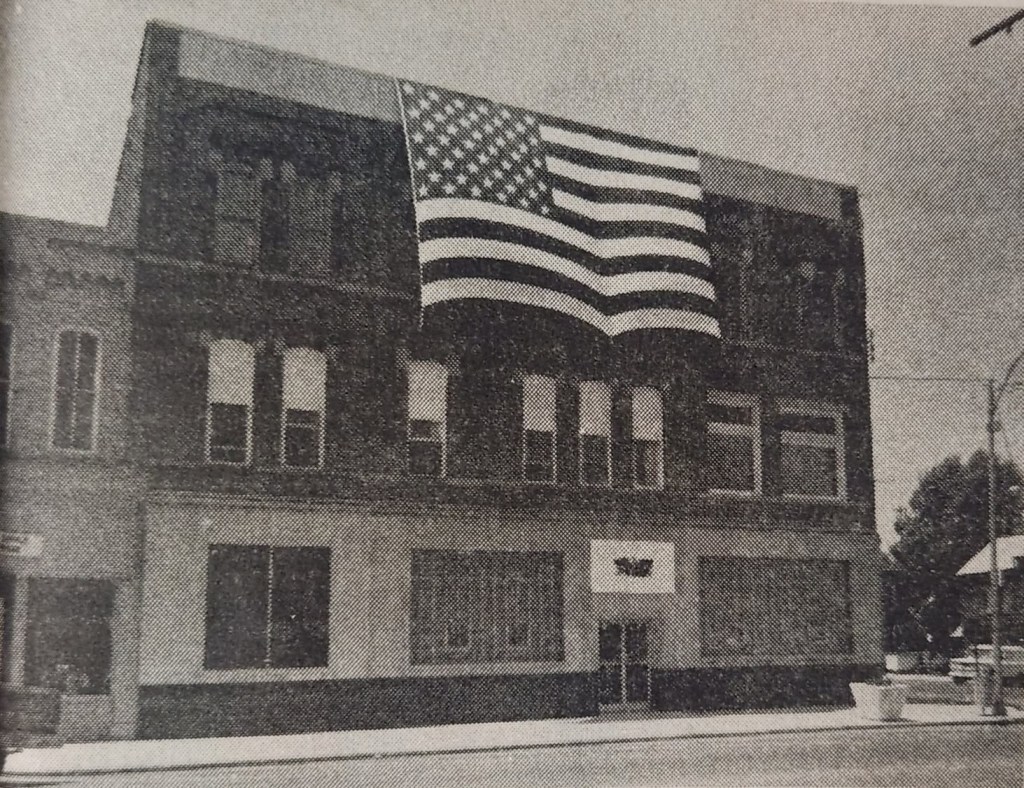
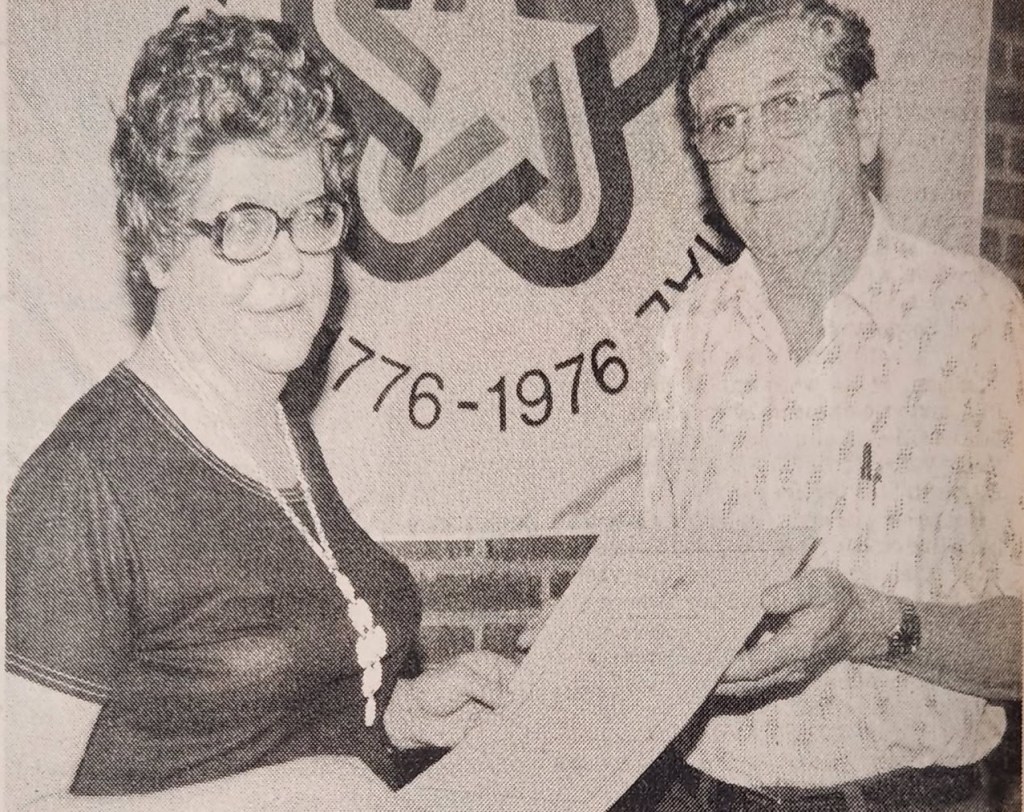
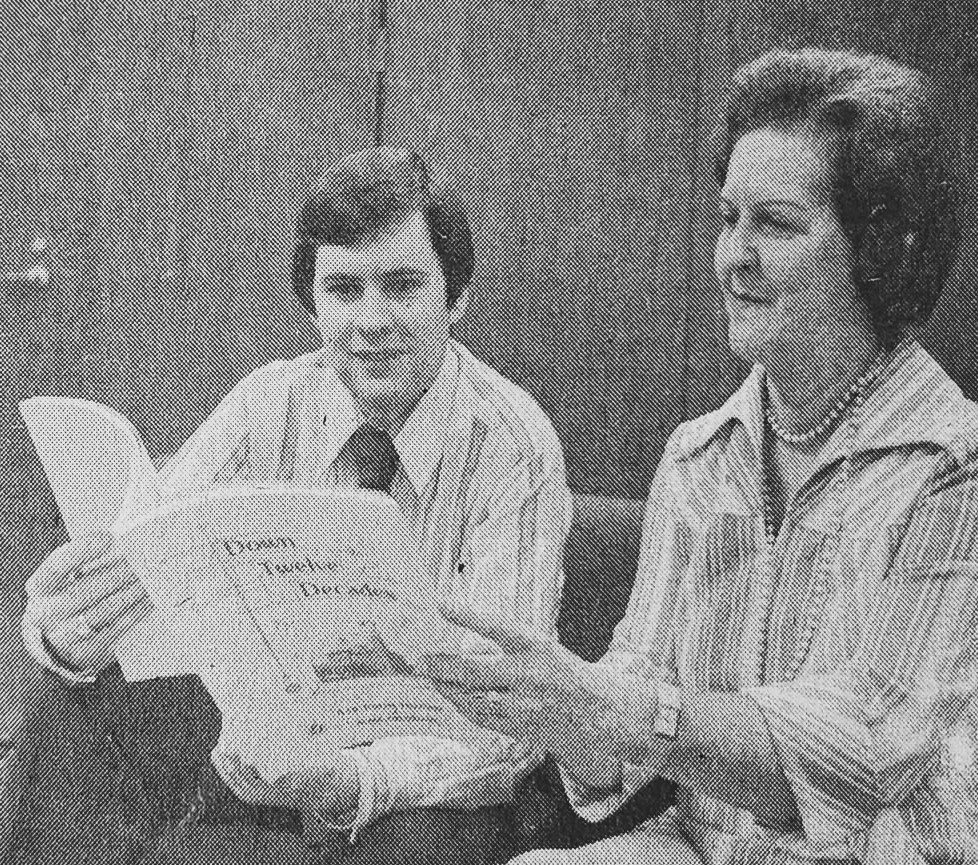
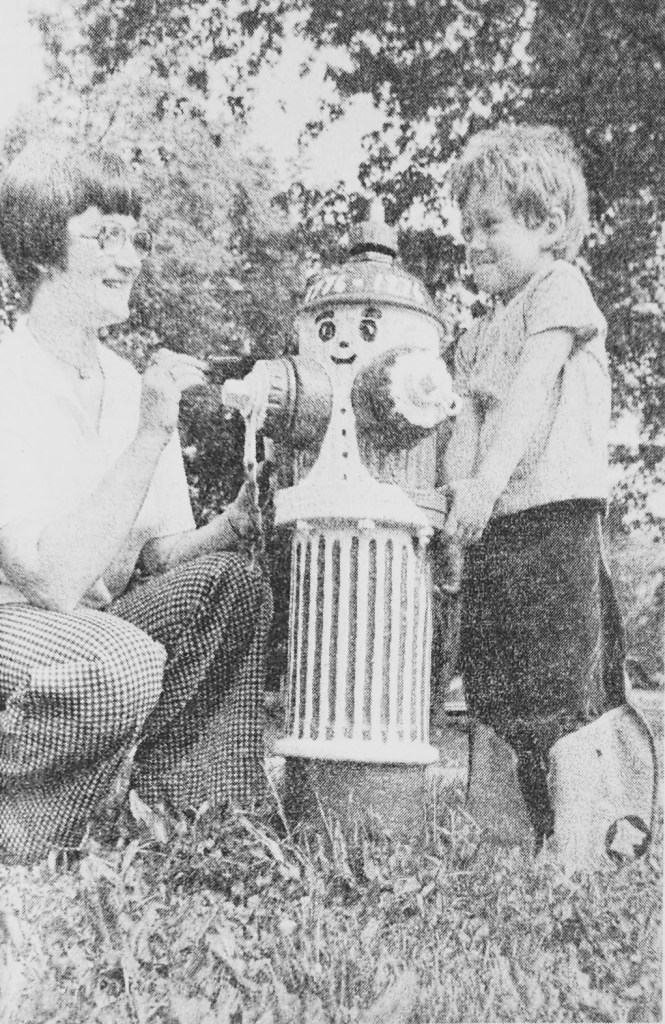
Celebrating the Bicentennial from the top: St. Louis prepares to kick off its summer festival by displaying a giant flag constructed by the St. Louis High School Future Homemakers of America; Ione Houlden of Ithaca chaired the Bicentennial program. Ithaca was the first to receive Bicentennial status in the county. Houlden holds the Bicentennial Award letter she shared with Ithaca Mayor Robert Atkinson. The letter came from President Gerald Ford; County historians David McMacken and Louise Davenport worked together to produce a history of Alma through its first 200 years; The St. Louis “Paint-a-Plug Squad” went to work dressing up the city’s fire plugs in Bicentennial colors and design. Here, Sheri Gall and her son work on a St. Louis plug.
Today, the Wayback Machine goes back to recent Gratiot County history and looks at the nation’s Bicentennial. What were we doing fifty years ago, and what was happening in the county and nation in 1976?
The United States in 1976
Apple Computer was founded. The Viking I & II spacecraft landed on Mars. The NBA/ABA merged leagues. “Don’t Go Breakin’ My Heart” was the #1 hit of the year in July by Elton John/Kiki Dee. One of the movie box office hits was “All the President’s Men” with Robert Redford and Dustin Hoffman. Saturday Night Live had its first full season on NBC. And – there was a funky, exciting baseball player in Detroit called “The Bird” – Mark Fidrych.
Without seeking to stoke any current political feelings, it needs to be said that the nation’s Bicentennial was much bigger and more visible than the United States’ Bicentennial in 2026. There was just a bigger buildup and bigger expectations in 1976. Why was this so?
Several big political and social factors at work culminated in the mid-1970s:
-The end of United States involvement in the Vietnam War came to an end (1972-73).
-Watergate – There was resulting political shock, dismay, and fatigue over this lingering political scandal in Washington.
– A soft economy that started by the mid-1970s would extend into the next decade.
– The first Energy Crisis in 1973 – a result of the Arab Oil Embargo due to the Yom Kippur War in Israel/Egypt.
– In short, the Bicentennial gave Americans something to look forward to and enabled them to forget about some of these lingering national issues.
There had been some national anniversaries before the Bicentennial that centered on previous birthdays:
-The big one – Centennial in St. Louis and Ithaca (1876) – Read David McMacken’s Taming the Wilderness for coverage.
-1926 – 150th– The only big celebration recorded appears to be in St. Louis!
-1951 – 175th – The Korean War was going on, and there was not much movement for celebrations.
-1976 – The Gratiot County Herald recorded a lot of Bicentennial news, but not much appeared in the Alma newspaper.
One could ask, how soon did America start promoting the Bicentennial? This might be a matter of debate, but I can remember a speaker during the Pasadena Rose Parade around 1972 or 1973 who commented, “We (the nation) will be gearing up for the nation’s big birthday in 1976.” In Gratiot County, things really started to move in the fall of 1975.
The Bicentennial Takes Off in Gratiot County
In Gratiot County, news items began appearing in local newspapers starting that fall, such as Collotype, a type of Bicentennial printing at Alma College. The Gratiot County Herald asked readers to contribute to its Bicentennial Cookbook. Newspapers started running bits of American history from the past 200 years, such as “Great American Happenings.” But the real kickoff in Gratiot County concerning the nation’s Bicentennial took place in the little village of Perrinton, in southern Gratiot County. On Saturday, November 8, 1976, Perrinton held a Bicentennial program that honored veterans, provided lunch, featured old-fashioned games and costume contests, and dedicated the VFW flagpole in downtown Perrinton. What made the Perrinton celebration unique was that it had applied for and received official Bicentennial status (the second place in the county to do so, and the first to celebrate it).
As the new year began, Gratiot County celebrated its first “Bicentennial Baby,” Mr. and Mrs. Gary Curtis of 315 Linwood in Alma. He weighed 4 lbs, 10 oz and was born at 12:36 p.m. on January 1! St. Louis celebrated its first Bicentennial baby when Mr. and Mrs. Alfonso Alegria of 510 South Mill had a girl weighing 7 lbs 10 oz. She was born January 7 at 5:39 p.m. The Ithaca Chamber of Commerce sponsored its annual community dinner, which included Carol Evans, a member of the United States Bicentennial Board. This kicked off Ithaca’s plans to celebrate the Bicentennial that summer. Ione Houlden was the Ithaca chairman for planning this event. One of the centers of the Ithaca celebrations was the courthouse, a national landmark. By early March, St. Louis also approved a Bicentennial celebration involving a Girl Scout parade scheduled for March 12. But something got in the way that month that interrupted the Bicentennial – it was the terrible ice storm of March 1976! Gratiot County and much of Michigan were temporarily paralyzed by the ice storm (unless you were in St. Louis and had access to city power). Gratiot County adopted a Bicentennial song in early March, composed by the grandson of County Clerk Eva Smith. The chorus went:
“Two hundred years in America, the land of freedom, foremost in all the world, in all the world. May she always be A land of liberty, and her flag forever wave.” The verses said: “Thirteen original colonies, that’s how it all began, Harbor of strength and unity, freedom for ev’ry man. “Trial and Tribulation Challenge her ev’ry day – Spirit of this great nation, stronger in ev’ry way.”
In the spring of 1976, Professor Gordon Beld started writing a regular series of historical sketches dealing with early America. These appeared in the Gratiot County Herald starting in April. St. Louis High School’s Future Homemakers of America class surprised everyone by creating a large 20×30-foot American flag (more about that later). Bicentennial colors” began showing up around the county. Over in Ithaca, a group of boys led by Ron Gruesbeck painted their basketball court and backboard in red, white, and blue. The court was a meeting place for boys on the block to play basketball,
The month of May meant Memorial Day and annual patriotic themes. The Alma Jaycees worked with the Alma Bicentennial Committee to sponsor “Profile 76” at the Alma High School gym. Tickets were free, but needed to be picked up to measure attendance. Perrinton was back in the news with its fifth annual “Loyalty Day” on May 1, which had a parade, Fulton High School marching band, speeches in front of the VFW Post, and the awarding of Voice of Democracy speech winners. The Seville Township Bicentennial committee was also in the news as the group designed a Bicentennial quilt and gifted it to President Gerald R. Ford. The quilt had a map on the reverse of Seville Township and Gratiot County, along with 100 names of those who wanted their name on it – for only$1 per name! Elaine Lockwood of rural Ithaca designed the quilt, and it was sent to the President in November. Gratiot Community Hospital also joined its annual National Hospital Week with the theme of “HEALTHY BIRTHDAY, AMERICA.” It ran from May 9 – May 15. Mayors from Alma, St. Louis, and Ithaca each signed a proclamation supporting and promoting the week. Hey, men, do you need a new “leisure suit”? You could get $17.76 off a new one at Miller’s Men Shop in Alma (the actual cost was $22.24 after the promotion).
But by the end of May, Gratiot County residents heard about the upcoming planned celebrations that would take place over the summer of 1976. Ithaca’s Frontier Festival and Heritage Days in Ithaca were among the events. The St. Louis Bicentennial Committee promoted a “Paint-a-Plug” squad that went around the city and painted fire hydrants decorated in red, white, and blue. Some of the members who did the painting included Betty Gall, Sheri Gall, Judy Sparling, and Jane Barker. Ashley kindergarten students in Marie Shelton’s class wanted to give America a birthday party. So, they created a 9×13-foot birthday cake in a colonial flag design. It took 143 cakes, involving 15 pounds of sugar and ten pounds of powdered sugar, all painted in a colonial flag design. After the program, the entire school and many parents devoured the cake. The Gratiot County Board of Commissioners also got involved in the Bicentennial by holding their June meeting at the Wheeler Township Hall – a move designed to be more accessible to other parts of Gratiot County. This was the first time that the Commissioners met outside of the County Seat. After the meeting, a square dance organized by Gladys Rausch and music by Dave Bailey’s group (and fiddling by Chairman MacDonald) entertained the group. Regular attendance for a meeting increased by over 50 people that night in Wheeler! Over at Lumberjack Park, Lumberjack Days had a Bicentennial flavor featuring flag raising and planting of the Bicentennial flag, along with a costume ball in best colonial attire. The celebration lasted three days at Lumberjack Park. Bannister had a Flag Day ceremony as they dedicated a new flag and a new flagpole.
But what about the bigger towns and the Bicentennial? For the three-day St. Louis Festival in June, St. Louis dedicated a special monument, “Valor for God and Country,” and the big American flag was hung from the top of the old bank building in downtown St. Louis after the city’s parade marched with over 60 entries. The St. Louis VFW also held a flag-burning ceremony to show the public how old and worn-out flags were to be properly disposed. During the week of July 4 (which fell on a Sunday), the St. Louis Pony League Tournament was held at the St. Louis softball park. Bill Shrum announced some of the games and once told the crowd, “What a way to celebrate the Bicentennial – by playing baseball!”
Ithaca and Breckenridge entered the Bicentennial Spirit starting in late June 1976. The Ithaca Bicentennial Committee planted two small sugar maple trees on the Ithaca City Hall lawn on June 18. These trees grew from a 100-year-old tree near Niles, Michigan, planted in 1876 to observe the Centennial. At the end of June, the Lafayette Presbyterian Church saw 50 people dress up in Bicentennial costumes. The services, musical presentation, and noon potluck dinner drew 150 people.
However, the big draw in Ithaca in late June involved the Ithaca Frontier Festival, which ran from Thursday through Sunday, June 24-27. In addition to the many Ithaca-related events like the calf scramble, Sheriff Posse Queen, garden tractor contests, rodeo, harness racing, and a parade. During the parade, Ithaca elementary school children carried the giant flag from St. Louis. The Fifth Artillery of Michigan Civil War reenactment group demonstrated cannon work on the courthouse lawn.
The penultimate celebration and events occurred in the county in July. The little crossroads of Sickles had a car show on one day in early July. However, the big celebration took place on Heritage Weekend in Ithaca with Ione Houlden, Bicentennial chairman, overseeing the program, which involved the rededication of the Gratiot County Courthouse, a costume contest, and a concert on the courthouse lawn. The day ended with presentations of a Bicentennial opera entitled “Tall Trees,” based on Michigan’s lumbering era, at North Elementary School gymnasium. Earlier in 1976, the courthouse received national historic site status. The weather for Heritage Weekend in Ithaca was perfect.
As summer came to a close in Gratiot County, so did many of the Bicentennial observances. The Seville Church of God and the old French School celebrated on August 21-22, when people attended programs on horseback, in buggies, by wagon, and on foot.
Today, there are still at least three important legacies in Gratiot County that came out of the nation’s Bicentennial celebrations :
-Bicentennial coins – although a little uncommon, they can be found in change.
-Alma Bicentennial book “Down Twelve Decades, A Pictorial History of Alma” by David McMacken and Louise Davenport is a key read in starting to learn about Gratiot County’s past. You can still buy a copy at the Alma Public Library.
-St. Louis Bicentennial flag – a giant flag made by Betty Paton’s Future Homemakers of America at St.Louis High School! It is still in storage, has been hung on buildings, and was even displayed over the bridge when St. Louis Police Chief Teed died.
Keith Kellogg, a Newark Township farmer who served in the Michigan Legislature, was called upon to speak at the Gratiot County Courthouse ceremony in July. He made several observations about the Bicentennial celebration in Ithaca. Kellogg said this, and it is still true today: “In conclusion, at nearly 84 years of age, like many, many fellow Americans, being one of God’s chosen few, among the millions inhabiting the surface of this earth, I am grateful to the Creator of all things for privileging me to live out my life in such a land as this. Anyone even born here has little to complain about.”
In the midst of the 1970s, the national Bicentennial – and Gratiot County’s participation in it – enabled people to celebrate America’s 200th birthday.
Copyright 2026 James M. Goodspeed

