
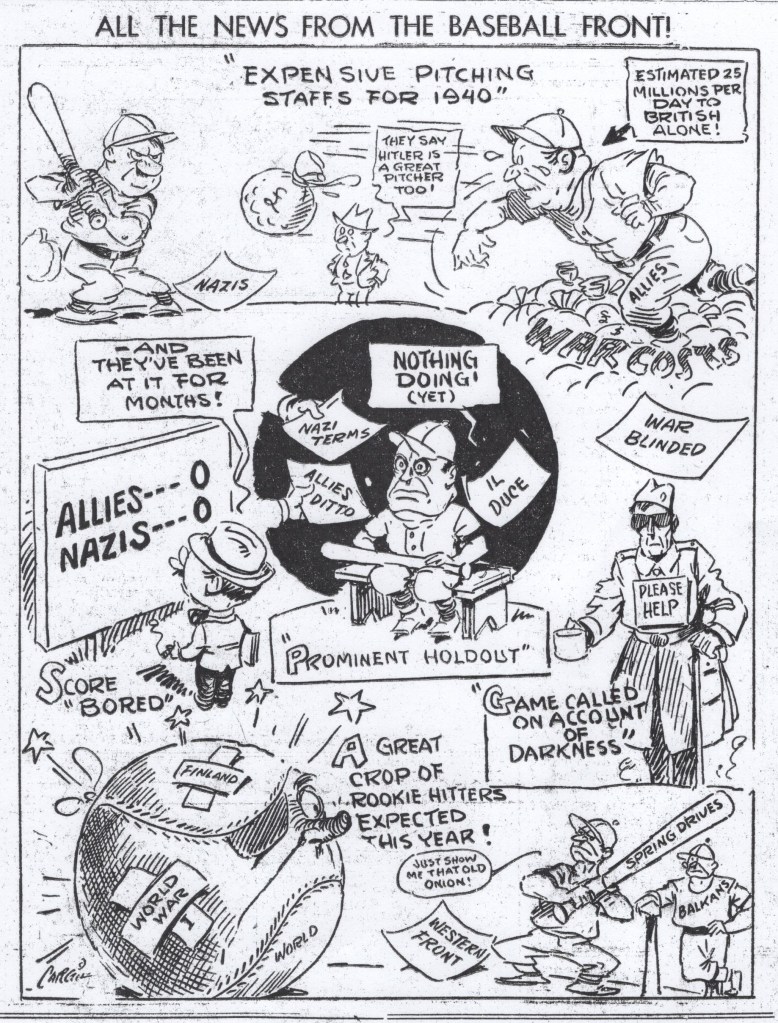

From the top: The Joe Porubsky auction took place eleven miles southeast of Ithaca and drew a record crowd, lining both sides of the road and filling up a twenty-acre field; baseball was on the minds of Gratiot readers, with messages about a war going on in Europe; Electrified Farm Week, along with new tractor models, came to the county in mid-February 1940.
The long winter of 1940 continued. Get out the ice skates. Read about the war in northern Europe. Farmer, think about the upcoming 1940 season.
It was February 1940 in Gratiot County.
The World at War – “The Winter War” Continues
Most war news in Gratiot County dealt with the Winter War and Russia’s invasion of Finland. Photographs of dead, frozen Russian soldiers appeared in the newspapers, the results of the clashes between the Finns and Russians near the area of Petsamo, Finland. A hint of Nazi Germany’s intention to start an offensive in the West began as the French slowly retreated from a quiet German advance. The world knew that spring fighting was not that far off.
The St. Louis Service Club met at the Park Hotel and watched talking pictures of the United States Navy and March of Time films. People continued to monitor world events. In all this talk and awareness of a potentially expanding world war, one group expected to benefit from the war centered around news for farmers. Economists foresaw a billion-dollar boom for farmers as competition for food supplies, changes in shipping routes, and sea conflicts meant Britain would have to deal with more goods from the United States. Although the United States was not in its position in 1914 when the world had an endless need for food and goods, many believed a growing need for goods would happen again starting in 1940 with the war’s expansion.
Gratiot County Life Late in the New Deal Great Depression
During the winter months, if one wanted to see New Deal social programs in the county, one looked at ice skating. The WPA (Works Progress Administration) continued to maintain and invite the public to use skating rinks. Over in St. Louis, Lester Fillhard supervised the Community Council skating rink east of Wheeler Field, which sponsored a St. Louis Community Ice Meet. The meet had six types of skating events, from boys and girls under twelve to men and women of any age. The community council stated that there was a “crying need” for someone to donate a public address system and phonograph to play music. Some St. Louis residents used the rink for birthdays, such as when one student invited forty fellow eighth graders to skate and have lunch together. Hockey teams from both St. Louis and Alma battled each other in city competitions. St. Louis held its first Skate Carnival, and Robert Wilson served as contest judge. Sled events opened to both boys and girls. However, soft ice postponed the events for a week. Soon afterward, the ice improved, and the St. Lois recreational hockey team met and defeated the Alma East End bunch by 10-5.
Alma had a skating rink on South State Street, and city commissioners agreed to provide music for its skaters. Above the dam, many ventured out to enjoy the new ice that was created in only a few nights of cold weather. The city lowered the water to construct an overflow drain and raised it to its natural level. Two WPA recreation leaders, Frances Lott, and Chester Johnson, oversaw the Alma rinks. They promoted a city-wide meet and planned to lay out an oval shape on the rink for the races. One of the problems with operating the rinks centered around people who got on the ice when it was not in skating condition. Some of the older boys tended to get on the ice before it was ready, which resulted in numerous ruts and holes and made skating impossible.
There were other New Deal programs at work in the county. The Alma Salvation Army allowed the NYA (New Youth Administration) a place for thirty boys and young men to work on woodworking projects. The NYA also offered a sewing project for girls and young women ages 18 to 25 and provided sewing machines to recondition used clothing. One special need concerned the making of layettes for newborn children. In February, the government programs employed fifty NYA workers on different projects in Gratiot County. The WPA offered the city of St. Louis financial help to construct pavements and sidewalks. However, the project was estimated at over $108,000, with over $76,000 provided by the WPA. Still, this meant St. Louis would have to issue bonds to borrow money, and the common (city) council hesitated as the public would have to vote on the matter. Another issue involved buying the Gratiot County Bank building and turning it into a city hall.
Even in February, WPA workers continued on labor projects, such as retaining walls and the river bank near Walnut Street and North Court Avenue. The city also wanted the dangerous curve at that location worked on in the upcoming year, and many Alma property owners petitioned for extensions to sidewalk work that started in 1939. The city also hoped to widen Downie Street and Pine Avenue entirely through WPA labor and funds.
Several leaders like A.D. Smedberg of Alma met at Alma High School for a radio broadcast over WBCM of Bay City to continue promoting the benefits of New Deal programs such as the WPA. The men explained how WPA programs helped the city and why Alma remained a good place to live and have a business.
For a community celebration, the St. Louis Park Hotel hosted the annual President’s Birthday Ball. The ball benefited those affected by infantile paralysis and the Gratiot County chapter of the March of Dimes. Half of the money raised from the ball went directly to those in Gratiot County who had infantile paralysis. Those who attended the ball were awed by the beautiful red, white, and blue decorations provided by the Consumers Power Company of Alma and the music and dancing led by the Don Hoffman Orchestra of Lansing. In the center of the ballroom hung a large picture of President Franklin D. Roosevelt.
The issue of public health was very real in 1940, as the Michigan Tuberculosis Association continued to offer T.B. clinics in response to eight people who died from the disease in Gratiot County in 1937. Tuberculin tests and at least one X-ray clinic occurred in the county in March 1940.
Some news in the county relating to the effects of the Depression was not so happy. Ralph Olmstead of Elwell led a case against the First State Bank of Alma, arguing that the Alma bank was the parent bank responsible for the loss of assets in his former bank in Elwell. Olmstead and other former depositors sought compensation for the closing of the Elwell Bank in 1933. Judge Kelly Searl granted an injunction to consider whether all suits could be combined.
The county also had a “scavenger sale” on delinquent properties. County treasurer William Federspiel offered over 500 property descriptions with a total value of $153,077 to the public in anticipation of the sale. However, the county only succeeded in selling 203 descriptions for a total of just under $25,000. While Alma and St. Louis led the sales, Hamilton Township sold nearly $4,000 of land to fervent bidders and speculators. Seldom did any original owners bid on any of their property.
Finally, opponents across the county for those concerned about President Roosevelt’s Social Security plan continued attending Townsend Club meetings. Alma, Ithaca, St. Louis, and Wheeler clubs participated in these potluck meetings to discuss their support for the Townsend Plan.
On the Farm, In the Gratiot Countryside
Although it was winter, Gratiot County farmers, dealers, and businesses planned for the upcoming farm season. The Michigan Sugar Company of Alma and Lake Shore Sugar Company of St. Louis issued contracts for the 1940 season. However, the companies issued contracts with a slight change. Farmers would be paid for their first beet payment by December 1, 1940, but would not receive the balance until October 1941. This proposed second payment would be one month later than the year before. The St. Louis Co-Operative Creamery announced plans to build a bigger creamery during its 25th annual meeting at the St. Louis High School auditorium on February 2. A significant reason for creating a new creamery came from the June 1, 1939 fire, which caused $9000 in damage. The dairy also promoted Milkmaker, a mix with alfalfa or clover hay, and sold a superior dairy ration.
Alma Production Credit Association held its annual meeting and elected officers. Howard McMacken of Shepherd was re-elected president, and Harry Glenzen of Alma as secretary and treasurer. Over 700 members in Gratiot County belonged to APCA, had been operating since February 1934, and issued more than 1.3 million dollars in loans. Amazingly, the association had lost only $137 since that time.
Did you need a new tractor? Johnson’s Farm Equipment in Ithaca offered the 1940 Model 60 Family Harvest for $545. Bill Harper’s Hardware, northwest of Ithaca, sold the John Deere Model “DA” disk, billed as operating “Faster, Easier, Better.” About 150 farmers visited Rademacher Motor Sales in Alma on February 21 to see a demonstration of the New Ford tractor, which had a Furgeson system. Albin Rademacher showed a film entitled “Building for Future Farmers,” with entertainment provided by the Mercury Rangers. A highlight of the day was the presence of William Ford, brother of Henry Ford, a general distributor for Ford tractors. Eleven miles southeast of Ithaca, a record crowd attended the Joe Porubusky auction. Cars lined the roads for over a half mile up and down the road, filling a twenty-acre field for the auction.
Other events surrounding county farmers proved sobering. Leon Cratsenberg of Hamilton Township lost his home to a fire early in February. The Cratsenbergs, who had attended the county teacher’s institute in St. Louis, were on their way home through Ithaca and heard of the fire from a passing motorist. When they arrived home, the family found that only part of the contents could be saved due to the fire’s severity. Cattle thieves stole eleven cattle from the Eugene Ensign farm east of Ashley. Police arrested two brothers who rustled in Saginaw and Genesee counties and returned five of them after being discovered on a Huron County farm. Law officers arrested the Desanders brothers on robbery and possible murder charges. Because the brothers sold some of the Ensign cattle and other stolen livestock to farmers, getting the cattle back to the rightful owners proved challenging as other farmers had innocently purchased stolen stock. George Stoneman, Jr., of Ithaca, had a team of valuable draft horses hit by a Cheboygan man’s car. The horses, which won several horse-pulling awards, suffered severe cuts. Still, a veterinarian called to the scene believed the team would survive the wounds. Stoneman pulled onto US-27 when the Cheboygan car hit the team, destroying the vehicle’s front end.
Gratiot County received $3,526.17 for claims made from dogs that killed livestock in 1939 and ranked ninth in the state for losses. Authorities stressed that mongrels and strays running in packs, as opposed to bird and hunting dogs, were most responsible for losing sheep and other livestock in the county. The state urged the continued enforcement of quarantine and local dog laws as measures to reduce losses. Another dog story appeared in the news when Fred Cornell of St. Louis helped boys playing near the Pine River after the boys ran to the Michigan Chemical Corporation yelling for help. It turned out that the boys could not help an Irish Setter who had fallen through the ice and gone under several times. After more calls for help, Leverne Hill and Burdett Yats also arrived at the scene. Hall strapped a rope around his waist and gently crawled out on the ice to the struggling dog. Cornell and Yats then carefully pulled Hall and the exhausted dog back to safety. After returning to the river bank, the men and boys witnessed that the dog could no longer stand due to exhaustion. They then returned with the canine to the Michigan Chemical plant to dry off and warm up. In a short time, the once-drowning Irish Setter recovered and was up and around. A St. Louis dog owner undoubtedly owed thanks to this group of boys and a trio of men who saved this pet.
Central Michigan Turkey growers met at the Court House in Ithaca to listen to speakers from Michigan State College explain new methods and answer questions about turkey management. Parks Allen, a Gratiot County naturalist, sought to save the life of an injured doe found east of Elwell. The deer appeared to have a broken leg, and a Pere Marquette Train brakeman reported that he thought a train hit it. Allen soon arrived and deduced that the doe had a dislocated shoulder but no broken bones. Allen took the deer home and provided a quiet location in a box stall, and the deer slowly improved. Allen also believed the injury occurred when the deer tried to jump a high fence near the railroad tracks in Elwell.
What else could farmers do in the winter? Ice fishing on Houghton Lake called many people north, where fishermen had daily limits of 15 perch or 25 combined pan fish. Fishing licenses cost one dollar and included one’s spouse! Although the trapping season ended, Gratiot trappers had until the end of February to report how many animals they trapped during the 1939-1940 trapping season. Barely half of those licensed to trap had reported their winter kills.
Finally, strange things happened in southern Wheeler and northern Lafayette Townships in early February. The commotion became so intense involving “Finnish soldiers” that the county sheriff and his deputies were called for help. Township residents hid in their cellars, locked their doors, and turned off the lights. One caller telephoned the sheriff, urging, “Come to the Powell farm two miles south of Wheeler in a hurry!” Area farmers were so excited that several turned out with shotguns because “peculiar objects” had been seen a mile down the road. Deputy Nestle led a posse into the area and saw four strange things that appeared against the white snow. Nestle called out, “What are you doing?” The response came back, “Just hunting crows.” It turned out that Carl Lanshaw and Dr. C.O. Shaffer of Wheeler, along with Glenn and Grant Marr of Lafayette, all wore white aprons to blend in with the snow, covering all except their head and shoulders. The four men went out on a crow hunt wearing white camouflage but riled up the entire neighborhood. After determining that the complaints and phone call did not involve “Finnish soldiers,” Nestle reminded the men as he departed, “You better go to Finland if you want to use those methods (to kill crows). Carl Lanshaw later told the local newspaper that his group killed over 150 crows, thought it was a good sport, and even took their wives along while hunting the black pests.
The Long Arm of the Law in February 1940
If someone wants to learn about some of Gratiot County’s problems, they must look no further than the local courts and the county jail. That month, Fifty-eight people were convicted of crimes and contributed $387.78 to the county coffers. At the end of February, the county jail had 19 prisoners. Forty of the convictions dealt with traffic violations, and the rest of the crimes covered a variety of offenses. William Partello, age 27, and Grace Schaffer, 23, both of Lafayette, were hauled into court on the crime of lascivious cohabitation (living together without a marriage license). This crime had a long history in Gratiot County, and the consequences varied. In Partello’s case, he was sentenced to sixty days in jail, while Schaffer was sentenced to a strict one-year probation. In another case, Armond Bongard, 36, and Goldie Lewis, 17, ended up in jail on the same charge of “L and L” crimes. They waved examination and said they would appear before Judge Searl for sentencing. The bigger question remained: how did the sheriff and judge discover the “L and L” crimes? Someone reported the couples, but the question remained: who?
Two other crimes involved embezzlement, one for vagrancy, and two for illegally trapping muskrats (one offender received ten days in county jail; the other got a $10 fine and $8.85 in costs). Other court cases involved selling chattel mortgage property and issuing checks without funds. Howard Phillips of Crystal pleaded guilty to embezzling $19 worth of property from Peterson Hardware Company, paid $33.85 in fines and costs, and pledged to repay the stolen money. The sheriff’s deputy went all the way to Flint to arrest Philips. Harry Conklin of St. Louis said he was not guilty of misappropriating the sum of $41.35 and twenty bushels of oats. His trial was yet to come. Roscoe Daymon, who lived west of Ithaca, was brought before the court for deserting his wife and three children. Daymon furnished a $500 bond and was released until his hearing.
Ralph Fisher of Elwell experienced the law’s long arm when Conservation Officer C.B. Smith pinched Fisher for spearing fish in protected waters. Fisher paid $8.85 in costs rather than spend ten days in jail. Over in Breckenridge, the conduct of a Porter Oil Field worker made the news when Lester McAlister caused an automobile accident in town due to drunk driving. McAlister was arraigned for drunk and disorderly conduct but spent sixty days in jail as he could not pay his fine and costs of $31.11.Oil wells continued to be installed in parts of one of the Porter oil fields, even though newspapers reported that drillers did not expect to find more oil. The Pure Oil Company, however, did put in its 28th well in Porter Township at the Mina Narmore lease.
Another pair of crimes in Alma upset residents. On a dare from his peer, one young man damaged newly constructed items at Gratiot County Conservation Park. In another case, thieves broke into the new log cabin at the park. They then stole $125 worth of aluminum cooking ware that the Lobdell-Emery manufacturing plant had just donated. The thieves used a wrecking bar to pry off the locks and entered the cabin to do their dirty work. The next night, another group of thieves broke into the Lobdell plant and stole 1,000 pounds of scrap valued at $125.
The Jesse Perez murder case reappeared in the courts after three years. Perez shot and killed a fellow Mexican beet laborer on a farm in Seville Township on July 7, 1936. Perez argued that Judge Searl failed to accurately hear and pass on the confession that Perez made about the murder and, therefore, Perez somehow witnessed against himself. Perez’s attorney also argued that his client did not understand the charges brought against him and that witnesses to the murder no longer resided in the United States. Perez’s appeal was denied, and he continued serving his 15-30-year sentence in Marquette.
Finally, the Women’s Christian Temperance Union requested printing an article in the Gratiot County Herald about a “Warning About Marihuana.” In 1938, there had been over 1,000 violations of the Marihuana Tax Act. Because over 8,770 pounds of bulk marihuana had been seized that year, parents and educators needed to be more aware of the possibility of the drug entering local schools. According to the WCTU, education continued to be the best defense against the drug.
Life in the Underside of Gratiot County: Race
What did being Mexican or Black in Gratiot County in 1940?
As more Mexican beet workers came to the county to work in the fields each summer and fall, the Gratiot County Council of Churches and Sunday Schools sponsored a religious project for children and adults. The program ran from June 15 to September 1 in Alma and St. Louis with two Spanish-speaking teachers and a Mexican minister. Helen White served as superintendent of migrant work for the Council of Church Women of the Board of Home Missions.
A historically uncomfortable but then acceptable event in Gratiot County dealt with the performance of a minstrel show by the Alma Rotary Club. On February 20, the Rotary Club used forty men in a two-hour show and charged forty cents for admission. The sold-out performance hosted 500-600 people. Before the program started, Father John Mulvey gave a short talk about why minstrel shows appeared in history and the beliefs and history of the Alma Rotary Club. Aside from Father Mulvey, only one performer did not appear in “Blackface” during the performance. The Alma Record wrote about the show’s conclusion, “The grand finale was all that the term implies, with nothing lacking to revive the glory of the old-time minstrelsy and the spirit of Auld lang Syne.” Minstrel shows as community or organizational fundraisers and entertainment could be found in Gratiot County well into the 1960s.
County Clerk Charles L. Hicks announced that an examiner from the Detroit Federal Naturalization Office planned to be in the county on February 21 to conduct a naturalization hearing. Approximately a dozen people who petitioned for their citizenship planned on attending. The examiner also said he would be present in the afternoon to help petitioners with questions and problems about becoming a United States citizen.
Finally, Reverend V.K. Beshgetoor, born in Armenia and well-known and respected in the Alma area for decades, officiated at his daughter’s wedding in Highland Park, Michigan. Throughout his life, Reverend Beshgetoor had been a proponent of remembering and telling the story of Armenia’s sufferings and hardships.
And So We Do Not Forget
Miss Maurine Stovall announced that she installed a new lighting system at her studio in Alma. The new system gave the subject a daylight effect without heat and glare. She also had new photo enlargers and remodeled her darkroom…A.D. Smedberg of the Triangle Coal and Oil Company at 904 E. Superior in Alma advertised a new, higher quality coal stoker with a lower price…a St. Louis product, Crystal Fo Iodized Salt, appeared at the M.S.C. dinner in Lansing. The event hosted 150 Michigan publishers and their wives. Each received a complimentary box of salt…Corky’s Standard Service at the stop light in St. Louis gave away free autographed photos of actress Dorothy Lamour from her new movie, “Typhoon.” Drivers could also purchase Winter Iso-Vis Motor Oil…Gratiot County prepared to honor the birthdays of Abraham Lincoln and George Washington. Both former presidents appeared on the front page of the Alma and St. Louis Leader newspapers…Alma Public Schools notified parents of students who wished to enroll outside the Alma district. The cost for enrollment would be $11.20 per child…Alma JC Penney Store announced it had increased the size of its “Baby Shop.” The area next to the ladies’ ready-to-wear section featured the newest items for the baby or nursery…The Gratiot County Crippled Children’s Society met and decided to hold its annual Easter Seal campaign during the Week of March 11, 1940. Four area Rotary Clubs planned to promote the campaign. In 1939, the county raised $436.99 in penny Seals…Simi’s Restaurant and Billiard Hall planned to open in the Gaffney Building beginning March 1. Hubert Croton, Ray Helman, and Silvio Simi invited the public to come and see the new location.
The Danceland Ballroom, located above JC Penney Company in Alma, planned to host the annual Fireman’s Ball. Reed’s Sing Band provided the music….want the “Soundest Investment I Ever Made”? Buy a Pontiac at Pung Motor Sales at 315-317 East Superior Street in Alma or Whitney Auto Sales in Ithaca…the quickest knockout ever seen in amateur boxing took place at the Alma Athletic Club when featherweight Don Anderson of Ithaca knocked out Al Brown of Stanton – in all of seven seconds. Anderson took out Brown with a sharp right jab that took Brown out for the count…the Detroit Tigers announced that they planned to move Hank Greenberg from first base to the outfield. The move enabled Rudy York to play at first base…a high school Mardi Gras took place at Alma High School. Eighteen students appeared in a photo in the Alma Record and Alma Journal…the Jean Bessac Chapter of the Daughters of the American Revolution held a colonial tea and exhibit at the Gleaner Home in Alma. The Jean Torrence Chapter of the Ithaca D.A.R. provided historical exhibits, and members of the Alma chapter appeared in colonial dress. This meeting was the first significant function of the Alma D.A.R. since its formation a few months earlier. A crowd estimated at 125-150 people attended…a group of an executive committee met in Alma to continue exploring establishing a community center in Alma. A.D. Smedberg chaired the committee. A group of twenty-five delegates from various Alma organizations encouraged the creation of the executive committee …the I.O.O.F. Hall in Elwell hosted a dance every Saturday night. Both round and square dances took place, and it only cost thirty-five cents per couple…Edward G. Robinson starred in “Blackmail” at the Ideal Theatre in Ithaca. Admission was fifteen cents…the Ithaca Post Office received approval to move to the old Ithaca National Bank Building. The area would be enlarged to 1800 feet of floor space. The old post office had been in operation for over forty years and was owned by the Barstow estate.
Drivers in Ithaca could now turn on red at Center and Pine Streets. A flashing red arrow now came on with a red stop light for traffic coming from the east…famous artist J. Franklin Caveny entertained a large crowd at St. Louis High School using works done in crayon and clay. As he talked to crowds, Caveny quickly transformed drawings like the Atlantic Ocean, then used a few strokes to make it into the Hudson River. What appeared to be a lump of clay promptly became a bust of William Shakespeare or Abraham Lincoln. The crowd responded with prolonged applause for several of his works…over at St. Louis, excavators working on Maple Street at the Ray Boivin home found flakes of gold at a depth of seen teen feet. Samples of the gold quickly went to laboratories for testing….Laurel and Hardy starred in “Flying Deuces” for two nights at the Alma Theatre…Mrs. R.B. Smith of Alma returned home with her daughter, Miriam, from visiting her son, Lieutenant Reynolds C. Smith, in New Haven, Connecticut. No one knew it in 1940. Still, Reynolds C. Smith would be the first Gratiot County serviceman to die in World War II…Professor Roy Hamilton of Alma College addressed the Alma Rotary Club. He issued a “terse and forceful plea” to the audience about the lack of moral and spiritual poise during this time of world and individual affairs….American League umpire George Moriarty spoke to a very excited crowd of listeners at Ithaca High School. Moriarty told stories about professional baseball and how, by living by “clean rules,” America could fight “the anti-Christ influence” coming from Europe’s dictators. Moriarity signed a baseball for Marie Plank, and the photo appeared in the Gratiot County Herald…Leslie Reeves of Ithaca stated that he would display the new Case Flambeau Red Tractor during Electrified Farm Week…” Elmer and His Singing Farmers” traveled to South Bend, Indiana, for a one-night performance at the Mid-West Creamery Banquet. The group included Kenneth McComber, Linden Wright, Wendel Wright, and George “Elmer” Schleder.
And that was February 1940 in “Gratiot County During Depression and War.”
Copyright 2025 James M. Goodspeed
 Goodspeed's Gratiot County Historical Blog