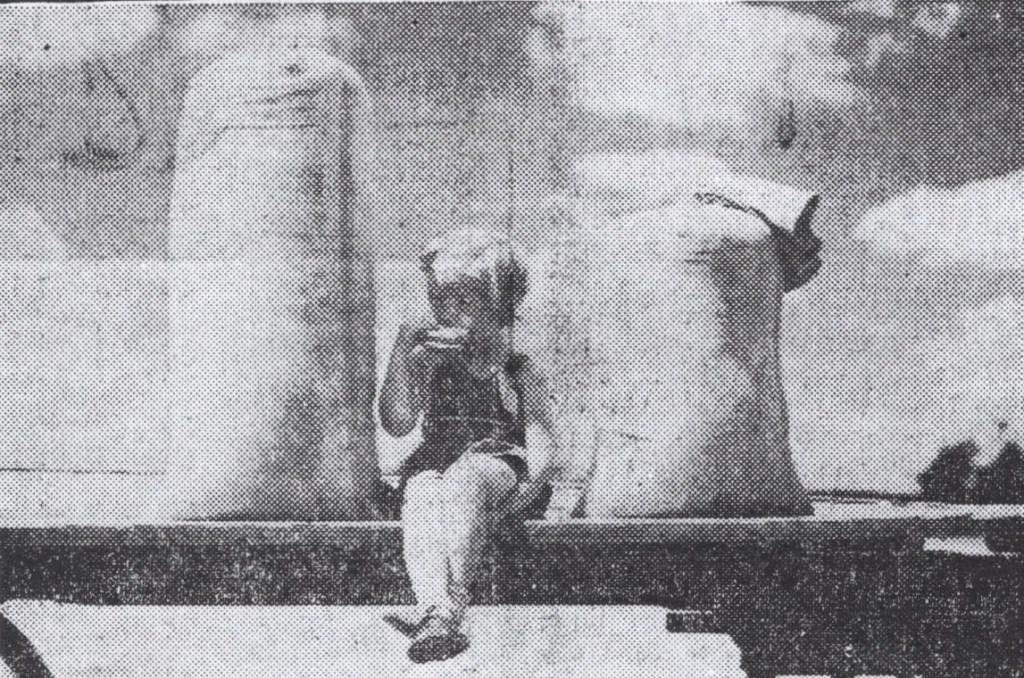

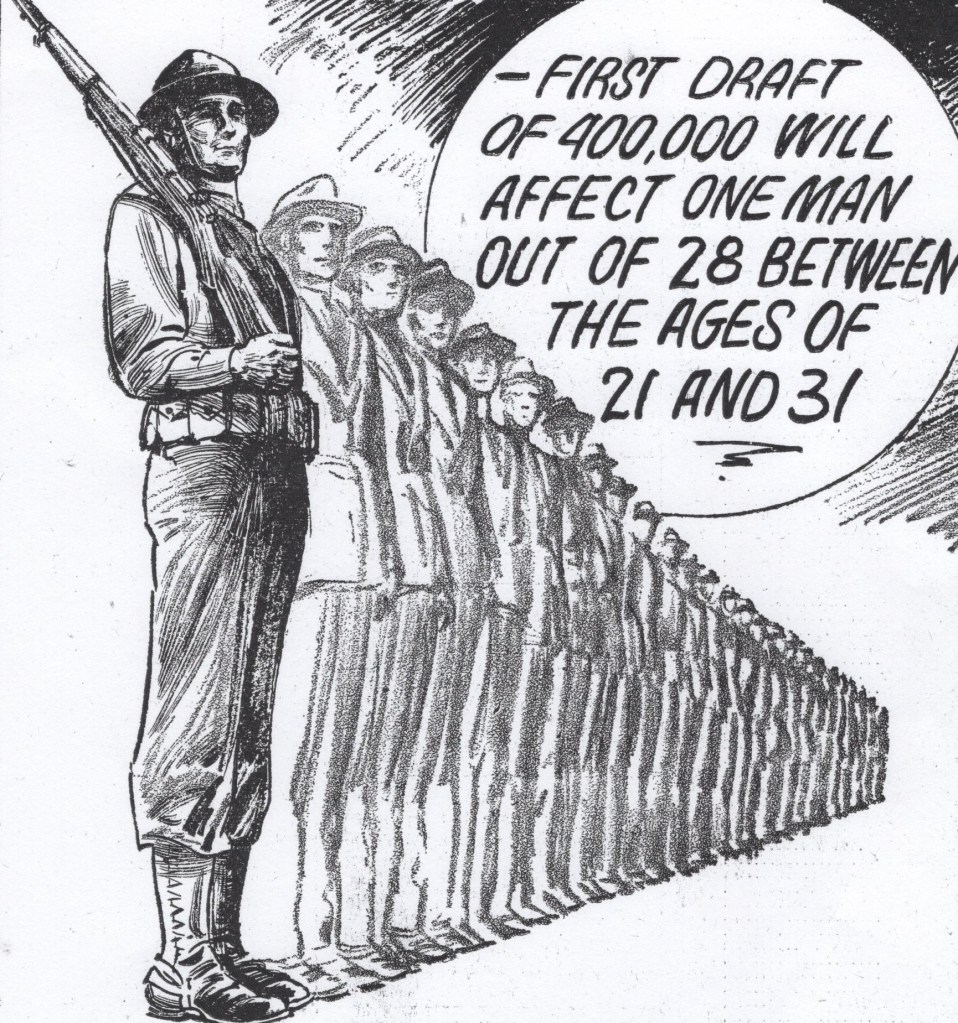
Above from the top: Wheat harvest was coming in, and young Beverly Kay Gulick of Ithaca lacked nothing to eat. The two sacks represented how much wheat the United States had in its possession (left) and how much it would consume in the next year (right). The message was that the country had much to avoid a famine – unlike parts of Europe who suffered from the war; a new county highway garage went up in Ithaca with the goal of completion by November 1; “One Out of Every 28” was the title of this cartoon, which foretold an impending draft of young American men in the wake of the European war.
A warm late summer in Gratiot County provided what crops needed after a poor start.
As war spread over Europe, most people in Gratiot County seemed unconcerned; even talk of a draft was in the works.
And FDR appeared to be willing to run for a third term as President. What would Gratiot County voters do to avoid a dictatorship?
It was August 1940 in the county.
War News Comes to Gratiot
Plenty of news articles and photographs warned Gratiot County that a world war covered parts of Europe as the Nazis now threatened to invade the British Isles. As “the Blitz” continued over parts of England, citizens prepared to handle both early morning “feeler raids,” as well as more brutal attacks over northwestern England and up and down the coasts of Scotland. Cities like Southampton, Dover, and Hastings all became targets as barrage balloons tried to deter German planes.
The Alma City Commission continued discussions of the city’s involvement with a new National Guard Armory for Troop B, 106th Cavalry. Because the federal government talked of taking the National Guard, combining it with the training of army recruits, and removing horses due to mechanization, the commission did not favor a push for a new armory. Soon, Troop B left Alma in early August for intensive maneuvers in Wisconsin. A total of 63 members went on this trip. Captain Howard L. Freeman led the Alma group.
A photograph of the original glass jar used in 1917 by the Secretary of War to draft Americans for World War I appeared in the Gratiot County Herald. How long before young men would be drafted for another war? A U.S. Army recruiting party came to Alma and St. Louis to demonstrate the use of a searchlight for aerial spotting of aircraft. For this two-hour demonstration, the recruiters also brought along two scout cars, rolling equipment, anti-aircraft, and anti-tank guns. Byron Bradley of St. Louis made the news for being accepted into the Air Corps division in Lansing. He left the same night to begin training at Scottsfield, Illinois.
With Hitler’s conquest of Europe, attention turned to millions of people who were already hungry, and fall was coming. The Michigan Children’s Aid Society announced that it would be discussing the issue of care for refugee children during its summer conference in St Joseph, Michigan. The Children’s Bureau of the Federal Government asked the Society to make facilities available for refugee children.
In news of another war in another part of Gratiot County’s past, Jasper Norton of Elm Hall, believed to be Gratiot County’s last surviving Civil War veteran, celebrated his ninety-fifth birthday. Norton was born August 2, 1845, and entered the Union Army at the age of sixteen as a private in Company D, 12th Regiment, Michigan Infantry. He reenlisted in the Army in 1864 and was honorably discharged on February 15, 1866. Private Norton was wounded in the right thigh in a battle near Camden, Arkansas. Up until a few years ago, Norton regularly helped with work on his farm and still took daily automobile trips out to his farm outside of Elm Hall.
New Deal Social Programs at Work in Gratiot
New Deal social programs such as the NYA (National Youth Administration) and WPA (Works Progress Administration) continued to be active in Gratiot County during the summer months.
Much of the NYA work dealt with recreation programs. Wheeler Field in St. Louis saw much community activity with programs like a doubles tennis tournament, horseshoe pitching tourney, shuffleboard, men’s night activities, and the town’s first public dance. NYA workers built the new shuffleboard and equipment, then they went and painted the court on the west walk near the grade school. More than 90 NYA workers were on the monthly payroll, with young workers receiving either $24 a month for 80 hours of service in the “A” class or $18.40 monthly for those in the “B” class. Several of these NYA workers were involved in activities in both the St. Louis and Alma recreation departments.
WPA projects and workers continued in the county. The Gratiot County Road Commission applied to the WPA for help with the construction of a bridge in Lafayette Township, three miles south of Breckenridge. It was hoped that the WPA would authorize a dozen men for help with this needed project of widening the bridge area and modernizing the bridge’s structure. St. Louis planned to use WPA workers for its sidewalk project to start at the end of August. The city also wanted work done, lengthening sewers and water mains in St. Louis. Over 100 men worked in Alma, pouring concrete on Walnut Street and River Avenue, as well as widening streets in the city. An increase in workers now meant that the city might be able to complete the forty-block project, which started in 1939. When this was finished, the city wanted to start work on another 15 blocks. WPA workers also planned to construct six tennis and six shuffleboard courts in Wright Park.
WPA workers were also authorized to help with alien registration at local post offices in the county. Each worker’s job was to assist aliens in filling out registration forms, fingerprinting, and explaining the requirements of the registration law.
With summer in full tilt, recreation programs in Alma, Ithaca, and St. Louis all continued to draw large numbers of participants. Over in Ithaca, a new recreational center opened at the county fairgrounds. A new softball field with lights has now become the place to play softball each night of the week except Wednesday. Alma held another water carnival, which drew many people to Turck’s Beach on a Friday night. The beach drew in the crowds. During a hot August spell from August 22-28, the count showed that 6,400 people attended activities or went swimming at the beach.
For those who wanted to stay indoors in August, another Townsend Club meeting took place for Progressive Townsend Club Number 2 in Ithaca at the village hall. “Very good attendance” resulted in choosing delegates for the 8th congressional district convention in Saginaw.
Health and Gratiot County
Most of the health news during August 1940 dealt with hospitals and the topic of rabies.
Carol Jean Harrington, age 5 of Ithaca, fell off her bicycle and fractured her left elbow. She was x-rayed at Smith Memorial Hospital in Alma and then sent home. Dean Breidinger of St. Louis was the victim of burns to his body and left hand while trying to clean a paint brush in the boiler room at Leonard Refinery in St. Louis. His condition was satisfactory. Gerald Smith of Alma, like Dean Breidinger, was treated at Smith Memorial Hospital for injuries suffered while riding his horse. The horse stumbled, threw Smith, and he fractured his left leg below the knee. John Wilberding, his mother, and grandmother, all of Shepherd, were also treated for a traffic accident on US-27 three miles south of Shepherd while on their way to a Catholic picnic. Wilberding’s party was not at fault for the accident.
Newspapers said that reports of rabies declined by 33 percent since May; however, there was no immediate ban on the free movement of dogs in Gratiot County. Law enforcement officials stressed that dogs had to be kept on a leash in public and boarded up while at home. Some dog owners hoped for a reprieve in terms of allowing dogs to train for the upcoming hunting season, which was on the minds of Gratiot County hunters.
To support children in the county who needed dental care, the free twelve-week dental clinic continued. After five weeks at Ithaca High School, the clinic relocated to Alma Junior High School for the next four weeks. This dental treatment was given to underprivileged families in the county.
Farming
What would Gratiot County farmers do without such often unpredictable weather and tragedy, especially in the heart of summer? A large fire in New Haven Township at the Arthur Akin farm did $20,000 worth of damage to five buildings. Electrical problems may have been the cause, and Akin had only partial insurance. Akin also lost his sheep barn, hay, and grain, along with three cattle and a hog. Another fire at the George Baker farm in Emerson Township, at nearly the same time, was caused by children playing with matches and a cap gun. Luckily, the children narrowly escaped the fire.
Above-normal heat and moisture helped the summer’s crops catch up after a poor spring weather. The sugar beet crop looked very good, and the beans showed significant improvement. More rain at the end of the month appeared to be helping; however, farmers wondered if the crops would be ready before the first freeze and the onset of cold weather in the fall.
All seemed well until Monday, August 19, when an unusual wind of “tornadic proportions” came from the northwest and hit Alma, taking out 13 Union Telephone company telephone poles between the city and along US-27 on the old Ithaca Road. Fred O’Boyle’s trailer camp east of Alma was hit the hardest with flying limbs and downed trees near the surrounding trailers.
In other Gratiot farming news, St. Louis beet growers enjoyed a picnic sponsored by the Lake Shore Sugar Company. A group of 650 people came to the Gratiot County fairgrounds in Ithaca for three hours of entertainment. One of the best friends Gratiot sugar beet growers had was United States Representative Fred L. Crawford, who came out against Eastern seaboard refiners who took too much sugar from places like Cuba. Crawford feared the government would turn the sugar market over to Cuba and that the United States would stop producing sugar. A group of 28 boys returned from a five-day trip sponsored by Future Farmers of America. The group traveled through the Upper Peninsula and into Wisconsin. Omer Garberson and Leroy Roslund were just two of the young men in the group.
Farmers were warned about the damaging effects of the corn borer on the county’s corn crop. Farmers had limited options to control the pest, except to place corn in the silo, run fodder through shredders, or to clean plow all stubble and stocks under in early summer. Turkey growers in central Michigan gathered for a meeting at the Gratiot County courthouse to plan the grading and marketing of turkeys, which would be shipped to Detroit. Thanksgiving and the Christmas season were not that far away. A.J. Neitzke led the ten highest herds in the Gratiot Dairy Herd Improvement Association during the month of July. Neitzke’s Brown Swiss yielded 999 pounds of milk and 39.52 pounds of fat on one test. On a more sober note, Hill’s Fox Farm in Alma offered $5 and $8 for dead horses to feed animals at their fox farm. Just send a card to Hill’s, and they would make contact.
The Long Arm of the Law in August 1940
The Gratiot County prosecuting attorney, Robert H. Baker, reported 79 violations of the law and subsequent cases. Of that number, 76 resulted in convictions, with fines totaling $294.65 and costs amounting to $246.
David Lavoy, 17 of Alma, pled guilty to stealing Ray Updegraff’s pocketbook. He got a fine of $31.15 or 345 days in jail. The law came down hard on Roched Alvey, 52, a Cleveland, Ohio, rug salesman who failed to have a peddler’s license. Alvey claimed his World War I veteran’s peddling license was sufficient. He spent 20 days in jail instead of paying the $30 fine and costs. His tune changed after two days in the county jail, and he was able to raise the money to get out. Ganro Mejia, an Alma Mexican, 43, was arrested by Alma police for carrying a loaded revolver. He received a ten-day jail sentence and two years’ probation. Meija was not to retake a weapon unless he had a license. Harmon Burrell, 27, an Alma man of color, was arrested for carrying concealed weapons and was sentenced to Jackson Prison for six to eight months. Burrell had a homemade dagger that he exposed during an argument in the Alma Coney Island Restaurant. More violence occurred when Staley Druska, 51, of Bannister, was arrested for having a bloody fight with Steve Gruska. Druska attacked Gruska with a knife and hammer. That trial was assigned for later in the month.
Patrick Long of Alma made the news for being arrested for two different cases on the same day. First, he briefly escaped from the Alma jail after being arrested for passing counterfeit checks, but was rearrested and brought before a judge. He had to pay $36.85 in fines and costs in addition to the amounts of the checks. After arraignment in Alma, he was taken to Justice J.L. Smith’s court in St. Louis for failure to appear for a traffic violation ticket on July 4. He had to pay $8.00 or spend ten days in jail. Finally, Maynard Isham, Lloyd Willert, and M.H. Sheridan, all of Perrinton, pleaded guilty to a fine of $16.85 each for violating state laws by fishing with set lines in the Maple River.
Several articles in local newspapers addressed the issue of alien registration, which became a state and federal requirement. Part of this need to register seemed tied to events in Europe as the United States slowly drifted toward war. The St. Louis Leader stated that it believed many aliens existed in Gratiot County. Starting August 27 through December 26, aliens of all ages had to register at one of the post offices in Alma, St. Louis, or Ithaca. All had to register and be fingerprinted, and those under the age of fourteen had to be registered by a parent or guardian. Also, those who could not speak English had to furnish their own interpreters. Aliens who started the citizenship process but had not completed it still had to register with the authorities. The Department of Justice would mail a proof of registration to each person who completed the process in the form of a receipt card. Some of the questions that aliens had to answer involved how long they anticipated being in the United States, and for how long they planned to stay. Other questions asked about their method and ways of transportation into the country, whether they had any military service, listing organizations they belonged to, and how these activities helped a foreign government. Failure to register by the end of December may result in a six-month jail term and a $1,000 fine.
The Alma postmaster claimed that each registration would take approximately thirty minutes to complete, and fingerprinting was part of the process. There was no cost for the Gratiot alien registration process. On the first day, registration took place at the St. Louis post office. Postmaster Adeline Philips reported that ten aliens had registered so far.
In sad news, Judge James G. Kress, a probate judge in Gratiot County for twenty years, passed away after a prolonged illness. Kress was born in Alma in 1866 and had a long career as an attorney and judge. He was laid to rest in Alma’s Riverside Cemetery.
And So We Do Not Forget
A.H. Beebe, the caretaker of the Alma Pine River Country Club golf course, described his ten-year collection of golf tees. He currently had 210 different tees made of wood, wire, rubber, bakelite, white bone, tin, plastic, and celluloid…Alma’s New Moon Trailer published a new illustrated folder of new trailers for sale. The Alma Record printed 20,000 folders for distribution…James Kline of Ithaca was now in charge of the new locker storage plant, the first freezer plant in Gratiot County, and had 200 lockers to rent…Gay’s 5 & 10 in Alma had a new American flag in the window made out of red, white, and blue jelly candies…Three Ashley residents, Kenneth McComber, Lyden, and Wendal Wright sang ballads on the Prairie Farmer-WLS Home Talent program over radio station WLS in Chicago on Saturday afternoon, August 10…Leonard Refineries held its first annual employee picnic for workers in the Alma and St. Louis plants. Approximately 300 people attended the picnic at Lake Lansing…The 1940 District Class C softball tournament started at Conservation Park Field in Alma on Sunday, August 11. In the opening game, Lobdell-Emery played the Newsboys…Matthews, located at 222 East Superior in Alma, had a daily fountain feature of a double peach sundae for only ten cents.
The 1940 Gratiot County school census had 9,568 students, a drop of 260 students from the previous year. Alma had a gain of 29 students and a student enrollment of 2,216…Ira Nusabaum, a twenty-year employee at the O.E. Buccaning’s Beehive Restaurant, was found dead in his apartment over the Alma establishment. When he did not appear for work, another employee went to check on Nausbaum, who had passed from an apparent heart attack. Nausbaum had worked for the Buccanings for twenty years…Alma Bowling Alleys are prepared to reopen for the fall bowling season. “Mauling the maples” was soon to start in Alma…The contest for the oldest battery in Gratiot County ended when Robert Fisher of Sumner Township, who produced a thirteen-year-old battery from a 1927 Model T Ford…Jack Catlin, formerly from Alma, signed a contract with the St. Louis Cardinals farm club and was assigned to Worthington, Minnesota, farm club. Catlin formerly played for the Pure Oil baseball club on Sundays in St. Louis…A group of young men from Ithaca formed a flying club on the George Reed farm in North Star. Reed, a licensed pilot, began working with ten young men to complete their eight hours of dual instruction courses before flying an airplane…Several news articles appeared in county newspapers about the apparent 1940 Republican nominee for President, Wendell Wilkie…Marian Smith, daughter of the late Dr. R.B. Smith, married Alton Norris in the Smith family gardens in Alma. Miss Smith was given in marriage by her brother, Lieutenant Reynolds C. Smith. Seventy friends and family attended the wedding.
In Alma, the Beehive Restaurant at 322 North State Street and G.J. Maier at 115 East Superior Street both installed fluorescent lighting. Maier was using Westinghouse lights…A busy harvest season in the county meant that members of the county’s board of supervisors were forced to postpone their first annual picnic at Conservation League Park…In Michigan Mid-State Baseball action, Beal City played St. Louis in a double header at the St. Louis softball field on Sunday, August 4…A new sign sponsored by St. Louis Lions Club and Frank Champion was placed two miles south of St. Louis on US-27. The sign read, “The Lions Club welcomes you to St. Louis, Michigan, center of the Nation’s Playground, straight ahead, scenic route to Mackinaw”… St Louis schools planned to open Tuesday, September 3, for the upcoming school year. The teaching staff had only one new addition from last year…The annual August Northrup Birthdays took place at the home of Lyle Bartrem. While the plans originally were for an outdoor party, weather changes forced it indoors…Mid-West Refineries acquired two new refineries as part of a business expansion. The six-year-old company voted to purchase the stock of Imperial Refining Corporation of Grand Rapids, along with its two refining plants…The intense late July heat resulted in lower attendance at the Republic Truck Reunion. Approximately 900 people attended a Sunday picnic at Conservation Park. A total of 438 former Republic workers participated in the picnic…In an unusual yet sad story, a double funeral was held for Mr. and Mrs. Peter Brillhart in Ithaca. The elderly couple passed away within six hours of each other. J.L. Barden and Sons handled the services.
A new St. Louis restaurant, the Colony House, opened with an exterior in the Colonial style, featuring knotty cedar panels. The business had room for 42 people at one time. While it featured meals and lunches, the Colony House also had a soda fountain service…Marriage licenses included John Hein, 25, of Bethany Township, and Margaret Kostka, 25, of Emerson Township. Good luck to Cupid’s victims…Walter Brown, Ithaca tailor and World War I veteran, gave a talk at the Park Hotel for the St. Louis Rotarians about the history of clothing, as well as his exhibits on button types, including the potato button…Claire Trevor and John Wayne starred in “Dark Command” for two nights at the Ideal Theatre in Ithaca. Tickets were ten and fifteen cents…A new lighted softball diamond in Ithaca, located at the county fairgrounds, hosted games every Wednesday night, except on Wednesdays, which were avoided due to the free programs offered in downtown Ithaca. The official opening of the new field took place on August 5…The 47th annual Central State Camp Meeting of the Church of God ran August 16-25 east of St. Louis. Reverend. W. T. Wallace of Louisville, Kentucky, served as camp evangelist…The new Ithaca Post Office opened on August 1 in the old Ithaca National Bank building…The village of Perrinton held its fifth annual homecoming days on July 26-27. The event was primarily sponsored by the Perrinton firemen, who managed to break even with the cost of the event through a Ladies Aid Society dinner. Events included a free show, a softball game between Perrinton All-Stars and Rowley and Church, a tug of war, free music from the Vocational Band, a popularity contest, and a contest to catch a greased pig…and St. Louis saw its biggest building boom in ten years with several home and businesses were going up in and around the city. Most of the new homes cost between $3,000 and $6,000 to construct. Many of the new buildings were made of brick.
And that was Gratiot County during the Depression and War in August 1940.
Copyright 2025 James M. Goodspeed
 Goodspeed's Gratiot County Historical Blog