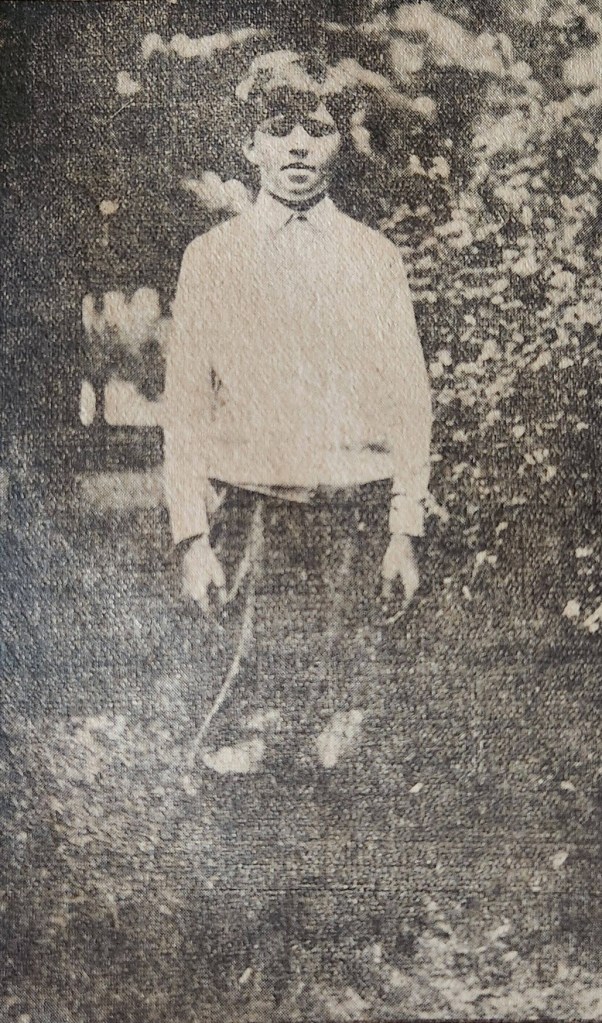
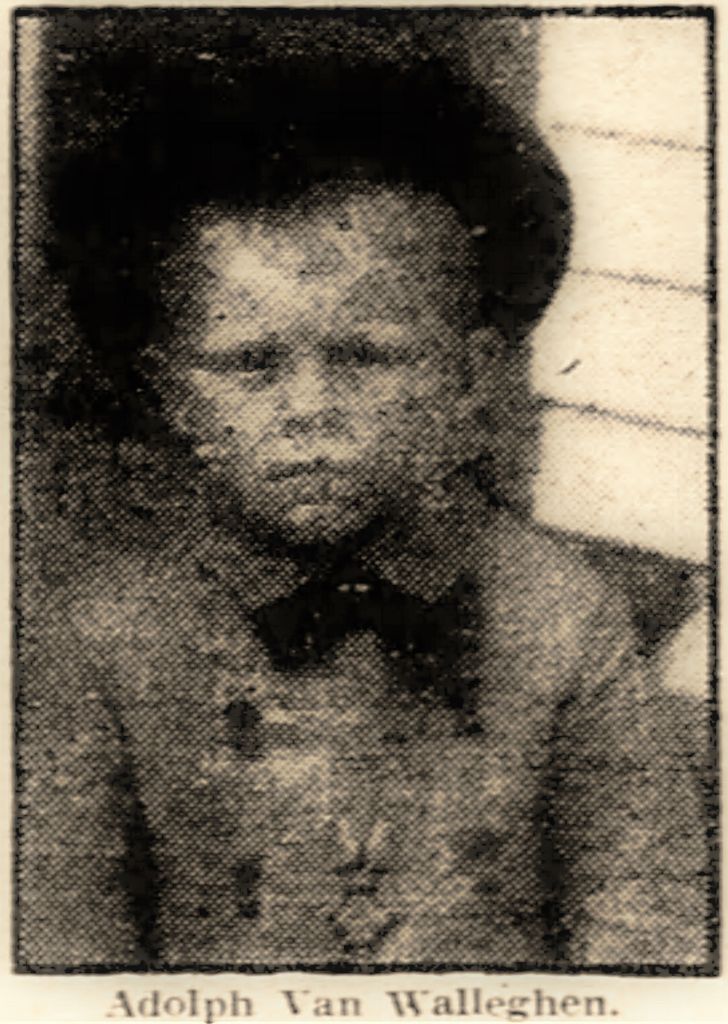

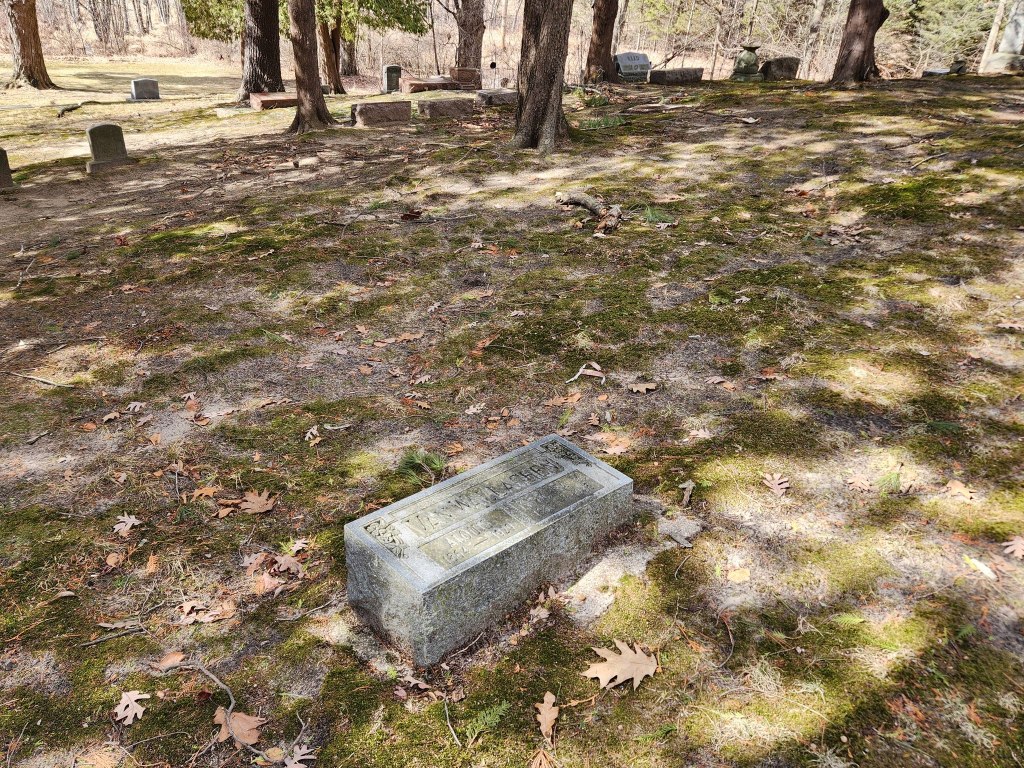
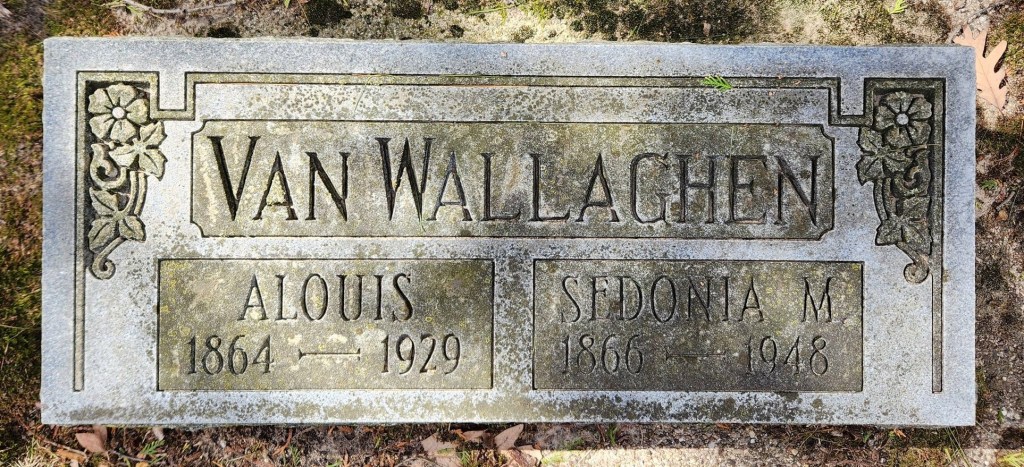
Above from the top: Percy Kiter in an undated photograph that appeared in the June 8, 1922 issue of the Gratiot County Herald; a very young Adolph “George” Wallaghen in a photograph taken years before his murder; looking northwest along the Pine River in toward the possible area of the St. Louis “high banks,”; opposite of the former location of Velsicol plant; family burial plot of the Wallaghen family in Oak Grove Cemetery in St. Louis; the only marker on the family plot belongs to the Wallaghen parents.
“Murder on the St. Louis High Banks”: The Percy Kiter Murder Case, 1922
Gratiot County newspapers called it a bloody and shocking juvenile crime which was unequaled in the history of mid-Michigan. And it happened because of a missing pipe and nine cents.
It happened in 1922, in St. Louis, and this tragic murder left a deep mark on the city’s history for the next thirty-five years. For many people living in St. Louis, the death of a young boy was the most terrible event since the town’s earliest settlement.
An Early Summer School Day in St. Louis
This murder took place on an early summer’s day as the school year came to a close at the Oak Grove School northwest of St. Louis. The compact, square box-shaped school, with its three narrow windows on each side and a small set of steps leading to the front door, was located near the Oak Grove cemetery. Because of the school’s location, students frequently walked a short distance to the nearby Pine River or to town by crossing the millpond bridge.
As summer approached and the school year ended, young boys went swimming in the Pine River. One of these spots, known to many as the local swimming hole, was on the north side of the Pine River and sat near a spring. Farmlands abutted the river, and the northern area on that side contained what locals called the “high banks” shores. These river banks sometimes dropped by 20 feet or more in some spots to the edge of the Pine.
Before the 1920s, it was not unusual in Alma or St. Louis for youth to engage in activities in town that concerned the merchants. Theft, vandalism, and horseplay all caused business owners to be on the lookout for unaccompanied children. Youthful offenses ranged from stealing money from an unattended cash register to taking fruit without paying. Knocking over stands and even breaking windows put businesses on alert. Incidents became so frequent in Alma that the police chief stepped up efforts to crack down on misbehavior by arresting youngsters.
On May 31, 1922, young Percy Kiter made a trip into town and back after finishing his examinations. Two other boys, Alex Wallaghen and Donald Smith, also left the school with Kiter and also wanted to have a good time, so they pooled their money, and Kiter went into town to purchase a pipe and tobacco. However, this morning, their time together changed their lives.
Three Boys, Tobacco, and Nine Cents
Percy Kiter, 12, was the second of eight children. The Kiters moved to St. Louis from Grand Rapids, and his father, Perry Kiter, worked on a tile ditching machine, also known as a “ditcher.”
Following Kiter around on that morning was Adolph “George” Wallaghen, age 13, one of two sons born to Alouis and Sidonie Van Wallaghen. The family moved to St. Louis from Detroit sometime before 1920. Both parents were immigrants from Belgium, but appear to have arrived in Gratiot County during a time of Belgian immigration early in the World War I era. An immigrant train arrived in Alma in February 1915, bringing 30 families courtesy of the Burt, Sharrar, and Moore Company. Although the Wallaghens were not on that train, they were one of several Belgian families in the county. The Walleghen family spoke Flemish at home, and later changed their last name to just “Wallaghen.” Alouis Wallaghen worked as a laborer in the St. Louis area.
The third party in this story was young Donald Smith, who was 10 years old. Little is known about Smith’s background, and his name does not appear in any records tied to the Oak Grove School. His father’s name was Ira, and Ira Smith had a farm not far from the river. Donald Smith appears as the young follower who went along with the older students just to belong and for fun. Due to his youth, Smith was intimidated by his peers. One interesting aspect of this story of these boys is that newspapers described them as being a bit older than they really were. For instance, Van Wallegen was about 4 months away from turning 14. Likewise, Percy Kiter was only 3 months shy of being 13, yet newspapers “rounded off” their ages. Consequently, the reports portrayed a story involving childhood and early teenage years.
During a break from morning examinations on Wednesday, May 31, the three decided to go for a swim and a smoke about three-quarters of a mile above the St. Louis dam. Although the boys obtained the tobacco and pipe, they had no matches. That job went to Donald Smith, who made the trip into town but returned empty-handed. Percy Kiter then decided to make another trip and came back; this time, he had just three matches. As the boys gathered close to the bank upon Kiter’s approach, George Wallaghen teasingly accused Kiter, saying he would tell Kiter’s parents about Kiter stealing things in town and about his smoking. A war of words immediately broke out between the two boys over Kiter’s thefts and smoking.
As Wallaghen bent down to take off his shoes to go swimming, Percy Kiter hit him hard in the head, knocking him down. When Wallaghen attempted to get back up, Kiter hit him a second time, then kicked him, sending Walleghen backward down a steep bank that extended fifteen to twenty feet deep toward the water. On the way down, Alex Wallaghen hit a branch of a tree that jutted out of the water, which had come to rest there after winter storms. As Kiter jumped down the bank after Wallaghen, he approached Wallaghen and continued choking him and hitting him. It was then that Kiter saw blood come from Wallaghen’s ears and nose. As Kiter examined Walleghen, Kiter realized that a sharp tree branch had lodged in the back of Wallaghen’s head. Kiter then checked for a heartbeat, but Wallaghen was dead.
The Cover-Up
Upon realizing that George Wallaghen was dead, Percy Kiter instantly ordered Donald Smith to come down to help him and dispose of the body. Young Donald Smith also came down the bank, frightened and intimidated by Kiter. Kiter and Smith then stripped the body, folded the clothes, and took a moment to try to wash the blood off the back of Wallaghen’s shirt. The two then pushed the body out into the Pine River with a large forked stick in an attempt to make the incident look like a drowning. The stick left gouge marks on Wallaghen’s neck. Just before they climbed and left the high banks, Percy Kiter went back to Alex Wallaghen’s clothes. Kiter took nine cents out of the pocket (another report said a dime), and the remaining tobacco, pipe, and matches they were going to use that day. The two boys then made their way toward school, where Kiter attended another session of school examinations after lunch. Just as the two boys left the high banks, Percy Kiter threatened Donald Smith again, telling him never to say anything about what happened. One boy was dead, another intimidated, and a third just went about his business at school.
By late evening, George Wallaghen’s parents began searching for their son, who had not come home for dinner. The search continued into the next day, when a farmer, while dragging his ground near the high banks, went to the nearby spring for a drink and found Wallaghen’s clothing. Soon afterward, some men returned to the location, and Wallaghen’s body was discovered and removed from the river. Soon, a woman recalled seeing the three boys walking toward the high banks, prompting the police to question Percy Kiter and Donald Smith. Smith seemed very nervous, under pressure, and unwilling to talk. Once the police separated the two boys and questioned them separately, the story gradually came out, especially from Donald Smith. The two boys’ stories seemed to agree – Kiter did the kicking, pushing, and choking of Alex Wallaghen. Smith helped move the body due to pressure and threats from Kiter. It took until Friday afternoon to learn the full story of Alex Wallaghen’s death. But once in jail, Percy Kiter finally confessed fully to his role in the murder of his school “chum.”
The inquiry and police work covered six days from the murder until the official announcement that appeared in local and state newspapers. The delay in releasing the investigation was due to the police and the prosecuting attorney wanting to make sure they had the facts, the story, and the guilty party all in line. One of the hidden aspects of the murder investigation involved the fact that the coroner’s jury judged that Wallaghen had no water in his lungs. This fact ended any speculation of the event being an accidental drowning. Instead, it was declared a murder, and a violent one at that.
Prosecution, Judgment, Consequences
Although Percy Kiter confessed to the death of his schoolmate, Wallaghen, there were limitations on what charges Gratiot County prosecuting attorney Romaine Clark could bring before Judge James G. Kress due to Kiter’s age. When Kiter appeared before the judge ten days after the murder, as a minor, Percy Kiter could only be sent to the Industrial School in Lansing until his eighteenth birthday. That length of sentence would be true if Kriter proved he could be a “model inmate.” If not, he would remain there until age twenty-one.
Life was hard for the Wallaghens after the death of their son, who was buried in the family plot in the North Section of Oak Grove Cemetery under what today are several trees. Alouis, the father, died in 1929 and was buried next to his son. He left his wife, Sedonia, who worked as a housemaid for others until she died in 1948 in St. Louis. Strangely, George Wallaghen never had a marker placed on his grave, but his parents’ names appear on theirs. Their other son, Emil, moved out of the St. Louis area and became a social worker.
Donald Smith disappeared back into history, old enough to have witnessed a murder, seemingly granted grace as a child who was intimidated under threats and pressure into helping to cover up a crime. Nothing appears on Smith in any school records. However, Donald Smith’s name appeared in the news again in the 1930s when he suffered a serious injury in a traffic accident.
There was more to the story of Percy Kiter, who served his time and was released back into life in St. Louis by 1930. It is not clear whether he left the Lansing Industrial School at age eighteen or twenty-one. Still, in the 1930 census, he is listed as a common laborer and the eldest of the remaining Kiter children still at home in St. Louis. Married by 1940, Kiter, his wife, and two children moved to Carson City, where Kiter worked as a truck driver for Guy Gossett. Throughout the 1920s and 1930s, the Kiter family held reunions outside St. Louis. By 1950, Percy Kiter moved to California, where he worked as a mechanic and did auto repair at a garage. He eventually died on November 23, 1974, in Riverside, California.
A Wallet, $22, and a Small Boy
However, in retracing Percy Kiter’s later years, a strange story was found. One day during the Christmas season in 1933, Kiter worked on a CWA project in St. Louis. The Depression was on, and money was hard to come by. On his way across town to a gas station one day, Kiter lost his pocketbook that contained $22 and papers. After advertising for its recovery in the newspaper, Kiter gave up and forgot about his loss. About a month later, a ten-year-old boy appeared at the CWA worksite and asked if someone had lost his wallet. It turned out the boy had found the wallet, but his mother insisted they keep the money, as times were hard and Christmas was coming. A month later, the mother regained the money and sent her son to find Kiter to return the wallet, cash, and papers. Upon finding the owner, the boy handed over the items to an astonished Percy Kiter, who wanted to give him a reward, which he refused. Kiter was so excited at the return of his money that, as he showed his fellow workers, he had failed to get the boy’s name.
Did Kiter pause at any time to remember that this boy was the same age as Donald Smith, whom he had coerced into helping to cover up a murder almost twelve years earlier? How often did Kiter think about the other boy he murdered, George Wallaghen, by knocking him down a steep bank on the high banks and choking him as he died?
These questions were all part of the lives of children and teens in St. Louis’s past. And so the story of a murder on the St. Louis high banks moved into history, where a kid killed a kid for a smoke and nine cents.
Copyright 2026 James M. Goodspeed
 Goodspeed's Gratiot County Historical Blog