April 6, 1917: “It is War!” Ithaca Enters World War I

IMG_20170406_193316460.jpgIMG_20170406_193325551.jpg

Above: Headlines from April 12, 1917 issues of the Alma Record and Gratiot County Herald

It was really only a formality in Gratiot County. In the days leading up to a Declaration of War from the United States Congress, people in Gratiot County were gearing up for an announcement that came on April 6, 1917: America’s entry into the Great War.

On the day prior to the announcement a group of volunteers led what would be a stream of Gratiot men who volunteered to join up. In Ithaca, nine high school students were part of a group that left the town early on Thursday morning to go to Alma, and on to Saginaw, in order to join the Navy. The group included Watson McCall, Howard Burtchard, Peter McAdams, Ivan White, Mike Scott, Davis Summerville, Robert Rayburn and William Rayburn. Ted Kress had volunteered earlier and joined the group, but he left a week later for a different camp. Four of the boys were given their  diploma ahead of what would have been their June graduation from Ithaca High School. All of them had previously visited the enlistment office in Alma, took their entrance exam, passed it, and had been accepted for military service.

Ithaca held a celebration that Wednesday night. Early the next morning, the young volunteers were then paraded through the village and down main street past more than one thousand people who turned out for the send off. Stores displayed American flags. Windows and store fronts were equipped with colorful red, white and blue bunting. After they loaded up, twenty five automobiles and one hundred people followed the Ithaca boys as they proceeded over to Alma. As they arrived there, the fire department led the parade on through town. When they reached the Alma depot, crowds were filled with citizens from both Alma and Ithaca, as well as students from both high schools. Each volunteer was called up front and received an individual cheer from the enthusiastic crowd.

A short service then took place which included an address from the schools’ superintendents, a speech from a local lawyer, and the presentation of  gifts from an Ithaca minister. Reverend Vatcher, from the Ithaca Baptist Church,  gave each boy a New Testament, a gift from Ithaca businessmen. The playing of  “America” and “The Star Spangled Banner” opened and closed the event.

After arriving in Saginaw, the young men headed for Detroit, then Lake View, Chicago,  for five weeks of training. It was expected that they would be sent to Philadelphia and then on to naval patrols off the East Coast of North America.

What happened in Ithaca at the start of the war did not go unnoticed in Michigan. The state’s naval recruiting officer, Lieutenant W.W. Richardson, Jr., wrote a letter to the mayor of Ithaca saying that “Ithaca is upholding the honor of the state. If every city of Michigan  wold come forward as has Ithaca, we would soon have our quota of men.”
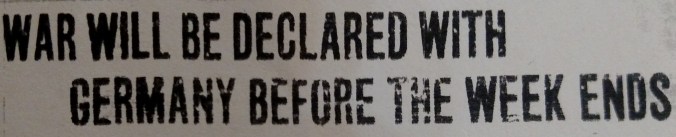
April 5, 1917: “The Great War will be in Gratiot County by the End of the Week”

IMG_20170403_202605879.jpg

Above: Front page of April 5, 1917  issue of the Gratiot County Herald

By the time that most people read their newspapers at the end of the week they already knew Gratiot County was at war. Now, their sons would be a part of it.

Some advertising in newspapers still seemed to make light of the European war.  In Ithaca, J.L. Barden advertised that “War is Declared” and that rugs and floor coverings would be going up in price. Slater and Goodes Men’s Wear warned that “The Big Guns in Europe Are Shooting Away your Shirts, Socks and Underwear.” Cotton was sure to go up in price – one should buy their clothing now. There were also advertisements that the French Army wanted horses. From April 11-14 a buyer for the Good Horse Company would be in Alma, Shepherd and St. Louis to buy good Army horses. They had to weigh 100 to 1400 pounds and be in sound condition.

President Woodrow Wilson had already asked for a declaration of war against Germany. All that mattered was that Congress had to make a formal declaration. The Kaiser had to go. The German government could not be trusted. Its use of spies, unrestricted submarine warfare and slaughter of innocent people had to stop. Wilson was expected to raise 500,000 soldiers immediately and then to increase the army until enough men were in uniform to adequately defend and fight for the United States in the Great War.

Patriotism was said to be extremely high and Gratiot County would be called upon to do its share to make the world safe for democracy.

How many men served our county in the Great War? What was the role of ordinary people in maintaining the war effort? Who were the men who died in the Great War while serving Gratiot County? What were the war years really like in Gratiot?

Follow Gratiot County’s role and place in World War I here on the blog. We start the journey here this week.


February, 1906: “A Ghoul in Seville Township”

IMG_20170331_161809252.jpgIMG_20170331_162024148.jpg

Above: Seville Township’s Brady Cemetery as it appears today

In early February, 1906, S. B. Abbott of Seville Township discovered that there were ghouls in Seville Township’s Brady Cemetery. Abbott made the trek up the small hill which the cemetery sat on one day that winter. He then made a shocking discovery: one of the graves had been opened. Human bones and pieces of underwear were strewn about. Someone, or some thing, had dug into the old casket in such a way that the interior could be clearly seen.

Abbott worked to return the bones and belongings to the twenty year old grave which belonged to one of Seville’s early pioneers.  He then filled it back in and  went to work to find the culpit. It did not take long.

It turned out that a badger, thought to be extinct in Gratiot County by that time, had managed to unearth and desecrate the grave. Abbot trapped the badger, which weighed twenty two pounds, cleaned it and displayed the jaws and teeth of the “ghoul” as conversation pieces.

He was also surprised to find that the badger had some other interesting contents. It had managed to swallow two gold rings which had probably been in the grave.

After learning that more badgers  were at work in other cemeteries in that part of Gratiot County, Abbott said that he hoped Michigan would put a bounty on them.

It is not clear what happened to the two gold rings.

“A Day at the Races, August 24, 1916”

unnamed.jpg

In the hot summer of August, 1916 what would a Gratiot County native do for a good time? Head for the county fair! Of course, you would have to pay for a ticket and the fair usually only took place from Wednesday through Saturday. Be sure and attend on Saturday night, that was the highlight of the fair as something was going on that always drew a big crowd.

In 1924, one of the biggest crowds to attend the Gratiot County Fair took place when the Ku Klux Klan held “Klan Day” at the fair in Ithaca. The largest crowd to ever attend an event in Ithaca took place on that Saturday as people watched the parade of Klansmen marching,  riding on floats, and on horseback.

The county fair in 1916 was the last one before the Great War took place. Young men from Gratiot County who attended the fair in August 1917 just might be required to tell why they had not enlisted to fight, or what they thought they were doing to support the war effort. “Slackers” even found themselves in a roundup that year as the local sheriff and his deputies checked the status of these men.

And I thought the fair was supposed to be fun.

“I Jumped the Fence to Join the Great War”- Gratiot County’s Men at War in Canada, 1916-1917

CanadianCross.jpg

Above: Canadian Cross of Sacrifice at Arlington National Cemetery

Before the Sammies and Doughboys went to war in April, 1917, some Gratiot County men could not wait to get to Europe to fight in the Great War. In a few cases, these men crossed the border and served in the Canadian Expeditionary Force (CEF).

At least four Gratiot County men served in the CEF.  These included Robert C. Davies  and Ivan Brown from Alma, along with John Bartlett Allen and William M.Salter from Ithaca.

John Bartlett Allen was an Ithaca farmer and probably saw the most action. After arriving at Saskatoon, he became part of the 243rd CEF in August, 1916. He made it to France by December 1, 1917, several months before most Gratiot County Doughboys ever arrived on the continent. Allen served until May, 1919.

William Salter was a life insurance salesman in Ithaca and enlisted in Toronto, Ontario on May 23, 1917 in the Canadian Armed Service Corp. He was moved among camps in Canada and never made it off of the continent. Soon after Salter arrived back in Gratiot County at the end of the war his wife died, leaving him with a four month old son.

Robert Davies worked for the Republic Truck Company in Alma and joined the CEF in August, 1917. He became a service pilot for the Royal Flying Corps and returned home in January, 1919.

Ivan Brown is a little more difficult to trace. By June, 1918 he attended a training camp for engineers at St. Johns, Quebec. He wrote home and stated that he had become an engineer and expected to head immediately for France. Brown crossed over to Canada because he had been rejected three times by the American Army due to poor eyesight. The Canadians did not seem to care and they accepted him.

As many as 40,000 Americans enlisted in the CEF during the war, most giving their addresses as either being from the United States or Alaska. Over 35,000 claimed to be Americans by birth. The 97th Battalion was known for its large composition of Americans who came to serve in the CEF.  While Americans were accepted, it is estimated that 2,700 Americans died in the Great War for Canada. These men are buried in Canadian war graves in Europe and in Canada.

Coming home from the Great War may not have been that easy for these Gratiot County men. In many cases, Americans lost their citizenship and crossing back over the border could have been a problem. However, by 1920 the United States resolved the problem and Americans were readily welcomed back home.

First Post – Welcome Aboard

cropped-img_20170314_123814754.jpg

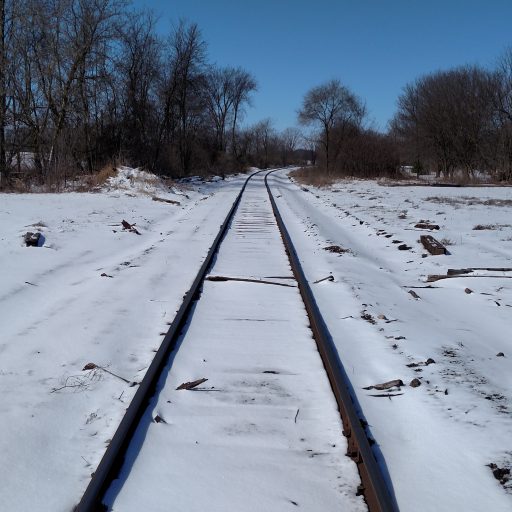
Well, here we go. I am trying to learn new ways of conveying Gratiot County’s history to what I hope will be an interested audience. If you follow this blog I hope you find and learn about the parts of Gratiot County’s past that you don’t know too much about. At the same time, I hope the blog is worth your time. I am learning, I hope you learn and let’s see what happens. Above: the town that moved to the tracks  over a century ago- Pompeii, Michigan on a snowy day.