

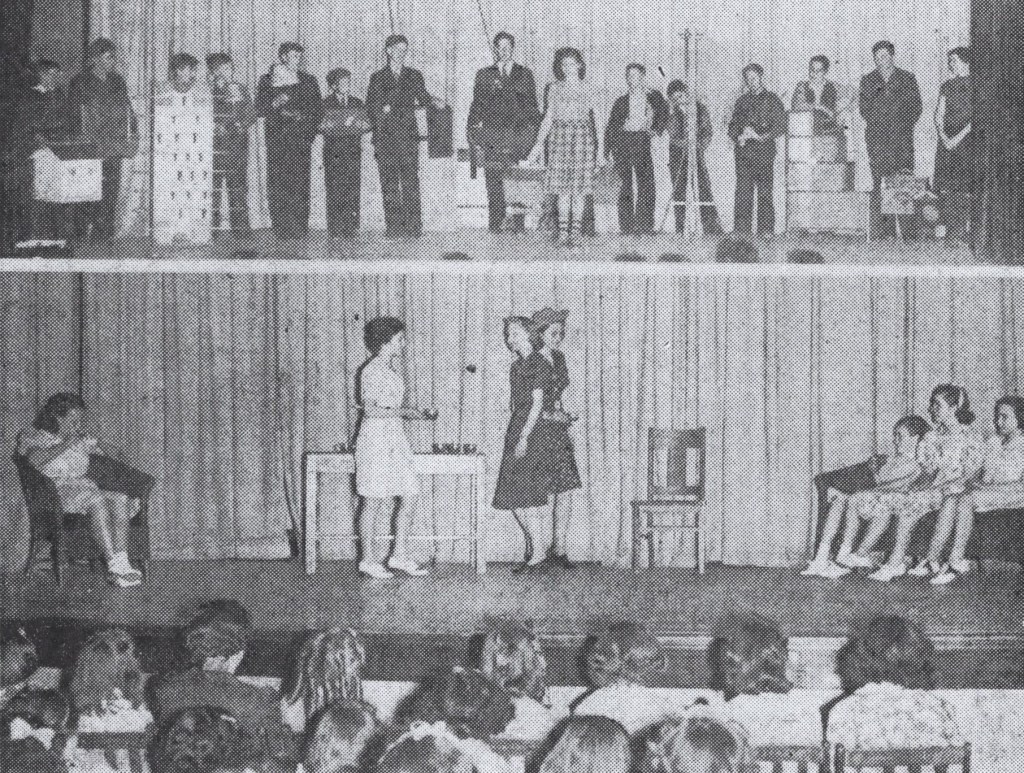

From top to bottom, life in April 1940: A new neon sign appears in county newspapers. The sign at the corner of Washington and Mill Streets is considered one of the nicest in mid-Michigan; a WPA mural done by Joe Cox, entitled “Harvest,” is hung on the north wall of the Alma Post Office; a group of English women prepare for anticipated air raids in London.
The long winter leaves Gratiot County, and the spring thaw takes place.
In Europe, it meant the resumption of Hitler’s war. “The Phony War” was over as the Nazis invaded Scandanavia, Denmark and prepared to invade Western Europe.
Farmers got ready to work their fields, and people carried on their lives in an isolated area of mid-Michigan. How many quiet springs would be left?
It was April 1940 in Gratiot County.
Winter War Becomes the Spring War
As winter ended in Europe, the “phony war” ended. Nazi Germany now started to make its anticipated aggressive moves toward the West – on land and sea. Gratiot County saw and read about these events through articles and photographs published in county newspapers.
British citizens in London anticipated air raids, as did French ground crews who believed invasion was imminent. French soldiers passed their time in places like the Maginot Line, waiting for the Germans to attack. Australian troops (Anzacs) in Palestine believed that they too faced a Nazi invasion of the Middle East. The Italian navy moved toward the Dardenelles to help the Nazis.
Hitler ordered his troops to occupy Denmark, and the Danes barely resisted. The situation in Poland was far worse as Warsaw lay in ruins and Jews were forced to wear the yellow triangle and walk in the gutters instead of on the street. The Nazis had also attacked Norway and moved to occupy the city of Trondheim on the east coast. The naval war between Germany and England began when Hitler proclaimed he was there to protect them.
In Brooklyn, New York, a group of seventeen men known as the Brooklyn Boys went on trial for plotting to overthrow the government. The United States Army tested new tanks at Camp Ord, California. In St. Louis, Michigan, Vojta Benes, brother of the former President of Czechoslovakia, spoke to groups about how he escaped his country before the Nazis occupied it. Ottakar Podrabsky, a Czech college student who escaped and enrolled at Alma College, explained what life was like with blackouts and preparations for a Nazi occupation. Both speakers asked Gratiot County residents for moral support during the European crisis.
Depression Life May 1940
The issue of a lack of money and social issues in Gratiot County continued in the news.
One of the growing responses to the problems of the elderly remained the popularity of Townsend Clubs. The Townsend Plan was another proposed way of providing pensions for the elderly, and these programs attracted large numbers of interested people. Over in Elwell, a meeting at the Odd Fellows Hall drew sixty people who gathered to see a movie about the Townsend Plan. An even bigger group of 300 interested people appeared at the St. Louis Park Hotel to hear state spokesman Ira Brinker. Dr. Townsend also had regular newspaper columns, such as the Alma Record.
The cost and care of indigent residents in Gratiot County continued to concern those on the board of supervisors. Part of this concern centered upon a potentially growing financial deficit for the cost of care now that Gratiot County had taken over responsibilities from the state. The county received $223.79 a month for total care of all indigents and already had a deficiency of $788.96, and this was only a few months into the county’s role of managing these costs. Much discussion occurred about the need for sworn written statements from county doctors when a child or adult indigent needed to be sent to a place like the University of Michigan Hospital for treatment. An auditor told the commission that if the current rate of debt continued, the county faced a $78,400 bill in October 1941.
Over in St. Louis, the Community Council led the discussion of creating a community chest that could be used in part to help care for needy families. One way to do this was to create a card system for disadvantaged families and places where donations like clothes and shoes could be stored, such as the city hall and the Gratiot County bank building. The bank building was presented as a site where women repaired clothes. The greatest need in St. Louis was shoes for the needy.
All of the discussion about the needs of people across the county occurred during what the Gratiot County Herald labeled “New Deal Defeatism” – or disenchantment with the deficits created by the New Deal. In 1932, the Herald cited the nation’s unemployment at ten million people – the same number a WPA administrator claimed was the rate in 1940. With so many out of work, looking for jobs, and the nation’s deficit growing, how could the New Deal programs be worth supporting?
Places like St. Louis faced financial issues tied to a New Deal program. Residents of St. Louis voted down two bond issues, one of which involved paving sidewalks with additional money from the WPA. That bond would cost taxpayers $32,000, the city $12,000, and the WPA $76,000. There was still interest in the sidewalk proposal, but voters needed more details. The other bond issue, which involved buying the Gratiot County Bank building for a new city hall, went down overwhelmingly.
However, people could still see New Deal programs at work in Gratiot County. NYA workers trimmed trees in Wright Park and faced problems with removing stumps. In 1938, the city removed trees under a state forestry expert’s direction to increase sunlight in the park. Now, the city had to deal with how to get the stumps out of the ground, which required stump-pulling equipment. Without the equipment, it was impossible to remove all of the unsightly, decaying stumps. The NYA also planned to help Alma by working to enlarge the city’s summer programs for youth. Alma High School coach Floyd Lear was contacted to oversee the summer program. WPA workers in Alma continued to work on terracing and seeding streets south of Superior Street on Gratiot Avenue and toward Gratiot. The city also planned to work with the WPA to complete curbing on several streets.
The most beautiful work done by a New Deal program in 1940 was done by Joseph H. Cox of Indianapolis, Indiana. Cox, a University of Iowa instructor, completed a large mural mounted inside the north wall of the Alma post office lobby. Many people turned out to watch as the mural, entitled “Harvest,” depicting harvesters stopping from their work to drink water from a long-handled dipper, was placed on the wall. Another part of the mural showed a one-horse wagon loaded with grain, with farm buildings in the background. Cox came to Alma to supervise the hanging of his mural.
Farming, Outdoors
Unseasonably cold weather in April meant spring planting lagged as farmers waited for spring to arrive. Some called this time in Gratiot “backward spring,” as the only thing being planted so far had been oats. The Gratiot County farm agent commented that more farmers intended to grow more beans than sugar beets. However, many farmers believed that an overproduction of beans would occur and reconsidered their sugar beet acreage.
A group of 1,096 farmers in Gratiot County signed up for farm plans under the AAA (Agricultural Adjustment Administration). The number of sign-ups represented 52 percent of all farms in the county. By signing up with AAA, these farm plans monitored soil depletion, acreage allotments, goals for soil building, and the maximum payment every farmer could receive in 1940.
Farmers who planned to use sugar beet labor were required to pay the same rates as they did in 1939. Those beet growers who wanted benefit payments from the Sugar Act of 1937 had to comply with these wages. In anticipation of the upcoming farm season, Mexican sugar beet workers in Texas faced physical examinations to receive health certificates before they came to Michigan to work in the fields. Michigan doctors who traveled to Texas to examine potential workers looked for tuberculosis and venereal diseases. In 1939, 126 laborers were denied work due to health issues. Of that group, 86 had tuberculosis. The total cost of the examinations was $2,500. Michigan beet growers were supposed to have sanitary living conditions, quarters, and return transportation to Texas.
Problems with rabies and dogs occurred on and off farms as spring began. Clifford McKellar and Dr. D.J. Shepherd of Breckenridge brought charges against Bethany Township tenant farmer Floyd Ludwig. Ludwig shot an English setter belonging to McKellar and Shepherd after he claimed the dog wandered onto his property and lunged at him. However, after getting his gun, Ludwig shot the dog on an adjacent property belonging to someone else. Ludwig was jailed for defaulting on a $500 bond and awaiting an examination. The dog was valued at $200. Miss Martha Carlson of St. Louis experienced sadness when her beloved collie dog, Laddie, was ordered to be put to sleep for his aggressive behavior. Laddie had been in court a year before due to his attacks on other neighbors. In one case, Laddie attacked a man who was plowing on nearby property by tearing off the man’s shoe. While the trial was held in Justice J.L. Smith’s court in St.Louis, the dog’s owner was in Detroit and could not attend the hearing, petitioning the court for leniency through her sister—a sad case for all those involved.
That spring, a bigger issue with animals and Michigan was rabies. 47 counties south of Town Line 21 now faced immediate compliance with quarantining all dogs starting April 1 due to a rabies outbreak. All dogs in Alma had to be confined; if on the street, they had to be on a leash. All stray dogs would be picked up and impounded. Newspapers like the Gratiot County Herald supported the quarantine and believed it was the only way to end the scourge of rabies. Howard Evitts, the county dog warden, also announced that he planned to place dog traps in areas where farmers notified him about the loss of sheep. Dogs caught in these traps would be disposed of upon notification.
The topic of banning Sunday hunting remained a hot issue. Two of three newly formed hunting clubs in the county supported banning Sunday hunting, partly to control the number of hunters invading the county on weekends. Clubs in New Haven and North Shade supported the ban; one in the Seville Township area did not.
There were other things related to farming and farming during April. A new freezer locker storage plant will open in Ithaca – the first in Gratiot County. This locker is expected to open in the old Nelson Produce Company, which Mrs. Gertrude Brown owned. A total of 300 lockers would be available. Interested people could view 700 exhibits by Gratiot County winter 4-H clubs at Alma High School’s gymnasium. Of the approximate 990 girls and boys who worked on projects, 875 finished them. This exhibit, the largest ever assembled in the county, featured girls’ clothing, handicrafts, electrical work, hot lunch, and food preparation.
The C. R. Ranch Rodeo Company agreed to perform at the 1940 Gratiot County Fair. Suckers were running up the Pine River, you could buy live ones at George Gates’ vegetable and fruit stand in Alma on State Street north of the post office. Michigan Mutual Windstorm Insurance Company offered insurance for high winds and tornadoes. Buy chick mash for baby chicks at the Middleton Farmers Elevator Company in Middleton. It only costs $2.35 for 100 pounds of mash.
Health in Gratiot County
Smith Memorial Hospital in Alma received good news when the State Supreme Court upheld its tax exemption. Before this, the city claimed the hospital owed almost $2,000 in realty taxes. Because it argued that the Smith was a charitable, non-profit institution, it was exempt from those taxes. The high court affirmed the decision made in Judge Kelly Searl’s court in 1938 that the hospital did not have to pay those taxes.
A variety of health issues continued to plague the county. The Michigan Tuberculosis Association offered a chest X-ray clinic starting in Ithaca at the Methodist Church to deal with tuberculosis. Those who had a positive tuberculin test after attending clinics in Ithaca and Crystal were encouraged to participate in the clinic. Metal signs went up in public places across the state as well as in the county, warning about the dangers of syphilis. Made by prison industries in southern Michigan and numbering 26,000, the signs appeared in public places such as washrooms and warned of the symptoms of venereal disease. A group of citizens met with the Children’s Fund of Michigan representatives to offer another summer dental clinic. The clinic mirrored the one provided in 1937, in which indigent children who could not afford it received free dental care. The Gratiot County Board of Supervisors appropriated $200 for the clinic.
In sad news, Samuel Mills of Emerson Township, age 58, took his own life after battling nervous depression and despondency for almost fifteen years. Mills had been under doctors’ care for some time. Mills, his brother, and their wives farmed 80 acres of their own and worked the Thomas farm of 240 acres adjacent to theirs. Samuel Mills was found early one morning by his sister-in-law in the cellar. A shotgun had been used as the instrument. Mills left behind a wife, two children, and his brother’s family.
The Long Arm of the Law, April 1940
Crimes and law-breaking of all kinds and levels appeared in the spring of 1940. During March, Prosecuting Attorney Robert H. Baker announced that 58 convictions were reached in court. 41 cases involved traffic violations, while 17 others involved other various offenses. Still, the court received $308.65 in fines and costs.
What were some of the offenses? Six of the cases dealt with breaking, and one with vagrancy. The notorious “Trailer Thief” Ross Smith, father of Michigan’s first trailer baby born in a stolen trailer from Redman Trailer in Alma, was released from jail three years ago. Smith failed to pay $200 in restitution, and then he disappeared. When he turned himself in to the authorities in Traverse City, Smith was sent back to Gratiot County, where Judge Searl gave him six months to five years in Jackson Prison. A jury convicted Leo Rawlings of North Star of stealing nearly 1,000 pounds of aluminum and scrap metal from Lobdell-Emery in Alma. It took the jury only 35 minutes to find Rawlings guilty.
Sixteen couples found themselves in court for chancery cases, in other news involving the law. The Dewey Glinke embezzlement case continued as the county sought to determine how much money Glinke stole from the county in late 1939. County supervisors have now announced that $3,078 in stolen funds is certain. The county would probably owe another $500 for paying two clerks who assisted the auditor general’s office with the case research. During the winter, a few taxpayers outside the county still needed to be contacted to determine if Glinke had stolen their payments. The Glinke case continued for several years in an attempt to find him and bring him to justice.
In other news, the Wheeler Township Board denied two beer license renewals by Orville Wilk and Steve Brenz, both outside Breckenridge. The FBI moved into Michigan—or so it was announced. FBI investigator Chief O. John Rogge said he planned to investigate corruption in high places. One Frank McKay profited from selling over $90,000 in bonds to finance the Blue Water Bridge at Port Huron.
And what else stirred up the Gratiot people in April 1940? It had to be the national census. Many residents spoke out about consenting to being interviewed for the national census of 1940. A list of 25 census enumerators appeared in newspapers to inform readers who would be knocking on their doors. Some, like Ethel Dunn of Elwell, sought out people in Seville Township. Mabel Lippert toiled in Alma’s second ward. Urban enumerators received 40 cents per name, while those in the country got up to 30 cents for each farm they recorded. Individuals like W.G. Davis and H.O. Butler of Ithaca protested being asked to contribute information to the census and being paid to interview them. Butler went so far as to organize the Gratiot County Vigilance Committee and hold a meeting at the Ithaca Circuit Courtroom. A total of 200 people showed up to oppose participating in the census, who did not want President Roosevelt or Uncle Sam to know about their status in 1940.
And So We Do Not Forget
A welcome sign was placed at Conservation League Park outside of Alma. The sign encouraged public use of the park and explained future planned improvements…John G. Young, Riverdale postmaster, died after being ill for two weeks. Young had been postmaster since 1910…the J.J. Newberry Store in Alma planned to open after completing a false front, new trimming, and a new stairway. The fountain bar, a public favorite, remained untouched and ready to continue its service for eager customers. The store planned to rent the upstairs rooms…Area schools prepared for the county achievement tests for two days in early May. Seventh and eighth grade students would take their tests on May 2; the rest had the day off. On May 3, all fifth and sixth-grade students were tested while the rest had a free day. Make sure and bring two well-sharpened pencils and a lunch…Since May 1, 1939, the St. Louis Fire Department answered 61 calls for fires, including 4 in just one week in early April. The department responded to 40 fires in 1939, an increase of 21 fires…Buy your baseball equipment at the Varsity Shop in Alma. Baseball shoes cost only $2.15; gloves and mitts started at 69c, and bats ranged from 25c to $1.75…St Louis put up a large neon sign at the Washington and Mill Streets intersection. It measured 15 feet long and 5 feet high. Newspapers stated that St. Louis was the only city in mid-Michigan with such an attractive sign.
Eight students graduated from the St. Louis Business Institute in the previous three months. Four of the graduates already had jobs. Some graduates included Phyllis Alward, Bette Comstock, and Geraldine Humm from St. Louis…Resident V.K. Beshgetoor described a horrifying incident he witnessed on his way home to Alma. Beshgetoor motored through Shepherd when he saw a young boy inching near passing cars on a bike in northbound traffic. The boy took a tumble off his bike and missed being run over by a truck by only inches. Beshgetoor commented that after being scared for his life, he wondered how parents would allow their children to ride bicycles in such heavy traffic…The Porter-Yost field in Midland Township had 341 wells running and made a daily run of 4,754…The Ford Motor Company provided a Mercury 8 1940 test car for the Rademacher Motor Sales in Alma. Its average mileage is 22.3 miles per gallon.
Go to McIntyre’s Drug Company in St. Louis and order a treat. On April 28, customers could enjoy a free tree from the New Arctic Soda Bar…St Louis Schools expected its teaching staff to return for the 1940-41 school year. The only one not returning was kindergarten teacher Miss Ellen Strom…Mr and Mrs. M.D. Fisher opened their home to host the Gratiot County Rural Letter Carriers’ Association and Auxiliary. The group enjoyed a meal of chop-suey…Jackie Cooper and Betty Field starred in “Seventeen” at the Strand Theatre. Tickets cost 10c and 20c. A local newsreel ran every Wednesday and Thursday nights…The St. Louis Park Hotel offered regular duck dinners for 75c. Frankenmuth style cost $1.00. “Why eat at home when you can dine with us at these prices?”… Sixteen-year-old Richard Hetzman pf
Alma was chosen to represent the George W. Myers American Legion as a delegate at Wolverine Boys’ State in East Lansing in late June…The Sawkins Music House sold the 1940 Norge Steri-Seal Washer and a vacuum cleaner for $69.95. Buyers could also pay $1 a week. Interested customers could see for themselves at the Builders Show in the Alma High School gymnasium April 25-27…The Alma Oddfellows Hall hosted thirteen boxing matches for the Alma Athletic Club before a large crowd. Four of the bouts ended in knockouts…Alma High School returned five lettermen for the upcoming track season. Four of the five were seniors…County school children again sold Easter Seals for the benefit of handicapped children. This year, the thirty schools sold a combined $498.45 in seals…Most St. Louis Trade Association members wanted to close their businesses on Wednesday nights and offer entertainment programs on Saturday evenings…
Resident Theodore Bloss made the news for his friendship with neighboring fox squirrels. Bloss had been friendly with several of them for the past four years and had them visiting Bloss on his back porch and eating out of his hand…Burlingame & Son of St. Louis offered the new 1940 Chevrolet Master 85 Business Coupe for $659. Phone 282 to contact the business..Alma Girl Scouts launched their annual cookie sale. Crisp, crunchy butter cookies with chocolate and vanilla flavor appeared like the Girl Scout trefoil. Only 25 cents a box…St Louis Michigan Chemical Corporation displayed its new custom-built salt machine, which could produce one per minute. The blocks were sold to feed cattle…The Alma Builders Shows started on Thursday, April 25, and ran the rest of the week at the Alma High School gymnasium. Sawkins Music House showed moving pictures in the smaller gymnasium each evening…Monroe’s Drug Store in St. Louis sold vitamins, antiseptine, nose drops, and Tread Easy Foot Powder, see the advertisement in the St. Louis Leader-Breckenridge American….An article in the Alma Record told how a migration of Amish settlers left Canada and the United States for Mexico in the 1920s. Now, some of the followers established communities in Maryland…Fleming Shoe Company in St. Louis sold nurses’ Oxfords for $1.98 a pair…Engineers in Montcalm County studied plans to increase the water level in Rock Lake. Plans called for transferring water from Marl Lake, a quarter of a mile away…Alma High School prepared to show 400 feet of film entitled “Land of the Free,” movies taken of students while they were in the building. The school recently purchased movie equipment to show a four-reel movie…
Bert Hicks & Son continued remodeling their grocery store on the corner of Woodworth and Superior Streets in Alma. C.A. Hicks (“Bert”) had been in the grocery business for 37 years, 10 of those for himself. For the upcoming grand opening, Hicks planned to have a SunshinebBiscuit and Maxwell House coffee demonstration for all of those in attendance…James Merodeas joined James Stamas and Steve John as Alma State Sweet Shop partners. Merodeas came to the business with an excellent record as a cook…The Triangle Coal & Oil Company in Alma displayed a new thermometer on their building. In this way, motorists who stopped for gas or oil could easily read the temperature and realize the need to buy more coal for heating during cold weather…Mrs. Inez Brainard of St. Louis established the “Willard J. Brainard Loan Fund” to assist any St. Louis High School students who sought to further their education. Mrs. Brainard established the fund as a way of honoring her son, who died from fatal burns in an incident in 1939…Buy linseed oil, turpentine, and Moore’s House Paint at the Davis-Wolansky Hardware Company in North Star…A total of $498.45 was raised during the Seventh Annual Crippled Children’s Seal drive. Over 30 schools in Gratiot County participated in the program…66 schools renewed their Junior Red Cross subscriptions, which resulted in $100.63 to the Gratiot County Red Cross…Barbara Stanwyck and Fred MacMurray starred in “Remember the Night” at the Ideal Theatre in Ithaca. Admission was 15 and 10 cents…
The thawing of heavy snow in Middleton left much of the village with high water in vacant lots, on streets, and on main roads. School buses could not travel some main routes to pick up students on a Friday. Still, robins and turtledoves could be heard and seen in Middleton…The Ithaca High School Junior Class presented “The Eyes of Tlaloc,” a mystery play, in the high school gymnasium…Mr. Harwood’s St. Louis High School English class polled students about their favorite radio program. Kate Smith’s program and “The Hit Parade” came in at the top of the most listened to on the radio…Bobby Erskin was lucky to have parents and grandparents who wintered in Dunedin, Florida. Bobby loved the Detroit Tigers, saw the Tigers in spring training, and served as one of two Tigers batboys. Ersikine brought home cracked bats used by Rudy York and Roy Cullinbine…Buy a new 6.2 cubic foot 1940 Westinghouse refrigerator for $112.75 at Walker’s Electric Shop in Alma.
And that was war and Depression life in Gratiot County during April 1940.
Copyright 2025 James M. Goodspeed
 Goodspeed's Gratiot County Historical Blog