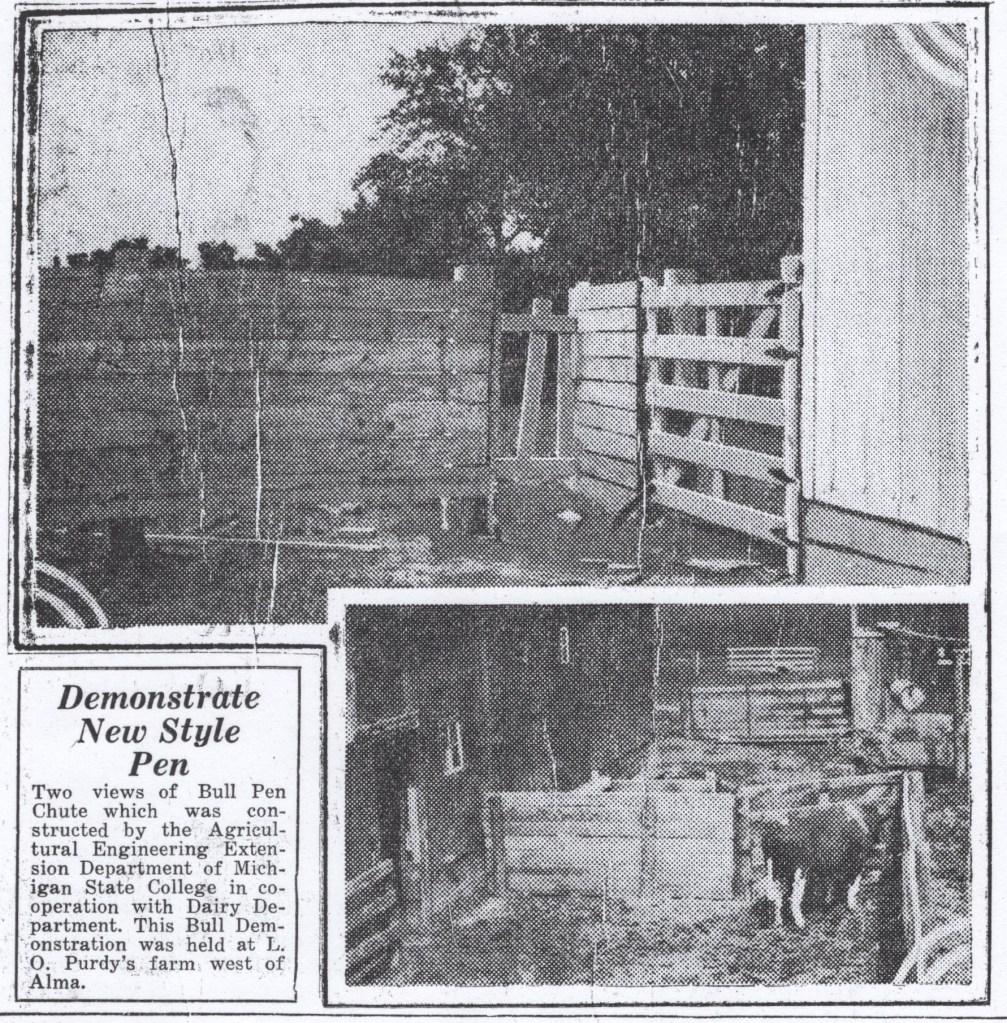
Above: Purdy’s Bull Pen as it looked near Alma on June 26, 1930. More than one Gratiot County farmer found himself on the wrong side of a bull.
Farming can be the most dangerous job in the world, and it turns out that Gratiot County’s history proves that to be true. One of the most common farm accidents in our history involved runaway horses. Beginning in Gratiot’s logging era, runaways could be both exciting and deadly for bystanders. However, the dangers posed by runaways on the farm were also a real problem.
In February 1911, O.H. Becker lost his life northeast of Beebe when his frightened team, hitched to a dray, headed to the field, then made a sharp turn around a corn crib, throwing the 70-year-old Becker to the barn wall, breaking his neck. Becker, a Civil War veteran, left a wife and two daughters. Two years later, Daniel Boyer was nearly killed west of Ithaca when his two-year-old colt, startled by a creamery wagon, threw Boyer from his buggy into his yard. Boyer somehow held on to the colt despite being dragged around, suffering severe injuries to his knee and wrist. Yet, he lived to tell the tale.
Remember a farmer’s adage: never get kicked by a horse. A horse tied up in the barn of Martin Heath of Perrinton in May 1923 almost ended his life when the horse knocked Heath down after attacking him. Luckily, his sister found the unconscious Heath and called for help. Heath suffered a broken collarbone and severe bruises. Cephus Allen of Newark was both kicked and trampled by his horse in February 1930, leaving him unconscious for several days. Three-year-old Willard Workman of Pleasant Valley was not as lucky that fall, after the boy followed his father to the barn for chores. Somehow, a horse “spooked” and kicked the youngster, who died from a fractured skull. Another young child, Lucy Byers, 9, of St. Louis, was seriously injured in July 1932, suffering a basal fracture when kicked by an unshod horse as she and her siblings tried to round up horses from an oatfield.
Watch out for that bull and keep your eyes on him – all the time. In 1913, Ithaca-area farmer George Boyer went out to drive his cows from a distant field and failed to return. His son later went looking for him, only to find his father lying in a pool of blood. As soon as the young Boyer approached his father, the family bull charged at him. Somehow, young Boyer eluded the bull and managed to get his father to the house, but George Boyer soon died. In 1920, Arthur Gibbs, an Ithaca farmer, narrowly escaped a bull he thought he had under control while holding a chain through its nose. However, the dehorned bull quickly turned on Boyer, pushing him on the ground for four rods as Boyer pulled the chain, even as Boyer tried to jab the bull with a pitchfork with his other hand. Between the chain, ramming the pitchfork into the bull’s head, and a yapping farm dog, Boyer somehow got up and jumped over the fence. He had no broken bones, just bruises and a terrible limp.
Frank Peterson of St. Louis was not so lucky in July 1952 when his bull attacked and trampled him. While moving cows from the pasture, his bull charged him, knocked him down on a stone pile, and crushed fourteen of his ribs. The Johnsons, a farm couple who worked for Peterson, risked their own lives trying to free Boyer. Mrs. Johnson went after the bull, clubbing it on the head to free Boyer. After getting him to the Alma hospital, Boyer only lasted twelve hours before he died. Desidero Mojica, 58, of Elwell, also lost his life to a bull attack in July 1952. During milking time, Mrs. Mojica thought she heard her husband calling in their herd of cows. Instead, she found the couple’s bull standing over him. The Holstein bull apparently knocked Mojica down when his back was turned and then trampled him. While the Mojicas always warned others to stay away from the bull, they regularly worked around the cows in the yard without any problems. Desidero Mojica suffered broken ribs, a broken arm, and serious internal injuries, leading to his death at Smith Memorial Hospital. These were just a few of the dangers of working and living on a Gratiot County farm; there were many others.
Copyright 2026 James M. Goodspeed

