“In Gratiot County, I am Bothered by Chancellorsville” – August, 2017


DHFcZfuVwAAOesg74576

Above left: Image attributed to the Washington Post, August 16, 2017. The red arrow in the picture is not of my doing. Above right: Liberators from the 82nd Airborne and 8th US Infantry Division view the victims of the Nazis inside a building at Wobbelin, May, 1945. Photograph from United States Holocaust Memorial Museum.

     It has been over a week since the protests in Chancellorsville, Virginia took place and I am glad that I just missed the events there. Still, I also remained bothered by what I continue to learn about this event in our country. One image attributed to Chancellorsville, in particular really bothers me. And it compels me to continue to teach, write and lecture.

     I recently took a trip to nearby Staunton, Virginia to attend a teachers conference on President Woodrow Wilson, who served from 1914-1920.  Staunton, which sits west of Chancellorsville, is Wilson’s birthplace and the site of his library. I just dodged another tragic event in two years (last year at almost the same time I was in Nice, France 36 hours after the attack happened there on the French Riviera).

     Last week, my google search notice went off in the morning when the words “Wobbelin 1945” popped up on my screen.

     For fourteen years I have been researching, and recently just started writing about, a Nazi concentration camp that was liberated by the 82nd Airborne and 8th United States Infantry Regiment on May 2, 1945. Approximately 5,000 people went through Wobbelin, a satellite camp of KZ Neuengamme. At Wobbelin, the Nazi weapon of death was simple and crude: starvation. No gas stations or crematoria, just death by starvation.

      When the liberators arrived at Wobbelin it was estimated that somewhere between 1,500 to 2,500 people from over 17 different nations had died of starvation at the hands of the Nazis in ten weeks.

      Since 2003, when I became a Teacher Fellow with the United States Holocaust Memorial Museum, I have been working with a Holocaust memorial at Wobbelin. I also interviewed, met, wrote to and researched dozens and dozens of men and women who saw the Wobbelin camp in 1945. In the process, I was able to find at least four men from Gratiot County who served with the 82nd and who were in the region of where the Wobbelin camp was located. The late John Muneio, who lived in St. Louis, told me how he remembered personally confronting Germans after liberating the camp who came up to him and complained that the survivors of the Wobbelin camp were being fed and helped by the Airborne. Muneio loudly and bluntly told them, “SO?” I took the meaning to be, “SO WHAT, you didn’t give a rip about helping these people – get out of here.”

       What struck me most was how indelibly the images from 1945 still were with these veterans. Dead bodies. Emaciated survivors – the “walking dead” as some called them. The stench of decaying bodies and the camp itself. These were some of the images that the liberators had decades later about what they witnessed at Wobbelin. Most of all, there were memories of those Germans who lived around Wobbelin and who claimed that they knew nothing about the camp and that they had no idea of what was going on there.

      Both the 82nd and the 8th made sure that after the camp was discovered, Germans were going to remember what happened there.   German civilians, young and old, men, women, soldiers, Hitler Youth – any German that was found near Wobbelin – was made to take “a tour” of the camp. Nazi Party members were rounded up and made to carefully excavate corpses from burial pits (with their bare hands) for public funerals that were held in at least four locations. One liberator, Leonard Linton, oversaw the excavation of the pits and reminded those in charge of removing the bodies that they would not be using gloves, “So that you (Germans) will never forget what happened here.” The confrontation with the camp and the funeral was to remind these Germans in 1945 of what the Nazis did and what they, as citizens, had allowed to happen in their own midst.

        What does this have to do with Chancellorsville?

      The Google notice from “Wobbelin 1945”  that I saw featured a picture from the events at Chancellorsville from a story from the Washington Post dated August 16. It was from an article by Cleve R. Wootson, Jr. In it was a picture of what appears to be a man giving a KKK salute while wearing, of all things, a hat from the 82nd Airborne. The irony of attending a KKK/neo-Nazi rally while representing anything to do with the 82nd Airborne was appalling and shocking.

     I had several gut reactions to the Chancellorsville photograph.  “This guy needs his head examined.” “Ignorance is bliss.” “Those who don’t know their own history are doomed to repeat it.” “This stuff needs to stop right here.”

      This is what the 82nd Airborne fought for in 1945?  Does this guy in the photograph have any idea of what Nazism ultimately led to?  My grandfather, who was not a member of the 82nd Airborne but who served in Italy, fought against the same enemy. What would he think of the image? This “protestor” needs to go back to Wobbelin and take a look at what the end of Nazism, hate, prejudice, and discrimination ultimately lead to.

     He also needs to spend some time learning about the Holocaust and American history – and about the 82nd Airborne. And this is why we educate people.

    Maybe I should tell this guy in the photograph that he just gave me the impetus to pick up a recently started manuscript on a book on Wobbelin and that I need to get going with it again.

A year ago I was scheduled to talk to a local historical society about the Ku Klux Klan in Gratiot County during the 1920s. Talk about timing.


“Journeys with a Gratiot Cemetarian” 6.5: Victor Simon, World War II Veteran, Alma Riverside Cemetery

Simon.jpg

Victor Arthur Simon was born July 24, 1918, to Victor and Hattie Simon in Saxon, Wisconsin. Victor served his country during World War II in the European Theater from January to June 1945. While serving there, he was wounded and was awarded the Purple Heart.  Since 1946 Victor was a lifelong resident of Alma resident. He married his wife Geraldine and had three children. He was the service manager for Greening Buick for 27 years and was affiliated with Decker Real Estate for 15 years. He also taught in the auto department at Mott Community College. Victor died on May 2, 1992, and he rests in Alma’s Riverside Cemetery. Victor Arthur Simon is one of many Gratiot  County men and women who served their county, state, and country during a time of war.

“Journeys with a Gratiot Cemetarian” 6.4: William G. Brewbaker, World War I Veteran, Alma Riverside Cemetery

IMG_20170701_141708046.jpgIMG_20170701_141721674.jpg

William G. Brewbaker was born December 28, 1896, to Ely and Geneieve Brewbaker of Alma, Michigan. William, or “Tad” as he was known to many in Alma, was an only child. He attended Alma public schools and Alma College. During World War I, William was sent to places like Columbus Barracks, where he enlisted on May 24, 1918, and others like Camp Meigs in Washington, D.C. He ended up at Camp Humphreys in Virginia as a member of Company D of the 5th Regimental Engineers. While at Camp Humphreys, he became a Sergeant 1st Class and remained there until being discharged on February 24, 1919.

At the start of the Great Depression, he was living in Detroit with his wife and son as an auditor for the Chrysler Motor Company. It was there on one day in 1932 when William went to work on his car inside of his garage that he became an accidental victim of carbon monoxide poisoning. A tragic and early death, the town of Alma was shocked by his passing. The funeral was held at his parents’ home to a packed house. William was a member of St. John’s Episcopal Church in Alma and a member of the Masons. William was also a great grandson of Alma’s founder, Colonel Ralph Ely.

William T. Brewbaker is one of many men and women who served Gratiot County during a time of war.

“Journeys with a Gratiot Cemetarian” 6.3: Herbert Burris, World War II Veteran, Alma Riverside Cemetery

IMG_20170701_141918277.jpg

Herbert C. Burris was born October 20, 1916. On April 4, 1941, he enlisted in the United States Army and served there until being discharged on November 13, 1945. Herbert lived part of his life in the Clinton County area. He passed away on November 23, 1978, and rests in Alma’s Riverside Cemetery. Herbert C. Burris is one of many Gratiot County men and women who served their county, state, and country during a time of war.

“Journeys with a Gratiot Cemetarian” 6.2 Robin L. Wilcox, Korean War Veteran, Alma Riverside Cemetery

IMG_20170701_140829583.jpg

Robin L. Wilcox was born May 30, 1929, to Earl and Nora Wilcox in Jackson, Michigan. Rob grew up in the Lansing area and graduated from Eastern High School in 1947. During the Korean War, he served in the United States Navy. Rob worked for GMAC in Chicago for many years and later he worked for the State of Michigan. He passed away on April 30, 2012, and rests in Alma’s Riverside Cemetery. Robin L. Wilcox is one of many Gratiot County men and women who served their county, state, and country during a time of war.

“Journeys with a Gratiot Cemetarian” 7.2: Clyde S. Howard, World War I Veteran, Lafayette Township Cemetery

IMG_20170703_120254933.jpg

Clyde S. Howard was born July 30, 1897, to Clyde and Anna Howard. A lifetime resident of the area, he worked as a laborer for the village of Breckenridge. During World War I, Clyde served as a Private in the 16th Anti-Aircraft Sector. He died on June 17, 1957, and rests in Lafayette Township Cemetery. Clyde S. Howard is one of many Gratiot County men and women who served their county, state, and country during a time of war.

“Journeys with a Gratiot Cemetarian” 7.1: Paul Mesick, World War II Veteran, Lafayette Township Cemetery

IMG_20170703_114551626.jpg

     Paul Mesick was born June 11, 1909, in Indiana to John and Zuzana Mesick. Paul lived most of his life in the Breckenridge area and later worked as a meat processor.  He enlisted in the United States Army on October 1, 1942, and served until being discharged on November 10, 1945. Paul retired from the Swift Incompany and he died on January 9, 1989, in Chicago, Illinois. Today, he rests in Lafayette Township Cemetery. Paul Mesick is one of many Gratiot County men and women who served their county, state, and country during a time of war.


“Draft Boards, Exemptions and Farewells”: Gratiot County During the Great War, August, 1917

images.jpg

Above: a World War I exemption button.

                In August 1917 both Harold Redman and Adam Peska had their names in Gratiot County newspapers pertaining to the Great War. However, each would be for different reasons.

                The first county examinations for draftees for the Great War took place in Dr. Carney’s office in Alma. Harold Redman of Alma, the son of a grocer and the first man to be examined by the draft board, was the first to be officially accepted into the Army from Gratiot County. Redman passed all of the examinations and waived any request for an exemption. Adam Peska, on the other hand, received a visit from the county sheriff and was hauled in to face the same draft board. Somehow, the draft board had been told about a slacker who did not want to serve Gratiot County. Upon his appearance, Peska quickly admitted that he was not 31 years old (which would have made him too old to be drafted). As he stood in front of the board and answered questions he “gradually…became younger” until he admitted to being the age of 28. Both men were examples of the different views of men who were called to serve Gratiot County and their country that summer.

                An important word being used that August was the term “exemption.” Just as there were many men who answered the call for the draft, there were also Gratiot County men who asked for exemptions. While Gratiot County’s draft board found most of the men who applied for exemptions to be compliant when not granting them,  other states like Oklahoma had seen strong resistance to the draft. Over one hundred men had been arrested there for failing to comply with decisions made by the draft boards.

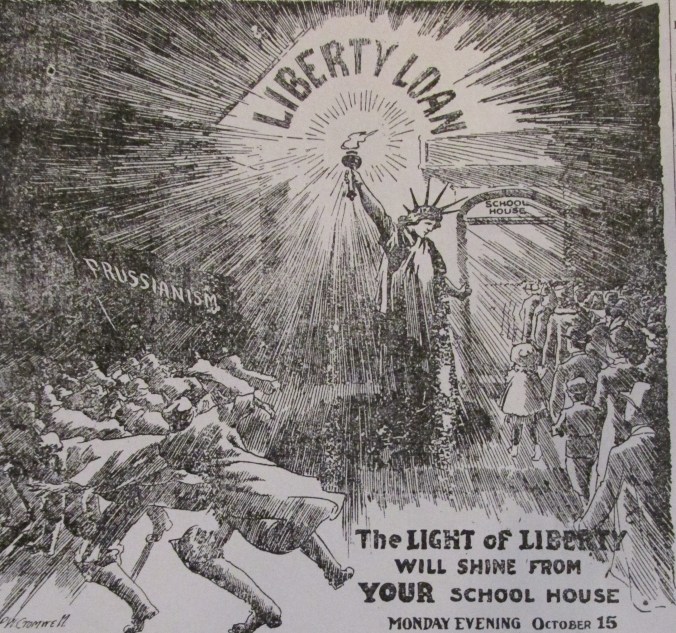
                The names of men who did not apply for exemptions were listed in county newspapers, next to those who did. Readers were asked to look at the exemption lists and help identify those men who made fraudulent claims. They were to then report the names to the draft board. It was said, “By so doing they (the public) will be performing an act of justice and patriotic duty.”  Penalties for falsifying an exemption would result in being found guilty of a misdemeanor and facing up to one year in prison.

 Reasons for each Gratiot County man who applied for an exemption was published next to his name. Some of these reasons included having to support a wife and child, being the father of a motherless child, needed to take care of aged and infirmed parents, having a widowed mother, serving as a regular minister of religion or studying to become a divinity student, and working as a United States mail employee. At least three Gratiot County men asked to be exempted because they were subjects of Austria, one of the nations at war with the United States.

  As August went on, the government worked on improving the definitions for draft boards concerning who could be exempted. Part of this dealt with the status of married men. At first, it seemed that single men would be drafted and all married men would be exempt. Then it was believed that if a married man had children he would be exempted.  Now, draft boards were told to consider whether a married man’s absence from his home would result in his family becoming a public burden. Initially, the government hoped that a wife could live on the $15 to $25 a month that a soldier might send home and that she and her children might receive aid from family members. Another area involved drafting men who were considered important for industrial work. Regardless, in both cases testimony was needed by families, friends of families and industrial agents to convince the draft board that the man in question should not be drafted because he needed to remain in Gratiot County.  To the draft board, it seemed that the government was trying to both tighten the requirements on exemptions while allowing them some leniency with exemptions, especially in the cases of wives and children that could not support themselves.

One way that men in Gratiot County demonstrated that they were  finally exempt from the draft was by wearing “exemption buttons.” These small, round, metal badges had an inscription within a circle that read “Exempted, U.S.” The buttons were given out by the draft board and were soon worn on men’s shirts in many Gratiot County towns and communities.

County zeal for supporting the war effort continued to be evident that summer. Citizens were encouraged to mail magazines to soldiers in Europe. Each magazine, unwrapped and unaddressed, had to have a one cent stamp in the upper right corner, along with a note written on the cover telling the postal service that it was intended for a soldier or sailor. “Bounty boxes” could be found at different locations for cigarette donations to be mailed to the front. A few in Michigan questioned whether mailing cigarettes was the healthy thing to do and wondered why the Red Cross sponsored the boxes. Still, newspaper advertisements readily encouraged people to help support soldiers and sailors by sending them gifts of tobacco.

The Gratiot County Red Cross received almost $9,000 in pledges by August. Now, the challenge was in collecting the pledges for the war. Towns big and small in Gratiot County made pledges and recruited members to help the Red Cross. Localities like Middleton (306 members), St. Louis (466), Perrinton (150), Sumner (19), Elm Hall (11), and even Sickels (14) pledged to help the Red Cross. Out at the Bannister branch, the group donated two dozen towels, six draw sheets, six operating sheets and fourteen towels. Places like Fulton Center, Lafayette, West Hamilton and Wheeler also pitched in with donations of socks, sponges, compresses, bandages, scarfs, and pillow cases. All of this showed how the county supported the early war effort.

Over at Alma, one of the first meetings took place to form what would be called “The Home Guard.” These were groups of men who would take the place of the National Guardsmen who were leaving as they were called to service. Supposedly these “Home Guardsmen” were formed to protect both property and the menace of strikers, like the I.W.W. (the International Workers of the World, or “Wobblies” as many called them). Fifty men showed up at Alma’s city hall for an organizational meeting and thirty of them signed a pledge to join. Those who signed were then asked to help find more recruits. It was hoped that 150 men would form the unit, who would meet periodically at the Alma High School gymnasium for drills.

Some of the first letters that August appeared in newspapers from men who had joined the Army. Lieutenant Lewis Sarvis wrote that he would soon be transferred to what would be called Fort Custer in Battle Creek. Chris Downs, from Elwell, was in Columbus, Ohio and he was aware of a few desertions that had taken place there. One man had been shot. Leon Aldrich was at Fort Myer, Pennsylvania and he had been allowed to travel to Washington, D.C. While there, Myer saw the former residence of Edith Galt Wilson, the President’s wife. During his visit, he claimed that he could plainly see the home of General Robert E. Lee two miles away from where he stood. A couple of times Aldrich had also personally seen President Woodrow Wilson, along with his body guards, while attending plays at Keith’s Theatre. All of the soldiers whose letters appeared in the newspapers asked for people to write to them.

The Army also started to call for men from Gratiot County who were doctors, cooks, and bakers. Dr. A.A. McNabb answered the call and became an officer at the Grand Rapids hospital unit. There were also calls for volunteers for the newly formed Aviation Corps or aero squadron. Some Gratiot men would end up there during the war.

As August ended, men who were to be the September call ups were invited for a dinner at Alma High School for a chicken pie dinner. On September 4th, women from across the county were invited to come and help the Red Cross. Inside, the gymnasium displayed patriotic banners and decorations.  A farewell program with speakers and entertainment was planned. Local communities, like Elwell, also had farewell activities for their men who were leaving. Forty-four men from Elwell’s surrounding area who were going away for military service attended a Saturday evening banquet and dance at the local I.O.O.F. Hall. It was reported that a total of 210 people came to Elwell to share in their good byes.

Finally, it seemed the government was trying to calm the concerns of men and their families as the reality of war hit the nation. The Marine Corps issued an article that the fighting men of the nation were not as much at risk as many people thought. It stated that based on its findings in the French and British armies, “A careful estimate shows that only one man in fifteen is killed, and one out of five hundred loses a limb.”

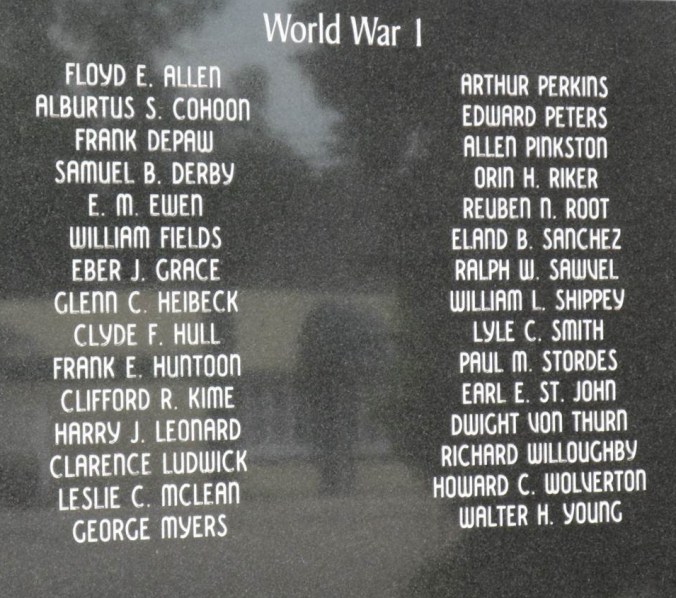
Ultimately, names of men from Gratiot County that appeared in the August draft lists with names like Fields, Van Thurn and Smith would end up paying the ultimate price in France. Many others would be wounded or gassed. All of those Gratiot County men who served overseas would be shaped by the war in ways that the summer of 1917 could not yet imagine.

Copyright 2017 James M Goodspeed

“Come to Ithaca for a Different July” – A Time of War, a Time of Peace, July 1917

IMG_9953.JPG

Above: Gratiot County Herald, June 28, 1917

     During the summer of 1917,  it seemed that some Gratiot County residents did not know whether to celebrate the Fourth of July or to spend time contemplating the seriousness of a nation going to war. It had been a custom in Gratiot County that the annual Fourth of July celebration would be hosted in a different town each summer. Now, with a war on, St. Louis opted not to host the event.

     Ithaca quickly came to the rescue in hope of promoting Woodland Park, a park located on the town’s west side. People were invited from across the county to come and spend the afternoon and the evening in Ithaca. The event was billed as “a day of pleasure and quietness instead of the usual 4th of July celebration.”

   The park was promoted as a place that had plenty of water, room to park one’s automobile or hitch their horse, and enough activities to keep everyone busy. The events offered baseball games, horse shoe contests, three legged races, volleyball, medicine ball, racing, singing, and music. On the spiritual side, the Free Methodists were also holding camp meetings in the park.

      That July it was a time to slow down as the county went to war.

Copyright James M Goodspeed 2017

“Journeys With a Gratiot Cemetarian” 5.6: Lester L. Smith, WWII Veteran, Ithaca City Cemetery

IMG_20170526_192412785.jpgIMG_20170526_192425038.jpg

     Lester Leroy Smith was born June 2, 1919, to Clair and Laura Smith in Taber, Alberta, Canada. On May 18, 1944, he was one of 48 Gratiot County men who was sent to Detroit for their pre-induction examinations to enter the service during World War II. Lester served his country in the United States Army.

     He eventually met and married his wife, Harrriett. Lester also worked at Federal Mogul in St. Johns, Michigan. He died on June 23, 1990 and is buried in the Ithaca City Cemetery. Lester Leroy Smith is one of many Gratiot County men and women who served their county, state and country during a time of war.