

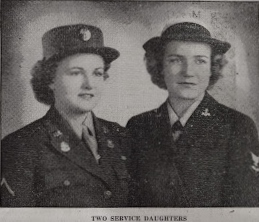

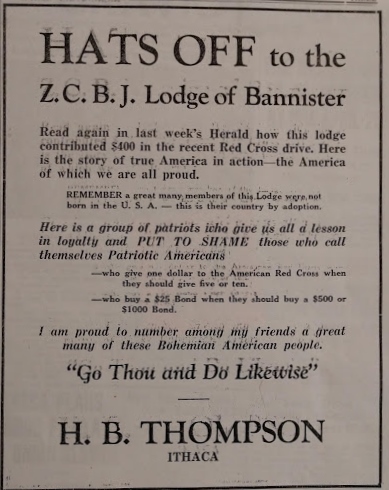
Above: May 1944 Consumers Power Company advertisement from Gratiot County Herald; May 25, 1944, St. Louis Leader advertisement Michigan Chemical Corporation; June and Jean Knapp from Alma served Gratiot County as a WAC and WAVES respectively; Family War Bond advertisement Gratiot County Herald.
It was May, it was warm, and yet life was not entirely right in Gratiot County. There was a war going on.
While some rationing improved for people in the county, people could not get all of the kinds of food that they had before Pearl Harbor. Gratiot County servicemen – and servicewomen – went to and reported from all parts of the United States and the world. Letters and pictures from these men and women regularly appeared in local newspapers. Bad news arrived in the form of those missing, wounded, and killed. The numbers of casualties and deaths also kept growing.
In the midst of all of this, Allied successes on the war fronts promoted speculation among civilians that the war could end in 1944. However, no one knew that the war would go on longer than hoped. Many of those who did the fighting thought the war would be long before peace ever came.
And then there was “invasion talk” as a new front on the European continent was soon to be launched by the Western Allies.
Soldiers and Servicewomen in the News
There was no shortage of reports from those in the service. Corporal Leslie D. Romine of Alma helped supply the front in the Mediterranean as a convoy commando. Romine drove trucks with supplies over mountains and deserts to help keep the Army moving. He had been in the war for 19 months. In service for exactly one year, Privates June and Jean Knapp of Alma had their pictures appear together in the Alma Record. June was a WAC, and Jean served as Aviation Machinist’s Mate Second Class in the WAVES. June served as a telephone operator at Sedalia Air Force Base in Missouri, while her sister was stationed at Ellyson field in Pensacola, Florida.
Fordson Essex, age 17 and from Alma, started naval indoctrination training at Great Lakes Naval Training Center. Lieutenant Lewis Jolls of Ithaca received recognition for being a pilot of a B-17. Jolls had been on several missions already and sent a picture of his plane and crew of the “Hell’s Belle” back to Ithaca. Jolls worked for the Gratiot County Herald before the war. Private Maynard Dodge of Middleton made it safely to North Africa. He had trained as a dental technician at Camp Grant, Illinois.
Some families received news regarding men injured in action. Lieutenant Norman Keon had been in New Guinea since October. In early April, he was driving a jeep through the mountains when it went off the road, fracturing his collarbone and causing serious facial injuries. After being rescued from his overturned jeep, Keon was unconscious for two days due to the shock from the incident. Another former Gratiot County man, Dr. Earl S. Oldham, served in the Navy Medical Corps. He wrote that he failed to miss any of the invasions that had occurred in New Guinea since Christmas. Sergeant Leo Coonrod was stationed in Panama with a bomb squadron, but he had been transferred to the Galapagos Islands. He graduated from Alma High School in 1939.
Once and awhile news came home to Gratiot County when men made it safely to the war theater. Howard and Robert Comstock of St. Louis were featured in the Gratiot County Herald. Howard Comstock was a Paratrooper with the 82nd Airborne and had seen action in North Africa, Sicily, and Italy. Robert, who had been attached to the Army Air Forces while in the United States, arrived safely in England. Another pair of brothers in the Army, James and Peter Surdennik of Fulton Township, both arrived in England. They hoped to meet each other before “The Big Push” into Europe got started. Their father worked as a barber in Ithaca, and their mother had recently been ill during the winter. However, she was doing better.
Some men who came home from the war did so as a result of an injury. Kenneth Langin was one who had spent two years overseas, including the North African invasion. Langin suffered from shell shock and now worked in a hospital. Marine Sergeant Jack Horr returned as a result of wounds incurred at Tarawa. Wounded on the first day of action, Horr continued fighting until again being wounded the second day. Two days later, Horr received a concussion from a Japanese shell that led to him being hospitalized. He had been in the Marines since 1936 and had fought on Guadalcanal. Horr’s family was originally from Ithaca. Corporal Hubert Eicher of Ithaca suffered a broken neck in Ireland. He was in a neck and upper body cast, but Eicher was up and moving in a Red Cross hospital. Private Russell Shepard suffered face and hand wounds while on the Anzio Beachhead. Somewhere in the Southwest Pacific Private Russell Augustine of St. Louis had been wounded. No other details had been released about him.
One of the developing themes in Gratiot County war news involved those servicemen who married overseas. The term “war bride” was yet to be used. Mr. and Mrs. G.V. Wright of Alma received a letter that their son, Lt. Norman S. Wright, married an English girl in March. The new Mrs. Wright served as a Red Cross organizer and fire warden. They now lived in London. In Northern Ireland, Lieutenant Commander Gordon Lamb, whose parents lived in Alma, was going to marry Miss Florence Walker in June. Lamb was a medical officer, and he had been in Northern Ireland for over two years.
The urgency of the war could now be seen in how young high school students were called, even before some officially graduated. Adolf Faust of St. Louis was unable to attend Commencement because he had enlisted as a cadet in the United States Corps and had to report for duty on May 24. Faust had a perfect All-A record and was co-valedictorian of the Class of 1944. Of the seventeen graduates at Ashley High School, three of the boys were absent as they were in the Navy. Their fathers received diplomas for them. The song “Anchors Away” was also played in their honor at the start of the service. These students included: Charles Probst, Jr., George Shaw, and Glenn Reeb. Edwin Mumby was in attendance, but he would soon be inducted. Over in Breckenridge, William C. Newsom received a newspaper as a birthday gift. He had been a member of the Breckenridge Class of 1943 and he missed graduation because he had been inducted into the Navy.
Letters Tell of War
Private William K. Stoffs wrote to his mother in Carson City that he was in the Marshall Islands. What he had encountered had been front page news, such as fighting in places like Tarawa. Stoffs saw the raising of the flag there and remarked that “it’s a mighty feeling to see Old Glory” raised on Tarawa. Private Jay Stahl of Ithaca also wrote home to tell his parents that he did not think that he would be home for Christmas in 1944. Writing from somewhere in the South Pacific, his current location was wet and muddy. He was standing at times in mud up to his hips, and sand steadily blew into his face. A short distance away, a mass of tangled vines and underbrush showed him how dense the jungle could be. With no place to go or nothing to do, he and others had to make up their entertainment. Still, the coconut trees were beautiful as were the evening stars.
Private Bill Allen also wrote from New Guinea and asked readers of the Gratiot County Herald to send him newspapers. He could not write much about his location due to censorship rules. However, he wrote that he learned to talk to the natives in pigeon English. They often asked him, “How about a cigarette, Joe?” regardless of where he went. New Guinea was beautiful, but it could also be an awful place due to its climate and setting. Still, Allen valued the work of the Red Cross there. He and other men were always glad to see a Red Cross girl. After being overseas for nine months, he and other men had a new slogan to inspire hope for returning home: “Golden Gate in ’48.’” Private Ronald Vining added to the descriptions of life on New Guinea. He wrote that “In comparison with the United States, there is the likeness and comparison as there is between a thorn and a beautiful red Irish rose.” He and other men lamented their first days there. However, he added, “It is only natural that we should have a bad impression of this land, as we are new here and have not come to know the different angles that we shall have to know to live in ease.”
Out in Australia, Private Wendell T. Fairchild told his mother in Elwell that he received the gum that she mailed to him. He was writing from a table that he had obtained and kept a radio on it. The song that he was currently listening to was “When the Lights Go on Again All Over the World.” Life was monotonous for him and he could not tell his mother much, except for the 19-day furlough that was soon approaching. Ensign O.L. Lippert, a Navy pilot aboard the PBM Mariner, typed a letter to his mother on V-Mail stationery because he thought he could get more words on it. He desired to receive more mail as he had nothing but time on his hands. Lippert spent his time swimming and climbing mountains. Aside from “a beautiful sunburn,” he had walked five miles of beach line and watched fifteen-foot waves approach him. Yes, there were native girls around, but “personally they aren’t so hot, although they are friendly enough. I think too much of Lillian to even think about them.” He now sported a mustache, and he wanted his mother to know that he had arrived okay. Lippert was from Alma.
Missing in Action, Killed in Action, Prisoner of War
News concerning the number of men missing, killed in action, or those who became prisoners of war came as the spring of 1944 continued.
Sergeant Harold Waldron of Breckenridge was aboard a B-17 when his plane went missing over Germany on April 13. Soon it was announced that Waldron was a POW. One week later, Sergeant George Mahin also was reported missing in a similar incident. Mahin was recently married, and he was a 1942 Alma High School graduate. Also missing was Private William McGill of Elwell. McGill was listed as missing in action in the Mediterranean area.
Newspapers found much to write about regarding two local men who had been shot down over Germany. Lieutenant Ronald Nesen of St. Louis was missing in action on April 24. He was a 1934 St. Louis High School graduate and he had worked at Lockheed Aircraft in California. His wife also was a teacher in the St. Louis Schools. Nesen had been overseas barely one month when his B-17 went down.
Another story that newspapers followed with interest centered around Ithaca’s John L. Barden. On April 29, Lieutenant Barden’s P-51 Mustang was hit after he strafed an airport southwest of Berlin. In Ithaca on the next day, April 30, Barden’s father listened to the radio concerning a report that 2,000 American planes had taken part in a raid over Germany. Only 5 Mustangs and 4 B-17s had been lost in the raid. The father wondered if his son had been one of the Mustangs that was lost. He was correct. Lois Barden was at work when she received a telegram stating that her husband was missing. As she and her family grieved the uncertainty of the situation, Lois Barden soon received a letter from the wife of one of the men who were on the same mission. Sammy Hewatt sent a letter to Lois Barden regarding a message she had received from her husband. Sergeant Hewatt went on the same mission as John Barden and saw Barden parachute out of his plane and make it safely to the ground. Lois was told to be encouraged because Sergeant Barden most certainly had survived and was now a prisoner of war.
Other Gratiot County men also became associated with the acronym “POW.” Lieutenant Dale Beery from St. Louis had been one since mid-March. Another story that Gratiot residents would follow for the rest of the war dealt with the status of Benny Zamarron of Ashley. He would be reported as missing in action. However, soon Zamarron was also a POW. Bits of Zamarron’s story appeared through the remainder of the war in Europe.
The Draft Continues
On May 12, 39 selective service registrants left for Detroit to join the Army. Among the names of those aged 18 through 25, including Stanley Worden and Robert Richardson of St. Louis, Orland Keefer and Charles Greenway of Alma, Harry Schaub and Arlo Gould of Ithaca, and Virgil Barton of North Star. Six days later, another 48 men left on May 18 – 22 for the Navy and 26 for the Army. A few of the men in the second group included Lewis Joley of Wheeler, Steve Plesko of Ashley, and Oliver Smith of Bannister.
The Gratiot County Selective Service Board published an announcement that all boys who reached the age of 18 had to register with the draft board in Alma. They needed to bring a birth certificate or proof of their birth with them to register.
Conserving, Saving, Rationing – Some Good News but Continued Sacrifice Expected
With the spring planting season approaching, Alma Victory Garden Chairman E.L. Mutchler told residents without gardens that they could have a victory garden plot for one dollar. Various places in Alma offered five-acre gardens such as College Street near the football field, and on Rockingham Avenue. Eight lots were ready on Williams Street and another eight at the entrance of Conservation Park. Gardeners were told to plant early vegetables on one side of their gardens and place radishes, carrots, beets, and lettuce in between hills of corn. A continuous supply of fresh vegetables could be expected – and canned and saved for the winter.
Good news on May 1 arrived in the county when all meat except beef steaks and beef roasts became ration free. While people could not take previous red points and put them toward obtaining bigger sirloin steaks, a person could purchase all the hamburger, pork, and other non-rationed meats that one wanted. The reason for the relaxation on red points came as more hogs and beef entered the markets nationwide. Also, current Lend-Lease requirements for meat had been filled and stocks for the armed forces increased. Best of all, a person could buy all the hamburger that they wanted! Butter points were cut and vegetables stopped. Even creamery butter dropped from 16 to 12 points a pound. For a “Recipe of the Week” in early May, housewives read that Swiss, American, and Muenster cheeses could all be eaten even if the cheese dried out. They could grate them and place on spaghetti, soup or with vegetables.
Other non-edible things still had to be rationed. Gasoline stamps 11A was good for three gallons of gas over the next six weeks. Stamps B2, B3, C2, and C3 all could get five gallons of gas. Tires also continued to be rationed. Those with “B” and “C” rations cold get new Grade I tires. “A” book stamps now allowed for the purchase of Grade 3 tires. While local rationing boards still had to screen applicants as there would not be enough tires for everyone who wanted them. Recapped tires were not eligible for replacement. Despite all of this, 590 tires and tubes had been issued by the county ration board; 27 of them were truck tires.
Paper salvage also continued, and Gratiot County asked people to save every scrap of their newspapers, magazines, and scraps of paper for pickup. A.O. Ensign led the Ithaca Boy Scouts on May 12 for their pickup. Ithaca housewives were asked to place “Stop Sign” posts in their windows if they had things to donate. On May 27, Boy Scouts wearing the Civilian Defense badges “Volunteers on Duty” (also called the OCD insignia) helped housewives and others in Alma with picking up their paper items. Alma residents were also asked to contribute clean tin cans. While the collection of Gratiot fats fell over 45 percent from April, “thrifty people” were called upon in newspapers to make up for this in May. After all, the Gratiot County Herald recorded, “The enemy chuckles with glee in the gurgles of water through grease-clogged drains, cheers in the crackle of burning paper; and the rattle of tin cans on the dump is the ‘death rattle’ of a good ‘soldier’ cheated of its right to go to war.” Finally, if you had nothing to help with rationing and salvage pickups, a person could always pray for local men at war.
Gratiot County also received news about the Fifth War Loan quota that it was expected to rise. Chairman Victor A. (Doc) Jaeckel of Alma announced that $1,382,000 would be the goal and the drive would run June 12 through July 8. This goal was an increase of $209,000 from the previous drive. Each township would have a quota to raise, and residents could expect the house to house canvassers to make contact with them. “Buy More than Before” would be the theme of the Fifth War Loan Drive.
Farming in Gratiot County
Farmers throughout the county were urged to contract for sugar beets. Area companies believed that almost every farm near them had some acreage that could raise beets. Any farmer who had not been contacted by a company field man and who was interested needed only to call the sugar company. Even the smallest acreage of sugar beets in 1944 would be important to the nation’s need for sugar.
The St. Louis Lakeshore Sugar Company started a new process of drying potatoes and using the pulp for livestock feed. After going through a slicer, a drying machine dried the pulp. It then went onto a boxcar for delivery. The War Food Administration and AAA provided the equipment.
Other problems appeared on the horizon, even though it had been great weather for planting. Oats and barley, along with sugar beets and soybeans, had been planted in the county. However, shortages of corn made it difficult for farmers to feed their hogs and cattle as they could not get large loads of their stock to market due to embargoes. Because they had to hang onto the livestock, they also had to feed them. Help on the farms also remained in short supply, to the extent that many farmers worked seven days a week in the fields.
Michigan Governor Harry F. Kelly designated May as “More Michigan Food Month.” Conferences took place in different parts of the state to focus public attention on the need to see food production as a battle to be won in 1944. Farmers were urged to grow as much food as possible, sell more, and to find more uses of Michigan foods.
And So We Do Not Forget…
Swift and Company in Alma still needed 55 women to work at egg breaking so that powdered eggs could be shipped to the armed forces. Women who were hired would be expected to work six nine-hour days each week and they but make over $30 in wages…The first call went out for milkweed floss pickers who to help out later in the summer. Gratiot County had may children who were asked to pitch in, pick up the floss, and help send it to Petoskey for processing…The American Legion prepared for its May 27 Poppy Sale. The Legion needed volunteer workers…The Michigan State Health Department started a project to get penicillin and larger blood supply to all people in the state…Alma Blue Star Mothers decided to promote the county-wide drive to establish a memorial for all of Gratiot County’s servicemen…J. C. Penney’s in Alma displayed pictures of area servicemen in their front store window. They asked for pictures and welcomed donations for the county memorial. Their goal was $2000…The Alma Rotary showed the movie “Our Enemies, the Japs” to Rotarians. The movie depicted how the Japanese were trained from childhood to hate and fight their enemies. Also, it described the Japanese value of thriftiness with land use…Lieutenants Martha Foster and Joan King appeared at Alma City Hall in their WAC uniforms. Their goal was to recruit more women…The William Fields American Legion Post in Ithaca prepared for the Memorial Day parade and services. All veterans from the current war were urged to wear their uniforms. .. A memorial service was scheduled in Breckenridge to start at the village hall with a parade of veterans from World War I and World War II veterans…St. Louis played Fulton for the Valley C Conference baseball championship. To get to the championship, St. Louis defeated St. Charles. Oren Sebring drove in three runs for the Crimson Tide…The Alma Frozen Food Locker Plant claimed to be having a brisk business. It looked like more space would have to be added to the existing locker because people wanted to rent their freezers…The Gratiot County Red Cross created a Prisoner of War committee to help families of Gratiot’s POWs…Alma College drama club students staged the play “Janie” in the Alma High School auditorium. ..The Seaver Hotel in Ithaca reopened for business, offering meals every day…Harry Schaeffer, age 79 from Elm Hall, narrowly escaped being dragged to death by a pet steer. The animal was blind, and Schaeffer got a rope entangled around his feet while the steer dragged him…The Automobile Club of Michigan awarded a $25 war bond to Alfred Dubay. Dubay served as captain of the Alma safety patrol team…Secretary of the Navy Frank Knox died in Washington, D.C. Knox had been an Alma College student. A memorial service took place at the college…Thirty Blue Star Mothers met in Ithaca at the Thompson Home Library. They planned on decorating graves on the evening of May 27…Michigan Chemical Corporation wanted men for war work…The Ideal Theatre in Ithaca was playing “This is the Army Now” and “Sahara”…Labor troubles continued at the Alma Trailer Company. An estimated 100 men had walked off the job. The group made up about one-third of the labor force. One of the reported parts of contention involved the difference of pay for men at Alma Trailer compared to those in city plants doing the same work…Students at Fulton Township Schools presented the play “Who Killed Aunt Caroline” in the school gymnasium…Alma’s City Newsstand was now under new management. Bert and Sadie Colburn were the original owners…Baccalaureate Service for Ashley High School took place at the Methodist Church. Ashley graduated seventeen students with the Class of 1944…The WCTU wanted all sale of liquor in Gratiot County to be stopped. It met at the Sowers Methodist Church for its annual convention…The Ithaca Church of God held its State Convention for two days for its Home and Foreign Missionary Society…The Czechoslovak National Alliance Branch of St. Louis sponsored a movie in Czechoslovak language on May 7…Leonard Refineries purchased 73 acres of land by buying the Fred Burt farm…and General Douglas MacArthur requested that his name not be nominated for President in 1944. MacArthur for President Clubs across the country stopped all efforts to promote a nomination of the General.
And that was Gratiot County during World War II in May 1944.
Copyright 2019 James M Goodspeed








 Goodspeed's Gratiot County Historical Blog