Thirty Who Dared to Serve Gratiot County in the Great War, Part 10: “I Fell Near Chateau Thierry” – Harry J. Leonard of Alma

IMG_20180810_094314811.jpgIMG_20180810_095006528_HDR.jpgIMG_6363.JPGIMG_6362.JPG

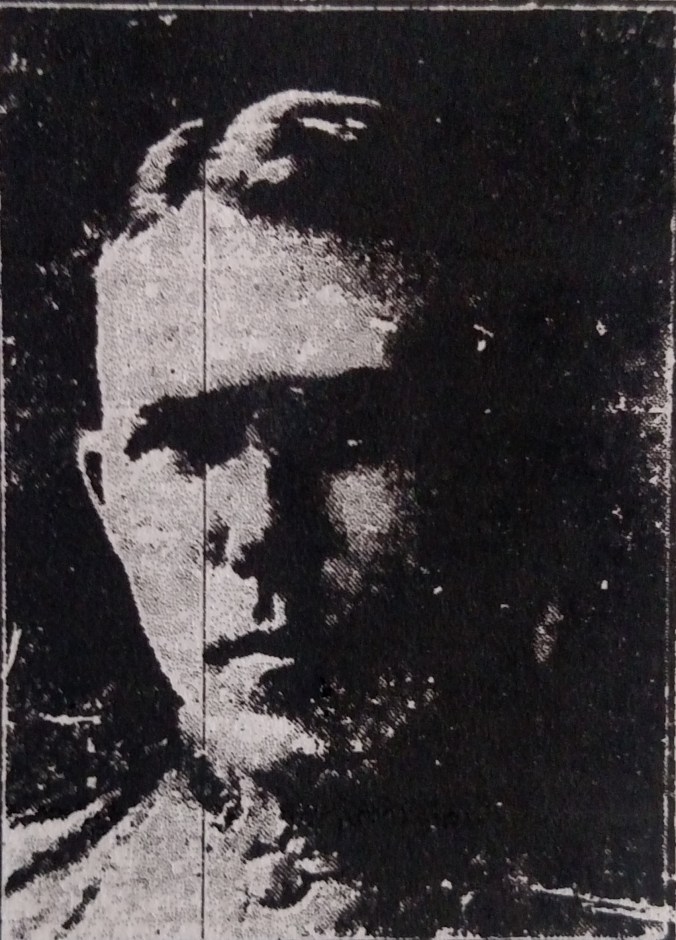
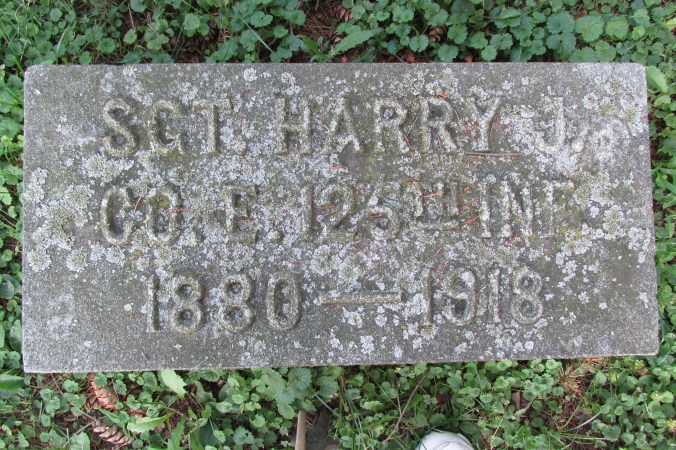
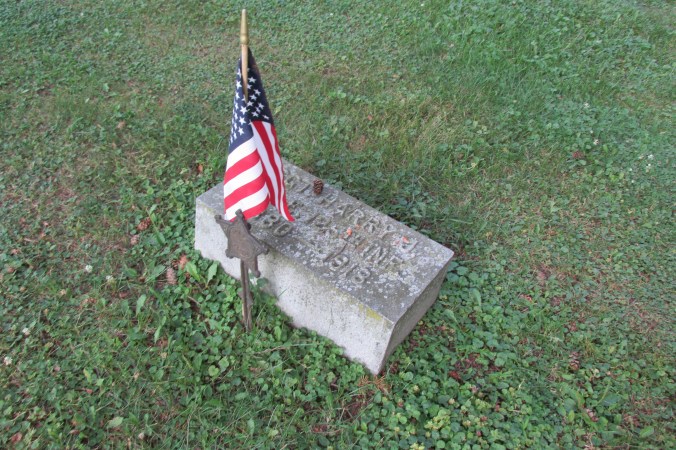
Above: The only known picture of Harry J. Leonard from the Alma Record; Leonard’s Identification Badge; Leonard’s marker in Alma’s Riverside Cemetery.

         Harry James Leonard was born September 4, 1888, in Fenton, Michigan. His parents, Frank and Anna, also had a younger son known as C.B. Harry attended Alma schools, graduating in 1903. Afterward, he attended Alma College for two years and graduated from the Valparaiso School of Telegraphy. Prior to the war, Leonard was working in Flint where he joined the Michigan National Guard. In 1917, he was initially left out of the guards but after a few weeks, he found a way to join them. He would eventually go to France with the 125th Infantry as Sergeant of E Company, which was part of the Rainbow Division.

There were other things that people did not know about Leonard until after he died. As a member of the National Guard, he had served during a bitter mining strike at Calumet, Michigan. He also had been stationed near the Mexican border during conflicts prior to the United States entry to the war. Because of his experience, Leonard knew something about being a soldier before he ever made it to France, and he “itched” to do his part. Something else that people did not know about him was that he suffered a personal tragedy – his young wife, Helen, died shortly after Leonard left for France from a surgical operation. They had been married just over two years.

As the summer of 1918 continued, the numbers of young Gratiot County men who died in France started to grow. In late August, news of Leonard’s death was announced in county newspapers, even though he been killed at Chateau Thierry on July 31. A report filed by Sergeant Alfred Johndro stated that Leonard had been wounded by machine gun fire on that afternoon and that he died at seven o’clock that night in a first aid station. He was buried three days later on the battlefield, ¾ of a kilometer south of the town of Cierges.

On April 12, 1921, Leonard’s father, Frank, received a telegram stating that his son was being brought home to Alma. Part of the arrangements of the body and burial were conducted through G.V.Wright’s funeral service in Alma. It was an especially hard arrival for many in Alma when Harry Leonard arrived as he was accompanied by another fallen Alma soldier, Leslie McLean. It turned out that both men were buried on the same day in the same location, Alma’s Riverside Cemetery. Both soldiers also had many people attend their funerals.

Harry J. Leonard was one of the oldest of Gratiot County’s men to die in the World War at the age of 37. He left behind his father and one brother.

Copyright 2018 James M Goodspeed

Thirty Who Dared to Serve Gratiot County in the Great War, Part 9: “Where is Riker?” – Orrin Riker, Ithaca’s First Enlisted Man to Die in World War I”

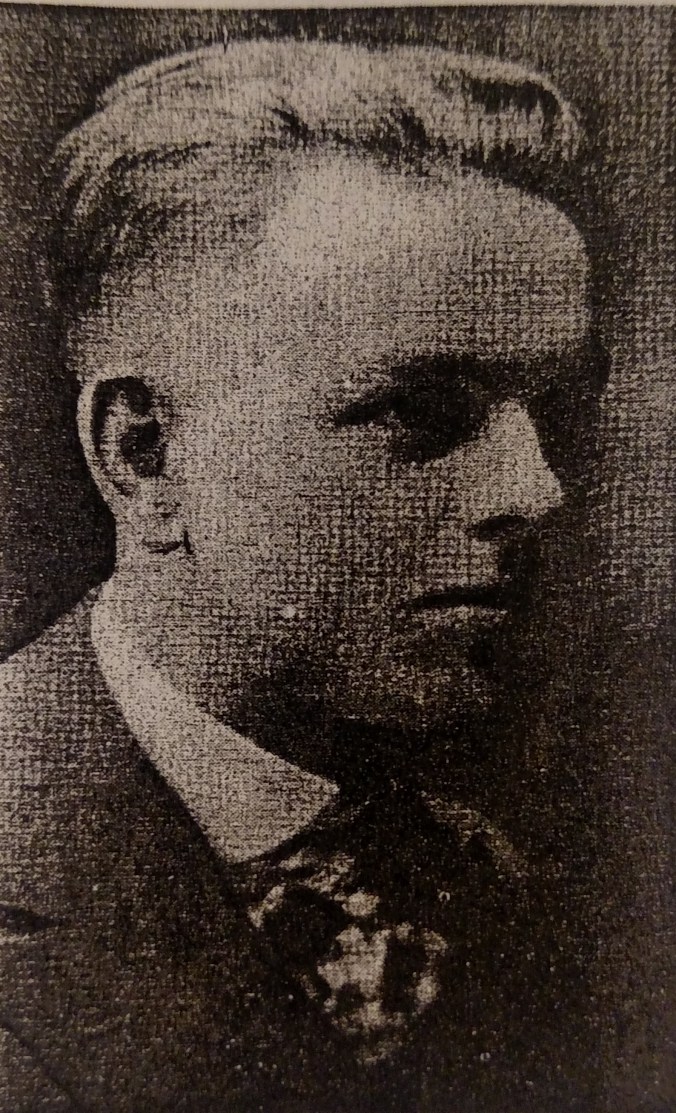
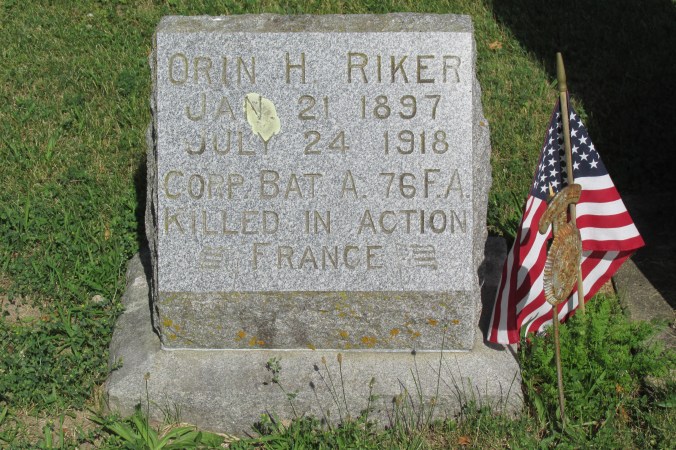
IMG_20180803_223148045.jpgIMG_6375.JPGIMG_20180803_223134246.jpgIMG_20180803_223531007.jpg

Above: Portrait of Orrin Riker taken before summer 1917; Riker’s marker in Clinton County; testimony of how Riker died in July 1918; Riker’s identification tag.

        On July 4, 1918, an Ithaca soldier who had recently completed his training wrote to an Ithaca family and asked about his friend. “Where is Riker? Did he make it across?” The soldier wanted to know what happened to his buddy, Orrin Riker, and if he had made it over to Europe or not. Three weeks later the Army announced that Orrin Riker had been killed in action in France. He was the first enlisted man to die from Ithaca.

        Orrin Hudson Riker was born to William and Lilian Riker in Maple Rapids, Michigan on January 21, 1897. Orrin was one of four children and his childhood was largely spent in Maple Rapids, except for a brief time on farms in Ovid and Essex townships. Up until the age of five, he went to school in the Grove District school. Afterward, he attended high school in Maple Rapids. Starting in the fall of 1913, Riker learned the trade of printing at E.B. Pilkington’s Dispatch office.  He soon moved to The Ashley World and the Middleton Record, then he spent three years at the Gratiot County Herald where he was the night linotype operator.

        Once the United States declared war against Germany Riker was among the first to join up.  On May 6, 1917, Orrin enlisted in Alma and was soon headed for Grand Rapids.  His records show that he was 5’ 9 ½” tall, had gray eyes, brown hair and weighed 139 pounds. From there he went to Columbus Barracks, Ohio and Fort Ethan Allen in Vermont. In the process, Orrin Riker was made a member of Troop A of the 18th Cavalry.  From Vermont, Orrin wrote one of his letters home to his parents. He had just received a box of gifts from a group of employees at the Herald and the letter was dated October 2, 1917. Riker mentioned that he had been placed in a field artillery formation that was practicing canon drills. The caissons that he saw each had a gun and each caisson was drawn by three teams of horses, which required certain skills to drive the team. It was also interesting to him that the guns he saw were used by General Pershing in Mexico and that they had seen action there.  Riker commented that he had been made a corporal “a while back and since then my life has been a misery. You have responsibilities you never dream of… I am no quitter and I am coming fine.”  Map reading interested Riker and he felt that his work as a printer helped prepare him for it. He did lament the weekly “maneuvers” that his group had to do, which once meant an overnight hike of 35 miles. Records show that Riker was then sent to Camp Shelby, Mississippi on December 1, 1917, and that he was transferred to Company A of the 76th Field Artillery. On February 15, 1918, he went overseas to France.

         Tragedy met Corporal Riker on July 24, 1918, when he was instantly killed while standing around the gun positions of the 76th near Fismes, France. Apparently, Riker had been on his way to a listening post when he paused at that spot. It was then that a direct shell hit him in the head, shattering his lower jaw. To many who heard of where he died,  Fismes was a part of what was called the Second Battle of the Marne.  Riker was initially buried near where he fell and he was moved again until he was buried at an American cemetery near the town of Seringes. Here Riker was placed in a grave with one of his identification tags placed on his marker and another on his body.  Back in Maple Rapids, a memorial service was held in his honor in October at the Maple Rapids Christian Church.  No one knew then, however, it would be almost three years before Orrin Riker found his way back home.

       Riker ’s mother was like many other American mothers who wished that her son would be returned home for a final burial. It was not until April 1921 that the Army told Mrs. Riker that her son’s body would be returned. The following month the body was disinterred and boxed; in late July it was sent aboard the SS Wheaton with a group of twenty other Michigan men. Breckenridge’s Howard Wolverton, who died in July 1918, was also part of this group coming home. On August 4, 1921, a telegram arrived at the Riker home stating that Orrin Riker would be arriving at St. Johns. His final resting place was at Sowle Cemetery in Essex Township, Clinton County. An estimated 70 soldiers and sailors from Clinton and Gratiot counties attended the service.

         Orrin Riker was one of few men from Gratiot County who were also claimed by other counties. When Riker death was announced in July 1918, the Gratiot County Herald paid special tribute to him and placed a gold star for him on the newspaper’s service flag. After the war, he also was the only Ithaca man to die in combat and the town recognized him as such. In February 1920, well before Riker’s body returned home, a group of fifty men met at the Ithaca armory and formed the Orin H. Riker American Legion Post Number 237. The Post in Ithaca remains active and carries his name  (along with World War soldier D.C. Furgason) to this day.

        Yes, in response to an Ithaca soldier’s question in the summer of 1918, people after the World War now knew where Orrin Riker was.  He “had made it across” to France, he was killed in action but he had finally made it back home.

        Orrin Hudson Riker was only twenty-one years old when he died during World War I.

Copyright 2018 James M Goodspeed

Thirty Who Dared to Serve Gratiot County in the Great War, Part 8: Leslie C. McLean, “The Boy with the Shock of Black Hair”

Mclean.jpg29196547_463105757437520_6583554801655611392_n.jpgIMG_20180731_203339830.jpgIMG_20180731_203130612.jpgIMG_20180731_203415325_HDR.jpg29214677_463105834104179_8370571147401494528_n.jpg

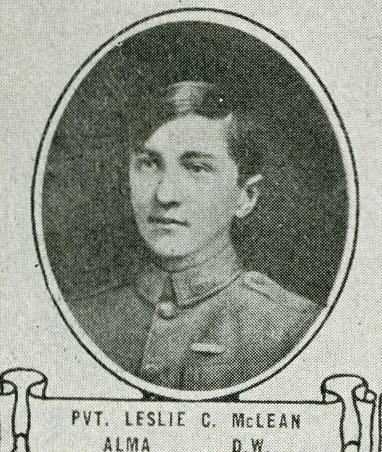
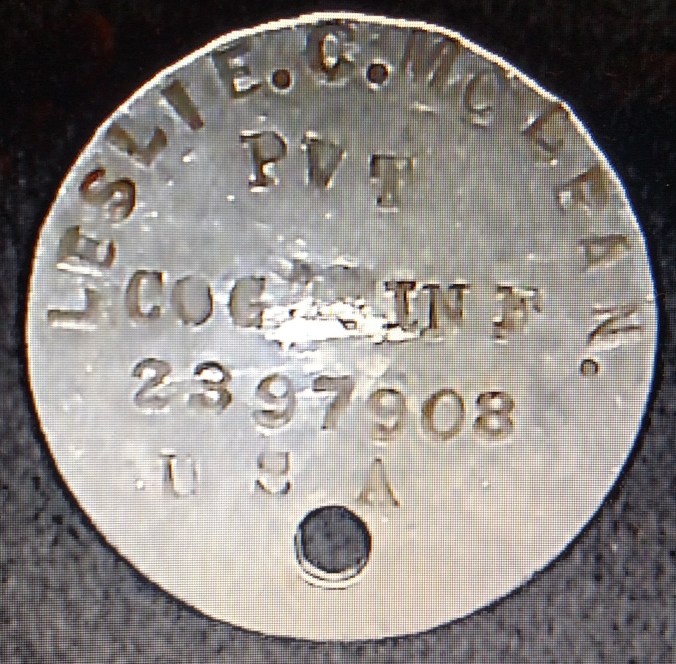
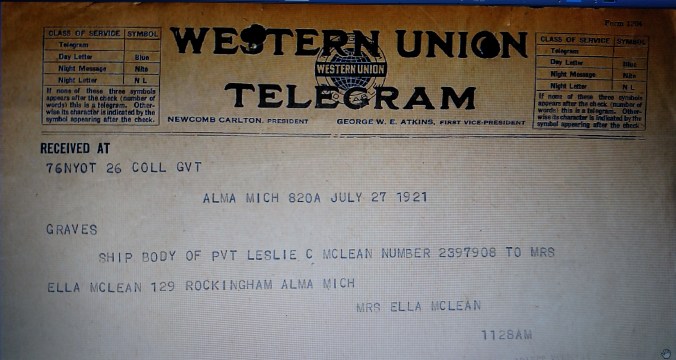
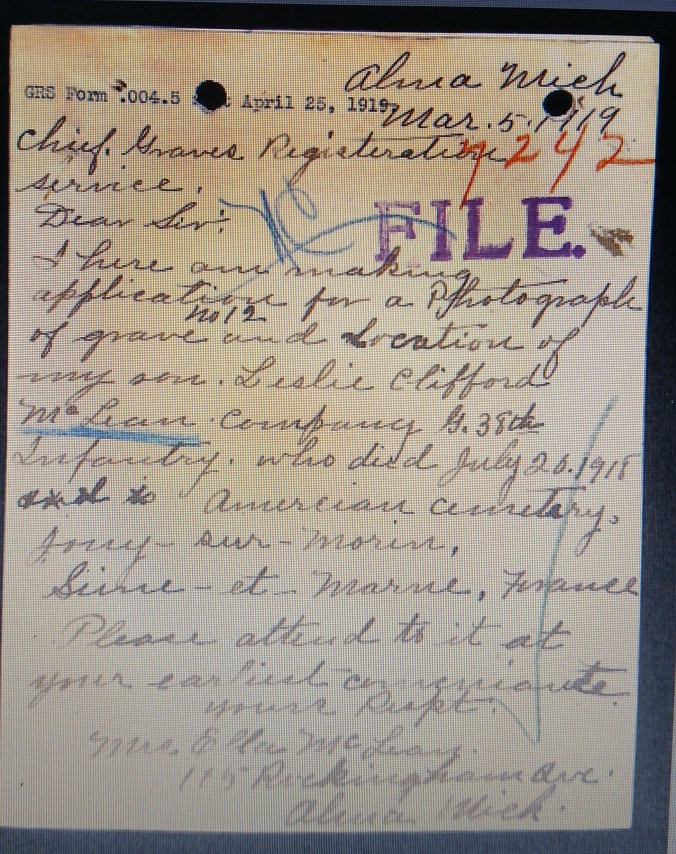
Above: 1918 photo of Leslie McLean; McLean’s plot in Riverside Cemetery in Alma; McLean’s identification medal; Army telegram to Ella McLean and card she wrote to the Army; other McLean marker in Riverside Cemetery.

        He was just a boy with a shock of long black hair who begged his parents to let him get into the war. Today, he is the youngest of Gratiot County’s veterans who died in the World War. His name was Leslie C. McLean from Alma and his story is a difficult and intriguing one.

        Leslie Clifford McLean’s story starts in 1902 when he was born to Edward and Ella McLean in Bethany Township on what was called the Boyd Farm.  The McLeans worked hard to clear the land and put up all of the buildings on what was considered a pioneer farm. The family later moved to the Delbert Conley farm near Alma. Leslie’s father was a farmer and he had two brothers. Although news accounts through the years would say that there were three McLean children, it was decades later that a descendant of the McLean family told an interesting story about a very young Leslie who once brought home a young boy in need of food and clothing. Soon, Ed and Ella McLean took the boy in and raised him along with Leslie like a brother.  Later after the war, Ella McLean would share her love for flowers and gardens with the communities where the family lived.  Edward would work as a repairer at the Republic Truck Company in town. Prior to the start of the war, the McLeans moved to Alma and lived there for four years while Leslie attended Alma High School up until his enlistment.

        In 1918, young Leslie McLean desperately wanted to enter the war while he could. Three days after his sixteenth birthday, Ella McLean signed the papers that allowed Leslie to do so. How unusual was it for a boy, barely age sixteen, to fight in World War I? According to Army census records, the average age of a soldier during the war was over the age of twenty-four, and most soldiers were in the range of twenty to twenty-five years of age. There were indeed instances of “kids” who went off to war, but there was not a lot who did so. Fourteen-year-olds (a total of 16), fifteen-year-olds (140), and sixteen-year-olds (935) did serve the country. McLean was only one in less than one thousand who did so. Considering that the minimum age for enlistment in 1917 was eighteen (seventeen if one could get a parent’s permission), it is surprising that the Army took these volunteers. Yet, in a time of war, they did so. McLean must have been one of those youths who believed that the Great War was the most important event of their young lives, and they were determined to play a part in it.

        Once young Leslie was in the Army there was not a lot to his story, however, some things are known prior to his death. He enlisted January 23, 1918, at the Alma recruiting office, but because his parents had moved to Midland in 1918, both Gratiot and Midland counties would count Leslie as one of their own. Leslie was sent to Camp Hancock, Georgia and arrived in France on April 7, 1918, with Company G of the 38th Infantry. It was thought that he was fighting in the trenches in May and that he saw several battles in July, which coincided with the Second Battle of the Marne.  McLean wrote one letter home in June shortly before he was killed. “I am feeling fine and hope you are the same.” He asked for some news clippings from the Alma Record “as I would like a to get a little news of the town.” He then told about the reality of being on the front. “A few shells bursted near us yesterday, but not close enough to hurt anyone. We have been very lucky that way so far, but it is hard to tell when one will drop in the middle of us.” He explained the importance of having one’s own hole to avoid the blasts, even sleeping in them at night, however,  they were damp. He thought that men in his unit slept quite well once they had obtained straw from a local farmer. His only regret was that they needed water, had not washed for two weeks and had only received two meals each day (one at ten o’clock in the morning and the other three o’clock in the afternoon). The men did receive a cup of coffee later in the evening. “We have had the same thing every meal now for over a week. We have some kind of French meat. It looks like horse meat and we have potatoes, bread, and coffee. Once in a while, we get a little rice or bread pudding without any sugar for dessert. “  With this closing, the letter contained the last recorded words that Leslie McLean shared with his family and Gratiot County. It would not be until a month after his death that his mother shared the letter with the public.

      Leslie McLean’s death was first reported on August 1, 1918, even though he died earlier than this. The Alma Record reported that “The hand of grim death, which is stalking over the blood-drenched battlefields of Europe, has reached forth its bloody dripping fingers and called to its own the first Alma man to fall on the battlefield, facing the scourge of the earth, the terrible Hun. Leslie McLean is the first Alma man called.” A week later, the Midland Sun also reported on McLean’s death. The Sun noted that Ella McLean had been notified of her son’s death by telegram and that his parents were living in Midland. Prior to Leslie joining the Army, Edward McLean had opened a pool and billiard parlor in the city and young Leslie had spent several months there helping his father to set up the business. The Sun also noted that Leslie had given his mother’s name as his “nearest friend” and had taken out the maximum government insurance policy of $10,000.

        When McLean’s death first became clear, it was announced that he died on July 20. Once the news reached Gratiot County there was an immediate desire to have a memorial service for him, even though his body was in France. At this time in Alma, a Chautauqua meeting was taking place and the tent was going to be used for the memorial service since the number of those expected to attend could not all fit into the McLean’s church, the Methodist Church of Alma. One of the key Chautauqua speakers, Captain George Frederick Campbell,  a British flyer who had fought in the war, even promised to stay an extra night so that he could be a part of the program. Churches in Alma closed up that Sunday evening in a show of unity across denominational lines in order to pay tribute to McLean. The service also had ministers from different churches who spoke about McLean. The tent was full that evening as Alma mourned Leslie McLean.  An estimated 1500 people attended the service.

        In early September 1918, the story of Leslie McLean had what would be the first of many turns. Through all of these events, there was a family that waited for more information about their son’s death. At times these turns seemed cruel and unfair. The September 12 issue of the Midland Sun surprisingly featured an article that “Leslie C. McLean May be Alive.” Five days earlier, Ella McLean received a letter from Leslie’s commanding officer, Captain J. W. Woolridge, that he was recommending that Leslie be sent back home because “he had done his bit,” he had been wounded in a “desperate battle” on July 15 and  Leslie was slightly wounded (the telegram was dated August 5, however, it took over a  month to reach the McLeans). For Ed and Ella McLean and their family, their grief had just been turned to hope that their son was alive. On October 31 the Alma Record also reported that Leslie was alive and that he had only been wounded. Even the Detroit Free Press carried a small announcement about McLean. What had happened? The McLeans and the town of Alma had held a memorial service almost two months prior to this and now the first Alma man to be killed in the World War was said to be alive? The McLeans and many others were bewildered by this news.

        Even more details about the death (or life) of Leslie McLean now started to filter into the press. Supposedly, he had been shot in the right thigh while fighting off a German attack near Metzy, France. Another telegram, dated September 21, told the McLeans that Leslie had survived, however, it was impossible to tell which hospital he had been sent to. The telegram also stated that the Army did not know if he was wounded, gassed or a victim of shell shock. Michigan Congressman G.A. Currie entered this story as he wanted an investigation into what had actually happened. Currie attempted to get more answers to the McLean mystery. Still, the investigation would linger another three months and the McLean family was left wondering what had happened to their son.

      In early January 1919, with the war now over, news came that friends of Leslie McLean who were in the Army at the same time Leslie was believed that he was indeed dead. Even more, the first installment of the government insurance policy was paid to Ella McLean’s policy that Leslie took out in her name. Another sad event happened when in February, Colonel Charles C. Pierce of the Graves Registration Service in France sent word to the McLeans that their son was “in a hero’s grave in the American cemetery at Jouy-sur-Moin, Seine-et-Marne.” The Alma Record also wrote that Ella McLean received a letter prior to this one that a St. Louis soldier told of meeting another St. Louis man in France who witnessed a wounded Leslie McLean on July 15, 1918, who was crawling to a first aid station “after having refused assistance” for help. He claimed that McLean died from blood loss due to his wounds. For the first time the press now openly addressed the mix-ups, delays and crossed messages that played a part in determining what really happened to young Leslie McLean. This was also the first mention that Leslie had been to a field hospital.

        In all of the confusion and renewed hope that her son was alive, Ella McLean returned the first insurance checks issued to her upon the hope that her son was not dead. No further checks came to her. For the remainder of 1919 and most of 1920, Ella McClain and her family lived with the uncertainty of their son’s death or existence. Burgess Iseman, who was a former soldier from St. Louis, wrote to the Quartermaster General in Washington and asked where Leslie McLean was buried so that he could visit the grave.  The Army wrote back and told Iseman that McLean was in grave #52 in the American Cemetery in Jouy-Sur-Morin. It is unclear if Iseman made it there or not, but at least there were others who were interested in keeping the memory of Leslie McLean alive.  In December 1920 the story took another turn. The Alma Record ran an article on December 30 that read, “PREY ON GOLD STAR MOTHERS: Crooks Attempt to Secure Funds by Sending Fake Reports by Telegraph, LOCAL WOMAN NEAR VICTIM.” It stated that “Mrs. Edward McLean is suffering from the heartaches of the noble mother who has given her son for the honor of her country.” Ella received a telegram that read, “Arrived today. Coming home. Wire $100.” It was signed Leslie McLean and it was sent from Brooklyn, New York. Was it possible that Leslie McLean was alive 2 ½ years after his death was first announced? Ella sent her son Herbert from Midland to Brooklyn, New York to find out who sent the telegram. Four days later she received a telegram that “The man is a faker” and that the first telegram was a hoax.  Fate was again playing with the family’s emotions.

       It would not be until the summer of 1921 that some closure came to the McLean family. It was then that someone answered an article in the American Legion magazine regarding what happened to Leslie McLean.  A Corporal Orman Egleston,  who was from Oswego County, New York, had served with Company G of the 138th Infantry, along with Leslie. He wrote to Ella McLean and detailed her son’s last days. On July 15, 1918, Leslie had been wounded across both of his legs and he was placed in the cellar of a hotel in Merzy, France. Egleston was in the cellar with McLean and a Frenchman. All three had been seriously wounded. Anyone in the cellar was told that if anyone could walk they were told to get up and leave with the retreating American troops as the Germans were soon to surround the town.  After two or three days, the Frenchman crawled out of the cellar and a scream was heard shortly afterward. It was believed that the Germans had killed him. With little to eat or drink and seriously wounded, McLean and Egleston were in the cellar until July 20, a total of five days. It was then that Egleston decided that he would crawl out, which he did. After crawling to his former headquarters in the town, he passed out. Although the Germans soon discovered Egleston, they did not kill him. The Germans soon left the town and Egleston was somehow reunited with his commanding officer. He told the officer about McLean being in the basement and a search party found him. However, after being evacuated,  McLean died on his way to the hospital. This testimony was now the concluding piece of the story of how Leslie McLean actually died.

        After years of grief, discouragement, hope and false hope, it was during the summer of 1921  that things happened that allowed Leslie McLean to return to Gratiot County. Ella McLean had made it clear that ultimately she wanted her son to buried in Alma and not remain in a national cemetery in France.  The Army exhumed the remains and upon a final autopsy in 1921 it was noted that although there was not a lot to identify Leslie beyond his dental records. However, it was recorded that his hair was “apparently black and plentiful.”  Several times the records stated “DWRIA” which meant “Died of Wounds Received In Action.”

                On July 2, 1921, the body of Leslie McLean started home aboard the SS Wheaton.  He ended up being one of 45 men from this group to return to Michigan that summer. On July 27, the McLeans received a telegram telling them that Leslie’s remains would be delivered to them on July 27.  The journey led to Alma and the McLean family held the funeral on Sunday, August 4 at the Alma First Methodist Episcopal Church. It turned out that another Alma man, Sergeant Harry Leonard, who also had been killed in July 1918, was also being brought home on the same transport with Leslie McLean. There were two World War funerals on the same day in Alma – and both were held at almost the same time, but at different churches. Both men were buried in Alma’s Riverside Cemetery and hundreds turned out for the two funerals. This was the second Alma funeral for Leslie McLean and people still came to pay their respects. The McLean family now had closure to the tragic death of their youngest son.

       As time passed the memory of Leslie McLean’s name appeared again. In March 1934 the Gratiot VFW Post in Alma was named in honor of him. Forty veterans attended the meeting and twenty-two signed the post’s charter that night. On September 10, 1937, Ella McLean passed away. In response to her youngest son’s death, Ella was made an honorary member of the VFW and American Legion, as well as an active member of the American Legion Auxilary. At her funeral, an American flag was placed on her casket. Her obituary also told more about her. After the moves back and forth from Midland to Alma (apparently during or just after the war), Edward and Ella purchased a home on Rockingham Avenue which was in a way a living memorial to their son. They created a beautiful garden which the town of Alma knew about because of its flowers. Ella grew tulips, gladioli, delphinium and perennials which decorated their garden. They often entered them in flower shows and they also created a business that sold flowers and bulbs. Ella would frequently take gladiolas to downtown Alma businesses for their display windows. When she passed, it was said that she was remembered as “a remarkable but modest personality.” Edward McLean lived until September 30, 1942. His funeral, like his wife’s, was held in the family home.

        In the early 1920s, a call went out to ask Gratiot County’s World War I veterans to share information for posterity regarding their service.  Leslie McLean’s file was basically empty, containing only an article from the Lansing State Journal published after the war about his death in a French cellar. That was all that it said. Not even his service serial number was listed (it was identified later as #2397908). When the Alma VFW Post dedicated its new building on May 12, 1973, on Wright Avenue in Alma Leslie McLean’s story was told again. Mr. and Mrs. Clare McLean of rural St. Louis, relatives of Leslie McLean, donated McLean’s picture and a clipping about him from the 1918 Alma Record. After the end of the Vietnam War, this brought the story of Leslie McLean to another generation of Gratiot County residents.

       Yet, McLean’s story came up again. In 2014, the Alma Public Library sponsored a program entitled “Remember Me – A Walking Tour Through Alma’s Riverside Cemetery.” Local historian Dave McMacken wrote the script that introduced several interesting and important people from Alma who were buried in Riverside Cemetery to those who wanted to learn about Riverside Cemetery. Those who went on the trip to the library and the cemetery to learn these stories heard McMacken tell the background of certain individuals who featured in the tour.  A local person dressed, read and acted out the part of the deceased. One of the stories featured Leslie McLean, who was portrayed by Ithaca High School student Dustin George. Finally, during the 2017 fall semester, a Fulton High School junior who was looking for a research paper topic relating to Gratiot County’s history came upon the story of Leslie McLean. She wanted to learn more about him. Brittany Barrus sought out McLean’s grave, searched through old newspapers and wrote a research paper about him.

        Now it has been a century since the service and death of one of Gratiot County’s most interesting and tragic stories concerning about men who died during the Great War. The boy with the shock of long, black hair, Leslie C. McLean of Alma, was one of these men. And he was only sixteen years old when died in France in 1918.

Copyright 2018 James M Goodspeed

“From the Corner of St. Johns and Emerson to Barber Street: 100 Years of the Ithaca Church of God, 1918-2018″ Part II: Putting Down Roots During Boom and Depression, 1921-1943”

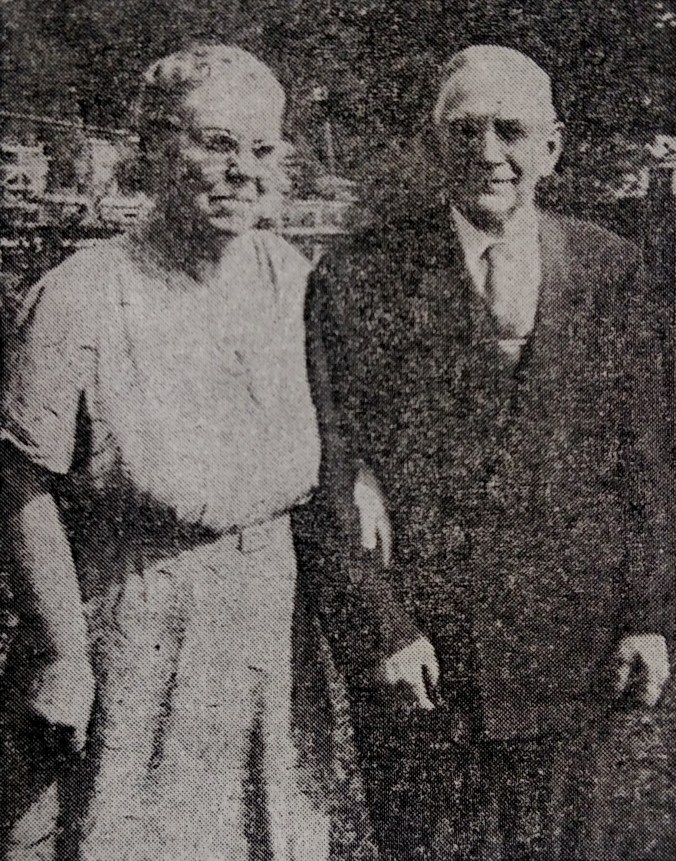
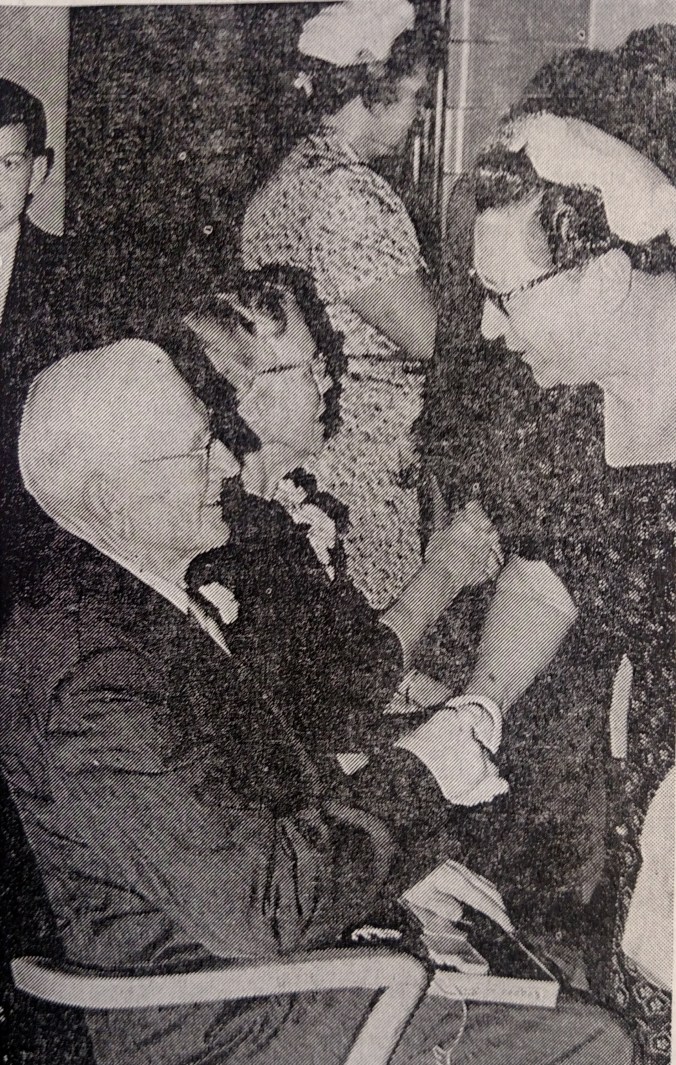
Lewis copy 1953.jpgLewis copy 2 1963.jpg

Above: Pastors George and Effie Lewis in 1955; “George Lewis, This is Your Life” at Ithaca High School, 1961.

         Under Reverend Lewis’ work, the Ithaca Church of God congregation slowly grew in numbers. The times were not easy. The 1920s were generally a “boom time” economically for parts of the nation, however, it presented many social problems and challenges. Gratiot County had an active Ku Klux Klan unit from 1922-1930 and made appearances in Ithaca. The 1920s were also the period of Prohibition and Ithaca dealt with illegal liquor, bootleggers and the quest to “stay dry.” Diseases such as tuberculosis, scarlet fever, and diphtheria were present and claimed the lives of both young and old in Gratiot County. By the end of the decade, an economic crash took place, unlike anything that was ever seen in the county’s history.

         Throughout the period Reverend Lewis faithfully continued his work as a pioneer minister. At one point during the Depression, a motion was made by some in the young Ithaca congregation to raise his pay ( from $ 3 a week to $4) because some felt that their pastor should not be the lowest paid minister in Ithaca. At the start of the Depression, Lewis listed his occupation as “working on own account” or “decorator” and he still carried out his duties as pastor. The Lewis family also had a member who lived with them for fourteen years that would be devoted to the Ithaca church throughout her life: Miss Lottie Ruehle. After her mother died, Lottie came as a young lady to live with the Lewis family.  She was devoted to the church and was known to many in Ithaca because she was one of the Ithaca’s telephone operators.

         In 1937, a 12 by 30-foot addition was added to the south side of the Chapel. Another addition was made in 1940 in similar size to the north side in order to give the congregation more Sunday school room. By this time, people began to know this place of worship as “The Little Brown Church.” The church was growing in size but it still lacked one thing throughout this part of his story: it needed places to park.   Throughout this part of its history people had to park up and down the streets in front of the church in order to find a place to park their cars.

        Through all of this, Reverend and Mrs. Lewis faithfully oversaw the growth of this church. During the summer of 1942, Reverend Lewis resigned as the pastor but stayed on until a new one was hired in early 1943. After leaving the Ithaca church, he served as a supply minister in the county.  On October 16, 1955, the church held a special service to honor their work.  After Reverend Lewis’ sermon, the church had a formal presentation for the shrubbery that was planted along three sides of the church. It was dedicated as a living tribute to Lewis’s work and service.   In the years after they left, many in and around Ithaca continued to call on “Pastor Lewis” for help such as funerals. He continued to be well respected and wrote a regular column for the Gratiot County Herald right up until his passing.

         In September 1961 Reverend Lewis was a guest of honor at a surprise “This is Your Life” program that was held at the high school. Three hundred people turned out to pay tribute to Reverend Lewis in the words of then Pastor Earl Van Sipe as “minister, counselor, community figure and beloved friend of many hundreds in Gratiot County.” It was said that Lewis had married approximately 500 couples and conducted 1,000 funerals. “The Little Brown Church” had been launched and was on its way as it entered the 1940s, new pastoral leaders came and the church faced and endured another world war.

Copyright 2018 James M Goodspeed
Thirty Who Dared to Serve Gratiot County in the World War, Part 7: Richard N. Willoughby, “No One Seemed to Know What Happened to Me.”

Willoughby head stone.jpg

HWilloughby card A.jpg


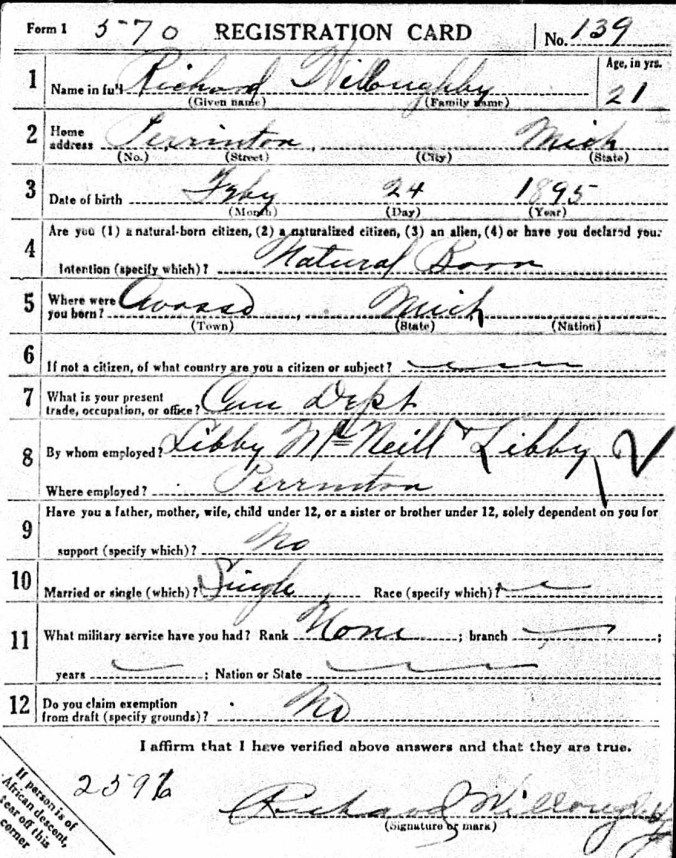
Above: The marker of Richard N. Willoughby which is in Fulton Center Cemetery in Fulton Township; Willoughby’s 1917 draft registration card.

         He had a mother who desperately wanted to know how he died, where his belongings were and when his body would be brought home. It took over two years, however, Richard Willoughby eventually made his way home after dying for Gratiot County in the Great War.

Richard N. Willoughby was the youngest of three children; he was born February 24, 1895 to William and Anna Willoughby. In 1900, he was listed as living with his family in Owosso where his father was a farm laborer. By 1910, when Willoughby was only 15 years old, he lived with his aunt and uncle. Something around this time happened in the family: possibly his father died, his mother remarried, and the family may then have moved to Perrinton.

Richard grew up to be a tall, young man who had blue eyes and light colored hair. He also worked in the office for Libby, McNeill & Libby of Perrinton as a time keeper. It appears that Willoughby enlisted in the Army on June 5, 1917 and was sent to Columbus Barracks, then to Syracuse, New York and in the process he became a Private in Company I of the 23rd Infantry. Not much was said or written about Willoughby’s service in the local newspapers. Only one, the Alma Record, noted in late September 1918 that “there is a strong probability that (Willoughby) is a prisoner in the hands of the Hun. It is also possible that he has paid in full his debt to this country, by giving his life in aiding to promote its success.” It ended up that the Alma Record was correct on the second part of its statement.

In reality, Willoughby had been killed in action on July 19, 1918 when he was hit and immediately killed by shrapnel that shattered his head and his left arm. Private Guiseppi Guarino of Cambridge, Massachusetts was a witness to the incident. Willoughby was given a chaplin’s funeral in Ploisy Aisne Cemetery, near the spot where he fell. Back home, his mother, Mrs. Anna Herrick, heard nothing other than the news that her son was dead. For almost two years she did not know where her son died, what actually happened to him, where he was buried or where his belongings went.

In November 1920 Mrs. Herrick wrote to her Congressman asking for answers to these questions. She eventually filled out a request for his removal and final burial at home, but she also wanted to know when he was coming home and how he died. In January 1921 some of her questions were answered when the government notified her that that the remains of her son were finally being sent home. Mrs. Herrick was adamant that her son be sent to Perrinton for internment. In early May 1921 she was told that her son would arrive on May 13, accompanied by Private Robert F. Coles, an attendant with the 28th Infantry. Willoughby had first been placed on the USAT Somme, then once he arrived in Hoboken, New Jersey, he was ultimately placed on the Grand Trunk Railroad.

Once Richard Willoughby returned to Perrinton, Michigan he came home with only two things: a ring with the letter “R” stamped on it and his serial number (51,464), which no one back home seemed to know. Willoughby did, however, leave a legacy in southern Gratiot County. In 1921, he and another fallen soldier from Perrinton in the World War (Lyle Smith) had the American Legion Hall named after them in Perrinton. Today, a marker is all that exists for the sacrifice that Richard N. Willoughby made for Gratiot County. Richard Willoughby was only 23 years old when he died in the Great War.

Copyright 2018 James M Goodspeed
 

Thirty Who Dared to Serve Gratiot County in the World War, Part 6: Howard C. Wolverton, “I Was the First from Breckenridge to be Killed”

Wolve 2 a.jpgWolve 2b.jpgHoward C Wolverton.jpg

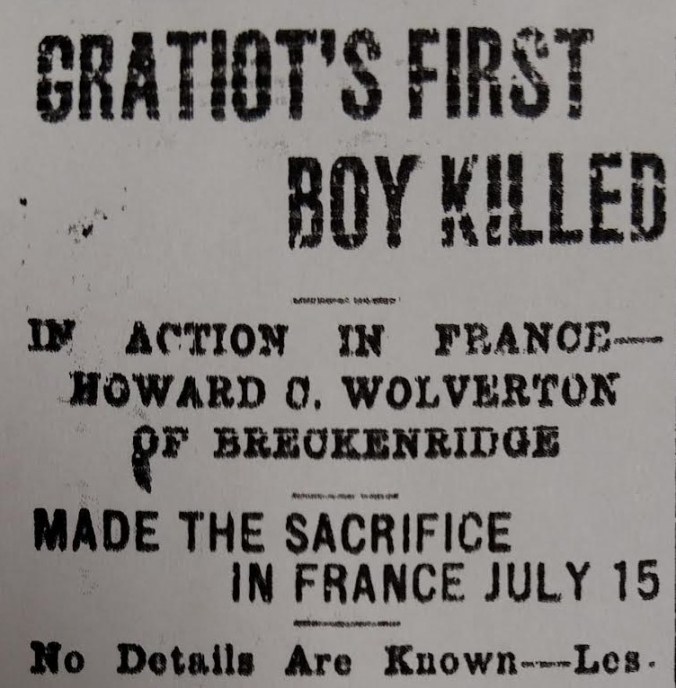
Above: Newspaper articles from Gratiot County newspapers in the summer of 1918; Howard C. Wolverton’s burial marker.

         “He was, I can unhesitatingly state, one of the best men and best soldiers under my command. Cheerful, intelligent, ready, willing, and without a trace of personal fear. My highest regards to you who brought him up…”

        These words made up part of the letter that Howard C. Wolverton’s commander wrote to his  parents as he tried to talk to them about the loss of their son. Wolverton had been killed early in the morning at Petit a Beaux, France on July 15, 1918. A witness said that he and a corporal were resting outside their tent near their gun position, awaiting their morning breakfast. Then, a direct hit from the enemy early that morning  killed both soldiers instantly.

        Howard C. Wolverton was born in 1895 in Gaylord, Michigan to Mr. and Mrs. W. G. Wolverton. The family moved different times before settling in Breckenridge. At one point, after moving from Sheridan in Montcalm County, they operated the Pompeii store. Howard then went to work for the Republic Truck Factory in Alma. He was of medium build and height, had blue eyes and brown hair. He also worked at an auto plant in Detroit, got sick but then went and enlisted in the Cavalry on May 6, 1917, shortly after war was declared against Germany. He was sent to Fort Ethan Allen and by January 1918 and he became a sergeant at Camp Shelby, Mississippi. Wolverton sailed from Camp Merritt, New Jersey for France in April. His commanding officer told his parents in his letter of consolation that it was a goal of sending Howard to Officers Training camp in the future. Howard was that good of a soldier.

           In late September 1918, services were held at the Breckenridge Congregational Church, even though Wolverton’s body was in France. The Gratiot County Herald recorded that at the service “There was a large crowd turned out to do honor to our first Breckenridge boy to fall for democracy on the field of battle.” Upon his death, Wolverton was buried near where he was killed, then he was moved in 1919 to the American Cemetery near Belleau Wood.

        At some point either near the time that their son died, or shortly thereafter, the Wolvertons moved to Fenton, Michigan. It was here in 1921 that Mr. Wolverton wrote to the government to ask that his son’s body be sent home for a final burial. After traveling from Antwerp, Belgium to Hoboken, New Jersey, the Grand Trunk Railway brought Howard C. Wolverton’s body to his final resting place in Oakwood Cemetery in Fenton. Records state that there is a marker in Breckenridge’s Ridgelawn Cemetery. Probably the marker was erected shortly after his death in 1918 to commemorate a son who could not come home at that time.

          Regardless, one of Howard C. Wolverton’s legacies is that his name was joined with another Breckenridge native who was lost in the World War. Together they formed the creation of the Wolverton-Sawvel American Legion Post, which still exists today.

Copyright 2018 James M Goodspeed

Gratiot County During the Great War – July 1918: “The Summer of Saving, Sacrifice and Blood”

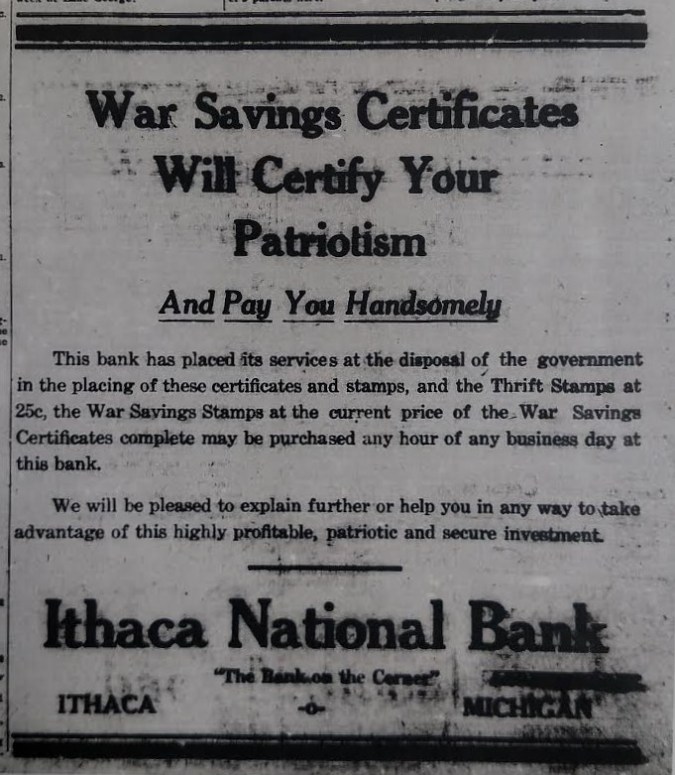
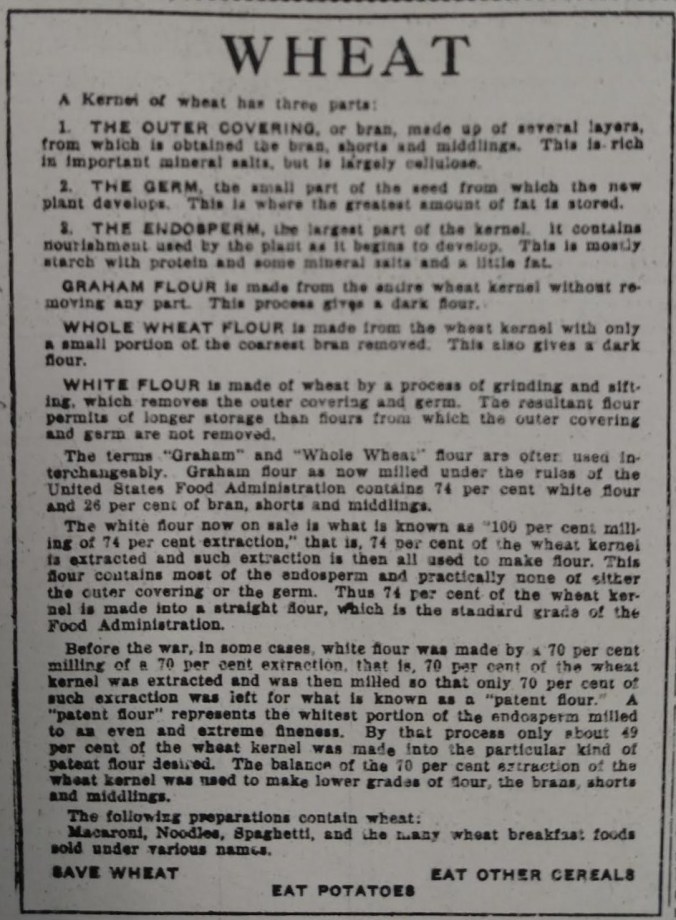
Enlist A.jpgBAnk A.jpgWSS A.jpgWheat A.jpg Above: news advertisements from the Gratiot County Herald and Alma Record from July, 1918.

        During July 1918 some advertisements appeared through the newspapers in ways that they had since the United States entered the Great War (now referred to many as “The World War”).

       The Ithaca Commercial Bank asked people to buy “Baby Bonds” (War Savings Stamps) because “Every member of the family should have a BABY BOND.” The same bank imitated the pressure put on people in 1918 to be loyal Americans: “War Savings Certificates Will Certify Your Patriotism – And Pay You Handsomely.” Other businessmen like H.B. Thompson told people they should buy military watches for their soldier boy because “The hardest item in the Jewelry line to obtain is to get a good Military watch.” People also were asked to “Be Patriotic: Attend the Big Day and Night Fair” at the county fair as a portion of the proceeds of ticket sales would be given to the Red Cross. Then there were advertisements that loudly hammered the theme of doing one’s best in wartime, and then asked individuals to buy the merchants product. The Middleton Farmer’s Elevator shouted to people to “SAVE FOOD” because the United States Food Administrator, Herbert Hoover, urged conservation and self-sacrifice with food products. The elevator had a supply of Number 4 Yellow Corn for sale, and this type could be fed to livestock. C.H. Corwin in Ashley also told readers to “SAVE! SAVE! SAVE! And Help Feed the Allies” by buying groceries and provisions from him. Still other advertisements from the government repeated “Be an American! Enlist in the Marines!”
The county was continually asked to buy war bonds and stamps in July. Known as “Baby Bonds,” War Savings Stamps became the way that all people, regardless of how much money, could support the war effort. Every person in Gratiot County could purchase War Savings Stamps and they were expected to do so. Simon Messinger of Alma tried to encourage 98 boys to buy stamps. If any of them showed a card with three stamps on it, he would provide the fourth, which would eventually be redeemable for one dollar after the war (an increase of 25 cents). Fred Slater, William Rogers and Otto Sanderhoff all purchased an advertisement in the Alma Record entitled “A Call to Every American.” It encouraged people to invest in the five dollar stamp plan. When Alma held another stamp drive in July, employees of Republic Truck Company Plant Number Three purchased over $2000 in stamps. Mrs. F.W. Ruggles, the company owner’s wife, purchased the limit of $1000 worth of stamps. Mr. and Mrs. Henry Kuhn also bought a total of $500 in stamps.

       Rationing continued and there seemed to be no end to the warnings by the government that leaner times were here. Gratiot County just needed to prepare and persevere. In Alma, there were attempts to start rabbit clubs in order to provide extra meat for families. Boys and girls from ages ten eighteen were invited to participate. War time recipes involved what could be done with cottage cheese dishes. Egg candling was required for anyone selling eggs by the case. Wheat harvest was imminent and already people were being told how to use whole wheat flour in efficient ways. Macaroni, noodles, spaghetti and many wheat breakfast foods all contained wheat, therefore as one advertisement read “SAVE WHEAT – EAT POTATOES – EAT OTHER CEREALS.” Dr. J.H. Kellogg from the Battle Creek Sanitarium even tried to convince the public that “There is no necessity for eating wheat at all.” Kellogg recommended a total meatless diet and encouraged using more peanuts and soy beans. He also argued that using more corn with milk would be a great substitute in the diet. New sugar rulings took effect starting July 1 and one could not buy more than three pounds of sugar per month and grocers could have no more than a thirty day supply on hand at any time. Those who still had a sweet tooth for cake were told by the government that wheat flour substitutes could be used to make barley sponge cake, corn (flour) sponge cake, oat sponge cake, spice cake -and even chocolate cake – with barley. Other conservation that summer came when elevators across the county announced that grain bags would no longer be loaned to farmers. An impending gas shortage seemed to be on the horizon. Drivers were urged to drive at an “economical speed” of 12 to 20 miles per hour. Running a car while it sat idling was frowned upon and maintaining brakes, oil and tires helped a car to be most efficient. Hard coal was going to be in short supply for the upcoming winter and people were urged to buy and save coal now. Also, starting July 29 lightless nights would be in effect on Monday and Tuesday nights in the county in order to conserve fuel.

        The Red Cross continued its work in the county, especially by encouraging support for a membership drive. Two benefits were held in Alma. One of these, the Artists’ Red Cross concert, was held at the high school and raised $300. At the Ruggles home in Alma, those who attended the benefit there found electric lights draped across the large lawn. Morton’s saxophone orchestra provided music for dancing for those who came to support the Red Cross. The Red Cross also had a large parade in Alma in mid-July. As a band made up of locals led the way, a group of 35 ladies followed in the shape of a large Red Cross. Then came the Alma branch of the Red Cross, followed by high school cadets and Michigan State Troop Company 87. When the parade finished there was a stand set up at the corner of State and Superior streets for speakers to address the crowd about donating, pledging and supporting the organization. Still, the Red Cross was active in many other parts of Gratiot County. The New Haven Red Cross chapter had 31 ladies present at its regular July meeting. The group completed work on hospital jackets, socks, quilts and waist clothes. During that month, the chapter added ten senior and three junior members. Readers of local newspapers also saw more and more drawings and images that showed the important role that the Red Cross had in the war effort.

         For a while, the county newspapers continued to focus on the status of soldiers who were still going off to war via the draft. Those who enlisted on their own found their names on the front page of the newspaper, such as six Alma men who had done so voluntarily (Clifford Link, Theodore Snydes, Elmer Markham, Russell Burrows, Elton Durkee, and Anthony Trendell). Then there was the story of Francis Zone of Lansing, a deserter, who was caught at the Alma Post Office. Zone skipped his final examination in Grand Rapids and was discovered in Alma. Sixty-four men were called for duty to Camp Custer on July 25, however, the number requested from Camp Custer was well short of the 190 Class One men that were required. The draft board was looking at the reclassification of some eligible men. There was a list published of 34 men on the Alma Company of Michigan State Troops (Company 87) along with 10 who were reserves. Sometimes when a soldier married a local girl before going off to war the announcement made the news. This happened when Lieutenant Joseph Baldwin married Irene McCall of Ithaca. The wedding was simple and the honeymoon was short, then Baldwin left for Camp Custer to train troops. He was not expected to head to France until October.

        During July, newspapers now started to publish the addresses of soldiers in camps and those who were in France. Families began to turn in the addresses as they learned where there son was located. It was hoped that people would write to Gratiot County’s young men. One of the letters that appeared in the Gratiot County Herald from Sergeant George H. Dolloff simply came from “Somewhere in France.” Dolloff wrote about being able to see over a trench into No Man’s Land into the area belonging to Kaiser Bill. One of the men in his company had just returned from a raiding party and brought back an enemy helmet. Dolloff expected to leave his trenches very soon on similar patrols.

        News reports about area soldiers changed from being informative pieces and letters from young men who were just starting the army life to the horrible reality of war. Clarence Gruesbeck of Hamilton Township was reported as being severely wounded in France in late June. The family awaited details of his condition. Grimmer still were the first stories of Gratiot men who were killed in combat. July was a bloody month as soldiers like Howard Wolverton, Richard Willoughby, Leslie McLean and Orrin Riker all fell in France. For the families and friends of these men the war took the highest possible price, Gratiot County’s youth. Sadly, there would be still more that would die from Gratiot County.

Copyright 2018 James M Goodspeed
“From the Corner of St. Johns and Emerson to Barber Street: 100 Years of the Ithaca Church of God, 1918-2018” Part I: The Birth of a Church, 1918-1920

Lewis 7a.jpgLewis 6a.jpgLewis 3b.jpglast Lewis.jpg

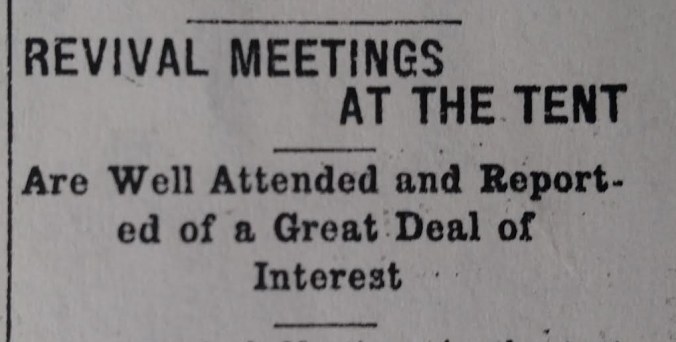
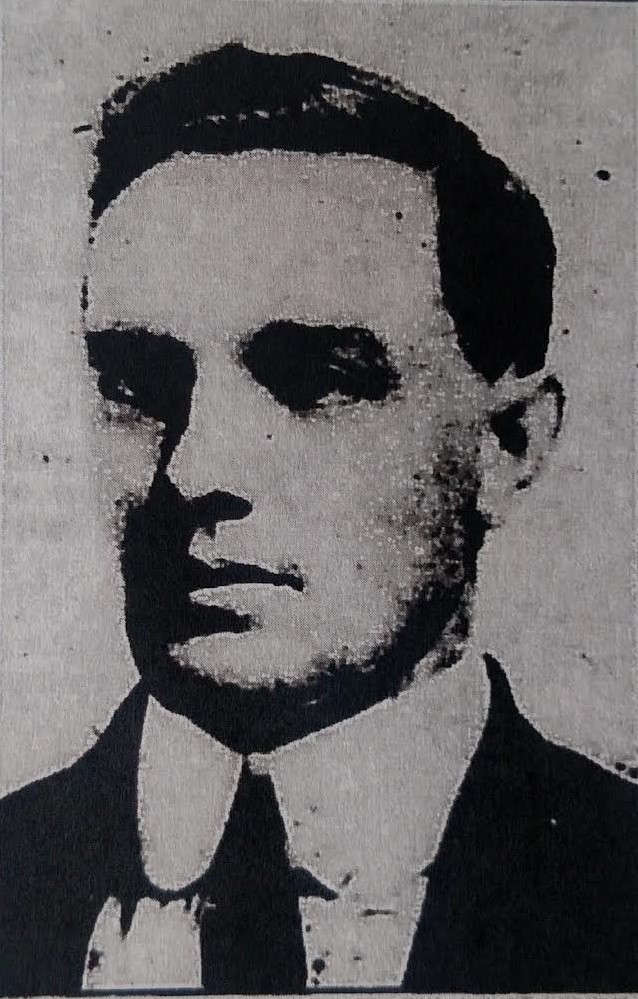
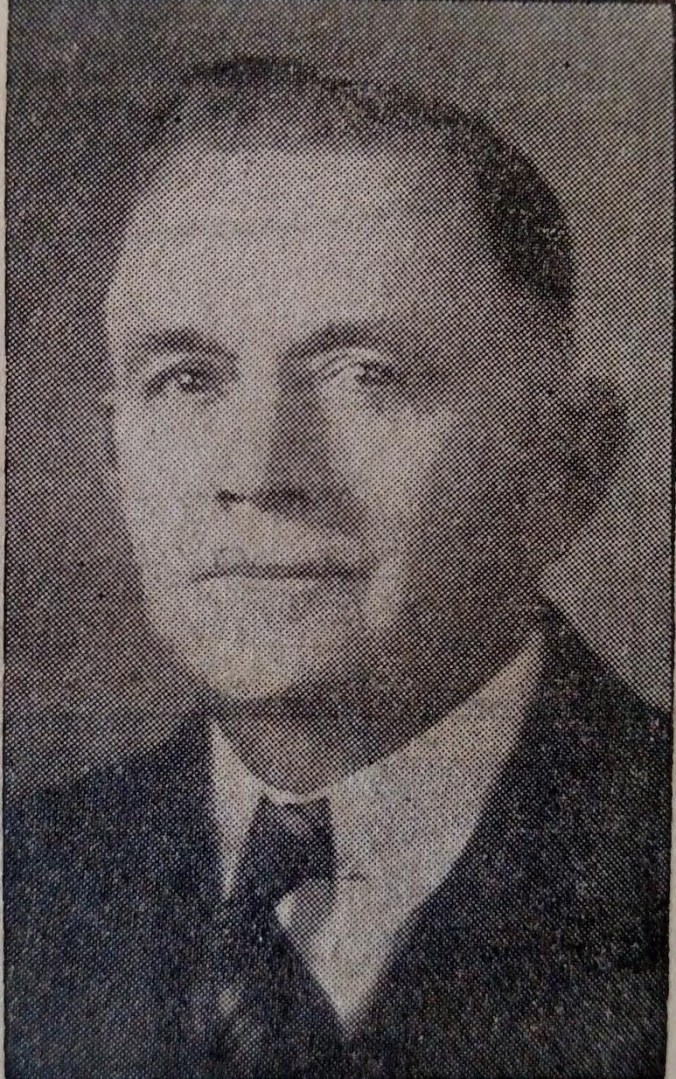
Above: Announcement for the Revival Meetings held in Ithaca in July, 1918; George H. Clingenpeel, Evangelist of the meetings; Reverend George W. Lewis, taken in 1943; a very young George W. Lewis taken in 1905.

Author’s note: This month marks the 100th anniversary of the Ithaca Church of God in Ithaca, Michigan. The following is the first in a series of articles about the history of this church, its pastors, events and  some of the people who were used by God to bring this church through its first 100 years.

          It was a time of change and challenges. Ithaca, Michigan in the summer of 1918 was, like other communities across the United States, at war. The United States had been at war against Germany for nearly a year and news of those young men from the area who died in service to their country started to reach Ithaca. That fall, the Flu Epidemic hit the United States and many in Gratiot County became seriously sick and also died. There was also heavy pressure to show one’s patriotism and to support the country during World War I. A postwar recession in 1919 would hit the area that made times tough for people. These were some of the things happening in Ithaca when a small congregation was born that eventually became known as the Ithaca Church of God.
On July 4, 1918 a notice appeared that a revivalist was holding services one block north and one east of the Methodist Church. The first meeting was held in the Revival Tent under the direction of George H. Clingenpeel, a Church of God evangelist from Wheeler Township, who had held similar meetings in Alma. These meetings took place for approximately two weeks. At end of one of the advertisements for the meetings was an almost prophetic phrase that would be one of the legacies of the church through its history in Ithaca: “Everybody Welcome.” The Gratiot County Herald reported, “The Revival meeting in the Gospel tent, is a grand success from the beginning. The crowds are filling the tent each night and are very much interested…Clingenpeel …is a plain speaker, and has something interesting for everyone.” The meetings were so successful in Ithaca that the Herald noted that people even came and listened to the meetings from their automobiles.
Two key events took place after the meetings concluded: land was donated and the first pastor of the church was called. First, William Kennett, a well known resident who was born in England and who lived in Lafayette Township and in Ithaca for most of his life, agreed with his wife to purchase a lot at the corner of St. Johns and Emerson Streets (where the tent meetings had been held). He then donated it to the church. This would be the location of the Ithaca Church of God until 1963.
The second important event dealt with the calling of the first pastor, Reverend George W. Lewis. Lewis was from New Haven Township and his grandfather was instrumental in the creation of the Lewis School, located in Newark Township. Born in 1882, George W. Lewis was converted at age 17 and began active gospel work less than a year later with the Crusaders, a group of evangelistic workers who visited area schools and Sunday schools. In 1905, he became officially ordained in the Church of God ministry and he led the church in the teachings of the Church of God Reformation Movement. Lewis met his future wife, Effie, at the Burlingame School in New Haven Township and they married in 1903. Together they had six children. On November 5, 1919 the family moved to Ithaca and purchased the Frank Shaver property on Shaver Street. He officially became the church’s pastor in 1920. Lewis supported his family by working as an interior decorator, as well as serving as minister for 23 years.
The earliest meetings of the church were held in the homes of Pastor Lewis and Mrs. Chriss Lehner. Others who were drawn to the church also hosted meetings. For example, notices appeared in the newspaper that a group of ladies “were in Newark Tuesday evening to attend a Church of God prayer service at the home of Mr. and Mrs. John Bosley.”
In 1920, the first building was built on the corner of Emerson and St. Johns Streets. The building was simply known to many in Ithaca as “The Chapel.” It is also important to note that the young church was almost on the edge of Ithaca at that time, only a few blocks from the city limits. On top of this, the main line churches in Ithaca had been in existence for decades. This was truly going to be a new church. If one wanted to know where the Ithaca church was at that time they were usually told to look for “The Chapel.” As the church started its journey, Reverend Lewis continued to work, raise a family, and to pastor a church. “The Chapel,” as it was originally built, would continue until late into the Great Depression.

Copyright 2018 James M Goodspeed
Thirty Who Dared to Serve Gratiot County in the Great War, Part 5: Paul M. Srode, “I Wanted to Fight, but My Health Failed Me”

Paul Srodes GCH pic.jpgIMG_6434.JPGIMG_6436.JPGIMG_6439.JPGWWI vets names Gratiot - Copy.jpg

Above: the only known picture of Paul M.Srodes from the Gratiot County Herald; the Srodes family plot in Ithaca Cemetery; All Wars Memorial in Ithaca.

      There were many young men who eagerly went off to war from Gratiot County and who wanted to do their best. Paul M. Srodes, who was from Ithaca, was one soldier who wanted to fight, but in the end, his own health failed him.

     Born April 28, 1896, in Chicago, Illinois to John and Eunice Srodes, Paul was a telegraph operator before he entered the war. Not much is known about the Srodes family, however, his father came to Ithaca in 1886 and purchased two lots on North Main Street. The nice home there became known to many in Ithaca as “The Srodes Home.”

     Paul Srodes entered Fort Leavenworth in Kansas on December 12, 1917, as a telegraph operator. In January 1918 he wrote home to his family, thanking them for the sweater that they had mailed to him. He now had four sweaters, but he needed them all to combat the cold weather in Kansas. Paul was only in need of more gloves to wear, however, he knew that his family was preparing to send him more.  He also told his mother that his unit was hiking twenty to thirty miles a day in order to practice how to string telegraph wires and set up telegraph posts. His letter ended with a detailed account of the death of fellow soldiers. He wrote, “We buried one of my best friends here Sunday. He died of pneumonia. He and I used to make our beds up together to keep warm. We took another fellow to the depot today, a man from our section of the company. He also died of pneumonia.”  Srodes explained how a funeral march followed the bodies to the train depot, playing songs at the station like “Nearer My God to Thee” as the train pulled out of the station. All of the men stood at parade rest as the bodies departed for their homes. “It is a beautiful site and believe me that band can make wonderful music,” he said in closing.

       Paul Srodes left with his unit, the 5th Field Artillery Signal Corps, for France in February 1918. He was in France for just about one month when disaster struck – Srodes was diagnosed with tuberculosis. In March 1918 he was sent back to the United States, entering through Ellis Island, then to Baltimore and then to an Army hospital in West Haven, Connecticut. On July 15, Paul Srodes died. He was only 22 years old.

      Newspaper accounts of his death said that several years before the war started, he moved to Colorado and then Arizona to live because he feared he had contracted “consumption.” Over time, Srodes seemingly recovered his health. When the war broke out, Srodes enlisted from Ithaca. One thing that his Fort Leavenworth letter did not tell readers was that he too eventually contracted pneumonia, had recovered and then was sent to France. Did this bout with pneumonia trigger his next encounter with tuberculosis?

       Once Srodes’ body returned to Ithaca it was the first military funeral to take place in the town during the war -and a big funeral it was. The State Troops of Ithaca led the service and the burial service had full military honors. The funeral assembly started at the home of his mother and walked all the way to the Ithaca Methodist Church.  from the Methodist, Baptist and Presbyterian churches all participated in the funeral service. The Gratiot County Herald recorded that at the church “the company of six hundred (people) were permitted to look for the last time on the form of Ithaca’s first sacrifice to the cause of human liberty.” After the conclusion of the service, the Ithaca band led the Bearer Sergeants, which was followed by the funeral car that was decorated with a United States shield and flags of the United States and her allies. Following the funeral, car were the ministers, family and friends, all on foot. Others followed behind this group in their cars.  The procession from the church to the cemetery was a distance of roughly eight city blocks.

      The State Troops and their leaders formed perfect lines around the grave as the body was laid to rest. After the final spoken words and funeral dirge, a firing squad fired three volleys. And then it was over,  Ithaca had buried its first man to die in the Great War.

      Today, all that is left of the story of Paul Srodes is his cemetery marker, two newspaper articles and one very short page in his military burial record about the story of an Ithaca boy who wanted to serve his country and who did the best that he could.

Copyright 2018 James M. Goodspeed

Remembering the American Protective League in Gratiot County During World War I

spyglass.jpgBadgeAPLSecretServiceF_small.jpgdownload.jpgWalker.jpgAbove: American Protective League newsletter,  and badges. The membership card  belonged to George Herbert Walker from St. Louis, Michigan.

“Why are you not buying more Liberty Bonds or War Savings Stamps? Are you unpatriotic?”

“We had a parade in downtown Ithaca yesterday. Why didn’t you attend?”

“We heard that you think that the German soldiers are better than Americans. Why did you say that?”

“You are from Germany and you have yet to take out your (naturalization) papers. Why has this not been done?”

“You have been reported for hoarding sugar. Do you want to be reported? ”

“Someone has said that you will not sell your grain and our nation is in crisis. We are here to look into this. Do you not understand that this is against the law?”

“We are looking for slackers. Do you know the whereabouts of Joe Smith?”

        Any of the above questions could have been asked of Gratiot County residents during 1918 by a somewhat secret group of men. These men privately kept their eyes and ears open to people during the heart of American involvement in the Great War. They were a part of the American Protective League and there was a unit in Gratiot County.

         Who these men were and what they did is a little-known part of Gratiot County’s  World  War I history. Their work involved “watching” for German spies, subversives, those who complained against the war. They also were aware of those who were critical of President Woodrow Wilson’s governmental wartime policies. Also, anyone who appeared to be lax in unpatriotic behavior like failing to support the country by failing to buy war bonds could have been their target.

         This group, known as the American Protective League (APL), was an organization based in Chicago, Illinois that worked with the United States Department of Justice. In 1917, A.M. Briggs, a wealthy Chicago advertising executive, helped convince the Department of Justice that it needed help watching German spies. The Bureau accepted Briggs’  idea as long as members of the APL understood that their service was to be purely voluntary. The organization was believed to ultimately have 250,000 members in over 600 cities.

        What exactly did these APL members do? In addition to paying for all of their personal expenses, they received no pay. Supposedly, members who were chosen to join an APL unit had to be able to use what the APL deemed to be “good judgment.” Most of the members had been exempt from the draft in 1917-1918 or were too old to serve in the military. Those who were members in 1917 carried a nickel plated badge which cost them fifty cents. In 1918, some of them carried a gold plated badge which cost them three dollars. The organization kept members aware of some of its nationwide activities by publishing a newsletter called “The Spy Glass,” which was published for a nickel or obtained as a yearly subscription for $1.30.

         Today, such an organization may have seemed unbelievable, however, events before and during the war made them appear necessary. One of the key fears that many Americans heard about during the war in the press dealt with the number of German spies that operated in the United States and that there were not enough American agents to observe them. Also, the country had been rocked by the Black Tom Explosion in 1916 in Jersey City, New Jersey. German agents had successfully sabotaged a plant that made American munitions that were being sold to the Allies. After American officially entered the war in April 1917, the focus on Germans as spies and saboteurs increased.

            Probably the biggest impact that the APL had in Gratiot County (and in Michigan) dealt with the organization’s attempts to help crack down on “slackers” or draft dodgers. Being a slacker in 1917-1918 was a serious accusation which meant that men who were eligible to be drafted were avoiding it, either by refusing to answer and turn in draft registration forms, or they were just on the run. These “slackers” often tried to stay mobile and avoided capture by using assumed names. One of the most famous stories in America involving a “slacker” on the run was the story of Grover Cleveland Bergdoll, the wealthy son of a Philadelphia brewer who did not want to serve in the Army. His story of being on the run, teasing the authorities that he could never be caught, and the government’s attempt to catch Bergdoll both entertained and angered readers for several years.

            The government’s attempt to catch “slackers” took the form of “slacker drives” that took place in 1918 in several major cities. American Protective League agents, along with federal, state, and county authorities would try surprise “round ups” at locations where young men were thought to be. On July 11-14, 1918 a major raid took place in Chicago’s Lake Michigan beaches. The group caught 100 “slackers.”  A number of “drives” took place up through June of that year caught 308, 489 “slackers,” or enough for 25 divisions of soldiers. Another key raid took place in New York City in early September that rounded up or questioned 20,000 – 25,000 suspects.

            While these events took place, Gratiot County was a target of a “slacker raid” in late August 1918 on the last day of the Gratiot County Fair.  The APL, county and state police all surrounded the fairgrounds on that afternoon in one large circle and did not allow any young men to leave. APL members then went through the crowd and stopped every man and asked them to show them their registration card. Anyone without a card was arrested and sent to the county jail in Ithaca. In some cases, some of those arrested simply forgot to carry their card and they were held until someone at home brought the card to the jail, then the young man was released. Antony Chowak, Ernest Allen Dunn, and Dewey Wonnacott were three men that were caught who were not registered for the draft. Only Wonnacott was from Gratiot County. The other two men were not Gratiot County residents and happened to be attending the fair.  Each was eventually returned to their respective county to face the draft board.

            The Gratiot APL probably was most active at draft registration meetings when area men came to pick up registration forms in anticipation of the draft. It was readily advertised that help was available at the Alma draft board office in filling out forms. Anyone could ask questions and receive help. These “helpers” were none other than APL members – and most Gratiot men who asked for help may have never known that the APL was in the building.

             APL members also targeted unpatriotic behavior. John Stake, a farmer in Wheeler Township in 1918, came under the focus of the APL when he was accused of hoarding and refusing to sell his wheat. He was also said to be pro-German and he refused to sell his wool clippings from his flock of sheep. The hoarding of things necessary for the war effort, as well as foodstuffs, was taken seriously.

          However, there is still the question of who belonged to the Gratiot County chapter of the American Protective League. Who were they and what did they do? Existing records show that thirteen men were members, but there were probably many more. We do know that the Chief was Clyde E. Pinney of Ithaca. The Assistant Chief was Carl H. Washburn, who was a cashier at the First State Bank in Alma. The group included bank officers, businessmen, a city or county commissioners, a postal carrier and a broker.

        The APL only really operated from late 1917 until the signing of the Armistice in early November. After the war ended, most units had been dissolved by January 1919. Still, there those people in Gratiot County who during the war had interactions with the APL, for either good or ill.

 APL members from Gratiot County included:

Karl R. Adams, from Alma, National Guard Director and a bank officer.

A.J. Davison, from St. Louis, a businessman.

Floyd H. Glass, from Alma, a First Commissioner.

Alexander Garvin, from St. Louis, joined the APL on October 5, 1917.

Lloyd Johnson, age 42, from Alma, a building manager for a gas company.

Earl O. Parker, from Alma.

Clyde E. Pinney, from Ithaca, the Chief of the Gratiot County APL.

Wilbur F. Price, from Alma, a postal carrier.

George Hubert Walker, from St. Louis, age 43, a broker/partner for G. Walker Company. Joined December 4, 1917.

Carl H. Washburn, from Alma, a cashier at First State Bank in Alma, Assistant Chief of the APL. Joined February 2, 1918.

Edgar M. Wood, from Alma.

George V. Wright, from Alma, businessman (furniture and undertaking).

Carl H. Washburn, from Alma, served on World War I Campaign Committee, also treasurer for the YMCA Campaign in 1918, Secretary of Merchants Building Committee.

Copyright 2018 James M Goodspeed