Thirty Who Dared to Serve Gratiot County in the Great War, Part 4: “He Died in Belleau Wood: Clarence B. Perkins”

IMG_20180614_123013098.jpg55947612_1465568066.jpg

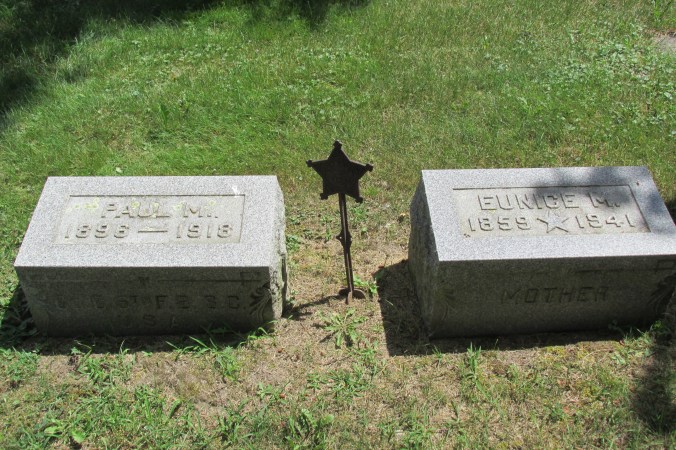
Above: The only surviving picture of Clarence B. Perkins from the August 29, 1918 issue of the Alma Record. Also, Perkins’ marker in Aisne-Marne American Cemetery in France.

It was the late summer of 1918 before most people in Gratiot County knew of the loss of Clarence Perkins. It turned out in the end that there were reasons for this.

Clarence B. Perkins was said to be from North Star, however, he really was not. Perkins’ story is one that was sometimes repeated throughout the Great War when a county (or even more than one) claimed a fallen soldier as one of their own. Originally, Perkins was from Coleman in Isabella County from which he listed as his home when he joined the Army in 1909.

Perkins was one of seven children born to Joseph and Fannie Perkins. He was born April 11, 1886, in Rowland Township in Isabella County.  Clarence lost his father when he was ten years old. Fannie remained a widow for thirteen years until she married Peter Zimmerman and moved to North Star in Gratiot County.

Perkins’ military service had been a fairly long one before the Great War started. About the time his mother remarried in 1909, Clarence joined the Army in Milwaukee, Wisconsin.  From there Clarence went to the Soo for two years, then to the Philippines for four years, and then he spent one year in Alaska. From Alaska, he went to training camp at Plattsburg, New York and then to Camp Green in North Carolina. In April 1918, Perkins left Camp Green for France.

On April 6, 1918, Clarence B. Perkins was killed in action, less than one week into what was called the Battle of Belleau Wood. He had served as a First Sergeant in the 30th Infantry, 3rd Division and he was buried in the Aisne-Marne Cemetery in Belleau, France, near where he fell. On his marker, he is listed as having come from California. How this relates to Perkins’ story is unclear. Possibly his service in the Philippines had some connection to once being stationed in California?

Since Perkins was not actually from Gratiot County, and because he had been in the Army in different locations for periods of time, both could be reasons why his death was not reported in Gratiot County until almost two months after he died. Possibly the Army also had a problem trying to find Perkins’ family. Because he had one surviving parent who resided in Gratiot County after his death, she later saw that his name was given to the American Legion for recognition as one of Gratiot’s men who died during the war.

Regardless, Clarence B. Perkins was recognized as the first man from Gratiot County to die in combat in France during the Great War. Clarence B. Perkins, who had served his country in several different places prior to going off to  war, was 32 years of age.

Copyright 2018 James M. Goodspeed

Thirty Who Dared to Serve Gratiot County in the Great War – Part 3: “Lost in the Bermuda Triangle: The Death of Alburtus S. Cohoon”

alburtus cohoon.jpgCohoon father.jpg

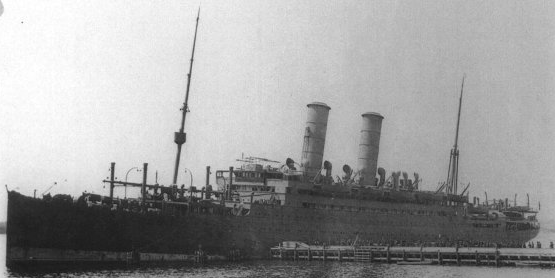
Above: The USS Cyclops. Below: Family plot of Alburtus Cohoon in Alma’s Riverside Cemetery.

    In the early spring of 1918, a Gratiot County father learned that his son had disappeared, along with all of his son’s fellow crewmen.  County newspapers failed to carry the story even though Alburtus Cohoon,  the son of an Alma farmer, was involved in what is termed the single largest loss of life in United States naval history in which there was no direct involvement in combat.

        Alburtus Cohoon, who was born October 7, 1896, grew up as the youngest of five children. His mother passed away when he was only three years old and he was fifteen when his father remarried. In 1910, his father was living and farming in Pine River Township.

     From there, Cohoon’s story about his service in World War I ultimately ended in his death.  When he enlisted in the United States Navy in Cincinnati, Ohio on April 17, 1917, his records stated that he was five feet, seven inches tall. He weighed 132 pounds, had blue eyes, brown hair, and a ruddy complexion. He listed his trade as having been a pipe fitter.

     He was then sent to the USS Cyclops, where he eventually became a Fireman, 2nd Class. The Cyclops was one of four Proteus-class collier ships that the United States had in service. Colliers transported heavy loads, in this case, it was manganese ore. The Cyclops left Rio de Janeiro on February 16, 1918, with a full load, then stopped two days later in Salvador and headed for Baltimore, Maryland as its final destination. When the Cyclops stopped in Barbados it was noted that the ship had over 11,000 tons of manganese ore on board and that the ship sat below its waterline, indicating that it was overloaded. After it left Barbados the ship was never heard from again. On board was a crew of 306 men, including Alburtus Cohoon.

     After two days without any contact, the Navy became concerned. Another ship thought it saw the Cyclops off the East Coast of the United States, but in the end, it was determined that this was not true. Where was the ship? After three months, on June 1, 1918, Assistant Secretary of the Navy Franklin D. Roosevelt declared that the ship was lost at sea, along with its crew.  On county records, the date of Cohoon’s death was declared to be March 4, 1918. To this day no one knows for sure what happened to the ship and its crew. Some have conjectured that the ship sank due to structural failure because it was overloaded. Others have noted that it was another ship lost in the infamous “Bermuda Triangle.”

      Little is left behind to tell about Alburtus Cohoon after his death. In April, his brother in Owosso received a letter  on April 19, 1918, telling him that the ship was overdue and that “Her disappearance cannot be logically accounted for in any way as no bad weather conditions or activities of enemy raiders have been reported in her vicinity of her route.” Fred Cohoon also received his brother’s insurance policy from the War Risk Insurance Bureau. In 1930, Alburtus Cohoon’s stepmother was asked by the government if she wanted to travel to Europe as a Gold Star Mother to visit her son’s grave. However, there was no grave to go to and apparently the government did not understand that.  It appears that Mrs. Cohoon never replied. Today, a family burial plot for the Cohoon family exists in Alma’s Riverside Cemetery, but without any indication of the fate of the young man who was a part of the largest loss of life in naval history during World War I and its largest unsolved mystery.

      All that exists today is a name on the Gratiot County All Wars Memorial in Ithaca, about the young man who lost his life March 1918. Alburtus S. Cohoon was only 21 years old.

Copyright 2018 James M Goodspeed

Gratiot County During World War I – June, 1918: “A Time of Enforced Patriotism”

IMG_20180603_215447175.jpg4.jpgIMG_20180603_215353484.jpg

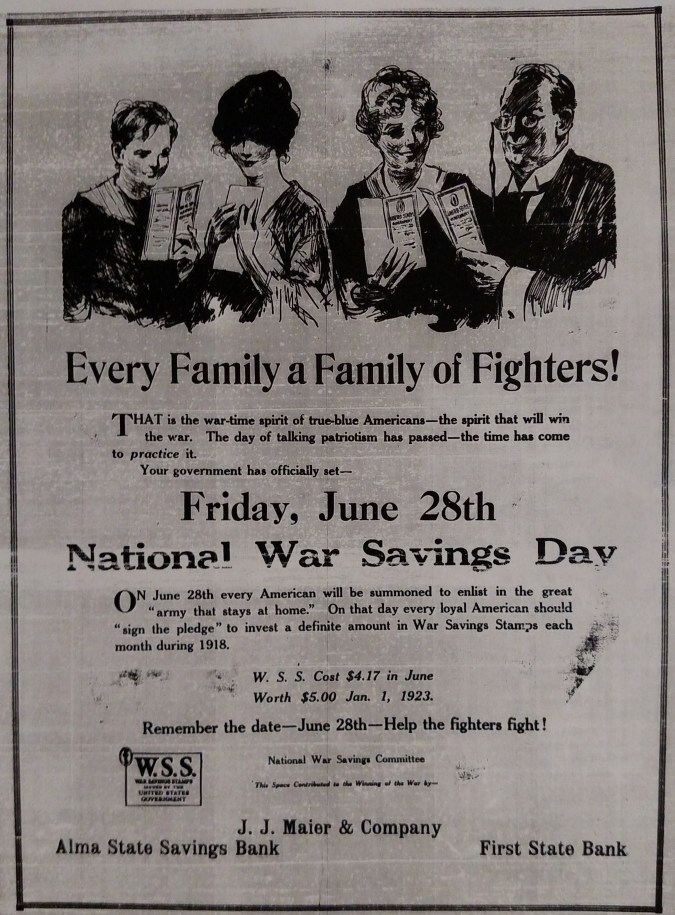
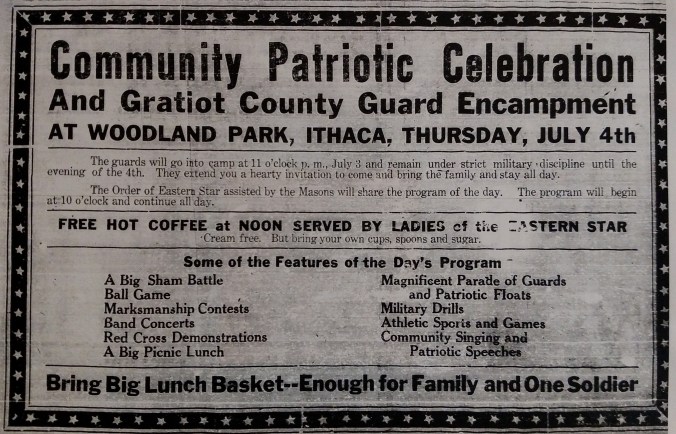
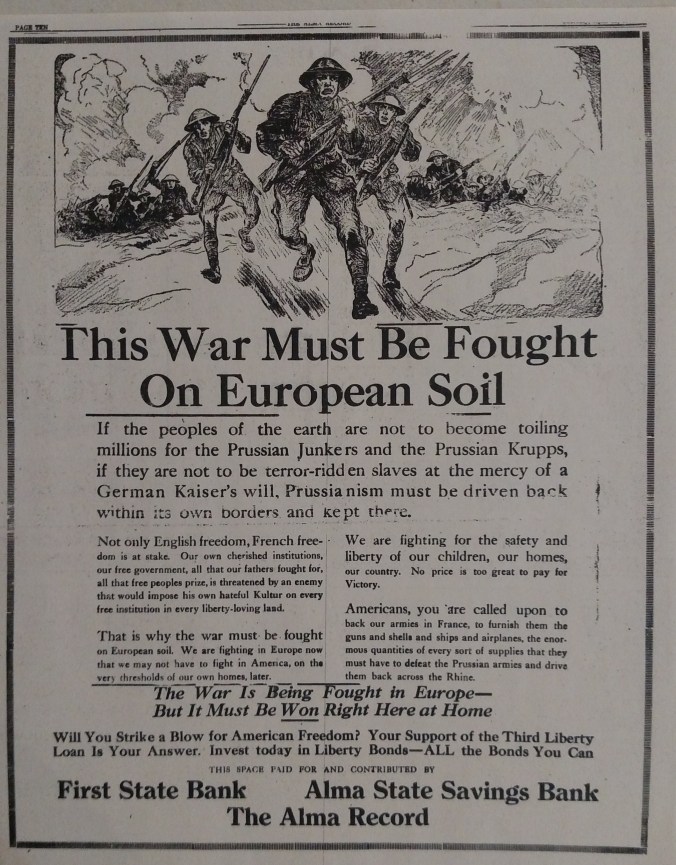
Above: Advertisements from the Alma Record and Gratiot County Herald during June 1918.

     On the eve that many Gratiot County men went into combat in France life at home centered around showing how patriotic people were.

     During early June 1918 twenty-five boys weeded beets on the farm of Arthur Gibbs, just east of Ithaca. Any farmer who wanted help on his farm only needed to contact L.A. Murdick, who was the county’s YMCA secretary. Murdick helped any farmers to locate young people as workers. The Crandall and Scott business in downtown Alma displayed a new show rug in its window. This “liberty rug” had images woven into it from all of the Allied Powers at war, as well as the Statue of Liberty, the Capitol, and Independence Hall. The rug was admired by many viewers. Miss Lou Florence Olp, a former Alma resident and one of Saginaw’s finest piano players, was headed to France to serve as a volunteer for the YMCA. A new call went out from the government warning “alien women enemies,” German women who were not legally citizens, to register at the Ithaca post office. This applied to women from the age of fourteen and older who were born in Germany had unnaturalized German parents, or who were  Americans and had married an unnaturalized German. Two weeks after the announcement not one single person had registered – and there was no evidence that anyone in Gratiot County did in June. The Alma Red Cross had six sewing machines in operation but it needed more help to keep them going all of the time. Local post offices informed people who were sending weekly and monthly magazines to soldiers needed to only send current issues. Too many people were leaving old periodicals there that were of little value to soldiers. The Gratiot County Herald had service buttons for people in Ithaca who were family members of men in the service.

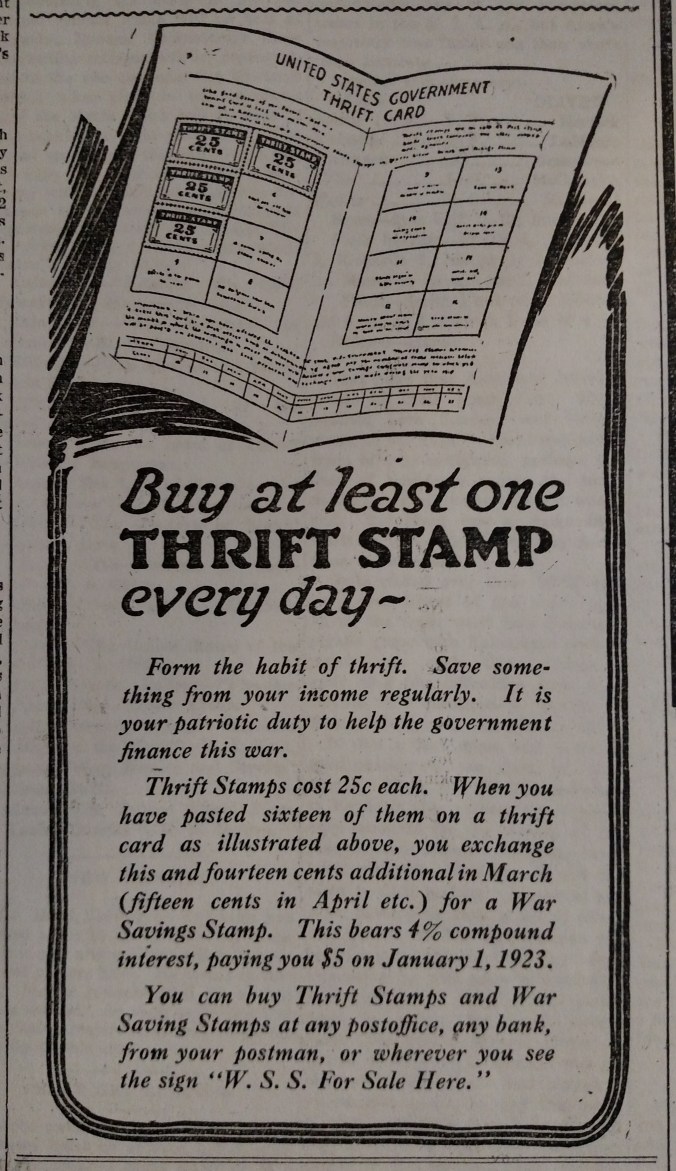
     During June, the government urged everyone to buy War Savings Stamps. Everywhere in the county people were encouraged to “Paste the Kaiser with WSS (War Savings Stamps).” A new WSS saying could be heard: “Every quarter that you get, buy a stamp and make it wet, Stick it to a little card, it will hit the Kaiser hard.” Down at Middleton, Principal Miss Bertha Hoxie told the Gratiot County Herald that the school had students in Mrs. McCarthy’s room raised $190.00 in stamps and bonds. Miss Vera Martin’s class gave $750.00. Two other teachers and other students of the Middleton schools raised $1,475.00  for the war effort. President Woodrow Wilson issued a proclamation that June 28 would be National War Savings Day and that Michigan needed to raise its full quota of $70,000,000. Gratiot County’s new goal was to raise $497,200. Area ministers were asked to read a message from the President to their congregation explaining the need to support “The Big Drive.” Patriotic citizens needed to support the government by purchasing War Savings Stamps and Liberty Bonds by that date. Citizens also were urged to practice economy and thrift and not to spend their money thoughtlessly or needlessly, so that they could buy stamps and bonds.  Advertisements in the newspapers reminded that all of those who purchased $4.17 worth of stamps each month could be redeem them for $5.00 on January 1, 1923. People were asked to “Prove Your Patriotism” and be a “True Blue Patriot” on June 28 and to step up and buy the stamps.

     The fight over wasting and conserving food continued. Eating places like hotels and restaurants could not serve beef more than twice a week, one time each for beefsteak and roast beef. More pork could be available to supplement the meals, as well as beans, bacon, ham, and sausage. Michigan Governor Albert Sleeper endorsed the use of potato bread in place of wheat bread. Using Michigan potatoes demonstrated patriotism and support for the war, and Michigan still had much left over from its 1917 harvest. The use of “combination substitutes” was also promoted for different recipes for muffins which included either buckwheat, barley, or rolled oats. Women were told in advertisements that “Wheat Will Halt the German Drive” in June and everyone needed to pitch in. There was also a movement for “The War Garden Army” which hoped to enlist five million boys and girls and forty thousand teachers to help turn any vacant garden or back lot into a “War Garden” to produce more food that summer. By late June, at least 16 groups had formed in Gratiot County. People were also urged to raise chickens for food. Two to three hens for each person in a household would produce enough eggs for the family. Those who sold eggs at retail had to make sure that the eggs had been candled and boxes had to have candling certificates to prevent the selling of eggs that were unfit for consumption. Sugar was expected to be available to people for the next two to three months. However, the government planned that each person would consume no more than three-fourths of a pound per week. Those families who lived in town could obtain two pounds per week; those in the country were sold five pounds.

     Increasing pressure was being placed on people throughout Gratiot County to demonstrate how patriotic they really were – even beyond buying bonds, donating money and conserving food. At the Ithaca Methodist Church, a crowd of 500 people came to hear about the atrocities committed by the Germans against Serbians and Belgians. Over $250.00 in donations and pledges were made to the American French-Serbian Field Hospital. Both Ithaca and Alma held a community “Patriotic Celebration” on the Fourth of July. At Ithaca’s Woodland Park, Ladies of the Eastern Star and the Gratiot County Guard Troop had an encampment which recreated a mock battle, held a marksmanship contest, played a baseball game, offered a band concert, and held a parade of patriotic floats. The public was asked to come and bring a picnic lunch (with enough food to also feed one soldier). Free ice cream and coffee was provided. Other things were also asked of Gratiot’s Citizens pertaining to their patriotism. On July 8, all school districts in the county would have a “Patriotic Meeting” at its schoolhouse. Schools and teachers were responsible to provide “a stirring patriotic rally” by opening with a prayer and singing “America” as part of its program. It was important to feature a local speaker, review why America was fighting the war, and tell why support for the war needed to continue until it was won.  July 8 was chosen because it was the date of the annual school meeting in each school across the county. Finally, patriotism for the first time in Gratiot County was being measured by what people should not do. Rumors, false reports, and criticism of the government of any kind were discouraged. In a column in the Gratiot County Herald, the government even went so far as to state that “Any word which tends to create a doubt or a question in the mind of an American citizen as to the purity of purpose of the government is an act of treason.”

     More and more men were being called into the service. At least 250 men in Gratiot County had turned 21 in the last year and were, therefore, eligible to be drafted. As the War Department made it a goal of having 3,000,000 men in the service by August 1, Michigan’s quota for the draft was 8,900 men. Draft boards now had a new pool of draftees: those who were in non-productive employment. Professional baseball players, sales clerks, clerical workers, traveling salesmen, public and private, cooks, managers, elevator operators, managers  – all were now open to the draft. While a headline read that “Married Men are Exempt,” there were narrower definitions of who qualified for an exemption , based on when they married and when they had children (generally within the previous year and when a prior draft call had been announced). It seemed that each week the name of one man who entered the service was featured in the news. Vernon Pino of Ithaca received a send-off from the Home Guards, after having a farewell banquet and gift of a wristwatch.   Reverend George Brown of the Breckenridge Congregational Church enlisted in the YMCA and was on his way to New York City. Brown expected to leave soon for France.  L.T. Chapin, a businessman of the Fleming Clothing Company in Ithaca, left for the United States Merchant Marines Alma, it was noted that Nick Bardville, a recent manager at the European Café, was being a good example for service by his training at Waco, Texas. Bardville was not yet an American citizen, but he was eager to fight the Hun.   Some Gratiot County men at Camp Custer were told that they may be sent to Italy.

     Letters from men gave people different viewpoints about the war. Private Claude Eastman described to his mother some of his experiences as a sub chaser on the Delaware River in New Jersey. While he was not on board when any of the German U-boats were hit, he noted that Sub Chaser S-646 got one of them. Lester W. Pressley wrote somewhere in France about the value of the YMCA as a place to find reading materials and with help writing letters.  The entertainment at the YMCA was also very good. Although he had to shop at different places in town, he was able to eventually find enough ingredients for French fried omelets, completed with fried potatoes and vegetables. His company was also in charge of maintaining its own garden. Pressley’s village was free of mud, but woe to those soldiers who marched in the valleys. Lyle Smith from Perrinton also wrote home to a family from his location in  France. He wrote that he was recuperating from several days in a hospital due to a terrible episode of mumps. He was amazed that French farmers only used one horse at a time to work in the fields. There were a lot of goats and he even saw one woman with a small pig in a baby carriage. Smith’s letter seemed to describe the lighter side of military service “Over There.” However, before the end of summer, he would among the county’s first fatalities in France.

      And Gratiot County continued on in the Great War in the summer of 1918.

Copyright 2018 James M Goodspeed


Gratiot County in May 1918 – “Calls for Public Patriotism”

IMG_20180527_225708382.jpgIMG_20180527_225629946.jpgIMG_20180527_225602986.jpgIMG_20180527_225553805.jpg

Above: Advertisements and headlines from the Alma Record and Gratiot  County Herald during May 1918.

             The war was on and life continued in Gratiot County during  May 1918.

           On top of Alma’s City Hall, one could see a Third Liberty Loan flag that Michigan Governor Albert Sleeper sent to Alma to congratulate the city for its efforts during the recent bond drive. Advertisements by businesses, like the St. Louis Alma Bottling Works, urged readers to buy a bond to “help to save the country.”  Governor Sleeper also moved to make one thousand new tractors available to farmers in Michigan who could use them and afford to pay for them. Ensuring supplies of seed corn and spring wheat for farming was also one of the governor’s goals. Army officers who were in need of financial assistance to purchase their equipment to attend the training camp at Fort Custer could receive up to $400 in loans, but it had to be paid back after the war.   The Yerrington Band played in St. Louis at the opera house for meetings to raise Liberty Loan money. The Alma Record gave service buttons to family members of men who had gone to France. The buttons were red, white and blue with a star in the center to represent the soldier. Some buttons had two stars to represent a family who had two soldiers on the front.  There were more serious concerns in the county. Alma schools announced that it was dropping the study of German after the current school year. Instead, French would be taught in its place.

          The use and consumption of American wheat were deemed as one of the important factors in defeating the Kaiser because the boys on the front needed to be fed. The government even reported that some places in the South and West had committed to not eating wheat bread until after the summer harvest. An article from County Food Administrator C.J. Chambers said that “THE AMERICAN PEOPLE MUST MEET THE TEST” and Gratiot County was urged to do the same. He asked, would Gratiot County also make this commitment? Families were supposed to eliminate the use of wheat until the next harvest, which would be a challenging task. Those who had to use wheat were told to confine their use to 1 ½ pounds per week. In Alma, no more than 1/8 of a barrel of flour could be sold at a time to one householder. One advertisement in the Alma Record showed how families should ration flour based on the number of people in their home. It read, “IF YOU ARE A PATRIOT YOU ARE OBSERVING THIS SCHEDULE OF FLOUR RATIONS IN YOUR OWN HOME.”  Warnings were issued that the National Food Administration would punish flour hoarders. People were told that no one should have more than a thirty day supply of flour on hand at any time. Sugar seemed to be another concern but women were told that they would have enough for the upcoming canning season.

         There was a constant call to support Gratiot County’s men at war. In early May, one of the first articles appeared that warned people about the dangers that soldiers faced from poison gas attacks. Doctor Esther Lovejoy, a physician, and public health advocate warned readers of the long-term effects of those who were blinded as well as those who would have to have artificial limbs and plastic surgery. So far, most people in Gratiot County had yet to see a wounded soldier in their midst, but that time was coming.  The United States Navy continued to recruit men in the county and held a patriotic meeting at the Alma Methodist Church. The Navy needed a half million men for its ranks. Seven men from Alma and Alma College received commissions as second lieutenants at Camp Custer. Among them was William C. Searle of Ithaca who was the son of Judge Kelly Searle. He was also the grandson of Alma founder Ralph Ely. On May 25, 61 men were called for military duty and had to appear before the draft board. To meet this requirement the draft board would now take men who had married in the last year and those who had previously been deferred. Also, 21-year-olds as of June 21, 1917, now had to register at the office above the Wright furniture store on Superior Street. None of the men in these groups were supposed to be excused for any cause.

          Another call went out about the need to support the Red Cross and it confronted those who failed to do so. A county Red Cross drive took place in the hope of raising $25,000, with each township having an assigned amount to raise. The Alma Chapter lamented that while there had been a city-wide parade at the end of the month, enthusiastic support seemed lacking. Some thought that Alma college students were needed to get involved in order to wake the city up. Similar calls for patriotic support with the Red Cross went on in other locations in Gratiot County. Over in Newark Township the question was asked, “We wonder what is the matter with the south part of the township, are you working in some other chapter, if not come and help us, we need you.” One lady walked four miles and another three miles just to work with the Red Cross unit there. Students at area schools were also asked if they had things that they could donate such as old gold rings or silver hat pins for “melting pots” (scrap metal that could be used for the war effort). The Red Cross also asked people to donate their old automobile tires. In Alma, donors could place their old tires on the bandstand that sat in front of city hall.

        As these things went on, more and more letters appeared from France. Private Earl Christy wrote to his brother that he had received a warm welcome in France and that there were 6,000 men on his ship when it arrived there. He commented, “Wouldn’t that have been a lovely bunch for some German submarines had they had a chance (to attack us), but, thanks to the Jackies who escorted us across.” He thought the YMCA and Red Cross were a great help to boys in the Army. Merlin Hamilton wrote to his parents that “A letter over here is a rare treat.” He did not mind that his letters home were tardy because each letter was believed to be censored at least twice. When he went into a French store he said that all he had to do was point to anything he wanted to buy and the shopkeeper would hold up a coin to show how much the item cost. His French had improved considerably and he could barter on his own. Lyle Reed told his wife that his French was very hard to learn but he knew enough to buy goods. He also was driving a three-ton Packard truck each day in order to deliver supplies. His biggest challenge was that in the city of 100,000 where he was at the streets were narrow and people walked right in the center. Lester Brandal was with the 20th Engineers and spent his time working in the woods cutting logs. Writing to his sister, Leo Sheridan asked the family to look out for copies of May’s issue of McClure’s, Woman’s Home Companion or the Saturday Evening Post as he had his picture taken while visiting a YMCA building. He also closed by saying that he looked forward to returning home “so you can prepare one peck of German fried potatoes, a can of macaroni and cheese and Johnnie cake with all the trimmings.” One letter from Fred Crawford, Jr. to his aunt and uncle, Mrs. and Mrs. J.B. Crawford of Ithaca told of fighting on the front. He thought the dugouts were better than he expected and although he was in a quiet sector, he and other men watched airplane battles that went on above. Crawford likened the event to watching a football game. He recalled being shelled near Verdun, “I wish I could describe how I felt the first time we were bombarded. The feeling was a brand new one, and it was similar each time afterward, although of course, not so tense. The best description I can think of is the highest possible tension of the nerves, so that every fiber in you is on edge and especially when are outside. Every sense you have is so alert that you don’t have time to be afraid.” Sometimes Crawford was up from 24 to 36 hours at a stretch and he believed he could tell where a shell was going based on the whistle it made.

        More stories of combat in France would be coming to Gratiot County as some of the bloodiest battles were yet to begin.

Copyright 2018 James M Goodspeed


“One Year into the Great War”: Gratiot County in April, 1918

IMG_20180429_222717347.jpgIMG_20180429_222655711.jpg

Above: Wartime advertisements from the Alma Record in April 1918.


          One year into the Great War, Gratiot County’s support for the war effort remained strong and unyielding. Patriotic zeal was clearly evident during the first anniversary of involvement in the war.

      One of the best examples of support for the war involved patriotic meetings.  Speakers from outside the county encouraged citizens to raise money for the war. One of these speakers was Louis D’Harcklay from Belgium who told about his role in European relief work. D’Harcklay told listeners at the Alma Presbyterian Church how the Germans tortured civilians and how they treated captured, Allied soldiers. Professor Stearns, from Alma College, gave public lectures about the importance of camp sanitation at places like Camp Custer, as well as how malaria and typhus threatened soldiers. These patriotic meetings extended across the county into areas like Middleton. On one Friday afternoon, Middleton High School dedicated its service flag, complete with nine stars, which represented local boys who had gone off to war. A parade took place starting from the Masonic Hall and leading to Mertz’s Hall. School superintendent Bertha Hoxie moved to the head of the group and led the people down the main street to the beat of a snare drum. When they reached the school, children led the salute to the flag, followed by singing and a speech led by Mrs. Fred Baker, who asked the community to support the purchase of Thrift Stamps and the Third Liberty Loan.

         During April, the government launched the Third Liberty Loan bond drive and wondered how Gratiot County would respond. Newspapers pitched the idea that people should consider buying bonds just as farmers would invest in building a good fence to protect their stock and property. Did residents of the county want the Kaiser to break down their fences and loot and plunder should the Germans win the war? Readers were told “Fence your farm with LIBERTY LOAN BONDS” as “The Third Liberty Loan is your opportunity to hit the Hun.”

        Several events that month showed how important support for the Liberty Loan drive really was. Loan salespeople went door to door in Alma asking people to buy bonds before an important meeting was held. Then, the big draw was brought in – the famous Jackie Band, led by Lieutenant John Philip Sousa from the Great Lakes Naval Station. Dubbed “the greatest band in the land,” the band traveled across the county and was credited with helping to raise $750,000,000 in Liberty Bonds. The anticipation in Alma was great and this event was considered one of the largest turnouts in this area of the state. A parade, which was held prior to the entertainment, started off with an automobile that carried local Liberty Bond committee and speakers. Then came fifteen Liberty Trucks, followed by an old hearse which had a pig wearing a German helmet. On the side of the hearse was a big banner which read “Buy Bonds and Bury Bill.” Next came the Alma High School Band and the Jackies. Afterward, a Liberty Bond meeting took place at the high school followed by a dance. Another parade and meeting were held the next night in St. Louis. The results were astounding because in nine days 1,752 Gratiot County citizens subscribed to $241,250 in the Third Liberty Loan. The Alma Record described the county’s efforts by saying, “No one can accuse the farmers of Gratiot County of being slackers.”

          Residents also heard about the need to purchase Thrift Stamps. Michigan had a goal of establishing 20,000 Thrift Clubs which were groups of people who bought a certain number of stamps over a period of time. Housewives were asked to put signs in their windows stating that they would hire young people to work for twenty-five cents per hour. Payment was to be made in the form of purchases of Thrift Stamps. The Boy Scouts of America also went door to door selling stamps in what was called “The Red Post Card Campaign.” Those who bought stamps would receive a red postcard from the local postmaster for delivery. President Wilson wrote a personal letter to the Boy Scout who sold the most stamps. A  special service flag was given to the troop that had the most sales.

        The nation continued to call for Gratiot County women to play a role in the war effort. Starting the last week in April a non-compulsory census was conducted by the Woman’s Committee of the Council of National Defense. Every woman over the age of sixteen was asked to fill out a registration card. In Ithaca, women could find the cards at nine designated locations between April 27-29.   Who could work outside the home, take training for further service, or work in a salaried position? These were some of the questions that the census tried to answer.  The government hoped that women could help fill the one million jobs left vacant due to military service.

         In addition, the Red Cross also called for support. The Alma chapter moved into its new location in the north room of the Alma Masonic Home. Local schools encouraged student support for the Red Cross. Alma schools contributed $123.25 through the Junior Red Cross. Students from different classes there made and donated wristlets, compresses, bandages, and sweaters. Over at Ithaca schools, the Junior Red Cross asked each student to contribute one dollar for membership. In order to help students who could not raise the membership fee, teachers called on Ithaca residents to offer to pay students for cleaning, odd jobs, and outside labor in order to help the students earn money needed for membership. At the south end of the county, the girls in Miss Davis’ grammar class at Middleton High School raised $10 in order to become Junior Red Cross members. Eventually, primary and intermediate classes raised the required amount when they sold popcorn, homemade candy, and holders.

         There was still the issue of the draft and those soldiers who had gone off to war.  Warnings were issued about deserters who had yet to return questionnaires for the draft. A list of 95 names was published and families were asked to help locate the men. On the one hand, it was argued that some of the charges about desertion were unjust because some men probably had moved, were already in the service or had just failed to mail in their forms. Still, the title of “slacker” was applied to the names on the list. Some family members became very angry with the county newspapers when their son or husband was already in the service ended up with their name on the list. Letters and visits to newspaper editors frequently took place and retractions concerning the label of “deserter” appeared in following issues.

        Letters from soldiers told Gratiot County readers about military life and war in Europe. Ellis J. Ayers was “Somewhere in France” and lamented the lack of attention that he paid to geography and history when he was in school. Ayers wrote, “We don’t realize what it means to study those subjects until we come face to face with the objects spoke of and then it dawns upon us the real value of study.”

        John W. Doyle, a sergeant in the 32nd Division, told about his second Sunday in France. “The grass here is green though and they say the winter here doesn’t get much colder than it is now…We see all sorts of people here. Quite a few Chinamen (are) even (here).”  He added that “…we had a safe voyage and saw no submarines. All the war news we here is from an occasional Paris edition of the New York Herald and you folks at home get more news than we do here of the war.” He regretted that he could not buy candy anywhere, but one could buy all the wine and liquors he wanted.

          Those who wrote from camps inside the United States offered some insight into the changes Gratiot County men encountered. Ike Hansen wrote from Camp Jackson about the differences of being sent to the South. He wrote to his parents, “I almost forgot to say something about the cotton fields and negroes. In Georgia and South Carolina, the cotton fields in some places extend as far as a person can see, and the negroes are as thick as white people. Once in a while, we went through little towns that seemed to be mostly of negroes.” Stanley Bergen from the 424th Engineers wrote from Camp Kearny that his church attendance had been “choppy” since he arrived, but he was attending services at a little country church three miles from camp. Although Sundays were termed “Liberty days,” he could not always go to church as he had to make up engineer property returns at his office. Murl Stedman wrote from a field hospital at Fort Oglethorpe, Georgia and found the food to be tolerable. “Well, I just came back from mess. We had roast beef potato salad, pudding, bread, and tea. Had a good dinner today, went back after my second dish,” he commented.

         Finally, other things appeared in the news. Over in Breckenridge and Wheeler schools, every eligible boy there applied to enroll in the Boys Working Reserve Program. Meetings for the program were also held in Elwell, Ithaca, Riverdale, North Star and Perrinton where boys enrolled to help with farm work for the upcoming season. Spring sports at Alma Schools were canceled so that boys could help farmers. Both the superintendent and principal encouraged students to join the program. The Alma Record noted that “It is quite evident that Gratiot County boys are realizing the need for food and are lining up to do their best to feed the Allies. In other words, they are patriotic.” The former secretary of the Gratiot County YMCA was now in France and told readers what it was like to operate a YMCA dugout near Paris. Men came directly to and from the front to visit his dugout. He also asked readers to send records for the men to listen to.

         As the one year anniversary of the country’s involvement in the Great War took place there was no sign as to how long the war would last. It also did not indicate the loss of life that was still to come.

Copyright 2018 James M Goodspeed


March 1918: Wartime Sacrifices in Gratiot County During the Great War

IMG_20180323_223902619.jpgIMG_20180323_223730254.jpgIMG_20180323_223815926.jpgIMG_20180323_223935554.jpgIMG_20180323_225516563 (1).jpg

Above: a host of advertisements from Gratiot County newspapers from March 1918.

           In March 1918 many people continued to make wartime sacrifices as winter ended. The Great War affected every American from big cities to small towns. Gratiot County was no exception.

         “We Won’t Win If We Waste” was the warning to housewives to do their part for voluntary rationing. Women were encouraged to reduce the use of wheat in their household by at least one third. They were told in newspapers, “Do your bit – small sacrifices now may save you from making greater ones later.” For example, dairy products were excellent substitutes, as well as eggs, macaroni, spaghetti, crackers, along with cornstarch and rice flour for puddings. Additionally, another form of patriotism involved the use of potato bread because Michigan had a surplus of potatoes. This substitute bread could be made with two cups of mashed potatoes for every cup of flour. These changes allowed a housewife to “beat the Kaiser at his own game” because “Bread and bullets will win battles for America.”   By conserving the purchase of wheat flour, a woman might save enough money to buy another Thrift Stamp for the war effort. Other substitutes for wheat-based meals included barley mush, vegetable loaf, and carrot soufflé.

          As Uncle Sam called more men for the war one of the groups included farmers and farmhands. There were those in Gratiot County who believed that these workers should be exempt from the draft because Gratiot County played an important part in providing food for the war effort. “A Farmer’s Daughter” sent a long letter to the Gratiot County Herald protesting the drafting of farmers’ sons. Both “city boys” and “country boys” were in high demand on farms in 1918 and many farmers depended on help from both groups. The draft boards were eventually told to try and delay calling all men engaged in actual farm work. A bulletin from the Adjutant General read, “Due to the scarcity of farm labor, the President directs that men engaged completely in agricultural work or farming…shall be given a deferred classification for the moment.”

       Boys between the ages of 17 and 21 who could work on the farms in 1918 faced pressure to sign up for the Boys’ Working Reserve Program in the county.  While school superintendents hoped that these boys would remain in school in order to graduate, many recognized the importance of their role in the war effort. At least one Michigan school district threatened students that if they did not work in the program then they would not be able to play football that fall. The state superintendent issued a statement that boys who entered the program were doing their community, state, and nation a great public service. The only criteria to enter the program in Gratiot County was that they were “physically qualified.” This hoped to add many boys to help out on farms in the county.

          Other issues Gratiot farmers faced that month included the government’s decision to fix the prices of wheat, sugar, and beans. When the government failed to do the same for cotton in the South, county farmers felt that this was unfair and that cotton growers should also face restraints. Gratiot farmers were also urged to prepare for a nationwide tractor shortage. They were told that they should immediately place their orders for Ford tractors to be delivered starting April 1. It is unclear how many in the county could afford a tractor or how many purchased new ones.

          The stories of Gratiot County men in the military continued to be read in the county newspapers. Arthur Wiseman and Clarence Frump from Ithaca both had going away parties given in their honor and both men received new wristwatches. Roland Crawford and Fred Crozier had dinners given in their honor in the evenings before they left for Fort Custer, both were Ithaca High School graduates. Roland was about to become a senior at the University of Michigan. Crozier was taking classes at Ferris Institute in Big Rapids and he was known for his work in pharmacy stores in Alma and Ithaca. Art Foote, the captain of the Alma College football team, was the seventh member of that team to leave when he enlisted in the medical corps. “Art” hoped to become a doctor and was well known and liked by many on the campus of Alma College.

        Other news about soldiers sounded more serious. One mother, Owen Courter of Elwell, was relieved when she got a telegram from her son who was in Europe. She was uncertain as to whether her son had been aboard the USS Tuscania, a transport ship that was torpedoed in early February off the coast of Ireland. By mid-March, she reported with great relief that her son, Glen, cabled home a simple message, “Arrived here safely.”  Malon C. Briggs, who was in a camp in Middleton, Pennsylvania, wrote home to his family in Vestaburg detailing his unit’s battle against diphtheria and smallpox. The town had been quarantined and no one was allowed in or out. He and his men had received a player piano and a Victrola and they used these to pass the time. Walter H. Young, who was at a camp in Arizona, stated that a new YMCA building had been built and it allowed soldiers to write home. He also wrote that his group had just been issued new Colt .45 pistols. Whitford Unger wrote from England to tell his family that he was preparing for the move to France where “the biggest half of my battalion lie beneath the sod, and I will do the same to keep my dear old country free.” Bob Rayburn from Ithaca wrote from a camp in Newport, Virginia to tell his sister how a shell exploded inside of a three-inch gun, wounding thirty men and killing two. He added, “Several others were hurt severely. None of the Ithaca boys were near the gun so we did not get hurt.” Clarence M. Gruesbeck, who was in the 15th Field Artillery, was actually in France now and described the French people as being very sociable, although they did not work as fast as Americans. He was stationed in a small village where the house and barn were connected. Gruesbeck was living at one end of the building and animals were in the other. The cake that his family sent to him arrived and although it was dry, it was eaten “and we thought it was very good.” He still really wished for good American candy.

        Call-ups for the draft went on. In Gratiot County, 50 men were called to appear for their physical examinations early in March. It was said that the government needed 95,000 men and 5,585 were to come from Michigan. Another 80 men were called, then the number reached 94. These men entered the service on March 29. Among the names who would never return to Gratiot County were George Washington Myers, Samuel Benjamin Derby, and William Lee Shippey. All would die during the war.

       Different chapters of the Red Cross in Gratiot County performed their services to raise money and tried to increase their membership. Sergeant Major Russell of the Canadian Army, who had served at the Western Front for three years, came to the county and spoke at different churches. One meeting he held in Ithaca raised $370. Another at the Alma Presbyterian Church raised $250. Both places donated the proceeds to the Red Cross. Different events in Ithaca like thimble parties, dancing parties, and box socials also raised funds. Both of the movie theater owners in Ithaca and St. Louis showed movies and donated proceeds from a show to the Red Cross. A Red Cross drive in Alma hoped to raise the necessary $500 each month to do its part for the war. Solicitors went out into parts of the city to find new pledges of support.  The money was needed because current funds did not cover the cost of shipping supplies to service areas.  The Alma Chapter was very active and it asked people to help pledge something for this challenge. Even pledging only twenty-five cents showed that “This is one means of paying for the privilege of staying at home. It is your patriotic duty to give all that you can to one of the noblest services that the war presents.” The Alma Chapter also held a Firemen’s Ball and raised $108.44. Community singing programs continued as ways of showing support for the war and raising funds, however, once spring weather approached the programs were suspended.

        The Red Cross chapter encouraged people in Alma to prepare to use any unused ground in the city for liberty gardens in the spring. Collecting clean, strong and durable clothing was needed to help reach a goal of sending 2100 tons to Belgium’s men women and children who were in need. The Alma Chapter asked readers, “Have you been to the Red Cross room this month?” A Free Reading Room with bulletins from the Committee on Public Information was available. Red Cross workers also were given new directions from Washington, D.C. concerning the official dress for those at the Alma Red Cross room. Each lady was expected to wear a white apron with sleeves to the wrist, along with a white coif. The instructor in charge wore a red coif with a white band. Any woman with 32 hours of work wore a Red Cross emblem on the left breast of her apron. The new dress regulations were to start April 1.

       Also during that March, citizens were urged to show their individual patriotism. Over in Elwell, an announcement read, “It is believed here that it will aid the patriotic spirit if community singing of patriotic songs is taken up here the same as in many other places in the country. All that are interested are requested to be present this Sunday evening at the church. This means you!” The village of Sumner had similar meetings at the Christian Church. Service flags continued to spring up all over the county. The Ithaca Presbyterian Church presented, unveiled and dedicated its new flag with stars representing members from that congregation. The Booster Class of the Ithaca Baptist Church did the same thing on Sunday morning. Reverend Roberts fulfilled his role there as a “Minute Man” for the ceremony. The Minute Men in Gratiot County were individuals who gave short, four-minute speeches to show support for the war effort. The Committee on Public Information (CPI) prepared speeches for people to give at various times and places across the nation. Breckenridge High School also displayed its first Service Flag which had 34 stars on it.  Businessman Carl Faunce in the same town had a service flag in his store’s window with three stars, each for a former employee who was in the service.

        Raising money for the effort continued. People in Alma and Ithaca were encouraged to come and hear Gunner Depew, an American sailor who went off to the war in 1914 and fought for France against the Hun on both land and sea. The Third Liberty Loan Drive also started and the Alma Episcopal Church stepped up and bought $1,000 worth of bonds. Some county men in the service wrote letters home telling how they also had purchased bonds. Anyone in Gratiot County who could not buy a bond could buy Thrift Stamps. Many were urged to buy a stamp each day for only a quarter. Other things people could do to show support for the war involved watching high school cadets practice their drills at a basketball game between Alma and St. Louis. The Alma Order of the Eastern Star wanted to adopt a French Orphan and planned to raise money to provide for the child for one year. The C.A. Sawkins Piano Company in Alma asked for people to donate unused phonographs and records for soldiers at Fort Custer. Citizens were also asked to buy either a watch, razors, dining utensils or Masonic and Odd Fellows rings for soldiers who had gone off to war.

         There also were warnings directed toward the disloyal or unpatriotic in Gratiot County. Penalties for hoarding were posted. Hoarders were warned of facing a $5000 fine and imprisonment for hoarding “in a quantity in excess of his reasonable requirements for use and consumption for himself and dependents for a reasonable time.” Also, the United States Intelligence Department asked for drawings, photographs, and descriptions of bridges, buildings, towns and communities in France, Belgium and Luxemburg that the Germans currently held. The government asked individuals to go through their collections and donate these items to the Intelligence Department, however, they would not be returned. Those who could help could leave their items at the Alma Record.

        Finally, everyone was urged to prepare for the impending “Daylight Law” that would start April 1. All clocks were to be set ahead one hour so that places like factories in Alma could start work one hour earlier. Church service times did not change. It was what we called Daylight Savings Time.

Copyright 2018 James M. Goodspeed


Thirty Who Dared to Serve Gratiot County in the Great War, Part II. Clifford Kime: “The First Man on Breckenridge’s List”

IMG_6450.JPGIMG_6451.JPGIMG_6452.JPG

Above: The markers and resting place of Clifford R. Kime in Breckenridge’s Ridgelawn Cemetery.

Note: This is the second part of thirty articles that will run in 2018 to commemorate the lives of thirty Gratiot County men who died serving their county, state and nation during The Great War. These thirty men are named on the Gratiot County All Wars Memorial in Ithaca. Each article will run on the centennial anniversary of that man’s death.

         Clifford  Kime was the second Gratiot County man, and first Navy man, to die in the service of the United States during the Great War. News of Kime’s death reached Breckenridge just a few days after his death on February 19, 1918 at Carney Hospital in South Boston, Massachusetts.

        Clifford Ray Kime was born on March 20, 1895 to Jacob and Ida Kime in the Midland County town of Porter.  He was the middle of three , sons. The Kime family moved to Breckenridge in 1908 and Clifford graduated with the Breckenridge Class of 1913. At some point  prior to the war Kime’s father went to work for the Republic Truck Company in Alma.  Kime served the next four years as a druggist clerk in Breckenridge and Detroit. He then took an examination to become a registered druggist through Ferris Institute. During the summer of 1917, Kime worked in Houghton, Michigan, but when the call for military service came his name was the first name on Breckenridge’s registration list. Clifford Kime  willingly answered that call.

      Kime initially enlisted as a volunteer in the Navy’s medical corps. He left for the United States Naval Training Station at Newport, Rhode Island  on September 13, 1917.  His family and friends saw him at Christmas when he came home on a two week furlough. What was Clifford Kime’s biggest regret at that time? Only that he claimed that he would  have enlisted as soon as war had been declared  that spring. Kime believed that all young men in Gratiot County should join up to defend what was right and to fight Kaiserism.

         Shortly afterward, he transferred to the Radio Service and in January 1918 he took course work at Harvard University.   During this time he contracted pneumonia and died after a three day illness. In remembering Clifford Kime, it was written in a local newspaper that “Clifford was always of a cheerful disposition, energetic, possessing a winning frankness that guaranteed him an ever increasing number of friends wherever he went.” He also had been a member of the Breckenridge Masonic Lodge and the Men’s Bible Class of the Methodist Sunday School.

        After his body was returned to Breckenridge, services were held before a large crowd at the Methodist Church. The text from the pastor on that day that typified Kime’s service was taken from John 18:37. It read, “To this end was I born and for this cause came I into the world.” Among the family members he left behind was his niece and namesake, Virginia Clifford Kime. After the funeral, Clifford Ray Kime’s body was laid to rest in Breckenridge’s Ridgelawn Cemetery.

Copyright 2018 James M Goodspeed

“The Reality of War”: Gratiot County in February 1918


SS_Tuscania_in_Nova_Scotia_in_1917.png

s-l500.jpg

digital.library.unt.jpg

Above: SS Tuscania; The Boys Working Reserve pin; 1918 era poster promoting The Boys Working Reserve

     In February 1918 Gratiot County got the message about the cost of lives that were connected to  American involvement in World War I.

       A major shock came in early February with the loss of the SS Tuscania, a transport ship and former Cunard luxury liner which carried 2, 179 soldiers to Europe, along with 383 crew members. The German U-Boat, UB-77, sank it on the morning of February 5. It took four hours to sink and 210 on board died. Newspapers focused on the sinking and although many Michigan men of the 32nd Rainbow Division were aboard, no Gratiot County servicemen were named in the reports. This event accompanied the news at the end of the month concerning the death of a Gratiot County soldier, Clifford Kime, from Breckenridge. Kime died from complications of tonsillitis and pneumonia in a Boston area hospital. Together, these events in February brought home the reality of the war to Gratiot County.

      Enlistments from Gratiot County remained strong because many Gratiot County men volunteered to serve their country. February saw almost 40 men step forward to serve Uncle Sam. Recruiting Officer Tom Boston had been in Gratiot County for nine months and he had helped almost 300 men to enlist during that time. Still, the draft board remained busy and examined 279 men on February 18-19. At least 75 in the group were going to be sent to Georgia training camps in March. Because of stricter regulations, fewer men were being discharged.

      Anyone who questioned Gratiot County’s patriotism needed to only count the number of service flags that were being donated and flown in various places. Alma College dedicated its service flag on Lincoln’s Birthday, accompanied by a speech by former Michigan Governor Chase S. Osborne. It had 72 stars on it when it was ordered (one for each former Alma College student serving in the war), however, by the time the ceremony took place it was thought that over 100 students were in the service. Alma High School ordered a service flag with 55 stars, but it too was thought to need more stars by the time it arrived. Churches also joined the flag raisings. Alma’s Methodist Episcopal Church invited service families from the congregation to recognize approximately 20 soldiers connected to the church when it dedicated its own flag. While Alma was in the news, many areas of the county, including schools and villages, had their own flags on display.

     The Red Cross became even more organized and kept the county informed of its needs, as well as its accomplishments. A new weekly column appeared in the Alma Record entitled “Alma Women in War Work” and it ran weekly throughout the rest of 1918. Women were urged to come and volunteer their time in one of four departments which worked on gauze, bandages, hospital garments or knitting. The Alma Red Cross even encouraged women to take work home to help out so that “no woman in this vicinity is to be known as a ‘slacker’.” Still, when $75 worth of yarn was distributed to knitting parties in January and nothing had been turned in, a gentle reminder was issued in the newspaper that people who had the material needed to turn in socks, helmets, sweaters or wristlets. More pressure was also put on women through the newspaper to register with the Red Cross “who (are) loyal to our Government” in order to help serve the country.

     The Red Cross also started a tradition with community singing.  After each program, someone  gave a talk that explained what people could do to be involved in the war effort.  These sometimes brought as many as 400 people to the services.  When the Red Cross had to vacate its headquarters in the Pollasky block it temporarily moved to the reception room at the Oddfellows Temple. Eventually, it ended up at the Masonic Home.

    Looking ahead to spring, the county worried about what could be done about potential food shortages. Among one of the biggest problems was the issue of the lack of farm help. The United States Boys’ Working Reserve program actively sought 700 young men, ages 16 to 21, who could work on Gratiot County farms. In 2017 it was estimated that 200,000 boys across the United States had become involved in the program.  While F.M. Harrington of Ithaca looked for recruits in the area, some farmers in the county objected to having city boys for labor. Still, if they really wanted help they could not be picky. One farmer lamented in the Alma Record that “if you can’t send me an experienced man, send me a boy –as husky a one as you can find.” When he stated that he had 80 acres to farm, 8 cows, some hogs, 15-20 acres of corn, 10-15 of oats – and hay, wheat and pasture – any recruit would quickly find that he would have plenty of work to do.  Regardless, the program was offered as a patriotic way for young men to serve in Gratiot County’s war effort.

     Then there were chicken rules, fats, and sugar. The United States Food Commission issued a new rule that starting April 1, 1918, it would be unlawful to purchase or kill live fowl or pullets. It was hoped that this would help with preserving the nation’s egg supply. Violation of the law could result in a fine of $5,000 and two years in prison. However, the new law affected many farmers’ wives who had previously counted on chicken and egg money. While people in 1918 needed a certain amount of fat in their diet, Americans were called to remember the suffering of women and children in Europe. Gratiot County women were urged to save butter and serve meat gravy in its place at dinner. They were also told to save lard and butter and not to use it in cooking. Deep fat frying was to be done sparingly. Fats that could not be used any longer were to be kept for fall soap making or house cleaning. Sugar consumption was to be limited to 3-4 pounds per week per person. This was not easy. When a store in Alma had a new sack of sugar the word quickly got out and brought lineups at the counter. Cottage cheese was also viewed as a great substitute for meat by adding cream, milk, chopped onion or green peppers to it.

     Other anticipated shortages in 1918 included binder twine. People were encouraged to buy a soldier a Smileage Book and mail it to him.  The books allowed soldiers to see entertainment at Camp Custer’s Liberty Theater. They sold out quickly in Ithaca. E.Berman and Sons in Alma wanted scrap iron. And then there was the chorus to a popular song that echoed the times, the war, and the yearning for sons and husbands to come home:

  “Keep the home fires burning,

  While your heats are yearning;

Though your lads are far away

They dream of Home;

There’s a silver lining

Through the dark cloud shining,

Turn the dark cloud inside out

Till the boys come Home.”

Copyright 2018 James M Goodspeed


Gratiot County in the Great War, January 1918: “Serve, Get Involved and Do Not Waste!”

WSBSVB-QM9fD8ktkh_ediBU2MzBFGGLrWkahae0kMrA.jpg787af43580131f9d74815fa7d324fae1--meatless-monday-vintage-recipes.jpg

Above: Signs that would be found in Gratiot County homes that volunteered to conserve food during 1918 from the U.S. Food Administration Service.

     As the war effort continued at the start of 1918, daily life across Gratiot County was filled with patriotism.

    For the first time, Gratiot County residents learned how to file their first federal income tax. A federal tax officer announced that he would be in his newly opened office in Alma in order help people make out their returns. There was no charge for the service. Married persons with an income of over $2000 and individuals with net incomes of $1000 had to file this new tax form. An estimated 5000 people in the county would have to file their taxes for this first time in history.  Penalties for not doing so ranged from $20 to $1000 or going to jail.

     St.Mary’s Church in Alma displayed a new service flag which had twelve stars, one for each member of the church that was currently in the service. One of the stars was for Father John Mulvey and another four represented four Alma College students. Alma College also hosted one of the first patriotic “pep rallies” in the county that would take place throughout 1918. More than one of these that year involved a speaker or serviceman from Canada or England. Doctor George Robert Parkin, from London, England, who was the Director of the Rhodes Scholarship Trust, spoke to an audience in the college chapel.  He expounded on how the United States and England were partners in the world war and they alone were left to win it since Russia had fallen into civil war and France was on the verge of collapse. Parkin also admitted that he was in the United States in order to assess the attitude of Americans toward the war. The Ithaca National Bank, “The Bank on the Corner,” encouraged people to purchase War Savings Certificates, also called “Baby War Bonds.  The Alma State Bank stated that it sold $700 worth of stamps to customers there.

     Probably one of the biggest things that affected the daily lives of Gratiot County residents involved what became known as “The Prudden Orders” (named after W.K. Prudden, the Federal Fuel Administrator).  These orders dealt with how the state of Michigan would conserve fuel for the war effort.  Regulations were issued about how long certain buildings could be heated or lighted each week. Stores could only operate for nine consecutive hours a day, except for Saturdays when they could be open for twelve hours. They also faced regulations on how many hours they could be lighted outside. Inside, the heat was set to no more than 68 degrees. Movie theaters in the county were closed on Tuesdays, on other days they were limited to six hours of operation. Saloons and bars were closed on Mondays. Meat markets and grocery stores could only be open until noon. It seemed that everywhere the public was now called upon to make fuel sacrifices because of the war.

     And then there were new issues with food. By late January, families had to apply for government-issued sugar cards in order to purchase any sugar in grocery stores. Ration cards were sent to each family to cover three months, with a grocer allowed to sell them only one pound of sugar per week. The card was punched by the grocer with each purchase. The government warned that there was not enough sugar in the country for everyone to have the usual amount until the fall harvest. It was suggested that children be given syrup, honey, molasses or preserves for snacks, as well as raisins for dessert. Mothers were encouraged to make a cake without frosting and to encourage the eating of preserves.  Coffee drinkers were urged to go easier on sugar in their coffee – and never leave any in the bottom of the cup. It was hoped that people in Gratiot County would limit themselves to no more than two ounces of sugar per day. County newspapers would continue to publish columns such as “WE WON’T WIN IF WE WASTE: Tested Wartime Recipes.”  Examples included recipes for how to make  Soldiers’ Mince Pie, Liquid Yeast, Old Glory Bread, Oatmeal Muffins, and Bread.

     The county moved to a voluntary “porkless Saturday” at the end of January. The pressure was put on families to voluntarily comply with this idea with the threat that eventually “porkless days” could become mandatory. The Gratiot County Herald issued a note from C.J. Chambers, the Food Administrator for Gratiot County, who admonished readers that “OUR GREATEST PROBLEM IS ONE OF FOOD!” He then asked them directly whether or not they observed meatless Tuesdays, wheatless Wednesdays, and having one other meatless meal at least once during the week. The article went on, “We are at war. Our soldiers and sailors come first. There should be no hoarding of flour or sugar in Gratiot County…You cannot afford to assist the enemy by deliberately refusing to observe the food regulations. If you do, you are only pushing victory away that much longer. Let’s Hooverize Gratiot county 100%.”

     Red Cross members continued to labor faithfully across the county.  In Breckenridge, the branch there met twenty-four afternoons since it formed the previous July. Although meetings only averaged about ten ladies, the group had expended a total of $278.68 on material and focused on creating surgical dressings. Other small Red Cross branches continued to serve. The East Fulton Red Cross had sixty-two members, held twenty-five meetings and had an average attendance of seven. With fuel shortages taking place the group held their meetings in the homes of members. They produced T. bandages, pillow cases, nightingales, and abdominal bandages.  The Newark Red Cross, led by Belle Kellogg, met at the Grange Hall where twenty-three women came in one day to work. After citing their accomplishments for the month, the group remarked that “The truly Red Cross spirit means our love for humanity and the work we do is measured by this love.”  Camps at Fort Wayne, Selfridge Field, and Camp Custer received the many different things created by all of these Gratiot County women.

    As the draft continued so did problems with those men who failed to heed the call. Those who did not report for the draft had their names turned over to the police. Early in the month, fifty-eight men failed to return their questionnaire and their names were published in the newspapers.  The local draft board also thought that many of the men who registered did not understand the correct methods of classification, whether it was due to physical conditions, or because they claimed agricultural and industrial work grounds. Because of these problems, the draft board had to again examine 2,600 papers and then call men back in again to answer questions. Men who had married since May 18, 1917, had to furnish proof to the draft board that they had not gotten married just to avoid the draft.  A special drive was taking place with the Alma enlistment office because it wanted to enlist a total of forty men for the month of January.  If the county did this for a second consecutive month, it would be classified as a central recruiting office, one which would have been uncommon for a county population under 50,000 people (which Gratiot County did not have in 1918). When enlistments lagged at mid-month due to a winter storm, officers went to Breckenridge and Shepherd to drum up recruiting there. Unfortunately, the drive failed. The Army also put out a statewide announcement that 7,000 specialists were needed for the Aviation Section Signal Corps which was stationed Camp Hancock, Georgia.

`     Gratiot County’s soldiers continued to write or visit home. Lieutenant Charles Dutt came home to Alma on his last leave from Mississippi, his last before being sent to France. Howard Burchard was also home on furlough. He had served as a gunner on the S.S. Teresa, a merchant ship that had been attacked one night by torpedoes off the European coast. Luckily, both shots missed the ship.  Lester N. Pressley wrote home from “Somewhere in France.”  He said that the climate was fair, he had candles with which to read and write at night, and he valued the handkerchiefs and hats that the Red Cross was knitting and sending overseas. Ted Kress from Ithaca wrote home that he and a group of men had purchased a type of phonograph that they hoped to take with them to France. Herman Rahn, who was with the Field Hospital Company Number 127 at Waco, Texas, explained how he had to try out newly created gas masks. Clyde E. Marvin, also stationed at Waco, wrote about the cleanliness and order at the camp. Napoleon Vancore published a column from Camp Custer and had his picture published in the Alma Record.

Finally, there was the growing reality that the war was going to reach more men and women from Gratiot County in 1918. Alma College faculty prepared to teach a new course about how science applied to warfare. Subjects included:  gas masks, diet, frostbite, how to purify water and how to use the stars for direction. Conversational  French was also being offered. The college announced that it was going to cancel spring break because students were going to be called for the draft or sent to farms to work in the spring. Telegraphers were also needed by the Army Signal Corps. A new war disease was named that affected soldiers on the Western Front. It was called “trench foot,” which was the result of standing in cold water both day and night. In many places in the county’s pool rooms, train depots and post offices posters told men of the trades that the Army offered for those who enlisted and how many men were wanted for service.

    The year 1918 was starting and it was going to be an interesting one for Gratiot County’s involvement in the Great War.

Copyright 2018 by James M Goodspeed

Thirty Who Dared to Serve Gratiot County in the Great War – Part I: Frank E. Huntoon, “He was Universally Liked by His Fellow Soldiers”

IMG_6402.JPGIMG_6404.JPG

Above: Frank E. Huntoon marker, Oak Grove Cemetery in St. Louis, Michigan.

        Gratiot County’s first man to die in the Great War was one of several who sadly never made it to the Western Front.  This story, like a few others that will be told, is best viewed as the result of misfortune or accident.

           Frank E. Huntoon was born October 18, 1877, to Adelbert and Melissa Huntoon in Bridgeville, a small village located at the southern end of Gratiot County. Frank was the middle child of at least three children (George, Frank, and Mattie). By 1880 the family was living on a farm in Emerson Township.

          Little is known about Huntoon, although he must have joined the military and served in it for several years prior to the war. In 1910, he was a member of the 8th United States Infantry at the Presidio of Monterrey in Monterrey, California. There is no evidence that he ever married or had children, so it is very possible that Frank E. Huntoon spent at least some of his life earlier in the United States Army.  However, in 1917 he again enlisted in the Army to serve his country.

           Huntoon was just short of forty years of age on August 1, 1917, when he found himself stationed at Fort Benjamin Harrison. By winter there were an estimated 7300 troops of the 10th Infantry Regiment at the camp. Frank E. Huntoon was one of these men.

           The winter of 1917-18 was extremely cold and harsh and had enormous amounts of snowfall. Soldiers at camps like Fort Harrison found themselves literally snowed in, confining them to the base. The Army tried to keep them busy there with their duties.  In short, life for Huntoon could have been very boring.  It was here that fate met him on December 28, 1917.

           Records and clues as to the cause of Huntoon’s death are scarce. One states that Huntoon “Worked at (the) Barber trade, and was in that service when he died.” Upon his death, his commanding officer, Lieutenant Henry G. Sebastine, wrote to Huntoon’s mother, “Private Frank Huntoon was an excellent soldier who was universally liked by his officers and his unfortunate death is a source of genuine sorrow to us all.”

          But what led to Frank E. Huntoon’s death? The only record left in the National Archives reads, “Died Dec. 28, 1917, at Ft. Benj. Harrison, Ind.  of wood alcohol poisoning.” Is it possible that Huntoon tried to relieve his boredom with some poorly made alcohol on the base? Was someone selling bad alcohol and Huntoon was a victim? Another answer to the cause of Huntoon’s death is a clipping from the St. Louis Leader which was printed after his funeral. It read that he was “taking ill with ptomaine poisoning, which was the cause of his death.”  This suggests that he contracted bad food at the camp.

           Regardless, there is more to Huntoon’s story after he died. Upon notification of her son’s death, Melissa Huntoon was told that the only way that she could get her son’s body returned to her in St. Louis was to pay $75 to a funeral company in Indianapolis, Indiana. Melissa, who had little money, somehow scraped together the required sum and forwarded it to the Flanner and Buchanan Funeral Home and the body was shipped home. And then things came to a boil after she talked to other soldiers who were home on furlough in St. Louis.

         Mrs. Huntoon soon learned that grieving mothers or widows could be entitled to insurance policies that soldiers took out in the event of their deaths. She also learned that the United States Army did not charge families money to have their sons or husbands sent home for burial. Upon writing to the Quartermaster General she stated, “We have buried (Frank) at our own expense and we are poor and if there is such a thing it would seem acceptable to us (to be compensated for the cost)…It seems though Uncle Sam ought to have paid my boy’s expenses home. He gave his life and now not one bit of help from him.”

         An Army investigation was quickly launched regarding Melissa Huntoon’s letter.  The entire affair also somehow made it into newspapers, apparently in Indiana, and writers there accused the funeral home of extortion. Within a few short weeks it appeared that Mrs. Huntoon received her money back, all as what the funeral home and Army would call “a misunderstanding.” Years afterward, the Army conducted another investigation to make sure that Melissa Huntoon had indeed been properly compensated.

           She had been paid, but she lost Gratiot County’s first man in the Great War.