“Journeys with a Gratiot Cemetarian” 5.2: Louis F. McKinley, Korean Veteran, Ithaca City Cemetery

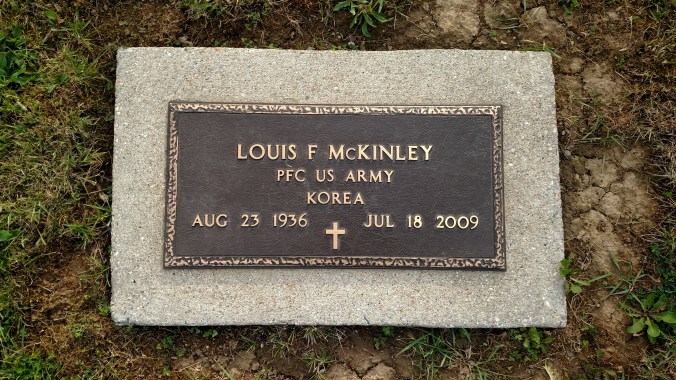
151976202_1441649737.jpg     IMG_20170526_192706953.jpgLouis F. McKinley was born August 23, 1936, near Alma, Michigan to Henry and Hazel McKinley. He was one of eleven children. As a young man, Louis enlisted in the Army to serve his country during the Korean War. After the war, he lived in the Saginaw and Bay City area and worked in construction and landscaping. At the end of his life, he moved to Ithaca and lived his last years with his sister, Julia Tinson. Louis died July 18, 2009, and he is buried in the Ithaca City Cemetery. Louis F. McKinley is one of many Gratiot County men and women who served their county, state, and country during a time of war.


Remembering Gratiot County and Pearl Harbor at 75

293387f92b0187bbc94495ca45b7a5f5--remember-pearl-harbor-american-war.jpg

Above: War time poster from the National Archives, Washington, D.C.

Note: This article first appeared in the December 7, 2016 issue of the Gratiot County Herald.  

      Seventy five years ago on December 4, 1941, it was a “Window Night” in Gratiot County, which marked the start of the Christmas shopping season in the towns of St. Louis, Alma, and Ithaca. Businesses stayed open late with lighted store windows.  That weekend at the Strand Theater in Alma, viewers watched a musical movie entitled “Chocolate Soldier.” Over at St. Louis, the Boy Scouts helped the national defense effort by hosting a paper drive.  A representative from the Public Works Reserves explained to the St. Louis City Council how they could eventually adjust from wartime to a peacetime economy. These events all took place in Gratiot County just days before the Japanese attack on Pearl Harbor. After December 7, the county, like the rest of America, was never the same.

                As news of the attack arrived that Sunday, “general indignation” best described residents as they discussed what they had learned. Within hours of the attack, a previously scheduled group of 46 selective service men left for induction at Fort Custer near Battle Creek. Starting December 8, the telephone at the draft office in Alma rang repeatedly. Men who had previously changed their addresses now notified the office about how they could be found to join the military. Some men above the age of 28, who had been previously excluded from selective service because they were too old, now wanted to know how to enlist. In the first wave of men who immediately volunteered through the Alma office, fifteen joined the Navy, twelve went into the Army, while others headed to Lansing and Saginaw to enlist there. The Gratiot County Red Cross announced the week after the attack that the county needed to raise $5,100 for the national fund. Women wanted to sew and knit for soldiers and servicemen at the Alma Red Cross office.

      Local families worried about the fate of their sons in the aftermath of Pearl Harbor. One of these involved Mervin DeMott of Pompeii, who was stationed aboard the US Dunlap. Within a week of the attack, DeMott wrote to inform his family that he was safe but he could not say more. Also, his Christmas presents had been mailed home. Marine Corporal Dale L. Peters of Breckenridge was stationed at Wake Island during the Japanese attack, along with former Ithaca resident Private Charles D. Sagash, who was at Corregidor.

                Gratiot County readied itself throughout December. Leonard and Mid-West Refineries hired extra guards and put up fences around their plants to protect against sabotage. For further protection, the companies required fingerprints and photo identification buttons for employees. The Gratiot County clerk announced a huge demand of birth certificates took place in Ithaca because those wanting work in industrial plants needed one in order to apply for a job. Amateur short wave radio operators in the county had their licenses suspended for fear of sending messages to the enemy. County firemen underwent defense training for handling bombs and volunteers throughout the county learned how to provide basic Red Cross first aid. Lobdell Emory announced that it had received subcontracts for the defense effort, but for security concerns could not acknowledge exactly what it would be producing.

                As December ended, citizens continued united in their response to the Pearl Harbor attack. The St. Louis City Council purchased $20,000 in Defense Bonds. In Alma, twenty county men quickly joined the National Guard Unit. By Christmas, one of the first painted “V” for Victory Signs appeared in the east window of the Alma Main Cafe.

Copyright James M. Goodspeed 2016


“Journeys with a Gratiot Cemetarian” 4.3: Duane C. Dancer, World War II Veteran, Emerson Township Cemetery

IMG_20170528_120120972.jpgIMG_20170528_120104014.jpg

      Duane Carl Dancer was born July 13, 1919 to LeRoy and Clementine Dancer in Breckenridge, Michigan. Duane grew up in a large family near Wheeler with eleven other siblings.  On Christmas Eve, 1941, Duane was one of 35 men who left Alma by bus for induction into the Army at Fort Custer. Before each man got onto the bus, members of the Gideons gave them a copy of the New Testament.  By the time the United States invaded North Africa Duane was in the Coast Artillery. He then was transferred to the Italian war theatre. By October 1943, word came to Duane’s wife, Virginia, that he had been wounded somewhere in Italy. He went on to serve honorably in the 5th Army and was discharged in 1945.

     After the war, he owned his own milk hauling business and operated the family farm in Arcada Township. He also worked for over 25 years for the Cooper Chevrolet dealership in Ithaca and retired from there in 1989. Duane served many years as a trustee for the Beebe United Methodist Church and he was also a member of the American Legion Post #256 in St. Louis. He and his wife had two children. Duane passed away on September 1, 2007 and is buried in Emerson Township Cemetery.  Duane C. Dancer is one of many Gratiot County men and women who served their county, state and country during a time of war.

Gratiot County in World War I: “July, 1917: The Coming of the Draft”

IMG_20170706_090600807.jpg

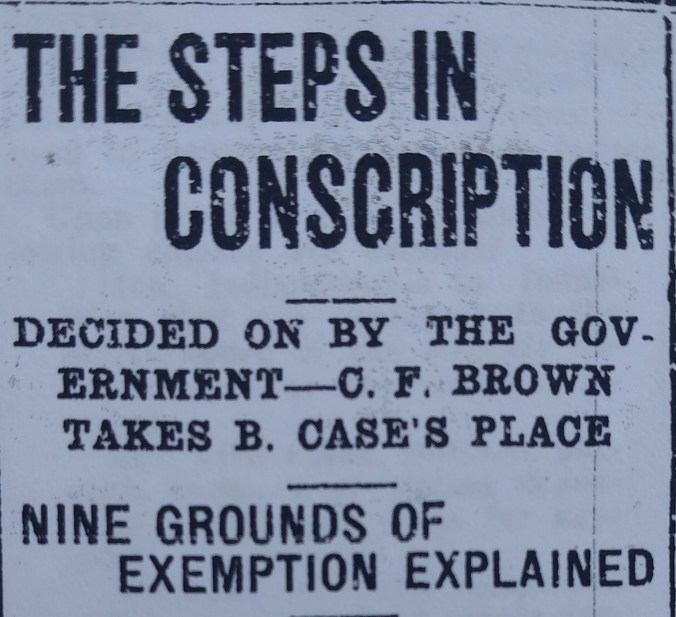
Above: Headline from Gratiot County Herald, July 5, 1917

     In July 1917 Gratiot County could no longer talk about its participation in the Great War. It was a time for action.

     The talk of the county that month, as it was across the United States, concerned the first draft since the Civil War. On June 5, men were ordered to register for the draft and those who did not found themselves in trouble with the law. Names were published in county newspapers of those men who failed to comply with the draft. A new title was assigned to each one: “slacker”. Walter Dorman of Reed City and William Hoover were arrested for failing to comply with the draft (three men had been arrested so far as of early July).  However, the overwhelming majority of Gratiot men did their part in registering for the draft in June. The Alma Record remarked that “It proves that the young men of the country are not slackers, and having lost in the game of chance in the lottery they will go forth, many not to return.”

     The goal in Washington was to register approximately 10,000,000 men between the ages of 21 and 30. Each was assigned a serial number for their registration card and a selection was planned to start September 1, 1917, with a goal of drafting 675,000 men. Local draft boards, like the one in Gratiot County, still did not know the specifics about how the draft was to operate. Their first job dealt with the issue of exemptions. Initially, over a dozen reasons were accepted for an exemption. These included: men who were vital to war industries, men whose families were dependent upon them, members of religious sects that were unable to bear arms, political office holders, and aliens who were not citizens and who were subjects of Germany. All were the start of exemptions. The draft board had to hear and make a decision on all draft exemptions within three days of the claim. Those who wanted to be exempted had to provide two supportive affidavits by heads of families. Appeals for those who were initially denied claims were ruled on by the board within five days. Many of them had their final status determined by the district board in Lansing. Not all who applied for exemptions were accepted.

    The first lists of registered men were published in newspapers but they created confusion. The first registration lists contained approximately 80 men from each township and the long lists of names covered several pages. According to officials in Washington, D.C., the numbers assigned to each man had been pulled from sealed capsules and were drawn by twenty different men. Each number was recorded in the order it was drawn. The first name by order of township was C.R. Andrew from Arcada Township. On still another list, Manual Amos Chapin of Bannister was the first man listed. The actual numbers assigned to the registered men in Gratiot County ended with number 2480 and belonged to C.C. Orcuitt of Alma Number Two. When readers looked at the registration lists by township they saw each name in alphabetical order. Regardless of the confusion, the government informed Gratiot County that its first quota would be 276 men. Because 21 men had already volunteered the previous month and had already left the county, 255 men would be sent on the first call with 550 men appearing for the first examination. Later in the month, the number dropped to 224 as more men enlisted.

    Once the men were chosen for the first call, the draft board had some responsibilities to get the men to their camp. If necessary, a draft board had to make sure that each man had meals provided for him and a place to stay prior to their arrival at camp, unless the men were allowed to stay at home until called. For many of these Gratiot men, it would be Camp Custer near Battle Creek, Michigan. Initially, these men were told to only take light baggage on their trip. While the Quartermaster Corps looked for men who would serve on the battlefield, in July 1917 it also sent out a call at that time that it was looking for bakers, cooks and even veterinarians (an Ithaca man, Dr. McNabb, served as one).

     Other things with civilians also were happening in the county. The Red Cross continued its drive to recruit more members and raise money for the war. By mid-summer, well over 3,000 Gratiot residents had joined the Red Cross and donated time and money to the war effort. Branch chapters sprung up around Gratiot County , even in the smallest of communities. Over in Middleton, 290 people joined the chapter and raised $131.50 in a short period of time.  Counting all of the county’s memberships, over $9000 (valued at $18000 today) would be raised in Gratiot County by the end of July.

     Some helped the Red Cross in other ways. Historian Willard D. Tucker reduced the price of his newly written history of Gratiot County to $2.00 and gave forty cents of each sale to the Red Cross. Over at the Idlehour Theatre in Alma, the proceeds on one day from the play “Snow White”, starring Marguerite Clark, a  well-known stage and silent screen actress, were donated to the Red Cross.

    However, there more serious issues that summer. Farmers begged for help in the fields. The summer wheat harvest was being delayed in Gratiot County due to heavy rains. The county asked men who had time and who were not employed in factories to help local farmers with the harvest. Local newspapers, like the Gratiot County Herald,  offered to connect willing workers with farmers in need.

    The tone of the county gradually would turn to the seriousness of the war. A voice from Newark Township lamented, “There are many sad people in this neighborhood on account of the draft. It has touched nearly every family in this community. We all earnestly hope that this dreadful war may stop before any of our boys are called to leave the dear old U.S.A.” It would not happen.

Copyright 2017 James M Goodspeed

“Journeys with a Gratiot Cemetarian” 4.2: Maynard R. Starry, WW II Veteran, Emerson Township Cemetery

IMG_20170528_120133963.jpg

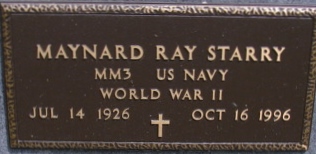
Maynard Ray Starry was born July 14, 1926 to Charles and Iva Starry of St. Louis, Michigan. His father was a barber and Maynard grew up in a family with six other siblings. On December 6, 1944, almost three years to the date that the United States entered World War II, Maynard left with a group of 30 men from Gratiot County to enter the service. From that group he was one of ten that entered the Navy. During the war he served in the United States Navy Seabees. After the war, he remained a resident of the area for 70 years. He served as Director of Public Utilities in St. Louis in 1978 and retired  from Bay City as Peaking Plant Superintendent.  Maynard also served as a member of the St. Louis Fire Department for approximately 25 years. Maynard also returned to school and was one of the first graduates of the St. Louis Community Education program and received his high school diploma in 1971. He and his wife Ruby had eleven children. Maynard passed away on October 16, 1996 and is buried in Emerson Township Cemetery.  Maynard R. Starry is one of many Gratiot County men and women who served their county, state and nation during a time of war.

55940830_128113238208.jpg

“Gratiot County, Get Involved! The Coming of the Draft, Liberty Bonds and the Red Cross” – June, 1917

IMG_20170612_123949241.jpg     Only two months after a declaration of war, many people in Gratiot County in June 1917 had to be quickly reminded why they were involved in what was called “The Great War.”  Local newspapers, like the Gratiot County Herald, reminded readers that “Every day reports come to us that even here in Gratiot county some intelligent people are inclined to poo poo the idea of any danger to America and ask ‘What are we in this for anyway?’”  The answer? America (and Gratiot County) was in it to protect itself. Submarine warfare threatened America’s new allies and Germany was out to do one thing – to rule the world. If America did not win the war then everything the ancestors of Gratiot County residents did in 1776 and 1861 was in vain. All Americans were in this fight, they should get to it, get it over with and rid the  world of Kaiserdom. Such was some of the news in Gratiot County in early June 1917.

     To further realize the urgency of this new war, reports came in from some of the earliest Gratiot County soldiers who witnessed the conflict. Arnold Robinson from Alma communicated that he had been aboard the S.S. Rochambeau and was headed for France when it was hit by a torpedo from an U-boat. The ship was hit in the propellers near the French coast, but it limped into port with 500 men on board. A St. Louis boy, S.D. Briggs, witnessed a battle between a merchant ship and a German sub just as the ship returned to the United States. This time the merchant ship actually hit the U-boat with two torpedoes, disabled and captured it. In reality, this new American involvement with the war at sea was just beginning.

     The biggest news in June concerned the newly announced draft. Prior to this, volunteers from across the country – and Michigan – had rushed to get involved in the war. To this point Michigan easily met its volunteer quota of 5, 620 men and even exceeded it. However, the new task was to build a bigger armed forces and President Wilson instituted the first draft since the Civil War.

    On June 5, 1917, all men between the ages of 21 and 30 had to register for the draft. Each had to appear at a designated place in their township to fill out an instruction card that had over ten questions on it. Usually these men appeared at a local township or village hall. In Ashley, they appeared at the I.O.O. F. Hall. In Alma, for part of the city men appeared at the Arcada Hotel. In St. Louis, it was the city court room above the Commerical Bank. Registrations across the county were peaceful. While Alma led the way with 673 men, men in places like Fulton (144), Newark Township (144), North Star (108) and Ashley (80) complied with the draft registration process.

     Especially remarkable to one local newspaper was the observation of what was going on in Elba Township. Here, where one third to one half of all registrants were either foreign born or who were children of foreign born parents, descendants of Austrians, Hungarians and Bohemians were all enthusiastic about their desire to serve the country and their county. There seemed to be little question at this point about young Gratiot County men going off to war to fight countries that their families came from.

     The next challenge came with forming a county draft board. The board would be made up of three men which included Sheriff Newell Bradford, County Clerk Bernie L. Case and Doctor Wheeler. Newell and Case were from Ithaca; Wheeler was from St. Louis. The job of the board was to take the registrant’s cards and then number each one consecutively in red ink. The cards were then sent to Washington, D.C. From there a national draft board instituted a lottery system to decide how many men had to be drafted from each county. A telegram then was sent to Gratiot County telling them what numbers had been chosen and how many men were to be drafted. Local county newspapers listed the numbers and the men.

     Berry was not the last man to face such an accusation and “slacker raids” would take place later that summer in GratShortly afterward, names and stories began to appear of those Gratiot County men who did not want to register and who did not want to fight in the war. Michigan Governor Albert Sleeper sent telegrams to all counties to inform county sheriffs that they were under orders to pick up and detain all men in the 21 to 30 year age group who had not signed up for the draft. One man, Lloyd Berry, who came from Ogemaw Heights to work in the city of St. Louis, was one of the first to be accused of being a “slacker” – a name associated with those who were deemed unpatriotic, and seemingly cowardly. iot County.

     Another big movement in Gratiot County that June included Liberty Bond drives. The Liberty Bond became the government’s way of financing a war and a way of getting all Americans involved in the war effort, even if they themselves could not serve in the army. As the Gratiot County Herald urged its readers, “Perhaps you can’t enlist. Buy a bond, and do your part.”

     The first Liberty Bond meetings took place in fifteen locations across Gratiot County.  The bonds sold for prices between $50 and $1000 and could be obtained at any local bank, like the Ithaca Savings Bank and the Commerical National Bank. The bonds paid 3 ½ % and they buying one was viewed as a patriotic duty.

     Still another way that Gratiot County citizens could get involved with the war was to become a part of the newly formed Red Cross. The Red Cross initially tried to recruit 5,000 members from the county and it too presented itself as a patriotic duty. The lowest price for membership in the Red Cross was only one dollar. On June 24, 1917, every church in Gratiot County had its Sunday School celebrate what was called “Red Cross Day.” In Ithaca, one of the first formal organizational meetings took place in the Domestic Science Room at the local high school. Those who attended were urged to bring their thimbles and sewing needles.  Ithaca soon became the county headquarters for the Gratiot County Red Cross program during the war. When local units were asked to help the county raise $7000 in its first drive the response was so enthusiastic that funds exceeded $10,000. Places like Breckenridge gave $650 – over three times its anticipated goal.

     As June, 1917 came to an end, citizens of Gratiot County were presented with even more ways to support the war. Women were told that their household could not waste a single slice of wheat bread during the war. To make a point, the government instructed that if all the wasted bread in America was added up over one year then it could save over 356,000,000 loaves annually. Substitutes for preserving wheat bread were also presented. One of these was the use of corn or corn meal for wheat cakes, bread, biscuits, and rolls.

     Participation and support for Gratiot County and its servicemen was just starting that summer of 1917.

Copyright 2017 James M Goodspeed


“Journeys with a Gratiot Cemetarian” 5.1: Ralph J. Tinson, Sr., WWII Veteran, Ithaca City Cemetery

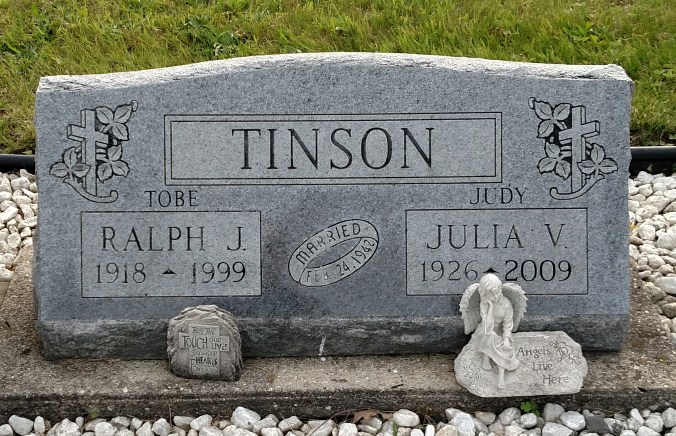
IMG_20170526_192735063Ralph J. Tinson, Sr. was born December 15, 1918 in Pontiac, Michigan to Stephen J. and Minnie Tinson. Ralph had 3 older siblings. Ralph married his wife Julia in 1942 and he entered the United States Army at Fort Sheridan, Illinois on June 12, 1944. Ralph was discharged on January 25, 1946.  After the war he worked for the Gratiot County Road Commission for 31 years. He was a charter member and commander of the Ithaca VFW Post 7805. Ralph died on August 5, 1999 and he is buried in the Ithaca City Cemetery. Ralph J. Tinson is one of many Gratiot County men and women who served his county, state and nation during time of war.

“Journeys with a Gratiot Cemetarian”: 4.1 Bernard K. Coston, Korean War, Emerson Township Cemetery

IMG_20170528_120303619

Bernard K. Coston was born November 18, 1923 to Charles and Leola Coston. He married his wife, Anna, on July 6, 1952. Together they had five children. Bernard served his country during the Korean War. After the war he worked as a mail carrier in Midland. He was also a member of the West Branch VFW Post #3775.  Bernard died March 18, 2009 and rests in Emerson Township Cemetery. Bernard K. Coston is one of many Gratiot County men and women who served their county, state and nation during a time of war.


“Journeys with a Gratiot Cemetarian” 1.3: James C. Motz, WWII Veteran, North Star Cemetery

James C. Motz was born February 12, 1917 to Joe and Jennie Motz, who were both immigrants from Bohemia. James, who was one of three sons, lived his entire life in Ashley in Elba Township. He enlisted in the United States Army on August 28, 1942 and was discharged on February 13, 1946. On April 7, 1948 he married his wife, Vlasta, in North Star, Michigan. They had one daughter. James farmed and worked for Oldsmobile of Lansing. He  was also a member of the Bannister ZCBJ Lodge. James passed away on July 1, 1975 and rests in North Star Cemetery. He is one of many Gratiot County men and women who served their county, state and nation during a time of war.

“Journeys With a Gratiot Cemetarian” 3.2: Cleo R. Riddle, WWII Veteran, Pine Grove Cemetery

IMG_20170524_172901786.jpgIMG_20170524_172907944.jpg

Cleo Raymond Riddle was born May 4, 1919 to James and Lizzie Riddle in Edgewood. He was one of three children and served Gratiot County in the U.S. Navy during World War II. In March 1943 he entered the Navy and attended boot training at Great Lakes Naval Training at Great Lakes, Illinois. Cleo was 23 years old. By late May 1943, Cleo was sent to Gulf Port, Mississippi for four weeks. By July he had returned to New York City. In October he wrote home to his mother from “Somewhere in South America.” About his assignment he wrote to his mother, “It’s so hot here. We aren’t far from the equator. There are lots of bananas and coconuts. I will probably freeze when I get back (home). It rains almost every day and it sure is welcome.” He also mentioned how water was rationed and that there were five men from Michigan in his gun crew. He eventually would end up in the South Pacific. After the war, he worked Cleo married Doris Allen. He went on to become a Mason, a member of the Ithaca VFW Post #7805, a member of the Ithaca United Methodist Church, and a 4-H leader. Cleo Riddle passed away on June 27, 2002.  Cleo Raymond Riddle is one of many Gratiot County men and women who served their country, state and county during a time of war. He rests in Pine Grove Cemetery.