James C. Motz was born February 12, 1917 to Joe and Jennie Motz, who were both immigrants from Bohemia. James, who was one of three sons, lived his entire life in Ashley in Elba Township. He enlisted in the United States Army on August 28, 1942 and was discharged on February 13, 1946. On April 7, 1948 he married his wife, Vlasta, in North Star, Michigan. They had one daughter. James farmed and worked for Oldsmobile of Lansing. He was also a member of the Bannister ZCBJ Lodge. James passed away on July 1, 1975 and rests in North Star Cemetery. He is one of many Gratiot County men and women who served their county, state and nation during a time of war.
“Journeys With a Gratiot Cemetarian” 3.2: Cleo R. Riddle, WWII Veteran, Pine Grove Cemetery
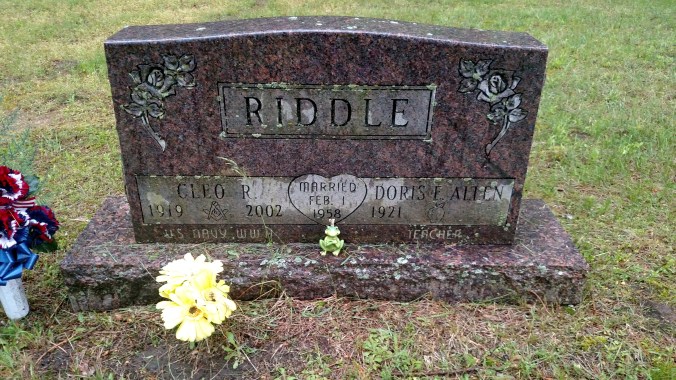

Cleo Raymond Riddle was born May 4, 1919 to James and Lizzie Riddle in Edgewood. He was one of three children and served Gratiot County in the U.S. Navy during World War II. In March 1943 he entered the Navy and attended boot training at Great Lakes Naval Training at Great Lakes, Illinois. Cleo was 23 years old. By late May 1943, Cleo was sent to Gulf Port, Mississippi for four weeks. By July he had returned to New York City. In October he wrote home to his mother from “Somewhere in South America.” About his assignment he wrote to his mother, “It’s so hot here. We aren’t far from the equator. There are lots of bananas and coconuts. I will probably freeze when I get back (home). It rains almost every day and it sure is welcome.” He also mentioned how water was rationed and that there were five men from Michigan in his gun crew. He eventually would end up in the South Pacific. After the war, he worked Cleo married Doris Allen. He went on to become a Mason, a member of the Ithaca VFW Post #7805, a member of the Ithaca United Methodist Church, and a 4-H leader. Cleo Riddle passed away on June 27, 2002. Cleo Raymond Riddle is one of many Gratiot County men and women who served their country, state and county during a time of war. He rests in Pine Grove Cemetery.
“Journeys With a Gratiot Cemetarian” 1.2: Grover C. Johnson, WWI Veteran, North Star Cemetery
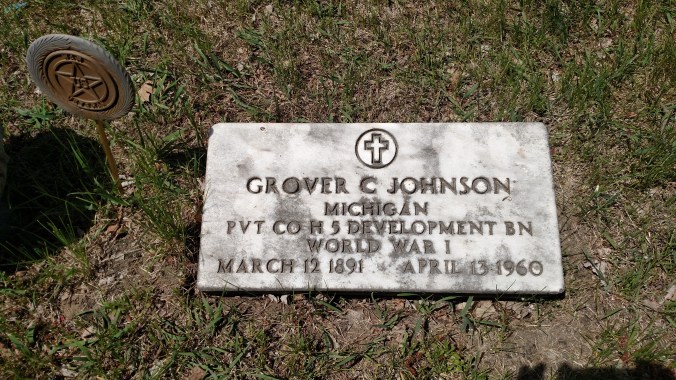
Grover Cleveland Johnson was born May 11, 1891 in Perry, Michigan. His parents were James and Marilla Johnson. Not much is known about Grover’s personal life, however, his mother passed away before the start of World War I. Prior to entering the service Grover worked as a teamster. On May 11, 1918, as a private, he entered Columbus Barracks, Ohio. He was sent to Camp McArthur, Texas one week later and served in Company A in the 19th Machine Gun Battalion. He was then transferred to Company H of the 5th Development Battalion. Due to the end of the war and demobilization, Grover was discharged on November 19, 1918 – just over one week after the Armistice took place in Europe. After the war, Grover worked for the Furnstedt Manufacturing Company. He eventually married and moved to Washington Township around 1950. Grover Cleveland Johnson died on April 13, 1960. He is one of many Gratiot County men and women who served their country, state, and county during time of war. Grover Cleveland Johnson is buried in North Star Cemetery.
“Journeys with a Gratiot Cemetarian” 3.1: Robert C. Olson, Korean War, Pine Grove Cemetery
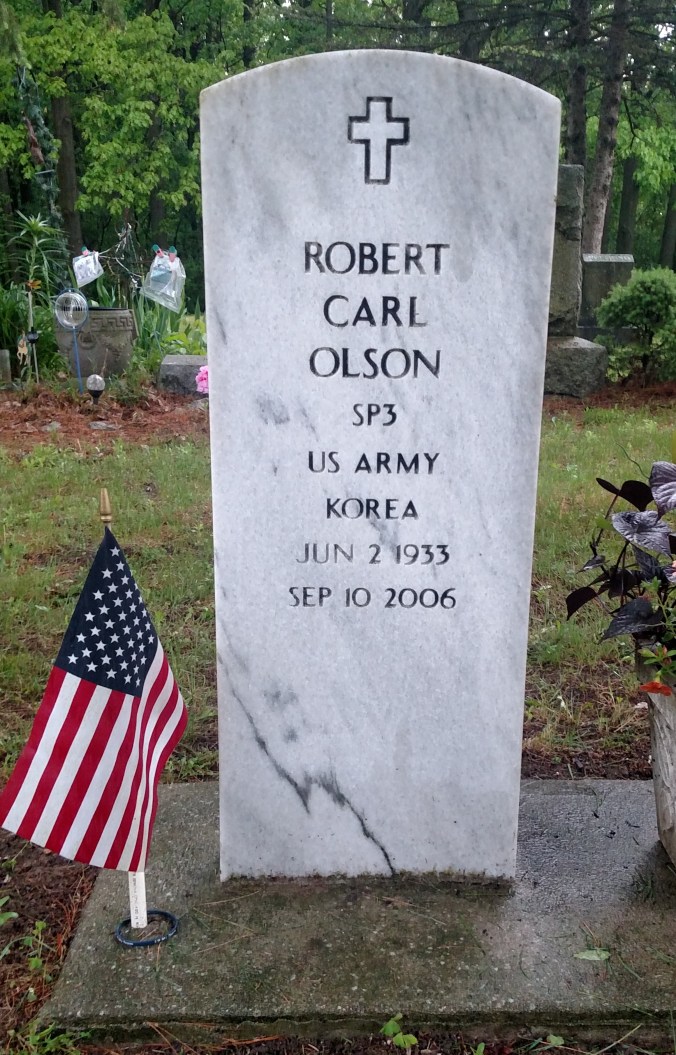
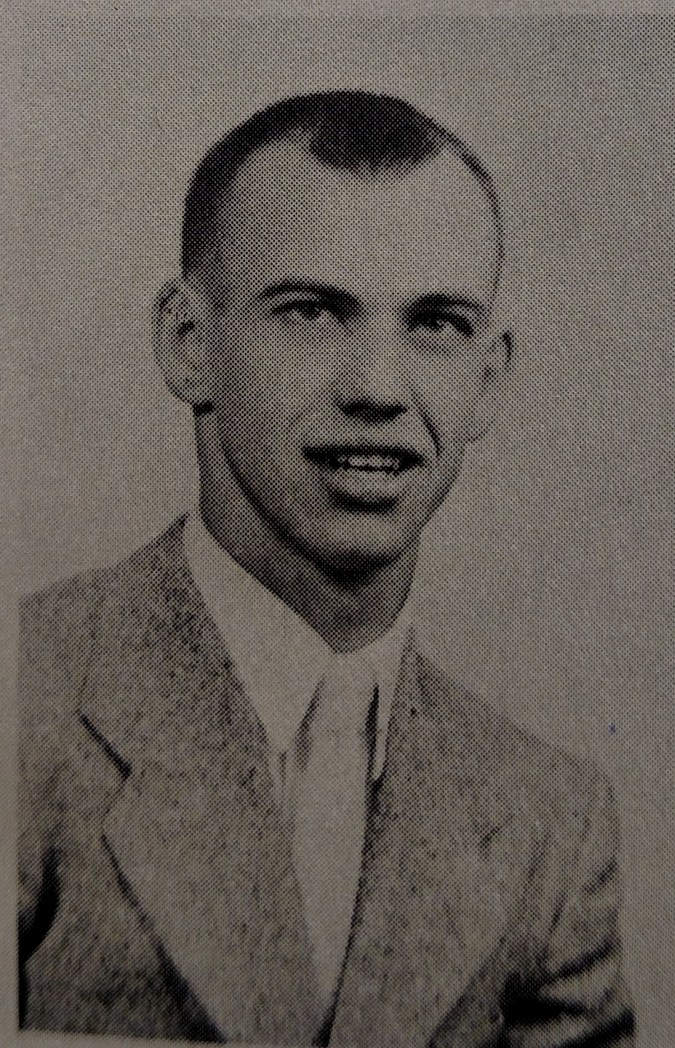

Robert Carl Olson was born June 2, 1933 in Emerson Township to Clark and Lucille Olson. Bob was a life long resident of the Ithaca area. He was a 1953 graduate of Ithaca High School. The saying on Bob’s senior picture read, “I have a hot rod Ford and a two dollar bill. Bob married his wife, Sally, in 1956. Together they raised their children in Emerson Township. Bob worked for and retired from General Motors. He was a charter member of Pheasants Forever and White Tails Forever. Bob passed away on September 10, 2006. He is one of many Gratiot County men and women who served their country, state and county. He rests in Pine Grove Cemetery in Emerson Township.
“Journeys with a Gratiot Cemetarian” 2.1: Roy S. Lamey, WWII Veteran, Brady Cemetery


Roy S. Lamey was born March 2, 1921 to Thomas and Lydia Lamey in North Star Township. One of nine children, Lamey’s parents were farmers and records show that they operated a 130 acre farm in 1927. In early June, 1942 Roy was one of 45 men who were drafted that month. They became part of 76 from Gratiot County at this time who went to Detroit by bus to take their examinations. For one of the first instances since war was declared after Pearl Harbor, there was no ceremony for this group of Gratiot men. All of them received a dinner at the George W. Myers American Legion Post before they left. Also, the Alma Chamber of Commerce provided the men with treats for their trip. Roy’s draft number for Gratiot County was #10178. Roy Lamey eventually became a staff sergeant and served in the European-African-Middle Eastern Theater. He was honorably discharged on October 22, 1945. On October 4, 1945 he married his wife, Dorothy, and together they raised 4 children in North Star Township. Roy farmed there all of his life. He passed away on December 28, 1995. Roy S. Lamey is one many Gratiot County men who served their county, state and nation during time of war. He rests in Brady Cemetery in North Star Township.
“Journeys with a Gratiot Cemetarian” 1.1: Jerry Grigar, WWII Veteran, North Star Cemetery


Jerry J. Grigar was born January 24, 1925 to Thomas and Elizabeth Grigar. Jerry graduated from Fulton High School in 1943. His graduating motto was : “Studies are important but keeping up my social life in Bannister is more important.” He participated in FFA, boxing and football while in high school. On his eighteenth birthday he registered with the local draft board because of the war. His address was RFD No. 2, Ithaca. On June 17, 1943 Jerry was selected for the United States Navy and reported to the U.S. Naval Station at Great Lakes, Illinois. After the war he married Wanda Traver, became a farmer and together they raised four children. Jerry passed away on May 25, 1981 as a result of a farming accident. Jerry J. Grigar is one of many Gratiot County men and women who served their county, state and nation during a time of war. He rests in North Star Cemetery.
Gratiot County During the Great War: “May, 1917 – Food Shortages, the Red Cross and Liberty Bonds”
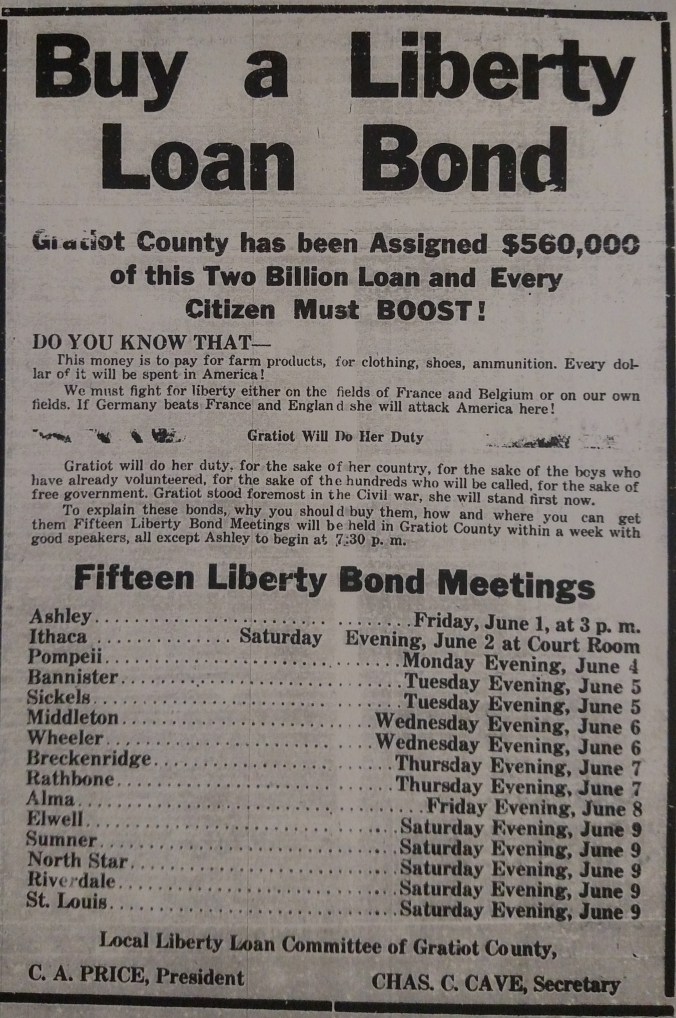
Above: Advertisement from Gratiot County Herald, late May, 1917.
In May, 1917 Gratiot County started to act like it was joining a world war. Early in the month conscription was announced, although it would be a month before it actually took place. On May 7, a letter was sent from the County Clerk to all township and precinct supervisors telling them that they would soon be the ones acting as registrars for making lists of all men eligible for military service.
Each week the names of those young men who first volunteered to enlist appeared in the newspapers. Names like Cecil Stockwell of North Star and Louis Hetzman and Orin Riker of Ithaca left for the army. A year later, Riker would be the first Ithaca boy to be killed in the war. The government established officers training camps in anticipation of the draft that was to come. Gratiot County donated $1,000 to help the YMCA toward establishment of a building in each military camp. Places like the one in Fort Custer would give soldiers opportunities and libraries to write letters home, a place for them to spend their leisure time, and a place for “clean living campaigns,” which supposedly encouraged religious values.
There were also plenty of things that Gratiot County residents could do and were expected to do to support the United States in wartime. The Gratiot County Herald warned readers that every citizen had to do something to meet the crisis. Every foot of land that could be used as gardens had to be cultivated. Farmers also needed to receive extra farm help and the necessary seed to grow more crops.
In response, a large crowd of people came to a meeting at the Ithaca court house to address what citizens could do about an impending nationwide food shortage. Although farmers were being encouraged to plant as many crops as possible, the cost of seed had skyrocketed, making it too expensive for some farmers to purchase. One topic at the meeting was how to make bean seed available to farmers through loans.
The head of the Gratiot County YMCA,a Mr. Curtiss, said that he had organized 300 boys who would be willing to help cultivate plots of land a half acre to acre itself. Vacant lots in Ithaca were also discussed as places where residents could grow more food. The YMCA group offered to help residents put up gardens in these locations.
Other things were in the works to support the nation at war. War taxes were coming. In addition to a raise in income taxes, taxes on movie tickets, railroad tickets, whisky, railroad freight, cigars, heat, light and telephone bills, telegraph messages, even the purchase of musical instruments – all of these were imposed to help raise revenue for the war.
It was during May, 1917 Gratiot County’s involvement with the Red Cross started. On May 18, another group of people met in the Ithaca court house to officially form the Gratiot County chapter of the Red Cross. A temporary committee set up the chapter and accepted 43 applications from people in Ithaca who wanted membership. It was intended that local units would spring up across Gratiot County and that a yearly membership would cost only a dollar.
Liberty Bonds became another way citizens could participate in the war effort in Gratiot County. Local bankers in the county wanted residents to buy bonds, whether they lived in the larger towns of Ithaca, Alma and St. Louis – or the smaller of hamlets of Perrinton, Middleton, Bannister, North Star or Pompeii. A $50 bond was offered to a buyer at 3 ½ percent and helped the government to buy shoes, clothing and munitions in Europe. Any bank in the county sold the Liberty Bonds. In some cases, people like James Anstey of Ashley Encouraged fellow citizens to buy these new bonds. At age 83, Anstey went out on one Friday morning managed in two hours to talk to forty people and sold eleven bonds.
Preparation for war was on.
Copyright James M Goodspeed 2017
April, 1917: Pupils, Patriotism, Volunteers Expected in Gratiot County

Above: The Gratiot County Herald, April 12, 1917
The news that the United States had officially joined the Great War in April, 1917 brought about a surge of patriotism in Gratiot County.
Down in Middleton, high school students showed their patriotism by wearing small flags on their clothes. They sang patriotic songs in the afternoon when the Declaration of War was announced. The American flag waved over the building as it also did over numerous downtown businesses.
Gratiot County hoped that at least one hundred young men would initially join up to fight before April ended. The nation had a goal of supplying 38,000 men for the navy by the end of the first week alone. Volunteers between the ages of sixteen and forty were asked to apply (those under eighteen needed their parents permission). These first volunteers only had to be able to understand English – reading and writing was not required. Some of the departments that were immediately open for recruits included the infantry, field artillery, coast artillery, medical department and signal corps. As another incentive to sign up, the government pledged that those who volunteered would be released from service as soon as the war ended.
Volunteering was an expectation of men as Gratiot County went to war. True patriots were expected to willing offer their service to the country. Only “slackers” dodged the service (a term that would be used in Gratiot County as the summer and fall of 1917 went on). It was initially believed by county newspapers that if enough men volunteered then there would be no immediate need for a draft. Although conscription seemed to be inevitable, a draft was the last resort. Right now, in April, 1917, true patriots in Gratiot County would step up and defend the nation by volunteering.
Ordinary citizens were quickly told by the government about what they could do for the war effort. Foremost was an immediate concern about the winter wheat crop in Gratiot County. Because a national food shortage was being envisioned by President Woodrow Wilson, farmers were encouraged to plant spring wheat and to prepare for other crops for the upcoming season. One of the biggest calls for boys too young to volunteer for the war was to make themselves available to help on area farms. Wilson coined these boys “Soldiers of the Commissary” and he urged youngsters to volunteer for this farm labor. For these young boys, Gratiot County’s farms would be the battlefield that they could serve on.
Still, sacrifices would have to be made by all those living in Gratiot County. Another item quickly became Liberty Gardens, individual gardens grown by everyone to help supplement their own food for 1917. These included growing potatoes, beans and onions, among other foods. A League for Woman’s Service was organized the same month in the county. Although details were unclear as to what women would be expected to do, groups formed to foster patriotism and to cooperate with the Red Cross. It’s slogan became “For God, For Country, For Home.”
Over in Ithaca, prominent men were asked to raise money to help foster Belgian babies. Judge Kelly Searl spearheaded a drive to raise money to contribute one dollar a month to provide food for Belgian babies who had been orphaned or left destitute due to the war conditions in Belgium. On his first meeting at the Ithaca Methodist Sunday School in late April, Judge Searl obtained pledges for $20.50 a month to help these children.
Yes, things were off and moving as Gratiot County started its trek through the Great War.
Copyright 2017 James M. Goodspeed
April 6, 1917: “It is War!” Ithaca Enters World War I


Above: Headlines from April 12, 1917 issues of the Alma Record and Gratiot County Herald
It was really only a formality in Gratiot County. In the days leading up to a Declaration of War from the United States Congress, people in Gratiot County were gearing up for an announcement that came on April 6, 1917: America’s entry into the Great War.
On the day prior to the announcement a group of volunteers led what would be a stream of Gratiot men who volunteered to join up. In Ithaca, nine high school students were part of a group that left the town early on Thursday morning to go to Alma, and on to Saginaw, in order to join the Navy. The group included Watson McCall, Howard Burtchard, Peter McAdams, Ivan White, Mike Scott, Davis Summerville, Robert Rayburn and William Rayburn. Ted Kress had volunteered earlier and joined the group, but he left a week later for a different camp. Four of the boys were given their diploma ahead of what would have been their June graduation from Ithaca High School. All of them had previously visited the enlistment office in Alma, took their entrance exam, passed it, and had been accepted for military service.
Ithaca held a celebration that Wednesday night. Early the next morning, the young volunteers were then paraded through the village and down main street past more than one thousand people who turned out for the send off. Stores displayed American flags. Windows and store fronts were equipped with colorful red, white and blue bunting. After they loaded up, twenty five automobiles and one hundred people followed the Ithaca boys as they proceeded over to Alma. As they arrived there, the fire department led the parade on through town. When they reached the Alma depot, crowds were filled with citizens from both Alma and Ithaca, as well as students from both high schools. Each volunteer was called up front and received an individual cheer from the enthusiastic crowd.
A short service then took place which included an address from the schools’ superintendents, a speech from a local lawyer, and the presentation of gifts from an Ithaca minister. Reverend Vatcher, from the Ithaca Baptist Church, gave each boy a New Testament, a gift from Ithaca businessmen. The playing of “America” and “The Star Spangled Banner” opened and closed the event.
After arriving in Saginaw, the young men headed for Detroit, then Lake View, Chicago, for five weeks of training. It was expected that they would be sent to Philadelphia and then on to naval patrols off the East Coast of North America.
What happened in Ithaca at the start of the war did not go unnoticed in Michigan. The state’s naval recruiting officer, Lieutenant W.W. Richardson, Jr., wrote a letter to the mayor of Ithaca saying that “Ithaca is upholding the honor of the state. If every city of Michigan wold come forward as has Ithaca, we would soon have our quota of men.”
April 5, 1917: “The Great War will be in Gratiot County by the End of the Week”
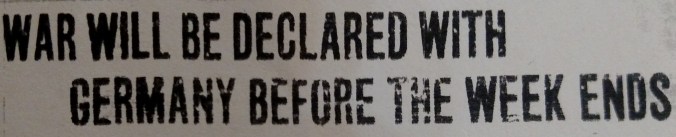
Above: Front page of April 5, 1917 issue of the Gratiot County Herald
By the time that most people read their newspapers at the end of the week they already knew Gratiot County was at war. Now, their sons would be a part of it.
Some advertising in newspapers still seemed to make light of the European war. In Ithaca, J.L. Barden advertised that “War is Declared” and that rugs and floor coverings would be going up in price. Slater and Goodes Men’s Wear warned that “The Big Guns in Europe Are Shooting Away your Shirts, Socks and Underwear.” Cotton was sure to go up in price – one should buy their clothing now. There were also advertisements that the French Army wanted horses. From April 11-14 a buyer for the Good Horse Company would be in Alma, Shepherd and St. Louis to buy good Army horses. They had to weigh 100 to 1400 pounds and be in sound condition.
President Woodrow Wilson had already asked for a declaration of war against Germany. All that mattered was that Congress had to make a formal declaration. The Kaiser had to go. The German government could not be trusted. Its use of spies, unrestricted submarine warfare and slaughter of innocent people had to stop. Wilson was expected to raise 500,000 soldiers immediately and then to increase the army until enough men were in uniform to adequately defend and fight for the United States in the Great War.
Patriotism was said to be extremely high and Gratiot County would be called upon to do its share to make the world safe for democracy.
How many men served our county in the Great War? What was the role of ordinary people in maintaining the war effort? Who were the men who died in the Great War while serving Gratiot County? What were the war years really like in Gratiot?
Follow Gratiot County’s role and place in World War I here on the blog. We start the journey here this week.
 Goodspeed's Gratiot County Historical Blog