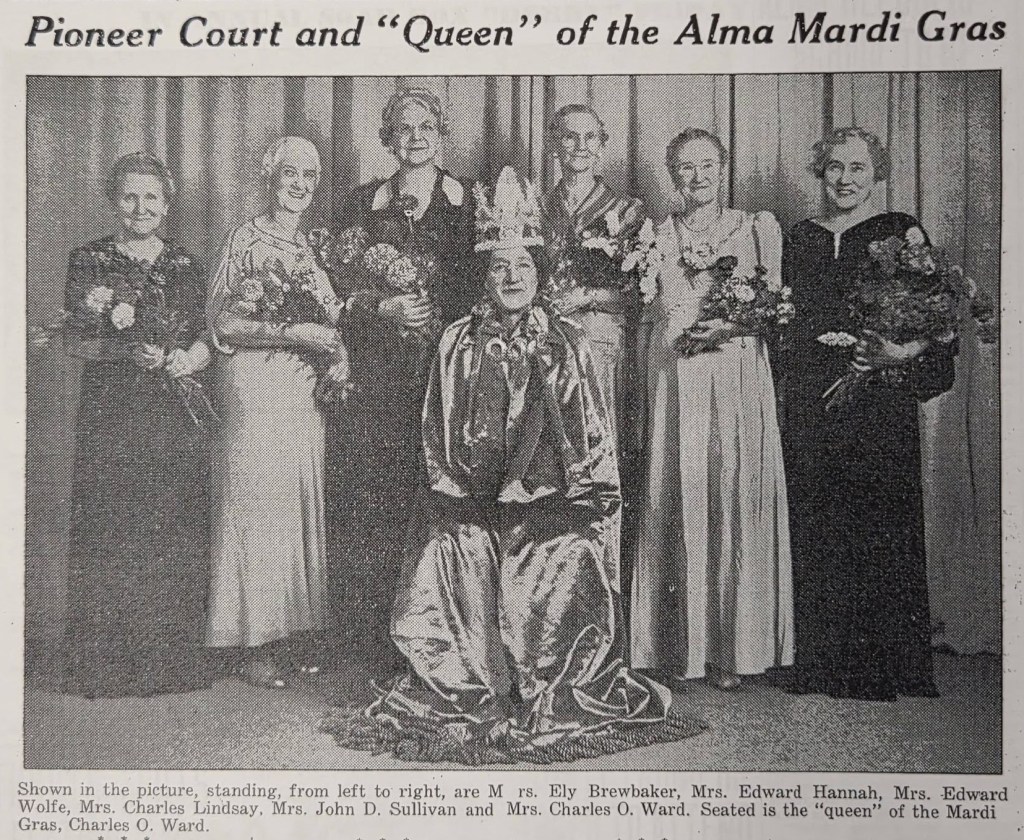
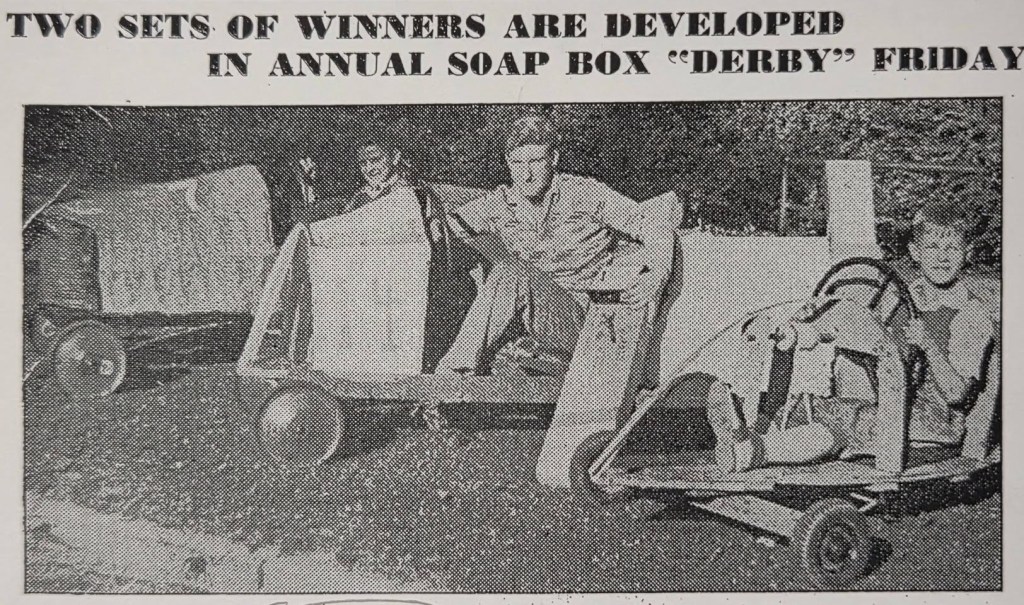
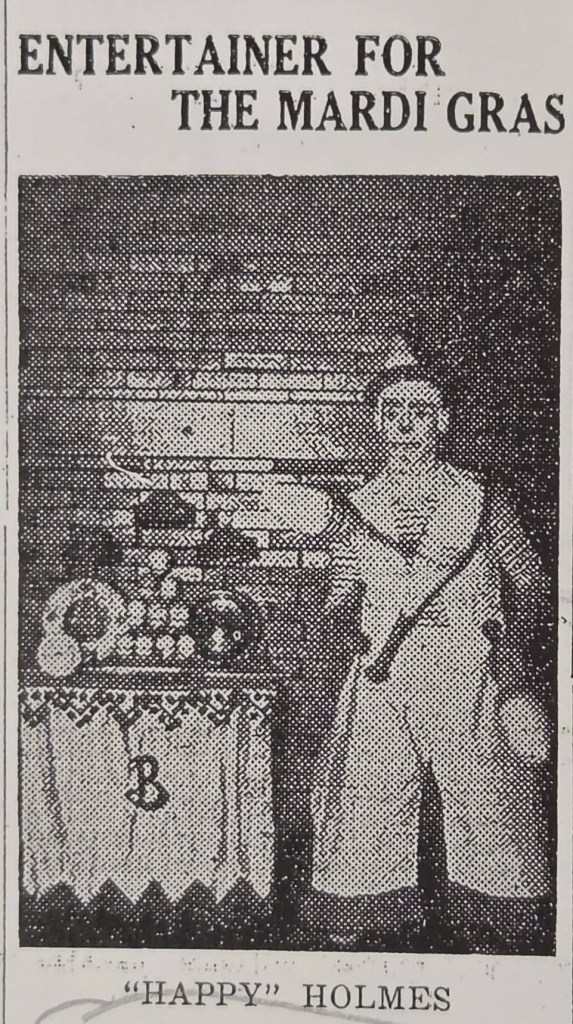
Alma Mardi Gras in September 1941, from the top: The Mardi Gras queen and court. Each of the members of the court had important ties to Alma’s past; a soapbox derby contest held on the first day of Mardi Gras resulted in winners (from left) Douglas Mallory, Joe Lockwood, and John Sullivan; One of the Mardi Gras entertainers included Harry “Happy” Holmes, an Alma young man who had been in the show business since 1927. One of his acts took place above the Pine River.
It used to be called a harvest jubilee, but in the early fall of 1941, Alma hosted “Mardi Gras” and called the Alma community to remember its history. Some seasonal celebrations in Alma dated back to the early Depression years; however, this year the city’s chamber of commerce wanted something that would call “attention to the venerable age and community tradition” and recognize people “from among pioneers” of the Alma community. In other words, for three days Alma still wanted to celebrate and draw thousands of Gratiot County residents into town for a harvest celebration while still recalling its past. In September 1941, this came in the form of Mardi Gras.
Beginning the evening of Wednesday, September 11, 1941, and running for two more days, Alma blocked off part of its downtown, set up a stage at the corner of the decorated Woodworth and Superior streets, and made space for carnival rides. The city also tried to attract visitors by offering free parking on Alma’s southeast side near the river, in what was fast becoming a remodeled parking lot, part of which had been the site of the city’s old dump. In the run-up to the festivities, workers toiled furiously to level the area to create the free parking area.
On Wednesday evening, a parade kicked off Mardi Gras with over thirty floats interspersed with five local high school bands, and ended with a bowery dance. On Thursday, attendees watched people take part in a series of “attention-grabbing contests” that brought many laughs. Charles Reed, Jr. won the fat man’s race, while Gracia Cooley took the women’s wood-cutting contest. Frances Heil placed first in the women’s nail-driving contest, and three boys (Joseph Lockwood, John Sullivan, and Douglas Mallory) each won first-place awards in different parts of the Soap Box Derby contest. Vaudeville acts and a kiddies parade also entertained the crowds.
In other entertainment, “Happy Holmes,” a clown juggler-magician, performed various acts and wowed the Alma crowds with his “Tower of Pisa” performance on a wire over the Pine River. During the routine, Holmes stacked a set of swaying tables while maneuvering along the wire. In another part of downtown Alma, Barkroot Amusements provided rides for the young. Things got a little exciting when June McWilliams, age 11, was injured when she fell off the Tilt-a-Whirl ride and sustained a scalp wound. After the accident, the amusement operators took McWilliams to the nearest doctor, oversaw her care, and paid the bill. The company also bought the young girl a brand-new dress.
But one key highlight of the Alma Mardi Gras was the election of the queen and court. Before the festivities began, the chamber of commerce announced that this year’s queen and court would represent the “pioneer court of royalty” with ties to Alma’s past. This departed from previous Alma Jubilees because the court usually consisted of younger ladies.
At the opening parade, the crowds first met the court as the float moved down Superior Street, carrying the royalty except for the Mardi Gras queen. The court included Mrs. John Sullivan, Mrs. Ely Brewbaker, Mrs. Eula Hannah, Mrs. Charles O. Ward, Mrs. Abbie Wolfe, and Mrs. Nettie Lindsay. The crowds soon understood that, through the Mardi Gras court, the Alma Chamber of Commerce was giving a history lesson about the town’s early settlement and its surviving pioneer families.
On Friday night, master of ceremonies Dr. Thomas Carney explained how each court member was tied to Alma’s past. Mrs. Nettie Lindsay was born in a house in 1865 where the Gleaner home (formerly Saravilla) sat. She and her husband had just celebrated their 59th wedding anniversary.
Mrs. John Sullivan, whose in-laws were among the first Gratiot County settlers in 1854, had a log cabin near an Indian settlement. A later Sullivan home hosted the county’s first Episcopal service. Mrs. Ed Wolfe came from a family that settled near Wolfe Bridge in 1952. The Wolfe family boasted five generations of family still living in the county as of 1941. Eula Hannah was a descendant of the Kress family and had ties to the founding of early Alma and Gratiot County. Hannah’s mother was also the first teacher in the Alma school, and Eula also had ties to James Gargett, an early Alma builder and politician.
As the crowd listened to the recognition of the queen’s court, the Alma history lesson continued. Two ladies in the group, Mrs. Ely Brewbaker and Mrs. Charles O. Ward, were related by marriage to General Ralph Ely, Alma’s earliest founder, who built the first mill and dam and owned the land on which Alma was built. Mrs. Ward also wore a tope-colored silk shawl that her grandmother, Mrs. Ralph Ely, owned. Of course, Dr. Carney also mentioned two other important Alma families: Ammi Wright and the Pollasky-Messinger family. However, no direct descendants of the families still resided in the county and could not be represented.
After the Mardi Gras court was completely announced, people began to ask, “Where was the queen of Mardi Gras?” Announcer Carney then produced the “queen,” who turned out to be Charles O. Ward, vice president of the local bank. After lauding the candidate, Carney turned to the person in the center of the queen’s court and pronounced, “I now take great pleasure in crowning our distinguished citizen and fellow townsman, CHARLES O. WARD, as queen of this Mardi Gras.” As Ward received his crown, the crowd roared, and the official festivities ended.
A few days later, the Alma Chamber of Commerce began reviewing how Mardi Gras went. Just how successful had the festivities been, and how many people attended? Mardi Gras was not quite as successful as the previous Jubilee celebration. Ticket sales for amusement rides totaled 9,078 tickets, 2,300 fewer than the year before. The Alma Chamber also came up $175 short of breaking even. Several merchants complained about the blocking off of Superior Street, and others protested that there should be no downtown carnival. Other comments included a request for a “showboat” venue on the Pine River in 1942, much like the one in Chesaning.
However, no one in Alma – or Gratiot County – could foresee that Gratiot County and the world would look drastically different by the fall of 1942 and community celebrations took a back seat. Less than three months after Alma’s Mardi Gras ended, Gratiot County became involved in World War II.
Copyright 2026 James M. Goodspeed

